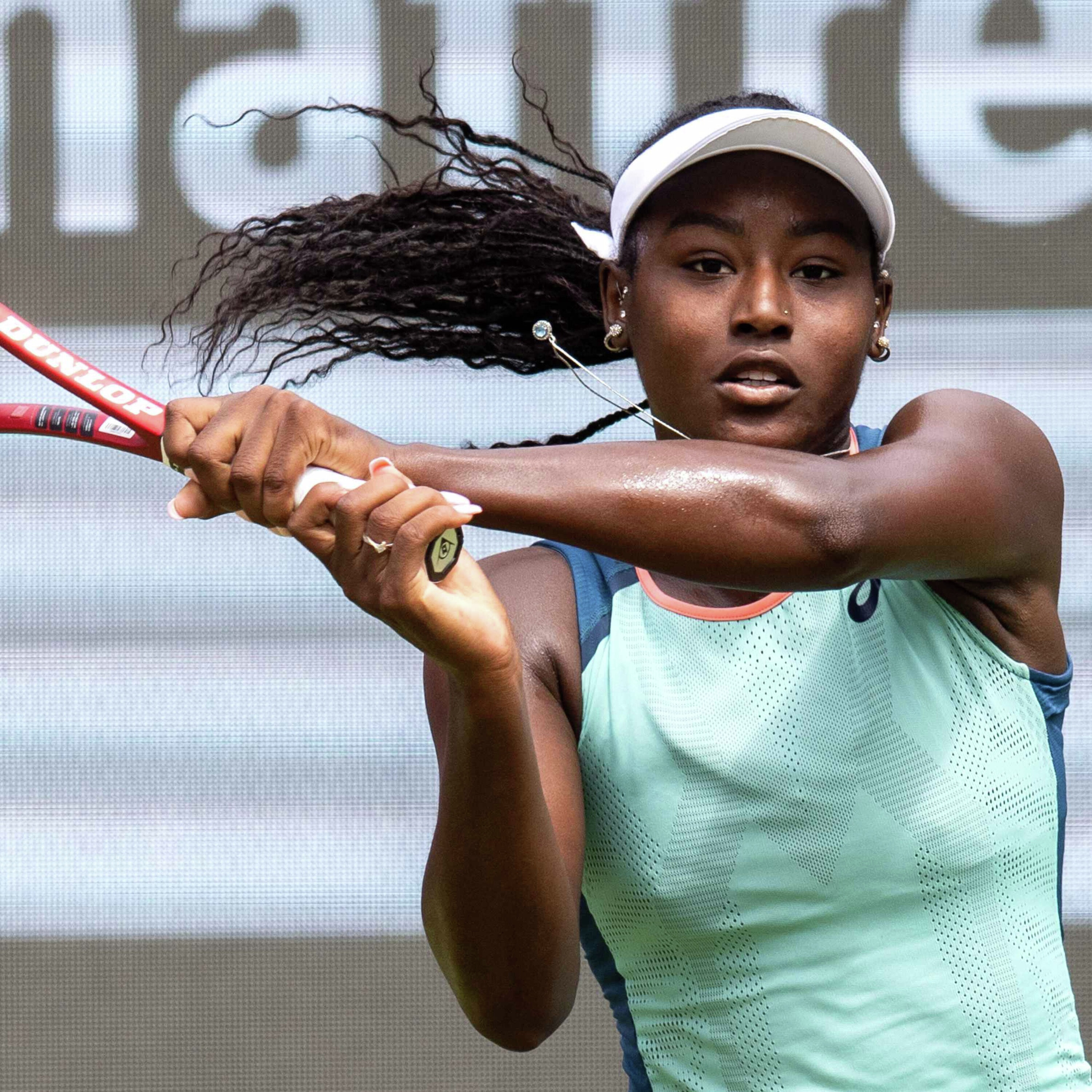
The South Got Something to Say
We give shoutouts to maiden titles won this week by Alycia Parks and Zhu Lin, as well as some love for Tommy Paul. Plus: Does college tennis help or hinder a pro on the rise? Per usual, Rennae and Caitlin disagree respectfully and honor their differences.
Hosted on Acast. See acast.com/privacy for more information.
See omnystudio.com/listener for privacy information.
2023-02-06
44 min
Transcript
Available Results
Generated results are saved to the knowledge database for reuse and search.
No generated results are available for this episode yet.
Extract Knowledge
Pick what you want extracted first. Model, scope, and chapter options appear after a template is selected.
Generated results for public episodes are saved to the knowledge database so they can be reused and searched later.
Transcript
00:00:15
Speaker 1: The nice stems. We're back, Hey, Caitlin, we're back in the same continent.

00:00:20
Speaker 2: Yeah, we actually are back in the same city.

00:00:21
Speaker 1: We're back in the same city. I know. We haven't seen each other in a while. You came in hot, straight off the plane, back to your show at Amazon. How was the sleep? How was the schedule? How was it to perform in one continent and then another within twenty four hours, calling matches in Australia and then posting a live TV show in New York within days?

00:00:41
Speaker 2: I did, I did. A couple of words came out of my mouth that were incorrect about Other than that, well pretty good. I actually went straight into the old show and it was nice to get back at the desk, a seat that you kept warm for a week, which I appreciated.

00:00:57
Speaker 1: I don't think anybody would accuse me of being a over the name of placement, so it was just happy to keep it won Breth.

00:01:03
Speaker 2: I thought you did a great job, by the way, and you know me, I don't. I'm not into hyperbole of praising you. I let you deserve it.

00:01:09
Speaker 1: You're a tough coach, You're a tough pacha. Well, I just want to say one of the things that I was really happy for you to get to talk about on your return, because they were kind enough to not make me talk about other sports which I know nothing about. But upon your return you got to talk again about the goat watch in skiing. You know, obviously this tennis podcast, the Renee Stems tennis podcast, it's in the name means we're talking tennis. But I do want to briefly segue into the fact that your show is not a tennis show. It's a sports show. So while you talk a heavy amount of tennis, you got to talk about the greatest skier of all time in Mikayla Schiffrin, and her record beating slalom race or overall title race occurred while you were at the desk. That is such a cool story.

00:01:53
Speaker 2: Yes, she passed Lindsay Vaughn as the greatest American skier, not female, not male, American skier of all time. Lindsay Vaughn had eighty two I believe World Cup victories, and which is in and of itself outrageous, and especially because Lindsay was a specialist downhiller. Really, you know, she obviously did super g as well and probably threw her hand in the giant slalom. And I don't think she ever tried salom, but if she did, then I didn't see it. But if she did, then she probably was good at it. But Lindsay Vaughan's record that probably not a lot of people thought was possible, And now she's staring down the barrel of passing Ingemar's Denmark at eighty eight. I believe World Cups. I mean, it's just outrage. I think she's at eighty six. It's incredible what she's doing. She's so young. I believe that Lindsay Vaughan's bar was so high. Now it's just she's off to the races now. I think she's going to get to one hundred, one hundred World Cup wins in before her career ends.

00:02:55
Speaker 1: Well, what's crazy about that? And where we can take that back to tennis, especially in the context of like you know, Novak Djokovic tying Rafa trailing Serena by one, Like when something when you're close to a record being overturned or tied and really the eyes are on you and the pressures on you. We've seen, you know, certainly with Serena like that. You see what it means to them and then all of a sudden something that might have been, you know, kind of a swift walk in the park, maybe kind of people stall out for a little bit, you know. I mean Novak didn't really mainly because he didn't play two slams for the whole vaccination stuff last year, but like presumably he would have gotten there sooner. Whereas like Serena, you could tell like it was weighing on her a lot, try to trying to best that steadigraph record, which she did.

00:03:44
Speaker 2: Obviously, there's a big caveat to a lot of that, and one of them is Serena did this little thing gold get pregnant?

00:03:52
Speaker 1: And yeah, I think having a winning a slam while pregnant should count for like five extra slams personally, I believe, but I don't make the room.

00:04:00
Speaker 2: But not only that, Caitlin, she was so dominant at that point, you know that there's no question if she hadn't gotten pregnant, she would have won Wimbledon that year for sure. I mean, she was almost unbeatable at Wimbledon when she was playing well, you know, so there's no question that you know, would she have won the French I don't know, it was the toughest one for her to win that year, but it's no doubt in my mind she probably would have won Wimbledon and I would you know, US Open was always difficult because it was emotionally such a tough event for her to play for so many reasons. But would she have won there? I would give. I would certainly have said her over the field, you know, at the US Open that year. So look, she she probably would have passed Margaret's twenty four grands hadn't got it doesn't count to me. Twenty two was always the mark. It was always the mark because it was professional tennis, and Margaret Court won ten Australian Opens and basically eight of them when pretty much there was never a full field right there was.

00:05:00
Speaker 1: And it was locals only because people didn't really go down there. So yeah, no, to me, the twenty four was always a pretend thing and moving the goalposts. So now Serena has the record. Two dudes sit right behind her and presumably, you know, I don't know if Rafa is coming back anytime soon, but you know we've we've written him off before and it hasn't happened, But it seems certainly. You know, Novak's probably got you know, twenty three and twenty four within the next You're easy, right, Oh.

00:05:27
Speaker 2: I think that by the time Novak finishes his career, he's going to have I'm going to guess at twenty eight. I think that he can. I can think that he can win five more Grand Slams by the time he's finished his career, So that'll put him at about twenty six. I know, it's really hard to do. Once once he's young, kids like Alparez Runna start really believing in themselves over five sets, And obviously al Karez does because he won the US Open last year. But but but Novak was not there. Novak's not ever been a lock at the US Open for many, many years. But still you have to think that he's a favorite every time he plays a particularly a hard caught Grand Slam or at Wimbledon. I mean, the guy's going to win a couple more Gimbledon.

00:06:06
Speaker 1: At five sets, especially given the sort of lack of belief among the younger guys for now. But you know, let's see what happens over five sets.

00:06:16
Speaker 2: That's the cuture, because you guys all believe that they can beat him over three because they've done it right and he can have a bit of an off day, But to have an off day over five sets is Even if you have a bit of an off day, you can always pull it back. So over five sets, no back is just unbeatable.

00:06:31
Speaker 1: It's for now. Yeah, well, let's see if they let him in the country. I think the laws as are of changing because he's not.

00:06:38
Speaker 2: No US open, he's US open. He'll be fine for but Indian Wells is still a question mark.

00:06:45
Speaker 1: Indian Wills is coming up. So we have some incredible women to talk about this week, which makes me super excited. As you know, that is so fine. Although, do you want to give a shout out to the Davis Cup team currently winning in Who's Bekistan? They currently oneius in Zbekistan. I love the fact that like Tommy Paul and all these guys are chilling in Florida and they are ee wagons and then here we are in news Bekistan just getting it done. You know, tennis is so global, Like I love that about it. I love that Tommy Paul was sort of the hero of the show. I would love for Tommy Paul to make a deep run. I feel like he's kind of like the sleepy American that nobody pays attention to. But he's the one who made the best run of the Australian Open. Hopefully that's more to come from him. Do you feel like that's likely or people say that he and Lake Nona the physical beast. I was hearing from our friend Mark Lucero and other people who've done a lot of training and coaching with the men. They're like, Oh, yeah, he's got like the biggest lung capacity, he has like the highest vertical jump. I guess he's the athletic freak. But he's just kind of flying under the radar in this way that he hasn't been sort of celebrated or talked about.

00:07:47
Speaker 2: Well, his game isn't flashy. That's fine. Yeah, So you know, unfortunately there are players that have played so well through the years and they just people don't gravitate to them because they're like, oh, I love watching this guy play. I would say I love Tommy Paul and I think he's a great guy. He's not like, oh he's so fun to watch, like he's als. There's nothing exciting about Tommy other than the fact he's bloody fast and he makes a million balls, and he's a great competitor and he's smart and he uses that and so it was great to see him get through the semi's. That was a huge, huge run for him. You think about Ben Shelton, you know, he's got this big serve and this big point and he's doing shit on the court. You're just like, what was that? You know, so sort of like a little bit of a box of chocolates with been. One of the funniest things to this straight and open was when you're allowed to coach, right, and this is what everyone's I'm like.

00:08:36
Speaker 1: Yeah, which is new, which is like relatively new, which I feel like people didn't realize that it's not cheating because now it's legal for people to get coaching.

00:08:44
Speaker 2: Here's the funny thing is, at one point, it was a very big game, I believe, was in the fourth set, and he looked at his coach Brad Stein, who was sitting in the coaches box Tommy Paul, and he's like, what should I do, like tea, why? Like which one should I cover on a big point? And apparently Ben Shelton saw in conversation and he saw he saw brad Stein go tee or whatever and show it up in my bang the other way, and he's like, oh, way to go. And then he looked at Ben and Ben's laughing, and then he's like, oh man, he saw where I told you.

00:09:17
Speaker 1: So maybe coaching isn't necessarily an advantage if you're inavertently coaching both players at the day.

00:09:23
Speaker 2: It's what I say. I said, listen, you can tell your play so much, but you also have to be very careful of what you say because the opponent can hear it. You have to be careful with your signs because the other player can see it. So, you know, coaching at literal coaching, legal coaching, now it's a fine art. You've still got to be very tactful how you do it, and you too much information, too much information.

00:09:44
Speaker 1: Otherwise your brain just short circuits while you're staying in the moment and trying to actually execute. Is this for those of us and myself included, who are not totally clear on the rules, because I remember the WTA obviously had it maked up very overtly part of the game a couple of years ago. But in WTA matches, not an IF matches, which is what the slam tournaments are what's the rule right now and is this permanent or what are we doing?

00:10:07
Speaker 2: Yeah, as far as I know, I don't know for the other slams like Wimbledon, et cetera, what they're allowing other French, but I know the Strain Open US Open. You're allowed to coach. You're allowed to coach when the players down, you're end of the court. There can't be this back and forth conversation, like you can't say, hey, what should I do? Oh, you should go here and you should do that. Yeah, but what about if I do that? You can't have this back.

00:10:25
Speaker 1: Yeah, it's not like a giant consultation.

00:10:28
Speaker 2: It's just like cover the back end more.

00:10:30
Speaker 1: And it's not what the WTA used to allow, which is when you got called on you know, like you're coaching. That's done, Carolina Plushkova at the finals of the WTA in Singapore. You get to go on the court and like go through shit on a whiteboard. That's not what this is. This is just more like they have made legal the already pervasive sort of little chit chat that happens between a player and their coach and has as far as I can talk, since the beginning of time.

00:10:55
Speaker 2: Trust me, I've coached, I was a player. Everybody coaches. Everybody, every player looked their coach for some advice, and every coach gives it when they can, when the umpire's not looking at them, or when the lines people are not looking at them, and it happens, and it was always a part of the tennis world. Always.

00:11:11
Speaker 1: This to me is a step in the right direction, which is hopefully the tennis gets better, and when it doesn't get better, like the example that you just said with Tommy Poulin Ben Shotton, at least it gets funnier.

00:11:21
Speaker 2: It got it on all the time. We'd always get players would be playing and then the coach would do something and we were like, I don't think that's allowed. What happened all the time, and I mean this situation it really got changed. Let's face it, when the situation and the shit hit the fan with Serena at the US Open, because a lot of people were like, well, he gave a very innocuous signal, which is like these two hands together moving forward, which whatever, what does even that mean? Second of all, Serena wasn't even looking at him at the time, because they showed the split screen, right, they showed the split screen of when he did it and what she was doing, and she wasn't even looking at him, so it's like, okay, he wasn't she didn't even look. Yeah, that's why she got so angry because I can tell you, I know for a fact if coaching her somewhat a little bit now, she doesn't look right. And I could coach her at the us O, but I actually could tell her something, and I did a couple of times, but she's not the person that looks at you like what do I do? So that's why she was so.

00:12:14
Speaker 1: Pissed, which I totally understand. I understand. I mean, I think for me that situation, I came really down hard on screen him about like some of the sportsmanship and stuff about that. But at the core of it, like Patrick moraglu Yes doing in fact coaching by like seeming to indicate, I don't know, get to the net two parallel hands like doesn't seem like it would have changed the outcome of the match, and she didn't see him, so like for her, she didn't get coaching.

00:12:37
Speaker 2: I'll button it up by saying the rule is if you coach and I see you. It doesn't matter if you play a sees you. That's the rule, okay, which is why he get away with it and run away from it and say I did my job. The s second thing is you got to know your players a little bit. You got to know the coach and the player a little bit. Got to be able to because I can guarantee you Sasha Bajan down the other end, who was with Naya Maysaka was coaching his brains out, Okay, So you got to know also the player and your coach before you give out a warning like that, because calm on, like use your sense of smarts there in that situation anyway, we don't want to go into that QUI.

00:13:10
Speaker 1: Well, the good news is you've given me a great segue. We've already talked about the men more than I intended to. Because now we've talked about the women, we can talk about the most exciting young American women that nobody has talked about really before this week, although we should have in Idsha Parks, you did tell us what you said before and tell us what you're saying now, because she has a title having beat Cargar Cary Garcia, who's one of the hottest, most inforum players on the WTA Tour, a contender for every slam she enters now and Alicia Parks took a tour today and Leon winning her first WTA Tour final. A young girl from Atlanta, who wow, does she have a game?

00:13:48
Speaker 2: Twenty two years of age really coming into her own now. Clearly someone like Cocoa Goths taking so much of, you know, the attention away from so many other players, which young playerssolutely absolutely deserved. Of incredible player. We know what she's done over the last couple of years, including reaching a final of a Grand Slam last year and getting into a couple of doubles Grand Slams finals. But Alisha Parks, so I sort of knew something about her a little bit, and then I'd heard I was a big game and big serve and la la la. Anyway, last year at the US Open, as you know, I had really one of the things that I wanted Serena to do was play practice sets against as many people as possible before she went into the US Open, something she had never done in the past. And I just felt with no match play over the last year, hardly any like three matches she needed to play practice sets. It's the closest and only thing you can do to simulating a match, right. So she played with On Shibam, Maria Sakari, you know, all really good players, Sonya Kennon, all very well known players, players in the top ten or former Grand Slam champions. And Eric, who was also coaching Serena at the US Open with me, Eric Heckman. He says, oh, I got this. I said, who do you have tomorrow? Because he was helping organize the practices, and he goes, I've got this girl, Alicia Parks tomorrow. I said, oh, okay, young American. Yeah, she lost in qualities, good player, big game, blah blah blah. Anyway, she'll do whatever Serena wants her to do. Okay, So we turn up Serena's having a I want to preface this by saying Serena was having a bad day. She was not in a great mood at all. Little did I know her dog had passed away that day. She had other things going on.

00:15:28
Speaker 1: For people who like dogs. Yes, Caitlin and checking, you just want this to be factually accurate. So I'm just asking about how that could affect someone's mood.

00:15:37
Speaker 2: You are not helping yourself get loved again by dogs.

00:15:41
Speaker 1: I get loved again. You don't enter in the field of journalism because you need people's love. But anyway, I dig she had a bad day. She just having a bad day. The dog died. I know that having a bad day and Venus both are very close to their dogs.

00:15:54
Speaker 2: Yeah, anyway, so Serena's having a bad day, but she is kidding spaink bye, Alicia. I mean it was like game. She was acing like one hundred and twenty miles an hour, Tea serves out wide. I'm like, what the fuck. I'm like, first of all, why would you get this girl to practice with Serena? She has no she loves Serena clearly her idol. But she's gone out here and she's having the best time. She's serving off the court. She's like, this is great. I've got no pressure on me, and poor Serena is getting and I'm like, not building up a confidence right now. You know, it was it was the worst practice we had before.

00:16:29
Speaker 1: That, and said Serena, like even even I was just like, no, it's year before, Like you.

00:16:36
Speaker 2: Know what was not really yes, because she was played a little bit in Boker. So I think Serena knew of her as well. But I'm like, this girl is looking so good. She is literally bounding the ball. I'm like, how did this girl lose? So we cut to then she goes great. At the end of last year, won a couple of smaller like challenger events, back to back one two. I believe back to back got her ranking high enough to be inside the austray and Open main draw, but couldn't because the deadline had passed, so she had to play qualies. So on my show we highlighted her. It's the number one seed in qualies. She's going to be a player to watch. Blah blah blah. Won her first round in Collies tough two set, seven six, seven six against an Ossie Wildcut I think, so I was like, Oh, that's a bit weird. She should win more comfortably that and then she lost second round, so I was like, ah, the pressure was on her. She didn't really get through. And I critiqued her on my show and I said, I think the mistake she made was playing in the United Cup. She was on the team for the United Cup, so basically she was a substitute singles player or doubles player, right, but she didn't get a match. She didn't get a match at the United Cup and then went straight to Collie's and then lost the second round. Now, if it was me, I think experience she had at the United Cup was invaluable and incredible to be around that and enjoy that and see how you know, Jessica Bagoula and Madison Keys operate and how they play and all that sort of stuff. So I think it was very valuable. But looking back in hindsight, I think she should not have played that and she should have been in Melbourne preparing for Collies. Because listen, she's playing so well right now, coming off winning a couple of challenges. Is she got through Collies? I mean, good luck everybody playing against her.

00:18:18
Speaker 1: So I think that she just took out a top ten player in Carolyn Garcia, like you have to like her as in a dry like wow.

00:18:24
Speaker 2: I just think it was a tech. It was just a scheduling malfunction from her Sydney conditions which she was there for like almost two weeks, very different to Melbourne. Court was very different to Melbourne. So I think, you know, looking back, and she probably made a mistake there. But hey, look at me. I look like a dummy now because it doesn't matter. She went to Lyon. She's won like fifteen matches in a row indoors, so she plays great indoors. Her serve is I'm telling you, oh my god, good with it coming at me and I'm like, oh my god, is like Serena Peak. That's how good her survey is. When it goes in, I'll tell you she's a potential top ten player and that then I said it. In the next twelve months, I believe that she can be in the top ten. She's got to keep obviously the body healthy. She's strong girl. She's like five or ten eleven, about my little bit taller than me. That maybe be a five to eleven. A strong, strong girl really wants it, has a great head on her shoulders. The way she handled this final today even with the crowd, like at one point she got a little bit annoyed at the crowd, sort of yelling and screaming in between your serves, and then she won the next point. She's like, come on, bring it, bring it, you know, so I love it. I think she's a great talent, and I actually think there's so much upswing for her if she can get the right coaching, get the right you know, physicality, make sure she doesn't get injured. This girl has every every power tool in the world and can be without question a Grand Slam champion one day. She keeps putting the work in and she's good. She's really good. And I don't you know me, I'm not into hyperbole when it comes to like pushing for someone being in the top ten, well being a Grand Slam champion, but absolutely.

00:20:02
Speaker 1: One hundred percent. And I think for me, like what I like so much about especially the Women's Tour is just you know, the variety that we see of personalities, of backgrounds, of game styles. She's strong and looks like she's a fully formed player. I played junior tennis out of that Atlanta section, and having a lot of like young black talent out of Atlanta, it's kind of overdue, Like there's so many good players down there, Like starting with the Jenkins brothers, Jackie Jermaine, two of whom ended up as hitting partners. Jackie was my age Jeremy or and Jermaine ended up being I think hitting partners for Venus and Serena Donald Young Taylor Townsend. You know, to have Alicia Parks coming out of that scene, that public court scene, South Filton County Tennis Center, shout out. I've made a lot of tennis tournaments there. It was just really cool, like, you know, the South has something to say, as outcast would say. So I was just really, really really excited about that. Let's talk about another young people, because now we're on our favorite subject, professional women's tennis. Many people might have remembered the best head gear at the Australian Open being worn the sort of babushka bandana rambo headwear by Diana Schneider, a young Russian who was a lefty and got a very impressive set off of Maria Sakari. But before like basically she almost won that match, she kind of ran out of the team at the end, and everyone was sort of talking about like, oh my god, this girl's eighteen and she's about to go back to NC State to go play college tennis. And everyone was like, well, that's crazy because she's now in the top one hundred and the Women's Tennis Association Tour. Why wouldn't she just and she has points and has made money, Why wouldn't you just keep it going.

00:21:51
Speaker 2: But no.

00:21:52
Speaker 1: She played her first collegiate tennis match yesterday for the North Carolina State Wolfback. She won, obviously, and she had told that money back. I think she had to give all that money back. I won one tournament as a NCAA. I won ninety four dollars and I had to give it back. Now, I don't know, that's a.

00:22:10
Speaker 2: Lot more that you win, babe, Like one hundred and fifty.

00:22:13
Speaker 1: Getting into the main draw at a Grand Slam that I presume she has to give back. But I don't really know the rules. But it's hard to imagine. You're like playing this young woman in a NCAA match, like are you shitting yourself? Before you even get out on the cord, Like, oh my god, she's playing a Grand Slam and got a sat off a top dead player.

00:22:31
Speaker 2: Not only did she get a set, Caitlin, but she also won a round.

00:22:35
Speaker 1: No, you're right, yeah, of course.

00:22:37
Speaker 2: So she had like one hundred and fifty thousand US in her back pocket and she's had to give that back. You can claim all your expenses. So I hope she had a really good text person saying oh yeah, and I flew this person down and this person down at oh I had dinner here and yeah, and just take all the cash. But yeah, she's a really dynamic, fun player. But it's interesting that she's going chosen to go to college because most people don't go to college if they know they can at least get She now can get into every Grand Slam this year.

00:23:06
Speaker 1: She's automatic. Yeah, she's an automatic.

00:23:09
Speaker 2: In automatic into French, automatic, into wimbled And now I wish you know, before we started talking about that, we were going to talk about this on the wish, I'd ask Lisa Raymond because Lisa had the same situation. She was still at Florida. She played two years at Florida, and I believe she made the round of sixteen at Wimbledon or a third round at Wimbledon when she was still at college. I believe I need to probably find that out, but I believe that's true. So there's been some players in the past that have done very, very well professionally while being in college. I know from Lisa's standpoint, because we talked at a lot, is that she wasn't emotionally ready to go pro. She just wasn't quite ready to be on the road full time and liked her teammates, liked that atmosphere, loved her coach, worked really hard at college, like he was Andy. Brandy was her coach there, and he you know a lot of very very good players, and I think she liked his guidance, didn't really want to leave them there, and became a better player because of it. Won the ncubaas twice in singles back to back, was unbeaten in her second year. Won the NCUBAA titles as a team for the first time for Florida when she was there the first year, so she accomplished a lot of great things there and then was like, yeah, okay, I probably should go out there now. I mean, she was losing like a six and the third to Jennifer Capriarti that year at Wimbledon when she was still at college. So you know, this was a player that now felt like emotionally she readly look at Danielle Collins last year's Stray and Open finals. You know, a top ten player in the WTA Tour. She went to four years of college because she didn't feel like she was ready either and developing her game and maturity. So maybe this kid, Diane, she feels a little bit the same way. She's from Russia, probably didn't have a lot of support, didn't have any money, and thought, well, i'll go to school for a few years, maybe four play tennis, still get an education. She's probably a smart kid, and it's interesting that she's decided to go back. But we'll see.

00:25:04
Speaker 1: Having been a collegiate tennis player, a very very mediocre college tennis player. To be clear, it's sort of it makes me wonder what college tennis is for. And I mean this without really an agenda, just more kind of an open question, like college tennis is on the women's side, especially because women have more scholarships thanks to Title nine in tennis than they do men, because men's tennis scholarships are largely eaten up by the fact that one hundred and ten men get scholarships for most D one college football teams, and that kind of eats up the rest of the ability for other men to have other sports that don't cause brain damage, by the way, and that's sort of an issue, But for women, plenty of college scholarships available. They're all for you know, large by and large, like kind of endowment funded or taxpayer funded. And it is interesting because I'm not sure tennis. College tennis necessarily a very good step ladder towards the pros. At times in tennis, well, no, but at times it has been like you think about Arthur ash who played at UCLA. You think about John McEnroe who played at.

00:26:11
Speaker 2: He played John McRoy played, No, you're right, you're right, Patrick and patat Trick.

00:26:17
Speaker 1: Yeah, so you know, and that's obviously Lisa Raymond was one of the most celebrated in SKAA athletes of all time at Florida. You know, So it's certainly possible. And if you're playing at the very highest levels of NCAA tennis, you're playing for Stanford or Florida or Duke, Yeah, you're on that trajectory where you're playing other elite players, and it's possible.

00:26:36
Speaker 2: Jenny Brady U CLA. I mean there's been a lot, Caitlin, so I just think it comes back.

00:26:39
Speaker 1: I don't think there has been a lot, though. I think it's a fraction, a fraction, especially in today's game. It's a fraction. And the truth is most people get worse in college, not because college isn't a good experience to have, but in the case of a lot of really good athletes that I played tennis with, not only within like you know, like the University of Texas for example, they will have gone to an academy Florida, a voluntary academy now Collein img or Rick Mitchi or whatever, you know, one of these, and they're playing tennis about six hours a day and going to school about two hours a day. When you go to college, that is flipped. You're playing tennis for about two hours a day and you're going to college for about six hours a day. And so if you're not, if you're coming from a really high intensity training environment, you have to be phenomenally self motivated to make that shift and ratio really work for you. And the fact of the matter is most people have already kind of peaked by the time they're eighteen nineteen. Now I'm not saying it's not great to go to college. Believe me, having had a free education was the best thing that changed my life. But I do wonder what college tennis in the in the vein of pro tennis is is four you know what I mean?

00:27:41
Speaker 2: Well, I guess she's going to be the one to answer that in the next few years. And if and I've always said tennis now is a marathon, it's not a sprint. You can play up until you're thirty five, thirty eight, thirty nine, forty years of age. So there's twenty years left of her career. And I think she's talented. Off I do think she's pretty talented. So I think actually getting more sort of reps and winning a lot of matches in because if she's as good as we think she is, she will win almost.

00:28:06
Speaker 1: Every match in eight percent of her matches for sure.

00:28:09
Speaker 2: And same with Lisa. Like same with Lisa, and Lisa went on to the pro tour and then believed in herself more because she wasn't a type of person that was like super cocky. And I mean she's cocky in certain ways, but down deep inside there was a lot of insecurity about herself. And I think that once she walked out of college, she was like, oh, well shit, I can't do anything more than I've done there. And you think about Jenny Brady, who played like four at UCLAH or three or four. She wasn't even a top player, but she learned how to win there and then eventually she started doing that on the pro tour. But I mean, look, look at that quarter file just a week ago. So JJ Wolf is playing against Ben Shelton. You got Ohio State playing against against Florida. You know, these two guys did really well in college and then they've gone on. So I think, here's my answer to it. If you are not ready foryally and mentally to be a professional tennis player and put the hours and the time in to get better, do not turn pro go to college?

00:29:09
Speaker 1: Yeah?

00:29:09
Speaker 2: Good point, Yes, because you can, you say, get worse. I think if if you do the work in college, and if you.

00:29:18
Speaker 1: Have a good coach and a good program, which I did not have, pick a good school, a good coach, and.

00:29:23
Speaker 2: A good prom Some kids I don't have the availability been out of practice. They don't have the money to be able to buy a lot of tennis balls. Cost a lot of money to buy tennis balls. It costs a lot of money to like have a full time coach. It's costs a lot of money to get ou unless you're geting a scholarship at an academy by an IMG who now own you you, you have to find somewhere to get structured practice. And practice is available at these really good schools So I'm a big believer in if you're not emotionally and physically ready, go to college, and you can always go back right and get you finish your scholarship if you don't make it on the pro tour. So I'm a big propon and all that, especially Americans, when you can just go for a year if you want, if you're lighting the world on fire and beating everybody in college tennis, then you may have you have a chance to make it on the tour. You don't done a chance. I see so many girls out there that I'm like, you suck and you didn't go to college, Like, why wouldn't you go to college at least get your education.

00:30:19
Speaker 1: That's a terrible that's a terribly ur your need read But you're not probably not wrong, which is you could be in college right now and winning a lot of tennis matches and getting an education, which for somebody like me, who knew I was never going to be able to make a living playing tennis, going to a school where I could get it, I was like, Okay, my first career is over. Now I got to figure out my second career. And sometimes it takes people longer to figure that out.

00:30:44
Speaker 2: Look at Alicia Parks twenty two just find her first tante starting to come into rwe Now, hey, maybe if she I didn't know, I don't think she went to college. Maybe if she'd gone to college for a couple of years, who knows, she would have had an education under her, she would have had an experience that she'll never forget, and she probably would have been a better player in the end a little bit earlier because she would have had a lot of structured practice and a lot of really good matches. She would have won a hull of a lot. She would have lost a lot as.

00:31:10
Speaker 1: Well, unless she had a dick coach who pitted her against her other teammates and dad da. I mean, I'm just saying a lot for a lot of people, a lot of women, especially the NCAA college experience is horrific because a lot of the male coaches in particular, are very the worst. To me, the other big counterpoint to this, and this is the only thing I'll say to sort of counter you, because I think your metapoint is right and correct, which is experience and money and access, which is great. On the other hand, if you're a coach, the best elite coach gets to coach pro players. If you're a very very very good coach, you get to coach elite junior players who have the chance of going pro. The worst of the coaches worse than your and oftentimes like club players, especially if it's not at a program that has you know, top ten, top twenty athletic department, you're the worst of the bunch and you're coaching college tennis. So for me, if you don't pick a very good program, you're gonna get worse. So I do think college tennis is not necessarily a panacea. If you're Ben Shelton and you're playing at Florida Great launching Pad. If you're Jenny Brady playing for Stella sampras at U see La great logic pad, or you know somebody like you know the many many athletes who come through like our friend Christian you know coming through Stanford, great outcome, Nicole Gibbs, Lots of pros come through that pipeline. You going to the University of Missouri, I don't know. Now the coach is great, and you have a better chance than when I went there, But like I do, I do think, like pick a good school where you're gonna be able to get a good coach who actually will not make you worse.

00:32:46
Speaker 2: Ladies and gentlemen, Kaitlin, who's bringing up all.

00:32:50
Speaker 1: This is very cathartic. This is very Gothardic for me. Sorry, this is.

00:32:53
Speaker 2: Clearly did not have a good experience with your coach who told you when you had your period one time when you said I'm not feeling too good, drop me down the leven and he said gross. You got gross, And you're like, dude, you're coaching a women's tennis team, so you need to get over You don't know how they.

00:33:07
Speaker 1: Have one period to deal with you have eight periods to deal with.

00:33:10
Speaker 2: Y So okay, so we'll button that up. Look, I think the bottom line is pick a good school, make sure they have a good coach, make sure they have good rapport with their players, and talk to people before you choose a school.

00:33:22
Speaker 1: If you're really good, you know what, I think that might be good life advice, which is if you work with a coach, make sure that they work well with you, They bring out the best and you, they push you, their knap decks to you.

00:33:32
Speaker 2: And also I want to also kick back on you a little bit because I know a bunch of coaches on the pro tour who couldn't make it even at fucking the local club. Okay, so let's just fair enough, calm the farm on. If you're coaching an elite player, you're an elite coach. No, you're not. You just happen to get lucky by being a decent former player yourself who maybe played maybe the challengers, especially men. This is only I'm directing this mostly to men because it's chance a woman that hasn't had a stellar careers not getting once a coaching job. You know, if you're not a Concheta Martinez and one Wimbledon, you're not getting a look can And so many of these guys are like players that never made it on the pro tour. They barely want to match in the challenges. They maybe were ranked like eight hundred in the world as guys, and they're coaching some of the most elite players, so that some of them are great coaches. They are very good coach. And I know a lot of players coaches that did not make it very good in the professionals who are great coaches and nice guys. But there are some that are not. And not every probably player coach. He's an elite coach. Okay, okay, you are so we wanted to mention you want to talk about Julyn.

00:34:45
Speaker 1: Speaking of streaking amazing new faces that we saw at the Australian Open. Obviously we talked about Danie Shpeter, we can talk about Julian, a young Chinese player who did beat Maria Zakari in the next round. Looked like she was hitting lasers off the ground, absolutely took the fight one thousand percent to both Maria Zachari and one, but also Victoria Azarenka, who had to play incredible. And I talked a lot about how happy I was to see Vika back at the level of not only playing intense, awesome Vika tennis, which like she does even on a bad day, like because it's intense, but thinking her way through playing against a streaking player. Her match point to beat Julian, where they had an incredible rally, Julian penzer at the baseline and Vika hits one of the greatest running backhand crossport passing shots I've ever seen. Was like a thing of beauty. But I will say Juln back in it up this week Thailand.

00:35:39
Speaker 2: Yeah, but I don't want you to be upset at me here for correct you. But to calls you ling young is funny because she's twenty nine.

00:35:47
Speaker 1: Well I'm forty two. But yeah, she's not a she's a new face. I wouldn't say a young face. A new face.

00:35:53
Speaker 2: Back in the day, twenty nine was all like, oh, like, you're almost thirty, it's time to pack in, give it up, you know, and have kids. Nowadays it's like thirty nine. But having said that, I have to say, it is nice to see a player who is twenty nineties of age, she's been through a lot, who you know, hasn't had tremendous success, but it's always around there, just you know, overall, just a really quality player that's really given it all. Is now going to be fifty four in the rankings as of today, So that's a big step up for her, almost inside the top two, top side the top fifty. But you know, I was looking at her career prize money's two million dollars at twenty nine. It's not a lot of money, and that is half of it's gone in Texas. A quarter of it, without question, has already gone in travel. So you know this is a player. It's been around a long long time. And you know, she beat Maria Sakari at the stray and Open as well as that a terrific match against as a ranker where she won the first set and everyone was like, oh, who is this girl? But you know, yeah, it's just.

00:36:54
Speaker 1: And she won her first title. This is her first total that she's ever won at the WTA level and she beat Lesiskvid the Ukraine. Well done to Julian and also so nice to see Lessia Cirenko play well like late in the game. Oh you know what, I'm going to get political here, and not in the way you think, because we've had quite a week. You know, you dare talk about somebody and not give him unmitigative praise, and then you hear about it from everybody else, well, a certain fanship who is in your DMS threatening to you know, kill your children. But I will say, can we just talk a little bit about Elina's Fiddlina.

00:37:25
Speaker 2: Yeah, she's putting the flag down as you say.

00:37:29
Speaker 1: Yeah, she has come out with a very emotional play plea as she did last year as well. So I don't want to make it sound like you know, this is new but she has come out preemptively ahead of Wimbledon deciding if they will again ban Russian and Belarussian players from playing, and saying this should stay in place. We both know where we stand on whether we think the tournament should ban players or not. But and I don't think we're on exactly the same side. But for me, it is interesting saying that Elena's Fidelina is hard to not have to play. I mean, it's hard to not sympathize with how you know, her country has been a customized decimated and you know, spent the past year in absolute terror, and you know, for her friends and family. So it's just it is interesting, like politics just are in tennis, and it's it's not something that we can get away from. And I don't want to bring it up because I necessarily have a stance on it. It's just, you know, her point is the war is still happening, My country is still being you know, absolutely victimized by Russia, but obviously with sort of the implicit political sport of both Belarus, and then you know, what does that mean for tennis and what should tennis be doing? You know, I don't know that there's an answer, don't let people wearing Putin flags into your tournaments and have people's parents pose with them. That's an easy one. We'd love to see that band continue. It wasn't. No, I will say, that's the most overt pro war pro putin you know, sort of thing we've seen. I would much rather see a ban on that or like Russian money in tennis than I would Russian players. You know, I do sympathize with the fact that, you know, these Ukrainian players have to go out and play tennis while their country is under siege. Like it's crazy.

00:39:08
Speaker 2: I mean, look, it's just messy, isn't it. That's the best way to put it. It's just messy. You know, obviously think that you know, the Russian tennis players and bell Russian tennis players aren't going to do anything about the war, like Peton's not going to be like, oh wait a second, well, now that andre now doesn't want me to bomb Ukraine, I'm going to stop. He's already said it publicly, like and you know, Sablenka could come out and be like, I'm against the war too, And it's not like that the Belarussian president is going to be like, oh Arena.

00:39:39
Speaker 1: If anything, they probably be like, where does your family live? We're going to capture them, you know. So it's just, you know, it's tough. Yeah, I understand why these players can't. It would happen for sure. That's what happened is in authoritarian government.

00:39:51
Speaker 2: Now. I have had some couple of conversations with certain people where they're like, well, you know, Zelenski's just as bad, and I'm like, oh, well, I'm like, hold on a second. So there are were they Russians who were saying this. I'm not going to say, but there was. I remember that line told to me by someone who is not of Americans or certainly in this sphere.

00:40:17
Speaker 1: To be fair, Americans, Americans can't necessarily point out Russia and the place not maps.

00:40:23
Speaker 2: So you know, Americans definitely should not be throwing the first stone in a glasshouse. Okay, you say that about every country, but American in particular.

00:40:36
Speaker 1: We've we've, along with the British, have conducted so many atrocious, you know, war crimes ourselves. And I say this sort of as a Canadian, but yes, we as Americans are uh you know, responsible for destabilizing the entirety of South America. Going on adventures in the Middle East for oil that have resulted in pain suffering. But it is terrible.

00:40:57
Speaker 2: Yeah, I'm going to now we're going to get to from every American now telling everyone.

00:41:01
Speaker 1: No Americans don't care.

00:41:04
Speaker 2: Can you can you tell me one wait in the last week that you've got there where you're just like, Okay, this is stepping out of the line a little bit too far for people out there.

00:41:14
Speaker 1: There was some threats to my child's life that felt like, uh, you know, I got a lot of like attempts from to be hacked in. Your account is attempting to be hacked in from uh three different places, one of which was in Serbia, but not all of them. And it's just kind of like, oh man, hey guys, if I'm your if I'm your worst nightmare for pointing out, what are you know, the the war Crimes Tribunal in the Hague would would very clearly you know, back up, then you got bigger frist to pry. I don't know, like my kid.

00:41:47
Speaker 2: Listen like you, madam, you and me both. I don't have a kid, thank god, because if they threatened my kid, I might actually get on a plane to Serbia myself but but I've had my eyestalker in the last couple of days talking me and my partner with some just off the off the wall, crizy.

00:42:06
Speaker 1: Shit not related to politics, not related.

00:42:09
Speaker 2: To politics now just to straight up all they psychopat loon. So you know, we've had our share.

00:42:15
Speaker 1: But you know what, here we are, we're still talking about tennis. We're still sharing our opinions, some of which you're informed by personal experience and some of what your opinions. But either way, I'm delighted to get to talk tennis with you, because there is and I'd say this every time, but I think it's always true. There's never a better time to be a tennis fan. We have such amazing tennis to watch, we have such amazing characters to come. And I can't tell you the amount of people who've come up to me and said, hey, I just started watching Breakpoint. Hey I caught some of the Australian Open. Hey, like, are you going to Indian Wells this year? Hey, what tournament should I go to? Should I skip Miami and go to Charleston? You know, like just just you know, it's wonderful, like to me, Yeah, well Miami is now in a parking lot that's sinking into the swamp, and they moved it out of the actual city of Miami. So if that is a consideration for one thousand percent, skive Miami until they move it back to the city and go to Charleston, which is a lovely place with incredible food and has a fantastic, fantastic tournament or some other tournament that has some kind of connection to the local city that it's in. And by the way, the tournament organizedations in Miami. I'm sure you guys are in a hot spot because of all the family who owns Scranton Park and the city and politics and stuff. But do better because that Dolphins stadium setup is atrocious. And you know what, I will say, less is more and move on to praising the tournaments that do a great job Indian Wells, Charleston at Roland Garros. You know, like, there's just so much to look forward to, and this is part the part of the year where things, you know, get a little bit more in my time zone, so I get a little bit more excited. I don't that's all I'll say about Australia, but it's exciting to have tenness back blah blah blah blah blah.

00:43:46
Speaker 2: Just admit that Clay is on its way.

00:43:48
Speaker 1: Clay is on its way.

00:43:50
Speaker 2: So for everyone out there that listens to our podcast, thank you so much. Thank you for watching my show. If you do five pm every weekday, I do talk a lot of tennis, so please tune in. And I have some great guests this week to talk all things sports, tennis, etc. And Caitlin was my co host for a little bit and then she was amazing actual host for a week. But thanks for listening to us today and also everybody out there, just calm the farm.

00:44:18
Speaker 1: Thank you for listening. Until next week, we'll have more to discuss RENEE. Any parting shots, parting words.

00:44:24
Speaker 2: My parting shots are have a good day everyone, and calm the farm. We'll see you next week.
Chapters
No chapters available.