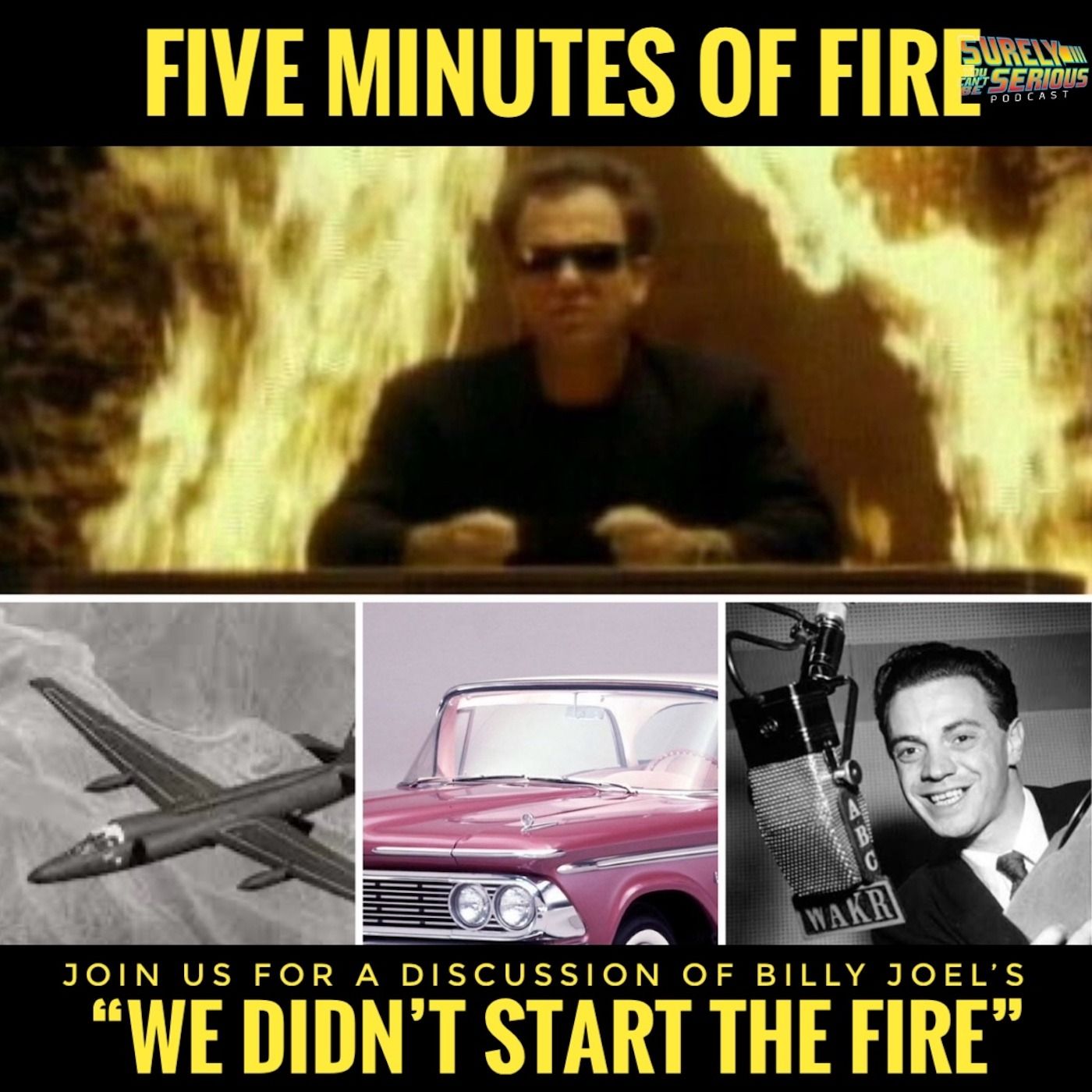
"Five Minutes of Fire": Edsel is a No-Go, U2, Syngman Rhee, Payola
Join us on a daily voyage through history with "Five Minutes of Fire," the podcast series that dissects the historical tapestry woven into Billy Joel's timeless anthem, "We Didn't Start the Fire." Twice a day, in just five minutes, we explore the riveting stories behind the names and events that shaped the 20th century.In today's episode, the flames of history illuminate the excitement and pitfalls surrounding the release of the Ford Edsel, a car that became a symbol of both ambition and miscalculation in the automotive industry. We then soar into the geopolitical turbulence of the U2 spy plane incident, a moment that heightened Cold War tensions. The narrative takes a turn to the Korean Peninsula with Syngman Rhee, a key figure in the complex political landscape of post-war Korea. Finally, we unravel the scandalous notes of the payola controversy, exposing the hidden dynamics of the music industry.In just five minutes, we'll guide you through these historical snapshots, providing context, anecdotes, and a deeper understanding of the individuals and events that defined their times. Whether you're a devoted Billy Joel fan or someone eager to explore the stories behind the lyrics, "Five Minutes of Fire" is your daily dose of historical enlightenment.Subscribe now to join us as we unravel the verses of "We Didn't Start the Fire," offering insights that breathe life into the captivating tales behind the names etched into the song. "Five Minutes of Fire" - where history unfolds swiftly and vibrantly, twice a day. Don't miss your daily spark of historical exploration!
2024-01-12
5 min
Transcript
Available Results
Generated results are saved to the knowledge database for reuse and search.
No generated results are available for this episode yet.
Extract Knowledge
Pick what you want extracted first. Model, scope, and chapter options appear after a template is selected.
Generated results for public episodes are saved to the knowledge database so they can be reused and searched later.
Transcript
<v Speaker 1>I'm Jason Colvin, I'm d Graves.
<v Speaker 2>Give us five minutes and we will give you the fire.
<v Speaker 1>Hello everybody, and welcome back to the Surely You Can't
<v Speaker 1>Be Serious Podcast Special Edition five Minutes of Fire. We
<v Speaker 1>are here talking about the lyrics of We Didn't Start
<v Speaker 1>the Fire by Billy Joel. We're covering only five minutes
<v Speaker 1>at a time, which is about to link with the song,
<v Speaker 1>so it works out kind of nicely. So please join
<v Speaker 1>us as we dive into some new lyrics today.
<v Speaker 2>All right, guys, so here are the topics that we're
<v Speaker 2>going to be covering today.
<v Speaker 1>Edgelzan Nogo, you too, singing Ray Pyola.
<v Speaker 2>And okaydie tell me about Ed's alzanoga.
<v Speaker 1>All right. In the late fifties, Ford realized that it
<v Speaker 1>was not winning the luxury car battle with General Motors.
<v Speaker 1>Their idea was, we need to come up with a
<v Speaker 1>new model that will elevate our luxury vehicles, and so
<v Speaker 1>they decided to develop this car. They called it the
<v Speaker 1>E car for the experimental car. They said, well, we
<v Speaker 1>can't just call this car the experimental car. We can't
<v Speaker 1>call it the E car. That doesn't make any sense.
<v Speaker 1>And so they said, well why don't we call it
<v Speaker 1>edsel Why would you call it Edzel? Because Edseel was
<v Speaker 1>the name of Henry Ford's son. Edsel Ford had also
<v Speaker 1>been the president of Ford for several years. The president
<v Speaker 1>at the time was Henry Ford the Second. They didn't
<v Speaker 1>inform him that they were going to be naming this
<v Speaker 1>car after his father, and they did it at a
<v Speaker 1>board meeting that he was not present at, and he
<v Speaker 1>was quite disappointed with the decision. But they produced it.
<v Speaker 1>They said it's okay, this will be a great car,
<v Speaker 1>and they put their name all over it. Unfortunately, all
<v Speaker 1>of these attempts to make it a popular decision for
<v Speaker 1>the mid range vehicles failed and within just a few
<v Speaker 1>years car was discontinued and regarded as one of the
<v Speaker 1>biggest failures in American corporation history. All Right, you too,
<v Speaker 1>I love this band.
<v Speaker 2>Actually we're not talking about you too, the Irish rock band,
<v Speaker 2>although they did get their from this plane. We're going
<v Speaker 2>to talk about Okay, So this involves the U tube
<v Speaker 2>plane incident of nineteen sixty. Now then May first, nineteen
<v Speaker 2>sixty a U two spy plane was shot down over
<v Speaker 2>the USSR and the pilot, Gary Powers, was captured now,
<v Speaker 2>this plane was doing an awesome job of spying on
<v Speaker 2>the Russians. One of the reasons why it was so
<v Speaker 2>successful is it could fly thirteen miles over the surface
<v Speaker 2>of the land, which was out of the range of
<v Speaker 2>Soviet missiles until it wasn't so a new USSR surface
<v Speaker 2>to air missile was developed. We didn't know that, and
<v Speaker 2>they shot us down and captured Gary Powers to the pilot.
<v Speaker 2>On May fifth, kruse Chef announces the capture of a
<v Speaker 2>US spy plane. Eisenhower says it's a weather plane. Kruse
<v Speaker 2>Chef demanded an apology and wanted no more spying well.
<v Speaker 2>Eisenhower refused to apologize. Of course, this is all in
<v Speaker 2>the assumption that the pilot is dead. On May sixteenth,
<v Speaker 2>nineteen sixty, there was a scheduled summit with the USSR, USA, Britain,
<v Speaker 2>and France and Paris. Because of Utube, kruse Chef walked out, so,
<v Speaker 2>I mean tensions were super high at this moment. Krusecheff
<v Speaker 2>then revealed that they had the pilot alive and well,
<v Speaker 2>and this was no fore making weather plane. Of course,
<v Speaker 2>it was incredibly embarrassing for the US in Eisenhower Gary
<v Speaker 2>Powers was since to ten years. It was actually released
<v Speaker 2>on an exchange and you can see this exchange if
<v Speaker 2>you've ever seen the movie Bridge of Spies. This incident
<v Speaker 2>actually led to the construction of the Berlin Wall in
<v Speaker 2>nineteen sixty one.
<v Speaker 1>I know one of them said, none of this would
<v Speaker 1>have happened if that son of a bitch would have
<v Speaker 1>just taken his cyanide pill like he was supposed to.
<v Speaker 2>Ooh, okay, d tell me about Sigmund Ray.
<v Speaker 1>Okay. Sigmund Ray was the president of South Korea and
<v Speaker 1>as a young man, he would fight for Korean independence. Ultimately,
<v Speaker 1>his fight for independence for Korea came to fruition when
<v Speaker 1>in nineteen forty five, World War Two ended and South
<v Speaker 1>Korea became a US controlled province, and on July twentieth,
<v Speaker 1>nineteen forty eight, he was elected the first President of
<v Speaker 1>the Republic of Korea by the National Assembly, issuing in
<v Speaker 1>the first Republic of Korea. As president, he was a
<v Speaker 1>hardlined anti communist and pro American. You mentioned in one
<v Speaker 1>of our prior episodes that the Armacist was never signed
<v Speaker 1>in Pamu jam right. It was because he refused to
<v Speaker 1>sign it. He was again reelected in nineteen sixty because
<v Speaker 1>his opponent died from cancer before the election took place. Then,
<v Speaker 1>when his vice presidential companion won by a landslide, there
<v Speaker 1>was opposition by the other side because they thought the
<v Speaker 1>election had been rigged. The resulting scandal cause Simon Ray
<v Speaker 1>to resign on the twenty sixth of April nineteen sixty.
<v Speaker 1>Despite the fact that he had resigned, however, the protests
<v Speaker 1>continued and he had to be taken by the CIA
<v Speaker 1>and covertly evacuated. He spent the rest of his life
<v Speaker 1>in exile in Honolulu, Hawaii, and died of a stroke
<v Speaker 1>in nineteen sixty five. Okay, Jason, tell me about Paola.
<v Speaker 2>Paola in the music industry is the illegal practice of
<v Speaker 2>paying a commercial radio station to play a song without
<v Speaker 2>disclosing the payment. Buying off DJs to play your music
<v Speaker 2>is illegal, according to the FCC. Okay, Alan Freed was
<v Speaker 2>a radio DJ in Cleveland before he moved to New York.
<v Speaker 2>This guy's super influential. He actually even coined the term
<v Speaker 2>rock and roll. Record companies would compete and give gifts
<v Speaker 2>like trips, money, female entertainment to influence DJs to play music.
<v Speaker 2>Uh huh, Alan Freed was even given songwriting credit on
<v Speaker 2>a Chuck Berry song. Maybee DJ soon started demanding payment
<v Speaker 2>in order to play a new record. US government became
<v Speaker 2>interested in The FCC announced that radio stations could lose
<v Speaker 2>their license for payola.
<v Speaker 1>Many thought that this would actually kill rock and roll. Unfortunately,
<v Speaker 1>that did not happen until Napster in two thousands.
<v Speaker 2>In nineteen fifty nine, Alan Freed gave his last broadcast,
<v Speaker 2>and five years later he died of alcoholism.
<v Speaker 1>They accused Dick Clark as well, but he was found innocent.
<v Speaker 1>There you go. Okay, guys, that does it for today's episode.
<v Speaker 1>Join us next time for five minutes of fire
Chapters
No chapters available.