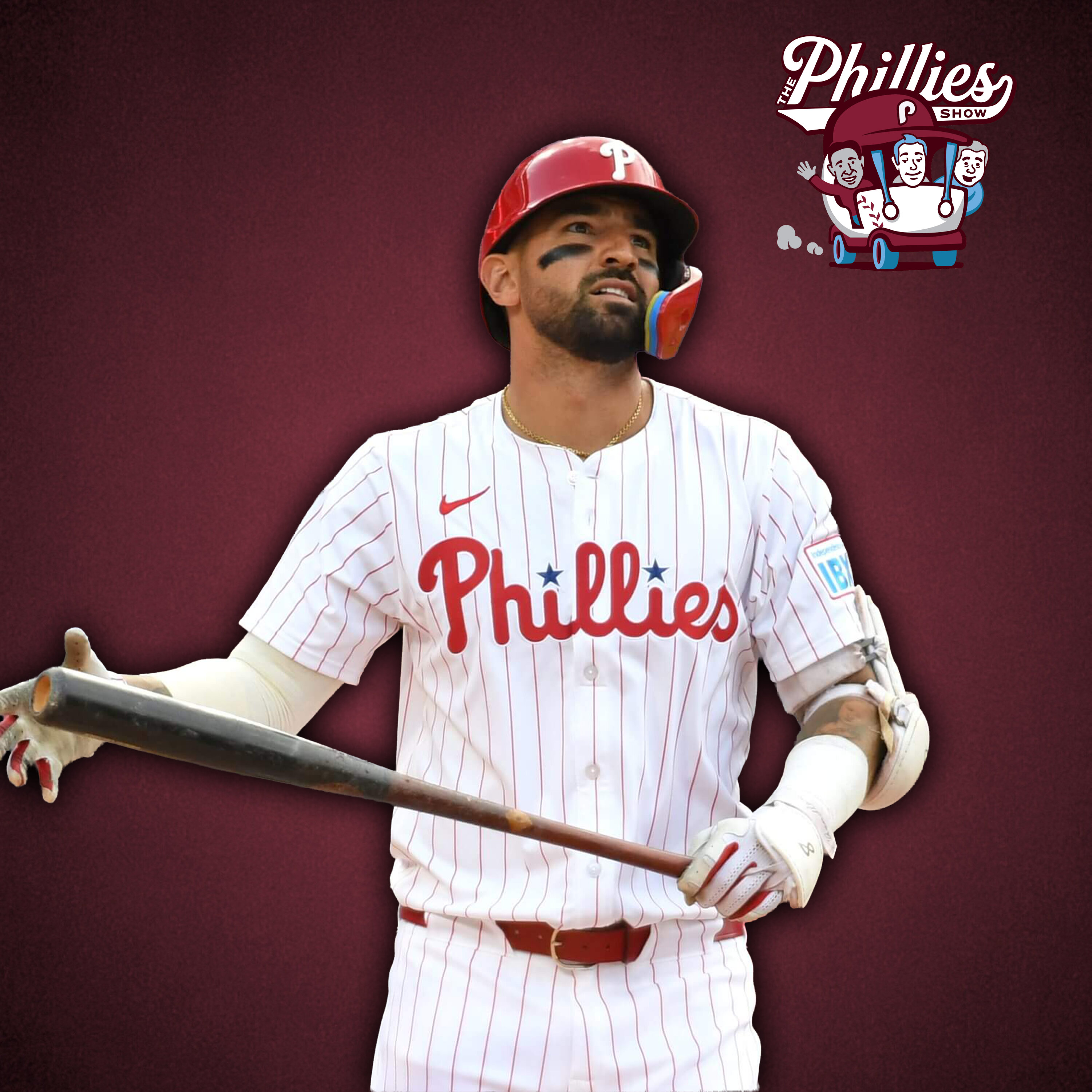
Beer and Baseball: Phillies release Nick Castellanos
The Phillies couldn’t salvage their relationship with Nick Castellanos. They didn’t want to.
So, they released him on Thursday. The Phillies are eating the final $20 million of a five-year, $100 million contract. That’s how badly they wanted Castellanos to go away. We talked about the Phillies’ decision, why it took so long and Castellanos’ admission that he brought a beer into the visitors’ dugout in Miami in June. We get into everything that soured the Phillies on Castellanos, and vice versa.
Love the show? Get Phillies Show merchandise at ThePhilliesShowShop.com!
@The Phillies Show Subscribe to the show on YouTube and follow us on social media!
@Foul Territory We’re part of the Foul Territory Network. Follow FT and find more shows, including Fair Territory!
If you like The Phillies Show, subscribe and give us a five-star review!
See omnystudio.com/listener for privacy information.
Available Results
Generated results are saved to the knowledge database for reuse and search.
Extract Knowledge
Pick what you want extracted first. Model, scope, and chapter options appear after a template is selected.
Transcript
00:00:04
Speaker 1: Hi, this is Chase that Lee.

00:00:05
Speaker 2: This is a Philly Show.

00:00:08
Speaker 1: Ruben Tomorrow, Junior, Jim Salisbury, Todds, The Lucky, It's the Philly Show. It is Friday, February thirteenth, twenty twenty six. But we are doing a little bit of an emergency pod on Thursday night posting on Friday morning because the Phillies have finally officially parted ways with Nick Castianos. They announced on Thursday afternoon that he has been released. A relationship that was unsalvagable finally comes to an end. What's your guys immediate reaction to this?

00:00:44
Speaker 2: We all knew it was coming. We knew it was coming as soon as the season ended. We knew it was coming. But now it's finally happened.

00:00:51
Speaker 3: Yeah, A good word in your part. Unsalvagable. That to the point where they had to eat twenty million dollars and move on. There were no takers in the trade market. Not surprised there, because you know, when a team is so public about wanting to move a guy, you say, I'll just wait till they release him. But when a team is so public about moving a guy, you say, well, do I really want this guy? I still think he could swing the bat possibly help someone. But this was an unavoidable circumstance that had been building all of twenty twenty five and obviously reached ahead in Miami when Rob Thompson, one of the most easy going managers in the history of baseball, was forced to react and bench a guy, thus ending his long consecutive game streak, just because the actions in the dugout that night were so egregious that he had to move in that direction, and things remained tense for the rest of the season. Dave Dombroski right after the season indicated that a change of scenery was coming. He was unable to facilitate that via trade. So the end of a end of an era.

00:02:12
Speaker 4: Again not surprised.

00:02:13
Speaker 5: I mean, it was very obvious that Nick Castianos and the Phillies front office and the staff were no longer a fit.

00:02:21
Speaker 4: And I guess there was enough tension.

00:02:24
Speaker 5: And enough quote unquote animosity, difference of opinion, almost a little bit like a divorce where you you just don't see eye to eye and you don't agree with some of the things that were going on, and then relationship basically deteriorated to the point where they had to release him. Unfortunately, he wasn't as productive that as they would have liked as a player over the last couple of years. Otherwise he probably would have had some value on the market. Not a whole lot of right handed bats out there to be had, but he hasn't been a super productive player as of late. Uh. He was given every chance to play pretty much every single day for a long long time.

00:03:14
Speaker 4: And you know it's time to part ways.

00:03:17
Speaker 5: And and you've got to give John Middleton uh and and Dave Nebrawski a lot of credit in that they're respecting I think probably the wishes of the staff, meaning the coaches and the manager. Uh And they are also respecting, you know, so sort of eating the money, which is a significant amount of money for the betterment of the collective. And uh, I think they're moving forward without him in a way that uh, I think that the Phillies feel is positive.

00:03:49
Speaker 3: And aren't they making the statement as almost any business would, that gross insubordination cannot be tolerated absolutely.

00:04:00
Speaker 4: I mean, there was some real egregious stuff that went on.

00:04:02
Speaker 5: I know that Nick Castianos didn't refer to with some of the stuff on on Instagram, but I don't think the entire picture was painted there.

00:04:12
Speaker 4: There was more to be said.

00:04:13
Speaker 5: There was a lot of disrespect that was created from Nick Castiano's to others, and I think they finally said that's enough.

00:04:24
Speaker 1: So I want to mention real quick if you're watching it, because on YouTube, please subscribe.

00:04:29
Speaker 2: We've got past ten thousand.

00:04:31
Speaker 1: Recently, we're trying to get to fifteen, so we appreciate your support, and as always, go to the Philly show Shop dot com right there. But so it's like Nick had these you know, remember when he signed it was a five year, hundred million dollar contract of March two, twenty two, he gave.

00:04:46
Speaker 2: This very interesting press conference. You know, I don't have a college degree.

00:04:50
Speaker 1: I hit baseballs for a living, and it was like, oh man, this guy's going to have an edge.

00:04:53
Speaker 2: And he had such wild.

00:04:55
Speaker 1: Ups and downs, these wild high these incredible highs and these incredible lows. When he was bad, he was bad, he admitted he was bad. But when he got hot, man, he could carry a team. I remember in the twenty twenty three postseason, you know, he had all those you know that nlds and I think he homered in his first at bat in the twenty twenty three NLCS against the Diamondbacks, I'm like, oh, my god.

00:05:17
Speaker 2: The Phillies of the World Series. And then he was like oh for twenty three the rest of the NLCS.

00:05:22
Speaker 1: So he had these crazy ups and downs, got cheered a lot, got boot a lot, and then you know, when he did struggle. I remember Rob dropped him to as low as eighth in the lineup at one point. I think that might have been in twenty twenty three, and he was not happy about it.

00:05:39
Speaker 2: You know, he wasn't happy last year. I think when he.

00:05:42
Speaker 1: Kind of rebounded finished the season strong in twenty twenty four, and I think he started last season hitting seventh in the lineup. So there were some frustrations there on Knicks part in terms of you know, hey, you know, the least she was given or whatever, right or wrong you.

00:05:57
Speaker 2: Know, he had.

00:05:57
Speaker 1: There was some frustration there and he expressed it at times. As you guys know, as everybody knows, he was never afraid to voice his opinion. He was very blunt, very open. He could be a difficult interview at times.

00:06:10
Speaker 2: He could be a fun.

00:06:11
Speaker 1: Interview at times, but he could be very, very harsh in terms of his opinions, and that I think that all kind of culminated into what happened in Miami in June.

00:06:21
Speaker 3: You know, it's okay to be blunt and opinionated in a difficult interview, sometimes an entertaining interview. So it's okay to be quirky. It's not okay when your manager makes a decision to remove you to try to help win a ball game and replace you with a better defender. It's not okay to go off on the manager in the dugout and the coaches in the dugout. And then, you know, crack a beer that symbolically was I don't know, what do you think, Reuben, he gave him one of these?

00:06:59
Speaker 1: Yeah, yeah, I've never heard of a player bringing a beer into the dugout. I've heard of players, you know, they can pulled out of the game, or reliever gets out of a game, the starter gets out of the game.

00:07:08
Speaker 2: They might have heard of that before, but but never heard of a player the dugout.

00:07:13
Speaker 3: I have no problem with.

00:07:16
Speaker 4: Not agreeing with the manager or authority.

00:07:20
Speaker 5: I do have a problem with dealing with it in an unprofessional way.

00:07:25
Speaker 4: And it was pretty clear that that's what happened.

00:07:28
Speaker 5: And uh, you know, love or dislike Casianos she had. He had an edge about how he played, and he had some really highs, you know, big big.

00:07:43
Speaker 4: Moments for the Phillies at times.

00:07:45
Speaker 5: But I think at the end of the day, it's about the whole body of work. And I guess the feeling was, if you're not going to be super productive and you're not going to be a positive in the in the doug in the dug out, in the clubhouse, and you're going to be a negative, then you sort of have to be removed.

00:08:06
Speaker 4: And that's the decision they made.

00:08:09
Speaker 3: And it's it's okay to question the manager. It's okay to stand up to the manager. It's okay to offer your opinion, it's okay to bang heads. But there's a way to do it. It's done, you know, at at one in the afternoon behind a closed door or midnight after a game behind a closed door. We've all walked through clubhouses and heard shouting, but you know, it's behind closed doors, done the right way. So his objections to being taken out of the game that night, we're just part of the decision on the Phillies part. But it wasn't handled correctly, and it was the right decision.

00:08:49
Speaker 4: I mean totally.

00:08:50
Speaker 3: I don't agree with every single move.

00:08:52
Speaker 5: That Rob Thompson makes. I do think he's an excellent manager. I like the man, I like the way he goes about it. That particular decision was the right decision. He put a better defender in on a game that he needed to win, and frankly, I was surprised he hadn't done it before.

00:09:09
Speaker 1: Well, it's funny you mentioned that, Ruby because I wrote about that a little bit on on Thursday that you know, we had been asking Rob for a long time.

00:09:19
Speaker 2: I mean, I don't know how far back.

00:09:20
Speaker 1: But hey, in a close game, laid in the game, would you take Nick out for defensive purposes? And then, you know I always go back, and we've talked about this before. Who was in left field when the Phillies got the final out in the two thousand and eight World Series.

00:09:35
Speaker 2: It wasn't Pat Burrow. It was Eric Bruntlett.

00:09:38
Speaker 1: Eric Bruntlett I think finished almost every game in the postseason the left field because he was a better defender and left than Pat Burle was.

00:09:45
Speaker 2: And you never Patt never complained. He I'm sure, I guess he.

00:09:48
Speaker 1: I'm gonna guess he didn't like it, but he also didn't like hate it.

00:09:51
Speaker 2: And make a big story.

00:09:54
Speaker 4: Pat knew was best for the team.

00:09:56
Speaker 1: Right.

00:09:56
Speaker 4: The same thing happened with Greg Lezinski over the years.

00:09:59
Speaker 5: Jerry Mark, I mean, you know, I think I just feel like, listen, you have to make moves that.

00:10:06
Speaker 4: Aren't necessarily popular are going to help, you know, win the baseball game. And that was one of them.

00:10:15
Speaker 1: Yeah, and you know, you look at Nick's you know that, and then after what came out of that afterwards, I remember Nick was had asked for the Phillies to supply him all of his defensive metrics and whatnot. And but yeah, to me, it was an obvious decision.

00:10:27
Speaker 4: It was.

00:10:27
Speaker 2: And it was like, hey, why why had this not? Why had this Why hadn't this happened?

00:10:33
Speaker 5: I would say this, So, you know, Mitford worked very hard on his defense. I mean, he made himself very adequate. But it wasn't really about the issue of the of his effort. It was more about his overall ability to cover ground. He just didn't have the foot speed much like Pat Burrow, that was a very good left fielder, I thought, with tracking the baseball and what have you good throwing arm through the ball. Well, the problem was that he just didn't have the overall speed necessary to cover enough ground to be a plus defender. And so that's sort of the same thing you had with Castianos. And you know, you want to have some you want to have, you know, some somebody who can cover some ground, someone who has some range, and someone is a better player out there when when when the game's a lot.

00:11:20
Speaker 3: But I feel like this transaction, the performance was only part of it, small part of it really, just the relationship had soured. He was unhappy with his role. There was an incident, there was other comments he made that night in Arizona where he strongly insinuated the manager, who was a very good communicator, was not a very good communicator. I mean that stuff just you know, kind of bills and bills and becomes like a wave. And it would have just been too difficult to have a person with those grievances against the leader. You're against leadership come back into your into your clubhouse.

00:12:01
Speaker 5: And this is a GM supporting his manager in a lot of ways.

00:12:05
Speaker 4: And in my in my mind, it's the right thing to do.

00:12:09
Speaker 3: What was it? Todd paint the scene a little bit down there today if you could, Well, you kind.

00:12:13
Speaker 1: Of knew it was coming down, of course, right, I mean, Philly's first full squad workout is Monday, and players are already starting to come in. It's like, you know, he didn't have a locker, they'd taken down some of his pictures in the clubhouse, and so you.

00:12:28
Speaker 2: Knew it was imminent.

00:12:30
Speaker 1: And then all of a sudden, we get a heads up Thursday afternoon, like, hey, they're going to release Nick in a few minutes. You know, Dave de Browse, he's going to come and talk to you guys. And so we met Dave right outside the press box and he talked for maybe like I don't know, seven ten minutes something like that, and you know, just kind of he kept saying, we just needed to have a change scenery. We needed to have a change of scenery. And you know, he said that they had tried to trade him, they had some interest, but when it came down.

00:13:05
Speaker 2: To it, obviously they could not close the deal.

00:13:08
Speaker 1: And it was it was kind of asked like why did it take so long, But it was like, well, we thought we could make a trade here for Nick, trade him to somebody and he pointed out, He's like, we weren't looking for a lot of money in return. We weren't looking for a lot of prospects in return. We were looking for minimal return in money, minimal return prospects to try to trade him, and it didn't happen.

00:13:29
Speaker 2: You know, I did ask him at one point, I.

00:13:32
Speaker 1: Said, was there any because this is important because and Dave did say this, He's like, this was more than just the Miami incident. He's like everybody's making a big deal about the Miami incident. It wasn't just that, And it wasn't just that. I mean, go back. They tried to trade him now three consecutive off seasons, including this one, you know, so they've been tried to trade him for a while. But I said, was there any attempt after the season to say, hey, is there any way that we can work this out? In other words, like hey, if you open the season as a platoon player, we'd still love to have you. We still think he can be productive. Could you be a platoon player for us? And he basically said, we never had that conversation, So that that to me, said.

00:14:14
Speaker 2: They you know, it was more than just one moment in time.

00:14:17
Speaker 1: It was just a culmination of things like we're done, you're done, we're done, we're moving on.

00:14:22
Speaker 2: You're moving on.

00:14:24
Speaker 1: And I'll tell you what, I'm gonna be very interested to see what kind of season he has.

00:14:29
Speaker 4: I think he's in a lot of ways.

00:14:31
Speaker 3: In a lot of ways, he's just what they needed. They needed a right handed bat in the outfield. I mean, if you could subtract the periods of you know, the periods when he wasn't producing, if you get some more consistency, it's just what they're looking for. But I just think it was all based on where the relationship had gone. Do you think there's going to be you think he lands somewhere? What do we think.

00:14:56
Speaker 4: I think he's got an opportunity to go somewhere.

00:14:59
Speaker 5: In a lot of ways, Yeah, it's going to be interesting to see what kind of season he puts together. But sometimes sometimes you have to sort of be smacked in the head and the mirror.

00:15:08
Speaker 4: Has to break for you realize that you really have been struggling.

00:15:12
Speaker 5: And I think this is probably a little bit of a wake up call that the team could not move the man. You know, it's interesting he had a two to fifty batting average for the season seventeen home runs, seventy two RBIs. He only had a two ninety four on base percentage, which is probably the lowest on base percentage of any everyday player or close to it that played pretty much every day, someone with over five hundred plate appearances. But I would not be surprised if it sort of lights a fire in him and the player for somebody, it's very very possible that.

00:15:53
Speaker 3: You know, it's odd. He gets hot, he makes.

00:15:55
Speaker 5: Some adjustments and does some things and puts some I mean, he has a bill.

00:16:00
Speaker 4: There's no question the man was a first rounder.

00:16:02
Speaker 5: He's had a lot of success over the course of the his career. You know, he's thirty three, he's not forty, and so keeps himself in pretty good shape. I mean, I would be I would actually be surprised if he didn't have some sort of productive season because I even though he's guaranteed the money, he's probably gonna want to play after twenty twenty six, and I.

00:16:27
Speaker 4: Now wants to show the rest of the world that he can.

00:16:30
Speaker 1: Yeah, and I yeah, it's funny because we all had people saying, why don't they just release them? They're not going to be able to trade him. I'm like, well, I think that they think that they can. You know, somebody is going to see some potential there. Even with the whole incident, I'm sure. I think most people in baseball probably had heard something about what had happened in Miami and how the relationship had soured and whatnot. But you know, I said this, everybody said, tell you what if I was a GM on another team and I could get Nick for two million dollars per Phillies, two million dollars if there was other interests and I needed a right handed bat. I think he'll be on better behavior this year, you know, in terms of all of this, because he's a free agent after the season. I think he's going to be motivated again, like you said, Ruben, because he's going to want another contract beyond the season. And I think Nick is the type of guy who's going to play with an edge, and he would love nothing more than have a big season that shove it up, shove it up to Phillies butts. I think he would absolutely love that moment.

00:17:31
Speaker 5: And I would love to do that based on what I know of him and how he's reacted to other things.

00:17:37
Speaker 4: I think he would love to do that, and he may very well do that.

00:17:40
Speaker 3: Question, Rubin, how much does a general manager in his front office way the potential of some right handed production when he's hot, with some adjustments, et cetera. How much do you weigh what you could get from the player with how it ended in Philadelphia, with the stuff off the field.

00:18:01
Speaker 5: This is where if I was another GM looking for a right handed bat with some production and a veteran guy, where this would be require a flight to his.

00:18:10
Speaker 4: Home, a discussion with him, a face.

00:18:13
Speaker 5: To face and a very very candid discussion about what happened. Why, knowing about much of the things that happened, but why, and whether this is the right.

00:18:25
Speaker 4: Fit for my team.

00:18:27
Speaker 5: Some teams can, you know, don't get affected by guys like this, even if he has a little bit of an edge or whatever. You don't like totally like the makeup. But I mean, listen, I was never afraid to, you know, go and take a chance on somebody like this, especially who is going to probably pretty pretty motivated to show the world that he's a better player than he has been the last couple of years.

00:18:55
Speaker 3: Motivated to show the Phillies, motivated to get another contract correct in stay baseball. I mean I could see somebody rolling the dice on him. Who has a need Padres trying to think who else but I? And if it doesn't work out, you release him. You're on the hook for you know, seven fifty grand.

00:19:16
Speaker 5: And you're not taking big of a real big chance on the guy obviously because you're paying him the minimum.

00:19:22
Speaker 4: But no harm, no foul by giving him an opportunity.

00:19:28
Speaker 5: But I think it would precipitate a very very candid conversation for sure.

00:19:37
Speaker 1: For sure, and you know it's going to be fun to watch this season. Wherever he lands, people are gonna be looking at that box square.

00:19:43
Speaker 2: We're not going what Nick do? What Adulis Garcia do?

00:19:46
Speaker 1: Not not?

00:19:47
Speaker 6: It's not necessarily no doubt Garcia yea yeah, because I mean this front off, you know, they they they're rolling the dice on Garcia coming off of two down years.

00:19:58
Speaker 2: They missed on Max Kepler last year or so.

00:20:00
Speaker 1: I mean, there's some you know, they need, they need one of these guys and one of your guys to hit, and it's the big.

00:20:05
Speaker 3: What do you think of the letter? I liked the letter. I liked that he drew like a log cabin on the letter.

00:20:11
Speaker 5: Not too many people used cursive anymore or write with a lot of people type it all out.

00:20:17
Speaker 2: That's true.

00:20:18
Speaker 4: I mean, I think the letter was candid, but not totally candid. It was a nice you know the thing, got the whole story there.

00:20:27
Speaker 3: And I wonder if the if, the if the I wonder if the President Day was the good stuff that you get in the Dominican or the or the knockoff stuff that they sell here in the States.

00:20:38
Speaker 4: You think it's a knockoff they sell the States. Huh, Well, it's.

00:20:41
Speaker 3: Not the same quality as you get in the d R.

00:20:44
Speaker 5: It's kind of like coming out of that cold ice water and you drop off in the Santa Domingo.

00:20:50
Speaker 1: It's kind of like when you get a Guinness in Dublin and tastes different than the United States.

00:20:55
Speaker 4: Is that you're Jim, It's Stephan.

00:20:58
Speaker 3: I've always said I've had it in the DR and I've had it here and it does a little.

00:21:02
Speaker 4: I have a bunch of President Days in my refrigerator right now.

00:21:07
Speaker 3: You should go crack one and on her and Nick.

00:21:10
Speaker 5: I don't think I'm going I don't think I'm gonna do that, James on my birthday.

00:21:13
Speaker 3: I'm not going to do that.

00:21:15
Speaker 4: That's right.

00:21:18
Speaker 2: This is what we will say this about Ruben. It's Thursday night. We remember recording this. It is his birthday and he's taking the time to chat with us.

00:21:25
Speaker 4: So happy birthday, Rubens. You're getting older better than the alternative.

00:21:31
Speaker 3: What else is happening down there, Todd, give us a quick update before Ruben has to go put his party hat on.

00:21:36
Speaker 1: Well, today was actually a real short day. They had like a bunch of guys throw before the first official workout on Tuesday, a ton of guys throwing Tuesday, had a few guys throw on Wednesday, so it was actually a very short quick day. Guys were in and out. Bryce and Stott was in camp today. He got it on the half field and guess who greeted him very warmly. Bobby Dickerson and Larry bow They were and it took about h less than a second for them to start jumping on.

00:22:07
Speaker 2: Bryce's stock smack.

00:22:09
Speaker 3: Having a hard time the fun fraternity.

00:22:13
Speaker 4: I said to Bryce, and I go, there's fine at the time of the spring.

00:22:16
Speaker 5: I love watching them work out before it so funny.

00:22:19
Speaker 1: And Bryson's a great guys. You guys know and I said to Bryce and I go, did you miss Bobby?

00:22:25
Speaker 7: And he goes, no, this is that as Bobby's just riding them already, you know, so of course they they work well together, and everybody does like Bobby and the work that.

00:22:37
Speaker 1: He does there. So it was yeah, you get guys, just slowly starting to trickle in. So the next few days we'll see Bryce and Trey show up and and whatnot. Which warper's here looking jacked, you know, he's ready to rock and roll. So and the weather was nice day and the sun was out night.

00:22:53
Speaker 4: Let's go warm it up.

00:22:54
Speaker 3: I'm coming in a week.

00:22:55
Speaker 4: There we go.

00:22:56
Speaker 1: I'm looking forward to it. Hope to see both of you guys very soon down in clear Water. Get that hoodie off, Jim, you gotta get the lightweight.

00:23:04
Speaker 2: Philly Show hoodie.

00:23:05
Speaker 4: Light Wait we go lightweight.

00:23:07
Speaker 3: Wait you see the pipes in my short sleeves?

00:23:09
Speaker 4: Sh God, you have unbelievable guns. I cannot wait.

00:23:14
Speaker 2: Bring that mesh t shirt down, Jim.

00:23:16
Speaker 3: Don't forget and we'll forget your thal.

00:23:20
Speaker 4: All right, guys, thanks for thanks for listening. We will be back so right.

00:23:26
Speaker 3: Great talking to you, Smelly Lena Jim.

00:23:29
Speaker 1: The Philly Show is brought to you by the Foul Territory Network. Subscribe to The Philly Show on YouTube and wherever you get your podcasts.