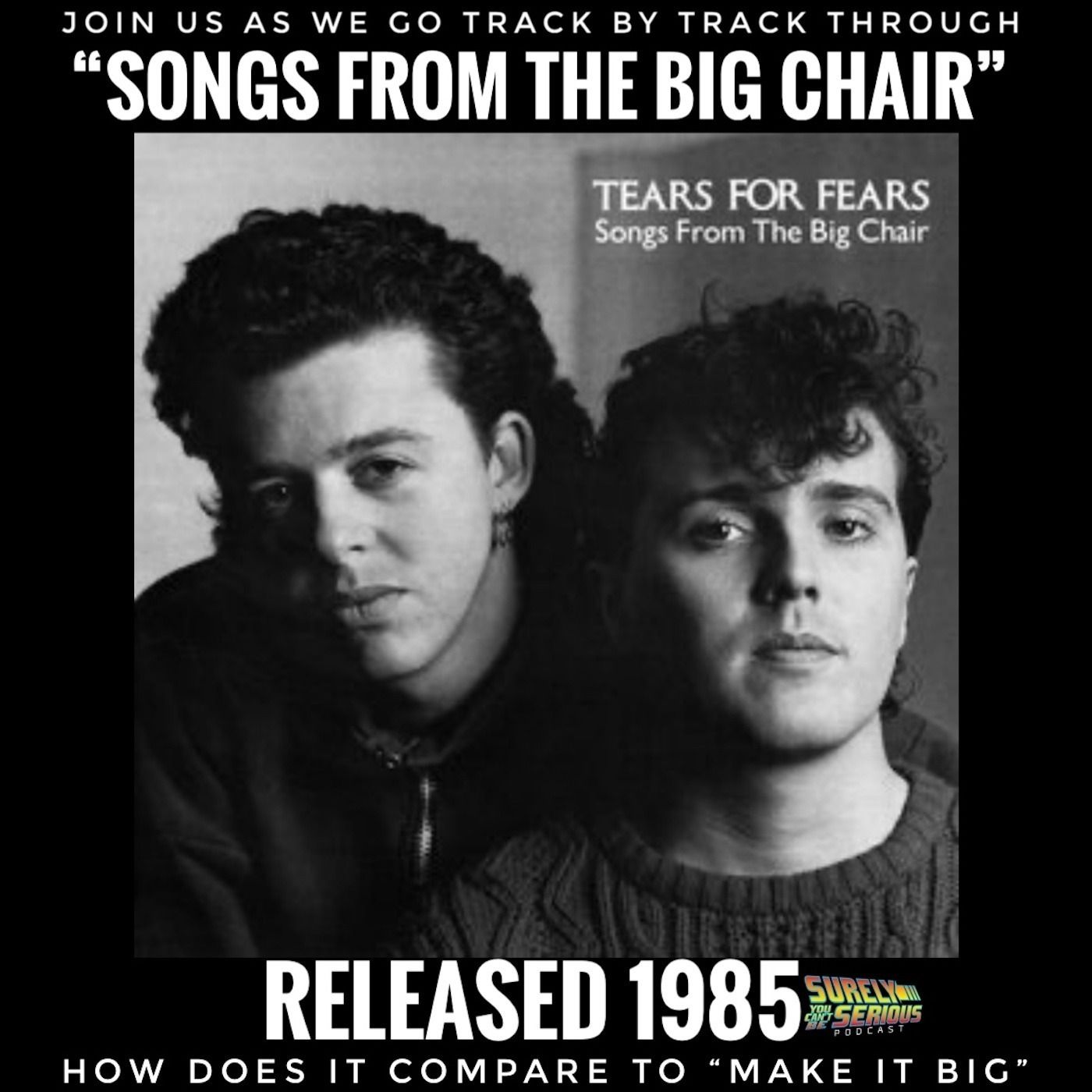
Tears For Fears "Songs from the Big Chair" (1985): Track by Track!
Welcome to "Surely You Can't Be Serious," the podcast where hosts Jason and Dee take a deep dive into the music that shaped our lives. In this episode, we're dissecting the iconic Tears for Fears album "Songs from the Big Chair."Join us as we unravel the layers of each track, exploring the genesis of the songs and the anecdotes behind the music. From the anthemic "Shout" to the introspective "Everybody Wants to Rule the World," we'll explore the themes, inspirations, and creative process behind each masterpiece.As we dissect each song, we'll uncover the influences that shaped Tears for Fears' sound, from their childhood experiences to their musical inspirations. We'll discuss the emotional depth of tracks like "Head Over Heels" and "Mother's Talk," and explore how they resonate with listeners decades later.But the conversation doesn't end here. Join us next week as we compare "Songs from the Big Chair" to Wham's "Make It Big" album. It's a clash of the titans as we examine two seminal albums from the 1980s, exploring their impact on pop culture and music history.So tune in, grab your headphones, and prepare to journey through the sonic landscapes of Tears for Fears. This is "Surely You Can't Be Serious," where the music never stops and the conversation never ends.
2024-04-02
63 min
Transcript
Available Results
Generated results are saved to the knowledge database for reuse and search.
No generated results are available for this episode yet.
Extract Knowledge
Pick what you want extracted first. Model, scope, and chapter options appear after a template is selected.
Generated results for public episodes are saved to the knowledge database so they can be reused and searched later.
Transcript
<v Speaker 1>This is Jeff from the thirty something Movie Podcast, and
<v Speaker 1>you are listening to Jason and d on what is
<v Speaker 1>currently considered to be the most recent episode of the
<v Speaker 1>Shirley You Can't Be Serious Podcast.
<v Speaker 2>Hello everybody, and welcome back to Shirley You Can't Be
<v Speaker 2>Serious Podcast. We are here to talk about the Tears
<v Speaker 2>for Fears album Songs from the Big Chair, released thirty
<v Speaker 2>nine years ago this month. Jason, isn't it funny how
<v Speaker 2>time live? Yes?
<v Speaker 3>Yes, I love this album. I can't wait to dive
<v Speaker 3>into it. I owned it. It really ruled the summer
<v Speaker 3>of nineteen eighty five.
<v Speaker 2>This album for me was, well, I put it this way.
<v Speaker 2>I have said this to you before. I think I
<v Speaker 2>may even mentioned it last episode. This album was like
<v Speaker 2>that girl in high school that you thought was kind
<v Speaker 2>of cute and kind of forgettable, and then you come
<v Speaker 2>back for your thirty nine year old class reunion or whatever,
<v Speaker 2>and you're like, oh my gosh, I'm in love with her. Right,
<v Speaker 2>So I got to, you know, we dive in. I
<v Speaker 2>re listened to this thing and I'm like, holy cow,
<v Speaker 2>how did I not know how good this entire album is?
<v Speaker 3>You know, I had the same kind of experience because
<v Speaker 3>when you're a little kid. When I was twelve when
<v Speaker 3>this came out, Yeah, I'm like, oh, these songs are great,
<v Speaker 3>They're fun, they're they're catchy. You know, you don't realize
<v Speaker 3>how complex and how deep they are at twelve years old.
<v Speaker 2>Yeah. We were having a conversation with our Shurly fans
<v Speaker 2>that we have a text group with. By the way, guys,
<v Speaker 2>if you want to join our group, go to patreon
<v Speaker 2>dot com backslash Shirly Podcast, and if you just want
<v Speaker 2>to follow us, it doesn't cost a thing to follow us.
<v Speaker 2>You can see what our Patreon episodes are and decide
<v Speaker 2>whether you want to join or not cheap to join.
<v Speaker 2>If you do decide and you get access to those episodes.
<v Speaker 2>But also we have a continuing text exchange with almost
<v Speaker 2>all of our Patreon members. And today we were talking
<v Speaker 2>about this thing that seems to happen now with songs
<v Speaker 2>that you don't have guitar solos or piano solos or
<v Speaker 2>drum solos or saxophone solos or any.
<v Speaker 3>Of those things, or long intros rright.
<v Speaker 2>Or long intros, and you go back and you listen
<v Speaker 2>to the songs of thirty nine years ago nearly forty
<v Speaker 2>years ago, and at that era, all of them had
<v Speaker 2>it like you didn't have a song that didn't have
<v Speaker 2>a guitar solo in it. And the problem is is
<v Speaker 2>that all of the people making music now thinking that
<v Speaker 2>the gen z doesn't have the attention span to sit
<v Speaker 2>through a musical solo. Well, let me to tell you, guys,
<v Speaker 2>the songs of these albums are favorite songs for my
<v Speaker 2>sixteen year old and my fourteen year old and my
<v Speaker 2>twelve year old, and for us. I mean, I'm gonna
<v Speaker 2>go down a limb here, but Shout was the song
<v Speaker 2>of this album, right like for you and me, Like
<v Speaker 2>Shout was the big hit in nineteen eighty five, right
<v Speaker 2>for them. Literally before we came to record Tonight, I
<v Speaker 2>was like, avery, of these three songs shout, everybody wants
<v Speaker 2>to rule the world, head over heels, which one is
<v Speaker 2>the best. And She's like, I don't think I know shout.
<v Speaker 2>And Caleb's next to her and he's like, what you
<v Speaker 2>don't have a shout? Are you crazy? I'm like, dude,
<v Speaker 2>she doesn't know what. She doesn't know. It's okay, But
<v Speaker 2>even he was like, it's head over heels And she
<v Speaker 2>was like I like them both a lot, but it's
<v Speaker 2>probably everybody wants to rule the world. Sixteen year old
<v Speaker 2>Cole one percent. Everybody wants to rule the world. Didn't
<v Speaker 2>know shout. But the fact is is that these guys
<v Speaker 2>have the attention span. My kids have the attention span
<v Speaker 2>to listen to these songs with long intros, great sax solos,
<v Speaker 2>great guitar solos, and they prefer it. So wake up
<v Speaker 2>music producers of the day. Give some credit to our
<v Speaker 2>listening audience, and let's put some music talent behind the
<v Speaker 2>songs we're making today.
<v Speaker 3>I've got to tease up for you on this. So
<v Speaker 3>you mentioned the length of the songs. Yeah, there is
<v Speaker 3>a lyric in one of the songs that you know
<v Speaker 3>well that makes a reference to the length of the
<v Speaker 3>songs on this album.
<v Speaker 2>I mean, the fact is that even in the eighties,
<v Speaker 2>the record producers were like, Eh, we don't have this
<v Speaker 2>is too long, we got to cut it short, and
<v Speaker 2>they do. They totally reference it in one of these
<v Speaker 2>other songs.
<v Speaker 3>I almost fell down when I heard that.
<v Speaker 2>So, guys, we're talking about an album that's nearly forty
<v Speaker 2>years old at this point, and it is still incredible.
<v Speaker 2>This is a great album to listen to with your kids.
<v Speaker 2>There's all kinds of history behind the band. But I
<v Speaker 2>really just want to jump right in. Before we do that,
<v Speaker 2>we have to briefly talk about how we got the
<v Speaker 2>title of this album.
<v Speaker 3>I have wondered this for thirty nine years now, right.
<v Speaker 3>So the title of the album is called Songs from
<v Speaker 3>the Big Chair. Yep, what the heck is the Big Chair?
<v Speaker 2>Well, lay down and we can talk about it.
<v Speaker 3>That's Have you seen the nineteen seventy six TV movie
<v Speaker 3>starring Sally Field called Sybyl.
<v Speaker 2>No, I have not, but I am well aware of
<v Speaker 2>what it's about. I know it's the multi personality. The
<v Speaker 2>actual woman's name was not Sybil, it was Suirley Ardell Mason.
<v Speaker 2>But there's a lot of skepticism about whether she had
<v Speaker 2>as many multiple persons as she did or not.
<v Speaker 3>Right, So it's about this woman who has multiple personalities.
<v Speaker 3>Which part of the reason why they chose this title
<v Speaker 3>is because each song on this album has a different personality.
<v Speaker 2>Ah, that's oh, that's great, that's great. And so just
<v Speaker 2>as it relates to the movie, the idea was that
<v Speaker 2>with all of these multiple personalities that she had, she's
<v Speaker 2>being psychoanalyzed by the psychiatrist, and the only way that
<v Speaker 2>she can prevent herself from using her different personalities is
<v Speaker 2>when she's sitting in her big chair. That's a share
<v Speaker 2>that she talks to the psychoanalyst from.
<v Speaker 3>She only feels safe when she's sitting in the big chair.
<v Speaker 2>Yeah.
<v Speaker 3>Now, this album, just for the record, went five times
<v Speaker 3>platinum in the US alone, sold ten million copies worldwide.
<v Speaker 3>Released February twenty fifth, nineteen eighty five. We talked about
<v Speaker 3>and was the album of nineteen eighty five, with maybe
<v Speaker 3>only one exception, which we'll talk about next week.
<v Speaker 2>Yeah, we are here to compare this album to the
<v Speaker 2>Wham album Make It Big.
<v Speaker 4>Wake Me Bye, Don't Change not the jo.
<v Speaker 2>Guys. We'll cover that one next week, But for now,
<v Speaker 2>we are jumping in song number one on the album, Shout.
<v Speaker 4>Shot, Shout Jump.
<v Speaker 2>What an iconic, unmistakable intro. You love those bells that
<v Speaker 2>come in with the strong chorus at the beginning of
<v Speaker 2>the song fan freaking tastic right out of the gate.
<v Speaker 4>Yeah.
<v Speaker 3>So this song was one of the ones that went
<v Speaker 3>to number one hit number one in the US August third,
<v Speaker 3>nineteen eighty five. Here's the interesting thing. The release schedule
<v Speaker 3>in the United States is different than the one in
<v Speaker 3>the UK. Right, So in the UK, hey, this is
<v Speaker 3>like the third single. In the US it's the second single.
<v Speaker 3>If you're listening to the UK, you're gonna be like,
<v Speaker 3>wait a minute, what summer of nineteen eighty five?
<v Speaker 2>What are you talking about.
<v Speaker 3>Well, in the US it was big in the summer
<v Speaker 3>of eighty five.
<v Speaker 2>Yeah. Huge. It wasn't just big, it was huge. This
<v Speaker 2>is a tidal wave of a song as far as
<v Speaker 2>the US is concerned.
<v Speaker 3>I bet they played this video once an hour on MTV.
<v Speaker 2>I couldn't I couldn't stop singing this song at ten
<v Speaker 2>years old. It's like I just couldn't do it. I mean,
<v Speaker 2>it was too intoxicating not to do it. And then
<v Speaker 2>I got it into my head. Why doesn't shout the
<v Speaker 2>fabric detergent? Use THISAA shout shout, get the stains out.
<v Speaker 4>Yeah.
<v Speaker 3>So it's interesting when it was created, Rolandor's bole just
<v Speaker 3>he kind of came up with the words and thought, well,
<v Speaker 3>this is just it's kind of a chorus for people
<v Speaker 3>to sing along. It's not really a song, just something
<v Speaker 3>we can use in our concerts.
<v Speaker 2>Yeah. I remember as a kid talking to my brother
<v Speaker 2>about this, and he was like, these guys did this
<v Speaker 2>scream therapy and that's where they got this idea for
<v Speaker 2>this song. Right. So, you know, speaking of psychoanalysts and
<v Speaker 2>Sybil and all that, Right, there's this psychoanalyst from the
<v Speaker 2>late sixties early seventies called Arthur Jenoff. Right, he does
<v Speaker 2>what he calls primal therapy, where he with his patients
<v Speaker 2>dives into their childhood pain. And so he comes out
<v Speaker 2>with this book called The Primal Scream. Sounds like, oh, hey,
<v Speaker 2>my brother was right. These guys are tapping into this
<v Speaker 2>we know, and we'll talk about it in a little bit.
<v Speaker 2>Where the name of the band comes from and it
<v Speaker 2>is straight from Arthur Jenoffah, but this book, he writes
<v Speaker 2>this book about his primal therapy, and he sends a
<v Speaker 2>couple of like preview copies to some famous people, including
<v Speaker 2>John Lennon. John Lennon totally buys in. A couple of
<v Speaker 2>other famous celebrities buy in, and all of a sudden
<v Speaker 2>he is a world renowned guy. Well this is early seventies,
<v Speaker 2>like nineteen seventy basically, okay, and we know that Tears
<v Speaker 2>for Fears gets together I mean they become Tears for
<v Speaker 2>Fears in nineteen eighty one, but before that they were
<v Speaker 2>devotees of Arthur Jenoff.
<v Speaker 3>Yeah, so I was telling you I read this article.
<v Speaker 3>Roland R'sbal said, we were evangelical about Arthur Jenoff. He said,
<v Speaker 3>the only band I could really compare ourselves to would.
<v Speaker 2>Be like you two.
<v Speaker 3>So you two took pop rock and combined it with
<v Speaker 3>the teachings of Jesus right their Christian faith, whereas Tears
<v Speaker 3>for Fears took pop rock, synth rock and combine it
<v Speaker 3>with the teachings of Jenoff. And here you go Tears
<v Speaker 3>for Fears primal scream therapy shout right.
<v Speaker 2>And then part two is Roland Oserbaal says, No, that's
<v Speaker 2>actually not what it's about. It's not about the scream therapy, right,
<v Speaker 2>He's like, this is about rebellion and all this. I'm like, really,
<v Speaker 2>are you sure?
<v Speaker 4>Yeah?
<v Speaker 2>But here's the other here's the part too of that.
<v Speaker 2>There could be the reason that he could be saying
<v Speaker 2>that is that they actually got to meet Arthur Jenoff
<v Speaker 2>in the mid eighties. Okay, they met him, And this
<v Speaker 2>goes back to you're in my experience with Lu Frigno,
<v Speaker 2>don't meet your heroes.
<v Speaker 4>Oh no.
<v Speaker 2>Yeah. So they met him and they were completely disillusioned.
<v Speaker 2>They said he had just become completely Hollywood. He was
<v Speaker 2>not interested in talking to them about psychosis or psychoanalysis
<v Speaker 2>or any of that stuff. What he wanted them to
<v Speaker 2>do was write a musical for him. Oh no, yeah,
<v Speaker 2>I was with you when you.
<v Speaker 3>Met lou Fregno. By the way, I felt I was
<v Speaker 3>bad for you.
<v Speaker 2>Yeah.
<v Speaker 3>So here's the interesting thing. When roland Orzibal wrote this chorus,
<v Speaker 3>just a simple shout protest chorus, he went over and
<v Speaker 3>he sang it to Ian Stanley. Ian Stanley is the
<v Speaker 3>keyboardist and another kind of the guys in the band. Yeah,
<v Speaker 3>And it took weeks for Ian Stanley to convince roland
<v Speaker 3>Oor's that it was any good. When he first heard
<v Speaker 3>he said, that's a worldwide smash, and Rolan's like, I
<v Speaker 3>don't know, man, it's just like a chorus, like I
<v Speaker 3>want people to kind of chant it during a concert.
<v Speaker 3>He's like, yeah, dude, that chorus is a worldwide smash.
<v Speaker 3>Took weeks to convince him. It was the second to
<v Speaker 3>last song added to the album, and because the song
<v Speaker 3>is complex, it pushed them over time and over budget,
<v Speaker 3>but gave us the gift of one more song that
<v Speaker 3>we'll talk about here in just a minute.
<v Speaker 2>Yeah, the studio didn't like how long the song was.
<v Speaker 3>Should we talk about that now or in two songs?
<v Speaker 2>Let's talk about it.
<v Speaker 3>Let's talk about now.
<v Speaker 2>And we'll just we'll tee it up that it's gonna
<v Speaker 2>come up a little bit later. We'll just tell them
<v Speaker 2>what happened now, and then we'll tell them about the lyrics.
<v Speaker 2>Next song.
<v Speaker 3>Sounds good, sounds good. So this song the average length
<v Speaker 3>of the songs on these albums over five minutes the
<v Speaker 3>average length.
<v Speaker 2>They're long.
<v Speaker 3>They're long songs, including Shout.
<v Speaker 2>Yeah.
<v Speaker 3>So David Bates is a record guy, and he wants
<v Speaker 3>them to reduce this song shout by thirty seconds. He
<v Speaker 3>wants them to fade out.
<v Speaker 2>That's a huge reduction in a song.
<v Speaker 3>Thirty seconds.
<v Speaker 2>That's a long time time.
<v Speaker 3>Yes, And they're like, we don't want to, like, no,
<v Speaker 3>you guys are doing it.
<v Speaker 2>They do. They do, and they're not happy about it.
<v Speaker 2>They're sad about it, and they're going to protest it
<v Speaker 2>a little bit later. They're so sad that they had
<v Speaker 2>to fade it all right, So we talked about how
<v Speaker 2>this song reached number one in August of eighty five.
<v Speaker 3>Okay, here's your top five August third, nineteen eighty five.
<v Speaker 2>We're already here. I'm so happy. Hey.
<v Speaker 3>Number one is Shout. Number two is every Time You
<v Speaker 3>Go Away by Paul Young.
<v Speaker 2>Okay, that's a decent song. It's good song, right.
<v Speaker 3>Number three if you love Somebody set Them Free by Sting.
<v Speaker 2>I like that song, yeah, face, I like that song. Okay,
<v Speaker 2>free you set Them Free? Yeah, I dig that song.
<v Speaker 3>Yeah, okay, all right. Number four You Give Good Love
<v Speaker 3>by Whitney Houston.
<v Speaker 2>Yeah.
<v Speaker 3>And number five Glory Days by Bruce Springsteen.
<v Speaker 2>I love that one. It's a good one.
<v Speaker 4>Right.
<v Speaker 2>He has one of my favorites. Yeah.
<v Speaker 3>So this video was directed by Nigel Dick.
<v Speaker 2>Oh, I'm so glad that you were talking about Nigel Dick.
<v Speaker 3>Okay, I was wondering if you would remember who that was.
<v Speaker 2>So yeah, we totally talked about him when we talked
<v Speaker 2>about get Ready for This, Ladies and Gentlemen, Guns and Roses.
<v Speaker 3>I know, he's like either Tears for Fears or Guns
<v Speaker 3>n' roses.
<v Speaker 2>Right, It's it's crazy. I mean, he's got he's one
<v Speaker 2>of those guys that has directed a ton of videos. Yes,
<v Speaker 2>but but the most iconic Guns and Roses videos are hit.
<v Speaker 2>So he's got patience, he's got Paradise City, he's got
<v Speaker 2>Sweet Child of Mine.
<v Speaker 3>I mean, he's come to the jungle.
<v Speaker 2>He's the man.
<v Speaker 3>He also did Rocket by Duff Leppard, Down in a
<v Speaker 3>Hole by Alice in Chains. Yep, he did Wonderwall and
<v Speaker 3>Champagne Supernova by Oasis, and Hit Me Baby One More Time.
<v Speaker 2>Yeah, he had a few Britney spears and he did
<v Speaker 2>this too. Yeah, he did Nigel Dick.
<v Speaker 3>Yep, what a name, terribly unfortunate name. I did see
<v Speaker 3>an interview with Kurt Smith how he's got kind of
<v Speaker 3>a little braided tail in the video.
<v Speaker 2>That his hair style choice in the eighties was unfortunate
<v Speaker 2>and several different occasions.
<v Speaker 3>So apparently his children thinks it's hilarious that he had
<v Speaker 3>a braid in this video.
<v Speaker 2>A rattail.
<v Speaker 5>Brain.
<v Speaker 3>Yeah, like, dad, look your braid. Oh my gosh.
<v Speaker 2>Speaking of his children, he's got a couple of little girls,
<v Speaker 2>one of whom has an incredible voice, an incredible musical ability.
<v Speaker 2>And we've been watching this it was like an Instagram
<v Speaker 2>kind of We're just gonna make this song real quick
<v Speaker 2>from COVID, Like they were stuck inside the house and
<v Speaker 2>she's in her early twenties. I mean she looks like
<v Speaker 2>she's fifteen. She's a super sweet looking little girl. Yep.
<v Speaker 2>And they're both she's playing guitar, he's playing bass, and
<v Speaker 2>they start singing mad It's so great.
<v Speaker 4>A famillion fais Warner place, says Worner fass fredonly pull
<v Speaker 4>the dailyais go going going now and it is a
<v Speaker 4>feeling up bag classes no expression, no wexpression.
<v Speaker 3>Have my head. I want to dramas ut Ah's cool?
<v Speaker 4>Is that?
<v Speaker 3>Man? That's just so sweet?
<v Speaker 4>It is.
<v Speaker 2>It is incredibly sweet. And her voice, I mean her
<v Speaker 2>harmony with her dad is a beautiful blend. It is great.
<v Speaker 3>Well, that's true. I could sing with Kurt Smith and
<v Speaker 3>it was singing halfway awesome, So well, she does better
<v Speaker 3>than that's true. That's true. I do like how in
<v Speaker 3>some of the lyrics of the song, you still have
<v Speaker 3>some of the remnants of nuclear tension, right. Oh yeah,
<v Speaker 3>So the line I hope we live to tell the
<v Speaker 3>tale nuclear tension between the world and the USSR and
<v Speaker 3>that type of thing.
<v Speaker 2>It was nineteen eighty five, right in the middle of
<v Speaker 2>Reagan and Gorbachop. I mean it was Cold War at
<v Speaker 2>tension peak, no.
<v Speaker 3>Doubt, one of the biggest songs of the summer of
<v Speaker 3>nineteen eighty five.
<v Speaker 2>The song is amazing. It never gets old to me,
<v Speaker 2>and I think for guys our Age it defines the album.
<v Speaker 3>Okay, were we ready to move on to the next one.
<v Speaker 2>Let's move on to song number two?
<v Speaker 3>Song number two. That song is called the Working Hour.
<v Speaker 2>So talk about songs with different personalities. Yeah, I mean
<v Speaker 2>this sounds like Jon Hammer. This song could be playing
<v Speaker 2>while Crockett is angry driving in the Ferrari after he
<v Speaker 2>accidentally shot the drug dealer.
<v Speaker 3>Yeah, for sure. So you got that long, really long intro,
<v Speaker 3>sweet saxe, sexy say, and then you got that kind
<v Speaker 3>of shuffle beat and then the song really takes off.
<v Speaker 3>I love it. It's a great song.
<v Speaker 2>This was really good. This was not on my radar
<v Speaker 2>before we came back and revisited this album. This is
<v Speaker 2>not one that was that what I was listening to
<v Speaker 2>back in the eighties, but it definitely has a distinct sound.
<v Speaker 2>I wouldn't have you play until Roland Oors the Ball
<v Speaker 2>starts singing and I don't know who this is initially, right,
<v Speaker 2>does not sound like my Tears for Fears. When you
<v Speaker 2>play that sexy sacks intro and you compare it to
<v Speaker 2>the beginning of shout, sounds like two different bands. So
<v Speaker 2>speaking of two different bands, let's talk about the different
<v Speaker 2>bands that became Tears for Fears. How about that?
<v Speaker 4>Right?
<v Speaker 2>Sounds good? Okay, So the key members of Tears for Fears,
<v Speaker 2>the guys who are on the album cover are Roland
<v Speaker 2>oors Ball and Kurt Smith. Right, They actually played in
<v Speaker 2>a band when they were fourteen years old, the little
<v Speaker 2>youth band called Ducks like duck with a Z at
<v Speaker 2>the end.
<v Speaker 3>Ducks.
<v Speaker 2>Okay, Yeah, I don't know what they did, but they
<v Speaker 2>split up, I guess eventually or moved on to other projects.
<v Speaker 2>And then Roland Orzabal joins up with this guy and
<v Speaker 2>forms a duo and they call themselves the Baker Brothers.
<v Speaker 2>The other guy is John Baker, So that makes sense,
<v Speaker 2>except that they weren't brothers, so that's a little weird.
<v Speaker 3>We have no relationship.
<v Speaker 2>But they would play in pubs. They're like sixteen years old.
<v Speaker 2>They would play in pubs. This around nineteen seventy seven,
<v Speaker 2>and they always opened with the song Missus Robinson by
<v Speaker 2>Simon and Garfink.
<v Speaker 3>Oh cool.
<v Speaker 2>And so ultimately they change their name to Graduate. Yes,
<v Speaker 2>and by this time they've brought Kurt Smith back on
<v Speaker 2>on bass. They release an album called Acting My Age
<v Speaker 2>and they have a video and a relatively decent hit
<v Speaker 2>called Elvis Should Play Scott that hits number one in Spain.
<v Speaker 4>Yeah.
<v Speaker 2>I heard the song a couple of different times, and
<v Speaker 2>then I learned that they're not talking about Elvis Presley,
<v Speaker 2>were talking about Elvis Costello.
<v Speaker 3>Oh you are kidding me?
<v Speaker 2>Oh yeah, they're talking about Elvis Costello. And I don't disagree.
<v Speaker 2>I would disagree on Elvis Presley should have played Scott.
<v Speaker 2>That would not make Elvis Costello. Absolutely, I'm on board
<v Speaker 2>have him play Scott. That would be great.
<v Speaker 3>Okay, So I got a question for you. Yeah, how
<v Speaker 3>do they get the name Tears for Fearce?
<v Speaker 2>Okay? Before we get there, Graduate goes on this grueling
<v Speaker 2>tour of Europe. I mean they're up in the UK,
<v Speaker 2>but they're touring down in Spain and other places in Europe.
<v Speaker 2>They don't even have roadies, like they're carrying their own equipment.
<v Speaker 2>They're setting up their own equipment. Yeah. Nice for the
<v Speaker 2>other guys in the band, But Roland and Kurt are like,
<v Speaker 2>this sucks yah, And they decide, we'd really like to
<v Speaker 2>just do studio work, like we would prefer to work
<v Speaker 2>in the studio. We hate being on the road, we
<v Speaker 2>hate having to do all this crap. And so they're out.
<v Speaker 2>They move on and they decide to form their own band,
<v Speaker 2>and initially they call the band and a History of Headaches.
<v Speaker 2>What they initially called the band A History of Headaches.
<v Speaker 2>But then they come across another one of Arthur Jenoff's books,
<v Speaker 2>and they come up with a different name. You know,
<v Speaker 2>the name of the book.
<v Speaker 3>The book's name is Prisoner of Pain.
<v Speaker 2>Yeah. And so what a part of this book is
<v Speaker 2>is about children having nightmares. They come in, they're crying
<v Speaker 2>about their nightmares. And what Arthur Jenoff says is many
<v Speaker 2>parents are like, don't cry, It's okay, don't worry about that.
<v Speaker 2>And what he says is what you should be saying
<v Speaker 2>is go ahead, cry it out. Let them have their
<v Speaker 2>tears for tears, love it now real quick before I
<v Speaker 2>jump back into that, there was a brief period before
<v Speaker 2>Tiers for Fears that they were studio musicians. Do you
<v Speaker 2>know this?
<v Speaker 1>No?
<v Speaker 2>I didn't. Yeah, they were studio musicians and they played
<v Speaker 2>in a band called Neon. Okay, now Neon didn't really
<v Speaker 2>do anything, but the guys they played with were a
<v Speaker 2>guy named Pete Burn and Rob Fisher. Well, when they
<v Speaker 2>split up, Burn and Rob Fisher form a band called
<v Speaker 2>Naked Eyes. What do you know this band?
<v Speaker 3>Always something there to remind me.
<v Speaker 2>Got it? Brother, Always something there to remind me, and promises,
<v Speaker 2>promises what yep? Kurt and Roland played with the guys
<v Speaker 2>from Naked Eyes before they formed Tears for Fears, and
<v Speaker 2>then those guys went on to record those two songs.
<v Speaker 3>Wow, that is a fantastic nugget, great dig right there.
<v Speaker 2>Yeah. And while they were in Neon, they played with
<v Speaker 2>the guitarist named Neil Taylor, who is the guitarist on
<v Speaker 2>Songs from the Big Chair.
<v Speaker 3>Oh Sweet.
<v Speaker 2>Okay, So anyway, we've we've gone far straight from the
<v Speaker 2>working hour. As we've said, this is a completely different personality.
<v Speaker 2>You've got jazz, you've got sacks. Sure, you got all
<v Speaker 2>kinds of complexity that's not in their other songs. And
<v Speaker 2>that's really truly amazing stuff. Did you have experience with
<v Speaker 2>a song when you were a kid?
<v Speaker 3>I listened to side one of this album on repeat.
<v Speaker 2>Okay.
<v Speaker 3>It was that time of my life where I was
<v Speaker 3>still kind of playing with transformers. I had one foot
<v Speaker 3>in toys and one foot in MTV. Okay, okay, so
<v Speaker 3>it got me through that little little period of time.
<v Speaker 2>I don't really know what this song is about.
<v Speaker 3>Well, I'll tell you what we do know. We know
<v Speaker 3>that these songs came out during the decade and eighties,
<v Speaker 3>and that Roland Oorsball is just kind of an old
<v Speaker 3>school hippie. Yeah, he's kind of a cleaned up hippie.
<v Speaker 2>He really is. We'll talk about his growing up here
<v Speaker 2>in a song or two. And it's unique.
<v Speaker 3>It is, it's different.
<v Speaker 2>It's fascinating. Yeah, Okay, that does it for the working hour.
<v Speaker 3>Let's get to it.
<v Speaker 2>We've got to get to this next song, maybe maybe.
<v Speaker 3>A mount Rushmore song of the eighties. This song's called
<v Speaker 3>Everybody Wants to Rule the World.
<v Speaker 2>So this intro goes on for thirty solid seconds before
<v Speaker 2>he comes in with the vocal.
<v Speaker 3>Thirty solid seconds of amazingness.
<v Speaker 2>I know, But what song plays thirty seconds of music?
<v Speaker 2>Before the voice starts today in nobody anymore, No, nobody
<v Speaker 2>does it right. Plus you get that really.
<v Speaker 3>Cool arpeggio, which I've learned since doing this podcast. You
<v Speaker 3>get it right at the top of the song. Yeah,
<v Speaker 3>they play it one more time, but if you played
<v Speaker 3>that or peggio for me, I'd be like, that's Tears
<v Speaker 3>for Fears.
<v Speaker 2>And it's a simple but beautiful mixture of sounds of
<v Speaker 2>different instruments and techniques that encapsulates what was beautiful about
<v Speaker 2>eighties music.
<v Speaker 3>It's so good.
<v Speaker 2>So the verse of the song is two chords, but
<v Speaker 2>it's almost not even really two chords. It's almost one chord.
<v Speaker 2>It is D one with an A bass and one
<v Speaker 2>with a G bass. That's it. It's D. It's basically
<v Speaker 2>the same chord with a different bass note for it.
<v Speaker 2>And amazing they built this song, and what is crazy
<v Speaker 2>is they didn't want to do this song.
<v Speaker 3>Not only did they not want to do it, the
<v Speaker 3>producer made them finish it, and when they finished it,
<v Speaker 3>they still didn't like it. They had three songs laying
<v Speaker 3>around They're like, which one are we going to pick
<v Speaker 3>out of these three? And the producers like, you're taking
<v Speaker 3>this one and They're like, I don't know, and so
<v Speaker 3>it barely made the cut. Yeah, so we talked about
<v Speaker 3>how Deaf Leppard created Pour Some Sugar on Me. Joelliott
<v Speaker 3>was just playing with the guitar. Mu Lang was walking
<v Speaker 3>by and said, what the heck are you working on?
<v Speaker 3>And he said, it's just something I'm working, you know,
<v Speaker 3>just filling around with He's like, no, that's a song.
<v Speaker 3>Same thing happened on this song, Rollandor's ball was messing
<v Speaker 3>around and played two chords that duh, duh.
<v Speaker 2>Okay. So the producer that you're talking about is Christopher Hughes,
<v Speaker 2>just Hughes, that's right. But his middle name was Marrek.
<v Speaker 2>Everybody called him Marrick. Oh okay. Yeah. So he was
<v Speaker 2>the drummer for Adam and the Ants. What Yes, Like,
<v Speaker 2>he and Adam Ant were in a band together before
<v Speaker 2>he and he produced some of their albums and then
<v Speaker 2>he started focusing on producing instead of being a drummer.
<v Speaker 2>He was the producer on The Herding, which is the
<v Speaker 2>album I mean this is. We didn't mention that this
<v Speaker 2>is Tears for Fear's second out, second album, and the
<v Speaker 2>first album was The Hurting, which is where you get
<v Speaker 2>mad World and Change and some of these other just
<v Speaker 2>incredible songs. I didn't even realize, like this is how
<v Speaker 2>out of touch with Tears for Fears I was. I
<v Speaker 2>didn't realize that Mad World was a Tears for Fear song.
<v Speaker 2>I know it from like the Gray's Anatomy, the new
<v Speaker 2>version that's out right new, the twenty year old versus
<v Speaker 2>I got thirty year old version right right. But Merrik
<v Speaker 2>cused Christopher Hughes. He co wrote Everybody Wants to Rule
<v Speaker 2>the World. That's why he's pushing it. That end the
<v Speaker 2>fact that it is an amazing, amazing song, right, as
<v Speaker 2>you mentioned I think before with some other guys. He
<v Speaker 2>had worked with def Leppard. Really yep, he worked with
<v Speaker 2>def Leppard. He worked with Robert Plant, Paul McCartney, Rick Okasik,
<v Speaker 2>Peter Gabriel, John bon Jovi.
<v Speaker 4>What.
<v Speaker 2>Yes, he was a huge producer and he is the
<v Speaker 2>guy who was playing drums on Shout. Now Manny Elias
<v Speaker 2>played drums on all of the rest of the songs,
<v Speaker 2>but the drums on Shout are Christopher Merrick Hughes, the
<v Speaker 2>producer in this song who convinced them and helped them
<v Speaker 2>co write Everybody Wants to Rule the world.
<v Speaker 3>Okay, so let's get into it a little bit. Because
<v Speaker 3>he walks by, here's the two chords. He's like, guys,
<v Speaker 3>turn that into a song. That's fantastic, and they're like,
<v Speaker 3>what are you talking about. We were finishing up the album.
<v Speaker 3>We were working on Shout it's the song.
<v Speaker 2>Yeah, we're done.
<v Speaker 3>He's like, no, you're turning that into a song. Takes
<v Speaker 3>them two weeks to finish it out. But Roland didn't
<v Speaker 3>like it. He didn't feel like it a fit the album.
<v Speaker 3>Felt like it was too light, and let's let's be honest.
<v Speaker 3>It's not light, but it's very radio friendly. I mean
<v Speaker 3>you can hear that right off the bat. So this
<v Speaker 3>song was influenced by the song Waterfront by Simple Minds.
<v Speaker 3>The drums were flat out stolen. They were stolen from
<v Speaker 3>this song.
<v Speaker 2>Oh okay, no, no, it's for real, Like they didn't
<v Speaker 2>sample it, it did, they didn't go that far, but
<v Speaker 2>they programmed their drums with just a minor tweet. Let's
<v Speaker 2>listen to it. Let's listen to the Waterfront and see
<v Speaker 2>what you think.
<v Speaker 3>Okay, yeah, it's that kind of shuffle right yeah.
<v Speaker 2>Boom to boom chat. But I mean I heard Kurt
<v Speaker 2>Smith talk about it. He didn't, he didn't try to
<v Speaker 2>deny it. He was like, we love that drumbeat. It
<v Speaker 2>catches you, it entrances you, and we flat out program
<v Speaker 2>the drum so that it would sound like that.
<v Speaker 3>Well here's they didn't just steal from that song. They
<v Speaker 3>stole from another song too, huh.
<v Speaker 2>Okay.
<v Speaker 3>So they're working on the chorus and they're writing it,
<v Speaker 3>and Roland's like, Okay, I knew that I had it
<v Speaker 3>worked out to where it was everybody dad, right, And
<v Speaker 3>so he knew it was everybody something. And for a
<v Speaker 3>while it was everybody wants to go to war?
<v Speaker 2>Yeah, well another Cold war deal, right right?
<v Speaker 3>And so he's like, it just didn't work. Let me
<v Speaker 3>play the first part of a song from the Clash
<v Speaker 3>called Charlie Don't Surf. Yeah, stole it right from that song.
<v Speaker 2>Well, yeah, I heard I heard the story on this.
<v Speaker 2>So did did you hear the rest of the story?
<v Speaker 4>I did?
<v Speaker 2>I love it, yeah, Kelly, this is well, after Everybody
<v Speaker 2>Wants to Rule the World has come out.
<v Speaker 3>It's like the number one world smash, right.
<v Speaker 2>Right, And and Joe Strummer and Kurt Smith end up
<v Speaker 2>in the same pub together and Joe Strummer like sees
<v Speaker 2>him across the room and Kurt Smith sees him, and
<v Speaker 2>he sees him like walking towards him, and he's like,
<v Speaker 2>you owe me a drink.
<v Speaker 3>Yeah.
<v Speaker 2>Smith is like, okay, yeah, I could do that.
<v Speaker 3>See I heard it. I heard that it was you
<v Speaker 3>owe me a fiver for stealing the lyrics to my song.
<v Speaker 3>And so he reached his pocket, pulled out a five
<v Speaker 3>and handed it to him. But still a great story.
<v Speaker 3>Right right now, you mentioned Kurt Smith. Kurt Smith is
<v Speaker 3>actually the one lead singing this song.
<v Speaker 2>Yeah, even though he didn't write it, right, Yeah, even.
<v Speaker 3>Though I can tell the difference. They both have kind
<v Speaker 3>of these full throaty vocals.
<v Speaker 2>You know, these guys were made to be in a
<v Speaker 2>band together. Their their voices are so well matched that
<v Speaker 2>they're almost you almost can't tell who's singing from song
<v Speaker 2>to song. But they definitely do trade off quite a bit. Now,
<v Speaker 2>Roland Arsbal had written most of their stuff, and he
<v Speaker 2>does sing a large part of what they have, but
<v Speaker 2>Kurt Smith has definitely contributed. I mean, Kurt Smith wrote
<v Speaker 2>Mad World, which is one of their best songs ever,
<v Speaker 2>right right, I mean it's and in several others, several others.
<v Speaker 2>But it's funny. I saw a meme because there's all
<v Speaker 2>kinds of pictures of these two guys and they're always
<v Speaker 2>staring off into some other direction. And somebody was like,
<v Speaker 2>Tears for Fears always looks like a couple who just
<v Speaker 2>had a fight.
<v Speaker 3>Yeah, yeah, I love it. I love it, And like,
<v Speaker 3>you know, we talked about how they didn't really like
<v Speaker 3>the song. They didn't think it fit and I love
<v Speaker 3>this line. So the producer, you know, Chris, he has
<v Speaker 3>made them work on this, right, he made them work
<v Speaker 3>on it. And so they started to play it again
<v Speaker 3>and again and again, and Roland said it didn't really
<v Speaker 3>take until we had to quote unquote wear it. And
<v Speaker 3>that's when they were like, Okay, this song's pretty good.
<v Speaker 3>It's still all didn't make the album. That summer, when
<v Speaker 3>it hit number one, they got a call from the manager.
<v Speaker 3>It said, congratulations, you guys are number one in America.
<v Speaker 3>You know what, Kurt said, Wow, that was quite easy.
<v Speaker 2>Now we I mean, I was blathering on earlier about
<v Speaker 2>the fact that songs from the eighties had long introductions
<v Speaker 2>and killer guitar solos and if I say to you,
<v Speaker 2>great guitarists from the eighties or great guitar solos from
<v Speaker 2>the eighties. You probably don't immediately go to Roland hors
<v Speaker 2>Ball or Everybody wants to Rule the world, right, but
<v Speaker 2>number one rolland horse Ball is a sick guitar player.
<v Speaker 2>He is really a talent.
<v Speaker 3>He's good, no doubt, really good.
<v Speaker 2>And if you listen to the guitar solo on this
<v Speaker 2>hasty it is some fine, bluesy, jazzy, kick ass guitar playing.
<v Speaker 3>Yeah, no doubt.
<v Speaker 2>Now before the guitar got solo comes in, though, there
<v Speaker 2>is a there's a lyric.
<v Speaker 3>We gotta talk about the lyrics.
<v Speaker 2>That's what we were just talking about in a minute ago.
<v Speaker 3>Yeah, right, so let's talk about the lyric. So glad
<v Speaker 3>we almost made it. So sad they had to fade it.
<v Speaker 2>Yeah, I didn't know what that meant. I just thought
<v Speaker 2>that was just some kind of poetic thing, you know,
<v Speaker 2>put in a song. They're referencing something very specific.
<v Speaker 3>That's a direct reference to when that record label guy
<v Speaker 3>made them fade out shout too early.
<v Speaker 2>Thirty seconds early. So sad we had to fade it,
<v Speaker 2>because turns out the record producer rules the world.
<v Speaker 3>Listen This song hits number one June eighth, nineteen eighty five.
<v Speaker 3>It's number one on the Hot one hundred one on
<v Speaker 3>the Dance chart, number two on the Rock chart, and
<v Speaker 3>number one on the Adult Contemporary. That is wide spread appeal. Okay,
<v Speaker 3>I've got to give you this top five from June
<v Speaker 3>eighth of eighty five.
<v Speaker 2>Hey, two top fives in one episode. I gotta hit
<v Speaker 2>these because I love it. It's loaded with Shirley Socks apologize,
<v Speaker 2>no apologies necessary, let me hear it.
<v Speaker 3>Okay. So number one, Everybody Wants to Rule the World.
<v Speaker 3>Number two Everything she Wants by Wham.
<v Speaker 2>That's straight off of Make It Big.
<v Speaker 3>We're gonna talk about that next week.
<v Speaker 2>YEP. Number three axel f Oh, which we just talked about,
<v Speaker 2>just talked about, just talked about in our Beverly Hills
<v Speaker 2>cop soundtrack.
<v Speaker 3>Number four is Suddenly by Billy Oshan. I could skip
<v Speaker 3>that one, and I bet you love it like Billy Ocean.
<v Speaker 3>And number five is Heaven by Brian Adams.
<v Speaker 2>Oh, that's a good one. I love Brian Adams. We're
<v Speaker 2>gonna cover We're gonna cover Brian Adams a little bit
<v Speaker 2>later on this summer.
<v Speaker 3>Just a few weeks away. Yeah, okay, now then have
<v Speaker 3>you seen the movie Real Genius?
<v Speaker 2>Yes, I have love that movie. I love that movie.
<v Speaker 2>I think Top Secret was the movie that I got
<v Speaker 2>introduced to Val Kilmar. But Real Genius, yeah, Real Genius
<v Speaker 2>was a piece of gold for me, soa in the theater.
<v Speaker 3>That movie came out the summer of eighty five and
<v Speaker 3>had enough foresight to grab everybody wants to Rule the world.
<v Speaker 3>For the final laser popcorn scene.
<v Speaker 2>For those of you who don't remember it and can't
<v Speaker 2>pull up Real Genius on your streaming service, right, there
<v Speaker 2>is a laser that is shot from space to the
<v Speaker 2>evil Professor's house Jerry Hathaway. Jerry Hathaway, same guy who
<v Speaker 2>plays Dicklas on The Ghostbusters, who plays the news reporter
<v Speaker 2>on Diehard, He's the evil Professor on Real Genius. And
<v Speaker 2>they shoot a laser unbeknownst to him into his house
<v Speaker 2>that is filled with instant pop popcorn, and suddenly his
<v Speaker 2>brand new home is overflowing with popcorn while Tears for
<v Speaker 2>Fears is black your ears.
<v Speaker 3>It's so great. We got to cover Real Genius maybe
<v Speaker 3>next seven.
<v Speaker 2>Okay, I want to say one more thing before we leave.
<v Speaker 3>Everybody wants to Rule the World. I honestly believe that
<v Speaker 3>if you were making a top ten Songs of the
<v Speaker 3>nineteen eighties, if you said this song is in that
<v Speaker 3>top ten, I'd have no problem with that. It's a
<v Speaker 3>fantastic song and one of the greatest songs of the eighties.
<v Speaker 3>It is not my favorite Tears for Fear song. It's
<v Speaker 3>not my favorite eighties Tears for Fear song.
<v Speaker 2>Are we going to talk about your favorite tears.
<v Speaker 3>What is your favorite Tears for Fear's eighties song?
<v Speaker 2>It's Shout Shouts your number one. It's been shout since
<v Speaker 2>nineteen eighty five.
<v Speaker 3>Okay, yeah, Mine is Sowing the Seeds of Love.
<v Speaker 2>Oh wow, okay, eight nine eighty nine.
<v Speaker 3>It's an absolute banger to me.
<v Speaker 2>I heard that and I was like, oh, they decided
<v Speaker 2>to do the Beatles.
<v Speaker 3>Doing the Beatles is your down to the Beatles?
<v Speaker 2>And they did a great They did a great job
<v Speaker 2>of the Beatles.
<v Speaker 3>They can wear those shoes.
<v Speaker 2>Yeah, yeah they care.
<v Speaker 3>Okay, We've done with this one.
<v Speaker 2>Yep. Time to move on to song number four.
<v Speaker 3>Songs called Mother's Talk, so talk again.
<v Speaker 2>About songs with completely different personalities. The first twenty second
<v Speaker 2>of this song could be a theme from a James
<v Speaker 2>Bond episode, right.
<v Speaker 3>Yeah, yeah, bomb.
<v Speaker 2>Bomb and then twenty seconds in they completely change gears
<v Speaker 2>and it's like a dead or alive dance hit. I mean,
<v Speaker 2>it's like it's gold. I love this song.
<v Speaker 3>So the beginning strings that you mentioned that sound James
<v Speaker 3>Bond themish, They sampled that from Barry Manilow beautiful yep
<v Speaker 3>of it, and then it kind of jumps into this
<v Speaker 3>sort of dance rock thing.
<v Speaker 2>Yeah.
<v Speaker 4>I know.
<v Speaker 3>Our good friend Melissa Mingle, this is her favorite. Here's
<v Speaker 3>her first song.
<v Speaker 2>Nice.
<v Speaker 3>This was the first single released in the UK, but
<v Speaker 3>the fourth single released in the US reached number twenty
<v Speaker 3>seven on the US charts.
<v Speaker 2>Yep this again. This was one of the songs that
<v Speaker 2>flew under my radar. I was not I was hearing
<v Speaker 2>the three big hits off of this album, and that
<v Speaker 2>was that was it.
<v Speaker 3>I've got a story I want to tell you about
<v Speaker 3>Roland Orsbal's mom.
<v Speaker 2>I Am at your feet.
<v Speaker 3>Go ahead, all right, So mother's talk. Obviously we're talking
<v Speaker 3>about his mother here. Okay. So there's a song off
<v Speaker 3>the album Seeds of Love called Woman in Chains. Okay, okay,
<v Speaker 3>and it was written about his mother. Just like this
<v Speaker 3>song was okay. His mom was a stripper at one point.
<v Speaker 2>Okay, she wasn't just a dancer, she was a stripper.
<v Speaker 3>She was a dancer, stripper, entertainer of men. Now I
<v Speaker 3>don't know where the line was on how much entertainment
<v Speaker 3>she provided, but it's not your average mother job.
<v Speaker 2>He I saw him talk about the fact that he
<v Speaker 2>had a very unusual childhood. Yeah, Like he talked about
<v Speaker 2>how he his friends had parents that work nine to five,
<v Speaker 2>had had basically a nervous breakdown when he was very
<v Speaker 2>young and became semi bedridden, then decided to form this
<v Speaker 2>entertainment company with his mom as a dancer.
<v Speaker 3>That's right. Yeah, Apparently there were times when dad felt
<v Speaker 3>okay because his mom would go out and strip, and
<v Speaker 3>his father would send his personal driver to go spy
<v Speaker 3>on her, and if she was talking to interestingly to
<v Speaker 3>other men, he would beat her up.
<v Speaker 2>The driver or the dad, the dad. Oh my stripping
<v Speaker 2>was okay? The talking right, not okay, that's mother's talk.
<v Speaker 3>Yeah, it's it's a it's really a strange oh my
<v Speaker 3>childsh Now, you send me a reel where he's talking
<v Speaker 3>about how there were people coming into their out of
<v Speaker 3>their houses for this entertainment industry. There were conjurors and
<v Speaker 3>cat jugglers.
<v Speaker 2>He said jogging. He did say it, he said conjurers
<v Speaker 2>and cat jugglers. And I went, what did he say?
<v Speaker 2>Did he really say cat juggle? Because I told you
<v Speaker 2>I was like I thought cat juggling was like a
<v Speaker 2>completely made up thing by Steve Martin from the Jury.
<v Speaker 2>I've seen this before, cat jugglers.
<v Speaker 1>This is disgusting.
<v Speaker 2>Where cat jugglers real?
<v Speaker 3>I guess I don't really live in that world of
<v Speaker 3>cat juggling.
<v Speaker 2>Well, if they were real and real and olders of
<v Speaker 2>all was not just making up a story. Part of
<v Speaker 2>the story was that there were also musicians who would
<v Speaker 2>come in, and that is where he learned to pick
<v Speaker 2>up the music, pick up the guitar, and start playing.
<v Speaker 3>Okay, I've got a story for you. I don't know
<v Speaker 3>where it fits, but it's too interesting not to tell us.
<v Speaker 3>I'm just gonna drop it right here.
<v Speaker 2>Okay.
<v Speaker 3>So, after Tears for Fears had been touring in support
<v Speaker 3>of this album for over a year, they turn the world.
<v Speaker 3>They're all over the place, They're on each other's nerves,
<v Speaker 3>and they finally have a break. So they had five
<v Speaker 3>days off where they planned to go vacation in Hawaii.
<v Speaker 3>Well that just so happened to be the same time
<v Speaker 3>that Bob Geldolf had planned Live Aid. Well, he announces
<v Speaker 3>that Tears for Fears is going to play Live AID
<v Speaker 3>without asking them. Okay, he thought that he could just
<v Speaker 3>pressure them and do showing up by announcing it. Well,
<v Speaker 3>that pissed him off. So they said, screw you, buddy,
<v Speaker 3>We're going to Hawaii, and they went. And that's why
<v Speaker 3>they weren't a lively Oh wow.
<v Speaker 2>Now, just as a tip of the hat to our
<v Speaker 2>next episode, yep, this song. Middle of the song are
<v Speaker 2>the lyrics wake me.
<v Speaker 3>Up, nice hit. Stop on your tape player, kick it out,
<v Speaker 3>flip it over for side two, and we start off
<v Speaker 3>with a song called I Believe.
<v Speaker 5>They Okay, so we start off with this reverse drum beat, right,
<v Speaker 5>this this is obviously a drum played in reverse.
<v Speaker 2>And then you come in with Roland Orizibal singing this
<v Speaker 2>like jazz of a nightclub, smooth, slow, sweet, jazzy. George
<v Speaker 2>Michael feels it's like kissing a fool, right, But of
<v Speaker 2>course kissing a fool didn't come along until later eighty eight.
<v Speaker 3>Yeah, that's right, but it is that sort of crooner
<v Speaker 3>you know, tip your waitresses, jazzy nightclub smoky feel.
<v Speaker 2>This is what I know. This song was influenced by
<v Speaker 2>the songwriting of Robert Wyatt. Can you tell me about this?
<v Speaker 3>Here's what I know about Robert Wyatt. So, Robert Whitatt
<v Speaker 3>was a drummer and singer for two bands, one called
<v Speaker 3>Caravan and one called Soft Machine. Soft Machine had a
<v Speaker 3>song called dedicated to You but you Weren't listening. In
<v Speaker 3>the liner notes in this album, it says this song
<v Speaker 3>in particular is dedicated to Robert Wyatt if he's listening.
<v Speaker 3>Uh huh, because it's a direct reference to that song.
<v Speaker 3>Here's the deal. Robert Wyatt was a good guy, kind
<v Speaker 3>of a non drinker before and then he got swept
<v Speaker 3>up in that lifestyle and became like an instant alcoholic,
<v Speaker 3>like couldn't handle it, became a heavy drinker and was
<v Speaker 3>out of control instantly. Well, while at a party and
<v Speaker 3>clearly heavily inebriated, fell out of a fourth story window,
<v Speaker 3>broke his spine, didn't die, but was paralyzed from the
<v Speaker 3>waist down, and he credits that accident as saving his life.
<v Speaker 3>He said that if he had not fallen out that window,
<v Speaker 3>he would have continued down a path and died from
<v Speaker 3>his drinking, but that caused him to change his life
<v Speaker 3>and therefore live.
<v Speaker 2>Wow.
<v Speaker 3>Okay, I have to talk to you about the music video.
<v Speaker 2>Oh there's a seen the video.
<v Speaker 3>Okay, So this was released as a single in the UK.
<v Speaker 3>They actually made a music video for it, so you
<v Speaker 3>haven't seen it right now. No, so let me describe
<v Speaker 3>it for you. Then I want you to watch it,
<v Speaker 3>then you'll react to it. Okay, Okay. So in the
<v Speaker 3>music video, he's shirtless and it's like he's in you know,
<v Speaker 3>buttonfly jeans, but he's actually kind of uncomfortably muscular. When
<v Speaker 3>I watched this musical, it makes me feel like back
<v Speaker 3>to the junior high days where you're sitting in the
<v Speaker 3>back seat with somebody right into the movies and then
<v Speaker 3>you look over your two friends are making out and
<v Speaker 3>you're trapped back there, you know, like uncomfortably coming into
<v Speaker 3>a situation. Roland Orsibal singing shirtless. I'm like, I feel
<v Speaker 3>like weird watching this video. But here's the deal. So
<v Speaker 3>he's singing without a shirt on, and then out of nowhere,
<v Speaker 3>Kurt Smith drops in out of the blue just to
<v Speaker 3>tap the triangle just and then disappears again. You have
<v Speaker 3>got to watch this video. Okay, all right, okay, dde,
<v Speaker 3>Now you've seen the video. What do you think he
<v Speaker 3>was uncomfortably muscular? He's not like, it's not Krim Simsworth.
<v Speaker 3>But I mean when you see Roland Orsible and all
<v Speaker 3>of the other Tears for Fears video, you think a
<v Speaker 3>dainty man. Right, Just to be frank, you don't think
<v Speaker 3>you don't think of a guy who's in shape.
<v Speaker 2>And he he is in these in decent shape. Sure.
<v Speaker 2>Now the jeans, the buttonfly jeans, top button wasn't buttons, okay,
<v Speaker 2>number one, how button wasn't But that's okay because they
<v Speaker 2>were definitive mom jeans. I mean they went all the
<v Speaker 2>way up to well above his belly button, I mean
<v Speaker 2>nearly to the sternum. And then yes, he didn't like
<v Speaker 2>just walk in and walk out. It was like he
<v Speaker 2>faded in and faded out Kurt Smith with.
<v Speaker 3>The little ting of the triangle, just like a peer
<v Speaker 3>out of nowhere.
<v Speaker 2>And then you get when you get the sax solo,
<v Speaker 2>you get him saying William William, So do you know
<v Speaker 2>who that is? No? Okay, So that's William Gregory played.
<v Speaker 2>I mean, his biggest probably claim to fame was playing
<v Speaker 2>saxophone for Tears for Fears. But later on he was
<v Speaker 2>a part of a duo called Goldfrap. But before that
<v Speaker 2>and after Tears for Fears, he played with Peter Gabriel. Okay,
<v Speaker 2>played with the Cure. He played with Portishead, which is
<v Speaker 2>one of my favorites. I think James Buckley's a big
<v Speaker 2>fan of Port'shead as well. Okay, and then he played
<v Speaker 2>obo for Torri.
<v Speaker 3>Well, how about that.
<v Speaker 2>There you go, there's William in his classes. He's the
<v Speaker 2>nerdiest saxophone in the world.
<v Speaker 3>He looked like worms are from Revenge of the Nerds,
<v Speaker 3>a little kid. All right, let's move on to the
<v Speaker 3>next one. That next song is called broken. Okay, So
<v Speaker 3>this song goes well over halfway through the song before
<v Speaker 3>there's any singing.
<v Speaker 2>Yeah. This this song is about two and a half
<v Speaker 2>minutes long, and it's a minute and forty before you
<v Speaker 2>hear any stuff.
<v Speaker 3>Thought it was an instrumental When I first listened to it.
<v Speaker 2>To percent, I thought it was a jam session. I mean,
<v Speaker 2>this is when you go and see a concert. I
<v Speaker 2>love these moments where the band just jams out and
<v Speaker 2>they're just playing and having fun and doing some crazy stuff.
<v Speaker 2>And that's totally what's happening in this song to me.
<v Speaker 2>Then all of a sudden, you're like, oh, whoa, there
<v Speaker 2>are lyrics to this song.
<v Speaker 3>Well not only that, but the first time I'm listening
<v Speaker 3>to it, I'm like, oh, they're jamming out, they're having
<v Speaker 3>a good time, they're playing music. Hey, that's head over Heels.
<v Speaker 3>Oh wait, now we're back to a jam session.
<v Speaker 2>Fifty five seconds and you get done. No, no, no,
<v Speaker 2>and then it's over and it's like, what I know that.
<v Speaker 3>A jab to the gut. I'm like, wait a minute.
<v Speaker 4>What.
<v Speaker 3>So this song was written by Ian Stanley. This was
<v Speaker 3>his baby on the album.
<v Speaker 2>Uh huh.
<v Speaker 3>They loved that little piano piece at fifty five seconds,
<v Speaker 3>and so they later go on to build that into
<v Speaker 3>the song head over Heels, which we'll talk about here
<v Speaker 3>in just a moment.
<v Speaker 2>So Ian Stanley, because we haven't mentioned his name before,
<v Speaker 2>he's the guy playing keyboards. I mean this for the band.
<v Speaker 2>For songs from the Big Chair, you obviously have You've
<v Speaker 2>you've got Roland, and you've got Kurt, You've got Manny
<v Speaker 2>Elias who played the drums on songs two through seven.
<v Speaker 2>Who was there? I mean, they had been their drummer
<v Speaker 2>from neon. And then you have Ian Stanley playing keyboards,
<v Speaker 2>doing the Lynn drum programming, and he also did the
<v Speaker 2>arrangements for Listen, which we'll talk about here in just
<v Speaker 2>a minute.
<v Speaker 3>I've got a great Ian Stanley story for Are you
<v Speaker 3>ready for this?
<v Speaker 1>Yeah?
<v Speaker 3>Okay. So in June of nineteen eighty five, this is
<v Speaker 3>the peak of Tears for Fir's power.
<v Speaker 2>Yeah, they're true in the world.
<v Speaker 3>Whatever, And they end up in Kansas City for a
<v Speaker 3>two night stopover. So they end up for whatever reason,
<v Speaker 3>Ian Stanley goes to the Peppercorn Duck Club at the
<v Speaker 3>Hyatt Hotel.
<v Speaker 2>In Kansas City. Okay, Peppercorn, Peppercorn Duck Dot Club, now
<v Speaker 2>think with me.
<v Speaker 1>Yeah.
<v Speaker 3>In June of nineteen eighty five, Tears for Vere's is huge,
<v Speaker 3>and he goes to listen to a local singer at
<v Speaker 3>a bar in a hotel. Okay, okay with me Hyatt
<v Speaker 3>at the Hyatt. Her name is Olita Adams.
<v Speaker 2>Okay.
<v Speaker 3>He listens to her perform and he is blown away.
<v Speaker 3>So the next night he invites the rest of the
<v Speaker 3>guys in the band to come, like Kurt Smith and
<v Speaker 3>Rolandosble to come join him and listen to this lady sing.
<v Speaker 3>So they come down and they listen and they're blown away.
<v Speaker 3>So they go up to her afterwards and they're like, hey,
<v Speaker 3>guess what. We're Tears for Fears. We're worldwide known, We've
<v Speaker 3>got a number one hit in the world right now.
<v Speaker 3>We would love for you to sing on our next album.
<v Speaker 2>I know who this is. Oh okay, yes, yeah, she's
<v Speaker 2>big on that album.
<v Speaker 3>So she says, of course, I would love to. She
<v Speaker 3>doesn't really believe that Tears for Fears is going to
<v Speaker 3>remember her, let alone call her in two or three
<v Speaker 3>years whenever they do this. So guess what, two years later,
<v Speaker 3>when they start working on their follow up album, they
<v Speaker 3>call her and she's like, yes, of course. So she
<v Speaker 3>sings in a duet with them on the song Woman
<v Speaker 3>in Chains, which we talked about when we talked about
<v Speaker 3>Mother's Talk. She also agreed to open for them on
<v Speaker 3>the Seeds of Love tour, and she stays on stage
<v Speaker 3>and sings back up the entire time.
<v Speaker 2>I remember the video, She's a huge part of the
<v Speaker 2>video from that.
<v Speaker 3>Oh man, they discovered her in Kansas City at a
<v Speaker 3>bar at the Hyatt.
<v Speaker 2>That's crazy. How about that. That's great story, man, fantastic.
<v Speaker 2>That's worth the price of admission right there.
<v Speaker 3>I love stories like that.
<v Speaker 2>Right, Absolutely, that's fantastic.
<v Speaker 3>Okay, we ready to move on to another big hitter.
<v Speaker 2>Absolutely, three songs I know from the era. This is
<v Speaker 2>song number three, song number seven on the album, which
<v Speaker 2>is a slash song. This is a head over heels
<v Speaker 2>slash broken. Before we start the song, Before we start
<v Speaker 2>the song, I just I want everybody just to think
<v Speaker 2>about this as this intro plays beautiful piano and you
<v Speaker 2>get this ethereal synthesizer coming in behind it. Then suddenly
<v Speaker 2>the guitar takes over for the synthesizer, Then the drums
<v Speaker 2>pound in, and then it crescendos at thirty seconds, and
<v Speaker 2>well the ball starts singing, what a incredible build that was.
<v Speaker 3>I love this song, man, Oh it's so good. I
<v Speaker 3>love it. How in the world did this song not
<v Speaker 3>hit number one? It only went to number three.
<v Speaker 2>We have a third top five for this episode.
<v Speaker 3>Would you like it? We love to hear it because
<v Speaker 3>we've talked about it already. We've talked about this very
<v Speaker 3>top five.
<v Speaker 2>Okay, yeah, So when did we talk about.
<v Speaker 3>It on our Miami Vice soundtrack episode?
<v Speaker 2>Okay? Okay, episodes ago? Right? Got Yeah?
<v Speaker 3>So this song tops out at number three November ninth
<v Speaker 3>of eighty five. Okay, how it does not hit Number
<v Speaker 3>one is a Crime against Humanity?
<v Speaker 2>Okay?
<v Speaker 3>So number five this week is We Built This City
<v Speaker 3>by Starship Okay. Number four is You Belong to the
<v Speaker 3>City by Glenn Frye off the Miami Vice soundtrack. Number
<v Speaker 3>three is Head Over Heels. Number two it's Part Time
<v Speaker 3>Lover by Stevie Wonder.
<v Speaker 2>Oh, that's got to hit you deep heart in your soul.
<v Speaker 4>It does.
<v Speaker 3>It makes me hurt. And then number one is Undeniable.
<v Speaker 3>It's a Miami Vice theme, but Head over Heels.
<v Speaker 2>Beats it every day, all day and twice.
<v Speaker 3>I agree, I agree. Yeah, this song is amazing, absolutely amazing.
<v Speaker 2>Can I just read to you the poetry of these lyrics? Sure,
<v Speaker 2>and read it to me. I wanted to be with
<v Speaker 2>you alone and talk about the weather, But traditions I
<v Speaker 2>can trace against the child in your face won't escape
<v Speaker 2>my attention. You keep your distance via the system of
<v Speaker 2>touch and gentle persuasion, and I'm lost in admiration. Could
<v Speaker 2>I need you this much? Oh? You're just wasting my time,
<v Speaker 2>Just just wasting my time.
<v Speaker 3>That's great.
<v Speaker 2>I love it. Wow.
<v Speaker 3>Okay, now we're sitting in awe of this song. Yes,
<v Speaker 3>but both Kurt and Roland didn't particularly like this song
<v Speaker 3>very much.
<v Speaker 4>What come on?
<v Speaker 3>Guys? Orsbo called it one of the simplest tracks Tears
<v Speaker 3>and Fairs ever produced, the simple love song. He didn't
<v Speaker 3>really like it that much.
<v Speaker 2>He's so wrong.
<v Speaker 3>He's way out of as on this one.
<v Speaker 2>Yeah, this is this is gold.
<v Speaker 3>This is the only track with Kurt as a co
<v Speaker 3>writer and the mix of their two voices they harmonize
<v Speaker 3>in this. It's just it's just beautiful.
<v Speaker 2>I love it.
<v Speaker 4>Ye.
<v Speaker 3>Can we talk about the music video for a second.
<v Speaker 2>Let's do it.
<v Speaker 3>It's a ridiculous eighties music video that we saw every
<v Speaker 3>five minutes on MTV. He's walking around a library. He's
<v Speaker 3>got a stack of books and he's talking to the
<v Speaker 3>librarian who is disinterested in him. Another video by Nigel Dick.
<v Speaker 3>Here's the funny part about this. So in the music
<v Speaker 3>video we have card catalog trouble right. It's a very
<v Speaker 3>eighties thing.
<v Speaker 2>Are you telling me roland Or's bald does not know
<v Speaker 2>the Dewey decimal system.
<v Speaker 3>He has trouble and if I were to, if I
<v Speaker 3>was a bettied man, I bet they got that part
<v Speaker 3>of the music video from Ghostbusters well because the cards
<v Speaker 3>in the card catalog and the are flying off the shelf. Right, Okay,
<v Speaker 3>So he goes up to talk to the library and
<v Speaker 3>her name is Joan Dinsmore. Here's the thing.
<v Speaker 2>She was a model.
<v Speaker 3>Okay, Nigel Dick when he hired her, there was two girls.
<v Speaker 3>One was nice, one was mean and nasty, and he
<v Speaker 3>hired the mean and nasty girl because he wanted her
<v Speaker 3>to be indifferent to Roland's advances in the video. Okay,
<v Speaker 3>so when you watch the video, you're like, she's not
<v Speaker 3>very nice. That was intentional and obviously true. Exactly.
<v Speaker 2>Yeah, I don't know.
<v Speaker 3>There's not too much to say about this one other
<v Speaker 3>than it's just a fantastic.
<v Speaker 2>It is a baller song, beautiful music, beautiful arrangement. The
<v Speaker 2>dynamics are incredible and the lyrics are poetry. We like
<v Speaker 2>I said, it lasts to today. It lasts too where
<v Speaker 2>my fourteen year old football playing son says this is
<v Speaker 2>his favorite tears for Fear song.
<v Speaker 3>I can't fault him at all. No, And they built
<v Speaker 3>this off of one little thing from the song Broken,
<v Speaker 3>which had been around since nineteen eighty two. He took
<v Speaker 3>that little piano piece and built it into a number
<v Speaker 3>three hit.
<v Speaker 2>Yeah.
<v Speaker 3>Have you seen the movie Donnie Darko? No, I haven't
<v Speaker 3>seen it either. But at the beginning, there's this big
<v Speaker 3>intro where there's no dialogue in for like four minutes,
<v Speaker 3>you get nothing but the Tears for Fear song ahead
<v Speaker 3>of a Hearless And so I watched this piece of
<v Speaker 3>the of the movie. So they're walking through the hall
<v Speaker 3>their you know, high school students intermingling, and it kind
<v Speaker 3>of sets the tone for the movie. Here's the interesting part.
<v Speaker 3>When the movie was being made, they did not have
<v Speaker 3>permission to use the song yet, so they went all
<v Speaker 3>in on the song in the hopes that they could
<v Speaker 3>get the rights to it. So this big opening scene
<v Speaker 3>all set to this song, the Tears for Fears. Guys
<v Speaker 3>weren't going to allow them to use it, but it
<v Speaker 3>took a personal phone call from Drew Barrymore to Kurt
<v Speaker 3>Smith that sealed the deal.
<v Speaker 2>Nice.
<v Speaker 3>How about that?
<v Speaker 2>That's awesome. That's interesting. When was when did When did
<v Speaker 2>Donny Darko come out in.
<v Speaker 3>Two thousand and one or two something like that.
<v Speaker 2>Wow, that's awesome, you know, speaking of time passing, time flies, Right,
<v Speaker 2>So there is a like a basically kind of a
<v Speaker 2>mini concert, a basement concert where the Tears four Fears
<v Speaker 2>guys are all together recording together in this smaller space,
<v Speaker 2>and they do I mean, they've got songs from the Herding,
<v Speaker 2>They've got songs from Songs from the Big Chair, They've
<v Speaker 2>got songs from song the Seeds of Love. Nice little concert,
<v Speaker 2>and they're I mean, this is last year these are
<v Speaker 2>they're in their sixties. They may have gotten better. Like,
<v Speaker 2>I mean, it is so freaking good. I was telling you.
<v Speaker 2>I was like, it's kind of weird because rolling oars
<v Speaker 2>the ball. He's now completely gray, almost white hair. Yeah,
<v Speaker 2>he looks like Gandalf.
<v Speaker 3>He does.
<v Speaker 2>It looks like Gandolf, but it's like he wears it better.
<v Speaker 2>He looks better now at sixty than he did when
<v Speaker 2>he was in his twenties in the eighties, right, I mean,
<v Speaker 2>he looks like I just a kick ass biker rocker stud.
<v Speaker 3>So I saw this picture on the internet, and it's
<v Speaker 3>a picture of the two guys from the songs from
<v Speaker 3>the Big.
<v Speaker 2>Chair cover right Curtain Roland here, Kurten.
<v Speaker 3>Roland, and then I saw a picture of them basically
<v Speaker 3>in the same positions, except now clearly they're much older.
<v Speaker 4>You know.
<v Speaker 3>Roland's got a white beard and white hair, Kurt's barely
<v Speaker 3>got any hair. And the caption was funny, how time lies?
<v Speaker 2>Oh, it all comes back all right? Sad to say it,
<v Speaker 2>but we are to the last song on the album.
<v Speaker 2>So I need everybody, everybody, I need you to listen, okay.
<v Speaker 2>So clearly this song spills over from the live version
<v Speaker 2>of Broken that we just listened to, from song number
<v Speaker 2>seven on the A Yes, yes, And I have a prediction.
<v Speaker 2>I have a prediction, everybody. I Jason and I have
<v Speaker 2>not talked about this song before, but my prediction is
<v Speaker 2>that Jason actually really loves this song really. Yes, you
<v Speaker 2>know why is my prediction? Why because it has got
<v Speaker 2>Phil Collins and Genesis all.
<v Speaker 4>I like it.
<v Speaker 3>Yeah, I like it. Yeah, we know each other's taste
<v Speaker 3>pretty well now we do.
<v Speaker 2>And this song. I enjoy this song. I gotta say,
<v Speaker 2>I would not have put it as the tempole end
<v Speaker 2>of the album.
<v Speaker 3>Yeah, it doesn't really fit at the end.
<v Speaker 2>No, this is a this is a great song for
<v Speaker 2>a middle an intermission. A let's just kind of live
<v Speaker 2>and soak in this moment for a little bit. But
<v Speaker 2>if you had said to me, do we put the
<v Speaker 2>song Listen last? Or do we put the song head
<v Speaker 2>over Heels last? I'd be like, head over Heels, right,
<v Speaker 2>don't fail this.
<v Speaker 3>You want to spike the football on your way out.
<v Speaker 2>Yeah, but as you mentioned, they didn't even really like
<v Speaker 2>head over Heels.
<v Speaker 3>Yeah.
<v Speaker 2>I mentioned just a bit ago that Ian Stanley, the
<v Speaker 2>guy that did their keyboards, he was the one that
<v Speaker 2>arranged this song. And this song is complex, right, There's
<v Speaker 2>no question there's a lot of a lot of jamming
<v Speaker 2>going on here. But if we're if we're saying this
<v Speaker 2>is an organized machine, Ian Stanley's the one that kind
<v Speaker 2>of put this together. How did Ian Stanley get in
<v Speaker 2>the band?
<v Speaker 3>No idea.
<v Speaker 2>He offered the guys his recording facility to record it.
<v Speaker 3>That's the way to do it, man. Yeah, that's how
<v Speaker 3>David Roth got into Van Haleen.
<v Speaker 2>Basically, He's like, I got a place you guys can
<v Speaker 2>go record over there as fine, And then, of course,
<v Speaker 2>just within very short amount of time, he had joined
<v Speaker 2>the band. Now, speaking of angry married couple, Yes, Roland
<v Speaker 2>and Kurt had an acrimonious split. It did in the
<v Speaker 2>mid late nineties, right and ninety one, Right, ninety one,
<v Speaker 2>that's right. So six years after this album they're like, fu,
<v Speaker 2>I'm not recording with you anymore. They did not like
<v Speaker 2>each other.
<v Speaker 3>Okay, so they went ten years without speaking.
<v Speaker 2>That's incredible, given how gifted they are, how well that
<v Speaker 2>they did work together. But yeah, there there must have
<v Speaker 2>been something very bad that happened.
<v Speaker 3>Roland talked about it. He goes, you know, when I
<v Speaker 3>read about our breakup, he goes, I was there, so
<v Speaker 3>I know what happened. Everybody makes it sound like we
<v Speaker 3>were having fistfive and throwing stuff at each other, because
<v Speaker 3>it wasn't like that at all. He was like, what
<v Speaker 3>happened was I would be like, I'm right, and this
<v Speaker 3>is the way we need to do it, and Kurt
<v Speaker 3>would be like, no, I'm right, and this is the
<v Speaker 3>way we do it. Need to do it, and then
<v Speaker 3>they would go stand in opposite corners of the room.
<v Speaker 3>There's no yelling, there's no screaming, there's no throwing stuff,
<v Speaker 3>there's no fu there's no, nothing.
<v Speaker 2>It was just stare into a different area exactly. Somebody
<v Speaker 2>would take a picture and it would be the next
<v Speaker 2>album cover, just exactly. But it caused a ten year rift,
<v Speaker 2>ten your rift.
<v Speaker 3>And when they got back together and made the next album,
<v Speaker 3>you know what, the album's called, Everybody Loves a Happy Ending.
<v Speaker 3>I thought that was perfect.
<v Speaker 2>It is perfect. And like I said, the stuff that
<v Speaker 2>they did just a year ago, they they're playing together
<v Speaker 2>beautifully right now, beautifully.
<v Speaker 3>I saw Roland also talk about how they compliment each
<v Speaker 3>other so well that they really can't stay apart. Yeah,
<v Speaker 3>they are intertwined and that's how it is.
<v Speaker 2>One little tidbit on that intermission period. All right, Okay,
<v Speaker 2>so I Stanley guys, that guy that are arranged and
<v Speaker 2>that we're listening, you know we're talking about right now.
<v Speaker 2>He collaborated with Roland oors a Ball on a side
<v Speaker 2>project called Ready for This. Yeah man crab Man crab
<v Speaker 2>Man crab oh, okay, man crab. They released a song
<v Speaker 2>released a single called Fish for Life, which is on
<v Speaker 2>the Karate Kid to soundtrack.
<v Speaker 3>Get Out of Here with That. That is awesome.
<v Speaker 2>Yeah, fish for Life excellent, excellent.
<v Speaker 3>Well, I do have one sort of sad story. Okay,
<v Speaker 3>So roland Oor's ball was involved with a lady named
<v Speaker 3>Caroline Johnston for many years. They were dating since they
<v Speaker 3>were teens, got married, had two sons together. She slowly
<v Speaker 3>developed an alcohol problem and she died in twenty seventeen
<v Speaker 3>due to alcohol related dementia and soirrhosis. Oh no, And
<v Speaker 3>when she passed away, he looked up and who is
<v Speaker 3>there to walk him through that? Kurtzmth Kurtz. That's what friends,
<v Speaker 3>true friends are for.
<v Speaker 2>Love it, love it. Well, here we are. We're at
<v Speaker 2>the end of the album and I loved every minute
<v Speaker 2>of it. Fantastic album. Like I said at the beginning,
<v Speaker 2>this is that girl that I didn't really pay attention
<v Speaker 2>to in high school, and we come back for their
<v Speaker 2>reunion and I'm falling in love.
<v Speaker 3>It's fantastic.
<v Speaker 2>Guys, be sure and hit that follow button, hit that
<v Speaker 2>subscribe button, whatever you need to do so that you
<v Speaker 2>can catch our next episode where we are going to
<v Speaker 2>compare songs from The Big Chair two Make It Big
<v Speaker 2>by Wham.
<v Speaker 3>Two of the biggest albums of the summer of nineteen
<v Speaker 3>eighty five.
<v Speaker 2>So be sure and join us for that if you
<v Speaker 2>would do us the honor. If you've listened this far,
<v Speaker 2>give us a five star rating, put a review out there.
<v Speaker 3>Tell us love reviews.
<v Speaker 2>We love them. They help us out so much and
<v Speaker 2>they let other people know us about us. And if
<v Speaker 2>you are even more deeply in love with with us
<v Speaker 2>than that, check out our Patreon page, where we have
<v Speaker 2>a new episode every single month where we deep dive
<v Speaker 2>into the one hit wonders of the eighties and nineties
<v Speaker 2>and some other songs too.
<v Speaker 3>I love it, Dee, we've done another one. Can't wait
<v Speaker 3>to be back here next week.
<v Speaker 2>Make it big waym
Chapters
No chapters available.