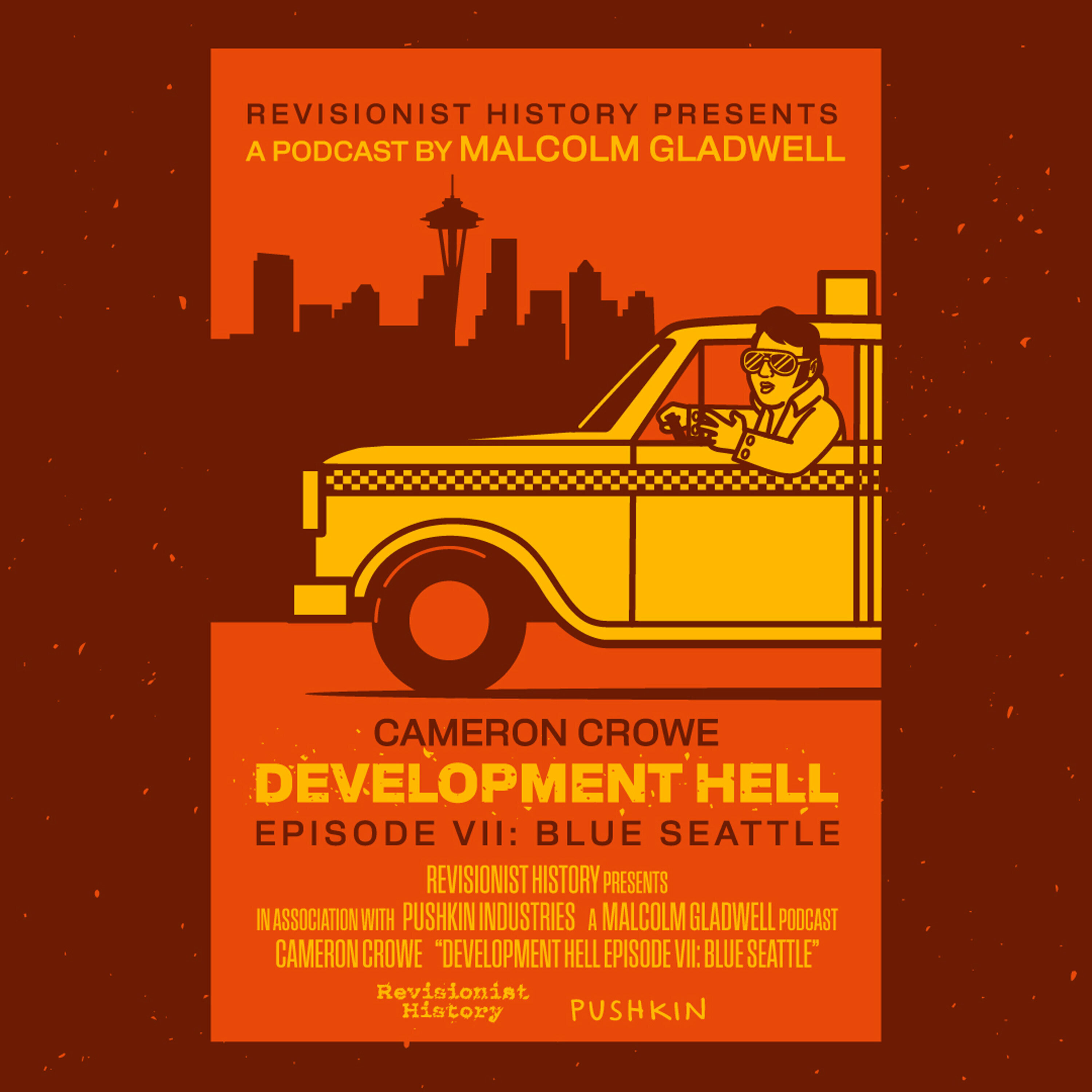
Blue Seattle with Cameron Crowe | Development Hell
In 1986, Cameron Crowe, the film director, and Nancy Wilson, of the rock group Heart, got married. They honeymooned in a little cabin in the Pacific Northwest, and while they were there decided to write a musical, about Elvis as a cab driver in Seattle. They wrote and recorded demos of all the songs, and called it “Blue Seattle.” It became a lost masterpiece that never saw the light of day. In our Development Hell season finale, Cameron joins Malcolm to share the songs and tell the story behind “Blue Seattle” for the very first time.
See omnystudio.com/listener for privacy information.
Available Results
Generated results are saved to the knowledge database for reuse and search.
Extract Knowledge
Pick what you want extracted first. Model, scope, and chapter options appear after a template is selected.
Transcript
00:00:15
Speaker 1: Pushkin. Hello, Hello, Malcolm Glabel here, and welcome to what might be the final episode in our development hell series of Revision's history. Today we're talking about Alvis Love down on his street. That person singing is not Elvias.

00:00:40
Speaker 2: These are the people.

00:00:42
Speaker 1: That's Cameron Crowe. You've seen his movies. Jerry Maguire almost famous, he wrote Fast Times at Ridgemont High, so many more. And the guitarist on this song is Nancy Wilson from the mega nineteen seventies band Heart, who at the time was Cameron Crowe's wife. And the story we're going to talk about today starts back in the summer of nineteen eighty six, when Cameron and Nancy were on their honeymoon. They spent it in a little cabin in the Pacific Northwest, a little cabin that would become the birthplace for today's movie that Never was Blue Seattle, a loving romp about two songwriters trying to write a movie for Elvis Presley, A movie about a couple writing a movie, written by a couple writing a movie. What's not to love? A script so meta that it belongs on the big screen. Only the big screen wasn't big enough to handle it or something like that, because one of the things that you might conclude in listening to this interview is that for Cameron Crowe, it is so much fun talking about his lost Elvis masterpiece that I think he's afraid that if he actually makes it, he'll feel abandoned, like a version of screenwriter empty nest syndrome. So let's tell the story of Blue Seattle. And this interview is different from all the other development hell stories we told on the series because instead of giving us the script to his movie, Cam and Crope gave us the songs he and Nancy wrote forty years ago. As in every Elvis movie, the best parts of the songs to capture a moment, that honeymoon bursts of creative inspiration, and they tell a story but a young couple in love. I've been looking forward to this. Let's start from the beginning because this is this is a story that needs, as you know, appropriate setup.

00:02:38
Speaker 3: Well, when we first talked, I went down a road that felt very friendly and evocative and filled with memories. Because you are an Elvis guy, your revisionist history on Elvis was seminal, and this idea of like never made projects from the heart and stuff. It combined with my love of Elvis and a particular part of Elvis to you just want to like put this in your lap, Malcolm. This is this was one that got away.

00:03:13
Speaker 1: Well, let's start with Elvis. So you your first concert you ever attended as a kid, right, is an Elvis concert?

00:03:21
Speaker 3: That's right? I won tickets on the radio.

00:03:23
Speaker 1: It's your twelve Yeah, something like that. Which Elvis are you getting in that low period?

00:03:28
Speaker 3: Elvis seventy two, Elvis.

00:03:32
Speaker 1: The big, the big high Collers.

00:03:35
Speaker 3: Big high Callers, karate kicks. He was a little obsessed with Nixon. In my San Diego Sports Arena show, he did an imitation of Nixon and at one point was on his back kind of kicking his legs, just having fun. The kid was having fun at my show.

00:03:55
Speaker 1: Baroke, it's baro You got Barroke Elvis.

00:03:58
Speaker 3: I got Baroque Elvis. But Malcolm, he did. There was one moment where it just broke through, like his genius really broke through. And it was a brief moment of sunlight through the clouds, but it was bridge over trouble water and I felt him connect and there was that moment where it was galvanizing and giving what he wanted to give, and the audience was like mid shriek and kind of taking it in. And and that was that was the DNA you were meant to build up from watching the show. Okay, there he is when you were feelings, it was kind of fun in games Elvis.

00:04:44
Speaker 1: And so this is so much of your life's work kind of grows, is growing from the tiny seed of not the all that of that Elvis concert, right, I mean almost famous. So this this concert had a huge impact on you.

00:05:01
Speaker 3: It did, and also also Malcolm because like I took my mom and my mom you know, if you if you've seen all famous.

00:05:11
Speaker 4: It's unfair that we can't listen to our music.

00:05:13
Speaker 1: It's because it is about drugs and promiscuous sex.

00:05:16
Speaker 4: Simon and garfun is poetry, Yes, it's poetry. It is a poetry of drugs and promiscuous sex. Honey, they're on POTT.

00:05:24
Speaker 3: So that week changes a lot. So this was the door that gets cracked open where rock and of course my future love and that combined with journalism. I was on my way, but Elvis was there at the gates, you know, and I still was obsessed with Elvis but I was obsessed with the corners of Elvis's experience, and one of those corners was his movies. And I loved those B movies. Some might even call them C and D movies. There he comes out of the box hot with Loving You and Jail House Rock, but eventually he's doing genre things for the money that Colonel Parker has put him up for. And you know, there's a set formula for the Elvis movies that happened. And I became obsessed with those movies.

00:06:18
Speaker 1: Yes, yes, And you became obsessed with them because I mean, one thing I was trying to figure out is I listened to the music of the project we're going to talk about. Was I was trying to understand your intentions and your So are you obsessed in a kind.

00:06:36
Speaker 3: Of that's so delicately put? I love it?

00:06:40
Speaker 1: Is it is?

00:06:41
Speaker 5: It is it?

00:06:41
Speaker 1: Are you winking at Elvis? Are you sharing in the fun? Or are you buying it?

00:06:48
Speaker 3: All of the above? All I think you just you just have to enjoy it for what it is, which which is a romp. Elvis often did three of those movies in a year. You can see he's kind of confused by the character names they call him by. It's like he's he's lost, He's he's brilliantly lost. It's just, you know, you see so much. It's almost watching his face in these movies. It's like a diary that he never wrote. You can see why am I here? You can see glimmers of oh this is good, and Margaret Viva las Vegas. Wait a minute, she's challenging me. So it's all there, hidden in this candy colored genre romp that the Elvis movies became so all of the above.

00:07:35
Speaker 1: Yeah, yeah, sir, So you developed early on, in other words, a rich and nuanced interpretation of who Elvis was and what he stands for. Yes, and that's that's Is there any other artist who plays a comparable role in your in the development of your imagination?

00:07:56
Speaker 3: No, because there's only one guy who was or artist who was so huge that he was able to make thirty throwaway movies that did well enough so that he could keep doing it, perhaps against his will. Only one person that I ever knew about, and we'll share this later, did ask Elvis, like, why did you make all those movies? And he gave this one person an answer, But mostly he never did any interviews. He never commented on it. He just did all those movies for fifteen years. They squandered quite a bit, you know, as John Lennon would would tell you in his interviews, like why is Elvis? Why is the King? Just like you know, strolling around Hollywood sound stages with B level stars singing like medium decent songs, you know, but that's part of the mysteries of Elvis.

00:08:48
Speaker 1: Yeah, yeah, so we have this. This is the kind of the necessary context, Yes, the story that you're gonna tell.

00:08:58
Speaker 3: Yeah, okay. So it's the eighties and I had written Fast Times at Ridgemont High which like amazingly kind of found an audience, so I kind of had a shot at possibly a screenwriting career. And in the middle of all this, I perhaps most importantly, fell in love with Nancy Wilson, the great Nancy Wilson, amazing guitarist, half of the Wilson sisters who front their band Heart. So we were together for a while and then decided to get married. And it was a beautiful time. And Anne Wilson, Nancy's sister, had a cabin in Cannon Beach, Oregon, and that was where we wanted to go for a little honeymoon, you know, just borrow the cabin from Ann. Now this you must know as a setup is Ann and Nancy Wilson. To this day, they're like the everly sisters. They sing together and it's like, you know, there's no thought that goes into it. They have the sibling voices that blend so beautifully their musical twins in a way, and sings. Nancy sing a little bit, but mostly plays this elegant, beautiful guitar. They're a serious duo. So ten days into our honeymoon, which was how long we wanted to spend at Anne's cabin, we decid we want to spend two weeks. We want to spend a little bit longer. But Anne wants to come to her cabin. So Ann Wilson shows up on our honeymoon, which is an interesting thing for a small cabin. It's like a sitcom in a way. Here you have the two sisters with you on your honeymoon with one of them, and what are you going to do in this in this small environment in a in a you know, coastal town in Oregon where not much is going on. Well, we're going to do a project, a musical project that will involve all three of us. Whose idea was this mine because I love watching them sing together. And Nancy would later score my movies and stuff, and so we worked really well together and AND's a lot of fun. Now, all all of this being said, I was working loosely on a book I wanted to do about Elvis movies, So so that was on my mind. And like any idea that you believe is good, it's built on the things you love, and Elvis was one. Playing music with my wife was another, and s c TV and Martin Short was a third element. I loved Martin Short, that great that great comedy show s c TV.

00:11:45
Speaker 1: Remember I'm Canadian.

00:11:47
Speaker 3: So here comes this idea for a kind of and this is the cousin of what you're doing, Malcolm. It's like lost masterpieces. What's What's What's something that like a movie that almost got made? And it's built on the burning fever inside your gut that this is the idea of all time. So I started building this idea of the great Elvis movie that never got made and what's the story behind it? And I decided that it was like you had Goffin and King, who are like a great couple songwriting their legends. They'd written all these great songs. The Beatles did some of them. I thought, like, what about a much lesser Goffin and King, Like, what about a couple who's the songwriting team They haven't gotten in the door. And it's Parnell and Zix was their name, Linda Parnell and Louis Zix. And Louis Zix of these two songwriters, is obsessed with writing. He hears Elvis may do one more movie, and he's gonna write with with with his songwriting partner wife, they're gonna write this song cycle for the ten songs of an Elvis movie that they're gonna pitch and make. And this is the beginning of Blue Seattle, which is their song cycle Malcolm, that they're gonna try and sell to Elvis himself. And so here on our honeymoon, I began to write these Elvis songs that were fleshed out with Ann and Nancy Wilson of heart and and and un ironically, really mostly we were gonna do these songs that that captured all the elements of the Elvis movie formula.

00:13:34
Speaker 1: Now, before we get into the songs themselves, which I have to say, are genius? I want you to define you said all the elements of the eleph movie formula. Break it down from before we start. What what are the elements, the crucial.

00:13:49
Speaker 3: Elements, okay, the the the Elvis elements of this. First of all, he has to have a name that sounds like a fist, you know, nothing too complex, just kind of like deep Rivers was one Buck Thomas, you know, so like we we thought, you start with a name that's like, you know, Mike Davis something like that. And and Elvis must always have workplace pride. He needs to do a couple different things in an Elvis movie of this era, but like they're often a strange combination of things, like he can be a veterinarian who's also a race car driver who also works in a county fair somehow living you know, a little kid should appear at some point looking for kind of some kind of mentorship, which he provides, usually in the form of a song. Dancing girls must appear.

00:14:52
Speaker 4: In the Garden of Paradise, Noble Master.

00:14:55
Speaker 3: So like that. It's worked in a fight, at least one fight, and a thoughtful moment over a pet. Come on, Albert, don't be a faint.

00:15:12
Speaker 1: A good album because, of course Elvis. Yeah, I mean his dog, his love of dog. I mean the seminal of what was the seminal dog in Elvis's life. I've now forgotten the one that song he used to sing over and over and over again as a teen was a song about a dead dog, Shep.

00:15:32
Speaker 3: Yes, wasn't it.

00:15:32
Speaker 1: I think it's Shep. Yeah. These are the kind of stations of the Elvis cross that you've.

00:15:37
Speaker 3: Us the stations of the cross. You can't say it any better.

00:15:42
Speaker 1: There's a lot going on in these movies.

00:15:46
Speaker 3: And he lined them up, man, he lined them up and did them. But then ultimately we end up at a place where Elvis's nobility is protected. He either gets the girl or he doesn't get the girl, and there's a there's a rave up song that sends you out feeling good.

00:16:03
Speaker 4: Yeah.

00:16:04
Speaker 3: Yeah, and that's the Elvis movie.

00:16:05
Speaker 1: Did you have you watched all the album Elvis movies?

00:16:08
Speaker 3: Yeah, definitely. And as long as you have these elements, you're in the ballgame. Yeah. And of course the songs are written outside of Elvis's experience, and usually they come to him and at some point and they play him the songs, and you know, legendarily he's like, no, no, okay, I do something with that. Okay, No, okay, now I'm tired, you know, Like, and they bring more songs another day. And these are songs that the songwriters have like killed themselves over because they know they're gonna have a session with Elvis, you know, yeah, yeah, And this was the songwriting couple in the story, my fictional story for lu Seattle, Like their dream is that they will one day be able to play these songs for Elvis and pitch this movie.

00:16:56
Speaker 1: Are we going to hear some of those songs, dear listener, Oh yes we are. After quick Break, Cameron Crowe is going to play us some of the music from Blue Seattle. So you sat down, you're there. How long did it take to write these ten songs?

00:17:18
Speaker 3: Like four or five days? Because I remember we made this cassette that we're going to listen to mercifully a little bit of yes, maybe a lot, but there's I remember we listened to it on our way back from the honeymoon. We were like, this is really pretty good.

00:17:36
Speaker 1: Yeah, wait, why don't we let's play that one? I actually I think you're being far too modest. I have another one I want to recommend, but we'll get to that one. Just play just to get us in the mood. Let's listen to your favorite of the ten songs you wrote.

00:17:50
Speaker 3: It's going to be My People, My People.

00:17:52
Speaker 1: Let's listen to My People.

00:17:54
Speaker 3: Let me set it up. We wanted to bring Elvis this movie in the late sixties because this is kind of the period where post Elvis has started to develop a little bit of a social conscience. So the idea is Elvis plays a cab driver in this who is a man kind of of the people. And so like the idea of Elvis roaming the streets in Seattle and like Pike Place and all that stuff. We loved it. And so there is a moment where he realizes he he must return to the relevance of the street where he was once this cab driver, and he leaves this relationship that has kind of belittled him in some ways. And so he's like going back to his roots, and he's singing this song from behind the wheel of his cab, My People, And it's always good. I'll just add this, It's always good when you have a little bit of a of a Spanish kind of castinette, you know.

00:19:02
Speaker 2: Clove down in his street watching from my seat. These are the people, my people in the city. Raid, I seem to know my these are the people, my people.

00:19:35
Speaker 4: I'm just an afty.

00:19:39
Speaker 6: How did mine.

00:19:42
Speaker 4: My review?

00:19:43
Speaker 2: Mar excuse me in my crime?

00:19:51
Speaker 4: I must be seeing my bride.

00:19:56
Speaker 1: For the people, the people of people people.

00:20:02
Speaker 3: A little bit.

00:20:03
Speaker 7: You're a moment in there, and now another one. He's gonna be clapping, even though he has danse hands on the wheel simp figure.

00:20:17
Speaker 1: It out almost.

00:20:26
Speaker 2: To the people.

00:20:28
Speaker 1: People you can. Actually, it's funny. That's like totally believable. Wasn't Elvis song? If Alvis? Have I heard that on an Elvis album? I'm not thinking twice about it.

00:20:48
Speaker 3: I've come such a long way to hear you say that.

00:20:52
Speaker 1: No, I mean I'm not I'm not blowing smoke here.

00:20:55
Speaker 3: No, I felt that too at your time. Almost sell that to to to Elvis. Yeah, for one of those movies.

00:21:02
Speaker 1: Yeah, who's playing guitar on that?

00:21:06
Speaker 3: Nancy and Ann are both playing guitar and singing, and I'm like attempting to do an Elvis voice?

00:21:12
Speaker 1: Yeah, which is it's not that the wake link for sure, it's not your range.

00:21:19
Speaker 3: Fantastic. You know, they can play anything at the drop of a hat, and their harmonies are so cool.

00:21:25
Speaker 1: Wait, let's so let's start from the view. So Blue Seattle is set's the is the first song sets the tone here, and we we're what are we? What are we doing?

00:21:35
Speaker 8: What do we?

00:21:36
Speaker 1: What are what are we trying to do? Narratively with Blue Blue Seattle.

00:21:40
Speaker 3: Usher you into uh an Elvis world of time and place and character. Yeah, where fun will perhaps abound.

00:21:48
Speaker 1: Yeah, let's let's play a little, just the first half of it, and then just to get a kind of feel we get in the mood, Let's let's hear a little bit of it.

00:22:10
Speaker 3: Leathers always in LUs.

00:22:18
Speaker 6: Green mountains, a maple.

00:22:36
Speaker 3: This is the native influence was thing through.

00:22:43
Speaker 6: I'm going back to the place where I'm.

00:22:49
Speaker 4: A pretty little ship of warm man. Just kg.

00:22:57
Speaker 1: The sticks are rare boom. I thought the opening this should be the theme for Seattle. First of all, Blue Seattle. Seattle needs to call itself blue because everyone thinks they're gray Seattle, so as a marketing campaign to remind us that the skies are blue in the mountains are green is like. And secondly, just those opening this place made the town made for love. I mean, come on, why is the city not make this just that those three opening lines. That's the That should be the official tagline for Seattle.

00:23:34
Speaker 3: Everything takes its time. I'm realizing to come to this crossroads with you is really meaningful. So yeah, once he did. It happened at the World's Fair in Seattle. So this is like a reunion with uh, with an Elvis city that's like undervalued as an Elvis city.

00:23:51
Speaker 1: But wait, yes, Elvis. Elvis plays Seattle during the expo.

00:23:58
Speaker 3: He makes a movie. It happened at the World's Fair. I forget who the co star is, but like the space needle is on the poster for it.

00:24:07
Speaker 1: It's a good nastic oh oh wow, a little kind of a little a little a little phallic imagery to add to the we then we come to pay the fair. Yeah, and as you said earlier, in the kind of like in the Elvis movie taxonomy that you created, he needs to have multiple jobs, but one of them has to be a kind of keeping it real, that's right. And so the keep it real job we have here. We understand that he's a cab driver.

00:24:36
Speaker 3: He's a cab driver, looking for love.

00:24:39
Speaker 1: Looking for course. Yeah, let's do let's do it. Let's do a minute of let's do a minute of of pay the fair.

00:24:45
Speaker 3: We'll see the little girl.

00:24:48
Speaker 5: I'll stand a rod over there, maybe forty.

00:24:55
Speaker 8: Understand she's a watch.

00:24:59
Speaker 4: He's a watch.

00:25:00
Speaker 8: He's a watch. He's a wall.

00:25:05
Speaker 2: A fair.

00:25:09
Speaker 3: Yuh, that little girl a little lot of like you. But das and they sound and Nancy sounds so good on this, they don't.

00:25:23
Speaker 1: I know that the thing that makes this genius is because understanding that we have the Wilson sisters doing the do do Do Do Do Do.

00:25:28
Speaker 4: Do right.

00:25:38
Speaker 1: Came when you when you're doing this project? Are they what's there? They as into it as you are? There?

00:25:47
Speaker 3: I mean A we're bored, yeah, but b it's it's a it's a great question. There was mist there's like waves crashing on the below these little cliffs where we're staying, and in the middle of this we're just like howling through these Elvis songs. It was amazing.

00:26:07
Speaker 1: Honeymoon is there Is there a lot of weed involved or not?

00:26:15
Speaker 3: Not really? Not really. I think a lot of beers. I think we were just like lining up beers doing some of this stuff. Yeah, yeah, I think I think we would have lost our hard Elvis edge if we'd gone to the weed too much. That would be the later Elvis movie, that's right. So Hiccups is the one's there's usually a novelty song that's completely embarrassing.

00:26:39
Speaker 1: Oh that's what Hiccup is doing.

00:26:42
Speaker 3: Yeah, where Elvis is asked to do something that's really kind of beneath him and he knows that. You can always see it in the movies when he's asked to do this, to play patty Cakes with a little kid, or or do a move like that, he usually, if you're really looking at it with a microscope, he has a little fun and then it gets old because they're asking him to do a number of takes you can usually tell. And so by the end of the novelty song in the movies, he's so ready to move on. But but it's important that he bonds with a child and a pet.

00:27:15
Speaker 1: Yeah, yeah, those are crucial.

00:27:19
Speaker 7: You know.

00:27:20
Speaker 1: It's just impossible not to be filled with sympathy for Elvis. I would want no part of his life. It just said. Everything about it just sounds he's locked up in this gilded cage and he just sounds like he's desperately unhappy almost all the time.

00:27:36
Speaker 3: Yes, and the further you go into the movies, you see the anguish start to turn up. You can see the anguish build and sometimes for whole movies he's annoyed, kind of just wondering why he's there while he's doing these lines.

00:28:00
Speaker 1: Yeah, yeah, it's so. It's so heartbreaking, it is, but still a little bit of hiccups, just so we understand this the novelty because now that you say that, it made I was puzzling. I was listening. It's like, why is hiccups here? That's here?

00:28:18
Speaker 2: Part this partlet a rhyme, the hiccup, No friend of mine, there's no way to rid yourself.

00:28:27
Speaker 1: Oh this a little scat hellup, yeah, big.

00:28:40
Speaker 6: Big.

00:28:41
Speaker 1: I was humming this to myself after a mile around.

00:28:45
Speaker 3: Now this year. Right, this is a heartbreak. This is like the guy who was truly dangerous is now doing the hiccup song.

00:28:52
Speaker 4: Yeah.

00:28:52
Speaker 3: Yeah. Culturally, my and.

00:28:56
Speaker 1: That line at the end, my prescription is simply love. When he goes to yeah, when he goes to all the cures for the hiccups and then he comes as to the only one that works for me is love, which by the way, is like so poignant and so true. The one thing he was lacking was love. Right, That's a truer line has really been written of Elvis that he got every other drug in quotes offered to him and none worked. The only thing you need it was Yeah, it was.

00:29:26
Speaker 3: Super well said, and there was buried in the Hiccup song.

00:29:30
Speaker 1: But the way, what's hilarious continuing hilarious is I said before the contrast between two of the great guitar players of our generation. And then it's a good Elvis impression. But as you say, you if you are the weak, you could only be you could only be though in this company.

00:29:49
Speaker 3: That's that's true. It's true. And and of course story wise, which we'll we'll get to.

00:29:55
Speaker 4: It.

00:29:56
Speaker 3: These are the demos that the songwriting team within the story are going to present to Elvis. So this would be they're recording these themselves present to him, which which i'll you know, we'll talk about in a second. Yeah, yeah, I'll be brief.

00:30:12
Speaker 1: I want to I want to play I want to play One Chance to Love and then we listen, let's talk a little bit more about about about context. This this is this is where in this functions how.

00:30:24
Speaker 3: I think this is kind of the looking over his shoulder at the romantic landscape of Blue Seattle. He kind of steps out and it's a single man in the spotlight Roy Orbison kind of song. Yeah, that allows him to uh, you know, flex his his vocal Elvis chops.

00:30:45
Speaker 1: And this time I think we should listen to the whole song. I think it's a lovely song. Yeah, just do the whole thing.

00:30:51
Speaker 8: H m, Dom, I've known you.

00:31:07
Speaker 2: And yet I've loved you. No old as many greedy men.

00:31:16
Speaker 3: With hands and gloves.

00:31:20
Speaker 2: But I just want one.

00:31:23
Speaker 4: One chance too loud.

00:31:30
Speaker 3: What I want you to know? I am everything, yea Christ. I don't have a lot to give, but I'm giving it all here.

00:31:45
Speaker 4: You coming man.

00:31:55
Speaker 1: So helpless.

00:31:59
Speaker 8: Would ask for.

00:32:05
Speaker 2: Chances to look what I means.

00:32:10
Speaker 8: No, I'll take my chid.

00:32:14
Speaker 1: I'll take my chance of just one.

00:32:18
Speaker 4: What chance?

00:32:49
Speaker 3: There's only one chance, There's not two, there's only one.

00:32:57
Speaker 1: I just think s great. I just I just love this one.

00:33:03
Speaker 5: We're building We're building this olf, Yeah.

00:33:25
Speaker 1: We're we're we get the Wilson Sisters at the end.

00:33:28
Speaker 3: You can't beat it.

00:33:29
Speaker 1: We have real singers at.

00:33:31
Speaker 3: The end, but the situation forgot what real city is like.

00:33:35
Speaker 1: It's the least demo.

00:33:36
Speaker 3: Ish mm hmmm mm hmmm.

00:33:39
Speaker 1: It feels like by the end of this you're your enthusiasm for the project is increasing.

00:33:44
Speaker 3: You're exactly right.

00:33:46
Speaker 1: That is the most Elvis, that's the most pure. If you played that for anyone and said who would be the ideal singer for that? Everyone everyone would say Elvis, that's an Elvis song.

00:33:58
Speaker 3: I'm so close to it, you know, I'm When you're the artist, Malcolm, it's hard to look outside the character you're playing. Sometimes. No, that's amazing, Thank you. I still one chance to love.

00:34:10
Speaker 1: Yeah, Okay, now that you've heard the songs, I think you understand why I needed to see this movie. We're gonna take a short break. When we come back, we talk about how the story of the film turns out and what it all means. So we've we've we've got our ten songs, and now we're this is the core of a of a narrative. You want to do you want to do this kind of tongue in cheek Elvis movie, Yes, pretending to.

00:34:52
Speaker 3: Tell the story of how it almost happened? Or yeah, could have happened that that idea is what kind of landed for for this.

00:35:03
Speaker 1: So to go back to the screenplay, did you actually write a screenplay around those songs?

00:35:07
Speaker 3: I did? I did?

00:35:09
Speaker 1: So how does it begin with those two characters dreaming about writing an Elvis movie?

00:35:14
Speaker 3: Yeah, and enjoying enjoying one of the movies and trying to be productive in their own little songwriting career. And I got the feeling story wise that Elvis had done the Comeback Special and just maybe he had two more movies that he did after that. I think he did. I could be wrong. I think he did. He did a movie called let Me See Chautauqua was the name of it, and it was kind of like a sought after property. And he does this movie Chautauqua, but by the time it comes out, they've changed the name to The Trouble with Girls and how to get into it? So so dashed again or his you know, dying embers of an acting career. And then he goes into the last one, which is Change of Habit, which he does with Mary Tyler Moore, and of course he plays a doctor.

00:36:13
Speaker 1: In a movie with Mary Tyler Moore.

00:36:16
Speaker 3: The last one, it's the last one. So I got the idea that our little songwriting duo gets a shot. That's the dream to get the shot with Elvis. They're they're ushered in and they have a moment in his trailer where he's in his doctor uniform. There's a guitar in his trailer. He's on a break doing you know, change of habit, and he and he ushers them in and they're kind of nervous. Our guy, the main guy who's who's like an Elvis fanatic and has like really studied Louis Zix has studied Elvis. But anyway, they run through the songs. But before they do, Elvis says, you know, not real talkative, totally charismatic, bronze in his doctor outfit. He says, I always wanted to be in a good movie. I don't know I'm gonna I'm gonna do this very much anymore, maybe never go ahead. So with having led with I'm not really doing this stuff anymore. These guys earnestly run through the songs, and Elvis listens and he says, let me, let me, let me, let me have the sheet music for the the Cab Driver my People song. And there's one guy that's written the songs, plays the guitar his Elvis's guitar and accompanies him, and Elvis sings My People in that little trailer, and then a guy comes to get him to do a scene and he's leaving, and our guy, Louis says, Elvis, why'd you do all those movies? And I used the line that I had heard from the actual story where somebody asked him that, and he said, hey, man, last thing I remember I was driving a truck. And he laughs and leaves, and we're left with the songwriting couple, and the wife of Louis says, I think he said no. And Louis says, yeah, but what a no? That's like the greatest no ever. And she says, sometimes a no is maybe even better than a yes. And that's that's the end of Lost Masterpieces, the movie that never gets made. Elvis never makes another movie, but they have that moment in the trailer that that where it all came to life for one minute while he sang the.

00:38:56
Speaker 1: Song, yeah that truck. Last thing I remember, I was driving a truck.

00:39:01
Speaker 3: Yeah, I'll tell you where it came from. Leon Russell, the great you know, pianist and member of the Wrecking Crew and stuff. Besides being you know, genius solo artists, he played on so many records, and he played on a bunch of Elvis records. And he was in the RCA studios in the hallway and he sees Elvis coming down the hallway and they hadn't seen each other since playing on a session, and Leon Russell described it as he kind of like developed Elvis Turett's you know, he just like, what do you say to him? And he ended up blurting out, Elvis, why'd you make all those shitty movies? Just yucking it up in a studio hallway, and Elvis said, last thing I remember, I was driving a truck and like walks on, you know, driving a truck in Tupelo basically, and then the hurricane.

00:39:53
Speaker 1: His whole life is just a blur.

00:39:55
Speaker 3: That's what he means.

00:39:56
Speaker 1: Oh, that's what he means.

00:39:58
Speaker 3: But yeah, but.

00:40:00
Speaker 1: Cameron, well, once again, it's just it's so heartbreaking.

00:40:05
Speaker 3: It is heartbreaking the idea that.

00:40:07
Speaker 1: He would confess. He's essentially confessing to the fact he's had no agency over his own career, which we know is the truth of his own career. Yeah, that he just completely surrendered all decision making to somebody out to this kind of bad surrogate father.

00:40:23
Speaker 3: Yeah, and clearly, in what little research I've been able to do in the years passed our little novelty project here, he didn't appreciate his movies. He never apparently had the moment of watching him at two or three in the morning and saying, like, shit, it's kind of good. I think he mostly became ashamed of them.

00:40:49
Speaker 1: Yeah, But also the idea of doing this kind of bittersweet Elvis, who's aware of his own kind of loss and failure in some sense, and who you know, they're coming to him and they're confronting him with more of the kind of falsehood, you know, like a kind of act, and like that's and he just he can't do it anymore.

00:41:16
Speaker 3: Driscilla Pressley said, there's a version of Elvis that few people ever saw. And they would go to the outskirts of town to like gospel festivals, and Elvis would sit at a piano with with like a gospel group who was just like kind of an amateurish gospel group, and he'd sing at this piano and she would say that was the purest Elvis that was him just connected to his own heaven. That was it. And she said, like, if you're going to do something about Elvis and not have that in, you're not seeing the real guy. So I felt like that moment in the trailer he actually there was. There was just a love of music and there was something in that song that like touched him enough to want to sing it. And he who is he if not a singer? And so he takes a spin. He takes it for a spin, and that was his goodbye. It's like.

00:42:15
Speaker 1: In the screenplay, how much of Alvis had we seen prior to the trailer?

00:42:21
Speaker 3: Oh? Nothing, He's like Wolfman Jack in American Graffiti or something. It's like, so we have a brief.

00:42:29
Speaker 1: That he has that cameo right at the very end.

00:42:32
Speaker 3: Yeah, they're just jamming like we're on the honeymoon. They're trying to like it's the joy of their creation that the songwriters the whole story really is. They're living in it and experiencing it like we did on our honeymoon. But but I think that line is is cool because maybe maybe his partner realizes that the act of actually doing it and pulling el of us back into a place that he was obviously leaving, and like, how will the songs really turn out? And are they out of step with the times? Like these are all challenges that they don't have to face. They got to see it, and damn it was good.

00:43:16
Speaker 1: Yeah yeah, oh man, Cameron, Why have why have we been denied this? This is so much more interesting than I imagined I thought what you were doing because all I had was the songs you sent me, the songs. I didn't have the story, and I thought, oh, this is like a goof I just thought, oh, you're just like someone loves Elvis is doing a little goofy Elvis. But now I understand, as is the case with so many of your movies, when we get to the core of it, there's there's something really emotionally resonant there, like painfully, painfully emotionally.

00:43:59
Speaker 3: So it's that happy sad feeling that you know, like the songs we love so often tap into the happy sad feeling of you know, the ying and yang, and you get to feel it all.

00:44:13
Speaker 1: So did you pitch this script anywhere?

00:44:17
Speaker 7: No?

00:44:17
Speaker 3: I kind of wrote it and enjoyed it and moved on to something else.

00:44:23
Speaker 1: Why didn't you pitch it?

00:44:25
Speaker 3: I hadn't started directing yet really, and by the time by the time that I did, I was already off on another journey. But I mean, I always loved the idea of the dream that almost happened. And this, this is what you're digging into right now. There's there's an incredible kind of like happy said, melancholy about you know, some of some of the Christopher Guests stuff in the way that that it was influencing me around this time and later too, Like I just loved the humanity and the humor and the mix of that. I don't know it just maybe someday I'll circle back to some version of this. But I did love the idea of a portrait of these artists, just like scraping for something true and a different truth comes out of it.

00:45:18
Speaker 1: On this season's development Hell series, we've heard stories about my brush with Hollywood Glory science fiction tales never were chimped forward Michael Jackson biopics. But I wanted to tell you about Blue Seattle at the end of it all, because this conversation was my ticket out of development. Hell Crow and Nancy Wilson got divorced some time ago. We didn't talk about that, but I think it was part of the happy sad feeling I got listening to these songs they made together right when they got married. Crow is the king of happy sad on film, the kind of instant nostalgia. It's all about feeling joy while knowing it will pass, that all things fade, but not if they never exist in the first place. That's the beauty of development. Hell I thought it was all about missing out on projects the world deserves to see, and for some films, like say Bubbles, it really is. But it's also about ideas so perfect that realizing them on screen might do them a disservice. Will anyone's elbows be better than Cameron Crowe singing with Nancy Wilson ten days after they got married? How could you even shoot the scene with the songwriters run through all the songs they've written in a trailer? How's Elvis gonna clap his hands while driving his cab? Would it look ridiculous? Maybe that's not the point. Does it sound amazing? Absolutely? And does it come to life in our imagination? Yes?

00:46:42
Speaker 4: It does.

00:46:44
Speaker 1: It's like Louis's wife says, sometimes a no is better than a yes. This episode of Revision's History was produced by Nina Bird Lawrence and Ben and Alfhaffrey, with Talian editing Sarah Nix, original scoring by Lubiskarra engineering by Echo Mountain. Our executive producer is Jacob Smith. Thanks to the Pushkin Crew, Greta Cone, Christina Sullivan, Sarah Nix, Nicole upten Bosch, Eric Sandler, Sarah Bruger and Kerry Brody. An extra special thanks of course to Camera Crow. I'm Malcolm Glappa.

00:47:29
Speaker 4: One too loud?

00:47:36
Speaker 8: What I love?

00:47:51
Speaker 4: Ye man, There's so.

00:48:01
Speaker 8: Many of us who that's what one.

00:48:10
Speaker 6: Whatever?

00:48:10
Speaker 2: Let the chances to look, but not me.

00:48:14
Speaker 8: Donald. No, I'll take my shot.

00:48:19
Speaker 2: I'll take my chances.

00:48:21
Speaker 8: Just what chance? It's true?

00:48:31
Speaker 4: What's it?

00:48:52
Speaker 6: Chimes one sends to

00:49:24
Speaker 8: Chans to