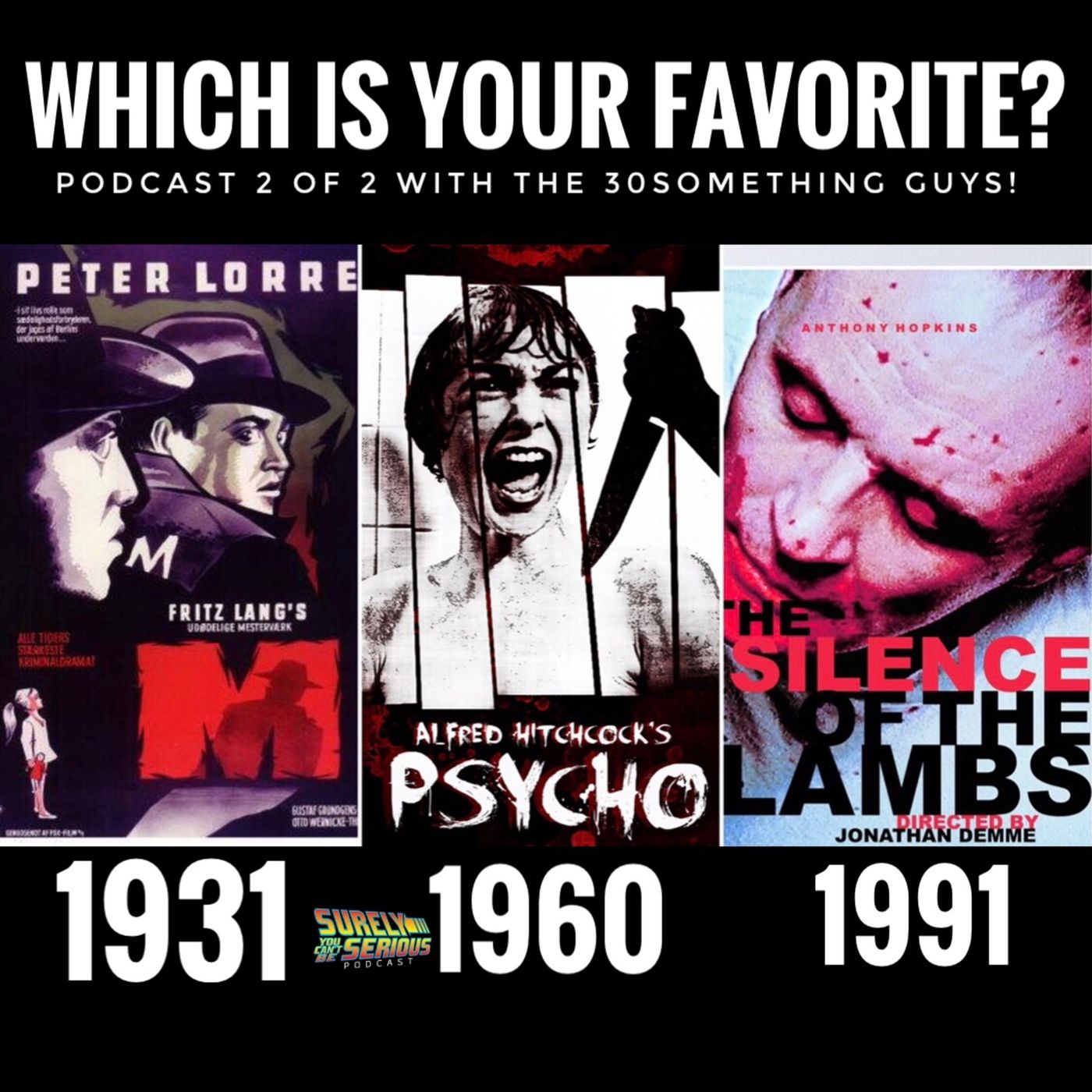
"M" (1931) vs. "Psycho" (1960) vs. "The Silence of the Lambs" (1991): Part 2
When these three movies were released they chilled people to the bone! Some people described these films as dark, morbid, even grotesque! Join us as we take a deep dive into these three chilling thrillers with our good friend at the 30something Movie Podcast. Fava beans and chianti are optional!
2021-10-12
72 min
Transcript
Available Results
Generated results are saved to the knowledge database for reuse and search.
No generated results are available for this episode yet.
Extract Knowledge
Pick what you want extracted first. Model, scope, and chapter options appear after a template is selected.
Generated results for public episodes are saved to the knowledge database so they can be reused and searched later.
Transcript
<v Speaker 1>Hello everybody, and welcome back to the Shirley You Can't
<v Speaker 1>Be Serious Podcast. I am here in my grandmother's wig
<v Speaker 1>and long dress with my butcher knife, and Jason is
<v Speaker 1>over here in his skin suit with everything nicely tucked.
<v Speaker 1>We are sitting down to a beautiful dinner of liver,
<v Speaker 1>farvar beans and a nice chiante. I can't wait to
<v Speaker 1>dive into this. We are back with the thirty something
<v Speaker 1>movie podcast. Guys again, We're jumping back into our conversation
<v Speaker 1>on the movies m Psycho and Silence of the Lambs. Okay,
<v Speaker 1>so what do you guys think is the best scene
<v Speaker 1>in the movie? You got to pick one scene? Is
<v Speaker 1>the best scene? What are you going to? Which one
<v Speaker 1>are you gonna pick?
<v Speaker 2>I'm going to go and Peter Lourie, Oh if something
<v Speaker 2>else go first?
<v Speaker 3>Go ahead.
<v Speaker 1>No, you already start a good book.
<v Speaker 2>It breaks down.
<v Speaker 4>He gets his lines at the end, and there's the
<v Speaker 4>big kind of if you want to call it a monologue.
<v Speaker 4>And I think the anguish and the torture of you
<v Speaker 4>presenting this problem of this is me. I have this issue.
<v Speaker 4>What are you going to do with it?
<v Speaker 2>What do you know?
<v Speaker 1>Like it?
<v Speaker 4>I can't help it, and I think it's a pretty
<v Speaker 4>passionate throws people into it. You know, how do you
<v Speaker 4>deal with this problem now? Because you want to hate him,
<v Speaker 4>and we do, But at the same time, he's explaining
<v Speaker 4>that this is not my choice, this is something that
<v Speaker 4>I am sick, I am ill, and what do we
<v Speaker 4>do with the sick and ill in our society, especially
<v Speaker 4>when they're harming our children. It gives you that ethical
<v Speaker 4>dilemma to a certain degree where you don't feel necessarily
<v Speaker 4>I wouldn't say simply, well, would it be sympathy. Maybe
<v Speaker 4>it would be sympathy or empathy maybe a little bit.
<v Speaker 4>But I think that that scene it there where because
<v Speaker 4>now it's just you know, all along it's him, so
<v Speaker 4>there's no hiding of who done it. But now you
<v Speaker 4>get to hear him talk really for the first time,
<v Speaker 4>and what he says isn't like it's almost disarming to
<v Speaker 4>a certain degree for people with this kind of mock
<v Speaker 4>trial going on and what appears to be like a
<v Speaker 4>basement somewhere.
<v Speaker 1>So I think all.
<v Speaker 5>Three of these movies do a great job of adding
<v Speaker 5>a bit of sympathy for the bad guy.
<v Speaker 1>Right.
<v Speaker 5>We feel bad that the kangaroo Courts about to pull
<v Speaker 5>this guy apart, you know, and Norm Bates we feel
<v Speaker 5>a little bit bad. This guy's got major issues, you know,
<v Speaker 5>he's got trouble. And then even Buffalo Bill, I'm like,
<v Speaker 5>this guy's messed up.
<v Speaker 1>He yeah, I mean we'll get to we'll get to
<v Speaker 1>that in a minute. But that's not the best scene.
<v Speaker 1>But the scene where he's talking to her in the
<v Speaker 1>pit and he keeps trying to say, you know, it
<v Speaker 1>will put the lotion on, it will put the lotion on.
<v Speaker 1>Ted Levine does a fantastic job of showing you that
<v Speaker 1>he's having difficulty controlling the sadness he has for the
<v Speaker 1>creature that he's trying to kill. You know, he's trying
<v Speaker 1>to keep separate. You can see him struggling, and then
<v Speaker 1>you know the way he overcomes to that is to
<v Speaker 1>start screaming at her in a different.
<v Speaker 2>Way, fighting the urges too.
<v Speaker 4>They're they're battling their demons and you get to experience
<v Speaker 4>it through those exchanges, and in this one with them,
<v Speaker 4>it's it's again the whistling that never seems perfect. You know,
<v Speaker 4>it's not like he's whistling like the best whistling. And
<v Speaker 4>then there's the one scene where he's whistling and it's
<v Speaker 4>like almost an angry, frustrated like I can't control this,
<v Speaker 4>and he's whistling, and like you can feel the struggle
<v Speaker 4>of him trying to keep it at bay and keep
<v Speaker 4>those bad thoughts at bay, and he's struggling, and the
<v Speaker 4>whistling becomes you know, it's not like an enjoyable sinister whistle,
<v Speaker 4>you know, which which it maybe sort of feels like
<v Speaker 4>in the beginning, but then you start to seal it
<v Speaker 4>and see that it's just it's almost torture for him.
<v Speaker 1>What he says is that he is tormented by the
<v Speaker 1>souls night and day, the tormented by his victims, tormented
<v Speaker 1>by the thoughts of their mothers, tormented always and forever
<v Speaker 1>except when he's doing it. The best scene for me.
<v Speaker 5>I don't know if i'd call this the best scene,
<v Speaker 5>but maybe it's the plot device whatever.
<v Speaker 1>I really like how you got the cops.
<v Speaker 5>Who are like, listen, we got to find this guy
<v Speaker 5>right now, and then you got the under world who's like,
<v Speaker 5>we got to find this guy right now.
<v Speaker 1>These cops are all over the place because of this guy,
<v Speaker 1>and we got to get rid of them, right Yeah,
<v Speaker 1>it was.
<v Speaker 5>It was, and it kept cutting back and forth between
<v Speaker 5>the meeting with the cops in the game.
<v Speaker 4>Take a little of the of a Dark Night, where
<v Speaker 4>it's like the bad guys are having that meeting.
<v Speaker 2>Yeah, problem, you know.
<v Speaker 1>This is exactly Yeah. It was much more enlightened than
<v Speaker 1>I thought it was going to be for a nineteen
<v Speaker 1>thirty one movie. I just was like, Wow, they're really
<v Speaker 1>talking about the struggle of the psychology of the murder
<v Speaker 1>of the child murderer. Here are we really exploring that?
<v Speaker 1>And then to leave it with the question unanswered of
<v Speaker 1>what do you do? Fritz Lang wants to say that
<v Speaker 1>you know that the point is to take better care
<v Speaker 1>of your kids, But I think the question is who's
<v Speaker 1>going to cast the first stone? I think that's what
<v Speaker 1>the question is, right. Do you put the mad dog
<v Speaker 1>down like the lady in the Kangaroo Court says you
<v Speaker 1>should do, or do you commit them to an asylum
<v Speaker 1>and try to care for him or I don't know.
<v Speaker 1>It's stuff. I watched it with my eighteen year old too,
<v Speaker 1>and she was like, this is one of the best
<v Speaker 1>movies I've ever seen. I was like, wow, this movie
<v Speaker 1>is ninety years old.
<v Speaker 6>Well, I can't say, like what you just said like
<v Speaker 6>codifies it so well? Like what really hooked me into
<v Speaker 6>this movie? And I know we were talking about like
<v Speaker 6>a comparison to Jaws. This movie almost did for me
<v Speaker 6>what Jaws does. Where Yeah, it's about the shark and
<v Speaker 6>it's about an adventure on the ocean, but that's great,
<v Speaker 6>but it's also an exploration of humanity and not only
<v Speaker 6>with you know, in Jaws you have those three lead characters,
<v Speaker 6>you know, like each hitting the problem from a different aspect,
<v Speaker 6>but then it's also all about the townspeople and or
<v Speaker 6>the island people and how are they responding and the
<v Speaker 6>mayor how is he responding? And oh, well is the
<v Speaker 6>shark a big problem? Or hey, you know it can happen,
<v Speaker 6>but we're still going to go swimming and odds are
<v Speaker 6>will be okay. I had the same feels watching this movie,
<v Speaker 6>just seeing everybody react to what was happening, and I
<v Speaker 6>saw a lot of I heard and felt a lot
<v Speaker 6>of the same beats like well, I don't have kids,
<v Speaker 6>this doesn't affect me, or we all need to be
<v Speaker 6>in together. Well everyone's not in it together, guys. I
<v Speaker 6>think that was like the city planners and the government
<v Speaker 6>was like not everyone's going for the Hey, let's do
<v Speaker 6>this together. So how do we get people on board
<v Speaker 6>with this? And I mean it was like wow. So
<v Speaker 6>it kind of was in a way. A lot of
<v Speaker 6>it was like less about the killer and catching the
<v Speaker 6>killer and more just watching everybody in society react and
<v Speaker 6>like you said, like that hit me like holy buckets.
<v Speaker 7>Ninety ninety years old.
<v Speaker 8>Favorite, I mean favorites for me is probably the one
<v Speaker 8>Dennis mentioned at the very end when he just they
<v Speaker 8>bring him into that court and he just starts to
<v Speaker 8>unleash and try to explain or just try to unburden
<v Speaker 8>his soul on you know why he's been knowing what
<v Speaker 8>he's doing. But if I'm going to pick a different one,
<v Speaker 8>I would go pick the scene where there's the kind
<v Speaker 8>of little old man and he's walking down the street
<v Speaker 8>and the little girl or the kid stops and asks
<v Speaker 8>what time it is, and all of a sudden, everybody
<v Speaker 8>starts crowding around, like why are you talking to this kid?
<v Speaker 8>What are you doing? What I couldn't get out of
<v Speaker 8>my head watching this movie was the idea that it's
<v Speaker 8>ninety years old. This was nineteen thirty one and I'm thinking,
<v Speaker 8>this is nineteen thirty one and Germany. What is going
<v Speaker 8>on in the early nineteen thirties and Germany it's I
<v Speaker 8>don't even want to say the calm before the storm.
<v Speaker 8>It's the like despair before the storm of the Great
<v Speaker 8>Depression and what the people of Germany were going through
<v Speaker 8>and all the unemployment and just all of the absolute
<v Speaker 8>I mean, that's what I used to teach in my
<v Speaker 8>social studies class, was just the absolute desperation that led
<v Speaker 8>to the rise of the Nazi Party to replace the Reichstag.
<v Speaker 8>And you know, watching this movie, I'm watching a scene
<v Speaker 8>where you have this community that I'm sure in any
<v Speaker 8>other time these people wouldn't be jumping on each other
<v Speaker 8>at the first chance they get, but because of the
<v Speaker 8>despair and the paranoia and the just this creeping feeling
<v Speaker 8>that you can't you feel helpless to do anything about,
<v Speaker 8>you know, I think that kind of sums up what
<v Speaker 8>the people of Germany were feeling like during the Great
<v Speaker 8>Depression and during this late twenties early thirties time. But
<v Speaker 8>just that scene to me as I'm watching it, and
<v Speaker 8>everybody starting to gang up on this man just because
<v Speaker 8>he told the little kid what time it was. I
<v Speaker 8>just I could not separate that. I could not divorce
<v Speaker 8>it from what was going on in this period in history.
<v Speaker 8>And so that scene, even though it may not be
<v Speaker 8>a major scene in the movie, like that one hit
<v Speaker 8>me as I was watching it, and.
<v Speaker 4>It's not exactly the same thing. But when I think
<v Speaker 4>of twelve Angry Men, twelve Angry Men leaves you. As
<v Speaker 4>a kid, I remember going, but wait, did he get
<v Speaker 4>is he guilty? Was he not guilty? Asking my dad
<v Speaker 4>as probably like an eight year old at the time,
<v Speaker 4>or a ten year old, because my dad just saw
<v Speaker 4>that movie over and over and over and over again.
<v Speaker 4>And I remember like being somewhat frustrated as a child
<v Speaker 4>that I wanted the answer, and then I realized as
<v Speaker 4>you grow older that it's the question that's more important
<v Speaker 4>than the answer. And then this I think it's the
<v Speaker 4>same thing. And to me, the question is what do
<v Speaker 4>you do with somebody who's mentally ill? Is it morally
<v Speaker 4>justified to kill them and execute them? Is it morally
<v Speaker 4>justified to put them in jail and take care of
<v Speaker 4>them and pay for them, you know, and keep them
<v Speaker 4>and try to keep them away from people. But what
<v Speaker 4>if he gets out the arms again? Are you now
<v Speaker 4>cupable because you allow?
<v Speaker 7>You know?
<v Speaker 4>So it opens that whole big discussion and thought process
<v Speaker 4>of what do you do with the second society? The
<v Speaker 4>people are not well in our harmony others, and do
<v Speaker 4>we become monsters?
<v Speaker 5>Answer that question in Psycho as you put him away
<v Speaker 5>for twenty years and then when you let him out
<v Speaker 5>he starts killing people again.
<v Speaker 2>Yeah.
<v Speaker 1>Psycho Too written by It's the guy did Frida Night
<v Speaker 1>right exactly, same guy did frid Night, Tom Holme. Yeah,
<v Speaker 1>that's right. You seen Psycho too? Yes, that's pretty good. Yeah,
<v Speaker 1>it's worth watching.
<v Speaker 2>Psycho two is pretty good.
<v Speaker 4>The worst thing about Psycho that I think when I
<v Speaker 4>get the bad tastes when it was the remake with
<v Speaker 4>the guy's a comedian.
<v Speaker 1>Yeah, yeah, yeah, I get a quick question? So who
<v Speaker 1>who played an Hash's sister who comes looking for after it?
<v Speaker 1>Is it Jillian Moore? That's what I was wondering. It
<v Speaker 1>is Julian Moore? I think who played Clarice Starling in
<v Speaker 1>the next Sorry yeah, no said, I just just occurred
<v Speaker 1>to me. I'm just like, was she in like the sequel?
<v Speaker 1>The bad sequel to both of these? She was in
<v Speaker 1>the Bad sequel to Psycho, and she was in the
<v Speaker 1>bad sequel to Silence of the Lambs. Yep, yep, there
<v Speaker 1>you go. All right, she participated in the eating of
<v Speaker 1>his brains. Oh yeah, but she was in The Big Lebowski,
<v Speaker 1>so that she's in Things and Boginos and Jurassic Park two.
<v Speaker 1>Which that is.
<v Speaker 9>The takeaway is if you want your movie to suck
<v Speaker 9>as a sequel, Julianne Moore as a way to go.
<v Speaker 4>Yeah, yeah, the sequel to the you know, the Hannibal
<v Speaker 4>one with Juliane Moore in there.
<v Speaker 2>I remember watching it. I didn't think it.
<v Speaker 4>I wondered always too, like, obviously, the first one is
<v Speaker 4>such a classic that the other one is not gonna
<v Speaker 4>be able to top that. If that other one was
<v Speaker 4>the first one, would we have felt as bad about it,
<v Speaker 4>you know as people sound like diffel Because I didn't
<v Speaker 4>think it was horrible.
<v Speaker 1>We turned it off in my house when he started
<v Speaker 1>feeding him his own brain. How was the turnoff point
<v Speaker 1>for us?
<v Speaker 8>I've never actually really liked ray Leota as an actor
<v Speaker 8>all that much, so I really enjoyed it.
<v Speaker 5>I just couldn't handle Clarice going away with him. I
<v Speaker 5>just couldn't get over that part. Okay, So over to Psycho,
<v Speaker 5>we did touch a little bit.
<v Speaker 1>We don't need to talk about casting on em because
<v Speaker 1>we don't have anything on that, but we didn't talk
<v Speaker 1>about casting at all on Psycho. So we've got Anthony
<v Speaker 1>Perkins yep. We've got Janet Lee yep, who, by the way,
<v Speaker 1>from nineteen eighty four to two thousand and two wrote
<v Speaker 1>four books, including two novels, so that's pretty impressive. We
<v Speaker 1>have Vera Miles, yes, who needed a movie to finish
<v Speaker 1>out her contract and so this She was supposed to
<v Speaker 1>do some other movie and got pregnant and couldn't do it.
<v Speaker 1>So Hitchcock said, all right, come do this movie for me.
<v Speaker 1>You have John Gavin, who played the part of Sam Louis.
<v Speaker 1>You have Pat Hitchcock. Alfred Hitchcock's daughter is the one
<v Speaker 1>who's playing the other girl who works in the office.
<v Speaker 1>You didn't know that, double your face, you didn't know that. Yeah,
<v Speaker 1>So the other girl who works in the office with
<v Speaker 1>Janet Lee's character with Marion, that's Pat Hitchcock. That's Alfred
<v Speaker 1>hitch cocks a daughter. And then the detective is played
<v Speaker 1>by Martin Balsam, who is also in twelve angry men
<v Speaker 1>that you just talked about. Nice.
<v Speaker 8>Nice, And I also want to point out as well,
<v Speaker 8>Marian's last name is Crane, which is also a bird,
<v Speaker 8>just like Starling. Yes, just like in the one scene
<v Speaker 8>of m there might have been a bird sitting in
<v Speaker 8>a bush. I don't know. I tried to connect all
<v Speaker 8>three stretch.
<v Speaker 7>Eight year old dude, eight year olds?
<v Speaker 1>What's a Petter ass Walter? Okay, So first scene, first
<v Speaker 1>scene in that movie, you've got what was supposed to
<v Speaker 1>be a helicopter shot, but it was too unsteady, so
<v Speaker 1>they really just did it like panting across a photograph.
<v Speaker 1>And then you go into the apartment where two people
<v Speaker 1>are obviously engaged in an affair. Nooner.
<v Speaker 5>It's a nooner, It's a Is it the first nooner
<v Speaker 5>we ever get in cinema history?
<v Speaker 1>I don't know.
<v Speaker 6>I was kind of surprised at that with Like, I mean,
<v Speaker 6>I don't see every movie that came out in the sixties,
<v Speaker 6>but that surprised me.
<v Speaker 7>A lot of that stuff that that was there in
<v Speaker 7>the sixties.
<v Speaker 5>See, I heard that Hitchcock he fluffed up certain scenes
<v Speaker 5>so that the sensors would kind of they could scale
<v Speaker 5>those back so they would leave the shower scene and
<v Speaker 5>the murder scene and stuff like that. So he went
<v Speaker 5>kind of full throttle with lebron underwear.
<v Speaker 1>So the sensors would go after from there, and they didn't.
<v Speaker 1>They didn't. First let's talk about first scene. Let's talk
<v Speaker 1>about first scene. Any thoughts on first scene?
<v Speaker 8>Well, I want to make an original comment about the
<v Speaker 8>whole You know that they're enjoying each other's company in
<v Speaker 8>the middle of the day. Being in a movie in
<v Speaker 8>the sixties, it was my understanding that there would be
<v Speaker 8>train tunnels to let me know when those kind of
<v Speaker 8>scenes were going to I've seen Hitchcock before, I know
<v Speaker 8>how he handles this kind of stuff, and I had
<v Speaker 8>no train tunnel, so I felt lost.
<v Speaker 9>We'll explain it to your to you when you're older,
<v Speaker 9>John Dora about it.
<v Speaker 3>Thank you.
<v Speaker 1>So the guy John Gavin, the guy playing Sammis, was
<v Speaker 1>an ultimate gentleman, and this was the very first scene
<v Speaker 1>that he in genitally shot together. And after about ten
<v Speaker 1>or twenty takes, Alfred Hitchcock goes to Janet Lee and says,
<v Speaker 1>not really feeling a lot of passion, here, can you
<v Speaker 1>take this in hand? And she said what he goes,
<v Speaker 1>can you take this in hand? And she said yes
<v Speaker 1>I can, and she aroused the passion and her co
<v Speaker 1>actor enough to make the scene a little more believable.
<v Speaker 1>Anything for the scene, right, Okay? Any other thoughts about
<v Speaker 1>opening scene? Nothing?
<v Speaker 6>Well, after hearing that little tidbit, I've got about six
<v Speaker 6>or seven hundred, but I mean, like.
<v Speaker 1>Okay, so best scene, best scene, go, it's the shower scene.
<v Speaker 1>It's the shower scene.
<v Speaker 7>Definitely got the point across.
<v Speaker 4>I think it's a toss up between the Martin Balsom
<v Speaker 4>going down the stae and I think it's also just
<v Speaker 4>the reveal. I remember watching the reveal at the end
<v Speaker 4>where it's that he comes in spins her yeah, and
<v Speaker 4>it's she turns the chair around and it's the mother
<v Speaker 4>and the chair of the skeleton, and then all of
<v Speaker 4>a sudden he comes.
<v Speaker 2>Out that door and he's got the wig all ryans.
<v Speaker 4>So I remember seeing that there was a show that
<v Speaker 4>did there was a no and I know somebody had
<v Speaker 4>one of you had the book, that History of Horror book.
<v Speaker 4>And there was also a show that was on that
<v Speaker 4>aired on TV frequently was always kind of replayed and
<v Speaker 4>they would go into like the Great classic characters and horrors,
<v Speaker 4>and I can't remember it was, but they would always
<v Speaker 4>show that scene.
<v Speaker 2>I think that I think maybe that the reveal is powerful.
<v Speaker 1>Yeah, it is. The problem with this movie is that
<v Speaker 1>it was made well before any of us were born,
<v Speaker 1>and so it's so popular. We all just kind of
<v Speaker 1>grew up knowing who Norman Bates really was and knowing
<v Speaker 1>that the shower scene was coming, and so that was
<v Speaker 1>kind of embedded in us. I would say to me,
<v Speaker 1>I think the most impactful, frightening scene is that scene
<v Speaker 1>when the detective reaches the top of the stairs and
<v Speaker 1>the camera angle is from above, and it's such a
<v Speaker 1>perfect use of music because you see her come out
<v Speaker 1>the door in silence, come out the door for just
<v Speaker 1>a split second before that music comes in with their
<v Speaker 1>wa and it made me jump out of my seat.
<v Speaker 4>The Verdigo effect going down the stairs, with the falling,
<v Speaker 4>it's just yeah, it was just shocking.
<v Speaker 5>A pun shot and he's got that slash on his
<v Speaker 5>face or whatever.
<v Speaker 2>Now, how old were you, guys? How old was everybody
<v Speaker 2>when they saw this?
<v Speaker 1>High school? Probably? I don't know if I watched it
<v Speaker 1>all the way through. I feel like I did watch
<v Speaker 1>it all the way through once, but I was not
<v Speaker 1>smart enough to like fully understand it or whatever. So
<v Speaker 1>really the first first viewing for me, it was in
<v Speaker 1>the last couple of weeks.
<v Speaker 2>Really wow.
<v Speaker 8>Like my dad would get on a stretch of like
<v Speaker 8>watching movies on a theme or movies by a particular director,
<v Speaker 8>and I remember during high school he was on a
<v Speaker 8>pretty good stretch of Hitchcock movies. So I all kind
<v Speaker 8>of at the same time. When I was probably about
<v Speaker 8>fifteen sixteen, we watched Marnie Psycho north By Northwest. I
<v Speaker 8>had seen the Birds when I was a little kid,
<v Speaker 8>but he always he loved Hitchcock and we used to
<v Speaker 8>always watch Hitchcock Presents. But the movies I didn't see
<v Speaker 8>until high school. But then it was like boom boom boom,
<v Speaker 8>one right after the other of like all the Hitchcock classics.
<v Speaker 2>I can say that.
<v Speaker 4>I did not know anything about this when I first
<v Speaker 4>saw it all the way through, Like I mean, you know,
<v Speaker 4>you hear Psycho whatever, but in the shower scene, but
<v Speaker 4>I don't know who the killer was in the shower scene.
<v Speaker 2>I don't know it was a guy.
<v Speaker 4>I didn't know what was going on, but I've seen
<v Speaker 4>the scene before you know, and he kind of knew
<v Speaker 4>that was coming, but the actual reveal at the end
<v Speaker 4>of the movie, the whole thing. I got to experience
<v Speaker 4>that fresh for a first time, probably as about a
<v Speaker 4>twelve year old. So I keep thinking it was like John,
<v Speaker 4>your uncle I remember, showed you a lot of things
<v Speaker 4>that were probably inappropriated in earlier age of movies and
<v Speaker 4>just let me watch them.
<v Speaker 2>It was the I was the youngest of.
<v Speaker 4>Five, so there's four older brothers, so by just the
<v Speaker 4>default case of you know what, just one kid, so
<v Speaker 4>what if he gets a little screwed up. I think
<v Speaker 4>that might have been the philosophy. They're older brothers who
<v Speaker 4>want to see the movie, so I get to see
<v Speaker 4>a lot of these. Some may try to send me
<v Speaker 4>to bat I used to go and listen and like
<v Speaker 4>creep down the stairs and try to see what they're
<v Speaker 4>because I want to be part of whatever they're watching.
<v Speaker 4>And then somebody'll be like, oh, now I'm afraid to
<v Speaker 4>go back upstairs. But but Psycho, I saw it in
<v Speaker 4>its entirety, probably in about the age of eleven or twelve.
<v Speaker 4>For me, it was like I got the full effect
<v Speaker 4>of that movie, and I did not know it was him,
<v Speaker 4>and I was totally like, oh my god at the end.
<v Speaker 8>And Dennis, for you, the shower scene was doubly shocking
<v Speaker 8>because you'd never seen running water before.
<v Speaker 9>I thought you were going to say he'd never seen
<v Speaker 9>a naked woman.
<v Speaker 2>Before anyways, but is still okay.
<v Speaker 9>I know I saw this one. I think like maybe
<v Speaker 9>when I was in junior high but you don't understand
<v Speaker 9>a lot of what you're seeing at that age, right,
<v Speaker 9>and so it didn't have a lot of significance. Unlike
<v Speaker 9>d I have seen this movie many many times since then,
<v Speaker 9>so maybe like late high school or college. Is like
<v Speaker 9>when I finally sat down and watched it top to
<v Speaker 9>bottom and was like, okay, oh wow, oh that's really like,
<v Speaker 9>oh that's weird, that's crazy, that's bizarre.
<v Speaker 4>Well for me as a as a kid too, it
<v Speaker 4>was like going through the emotions of you know, when
<v Speaker 4>you're younger like that, you you know, here's the detective
<v Speaker 4>and he's going to save the day. So that's why
<v Speaker 4>I think that stair scene had a big impact on me,
<v Speaker 4>because it literally, like you said, comes out of nowhere.
<v Speaker 4>The amount of time i'd have to go back and
<v Speaker 4>see because I haven't seen it this week or whatever
<v Speaker 4>before this, But how quick it is that your hopes
<v Speaker 4>of him coming up, coming up and he's going to.
<v Speaker 2>Save the day.
<v Speaker 4>He's the cop, he's in the police, he's he's got
<v Speaker 4>a weapon, he's gonna he's gonna be able to save
<v Speaker 4>the day. This is where where it's all going to be.
<v Speaker 4>And then all of a sudden, boom, it's just boom,
<v Speaker 4>he's down, like not even a fight. There's no fight.
<v Speaker 4>And it was like deflating to you of like, oh
<v Speaker 4>my god that I actually thought at the end that
<v Speaker 4>that girl was going to get killed too.
<v Speaker 2>So when the guy comes and saves the day.
<v Speaker 4>You're like, oh my god, thank god, I can go
<v Speaker 4>to bed, you know, without having to worry about this
<v Speaker 4>because somebody caught him.
<v Speaker 5>You know, think about how the people who saw this
<v Speaker 5>movie in theaters for the first time Janet Lee, they
<v Speaker 5>think she's the main character.
<v Speaker 1>Yes, yeah, forty five minutes in what She's dead? What
<v Speaker 1>the heck? So we all had, you know, some sort
<v Speaker 1>of i've seen this clip experience.
<v Speaker 3>Right.
<v Speaker 1>Even the previews for this movie before it came out,
<v Speaker 1>they didn't show any scenes from the movie. It was
<v Speaker 1>Alfred Hitchcock walking around the set and talking about, oh,
<v Speaker 1>this is a great scene that happens here and here
<v Speaker 1>we have but he refused to let anybody who wasn't
<v Speaker 1>involved in a particular scene know what was happening. He
<v Speaker 1>had a chair made up for the Missus Bates, you know,
<v Speaker 1>like everybody's got their own chair with their own name
<v Speaker 1>on it. There was a chair that said Missus Bates
<v Speaker 1>on there, so that not even everybody who was on
<v Speaker 1>the crew knew what would happen. He when he got
<v Speaker 1>the rights to the story, he went and bought all
<v Speaker 1>of the books that he could buy so that people
<v Speaker 1>wouldn't know how the book ended. And at that time,
<v Speaker 1>what was going on is that people would just wander
<v Speaker 1>in at any moment in the movie, And so he
<v Speaker 1>was like, what are we gonna do when somebody's thinking
<v Speaker 1>they're gonna see Janet Lee and they walk in the
<v Speaker 1>middle of this movie and they're like, where is she?
<v Speaker 1>And it's gonna spoil every I mean, there's surprise after
<v Speaker 1>surprise after surprise in this movie. Because you you start
<v Speaker 1>by watching it's like from Dust Till Dawn that you're
<v Speaker 1>talking about. You watch thinking you're going to see a
<v Speaker 1>Quentin Tarantino bank robbery movie, and all of a sudden
<v Speaker 1>there are vampires. You're watching a movie that you think
<v Speaker 1>is this girl who's decided to steal money and run away.
<v Speaker 1>Suddenly it turns into a murder movie. And then your
<v Speaker 1>interest in the character, right, You've you're like, well, she's dead,
<v Speaker 1>so now you're rooting for Norman Bates.
<v Speaker 3>Right.
<v Speaker 1>That's how they do it. They have that nice conversation
<v Speaker 1>so that you're you're like, well, I'm not rooting for
<v Speaker 1>her anymore. She's dead. I got a root for this
<v Speaker 1>guy because this poor guy's got to clean up after
<v Speaker 1>a psychopath mother upstairs. And so then it's a little
<v Speaker 1>bit later on that you go, oh, yeah, like the
<v Speaker 1>detective is gonna fix everything, He's gonna solve it. Oh nope,
<v Speaker 1>he's dead too. And then a little bit later on
<v Speaker 1>you get them talking to the sheriff and he's like
<v Speaker 1>his mother, his mother died ten years ago, and you're like, what,
<v Speaker 1>how did that? And then there's another mystery, a brand
<v Speaker 1>new mystery seventy nine percent into the movie that you go,
<v Speaker 1>what how is she dead? Who is this other person?
<v Speaker 1>What's going on? And it's not until you get that
<v Speaker 1>reveal where you the chair turns around.
<v Speaker 4>Is she really dead? Yeah, yeah, she's not really dead.
<v Speaker 4>She's over here, so.
<v Speaker 1>Though, and then even and then he comes out dressed
<v Speaker 1>as her, which is shocking in and of itself and
<v Speaker 1>a little bit funny. I just got to say, Anthony
<v Speaker 1>Perkins in the dress is a little comical, but his
<v Speaker 1>weird face.
<v Speaker 10>And then and then you have that whole psychological explanation
<v Speaker 10>that happens at the end that you're just like, Wow,
<v Speaker 10>he's not even him, he's her, He's been her the
<v Speaker 10>whole time.
<v Speaker 1>And then you get that great that last moment. You know,
<v Speaker 1>she wouldn't even hurt a fly, and he's looking up
<v Speaker 1>at the camera and he's just he goes from he
<v Speaker 1>looked like, who is that Andrew Garfield? Like when I
<v Speaker 1>saw this, I'm thinking, oh, this is a sweet looking,
<v Speaker 1>nice looking man. He looks like Andrew Garfield. Right, he
<v Speaker 1>looks like a very kid you'd let mow your yard
<v Speaker 1>or whatever. Right, And he moves in that last little
<v Speaker 1>moment of the movie into the psycho.
<v Speaker 5>I caught this for the first time ever. There's just
<v Speaker 5>a hint of a dissolve on his face.
<v Speaker 9>Yeah, it's like a skull that starts showing through. I
<v Speaker 9>think it's yeah, mother, yep, it's very fast. Yeah, if
<v Speaker 9>you blink, you're not going to see it right right
<v Speaker 9>at the very end. And to me, that that ending
<v Speaker 9>is one of the things that stands out about this
<v Speaker 9>movie is how unresolved everything really is. And you can
<v Speaker 9>kind of say it circles back to m what do
<v Speaker 9>you do with this part of society? It almost takes
<v Speaker 9>me back to the end of Clockwork Orange. You know,
<v Speaker 9>if you guys haven't seen that, but you know you
<v Speaker 9>have Alexander de Large and camera zooms in what's the
<v Speaker 9>last thing? He says? They cured me?
<v Speaker 3>All right?
<v Speaker 9>And you know that that's absolutely not the thing that happened.
<v Speaker 9>I get that same sense watching Psycho what status is
<v Speaker 9>he going forward? And then you get the you know,
<v Speaker 9>eventually you get Psycho two and Psycho three.
<v Speaker 8>Well, I think with all three of the movies that
<v Speaker 8>we're talking about tonight, that's just that's the mark of
<v Speaker 8>a good horror movie is it's not going to resolve
<v Speaker 8>it's not going to resolve the suspense, or it's not
<v Speaker 8>going to resolve the terror for you. You're left. Each
<v Speaker 8>of these m left open ended, You've got to figure
<v Speaker 8>out for yourself what path are they going to take?
<v Speaker 8>You know, this one leaves it with that fading out
<v Speaker 8>from his you know, just his eyes staring straight ahead
<v Speaker 8>and then silence of the lambs. Is okay, so you
<v Speaker 8>caught Buffalo Bill, but look what you let loose in
<v Speaker 8>the process of catching Buffalo Bill. Was it worth it?
<v Speaker 8>Or did you unleash somebody who could be way worse?
<v Speaker 8>I know, he says he's having an old friend for dinner,
<v Speaker 8>but you know, at least somebody that could be way
<v Speaker 8>worse than a buffalo Bill, because he's The creepy thing
<v Speaker 8>about him is he's smart and he's seems a little
<v Speaker 8>bit more under control than Buffalo Bill was. So I
<v Speaker 8>think that's one of the things about each of these
<v Speaker 8>three movies that is just a sign of a good
<v Speaker 8>horror movie is it's not going to give you a
<v Speaker 8>clear resolution at the end. It's gonna leave it open
<v Speaker 8>so that when you leave the theater you're like, oh, well,
<v Speaker 8>the threat's not actually gone.
<v Speaker 4>One really quick connection to to another movie, and this
<v Speaker 4>is Wes Craven just paying tribute to this is when
<v Speaker 4>we talked about early exits for people I remember having
<v Speaker 4>the same sort of feeling when watching his Scream for
<v Speaker 4>the first time with Drew Barrymore. I'm like, Drew Barrymore
<v Speaker 4>is in this movie, She's gonna be the star, and
<v Speaker 4>all of a sudden, then when you see her actually
<v Speaker 4>get killed, I'm like, wait a second, Like what just
<v Speaker 4>happened Like five minutes into the movie and Drew Barrymore
<v Speaker 4>is dead.
<v Speaker 2>How is that possible?
<v Speaker 4>She's the big star, you know, because I don't think
<v Speaker 4>the other girl at the time was very I mean,
<v Speaker 4>she might have been in TV shows, but Drew Barrymore
<v Speaker 4>was the bigger name to me, and all of a
<v Speaker 4>sudden she's gone. But I think Wes Craven was doing
<v Speaker 4>this almost as a you don't know what's gonna happen
<v Speaker 4>for the rest of this movie and who's gonna get killed?
<v Speaker 2>You know that no one is safe.
<v Speaker 4>It's not like you know that like you know, It's
<v Speaker 4>one of the things about Star Trek for me was
<v Speaker 4>you know who was.
<v Speaker 2>Gonna get killed.
<v Speaker 4>It's how it's gonna be that other guy who comes
<v Speaker 4>down with him to the plane. It's not gonna be
<v Speaker 4>one of the main characters.
<v Speaker 1>Bones and that other dude.
<v Speaker 8>Yeah, do you guys know, like the story about what
<v Speaker 8>Hitchcock tried to do to keep people from getting spoiled
<v Speaker 8>on the surprise of the movie, like especially going to
<v Speaker 8>kill your main character.
<v Speaker 9>Early on, he instituted a no entry policy in theaters,
<v Speaker 9>so after the film started, he made sure that movie
<v Speaker 9>theaters were not allowing people into the movie.
<v Speaker 5>I've suggested that Psycho be seen from the beginning.
<v Speaker 3>In fact, this is more than a suggestion.
<v Speaker 11>It is required.
<v Speaker 3>And here is what Broadway saw. No one, but no
<v Speaker 3>one will be admitted to the theater after the start
<v Speaker 3>of each performance of Psycho. The audience had been sold
<v Speaker 3>this concept. With it, they were sold on Psycho. Mister
<v Speaker 3>Hitchcock tells you as he told them. Why this, of course,
<v Speaker 3>is to help you enjoy Psycho more.
<v Speaker 11>We really have only your enjoyment in mind.
<v Speaker 9>Yeah, sorry, that was the start. Time you missed it.
<v Speaker 9>Come to the next showing.
<v Speaker 8>Which which supposedly is the start of movie showtimes. Like
<v Speaker 8>before that, it was, you just run your movie on
<v Speaker 8>a loop and people just buy a ticket come in.
<v Speaker 8>You could stay as long as you wanted to. If
<v Speaker 8>you came in and you missed the first thirty minutes
<v Speaker 8>of the movie. Well, well, I'll stay and watch the
<v Speaker 8>rest of the movie, and then I'll stay for the
<v Speaker 8>first thirty minutes and then I'll leave. So you might
<v Speaker 8>see stuff out of order just because the movies would
<v Speaker 8>keep running and running. And he's like, that didn't work
<v Speaker 8>for me. I am demanding that you have start times
<v Speaker 8>for these showings and that you do not let people
<v Speaker 8>in after that start time has commenced, And I guess
<v Speaker 8>there was a lot of pushback from the theaters. But
<v Speaker 8>then when this was so popular, the theaters all of
<v Speaker 8>a sudden were like, hey, we make people pay per
<v Speaker 8>showing as opposed to just buy a ticket and sit
<v Speaker 8>here all day if you want to. We can actually
<v Speaker 8>make more money that way. So that was I don't
<v Speaker 8>know if it's the first movie that ever did specific
<v Speaker 8>show times, but it's probably the most famous one.
<v Speaker 1>That's awesome.
<v Speaker 5>I love that marketing campaign, and it really paid off
<v Speaker 5>because the people lined up around the block. But it
<v Speaker 5>was like, not the president of the United States, not
<v Speaker 5>the brother of the theater owner, not the Queen of England,
<v Speaker 5>nobody gets in after the movie starts.
<v Speaker 6>I want to say that the soundtrack show, when they
<v Speaker 6>talked about Psycho I think David W. Collins told the
<v Speaker 6>story that there was someone that was like, yep.
<v Speaker 7>Sorry, you're not getting in.
<v Speaker 1>It's pregnant, Yeah, pregnant lady who they're trying to think.
<v Speaker 1>The guy was like, my wife is just pregnant and
<v Speaker 1>that's why she's late, and the theater manager was like,
<v Speaker 1>I'm really sorry, but she can sit in my office
<v Speaker 1>until the next showing happens. And like you said, what
<v Speaker 1>resulted was people waited in line because if you can't
<v Speaker 1>go in whenever you want to, you've got to wait
<v Speaker 1>for a specific time. So you got lines out of
<v Speaker 1>the theater to watch this movie, which made everyone else
<v Speaker 1>interested in what was going on. And then as they're
<v Speaker 1>waiting in line to go in, you've got people coming
<v Speaker 1>out of the theater like they've just been on a
<v Speaker 1>roller coaster ride, who were laughing and crying and like
<v Speaker 1>that was the most amazing thing I've ever seen, which
<v Speaker 1>just gave fuel to the fire.
<v Speaker 11>Right.
<v Speaker 5>You know, we talked a little bit about the shower scene.
<v Speaker 5>The blood in the water was not red.
<v Speaker 1>That's my trivia question. I'm sorry, no, no, go ahead,
<v Speaker 1>go ahead, It was not red. Go ahead because it's
<v Speaker 1>black and white.
<v Speaker 5>So a black and white movie they used.
<v Speaker 1>Yeah, who knows what they used?
<v Speaker 9>Chocolate sauce right.
<v Speaker 1>Yep, Bosco's chocolate syrup yep, which you can still buy.
<v Speaker 6>By the way, I just want to say I'm sorry,
<v Speaker 6>Go ahead.
<v Speaker 7>I didn't mean to interrupt.
<v Speaker 1>Oh go ahead.
<v Speaker 5>You were you were rolling, man, some of thee was
<v Speaker 5>going right there.
<v Speaker 6>Well, I was just saying I would like to go
<v Speaker 6>back and have a throwback day at the theaters where
<v Speaker 6>you can go in sort of like when video game arcades.
<v Speaker 7>Kids look them up. Video game arcades great places of wonderment,
<v Speaker 7>but like.
<v Speaker 6>When you could go into the video game arcade and
<v Speaker 6>you'd pay like five bucks and everything was free play
<v Speaker 6>for like five hours or something like, I would love
<v Speaker 6>to have throwback day.
<v Speaker 7>Were you just going to the theater? Here's my five bucks.
<v Speaker 6>Yeah, I just see any movie you want, Walk into
<v Speaker 6>this one, walk into that one. I'm telling you, man,
<v Speaker 6>that'd be sweet. And I'm just saying if they had
<v Speaker 6>that back in the day when the Matrix came out, Like,
<v Speaker 6>I sank an entire year's worth of college tuition in
<v Speaker 6>one week into buying tickets to rewatch the Matrix. So
<v Speaker 6>I'm just saying like that could have that could have
<v Speaker 6>like set me up. You know what I'm saying, throwback
<v Speaker 6>day five bucks, see whatever movie you want.
<v Speaker 9>You mean, when you go to the movies, you actually
<v Speaker 9>only go to one movie.
<v Speaker 6>So this podcast is going out to the public, chef,
<v Speaker 6>and I'm just saying I'm.
<v Speaker 9>Not admitting anything. I was just clarifying. So I understand
<v Speaker 9>you know what it is that I can support you
<v Speaker 9>in your dream.
<v Speaker 2>That's all you.
<v Speaker 8>Can support asking a clarifying question.
<v Speaker 7>I see, yes, Okay, me too, Okay.
<v Speaker 1>Good, okay. One more thing on the shower scene. So
<v Speaker 1>he sent it expecting him to say something about the
<v Speaker 1>nooner scene at the beginning that censors said nothing about
<v Speaker 1>the nooner scene, or almost nothing. And then for the
<v Speaker 1>shower scene, three of the five said we see nudity,
<v Speaker 1>and the other two said we don't see nudity. And
<v Speaker 1>then they're like, well, what do we do and they decided, okay,
<v Speaker 1>well let's send it back to him and say you
<v Speaker 1>need to take the nudity out. And so he took
<v Speaker 1>it out of the can and then he put it
<v Speaker 1>back into the can, sug it up a little bit,
<v Speaker 1>gave it back and the three that saw it before,
<v Speaker 1>didn't see it, but now the two that didn't see
<v Speaker 1>it now saw it, and they said they sent it
<v Speaker 1>back again, said take the nudity out. He said, okay,
<v Speaker 1>did the same little shaky shake process, sends it back
<v Speaker 1>and they're like, all right, thank you.
<v Speaker 6>I could just I could just imagine like five dudes
<v Speaker 6>like sitting around just being like, all right, hang.
<v Speaker 1>On, go back, okay, all right, I was right there.
<v Speaker 8>Okay, one frame forward, that's it.
<v Speaker 7>That's it. Sorry, you're out, And then the other guys
<v Speaker 7>are you sure? I don't think so.
<v Speaker 5>You basically describe me and my friends in high school.
<v Speaker 9>They would love past times at Richmond High.
<v Speaker 1>So, because he knew jantly he would be uncomfortable both
<v Speaker 1>trying to act and being naked at the same time,
<v Speaker 1>he went to a local strip club and got one
<v Speaker 1>of the burlesque dancers who's used to being naked all
<v Speaker 1>the time, to come and be the body double for gently.
<v Speaker 9>I thought they were going to say he's stripped down
<v Speaker 9>naked as well. That'd make everyone uncomfortable.
<v Speaker 4>That would have been the worst cameo for him. Do
<v Speaker 4>you know that he does like the cameos. He's famous
<v Speaker 4>for the cameos.
<v Speaker 7>Right, educate me, man, I mean, yeah.
<v Speaker 4>So one of the fun things I remember as a
<v Speaker 4>kid was trying to find like in all of his films,
<v Speaker 4>because my dad would be like, he's gonna be in
<v Speaker 4>everyone but for a second, and he'd be trying to
<v Speaker 4>look for him in all the film, and this one
<v Speaker 4>he's in it. In this first six minutes, he's outside
<v Speaker 4>her office. He's got a cowboy hats that's him, and birds,
<v Speaker 4>I remember. I think he walks out of the store.
<v Speaker 4>So he would have little cameos, kind of a little
<v Speaker 4>bit like what's his name from? From the mar Family,
<v Speaker 4>you know, where he's somewhere in the movie. He always
<v Speaker 4>has lines though where he didn't usually have lines. He
<v Speaker 4>just was there somewhere walking past in the back, and
<v Speaker 4>it's always like, there he is, there's Alfred.
<v Speaker 1>Scot Okay, So now moving on to Silence of the
<v Speaker 1>Lambs first scene. Okay, so I will tell you this.
<v Speaker 1>I didn't it's been a long time since I've seen
<v Speaker 1>Silence of the Lambs. When I saw it the first time,
<v Speaker 1>I guess I was probably put off or something. I didn't,
<v Speaker 1>you know, the tucking scene. I wasn't emotionally ready for
<v Speaker 1>it that moment, so I probably didn't like it as
<v Speaker 1>much when I first saw it, but without saying that,
<v Speaker 1>I like the tucking scene now to keep on going here,
<v Speaker 1>I noticed something at the beginning that I had not
<v Speaker 1>noticed before, because I don't think I knew it before.
<v Speaker 1>But when I was in college, I got a book
<v Speaker 1>called The Five Seeds of Cinematography, and one of the
<v Speaker 1>first things that it talks about in that book is
<v Speaker 1>that the actor should never look directly in the camera
<v Speaker 1>unless you want the audience to be unsettled. And my gosh,
<v Speaker 1>it was like every character of any importance did it
<v Speaker 1>in the first ten minutes of this movie, especially, and
<v Speaker 1>the worst of them all was doctor what's his name,
<v Speaker 1>the psychiatrist who is in charge of the chiltern. Yeah,
<v Speaker 1>doctor Chilton, thank you. He not only looked right in
<v Speaker 1>the camera, you could see the slimy uzy he was
<v Speaker 1>hitting on you.
<v Speaker 3>Yeah.
<v Speaker 1>It was gross, Like he's not hitting on her, he's
<v Speaker 1>hitting on me. Obviously Chilton did it, and her boss
<v Speaker 1>did it before that. He was looking right into the camera.
<v Speaker 1>And then, of course the next very important guy to see,
<v Speaker 1>Hannibal Lecter, is looking right through you.
<v Speaker 2>Jack crawfor senter.
<v Speaker 12>Trainy to me, Yes, I'm a stuned I'm here to
<v Speaker 12>learn from you. Maybe you can decide for yourself whether
<v Speaker 12>or not I'm qualified enough to do that.
<v Speaker 1>That is rather slippery of you. Agent's Darning said, please.
<v Speaker 9>Is Hannibal Lecter the only character where they do the
<v Speaker 9>extreme close up of the eyes, because there are a
<v Speaker 9>couple shots of Hannibal Lecter where you see just like
<v Speaker 9>from bridge of nose to just above eyebrow, and you.
<v Speaker 5>Got bethalo Bill at the end with the night vision
<v Speaker 5>goggles pretty tight too.
<v Speaker 1>Yeah, when she's walking through the cell for the first time,
<v Speaker 1>you've got the guy who's saying that he could sniff her,
<v Speaker 1>smell her, and they're all in regular barred cells. But
<v Speaker 1>when she gets in in front of Hannibal, he's got
<v Speaker 1>the plexiglass thing up. The reason that they did that
<v Speaker 1>was because they couldn't figure out how to shoot the
<v Speaker 1>shots through the bars without covering up all of Anthony
<v Speaker 1>Hopkins face and so like their set designer was just
<v Speaker 1>at the bank one day and she's like, why don't
<v Speaker 1>I just use like the plexiglass that they use here
<v Speaker 1>at the bank. As you know, this is the feature.
<v Speaker 1>Then the sound guy was like, well, because we won't
<v Speaker 1>be able to hear what he says, and she's like, well,
<v Speaker 1>we'll put holes in it, because he's got to be
<v Speaker 1>able to breathe, right, And so that's the reason that
<v Speaker 1>they have the plexiglass. Now fast forward, they take him
<v Speaker 1>out of that cell so that he can go talk
<v Speaker 1>to the senator and put him in a cell with bars,
<v Speaker 1>and that's the point that he's really getting into her mind, right,
<v Speaker 1>He's really getting in there and trying to control what
<v Speaker 1>she's thinking and feeling. And it's at that point you
<v Speaker 1>got those bars. You have to do that extreme close up,
<v Speaker 1>otherwise the bars are in the way. But it works
<v Speaker 1>perfectly because as he's staring into her soul, he's also
<v Speaker 1>staring into your soul. Yeah, is, so, what did you
<v Speaker 1>guys think of first scenes?
<v Speaker 5>To me, the first real scene is when Starling and
<v Speaker 5>Lecter meet. That kind of gets the movie kicked off.
<v Speaker 5>You're dropped in the depths with these guys and you realize, man,
<v Speaker 5>these guys are the worst of the worst, and she's
<v Speaker 5>got to hang out with this guy to figure out
<v Speaker 5>what's going on. The best scene for me is Lecture's
<v Speaker 5>ultimate escape from the courthouse in Memphis in the Ambulance.
<v Speaker 5>And when I saw that in the movie theater, I
<v Speaker 5>couldn't figure out what was going on.
<v Speaker 1>Who is what he shot?
<v Speaker 5>He got shot?
<v Speaker 1>He's on top of the elevator.
<v Speaker 5>No, that's not what and then he when he pulls
<v Speaker 5>off that face, I was like, whoa, I'm blown away.
<v Speaker 1>Yeah. The intercut that they did on that was fantastic.
<v Speaker 1>I think it is only topped by the inner cut
<v Speaker 1>of the FBI storming a house and ringing a bell
<v Speaker 1>that just happens to be coinciding exactly with when Starling
<v Speaker 1>is coming and ringing the bell of Buffalo Bill. That
<v Speaker 1>was a dirty trick. It was a dirty trick and
<v Speaker 1>it was effective and I liked it a lot. Yeah.
<v Speaker 9>Well, so circle back with d what you were saying
<v Speaker 9>about how they did the using the plexiglass. I always
<v Speaker 9>thought that and maybe this was just a bonus for
<v Speaker 9>the filmmakers. Right here she is walking down this corridor
<v Speaker 9>with the worst of the worst of the worst, and
<v Speaker 9>they're all behind bars, and like, what could be worse
<v Speaker 9>than that? You need something other than bars to hold
<v Speaker 9>him back? Right, Like, this guy is that bad that
<v Speaker 9>he gets plexi glass. They can't even risk having him
<v Speaker 9>behind bars. He needs a whole other type of containment.
<v Speaker 9>Even still watching now, every time they use that drawer
<v Speaker 9>that they to transport things in and out of his
<v Speaker 9>plexiglass cell, you know, the drawer shoots out and you
<v Speaker 9>know that she needs to put something in or she
<v Speaker 9>needs to take something out, and he's like, she's gonna
<v Speaker 9>put her hand in there, and he's going to pull
<v Speaker 9>that drawer back right away and just pop her hand
<v Speaker 9>right off at the wrist. That is incredibly effective. But
<v Speaker 9>in terms of a favorite scene for me, there are
<v Speaker 9>so many scenes that are so well done in this movie.
<v Speaker 9>You know, Jason, I agree with you. The Revealed and
<v Speaker 9>the ambulance. You know, when all of a sudden you
<v Speaker 9>start putting the pieces together in your brain. For me,
<v Speaker 9>it's almost faster than my brain can process all of it.
<v Speaker 9>I get what's going on, but I don't understand what's
<v Speaker 9>going on, And then like I need a minute to
<v Speaker 9>think about don't realize how evil he is, how incredibly
<v Speaker 9>brilliant he is, how much he doesn't give you know,
<v Speaker 9>a flying rip about Buffalo Bill. From minute one, he
<v Speaker 9>recognizes this is this is his opportunity to escape. That's it,
<v Speaker 9>you know, that's his whole endgame. It doesn't Buffalo Bill
<v Speaker 9>or anybody else. That doesn't matter. He's smart enough to
<v Speaker 9>know I play the game and I'm out of here. Yeah,
<v Speaker 9>you know. And even the way it wraps up with
<v Speaker 9>Clarice on the phone, doctor Lecter, doctor Lecter, Doctor Lecter,
<v Speaker 9>doctor Lecter, and then you just watch him literally fade away,
<v Speaker 9>disappear under this crowd of people, and he was like,
<v Speaker 9>what in God's name? How?
<v Speaker 2>What?
<v Speaker 3>Where? When? Who?
<v Speaker 9>Like it's crazy, it's absolutely crazy. But there's so many
<v Speaker 9>of those in this movie that just it's like a
<v Speaker 9>gut punch AND's like, oh, I didn't see that coming,
<v Speaker 9>or holy smokes, I was just like high tension, high anxiety,
<v Speaker 9>right like top to bottom.
<v Speaker 3>So good that I can.
<v Speaker 8>Think of when you were repeating what Clarice, when she's
<v Speaker 8>saying doctor lecter on the phone at the end, all
<v Speaker 8>I could think I was back into the lecter, back
<v Speaker 8>into the lecter, back into the elect That's the same
<v Speaker 8>accent as basically the same accent for me. I think
<v Speaker 8>one of the I've got a couple of different thoughts
<v Speaker 8>on like favorite scenes. I love the tension of the
<v Speaker 8>scene towards the end when he's got the night vision
<v Speaker 8>goggles on. Just I mean, just you're you're watching this,
<v Speaker 8>and I wish there's been a few movies I've been
<v Speaker 8>able to see when they put him back in the
<v Speaker 8>theater again. I would love to go see this movie
<v Speaker 8>in a movie theater and just be in a theater
<v Speaker 8>with other people, huge screen, dark theater, and I just
<v Speaker 8>want to hear people holding their breath during that entire
<v Speaker 8>sequence with the night vision when he's just he's reaching
<v Speaker 8>forward and it's just he's just barely about to touch
<v Speaker 8>her face and he pulls away or she moves and
<v Speaker 8>he doesn't quite touch her, but he's just so close
<v Speaker 8>and he's just so creepy and so tense that that
<v Speaker 8>is one of my favorite scenes of the movie. The
<v Speaker 8>other option I have for favorite scenes is any time
<v Speaker 8>that Anthony Hopkins opens his mouth, like anyone he says
<v Speaker 8>anything in this movie, I could I'll just sit there.
<v Speaker 8>I know he's a serial killer, I know he eats people,
<v Speaker 8>but it just I want to listen to him talk
<v Speaker 8>and just I love the way that he just twists everything.
<v Speaker 8>One of my favorites in particular just and the way
<v Speaker 8>the other people react to him too, is the scene
<v Speaker 8>where they've got him in the airplane hangar and they're
<v Speaker 8>trying to get the information out of him, and he
<v Speaker 8>starts with that whole thing, tell me, senator, did you
<v Speaker 8>nurse Catherine yourself? Did your breastfeed her? And he's like
<v Speaker 8>going into all this stuff and she's like, what are
<v Speaker 8>you even talking about. He's like amputato man's leg and
<v Speaker 8>he can still feel it tickling. Tell me, mom, when
<v Speaker 8>your little girl is on the slab, where will it
<v Speaker 8>tickle you? And then it just and then they start
<v Speaker 8>to put him away and then he just unleashes and
<v Speaker 8>he's like, all right, well, this is how tall he
<v Speaker 8>is and this is how much he weighs. And then
<v Speaker 8>at the end, I love the final comment at the end,
<v Speaker 8>he's like, and I but if I think of any more,
<v Speaker 8>I'll let you know. Oh and Senator, just one more thing.
<v Speaker 8>Love your suit. Yeah, I'm just like, huh, Like I
<v Speaker 8>even just got chills just now thinking about it. I'm like,
<v Speaker 8>it's just so weird and twisted and just so creepy.
<v Speaker 8>And he does such a good job of delivering every
<v Speaker 8>single line in the movie.
<v Speaker 9>The interaction between he and the Senator. That's not the
<v Speaker 9>same love, same connection that he has with Clarice, which
<v Speaker 9>is why when he's like, when he's like that with
<v Speaker 9>the Senator, it's completely unnerving. Yeah, you think you under
<v Speaker 9>as much as you can possibly understand a serial killer.
<v Speaker 9>You think you understand him after he's had a couple
<v Speaker 9>of visits with Clarice, and then all of a sudden,
<v Speaker 9>you really see the depths of his strangeness when he's
<v Speaker 9>with the Senator, and you're just like, oh.
<v Speaker 8>God, as much as you think a reptile could care
<v Speaker 8>for someone, he seems to have at least a little
<v Speaker 8>bit of maybe not care, but consideration for Clarice, because
<v Speaker 8>he gets upset when you know, when Miggs, you know,
<v Speaker 8>does what he does, and he gets upset because it's rude.
<v Speaker 8>And I don't know if it's a case of like
<v Speaker 8>him actually caring for or considering Clarice, but he just
<v Speaker 8>he doesn't like the rudeness of what just happened. But
<v Speaker 8>when you get to that, you're right, it's like there's
<v Speaker 8>a complete disdain, Like these creatures in front of me
<v Speaker 8>are not even human, Like I am so fi I'm
<v Speaker 8>on a completely different plane of existence. I have no respect,
<v Speaker 8>no consideration to give for any of these meat sacks.
<v Speaker 1>But he's so he's so poised and so intelligent, and
<v Speaker 1>there's so little violence throughout the whole movie that the
<v Speaker 1>one scene, the one scene where he unlocks his cuffs
<v Speaker 1>and he attacks the two elice officers is shocking. I mean,
<v Speaker 1>you're just all of a sudden, you're just like, oh,
<v Speaker 1>he just whipped that guy with his own nightstick and
<v Speaker 1>blood is just and he's still just i mean, almost
<v Speaker 1>expressionless as he's doing it, but it's just so ultra violent,
<v Speaker 1>so bad. And then bites biting the face of the
<v Speaker 1>other guy. You see the horror, and they had to
<v Speaker 1>have that kind of gore, which I don't typically care
<v Speaker 1>for in movies. But it's just it's like Aliens. It's
<v Speaker 1>like we talked about, you know, you've you've got almost
<v Speaker 1>the entire movie of No Blood, but that one scene
<v Speaker 1>when it happens boys and impactful.
<v Speaker 4>You still he covered exactly what I was gonna say.
<v Speaker 4>Is like one of my favorite scenes is with the
<v Speaker 4>two because as people are talking about when she was
<v Speaker 4>going through and you saw all the people behind the
<v Speaker 4>bars and everything else, I remember, like some of you
<v Speaker 4>guys are saying, like when he got to hear like
<v Speaker 4>I think it was Jeff saying like, oh boy, how
<v Speaker 4>evil is the beat that he's behind plexiglass? And maybe
<v Speaker 4>that's the initial thing, but somehow I felt like she
<v Speaker 4>was safer getting through the bars and all those guys,
<v Speaker 4>those creepy, weird guys who were just shouting stuff at her.
<v Speaker 4>And you got to this guy who's talking intelligent, who's calm,
<v Speaker 4>who's intelligent, and you're just thinking he's sort of like
<v Speaker 4>her friend in a way, but he's not. You know,
<v Speaker 4>he's got some evil stuff behind him. But they lull
<v Speaker 4>you into this cerebral sort of it's a psychological sort
<v Speaker 4>of intelligence that he has that just is like puts
<v Speaker 4>you almost at a little bit disarming, like he's not
<v Speaker 4>an animal.
<v Speaker 2>And when he.
<v Speaker 4>Comes out at the end and he does attack those
<v Speaker 4>two officers, it goes from being a cerebral villain to
<v Speaker 4>like a physical animal, like he has an animal at
<v Speaker 4>that point, utterly evil and you see what you didn't
<v Speaker 4>see almost that you you almost in a sense of
<v Speaker 4>like always.
<v Speaker 2>Helping her out.
<v Speaker 4>And I thought he liked her all the time, like
<v Speaker 4>like he like and not a maybe genuine way. I'm
<v Speaker 4>not sure if Johnny were trying to say that, but
<v Speaker 4>like like if he cared about her really, but or
<v Speaker 4>more as like, here's a chess apprentice that you know,
<v Speaker 4>I'm playing this kind of psychological sparring with and no
<v Speaker 4>one else messes with her because she's kind of mine
<v Speaker 4>and I'm protecting her. And to a certain degree I
<v Speaker 4>felt like he kind of did care about her. But
<v Speaker 4>then it was like when you see the animal part
<v Speaker 4>come out in that scene, that is like it is
<v Speaker 4>ultimately that transition that everything else sets up. It's intelligent,
<v Speaker 4>he's smart, he's calm. You know, there's parts where she
<v Speaker 4>almost gets him to lose his coold, but that the
<v Speaker 4>animal never comes out, and right there the animal is
<v Speaker 4>unleashed and literally like with almost like just bloody teeth.
<v Speaker 2>It's just you now have a full fledged animal, and
<v Speaker 2>you realize.
<v Speaker 4>What he's capable of when he like transforms, kind of
<v Speaker 4>like in m Night Sham Wants with the guy who's like,
<v Speaker 4>you know, playing the cycle, what's the one a bunch
<v Speaker 4>of care? Yeah, split, you know, when that monster comes out,
<v Speaker 4>it's like, now there's this evil thing versus the you know,
<v Speaker 4>the regular characters that were there, and you see that
<v Speaker 4>transition happen and that scene very quickly, and you are
<v Speaker 4>you're shot by it.
<v Speaker 9>Well, and it's underscored by whatever that music is playing
<v Speaker 9>on the cassette too, right, it's a classical piece, which
<v Speaker 9>is it's just another level of unnerving because that's not
<v Speaker 9>the music that you would associate with that type of attack.
<v Speaker 9>You know, it's like to go back to clockwork Orange
<v Speaker 9>when you know, when when Alexander and his his buddies
<v Speaker 9>are doing singing singing in the rain while they're what
<v Speaker 9>isn't that the rape scene? Yeah, Like it's you're just like,
<v Speaker 9>I can't. I don't want to process this. I don't
<v Speaker 9>want to connect these two things, but this movie is
<v Speaker 9>forcing me to do that.
<v Speaker 4>Another it's more of a shot, but it's I guess
<v Speaker 4>the whole scene with the lotion. But to me, it's
<v Speaker 4>the shot of the fingernail in the walls. Always been
<v Speaker 4>in the wall. It's been un settling to me because
<v Speaker 4>then you just like there's a certain dread that I
<v Speaker 4>remember when I first saw that when they kind of
<v Speaker 4>they zoom in on it and you see that fingernail
<v Speaker 4>and it may you think of everything that's happened to
<v Speaker 4>that point in there. There's nothing like a fingernail, bloody
<v Speaker 4>fingernail in a wall and you just without having seen it.
<v Speaker 4>Like you said, they don't show everything but the amount
<v Speaker 4>of horrific violence and desperation of somebody in that pit,
<v Speaker 4>you know, literally trying to clow their way out of
<v Speaker 4>something to the point that their fingernails are on the
<v Speaker 4>wall and blood.
<v Speaker 9>Would that be kind of a Hitchcockian move. I'm going
<v Speaker 9>to plant the seeds and let your brain do the
<v Speaker 9>rest of.
<v Speaker 2>The rest of the work.
<v Speaker 4>Yeah, And I think all I think, And that's where
<v Speaker 4>I think we go back to when we first start
<v Speaker 4>talking about slasher films and what we like. I think
<v Speaker 4>you like the intelligent thing, and you don't show the bloody,
<v Speaker 4>you know. I used to try to tell this to
<v Speaker 4>kids when I was doing my film class. Was they
<v Speaker 4>would always try to do a trailer or something that
<v Speaker 4>was scary, and they want to show can we do notice?
<v Speaker 4>And I'm like, it's it's not. It's a psycho killer
<v Speaker 4>coming and stabbing a bunch of people and seeing everything
<v Speaker 4>is not always the most scary thing. It's always the setup.
<v Speaker 4>It's the unknown. It's what you don't see. It's that
<v Speaker 4>because we've all been there before. I've never been in
<v Speaker 4>a situation, God forbid, luckily that some cycles coming at
<v Speaker 4>me with a knife and trying to stab me.
<v Speaker 9>We'll be there in thirty five minutes.
<v Speaker 4>We've all been in a place where we've heard a
<v Speaker 4>creek at night.
<v Speaker 5>Fritz Lang did that in m You don't see any
<v Speaker 5>violence in them.
<v Speaker 9>So instead of saying it's hitchcockey and it's what, it's Lingian.
<v Speaker 1>Maybe maybe there you go. Britz Lang's quote was when
<v Speaker 1>he was talking about no acts of violence or deaths
<v Speaker 1>being on screen. He says he forced each individual member
<v Speaker 1>of the audience to create the gruesome details of the
<v Speaker 1>murder according to their own imaginations. And that's the most
<v Speaker 1>effective way to do it. That's smart.
<v Speaker 2>Yeah, that's why.
<v Speaker 4>And again you see how all these people, all these geniuses,
<v Speaker 4>learn from each other and stuff particular incorporating a lot
<v Speaker 4>of the same things and going back to again, Rod
<v Speaker 4>Serling is one of my favorite you know, teleplay screenplay writers.
<v Speaker 4>Was when I when I show it in class and
<v Speaker 4>I think, Pat, you probably maybe walked in, John, maybe
<v Speaker 4>you walked in. At times when I would show my
<v Speaker 4>sixth graders that I had the beholder with the mask
<v Speaker 4>and the bandages around the face and they're talking. When
<v Speaker 4>they start to unwrap and they're going around it was
<v Speaker 4>a fishbowl with a camera, you know, and they're showing
<v Speaker 4>the light coming. I have kids literally like covering their eyes,
<v Speaker 4>freaking out, asking if they could leave the room. Literally,
<v Speaker 4>like the anxiety intension is like unbelievable that when the
<v Speaker 4>reveal is there and it's what's your name from the
<v Speaker 4>Beverly Hillbillies and they're like.
<v Speaker 2>What, I don't what you know?
<v Speaker 4>But they created the language in there helps you create,
<v Speaker 4>and then your mind, you're creating this horrific monster face
<v Speaker 4>that's going to be there, and it's worse than what
<v Speaker 4>actually any director almost can do because they're letting you,
<v Speaker 4>you know, like like what they could show you is
<v Speaker 4>that you've created the monster in your head, just like
<v Speaker 4>he's saying, you've created all that and your imagination is
<v Speaker 4>going to be ten times worse than probably anything they
<v Speaker 4>could do with a special effect.
<v Speaker 8>That's one of the things I really like about Silence
<v Speaker 8>of the Lambs is that the first time I saw
<v Speaker 8>Silence of Lambs, I already knew a few like facts
<v Speaker 8>or details about that movie. I was like, Oh, yeah,
<v Speaker 8>it's the hannibal elector. The guy's a cannibal. And then
<v Speaker 8>I watched the movie and I was like, wait a minute,
<v Speaker 8>so he's not the well he is the villain, but
<v Speaker 8>he's not the one they're trying to stop. All right, Well,
<v Speaker 8>that's that's weird. That seems like you'd think that would
<v Speaker 8>be your villain, Like he's the one that should be
<v Speaker 8>committing the crime they're trying to track down they're trying
<v Speaker 8>to stop. And I think that's one of the best
<v Speaker 8>things about that movie is you are left until you
<v Speaker 8>get to that scene where he starts eating the guy's
<v Speaker 8>face and breaks out of his handcuffs and everything else.
<v Speaker 8>You are just left to imagine what could be so
<v Speaker 8>bad that this guy is in this type of cell
<v Speaker 8>and he's there this careful around him, and it's just
<v Speaker 8>it's left up to your imagination. Is what in the
<v Speaker 8>world could Hannibal the Cannibal Lecter have done to be
<v Speaker 8>considered this dangerous?
<v Speaker 1>Okay, I got a couple of tidbits for you real quick.
<v Speaker 5>The guy in the airplane hangar who when he asked
<v Speaker 5>her if she breastfed Catherine. The guy who gets upset.
<v Speaker 5>That character's name is Paul Krinler. He actually shows up
<v Speaker 5>in the sequel. He's the guy who gets his brain eaten.
<v Speaker 5>That is the that's Jack Crawford's replacement. So when I
<v Speaker 5>learned that, I was like, whoa, that guy gets his
<v Speaker 5>braining And then the book. In the book, Hannibal Lecter
<v Speaker 5>went after women. He was a woman killer now and
<v Speaker 5>the movie all he does is kill men. But that's
<v Speaker 5>why they chose Starling because she kind of fit the
<v Speaker 5>profile of the women he normally would go after. And
<v Speaker 5>so they were using here clearly as me.
<v Speaker 1>Ready to move on to composers. I don't know who
<v Speaker 1>the composer forr M was. They used soundtracked effectively in this,
<v Speaker 1>and I know it's gotten remade and reused several times.
<v Speaker 1>But moving on to Psycho, you've got Bernard Hermann, who's huge, right,
<v Speaker 1>and he gave us the his when the writer asked him,
<v Speaker 1>you know how big of an orchestra are you going
<v Speaker 1>to use for the soundtrack, he says it's going to
<v Speaker 1>only be the strings. He's like, only the strings? Why?
<v Speaker 1>He's like, well, it's a black and white movie. I'm
<v Speaker 1>creating a black and white sound. It's strings or nothing,
<v Speaker 1>and so that's all of the sounds that you get
<v Speaker 1>for Psycho. Even the stabbing scenes are all just stringed instruments.
<v Speaker 9>To piggyback off of that. Think of the movement of
<v Speaker 9>the bows on the violins and the viola is right,
<v Speaker 9>that back and forth movement of a stat motion when
<v Speaker 9>you watch those bows go up and down on the instrument.
<v Speaker 9>So you hear the instrument, you picture the instrument, you
<v Speaker 9>picture that movement, but you don't sit there and make
<v Speaker 9>those connections logically. But it all works together to help
<v Speaker 9>develop that motion, that stabbing motion in your head.
<v Speaker 1>Yeah, Alfred Hitchcock said, Bernard Herman is responsible for one
<v Speaker 1>third of the success of this movie because it would
<v Speaker 1>not have been the movie it was without this amazing soundtrack.
<v Speaker 5>Kind of similar to what Steven Spielberg said about John
<v Speaker 5>Williams and.
<v Speaker 1>Jaws, who was an apprentice of Bernard Herman and used
<v Speaker 1>his music to influence the music of Jaws, which was
<v Speaker 1>the first movie that he and Spielberg did together.
<v Speaker 5>And when tried to meet Alfred Hitchcock, Alfred Hitchcock would
<v Speaker 5>not even bother to shake his hand.
<v Speaker 8>And then I think, you know, we already gave a
<v Speaker 8>little bit of a plug earlier to the soundtrack show.
<v Speaker 8>But in the soundtrack show, I think they mentioned that
<v Speaker 8>there's that motif in Psycho. You know you're talking about
<v Speaker 8>John Williams. There's that motif in Psycho when he's trying
<v Speaker 8>to cover up the murder, and it's kind of the
<v Speaker 8>I'm gonna mess it up if I try it, but
<v Speaker 8>it's like the dun don't It's like a quick, little
<v Speaker 8>like three note thing. Is the same musical motif when
<v Speaker 8>Obi Wan, Luke Han and Chewy first emerged from the
<v Speaker 8>hidden compartments in the Falcon the exact little, exact, same
<v Speaker 8>little piece of music.
<v Speaker 1>Nice. And then for Silence of the Lamps, we have
<v Speaker 1>mister Howard Shore, who's done an amazing amount of stuff.
<v Speaker 1>He did The Fly, Jeff Colebloom, my guy for Hannibal Lecter,
<v Speaker 1>he did Single Wak Female Jennifer Jason Lee my replacement.
<v Speaker 1>I'm just pointing out the obvious connections, right, And he
<v Speaker 1>also did all of the Lord of the Rings in
<v Speaker 1>the Hobbit. He's not it's not a small amount of
<v Speaker 1>movies that he's not and.
<v Speaker 9>Not into thoughts were Okay, I feel like that sort
<v Speaker 9>of thing. It's all dungeons, its dragons.
<v Speaker 1>But it's his his music, and this one does not
<v Speaker 1>jump out at you in this movie. It's very just
<v Speaker 1>kind of ambient. It's like it's just there and it's
<v Speaker 1>just created. It's creepy feeling, but it's not right right
<v Speaker 1>in your face. It's just there and supporting the moment
<v Speaker 1>of the film. That's really it. Thoughts.
<v Speaker 5>I will say the soundtrack when they play American Girl
<v Speaker 5>by Tom Petty. Every time I hear that song on
<v Speaker 5>the radio online looking around for Buffalo.
<v Speaker 1>Billy, you know that's the one she's singing before she
<v Speaker 1>gets kidnapped her.
<v Speaker 13>Yeah, thank you, right, take it easy, she was an
<v Speaker 13>American Girl.
<v Speaker 1>Okay, okay, you ready for release? Interception and yes, okay,
<v Speaker 1>let's do it. Okay go Well.
<v Speaker 5>M made about thirty five grand in the United States,
<v Speaker 5>but has been determined by the German Cinematography Institute to
<v Speaker 5>be the single most important German film of all time.
<v Speaker 5>So I'd say that's pretty high recognition.
<v Speaker 1>Yeah. It was banned in Germany for Yeah, the nazis
<v Speaker 1>it for thirty years. It was released thirty one, they
<v Speaker 1>banned it, I believe a year after he left in
<v Speaker 1>thirty four, and it did not come back until sixty six.
<v Speaker 1>In the meantime, over in the US, it was here,
<v Speaker 1>came out in the US and thirty three, and apparently
<v Speaker 1>they remade it like they remade an American version of
<v Speaker 1>M in nineteen fifty one. At that time you could
<v Speaker 1>still go see the original M, and the original M
<v Speaker 1>actually outperformed the remake that they did.
<v Speaker 5>I know that the head of MGM gathered all his
<v Speaker 5>young directors, showed it for them and said.
<v Speaker 1>You need to be making movies like this. Yeah, and
<v Speaker 1>then he said, if you brought me a movie that
<v Speaker 1>had this subject matter, I would reject it. Okay.
<v Speaker 9>So Psycho made money.
<v Speaker 1>Yes, it did a big hit. I've got that.
<v Speaker 5>The budget, you know, eight hundred and six thousand gross
<v Speaker 5>thirty two million, and of course the highest grossing movie
<v Speaker 5>of Alfred Hitchcock's career, and he owned what sixty percent
<v Speaker 5>of the profits?
<v Speaker 1>Uh woo take. I don't know how he ran out
<v Speaker 1>of money? Out of money. University theaters popped.
<v Speaker 9>Up, well played, hitch well played.
<v Speaker 5>Okay, Silence of the Lambs moving on, Silence of the Lambs.
<v Speaker 5>It's one of three movies to win the Big Five
<v Speaker 5>at the Oscars Best Director, Best Actor, Best Picture, Best Actress,
<v Speaker 5>Best Screenplay.
<v Speaker 1>Only two other movies have ever done that. Anybody any guesses.
<v Speaker 9>I want to say Dances with Wolves might be one
<v Speaker 9>of them.
<v Speaker 5>Dances with Wolves is not the answer, but that is
<v Speaker 5>the reason why Silence of the Lambs pushed its release
<v Speaker 5>date back almost six months or something like that. A're
<v Speaker 5>supposed to come out in nineteen ninety It was.
<v Speaker 1>Released February of ninety one, which is not typically when
<v Speaker 1>you release a movie that. It's not typically when a
<v Speaker 1>movie is going to do well with the Oscars. It's
<v Speaker 1>usually the ones that are released at the end of
<v Speaker 1>the year that are going to do well at the Oscars.
<v Speaker 1>This one is at the beginning and it still does well.
<v Speaker 1>I'm gonna guess Big.
<v Speaker 9>No, not Big Gladiator.
<v Speaker 2>Nope.
<v Speaker 8>I would have said Titanic, But I don't think that
<v Speaker 8>one actress or actor you.
<v Speaker 1>Want the year you want?
<v Speaker 5>Yeah, give me the year nineteen thirty four and nineteen
<v Speaker 5>seventy five.
<v Speaker 1>Seventy five would be one flu over the Cahoo's Nest. Yes,
<v Speaker 1>thirty four. The man you knew too much. Nope.
<v Speaker 9>Is it one of those when you said where we're
<v Speaker 9>gonna be like oh man, or is it gonna be
<v Speaker 9>like ha?
<v Speaker 5>It doesn't mean a lot to me. It's called It
<v Speaker 5>Happened One.
<v Speaker 1>Night, now, the title of that movie. But I don't
<v Speaker 1>think i've seen it.
<v Speaker 9>Is that I've heard of it? You mute a Dennis,
<v Speaker 9>that's how we like it, all right.
<v Speaker 2>And I was saying what happened one night? And I
<v Speaker 2>was muted.
<v Speaker 1>That's not fair, Yeah, go ahead.
<v Speaker 2>The reason is I was.
<v Speaker 4>Saying, we actually saw that film junior year in a
<v Speaker 4>film study class. I didn't think it was that great,
<v Speaker 4>but I remember it being a big thing. So when
<v Speaker 4>you narrowed it down of the year in nineteen thirty four,
<v Speaker 4>that's all I can think of.
<v Speaker 2>I remember nineteen thirty four?
<v Speaker 3>Was you?
<v Speaker 1>That was your junior year?
<v Speaker 6>That was junior that was that was junior year of
<v Speaker 6>college though, right and all fairness, all.
<v Speaker 2>Right, I'll running a mile. Let's see your wins anyway.
<v Speaker 1>So now is the time on Sprockets when we rank
<v Speaker 1>our movie.
<v Speaker 7>Oh boy, here we go.
<v Speaker 1>Okay, I'll keep it short and sweet. I loved im
<v Speaker 1>when I saw it for the first time this year.
<v Speaker 1>I thought it was fantastic. I was truly, truly impressed.
<v Speaker 1>I had not liked Silence of the Lambs before, so
<v Speaker 1>I thought it was going to be third, and I
<v Speaker 1>thought Psycho is so iconic. Once I rewatched this thing again,
<v Speaker 1>I'm going to think this is the best of them all.
<v Speaker 1>It was completely wrong on my prejudgment of everything right,
<v Speaker 1>so Psycho didn't do much for me. I honestly kind
<v Speaker 1>of nodded off a couple of times during Psycho. It
<v Speaker 1>just wasn't. It didn't. It didn't give me the thrill
<v Speaker 1>that I thought it was going to give me. IM
<v Speaker 1>is fantastic, and for the things that it set into play,
<v Speaker 1>I got to rank it at number one, but Silence
<v Speaker 1>of the Lambs is a close second. I was truly
<v Speaker 1>surprised at how good it was because I had not
<v Speaker 1>remembered it being so good. Silence of the Lambs is fantastic,
<v Speaker 1>but im laying the groundwork for everything that it did,
<v Speaker 1>the fact that it's ninety years old and it seems
<v Speaker 1>so enlightened, and the performance of Peter Lourie as he's
<v Speaker 1>describing what it's like to be tormented and how to
<v Speaker 1>relieve that it's just too good. I got to go
<v Speaker 1>M number one, Sounds the Lambs number two, and Psycho
<v Speaker 1>a kind of distant three. Okay, what do you guys got?
<v Speaker 1>Final judgment?
<v Speaker 6>I would like to just like, at first, I'm like,
<v Speaker 6>after watching all three of these movies and I'd never
<v Speaker 6>seen them all up until thirty six hours ago. My
<v Speaker 6>first reaction was like, dude, I'm just going to reject
<v Speaker 6>the question. But then I realized, Okay, well, if we
<v Speaker 6>have guests on our show, that's not really you know,
<v Speaker 6>that's not cool. And if this is kind of we're
<v Speaker 6>guests on your show, I don't want to show up
<v Speaker 6>and be that guy. So then actually hearing with Diaz
<v Speaker 6>to say, that's exactly kind of the ranking that I
<v Speaker 6>would feel in it, Like M was just awesome, and
<v Speaker 6>I feel like I could rewatch that. In fact, I'm
<v Speaker 6>gonna rewatch it just because I'm sure I missed a
<v Speaker 6>whole bunch of it, but I'm going to rewatch that thing.
<v Speaker 6>And I could see rewatching that every year, you know.
<v Speaker 6>I mean that's like Dennis said, I mean, that's like
<v Speaker 6>a twelve Angry Men esque kind of mind play.
<v Speaker 7>You know. The other two movies were fantastic.
<v Speaker 2>I don't know.
<v Speaker 6>I don't know if I'll rewatch them. I might go
<v Speaker 6>a little bit of opposite of what you was saying.
<v Speaker 6>I might rewatch Psycho before I rewatched Silence of the Lambs.
<v Speaker 6>But then as I say that out loud, it's like, no,
<v Speaker 6>I could see Silence of the Lambs again. I really
<v Speaker 6>I liked them all, but em was just so much
<v Speaker 6>to think about and so relevant.
<v Speaker 7>I would I would give that one the nod.
<v Speaker 4>So I'm gonna go buy more of what I would
<v Speaker 4>rewatch again, So I'm gonna go the almost op. I'm
<v Speaker 4>gonna go Silence to the Lambs one, Psycho two, M three.
<v Speaker 4>Because of that factor, if I were to judge which
<v Speaker 4>movie I'm gonna see again it's on TV, I'm gonna
<v Speaker 4>stop and watch probably Silence of the Lambs. Then it's
<v Speaker 4>going to be Psycho, and then it would be M.
<v Speaker 2>M is good. But like if I were to.
<v Speaker 4>Rank which one is especially for the time period and
<v Speaker 4>for what they had to work with, you know, and
<v Speaker 4>in a bold statement and a bold topic at that time,
<v Speaker 4>and daring topic. So while I might rank M under
<v Speaker 4>the scale of which is the better film, which one
<v Speaker 4>I would rewatch more, which one I.
<v Speaker 2>Would be wanting to see again? I would go Silence, Psycho.
<v Speaker 9>I'm struggling with this a lot, because the difference between
<v Speaker 9>all three of these would be like minuscule points, like
<v Speaker 9>they each bring a certain thing to it right. So
<v Speaker 9>I feel like without M, they're probably Psycho wouldn't have
<v Speaker 9>done its thing, and without Psycho, Silence wouldn't have done
<v Speaker 9>its thing right. But in my head, that doesn't warrant
<v Speaker 9>M enough credence to beat out Psycho and Silence. I
<v Speaker 9>think in terms of im if I'm going to put
<v Speaker 9>on a movie and I want to be entertained by
<v Speaker 9>a movie of this genre, I think I would probably
<v Speaker 9>go with Dennis's list and do Silence. Very close second
<v Speaker 9>would be Psycho, and then very close to that would
<v Speaker 9>be M. It just depends on what do I want
<v Speaker 9>to get out of my movie view experienced when I'm
<v Speaker 9>putting on this movie.
<v Speaker 8>Sometimes on our show, we try to ask the question
<v Speaker 8>and frame it like, all right, a two parter if
<v Speaker 8>this were coming out today and we're in theaters, like,
<v Speaker 8>what would draw me to go see it? Part two
<v Speaker 8>to that question is is this a movie that I
<v Speaker 8>would own? A physical copy of my list is pretty
<v Speaker 8>much exactly It actually is exactly the same as everybody
<v Speaker 8>else's for some of those same reasons. I really enjoyed
<v Speaker 8>EM the first time I had seen it, from start
<v Speaker 8>to finish. A heady topic, just it was it was
<v Speaker 8>great to see and watch a movie that was that
<v Speaker 8>long ago, and just some of the strategies, some of
<v Speaker 8>the different techniques and the things that it employed. I'm
<v Speaker 8>watching that movie, I'm going that's where that's from. I've
<v Speaker 8>seen that in other movies before, but this one is
<v Speaker 8>so early on and like that must be where it
<v Speaker 8>started or very close to where it started. So that
<v Speaker 8>was fun to see that in M To Jeff's point,
<v Speaker 8>I don't know that, at least in the near future.
<v Speaker 8>I will go back and rewatch M. It's one of
<v Speaker 8>those and it's like, Okay, I've seen it. I've checked
<v Speaker 8>that off my life of movies I need to see
<v Speaker 8>before I die? Do I need to see it again? No,
<v Speaker 8>I've got it. I understand its significance. I enjoyed it.
<v Speaker 8>I really liked it. Moving on to other things, Psycho
<v Speaker 8>Love Psycho. I would probably own a copy of Psycho.
<v Speaker 8>I don't own a copy but I would, if not
<v Speaker 8>for just its cultural significance, knowing that my family growing up,
<v Speaker 8>Alfred Hitchcock was always kind of a big thing in
<v Speaker 8>our family. We watched a lot of Alfred Hitchcock's stuff. Psycho.
<v Speaker 8>Would I be as ready to rewatch Psycho as I
<v Speaker 8>would Silence of the Lambs? Or would I be? I
<v Speaker 8>don't even want to say as entertained? Well, no, I
<v Speaker 8>do as entertained. No, I am more entertained, but just
<v Speaker 8>barely more entertained by Silence of the Lambs. There's just
<v Speaker 8>so much in Silence of the Lambs that just kind
<v Speaker 8>of hits it for me, just that the character of
<v Speaker 8>Hannibal Lecter, the struggle, the story, all the conflict in it,
<v Speaker 8>the interplay between Clarice and and Hannibal. It just it's
<v Speaker 8>that movie fires on all cylinders from me. So I
<v Speaker 8>think that's gonna be my order too. It's going to
<v Speaker 8>be Silence of the Lambs, Psycho, and then M. That
<v Speaker 8>doesn't diminish what M is and what EM did. It's
<v Speaker 8>just they're all three really good.
<v Speaker 5>Yeah, I'm gonna just copy what you guys said. I
<v Speaker 5>think for my list it goes M at number three.
<v Speaker 5>Psycho at number two, and then the character of Hannibal
<v Speaker 5>Lecter as the crazy psychotic who's helping you catch the
<v Speaker 5>super scary buffalo bill that puts it over the top.
<v Speaker 5>Silence of the Lambs for me is number one. We
<v Speaker 5>want to hear what you guys out there in facebook
<v Speaker 5>Land have to say about this.
<v Speaker 1>Where do you rank these?
<v Speaker 11>One?
<v Speaker 1>Two? Three? Facebook Land?
<v Speaker 5>Facebook Land guys, thank you so much for joining us.
<v Speaker 5>This has been a blast, just a lot of fun
<v Speaker 5>to get in depth with these crazy deep serial killer movies.
<v Speaker 3>Yeah.
<v Speaker 8>No, thank you guys so much for having us. We
<v Speaker 8>always have a good time with you guys, most of
<v Speaker 8>us except for Pat. Anytime we get a chance to
<v Speaker 8>talk about something creepy or scary, we're up for it.
<v Speaker 8>And Pat's a good sport, you know, he'll jump into yeah.
<v Speaker 7>And I mean, I don't know how creepy and scary
<v Speaker 7>these were.
<v Speaker 6>I think it was just really like intense, you know,
<v Speaker 6>So I don't know what that statement was supposed to mean.
<v Speaker 7>You can edit that out, but hey.
<v Speaker 6>It was great being on the show though, and seriously
<v Speaker 6>talking about three movies that I'd never seen before. So
<v Speaker 6>it was great to get the first time reactions and
<v Speaker 6>discuss them.
<v Speaker 4>So yeah, you know, rating these should be a one blanky,
<v Speaker 4>two blanky, three blanky type.
<v Speaker 2>Of rating for you.
<v Speaker 4>Yeah, man, yeah, you needed three comfort blankies there and.
<v Speaker 6>Not once I started rooting for Hannibal Lecter, like once
<v Speaker 6>I realized, like, dude, this guy's smarter than any of
<v Speaker 6>these fools out there. And I was rooting for Jodie
<v Speaker 6>Foster too, so then it kind of became like, you know,
<v Speaker 6>he's getting out like Jody.
<v Speaker 2>Was running too.
<v Speaker 8>So well that probably didn't hurt, but that, ye, Pat,
<v Speaker 8>you kind of hit on my sister's strategy. When she's
<v Speaker 8>watching a movie and it starts to get too scary,
<v Speaker 8>she decides she's going to start rooting for the villain.
<v Speaker 8>Right then it becomes less scary. So that's kind of
<v Speaker 8>her strategy for any horror movie if she's getting freaked
<v Speaker 8>out or too scared, So all right, I'm just going
<v Speaker 8>to start rooting for the guy or the creature that's
<v Speaker 8>killing everybody. It's less scary, right.
<v Speaker 9>Well, guys, thank you for having us on, and I
<v Speaker 9>also want to thank you specifically for this episode, you know,
<v Speaker 9>taking our our concept looking at sounds of the Lambs
<v Speaker 9>and then raising it with your concept because you guys
<v Speaker 9>always find fantastic ways to pit one thing against another.
<v Speaker 9>Thank you, and in ways that always makes sense that
<v Speaker 9>when you hear it, it seems so obvious, but you
<v Speaker 9>never think of it yourself until I also, like, you
<v Speaker 9>guys are like, so next week we're going to start
<v Speaker 9>comparing this one and that one, Like, oh, how come
<v Speaker 9>I've never done that before? That is, of course you
<v Speaker 9>should compare those things well, so bring bringing them and
<v Speaker 9>Psycho into the conversation for Sons of the Lambs.
<v Speaker 2>Is like, yeah, I never conversation together.
<v Speaker 1>Yeah, well, thank you for setting us up for promoing
<v Speaker 1>what we're coming out with next episode, which is two
<v Speaker 1>movies that turn forty years old this year, both werewolf
<v Speaker 1>movies Botheen eighty one nineteen eighty one, All Amazing Werewolf
<v Speaker 1>Change Movies, Got the Howling by Joe Dante and American Werewolf.
<v Speaker 8>Ohoes, Ambada bomba bomba bomb Bomb.
<v Speaker 1>It's been super fun, guys, look forward to doing it
<v Speaker 1>again soon.
<v Speaker 7>Yeah, you guys all take care. Thank you all so much.
<v Speaker 1>Doctor you guys. Okay, ready, we're going to take a
<v Speaker 1>quick break to do a Shirly showcase with one of
<v Speaker 1>our Patreon members, mister Jonathan Tweety. He's gonna hit us
<v Speaker 1>with his opinion on one of our episodes from season one,
<v Speaker 1>which is Trading Places versus Coming to America. Yep, let's
<v Speaker 1>hear from Jonathan.
<v Speaker 11>Hey, guys, this is John Tweety from Chapel Hill, North Carolina.
<v Speaker 11>I appreciate you inviting me to chime in on some
<v Speaker 11>of the films you've pit it against each other in
<v Speaker 11>the past. I've been listening to you since last fall,
<v Speaker 11>and I think it's an absolutely awesome show. I love
<v Speaker 11>the depth and complexity of the connections that you make
<v Speaker 11>between the films you review and how you weave together
<v Speaker 11>this tapestry of relationships to other films and actors and
<v Speaker 11>just pop culture in general along the way.
<v Speaker 1>Most of all, I.
<v Speaker 11>Think I enjoy the nostalgia, guessing we're around the same age,
<v Speaker 11>since a lot of what you talk about as a
<v Speaker 11>blast from the past from my own childhood as well. Anyway,
<v Speaker 11>since my first experience listening to your podcast was when
<v Speaker 11>you discussed Trading Places and Coming to America, I thought
<v Speaker 11>i'd say a little bit about those two. First of all,
<v Speaker 11>I absolutely loved both movies, It's almost impossible for me
<v Speaker 11>to say which I think is best. I do think
<v Speaker 11>each of them did something different for me. I found
<v Speaker 11>the plot of Trading Places to be more captivating, but
<v Speaker 11>I've found Coming to America to be a much funnier
<v Speaker 11>film throughout. I also really found Trading Places to be
<v Speaker 11>more of a film about Lewis Winthorpe than about Billy
<v Speaker 11>Ray Valentine. We do see a good bit of his
<v Speaker 11>experience independent of Winthorpe when he's working for the Duke brothers,
<v Speaker 11>but when they joined forces to bring them down, I
<v Speaker 11>feel like the story takes a strong lean towards fulfilling
<v Speaker 11>Lewis's agenda with Billy Ray long for the ride. It's
<v Speaker 11>really in Coming to America that we really get the
<v Speaker 11>chance to see Eddie's really come to life on the
<v Speaker 11>big screen, and you know, with two Beverly Hills cops
<v Speaker 11>coming out in the meantime, it's by no means our
<v Speaker 11>first introduction to him as the main character. But in
<v Speaker 11>both those and Trading Places, it feels like the comedy
<v Speaker 11>kind of takes a backseat to the larger plot, only
<v Speaker 11>really showing up when he's being silly or funny to
<v Speaker 11>distract somebody. In other words, Treading Places is a comedy
<v Speaker 11>drama using drama loosely here, you know, with some silly parts,
<v Speaker 11>and Beverly Hills cop is an action with some silly parts.
<v Speaker 11>But I found Coming to America to be a side
<v Speaker 11>splittingly hilarious comedy that was then loosely structured around a
<v Speaker 11>romantic plot line to hold it together, And I think
<v Speaker 11>that's what really made the difference for me. Both obviously
<v Speaker 11>have terrific casts. Donamchi and Bill Bellamy absolutely slay it
<v Speaker 11>as the Duke Brothers. Paul Gleeson does what he does
<v Speaker 11>best by playing a kind of a wet blanket of
<v Speaker 11>a nasty guy, and Jamie Lee Curtis of course gives
<v Speaker 11>us what I thought might be some of our sexy,
<v Speaker 11>strong and beautiful best as Ophelia. But then again, coming
<v Speaker 11>to America's use of Eddie Murphy and arseniy A Hall
<v Speaker 11>to play what seems like twenty seven characters apiece, along
<v Speaker 11>with the amazing talents of James Earl Jones, John Ames Sherry, Hadley,
<v Speaker 11>Louis Anderson, and yep, Samuel Mothers something Jackson back when
<v Speaker 11>he had both eyes at pretty much knocks Casting out
<v Speaker 11>of the park too. So, like I said, I don't
<v Speaker 11>think I could ever pick a favorite of the two.
<v Speaker 11>I love them both for their own reasons. So what
<v Speaker 11>it really comes down to is that I think Coming
<v Speaker 11>to America is the better comedy, and Trading Places has
<v Speaker 11>a more intriguing plot. Anyway, thanks so much for what
<v Speaker 11>you do, guys. It's been a joy listening so far,
<v Speaker 11>and I'm planning to keep following long.
<v Speaker 1>Okay, I totally understand. We pick these to make the
<v Speaker 1>decision hard we want. I mean, if it was an
<v Speaker 1>easy decision, it wouldn't be interesting.
<v Speaker 3>Right right right.
<v Speaker 1>We only pick winners. We only pick winners, and the
<v Speaker 1>winners are ones that it's tough to decide which one
<v Speaker 1>you like. I still go back and like, did I
<v Speaker 1>pick the right one? I don't know if I picked
<v Speaker 1>the right one.
<v Speaker 5>I lean Trading Places, but I love Coming to America too.
<v Speaker 1>Coming to America is by far a funnier movie, but
<v Speaker 1>Trading Places is so iconic.
<v Speaker 7>I don't know.
<v Speaker 1>It's a tough one. I'd watch them both right now.
<v Speaker 1>Eddie Murphy is so great. Really matter, but thank you, Jonathan,
<v Speaker 1>really appreciate your support. You've been a great advocate for
<v Speaker 1>us and really appreciate you giving us support. If you
<v Speaker 1>would like to, dear listener, would like to become a
<v Speaker 1>Patreon member, you can go to Patreon dot com forward
<v Speaker 1>slash Shirley Podcast and for as little as five dollars
<v Speaker 1>a month, which is the Billy Ray Valentine level, you
<v Speaker 1>can be one of our executive producers. We also go
<v Speaker 1>up to Lewis Winthorpe, Duke Brothers, and then Prince Akim.
<v Speaker 5>I know right right, Jonathan, Thank you so much.
<v Speaker 1>We really appreciate you. Thanks for weighing in.
<v Speaker 14>If you want to be on the Shirley Showcase, send
<v Speaker 14>us an email, keep it around three minutes or least
<v Speaker 14>and email us at Shirleypodcast at gmail dot com. And
<v Speaker 14>we've got a nice connection in the movies you just mentioned.
<v Speaker 1>For next week's episodes, we have John Landis once again
<v Speaker 1>the movie he did before he did Trading Places, right
<v Speaker 1>before he gets for Places, American Werewolf in London, which
<v Speaker 1>came out in nineteen eighty one, and we're going to
<v Speaker 1>compare that to another great werewolf movie from nineteen eighty one,
<v Speaker 1>The Howling. It's Halloween time. We got to do something scary.
<v Speaker 2>You know it is the year of the Wolf.
<v Speaker 1>Beware of the moon. Stick to the moors. No, stick
<v Speaker 1>to the road. Stick to the road, not the moors.
<v Speaker 1>Stay away from the moors. Oh, we're going to be
<v Speaker 1>still lost.
Chapters
No chapters available.