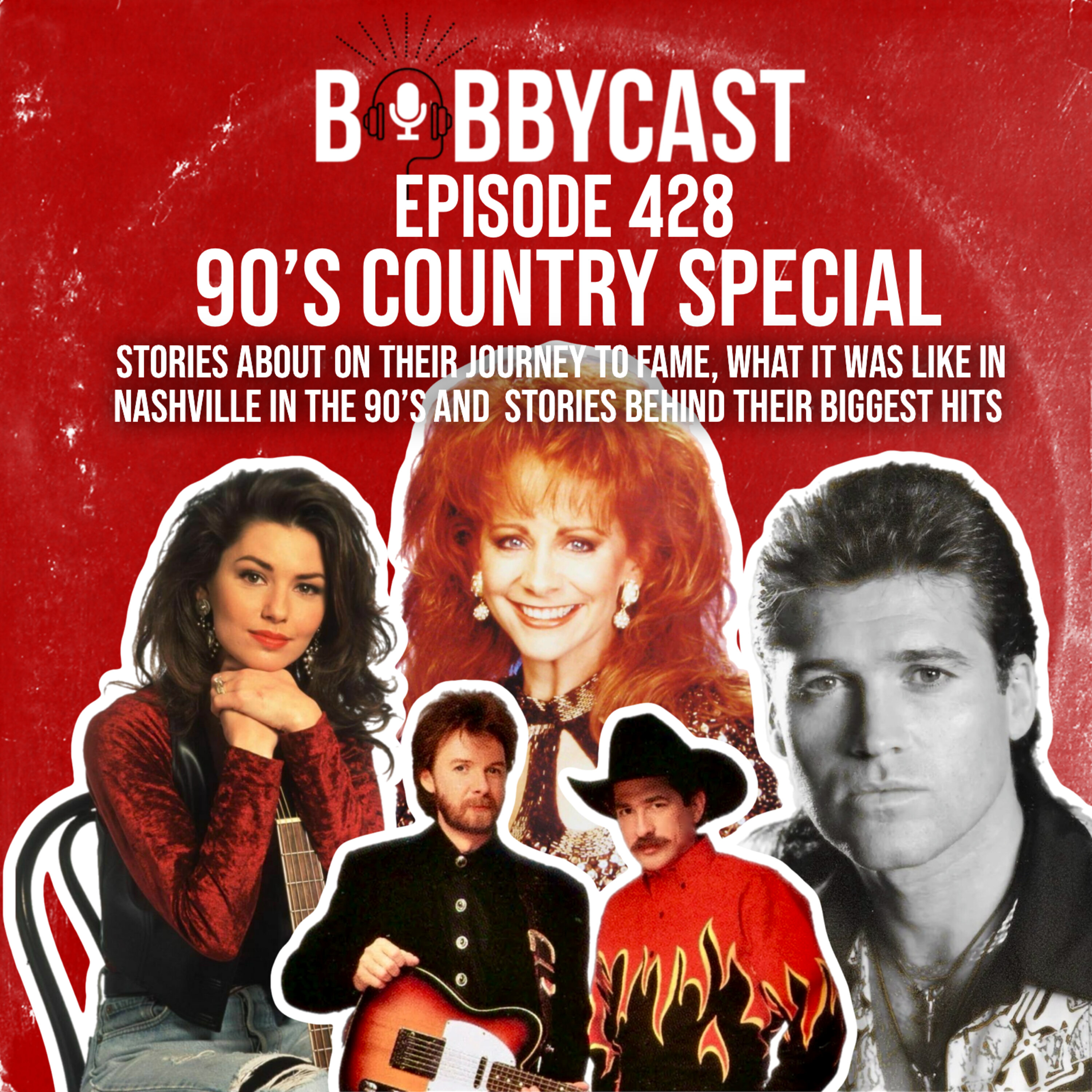
#428 - 90's Country Special: Stories from Brooks & Dunn, Reba, Clint Black, Shania Twain, John Michael Montgomery, Trisha Yearwood and more!
This episode is all about the best decade in country music...the 90's! We've taken stories from episodes over the years of artists that were huge in the 90's. You'll hear from Brooks and Dunn, Reba, Clint Black, Shania Twain, Billy Ray Cyrus, John Michael Montgomery, Tracy Lawrence, Trisha Yearwood, and Jo Dee Messina on their journey to stardom, what it was like in Nashville back then and they share stories behind their biggest hits. One of these artists even shares the story of calling Dolly to ask for advice when she was first starting out!
Follow on Instagram: @TheBobbyCast
Follow on TikTok: @TheBobbyCast
Watch this Episode on Youtube
See omnystudio.com/listener for privacy information.
Available Results
Generated results are saved to the knowledge database for reuse and search.
Extract Knowledge
Pick what you want extracted first. Model, scope, and chapter options appear after a template is selected.
Transcript
00:00:01
Speaker 1: Welcome to this episode of The Bobby Cast, all about nineties country. So it's stories from episodes over the years, and we have so many of them from all these great nineties country artists sharing some of the best stories from the best decade in country music if you ask me. So that's the deal, and you're gonna hear Brooks and Dunn, Rieba, Clint Black, Shanaiah Twain, Billy Ray, Cyrus, John Michael Montgomery, Tracy Lawrence, Trisha Yearwood, and Jody Messina all talking with me about their journey to start oh and actually what Nashville and country music was like back in the nineties. They talked about getting started, in friendships they made along the way, and how their massive songs became such big hits. Why do you like nineties countries so much? Probably just because I was a kid then. I think it's us now, who are you know? Thirties and early forties and that's what we listened to. So now we've made up popular again. I think that's what it is all coming back. Yeah, we have the control now too to actually bring it back, So that's what's pretty cool. Obviously has a big garth guy, Big Brooks and Dune Guy. But a lot of these stories are super cool, and so let's get into them. Kicking off the nineties Country Special with my favorite duo, Brooks and Dunn, Ronnie and Kick stopped by to talk about how they came together as a duo, their friendship with Riba, and how songs like Brand New Man and Red Dirt Road were written. Okay, so you guys got together like thirty one years ago. I looked it up like exactly thirty one years ago. So you get put together, right, Like it suggested that you guys should meet each other, right, So who makes that suggestion? And what's the first impression you guys have of each other when you meet? Take it?

00:01:34
Speaker 2: KB?

00:01:35
Speaker 3: Well, Jim Dubois called us both up.

00:01:38
Speaker 2: He was starting the label Aristo at the time Nashville with Clive Davis.

00:01:44
Speaker 4: He'd already signed Alan Jackson, so he didn't want another boys singer.

00:01:47
Speaker 3: He was trying to get one of everything.

00:01:48
Speaker 1: Yeah, and he'd.

00:01:49
Speaker 3: Signed Diamond Rio, he'd sign Pam Tillis was his girl, total formula Yeah.

00:01:54
Speaker 4: And the Jugs were breaking up, so he was determined to get a due. He needed a new due exactly, and so you know, He just said. We literally met at lunch over a bad enchilada, and he pretty more or less offered us a record deal if you know, if it worked out, if we could work together.

00:02:13
Speaker 2: He didn't really say that. He said to go away and write some songs, and we did.

00:02:16
Speaker 4: Came that same week. We wrote brand New Man in Next Broken Heart.

00:02:20
Speaker 3: That was Tuesday.

00:02:21
Speaker 4: We wrote those songs on Thursday and Friday, demoed them and took him back and he jumped up and down, and then he offered us a record deal.

00:02:28
Speaker 1: But when okay, you're right brand new Man, do you go, oh, we had this is something like we didn't even know each other, you know, three days ago, but we wrote brand New Man. This is something we didn't know.

00:02:36
Speaker 3: You know, we never know.

00:02:37
Speaker 2: You never know when you write him until they you know, they're become hits.

00:02:41
Speaker 3: I guess I thought it was pretty good.

00:02:43
Speaker 4: Yeah, I really did, because you know, and Ronnie had that idea, I'm a changed man and and it's my near miss on what.

00:02:52
Speaker 3: If we changed that?

00:02:53
Speaker 4: But he already had the I saw the light and I was baptized by that.

00:02:57
Speaker 5: You know.

00:02:57
Speaker 4: And Ronnie came from Oklahoma. He hadn't been hanging out in Nashville for ten.

00:03:01
Speaker 3: Years like me.

00:03:02
Speaker 4: So he had a lot of fresh ideas that I think we get bogged down and formula writing sometimes when you're doing that for a living. So it was for me as a writer, it was really a breath of fresh air, honestly, to have some new ideas that you weren't just sitting in a room and everybody passed around twenty times.

00:03:19
Speaker 3: Already, and it was kind of it was fun.

00:03:21
Speaker 4: We wrote a lot of stuff early that I thought it had some good energy to it.

00:03:25
Speaker 1: Whenever Bootscoot and Boogie happens and the dance blows up and everybody's that's you know what. I actually learned two step to Bootschoot and Boggie. Like a big part of my life was being in Arkansas and this girl named Carrie Carter had the biggest crush on was like, I'm a teacher had a two step and electric slide by the way, both of them. I learned a boots Scoot and Boggie the same song. And so when the boot Scoot and Boogie starts to be a thing, did you guys come up with a dance? Did you guys know it's going to be a thing, like, how does that whole thing happen?

00:03:52
Speaker 2: I wrote her in Oklahoma and we played a big club there called Tulsa City Limits, and we had to do cover songs play club, you know, bars and stuff or they're one original stuff, and these people kept coming up and asking us to play it again. So I kind of thought, well, maybe there's something there. So we'd sneak into the set late at night. But they were doing those dances, and you know, the dance, all the line dancing and all that stuff was already up and going strong in Oklahoma, Texas. But down there, if you if you play a song or dude or play in any of the clubs and they don't dance, then you're you know, you're out. So we had to had to write songs that that kept people moving.

00:04:30
Speaker 3: We had to write and turn sold beer.

00:04:33
Speaker 2: Now yeah, right, So.

00:04:35
Speaker 4: I've never been close to a line dance.

00:04:38
Speaker 3: I can two step a little. I would kill myself. I'm the clubsiest person in the world. I'd kill myself trying to line dance.

00:04:43
Speaker 2: Well, we used to stand in front of the stage and go, I'd do that.

00:04:48
Speaker 3: That looks dangerous.

00:04:51
Speaker 1: The Boo Book was such a big part of the song though, like it, I mean for two guys that don't dance like that was such a massive part of the song was that was the music video. I mean I were watching CMT. That's crazy, that's awesome. Can I just stand here and tell you how awesome you are for like fifteen minutes. This is the best thing my gigging out too hard to keep it going. Oh my goodness. Okay, So how about these Las Vegas shows you guys are doing, like you come back together, right, I mean I bet that pays so much, right, those Vegas shows? Holy crap, all this and money too, I mean right, like you get to play all the hits and that bag. Do you stay in Vegas for like three or four days? They put you up? How does that work?

00:05:29
Speaker 2: They give us all the sweet and uh have you seen the end of years yet?

00:05:34
Speaker 6: Oh?

00:05:34
Speaker 1: It's they're that big skates come on a couple of butlers.

00:05:41
Speaker 2: So if you want something anytime, you get that. But other than that, it's a good view.

00:05:45
Speaker 4: Yeah, we're two weeks set a time, four times a year, so you're out there. You do three shows a week and you know, get some golf in and and it's just fun to stumble down from your hotel room onto a stage where all your guitars are in tune and it sounds the same as it did last night, and just to sing and play. It's about as great a situation as you could ever hope for, and it's fun to sing those songs again. I think it was good for us to get away from it for a few years. And Riva, you know, kind of we got a great referee out there, so you know, it's it's we've been having a good time.

00:06:19
Speaker 1: Honestly, we both we mentioned earlier with the Kennedy Center Honors, and you guys have a longer relationship with Riba than I do. I'm again a Hugeriva fan and she's been great to me. But how did you guys become friends of Riba?

00:06:31
Speaker 4: Gosh, we hired us in ninety three.

00:06:34
Speaker 2: I guess she was the first tour that we actually got hooked up with and hired us. I think back then there were like four or five major tours straight Alabama. Who else since I think, yeah, and then Riba. So she had a spot and gave us the opening spot. He gave us ten feet of stage in ten minutes and one hundred dollars a night.

00:06:52
Speaker 1: Yeah, we took hundred bucks crazy.

00:06:56
Speaker 4: But a few years later we both kind of I got a good, good wave going and.

00:07:02
Speaker 3: And hooked up.

00:07:03
Speaker 4: I think in ninety six and maybe ninety seven we uh, we did some co headlining together. We had twenty one trucks and nineteen buses out on that tour. So for for.

00:07:18
Speaker 1: Wow, what song is it? What gets the biggest reaction when you play it?

00:07:21
Speaker 7: Like what song?

00:07:22
Speaker 1: Because you have so many hits, people probably react definitely everywhere you go. What's the one where you get people go boom, first lick, they got it.

00:07:28
Speaker 4: I'd probably say, Mom, Marie.

00:07:30
Speaker 1: Oh come on, that's a dance too, gotta be kidding me, Amy, we have freaking brooks and done in here and that's crazy and thing you want to ask them and hog at this whole interview. I have like ten pages of notes I made last night you got it? I made. Here's page one, tell them they're awesome, checks.

00:07:46
Speaker 2: Going by formula, Yeah, I love you guys.

00:07:50
Speaker 1: Page two, remind them how awesome they are. Yeah. Page three, good luck in the future. So La brand new Man was the first one for number one. What's that number one party. Like back then, first time you get a number one, back in the day, you hit number one, what do you do?

00:08:06
Speaker 4: I know Donna Hilly threw us a party Tony at the time. I just remember we were big into you know, our logos. This this this longhorned steer on steroids and Donna didn't know the difference, but bless her heart, we turned the corner on our party and she's got a cow out there, you know, these little horns.

00:08:24
Speaker 1: I remember going, Okay, what's good effort, you know?

00:08:28
Speaker 4: And yeah, but end, Yeah, did it ever get too big for you?

00:08:34
Speaker 1: Guys? Where you go? You look around and you go, holy crap, like this is this is a lot like a lot of trucks, a lot of stage You ever go this is? This is a show.

00:08:45
Speaker 2: You know, it's just a matter of personal I guess subjective viewpoint. But there's time. But when it was growing to the point to where you get on the bus and the door would open and shut like every fifteen minutes, somebody going, hey man, we need more lights, We need to add the lights. Where do you think about adding you know, more more monitors and that kind of stuff that was that's that's the most strenuous part, I think just dealing with the day to day going. I hope you're not going to step out there and you know, not have enough equipment. Uh, And it was that was kind of out of our wheelhouse. And it's like I just want to sing and write songs. It's like more to it than that. Obviously.

00:09:22
Speaker 1: Do you ever do the thing with yell the wrong city? Like what up to below? We were talking to other times.

00:09:29
Speaker 4: In those weekends when you're in Rapid City and Cedar Rapids and you know, some other something city, you know that where you really have to remind yourself. I think the worst mistake I ever made that way was we played the basketball Coliseum at Michigan State and I was really disoriented walking to the stage and I'm going, where what town is this? Though I know I know we're at Michigan State, but anyway, I just I see their logo going to the stage and I'm like, okay, I got this. So you want to scream something when you go out there, you know, walk down there, and I.

00:10:03
Speaker 8: Go, how about you trow Johns?

00:10:05
Speaker 4: And she's like, I know, I saw it was on the wall, you know, Spartan.

00:10:12
Speaker 3: I mean like you know, no, you're not coming back, dude. Like halfway through the show they start to kind of you don't.

00:10:20
Speaker 1: Cole again, that's funny. So we started typing right right that you rode the city on the ground, right.

00:10:28
Speaker 3: I swore I never have to do that.

00:10:29
Speaker 1: But Red Dough Road. You both wrote that, right. I heard kicks did the heavy lifting? Does that mean you coming on? Most of the article? Mut on the bus.

00:10:38
Speaker 2: One night after a show and he said, and he said, let's I've got this idea. And then did you have the title or or whatever? And we started talking about it. I said, well, I grew up like on a rule Route three and el Red, Arkansas. I kind of you know, and uh, we talked about a lot of that stuff. And I'm not sure we didn't have the courus, you know, well on its way.

00:10:58
Speaker 3: So funny how we remember.

00:10:59
Speaker 2: This, Yeah, everybody writes song.

00:11:03
Speaker 3: With we have a different story.

00:11:05
Speaker 4: I'll tell you what really happened after he does, so this is my life and I'm sticking to it.

00:11:11
Speaker 2: And then I remember having to like take off and go and we were it was a long long drive like from somewhere like somewhere to Oregon.

00:11:18
Speaker 4: We landed in San Francisco, and we had a show in Sacramento at.

00:11:21
Speaker 2: Our I'm in Oregon. You're on the other coast.

00:11:24
Speaker 3: You're on the right coaster. They're both over there, all right.

00:11:27
Speaker 2: So anyway there I am in Beijing.

00:11:32
Speaker 1: The buses take off.

00:11:33
Speaker 2: We got the next morning and kicks his buses parked out in front of us, and I see him get off and his hair is like it looks like he's been through a freaking World War three or something. Stumbles up on the bus with his guitar and he plays plays the song. The verses like good god man, Bingo, you hit it, you can tell done.

00:11:53
Speaker 3: So what really happened?

00:11:56
Speaker 4: Ronnie wrote down the primarily those great lines from a chorus. On the airplane flying to San Francisco. You had Terry McBride with you, and he hands it to me and goes, what do you think of this?

00:12:07
Speaker 3: I'm like, shit, that is great.

00:12:09
Speaker 4: And we had had this discussion about where we grew up in the red dirt roads, and we had decided to name our album that, but we said we got to write a song that goes with it. So I jumped on my bus, he jumps on his, and we head for Sacramento, and I just grabbed my guitar, went to work. We get there, him and Terry go knock on my door and go let's go get a steak.

00:12:31
Speaker 3: And I said, cool, but you got to hear this.

00:12:33
Speaker 4: First, so I made him listen, and as Rare Ronnie done for him, he went, I love it.

00:12:39
Speaker 3: That's freaking great. I went, what's wrong with you?

00:12:41
Speaker 4: Let's go let's see the steak, drink of beer, all that kind of stuff.

00:12:46
Speaker 1: What was the one head that you guys had with over twenty three number I think you have twenty three number one, or looked earlier. What's the one where you wrote and you went, that's the one, Like you can tell immediately because I'm asking you the flip side of this in a second. What's the one where you went, that's it?

00:13:00
Speaker 3: Red dirt.

00:13:01
Speaker 2: Red Dirt was pretty close. I mean, I think that was a moment where we were all sitting around and he played it for the first time and went, ooh, I think I think we've got it. They went in the studio and then it, you know, here comes that lick. Then it just turned into a like boom.

00:13:17
Speaker 4: I couldn't wait to get home and play that for Mark right, because we had we had started gathering up some songs, but we needed that anchor and to go with the title, you know, and that's it's just that moment where you go, ah, we did it.

00:13:28
Speaker 2: So many variables, you know, if you contribute to that aha moment, and then a lot of times it's just when you sit down in the studio not knowing where it's going to go, and the guitar player. Usually it's the guitar player sit down and hit hit that lick, and he hit that intro lick.

00:13:43
Speaker 9: Pop up bump bump, bump, bump bump.

00:13:45
Speaker 2: They just turned into like a kind of an anthem, the kind of thing away we went.

00:13:49
Speaker 1: On the other side of that, what major song, what big hit you guys had? It took forever and you're like, oh, this think took forever to write. We didn't get it right and producing it the first couple of times we didn't put it like, what's the struggle song.

00:14:01
Speaker 2: They're all struggling. It's like having to go do your homework. It's fun to sing, fun fun to play.

00:14:09
Speaker 4: I think He'll Billy Deluxe was one that was a totally different song than Believe, but it was a song that never you know, barely got in the top ten. It might have made it, it might not even made top ten, But I watched our sales double and and it's some of those songs, just like believe people to this day go that song changed my life. Those songs that have the impact and that really make a difference in whatever. They're not always those ditties that slam up to number one on radio or something like that, but you feel a connection to your fans and and to your career that.

00:14:45
Speaker 3: You're like, man, that's that one. That one got down there, that one did some good.

00:14:50
Speaker 1: You know the song that and I've often referenced on the show, we talk about songs that actually make you, like physically cry or feel something like cowgirls don't cry? Are you kidding me? Are you still if that thing.

00:15:02
Speaker 3: Comes from I heard that man.

00:15:05
Speaker 2: Look out the own inch big cowboys just like oh man, start wiping tears?

00:15:09
Speaker 1: Or what that song still get? I've heard the song ten thousand times and I hear it again and I don't I don't know if it's Riba being into two that pushes me over the edge, but are you kidding me? Then she sings it backed after her dad dies, Are you kidding me?

00:15:25
Speaker 2: There were a lot of redheads that had had a part in that. Terry McBride has a redhead daughter. I have two daughters of the red Heads. And then the Riba factor in there as well.

00:15:37
Speaker 1: Here's Riba sharing a cool story about calling Dolly Parton for advice whenever she had a massive duet. She also talks about the major influence her mom had on her career. I just look at you. Two is out of the same cut, out of the same cloth. We are as country as can be. Yep, you have ambitions that are bigger than just singing country music. Although that's your most important that's your kill her, you have ambitions other than just that. And you both did it at a really high level. And I would think that that hopefully she would be someone same thing with like Taylor to you, you know, with some of these other artists who are doing that, that that you could reach out to it after a point and get advice from her to that ever happen, you reached out like Dolly, you know, I can I pick your brain at all?

00:16:21
Speaker 10: Oh yeah, yeah, I have done that. I did that in the early nineties, A phone call, and she took my matter of fact, I called her. She was that I think Caesar's in Vegas, and I was in Bakersfield somewhere and I needed a piece of advice from her. And she is on the Tonight Show the night before and she said she's going to Vegas, won't be at Caesar's.

00:16:43
Speaker 8: So I called Caesar's.

00:16:45
Speaker 1: But you actually called the casino. Yeah, wow.

00:16:47
Speaker 8: And I said, I need to speak speak to Dolly Parton. Please.

00:16:51
Speaker 10: She said, one moment, please, who's calling? I said, Reba McIntyre And presume Dolly came on the last she said, is this really Reba mcin tire or some squirrel that wishes she was rebel?

00:17:02
Speaker 8: McIntyre said, it's me.

00:17:05
Speaker 1: That's funny to think about what we used to have to call. I mean, I haven't thought about having to do that. You just had to call a place to get someone. He just have to call a restaurant and be like, hey my uncle there. Yeah, yeah, that was like back in the day. Yeah. I want to play a little clip of does he love you? This is you and Dolly hear this here?

00:17:22
Speaker 5: Love you love you?

00:17:24
Speaker 1: Like you? Los me?

00:17:26
Speaker 3: He loves me?

00:17:27
Speaker 1: Does he think of you?

00:17:29
Speaker 3: Does he think of you?

00:17:30
Speaker 8: And see whispoos is he?

00:17:36
Speaker 1: How cool is that to hear even though you've heard it ten thousand times?

00:17:40
Speaker 10: Yeah, you're right, because when we first heard it, Dave Cobb was the one that produced this one. And when we were going down the list of all the songs and listening to him, and does He Love You? Came up and I sat there and listened. I said, play it again, and we listened to it again.

00:18:00
Speaker 1: It was just the best I can ask about the original version because from me moving to Nashville, I've gotten to know Linda, Hillary's mom, yeah, pretty well, like I love her.

00:18:12
Speaker 9: Yeah.

00:18:12
Speaker 1: But I remember watching on CMT you guys video. It was one of the videos that and probably propped me up beside the jukebox when I die, or probably the two that I really, you know, remember and think about from kind of that part of my life. But originally I had read that, you thought maybe why Nona would be the one, but Linda killed it singing it, and you know, like we have to go with that. Is that story true?

00:18:33
Speaker 8: Well?

00:18:34
Speaker 10: Parsonally, Linda was on the road with me, is she and Hillary's dad Lang Scott, They were on the road with me, and I thought, Linda, we could do this every night on stage. Because she's backup singer. I was featuring her on some songs because she had a record deal, and so Tony said, well, let's well, the record label of course, wanted either Trisha or one on A.

00:18:53
Speaker 8: And I said, but it's right here. It's so handy, and they said, well, let's keep working on it.

00:18:57
Speaker 10: And I said, well, in the meantime I'm recording it will Can Linda just step in and do the other part so I had somebody to sing against. They said okay, And when she got through, Tony said, she got the part.

00:19:10
Speaker 1: Did you tell her then, hey, you're just going to sing this as kind of a demo version?

00:19:13
Speaker 8: Yeah.

00:19:14
Speaker 1: Do you think in her mind she was like, I'm going to sing this so good that hopefully they can't refuse it.

00:19:19
Speaker 10: You know, Linda is so honest and so innocent. She was just probably glad to be there and just I don't know what was in her mind, but I knew she would kill the song, love it.

00:19:31
Speaker 5: And you know, all.

00:19:33
Speaker 10: Linda has to do is sing, and she she sells herself. It's wonderful.

00:19:37
Speaker 1: Did you know that Dolly would say yes, if you asked her to do that, No, did you worry she wouldn't say yes?

00:19:42
Speaker 8: Yeah, that's why I said, managers talk to managers.

00:19:44
Speaker 1: Yeah.

00:19:44
Speaker 10: I didn't want to put Dolly on the spot. Besides, I don't have her phone number, so I thought it would be a good idea just to go in that way. She had an out if she didn't want to do it.

00:19:53
Speaker 1: I'm curious about your mom because I remember the thing I've read about her. She could sing, uh huh, and she wanted to a singer, but she ended up being a school teacher and teaching music to kids. Uh liked. Did her desire to be a singer influence your desire to be a singer?

00:20:10
Speaker 11: Yes?

00:20:11
Speaker 1: Like did her once make you want it? Yes?

00:20:13
Speaker 10: How so, because when we were rodeo and we didn't have a radio in the car and four kids in the back seat, wrastling was getting would get on anybody's nerves, and so Mama would get us to sing to keep us out of trouble, keep us occupied. Then first grade, the teacher would say we're having a Christmas program. Anybody want to sing? And I'd raise my hand and Mama would encourage me on that. Just like she did pay Alison Susie. And so when we got in the high school junior high years, they formed a little country western band and we played the football games and had little concerts. And then when I went on to college, I took Mama made sure I took eighteen hours keep me out of trouble.

00:20:53
Speaker 1: It's a lot of hours that will keep you out of trouble.

00:20:55
Speaker 10: It didn't, and so, but they were mostly music classes. And so when I went to the National Finals rodeo in Oklahoma City in seventy four, I was a sophomore. Daddy knew I was up there party and having a good time, and he said, won't you get you a job while you're up there? And I said, shoot, that would interfere with.

00:21:11
Speaker 8: All my fun. I said doing what?

00:21:13
Speaker 10: And he said sing the national anthem. And that's when Red Stevegall heard me. So fast forward. That was in December seventy four, seventy five. He said, Jack, bring Rieba down and we'll cut a demonstration tape. I didn't really want to. I didn't know anybody in the music business. I had all my friends in the rodeo. I wanted to be a world champion barrel racer. So about halfway from Oklahoma here, Mama, I said, let's stop here and do this. Mama said, you know, if you don't want to do this, that's fine, let's just go home. But if you do this, I'll be living all my dreams through you. I said, well, Thunder, what did you say? So get in the car, let's go. And when Mama died, I told Susie because we were cleaning out Mama's house, I said, I don't think I want to do this anymore.

00:22:02
Speaker 8: She said why. I said, I was doing it for mama.

00:22:05
Speaker 1: When you do it now, are you still doing it for your mom?

00:22:08
Speaker 12: Yeah?

00:22:08
Speaker 10: Yeah, But it took me good three months to say, call Susie back, say okay, I'm back, I'll do it.

00:22:17
Speaker 1: Here's Clint Blake talking about getting his first single on the radio and what it was like at signings at Walmart and Target back in the day. You know, I was looking back, and you can tell me if I'm wrong.

00:22:27
Speaker 11: Here.

00:22:27
Speaker 1: I'm going from memory, but I look back because I had, like everybody else, I had the Killing Time tape and so from the record Killing Time. But I don't think that was was better Man. My recollection was better man. A single before Killing Time was yeah.

00:22:43
Speaker 13: Actually, you know, the first single was set to be straight from the factory and and I was worried about it in cities. I knew it would go over in Texas and Oklahoma, and I was just kind of worried about it. And we got to KZLA and Los Angeles and Bob Gara was the program director and we're sitting in his office and playing that song and he stops the tape and he says, well, he said I could add that if you get it into the top twenty. So I knew what that meant. I didn't I know a lot about the business yet, but I also didn't know if it would be okay for me to pull this tape I had in my pocket out and playing something from it. Carson Schreiber was the promotion guy there, and I kind of looked over at him and decided, I'm just going to do it. And I pulled out the tape and I said, I said, Bob, pop this in and play that first song. And it was better, man, And that's what I was thinking, you know, would be a better first single. But I just I let him play it. And at the end of the first course, he stopped the tape and said, I'll add that out of the box. So we got out of there and called the head of RCA and said, you know, here's what just happened. And the decision was made on the spot to switch to a Better Man.

00:24:13
Speaker 1: And how fast did that song make you feel like you were firmly in the country music community.

00:24:20
Speaker 13: It took a while, you know. I was still traveling around in a twelve seater van pulling a U haul trailer four five hundred miles a day a night, and so it was about a seventeen week climb to number one. So we started promoting it in I think late February, and it peaked in mid June. I think that's seventeen weeks. Anyway, it really it really seemed to be going fast to me. But that was not a quick climb back then. But it was rare for a debut single to go to number one, And so I'm hearing all these things and you know, getting perspective by the time that hit. I think I was. By the time it really you know, started to peak, I think I was getting some slots opening for the juds and and acts like that. So it started to feel more like this is gonna work. I'm gonna make.

00:25:28
Speaker 1: It when you guys decided to put on Killing Time second, and the song again, looking back at as my history, I feel like Killing Time was even bigger than A Better Man.

00:25:43
Speaker 13: Well it had it had a step up on Better Man, and I think it was more of a honky tonk song and you know, but again, I'm stepping off a debut number one releasing that so uh that song kidding yet that I think the promotion team had a little easier time pushing that one out, so it had a little bit of an advantage. But it's it's also you know, it's a it's a different feel and flavor and texture. Better Man was kind of haggard ask and Killing Time wasn't. I don't know what i'd call it, but it for me, for my sensibilities, it really it really felt like this is this is going to You're gonna get different things from me. It was important to me that I had diversity and my body of work, and I felt like that song really spoke to that.

00:26:52
Speaker 1: What was it like plotting a tour back in the late eighties early nineties, would you have to use a phone book to call places like what was on the bus? Would you have a phone book to pull over and call places?

00:27:02
Speaker 13: Well, I had nothing to do with that part of it. I had to I just did interviews and showed up at radio stations and and you know, targets, et cetera. And but yeah, back then, you know, we'd have to get to a hotel room, get in there and and get on the phone. And you know, it was a while before you know, I got that fifteen pounds cellular phone.

00:27:34
Speaker 1: Did you ever do what you talk about targets and walmarts? Did you ever go to one of these signings and it it got to the point where it was so crazy because you had so many hits in a row.

00:27:43
Speaker 13: It was crazy. It was you know, I've said recently, you know that back then I was pretty level headed. I feel like I never got the big head and I treated everyone well. But I I don't know, because it was so crazy, and I wasn't nearly as comfortable with it as I am now. It took me a long time to get used to being famous and the center of attention, and you know, being in the middle of chaos. It was it was really hard to adapt to. So I would. I felt like I went from one chaotic moment to another. And there were times where, you know, we're doing nine shows in a row, one day off, eight shows in a row, one day off. I mean, they had me really going and I was reaching the point of really just the point of breaking. And I told my manager, I said, I'm not going to last like this, and you know, we have to have some spacing in there, so you know, it'd end up getting two days off. But I just didn't that doing interviews and stuff, you know, so it was really taking a toll on my vocal cords. And I tried to tell them, you know, listen to my listen to my melodies, and listen to my songs. You know, I'm not Joe Cocker. I can't. I can't sing these things with a raspy voice, and I can't hit those high notes if I'm worn out.

00:29:36
Speaker 1: Shania Twain talks about how lime disease almost ended her career and also her journey from Canada to Nashville. You know, you have this entire class of female artists and these here, and you know, the last five, six, seven years, you're like what they grew up listening to. I mean you're what they admire. And I was with you, and you brought at Kelsey Ballerini, who were very close to and you gouts sing together. We were in California together fun and for her that's like a life changing thing. Even for me, like you're what I listened to on the radio.

00:30:06
Speaker 14: It's it's like a flashback for me.

00:30:09
Speaker 15: You know, years ago in concert. I had so many little kids at the shows, and I just never even imagined or projected myself into the future, thinking that one day they're gonna be the you know, kids in their twenties at my shows. Sometimes they're still there with their parents, you know, you see the two generations together, and sometimes it's just the group of college kids coming together the party and it's and.

00:30:37
Speaker 8: They'll say, oh, you were my first concert, and.

00:30:39
Speaker 15: I'm like, I'm thinking, wow, okay, you're you're a young adult. Okay, how is that possible?

00:30:44
Speaker 8: So yeah, no, it's true.

00:30:45
Speaker 15: It's this whole generation of college kids that went to my shows when they were little or you know, listen to my song from the car seat in the back.

00:30:56
Speaker 1: You know, I want to ask you about this. I remember reading when you had vocal corret the issue. Yeah, I guess I was in college. Right after college, what happened? So what happened in your vocal cords? Because you have surgery right like some super No No, I mean you can't.

00:31:10
Speaker 9: This is not you can't.

00:31:12
Speaker 15: I can't repair it with surgery.

00:31:13
Speaker 1: Oh so it's still a thing.

00:31:14
Speaker 5: It's an atrophy thing.

00:31:15
Speaker 3: Yeah.

00:31:15
Speaker 14: Yeah, I was tick.

00:31:16
Speaker 15: I had limes czi's. I got bit by a tick and.

00:31:19
Speaker 1: Wow, that made your vocal cords bad.

00:31:22
Speaker 15: Yep, it's it's you know, lime cise can really get to your neurological system. And it's I don't you know, make a long story short, and all the testing that I did finally because the vocal cords look normal from an irregular exam, but I've got slight atrophy on both chords. The nerves are damaged in there, and so I had to get five long needles. You get five long needles into your larynx and then they read your your nerve.

00:32:01
Speaker 5: Activity. Yeah that's what.

00:32:03
Speaker 15: Yeah, And so I've got a bit of tertria on both sides and it's it's really really makes it really tough. I do a lot of vocal physiotherapy basically, so.

00:32:12
Speaker 1: That's a lot of warm up then before you go out.

00:32:15
Speaker 15: Well, I'm trying to get the warm up down right now. I need about an hour and a half to warm up. And I can't do any spontaneous singing. Like if I was just sing like right now, I would sound like a dying cow.

00:32:24
Speaker 5: I really need to.

00:32:26
Speaker 15: And that's really a bummer for me because sometimes I'm in a club or whatever and I feel like, you know, I just want to get up and sing where I wanted to karaoke and you know, get into the whole thing. But I could really damage myself if I did that. Wow, So and I don't want to damage myself. I don't have nodules or anything that you know, the typical singer. So this is from a lime disease. It's nerve damage, and it's really a bummer. I'm stuck with it for the rest of my life. But so it just takes a lot of work. It's like a permanent injury.

00:32:54
Speaker 1: Yeah, it's gonna be weird to just even singing knowing you have because I have a lot of friends with professional athletes, and like they've torn my heart. But they say even the mental part of it is the hard because they don't even want to press on it because they're like, what if even though they've done all the proper right, it gives out.

00:33:09
Speaker 15: And it is like that, like if I don't warm up and really prepare it is. I always do refer to it like ane like a bad knee, and you never know when that knee's going to give out on you. And that happens to me when I'm singing, Like I wouldn't be able to be an opera singer, for example, because you know, but because I'm running around and I'm I can add a live and I can. I can, I can work with it, I can, I can manage it. And I'm just so determined, Like I couldn't sing for a long long time and I could barely yell out for my dog. It's really really a because the air escapes from the you know, it's very technical, but but I was just really determined to get to the bottom of it and find out what I could do about it. And little by little I realized that I could do this.

00:33:58
Speaker 9: I could do it again, and.

00:34:01
Speaker 1: So now I'm not going to give up.

00:34:02
Speaker 5: Now. You know, it takes a.

00:34:03
Speaker 10: Lot of work.

00:34:04
Speaker 14: I have to say, it's.

00:34:05
Speaker 15: A lot of work, and I do get to, you know, discouraged some days, like an athlete with an injury, you do worry is that is it going to give out on me when I'm on stage? Is it gonna Is it going to be there for me and when I need it? But I feel really good just talking about it too. That helps me psychologically with it, and I accept it.

00:34:24
Speaker 14: It's just part of who I am.

00:34:25
Speaker 5: Now.

00:34:26
Speaker 1: I want to ask you about people crying, cause I may people they meet you, they cry all the time. How do they How do you use to people crying when they meet you because you're royalty inside of our format, you're royalty.

00:34:36
Speaker 15: Well, you know, my mother used to always cry whenever I would sing. Every time, like at the kitchen table, A good cry, like mom, you know. Like so I would sit at the kitchen table, I play our a new song that I wrote. You know, I'm like ten or something. You know, she'd cry, and then you know, I'm on stage, I sing a song, she cries, or we're out of hig I was party somewhere, sing a song, she cries. I mean she would always cry. She was always very emotional about I don't know what it was, whether.

00:35:10
Speaker 8: You know, what does do all mothers do that, like cry.

00:35:13
Speaker 15: All the time when their child performs. I don't know, but my mother always did, and so I'm used to it and I appreciate. I learned to appreciate it at the time as a kid, I'm like, oh, mom, come on, and you've heard me sing a million times, you know. But I've really learned to appreciate the connection with people and what and what and the emotion said it's to something people do.

00:35:32
Speaker 1: Friends ever ask you to sing at their wedding, because I always feel like that would be really awkward, like if someone's your friend.

00:35:37
Speaker 5: Like, ooh, as you sing? I know, no, you know.

00:35:43
Speaker 15: They have you know I have done that. I know, I know I have done that, but never like not in like a band setting. You I'll just like get up and do a little few lines of something, you know, just to to do it. But yeah, no, that does happen. The karaoke is the worst.

00:35:57
Speaker 1: The pressure on you to go anywhere where anybody's singing, because everyone's like, oh, she's going to get up and sing. I know, well, sheet, but now I.

00:36:03
Speaker 15: Can't do that even if I wanted to that that is kind of a bummer. But yeah, you know, because I gotta warm up. I just can't get out up there, and like, you know, do it?

00:36:12
Speaker 1: What is your I mean, what's your song? When you think of Shanai, what's your song?

00:36:16
Speaker 9: Who's bet of your bits of ben under? And that's the first thing. So yeah, yeah, yeah.

00:36:22
Speaker 5: For sure.

00:36:22
Speaker 15: I wrote that in a little bush cabin in Canada by my wood stove.

00:36:28
Speaker 1: Really yeah, just you wrote that song by yourself?

00:36:32
Speaker 15: Well, I wrote it, and then I wrote that before I met Mutt, and then when we met, that was one of the songs I pulled out of my hat and and then we finished it together. I don't really even remember what we did collaboratively on that, but we want to do everything in the hat at that point, you know, once we were collaborating as songwriter.

00:36:54
Speaker 1: So what is your quintessential Nashville story? Because you hear, you know, there are a hundred stories about you. Now you just pack up moved to town.

00:37:02
Speaker 14: I did.

00:37:03
Speaker 15: I literally drove here from Timmins, Ah, put everything in the back of my Jimmy that was my vehicle at the time, and loaded that up with everything I could possibly put in there, laundry basket, I mean everything, I mean, I was I had no money, and I just drove the three days to Nashville and I got a little bit of cash from the label. I got a put a you know, first and last month's rent on an apartment in Brentwood.

00:37:37
Speaker 5: And here I was.

00:37:39
Speaker 1: Did you were you famous in Canada already before you came down?

00:37:43
Speaker 15: No?

00:37:44
Speaker 1: Like, did you have a bunch of Canadian money like Looney's.

00:37:46
Speaker 9: Oh she had no money?

00:37:47
Speaker 5: No?

00:37:47
Speaker 15: No, I had no money. I had no record, No, no, my my record. I was signed to Nashville, not Canada. I didn't have a record deal in Canada. I had never released a record in Canada.

00:37:58
Speaker 14: I was still a stage.

00:38:00
Speaker 15: Singer, a club singer, singer, songwriter. So I went straight from that to Nashville.

00:38:11
Speaker 1: And how long until you hit? You moved here? And then how long until you had your first big hit? Because people think people just move and go snap, there's a hit.

00:38:18
Speaker 15: I did very fast on you know, it was like a year.

00:38:22
Speaker 1: Wow. Yeah, did it sweep you up? Like whoa whoa, whoa, whoa whoa before you kind of realized what was going on and you were a star.

00:38:31
Speaker 15: I mean, I was so ready for it, because first of all, I was already by the time I was really what you would consider famous. I was thirty. I wasn't young. I mean I spent my whole youth preparing for that, So it's not like all of a sudden I was, you know, twenty two and famous I was.

00:38:55
Speaker 14: I was thirty.

00:38:56
Speaker 15: I you know, I guess I'm I don't know. I mean, I didn't have any recording experience. I didn't have any fame experience. But I'd spent my whole childhood and all of that, all of my twenties working toward it, you know, singing in bars and any time type of show that I could get into, festivals, writing, writing, writing, writing, writing. I mean I really, you know, wrote all the time, you know, by myself. I was just a solo writer. So by the time I made it, I was so ready. I mean, by the time I met Mine and made that first record with him, I had a whole stash of songs and it went very fast that record.

00:39:37
Speaker 1: You know, I think my song was Honey I'm home, like when I think, I just like I just love the pace. Yeah cool, Yeah, that's a good one.

00:39:46
Speaker 15: Yeah that's a rocking It's a Rocan country song, right, It's got a cool groove.

00:39:51
Speaker 1: Were you told You're not country, like everybody's told.

00:39:53
Speaker 15: Now, Yeah, sure I was, But I didn't know what I It was good for me that I really didn't know that that would be the case. I didn't really know what the definition was or what was considered the definition of country, because I grew up listening to such a I think, a different country than the country that maybe you guys grew up here in the US. Two Because in Canada, we had you know, we had Gordon Life, we had a lot of folk singers, a lot of folk artists that were considered country. So my country was a lot of uh, you know, Joni Mitchell, you know, Jim Crochet to me was country. The Carpenters were considered country to me, Willie Nelson and Chris Christopherson and even Elvis, you know.

00:40:44
Speaker 14: So it was kind of.

00:40:46
Speaker 15: Odd that I I sort of thought I felt like I fit into that scope of the more sole folk type country. And of course, you know, my youth was eighties raw, so that was always in me anyway too, and that's how the music came out.

00:41:06
Speaker 14: I think in the end that hybrid.

00:41:11
Speaker 1: John Michael Montgomery talks about some of his most career defining songs, including one that they wanted to be a pop song. So your first song Lives to Dance nineteen ninety two, All I did was look at the Billboard chart, and I think that's the song that I associate with you the most. That didn't probably Grundy County Auction, but Lives to Dance and Billboard it did not go number one, which was wild to think that that song, which is the song that I associate you and my childhood with. But when that song hit, is that a song that got bigger as time went on? Well, I just.

00:41:43
Speaker 7: Think it's like, first of all, I didn't want that song to come out first. I want it I Love the Way You Love Me to come out first, because I was like, that's that's a love song.

00:41:52
Speaker 1: Did they say, no ballad, no love song? Is that why?

00:41:54
Speaker 7: Well, they explained to me it's like look and I was used to singing George Strait, Keith Widley LIFs of Dance is a philosophical kind of song about it. I just never had really sang a songs like I didn't even know if I was good at Santa song like that. But Doug Johnson said, hey, this song's perfect for you, and It's a perfect one to come out with, and I just was like, well, we'll probably be lucky to break top forty with it, you know. But hey, I mean, what do I know. I'm new, these guys know what they're doing, so let's do it. You know. I like this song. I just you know, I gravitated towards the love song or the good old hardcore country, you know, heartbreaking song. And so sure enough, broke top forty, Top thirty, took forever to get up there, and it finally broke Top five, went to number four, and I mean, of course I was thinking, wow.

00:42:38
Speaker 1: I got a top five, you know.

00:42:40
Speaker 7: And but most people, just like with me and Bob Seeger and some old and people, can't believe how many of those big rock bands had big hits but they didn't go No.

00:42:54
Speaker 1: Number one. Yeah, Aerosmith didn't have a Number one until Armageddon the movie like a Love Song way later, and they had so many massive songs.

00:43:02
Speaker 7: Massive hits that never went to number one, and you would think every one of those were number ones. And I think Bob Seger was kind of the same way. I mean, yeah, I mean, he just I couldn't believe that all those big hits he had wasn't number one hits, but they weren't. What's kind of the same way for Life of Dance and Beer and Bones and a few others. They they some of them, you know, get obviously better as time goes on, and they get bigger as time goes on. And like, for instance, right now, when I go and do a show. In the nineties, everybody wanted to come and hear me sing Lives of Dance and I swear and I love the way love Me.

00:43:40
Speaker 3: And and.

00:43:45
Speaker 7: But now everybody wants to come to hear me sing sold to Grundy County Auction because that next generation that were little bitty kids when those songs were held are now going to the bars and places and going out, and they want to come and hear me sing that song, you know. And I mean it's actually bigger than I swear. It's uh probably out all the numbers that probably out performs in every way too, I mean, which I mean it's I remember when I did Be My Baby tonight, Atlantic Records, especially Rick, they went, that's a stupid song.

00:44:24
Speaker 1: You're gonna you don't you want to?

00:44:25
Speaker 7: I said that I grew up listening to Buck Ones and people like that. I was like, people love those kind of songs. And when be my Baby Tonight went number one, I think what number one?

00:44:36
Speaker 1: Yeah it did nineteen ninety four.

00:44:38
Speaker 7: Uh. When I came out with the next album and I had sold Grundy County auction there, Rick was like, you ain't gonna hear nothing from me.

00:44:48
Speaker 1: I would think that if you're playing a show, and you know, we talked about the difference in number ones, but also like career defining songs that you could just get up and go. When I was in the crowd just sings the rest of the whole they can sing the rest of the song.

00:45:03
Speaker 7: I'm surprised at how popular that song became. It still surprised me today. I didn't realize how much it meant to a lot of people out there that struggled in their life, had struggles in their life. And you and I still do meet and Greece, but I do a lot of meet and greets back in the nineties, and the people that would come up and tell me their personal stories, I mean, I was just like, oh, wow, well you know, I mean, you don't realize how much when you grow up singing other people's songs in the bar, and then all of a sudden you create your own. You don't realize how much they can mean in people's lives until you start getting the personal stories. And then at that point I was like, wow, okay, I get that song a lot more now than I did back then. When I Love the Way You Loved Me went number one, I was actually writing. I was back home on the Lake Harrington, back there with some buddies and Frank Myers, who wrote co wrote I swear was right we were. He came up to write with me, and I finally told Frank, I said, you know, we had a little cassette player. You know, we've put stuff down, and I said, Frank, Bob Kingsley is about to mention that I got the number one record on American Country Countdown. He's like, I was like, I'm just gonna have to take a break. I ain't worth a crap of being right, and I'll just be honest with you. He said, that's fine. He said, could you listen to this song real quick? I think it's perfect for you. He said, I co wrote this few years ago, and I can't get to get it pitched anymore. So I carried around with me and it was I swear and it pitched it to Scott Hendricks, who you know, produced that album if I swear on it, and.

00:46:48
Speaker 1: I was like, I love it.

00:46:50
Speaker 7: And but when it went number one, hearing Bob Kingsley say my name and I had a number one record, I mean, it was an incredible moment. I mean that was probably as big as when I heard Lives of Dance on the radio station that would you know, out.

00:47:08
Speaker 1: Know you randomly heard it somewhere there was at home?

00:47:11
Speaker 7: Yeah, But I cheated on it because I was playing golf with one of the radio guys here Inshville and we got done playing golf and it's funny and he was like, he said, so, what did it feel like here's song on the radio.

00:47:21
Speaker 1: I said, I haven't heard it yet. It's like we play it all the time.

00:47:25
Speaker 3: I said, I don't live down here.

00:47:27
Speaker 7: I live in Kentucky and uh And I said, I haven't been able to catch it up there to either, And he goes, so he makes a phone call to guys.

00:47:35
Speaker 1: I got John Mike on the car, played lots of dance.

00:47:37
Speaker 7: Next we're getting ready to stop and have some wings and stuff and everything, So, I mean it was it was a cool feeling. And then after that, it's like you know, when you buy a new car, you see the same car everybody's got one. After that, hearing it everywhere, and but uh, that's got.

00:47:54
Speaker 1: To be cool. Though it was, it's just it's it's everywhere. You probably here at the grocery store, in the car.

00:48:00
Speaker 7: The craziest thing even today, it's and I agree to you, other artists will tell you this. I can't tell you how many times I walked into a truck stop or I've walked into any of these other places that are playing the music on the speakers that one of my songs are playing. I mean, and I know they're not playing me twenty four to seven.

00:48:19
Speaker 3: It's just.

00:48:21
Speaker 7: It's just kind of like wow. Just I mean, I've walked into places. I can't tell you how many times that happens, and it's just the coincidences almost.

00:48:29
Speaker 1: Well, you and you have so many number one songs that were songs of a generation. I mean, there's only so many songs that I can hear and it assigns me back to where I was at that time, and a lot of your music does that. I mean, you mentioned I swear and it started with you. But then I remember All for One also singing it, you know, but it started with you right like you had the song. You sang the song. Did they approach you or do they approach your.

00:48:54
Speaker 7: Label or the right this this is what happened with that song. And you know, I I had Rick Blackburn, he you know, he want to meet with me one day. So I met with him and he was like, look, he said, what do you think about going pop with a song? You going me going pop with it? And I just told him, I said, Rick, I don't care anything about it. I was like, I said, I'm I don't want to be a pop singer. I'm like, I'm I think the song is definitely good enough to go pop. But I said, just to be honest with you, I just I'm happy with where I'm at. I want to be considered a country music singer and not a crossover or any of that kind of stuff. And he said, well, he said, I have to tell you there's another group up in uh that Atlantic New York is going to put out on the R and B section. That's they want to put it out. And I was like, let him do it. You know, and he's like, he said, well, I just wanted to ask you, talk to you about it first, and obviously he I guess he just didn't want me to be surprised.

00:50:00
Speaker 1: Were you happy, were you unhappy that they were doing it, or was it so out of your control that you were just like.

00:50:05
Speaker 7: You know, I just I really felt like the song was was bigger than me anyway. I thought it was just the song exploded. I was like, Wow, this thing is huge. But I kind of felt like, you know, the song deserves to be heard by another genre, another you know. I mean, it's just that good. And I just wasn't interested in being that person to go over and cross over into the pop world with it and all that kind of stuff. I just, you know, I just never did have any desires for that. And so when it came out, I was like, I was actually kind of wanting to see how they did it. You know. It's like, how are they going to do this differently, you know than I did, you know, And it's been it not be a copycat or whatever, But they pulled it off nicely.

00:51:00
Speaker 1: Treshy Yearwood shares the story about the time she met Garth Brooks before he was the Garth Brooks. You know something interesting about you is you mentioned that that you sang on roughly one hundred Garth.

00:51:13
Speaker 9: Songs, Yeah, something like that.

00:51:15
Speaker 1: Do you remember the first time that you ever went and sang with them or was he just one of the singers you were popping in with?

00:51:21
Speaker 12: No, I mean, actually I met Garth. It's kind of a famous story.

00:51:25
Speaker 16: Now.

00:51:25
Speaker 12: We were introduced by a guy named Kment Blazy who wrote if Tomorrow I never got and I did demos for Kent. So when during those demo days, when I was driving around with the cassette in my car, Kent was one of the first guys I met in Nashville, long before I met Garth. And so Kent had a studio in his attic of his house, and I would go over to his house and I would sing, and Kent kept saying, I'm working with this other guy, and you guys need to meet each other. I feel like you guys would really get along, and he needs to call you to do some of his chick singer demos.

00:51:55
Speaker 9: I'm like cool.

00:51:56
Speaker 12: And Garth was didn't have a record do yet. I think he had just signed with Capital, didn't have an album out yet. And so one day Kent hired us for to do a demo, a duet. So we met at Kent's house in the attic for ten bucks a song. And Garth says he didn't get paid anything that day, but I think he got ten bucks that day. And that was the day that we met. So we met before he was you know, famous, And I remember him saying, because that day he said he went to Bob Dwyle, his manager, and said this girl like, you've got to hear this girl sing. I remember him saying, you know, I just got signed to Capitol. I'm about to put up my first album, and I hope someday, you know, we can work together and if I'm lucky enough to do well and whatever. And I remember when he left, I thought, that's cool, like I meaned to, I thought, this guy's got really big dreams. I mean, I hope, you know, like he's he's not even released his album yet, and he's asking me to, you know, be on his tour kind of thing. And then of course he became Garth Brooks and after that first album, then he called me to come and sing on the second album.

00:52:56
Speaker 9: And so it was songs like.

00:52:59
Speaker 7: Uh.

00:53:00
Speaker 9: Cole's shoulder was that on the second album. Cole Shoulder was on the second album.

00:53:04
Speaker 12: I missed the Friends in Little Place's day. I was out of town on tour.

00:53:08
Speaker 1: Oh the literal day when I.

00:53:09
Speaker 12: Literally missed that day, which really bummed me out because there's like everybody's on that song and I wanted to be on that record and it wasn't. But it was fast forward to when I got my record deal a couple of years later, and by that time, Friends of Little Places was out and he was this phenomenon, you know, and so he he said, let's go over to MCA and go see Tony Brown and about seeing if you want to come out on tour with me. And everybody was wanting to be on that tour. I mean, it was like the tour to be on. And so when we got to the front desk, the receptionist, Willie, she called back to Tony and said, Garth and Trisher here, and Garth Fundis is my producer. So Tony thought it was me and my producer.

00:53:46
Speaker 9: And so I walk in with.

00:53:47
Speaker 12: Garth Brooks and he's like, I'd like to want I like to talk to you about maybe taking Trisha on this tour, and of course I was like yes, you know. So for me it was kind of a blessing and a curse because I had grown up doing demos. I had not grown up in the clubs. I'd not come up through learning my way in front of a small crowd of drunks. So my very first audiences were opening for Garth. And you know, doing a set in front of fifteen thousand people who didn't know who I was, was that right?

00:54:13
Speaker 9: So that was my first and.

00:54:14
Speaker 12: Of course Garth being Garth, you know, most of the time, if you're on a big tour like that, the artist has all their stuff and then there's a big curtain in front of it, and you've got about three feet to stand in front of them and do your show, which would have been a dream come true for me because I was terrified.

00:54:27
Speaker 9: And of course Garth's like, here, here's my whole stage.

00:54:29
Speaker 8: You know.

00:54:30
Speaker 9: I'm like, oh, that's so great. So that was it was terrifying, but I had to. It was really baptism by fire, you know.

00:54:35
Speaker 12: And I had She's in Love the Boy out, which was doing well, but that was the only song I had on the radio. So people spent either the entire twenty minutes, I was out there getting popcorn or yelling for She's Loved the Boy, you know, until that was my last song.

00:54:49
Speaker 1: Is that the first song of yours that you heard on the radio? Yeah, She's in Love with the Boy?

00:54:52
Speaker 9: Yeah?

00:54:53
Speaker 1: Play that one a little bit.

00:54:54
Speaker 15: Yea.

00:54:56
Speaker 1: Did you know what was coming when you heard it the first time?

00:55:00
Speaker 9: I remember exactly where I was.

00:55:01
Speaker 12: I was just I was right down the street here in Green Hills, driving down the road, and I had a four door Burgundy Honda Used and I was driving down that road and I heard it come on, and I rolled all the windows down, and I don't know why. I guess I thought I wanted everybody on.

00:55:16
Speaker 9: The street to hear it too. I don't know.

00:55:17
Speaker 12: I mean it was like this, you know, just this whole your whole body lights up, you know, And it was the most exciting thing in the world, because I had literally wanted to be a singer since I was five years old. And I remember listening to the radio in my mom's and dad's kitchen in our house thinking I was naive enough to think, well, they're on the radio, why can't I be? And I think that's part of the reason that I became one of those one percent because I didn't know the odds.

00:55:41
Speaker 9: I don't know what the odds.

00:55:42
Speaker 12: Were, and I really just believe, well, if they can do it, why can't I do it.

00:55:46
Speaker 1: Did you feel when you were working at the front desk and people would come into work in a profession that you wanted to do, that you were as good as they were already, And because I know it's frustrating when people are doing what you want to do, but did you feel like, oh, I'm I'm there to talent wise, it's just I gotta put in my time.

00:56:02
Speaker 12: My thing was I believed in my voice. I believed that I had a voice and that I could sing. But I'm I'm basically an introvert. I mean, I'm not like I grew up watching Barbara Mandrel on television and she played every instrument and she danced and she did all this stuff, and I'm not that kind of an entertainer. And so I really thought, you know, I can sing.

00:56:28
Speaker 9: I'm a little bit overweight. I don't play an instrument.

00:56:30
Speaker 10: Really.

00:56:30
Speaker 12: I can play a little bit of guitar, but I don't. So I didn't think I had enough. I thought I've got this one skill that I believe in, but I don't have all these other ones. So I think for me it was I did have a strong belief in myself and I don't. I think if I didn't, I wouldn't be sitting here. But at the same time, I had all these doubts about the things that I thought I needed to be able to do before I could be successful at it.

00:56:54
Speaker 1: So you felt you had to develop. Even then you felt like you need to develop a bit more. Yeah, you weren't so.

00:56:58
Speaker 12: Strong, No, no, I mean, and I went to Belmont where there were so many music majors, and you couldn't you throw a stick without somebody telling me what a great singer they were, you know, And I was not that girl. And even actually at at MTM Records after I got my record deal, there were people at that building who said, we didn't even know, we didn't know you.

00:57:17
Speaker 1: Sang really yeah, so you weren't. You aren't one of the ones that were like, hey, I sing I sing I was not.

00:57:23
Speaker 9: I was not.

00:57:24
Speaker 1: How did you change that then? How did you start telling people I sing I sing?

00:57:27
Speaker 12: I think it was because I was shy and I wasn't bold about telling people I was a singer. But after working at that label for about six months and answering the phones and ordering liquid paper and not and watching people do what I wanted to do, I realized, if I don't tell somebody this is what I do, if I don't really get off my butt and try to make this happen, then I'm going to get to do this for the rest of my life.

00:57:50
Speaker 9: And I reconnected.

00:57:51
Speaker 12: I had I had a couple of songwriters, one was camp Lazy that I had done demos for, and I I just found those guys again and said, hey, I'm trying to find trying to get some demo work, and demo work was my way out once I started to get enough work that I could actually quit my job.

00:58:06
Speaker 1: Who was it for you that took the big shot, like you went, Wow, this person really like put it out there for me to believed in me when maybe they didn't have to.

00:58:16
Speaker 12: I mean, there was there were several, There were a lot of people. The chain of events were the two Garths, honestly, because when I met Garth Brooks, he was the person who introduced me to Alan Reynolds, his producer, and Alan was really a great friend to me because Alan gave me advice based on what he thought was best for me, not what he thought I could maybe do for him. And he was the guy who said you should meet Garth Fundas. He's a guy who I feel like you guys are really hit it off. And Fundus was the one who, when he heard me singing, said let's do a showcase. He's the one who went to bat for me at the record labels and to help me get a record deal. And he was the one who helped me get the music that was in my head onto tape what I really wanted, how I they wanted to sound.

00:59:00
Speaker 9: And the music kind of music that I wanted to make.

00:59:03
Speaker 12: So it was it was really all of those people together because I would never met Garth Fundus if wouldn't have been for Garth Brooks. And so I guess it really was you know, ended up being my husband, the one that really believed in me, that was like to start just telling everybody about me, and he didn't even have a single on the radio, so.

00:59:20
Speaker 1: He was doing that before. He was yeah freaking Garth Brooks. Yes, he was just a guy named Garth.

00:59:24
Speaker 5: He just was.

00:59:25
Speaker 1: Yeah, he was the less famous Garth probably at the time.

00:59:26
Speaker 9: Yeah, and he was. And then it was like, I know two Garths.

00:59:29
Speaker 11: Now.

00:59:29
Speaker 12: Eventually a guy there's a guy who's a tour manager's name is Garth, and he came in and did an interview for a job, and I told him, I said, you're probably great at what you do, but I can't know you, Like, I just can't, Like I have two guards in my life. It's already two weird, Like, I just can't do it. That's a true story that happened.

00:59:45
Speaker 1: That's a lot of gard I mean, even two Guarths. I know obviously your husband a bit. I don't know any other Garth.

00:59:52
Speaker 5: I know.

00:59:52
Speaker 9: It's so odd.

00:59:53
Speaker 12: And actually, if we're all in the studio together, which happens, it's very strange, you know. So actually I started calling Garth fund Is Tennessee because I'm like, I have to have like a nickname for you, because I can't because I'd say Garth.

01:00:05
Speaker 9: They both with their head.

01:00:05
Speaker 12: Around, you know, I'm like, I know because they never hear anybody else call Garth, right, So yeah, so.

01:00:10
Speaker 9: It's a it's a thing.

01:00:13
Speaker 1: Tracy Lawrence talks about moving to Nashville in nineteen ninety and which artists were in this same class of artists that came into town at the same time back then your first number one sticks and Stones, And I want to get to that in a second when we start talking about music. But when you say you moved here in ninety and so many of my friends, we kind of have like a class. Like when I moved to town, it was always people like Dan and Shaye. They had moved to town, and like, we're all new at the same time, and so I'm in and I'm becoming friends with them, and none of I don't really have much going on. They don't have much going on. So you kind of have all these folks that are getting their feet wet in Nashville at the same time when you moved to Nashville in nineteen ninety, Can you think of anyone back that was around, you know, new class.

01:00:54
Speaker 17: There was two of them, the two that I was friends with actually did pretty well for themselves. Were quite a few of them that were running the bars that that kind of fell off the tracks. There never but Tim McGraw and Kenny Chesney. They did all right. They did okay, they did all right, And men and Tim are still close. You know, I hadn't talked to Kenny in a while, but we were all really good friends. We ran around together a lot. Tim was already already had a couple of songs out, but they really didn't have any impact. And then I got my deal. Sticks and Stones popped and Tim came out with Indian Outlaw. And it was still a couple of years before before Kenny hit.

01:01:27
Speaker 1: Hard nineteen ninety one. Here is Sticks and Stones.

01:01:31
Speaker 17: The sad stuff.

01:01:39
Speaker 1: So when this song starts to get some traction, you're a brand new artist. I mean, is the record label like we knew it, We knew you are a guy? Like are you treated differently?

01:01:49
Speaker 17: Rick Blackburn didn't believe in that song. El Roy Kahanick, who found me up in Daze of Kentucky, believe in that song. He literally got in his car. He was the head of promotions at Atlantic and he would drive all of the place and bring pds out and stick them in the car in the parking lot and make them listen to it. El Raconic made that hit. He shived it down everybody's throat. But it was so different when it came on the radio. There was nothing else that was like it, and that was the thing that that change in musical style. When I was trying to figure out in the summer of ninety when I was living in Louisiana, what do I need to do? Because you got to think about all the stuff that would happen that happened in eighty nine. You had Alan Jackson that came out, Mark Chestnut, Vince Gill, Garth Brooks. It's all this new music, this new sound that was happening, and it was exciting back then, and I was like, I've got to go be a part of that.

01:02:37
Speaker 1: I've got to go be a part of it now.

01:02:39
Speaker 17: So when I got the shot to cut my record and James Stroud and I were put together and all the wheels started turning on that kind of stuff. I mean, James had cut that first record on Clinton Black, So I was with part of that new sound that was making that change in country music. That's when that young country slogan, that whole thing just exploded out in Nashville.

01:02:56
Speaker 1: It was awesome time. Did you get any pushbacks? Ace? Your was different, and every kind of different generation gets a pushback. Was there any there? You know?

01:03:06
Speaker 17: I never felt it personally towards me, and I know a lot of the older guys. I heard the Whaling's and the Haggards grumbling underneath the surface, you know that they weren't getting airplay on the radio anymore, and there was a there was not It was not a there's not a lot of love toward us from those guys early on. I think it kind of eased up as time went on. But the one person that I never felt that from was George Jones. Never uh. And you know, George and Nancy they found a way to embrace that change, and so they just they gathered us all up and made us part of I don't need no rocking chair and all that stuff. And I went on tour with Jones. So it was it was. It was a great time. But George, they they just approached it from a different perspective. But yeah, there was there was some pushback. But you know, these guys have been getting the air play for thirty plus years and then all of a sudden, all these young kids are coming in town. The music's changed and taking over, and they're not getting airplay anymore. They're a little bit bitter at times.

01:04:00
Speaker 1: H Billy Ray Cyrus talks about the huge turning point in his life of when he decided to be sober and how that's impacted his career. What was happening in your life that had you feeling these feelings to create this dynamic music you think, I.

01:04:20
Speaker 6: Think it was an excess of alcohol. There was probably some h I hate to even say him, there was. It was a pretty.

01:04:31
Speaker 1: Rough time, so it was a very excessive alcohol.

01:04:34
Speaker 6: I'll just leave it to that.

01:04:35
Speaker 1: Were you, when you say excessive, did you know it was a problem or were we just partying too hard?

01:04:40
Speaker 6: I was actually working. It was like part of my job. I always had a rule. I said, okay, I'll go play the first set completely straight, straight up.

01:04:48
Speaker 1: Could you play us set straight? And yeah? Feel good?

01:04:50
Speaker 15: Yeah?

01:04:50
Speaker 1: I felt really good.

01:04:51
Speaker 6: I always felt like the first set was like probably my most correct and then the second set, like in between the break, I might take a little and then go up to the second set and I feel loocid. That's probably the best set of the night. But by the third set, I'd have a puff possibly unfortunately, maybe a snort unfortunately. Like then came like it was part of people partying. Would send me drinks and some of those drinks would be on fire. Someone would be like double shots of who knows what, I don't know what it takes the light of drink up and then blow it out and drink But I would do that. So by third set with Rocket pretty hard for set, I was probably legally drunk. And unfortunately, Keith Whitley was from my neck of the woods up there in Kentucky. You know, I was a huge Keith Whitley fan, and when he died it had a big impact on me, like, I can't finally get to this point where my dream's about to come true, but yet I have some issues.

01:06:00
Speaker 1: So him having his issues and dying did it Do you feel like it was kind of a mirror.

01:06:07
Speaker 6: He saved my life. I mean, this is no other way to say it. He saved my life because my manager, Jack McFadden, was Keith Whitley's manager, and he was like a son to Jack and Jack at that point I was on his roster, but he had never seen me play, never heard my music, didn't know exactly what it was that I did, but he knew it wasn't exactly straight up country. And Jack had managed Merle Haggard and Buck Owens and Keith Whitley and tragically on May the ninth, and again, this is nineteen eighty nine, May the night. Jack was going to take me to Sony Records for the first time. Jack was going to take me anywhere. And again I don't think he'd even hurt any of my songs, but we had an appointment. So I came down on the eighth. Tragically, Keith Whitley passed away on the morning of the ninth, and the meeting was cancer obviously, and I drove back home to Huntington, West Virginia, and uh played I'm No Stranger to the Rain over and over and over and over and over, about played one hundred times between here and Huntington, and it just had a huge impact on me. And luckily in nineteen and ninety one, when I realized that, hey, Cyrus, you're about to get your chance. This this you got the album that everybody seems to really believe something. Well, they told me said, man, hang in there, this is about to happen. And I stopped at a bridge down here on the harbor somewhere and through all my stuff into the river and said, I can't do this and and not be at my very best stuff.

01:07:51
Speaker 1: Worked through your stuff. Do you mean do you mean your actual stuff or drug?

01:07:55
Speaker 6: Cocaine?

01:07:55
Speaker 1: Got it the damn devil? Last you were cold turkey?

01:07:59
Speaker 6: Did I pulled over and threw my damn cocaine out?

01:08:02
Speaker 1: Would you have considered yourself an addict or someone who and I come from a massive family of addictions. So were you an addict? Or were you someone who just enjoyed it but could also if you needed to stop stop?

01:08:13
Speaker 6: I don't think I could stop stop, especially on alcohol, because I drank since I was a kid, and I ain't had a beer sense like I mean that I had to stop everything, except I did say, you know what, having a little puff every now and then, if marijuana helps me, it's medicine to me. And so I kind of allowed myself to say, Okay, if you get rid of these two devil alcohol and the cocaine, you can keep a little bit of the marijuana because that's kind of your medicine.

01:08:44
Speaker 1: And you never looked back.

01:08:46
Speaker 12: No.

01:08:47
Speaker 1: Wow. The fact that you stopped, drew a line and stood at that line says a lot about who you are deep down like you and I think it showed itself over and over again with the things you're able to achieve like you. Here's the line. This is my goal, this is what I'm going to achieve, and I'm not going to cross this. And that was a massive step to me. I guess I'm surprised in a way, not at you, but when you hit so hard and you're on and you are a superstar. Now that when you have all every resource, everything's available to you again, available more than it's ever been to you. By the way you have, money, you have, fame, you have you still didn't get back into it, that.

01:09:30
Speaker 6: Run from it.

01:09:31
Speaker 1: That is amazing.

01:09:33
Speaker 6: I can't. I don't want it around me and I don't even want to be tempted by it because it never goes away. Sometimes, I joked. I joked with my little girl, Noah, a couple of weeks ago, came to see me. She said, where are you at, Dad? I said, down on the banks of the Harpeth. What are you doing? I said, looking for my cocaine? I to the way of ninety one. She laughed, Really, I know it's a horrible joke, but she thought it was. She knew the story and so being able to joke about it a little bit. But I never knew anybody that anything could come out of.

01:10:03
Speaker 1: Cocaine whenever you were young teenage years because just you know, being a kid and watching you were just ripped like muscles on muscles, tank top muscles and muscles like you had to have been some sort of ath like crazy athletes.

01:10:20
Speaker 6: Honestly, Noah showed me a couple of weeks ago, this thing of thirty years ago. I made my first appearance at the Grammys and lost five. Few people can go from nothing to losing five Grammys and onenot, but I was very I I was very grateful that moment I knew I wasn't going to win one, so I wore a T shirt that I cut the sleeves out of it, said John three point sixteen. It's floating around.

01:10:43
Speaker 1: Somewhere that I see the picture of my head right now.

01:10:45
Speaker 6: Yeah, and it's embarrassing to say, but oddly, yeah, I did look more like a linebacker than and and But the point was, see, I was going to be a professional baseball player up until I was twenty years old, nineteen twenty years old, and as things started happening, oddly enough, this jacket and you'll see if I turn around in this video with Snoop. I took a silver sharpie. I wear a leather jacket, but I'm in this full circle moment. And Noah had said to me, and she showed me that video, Dad, look at you John three sixteen. And I wore the shirt because I knew I wasn't going to win a Grammy, but I wanted to say thank you God for allowing me to persist and pursue this dream and not give up because I'm here now, and I wanted to say thanks, knowing I wouldn't win and get to stand up and say thank you God for this moment. So I wore that shirt as that reason, and Noah said, we can do It's thirty years later. And so I took a silver sharpie and I wrote John three sixteen on the back of my leather jacket. I didn't wear it in here, but it's in the video. I'm gonna wear it this weekend in Vegas. And I think there's a lot to that. Knowing that along the line, you know, you just got to remember what this journey's all about.

01:12:07
Speaker 1: Here's Jody Messina sharing stories behind some of her biggest hits, and we learned something pretty shocking about her song Heads Carolina Tales California your first number one nineteen ninety eight. Here is bye Bye.

01:12:23
Speaker 11: Down my celebator Mirrnal.

01:12:29
Speaker 1: Never so was this your first single or was it your first single that went number one? And did you have one before this that didn't?

01:12:37
Speaker 11: We're just gonna love this one one of my teammates. My first single was Heads Carolina Tales California.

01:12:42
Speaker 1: Which is that which is bizarre?

01:12:44
Speaker 14: Maria wait and now get around by Maria.

01:12:48
Speaker 1: I was gonna talk about that. That's the wildest song to never go number one. Heads Carolina Tells California, like I can.

01:12:53
Speaker 11: It did on some charts, like the smaller charts, but Billboard and I think R and R it's set behind my Maria forever.

01:13:00
Speaker 1: That is just some bad luck that two of the biggest country songs of all time are on the chart at the exact same time. Paper just want to kick Ronnie and Kicks in the shin and be like, hey, guys, come on, let me hop up there a spy.

01:13:12
Speaker 11: They were my first major tour, so no I learned a lot from them touring with them, and they were just so kind to me, and the crew was kind to me, and they they gave everybody the speech you know when we first started, like whatever, whatever they need, you know, just see to it that they have it, take care of them. And we were just spoiled rotten on their tour. So no, but we did have bad luck or not bad luck, but we did have that same luck again with Lesson and Leavin that song that's for in a few years after that.

01:13:43
Speaker 1: Who sat at number one that time one star, Oh baby amazed? Wow?

01:13:51
Speaker 11: Eight weeks eight weeks we were at number one and two.

01:13:54
Speaker 1: That's crazy. So let me rewhind for a second. So heads Carolina tells cal which we still play on our show, because I mean, that song just transcends every form of music, every form of it doesn't matter. It's such a good song.

01:14:08
Speaker 8: That thank you.

01:14:10
Speaker 1: Was that your first ever single, and if so, it must have felt like a rocket ship.

01:14:14
Speaker 14: Well here's the deal.

01:14:14
Speaker 11: We were done with the album and Tim Nichols, who's one of the writers on there, had called me and said because he saw me at a showcase and he's seen me around town singing, and he called me and said, hey, I wrote this song and I was wondering if you would listen to it. I'm like dude, we're done. We're done with the record finally. And he's like, please, let me just leave it in your mailbox. Listen to it, and then let me know what you think.

01:14:37
Speaker 5: And so he did.

01:14:38
Speaker 11: He left at the mailbox and I was like, man, this song is really catchy.

01:14:41
Speaker 14: I love the chorus.

01:14:43
Speaker 11: I'm not crazy about the opening two lines, but I'm going to play it for my producers. And I played it for my producers and they're like, which is Byron Gallimore and Tim McGrath's.

01:14:51
Speaker 5: And they were like, oh man, we got to cut this.

01:14:53
Speaker 11: And I was like, yeah, but I don't like the first couple of lines, and so they're like, well, ask.

01:14:58
Speaker 5: Him to change it, and I was like okay. So they did. The only studio time that was available then was on.

01:15:04
Speaker 11: The fourth of July, so we actually cut it the fourth of July before it was released.

01:15:10
Speaker 1: And so as you cut it, were you already this is a single? Like in your mind, were you cutting it to be a single or are you cutting it just to get it on the record and see what would happen.

01:15:17
Speaker 5: We're cutting it to get it on the record.

01:15:19
Speaker 11: And then as soon as we passed the record in as soon as we passed it in, They're like, okay, this would be the first single.

01:15:24
Speaker 1: Do you remember what the lines were that were changed?

01:15:28
Speaker 11: We stood have known it the day they cut that paper mill down.

01:15:33
Speaker 5: Or shut the paper mill down.

01:15:34
Speaker 11: Sorry, there'd be no future for us, no more in our little town.

01:15:39
Speaker 14: I've got people in Austin.

01:15:41
Speaker 5: Ain't your daddy still in the morning, I was like, oh, and can we change Austin to Boston?

01:15:47
Speaker 14: People in Boston?

01:15:49
Speaker 1: So yeah, so that's about peaks at two and then you okay, so then bye Bye comes out? And did you feel like a little bit because Bye Bye again such a great So did you feel like a little bit that the chart? The chart people felt like, Okay, we need to make because she got such a raw deal with Heads Carolina Taels, California, we need to make sure there's nothing else in away with this one.

01:16:11
Speaker 11: I don't think they were aware. I think it was just the song itself. I saw they pitched you, and I pitched it to me. It was a Phil Vassar song, and they I loved it as soon as we heard it, and so and that one we had a different first line too. The opening line for that was a girl you sure look pretty there standing in the doorway in the sunset light.

01:16:35
Speaker 5: And when I sing it, it's.

01:16:36
Speaker 14: Like, boy, you sure look good.

01:16:37
Speaker 5: They're standing in the doorway.

01:16:39
Speaker 11: And I remember before we cut it, Phil Vash was like, it's not a song for a girl, it's a guy's song.

01:16:45
Speaker 5: And so he still says.

01:16:47
Speaker 14: That today, he's like, that's not a girl's song. That was written for a guy. So but we we love each other.

01:16:53
Speaker 11: But he's, yeah, we got bye bye that came out, and then.

01:16:58
Speaker 1: I'm all right, yeah, same, I'm all right, yeah, here's the clip.

01:17:01
Speaker 16: If I'm all right, it's a beautiful day, not a clown in sight, So I guess something, all right, So when I'm looking back, it just kind of the timeline.

01:17:16
Speaker 1: So heads Carolina tells California comes out, crushes but stays at two. You're not in Kansas anymore. Followed that. Now it was still a top ten song, to be fair, was still a top ten song. How many singles were on that first record though?

01:17:33
Speaker 11: Was that the one they released? Did it make something of it? Was that on that album?

01:17:38
Speaker 5: And then he'd never.

01:17:39
Speaker 11: Say maybe maybe before because I remember we were trying to buy time to get to the next album.

01:17:43
Speaker 5: And so we would complete the record.

01:17:45
Speaker 11: And that was a process back then because you had to go around listen to the songs, and then you had to put a playlist together, bring it to the producers. They'd go through it that cast out the things they didn't like, to bring it to the label. The label would cast out things that they didn't like. Then they came down to a small list and then they'd play it for friends.

01:18:05
Speaker 5: See you know who liked it and what people thought. And it took forever. It took forever to make a record.

01:18:11
Speaker 1: Well, when that second record comes out nineteen ninety eight, quite the year because you also had stand Beside Me, which was a number one song as well.

01:18:18
Speaker 5: Yes it is written by a man, and here you go.

01:18:20
Speaker 1: Here a stand beside it not so you gotta be feeling pretty good. You got three number ones in a row here, And at this point, are you headlining the big shows?

01:18:35
Speaker 7: Now?

01:18:37
Speaker 11: We didn't start headlining until like we were kept being an opening act and opening act, and then they're like, okay, you're gonna have to step out on your own.

01:18:46
Speaker 5: And so we started to step out on our own.

01:18:47
Speaker 11: And there was a new group that was out and I loved them, and I was like, oh, my gosh, they have to be my opening act and we have to find out how to get them.

01:18:54
Speaker 5: And people like, ah, they're not gonna last.

01:18:56
Speaker 11: You know, they're a bunch of young, you know, pretty boys, and then not gonna last. You don't want that on tour with you. And I was like, oh, but I love them so much. And that was at the beginning of the ninety nine or two thousand. It was two thousand where we took Rascal.

01:19:14
Speaker 14: Flats out with us and they, oh, for us.

01:19:20
Speaker 5: Or for me?

01:19:26
Speaker 1: Twenty three years ago, I'm all right, came out you landed your first number one. Dang twenty three years ago. This year when it hits number one after you know, three or four songs that didn't, was it a relief, like, Hey, I finally arrived, Like this second record, we knew, we leveled up, and like, I have a number one, so it's game time. Did it feel like that at all?

01:19:47
Speaker 5: I never really had that mentality.

01:19:51
Speaker 11: I think my mentality was always one of gratitude. And when then you're in the midst of it, you're trying to keep up, like you have a number one song, it's like, oh my gosh, how's the next We're going to do?

01:20:00
Speaker 14: Okay, we're gonna work really hard.

01:20:01
Speaker 5: We're gonna make it happen. We're gonna you know. It was like constantly fast moving.

01:20:05
Speaker 11: Everywhere, going everywhere, and to all the radio stations and to you know, to do all the like you know, will you come play for our lunch or will you come play at this small or would you We were just chasing it constantly and so and then if you look at the award shows.

01:20:22
Speaker 5: I told someone this the other day.

01:20:23
Speaker 11: I don't think people realize this, but you know, my songs were things that I wish that I could say, like I want a man to stand beside me, not in front of her behind me, because for some reason I had a tendency to date jerks, and so I loved that song because it was like the strong woman I wish I was, and the same with the same thing and bye Bye or I'm a Right or all those songs. So the reason why people gravitated towards those songs was the same reason that I gravitated towards them. I was like, man, I wish that was really my heart. So you take all those songs that did well on the chart you throw in award shows. I remember people because they're very tough songs.

01:21:01
Speaker 14: But I wasn't tough.

01:21:02
Speaker 11: I was like really insecure, and I'm like, I'm so ugly and I'm so gross and soil. You put me into a dressing room at an award show with Faith Hill and Martina McBride and Sarah Evans and Trisha Year, and I sat in a corner I would put my I'm like, I did not even feel worthy to be in the presence of those girls, but due to the strong songs and all the lyrics, everybody thought.

01:21:24
Speaker 5: Oh my gosh, look how stuck up she is.

01:21:26
Speaker 14: And I'm like really going, oh my gosh, I can't get too close to you. I'm like, you're so beautiful. I get I can't even exist in your presence.

01:21:34
Speaker 11: So I would hide in a corner at the award shows, I just hided up.

01:21:38
Speaker 5: So I never really all that to say.

01:21:40
Speaker 11: I never really reached that Hey I'm there, I'm so cool, I got this.

01:21:44
Speaker 5: I'm a big deal.

01:21:45
Speaker 11: I always felt grateful to be there and like, oh my gosh, I can't believe I'm sharing a dressing room with Martina mccride.

01:21:53
Speaker 1: Hey, thanks for listening to this episode the Bobby Cast all nineties country. I hope it brought back a lot of memory. Man, we got another one coming to with Dina Carter and Lone starring. Well, we'll get there. Make sure you're subscribed to the Bobby Cast wherever you're listening to this rate at five stars. Please. We're back next week. Bye everybody,