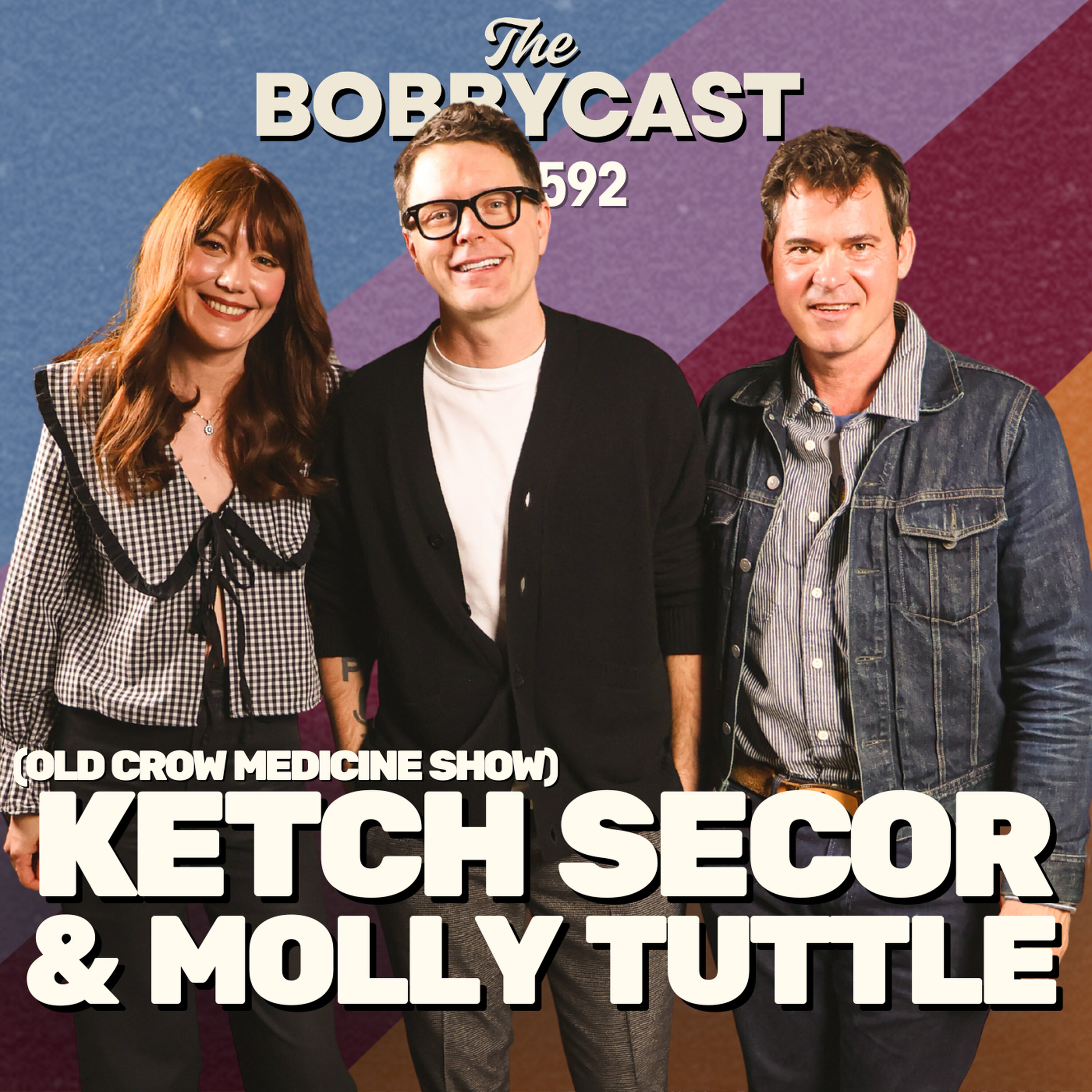
#592 - Old Crow Medicine Show’s Ketch Secor and Molly Tuttle on Wagon Wheel
Old Crow Medicine Show’s Ketch Secor and Grammy-winning singer-songwriter Molly Tuttle sit down with Bobby to talk about their love story, how their relationship came together, and the moments that made them realize this was something real. Ketch also shares the wild story behind writing “Wagon Wheel” from an unfinished Bob Dylan bootleg, what it was like to later hear from Dylan himself, and why that connection still feels surreal. Plus, the two talk about music, bluegrass, fate, and the time Ketch visited a fortune teller as a teenager that somehow still sticks with him all these years later!
Watch The BobbyCast on Netflix!
Follow on Instagram: @TheBobbyCast
Follow on TikTok: @TheBobbyCast
See omnystudio.com/listener for privacy information.
Available Results
Generated results are saved to the knowledge database for reuse and search.
Extract Knowledge
Pick what you want extracted first. Model, scope, and chapter options appear after a template is selected.
Transcript
00:00:06
Speaker 1: I finished the song I wrote it. It was good, It was instantly memorable to me. And that last line at the end, at least I will die free if I get to Raleigh. That's the state motto of New Hampshire. Live free or.

00:00:20
Speaker 2: Die Hey, welcome to the show. We're gonna have catch from ol Crow Medicine Show and Molly Tuttle from well, Molly Tuttle to excellent musicians to awesome people and they just so happened to be engaged now. And if you want to go see Molly on tour, she's awesome. Molly and Marty. It's Molly Tuttle and Marty Stewart the guitars on Fire Tour, Molly Tuttle dot com. We'll talk about that, We'll talk about Bob Dylan, we'll talk about Wagon will all that coming up. Glad you guys are here.

00:00:51
Speaker 1: Let's go.

00:00:52
Speaker 2: Guys. Good to see you both. Yeah, I'm fans of you in different ways. Molly, I'm fans of youth. Just watching your clips from the Opery and also being at the Opry. That was my introduction to you, was you playing the Opry and like, holy crap, there's only like two people I'm intimidated by it. Uh, dentists and bluegrass players for the record, that's it.

00:01:12
Speaker 1: Those let's see those choppers.

00:01:15
Speaker 2: Well, I got one broken right now.

00:01:16
Speaker 1: No, I don't see why you'd be scared of a dentist. Yeah, look like one.

00:01:20
Speaker 2: These are all exactly exactly, these are all fake. Oh really, When I first made money, I bought my Mama trailer and I bought me on new teeth. Not a joke. There is a joke that I do in my act about that that when I first made money I bought the two te's teeth and a trailer. Also my favorite Toby Keith song. People love that one teeth and a trailer, so they catch him last. But see also it's not the room a deep cut. No, I wasn't giving it like the breath. But anyway, I'm loving that. Thank you ketch. So, Molly, that's how I know you. And Catch. I've just seen them like wandering outside my house, outside your house. Yes, I ran into Catch. Well, they were playing at a record store here in town, and I messed up on the time. I got there way too early. There was nobody there, and I'm like nobody came to watch? Oh, cro was that grimy. Yes, it was a grimys. But I got there like an hour early, and so I'm there and I'm watching them and they're playing the same song over and over again, and I'm going, this is the weirdest, what's happening with this show? Then I realized I was there an hour early and they.

00:02:29
Speaker 3: Were just cursing the same song. Oh, it must have seemed like a performance art style with him.

00:02:36
Speaker 1: I didn't know what was going on, And so what made it weirder was that I had just come off that horrible flu everybody had, and I had smeared a lot of lubricant into my nostrils like this, and I had it all over my I didn't see an I was glowing.

00:02:52
Speaker 2: I didn't see anything.

00:02:53
Speaker 1: This guy comes up and he's like, hey, I think that's Bobby Bones over there.

00:02:57
Speaker 2: And I was just standing there watching by myself, going, nobody's at this concert.

00:03:01
Speaker 1: When you see people out of context, like I didn't think that we'd be seeing you at art in store at the local record shop, because you know, you're a big person in our world. Okay, So when he whispered that to me, I like set up a lot more rigidly and forgot that I was covered in this kind of shining snot lubric Hint, there.

00:03:22
Speaker 2: Was no lubricant. I was really or beautiful.

00:03:24
Speaker 1: I was like a hog man.

00:03:26
Speaker 2: All I know is I didn't want to bother them, and I was watching and then I realized I was there way early. So I went back to looking at some records. I like vinyl. Yeah, and I just like the physicality of it, like having something that I like the art. I think now I just like the art of it more than really anything else.

00:03:42
Speaker 3: Yeah, So I like listening to the whole thing. Like last night I was picking out this record, I went through all my records. I started putting them on and I was like, this is so refreshing to just sit with a whole album and not have like the playlist with different songs thrown in, and just listen to the sequence.

00:03:56
Speaker 2: Did you ever have cassettes? Yeah? I had a.

00:03:58
Speaker 3: Bunch went my first I remember when I was I got my first car when I was eighteen, and it had a cassette player.

00:04:03
Speaker 2: So I got a bunch of cassettes for it because the car had it. You didn't actually have like we had. You are, yeah, and you could you had to like listen to the whole tape.

00:04:13
Speaker 1: And not just cassettes singles.

00:04:16
Speaker 2: Yeah, but they had like one on each side, my favorite ever, MC Hammer Vanilla ice one on each side. Can't touch this on the front, ice ized baby on the back.

00:04:25
Speaker 1: Whoa wow.

00:04:25
Speaker 2: Yeah, I got at the mall. It was a limited edition.

00:04:27
Speaker 1: That must have me to brag because normally it would have been ice sized baby on one side and then play that funky music white boy on the back. Okay, sure, yeah, Ninja please Hammer don't hurt them. And I guess that was the name of the album.

00:04:40
Speaker 2: That's right, good, good recall, Well my thing, you finish my story.

00:04:43
Speaker 1: Sorry, Bobby, I'm jumping on.

00:04:45
Speaker 2: We're in the record store and I have now Molly. I've turned my focus to not wanting to bother them because I realized I'm here an hour early and this could be awkward for everybody, and I'm a pretty awkward person anyway, So I'm just like, Okay, I don't want to bother catch. I don't want him to feel like he has to come talk to me. And he comes up and he puts his hand on me, and he just lifts his shirt up to show an under shirt just before he says hello or anything, and he goes check it out and it says like the natural the land of Opportunity I think is what the shirt said, or the natural state or something, and I'm from Arkansas and that's like our slogan, right, and he goes, I was just here and that's what That's what he led with. And then he said to me, just got engaged. Oh nice, he said, we just came back from California.

00:05:28
Speaker 3: Yeah, that would have been right after because we got engaged and then just didn't see each other for a month because we were both on tour and he was on this Christmas tour, so that makes sense.

00:05:35
Speaker 1: I'm must take in my truth.

00:05:37
Speaker 2: I didn't even leak it and the pictures weren't up on Instagram yet, so I didn't say anything about it to anybody.

00:05:43
Speaker 3: Yeah, we had to get him up before I started playing concerts because I wanted to wear the ring live. And then I was like, I don't know what people are going to be like, zooming in on their phones and they'll be like.

00:05:51
Speaker 1: What I felt, because you're like the press, you know you're but I'm not. You're sort of big.

00:05:57
Speaker 2: Media to me now you're using me with the AP. A lot of people do that.

00:06:04
Speaker 1: I wouldn't normally do that, but I live in Nashville, so you're like, you know, an agent of you know media.

00:06:11
Speaker 2: Yeah, I know you though, and I.

00:06:13
Speaker 1: Heard you and I you know, when we saw each other that day at the record store. Molly and I have just been listening to you.

00:06:19
Speaker 2: That's not true.

00:06:20
Speaker 1: No, we have on this Bay Area country station like it was days before there in the car. You have a unique way of being anywhere at all times, Like you don't speak in a specific way like, oh, I want to reach all of our listeners out here. I mean you do that in those like little sidebars, but when you're doing your show, it's very universal, like you could be listening in Alaska or Florida.

00:06:47
Speaker 2: I am ubiquitous with communication. I'm everywhere all the time, and you don't know where I am. I like that, thank you.

00:06:55
Speaker 1: But for an Arkansas that's kind of rare because most people from your state, you let them know we're from here, like.

00:07:02
Speaker 2: Not as much as Texans. To be fair, Texans, they want you to know.

00:07:06
Speaker 1: I think you're absolutely right.

00:07:07
Speaker 2: Yeah, I think Txan's definitely Crowabo anyway, Molly, congratulations on you guys. You sut me off again, So he told me. I was super pumped, and then I saw the pictures come out, and then I mentioned it on my show in that order. Because I'm not the Associated Press, I'm not trying to break this, I'm not reiters, I'm not trying to break a story over here. But I was super pumped. So before we talk about anything music or professional, how did you guys meet? Is there a story, like a real one or was it just naturally organic? You guys are just in the same circles. Yeah, we met.

00:07:39
Speaker 3: I was opening for Old Crow at the Rhymen and that's how we met, just backstage said hi, and then I went on tour with them, did a couple of other shows together that summer. Then backstage at one of the shows later in maybe August or something, Catch was like, I think we should go on a duo tour together, and I was like sure, Like he's one of my favorite musicians.

00:07:59
Speaker 2: So we just got became friends. Did this tour together.

00:08:01
Speaker 3: We rehearsed a lot, so we were both.

00:08:03
Speaker 2: Just kind of like, let's rehearse. I think we both liked each other, but.

00:08:07
Speaker 1: You know, we just I didn't think she liked me at all. She's a really phenomenal musician.

00:08:13
Speaker 2: No, I know, like I said, I'm intimidating, intimidated by you both a little more her than you.

00:08:17
Speaker 1: Yeah, yeah, but I feel more like I'm a mic worker, I'm somebody. I'm a juggler with words, and I'm an entertainer song and dance man. But she's a picker.

00:08:28
Speaker 2: Okay, I have questions about your picking styles, but I want to focus on this for a second. So you guys, you're opening for him. He does the whole be my opening act. Let's tour does the whole song and dance. When did you know that? He kind of had.

00:08:42
Speaker 3: He just showed up at my house and was like, I really like you. This was like a year after that, so it was during the pandemic. We were going to have like a maybe like play some tunes out in the front yard, social distance style, and instead of that, he was kind of just like blurted. It was almost like word vomit.

00:09:00
Speaker 2: Just like were you nervous? Were you nervous going into that? That's quite the proclamation.

00:09:03
Speaker 1: I had broken up with my girlfriend a couple of days before, knowing that the gnawing feeling could not you know, be cut loose. So you had a bad Yeah, I had a real bad like I was. I couldn't stop thinking about Molly. I was just and you know, I obsession for a person like me was more of a rumination than it was, like I'm looking at pictures of you all day like a you know, freaky kind of thing instead of it wasn't that.

00:09:33
Speaker 2: I'm not sure that it wasn't. Now with how I described.

00:09:37
Speaker 3: Describing this thing that none of us really thought was I.

00:09:40
Speaker 2: Just see a board in your house, like when they're investigated crime and they have all the pictures of all the people, it's just Molly walking out of the house, walking to get coffee.

00:09:47
Speaker 1: That what you're describing was is was what my what my mindset was. She was every picture, every thought, you know, and just a really inspiring person, you know, like I just didn't and I don't think that I had really fallen in love before. And you know, I'd been married before, and I have children and I've lived a healthy, long ish life. But the kind of love that I was feeling when I first met you was like, whoa this is? I don't think this is going away and it was achy too, Like it wasn't just I really liked this gal, we'd be so great together. It was like a little painful, like a little nauseating, like I you know, like we went out on a couple of dates and I and it was agony after it was over.

00:10:33
Speaker 2: Sounds like rickets. Yeah, I sure you didn't have.

00:10:38
Speaker 1: Like hookworm?

00:10:40
Speaker 2: Did you know he had these feelings before he told you that.

00:10:42
Speaker 3: I had no idea because you were always telling you about your girlfriends and people you're dating, Like we'd catch up and just talk about our love lives and these people and who we were seeing. Nothing like super serious, but it was just kind of funny. Once he made the proclamation that, I was like, hmm, I hadn't considered this before.

00:11:00
Speaker 1: And then she went on a cross country road trip with her boyfriend.

00:11:03
Speaker 2: Uh oh, you still had a boyfriend at the time. Yeah, Oh, we're going to go there, extra brave, but extra brave by you knowing that, and you still went there. Yeah, Yeah, I just knew you had Ricketts. I get it, you gotta Yeah, And how long until you guys dated after that? Maybe a month or two.

00:11:22
Speaker 1: A couple of months passed and there was some letter writing, and she wrote back to me and yeah, we.

00:11:28
Speaker 3: Had broke Me and my boyfriend were kind of about to break up. Then we broke up, and then a couple of months later we started dating and then.

00:11:34
Speaker 2: He wrote letters to each other.

00:11:36
Speaker 3: He wrote me a letter. Well I'm a letter right, yeah, like shock to find it. I was like, wait what because we hadn't really. I was just kind of like, well, okay, what is my name on this.

00:11:48
Speaker 2: Damn's where did you mail it to your house? To my house?

00:11:52
Speaker 1: Yeah?

00:11:52
Speaker 3: So I got back and I saw found this letter. I was like, okay. It was just like we can be we can just stay friends.

00:11:57
Speaker 2: So you wrote a letter from your house and mailed it to her house. What do you think the total distance was?

00:12:02
Speaker 1: We're in the same zip code, we're about I'd say one point eight miles, you know, I mean we live together now.

00:12:07
Speaker 2: But then I would thank you. Yeah, there's a possibility now, But then you send a letter one point eight miles. But probably it was a significance of the letter, right, the writing of it on a piece of paper.

00:12:16
Speaker 1: Yeah, I just needed to get it out and just say my piece And how.

00:12:20
Speaker 2: Many pages was it? Uh?

00:12:23
Speaker 1: Well, it wasn't a card. It was on stationary page.

00:12:28
Speaker 2: Probably the front.

00:12:30
Speaker 3: It was like the front and the back of a full piece of paper.

00:12:33
Speaker 1: You know, I'm a chatterbox. When I get a pencil, I really start talking.

00:12:37
Speaker 2: Do you write songs pencil and paper?

00:12:39
Speaker 1: Yeah?

00:12:40
Speaker 2: No, not really on the laptop or anything.

00:12:42
Speaker 1: Well, we write on the laptop too, but it'll be both, and that's more of a newer thing.

00:12:49
Speaker 2: What's the newer thing the laptop?

00:12:51
Speaker 1: Laptop? Writ now on a laptop? I mean I can write on a phone too. We write a lot of songs in the car.

00:12:58
Speaker 2: Is music always happening with you two?

00:13:02
Speaker 3: Not always, I don't think. But we're always kind of deciding on like what's our next song we're gonna write about. But then we just do kind of like go on walks, do stuff around the house, and we might not do anything musical for I don't know, a couple of days and then just kind of come back to it. But I think we will start writing songs like in random Like we're so often traveling that we write a lot of songs while traveling, so like in the car and hotel rooms.

00:13:28
Speaker 2: Ever write at home just like hey, let's just write or yeah, are you probably the most.

00:13:33
Speaker 3: I feel like when we're traveling, your brain gets kind of scattered. For me, Like when I'm on tour, I just totally get out of the writing mindset. So if we're both home for prolonged periods of time, that's when we start writing most productively, I think.

00:13:45
Speaker 1: But we also write on FaceTime too when we're sometimes. Yeah, like we're a part a lot because of course she's playing. I mean, she played almost twice as many concerts last year as I did.

00:13:56
Speaker 2: I'll do like one hundred shows a year.

00:13:58
Speaker 1: I don't know, like seven still a lot, but it's plenty for me, but she does it a lot more.

00:14:03
Speaker 4: So let's take a quick pause for a message from our SPONSOROW and we're back on the Bobby Cast.

00:14:19
Speaker 2: I'm curious about some techniques as a player because I was reading and I'm not even remember them. But there was like a claw or a claw Yeah, what's it called.

00:14:27
Speaker 3: There is a claw clawhammer guitar. So it's like a you hear about clawhammer banjo a lot. It's kind of a banjo style. It's old time banjo, which sort of predates bluegrass, so it's this kind of rhythmic style of playing where you kind of your hand looks like this when you're playing. It almost looks I don't know if that's why it's called clawhammer. I assume because your hand sort of looks like a claw when you're playing, and you're kind of hitting the strings and plucking up with your thumb and it hits the banjo and it makes this sort of rhythmic percussive sound. And then it's basically taking that style and applying it to guitar, which is less common. So when I was a teenager, I played the clawhammer banjo because I love I started playing it because of Gillian Welch, and she does a few songs on her records on clawhammer banjo, so I wanted to learn all her songs. So I picked up the clawhammer banjo and then someone showed me that you could.

00:15:13
Speaker 2: Swap it over to the guitar.

00:15:14
Speaker 3: It almost looks like I get people telling me that it looks like I'm playing slat bass on the guitar sometimes.

00:15:20
Speaker 2: Is there a flat is there a star called flat something?

00:15:22
Speaker 3: Flat picking?

00:15:23
Speaker 2: Okay, will you explain that one to me?

00:15:25
Speaker 3: That's like bluegrass, like typical bluegrass lead guitar playing you call flat pickings.

00:15:30
Speaker 2: You're playing with a pick and.

00:15:33
Speaker 3: Just playing these sort of usually kind of intricate or high speed melodies on the guitar with this pretty heavy pick that bluegrass players generally use, like pretty thick, like bigger picks. So yeah, I think I've only heard flat picking really applied to bluegrass lead guitar players. So someone like Billy Strings or like Tony Rice was someone who sort of pioneered the style, or Doc Watson, he did a lot of flat picking.

00:16:02
Speaker 2: Your dad was a player, I know he was bluegrass. Was he a player? Like what did he play?

00:16:07
Speaker 3: He started to play everything. He plays well, all the bluegrass instruments. He plays fiddle and mandolin and guitar and banjo. And he also used to play bass with me when I was a kid. I me and my brothers played shows with our dad. We had like a little family band, and he would play bass. And he's mostly a music teacher, so he's taught music since he moved out to the Bay Area near San Francisco in the seventies and found this little music shop and started teaching lessons there. So he's taught tons of people all over California bluegrass music for a long time, and that's his primary thing. But he likes performing here and there, he just doesn't do it too often.

00:16:39
Speaker 2: I was talking to someone recently about music and nature versus nurture or nature and nurture, and I was asked if I thought that music ability was genetic or if music ability was something learned, and I said, I think it's a bit of both, because if you're around it, regardless of what it is, it starts to get a lot easier for you. Esecially, if you around at an early age, you understand it in those formative years of brain growth. But then also I do think there's something that if I can run fast, my kid will probably be able to run fast, just genetically speaking, because your dad is a teacher. Did your brothers play?

00:17:18
Speaker 3: Mm hmm, you have two younger brothers who play.

00:17:20
Speaker 2: What do you think you think nature nurture when it comes to music.

00:17:23
Speaker 3: Well, I think for me, just being around it made me have such an interest in music, Like I don't know if I would have gravitated towards it if I didn't grow up in a musical household, but I just heard it from such an early age. My dad would have jam sessions at the house or he'd just play songs around the house, constantly playing records. And then when I went to play. I remember picking up a guitar, it was not easy for me at all, Like I felt like I struggled. I feel like I almost like, looking back, I was like, I felt like I had no natural ability, Like it was so hard for me. But then I started practicing and practicing a lot more, and I think just having so much music around the house, I was able to pick up things by ear a little more naturally. But then my brothers they like, I feel like when they picked up instruments, they just were so fast and they were able to do it really easily, maybe because they saw me playing and had kind of watched how I learned. And the younger Yeah, two younger.

00:18:14
Speaker 2: Brothers, how did you not burn out?

00:18:18
Speaker 3: I remember when I was like in middle school, I started having this routine where I would make myself practice guitar for two hours a day. I was like, I need to practice two hours every day, and I don't like, looking back, it was sort of crazy, and I would just feel I felt burnt out. Even like as a young person, I was putting so much pressure on myself to just play and play and play. But I feel like I had this like internal drive that I just wanted to get better and better, even though sometimes I was like, oh, I just wish I could take a day off, but I like wouldn't let myself.

00:18:50
Speaker 2: Do you think at all it was to be closer to your dad.

00:18:53
Speaker 3: I think that was a huge part of it, because it became like this really fun thing that we did together and this bond that we shared. So I still feel like when I'm sending songs or sending records to my dad, I want him to like them, and I'm like, oh, I really care like what he thinks about my music. But I feel like it's gotten to the point of just like we're now just kind of friends and it'll come out to my shows and I know he's going to have a good time and he loves it. So I think back then it was just also this way to kind of, you know, feel good about myself in general. It kind of helped me have more confidence as a kid and it was like a boost to myself esteem. But I also really just loved to play, and I loved getting together with other people to play, and I wanted to sound good when I was, you know, in that situation going to a jam session or getting together with friends.

00:19:39
Speaker 2: Ketch, what is your kid genesis as far as music, Like, what did you start playing music?

00:19:44
Speaker 1: I had encounters with American folk music traditions at a young age that seemed to pull something out in me.

00:19:53
Speaker 2: Encounters I had feel like a spaceship landed.

00:19:57
Speaker 1: Well, it kind of felt that way, Bobby. It was like, because you know what makes somebody like whose dad is not a guitar teacher? Dad was. My dad has been for his career an elementary school principal. Mom worked in schools too. We lived in five states by the fifth grade, we moved around a ton. But in the first grade, this wonderful person came to my school to give a program named John Hartford, who is a really famous Missouri musician who wrote this amazing song jennal on My Mind, which Glenn Campbell rocketed to number one back in the seventies, and that allowed John Hartford to get a TV show and become, you know, one of America's kind of premier folk musician traditional fiddler or banjo picker type of guys. Wore a Bowler hat Buck dance on right in front of me when I was six years old. So I remember seeing that and thinking, well, that's entertaining, And then you know, I found that I loved my mom's record collection when I was a kid, which was up in the attic, and I pulled that down. I had a paper route when I was a kid, and when I first got my route, I went to go buy an alarm clock so I could start getting up early. But the alarm clock had an AM radio on it, or a radio, but the AM dial was so great. So at about five point thirty in the morning when I get up, I'd be listening to Cincinnati or Detroit or Toronto, the clear channel thing. And it wasn't like I was hearing like the Grand Old Opry and a bunch of music, but I was hearing all these towns. So for me, it was as much about music as it was about wanderlust, wanting to understand America being called. So back to your nature and nurture question, I think there's another component, which is did your soul get selected to be brought into the world of entertainment? Because the thing that we do when we're entertainers is we reflect something that can be more than one person at once. You know, it's an on mass sort of like my experience as a musician and as a traveler and as a storyteller, or helps somebody else out there better compartmentalize their own experience or did they go through something tough? Are they away from home right now and lonesome? That kind of power is a divinity, and it's just a gift that we all in this room have because we're all people that can talk through the mic and make somebody else out there in the world feel more at ease or more agitated, or more excited or turned on or whatever it is. So I think there's you know, I always felt like a decent musician, a good communicator, but also a really soul for a person who had a story to tell that could have a universal implication.

00:22:41
Speaker 2: Where do you think you got your first music affirmation.

00:22:44
Speaker 1: Singing in the Young Singers of Missouri. You see, bordering on the Great State of Arkansas is a far more greater state. It's called the show Me State, and it's got a lot more going on. It's a larger state. It's got a lot of regional biodiversity, uh and It has many large cultural centers, including Saint Louis and Kansas City. It might not have as great a football team, but it certainly has an upward mobility. Uh trump card.

00:23:12
Speaker 2: So you would sing and you were told you were a good singer, and you liked that feeling.

00:23:17
Speaker 1: I was a member of Young Singers of Missouri.

00:23:20
Speaker 2: But you had to be good to be a member, right.

00:23:22
Speaker 1: I think they would have took anybody.

00:23:24
Speaker 2: You just had to fit young. Yeah, you needed to know.

00:23:27
Speaker 1: You needed to have a mother who could get you. A cumber bunt.

00:23:30
Speaker 2: I thought it was cumber bund. It's called a cumber bunt. Man, I'm knowing himself like crazy today cumber bund.

00:23:36
Speaker 1: I thought it had a bundo.

00:23:38
Speaker 2: We met a fact check that boys, what do they call it? Cumber bund? Cumber bund?

00:23:43
Speaker 1: Oh?

00:23:43
Speaker 2: Is it bun? Oh? I don't know. I had one for I ended up not wearing it. Cumber bund, but I had one. It was red because I had a red and I ended up not wearing it because it felt I maxed out on doric and it felt even a little dorky year it was too far. I thought you were kind of counterculture, though I am now counterculture.

00:24:02
Speaker 1: In that, but in high school.

00:24:03
Speaker 2: No, If getting beat up is counterculture, oh, then I was a counterculture as you could be. I was number one. I was Bob Dylan of counterculture. If it was just about getting your head stuck in the toilet.

00:24:15
Speaker 1: Oh no, wow, yeah it was it a Was it a violent school system in which you didn't feel safe?

00:24:22
Speaker 2: You ever see the movie Stand By Me?

00:24:24
Speaker 1: Yeah?

00:24:24
Speaker 2: Or Lean On Me?

00:24:25
Speaker 1: Yeah, Rob Reiner? Yeah, elite great.

00:24:28
Speaker 2: Yeah, it wasn't like that at all.

00:24:31
Speaker 1: It wasn't like lard ass when nah I.

00:24:34
Speaker 2: Was all right. I was just the dirty, the poor kid that had the big mouth and that would get me in trouble, like got my head flushed to the toilet.

00:24:43
Speaker 1: Yeah. I would just think the Arkadelphia school system might have had Well I'm not from Arcadelfia. Oh okay, sorry, you're.

00:24:49
Speaker 2: Just as signing me. So I'm from the major metropolitan area of Mountain Pine, Arkansas right here at population seven seventy two. Oh my god, can I sign my hometown? Has that sign up? That's so cool? Yeah? Now all the people who put your head in the toilet have to look at that back at home. What about what is when I say musical affirmation. Molly, what comes to mind for you? When did you get the first musical affirmation that you're like, wow, this, whatever this is, I love it.

00:25:13
Speaker 3: Ooh, musical affirmation. I think like when I first would go on stage and.

00:25:22
Speaker 2: Just play.

00:25:22
Speaker 3: I remember I would work on these guitar solos. I would just play the same solo over and over and again and practice it and try to work on making it really you know, kind of perfecting it and playing something really complicated. I remember going on stage with my dad at this It was at a music camp he was teaching at, and I had this sort of intricate guitar solo I was going to play at like the student concert, and I played it and everyone cheered for my solo, and I just remember thinking, that's cool, Like they recognize this work that I put in.

00:25:49
Speaker 2: And I just liked that feeling.

00:25:50
Speaker 3: And I, you know, kind of liked making people happy with the music. And it was also something that made me feel happy too to share it with people. And I remember I had these other kids who i'd play with, and I didn't really know any kids at my school who liked bluegrass or were into it. But since my dad was a teacher, and you talked kids all over the Bay Area banjo and fiddle and mandolin. We would get together like other kids my age and form these little bands. So that's how I started performing, and I think that's kind of where I first felt that sense of affirmation.

00:26:21
Speaker 2: How many instruments do you play? Can you list them for me?

00:26:24
Speaker 3: I just it's a short list, just guitar and banjo.

00:26:27
Speaker 2: You don't play piano, I can. I know some chords.

00:26:31
Speaker 3: It's better at piano than me. I can just play like bassic chords.

00:26:34
Speaker 2: I don't think you've ever seen the two of us.

00:26:35
Speaker 1: The list is vast. Charlie Brown totally between the two of us, we could really have a two man woman band.

00:26:44
Speaker 2: So you play banjo, banjo, guitar.

00:26:47
Speaker 3: I can play like a few tunes on the mandolin, only in limited keys, no hard keys.

00:26:53
Speaker 2: But when did you know you wanted to do music with your whole life? That's a commitment to go to music school.

00:26:58
Speaker 3: I think I was midway through high school and I was really not the best student, and all my friends were deciding on colleges, and all I wanted to do was play music, and that's what I did. Any chance I got all my free time on the weekends, I was practicing or doing shows, whatever shows I could find. So when I heard about Berkeley College of Music in Boston, heard they had this American roots program and it was just this very like diverse music school where you could learn any style of music pretty much. And I knew some people who went there, and I knew that Boston had this cool scene for my type of music that just really appealed to me. So I went and applied there. But that was kind of like it felt like it was my only path I could have taken, Like it was all I wanted to do. There was not really any question of like is there a plan B. And also I saw my dad being a music teacher and kind of, you know, that's how he supported our family. So I knew that if performing didn't work out, I could start teaching, and you know, he would help me figure out how to do that.

00:27:56
Speaker 2: Did you have to audition? Yeah, and what is that process? Like, it's it's gary.

00:28:01
Speaker 3: I flew out to Boston to audition, and I also wanted to just see the school before going there. My dad came with me and I played one of my original songs at the time, and then I played something on banjo and they really liked that I played the banjo because that was unusual. But I remember just being really nervous and then I got in and the worst part after getting in was you kind of have to re audition, Like you do this thing called a ratings audition or rating exam, and they rate you in all these different categories like site reading and music theory and technical proficiency.

00:28:33
Speaker 2: Do you play on a stage in front of people.

00:28:35
Speaker 1: No.

00:28:35
Speaker 3: For your audition, you're just in a room with like two teachers.

00:28:38
Speaker 2: And they're just sitting there with just spad or something and they don't really say not clapping or anything.

00:28:43
Speaker 3: No, not clapping, definitely not clapping.

00:28:45
Speaker 2: That inimidating. Yeah.

00:28:47
Speaker 3: But then for my ratings audition, I went in and it's the same thing. There's like three or four teachers. They're just staring at you, asking you questions. And I came out and I got the worst possible ratings. I got all ones and it was craded on to eight. So I just just did horrible.

00:29:04
Speaker 2: You get to stay in school if they write you all ones, even after you're already in.

00:29:07
Speaker 3: Yeah, you just get the most like remedial possible classes after that?

00:29:11
Speaker 2: Why do they give you ones? I don't know. To this day, I'm like confused, and I have a im so advanced they didn't understand it. I don't know.

00:29:20
Speaker 3: I know that I couldn't sight read and I didn't know any music theory. And then I think the other ones they just saw that I didn't know anything about theory, and then they were just like, you know, we're just going to give you all ones and everything.

00:29:33
Speaker 2: Did you lose confidence after that or did you just know they didn't know.

00:29:36
Speaker 3: I was kind of like crushed after that because I didn't know a single other person who got all ones, because that was just kind of rare. But now I've met one other person who did, and it's Annie Clements, who has played with Maren Morris, and I know she's played with so many great acts and I yeah, she plays space, she's a great bass player, and she's the only.

00:29:55
Speaker 2: Person I've ever met who also got all ones. There's a story of Steve Harvey and his teacher told him that he wasn't going to be on TV because he talked too much or was never committed, and so every year he'd sent her a television as a Christmas gift because she always told him he'd never make it on television. What are we sending these teachers? We should tell them a video game all ones?

00:30:15
Speaker 1: Yeah, yeah, catch.

00:30:18
Speaker 2: What about you? When did you start as a When did you start playing music? Was it by yourself or did you form a band early?

00:30:26
Speaker 1: When I was a kid, I went to see this guy play a concert when I was twelve, and it was such a great show, but I didn't really understand it. In fact, I owned that guy.

00:30:37
Speaker 2: For people who aren't watching and just listening, it's Bob Dylan.

00:30:39
Speaker 1: Oh yeah, sorry, I'm talking about Bob. Of course. You know. I went to see the show and I didn't really get it, but I got it. I only understood four words, Hey, mister tambourine and man. Everything else could have been not even English, and I just wouldn't. But those four words were all I know, and I was hooked. This happened when I was a kid. And then I went to a fortune teller.

00:31:07
Speaker 2: We all do when working for us.

00:31:08
Speaker 1: Yeah, and I had my mom wait out. My mother was such a soldier.

00:31:12
Speaker 2: You were a kid at a fortune teller.

00:31:13
Speaker 1: I thought this was like later, No, no, no, this is like how old, Are you going to the bount at thirteen? So I went.

00:31:19
Speaker 2: Your mom dropped you off. She took me to the dillon, went in the house of a fort. Now I'm done with bob billing things. Okay, your mom dropped you off and you went into a fortune teller by yourself. Yeah, how much does that cost?

00:31:30
Speaker 1: Oh? Probably ten dollars, maybe fifteen.

00:31:32
Speaker 2: And what do you ask the fortune teller?

00:31:33
Speaker 1: It was on the edge of town where all the turkey plane.

00:31:35
Speaker 2: It has to be on the edge of town. Never seen one of the middle of town.

00:31:37
Speaker 1: I saw to me in the mountain Pine. Part of the story this is I grew up in a town that had a whole bunch of turkey factories where they slaughtered them and eviscerated them and made the dog food and the cat food and the turkey food. They do that, and that's where the fortune tellers were. So anyway I went. They had neon signs, so I knew they were there. Mom dropped me off. I walked in, and I at first I asked like the questions that I thought that a fortune teller would like to answer, or was used to answering, when will I lose my virginity. When what will my job be? You know, will I be a will I be will I make money? Will I live a long life?

00:32:16
Speaker 2: Got it?

00:32:17
Speaker 1: But then I really asked the only question I was there to ask, which was will I meet Bob Dylan? And she scoured this hand and flopped and flipped and then professed, You'll never meet Bob Dylan. And I was crushed.

00:32:31
Speaker 2: She gave you ones?

00:32:33
Speaker 1: Yeah, she gave me all ones. And you know, when you get the ones, it means you just rise because there's nothing better than a door slammed in your face as far as figuring out how to get in?

00:32:44
Speaker 2: Did you believe the fortune teller? Oh?

00:32:46
Speaker 1: And she was right? Yeah, I never met Bob Dylan.

00:32:49
Speaker 2: No, I know. I just wonder if you believed the fortune teller at thirteen, or if you thought this was a novelty. What did your mom tell you about this?

00:32:57
Speaker 1: I don't know that I told my mom about what I said with the four and Taylor, and mom had recently gotten into therapy, and I think that she felt that her children's sort of mental independence and sort of sense of self and ego was a very healthy thing. So Mom didn't ask me about what I had talked the Fortune Teller about how do.

00:33:16
Speaker 2: You feel about psychics?

00:33:17
Speaker 1: Now, I feel pretty uninterested in psychics, and but Molly is definitely a little bit more into.

00:33:27
Speaker 2: I saw well.

00:33:28
Speaker 3: I was surprised when you said fifteen dollars because I just went to see one on tour this fall and it was also fifteen dollars.

00:33:33
Speaker 2: So they haven't really raised their visible string. Same one.

00:33:37
Speaker 3: Oh, never raised the raids.

00:33:42
Speaker 5: Wow, the Bobby cast will be right back. This is the Bobby Cast.

00:33:58
Speaker 2: I have thoughts on psychics. Would you like to hear them. Yeah, It's one of those things that there is no way I can possibly prove it's not true. No, I can't prove that what they're doing. I can prove probably that there are certain ones that are scamming people. I think we can prove that, but I can't prove that that is not an ability or a special I don't even want to say, I'll say talent, a special talent. I can't prove that nobody has.

00:34:26
Speaker 3: It that's true, because if you see someone they tell you something that's not true, when maybe they're just one of the the ones that pretends to have it.

00:34:34
Speaker 2: And I've gone to a couple, as I'm very much a cynic in all facets of life. But and I think most people that tell me things like or I hear stories of like I died and saw when saw the yellow light, and I can't prove they're not telling the truth. Now I can often look at them and go, you're full of crap, just generally, or you know, you're trying to scam some money, but I can't prove that that hasn't happened to anybody ever. I feel the same way with eys. I cannot prove it's not true. I've met a couple that I believe are a plus humans and either I believe in them and they believe it, so I go, maybe so. But I definitely would not tell someone that psychics aren't real. Now do I believe they're real?

00:35:21
Speaker 1: No?

00:35:22
Speaker 2: But not no, And there's a difference.

00:35:24
Speaker 3: Yea.

00:35:24
Speaker 2: There's a difference too about that.

00:35:26
Speaker 3: And I feel that way about ghosts like same. I have never seen one and I can't disprove it.

00:35:33
Speaker 2: We'll be here for two hours if we're talking about other dimensions and aliens are you not?

00:35:37
Speaker 1: But not know?

00:35:38
Speaker 2: With aliens, and I feel like aliens must exist for sure, yeah, Well, there's just been so much that they've been slow rolling us, especially in the last couple of years. They're rolling it out there. There are certain things, and this is kind of a place that I go and I tend to make everybody roll their eyes in the back of their head. There are these entities that we have recordings of that are going so fast with no heat signature at all. We do not have the ability, we don't possess the science to have something move that fast with no heat signature at all, the propulsion to move left, right, up, down. So do I believe things are being kept from us? Absolutely? What I think they're little green men coming from above. I don't think so. Maybe from the ocean. We don't even know what's down there. We have mapped more of general space than we have the ocean, and we're here with that. But then also dimensionally, to me, what we see is, let's say this show is on Netflix.

00:36:43
Speaker 3: Right.

00:36:44
Speaker 2: Let's say we're watching Stranger Things at the same exact time. Orange is the New Black is on over here. Now we're not watching it because we're too Our frequency is on Stranger Things. Inside that streaming platform, there are five thousand other shows over here that we can't see because right now we're dialed into this one. And I kind of feel that way about where we are now, Like we can see certain even on the molecular level of animals can see colors because they have different cones in their eyes that we can't see. Just because we can't see it, touch and feel, it doesn't mean it's not here. And so yeah, that and I could do that for a while. And I could also do simulation theory, where I think that even if you just believe, if you're even if you're a Christian, you believe in heaven and that you start there, you come down here, you do a little dance here, just try to get back there, that's a version of simulation theory. Like so when people go simulation theory, that sounds like robots or a Commodore sixty four Oregon trail back in the day, I go the word possibly does. But in theory, there are many things that people accept that would be considered simulation theory. And one of them, the one that I can mostly preach to my friends, is if you believe we started from beyond, and you believe Heaven earth, that we start there, we come here we live a life. Hopefully we get to go back there. This is a temporary organic being. We're in to try to get our way back there. And they go, oh, maybe you're on some anyway, So how about that music?

00:38:08
Speaker 3: Huh her little side.

00:38:11
Speaker 2: So you went to a psychic Huh? I did.

00:38:13
Speaker 3: Yeah, I was on tour. I was just wandering around Winston Salem, North Carolina this fall, and I've never actually been. I don't think i'd ever gone to a psychic except I have this one friend from high school is who is psychic, and she reads tarot cards. So she's done that, especially during the pandemic. When we started dating, she was always reading my tarot cards and being like, I have a good feeling about this. That was one of the ways I kind of, you know, was like, Okay, I'm gonna at least give it a try. When we were starting to date, the tarot.

00:38:40
Speaker 2: Cards got you.

00:38:41
Speaker 1: My friend Maurissa is definitely Yeah, she's like a legit witch.

00:38:46
Speaker 2: I feel that psychic is almost like saying alien and little Green men, because I don't know that all psychics just a term we associate with having some sort of ability to see and feel things that maybe other people can't tune into right and I'm not at wu wu wa at all. But I do think people possess different ways to interpret just general interpretation of things around us. Psychic is the word we say when there are other terms clairvoyant mediums. Yeah, so did you when you went to yours It's not really yours, but the one you went to. Did you feel like a thing when you?

00:39:21
Speaker 3: Well, she told me I was going to be one of the most powerful witches of all times.

00:39:25
Speaker 2: Witches. Yeah, are you a witch?

00:39:28
Speaker 3: She said, I don't think of myself as necessarily a witch.

00:39:32
Speaker 1: It's not a bad word on.

00:39:34
Speaker 3: But anyway, she was like, But she said, I only had to tell my next birthday, which is actually today is my.

00:39:41
Speaker 2: Birthday, but literally today's birthday. He said. If I didn't figure out.

00:39:44
Speaker 3: My witch powers before today, then I wasn't going to actually become a witch.

00:39:47
Speaker 2: And I don't.

00:39:48
Speaker 3: I don't think I figured anything out.

00:39:50
Speaker 2: You're doing this on your birthday. Now. I feel guilty that you're here on your birthday.

00:39:53
Speaker 3: No, this is the best way to spend my birthday.

00:39:55
Speaker 2: Happy birthday, thank you, that's awesome. Holy crap. But I didn't really figure out, she said. I need to figure out my whole like you got till midnight? Then can I suggest something kind of throws something that you What if your powers are your music? Yeah, like literally music comes or just any sort of art or interpretation in art. Like some people just have the inate ability to do that on a much more natural level. Some people, I feel like I have to grind to get mine, like really, like I don't like I'm not naturally that I think. I I grip my teeth until I figure it out. And I'm not sure you're still I can't be in your bodies. But what if like our magic is like the art we create. Yeah, that's kind of like a week. Like that's how I think of it. Like guitar witch, they got one, they got ones that that's crazy. That's because I've seen you play. They're jealous.

00:40:51
Speaker 3: I was just running on like spite from the ones for a while. You know, it kind of feelsier like wrong, No, not really, I just think it's at this point.

00:41:00
Speaker 2: But I'm a little bothered for you. Let me, I'll take that on for you.

00:41:03
Speaker 3: I kind of like I see where I got the ones from because they were asking me things like play a mix. Olidian scale, and I was like, I've never heard that word a single time in my life.

00:41:11
Speaker 2: When you get to Berkeley, did you find people like you? Yeah, like for the first time, like really like you. Yeah.

00:41:20
Speaker 3: It was really cool because I just found this I just like clicked into this group of people who loved like bluegrass music and roots music and old time and were just totally focused on like learning and practicing. And it was so cool, Like I felt like I was at Hogwarts or something, because it was just this magical experience where I got to solely focus on music for I was there just two and a half years and it was so much fun. But I played all over Boston. They were bars that had weekly bluegrass bands playing at them. The cantab Lounge was one where every Tuesday bluegrass Night would happen, and I would play at that and these other historic folk clubs like this club Club pas See where Bob Dylan played in John Baiez played.

00:42:03
Speaker 2: We would do.

00:42:03
Speaker 3: Shows there and it was just really cool. I feel like I instantly made friends, and I had this group of people who we were always having these fun parties and just playing music together.

00:42:11
Speaker 2: Okay to Bob Dylan references, so I'm gonna go to it now. You said you hadn't met him yet. I think most casuals would know wagon Wheel. I don't think i've ever asked you, like the actual story of that song, like how you fold? Because I can I tell you the version that I have in my head. That may be wrong. Yeah, sure, you found out this is going to be wrong, but this is just what I've picked up.

00:42:33
Speaker 1: Because that sounds like you might be right.

00:42:35
Speaker 2: Okay, you found an old CD your tapet with a partial correct version of Bob Dylan singing wagon Wheel, and you thought I'm going to finish this. You got it, so tell me the real version.

00:42:49
Speaker 1: Well, my my sort of coming of age experience was when I when I opened up my case on a street corner for the first time and realized, oh my god, I don't need to stay, I don't need a venue. I'll just do it right here on the curb. That really opened a whole world of performance to me. And we had these sidewalk preachers in my town, you know, that would stand up on a crate and you know, proselytize. So I saw it like that, and anyway, it just it was real clear to me when I opened up my case that I was a performer and I needed songs and I so I learned as many songs as I could all through my teenage years. But I also wrote songs. I'm telling you this because if I hadn't have been a songwriter in my teenage years, you know, I wouldn't have messed with this thing. But I was already in the habit of rewriting music, you know, Like the first song I ever wrote, like you know, was a new version of the Lord's Prayer to music. And then a lot of political things that I would read, the declaration or the Pledge of allegiance.

00:43:53
Speaker 2: So you would put melodies behind a father in heaven. Yeah, so you were telling it really.

00:44:00
Speaker 1: Yeah, God, anything that was like scripty that you had a cadence to it, put it to music, and I'd take a little My mother was pissed about this, but I put sharpie on the keys and then I write them up there, so like triangle, this was like basic shape note. I also went to a shape note singing class when I was a kid at the Chautauqua Institute, which is up in around Buffalo, New York. Anyway, I was into music. I was into Bob Dylan, and those rivers converged and this confluence was hearing finally this unfinished Bob Dylan masterpiece. It was like nobody had heard it yet.

00:44:38
Speaker 2: It was cow on what.

00:44:41
Speaker 1: It was on CD and it had been purchased by my friend at the Virgin Megastore in London, England, and then sent to me dubbed form on cassette via the US mail.

00:44:53
Speaker 2: When he bought that on CD. Though, what was the CD?

00:44:55
Speaker 1: Well, remember back in the day when bootleg CDs could be purchased in large urban areas, in huge crates by people that were selling like twenty five fifty dollars for a double album, and it was a lot of Bob Dylan, a lot of Grateful Dead and you know Tom Petty and Bruce and people like that. So a lot of Bob Dylan bootlegs were moving around through the early nineties. My buddy heard one, send it to me. I heard this song. It was an outtake from a film called Pat Garrett and Billy the Kid, a movie that Chris Christofferson was in and was made in Durango, Mexico in seventy three or four or two. And I'm convinced Bobby that Bob Dylan was playing this song rock Me Mama like a wagon wheel, and then he put his guitar down and thought, nah, I can do better than that, and he began to write a new song which was very similar based on this song, a song that went Mama, take this badge off.

00:45:59
Speaker 2: Of me Mama Dick did. Yeah. Oh, I never thought about those being similar.

00:46:04
Speaker 1: Well, they were written in the same week. So anyway, I finished the song. I wrote it. It was good. It was instantly memorable to me. It was real autobiographical because as soon as I left high school, I moved to North Carolina. The whole song's about leaving New Hampshire and moving to You know, I didn't put Greensburro into it because I put Raleigh because of Sir Walter Raleigh, and that last line at the end at least I will die free if I get to Raleigh. That's the state motto of New Hampshire, live free or die So I again with the I just took the language around me and I funneled it into the songs that I was writing at the time.

00:46:42
Speaker 2: So were you just playing that song on the corner over and over again? Did you feel like you had something there, something good?

00:46:49
Speaker 1: Every time I'd played on the curb, I'd get tipped. It was like magic, you know.

00:46:54
Speaker 2: So did you keep that in your back pocket for when you started playing with the band.

00:46:57
Speaker 1: Well, then I started playing with the band, but we were so motivated by these American traditions that playing original music wasn't really our thing. So I just kept it, like say, in my back pocket. Then we moved to Nashville about nineteen ninety nine, two thousand and two thousand and one at that time, and then you know, they were like, well, you guys are really fun and interesting and visual, and but your material it's all raving old time music from the twenties and thirties. What do you got that's new? Because Nashville, Tennessee, you need new songs. You don't play old shit, So what do you got? I mean, you could play some old songs, but this is a place for songwriters. And I was like, well, I got this one song and it was great. We played it right away and people, you know, we got an agent right away and then a manager. It opened up a lot of doors that song. Did that song?

00:47:49
Speaker 2: Did? I can remember? I know the video I've seen the video ten thousand times, Like it's one of the first YouTube music videos that I remember seeing, like when YouTube, Like, so you guys recorded the video. It's active, it's outside a lot, right.

00:48:01
Speaker 1: Yeah, it's at a carnival, that's what it is. Yeah. Yeah, it's got burlesque dancers and Gillian Welch and David Rawlings are in it.

00:48:08
Speaker 2: Gillian Welch, isn't it.

00:48:09
Speaker 1: Yeah?

00:48:13
Speaker 2: So that song did it open doors up for did it continue to open doors up for you guys for years?

00:48:20
Speaker 1: Yeah, it's sort of been a story of a song opening up doors for this for my band in my career, uh, my whole.

00:48:28
Speaker 2: Life, and Bob Dylan never reached out.

00:48:31
Speaker 1: Well about about fifteen years into the story, Bob Dylan reached out through his manager and said, Bob so pleased with Wagon Wheel that he wants catch to have another of Bob Dylan's castaway songs. So here it is. So I wrote that song, rewrote it, and then we made a slick video and it was our most top charting country thing of all time, you know, like it did good, Like I think we were in the crack the top twenty in the first week of you know, contemporary country music. But this was like two thousand and thirteen or something. You never met him, and no, and after that, like, you know, just little I sure have thought about.

00:49:15
Speaker 2: Him open the door, bringing man Bob. Yeah, that would have been great on you.

00:49:22
Speaker 1: You are a male witch.

00:49:24
Speaker 2: That would have been great. No, really, that would have been great. Though I wish I feel.

00:49:27
Speaker 3: Like you are going to meet him though you're getting your.

00:49:32
Speaker 2: Do you want to meet him at this point?

00:49:34
Speaker 1: Uh? You know, when I was young, I met Ozzie Smith, who is my other hero.

00:49:39
Speaker 2: Saint Louis Cardinal shortstop who did backflip him doing backflips before a game going ahead. The short stop was one of the coolest And I'm a Cubs fan and that was one of the coolest things I've ever seen.

00:49:46
Speaker 1: So great.

00:49:47
Speaker 2: Yeah, and how was he?

00:49:49
Speaker 1: He was pretty scary. I mean I met him when I was ten at a baseball stadium, and you know, he was gruff, and but I mean he was beautiful.

00:49:58
Speaker 2: God.

00:49:59
Speaker 1: I mean, he's still alive and active and he's at National Treasure.

00:50:03
Speaker 2: Was he nice to year?

00:50:04
Speaker 1: He was nice enough. He wasn't, you know, callous or nothing, but he was gruff. But I like that and he made my life. But they say don't meet your heroes. And I met Ozzy and there was something radiant about him. So I feel like I've already met the hero. And so if I were to meet Bob and I just wouldn't want to have a bad experience. But I tell you, my friend met Bob. My band made of Mine. We were he was out for because the Mumford Boys, who we did a lot of work with, Mumford and Sons, was on the Grammys one year and Bob Dylan was going to do a mashup and so they were in these rehearsals and my buddy was sitting there on the couch and Bob Dylan walks in and sits on the couch right across from him, and and T Bone's there, and we had just done this record with t Bone and this project and t Bones talking with Gil, my friend. He's like, oh, yeah, you know, an old crow was back in the studio again. And Bob Dylan turns around and says, oh, crowe And Gil says yeah, have you have you heard of us? And and Bob says, yeah, you guys like chilling it. That's all I got. But that was enough for me, like I don't want to. I just wouldn't want to mess with with the magic.

00:51:22
Speaker 4: Let's take a quick pause for a message from our sponsor. Wow, and we're back on the Bobby Cast.

00:51:36
Speaker 2: How did the writing?

00:51:38
Speaker 1: How?

00:51:38
Speaker 2: How was that?

00:51:39
Speaker 1: Clote?

00:51:39
Speaker 2: Is you and Bob? Is it co? Bob Dylan and catch?

00:51:43
Speaker 1: Yeah? Catch seacor Bob Dylan co write fifty to fifty down the middle. And you know what's fascinating Bobby is that after the after the after we agreed on that co writing split. The manager said, now Bob has agreed to fifty to fifty Sea cor Dylan, but he'd like catch to know. Oh that Bob Dylan. He says he did not write that song. He learned it from Arthur Crudup.

00:52:06
Speaker 2: Was it so old though that it was public domain?

00:52:09
Speaker 1: Well, I listened to Arthur Crudup song rock Me Mama. The song was called rock my Mom when Bob recorded it, So rock me Mama. He's like, rock my Mama, dun't dunt dunt rock me all. Not that kind of thing. Memphis guy, he wrote, well that's all right, mama for Elvis. Right. So this guy, big Boy crowd Up was his name, but in the liner notes to the rock Me Mama to this album that had Arthur Crudups rock Me Mama on it, Arthur says he didn't write rock Me Mama. He learned it from Big Bill Brounsey. So now we're back to the twenties. See Arthur Croudup's from the fifties, but he learns it from this guy from the twenties, big Bill Brunsey. He's part of the great migration comes up fro Mississippi with Chicago and his song rock Me Mama starts there. So if you believe it, then you know that's nineteen twenty to Darius hearing it at his like daughter's you know, high school ukulele concert in you know, two thousand and ten. I mean, it's like ninety years for that song to finally reach the person that was going to go get it out there into the world in such a unique, powerful way.

00:53:16
Speaker 2: Yeah, a different boom when Darius did it. Yeah, I bet you killed on that, didn't you.

00:53:22
Speaker 1: You mean Doe Wise, I'm talking Dough.

00:53:24
Speaker 2: I bet you killed That's awesome.

00:53:25
Speaker 1: Yeah, I need to get me a scilt boy head home.

00:53:29
Speaker 2: Yes, sir, Yeah, that's really cool. I only knew a version, like a very general version of that story. That's crazy that you kept tracking it back.

00:53:38
Speaker 1: Yeah, true, true. You know, so I don't know about aliens or spells and conjuring, but I know that there is magic in this world because rock me Mama, like a wagon wheel is a spell.

00:53:53
Speaker 2: Why'd you move to Nashville, Molly?

00:53:55
Speaker 3: I moved here after Boston. I was hanging out there and then all my friends were either moving to New York or Nashville, and I just like, like, even when I started at music college, I just assumed I would move to Nashville because all the music I listened to, all my favorite artists live there, and I just thought it would be so cool to, you know, get to meet my heroes and maybe do things like play on the Grand ol Opry, which was like a dream come true when it finally happened.

00:54:23
Speaker 2: So I did. I moved to.

00:54:24
Speaker 3: Nashville in the spring of twenty fifteen. So now I'm like going into my eleventh year here. And yeah, I lived in Madison at first, and I felt really far away from everything. I was like deep in Madison, living in this basement, and that was kind of like I struggled to find friends. I didn't actually really know anyone that well. I thought I knew all these people, but they were just kind of acquaintances. And then I moved to Nashville, and I was like, what am I doing?

00:54:50
Speaker 2: Like, I don't know, I don't even know what to do with myself.

00:54:53
Speaker 3: I didn't really have an agent or any gigs to speak of. I was kind of trying to put together money to just fund like recording a few of my songs to make an EP, and then I just sort of kept plowing ahead. And then after about a year, I moved to house in East Nashville, and that's where I met Billy Strings. I was actually his roommate for like a year and a half. I lived with him and his girlfriend and now wife Ali.

00:55:18
Speaker 2: They were do you guys play music all the time?

00:55:20
Speaker 3: It was people always ask me that, and we did, like when everyone was around. We also had neighbors across the street. This woman, Lindsay Lou lived there and she's a great singer and songwriter and plays guitar and bass, and she would have these big jam sessions and host house concerts, so a lot of the music was centered around her house. Billy was playing like over two hundred shows a year, and he was just gone all the time. It was really inspiring to see how hard he was working. I think he said once he told his agents, just booked me as many shows as you possibly can. And I was also playing a lot, So sometimes one of us would get home and just like crash for a few days and like not even really do anything. But we did definitely play music. And it was just a really fun on street to live on because there was always something going on, always, like people coming through town and staying with one of the houses. There were kind of these two music houses. There was ours and one across the street. So yeah, that's kind of how I found my group. I felt like I found my people and that just made it so much. Felt like Nashville kind of opened up then after about a year, but at first it was really intimidating.

00:56:22
Speaker 2: Have you felt both of you in the last five years, Because if I were going to pinpoint it, I'd say around five years for me is when bluegrass really started trickling and then flowing into mainstream more. Have you guys felt that in the last few years.

00:56:36
Speaker 3: Yeah, I would say, like I think the pandemic, Like you were saying, the last five years or so, coming out of the pandemic, I just noticed this big boom and playing shows before everything shut down because of COVID, and then after it was kind of like night and day, like just the different There were just like all different kinds of people coming out to the shows, bigger shows, and the audience was just growing and growing. That's been really cool to see, and I feel like Billy's been such a huge part of that. Like just going to a show's here in Nashville. He'll be playing sold out shows at Bridgestone Arena and just seeing like ten thousand people singing along with like a Bill Monroe song from the nineteen fifties is so cool.

00:57:16
Speaker 2: How do you feel about that?

00:57:18
Speaker 1: You know, it's it's a really amazing power that American music traditions have of coming back up, bubbling back up to the surface again. And I agree it's happening right now very much so. But it happens all through the course of you know, American popular music, like starting in Nashville. You know, we talk a lot about the outlaw movement, you know, that is a return to roots and basics, the neo traditionalist movement of the eighties with artists like Randy Travis and you know, Susie Bogas. That's about getting back to just about the song. It's not about the production values anymore. Let's make let's simplify, And that simplification is something that that country music is always going to be interested in doing because we're always looking back and making sure that we did right by our raisin. You know, we're trying to look to our elders in this genre and be both you know, present in the in you know, in these times and looking forward, but also are we doing right to old Grandpa and grandma? Would would the elders look upon us and still dig this There's just a through line of of the of of tradition here. And I think the guy that really one way of looking at it is Roy Acuff who says that what makes country music so unique is that it's not a learned art form, it's an inherited one. So I think with that inheritance, there's just there comes something, there's a there's a responsibility to it. H and and traditional American music is always going to find a way because it's so elemental, you know, it's black, white, brown. It's it is you know, a common denominator. It's it's a set of chords. It's an instrumentation, it's a sound, and everything's built on it. All these records on the wall are are you know, related to the past because of its power.

00:59:15
Speaker 2: One other thing he told me when I saw him a couple of weeks ago. It's just coming into my head now because we talked for a while. All I remember he had a bunch of go on his face. So now you admit you saw the He said, Uh, he was bragging on you, and he said, just got engaged. She's up for two Grammys. He said, yeah, that's what it was.

00:59:35
Speaker 3: So exciting this fall because I found out about the Grammys and then we got engaged. I was like, I don't know which one I'm more excited about.

00:59:42
Speaker 1: You come on, you know which one. That's all I know.

00:59:46
Speaker 2: The Grammys.

00:59:47
Speaker 1: She's been this guy has been winning Grammy's left and right.

00:59:51
Speaker 2: Uh.

00:59:51
Speaker 1: And my kids like to tease me because it took.

00:59:55
Speaker 3: Me last time because we both have two grammy Yeah, brag about she has two Grammys.

01:00:00
Speaker 1: It took me like two decades to get my two Grammys. And she just like she just pulling them off the Grammy.

01:00:05
Speaker 3: Tree and they said, Dad, why did it take you so long to get two Grammys?

01:00:10
Speaker 2: What is your answer to that question?

01:00:12
Speaker 3: We called them and they're like roasting him there at.

01:00:16
Speaker 1: An age, And Bobby, you'll you'll know what I'm talking about when your child is roasting you. I see you've got a lot of awards up here. It won't be enough for your child.

01:00:25
Speaker 2: I don't know if there ever will be enough for a child, because they know you, they're going to be judged more than any Yeah, when you did Kimmel and now I'm thinking back of like it's not an acceptance from mainstream. I think it's mainstream understanding it bluegrass. I'm intimidated by it because just looking because again I have very general music skills. I can play some chords. I bought a chord sheet from Walmart. I learned to play chords like I do comedy with music, so I know the CG, D.

01:00:52
Speaker 1: E D.

01:00:53
Speaker 2: Mind like I can do all the generals, so then I can under I can understand enough because I perform, but I don't. But when I watch you guys play a banjo, mandoline, even guitar, bluegrass style. It's so fast. It is so fast, and that is extremely intimidating, and so to watch that, you're like, wow, it's like watching a dentist. Like I said, the two things that freaked me out are dentists and bluegrass players. But with like going on Kimmel, that's mainstream starting to have an understanding right of how dynamic it is that what you do. What was that experience like there in Los Angeles playing Kimmel.

01:01:28
Speaker 3: Yeah, it was cool because I mean I was I was so excited about it. I'd done it once before, like two years ago. I went on and played a song, and I was so nervous because it was the first ever time I'd really been on, especially late night. I hadn't really done much TV, and so coming back and doing it a second time, I kind of knew what to expect and I was able to just, you know, calm the nerves a little bit more and just sort of have fun.

01:01:49
Speaker 2: So it was great.

01:01:50
Speaker 3: Their whole team was awesome. We just it was very relaxed pace. We recorded in the afternoon and we got to come back and watch the taping of the show the rest of the show. So yeah, I had a great time. And it was just cool to hear from, Like my mom was like, oh, my neighbors are tuning in and just stuff like that, like people back home were watching.

01:02:09
Speaker 2: Well, I apologize for not knowing you were on the first time. Oh well, no, where the last time? I was like, MoMA's on Kimmel. That's crazy. I didn't know it was old hat to you by then.

01:02:16
Speaker 3: Oh yeah, just old Kimmel. Now do you know it's so exciting?

01:02:19
Speaker 2: Do you feel like with again? I would say the last five years, I've started to feel bluegrass just in general musical society, right, I don't, you don't don't. I don't feel like I have to chase it down to find it. I feel like it just exists in spaces. With your last record, do you feel like you can easily incorporate more non traditional bluegrass into your record because people are accepting it? So? I don't know. It feels like because when I listened to your last album, So Long Little Miss Sunshine, I love the movie Little Miss Sunshine, I get those confused. Yeah, do you feel like that you can you have the liberties to to incorporate things that aren't just bluegrass?

01:02:59
Speaker 3: Yeah, that's kind of what I was hoping to do with that record and still kind of keeping those bluegrass elements of my flat picking guitar and like catch played a bunch of banjo and fiddle and mandolin and but then just kind of infusing it with all these different sounds. And Jay Joyce, who produced the album, was fun to work with because he just was seeing it from this totally other perspective and adding so many cool sounds. So I was happy without turned out. In my last couple records before that, I really wanted to keep in that bluegrass tradition and you know, maybe stretch the boundaries a little bit, but not play with it too much. So it was fun on this last record to just like try something new and try out these different sounds. But yeah, I think like it's funny because in the bluegrass world, they're a little more closed. Like I've heard from people who mainly exclusively listen to bluegrass that they think my record is just not bluegrass at all, But then people outside of bluegrass call it bluegrass. So that's something I've always sort of ran into, Like.

01:03:56
Speaker 2: It's tremendously bluegrass to me, yeah, but not so fundamentally bluegrass that I feel uncomfortable, right, if that makes sense.

01:04:05
Speaker 3: Yeah, that makes sense. Yeah, It's not like going to the dentist exactly right, But.

01:04:09
Speaker 2: It's like, and I don't just walk by the room. I walk in the room because I'm not scared of it. Okay, the last thing I want to talk about. We mentioned he Rose earlier. I know you're going out with Marty Stewart. Yes, and you're touring there, so exciting. Yeah. So and you got first name, it's Molly and Marty.

01:04:25
Speaker 3: He made that poster, he made that tour name, and then he put my name first, which was so nice of him. So what I would definitely.

01:04:32
Speaker 2: Put his name before me. What's that show going to be?

01:04:34
Speaker 1: Like?

01:04:35
Speaker 3: Well, I saw him last week. We were both teaching at a camp and we were just kind of talking because we haven't exactly figured out what we're gonna do. I'm bringing out kind of an acoustic trio for my set, and then he'll have his fabulous superlatives with him and I love his band so much, so I'm hoping we can do a lot of collaboration.

01:04:53
Speaker 2: But it's gonna be fun.

01:04:53
Speaker 3: Like the Winner is sort of the more slow period for touring, so I'm excited to go out with Mark and just see what we can do. And we're doing two weekends in February. But I've never actually gotten to play with him before, so I'm so excited because he kind of weaves in his mandolin playing and that bluegrass and just takes it in a totally other direction with his band. And I love his guitar player, Kenny Vaughan. He's one of the best. I used to go all all we'se. I would try to go see him at his weekly shows around town in Nashville. So I hope that we can have some guitar battles.

01:05:26
Speaker 2: That's cool. Yeah, that you can even go out like that. I can't battle. I'm not ficiate enough of anything to battle anybody in anything. Just generally speaking, I'd.

01:05:34
Speaker 1: Love to do you ever have openers?

01:05:37
Speaker 2: Oh, are you like to get gig three? Well, you're too good now.

01:05:40
Speaker 1: No, No, I want to see your show real bad. But I'm on the opry. I'm not touring at all now. I did a special last year and seemt picked it up, a comedy special. You won't do any hard tickets this year.

01:05:51
Speaker 2: I don't have any plans to.

01:05:53
Speaker 1: Oh well, I did my special and I was like.

01:05:55
Speaker 2: I did this, That's cool. I toured it the theater's all over America and recorded it. Then somebody bought it and I thought, man, I'm good. That's great. But this year I'm pretty baby. Oh that's a big job.

01:06:09
Speaker 1: Well in the next couple of years. I'm just excited about when you get back to the stage. We want to come to see your because we want to come see the show.

01:06:16
Speaker 2: Well, enough about me. If you want to get tickets to Molly and Marty, you can go to Molly Tuttle music dot com and get tickets to the show. Are you guys playing Nashville at all? No, we're not. I think I get why not because I I love living here. I hate playing here because it's like a big long meet and greet because everybody comes, and then then you feel everybody's judging you. So nervous. When I play in Me Too, I'm gonna let out man securities here.

01:06:40
Speaker 1: It's stressful. It's always that there's a.

01:06:42
Speaker 2: Lot of people before you have to talk to everybody from the industry count in your head space. You don't have your normal.

01:06:49
Speaker 3: Ye, la is scary.

01:06:52
Speaker 1: They just there's this pressure, like You're supposed to be really good in these towns, but you can suck in Peoria. Nobody will care.

01:06:58
Speaker 2: They think it's a great thing you've ever seen. When I go to North Dakota, I'm the King. I love playing in Me Dakota too. Yeah, yeah, it was awesome. Okay, last thing, we're talking about heroes. That's why I remember to talk about Marty. You haven't met Bob Dylan? What hero have you met? I'm gonna ask you guys both this question. What hero have you met? And what hero have you not met? You got Bob who you haven't? Who have you met?

01:07:21
Speaker 1: Merle?

01:07:22
Speaker 2: Tell me about it.

01:07:24
Speaker 1: I Marty is a friend of mine, and Marty was a real discoverer of my band, Old Crow, and brought me under his great, big hill Billy wings and just made me feel like I belonged to Nashville. Marty Stewart did that for me. And one of the ways he did it was taking me out on the road with Merle Haggard, who was the headliner on this tour sponsored by the waffle House. And this was back in the early aughts. You know, a waffle House tour. They got their money's worth on that sponsorship you had six? Yeah, man, I mean it was just enough. How many ways we got to have our Ash Browns on that too?

01:07:59
Speaker 3: It I love.

01:08:04
Speaker 2: In Arkadelphia. I did it every morning, well late night morning. Yeah, yeah, I just love. So you have met yeah, Merle, you haven't met Bob? Who have you not met? Molly?

01:08:15
Speaker 3: I was trying to think about this, and.

01:08:17
Speaker 2: Who have you met? You can leave it or I can tell I can I can tell my story while you think of your I met who I haven't met? Is my number one all time hero, David Letterman. Oh not met him?

01:08:29
Speaker 1: Oh?

01:08:31
Speaker 2: And I don't live in the world of worried that people aren't nice. I just expect nobody to be nice. Therefore, I'm not disappointed.

01:08:39
Speaker 1: Very nice.

01:08:40
Speaker 2: He's my hero. I saw him as a kid and thought he looks different than everybody else, even a bit awkward. And that was me. And he was from the Midwest. Everything about him said you don't have to look or sound or be like everybody else to be somebody in that space. And I would watch when it was on NBC before I went to CBS, like I wouldn't even know what I was watching. And I would stay up late and watch Letterman every night. And so Letterman is the hero that I haven't met is my number one all time hero. Haven't met him. A musical hero I have met like two years ago, and I may tell you who it is yet, but I'll tell you a story. I was nervous about meeting him only because the first time I was meeting, well, he was playing a show in town first, and I refuse to do me and greet because I had heard he wasn't super nice, not that he was mean, and I just didn't want to and also I don't I'm jaded in that way. So I was like, you know, I'll just go to the show. I did go to the show, but I did not want to meet him. So and also, meet and greets are weird. Sometimes the artist is plenty of times sometimes the artist doesn't, and they're humans with awesome days, bad days, et cetera. I'm gonna pass on that. I go to the show, have a great time. A year and a half or so later, I got a call, Hey, would you like to have so and so on your show? And I'm like, absolutely, very low expectation because even the interviews that I had seeing this person do weren't great. Didn't offer a lot in the interviews, and but it didn't matter. It's to me. I'm gonna take it. He comes to the studio, sits for an hour, was the most generous with his stories, was so great. And he said to me during the interview, you didn't come to the meet and greet. Oh he was waiting for you. And I said, I did, and I'll tell you why. And he said, I get it. I understand that completely. And since then I wouldn't say we're friends, but we definitely we communicate a little, you know, through text. It's Adam Durret's Count of Crows. Nice, Wow, wouldn't And that's my favorite band ever, And so I had a very low expectation and it was met really high. And also I don't like push them, like like hanging out buddy, because then eventually all humans are human and you'll be like, how the dude sucks? But I don't want that. So I love him. He's been so awesome, and he's been on the show a couple of times, and I go when he's in town. So that does Letterman know Durret's yes, okay, Molly, okay, I've thought about mine.

01:10:57
Speaker 3: I think one hero who I got to meet briefly a couple of years ago, which was my all time made me so excited, was Joni Mitchell. I met her backstage at the Grammys. I got to announce her Grammy Award, and so right before I was going out to announce, she was up for Best Folk Album and Ketch was always also up to.

01:11:16
Speaker 1: The fort Mitchell and my girl.

01:11:19
Speaker 3: So I felt kind of bad because I was like ruined.

01:11:22
Speaker 2: I was. I didn't want to root against you, but I was like.

01:11:25
Speaker 1: It's Joni Mitchell, definitely rooting against me John. Of course, when.

01:11:30
Speaker 2: Yes, so I met, I got to say hi to her right before and.

01:11:32
Speaker 3: I was like, I'm gonna announce your award.

01:11:35
Speaker 2: She's the one.

01:11:36
Speaker 3: I just absolutely love her and I learned so much from her guitar playing. I think she's so like I mean, she's definitely people hold her in such high regard as a guitar player, but I still think she's underrated because she is just so amazing as well as her songwriting and singing. But it was really cool to meet her and she was just super nice. Although it was like super brief, and then I just handed her the Grammy.

01:11:57
Speaker 2: I was like, yeah, do you have a picture of you two together?

01:12:00
Speaker 3: And I have like a whole video of it. I should print out a picture. That was a cool moment. And then someone who I haven't met, who I've been thinking about this last like year or so, that I really want to meet her because she's from the same she grew up in the same town as me, Palo Walto, as Joan Bayez, and I feel like I just know so many people who know her or encountered her in the Bay Area, and she's someone I've never met, but I'm I really want to because my mom saw her in a shoe store like six months ago, and she just sees her like around town.

01:12:30
Speaker 2: I'm like, I need to meet her. She seems like she is awesome and also takes no crap. Yeah still, and that that's really cool.

01:12:37
Speaker 3: Yeah, she seems like a really cool person.

01:12:39
Speaker 2: What's the instrument that Joni Mitchell plays. It's like flat and fish.

01:12:42
Speaker 3: Oh, the dulcimer, Matt.

01:12:45
Speaker 2: I'm intimated by that, the dentist bluegrass, and those three.

01:12:52
Speaker 3: You shouldn't be intimidated by it.

01:12:54
Speaker 2: It looks intimidating.

01:12:56
Speaker 1: Just say, welcome to the boyhood home of Bobby bones dulcimer mast It's not.

01:13:00
Speaker 2: A hard it's an easy instrument.

01:13:02
Speaker 1: You just go like this.

01:13:04
Speaker 2: It's just a rhythm, says people that are playing with a stick. Do you know the County Crow song? That is a Jonny Mitchell song? A little trivia before we leave? Johnny Mitchell made it a massive hit. County Crows then had a song, oh, Big Yellow Taxis.

01:13:19
Speaker 1: Yeah, you know it seemed to go yeah, but you don't know what it's a great version.

01:13:23
Speaker 2: Of that he did.

01:13:23
Speaker 1: Yeah, and then mister Jones, I mean, I'm with you on Counting Crows.

01:13:27
Speaker 2: You want mister Jones, Huh, mister Jones, that's like the biggest song. That means if you like somebody's biggest song, that'd be like, I'm a huge old Crow fan. I love wagon will.

01:13:36
Speaker 1: That's cool with me?

01:13:37
Speaker 2: Yeah, But you know they're just kind of casuals.

01:13:40
Speaker 1: I knew Big Yellow Taxi.

01:13:41
Speaker 2: Yeah you did. No, I'm not calling you a casual. You just went right to mister Jones. Okay, that'll it.

01:13:46
Speaker 1: Is because he says, I want to be Bob Dylan. It's something that I have in common with that.

01:13:51
Speaker 2: Now you're getting in.

01:13:52
Speaker 3: Now you can name the lyrics, so you're getting a little more cred do.

01:13:55
Speaker 1: You know what?

01:13:56
Speaker 2: Okay, let's go. We're all connected here. Do you know what Darius song says that Bob Dylan's cool.

01:14:03
Speaker 1: Yeah, it's I only want to be with you. He got sued for that one.

01:14:07
Speaker 2: Hey, Bobby is so cool. And I texted her, was like, what's that mean? He goes, Bob Dylan Dune who got he was.

01:14:13
Speaker 1: Wearing we first met. I mean he took it straight out of Tangled Up in Blue. I think he even says Tangled Up and Blue one of it. Yeah, oh yeah, that was a big lawsuit.

01:14:23
Speaker 2: Yeah that let's if you credit the song you took it from. We got not a steal better than that, you know what I'm saying. It was the happy birthday Thank you? That's oh man, this has been super fun for me. Thank you guys both for coming up, Thanks for having I'm fans of both of you for different reasons. And now, yeah, you know what, I co signed Marrier. He brought you here. We're not we haven't even recording before. You don't want me to do that? No, don't gasp, there's no chance.

01:14:58
Speaker 3: So would you like, actually, you know.

01:15:00
Speaker 2: Do you know where you're getting married. If you haven't said it yet, you don't ask, don't know.

01:15:05
Speaker 1: We're not worried about.

01:15:06
Speaker 2: Well, do you know when you're getting married?

01:15:08
Speaker 1: We don't know that either. We're basically we're newly engaged and we like it that way.

01:15:12
Speaker 3: What happens we're calling around and our schedules are so loose.

01:15:16
Speaker 1: Anyway, that show them the ring.

01:15:19
Speaker 3: It catches great, great, pretty mother's ring. Oh really, yeah, the ring was so I was so surprised. I was like, you kept this a secret because he's had it this whole time.

01:15:30
Speaker 2: Did you keep it a secret like hidden on you when you guys were because he said, were you at the red Woods? Yeahs are coming online from the conversation now.

01:15:36
Speaker 1: Yeah, you know, I'll tell you about man.

01:15:41
Speaker 2: Exactly as we know each other.

01:15:45
Speaker 1: I met you one time.

01:15:46
Speaker 2: No, that's not true. I met you at the opery. We talked to the opera even on my show, and.

01:15:50
Speaker 1: I made twice.

01:15:53
Speaker 2: Three times. And also my my co hosts lived next door to you. There's we have an invisible string with a too. Okay, so don't act like we just met. Don't act like you do.

01:16:05
Speaker 1: I just I'm understanding. Now why I was so revealing to you when I saw you. I was just so taken that you came out to see my Christmas album release in store. I just that was a.

01:16:16
Speaker 2: Real But I like you guys, and I was over there and I was like, I'm going to hop in there and watch this, and then it turns out I was an hour early.

01:16:22
Speaker 1: Yeah, and that's why I told you my whole life story and my love story.

01:16:28
Speaker 3: Yeah.

01:16:29
Speaker 1: I might have wept a little bit. I'm not sure how much how far I went, but I'm glad we're friends, and I'm so glad we got to be on your show and it's inaugural season.

01:16:38
Speaker 2: Yes, I know this is fair enough you guys for coming by. You guys are both amazing. Much success to both of you in life and in career, and I know that's that's all I have to say. Thank you guys for coming by exactly

01:16:50
Speaker 4: Thanks for listening to a Bobby Cast production.