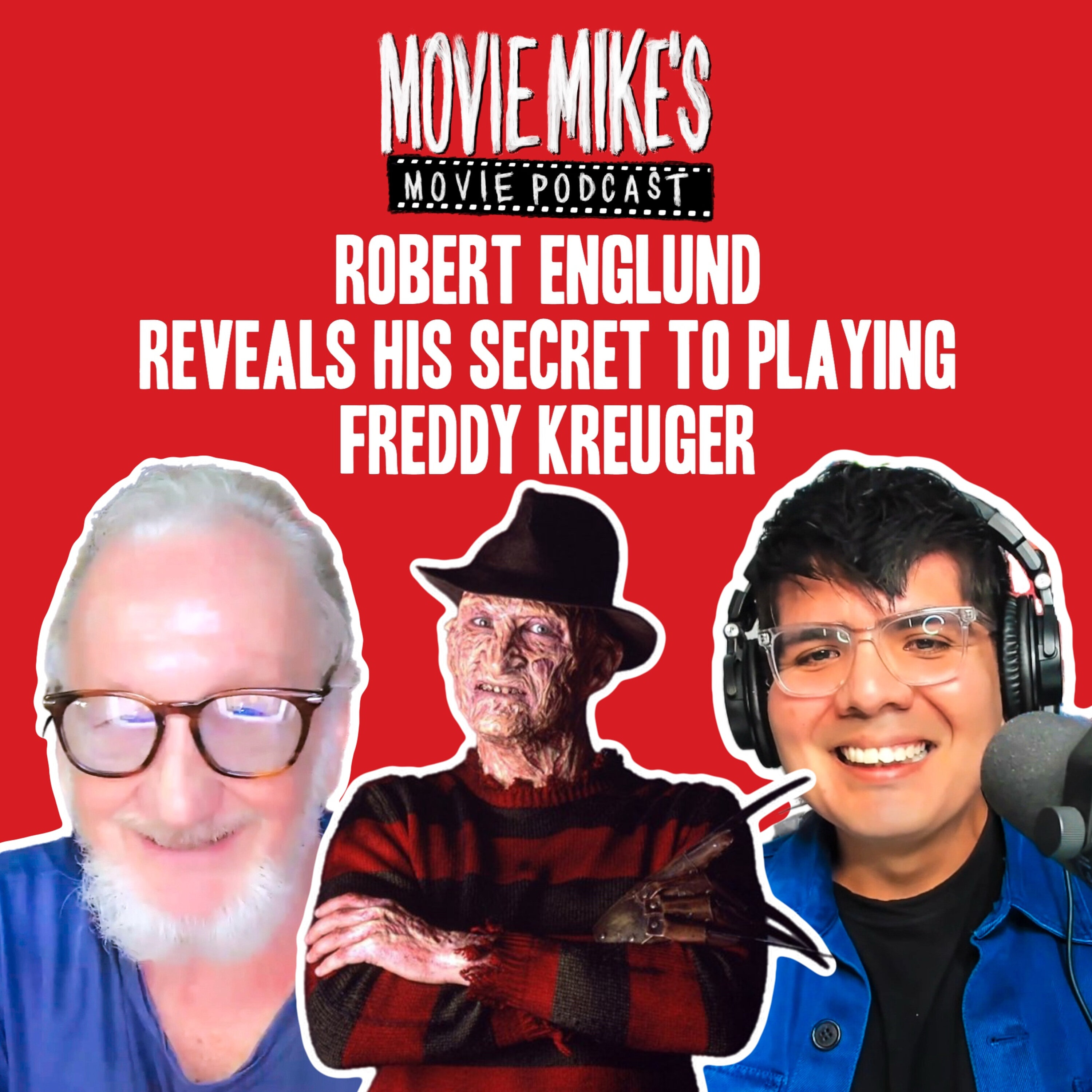
Robert Englund Reveals His Secret To Playing Freddy Kreuger + Movie Review: The Smashing Machine…Why did It Bomb? + Trailer Park: Zootopia 2
Mike talks to Robert Englund who is best known for playing Freddy Kruger in A Nightmare on Elm Street. He reveals his secret to getting into character, what music he listened to while sitting in 4 hour of makeup prep and how his athletic background prepared him for the role. Mike also talks to two directors from the franchise: A Nightmare on Elm Street 2: Freddy’s Revenge director Jack Sholder and Freddy’s Dead: The Final Nightmare director Rachel Talalay about the behind the scenes of each film! In the Movie Review, Mike talks about The Smashing Machine starring Dwayne Johnson. He plays MMA fighter Mark Kerr as he reaches the peak of his career but faces personal hardships along the way with addiction. Mike talks about why the movie failed, why he hopes it doesn’t stop the Rock from taking risks and what shot it has at Oscar nominations. In the Trailer Park, Mike talks about Disney’s Zootopia 2. Detectives Judy Hopps and Nick Wilde are back and find themselves on the twisting trail of a mysterious reptile who turns the mammal metropolis of Zootopia upside down. Mike shares how Zootopia 1 changed him and how the message of the sequel might be something we all need right now.
New Episodes Every Monday!
Watch on YouTube: @MikeDeestro
Follow Mike on TikTok: @mikedeestro
Follow Mike on Instagram: @mikedeestro
Follow Mike on X: @mikedeestro
Follow Mike on Letterboxd: @mikedeestro
Email: MovieMikeD@gmail.com
See omnystudio.com/listener for privacy information.
Available Results
Generated results are saved to the knowledge database for reuse and search.
Extract Knowledge
Pick what you want extracted first. Model, scope, and chapter options appear after a template is selected.
Transcript
00:00:00
Speaker 1: Hello, and welcome back to movie Mike's Movie Podcast. I am your host Movie Mike. Big episode for you today. Robert England aka Freddy Krueger is back on the podcast. We are celebrating the seventh film collection, which is out now, and I want to know his secret to playing Freddy Krueger. How did he get into character. I'll also talk to a couple of directors from the franchise A Nightmare on Elm Streek two, Freddy's Revenge, and the director of Freddy's Dead the Final Nightmare. Get all the behind the scenes, some of the things that went wrong and some of the things that went oh so right in the franchise. In the movie review, I'll finally talk about the Smashing Machine and why I believe it failed and something out of pocket for me. I am actually going to defend the Rock I know, I know, I gotta defend him because I almost feel bad for him. And in the trailer park we'll talk about Zootopia two. I also want to revisit Zootopia one a little bit and how much of an emotional punch did that movie packed. Thank you for being here, Thank you for being subscribed. Shout out to the Monday Morning Movie Crew those who listen on release day. Now, let's talk movies from.

00:01:02
Speaker 2: The Nustville Podcast Network. This is Movie Mike Movie.

00:01:06
Speaker 1: Pot A Nightmare on Elm Street is one of the greatest horror franchises of all time. It's October now it is a great time to revisit the franchise if you have it in a while. Whenever I revisit these movies, I love to start with number one and then go with them movie by movie to see how much Freddy Krueger changed from film to film. Because whenever Robert England first got hired to play Freddy Krueger, he wasn't really supposed to be the guy. But now when you look around at all the horror movie franchises, from your Halloweens, your child's plays, your Friday the thirteenth, Robert England is the one actor who is irreplaceable in those situations. Without him, these movies would not work. His portrayal of Freddy has become iconic, not only from how frightening he looks on screen once he gets that makeup on, but from his delivery of his witty wines. How much of a frightening presence he is every time he is on screen. Robert England is a legend, and he is somebody who I enjoy talking to so much because how much appreciation he has for this role that I feel like some people could get jaded by this point. But I got to talk to Robert England for the first time last year, and he is so enthusiastic and so generous with this time that he's become one of my favorite people to interview. Is so any opportunity I get with him to talk about A Nightmare on Elm Street, I'm going to take that opportunity.

00:02:29
Speaker 2: The seventh film collection of A.

00:02:31
Speaker 1: Nightmare on Elm Street is available now on four KUHD, and I'm looking at my copy right now, and it just feels so good to have such an iconic franchise in your hands, because this way, streaming services can't take it away from you if you own this collection. Anytime October rolls around, or it doesn't even have to be spooky season, sometimes I just get an itch to want to dive back into these movies. That is the great thing about having physical media. So that is available now. So first up, let's talk to the man himself, Robert England. And how he gets into character to play Freddy Krueger. I might so the Freddy makeup took about four hours each day. I wonder what did you listen to while you were sitting in the chair. Did you get like music going to hype you up?

00:03:12
Speaker 3: Like?

00:03:12
Speaker 2: What did you do?

00:03:14
Speaker 4: Well?

00:03:14
Speaker 3: You know, when we began the series, I wasn't the star of the series yet. I was just the guy under pounds of foam latex and colostomy bag glue. So I had to surrender to my makeup men. And so that was David Miller in the in the early years, and then Kevin Yaeger, the great Kevin Yaeger, and then the KNB.

00:03:38
Speaker 4: Crew, who now of.

00:03:40
Speaker 3: Course have done you know, have oscars for Chronicles of Narnia and created Walking Dead many other things. So I was sort of I had to suffer a lot of heavy metal in those early days. Those guys raw headbangers. So there was a lot of heavy metal in the makeup trailer.

00:03:56
Speaker 1: Did that help you at all to get into character during that process? Like the heavy metal going is that when you kind of start to like, okay, I'm seeking into this character now, and then you're immediately able to film right after that, or there's some other process to psyching yourself up.

00:04:09
Speaker 3: No, you know, I think that the aggravation of the cold, the cold glue in the morning on my face and the time, you know, spent in the makeup chair and getting poked with those old makeup brushes that had become kind of crusty over the weeks, you know, of you those guys were cheap skates, you know, they would get that like pull a tooth to get a new brush. So everyone when they touched me up, they I was getting poked a lot, and you know, you kind of feel that, especially around the eyes. So I wasn't in the best of mood, and so that would make me slightly profane, and I would tease those guys or threaten to spit in their coffee, things like that. And I could see myself all the time in the mirror because we were using a big ma makeup mirror, and I would see myself in the mirror, and sometimes I would slip into a voice that I would eventually settle on as Freddie's voice, you know, you know, like damn it, Kevin or David, get that brush out of my face. And it just worked and I knew that that I could live in that voice. You have to remember, back in those days and on all the films, I didn't have a lot of dialogue every day, maybe one or two lines a day until later on. You know, Freddy got more verbose as the as the franchise went on, and I did some narration and in parts in Freddie versus Jason. But that's sort of how I found Freddy in the makeup chair, you know. And then that began back with David Miller at his studio out in the San Fernando.

00:05:47
Speaker 4: Valley on the original one.

00:05:49
Speaker 3: You know, I really sort of found the voice there in those hours of experimenting with David Miller and creating the makeup.

00:05:55
Speaker 1: Looking back on the movies, I realized how physical the role of Freddy was. Was that kind of surprising to you, how physical it actually was to become Freddy Krueger.

00:06:04
Speaker 3: Well, you know, I was an athlete. You know, I surfed all my life. I surfed it well into my sixties. And I'd been a gymnast in middle school, and I'd been on the swimming team, you know, in high school and lettered, and so I was an athletic actor and I'd used a lot of those skills in the theater as well. But with Freddie, what was fun was when I had that makeup on, it sort of made me more or less inhibited, and I was able to kind of dance him a little more and move him differently than I would move as Robert England without makeup. I wasn't afraid to explore the physicality of the character.

00:06:56
Speaker 4: The stunts.

00:06:56
Speaker 3: I just did as many of them as I could. That's just sort of a you know, a misguided actors macho that we all succumb to on the set, you know, where we try to do as much as we can. And you know when I when there were big fire stunts, that's not me. I did some fire stunts, but the big ones isn't me. And when you see Freddie flying through the air on fire and things like that, that's not me. But you know, you know, I did a lot of my stuff, you know, I you know I did, and you know, everything from fire stunts to underwater stuff. So it was fun, you know, to have a little bit of that legacy that I could bring up, you know, and during happy hours somewhere.

00:07:36
Speaker 4: For bragging on.

00:07:38
Speaker 2: But thank you so much, for the time, Robert, this is awesome, all.

00:07:41
Speaker 4: Right, thank you, we'd bye Mike.

00:07:43
Speaker 1: A Nightmare on Elm Street to Freddy's Revenge is celebrating its fortieth anniversary. Came out back in nineteen eighty five and was directed by Jack Shoulder. Jack Shoulder has a background in music. He actually studied to be a trumpet player. He's known for his work in the horride, including movies like The Hidden, Alone in the Dark and A Nightmare on Hilm Street Too. He had an interesting dilemma going into the filming of part two because New Line at first considered replacing Robert England due to a salary dispute. So I want to get the story behind that.

00:08:14
Speaker 2: Let's talk to director Jack Shoulder.

00:08:17
Speaker 1: It is a while to me to think that Freddy was almost not played by Robert England and he actually had a stunt double.

00:08:22
Speaker 2: Like the first two weeks of filming. Did you notice immediately.

00:08:25
Speaker 4: That just his he wasn't the stunt double.

00:08:28
Speaker 5: Oh, he wasn't an extra somebody that grabbed off the street who fit the costume and they thought his face they could make it up to look like Freddie. He wasn't a stuntman. Would have been a lot better. I mean, this guy had no idea what the fuck he was doing.

00:08:39
Speaker 2: So it was just a random person.

00:08:42
Speaker 4: Random.

00:08:43
Speaker 6: Yeah.

00:08:43
Speaker 5: I keep expecting that somebody's gonna come out and say I was Freddie a nightmare too?

00:08:47
Speaker 7: For what?

00:08:48
Speaker 1: See, if that was me, I would be screaming that every day, like that was me in the movie.

00:08:53
Speaker 4: Yeah, you wouldn't think so, So how.

00:08:55
Speaker 2: Did that go? Like, what did you do as a director like this is not working?

00:09:01
Speaker 3: Yeah?

00:09:01
Speaker 5: Well, he was walking like Frankenstein, and I had to say, walk like a man, you know, don't walk like a monster.

00:09:10
Speaker 4: You know, he was like lurching from side to side. He just walks. You know.

00:09:14
Speaker 5: So after like about half a dozen takes, I've finally gotten to do something that resembled a human being.

00:09:20
Speaker 4: Then, you know, the following week, Robert comes.

00:09:23
Speaker 5: On and you know, when he walks across the room, he can feel the room shaped.

00:09:28
Speaker 1: You know, given that the movie was filmed in a pretty quick time, what was one of the biggest obstacles when it just came to using the practical effects everything?

00:09:39
Speaker 4: Well, I had this huge list.

00:09:42
Speaker 5: I don't know, there were like one hundred special effects or something or more. I had no idea how to do any of it. Scared the hell out of me. And they said, don't worry. We've got this great guy. And he was the He had been the head of special effects at twentieth Century for.

00:09:58
Speaker 4: Like, you know, twenty years. And I met him.

00:10:01
Speaker 5: He was a real old old timer and I said, so, of all the things that you've worked on, what are you the most proud of?

00:10:06
Speaker 6: Me?

00:10:06
Speaker 4: Thought him.

00:10:06
Speaker 5: And he said, I think the work I did with the Three Stooges, that was sure.

00:10:14
Speaker 4: But he kind of like he was really old fashioned.

00:10:18
Speaker 5: A lot of monofilament, and they had like this stuff called ab smoke that you could probably buy it like a magic store, where you put the A on one thing and then you put the B on the other.

00:10:27
Speaker 4: When you touch it, this phoney smoke comes.

00:10:29
Speaker 5: Out, and they're all of these things, and you know, I I just sort of said, okay, you know, you're the expert here.

00:10:37
Speaker 4: You know, you do it, and.

00:10:38
Speaker 8: I'll film it, so so you know, we we know got through it. You know a lot of you know, some of the effects are a little hokey, but it's kind of part of you know, if we were doing it now. A lot of these things would be done digitally or enhands digitally. But part of the beauty of the film, I think is that it's kind of handmade.

00:10:59
Speaker 4: You can kind of see it wasn't like made out of a factory mold.

00:11:02
Speaker 5: You know, where some some you know geniuses in a in a you know, AI special effects studio digitizing everything that you know, with perfection.

00:11:12
Speaker 4: You know, it's very imperfect.

00:11:14
Speaker 5: But I think maybe you know from viewers, that's part of the charm of you know, the eighties horror films.

00:11:19
Speaker 1: I think it definitely adds to the charm. What scene for you was the one where you filmed it and as soon as you hit cut that you were just like, okay, we got it there, and that is the one you're the most proud of.

00:11:30
Speaker 5: I think the the ending of the film in the in the steel mill, when well, actually, I mean I could I could sort of say the transformation scene, but you know, part of that was shot by second unit. Anything that that did not involve the actor themselves.

00:11:49
Speaker 4: So like the close up of.

00:11:50
Speaker 5: The claws coming out of the hand, you know, those kinds of things, those were Those are also the shower scene. The shower scene, I thought it went went went really great. I was I was really happy with that when when Marshall bell Is sort of tied up and the showers go both.

00:12:06
Speaker 4: Both bull bo both bull you know, they all they.

00:12:09
Speaker 5: All come on, and actually that was that was one of the things where I was able to enhance it that I wanted each each time that another shower had went on to almost be like like a.

00:12:18
Speaker 4: Gun impact boom boom boom and build up, you know, and you know, so those are kind of, you know, some of the little things that I was able to do.

00:12:26
Speaker 5: So you know, it's like it's the same movie, but it's it's better and it's exactly the way we wanted it to be, which is you've never seen it exactly the way we wanted it to.

00:12:34
Speaker 4: Be until now.

00:12:36
Speaker 1: Rachel Talaay directed Freddy's Dead The Final Nightmare back in nineteen ninety one was a great year because not only was this movie released, I was also released into the world.

00:12:45
Speaker 2: Her career spans for decades.

00:12:47
Speaker 1: Not only did she direct The Final Nightmare, but she also directed eight episodes of Doctor Who, as well as the BBC series Sherlock, multiple episodes of TV shows like American Gods, Marvel's Iron Fist, DC's Don't Patrol, Quantum Leap, Riverdale, Sabrina, Supergirl, Legends of Tomorrow, and The Flash. Did other movies like Tank Girl, Ghost in the Machine, and Wind in the Willows. She was also a pioneer for female directors in the nineties. Want to talk to her about that and what she remembers about Freddy Krueger's actual funeral, which was a promotional stuff that they did for this movie. But right now, let's talk to Rachel Talla.

00:13:23
Speaker 6: The Hi Nice Too, Happy October, Nice fucking Ball.

00:13:28
Speaker 2: Thank you, Rachel.

00:13:29
Speaker 1: You were one of the few female directors in the horror genre in the early nineties. How did directing a franchise as big as Nightmare on Elm Street impact your career and whether it was giving you confidence or be able to push projects later on?

00:13:42
Speaker 2: Like, how did it affect your career?

00:13:44
Speaker 6: This is a much more than a five minute conversation. I was incredibly lucky with New Line that they let me produce. They let me grow up on Nightmare and Elm Street, so that I started as an accountant, and then I became a producer on the series, and then I got to direct Freddy's Dad and then when I went out into the bigger world outside of Newline, being a woman was a big obstruction. So while everything I know about making effects and stuff, which helped me hugely in the future I learned on Nightmare and Elm Street, it was not enough to overcome my chromosomes.

00:14:16
Speaker 1: I know that there was a lot of just differences in what Newline wanted in your vision. How do you handle a studio note when you get something back like we kind of want to change this, Like, as a director, how do you take that?

00:14:27
Speaker 6: Well? I didn't have a lot of issues with Newline on Freddy's Dad, except when they except afterwards when they cut it for the video without telling me. I mean, I think there was a lot of trust in me on Freddie's Dad because I'd made the other ones and because I was listening to it was written by Michael DeLuca and it was Robert Shea and I had a good relationship Bob and I, and I had a good relationship with Robert England, but on other projects Let's not go there.

00:14:57
Speaker 1: How does that help with you saying you had a great relationship with Robert England during the process, Like, are you able to push him a little harder. Is he just able to trust you more throughout?

00:15:06
Speaker 6: I think it's a trust factor. But I think that also, I mean the trust factor goes my way, which is this man has created this. I mean he's not a man in a hockey mask. He's full, he's a brilliant actor, and it's one hundred percent him, even though he's got makeup on, and therefore you have to have But it allows for the dialogue how far do we want to push this, how scary should this scene b versus how funny should this scene be? Letting him giving him a lot of freedom. But often I always work with actors that way anyway, in terms of trying to have the maximum dialogue about so that it's a it's a collaboration.

00:15:41
Speaker 1: I remember them having a funeral for Freddy. Whenever the movie came out, the promotional thing, did you attend that funeral? And if so, like what went down?

00:15:50
Speaker 6: So it was Freddy Krueger Day, which is in Los Angeles, which is insane when you think about it. That tom they are trying biot Freddy at a coffin. I have a picture of me with Ray bans All and looking sad over the coffin. And there was an event that I don't remember particularly well, but the concept of this being like this promo funeral thing was it was so crazy, like that was you know, La and the crazy, crazy times hilarious.

00:16:23
Speaker 1: I've got to say, oh, yeah, just just picturing everybody around kind of mourning and then being such a big part of that.

00:16:30
Speaker 6: Coffin and this Freddy Collers and yeah, it was amazing.

00:16:33
Speaker 1: How do you feel about that process of when you finish a movie, now you have to sell it. How do you feel about that as a director?

00:16:41
Speaker 6: Well, most of the time you're four. I mean you have to be very powerful director to have any say in the marketing or be it with a very collaborative studio. So most of the time you're frustrated because you wonder what there There's a lot of why are they doing this with Freddy? It was because I worked with the company. I mean it worked at line as well. I was much more engaged, but they had a very strong I knew how to sell Freddy, so it was a very positive thing. And when they come back to you and say, oh, we marketed Freddy Krueger day, and you're like, okay, go let's do.

00:17:16
Speaker 2: Let's go appreciate it. Rachel, this has been awesome, nice, very nice to be too.

00:17:20
Speaker 4: Thank you.

00:17:25
Speaker 2: Let's get into it now.

00:17:26
Speaker 1: A spoiler free movie review of The Smashing Machine, starring Dwayne the Rock Johnson as MMA fighter Mark Kerr. Also stars Emily Blunt Ryan Batter, who is an MMA fighter making his acting debut and making his solo directorial debut. The movie is written and directed by Ben Safti. The movie is about Mark's career, who got his start in the late nineties and early two thousands, back when UFC isn't what it is today. It was more violent, it was more brutal. People wanted to see a band because of that. So part of this movie takes place with his career here in the United States, but also going overseas to Japan to fight over there. Mark is a very complex gentle giant where there are moments where he is so soft and comforting and will take the time to talk to a kid in the waiting room at his doctor's office, and where he is speaking to a kid and breaking down why he fights, what goes through his mind when he's trying to beat his opponent, how the two people don't hate each other, it is just the business.

00:18:30
Speaker 2: But in Mark's head, he only knows one thing, and that one thing is to win.

00:18:35
Speaker 1: But you see him throughout the movie just be this really soft spoken, normal guy that is so lovable, and then he has these moments of rage because of all the things he's battling with addiction, with pain, where he turns into this completely different person that goes on to be dubbed as the smashing Machine. And not only do you see him flip that switch in the ring, but you also see him flip that switch in his personal life with his girlfriend Emily Blunt, where he does things to show her how much he loves her, but he's also dealing with all these feelings that he doesn't know where to put his emotions, he doesn't know how to express it. He is literally in pain every single day, so that frustration comes out with him kind of lashing out towards her.

00:19:20
Speaker 2: So in this story, you see Mark fight a lot of people.

00:19:23
Speaker 1: He fights other people in the ring, in the most literal sense, he fights himself because a lot of his issues have to do with his own personal struggles. He fights with his girlfriend and him taking his career and his fighting more seriously, than he does their relationship and with all these struggles that Mark had going on in his life.

00:19:42
Speaker 2: I found the movie jumped around a lot, and.

00:19:44
Speaker 1: I think where the movie struggled was to really paint you a picture of who Mark Kerr is. Before The Smashing Machine, I had no idea who Mark Kerr is. I wasn't going into this because I'm a huge fan of him and wanted to see a biopic about him. But if you're gonna a movie about somebody that most people don't know who they are, you have to make their story so compelling that that doesn't matter. And I don't think The Smashing Machine succeeded in that. The movie was a slow burn and it didn't really feel like it reached its climax at any point in the film. While there was some moments where the cash shine, particularly Emily Blunt I think had probably the most powerful scene out of the entire movie from any character, and there were moments that you felt for Mark Kerr and the Rock really tried to squeeze out that Oscar worthy performance, but those moments were few and far between that the movie felt a little bit too cozy for comfort for a character that really needed to be developed in a story that really needed to hit a home run. I never really felt that moment where I was fully right there with Mark Kerr, because even when Mark reached his lowest of low's in the film, I didn't really feel it wholeheartedly. And I don't know if that was Ben Saftie's direction and vision or The Rock's performance, but I had a really hard time developing in amotional attachment to Mark, who I think is a really unique and interesting person. And this is the most three dimensional character that The Rock has played in years. And I find myself in a weird position now that I feel the need to defend the Rock. If you told me last year after I went on a huge rant about how Red One, his Christmas action movie, was the downfall of Hollywood, if you told me back when I was on that rant in twenty twenty four that I would.

00:21:28
Speaker 2: Be here now defending the Rock. Because of how much this movie has.

00:21:32
Speaker 1: Tanked and its Instagram posts saying you can't predict the box office and you can't control that, I feel the need to come to his rescue. Because The Smashing Machine opened to six million dollars. It came in third overall opening weekend behind Taylor Swift, behind a second week of one battle after another. The movie costs fifty million dollars to make, and as soon as that happens, people start.

00:21:58
Speaker 2: To jump ship on the movie a little bit.

00:21:59
Speaker 1: Where a big driving force going into that opening weekend was all of that Oscar buzz, and maybe that was just something that we all built up inside our heads because of the trailer, because of when this movie was coming out, because of the director attached to it, and maybe we unfairly put those standards on it. I'm also a huge pan of Texas football. Maybe it has the Arch Manning effect where we all thought he was going to be amazing and it was all just media hype and then you go watch the actual thing and you're like, well, that's not really what I was expecting.

00:22:30
Speaker 2: And I'm not saying this is a bad movie.

00:22:32
Speaker 1: I enjoyed The Smashing Machine from beginning to end, even though it wasn't exactly what I was expecting, even though it didn't really drive home that emotional moment. But I was expecting it to be Best Picture worthy. I was not only expecting The Rock to have an easy nomination for Best Actor, but be in contention to actually win his first trophy. After watching this, I think even a nomination would be a stretch because I didn't really feel his performance was at that level. It's also just wild to me, and I can't get over that six million number. The Rock has almost four hundred million followers on Instagram alone, the movie only made six million dollars. How small of a fraction of his followers actually went to see this movie. And I think after last year, I unfollowed The Rock just because his promotion was.

00:23:22
Speaker 2: A little bit too much.

00:23:24
Speaker 1: But this almost feels like the most popular kid in school has a birthday party and nobody shows up. And the reason I feel I need to defend him is because I commend The Rock for taking this role, for wanting to show people a different side of him, because he sees the criticism and you know it. I think this movie is a direct response to people saying he plays the same character over and over that you could take one still from any Rock movie and you couldn't really tell the difference between. I think even somebody in an interview for The Smashing Machine called him out on that, and he was actually able to do it.

00:24:00
Speaker 2: But he sees all that noise, and you think.

00:24:02
Speaker 1: Celebrities aren't reading all the dms, aren't seeing all the reviews. I feel like The Rock, maybe to his own detriment, is too consumed with that. And much like Mark Kerr, the Rock is somebody who does not like losing. And those were the parallels I saw between these two characters.

00:24:20
Speaker 2: Mark Kerr only knows one thing. He only knows to win.

00:24:23
Speaker 1: If you even put the idea of losing in his head, he can't comprehend that that word does not enter his mind. I think that is exactly how The Rock is, where any movie that comes out, if it is not number one at the box office, he sees it as a failure. He will immediately go to x or go to Twitter and try to find the win in that. He did it with Black Adam, he did it with red Wood. He'll do it with every single movie. And this was the first time I really saw him come across as defeated. In his Instagram post saying that he believes in this film even though the box office numbers don't represent that. He did and try to say, well, the audience score is so good because it does have a good audience and a good Rotten Tomato score, even though I don't mention that side on this podcast for different reasons. But the reason I am defending him is that I hope that this doesn't stop him from being more adventurous in the roles that he chooses. He talked about it even before the movie came out, saying he has people in his life that he listens to that he respects their opinion. He needs them in his life in order to tell him when he is doing something that maybe isn't the best, but ultimately it is going to be his decision because the people.

00:25:33
Speaker 2: Around him don't like change.

00:25:35
Speaker 1: They want him to still make the movies that are making him and in turn making them money. And the minute you start to shake that up a little bit and certain people aren't getting the percentages that they want, they're suddenly bringing you all these other scripts for like Jumandi six, seven and eight. Here's another Kevin Hart project. Here you go make us some money. Because the Rock is now a brand. He is a corporation, He is an entity. He is more than just an actor on his journey trying to find the best role.

00:26:05
Speaker 2: He is a brand.

00:26:06
Speaker 1: And that is why historically he has a no lose clause in some of his contracts, which all originated from the Fast and the Furious movies, that no Lose clause says that he can't lose a fight in a movie. And that is what I struggled with the most, because if you can't lose a fight in a movie, that really limits your character.

00:26:25
Speaker 2: Because if you can't see a character at their.

00:26:27
Speaker 1: Worst, you're not going to enjoy them at their best. If you don't see them beat down and bloody and where it looks like they're never going to win another fight in their life, that they're done, if you can't see them come back from that, you're never really going to root for that character. And in the Fast franchise, him and Vin Diesel both had that in their contracts, down to the amount of punches and damage that each of their characters could take on. It really hasn't been proven that he has that clause in all of his movies, but if you watch Black Adam, it kind of feels it was like he has that, and I think it probably comes from his background in wrestling, where you can control the narrative. You know who is going to win, who is going to lose, you know the arc of your character, and it all comes down to him protecting that brand because there is so much money attached to it, of him being a tough guy, of him being a hero, and this was the first time where I feel like that wasn't a part of his contract. Aside from the performances in this movie, I really enjoyed the way this movie looked. I believe they shot a majority of this film on a really small sixteen millimeter film camera. I think it was called like an Ara flex where it was hand held, which to me helped capture that raw, authentic feel. There were moments of the smashing machine that almost felt like home video style footage. They had this grainy and blown out look that I really enjoyed. And then they also filmed some other scenes with some really big Imax cameras, but still at times where hand holding those Imax cameras. I think it has the only ever handheld zoom shot where they actually held big camera and walked with it in their hands. So the way this movie was filmed really gave it that sense of urgency, that shakiness, that rawness that you feel from the world of fighting, which the fight scenes were probably the best part out of this entire movie again because of the rocks background in wrestling. Those all felt really authentic. But I only wish that there was more of that, because, like I was mentioning earlier, the entire story was just scattered around. Here's some fighting scenes, here's just him and his girlfriend, Here's just him with his struggles and addiction in his pain, and then here's him in Japan. It's a little bit all over the place for the two hour runtime that by the end of it, in that third act, I was just left feeling a little bit unsatisfied. It goes out on kind of a whimper and really erases the impact of this story by the end of it, still found the movie enjoyable. I still think it is one of the more noteworthy movies of the year and can't wait to see where it shakes out in the oscar race for the Smashing Machine.

00:28:57
Speaker 2: I give it four out of five blows to the head. It's time to head down to movie mics.

00:29:07
Speaker 1: Traylar paul Zutopia is low key a top three Disney movie from the twenty tens. I remember the way this movie packs such an emotional punch, and rarely does a Disney movie do this now, but back in twenty sixteen, this was still happening. I have a visceral reaction to a specific scene in Zutopia, one that has stayed with me. I really feel like this was a movie I actually learned a lesson from, and I think we could all learn a lesson from.

00:29:41
Speaker 2: And I think that is what Disney movies are supposed to do.

00:29:45
Speaker 1: At the core of what makes a good Disney story, it is what they did from the beginning of time. They were stories with a moral, often rooted in fairy tales, and fairy tales always have a story of good and evil, and there's always a moral that lies within that story. Zootopia in twenty sixteen was so progressive in telling a story in an unlikely friendship and work relationship between a slide fox and a dumb buddy. It took a family friendly comedy with a bunch of cute animals and made a story that spoke on prejudice and systemic bias, fear being used as a political tool, breaking stereotypes, being self aware, diversity and inclusion, and using your differences as the strength. And it did it in a way that wasn't preaching to the viewer. That was just teaching kids about some things that get embedded to us without us really realizing it. And it did it in a way that me watching this movie in twenty sixteen at twenty five years old was a lesson I didn't know I needed to learn and maybe simplify in such a way of a buddy working with a fox that are in nature mortal enemies. The fox is always going to want to kill and eat that bunny, but here they are trying to work together and seeing them achieve this level of friendship where it is greatly rooted in trust that one of them is not going to flip out on the other, and seeing that trust broken. It was this one scene, specifically in the third act, that I'll play for you now whenever Jason Bateman's character the fox Nick realizes that Judy Hops might still be afraid of them.

00:31:27
Speaker 7: What do you mean, clearly there's a biological component these predators maybe reverting back to their primitive savage ways. Are you serious?

00:31:38
Speaker 2: I just stated the facts of the case. I mean, it's not like a bunny could go savage, right, but a fox could. Huh next, stop it? You're not like them? Oh, there's them. Now, Judy, just with that line, you're not like them.

00:31:53
Speaker 1: That line sets so much to me because Judy was fearful of being seen as a dumb so she wanted to do her job so well that it was undeniable that she got things right. And she looked at the facts, and with her being obsessed to what this situation looked like on paper, she forgot about her friend and Inn the moment that followed after that, You're not.

00:32:16
Speaker 7: That kind of predator, the kind that needs to be muscled, the kind that makes you think you need to carry around fox repellent. Let me ask you a question. Are you afraid of me? Do you think I might go not? I think I might go savage? You think I might try to eat you? I knew it just when I thought somebody actually believed in me. Huh, probably best if you don't have a predator as a partner.

00:32:40
Speaker 1: It was the reach she said so much in that reach, going for her weapon, in this case some spray. But that was such a powerful scene. Jason Bateman's character has so much trauma over what happened to him as a kid, him referring to the muzzle there.

00:32:54
Speaker 2: So I only hope going from Zutopia one to Zutopia two that we maintain.

00:33:01
Speaker 1: That level of having a sophisticated, family friendly animated movie, and I think they can do that, And judging by the plot of this next movie, I think we are going to explore that even more because what happens in Zutopia too. They are investigating the mystery of a venomous pit viper, which snakes are not supposed to be a part of their community. Why because they've been told their entire lives that snakes are bad. So as they go to capture him, they realize there actually might be more to the snake and maybe they have been wrong. But with them protecting and defending the snake trying to get the real story, obviously other people are not going to want to agree with them because they don't want to hear any logic. They just know snake bad. We get rid of snake. But by trying to unravel the mystery behind this snake, they are also putting their own reputation on the line and also become an enemy in protecting the enemy. But this movie will also dive into the lives of some of the other animals in Zoutopia and have been pushed out to the outskirts that are underappreciated because of who they are and where they come from. So I feel good right now going from Zutopia one to Zutopia two. But before we get into more, here's just a little bit of the trailer.

00:34:14
Speaker 7: No snake has set foot in Utopia.

00:34:16
Speaker 2: In Forever Snakes, I'm the bad guys.

00:34:24
Speaker 1: I have to set things right, and when I do, my family will finally be able to come home.

00:34:32
Speaker 7: WHOA, Pops and Whiles dream team on the Games help them.

00:34:37
Speaker 2: I would like to call a partner meeting.

00:34:41
Speaker 4: I watched A Fox and that Rabbit.

00:34:44
Speaker 3: Do you know how many mayors they've already destroyed?

00:34:49
Speaker 7: Two?

00:34:50
Speaker 2: I got up to two.

00:34:52
Speaker 1: What stick out to me, aside from the story in the trailer of Zutopia two is the movie looks so much better. The animal looks fantastic. It feels like this story is going to be bigger. Also still focusing on the themes of unity, diversity, inclusion, and showing how understanding and collaboration is the key to building a better future, which I think is something we can all probably learn from right now. I have always been a big fan of movies that can teach kids complex ideas and put them in a way that they can understand. Why do I love that so much is because when I was a kid, I learned so much from movies, ideas and things that my parents could not teach me. I learned about life. I learned about death, I learned about hate, I learned about love. I've learned about good and evil by watching a lot of Disney movies in my childhood. The first time I ever had any experience with death was seeing Mufosa fall by the hands of Scar and me realizing that.

00:35:57
Speaker 2: Mufasa was not going to wake up.

00:36:00
Speaker 1: Now, Disney traumatize this all with Simba trying to wake up his dad and balling his eyes out and then immediately having to rush and be banished from Pride Rock, which is a wild thing to do. But looking back, I am so glad I experienced that sadness so early on because that was very formative in me learning about life. And I think to make great art, to make movies that make an impact, you have to include things that sometimes might be a little bit uncomfortable, which if you want to look at the great animated movies and the ones that just come out, you go see in theaters, you have some popcorn, you go watch it and that's it. And the movies that really change your life and become a part of your DNA, you have to dive into some of these things. And I think that is the power of animation, just the power of filmmaking in general, of creating stories that resonate with you, that teach you something, because I think sometimes when we think about the family film, we just want something like The Minions, which is fun that has its place, dumb, ridiculous humor that you don't have to think about. I think those movies are totally fine. I'm a fan of those, not hting on the Minions here. I'm actually a big fan of The Minions and all the Despicable Me movies. You have the Minions of the World, you have the Shreks of the worlds, but then you have movies with a little bit more substance that can still be fun, which Utopia one still has a lot of fun moments.

00:37:28
Speaker 2: I think the.

00:37:29
Speaker 1: Sloth character at the DMV is probably one of the funniest characters that they have created, not only in the twenty tens themselves, but probably since so I'm hoping they still have that fun, which I do get the sense of from this trailer. But I think what made Zutopia a noteworthy movie of the twenty tens was the message that it had, and I believe it did it in a way that wasn't preaching to the audience, that wasn't too complex for kids to understand. It just boiled it down showing you two characters who shouldn't be friends have to team up in a buddy cop style Disney movie and then learn so much about their differences. And if I was a kid now, this is a type of movie I would want to be exposed to and would be glad that they were making. And I think as a whole, as movie fans, we are craving stories with substance. Those are the movies that are really setting themselves apart. I think that is the difference between a box office success and a box office flop. You need a story that you can really sink your teeth into. And of the Disney movies that have flopped so far, so hard in the twenty twenties, it has been those movies that have had nothing to say that sink to the bottom. But I'm now so excited for this movie Zutopia two, comes out this year on November twenty sixth. Even if I'm one of the only adults in the theater without kids, I'm gonna go see this movie.

00:38:55
Speaker 2: Ad That was this link's edition of movie line Tramer.

00:38:59
Speaker 1: Bar and that is going to do it for another episode here of the podcast. Before I go, I gotta give my listeners shout out of the week This week, I'm going over to TikTok one of the best user names I've ever seen on TikTok.

00:39:12
Speaker 2: Do turtles have butt cheeks? Rights?

00:39:15
Speaker 1: Who commented on a video I posted of Kelsey and I talking about whether or not teachers were maybe a little bit hungover or just had a rough night the night before we all went into school and had an unexpected movie day.

00:39:30
Speaker 2: But do turtles have butt cheeks?

00:39:32
Speaker 1: Wrote I saw more movies in high school than any other time as an elder millennial. The movies we saw a lot were Twister and Ace Ventura. I love both of those movies, but I never watched those in high school. I guess when I was in high school was in the mid to late two thousands, and here I thought I was an elder millennial. I associate all of the early two thousands of Disney movies with be a movie day movies. I would have loved to have seen Twister and Acepinterra as movie day movies. But thank you do turtles have butt cheeks for that comment for watching over there on TikTok, which I did have to google. And by the way, I don't know why I had to google this. I could have assumed, but they in fact do not have butt cheeks, So what a bold user name.

00:40:15
Speaker 2: Thank you for sharing that.

00:40:16
Speaker 1: Thank you right now for listening, and until next time, go out and watch good movies and I will talk to you later.