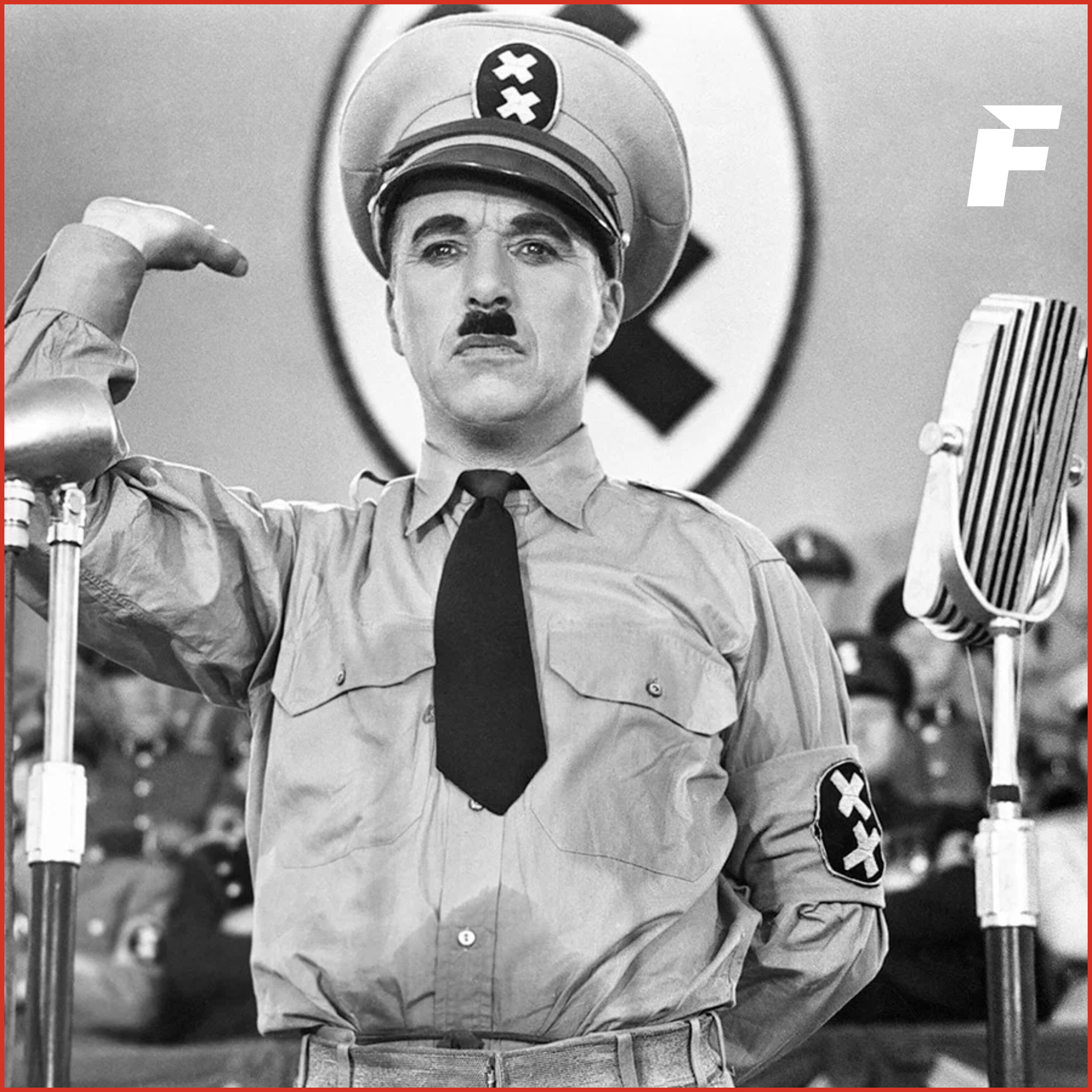
The Great Dictator: Chaplin’s Act of Artistic Nobility | Dissident Cinema
First up in Filmspotting’s Dissident Cinema Marathon, Adam and Josh discuss Charlie Chaplin’s 1940 satire The Great Dictator. They explore how comedy becomes a weapon against fascism, the film’s surprising prescience and moral clarity, and the risks Chaplin took by calling out authoritarian power before much of the world was willing to do so.
Links:
-Filmspotting Marathons
https://www.filmspotting.net/marathons
Feedback:
-Email us at feedback@filmspotting.net
-Ask Us Anything and we might answer your question in bonus content.
Support:
-Join the Filmspotting Family for bonus episodes and archive access.
https://filmspottingfamily.com
-Filmspotting Shop for T-shirts and more.
https://www.filmspotting.net/shop
Follow:
-Watch Filmspotting on YouTube:
https://youtube.com/filmspotting
-Adam/Filmspotting:
Letterboxd | Instagram | Facebook | Bluesky
-Josh/LarsenOnFilm:
Letterboxd | Instagram | Facebook | Bluesky
See omnystudio.com/listener for privacy information.
Available Results
Generated results are saved to the knowledge database for reuse and search.
Extract Knowledge
Pick what you want extracted first. Model, scope, and chapter options appear after a template is selected.
Transcript
00:00:21
Speaker 1: Film Spotting is presented by Regal Unlimited, the all you can watch movie subscription pass that pays for itself in just two visits. See any standard two D movie anytime with no blackoutdates or restrictions. Sign up now on the Regal app or at the link in our description and use code film spot twenty six to receive fifteen percent off.

00:00:45
Speaker 2: What kind of a show you guys putting on here today?

00:00:48
Speaker 3: We're not interested in art now?

00:00:50
Speaker 1: No, look, we're going to do this thing.

00:00:51
Speaker 3: We're going to have a conversation.

00:00:54
Speaker 4: Hey, film spotters, here we go, the official commencement of our Dissident Cinema Marathon. We're beginning with Charlie Chaplin's The Great Dictator.

00:01:07
Speaker 1: Does this remind you of anything?

00:01:10
Speaker 4: Hey? Why?

00:01:12
Speaker 5: Of course you recognize him.

00:01:14
Speaker 3: It's Adenoid Pinkle, the Fuy of Comania. You recognize him too. It's Charlie the Wonderful, the Extraordinary, Charlie Choplin.

00:01:28
Speaker 4: What is the Dissident Cinema Marathon, you might ask, Well, the way we described it, concisely, Josh, was movies that critically depict or fight fascist governments. I can't imagine where you came up with this topic. Or why.

00:01:41
Speaker 1: I don't know. I mean, it just seemed like it was in the air somehow in the United States. So yeah, I thought, let's look at some of these movies that have dealt with these sorts of oppressive regimes in the past and respond to them artistically and see what we can pull from them.

00:01:59
Speaker 4: We put together a six film lineup with the help of film Spotting listeners, mainly picking the topic was something we needed film spotting listeners for, in particular, the Film Spotting Family the Film Spotting Advisory Board helped us get down to four marathon finalists. I think we mentioned this on the show, but briefly, I'll say it again. We may get to these topics at some point. They were dissident cinema, postwar Japanese cinema beyond Kurrasawa, and Ozu the Actress's studio. So looking at members of the actress studio, method actresses, and Brazilian cinema all really good topics. And apparently Josh are voters Film Spotting Family members who voted and ranked them. They liked all of them because those last three I mentioned, post war Japanese cinema, actresses studio, and Brazilian Cinema were all within zero point four to four of each other, all nestled really closely together. But up there at number one, a pretty clear winner was Dissident Cinema, and we decided to go in order here start with the Chaplain film because it is the earliest film nineteen forty. Coming up next we have Rome Open City from Rossolini, Kurrosawa's No Regrets for Our Youth, Costa Gavras's Z The Sorrow and the Pity from Ofals. That will be the nineteen sixty nine film. And then we are going to jump up ahead to Jafar Panahi's two thousand film The Circle. This is a movie we mentioned is not available anywhere on DVD anywhere, streaming hard to see. Usually then something we take off the list or don't include in a marathon because we want these to be movies that everyone widely can participate in and do their homework and watch along with us. But you mentioned Josh, it seems like an important film, this Iranian movie. I love Panahi. I do want to see this movie a blind spot. It's one that you might be able to get through your local library. Not only that, I'm going to go ahead and say this on air, and I won't say anything else, just in case it might get me in trouble. I have had a listener to say, there are links online in which you can see this entire movie and they don't involve you going to the outer reaches and dark parts of the internet to do skotcha. Let's leave it at that. In other words, I think we can watch the circle and keep it in our marathon.

00:04:25
Speaker 1: Very excited for that. Yes, they had all of these. I think it's a wide range, it's a you know, stretch of history. So yeah, and this starting with a great dictator. This was one of the curiosities, the great curiosities of cinema for me, that I had never taken the time to look at for some reason, and so the marathon was partly an excuse to push me to do that.

00:04:54
Speaker 4: I'm glad I had a chance to revisit it. I've mentioned I saw this movie back as a film student. I took an entire class devoted to silent comedies and it was mainly, of course, Chaplain versus Keaton. That was the course. Effectively, it was all Chaplain films and all Keaton movies. I did not remember, it turns out almost anything about this film, it truly was as I expected watching it. It was like watching it for the first time. All I had in my head from the movie was the famous scene of Hinkel Chaplain as Hinkel as the Fuie doing the German gibberish scene giving the speech.

00:05:35
Speaker 2: He struck on the sound cut hen and too many of the strap and be hey.

00:05:55
Speaker 4: That was the only thing I remembered, And so in my mind, if I'm being totally honest, I wasn't as excited about seeing The Great Dictator as probably I should have been, because that was what it conjured for me. And while I thought I had a recollection of that being fairly funny it it didn't necessarily seem as biting to me or the satire as sharp and intelligent, and I wasn't then feeling like I have to go back and visit The Great Dictator, which I will note. It was nominated for five Academy Awards. Outstanding Production was one of them. Chaplin as Producer, Chaplin is Best Actor, Original Screenplay Chaplain. Best Supporting Actor went to Jack Oak, and I'm going to confess I don't even know who he plays in this movie. That's a name. I didn't look that character up.

00:06:55
Speaker 1: So Napoaloni, the dictator of bacteria. So the most stand in.

00:06:59
Speaker 4: Yes, that makes sense as soon as you said it. And then best music the original score from Meredith Wilson. So I didn't totally know what to expect with those relatively low expectations, Josh, and I will say this it It far exceeded my expectations. This revisit, we according to my viewing, we are off to a wonderful, rousing start with the great Dictator.

00:07:31
Speaker 1: Great. I love it. I love that you had that response. I think that I had similar, strangely enough similar expectations to your memories in that I've seen the clip of the scene you mentioned and maybe a few others, and I think it's regarded has been regarded as a lesser chaplain film by many as a later though not late career, but later career effort that might have been where things started to take a downturn. That was what I thought I was going to get and what I found. I will say I said it was a great curiosity because of those factors like what could this weird chaplain movie be? Having seen it, it's still a curiosity. This is a strange movie, an incredibly strange movie. I think in some ways it could be regarded a folly. I found it to be. And this is what's interesting about doing this marathon now, I think, Adam is we're looking at these movies through a very particular urgent. I would argue Lens I ultimately found this, while being ungainly in some ways, the mix of serious speechifying and chaplain esque humor, maybe having elements of bad taste, we can get into finding comedy in certain situations that are, you know, otherwise appalling. I think it ultimately, for me registered as an act of artistic nobility. This was someone man Chaplin was not messing around in nineteen forty. And we have the perspective now to say that there were a lot of people messing around in nineteen forty, not wanting to call a spade a spade, not wanting to confront what was coming. And here is Chaplain firmly aisconsd in the Hollywood filmmaking system at this point, so American, coming from an American vantage point, even as you know, someone originally from the UK and he was saying, this is scary, this is abhorrent. And I'm going after this guy and his party with everything I've got, and what I've got is comedy. And he added on top of that, as I suggested, a lot of earnest speech making. And I'll be curious to hear how that worked for you, that combination. But yeah, I think I mostly came away just feeling, like you know, looking at where we're at now, where I've been so just mortified by reputable news organizations for the last ten years, not willing to just bending over backward, trying not to describe a want to be American dictator as such, right doing everything they can to not just say what we all see. And there was something invigorating about a watch watching an artist in nineteen forty calling a spade a spade and doing it in ways that were very funny. This is a very funny film as well.

00:10:38
Speaker 3: Under the new emblem of the Double Cross, liberty was banished, free speech was suppressed, and only the voice of Hinkle was heard.

00:10:45
Speaker 2: He cut.

00:10:51
Speaker 1: So I guess I'd mostly like to hear from you how that mixture of you know, ernest speech making and amusing Chapelin comedy worked.

00:11:03
Speaker 4: When you said, what I've got is comedy, and I'm going to use that. I'm going to wield that cudgel effectively. What he's got is comedy. What he's got is a soapbox. In this case, the soapbox is a studio that's going to release his picture. He's got enough power to get a movie made and get a movie released, and he's got a microphone. He's literally got a talking picture and he's got a microphone. And that does mean that the movie's also literally going to end with him making a speech in front of that microphone and speaking directly to the American people. Does that at the end, in particular, does that go too far? I'll get to that in a moment perhaps, But to your point about it being at times a folly, I do think that that is applicable. But for me, what surprised me, what genuinely sort of startled me about watching The Great Dictator, was how little of a folly I felt it was, how prescient it certainly was, how precise it was, how prudent it was noble I love that term, how rational it was. I mean, I could go on and on with different different types of words like that. I did think watching it, especially at the end that Josh is going to struggle a bit with the speech of find and I did.

00:12:36
Speaker 1: At the end.

00:12:38
Speaker 4: And where I'm less forgiving of it, or why I'm less forgiving of it at the end in particular, is because it's there that it exists almost completely outside the realm of the movie, unless I'm misremembering. Once the barber hits the microphone, it's a close up, and the only purpose is to speak directly to the audience, and it's to deliver a moral as thoroughly as possible. There's no cuts to other characters. It's just on Chaplain. It takes us out completely of the movie. It's just for him to get on his soapbox and talk into the microphone.

00:13:17
Speaker 3: I'm sorry. I don't want to be an emperor my business. I don't want to rule or conquer anyone. I should like to help everyone if possible, Tue, gentile, black man white. We all want to help one another. Human beings are like that we want to live by.

00:13:36
Speaker 4: I'm forgiving generally Josh, because, yeah, Chaplain was a comedian taking a risk by making such a political film, and was a silent comedian making his first true talkie. There's ambition there, But I'm not just grading on a curve. I'll go back to those words I was using. It's how acute Chaplain is with his commentary, how incisively he understands and portrays the folly. I'll use the word of political gamesmanship. Now we all get the idea of wagging the dog, but back when he's making this film in nineteen thirty nine, nineteen forty for him to under stand it as well as he does. For example, the character Garbage the advisor to Hinkle later when he says to him, we might go a little further with the Jews burn down some of their houses. A spectacular assault on the ghetto now might prove diverting, and Hinkle says, we must do something more dramatic. Now's the time to invade osterli like. I think we're all thinking the same thing when we hear that line about our current situation and other situations that have mirrored situations like that back then, though not that there weren't scholars or others who have written about situations that had predated that. But I just think we're inundated with that now in our culture over the past fifty to seventy years. It's easy to think like that. For Chaplain at that time to understand it as clearly as he did, as clear eyed as he did, and his clear eye as he expresses it in this film is something. And I'll give you won more. Twenty plus years before Hannah Urent gave the world the phrase the banality of evil, you have Henry Daniel, that character Garbage, And have you seen anyone Josh better capture the vampiric visage of Steven Miller better than this, Like I think Stephen Miller might have watched. I think Steven Miller actually has seen The Great Dictator probably thirty seven times, but he cut out every scene that wasn't scenes with Garbage and Hinkle, and he's just studied those scenes closely. So we understood power and diversion and how to be a dictator. It's like it's like a manual on how to be a dictator. And so right, twenty plus years before we understand that idea, before we really understand and could put a phrase on it, the banality of evil. Now Here is where we get the line. Coming off the stage, Hinkle proud of himself, How was I garbage? The speech? Yes, very good, I thought your reference to the Jews might have been more violent. And he says what, And I'll get to I'll get later to I'm on Hinkle's side when he says what, because he kind of can't believe it, And Garbage says, we've got to.

00:16:42
Speaker 1: Rouse the thing at the mouth already.

00:16:45
Speaker 4: It's chilling. I thought it was genuinely chilling. And and Garbage responds by saying, we've got to rouse the people's anger at this time violence against the Jews might take the public's mind off its stomach. I'll just say again, we've now studied this. We've studied the rise of fascism in Germany. We understand it so well now I am in awe of how how well Chaplain understood it then and brought it to the screen. It's all there.

00:17:21
Speaker 1: And just to emphasize your point with a little timeline context, So the Great Dictator came out a full year before the US entered World War two. Okay, yes, and it came out. Here's the thing that shocked me when I was actually putting this, laying this out on a timeline. It was only a year after Germany invaded Poland that Chaplin made this. Now again, this isn't to say that he's the first person to say these things. Obviously there were you know, scholars and others well informed about this. But the fact that he had, to your point, the grasp of the situation and took the artistic risk to turn it into a movie when he was not known necessarily for these types of films. Now, does it work as a film. We can admire the wisdom, We can admire the risk that he took, the boldness. Does it work as a film? Here's where I think it works. He realized there's a crucial thing about calling out a dictator, whether it's Hitler or someone like we're living with you call him out as an idiot, because as a comedian, this is what chaplain's going to be able to do. Lampoon the inherent silliness. And I want to be clear that horrific violence also comes with fascism, right, But good lord, is it silly if you can step back and look at it. The puffery, the pageantry, the needing of arches and ballrooms and your face on every fricking thing anyone looks at. This is all silliness. And so it takes a comedian to spoof all of this self important buffoonery that, to my mind, is really just an attempt to mask a lack of moral authority. And this is a huge target for Chaplain and he goes at it with the stuff you mentioned, the Germanic gibberish in the speeches, which I was I only knew chaplain silent stuff. I think he's incredibly funny verbally here he is and in these speeches, right, but it's also like it's everything from the Limp salute he gives. It's like he half believes in the Heil Heinkel, right, and it's it's just undercutting, like the ridiculousness of even having a personalized salute. Who needs a personalized salute? It's hinkels, like tiny temper tantrums that he's spoofing the ludicrousness. And then my favorite bit is this long scene where he finds himself alone in his office with this globe and this is just after he's Stunny and Garbage have been talking about their plans to take over the world, right, and what does he do. He lifts up the globe. It turns out it's a balloon, and he has this like beletted routine that is it's actually impressive in its.

00:20:24
Speaker 4: Depths, so impressive.

00:20:25
Speaker 1: But it's also this grown man in a military uniform like kind of making love with a balloon a fascist dictator. Yeah, and it's just it's deflating, right, it's deflating, like war mongeringe as a childish whim and so it's amusing, it's dexterous, and it's very politically pointed, and in those moments, I'm thinking it does work as a movie. It does work as a movie, and maybe I'll give it those speeches and you know, sure, okay, okay, But in these moments it's really clicking.

00:20:59
Speaker 4: That's the thing. I think that there are more than enough of those types of moments and so much wisdom and incisiveness, and I'll get to more that. For me, it definitely works as a movie. And I agree wholeheartedly with everything you just said. I want to talk a little bit more about the globe balloon scene. I want to talk about one line reading in particular of Chaplains that shows his dexterity with words as an actor. But I do also want to make just a slight distinction. Again, I think we're totally aligned, but I was surprised the extent to which he makes him an idiot, and he satirizes the silliness without making Hinkle a complete buffoon. And what I mean by that is he's obviously comic, but and he is right, but he's he's not a mel Brooks character where And this is what I kind of thought or remembered of the movie. I kind of thought, going in, every five seconds you were going to have to completely suspend disbelief as to why someone like Garbage would follow him or anyone else. You know, every five seconds, his pants were going to be falling down, or his hat was going to be covering his eye or something like that. And this movie doesn't do that to him. There is still a composure to him and a relative intelligence to him, while while also not being totally ruthless or totally cunning or totally repugnant like he doesn't. He doesn't play the role of what we think Adolf Hitler would probably be like in real life. But he's also not the complete opposite extreme that I expected him to be, which I do think makes the satire stronger. Now I thought I was in store for the gibberish sauer kraut funny noises and we get more. We get more than that, we get we get something that feels just real enough that I think it makes the satire more potent because we get the push and pull with the the real and the and the absolute absurdity that is that is on display and that scene what prompts the globe moment that you mentioned is what a delight it is to watch chaplain When Garbage says to him.

00:23:28
Speaker 3: No nation would dare to oppose you, dictator of the world. Our destiny will kill off the Jews, wipe out the.

00:23:34
Speaker 4: Brunettes, he says, our dream of pure Aryan race, and Garbage says, they will love you. And he doesn't say anything. Garbage doesn't say anything at all where he ever has anything but a completely dispassionate face. He doesn't get excited about anything, he doesn't get depressed about anything, because why would he. This is all just how the world works. It's it's banal.

00:24:00
Speaker 3: We get rid of the Jews first, then concentrate on the brunettes. Shall never have peace until we have a pure Aryan race. How wonderful Tomania a nation of blue eyed blondes, Blonde America blond and a brunette dictator, dictator of the world.

00:24:16
Speaker 2: Why not?

00:24:17
Speaker 4: He says, they will love you, they will adore you, they will worship you as a guy. And when Chaplin as Hinkle, Josh says, oh no, you mustn't say it.

00:24:27
Speaker 3: It might be afraid of myself.

00:24:29
Speaker 4: Wow, it is incredible. It is so much fun to watch. It is such a line, it's such a line reading. But along with it, the way he stands back against this very tall file cabinet that he has behind his desk, it's like he has to brace himself. He can't even imagine this thought. He's afraid of himself being a god, so he has to brace himself. And the production designed that office. You know how the wall has those rays almost like heaven. It was clearly designed as if to show like Heaven is shining down on him because he is almost godlike that the feuror the Fui in this case, has to have an office that shines down on him in that way, like he's the chosen one. Every time he's sitting in his chair. Talk about absurdity, right, and then what does he do after that? He's so moved by this thought of being a god. He prances and scampers across the room and he scampers up the curtain and I love it, Josh. I love it as a pure bit of physical comedy. But I highlight it too, because we don't think of Chaplain as that type of physical comedian the way we think of Keaton, that athleticism, and we do get some of that athleticism here, even as it's not as daring, it's not as ambitious physically as the things Keaton does. It is more balletic overall. But even doing that scamper and then the glide down the curtain that he does, and then the dance, the dance to Wagner's it's beautiful, it's graceful. It's letting us in side this absolutely demented, horrible mind of this fascist right because it's showing us his visions of grandeur and how it moves him to think of himself in these terms. And so then as a viewer, it's this really complicated jextaposition two. And then what's that followed by Josh, another incredible choreograph number where we get Chaplin now is the barber shaving, yeah, shaving that customer to Brahms Hungarian dance. That's where that's where Chaplain's silent comedy chops are really coming through.

00:26:53
Speaker 1: And there's a lot of that in this In this movie, there's a lot of stuff that could be in any other Chaplain movie, and it doesn't feel so this is where his his dual role as the Jewish barber. It doesn't feel out of place there. Now, there are other instances where I don't know, gags about the clownish Nazi stormtroopers coming into the neighborhood and knocking people around. There's a really queasy moment where they attempt to hang the barber, Chaplin's barber, and that's kind of played as slapstick a little bit. And these are the instances, you know, references to concentration camp, and there's even some sequences played for comedy when the barber is sent there to a camp. These are the instances where I can understand people's revulsion honestly to even approaching these topics through comedy. And I have to ask myself, like, how would I feel now if there was a comedy where the ice kiddies were being portrayed as clowns? Would I find it funny? Would I find it cathartic?

00:28:02
Speaker 4: If it was satire, I think I would, maybe.

00:28:05
Speaker 1: Maybe I would. I guess those were the moments where like the movie did make me step back and be like, whoa, this is getting you know, sure in a realm. Not that I was personally. I couldn't be personally offended by it, but where people with other vantage points I can't understand why they could. But that's the game Chaplain is playing here, is like what is off limits if you're going to if you're going to tackle this. I can see him saying that nothing's off limits, right, And that's the choice he made.

00:28:41
Speaker 4: Sure, I see what you're saying. I guess I give him a lot of leeway, not just because this is a satire, but because of, as you noted earlier, the time in which it was made. That does matter here. That doesn't change how someone today may view the movie. And I'm not going to speak for other people and how they view the movie now and whatever perspective they bring to it, but me watching it now and watching it through the lens of someone who knows that he made this in nineteen forty. Yeah, it came out in nineteen forty, and obviously he's making it, you know that year leading leading up to it. You you don't know, he doesn't know what we know now, and so I had that in mind watching watching the entire film. So you can still say, well, but there's concentration camp. You had to know something was bad about that stormtroopers are doing bad things, yes, and that's what he's satirizing. And so that's where I give him a lot of leeway. Now, I want to stress with what I'm about to tell you that I didn't know this until after the movie. This was all my thinking, just watching the film, knowing when it was made, and having the experience of watching it and feeling like Chaplin was able to take these types of risks and that the risks pay off. But I don't know if you saw this, and I don't remember where it popped up for the first time for me when I was looking up a detail. But Chaplin apparently said later that if if you'd know this, if he had the true horror of the Holocaust how things played out, he wouldn't have made this movie, or he certainly would not have made the film the way he did. So apparently he's telling you if he had had the benefit of hindsight, his perspective would have changed on the material, but it's significant that it's made. When it's made, it's different. And the fact that he but the fact that he he did. I think your point was so well made early on, and I think you just you said it a lot better than I did. The fact that he took the risk. Then, Yes, many other people were speaking about the threat that Hitler was, but a lot of people obviously were still not listening at the time. And he was making this Hollywood movie and was willing to put his artistic and political integrity, his personal integrity on the line and if it, sadly, if it didn't play out the way it did, he could have been seen as another fool and he could have just been laughed at and completely disregarded. Unfortunately, he was validated ultimately.

00:31:32
Speaker 1: Yeah, and that's clear in you know, the Academy Award recognition that you that you cited, and I believe in research. Yeah, I saw his remarks later in his autobiography. But also you know, just the box office for seats that this movie did very well, so that risk paid off. And you know, even even that final speech, which is does completely take you out of the movie, is something that I would love for current ice agents actually to hear it, because it's interesting how he's directly addressing not Hankle or garbage or men like them. He's he's addressing. He says, soldiers, don't give yourselves to brutes. Men who despise you, enslave you, who regiment your lives, tell you what to do, what to think and what to feel. Who drill you, diet you, treat you like cattle, use you as canon fodder. I mean, good gracious are we in the US there and hiding further in that direction. So there's you know, my political sympathies are so aligned with the movie that yes, I'm willing to forgive. You know that it ends that way with such a speech. It's interesting too. We haven't brought her up yet, but Paulette Godard, you know, you're right that we do essentially leave the barber who's giving that speech and listen to chaplain. But he does include a jump over to Godard's character, who was the barber's neighbor, Yeah, and has fled the country because of the persecution and is now facing more persecution. And it you know, she hears him. It's like this metaphysical moment where.

00:33:17
Speaker 5: She hears can you hear me?

00:33:23
Speaker 4: Wherever you are?

00:33:25
Speaker 5: Look, the clouds are lifting, the sun is breaking through. We are coming out of the darkness into the night. We are coming into a new world.

00:33:38
Speaker 1: So the movie does try to connect us. I guess this is just like some of the clumsiness that's still there. It tries to connect us to her and the oppressed.

00:33:47
Speaker 4: Can hear him?

00:33:48
Speaker 1: Do you do you hear this? And it's it's the call. So I don't want to end on a down note, because we both I think very much appreciate the movie, but it does speak to the ungainliness, which I think is a reason for it's less than stellar reputation, you know, in the year's sense. And I think maybe we'd both argue you for sure, and I think I would argue as well, the Great Dictator is better than the reputation. I perceive it as happening.

00:34:14
Speaker 4: That was, That was absolutely my experience with it, and I'm I'm going to end with a little bit more praise, and I'm going to mention Black Goddard as well. Not good are because the other way that chaplain was always distinct, or when people compare him to Keaton, it's that humanism. It's the sentimentality that you see in his films that you don't see in Keaton. For better or worse, it depends what you are looking for, I suppose, or what you favor. We can like both. I certainly can appreciate both. Ultimately, if you have to pick between the two, I suppose, it just depends where you fall. His compassion, though, that sense from chaplain right. If you think about what the Tramp was, the Little Tramp was always about. Was always about dignity and claiming it or trying to reclaim it. His films do tend to have an emotional swell, and they have that sentimentality that you don't see in Old Stoneface Keaton. But among the films many potent moments For me, Josh and you could argue that it'd be better if we just saw her face and we clocked the moment, and that's all we need. If we don't need her to say anything. I'm good with it how we get it. I think it's a very potent moment after Hinkel has decided to leave the ghetto alone. It's purely for political reasons. He's trying to get a loan from another country. That's led by someone who's Jewish, so he's going to now treat the Jews temporarily well, but they don't know that. And after being mistreated and mistreated and mistreated, she's on the street and some stormtroopers actually treat her with dignity. They treat her with respect, they help her up, they talk to her like she's a person. And that medium shot of Goddard's Hannah her face after the stormtroopers treat her nicely, and there's a pause before she turns to the camera and she looks up. It's that face, that's that sort of aspirational face where you're looking just past the camera and up a little bit. She says, something's happened. I know it, And there's this whole little speech. Wouldn't it be wonderful if they stopped hating us, if we didn't have to leave and go to another country. She's getting her hopes up, and we know they're going to be dashed. But just the shock of it, Josh, the shock of that character being treated with dignity, and that face when she feels it for the first time, that's an emotional moment. I felt that that was a truly emotional moment that Goddard gives us and that Chaplain gives us in that moment, and then the opposite of that, the opposite of that compassion. We mentioned it earlier, his understanding of that duality man's desire to dominate, to oppress, to hate, which is what he's speaking about at the end, as you were saying, he's really speaking about brutality and hate. He's not really to talking about politics so much. He's talking about indecency and oppression. When Hinkle turns to the camera the first time during that speech and says the judin with that revulsion in his voice, and it's the camera too, because the camera's been pretty much sticking in a medium shot and keeping a distance from him, and this is the first time it cuts to a medium close up. And it also tracks forward on him as he's really laying into the Jews, so it's pushing forward, getting closer to him, just as he's also getting more aggressive with his hatred and even snarls a little bit. Chaplin does this a little snarl as he says it. And I used the word earlier, but I truly felt it. It's chilling. It is chilling, and I think it must have been for audiences of the time who were used to seeing The Little Tramp. I don't know if they all appreciated it, but to see the Little Tramp play a character as chilling as Hinkle and to see Chaplain pull that off, it's something. But that duality is what I want to highlight that within this film, Chaplin can pull off showcasing someone as deplorable as Hinkle, but then also give us moments like that hope, that hope and that longing for decency like he gives us in Goddard's face.

00:38:44
Speaker 1: She's really great in this, and you know, as a dramatic actress when called to be, but also a lot of witty verbal dexterity. I love how in the scenes with the barber's she's often answering her own questions before the barber can can offer an answer, and she has a lot of Yeah, there's a lot of great to interplay between the two of them. So yeah, she was a highlight of this. But absolutely, you know, a tour de force for Chaplain, distinct from his other stuff that I've seen, and just something that I'll go back to that word I started with, just has a nobility that for where we're at now. I deeply, deeply.

00:39:27
Speaker 4: Admire nobility, admire great great words to describe The Great Dictator the first film in our Dissidence Cinema marathon. We'll see what ros Salini can get up to with Rome Open City. I'm guessing he's up to the challenge. That's another one I've seen way back at the same time, I saw The Great Dictator in a different class, so I'm guessing it will once again be like seeing it for the first time. I'm excited. Hopefully listeners are playing along. I will mention about The Great Dictator available for free with an Amazon Prime subscription I think also with an HBO Max subscription, maybe other vod Criterion streaming platforms, Criterion Channel. So lots of ways to see The Great Dictator if you haven't seen it yet, and you can learn more about our marathons, including this one at filmspotting dot net slash Marathons four Film Spotting. I'm Adam Kimpanar.

00:40:25
Speaker 1: Andod I'm Josh Larson. Thanks for listening.

00:40:27
Speaker 3: This conversation can serve no purpose anymore. Good Bye.