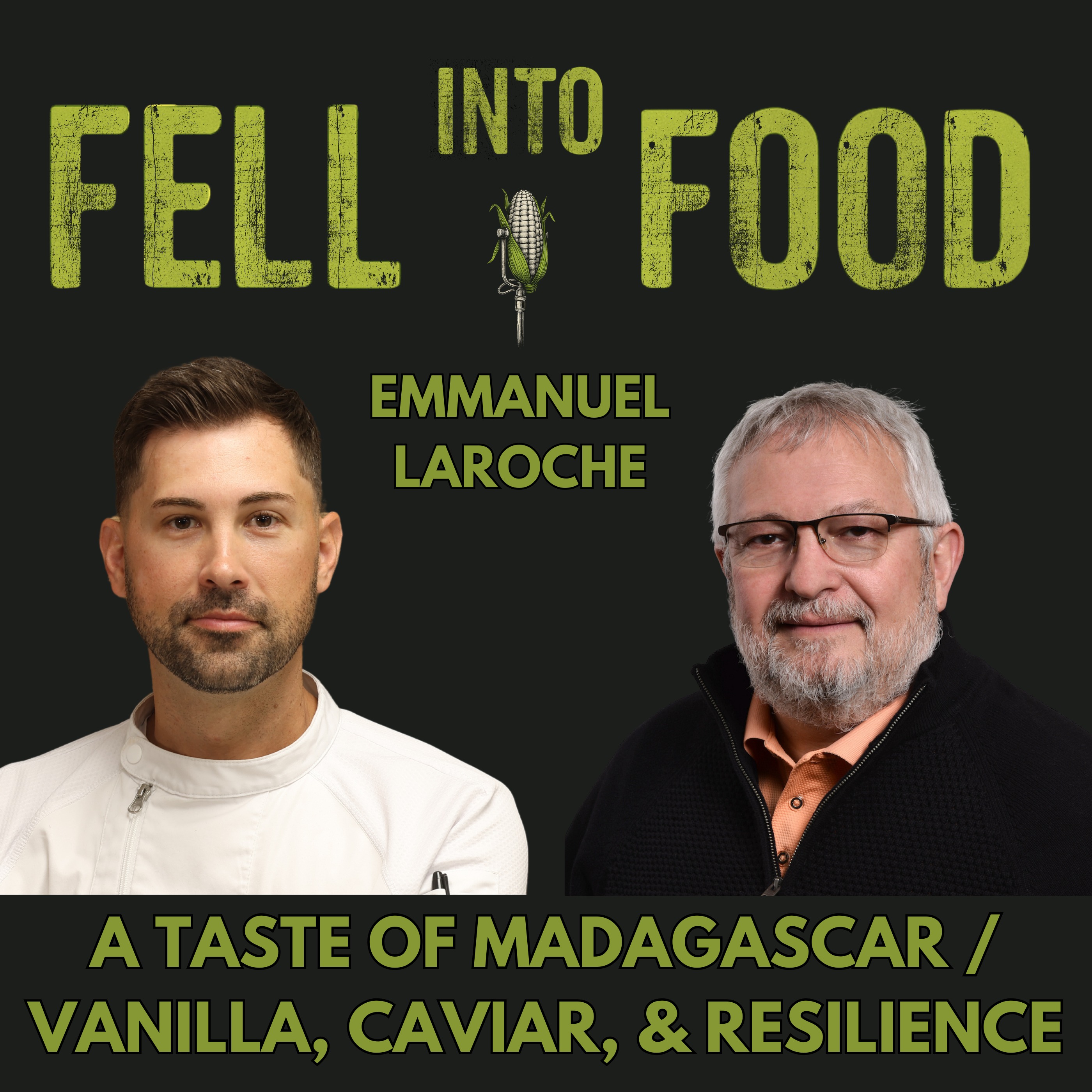
EMMANUEL LAROCHE: A TASTE OF MADAGASCAR / VANILLA, CAVIAR, & RESILIENCE
In the latest episode of the Fell into Food podcast, I chat with Emmanuel Laroche, a flavor explorer and author, to uncover the hidden culinary gems of Madagascar. Known for its rich biodiversity and unique food culture, Madagascar offers much more than just vanilla; it is a treasure trove of flavors waiting to be discovered.
Emmanuel Laroche, with a background in organic chemistry and an MBA in marketing, has spent over three decades in the food industry, driven by a passion for flavors. He describes himself as a "flavor explorer," someone who is always curious about discovering new tastes and understanding the stories behind them. For instance, he recalls his childhood memories of cooking with his mother, where he learned the art of making a classic Quiche Lorraine. This early exposure sparked his lifelong fascination with food, leading him to seek out unique culinary experiences.
Emmanuel first visited Madagascar on a business trip related to vanilla, which accounts for 80% of the world’s supply. However, what began as a professional endeavor quickly turned into a personal journey of discovery. Emmanuel explains that Madagascar is not just an island rich in vanilla; it is also home to a variety of other culinary delights, including pink peppercorn, cocoa, and even caviar. He emphasizes the importance of understanding the cultural and environmental context of these ingredients. On his trips, he was struck by the warm hospitality of the Malagasy people, who welcomed him into their homes and shared their culinary traditions.
During his travels, Emmanuel formed deep connections with the Malagasy people, particularly with a local chocolate factory owner named Niren. Their friendship blossomed during Emmanuel's second trip to the island, where they explored cocoa plantations and met various local farmers. Emmanuel's mission became clear: to celebrate the products of Madagascar while highlighting the stories of those who cultivate them. He emphasizes the resilience of the Malagasy people, many of whom live below the poverty line yet approach life with joy and generosity.
Emmanuel shares a surprising revelation from his travels: in Madagascar, the very ingredients that are exported to the world, like vanilla, are often not used in local cuisine. He recounts an experience where chefs expected to find vanilla in local dishes but found none. The farmers revealed that vanilla serves as currency and a source of income, rather than a staple in their cooking. This highlights the unique disconnect between local consumption and global demand, shedding light on the challenges faced by local producers.
His exploration of Madagascar reveals a rich tapestry of flavors and stories that extend far beyond vanilla. His passion for uncovering the culinary heritage of this unique island invites us to appreciate the complexities of global food systems and the resilience of local communities. As we explore new flavors, let us remember the stories behind them and the people who bring them to our tables.
Socials
Website: Flavors Unknown
Instagram @flavorsunknown
Facebook: @flavorsunknown
Listen to the full episode and more! It would mean the world to me if you could leave a 5 star review on your listening platform to help grow and expand the Podcast.
YouTube - https://lnkd.in/gQM3S5mr
Spotify - https://lnkd.in/g_5kFXie
Apple Podcast - https://apple.co/41RoTm4
Pandora - https://lnkd.in/gS-wu_YJ
YouTube: https://youtube.com/@FellIntoFood
Linkedin: linkedin.com/company/fell-into-food
Instagram: http://instagram.com/fell_into_food
Facebook: https://facebook.com/fellintofood
Partners
Hospitalitychain.com the world’s first online hub designed for the hospitality, culinary and catering industry. From leading food and beverage brands to professional foodservice equipment.
HospitalityChain.com makes sourcing simple. Search, select, buy direct and save – all in one Global market place
Advertising Inquiries: https://redcircle.com/brands
Privacy & Opt-Out: https://redcircle.com/privacy
Available Results
Generated results are saved to the knowledge database for reuse and search.
Extract Knowledge
Pick what you want extracted first. Model, scope, and chapter options appear after a template is selected.
Transcript
[SPEAKER_00]: Welcome everybody to another episode of The Fell in a Food Podcast.
[SPEAKER_00]: I am your host chef Jeff Fell.
[SPEAKER_00]: Soon to be the number one food podcast in the world, and we've got a good one today.
[SPEAKER_00]: My guest is a true flavor explorer who operates at the highest levels of the food industry, but his real passion is uncovering the stories that make a dish truly great.
[SPEAKER_00]: he is the VP of marketing and consumer insights for one of the world's leading flavor manufacturers, the creator and host of the popular flavors unknown podcast and the author of a book of the book conversations behind the kitchen door, but today we're going to dive into his newest book, a taste of Madagascar culinary riches of the Red Island.
[SPEAKER_00]: He takes his far beyond vanilla to explore the culinary incredible biodiversity, culinary traditions and environmental challenges of this
[SPEAKER_01]: Hey Jeff, thank you for having me.
[SPEAKER_01]: It's an honor to be on your podcast, to be on the Philopotcaster.
[SPEAKER_00]: Yes, yes.
[SPEAKER_00]: That's what makes it interesting is one, somebody in food, and then two, another podcast.
[SPEAKER_00]: So this could get really interesting real quick.
[SPEAKER_00]: But I first have to know what is a flavor explorer.
[SPEAKER_00]: You have to explain what that term is.
[SPEAKER_01]: Yeah, so the idea is that, you know, flavor has been always something that is part of my passion from, you know, just how I would see school.
[SPEAKER_01]: So I have a, you know, a master and organic chemistry and then after that an MBA in marketing and I will, you know, food has been always part of something that I love.
[SPEAKER_01]: I mean, you can tell from my accent that I'm not from New Jersey.
[SPEAKER_01]: that's, you know, originally born in France and moved to the US, you know, 23 years ago, so in French American now.
[SPEAKER_01]: But the idea is that, you know, food has been always to be critters, you know, at home I was cooking with my mom since I am, you know, 60 years old and you how to, you know, make a kish, Lorraine, for instance, you know, she's from that region.
[SPEAKER_01]: And then, you know, I was always wanted to find a job that put me in this
[SPEAKER_01]: intersection of science and then food and I discovered when I validated in my MBA, I didn't internship with a flavor industry in the south of France in grass, which kind of the herb of the flavor world and the flavor industry in France.
[SPEAKER_01]: And I found a passion for, you know, that industry and I'm still, you know, in that industry, you know, like 30 something years after and the idea of flare explorer is that it's it's for me a combination of
[SPEAKER_01]: professional and personal.
[SPEAKER_01]: So the idea is always being curious about discovering new taste, new flavors.
[SPEAKER_01]: So I go to, you know, restaurant on someone said you in the way you want to go.
[SPEAKER_01]: Why I said I want to go to a restaurant that never been before or you know, I'm going to a restaurant I'm going to look at the menu and I
[SPEAKER_01]: I want to make sure that I select something that I found really intriguing because always I think about, okay, what drove the chef to do the chef like to combine those things together?
[SPEAKER_01]: Is it coming from his background?
[SPEAKER_01]: Is it coming from, you know, the experience?
[SPEAKER_01]: Things that I, you know, like trips that he has made, you know, in another country and blending things together.
[SPEAKER_01]: exploring that world of flavor that never disappoint and you know always bring something you
[SPEAKER_00]: Yeah, I mean, you come from the center of the the the the food world.
[SPEAKER_00]: I mean, in France.
[SPEAKER_00]: So it's kind of funny.
[SPEAKER_01]: Yeah, I mean, I know I heard a lot of this.
[SPEAKER_01]: I, you know, I had the chance to travel around the world.
[SPEAKER_01]: Travel in old 48 states out of 50 here in the US and you know, it's always interesting to see.
[SPEAKER_01]: So let let let's cover maybe that topic because yes, I'm French.
[SPEAKER_01]: Yes, I've been a born in France, but
[SPEAKER_01]: you know, Japanese cuisine is fantastic and there's as well a long tradition about Japanese cuisine.
[SPEAKER_01]: I think the French may be the first one to, you know, class, like maybe create the brigades, you know, and then after that, you know, classified recipes and organized recipes.
[SPEAKER_01]: But, you know, if you go to Mexico, there is fantastic, you know, tradition and heritage and different way of cooking and, you know,
[SPEAKER_01]: French is always very refined and subdued and, you know, in Mexico, it's like, you know, how you use fire, for instance, you know, in order to grill vegetable grilled meats and, you know, and, or spices and, and it brings something really different.
[SPEAKER_01]: And then,
[SPEAKER_01]: I love, in fact, being here in the US because I found shifts in American shift, being much more adventurous.
[SPEAKER_01]: They are not, let's say, driven by maybe years of tradition from, you know, the French cuisine and saying that this has been done like this, you know, for many years.
[SPEAKER_01]: So I understand that you want to keep the tradition, but as well, you need to explore, you need to
[SPEAKER_01]: you know to experiment and what's what that's the reason why I created the flavor unknown podcast because I was just fed up like going back to France and was saying like you know exploring American food is fantastic and French people were telling me why we don't understand it's burgers and pizza and hot dogs I mean what are you talking about I'm like
[SPEAKER_01]: If you would spend the same number of hours preparing your trip about like exploring like the national park, you know, on west side of the country, of researching, you know, food and restaurant in the US, you will discover that there's a lot of other things beyond like, you know, the main chains of fast foods.
[SPEAKER_00]: Yeah, in an America, you have that blend, right, the melting pot.
[SPEAKER_00]: So you do get this really cool hybrid blend of somebody who has like you said a Mexican heritage and they want to blend that with some other piece, maybe they married into Korean.
[SPEAKER_00]: And so then they are like, they blend these two fusion together and you get these really cool flavor profiles from all over the country and what the chefs here do.
[SPEAKER_00]: I absolutely love that.
[SPEAKER_01]: And I have to say that probably, you know, just maybe to balance a little bit what I said, if you go, obviously to Paris, you are going to find this because there's a lot of influences, you know, coming from, you know, a different part of,
[SPEAKER_01]: of the world.
[SPEAKER_01]: But if you get outside of Paris, there's still a lot of the regional aspect and, you know, and the tradition, which I'm not against it at all.
[SPEAKER_01]: I think it's, you know, it's great.
[SPEAKER_01]: And... but...
[SPEAKER_01]: There's room for everything.
[SPEAKER_01]: Absolutely.
[SPEAKER_01]: There's day that you want to try something different, you know, from the prior day and, you know, and, you know, Variety is, is what I like.
[SPEAKER_00]: Yeah, Variety is a spicy life.
[SPEAKER_00]: Absolutely.
[SPEAKER_00]: Yeah, let's, let's talk Madagascar.
[SPEAKER_00]: It fascinates me because I don't know very much about it.
[SPEAKER_00]: So this is going to be a lot of approving just for my own knowledge.
[SPEAKER_00]: You know, your profile states, you know, your first visited on a business trip related to vanilla, which if you don't know, that's where a lot of the world vanilla is produced from.
[SPEAKER_00]: But you found, you know, kind of an unexpected connection and it really compelled you to research and write this book.
[SPEAKER_00]: So maybe talk a little bit about when you first realized that it wasn't just a business trip in a business opportunity, but really the reason why you felt the need to write a book about the country.
[SPEAKER_01]: Sure.
[SPEAKER_01]: So maybe to, you know, like, step back a little bit for everyone listening is like that they understand, you know, where is Madagascar because you are correct, you know, when I study talking about Madagascar in the US people said to me, oh, you mean the animation movie, I'm like, no, it's a real country, you know, it's an island as well.
[SPEAKER_01]: It does exist, I'm like, yeah, that does.
[SPEAKER_01]: It's like, so 250 miles west of the, like, the west coast of Africa.
[SPEAKER_01]: So, it's like really in between Africa and Madagascar, it's called the Mozambique Channel.
[SPEAKER_01]: It's under the tropic, and it's in fact the fourth largest island, you know, on the planet.
[SPEAKER_01]: So, it's about the size of Texas, just that people are, you know, realize.
[SPEAKER_01]: So, it's not a small island.
[SPEAKER_01]: You know, in Europe, if you put it like on top of the French, the map, you will have the top of the island being in Germany and the bottom of the island being in Spain, just to show a little bit, you know, the size and there's about like 30 millions, 30 million people living on the island and there's a lot of variety of
[SPEAKER_01]: landscapes and so basically there is in the middle of the island, there's a huge chain, you know, of mountains and, you know, it's quite high and then it goes after that, you know, down on both sides of, you know, towards the ocean and so fantastic, you know, in the ocean on the side and then the Mozambique channel on the west side which is really great is that
[SPEAKER_01]: When I went there for the first time, you know, I had preconceived notion close to Africa, so African inferences, and then if you arrive there, you found that in fact it's a melting pot of like Asian and Africa.
[SPEAKER_01]: So there's a lot of people that came in fact, originally from Indonesia and that populated origin in the island.
[SPEAKER_01]: So you have that inferences that you can find, you know,
[SPEAKER_01]: The idea is that, you know, I came there for work because as you just mentioned, you know, great source of vanilla, it's like 80% of the world production of vanilla comes from Madagascar.
[SPEAKER_01]: 80% of the vanilla beans, you know, are coming from, in fact, a small triangle, the area on the northeast part of Madagascar.
[SPEAKER_01]: And I took with me three American,
[SPEAKER_01]: Q&A leaders, so I had chef at Isabet Faulkner, you probably know the name, that came with me, Michael Gilota from New Orleans, and as well, a mixed-logist Shannon T. Bay that at that time was the beverage director of death and company in New York.
[SPEAKER_01]: And the ideas wanted to bring them closer
[SPEAKER_01]: I came to my guest car for vanilla, and in fact, I stayed because of all things that I discovered.
[SPEAKER_01]: I discovered that Pimpepacorn is amazing.
[SPEAKER_01]: It's the, in fact, the second producer after Brazil of Pimpepacorn on the planet, you know, like this cocoa, which is amazing, you know, profiles for, you know, chocolate bars.
[SPEAKER_01]: And then there is caviar, and that was like, what?
[SPEAKER_01]: What are you talking about?
[SPEAKER_01]: Right.
[SPEAKER_01]: So there's 11 ton of caveas being produced in, you know, Madagascar, which is the first African in, you know, Indian Ocean, you know, caviar.
[SPEAKER_01]: And there is a wild black pepper, an endemic black pepper that you only find, you know, on the silent.
[SPEAKER_01]: So I stay for that.
[SPEAKER_01]: And then I discovered all those other ingredients.
[SPEAKER_01]: There's so much things here that in fact might hand up into the table of the chefs, you know, or the kitchen of the chefs around the world, but people have no idea it's coming from that island.
[SPEAKER_01]: And then I decided to come back, I've done three trips, you know, long trip to the island.
[SPEAKER_01]: And I came back because of the people, because the farmers, the entrepreneurs, the beekeepers, they are fantastic individuals, they welcome you and had the chance to
[SPEAKER_01]: to really tour the island completely and I decided to come back because of you know them.
[SPEAKER_01]: To interview them and I said okay now I know that's the great content that I have to share with the rest of the world and you know that will be a great topic for a second book.
[SPEAKER_00]: Yeah, and that's the Malagasi people.
[SPEAKER_00]: Is that has said Malagasi Malagasi Malagasi Malagasi so what what about with their tradition what created this kind of bond that a travel like a normal experience you don't normally get you know You you may interact with the culture, but you really dove in so what was kind of that bond you had with the Malagasi people
[SPEAKER_01]: So I have to say that, yeah, I didn't have at all the expense of a tourist first because I think I'm always as a securityist and I'm very respectful of everyone's you know, culture tradition, always looking for great storytelling.
[SPEAKER_01]: And I had a chance to got acquainted
[SPEAKER_01]: a gentleman his name is Nieren and he is the owner of a chocolate factory as well as the cocoa plantation on north west side of the island where there's a big cocoa tree plantation area there and we became friends very quickly and it happens during my you know first trip and
[SPEAKER_01]: on the flight back, you know, I started to have this idea of this maybe could be a, you know, a second book.
[SPEAKER_01]: And then I think contact with him and I said to him, hey, you know what, I think this is what I want to do.
[SPEAKER_01]: And I said, I exactly that I want to celebrate the products coming from the islands and as well, featuring people that, in fact, are taking care of those products, but as well giving back to the local
[SPEAKER_01]: You know, being French, I have obviously that notion, like in mind, that, you know, Madagascar used to be a French colony, you know, until 1960, it became independent.
[SPEAKER_01]: So there's been a lot of...
[SPEAKER_01]: impact positive or negative, you know, from France there.
[SPEAKER_01]: And there's a lot of companies that decided to go to Madagascar because of the cheap workforce.
[SPEAKER_01]: And I wanted to make sure that people that I wanted to bring on that book was people that, in fact, did something very different and they were really, you know, giving back to the local, you know, the local community
[SPEAKER_01]: What happened is that he loved the idea, of course, you know, the fact that someone wanted to, you know, focus on, you know, his island.
[SPEAKER_01]: So he took two weeks vacation and he was my guide on my second trip.
[SPEAKER_01]: and I was able to meet beekeepers, you know, people that are cultivating clubs, you know, pink pepper corn, you know, of course vanilla farmers and so on.
[SPEAKER_01]: And I had the chance to connect with 18, I did a conducted, I think, 18 interviews in 14 days, you know, on my
[SPEAKER_01]: It's really interesting because those people are, you know, poor in, you know, generally speaking, the 75% of the population, which is below the poverty line.
[SPEAKER_01]: And, you know, so, of course, you know, when you experience this, you're drawn into.
[SPEAKER_01]: you know their stories and but they always have a smile on their face and they are welcoming you, you know, into your, into their home.
[SPEAKER_01]: And the generally want to, you know, establish a connection and share their,
[SPEAKER_01]: You know, they're, you know, traditions and anyone what they do and I think this is, you know, what resonated with me and the fact that I really wanted to celebrate their resilience, you know.
[SPEAKER_00]: How many of these extra exports, all these, you know, the things you don't think of caviar, the pink peppercorns, the cacao, how much of that's actually being exported versus consumed, you know, right there on the island?
[SPEAKER_01]: This is a fantastic question, in fact, that's because I can tell you a story, that we'll answer that question.
[SPEAKER_01]: The story that's what shocked us when I say, oh, see, it's me and the American chef, that were with me on the first trip.
[SPEAKER_01]: When, in fact, you know, you go to the island, you know, there's going to be a lot of vanilla.
[SPEAKER_01]: So you are expecting and it is a bit folkener really expressed it's the right way.
[SPEAKER_01]: She said, you go to a country like in Middle Eastern, you know, a region that cultivates saffron.
[SPEAKER_01]: You, you find saffron everywhere, you know, in the dishes, you know, and so on and the menu.
[SPEAKER_01]: There, there was absolutely no vanilla whatsoever.
[SPEAKER_01]: And so we went to the Savar region, which is the north, East region where, you know, 80% of the world vanilla comes from.
[SPEAKER_01]: And then we met with those farmers.
[SPEAKER_01]: And then we, they explain, you know,
[SPEAKER_01]: everything of the process working with different company for expressions and so on.
[SPEAKER_01]: And then we asked the question and we said, so what is vanilla for you?
[SPEAKER_01]: And it said, this is currency.
[SPEAKER_01]: This is income.
[SPEAKER_01]: And I said, but how do you use it in your cooking?
[SPEAKER_01]: Oh, we don't, I don't know what, we don't.
[SPEAKER_01]: So vanilla is absolutely not part of the culture from Madagascar.
[SPEAKER_01]: This is, in fact, everything is exported.
[SPEAKER_01]: And for them, this is, in fact, a huge income for the farmers for that region.
[SPEAKER_01]: And this is something that really where we're kind of,
[SPEAKER_01]: You know, you should have seen our draws, and we're like, dropping, say what?
[SPEAKER_01]: And then, and yeah, and so that's the same thing with, you know, paint paper upon, you'll find a little bit of paint paper upon in the, in the, in the cooking.
[SPEAKER_01]: Pimpapacon from the south is part of the island, and again most of it is exported, clubs, most of it is exported.
[SPEAKER_01]: All of this has been in fact, it's not really endemic, it's been brought through generation by some time, you know, people that came to the island, you know, it could be as well from.
[SPEAKER_01]: you know, the waves of colonialism, and yeah, so most of it is exported.
[SPEAKER_01]: The things that you can find in a cooking, it's like the wild black pepper, which is
[SPEAKER_01]: I think the most would say probably in gradients, which is one chapter on my, or maybe there's two different one is an in gradients that's cultivated it's rice, which is
[SPEAKER_01]: parts of the melagastic culture.
[SPEAKER_01]: The eats rice at the three meals from breakfast, lunch and dinner, a different style.
[SPEAKER_01]: But, and then the other one is an animal, which is the iconic animal on the island called Zébu.
[SPEAKER_01]: So Zé with an accent and BU.
[SPEAKER_01]: It's in fact the hunchback paddle.
[SPEAKER_01]: Very iconic, it's everywhere.
[SPEAKER_01]: You know, the meal that's like more celebratory meals.
[SPEAKER_01]: Some of those animals are sacrificed when, you know, maybe a farmer is marrying their daughter, or, you know, then they are having, you know, maybe a death in the family and so on.
[SPEAKER_01]: So all the family gathered and, you know, one of those animals are sacrificed and, you know, people are eating.
[SPEAKER_01]: So, but all the rest, you know, like the vanilla, the cocoa, the caviar definitely, you know, the pink peppercorn, the cloves, I would say, power exported.
[SPEAKER_00]: Yeah, you just answered literally my next two stuff like well, then what did they eat if they have the most abundance of all these ingredients, and they don't use them.
[SPEAKER_00]: What do they eat and then that zibu zebou cattle also what was what's what's the flavor of that?
[SPEAKER_00]: What is I mean given what grows there in their diet?
[SPEAKER_00]: What is that meat actually tastes like?
[SPEAKER_01]: I mean, it's really, you know, beef, definitely, you know, the closest, maybe with a little bit of, I would say, game, maybe a gaming, like, you know, profile, but it's, you know, it's interesting is that at the capital, which the name is Antonana Revo, it's a long name.
[SPEAKER_01]: You know, some of the new faces of like chefs, you know, the new culinary faces of Madagascar that are
[SPEAKER_01]: bringing those ingredients.
[SPEAKER_01]: So you find vanilla in, you find pin pepper corn.
[SPEAKER_01]: You find, you know, some of the honey as well.
[SPEAKER_01]: We haven't spoken about honey, but we can talk about it later.
[SPEAKER_01]: But and then you find Zibil, but you know, usually traditional recipe will be in stews, but then you'll find it like more cappacho style, which is like, you know, very, very different.
[SPEAKER_01]: And it's really delicious.
[SPEAKER_00]: What about the Malagasy?
[SPEAKER_00]: What about their approach to like-time tradition?
[SPEAKER_00]: Here in the US, everything is just go, go, go, go, go, go, so fast-paced.
[SPEAKER_00]: What does it like compared to the US?
[SPEAKER_01]: So, let's say they taught me patience, which is not my fault day.
[SPEAKER_01]: So, but, yeah, you need to be patient because they leave at the reason of especially outside of the capital with nature.
[SPEAKER_01]: you know, you need to realize that there's still 18 tribes, you know, that lives, you know, in on the island.
[SPEAKER_01]: So there is a lot of tradition.
[SPEAKER_01]: The roads are not sometimes the best.
[SPEAKER_01]: So you need to have a lot of time as well to drive, you know, a few miles.
[SPEAKER_01]: So it teaches you patience.
[SPEAKER_01]: So yeah,
[SPEAKER_01]: you know, life with their, you know, family and, and, but I have to say that
[SPEAKER_01]: You know, those in people, especially in remote part of the island, they are, you know, their main focus is to make sure that they can bring food on the table, you know, for the family.
[SPEAKER_01]: And so it's very, it's a different reality and in different fields of life, so in fact, they are focused on
[SPEAKER_01]: You know, by the end of the day, I fed my family, you know, so it's, it's really say, dear off, you know, it's sometimes, the, the, the challenges for them to project, you know, and and say, you know, like, you know, in a month or whatever, because it's, it's not the reality, the reality is, you know, the day today and and make it sure that it can feed my family.
[SPEAKER_00]: Yeah, it's just that simple.
[SPEAKER_00]: The simple life, yeah, just survived straight survival, not worried about all the other, the other things are in the world.
[SPEAKER_00]: You also say, and that the book is more than just, it's not a cookbook, it's a travel log.
[SPEAKER_00]: You know, what do you hope readers that take on the book, who've never traveled the island, probably a lot of people listening, have never went to the island or will get to get to go, but what take away, you know, is a single most important cultural or human lesson, you know, from your journey that you would want someone to take.
[SPEAKER_01]: So I think that we need people need to think and yes, it's about the ingredients that I mentioned on the island, but I think for everyone who is a foodie and I'm interesting into food, they need to realize that, you know, there's human behind the ingredients, there's more than an ingredient that you put into your food and your recipes.
[SPEAKER_01]: As an example, I never now see the vanilla bean the same way now after those trips, you know, then before the trip and an example, if like, you know, we all have like bunch of like vanilla beans, you know, at home for cooking or pastries or, you know, baking and then, you know, sometimes you look at it and you say, oh, this one is dry and then you drive through it in the garbage, you know, say, you know,
[SPEAKER_01]: Now that I have seen the work that he takes and the fact that there's, I don't know how meaning number of hours when I say hours is month.
[SPEAKER_01]: Number of the number of hands that that beings have been through in order to come from a green being that, you know, first of all,
[SPEAKER_01]: the each individual arcade flower because vanilla is a vine and it's an arcade and each of the flower are pollinated by hand.
[SPEAKER_01]: You know, at the peak of the season, I had the chance to
[SPEAKER_01]: go in October, which is the blossoming season and of September being in October, and the farmer taught me how to pollinate one flower.
[SPEAKER_01]: They have to do that for each and each flower produce a bean.
[SPEAKER_01]: So already it gives you like a perspective and the story behind it,
[SPEAKER_01]: Vanilla is origin from Mexico and in Mexico, this is the only country that has this little insect that we're able to pollinate, you know, the rocket flowers, you know, from the Vanilla and produce Vanilla beans.
[SPEAKER_01]: When throughout the time, especially French people, that took that bean and tried to implement it in all the part of the world, um,
[SPEAKER_01]: They took the insects with it, obviously, but the insects never survived anywhere else outside of Mexico.
[SPEAKER_01]: So all the Vanilla that exist in other parts of the world, there's some in Africa, there's some in Asia.
[SPEAKER_01]: Everything is fully naked by hand, so people need to realize that.
[SPEAKER_01]: And then after that, the idea is that, you know, it has to be obviously turning to like a beans or green beans, the green has to be brought to companies that are going to curate the beans, they are going to select the beans, they are going to, you know, sort them into
[SPEAKER_01]: quality and size and so on.
[SPEAKER_01]: So a lot of things happen and for me I don't see the vanilla being the same way now and there's no way that I'm going nowadays to have the being getting drawing my kitchen.
[SPEAKER_01]: You know it's I too much respect to the craft you know that I've been that I have observed and I witnessed.
[SPEAKER_01]: So I think that the one takeaway is like for everyone, you know, when they are bringing those ingredients that come from different parts of the world, Madagascar or, you know, other sources, they need to understand that there is people behind it, there is a craft, there is a tradition, there's there's tradition and if we are thinking Vanilla without supporting those individual
[SPEAKER_01]: Let's say, special moment that we may have on the kitchen with our kids, you know, when we are baking, you know, a cake and using vanilla and transmitting this from generation to generation might disappear.
[SPEAKER_01]: So that's for me, that was the main reason on this emotional bond that you have to imagine that, you know, connect people.
[SPEAKER_01]: My experience, our experience, but then there I would see life-lead and their tradition and their craft.
[SPEAKER_00]: yeah the things we take for granted it's very similar to coffee it sounds like you know how the beans are harvested green people don't understand that and what actually transpires to actually get good quality coffee and how many people you know especially in America one we've got some people that just roast the live and hell out of the beans and don't don't do them justice but then how many people have just a bag of beans in their cabinet and they they dry out the oils you know are
[SPEAKER_00]: Exfoliated and they just toss them and they don't know what went into that bag of beans and how much work Went to wherever whatever part where they'd be Columbia Africa, I mean all over the world.
[SPEAKER_00]: It's it's it's fascinating How very little risk how little respect that we have for the ingredients that we use
[SPEAKER_00]: We see it more when it's at home when we're talking about ingredients grown here, but really there should be a giant respect for what has to be grown from all around the world that we're using in our kitchens for sure.
[SPEAKER_00]: You mentioned bees and
[SPEAKER_00]: I'm very curious on what that is like there you mentioned that it's a special bug for for that plant because originally that was my first thought was well if they if they have a bunch of bees in a producing honey clue they can pollinate but obviously it's a special insect but what is honey to them how is that is it produced in the traditional sense like it is here in America's and then when it's exported you know I always hear the dirty secrets of honey and how it's always diluted.
[SPEAKER_00]: Is that what's coming over as a true raw unfiltered honey or is that process like yeah?
[SPEAKER_01]: So again, you hit like whole like the right You know spot here in your question because you talk about tradition you talk about you know modern way of Making honey's and you're talking about You know the quality and what can be found on the market and as you said you found a lot of
[SPEAKER_01]: not good, good honey.
[SPEAKER_01]: So let's start with the first part, tradition.
[SPEAKER_01]: So so there is bees that are engineers from from the island and in fact you find hives you know wild like in the forest.
[SPEAKER_01]: and people in the villages in different part of the islands, they have the tradition in fact to collect the honey, you know, from those wild hives.
[SPEAKER_01]: In fact, when you go into very remote part of the island, the chance to
[SPEAKER_01]: hike in very remote parts and I've done nine hours of like dirt road you know on the car one way nine hours the way back you go through little villages that are basically huts you know in like in woods and
[SPEAKER_01]: And people with a lot of, you know, obviously income there.
[SPEAKER_01]: And so you have a lot of kids that are, you know, sometimes you have to slow down because the old conditions sounded the best.
[SPEAKER_01]: And then they come to the car and, in fact, in Malagasi, I didn't know exactly what they were asking, but my driver said, because you cannot really go there on your own.
[SPEAKER_01]: said, you know, they're asking for if you have any plastic bottles, you know, we do because obviously we carry out the water because, you know, it's a hot bridge and then so they give and I said, why do we need the bottle for and they said, oh, because they are going collecting honey.
[SPEAKER_01]: So the kids go to the forest and they will, you know, collect the honey from the hives.
[SPEAKER_01]: The only issue is that, you know, this is the way they do it and most of the time they destroy the whole hive.
[SPEAKER_01]: So, you know, like the queen bee, you know, doesn't survive and then there's no no ice left.
[SPEAKER_01]: So, the tradition is great, but at the same time, you know, it's not the best way of keeping this.
[SPEAKER_01]: So,
[SPEAKER_01]: There's a lot of companies that are NGOs and you know that are being implemented in Madagascar because they are trying to give a different source of income to the farmers and main reason is
[SPEAKER_01]: We make talk about it, and later, but it's a situation of defouristation, which is a big situation on the island, because people are producing charcoal, because that's the way of them as well to have fuel.
[SPEAKER_01]: I mean, I mean, you know, to, you know, for
[SPEAKER_01]: eating and warm like the food as well and they are reselling it so but of course they are destroying the forest when they do that so they are educating farmers to say instead of producing charcoal you know if you put you know like maybe 20 hives on your
[SPEAKER_01]: you know, garden, property, whatever, then you can produce enough honey that you can resell and it's give you income that's going to go far beyond the income that you can get, you know, by selling, you know, charcoal.
[SPEAKER_01]: So there's a lot of this that's happening in different part of the island and I had the chance to meet, you know, one of the
[SPEAKER_01]: company that's called Beekeeper or in like company DML like the sort of honey company but you know French and Belgian company and then they they educate the farmers to you know how to
[SPEAKER_01]: you know, like produce, you know, first to take care of the hives and then, you know, and to collect honey and then obviously that French and Belgium company will export it and you know, then they will give, you know, that income back to the farmers.
[SPEAKER_01]: So you see a lot of this, but this is really a raw honey and and what's really super interesting is
[SPEAKER_01]: You have a unique biodiversity on the island.
[SPEAKER_01]: 90% of the vegetation of the animals that are in the island doesn't exist anywhere outside, you know, in the world.
[SPEAKER_01]: And then you are going to find leechie honey.
[SPEAKER_01]: You are going to find mangrove honey.
[SPEAKER_01]: You are going to find primary forest honey.
[SPEAKER_01]: So those type of things that you can find anywhere else.
[SPEAKER_01]: And they are definitely high quality raw honey.
[SPEAKER_01]: As you, you know, you are chef, so, you know, exactly goes like usually, you know, there's always the effect of crystallization, crystallization on their honey, so which is normal, you know, and depending of the the type of honey that crystallization can takes place like faster than, you know, other.
[SPEAKER_01]: And if people are not really like the consumer is not really educated.
[SPEAKER_01]: we have in the Western world, you know, consumers that wants to have honey which is like very translucent and liquid and they can, you know, and they can spread it and so on.
[SPEAKER_01]: Unfortunately, they are honey that are coming from other part of the world with the quality and just not the best.
[SPEAKER_01]: So crystallization for everyone listening, it's normal part of what, you know, the way how honey behaves when they are aging, so you can reheat it, you know, at home and and it goes back into liquid form, but, but now, yeah, the quality of the honey from Madagascar is high quality, you know, hot roll honey.
[SPEAKER_00]: Yeah, that's what I've noticed.
[SPEAKER_00]: I get Manoka Honey from New Zealand and that's how it comes.
[SPEAKER_00]: It's already crystallized.
[SPEAKER_00]: If you didn't know any better, you'd be like, this honey is no good.
[SPEAKER_00]: Why?
[SPEAKER_00]: And they don't understand, yes, that is a natural process of unprocessed, real honey.
[SPEAKER_00]: And it had a lot of benefits.
[SPEAKER_00]: And I'm assuming there's probably a lot of health benefits with the Madagascar and honey.
[SPEAKER_01]: And I already talk about it in the book and details.
[SPEAKER_01]: So
[SPEAKER_01]: There's so much different quality and like organaptic quality of honey in terms of different flavors that people are using there are the chefs, you know, on the island use it for different Let's say application.
[SPEAKER_01]: There's some that they will use as a signature for, you know, for like culinary dishes and meat
[SPEAKER_01]: There are some others that are going to be used in maybe like shakes, you know, for instance, and, you know, or some are going to be used more for a serial, you know, with serial in breakfast.
[SPEAKER_01]: So, I think that's interesting, and I talk as well about the
[SPEAKER_01]: And again, that's not my knowledge, it's the knowledge that I'm sharing from, you know, the company that I interviewed, but it's the idea that, you know, yes, there's different quality of honey, you know, out there on the market and the, you know, people need to be educated, you know, about like, you know, the different aspect of honey and crystallization is not a bad thing.
[SPEAKER_01]: In fact, it's a testimonial of like,
[SPEAKER_01]: And you can taste the quality difference.
[SPEAKER_00]: If you take them side by side, it's night and day on the sweetness is different.
[SPEAKER_00]: It doesn't feel like artificial.
[SPEAKER_00]: I don't know if that's the right word, but when you're tasting it, it doesn't have that.
[SPEAKER_00]: that mouth feel the, it's a different richness.
[SPEAKER_00]: If you haven't tried it, go out and get some, some non, you know, processed honey, and like you said, I'm sure you can find it.
[SPEAKER_00]: I know, I get mine at Costco because they get it in bulk, but it's, it's just great stuff.
[SPEAKER_00]: You touched on deforestation, and I have to ask, because I think that blends into where I was going to go with the influence from the outside world of, you know, what we're trying to teach
[SPEAKER_00]: From a big big big companies that want to capitalize, let's let's be real on these these products so what is the deforestation because they they actually want the wood are they needing it for a manufacturing like what is the reason behind that and then what is kind of the influence that the outside world is having on these on their culture.
[SPEAKER_01]: Okay, so I, you know, being obviously originally French and knowing the history of the colonialism, you know, of France, you know, from Madagascar and what happened before 1960 before it became independent.
[SPEAKER_01]: I have to say that probably the first station is, and I'm sure, if there's any French people that are going to listen, they are not going to like what I'm going to say, but the idea is that it is a direct, I would say, left over from the inference from France, where in fact, you know, a lot of,
[SPEAKER_01]: Let's say, you know, people from the outside at that time that went on the island, they explore the island because of, you know, the different raw materials that you can get, you know, from the island would being one of them because there was a lot of very rare, you know, mahogany, you know, type of wood and so on that, in fact, French would bring back, you know,
[SPEAKER_01]: you know, other things.
[SPEAKER_01]: So in order to do that, you had to access, you know, those species, so then you will destroy the rest of the forest.
[SPEAKER_01]: And then, you know, they were, as well, at that time, this is where the whole charcoal, you know, situation, you know, happen.
[SPEAKER_01]: So somehow the French, you know, brought that way of living and then for them.
[SPEAKER_01]: And when
[SPEAKER_01]: from one day to another, the French people decided to leave the island.
[SPEAKER_01]: There were no succession, you know, like really established.
[SPEAKER_01]: So it was a moment of, I would say, in balance from an economist and point.
[SPEAKER_01]: And in fact, the people in the different regions of Madagascar started to continue to replicate you know what they have been taught.
[SPEAKER_01]: And so they continue with the whole situation of, you know, producing charcoal.
[SPEAKER_01]: So because I was there, only way of surviving and the only income they can get.
[SPEAKER_01]: So
[SPEAKER_01]: a big impact of the differentiation comes from originally from the colonization, you know, situation.
[SPEAKER_01]: And so that's, you know, that's a big part of that.
[SPEAKER_01]: And then there's a lot of other countries that are there, you know, though.
[SPEAKER_01]: So when you look at it from an influence, the Russians are there, the Chinese are there, the Japanese are there, the French are still there,
[SPEAKER_01]: So, people are there because there's a lot of richness in this, in this, in this, on this island.
[SPEAKER_01]: So, that's why, for me, it was very important to focus on companies that are giving back.
[SPEAKER_01]: to the community.
[SPEAKER_01]: So for instance, I'm going to give you two examples.
[SPEAKER_01]: One is the caviar company, which is in fact three French individuals that came from the textile, so they have steel, you know, a very important industry, you know, and
[SPEAKER_01]: manufacturing of textile, you know, for big brands, you know, around the world, and then they decided to invest into another, you know, source, and, and that's where the caviar, you know, came up.
[SPEAKER_01]: So, they have seen that in France, in the south, west part of France, there was
[SPEAKER_01]: you know, caviar and like sturgeon farms that were created.
[SPEAKER_01]: So they decided, oh, you know, they know the luxury, I would say industry.
[SPEAKER_01]: So they said, okay, because of the textile aspect fabric, they said, well, that's probably a logical thing for us from, you know, a business standpoint.
[SPEAKER_01]: And so it's been at 13 years now, probably they've started.
[SPEAKER_01]: You have the entire story in the book in the caveat chapter, but in the nutshell, they identify like a lake with pristine, you know, quality of water.
[SPEAKER_01]: They establish everything with sustainability of, you know, the filtration, you know, of waters and they started to bring, you know, some fertilized eggs of, of sturgeon and then they.
[SPEAKER_01]: you know, grow the sturgeon.
[SPEAKER_01]: So now they are producing 11 ton of caviar.
[SPEAKER_01]: What is interesting is in fact that 80% of the workforce for this company are from Madagascar.
[SPEAKER_01]: In fact, what they did is the people, a lot of people that are working in that farm, the sturgeon farm,
[SPEAKER_01]: are the children from the parents that were working on the textile company that because of their income, they were able to put their children to school and to university and those people graduated with a very
[SPEAKER_01]: you know, high education and we're able to take care of, you know, of managing, of senior position, you know, of the of that surgeon form.
[SPEAKER_01]: So that's one element which for me was fantastic story.
[SPEAKER_01]: The second is that when you produce caviar,
[SPEAKER_01]: You are sacrificing, you know, the surgeon, obviously you have to kill the surgeon to, you know, collect the eggs.
[SPEAKER_01]: So what they did is like a part of those surgeon, female that are killed and then maybe some of the male as well, you know, that you can keep some for a production, but otherwise, you know, as well, you, you can, you know, give so they give them to villages that are around the farm and then those.
[SPEAKER_01]: individuals from the village, like resell it on the market.
[SPEAKER_01]: So that's a source of income for them.
[SPEAKER_01]: And then in other parts of the those fish, the surgeons are given to the orphanage in, you know, in Anton and Arievo at the capital.
[SPEAKER_01]: So it gives like a like a really an intake of like animal protein, you know, to the children that otherwise they
[SPEAKER_01]: you know, intake a year.
[SPEAKER_01]: And now they have like a regular protein intake.
[SPEAKER_01]: So that's for me, one example of, you know, the way how companies are in fact can give back to local communities.
[SPEAKER_01]: And then so if you see a rollback of Yr, which is the the brand from, and I know they are going
[SPEAKER_01]: so that's where it's coming from.
[SPEAKER_01]: So our OVA caveat.
[SPEAKER_01]: And then the other one is like company that the one I work for, but there's others and we're not the only one, but when it comes to vanilla, where in fact it's difficult to make it short, but in fact the vanilla
[SPEAKER_01]: a farmer.
[SPEAKER_01]: And there's a lot of farmers and farmers, you know, don't think about the Midwest farmers with, you know, like a lot of lands and so on.
[SPEAKER_01]: Sometimes they only have like 10 vines, you know, or sometimes they might have like 50 or 100 vines, you know, depending.
[SPEAKER_01]: But what you have to keep in mind is that when the harvest season is taking place, they are
[SPEAKER_01]: taking those vines to, like, a company like ours to do the curing for the extraction of the vanilla extract or treating the beans, they receive their income at that time.
[SPEAKER_01]: So one day is they bring the vine, they get the money.
[SPEAKER_01]: And that's sometimes this is the only harvest that they have.
[SPEAKER_01]: So you can imagine that's not easy to, let's say, manage, but so we decided like other companies that are in that business that, you know, if we want to continue this whole story of heritage of, you know, vanilla in the Western world and that we can enjoy, you know, the vanilla the way we enjoy it, we need to preserve, you know, that industry, we need to preserve those tradition
[SPEAKER_01]: Then we started to put together some services in order to help those farmers.
[SPEAKER_01]: So first of all, we teach them how to diversify their production with all the things that give them more income.
[SPEAKER_01]: So they can grow maybe, you know, cocoa, or they can plant patchouli.
[SPEAKER_01]: Patchouli is very important for fragrance.
[SPEAKER_01]: I mentioned it in the book as well.
[SPEAKER_01]: There's the whole chapter about like the, I could eat like the search of essence, you know, in Madagascar, which influence the modern world of perfumery.
[SPEAKER_01]: And so patchually, or they can grow vetive, or they can grow other botanicals that could be extracted for the world of fragrance.
[SPEAKER_01]: So that gives them more income, or we can help them with education for the children, or we can help them with health, you know, plants.
[SPEAKER_01]: you know, for their family and so on.
[SPEAKER_01]: So the idea is that we, we are not forcing anyone to sell us, you know, the beings, we are offering them, you know, that service that they can, you know, subscribe to, while they are sending, you know, selling the beings to us or like to other people, you know, other companies.
[SPEAKER_01]: So when we started the business, maybe we had 1,000 farmer that we work with nowadays, we are working with almost like 8,000 farmers because obviously we are
[SPEAKER_01]: giving back to the community, helping them for the livelihood.
[SPEAKER_01]: And something that I, that was very emotional for me when I'm, when they're because I've been selling this vanilla, you know, all my career at, you know, what's your eyes?
[SPEAKER_01]: I want to company I work for.
[SPEAKER_01]: When I had this interview with the chefs, you know, it is a bit fokener and the others with the farmers.
[SPEAKER_01]: And we said, do you have any question for us?
[SPEAKER_01]: And at the end, one of the farmers said, you are from Simurized, correct?
[SPEAKER_01]: And I said, yes.
[SPEAKER_01]: So we said, can you tell us that you will never leave the island?
[SPEAKER_01]: Because in fact, this is the future of our children.
[SPEAKER_01]: And that was something that was very emotional for me.
[SPEAKER_01]: Because you know, you'd never experience that, you know, when you think about the business, the way I interact with, you know, my customers and so on.
[SPEAKER_01]: And then when you realize that, in fact, what you are offering,
[SPEAKER_01]: is the lovely hood of thousands of farmers and, you know, in their families.
[SPEAKER_01]: So that's for me, very very impactful and very emotional.
[SPEAKER_00]: Yeah, that type of impact.
[SPEAKER_00]: I think me.
[SPEAKER_00]: Yeah, you said it beautifully like that's just exactly what we should be doing and that level of impact to to those people I think if more understood the impact that we are having on other countries and like you said this is their legacy for their children being able to support them diversify them.
[SPEAKER_00]: it's such a good story.
[SPEAKER_00]: When there's so many horror stories in this food industry of just complete greed and money to hear something that is changing people for the better, I love that story.
[SPEAKER_00]: Absolutely love that story.
[SPEAKER_01]: Thank you.
[SPEAKER_01]: I mean, that's true.
[SPEAKER_01]: And you know, I, you know, I'll obviously we are as well, you know, you know, we are into business,
[SPEAKER_01]: to make money and, you know, like everyone else, and so on, but there's way of doing it, you know, that thing that's, you know, to make sure that we are respecting everyone's culture, respecting, you know, everyone legacy, as you said, and making sure that we give them a lovely
[SPEAKER_00]: Yeah, all right one final question across all your books your podcast your career you dedicated yourself to finding all these flavors unknown at your stage right now What do you believe is the biggest remaining unknown of the food world?
[SPEAKER_01]: Wow, that's a tough question What is the biggest I know in the food world?
[SPEAKER_01]: You know, I don't know, I probably were going to repeat what we said before, but the idea of, um, like, um, you know, understanding that this is more than a flavor, that is more than an ingredients.
[SPEAKER_01]: And this is, you know, that story of like people, you know, behind, you know, like each of them.
[SPEAKER_01]: So for me,
[SPEAKER_01]: It's like trying to make them less unknown.
[SPEAKER_01]: So that's mean that the people are state curious.
[SPEAKER_01]: And the people you always explore and go beyond what they see on like a line on the menu.
[SPEAKER_01]: And for me, it's the idea of understanding the people behind
[SPEAKER_01]: Um, you know, that the people that are making, in fact, that are celebrating that ingredients because your chefs, so, you know, exactly what I'm talking about here, which is in fact, you will not have or you will not make, and I know that you are more maybe with, you know, working with technology and so on, but, you know, otherwise when you have restaurants, you know, the idea is that you are celebrating those ingredients, you know,
[SPEAKER_01]: trying what I've learned, talking to many chefs around the country is that more experience they have, less transformation they make on the ingredients.
[SPEAKER_01]: It's more about respecting the ingredients, sourcing the quality ingredients, and making sure that the ingredients is shining, on the plate.
[SPEAKER_01]: And then they are respecting, you know,
[SPEAKER_01]: the story behind and the people behind that ingredients so that's why there's so many partnership between chefs and farmers you know and and fishermen you know here in the in the US so for me it's the same thing so so you know the unknown is is really more for the consumer part to
[SPEAKER_01]: to make it less unknown and in fact being curious of engaging and understanding the story behind the ingredients and the story behind the people that are transforming the ingredient.
[SPEAKER_01]: Yes, for our pleasure as a consumer.
[SPEAKER_00]: Yes, yes, 100%.
[SPEAKER_00]: That seems to be the theme this year that I've noticed from everyone that I've been talking to is
[SPEAKER_00]: even a more de-perspect for the ingredients and learning the story behind the ingredient.
[SPEAKER_00]: It's like that's great that it comes from a family farm or whatever it might be, but what's the story behind that?
[SPEAKER_00]: There's usually some bigger story and what you and kind of
[SPEAKER_00]: shared with us today is these stories from across the world that we don't get here because they get buried in because they're not in our backyard.
[SPEAKER_00]: They're not front and center.
[SPEAKER_00]: So we kind of push them off to the side and say, well, it's produced somewhere that they're fine.
[SPEAKER_00]: I need this to cook today.
[SPEAKER_00]: But if we really took the time, and I highly recommend read the new book coming out, it's kind of probably, you know, this conversation is just a blip of, you know, your findings in one country, one of how many produce around the world.
[SPEAKER_00]: So, for sure, Emmanuel, where does everyone go?
[SPEAKER_00]: I know the book drops soon, so maybe give a plug for that, and then where do they go to learn about you, your podcast, and everything else?
[SPEAKER_01]: Yeah.
[SPEAKER_01]: Thank you Jeff.
[SPEAKER_01]: So for the podcast, they can go and myself.
[SPEAKER_01]: They can go to, you know, website, the, like, the flavors and on.com.
[SPEAKER_01]: For the book, it's just, they can go to a taste of Madagascar.com.
[SPEAKER_01]: That's the name of the title of the book.
[SPEAKER_01]: They can find a book for preorder now, you know, online, wherever they buy books, you know, social media.
[SPEAKER_01]: So on Instagram, it's flavors are known as well, on Facebook, on Instagram, and then other on LinkedIn, you know, under my name, in many of the rush.
[SPEAKER_01]: So that's where they find me.
[SPEAKER_01]: Oh, some MMRC, Emmanuel, MMRC, I really appreciate it, thank you very much for having me.
[SPEAKER_00]: Yes, and everyone listening until next time, we'll catch you on the sunny side.