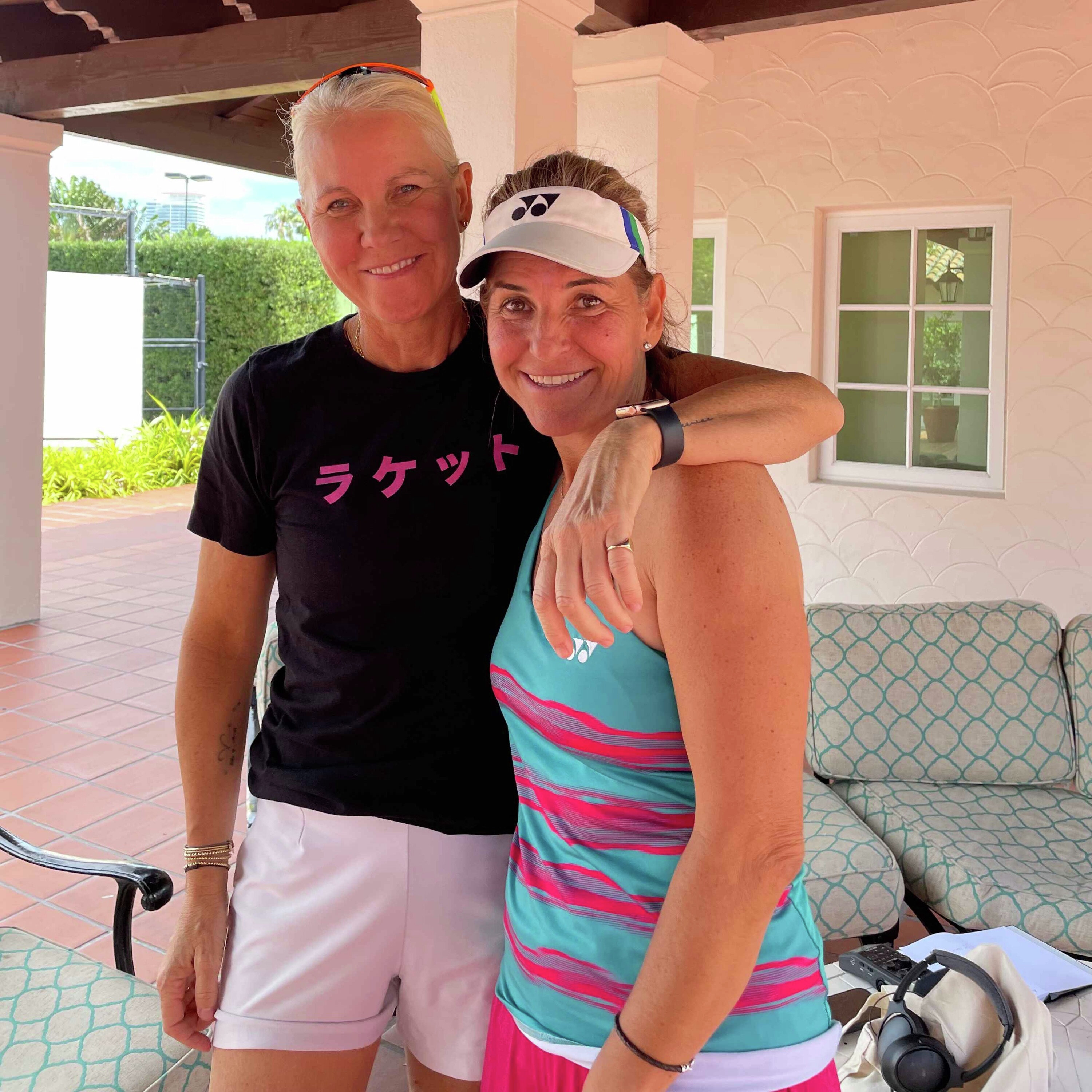
Arantxa Sánchez Vicario
The "Barcelona Bumblebee" talks about the mentality it took to get her 14 Slams, how retirement has been treating her, and what she REALLY thought about her portrayal in the film King Richard.
Hosted on Acast. See acast.com/privacy for more information.
See omnystudio.com/listener for privacy information.
2022-03-25
39 min
Transcript
Available Results
Generated results are saved to the knowledge database for reuse and search.
No generated results are available for this episode yet.
Extract Knowledge
Pick what you want extracted first. Model, scope, and chapter options appear after a template is selected.
Generated results for public episodes are saved to the knowledge database so they can be reused and searched later.
Transcript
00:00:15
Speaker 1: Hello, Renee. It's a new year, it's new you. It's a new tennis landscape. We've been on the road. Where have we been.

00:00:22
Speaker 2: What's been happening. It's a new name.

00:00:25
Speaker 3: I mean, let's be honest. We finally gave up calling it you know something, racket magazine. We just went with you know, Renice stops because really, Caitlin.

00:00:34
Speaker 2: Come on, I'm having a grand slams. You have six, So let's just hauled you up.

00:00:41
Speaker 1: What a great study, A special start to the Renee Stubbs Show. I'm delighted to join you. We've been in Palm Springs, We've been in Miami. You are still there. You have been on TV for the past twenty four hours talking about breaking tennis news. It is a true privilege and honor to be launching this our fifth season of the show with something so meaty to talk about that actually sets up quite nicely the incredible interview that we're going to have people here as the first episode of this season. So before we get into our incredible guest, a Rancho Sanchez Viccario, can you please describe what the last one or four hours I've been like in the tennis landscape.

00:01:23
Speaker 4: Well, I am in Miami.

00:01:24
Speaker 3: I'm down here for the tournament, and so I've been.

00:01:27
Speaker 5: Still doing practices and coaching, and then in my other spare time and hours, I've pretty much been on every network in Australia. I think every radio station ESPN. Of course, the very surprising retirement second retirement. I guess of Ash Barty and I guess the number one question that I've been asked throughout it, Caitlin.

00:01:46
Speaker 3: Is were you shocked? And my answer, of course is yes. I mean, she just won the straight and Open two months ago. She was a fairly dominant number one on the lost one match in a long time. But then the flip side, the position of Ash party is that I'm not shocked at all. You know, she didn't really I don't want to say love it, but she didn't really love it. She didn't really love tennis. I think she I think she loved it, but the competition and you know, the travel, the travel is what I think killed her. Just She's such a homebody. She loved being at home. And I think I really believe that the pandemic over the last couple of years is the one that sort of through the spanner in the works as we say, I think her being home for an extended period of time when the first pandemic hit, spending time with her family, her dogs, you know, her fiance, her new home. She's very comfortable as far as financially at that stage, and I think that sort of made her feel like, Gosh, I really like being here. I liked playing golf. I like kind of being home.

00:02:47
Speaker 5: And then the six months that she was on the road last year because she couldn't really go back to Australia.

00:02:54
Speaker 3: I think that really just was the nail and the coffin.

00:02:57
Speaker 5: I just think it just it was so much for her stress of and the delight you know that again jack'saposition of winning Wimbledon, where it was so unbelievably stressful but yet so rewarding. I think that was, as she talked about in the interview with Casey de laqwell, was such a dream for her. And I think she, honestly her happiness was not more because of winning Wimbledon and not more because of winning the Strain and Open. I think she was content, and then the content part overtook her wanting to go back on the road and do this all over again. And you know, I'm proud of it.

00:03:30
Speaker 3: It's really unbelievably mature for someone her age to say, I'm really content with what I've done in my career. I don't need to answer any more questions, and I'm good to go.

00:03:41
Speaker 1: I thought the peas in the New York Times by Christopher Clary that you re quoted pretty extensively and kind of summed it up nicely for me, which was, you know, not every athlete wants to be a brand. Not every athlete wants to, you know, raise one hundred and eleven million dollars for their own venture firm and be on the cover of magazines. Not that there's anything wrong with that either, but you know, not everybody's built for the sort of limelight portion of this. And it definitely seemed like Ashbarty was excited about the game and the sport aspect of it, but certainly not seeming to be super enthused about all this stuff that came with it, you know, And I think, you know, at the end of the day, all we can do is answer to ourselves. And she's had a pretty good show for a nice little run here as a very very dominant number one. You know, we really haven't had a number one like this retire at the top of their game with tournaments to defense. Since Justine Hannah my favorite player in a long time, so I think for me seeing this, yeah, it was sort of a surprise, but also.

00:04:43
Speaker 2: Life goes on.

00:04:44
Speaker 1: We have so many more exciting people to talk about. You know what it's interesting about ash Party is you and the subject of our first episode here a Roncha Sanchez Viccario, the Barcelona bumblebee is but Collins used to call her one of my absolute favorite players of all time. Fourteen Grand Slam champ uh fourteen times over. You guys talk a lot about Ashbarty. You talk about the lot the way the game has evolved from your and her heyday of the eighties and nineties, and she cites Ashbarty as being one of the few people who really has that all court game that was so dominant, you know, back when when she was a mainstay on the tour. And so I thought it was nice when I was editing the piece to hear how much admiration was in obviously your voice. You've talked a lot about Ashbarty and how much you admire her as a fellow, you know, compatriot, but also some legend of the game who's really watching and still engaged with it, who has admiration for the way that you know, she plays she plays tennis. So it was kind of cool to sort of have that perspective now that we're you know, about to lose this really multifaceted player on the tour, to link it back to those days where you know, I had a runcha and Steffi posters on my wall. So yeah, set up the conversation. Where were you, guys. It was a beautiful day down in Miami where you got to run into a runcha.

00:06:00
Speaker 2: Yeah, it was.

00:06:01
Speaker 3: We were at a charity event called Miami Mind and just a terrific little, you know, event that they put on there, and Francis Tiafo was then a Rancho and we had a nice little chat, a nice little sit down. You know, I don't get to see a Rancha very often, but when I do, it's always like, you know, going back to the old days and playing and yeah, she has absolute respect for someone like Ash and the variety that she had.

00:06:23
Speaker 5: And you know, Rancha was a perfect example of that as well.

00:06:26
Speaker 3: I mean, Rancha could adapt to any surface and she came so close to winning that Wimbledon finally, and I believe nineteen ninety five, which.

00:06:33
Speaker 1: If I have Wimbledon finals, she almost beat Sephigraff on Sepagraf's preferred surface. People forget that Rancha was not just a clear court grinder, even though that's obviously where she had her best results. She could play and win and dominate on every surface. She was really really multifaceted. I loved watching her play well.

00:06:49
Speaker 3: I think one of the reasons as well is that she played so much doubles, and she served in bollied and she came to the net and for somebody who wasn't really known for a net rusher or anything like.

00:06:57
Speaker 4: That, really just was such a great or court player.

00:07:00
Speaker 2: And you know, just to throw it back to.

00:07:01
Speaker 3: Ash, the thing that the person that she reminds me the most as far as like leaving the game and not really wanting to spotlight and not really still sort of needing it to fill her ego, it was stephie Graff, and so Ash reminds me of Stephie in that regard. Both have healthy egos of wanting to win, but didn't all the other trappings that go with being a professional tennis player. They both just didn't really like it. Obviously, Stephie won a lot more Grand Slams. But interestingly enough, Caitlin, one of the reasons why we don't see them playing that much doubles is because someone like Stephfie won about twenty million dollars in her career, okay, which was seen us so much. She won twenty two Grand Slams and god knows how many tournaments, and Ash won three Grand Slams and one about twenty four million dollars. So just think about that for a second. So that's why you don't see a lot of the players playing doubles anymore. Because I mean, in my day, everybody played singles and doubles, including a ranch of Sancho Segaria, who was one of very few players to be world number one in singles and double. So one of the reasons why they don't play a lot of the doubles is because I don't need to play for money because they're making so much on their own. That's why Ash can walk away from the game with a lot of money in her pocket and not wanting to deal with the travel and the stress that someone like a Rancher and Stephie you so well, although they didn't have to put up with social media, and we get into that a little bit as well in the interview.

00:08:24
Speaker 1: I know, it's really interesting to hear her as a mother of two and somebody who's had, you know, her share of ups and downs in the media. Certainly, you know, given her current legal situation, you know she's got she's got a lot to say about how sort of to preserve sanity, and it's always really nice to check in on a legend and sort of see how they're doing. So, without further ado, it is our first guest of this season, the inemitable a Rancho Sanchez Vicario. Any words before we kick it over.

00:08:52
Speaker 5: No one of the great, truly great competitors, someone who never ever gave up and was the original roughilmladal as far as the guts out there on the Alright.

00:09:02
Speaker 1: Enjoyed the episode, everybody, and thanks for joining us.

00:09:14
Speaker 5: All Right, Hi, everybody, welcome to the Renee Stubs Tennis podcast, now by Racket Magazine. I am here with a long time, long time friend and once doubles partners, even though we were terrible together. A runch out Centez for Carrio. She's a winner of fourteen Grand Slams. Fourteen right, yeah, so a ranchid. Great to see you. First of all, long time my friend. I only ever see you in Miami these days. But what have you been up to? Let's let's first of all, since you're retired and uh, since I mean I see you every year, but what have you been up to?

00:09:45
Speaker 2: Well, it's nice to see you.

00:09:46
Speaker 6: It's nice to be, you know, back into the tennis world.

00:09:49
Speaker 2: And I'm busy.

00:09:50
Speaker 6: I have two kids, or to be a mom is much more harder than playing tennis, I have to admit, but I'm very happy.

00:09:56
Speaker 2: You know.

00:09:56
Speaker 6: I have a daughter who's thirteen named Rancha, and I have a naming Leo. And they're very active, you know, they're very sports. They play a lot of sports as well, so they I'm busy with the soccer tournaments with you know, Ninscho Worried tournaments or whatever. So I'm all over. And besides that, I'm still doing involved with tennis. And when I have time, and I do a couple of things. You know, I did a little TV, I do some commitments. I did a little bit of you know, like play help some players, you know, like and so that's what I've been doing when I have time to connect everything. But I'm still you know, have the passion for the game of tennis, and one way or another, I'm always around, you know, not as much as everybody that you know that mostly, but I'm still there and you know, do some charity events that when I have time.

00:10:43
Speaker 2: That I love to do it. So that's what it's my life right now. Yeah.

00:10:47
Speaker 5: I mean one of the things that I remember so well about you is the competitiveness and you know, the passion for the game. When you have worked with a couple of pros, what are the things that you feel sometimes that they lack that you you didn't like that you were so good at. Do you feel like you can help them that way or do you feel see similarities with other pros?

00:11:07
Speaker 2: Well, I think that obviously.

00:11:09
Speaker 6: I mean every game is changed, you know, since the generations, the equipments and everything.

00:11:14
Speaker 2: Everybody.

00:11:15
Speaker 6: You know, it's now probably traveling with many more people than before before we used to travel with the coach and maybe the coach and physical trainer. That's it, you know, and a lot of things are changing, is improving. So I just think that the most important is to have, you know, the good communication, to have the team that you you are happy, you know, you trust and you have a good relation. And because you're spending most of the time with those people around the year that you spend probably more with your family or our home, right, So you need to have a very good, you know, team around you, and you need to have your feet on the floor. And I think that those values helps, you know, not only in tennis, but also in life.

00:11:49
Speaker 2: And that's what they teach me when I was a kid.

00:11:51
Speaker 6: I have a you know, a very good family who helped me and I'm still not teaching those values to my kids, and I think it's important for in general life.

00:11:59
Speaker 2: And what I'm just telling them is, you.

00:12:01
Speaker 6: Know, to try to enjoy, to give hundred percent, to always give you best, and you know if you do those things, you know that the results will come sooner or later.

00:12:09
Speaker 2: But don't put pressure. And especially I.

00:12:11
Speaker 6: Think now one thing that does it's a big difference when when I when I was playing is the social media, you know, and I think that's kind of crazy. I'm happy that I didn't have it when I play, because I would come, you know, become crazy. But how it's those things works right now, it takes so much out of you and so much energy, so it's not easy to deal with that, but definitely you have to and you have to do everything at the time you need to. But to control that you need also some people next to you to tell you, you know what you know when you don't look at your phone and stuff. So it's not easy, but that's those things changing is improving, and you know, I have kids now, so I know what it's like that. You know the technology and all that, but you need to, you know, to put some I think sometimes you know for that for everything, and uh, life goes on, but you need to.

00:12:56
Speaker 4: I want to talk to you a little bit more about that then.

00:12:58
Speaker 5: You know, when you played, obviously there was press and especially being Spanish and being as popular and also as great as you were when you when you read about yourself in the papers and stuff like that.

00:13:09
Speaker 4: It was never easy. But how do you now now?

00:13:13
Speaker 5: As you said, with social media, I can't imagine myself like playing with social media and.

00:13:16
Speaker 4: Looking at it.

00:13:17
Speaker 5: And you know, I mean it's tough for kids these days just to go to school, you know, little alone be a superstar tennis player. You know, think about someone like an eagishound tech who's so popular in Poland and to not look at social media And how did you, I guess, stay away from the negative on a consistent basis even when you were playing, and obviously you talked about it now with social but how do you stay away.

00:13:40
Speaker 4: From that and what do you tell yourself in those moments?

00:13:42
Speaker 6: Well, I think another you know, good thing was that in our time, even if you work with psychologies, was not good to say that you were working with someone because everybody was gonna say, you know, you look you look weak or you are weak, and why are you working with someone?

00:13:55
Speaker 2: Right now?

00:13:56
Speaker 6: It's normal and obviously if those things improve, is it's really you know, it's you need that, if you if you need to to control so many things, and that is happening, and I think it's more normal to talk about that now anymore.

00:14:09
Speaker 2: And I just think that it's yourself.

00:14:11
Speaker 6: You also need sometimes help And I mean I have psychologists when I when I play, you know, and even now when I see someone says that they spoke about that, I think it's good because that helps.

00:14:22
Speaker 2: You and you improve and you grow in right.

00:14:24
Speaker 6: But I think for me, my key was that I have the very good support of my family and that's something that for me helped me, you know, a lot during my career. And as you said, it's not easy to deal with so much pressure. I done it, you know, my country, being the first Spanish moment to deal with you know, winning the Grand Slams male female to win there. So the pressure is so much and for me, I would say that try not to look the social media so much.

00:14:49
Speaker 2: Try not to look the and.

00:14:50
Speaker 6: Read so much what's happening, even you know if it's good or bad, right, So try not to take that because it can affect you more than that help you, right.

00:14:57
Speaker 2: But sometimes it's very difficult. I think it depends on each person.

00:15:00
Speaker 6: But for me, I try to be away from that and I can definitely, you know, try to do something other that I like more than be on the social media. But that depends on each person. But definitely it's a big issue.

00:15:13
Speaker 2: Is not easy, and.

00:15:14
Speaker 6: I just think that if you have the as you say, you know that someone who will help you on those the right people around you, that makes everything easier to to be able to do.

00:15:23
Speaker 5: It style of tennis these days. I mean you were sort of a grinder known as a grinder, I mean, never missed the ball like people had to beat you.

00:15:31
Speaker 2: You know.

00:15:32
Speaker 5: I saw so many matches with you playing Steffie, you know, and I knew Stephi played her very best. Maybe she wins, right, but if she was a little bit off, she knew she was not going to be the day that she would want to play not well because she were going to make every ball. But where's the change now from twenty years ago?

00:15:51
Speaker 6: Well, definitely, I think that the game is changed a lot. I mean in our generation, as you say, there was more variety of styles of games. You know, game still a lot of players who serve em bolley as well, and now who are coming more to the net Now there is no many.

00:16:07
Speaker 2: They play more from the baseline, they hit the ball harder.

00:16:09
Speaker 5: Maybe they all play from the baseline, I know, only you know for early Ashley party is the one that is changing because you know, I mean this is Australian and maybe because they're teaching her more to do that.

00:16:18
Speaker 6: But you don't see that very often anymore. It's just like very powerful, very you know, like a lot of you know, hitting hard, a lot of long rallies, but really you know, like everybody is much more physically you know, stronger because they they work you know, so hard to become you know, so fit on the core as well, and so things have changed.

00:16:35
Speaker 2: But I probably think that I missed.

00:16:39
Speaker 6: That a little bit more biority on the game because of my generation. I was more used to to see that more than that that that power only right. So now it is, that's what it is right now. But and the one, the player who is much more consistency, the one that is willing to you know, to to have the chance to be that consistency, is the one who's going to win many more, many more tournaments and it's going to be much more you know there. Number one, as as we see, you know, as Levarti is probably learn and do very good schedule as well because she's taking as well. It's very important to take time off to recover, to to say okay, I don't want to play this, to time off and then come back. And then that's why I think she's more fresh, she's willing, she has a good team telling her what to do, and definitely I think that the player I like the most now because she can play good in any surface and she can play variety, you know, toss pin slices, stay back, coming in good serve is not as I say, I like it because she's like me, not very tall, she's just you know, like sure, but she's very smart and she uses her shots really well.

00:17:40
Speaker 2: And I will say I will miss that no now.

00:17:42
Speaker 4: But the game right now.

00:17:44
Speaker 2: Is power, power, power, and that's how it is right now.

00:17:48
Speaker 5: Yeah, but I also want to stress to everybody out there, the person who is number one in the world has a tremendous amount of variety. So there's you cannot just keep teaching your kids the same shot. You have to continue with a variety, which you had so beautifully just on the variety thing you I mean when we were playing, everyone was playing singles, doubles and mixed you know. And do you think that something like that can actually help some of these young especially the young girls and guys, to play some doubles and work it out. I mean, because you played, you would one of I don't know how many, not many, probably a handful or under a handful that were number one in singles and doubles.

00:18:23
Speaker 4: How much did that help you?

00:18:25
Speaker 2: For me?

00:18:25
Speaker 4: Help me a lot?

00:18:26
Speaker 6: I mean I think that because for me. I I'd rather, you know, to compete that practice. So I kind of like wanted to you know, to be always on the core and I have you know, the atmosphere, the adrenaline going right, So I was preferring to play doubles, and so I can practice my retorum myself and valet, you know, my stay back and come in, you know, to use that for doubles.

00:18:45
Speaker 2: To get the confidence to use it later on the singles.

00:18:47
Speaker 6: So that's who It helped me a lot to be able to become a very good doubles player. And I was being able to play with different partners you know, of ours my career and to use that later for you know, to play on grass, to play on indoors when normally that surface much more difficult for me. Right, So I think that that doesn't happen very often now because they want to concentrate more for singles. They want to keep the energy for singles. The price money change, so it's a lot of big difference between when we were playing to now. So it's insane. People are looking more maybe you know, difference between you know, how many matches you want to play, you know, because I want to play only singles and I get this money. And before us were just playing because we love it, because it's a good practice, because we want, you know that improve us for our game. And it's a difference. And now there's not many players, as you said, who play singles and doubles as before. Maybe they they're more concentrated for singles because if maybe they play one or two matches or two tournaments because they want to play some matches where they don't have confidence and there is no doubles like partners like before, more doubles, you know, like a more team together, right, so it changed. I think that our generations we were like more like single players but also double players.

00:19:51
Speaker 2: Now they concentrated only for singles. That's why the reason why they don't play it. But it's a shame.

00:19:54
Speaker 6: I think that they should tell some of the young players to go learn because I will help in the game and to get the confidence to.

00:20:01
Speaker 2: Be able to do it there for later to inserve too singles.

00:20:04
Speaker 6: But if you don't do and practice is very difficutly you're gonna do it rather you're the.

00:20:07
Speaker 2: Match you know.

00:20:08
Speaker 5: Well again, I want to stress Ashley Barty Grand Slam Doubles Champion before she won singles, Sancho Fakari, I mean you had so much success, but I mean I think about Vika as a ranker.

00:20:18
Speaker 4: She won Grand slams and mixed.

00:20:20
Speaker 5: The list is long for plays that won Grand slams prior to winning singles Grand slam. So again, stress your kids to play doubles. It only helps, as you said, serve volley, transition into the net, all of that sort of stuff.

00:20:34
Speaker 4: Okay, legacy for you, you.

00:20:36
Speaker 5: Look at someone like Paula Badosa, gabi Ya, Mugar Rutha, these plays that came after you, and of course Conchetah. I want to know the legacy that you felt, feel that you left for Spanish tennis, and then a little bit on your rivalry with Conchi and also the fact that you were I mean you were rivals like big time, but yet you came together so well in fed Cup, Olympics and sort of what that man. So your legacy and then also your rivalry with country.

00:21:04
Speaker 2: Well, my legacy.

00:21:05
Speaker 6: I came in, you know, to to sport tennis when in Spain the main sport was men's soccer, right, so that was the main sport in our country, and so it was very difficult to open any line or any spot, to be in the newspaper. A woman make you know something big, right, So since I was a young age, I I break that. I think I was the pioneer of a woman's you know sport of my country. And uh after that, we're becoming having a great you know players, not only tennis players, but soccer players, back a basketball, I mean all the other different you know sports. Because we after the Olympics, you know, so many you know, if you see the record, most of the medals were women's more than men. So I think that I'm happy that I opened and give them the confidence and to believe that it's possible that women's can do also really well you know in our country or only the men. It was hard and still hard, but it's an open window now that they can do so well.

00:21:56
Speaker 2: And I'm very happy to be able to help as much as I.

00:21:58
Speaker 6: Can, you know, as a woman, And I left that legacy that I hope that we continue. And as now I'm happy that we continue having great you know tennis players. And we have Carlos Warez who retired you know, and we had you know, we have Garbinian and Ruth, we have Paula, but also we have Salavez. We have a new player that they came up. Her name is Parisas you know that she's she's owned. So we have a lot of players that come up, and we have a very good team fed cup and I mean two of the top ten players, you know, Garbinia and Paula, and I'm happy hopefully you know, we only have it on the men's side, but also on the women's and uh, I will say that, you know, maybe I open window. And I'm happy that we hopefully have continued that successful a long time and it's great to see them playing well. They're hitting the you know, very powerful girls, they're very told and I'm very like, really like different styles Garbinia and Paula, but they're doing great and I'm very happy and from outside, I'm proud to have doing so well for for our country and for them careers well.

00:23:01
Speaker 5: This episode is supported by B and P Paribar and their commitment to the future of tennis with a focus on social equity, sustainability and community responsibility. Listen into a conversation that I had with BNP Pariba USA CEO Jean E. Filion and stay tuned for that episode later in this season.

00:23:25
Speaker 7: I think the future of tennis probably the future of annability. That's how do we give back, but giving back in a real way. Giving back you have to believe in it, otherwise your giving back is not really sustainabile. Eton you're one of the time, and I think these bankers managed, and there's so much more we can do to leguage tennis, including to leverage this tournament, trying to really go beyond the tennis itself and really focus on committing to the community's equity, the social dimension, equal access, as well as sustainability.

00:24:04
Speaker 5: Just you know, sort of like with Conchi, with the having playing against each other as much as you did and competing because you guys were like two and three in the world for so long there for a period of time.

00:24:14
Speaker 4: I mean what exactly you know, did that.

00:24:17
Speaker 5: Help in a lot of ways with you guys, and also fed Cup and Olympics and coming together it helps us.

00:24:24
Speaker 2: I think that.

00:24:24
Speaker 6: I mean, we know each other continnight since you know, we were like ten years old. We used to play the finals, you know, of the Spanish national every week, you know, every single week, so we know each other very well, and I think that we were rivals, but after we have a great relationship. I think that we're different, but at the same time we put together at the best of both of us, right, and I mean her styles of the games, she was a champion.

00:24:45
Speaker 2: She has a different.

00:24:46
Speaker 6: Style than mine. I have a different style for her. But when we get together, we always have a very good relation. We communicate very well with becoming a powerful team. And as we she and a forearm me in the back and there was no one can beat us. Right And as you said, I mean we make a legacy for I mean for ten years straight.

00:25:03
Speaker 2: That is very difficult.

00:25:04
Speaker 6: I think to be on the finals of a fed Cup, you know now Villaging Cup, hou it's called to be able to win five and lose five.

00:25:11
Speaker 2: I mean it's amazing.

00:25:12
Speaker 6: I mean I don't think that many teams or any countries can say that.

00:25:15
Speaker 2: And we make history for our country.

00:25:18
Speaker 6: We did it for a long period, for a record, We get to play, we win medals together, you know in Olympics, and.

00:25:24
Speaker 2: We make history for our country.

00:25:25
Speaker 6: And it's nice to see that she's still you know now coaching.

00:25:28
Speaker 2: She's doing great. She's doing very well.

00:25:30
Speaker 6: With Garvinia and now we're much more relaxed because we can talk about you know, outside.

00:25:35
Speaker 2: And don't have the stress as when we're playing.

00:25:37
Speaker 6: But I think the media make much more revality more than anything between us, and we have respect each other.

00:25:43
Speaker 2: We were rivals, but when we'll have to be together, we were friends.

00:25:45
Speaker 6: We're still friends, and I think that that makes so good a relationship and.

00:25:49
Speaker 2: We will be able to be together and do so well, you know together.

00:25:53
Speaker 5: Okay, So the King Richard movie came out recently, so I.

00:25:58
Speaker 2: Have to ask the same.

00:26:00
Speaker 5: I mean, you want to you tell us exactly what happened, because I was also at that tournament, so I know it kind of what happened, but I want you to tell us because there's nothing like There's nothing like hearing it from the horse's mouth in that match that you played against Venus, and just the whole hype around the way I'm says.

00:26:16
Speaker 6: I only I mean, if I'm honestly, that was you know, I was not number one in the world in that moment when they say I was number one. I was number two because I was the first seeded I remember, because Stephanie was not there. But I was number two in the world, that's for sure. So first thing that they should say I was number two or number one, but anyway, you know, they put it that way.

00:26:36
Speaker 2: Second, yes, it's true. We play on second round.

00:26:38
Speaker 6: I had a bye because I was, you know, waiting for for the for the winner. And I remember she won and she beat stamp for in the first you know, shouting staff or she was.

00:26:46
Speaker 2: What top thirty in the world or something like that maybe, and she destroyed her.

00:26:50
Speaker 6: So people were very you know, big deal to play, you know what, her first match professional and.

00:26:55
Speaker 5: Tell me the truth like the night before, We're like, holy shit.

00:26:58
Speaker 2: I can't you're telling you.

00:26:59
Speaker 6: So she'd go there and kill kill her when she was a good server and good playing. Well for me, I was the indoor tournaments when normally I don't like to play indoors.

00:27:07
Speaker 2: So imagine when I.

00:27:08
Speaker 6: Saw her and I was like, oh my god, this is you know, fourteen year old girls.

00:27:12
Speaker 2: She's huge.

00:27:13
Speaker 6: She's serving like you know, I mean, what one hundred and eight miles or a hundred ten.

00:27:17
Speaker 2: I don't know how many many lumba I mean, I don't know.

00:27:19
Speaker 6: I was saying kilmeters probably more. I was like, oh my god, you know I better be already. What I remember was like, okay, I mean, I have to be ready if I don't want, you know, will be another match, but I have to be ready just in case.

00:27:29
Speaker 2: Okay, I started the match, I was not playing very well.

00:27:32
Speaker 6: Obviously, she she started playing, you know, making aces all over the court, and I was making mistakes.

00:27:37
Speaker 2: So I lost the first set, and then I was breaking down.

00:27:40
Speaker 6: And and obviously after that, I said to myself, okay, but I'd better be changing my style of game because if I want to win, so rather be staying waiting for her, you know, to make the mistake, I started to go more to the net. That's why I was a good of this player. So I started to be serving you know, maybe set from volley sometimes, so stay back and.

00:27:57
Speaker 2: Wait for him form the opportunity to come in.

00:27:59
Speaker 6: And I kind of confused for a lot, so to start making errors whatever. So I want the second set, and then I want the third set. I remember, I want ten straight games you know on that. And then I ended winning you know, six laughing the third and I was happy because.

00:28:12
Speaker 2: I gave me a confidence.

00:28:13
Speaker 6: And after I have to play other players and then winning the tournaments, you know, to the final against Martina and or Ratilova and then.

00:28:18
Speaker 2: I want the doubles too.

00:28:19
Speaker 6: So what happened during the match, Obviously I don't remember because it's been way far. But one thing I can tell you is that if I went to the bathroom, that I don't know because obviously I don't remember. Obviously I never was the player who leave the core because when the match is going on, i'd rather continue, you know, So I was, And if I will go to the bathroom, I probably go to a minute because you go to battlem.

00:28:40
Speaker 2: And come back.

00:28:40
Speaker 6: But I never, never, never want to go nine minutes, ten minutes, as they say.

00:28:44
Speaker 2: So I don't know. I mean, if they want, do you have to ask them why they did that?

00:28:48
Speaker 6: Because bad because I have no comments to say anything because I don't want to make more and more comment about it.

00:28:55
Speaker 2: The movie is out, but it's called Hollywood, I know, I know.

00:28:59
Speaker 6: So I was gonna say that it is a Hollywood movie and it's a lot of things that you know they have to to put on the movie. But honestly, I mean, I don't want to play. I don't want to tell you about matter because what.

00:29:10
Speaker 2: They've done is done.

00:29:11
Speaker 6: And for I can tell you is that I want that match and I want the tournament, and that's all I remember.

00:29:15
Speaker 2: Spoken like a true champion.

00:29:18
Speaker 8: I love it.

00:29:18
Speaker 2: Okay, a couple of little things that I talked to you, and then what do you think about it?

00:29:23
Speaker 5: No, I was like, first of all, you wouldn't have taken a time out at three to one, so that was a little weird.

00:29:27
Speaker 6: That's what I'm saying. So if you're going, you're going to you know when it's a changeover, not a three one. So that's what I'm saying.

00:29:32
Speaker 5: So it's a lot of Hey, one thing I will tell everybody is that you know, sometimes you gotta do what you gotta do.

00:29:38
Speaker 6: Yeah, no, no, I mean I'll say, I mean we're human, means we need to go to the bathroom and it happens. But you never want to lose the momentum that you have when you're winning and when you are you know when you are doing you know it's not the but how the.

00:29:49
Speaker 2: Things now you know it's happening on the door.

00:29:51
Speaker 6: But anyway, the momentum was there and I want ten games straight.

00:29:55
Speaker 2: So that's where it comes.

00:29:56
Speaker 6: After I won the match and then I won the tournament, so that's where I remember.

00:30:00
Speaker 2: That's all that matters.

00:30:01
Speaker 5: And she went on to have a Hall of Fame career, so she learned from that moment. Okay, so the thing that you're also very famous for is your little clip ball ball clip, you know, you just put so a lot of people were like, why does she do that?

00:30:14
Speaker 2: And I try to explain it to them, But why did ito?

00:30:16
Speaker 6: Well, first of all, because I was a player who I didn't like to put the ball in the you know, on the pens because the pantalon, because I was running so much that I was falling down every time, so I have.

00:30:26
Speaker 2: To stop the point and I losing the point.

00:30:27
Speaker 6: So I get, you know, kind of crazy and say, no way, we don't have on that time bob girls blow boys like we had before. So there was a friend of my father who was an inventor of things, so invented this.

00:30:39
Speaker 2: Didn't think put this clip on.

00:30:41
Speaker 6: The back kind of like it was kind of the part of the ball, and say try it on the skirt.

00:30:45
Speaker 2: That's okay, let's try it.

00:30:47
Speaker 6: So I try it, I like it, and I say I'm stuck with that, you know, And that's how I use it. But the problem is that people are looking at me like, what the hell is that? You know, so I kind of use it. Then the girls started using and everything. But when it falls down, if it falls down once the point, everybody's getting crazy.

00:31:01
Speaker 2: So it's a little bit risky.

00:31:02
Speaker 6: But at the same time I get, you know, to do that, and then later I kind of learn to myself to us for a ball, you know, and don't use it. And obviously when you're younger, there's no problem. After I've been twenty one, I say, okay, it's time for me to be a little more, you know, like grown up. I say, I don't need that anymore. So I start using lesson and then I.

00:31:19
Speaker 2: Don't use it.

00:31:19
Speaker 6: But it was nice to see the girls little using because they want to be like you. They want to make you know, they want to play like you. So it's interesting how you make history for something as well. I was not only playing tennis, but also for the whole bowl.

00:31:30
Speaker 5: You know, you had not only the couple the little ball holder, but you had the greatest scrunchy game of all time, you know, back in the eighties, you know, with the hair and its scrunchy was was al firstyle in.

00:31:40
Speaker 2: The moment, I don't know kay my hair.

00:31:42
Speaker 6: But anyway, I will say that it was more comfortable because it was you know, I have to play so many matches, so I need a short cut and short hair.

00:31:50
Speaker 2: But anyway, I will say some photos, I don't want to see it now.

00:31:54
Speaker 6: You know, it's a little bit kind of like the different era. But anyway, I kind of like I was playing tennis.

00:31:59
Speaker 2: I was focus all winning tournaments and winning round slams. So that was my moment.

00:32:04
Speaker 6: You know, now I can look better and move you know fashion that is, you know, time.

00:32:08
Speaker 2: To change, girl.

00:32:08
Speaker 4: Friend.

00:32:09
Speaker 5: The scrunches are back, so don't worry about it. I want to talk a little bit about Stephie, your rivalry, because it was a rivalry. It was a great rovary. I watched so many of your matches, you know, as friends with Steffie, but also I knew you we played together. I mean you're in my era. I mean we're the same age. Well I'm a year older than you. But welcome to the fifties, by the way, they're welcome. Good good fifties, man, good fifties. Still looking good. But one game, you know what, one game I'm going to talk about.

00:32:35
Speaker 8: I don't even need Yeah, twenty nine minutes more than Final pay Wait wait a second, people, twenty nine minutes for one game, everybody, and if you haven't seen it, pull up YouTube five all I believe in the third, five all in.

00:32:51
Speaker 4: The third, twenty nine minutes.

00:32:52
Speaker 5: And one of the things I want to tell before you tell me what was going on, take a look at how many times either of them went to the town during a twenty nine minute game. Probably twice, and I think Stephie literally bolted over to hotel, and you maybe one time as well, just to like. So that's another thing that I'm gonna say. It's gonna piss me off with. These players go into a towel every point and you sweat. You sweat a lot, and so did Stephie. So don't tell me you can have to go to a towel when it's five all on the third at Wimbledon. Okay, twenty nine minute game and they went to the tower friggin once. Okay, So anyway, that's my thing on that. But tell me about that game.

00:33:28
Speaker 6: No, I mean it was amazing because obviously I mean the time when we were playing more than the grass was so low and so fast, So it will fit the players who are you know, good servers like Stephanie, you know, obviously, so.

00:33:41
Speaker 2: To be able to to to.

00:33:43
Speaker 6: Play that final the way I play, because I played probably one of the best matches I ever played on grass.

00:33:48
Speaker 2: How many times I wanted net? How many times you know I was able to.

00:33:51
Speaker 6: Put her in difficult wilty and see her face saying, oh my god, I mean I have to really just say sweat normally, you know, And like we I think there was as you see if you watch it, probably you know because it was like either you go for it or you lose the point, right, So maybe you know that there was a couple of points that you know, the ball just when you know a little bit outside you know that when you need it. But sometimes I think I lost that match from one point, and I remember fully, so I knew that every time they asked me, what do you which which tournament or you think you will to you remember the most? And I say, obviously, you know I was so close only one point, and you want to have it on your on your on your you know side. But at the same time, I remember, I give my best, I fight until the end.

00:34:34
Speaker 2: I lose against the best player ever.

00:34:36
Speaker 6: But the difference is only one point. But as you say, I never I swear a lot. I have to, you know, I never like to go too much to the towbel because you was taking my momentum. But now things change. They go every single moment, and for us, I was just just my off point to concentrate, to play every point. And maybe Stephie was you know that the biggest moment. She has better surf and that's what makes her make beatting more. You know, matches against me at the last minute, but it was a pleasure and to play against her because you always want to play against the best one. She was at the moment the best for me, and when I beat her it was a big win. When I lose, I gave my best and she knows that she has to be I just say your best, so I always she takes the best out of me, I take the best of her, and she was.

00:35:15
Speaker 2: My biggest rival.

00:35:16
Speaker 6: Then later when Monica came in, it was the same thing, right, But on my moment, I should say that if it was a player I'm dreaming with Stephie, you know, to play final and to beating her run slams, to beating her in the big tournaments.

00:35:27
Speaker 2: And I mean I have.

00:35:29
Speaker 6: Four Grand Slams, you know, winner, but I lost to Stephanie ten other finals in Islam, So imagine, how can people you know, how many you know, maybe I couldn't want, you know, but you know, circumstances, the people remember unfortunately only when you win, but who's in the final.

00:35:46
Speaker 2: You know you have to be there too, So there's a lot of things going on, but you.

00:35:50
Speaker 6: Have to be there to play those opportunities to be That's what.

00:35:52
Speaker 2: You're looking for when you're in the game.

00:35:53
Speaker 6: And I could never imagine having the success that I have as a career that I have.

00:35:57
Speaker 2: So I'm very happy. And obviously you would like to have on.

00:36:00
Speaker 6: My side, you know, to say okay, we moving, But I can say, okay, one four and I lost another finals. I have, you know, four ground and mixed doubles, six doubles or fourteen, and but the best career ever to be number one, to be in singles and double the same year.

00:36:14
Speaker 2: You say, it's very difficult. So I'm very proud and I.

00:36:17
Speaker 6: Make history for my country, for you know, for myself, and my name is there for a long time. My kid's now looking at her mom and they're laughing because my.

00:36:25
Speaker 2: Mom is number one, you know, So it is it is nice.

00:36:28
Speaker 6: To to still vote in the game what you've done and the passion that I have. And people remember, you know, my fights and my games and my matches. So it's nice to see the when you see you TV or when they're talking about it.

00:36:40
Speaker 2: So but and that goes on.

00:36:43
Speaker 5: And the world's greatest defensive lobber in the world, Oh my god, you could hit a lob on the run and it would land literally a foot from the baseline every single time.

00:36:51
Speaker 4: Every single time.

00:36:53
Speaker 5: Just last question, a little bit on Rafa what he's done in his career, and clearly he came just after you, And I mean, do you get a chance to chat with him and talk to him and what what is the most amazing thing about him? I mean, other than everything I.

00:37:08
Speaker 2: Think that I mean, first of all, he's a great champion. He's a great person, and.

00:37:14
Speaker 6: I think that you know, I would likely to have that family. He has a great family too. That also helps him, you know, because he has a great people around around him. But I was happy, as you said, you know, to be the first woman, female male to be number one, and then to open the now. I mean he's the he's the hero, you know what he's doing. And I think he has the passion, he has what he loves the game.

00:37:34
Speaker 2: That's why he's there.

00:37:35
Speaker 6: He's now learning more about the schedule because his injuries, his body, he's learning more about her body. But I think he's great for the game and he's showing and he's still making history. So as a Spanish I'm very proud in my era.

00:37:47
Speaker 2: He's doing his era.

00:37:48
Speaker 6: So Spanish tennis is on the top and we just leave legacy for the next, you know, generation.

00:37:53
Speaker 2: But I think it's.

00:37:54
Speaker 6: Amazing and I should say, as you say, I'm saying what he's doing, you know, and definitely I mean what you can say, have a raffa that he's a true champion.

00:38:05
Speaker 2: So and happy to see that. You know as well well, my friend.

00:38:10
Speaker 5: As I said, we played against each other many times in doubles. Thankfully never had to play you in singles because that would have been absolute torture for me.

00:38:17
Speaker 4: That would have been just torture for me.

00:38:19
Speaker 2: But you know, you've just you're such.

00:38:21
Speaker 5: A great champion, you're such a great ambassador for everybody for hard work and for being out there and just literally you are the female version of Ruffa. Every point mattered to you, every practice matter to you, every match matter to you, singles, doubles, mix, whatever it was, your country mattered to you, Fed Cup, Olympics, all of it.

00:38:38
Speaker 2: You did it all.

00:38:39
Speaker 4: So thanks, thanks my friend.

00:38:41
Speaker 2: It's nice to see that because.

00:38:42
Speaker 6: People are saying that that Rancha, nada nada, Rancha are the one, the famous, I mean the female one, the male in Spain disable because we.

00:38:50
Speaker 2: Don't give up and everything.

00:38:51
Speaker 6: But it's nice to hear the compliments and it's nice to see you, by the way, and obviously you know to be able to stay in board with our sport, our passion.

00:39:00
Speaker 2: But nice talking to you again.

00:39:02
Speaker 6: So I really enjoyed Graciatica.

00:39:07
Speaker 2: Thanks mite H
Chapters
No chapters available.