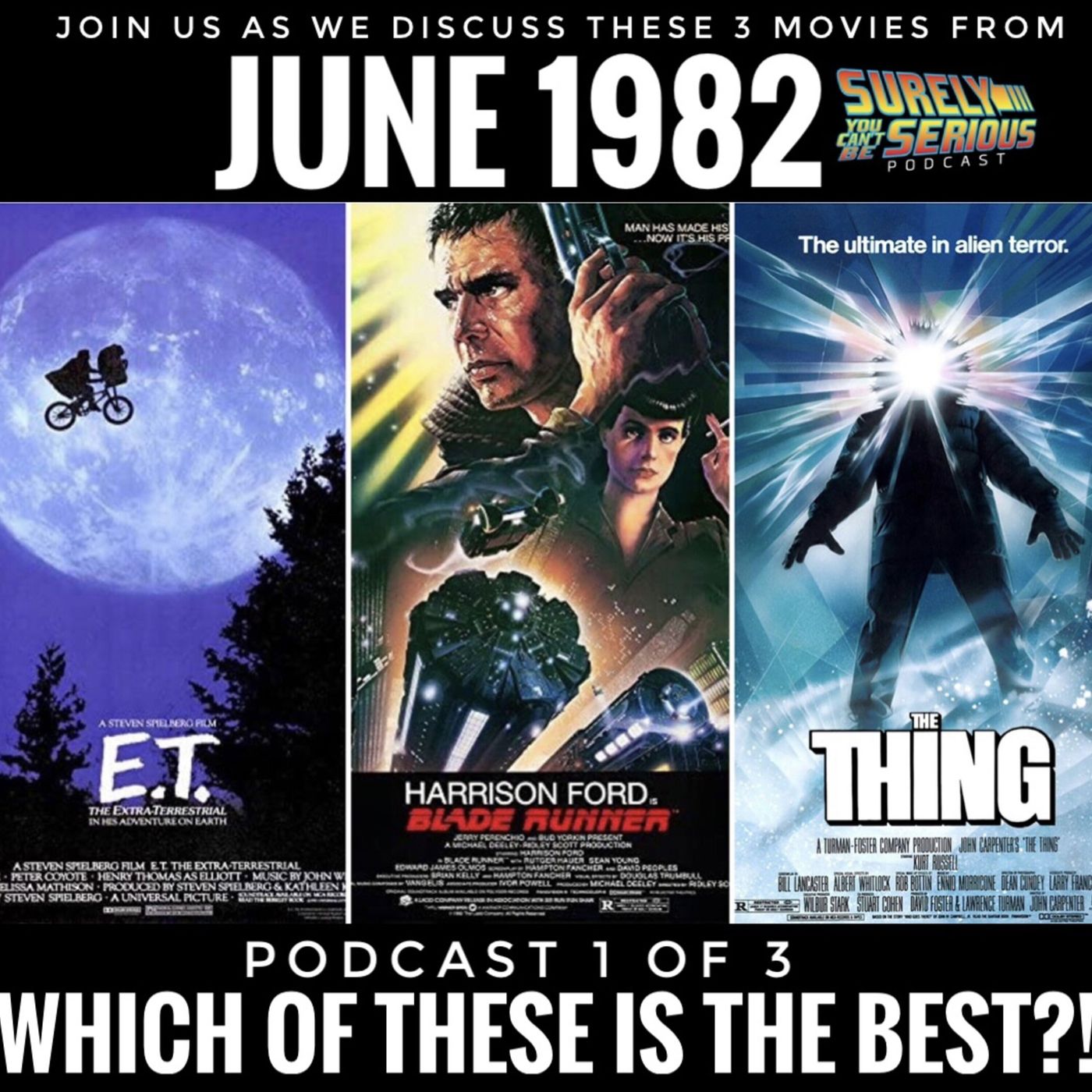
Blade Runner (1982) vs. The Thing (1982) vs. E.T. (1982): Part 1
June of 1982 gave us three of the greatest science fiction movies of the 1980's (and maybe all time)! Ridley Scott's "Blade Runner" and John Carpenter's "The Thing" may have gotten buried at the box office by Steven Spielberg's "E.T." but they have since become appreciated as 80s classics finding their audience through cable and VHS. This episode we deep dive into the origins of these movies telling the stories of how they came to be. We also cover some of the unexpected connections between these films. Grab your flame thrower and join us for the fun!
2022-05-31
49 min
Transcript
Available Results
Generated results are saved to the knowledge database for reuse and search.
No generated results are available for this episode yet.
Extract Knowledge
Pick what you want extracted first. Model, scope, and chapter options appear after a template is selected.
Generated results for public episodes are saved to the knowledge database so they can be reused and searched later.
Transcript
<v Speaker 1>This is a podcast from Minute Media. Hello everybody, and
<v Speaker 1>welcome back to the Shirley You Can't Be Serious podcast
<v Speaker 1>d I've got my Reese's pieces and I've got a
<v Speaker 1>massive flamethrower. I'm ready to go on this episode. That
<v Speaker 1>is great.
<v Speaker 2>I've got my Holy cap. Okay, I just saw some
<v Speaker 2>like glint in your eye. There's a reddish kind of Clint.
<v Speaker 2>I'm gonna need you to donate me some blood to
<v Speaker 2>hear real quick. I gotta do a little checking here,
<v Speaker 2>all right.
<v Speaker 1>Oh, it's all about the eyes. We're gonna talk about
<v Speaker 1>the eyes. We are diving into June of nineteen eighty two.
<v Speaker 1>This is a massive undertaking. We got three movies we're
<v Speaker 1>we'll be talking about.
<v Speaker 2>Let's be clear about this. We do not just have
<v Speaker 2>three movies. We have three of the greatest sci fi
<v Speaker 2>movies of all time. And they were all released within
<v Speaker 2>a week of each other.
<v Speaker 1>It's incredible.
<v Speaker 2>Like Et came out a week later, Blade Runner and
<v Speaker 2>The Thing came out on the same day. So in
<v Speaker 2>a span of eight days, you have three of the
<v Speaker 2>greatest sci fi movies of all time. Nineteen eighty two,
<v Speaker 2>forty years ago this month, before we dive in. Okay,
<v Speaker 2>let's do a quick shout out for a couple of
<v Speaker 2>the folks who have left us an awesome review. Oh yah, yeah,
<v Speaker 2>Hey guys, if you're out there, if you're listening, we
<v Speaker 2>would love it if you visited our Patreon page and
<v Speaker 2>could do a monthly subscription.
<v Speaker 1>That'd be great.
<v Speaker 2>If that is out of your price range or interest,
<v Speaker 2>right now, hit us up and leave us a review
<v Speaker 2>or some stars on your podcast app, and that helps
<v Speaker 2>us tremendously. It gets us in front of other people.
<v Speaker 2>We always have some sort of contest going on as
<v Speaker 2>far as the re reviews are concerned. If you get
<v Speaker 2>picked out of the people who give the reviews, then
<v Speaker 2>we send you a cup. There are a couple of
<v Speaker 2>awesome reviews that we've gotten just in the last few days,
<v Speaker 2>and I don't know who these people are. We have
<v Speaker 2>awesome reviews that, even if they won, we couldn't tell
<v Speaker 2>who to send the cup to. So let me just
<v Speaker 2>say a couple of them real quick.
<v Speaker 1>All right.
<v Speaker 2>So the first one I've got is from the diz Kids.
<v Speaker 2>I don't know who the diz Kids are. We probably
<v Speaker 2>know this person's name, but all we've got on the
<v Speaker 2>review is the diz Kids. So if you are the
<v Speaker 2>diz Kids, hit us up on Twitter, hit us up
<v Speaker 2>on Facebook, and let us know who you are. But
<v Speaker 2>the name of their review was writing checks the podcast
<v Speaker 2>can't catch. The podcast is like a warm hug of
<v Speaker 2>nostalgia every week eighties and nineties movies, music, and pop culture.
<v Speaker 2>If it's time to schedule your first colonoscopy, you'll love
<v Speaker 2>this podcast. I especially recommend the episodes where they go
<v Speaker 2>track by track on Pearl Jam and Nirvana. High quality,
<v Speaker 2>well researched stuff. Thank you the diz Kids.
<v Speaker 1>It's fantastic. Please hit us.
<v Speaker 2>Up on social media and let us know who you are.
<v Speaker 2>We also have another one from somebody known as Real
<v Speaker 2>KD twenty twenty. Again, I don't know who this is,
<v Speaker 2>but I think this is maybe the third awesome review
<v Speaker 2>that they've sent referencing one of our episodes, and we
<v Speaker 2>just got to say, Real KD twenty twenty hit us up,
<v Speaker 2>tell us who you are.
<v Speaker 1>Real KD twenty twenty, thank you so much. You're awesome.
<v Speaker 1>We appreciate you. Here's what Real KD twenty twenty says,
<v Speaker 1>good podcast. I look forward to seeing the movie. Prayers
<v Speaker 1>for Caleb's head and Jason's stones. Thank you very much.
<v Speaker 1>Keep up the great work. Thank you, Real KD twenty twenty.
<v Speaker 1>We appreciate you for everybody who's paying attention. Caleb is
<v Speaker 1>doing much better every day. He actually went to his
<v Speaker 1>last day of school so he could see all of
<v Speaker 1>his friends. So he's doing much much better. And are
<v Speaker 1>all the stones gone? Stones have cleared? I think so?
<v Speaker 2>Congratulations And then we got one on that same day
<v Speaker 2>from cf HB CG N v D. I don't even
<v Speaker 2>know how you pronounced that. There's not even any vowels.
<v Speaker 2>That's catchy right there, right so the Best gen X
<v Speaker 2>Nostalgia pod, hands down the best eighties nineties podcast out there,
<v Speaker 2>fun and incredibly well researched conversations about movies and music,
<v Speaker 2>including tons of great show pitting two classics against each other.
<v Speaker 2>If you're a gen xer or live that era, this
<v Speaker 2>is a must listen. Thank you, cfhbcg NV whoever you are,
<v Speaker 2>Hit us up and let us.
<v Speaker 1>Know, man, that's your real name is? Those are three
<v Speaker 1>awesome reviews. Thank you guys so much for taking the
<v Speaker 1>time to do that. If you like us and you're
<v Speaker 1>listening out there, please give us a five star review
<v Speaker 1>and maybe you'll get a cup out of it.
<v Speaker 2>Yeah, Jason, we have a new executive producer for this episode.
<v Speaker 1>Yeah, this is our good friend, Sissy Johnson.
<v Speaker 2>She's communicated with us on Twitter before. I think right, Yeah,
<v Speaker 2>I think she found us. I think maybe through Duran
<v Speaker 2>Duran episodes. Awesome, Sissy, Thank you so much for your support.
<v Speaker 2>Shirley fans. If you want to help us out, we
<v Speaker 2>put hours of time into each one of these episodes,
<v Speaker 2>both before, during, and after. So if you can see
<v Speaker 2>fit to give us monthly support, we would truly appreciate it.
<v Speaker 2>Just go over to our Patreon page Patreon dot com
<v Speaker 2>slash Shirley Podcast and you can pick any tier that
<v Speaker 2>you like to give us a monthly donation.
<v Speaker 1>Thank you so much, Sissy, We sure appreciate it. You
<v Speaker 1>are the best.
<v Speaker 2>Okay, guys, we are ready to jump back into these
<v Speaker 2>three sci fi movies forty years ago.
<v Speaker 1>They're all turning forty And I was texting with our
<v Speaker 1>buddy Jeff Manzuoka Yes, and he was asking me, He's like,
<v Speaker 1>what's the connection between these three? And I said, well,
<v Speaker 1>they all came out in June of eighty two, and
<v Speaker 1>they're all like all time classics, which for us is enough. Right,
<v Speaker 1>But I've got some really cool connections between these movies
<v Speaker 1>I want to talk about before we dive in.
<v Speaker 2>Okay, first movie that came out was E. T. The
<v Speaker 2>Extraterrestrial by mister Steven Spielberg. Yes, then we had on
<v Speaker 2>the same day we had The Thing by mister John
<v Speaker 2>Carpenter and Blade Runner by mister Ridley Scott. I mean,
<v Speaker 2>talk about big hitting directors of the eighties. All of
<v Speaker 2>these guys were in, they're trying, and they're prime.
<v Speaker 1>The list of these connections, I'm ready to blow your
<v Speaker 1>socks off. You ready for this? Blow online, buddy?
<v Speaker 3>All right?
<v Speaker 1>So Harrison Ford was the lead actor and Blade Runner, right.
<v Speaker 1>He was also at the time married to Melissa Matheson,
<v Speaker 1>who was the writer for et. She wrote Freaking ETEP.
<v Speaker 3>All right.
<v Speaker 1>The last line of dialogue or the sentence of dialogue
<v Speaker 1>from the Thing from Another World, which the Thing is
<v Speaker 1>a remake of, is Watch the Skies. Yes, Watch the
<v Speaker 1>Skies was the working title for E T. Yes, Okay,
<v Speaker 1>I've got a few more connections for you. So The
<v Speaker 1>Thing was made in response to Ridley Scott's Alien movie. Yes,
<v Speaker 1>Alien actually revitalized the thing, gave it life. Okay. One
<v Speaker 1>of the possible choices for McCready in the Thing Peter Coyote,
<v Speaker 1>who plays keys in ET. Yeah. And then one last
<v Speaker 1>thing is gonna blow your mind. Okay, there is a
<v Speaker 1>miniature of Dark Star the ship. Okay, John Carpenter's Dark
<v Speaker 1>Star that can be seen in the background at the
<v Speaker 1>police station. And Blade Runner. Wow, how about that.
<v Speaker 2>That's awesome? All right, Okay, there's more. I'm gonna bounce
<v Speaker 2>back and forth on them. But you've got a cameo
<v Speaker 2>appearance in Et on a deleted scene by one of
<v Speaker 2>those people we've talked about. You have guys that owned
<v Speaker 2>rights to one of the scripts, that had written scripts
<v Speaker 2>for the directors. These movies are interlaced like you wouldn't believe,
<v Speaker 2>and we're gonna hit all kinds of connections as we
<v Speaker 2>go through.
<v Speaker 1>So just a refresh your memory. Movies from June of
<v Speaker 1>eighty two. June of eighty two is really strong. Okay.
<v Speaker 1>The weekend of June fourth you had Poltergeist along with
<v Speaker 1>Star Trek to the Wrath of Kahn. Then June the
<v Speaker 1>eleventh you have of course Et and Greece two. For
<v Speaker 1>you cool riders out there. Then June eighteenth you have
<v Speaker 1>the Clint Eastwood Firefox movie. I don't even remember that one,
<v Speaker 1>but I was freaking pumped up to see that one.
<v Speaker 1>I remember of it, I don't. It was boring into
<v Speaker 1>the last ten minutes, and then d the Top done
<v Speaker 1>in the last ten minutes. And then June twenty fifth
<v Speaker 1>you had Blade Runner, Mega Force and the Thing. Wow,
<v Speaker 1>June of eighty two was great month to be a
<v Speaker 1>movie watching kid. Almost as good as June of eighty one. Almost,
<v Speaker 1>not quite.
<v Speaker 2>Yeah, okay, Jason, We're going to go back to nineteen
<v Speaker 2>thirty when a young eighteen year old kid going to
<v Speaker 2>his first year MIT starts writing science fiction.
<v Speaker 1>Wow, Okay.
<v Speaker 2>This guy's name is John W.
<v Speaker 1>Campbell.
<v Speaker 2>From nineteen thirty to nineteen thirty one, when he's eighteen
<v Speaker 2>years old, he wrote six short stories, six letters, and
<v Speaker 2>one novel for the science fiction magazine Amazing Stories. He
<v Speaker 2>would later become an editor of another science fiction magazine
<v Speaker 2>called Astounding. But this guy, to say that he was
<v Speaker 2>an important force in this world of science fiction is
<v Speaker 2>too much of an understatement. Let me just say this.
<v Speaker 2>The Encyclopedia of Science Fiction said, quote more than any
<v Speaker 2>other individual. He helped to shape modern science fiction. Isaac Asimov said,
<v Speaker 2>he is the most powerful force in science fiction ever.
<v Speaker 2>What this guy is huge? And he decided to start
<v Speaker 2>writing some stories in a different tone. He assumed a
<v Speaker 2>pen name of Don A.
<v Speaker 1>Stewart.
<v Speaker 2>That was the name he used when he wrote a
<v Speaker 2>little story called Who Goes There in nineteen thirty eight.
<v Speaker 2>It is the story that the thing is based on.
<v Speaker 1>Yes, okay?
<v Speaker 4>So?
<v Speaker 1>John W.
<v Speaker 2>Campbell became the editor of Astounding in nineteen thirty seven
<v Speaker 2>and stayed the editor through his death. He helped shape
<v Speaker 2>the careers of the Big three as far as science
<v Speaker 2>fiction goes. Isaac Asimov, Robert Heinlein, remember that name, Robert
<v Speaker 2>Heinlein and Arthur C. Clark, Right, so, Isaac Asimov, I
<v Speaker 2>mean everybody knows who that is, right, sure, okay? Robert
<v Speaker 2>Heinlein Starship Troopers and a ton of other things. He
<v Speaker 2>also shaped the career of Theodore Sturgeon, who did Starship Troopers,
<v Speaker 2>and then of course Arthur C. Clark is two thousand
<v Speaker 2>and one and a million others. Right As the editor
<v Speaker 2>of this magazine. He was a guy who kind of
<v Speaker 2>imposed certain standards upon all of his writers, these guys included,
<v Speaker 2>and that's how he kind of shaped the world of
<v Speaker 2>science fiction. And he started to go in a direction
<v Speaker 2>that was kind of disturbing to these other guys, where
<v Speaker 2>he started investigating parapsychology and ParaScience and pseudoscience and some
<v Speaker 2>of these other things, and that turned off Isaac Asimov
<v Speaker 2>and these other guys. Which is interesting because when we
<v Speaker 2>talked about parapsychology and dan Ackroyd back when we did
<v Speaker 2>our Ghostbusters episode, he was like, you know, if people
<v Speaker 2>would give this sincere scientific study, maybe we could learn
<v Speaker 2>something about these other worldly type of things. And you
<v Speaker 2>also mentioned that while they were filming the movie, there
<v Speaker 2>was a certain resident of New York City who ran
<v Speaker 2>into dan Ackroyd at the time that they were filming
<v Speaker 2>the movie.
<v Speaker 1>Can you remember that. Yeah, So dan akro is like,
<v Speaker 1>holy crap, it's Isaac Asimov. And Isaac Asmov is like,
<v Speaker 1>are you the reason why all this traffic is here?
<v Speaker 1>Dan Ackroyd's like, I guess so, sir, And he's like,
<v Speaker 1>I think it's disgusting. Right.
<v Speaker 2>So Isaac Asimov doesn't like the parapsychology guys right at all?
<v Speaker 2>So what this ultimately ends up happening is John W.
<v Speaker 2>Campbell does befriend a guy who's into these kind of
<v Speaker 2>weird things, and his name is l Ron Hubbard, and.
<v Speaker 1>So John W.
<v Speaker 2>Campbell is a key in the development of what would
<v Speaker 2>become dianetics, the foundational piece of work for scientology.
<v Speaker 1>Wow, you blowing my freaking mind.
<v Speaker 2>Hi, Tom Cruise, great job on Maverick. Okay, So back
<v Speaker 2>to who goes there? So this was produced in nineteen
<v Speaker 2>thirty eight. It is very similar in story to what
<v Speaker 2>we get in the movie The Thing from nineteen eighty two.
<v Speaker 2>But there was another movie called The Thing from Another
<v Speaker 2>World that came out in nineteen fifty one that was
<v Speaker 2>directed by Howard Hawks. Okay, and that one you had
<v Speaker 2>a guy in a costume, right it was.
<v Speaker 1>I watched that movie. Yeah, I watched it. Well, tell
<v Speaker 1>me Tommy, Well, I watched it on YouTube. Okay, it's
<v Speaker 1>free on YouTube. Okay, it's you know, it's a nineteen
<v Speaker 1>fifties science fiction movie. It's a whole lot of you know,
<v Speaker 1>a couple of people grandstanding about you know, creation moving
<v Speaker 1>forward and evolving and the scientists. You know, it goes
<v Speaker 1>a little crazy, but essentially there's a they find a
<v Speaker 1>fling saucer and they accidentally blow it up, but they
<v Speaker 1>rescue one of the alien b from the ice and
<v Speaker 1>the ice melts, and then that guy wakes up and
<v Speaker 1>goes on a rampage and kills everybody, and they managed
<v Speaker 1>to take care of it because he's a plant. Like,
<v Speaker 1>it's a walking plant. Vegetable matter. There you go. Yeah,
<v Speaker 1>and then the guy at the end is like, you know,
<v Speaker 1>watch the Skies. What was what was the last line?
<v Speaker 1>Watch the Skies? Well, that's important. Can you tell me
<v Speaker 1>more about why that would be important because that's the
<v Speaker 1>working title of ET? What yes, tell me more. Yeah. So,
<v Speaker 1>when Steven Spielberg was developing ET, what he was doing
<v Speaker 1>was he was actually writing a sequel to Close Encounters
<v Speaker 1>of the Third Kind, and the studio came to him
<v Speaker 1>and said, hey, listen, we like Close Encounters. We want
<v Speaker 1>to do a sequel. And Steven Spielberg's like, well, they
<v Speaker 1>asked me to do a sequel for Jaws. I didn't
<v Speaker 1>do it. They did it without me and it sucked.
<v Speaker 1>And so I want to be involved. If they're going
<v Speaker 1>to do this, I want to be involved. Yeah, And
<v Speaker 1>so when he wrote the screenplay, for Watch the Skies.
<v Speaker 1>It became it sort of evolved into et.
<v Speaker 2>So you I think we talked about this before. There's
<v Speaker 2>a guy named John Sales involved here, right, yes, And
<v Speaker 2>they didn't keep the name Watch the Skies. It ended
<v Speaker 2>up being something else.
<v Speaker 1>Do you remember this? So Watch the Skies was actually copyrighted,
<v Speaker 1>so he couldn't use Watch the Skies, right, So he
<v Speaker 1>changed it to Night Skies. Yeah, White Skies is great, yes, right,
<v Speaker 1>So he went to Lawrence Kasten and said, Hey, I've
<v Speaker 1>got this idea for this script. I want you to
<v Speaker 1>write it for me. Lawrence Casden said, well, I'm doing
<v Speaker 1>this little project called The Empire Strikes Back, so I'm
<v Speaker 1>a little bit busy right now. So he went to
<v Speaker 1>John Sales, who had written for Joe Dante the spoof
<v Speaker 1>on Jaws called Piranha, which we talked about in Jaws
<v Speaker 1>and in our Grimlins episode. Yes, sir, yes, so he
<v Speaker 1>changed the Night Skies. It's a story about a group
<v Speaker 1>of aliens who terrorize a family. And the aliens there's
<v Speaker 1>like a group of them, like, one was named Scar,
<v Speaker 1>one was named Squirt, one was named Buddy.
<v Speaker 3>Uh huh.
<v Speaker 2>Does this sound familiar to you? This sounds like Grimlins.
<v Speaker 2>So the night Skies became basically ET Grimlins and Poltergeist,
<v Speaker 2>that's right.
<v Speaker 1>Which also came out this year. It came out just
<v Speaker 1>a few weeks prior to ET. Yeah, directed by Toby Hooper,
<v Speaker 1>but really Steven Spielberg supposedly was actually the guy who
<v Speaker 1>directed it, but he was going back and forth between
<v Speaker 1>Poltergeist and ET. Poltergeist is the story of a suburban
<v Speaker 1>nightmare and ET is the story of a suburban dream.
<v Speaker 2>Yep, when we get to casting in a second, I've
<v Speaker 2>got a nice little connection on those two.
<v Speaker 1>Movies as well. Okay, cool.
<v Speaker 2>So jumping back to Who Goes There, I'm going to
<v Speaker 2>tell you something that came about just in the last
<v Speaker 2>few years. There was an expanded manuscript found in twenty
<v Speaker 2>eighteen at Harvard.
<v Speaker 1>John W.
<v Speaker 2>Campbell had donated a bunch of his manuscripts to Harvard,
<v Speaker 2>and somebody was just searching through these old manuscripts and
<v Speaker 2>found like a much larger version of Who Goes There.
<v Speaker 2>They started a Kickstarter campaign to try to get it published.
<v Speaker 2>Their goal was one thousand dollars. They raised one hundred
<v Speaker 2>and fifty five thousand dollars, and so the book was released,
<v Speaker 2>it was called Frozen Hell, the book that in sp
<v Speaker 2>fired The Thing, published twenty nineteen.
<v Speaker 1>That's fantastic. You know. That sounds very similar to the
<v Speaker 1>birth of Blade Runners. We'll get to that here in
<v Speaker 1>just a minute.
<v Speaker 2>I have so much stuff. That's so much stuff, all right,
<v Speaker 2>let's go. Okay, So after the movie The Thing from
<v Speaker 2>Another World, there were a couple of guys, a couple
<v Speaker 2>of screenwriters who had the rights to the story the
<v Speaker 2>original who goes their story right? And those guys' names
<v Speaker 2>were Hal bar Wood and Matthew Robbins. Let me give
<v Speaker 2>you a couple of movies that they wrote, Okay, Dragon's Layer,
<v Speaker 2>Whoa and The Sugarland Express. Are you serious, which, of
<v Speaker 2>course is Steven Spielberg's first movie. Yes, starring Goldie Hawn.
<v Speaker 2>There you go, another connection. Yes, all right. So those
<v Speaker 2>guys had the rights, they passed the Universe. They were like,
<v Speaker 2>we're not going to make this movie. We're not interested
<v Speaker 2>in it. So Universal bought it and David Foster, Lawrence Termann.
<v Speaker 2>We're trying to get a more faithful adaptation of the
<v Speaker 2>novel because in the novel you've got the alien's body
<v Speaker 2>mass that will change. It involves taking over people and dogs.
<v Speaker 2>The dog is killed, it's telepathic. It's all very similar
<v Speaker 2>to what we get in nineteen eighty two as opposed
<v Speaker 2>to what we got in nineteen fifty one, and they
<v Speaker 2>wanted it more like that. They approached John Carpenter in
<v Speaker 2>nineteen seventy six, but Universal chose not to go with
<v Speaker 2>him because he wasn't under contract. He was an independent guy.
<v Speaker 2>And the guy that they hit up was Toby Hooper
<v Speaker 2>because he was under contract, and Toby Hooper.
<v Speaker 1>Is the director of Poltergeist and Texas Chainsaw'm massacre. There
<v Speaker 1>you go.
<v Speaker 2>So they intempted to get others, including John Lannis, but failed,
<v Speaker 2>but it got put on hold right right until a
<v Speaker 2>couple of things happened. Okay, but before I get to
<v Speaker 2>those things, to talk about John Carpenter and Kurt Russell. Okay,
<v Speaker 2>So I'm gonna start with Kurt Russell.
<v Speaker 1>We're gonna draw a little bit everybody's blood. We're going
<v Speaker 1>to find out who's a thing.
<v Speaker 2>So Kurt Russell at fifteen, when he does his first
<v Speaker 2>Disney movie called Follow Me Boys, he's already seasoned actor.
<v Speaker 2>He's been acting for four years at that point. One
<v Speaker 2>of the movies that he was in when he was
<v Speaker 2>twelve years old, was it happened at the World's Fair.
<v Speaker 1>Do you know who's in that? No? Elvis?
<v Speaker 2>Oh yeah, And so at some point Kurt Russell shows
<v Speaker 2>up and kicks Elvis in the shin.
<v Speaker 1>Okay. So then he goes to Disney.
<v Speaker 2>Between sixty six and seventy five, he had a big
<v Speaker 2>career with Disney, Computer War, Tennis Shoes, Strongestman, with all
<v Speaker 2>these amazing Disney movies. And after nine years and nine movies,
<v Speaker 2>he was ready to be done, right, ready to be
<v Speaker 2>done with Disney. So in nineteen seventy four, the last
<v Speaker 2>movie that he does with Disney is The Strongest Man
<v Speaker 2>in the World. In the same year, he plays Charles Whitman,
<v Speaker 2>the sniper killer in the movie The Deadly Tower.
<v Speaker 1>Wow.
<v Speaker 2>I mean talk about let's burn this image to the
<v Speaker 2>ground seriously, right, So that's his objective. I am you know,
<v Speaker 2>I've been the Disney kid for nine years now, I
<v Speaker 2>want to do something completely different. Well, enter John Carpenter.
<v Speaker 2>Now John Carpenter we talked about in our Aliens episode,
<v Speaker 2>because John Carpenter went to school with this guy named
<v Speaker 2>Dan O'Bannon and they worked together on John Carpenter's student
<v Speaker 2>movie called dark.
<v Speaker 1>Star, which is also coincidentally the name of the plane
<v Speaker 1>that Tom Cruise flies and Tom gun Maverick.
<v Speaker 2>Yes, and I think that I think the movie had
<v Speaker 2>to have inspired the plane. Right, Those guys Lockheed Martin
<v Speaker 2>have to be John Carpenter fans.
<v Speaker 1>I believe it. So you can go.
<v Speaker 2>Back and listen to that episode, but you'll have to
<v Speaker 2>remember that Dan O'Bannon and John Carpenter had a falling out.
<v Speaker 2>Dan O'Bannon ended up doing a big project with a
<v Speaker 2>guy that didn't come through called Dune.
<v Speaker 1>Remember this, Yes, flew.
<v Speaker 2>Out to Europe, project fell through, he lost all his money.
<v Speaker 2>He came back and was sleeping on the couch and
<v Speaker 2>that's when he wrote the movie Alien right.
<v Speaker 1>Yep.
<v Speaker 2>The reason that he got the job was because Alejandro
<v Speaker 2>Jeordowski was making Doune. So Alejandro Hordawaski had gone to
<v Speaker 2>talk to this guy named Douglas Trumbull who was the
<v Speaker 2>special effects guy to talk to and Douglas Trumbull said, Hey,
<v Speaker 2>this is the way that we are going to do things,
<v Speaker 2>and Hordwaski was like, I don't want to do it.
<v Speaker 2>That way, and Douglas Trumble was like, well tough, that's
<v Speaker 2>the way it's going.
<v Speaker 1>To be, or I'm not going to do it.
<v Speaker 2>He's like, well then I don't want you. And then
<v Speaker 2>they went and saw this movie at the theater called
<v Speaker 2>Dark Star, and he said, who's the special effects guy
<v Speaker 2>for this movie? It was Dan O'Bannon, who, of course
<v Speaker 2>then became the guy who wrote Alien, which was directed
<v Speaker 2>by Ridley Scott worked closely with him. Ridley Scott, of
<v Speaker 2>course is the guy who directed Blade Runner, who had
<v Speaker 2>the most amazing set design that was made by Douglas Trumble.
<v Speaker 1>Wow, how about that?
<v Speaker 2>So Douglas Trumbule just passed away in February, God rest
<v Speaker 2>his soul. We had a couple of guys who are
<v Speaker 2>involved in these things who have just recently passed away.
<v Speaker 2>But Douglas Trumbull is a and icon as far as
<v Speaker 2>visual effects goes.
<v Speaker 1>But there you go.
<v Speaker 2>Another connection, hey, by the way, just a little connection, Okay?
<v Speaker 1>Yeah. Ridley Scott also directed Gladiator, which we paired up
<v Speaker 1>against Braveheart in one of our earliest episodes, Yes, which
<v Speaker 1>you were way wrong in whatever. That was one of
<v Speaker 1>the few episodes we really disagreed in.
<v Speaker 2>Yes, so, after John Carpenter has done Dark Star, he
<v Speaker 2>starts doing some of these other kind of low budget
<v Speaker 2>horror movies. One is called Assault on Precinct thirteen, which
<v Speaker 2>is a retelling of the Rio Bravo movie Yep. And
<v Speaker 2>he realizes that there's a lot of work and a
<v Speaker 2>lot of money to be made in TV movies at
<v Speaker 2>the time, does another couple of horror movies, and then
<v Speaker 2>he does this bio pic on Elvis. Yes, and guess
<v Speaker 2>who plays Elvis, Kurt Russell.
<v Speaker 1>You want to be able to walk around and see things,
<v Speaker 1>all the mobs of people, you know, just just be
<v Speaker 1>pre just be playing little old media instead of the inning.
<v Speaker 2>Same guy who at twelve years old kicked Elvis in
<v Speaker 2>the shin is now playing Elvis in the biopic in
<v Speaker 2>nineteen seventy nine, directed by John Carpenter, And that is
<v Speaker 2>where these two get together and fall in love.
<v Speaker 1>By the way, one of the little horror movies that
<v Speaker 1>you kind of skimmed over there, Yeah, Halloween, one of
<v Speaker 1>the most profitable movies of all time.
<v Speaker 2>Yes, so nineteen seventy nine is when this biopick came out.
<v Speaker 2>Nineteen seventy nine. Us of course, when Alien came out, yes,
<v Speaker 2>And also, of course John Carpenter had Halloween.
<v Speaker 1>Yes.
<v Speaker 2>So those are the two colossal events that wake up
<v Speaker 2>universal to say, hey, maybe we should go ahead and
<v Speaker 2>remake the thing to trust.
<v Speaker 4>I know what you mean, Blair, Trust a tough thing
<v Speaker 4>to come by these days.
<v Speaker 1>Tell you why why don't you just trust in the Lord?
<v Speaker 1>Bang on? Good job, nailed it.
<v Speaker 2>So they go back to John Carpenter, and he didn't
<v Speaker 2>think that he could do it better than Howard Hawk
<v Speaker 2>had done it. It was a movie that he had loved
<v Speaker 2>since the time he was a kid, but he hadn't
<v Speaker 2>really ever read the book. And so he reads the
<v Speaker 2>novella and he's like, you know what, this isn't the
<v Speaker 2>same as the movie. This is more like an Agatha
<v Speaker 2>Christie like and then there were none It really is
<v Speaker 2>like and then there were none. Yes, And so he's like, huh,
<v Speaker 2>I think I can do something different with this. I mean,
<v Speaker 2>just let me be clear on this. Howard Hawks was
<v Speaker 2>like a huge influence on John Carpenter. He was scared
<v Speaker 2>to do this movie. If you watch Halloween, you can
<v Speaker 2>see that it is an homage to Howard Hawks in
<v Speaker 2>the way that he did stuff and so they said,
<v Speaker 2>John Carpenter, we really want you to do this. Once
<v Speaker 2>he read it, he was like, I think I can
<v Speaker 2>do this in a different way. But they needed a script.
<v Speaker 2>They approached several different writers, one of which was Richard Matheson,
<v Speaker 2>who was, of course the father of Chris Matheson.
<v Speaker 1>Who wrote Freaking Bill and Ted Excellent Adventure.
<v Speaker 2>Yes, and Richard Matheson is the guy that said, hey,
<v Speaker 2>you should do a time travel movie based on your
<v Speaker 2>short story.
<v Speaker 1>Richard Mathson wrote, I am legend. I mean it's a
<v Speaker 1>big deal. He's a big deal.
<v Speaker 3>Right.
<v Speaker 2>He didn't do it, But there was a of a
<v Speaker 2>famous actor that was in descript writing and they approached him,
<v Speaker 2>and his name was Bill Lancaster, son of the famous
<v Speaker 2>Bert Lancaster incredible. When they approached him, he said, I
<v Speaker 2>want to keep this close to the novella, and they said,
<v Speaker 2>that's what we want.
<v Speaker 1>Now.
<v Speaker 2>In this script, you don't really see the monster. They
<v Speaker 2>played the Jaws card where they kept the monster brilliant hidden.
<v Speaker 2>But there's a guy named Rob Boteen who they had
<v Speaker 2>approached about doing the special effects in this movie, who said,
<v Speaker 2>I really think we should see the monster more often
<v Speaker 2>and that's why you got it in there as often
<v Speaker 2>as you do.
<v Speaker 1>By the way, every time you see the monster, you're
<v Speaker 1>gonna crap your pants because it's so freaking scary.
<v Speaker 2>This is one of the best special effects movies of
<v Speaker 2>all time, and one of the movies that John Carpenter
<v Speaker 2>had done in this time period between you know, hey,
<v Speaker 2>we want you to do the movie and the movie
<v Speaker 2>coming out. It was a movie called The Fog. Yeah,
<v Speaker 2>And so this young I think twenty or twenty one
<v Speaker 2>year old kid is like, Oh, John Carpenter, I want
<v Speaker 2>to go meet him. He's over on the lot. He's
<v Speaker 2>doing some work with a special effects guy named Rick Baker.
<v Speaker 1>Who you might have heard of Rick Baker.
<v Speaker 2>Yeah, and so he's like, oh, I want to go
<v Speaker 2>meet him.
<v Speaker 1>And he's like gets in.
<v Speaker 2>He's like, okay, so the movies he you're doing is
<v Speaker 2>what the Fog?
<v Speaker 1>Oh? Can I be in it?
<v Speaker 2>And he says that John Carpenter's like stand up, and
<v Speaker 2>he's like he thinks he's going to say stand up
<v Speaker 2>and get out, and he's like, turn around, Okay, I
<v Speaker 2>got a part for you. You need to be here
<v Speaker 2>tomorrow morning. You need to wear this, you need to
<v Speaker 2>learn these lines. I mean so so Rob Botein first
<v Speaker 2>working with John Carpenter as an actor in the Fog.
<v Speaker 1>Wow.
<v Speaker 2>Now, of course we know from our American Werewolf in
<v Speaker 2>London versus The Howling that Robotein worked again with Rick
<v Speaker 2>Baker initially on the Howling. But then John Landis called
<v Speaker 2>Rick Baker and he's like, what are you doing? I've
<v Speaker 2>got a werewolf movie. Wait? Yeah, I mean John Landis
<v Speaker 2>is the reason that Rick Baker is a household name. Sure, right,
<v Speaker 2>So Rick Baker leaves to go do American Werewolf in London.
<v Speaker 2>He leaves Rob Botein in charge of the special effects
<v Speaker 2>for the Howling, which of course are monumental at time.
<v Speaker 2>And so then when we get to the thing, Robboteen
<v Speaker 2>is the man for the plan.
<v Speaker 1>The effects in the Thing are so graphic and shocking
<v Speaker 1>that the press accused John Carpenter of being a pornographer
<v Speaker 1>of violence.
<v Speaker 3>Right.
<v Speaker 1>Yeah. We even did a little a little presentation a
<v Speaker 1>live show. Oh yeah, that's right last fall, and we
<v Speaker 1>presented some of the scariest movies in cinema. And one
<v Speaker 1>of those moments was when the.
<v Speaker 2>When opens up and the arms come off. Oh my gosh,
<v Speaker 2>so incredible. We'll talk about special effects in a little
<v Speaker 2>more detail a little bit later on. Okay, so we've
<v Speaker 2>got our director, we've got our script by mister Bill Lancaster,
<v Speaker 2>we've got our special effects guy.
<v Speaker 1>And it's time to start going.
<v Speaker 2>Yes, okay, okay, So that's the beginning of the thing.
<v Speaker 1>Yep. Now we've got to talk about the beginning of later.
<v Speaker 3>Wake Up, trying to die.
<v Speaker 2>Okay, all right, so once again we're going back in time.
<v Speaker 2>We are going to talk about sci fi writers. This
<v Speaker 2>guy's a little bit younger.
<v Speaker 1>His name is Philip Kindred Dick, mister phild K Dick.
<v Speaker 2>Philip K. Dick, an unfortunate name. Born a twin Oh
<v Speaker 2>really yeah, had a twin sister. She died in infancy.
<v Speaker 2>That's why you will see a lot of twinless twins
<v Speaker 2>in his works.
<v Speaker 1>Interesting. He said it had a.
<v Speaker 2>Profound effect on him, even though he's only six weeks old.
<v Speaker 2>It's a big condition, like there are organizations that are
<v Speaker 2>the twinless twins organizations. So it was profound on his life.
<v Speaker 2>But I don't need to get into all that. What
<v Speaker 2>you need to know is that he also was a
<v Speaker 2>young science fiction writer. He wrote other more mainstream stuff,
<v Speaker 2>but it was unsuccessful and he really was never truly
<v Speaker 2>appreciated during his lifetime.
<v Speaker 1>Okay, So Phil K.
<v Speaker 2>Dick started writing in nineteen fifty two and wrote for
<v Speaker 2>nearly ten years without any real success. His stuff would
<v Speaker 2>get submitted to the science fiction magazines. My guess is
<v Speaker 2>probably John W. Campbell read some of his stuff and
<v Speaker 2>rejected it. But in nineteen sixty two he came out
<v Speaker 2>with a novel called The Man in the High Castle. Yes,
<v Speaker 2>have you watched this on showtime?
<v Speaker 1>Or I have not seen a series? Okay. I read
<v Speaker 1>this book a long time ago, and it's basically what
<v Speaker 1>would have happened if Germany had won World War Two?
<v Speaker 1>And that premise alone is just fascinating.
<v Speaker 2>I haven't read the book, but as I understand that,
<v Speaker 2>there's actually a book within the book that is what
<v Speaker 2>would have happened if the Allies had won World War Two?
<v Speaker 1>Yeah, which is kind of.
<v Speaker 2>I mean, that's crazy. That is some deep weird stuff.
<v Speaker 2>I can say that going down the Phillip Dick Hole,
<v Speaker 2>if you will, is a world of crazy beyond your
<v Speaker 2>normal crazy.
<v Speaker 1>It's upper level, super highly intelligent stuff. It can get
<v Speaker 1>over your head in a hurry.
<v Speaker 2>He just as a quick glim of his life. He
<v Speaker 2>didn't have a lot of financial success despite the really
<v Speaker 2>famous works that he's done. I mean, we're talking about
<v Speaker 2>a guy who was the inspiration for his stories, were
<v Speaker 2>the inspiration for mann in Height, Castle, Minority Report, Blade Runner,
<v Speaker 2>Total Recall. I mean, this is huge, right, it's huge.
<v Speaker 2>But he was a weird, kind of messed up dude.
<v Speaker 2>I sent you a video today of him talking about
<v Speaker 2>a real life experience that he had that sounded like
<v Speaker 2>the inspiration for the Matrix like where he was talking
<v Speaker 2>about how he met this woman that had delivered something
<v Speaker 2>to him after he'd had a tooth extracted and he
<v Speaker 2>was still under the effects of the sodium pentahal and
<v Speaker 2>he thought she was like some sort of angel. She
<v Speaker 2>had an Ickc's necklace that he was like, what is that?
<v Speaker 1>Fish? What is that?
<v Speaker 2>And this guy, who was never Christian in his life,
<v Speaker 2>suddenly after meeting this woman's believed he was living two
<v Speaker 2>parallel lives. One is Philip K. Dick and the other
<v Speaker 2>is a man named Thomas who was alive during the
<v Speaker 2>events of Acts in the Bible, which he said he
<v Speaker 2>had never read, and one of his books is based
<v Speaker 2>upon that experience.
<v Speaker 1>He's a strange dude.
<v Speaker 2>He's definitely a strange dude, and not being a financial success,
<v Speaker 2>so he.
<v Speaker 1>Was in trouble with the irs, right. Yeah.
<v Speaker 2>In one of the dedications in his books, he dedicated
<v Speaker 2>to a guy who helped him out when he needed
<v Speaker 2>help paying off the irs, that guy who had never
<v Speaker 2>met just a guy who's liked his work and wanted
<v Speaker 2>to help him.
<v Speaker 1>Yeah, Robert Heinlein, really yes, the science fiction right now?
<v Speaker 4>Yes? What?
<v Speaker 1>Yeah, So there.
<v Speaker 2>You go, and again another looping connection. Ultimately, Philip K.
<v Speaker 2>Dick would win the John W. Campbell Science Fiction Award.
<v Speaker 1>It's just it's crazy, the overlap that we have in
<v Speaker 1>all of these things. Insane.
<v Speaker 2>And so you mentioned to me that while he was
<v Speaker 2>studying on The Man in the High Castle, he came
<v Speaker 2>across some stuff which led to the development of another story.
<v Speaker 1>Right. So he would he would go to the library
<v Speaker 1>at cal Berkeley and just read like the dark hallway journals,
<v Speaker 1>like the back corner stuff, right right, the stuff that
<v Speaker 1>nobody he reads. He's back there reading and he came
<v Speaker 1>across a bunch of journals from World War Two and
<v Speaker 1>it was Nazi journals, right, and so he's thinking about
<v Speaker 1>the man in the High Castle. So he's reading through
<v Speaker 1>these Nazi journals and he reads this one guy's journal
<v Speaker 1>and it says, we can't sleep because these stupid children
<v Speaker 1>who are starving keep crying. And Phil k Dick is like,
<v Speaker 1>this person who wrote these words cannot be human. It's
<v Speaker 1>not possible. You cannot listen to starving children cry and
<v Speaker 1>be upset that you can't sleep. That's not human behavior.
<v Speaker 1>There's something wrong with this person. Therefore he has to
<v Speaker 1>be an android. He legitimately believed this. Yes, he legitimately
<v Speaker 1>believed this person is not human, right, and so that
<v Speaker 1>led him to the story we know as do Android's
<v Speaker 1>Dream of Electric Sheep.
<v Speaker 2>Which of course was the inspiration for our movie Blater Runner. Yep,
<v Speaker 2>So tell you about another guy real quick. His name
<v Speaker 2>is Hampton Fancher. Hampton Fancher, at age fifteen, ran away
<v Speaker 2>to Spain to become a Flamenco dancer and renamed himself
<v Speaker 2>Mario Montejo.
<v Speaker 1>I did not know that. Why would you? Why would
<v Speaker 1>you know that?
<v Speaker 3>Right?
<v Speaker 1>So there's good job.
<v Speaker 2>There is a deep dive on Hampton Vancher.
<v Speaker 1>So, Henny Vancher's the screenwriter for Blade Run Right.
<v Speaker 2>So he had a job as an actor in westerns
<v Speaker 2>and Troy Donahue movies, The.
<v Speaker 1>Guy Who's named Jacked in Greece and in The Godfather yep.
<v Speaker 2>And by the way, he also had a couple of
<v Speaker 2>relationships with some hotties, one of which was Barbara Hershey.
<v Speaker 2>The other was Terry Garr.
<v Speaker 4>What mackers, thank you doctor, Let's go dude.
<v Speaker 2>Yeah, he's he's kind of rocking and rolling it. But
<v Speaker 2>around nineteen seventy seven he's like, you know what, I
<v Speaker 2>think I'd like to do some screenwriting, and that's what
<v Speaker 2>he decides he's going to do as a full time job.
<v Speaker 2>So he starts trying to option do Android's Dream of
<v Speaker 2>Electric Sheep in nineteen seventy five. Okay, and Philip k
<v Speaker 2>is like, I don't know who you are. I'm not
<v Speaker 2>gonna let you make a movie. No, And so Fancher
<v Speaker 2>goes to his buddy named Brian Kelly. Now, Brian Kelly,
<v Speaker 2>you will know as the dad from Flipper.
<v Speaker 1>Yeah.
<v Speaker 2>Yeah, So Brian Kelly had been involved in a motorcycle
<v Speaker 2>accident before he was about to make a movie. It
<v Speaker 2>left his right arm and leg paralyzed. He sued he
<v Speaker 2>didn't get to be in the movie because he's lost
<v Speaker 2>movement on that side of his body. So he sued,
<v Speaker 2>he got a settlement, and with that he started building
<v Speaker 2>homes and producing movies really, and so Fancher' is like, hey, Brian,
<v Speaker 2>I really want to make this movie.
<v Speaker 1>Can you help me out?
<v Speaker 2>When Brian Kelly goes, Philip Dick agrees, and Frantire gets
<v Speaker 2>brought on to write the screenplay. Now, ultimately, Kelly would
<v Speaker 2>later enlist the support of Michael Deeley, who wrote The
<v Speaker 2>Deer Hunter. Yes, and they made Fancher an executive producer,
<v Speaker 2>and he was obviously still largely involved, but he is
<v Speaker 2>kind of the catalyst that brought this book into movie world, right,
<v Speaker 2>But he as executive producer ended up having a ton
<v Speaker 2>of disagreements with Ridley Scott. And Ridley Scott even brought
<v Speaker 2>on his own guy named David Peeples, who you will
<v Speaker 2>know from writing The Unforgiven and Twelve Monkeys and rework
<v Speaker 2>the script. And rework the script. Now we're going to
<v Speaker 2>talk about the big question of Blade Runner, right, the
<v Speaker 2>big the big question where Ridley Scott is on one
<v Speaker 2>side and Fancher is on the other side on this one. Right,
<v Speaker 2>So you've got the guy who wrote the original script
<v Speaker 2>and the guy who directed the movie and they say
<v Speaker 2>opposing things.
<v Speaker 1>Yeah, it's interesting. So and Harrison Ford with Fancher as well. Yeah,
<v Speaker 1>by the way, Fancher and Peoples. When Ridley Scott brought
<v Speaker 1>in Peoples to help out with the screenplay, Fancher's like, you,
<v Speaker 1>f you and f you. I don't need this fan project.
<v Speaker 1>And he really got his feelings hurt. And so when
<v Speaker 1>Will Peoples met him, he was like, Hey, we kind
<v Speaker 1>of need to talk through, you know, some stuff, and
<v Speaker 1>he's like, I really did not expect to like this
<v Speaker 1>guy at all. And they became like best. Oh that's awesome.
<v Speaker 1>You know that is awesome. Yeah.
<v Speaker 2>Apparently Fancher when he would try to rewrite, he was
<v Speaker 2>so slow that the production crew would call him happen faster.
<v Speaker 1>Okay, do you know where the name blade Reunner comes from?
<v Speaker 1>Tell me Okay. The title comes from a book by
<v Speaker 1>a guy named Alan Norse, and he wrote a book
<v Speaker 1>called The Blade Runner, and this is about someone who
<v Speaker 1>sells illegal surgical instruments on the black market. Yeah. Really,
<v Speaker 1>Scott's like, that's a really cool name. A whole lot
<v Speaker 1>better than Do Androids Dream of Electric Sheep? And so
<v Speaker 1>he optioned the title from that guy and it became
<v Speaker 1>Blade Runner. Now listen to this. So here's the names
<v Speaker 1>considered for Blade Runner. Okay, so do Androids Dream of
<v Speaker 1>Electric Sheep not a great movie title. So he thought
<v Speaker 1>about Android Macanismo that sucks dangerous days? Okay, okay, how
<v Speaker 1>about this one? Really? Scott said, hey, how about we
<v Speaker 1>call it Gotham City.
<v Speaker 3>Wow.
<v Speaker 1>Bob Kane is like, nope, yeah, not happening. Yeah, right,
<v Speaker 1>So that's when he bought the title from the book
<v Speaker 1>and called it Blade Runner.
<v Speaker 2>So the name blade Runner literally has nothing to do
<v Speaker 2>with the original story. It is a completely unrelated.
<v Speaker 1>Story, right. Yeah.
<v Speaker 2>And they didn't want the title do Androids Dream of
<v Speaker 2>Electric Sheet because that's way too freaking long. But not
<v Speaker 2>only did they not want it, the word android became
<v Speaker 2>a you're not allowed to say this word. On the
<v Speaker 2>set of the movie, like Ridley Scott said, we had
<v Speaker 2>a few impermissible words, and one of them is android.
<v Speaker 2>If you said that word, you get a baseball back
<v Speaker 2>to the head.
<v Speaker 1>Not literally. That's interesting. Well, I do know that the
<v Speaker 1>word that they added in his place was replicant. Yeah,
<v Speaker 1>I mean Star Wars was huge and r g D
<v Speaker 1>two and c threepo are droids, yep androids?
<v Speaker 2>Yeah, you know, he considered the misuse of the term
<v Speaker 2>android and what had gone on with it in the past,
<v Speaker 2>and he was like, I don't want that for this
<v Speaker 2>group of people that we have, these pseudo humans that
<v Speaker 2>we have.
<v Speaker 1>We need a different name for him.
<v Speaker 2>So replicants and if you're less formal skin.
<v Speaker 1>Jobs, that's good.
<v Speaker 2>So we've got Ridley Scott who has just done Alien,
<v Speaker 2>which is what allowed the thing to be greenlit. Yes,
<v Speaker 2>we've got a script that has been worked and reworked
<v Speaker 2>based on a book by a guy whose Looney Tunes
<v Speaker 2>as can be. Yes, And so how do we get
<v Speaker 2>to et from here?
<v Speaker 1>How do we get to et from here? Good? Be
<v Speaker 1>good time?
<v Speaker 2>That too, Okay, So here's something that's interesting to me.
<v Speaker 4>Right.
<v Speaker 2>So when they cast Blade Runner, yes, Indiana Jones was
<v Speaker 2>not a name that anybody knew. Yes, isn't that crazy?
<v Speaker 2>Because when I watched this movie the first time, I
<v Speaker 2>was like, I can see how people who had just
<v Speaker 2>seen Raiders of the Lost Arc would have been extremely
<v Speaker 2>disappointed with Blade Runner because it's an entire like he's
<v Speaker 2>not He's not Indy at all, right, and he's not
<v Speaker 2>Han Solo, right. But at the time time they cast him,
<v Speaker 2>nobody knew who Indy was. Harrison Ford was just doing
<v Speaker 2>well right, yes, And so just before he had filmed
<v Speaker 2>this movie, he filmed that movie, he filmed Raiders of
<v Speaker 2>the Lost Dark. And while they were filming Raiders of
<v Speaker 2>the Lost Dark, he had his wife with him. She
<v Speaker 2>was friends with Steven Spielberg. Steven Spielberg is out in
<v Speaker 2>the desert looking at old seashells because he said it
<v Speaker 2>used to all be ocean, right, And he's talking to
<v Speaker 2>this wife of Harrison Ford named Melissa Mathieson. Yes, and
<v Speaker 2>he says, I've had this idea since I was a
<v Speaker 2>little kid, and I would love for you to help
<v Speaker 2>me out with.
<v Speaker 1>The fact alone that et is birthed in Tunisia while
<v Speaker 1>they're shooting my favorite movie of all time. Has anyone
<v Speaker 1>had two bigger movies back to back like that?
<v Speaker 2>Well, keep in mind, Alien became a movie because of
<v Speaker 2>Star Wars. Raiders of the Lost Arc became a movie
<v Speaker 2>because Steven Spielberg and George Lucas were building a sand
<v Speaker 2>castle on the beach in Hawaii, yep, just after Star
<v Speaker 2>Wars had been released, and Steven Spielberg said, I'd really
<v Speaker 2>liked to direct a James Bond movie, and George Lucas said,
<v Speaker 2>don't do that. I've got a better idea direct my
<v Speaker 2>movie instead, and that became Raiders of the Lost Ark.
<v Speaker 1>It's incredible, right, incredible. By the way, Harrison Ford when
<v Speaker 1>he auditioned for the part of Rick Deckard in Blade Runner,
<v Speaker 1>he showed up with a fedora and a leather jacket
<v Speaker 1>straight from the set of Raiders of Lost Ark. And really,
<v Speaker 1>Scott's like, huh, you're doing this little project with George
<v Speaker 1>Lucas and Steven Spielberg. I guess maybe we should take
<v Speaker 1>you seriously. So Steven Spielberg wanted to do a story
<v Speaker 1>about a boy and an alien. He also wanted to
<v Speaker 1>do a story about divorce. He had experienced divorce when
<v Speaker 1>he was fifteen. His father left the family and it
<v Speaker 1>was him and his two younger sisters, I believe, and
<v Speaker 1>it had a profound impact on his family and he
<v Speaker 1>fell alone and sad. And so it just so happened
<v Speaker 1>that these two projects coincided, and it's fascinating too, because
<v Speaker 1>he's like, I don't really care about this being commercial.
<v Speaker 1>This is a project I want to do. I don't
<v Speaker 1>know if people like it. It's kind of like a
<v Speaker 1>Disney movie. It was his small movie, like he considered
<v Speaker 1>it his small movie. And if you think about it,
<v Speaker 1>it really is. I mean it all takes place in
<v Speaker 1>the suburbs and the woods. You're not on the.
<v Speaker 2>Deck of a starship, that's right. You are not in
<v Speaker 2>deepest darkest Africa or in the deserts of the Middle East.
<v Speaker 2>I mean it's at a little kid's house, right, that's it.
<v Speaker 1>Yes.
<v Speaker 2>So we mentioned before in her Godfather episode that George
<v Speaker 2>Lucas was partners with a guy in their first production studio,
<v Speaker 2>and that guy was Francis Ford Coppola. Yes, well, Francis
<v Speaker 2>Ford Coppola. After he made The Godfather, he made a
<v Speaker 2>little movie called The Black Stallion.
<v Speaker 1>Yeah.
<v Speaker 2>You know who helped him write that script, Melissa Matheson.
<v Speaker 2>Melissa Matheson, You've got a boy who finds an animal,
<v Speaker 2>befriends it, falls in love with it, and ultimately the
<v Speaker 2>story revolves around that relationship.
<v Speaker 1>Right. That's fascinating.
<v Speaker 2>And so when Steven Spielberg is in the desert looking
<v Speaker 2>for seashells. Talking to Melissa Matheson, He's like, I really
<v Speaker 2>loved what you did with Francis on the Black Stallion.
<v Speaker 2>I've got this idea for a story where a boy
<v Speaker 2>finds an alien.
<v Speaker 1>I will love you for you to write it. Maybe
<v Speaker 1>an el for Leprechawn.
<v Speaker 2>There's nothing like that, Penis Bla Elliot and she says no, really, yeah,
<v Speaker 2>she said no. She's like, no, I don't really, I'm
<v Speaker 2>not interested in doing that. And so Spielberg, after Raiders,
<v Speaker 2>tries to write it. He and Kathleen Kennedy worked together
<v Speaker 2>to try to write it. They're not getting anywhere with it,
<v Speaker 2>and so finally they just pressure and pressure on Alyssa Matheson,
<v Speaker 2>and finally she relents. She's like, okay, I will write
<v Speaker 2>it for you, and so she spends eight weeks eight
<v Speaker 2>weeks writing the first draft. She sends him the first draft.
<v Speaker 2>After he reads it, he runs into Kathleen Kennedy and said,
<v Speaker 2>this is it. This is the script. We don't need
<v Speaker 2>to do any rewrites. This is the script. We will shoot.
<v Speaker 2>It is shoot script ready. That never happens, That never happens.
<v Speaker 2>I mean we're talking about two months. Last than two months,
<v Speaker 2>she writes what essentially is the entire movie of ET
<v Speaker 2>the Extraterrestrial.
<v Speaker 1>That's unbelievable. I love it. That's a great story. By
<v Speaker 1>the way, we did mention this. Melissa Matheson married to
<v Speaker 1>Harrison Ford. Yeah, she's not the Hollywood glamorous woman that
<v Speaker 1>you might think, not at all.
<v Speaker 2>And I remember when I looked at her the first
<v Speaker 2>time and I was like wow. I mean, Harrison Ford
<v Speaker 2>is regarded as, you know, Hollywood handsome, you know, big
<v Speaker 2>time leading man, and she's not, like you said, not
<v Speaker 2>classically beautiful Hollywood style. But I got to watch a
<v Speaker 2>lot of them behind the scenes stuff because she was
<v Speaker 2>always on set. The rewrites that they did, they would
<v Speaker 2>do as they were shooting the movie, and she was
<v Speaker 2>there and talking to the kids the whole time. I mean,
<v Speaker 2>she grew up raising Harrison's kids and had kids of
<v Speaker 2>her own and babysat kids and said all of those
<v Speaker 2>conversations that she would overhear became a part of the script.
<v Speaker 2>But as I watched her talk to these kids, she
<v Speaker 2>has an infectious smile and personality. I can see how
<v Speaker 2>anybody could fall in love with her.
<v Speaker 1>That's great. I saw those two and after you had
<v Speaker 1>said that to me, we were talking on the phone
<v Speaker 1>and I watched them behind the scenes with ETM like, totally,
<v Speaker 1>she's wonderful. Yeah, she just she beams joy. Yeah, which
<v Speaker 1>is oddly enough, Harrison Ford does not beam joy.
<v Speaker 2>No, but that's typically the way those marriages go, right,
<v Speaker 2>you know, you get the joy for one and you
<v Speaker 2>got the old grump.
<v Speaker 1>So Steven Spielberg takes that screenplay and goes to Columbia
<v Speaker 1>and says, hey, I've got a screenplay I want to do.
<v Speaker 1>It's about a boy and an alien. You're gonna love it.
<v Speaker 1>It's great. They look at it and they're like, I
<v Speaker 1>think we're going to pass on this one. There's another
<v Speaker 1>movie we're going to do instead, called Starman by John Carpenter. Yeah. Right, yeah,
<v Speaker 1>that came out in eighty four. But they said, listen,
<v Speaker 1>we're not going to stop you from making this. We'll
<v Speaker 1>give it back to you. So he goes to Sid
<v Speaker 1>Sheinberg at Universal, his mentor, the mentor, the guy who
<v Speaker 1>he did Jaws with, guy who hired him to be
<v Speaker 1>their full time director at the youngest age of any director. Yes, yeah,
<v Speaker 1>Sid Sheinberg, who also goes on to do jos for
<v Speaker 1>which we'll talk about here in just a few weeks.
<v Speaker 1>His wife is the wife the main she's the star
<v Speaker 1>of the movie. Yes, okay, can't wait to get into
<v Speaker 1>that one.
<v Speaker 2>I can't believe of all of the Sid Sinberg movies,
<v Speaker 2>you're laying Jaws four onbody. Okay, go ahead, take the good.
<v Speaker 1>With the bad. All right. Sid is like, this is great,
<v Speaker 1>we want to do this. Yeah, I believe in you.
<v Speaker 1>Let's do this. So he has to pay Columbia get
<v Speaker 1>this one million dollars and five percent at the box office.
<v Speaker 1>Oooh okay, okay. Columbia is like, we'll give to you
<v Speaker 1>for a million bucks and five percent of whatever you
<v Speaker 1>make on it, this little crappy little Disney alien thing
<v Speaker 1>that you're working on. Okay. Now, John Vetch, the president
<v Speaker 1>of Columbia, said they made more on that five percent
<v Speaker 1>of et m HM than they made on any of
<v Speaker 1>their movies that entired you. Wow. Five percent of ET
<v Speaker 1>worth more. Wow. Now. Then we'll talk about reception here
<v Speaker 1>in a minute, but basically what we know is that
<v Speaker 1>The Thing and Blade Runner and a lot of other movies,
<v Speaker 1>let's be honest, Yeah, got swallowed up in the tsunami
<v Speaker 1>that was et that summer.
<v Speaker 2>Let's be clear about this. Blade Runner and The Thing
<v Speaker 2>were considered to be failures. Yeah, drop dead fail yours,
<v Speaker 2>and both do in large part to the success of
<v Speaker 2>E t Now You've got You've got movies that spent
<v Speaker 2>tons of money on special effects and had incredible stories
<v Speaker 2>and what ultimately become highly regard art movies that got
<v Speaker 2>kicked to the curve by a little movie about a
<v Speaker 2>boy who finds an alien. Okay, we are almost at
<v Speaker 2>the end of our time for this episode, but before
<v Speaker 2>we go, we need to have our Shirley showcase.
<v Speaker 1>This week. We've got our good friend Travis Lasley and
<v Speaker 1>he must to weigh in on one of our former matchups.
<v Speaker 2>Yeah, he's going to tell us his opinion on Licensed
<v Speaker 2>to Ill versus Raisin Hell. That's an episode we did
<v Speaker 2>last November with our good friend mister deaf Dave. Let's
<v Speaker 2>hear what Travis has to say.
<v Speaker 4>Hello, Shirley, you can't be serious fans. My name is
<v Speaker 4>Travis and I have on my yellow ingred Adidas, so
<v Speaker 4>it's time to get ill. I'm here to talk about
<v Speaker 4>Raising Hell versus Licensed Ill.
<v Speaker 1>Now, I don't.
<v Speaker 4>Wrap and I can't teach anyone anything they didn't learn
<v Speaker 4>from Death Dave, Jason, and d during their extensive four
<v Speaker 4>part series. But I hope to bring a unique perspective
<v Speaker 4>to the conversation. I was born in rural Indiana. My
<v Speaker 4>backyard was a cornfield and across the street was a
<v Speaker 4>Christmas tree farm, so I wasn't stepping out my front
<v Speaker 4>door to a corncopria culture. Let's just say I watched
<v Speaker 4>a lot of TV and movies. Being the youngest in
<v Speaker 4>my family, I was the TV remote control and my
<v Speaker 4>sister's video music alarm, and she would often tell me
<v Speaker 4>to watch MTV and come get her when bon Jovie
<v Speaker 4>or whatever the hottest new video her and her friends
<v Speaker 4>wanted to watch came on. During this time, I started
<v Speaker 4>to see videos for run DMC and The Beastie Boys.
<v Speaker 4>It reminded me of my favorite movies on HBO at
<v Speaker 4>the time, Breakin', Break In Two, and of course Barry
<v Speaker 4>Gordy's The Last Dragon. It was awesome and their style
<v Speaker 4>and beats just spoke to me. I was only seven
<v Speaker 4>years old at the time, and even kids in my
<v Speaker 4>school were bringing these tapes to listen to during indoor
<v Speaker 4>Recess while we traded garbage pail kids. These two albums
<v Speaker 4>mean a lot to me and bring back more memories
<v Speaker 4>than any other. I'm mentioning this because I'm not ready
<v Speaker 4>to pick apart one of these two albums, but I
<v Speaker 4>want everyone to know that I literally grew up with
<v Speaker 4>both of these albums in my life since second grade.
<v Speaker 4>These albums mirror each other in so many ways, but
<v Speaker 4>one shines just a little bit brighter than the other.
<v Speaker 4>And my vote goes for License to Ill. And here
<v Speaker 4>are three reasons why I came to this conclusion. Number one,
<v Speaker 4>DJ Double R. Yes, Rick Rubin himself got better, having
<v Speaker 4>worked with Ello, Cooljay Run, DMC, and Slayer already, it
<v Speaker 4>is clear that he evolved as a producer. The sounds
<v Speaker 4>on Licensed Dill are clean and more polished than Rick's
<v Speaker 4>previous perks. Reason number two, there is no margin for
<v Speaker 4>error in this competition, and the worst song on either
<v Speaker 4>album is Perfection. I still listen to this song every
<v Speaker 4>time I put on this tape. Yes, I did say tape,
<v Speaker 4>but it does not belong on an album the caliber
<v Speaker 4>of Raising Hell. Reason three, and this one hurts. I
<v Speaker 4>have a lot of mixed emotions about what I'm going
<v Speaker 4>to say next. I love a crossover, and Walk This
<v Speaker 4>Way is the best crossover since the Harlem glob Chotters
<v Speaker 4>went to Gilligan Viole. That being said, the fact that
<v Speaker 4>the best song on your album is essentially a cover
<v Speaker 4>and the original band that is helping you is Strike three.
<v Speaker 4>This song changed everything and I love it. But Licensed
<v Speaker 4>to ill has no covers, and it's the reason it
<v Speaker 4>rained supreme. I would like to take a minute and
<v Speaker 4>thank Jason and d The last few years have been tough.
<v Speaker 1>On a lot of people.
<v Speaker 4>During that time, I have been entertained not only by them,
<v Speaker 4>but some of their suggestions. The thirty something meter movie podcast,
<v Speaker 4>the soundtrack show, buzz In the Tatler, the Vintage Video podcast,
<v Speaker 4>and of course the podcast Full of Kryptonite, which itself
<v Speaker 4>is the best crossover since Chubby Checker and the Fat
<v Speaker 4>Boys did the Twist. Add all that up and it's
<v Speaker 4>around one thousand hours of entertainment when a lot of
<v Speaker 4>us really needed it. Thank you, and I can't wait
<v Speaker 4>to hear what comes next.
<v Speaker 2>Wow, that was the best early showcase since Mork and
<v Speaker 2>Mindy went over to Happy Day.
<v Speaker 1>I loved that. That was fantastic. Thank you, Travis.
<v Speaker 2>Travis has been a listener for a very long time
<v Speaker 2>and we truly appreciate the friendship that has developed with Travis.
<v Speaker 2>What a great showcase loved.
<v Speaker 1>Yeah, that was really nice, and thank you for that compliment,
<v Speaker 1>and thank you for endorsing our good friends other podcasts
<v Speaker 1>that we've made friends with.
<v Speaker 2>Yep, Okay, that does it for Part one of ET
<v Speaker 2>Versus The Thing Versus Blade Runner, be sure to join
<v Speaker 2>us next week for part two, where we will get
<v Speaker 2>into casting.
<v Speaker 1>Yeah, we're going to talk about cast, we're going to
<v Speaker 1>talk about development, we'll talk about the directors. It's going
<v Speaker 1>to be great. Come back for part two next week.
Chapters
No chapters available.