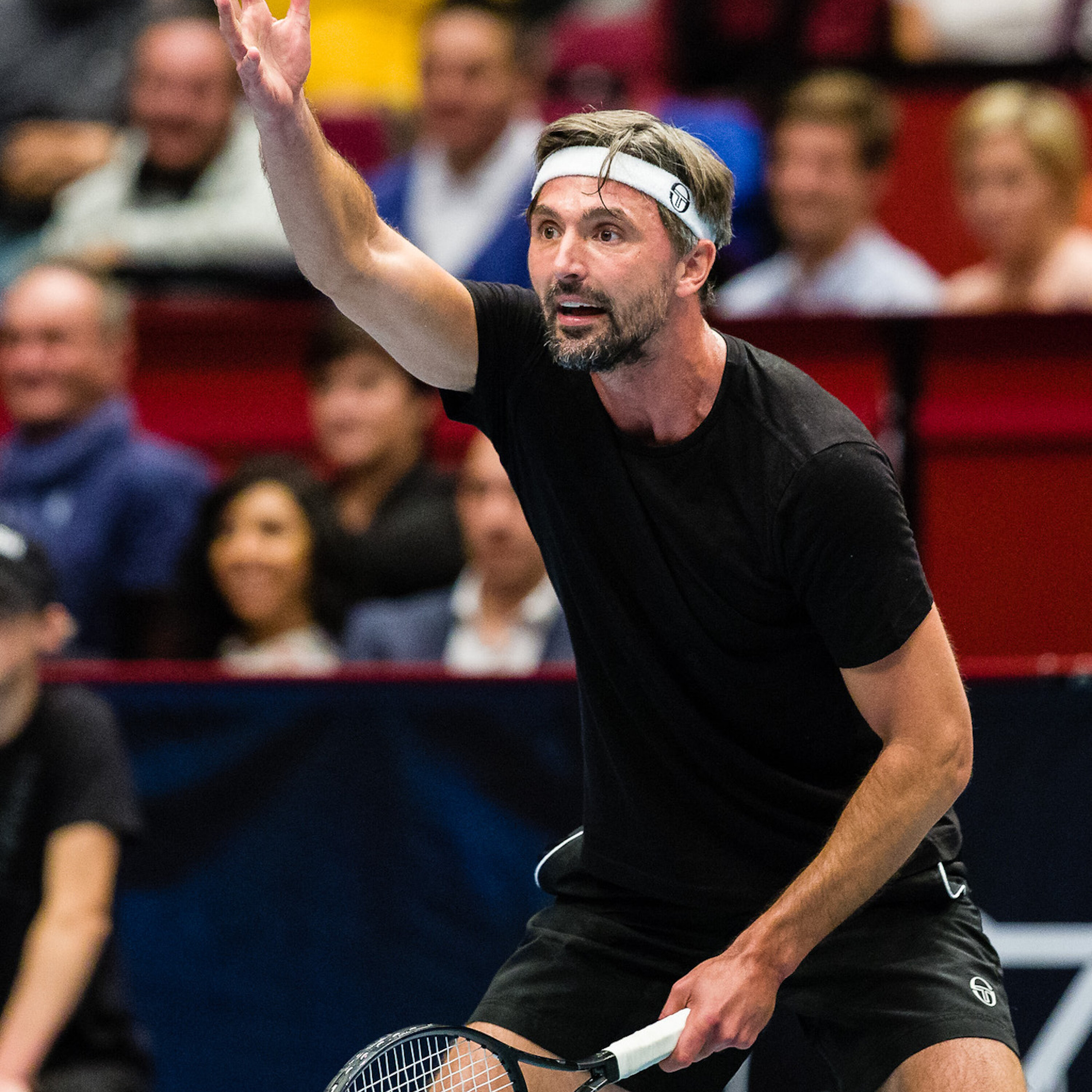
Goran Ivanisevic
The grand slam champ, celebrated coach and fan favourite joins Rennae to talk about the backstory to his historic journey from Wimbledon wildcard to Champion, coaching Novak Djokovic and the backstory to his insane tattoo.
Hosted on Acast. See acast.com/privacy for more information.
See omnystudio.com/listener for privacy information.
2020-04-13
51 min
Transcript
Available Results
Generated results are saved to the knowledge database for reuse and search.
No generated results are available for this episode yet.
Extract Knowledge
Pick what you want extracted first. Model, scope, and chapter options appear after a template is selected.
Generated results for public episodes are saved to the knowledge database so they can be reused and searched later.
Transcript
00:00:05
Speaker 1: This episode of the Racket Magazine podcast is brought to you by Sergio Chucchini, offering iconic tracksuits, classic Polos.

00:00:12
Speaker 2: And the new Young Line sneaker.

00:00:14
Speaker 1: Originally designed in the mid nineteen eighties, It's our favorite spring silhouette.

00:00:17
Speaker 3: And it's back.

00:00:18
Speaker 1: You can get it now at Sergiotuccini dot com and follow them on Instagram at Sergio Tucchini Underscore Official. For updates, Enter the promo code racket Bag at checkout and you'll get thirty percent off your order.

00:00:34
Speaker 4: Hello to Christiano Karati. And I played so bad and I was hoping they don't watch Best Match?

00:00:51
Speaker 2: What up, Tonay, it's getting weird. Listen. I gotta give you props.

00:00:58
Speaker 5: Man.

00:00:59
Speaker 3: You're in a a home with a kid, and I'm going to give all props to every parent out there that has at least one child.

00:01:09
Speaker 2: One's enough. If you've got more than one, god love you, but you've got one.

00:01:13
Speaker 3: Caitlin, I saw a great video the other day that said homeschooling is bullshit.

00:01:19
Speaker 2: This isn't school.

00:01:20
Speaker 6: It's like it's like trench warfare, Like we just kind of take turns being on the front line, and we're not even the healthcare workers who are actually on the front line actually dealing with this. But it feels like a battle nonetheless. And let me tell you, I look forward to recording and editing these podcast episodes in a way that I never before appreciated. And I listened to them after they recorded and edited because they're such a nice escape.

00:01:42
Speaker 2: Yes they are.

00:01:43
Speaker 5: Well.

00:01:43
Speaker 3: I hope we're giving some respite to a lot of people out there that are sitting in their homes spending a lot of time either with their kids, or their spouses or their partners that they want to maybe kill at this point. But he had been a pretty crazy time in our lives. I mean, we're going to look back on this ten to twenty years. Hopefully we'll be like, geez, remember that time COVID nineteen when we didn't have any tennis.

00:02:05
Speaker 2: But we've got podcasts. We've got podcasts.

00:02:08
Speaker 5: Now.

00:02:08
Speaker 6: You caught up with one of my absolute favorite players of all time on the phone last week. He is a crow at, he's a wild man, he's a Grand Slam winner. He is now a coach. There's a couple of things I want to ask you specifically about in this chat you had with him. First of all, you guys have known each other for a very long time. There's a lot of biographical overlap between the two of your careers and lives.

00:02:29
Speaker 2: Talk about that a little bit. Yeah, it is kind of crazy.

00:02:33
Speaker 3: The first time I ever saw goram was I explained it in the podcast, but it was in Italy. We were kids playing a junior tournament there, which was the biggest junior tournament in Europe at the time, in Milan, and that's the first time I remember hearing about him. That's the first time I remember people talking about him. And of course, you know, he does what he does there and then subsequently for the rest of his career, so we always interlapped one another. We're both born in seventy one, with the same age, give or take a few months. He's a little bit younger than me, but yeah, I just would see him, you know, and obviously what he did in his career, and then even the year that he had at Wimbledon that we talk about in the pod was the year that I won.

00:03:14
Speaker 2: My first Wimbledon doubles title.

00:03:16
Speaker 3: So we just had these random like things and we both went into doing some coaching afterwards, and he's done a phenomenal job with the work that he's done with the players that he's worked with. So I don't know, it's just we're a little nuts as well on the court, so I kind of understand his vibe. I understand his passion and he's just the great He's just he's been the same guy from the start to the finish.

00:03:37
Speaker 2: He's just such an awesome guy.

00:03:39
Speaker 4: He's so fun.

00:03:39
Speaker 6: Well, it was interesting because you were giving me shit a couple of days ago for going on the Irish podcast Second Captains and talking about Gouran and just for the record, i'll tell you what we talked about. They approached me. I've been on the show a couple of times. It's like Ireland Sports podcast. It's hilarious also because you just get to hear Irish people in your ears, you know, and their accent is so fun. So they were like, oh, Keaitlyn, I want to talk to you about one of our favorite Wimbledon's. Caitlin can get on the phone and talk to us, And I was like, of course, I can, you guys if I can understand all the words you're saying. And so they were like, yeah, we're gonna do a Wimbledon episode, because we're not gonna have Wimbledon and this is our favorite match from Wimbledon. Is it one that you can talk about? Do you remember it? And I of course I did, And so we basically went point by point talking through the tournament, and so it was actually kind of a nice preparation to then hear Goron's version of his of course two thousand and one title victory coming into the tournaments a wildcard. And I have to say, the story that you got out of him about the wild card is possibly my favorite part of the whole podcast. There's a whole section just about how he was not even thinking he was going to get into the tournament.

00:04:41
Speaker 2: I mean, it's so great.

00:04:43
Speaker 3: I just love him because he's such an open book and the stories that he tells about, as you said, the wild card, the actual tournament, his let's say apparel. It's just an old time classic mum in sports. And his story obviously wrapped up because we only get about forty five minutes with every player that we interview, so he had to fit it all in in that time. But oh my god, I could have talked to him for hours about that whole two weeks and his just his life in general. I mean, this guy grew up in the Civil Wars between Serbian Croatia and Yugoslavia as it was called back then, and I mean, it's just incredible what I don't know what he's gone through in his career, and a lot will say he probably underachieved, but I would say with his sort of personality and his emotions, maybe.

00:05:33
Speaker 2: He, you know, he achieved exactly what he was supposed to do.

00:05:37
Speaker 6: There's one thing that I want you to explain, because you guys kind of glass over it in the interview. But it's something that I've heard now a couple of times, which is, when you go to Wimbledon, you don't necessarily see the other players in the locker room because not everybody is in the same locker room. Can you unpack that just a little bit so when people hear it they understand what that means.

00:05:54
Speaker 2: It's so British.

00:05:56
Speaker 3: Okay, so Wimbledon, you know, every single Grand Slam, everybody's in the same locker room obviously, right, But of course Wimbledon because it has its sort of hierarchy of like.

00:06:05
Speaker 2: The royals and the members, and you know, it's just it's what we love about it.

00:06:09
Speaker 3: Okay, I mean you can argue about that's segregating people or whatever it is, but at Wimbledon, it's kind of the thing.

00:06:17
Speaker 2: Right.

00:06:17
Speaker 3: One time, no twice, actually I got to go into the members locker room because I was the number one seed in doubles. They don't allow doubles players in there anymore. But so Goran because he was a wild card. You know, don't even worry about the three times or whatever it was that he made the final of wimbled and he's down because he's a wild card, so he's ranking so low, he's in the lower locker room.

00:06:39
Speaker 2: Okay.

00:06:40
Speaker 3: So in the guys, it's the East West I think locker they call it because they're to the right of the members. So the members locker room is on the same level, but it's a totally different locker room. So you've got the top seeds and the former champions and the members are in one locker room and all the plubs as we call them, are in the other. But the women's it's the members locker room is on the same level as the men's locker room, and we're in the north South, meaning we're in the bottom like we're in that like basement area. So there's technically four locker rooms for players at Wimbledon, and Goron was in the plub locker room because he was like essentially you know, as we say, lower ranked, so he was in that one. So he didn't see Patrick raft Up, who was of course his opponent in the final, because Pat was one of the top seeds. So he was in the members locker room. So you actually don't see players often because of that. Obviously we see each other all the time in regular locker rooms, but in this one, well you can avoid each.

00:07:41
Speaker 2: Other, and they did even though they were all right.

00:07:45
Speaker 6: Well, the last thing I'll say before we get to this incredible interview, it's probably my favorite one. Like I said, the phone quality on the phone, I did the best I could, but I think it still sounds pretty great. And think you think you thank you by the way for asking him about his tattoo. In fact, the most since seen tattoo I've ever seen, as in its original state, which is a shark circling around across with the rose in its mouth, and the fact that he had something actually interesting to say about that beyond howvn't seen it is is a real testament. So thank you, thank you for getting that question in on my behalf.

00:08:16
Speaker 3: Yeah, you're welcome, and yeah, we just want everybody to know. You know, the podcast sound quality is always a little dodgy because we're either on the road or we're trying to grab these players at last second, and this one was obviously done socially distanced from one another. He was in uh, he was in Croatia. I am, of course in New York. We were doing it on the fine So bear with the bear with the sound. We hope it's uh, we hope it's good enough.

00:08:43
Speaker 6: If it's not too bad, don't listen, turn it off, all right, and they thank you again for making this interview happened. It was a real pleasure to listen to. Without further ado, here.

00:08:51
Speaker 5: Is you Aron?

00:08:52
Speaker 2: Even you switch?

00:08:59
Speaker 5: Hey, Garen? Hey, how are you?

00:09:01
Speaker 4: Hey? Hey?

00:09:03
Speaker 5: I just want to thank you for doing Racket Magazine podcast. We've had a lot of really cool people to do it, and we thought, what better person can we have on here that will make us laugh and learn about the world a kind of and Goran venizelt so thanks thanks for joining.

00:09:18
Speaker 4: Us, no problem, was leasure to be there.

00:09:22
Speaker 5: Goran. You've got like such a great storied life. Actually, you and I have known each other a long time. We are the same age, seventy one born. I think the very first time I ever saw you, correct me if I'm wrong, was I saw you for the first time at ever near a cup in Milan. Do you remember that tournament? A junior tournament.

00:09:38
Speaker 4: Yeah, that was one of the biggest tournament under sixteen in Milan. Yeah, a long time ago.

00:09:44
Speaker 5: It was a long time ago. Now, Am I right in saying that you won that tournament?

00:09:48
Speaker 4: Yes? Yes, I want I won.

00:09:50
Speaker 5: Yeah.

00:09:51
Speaker 4: Things I remember, I remember, have good memories.

00:09:53
Speaker 5: The reason I think I remember that is because I think I lost first round. So well done on that.

00:09:58
Speaker 4: Thanks.

00:10:01
Speaker 5: Thinking about like juniors, some of the players that have done really well over the years have done really well in juniors, and some have not done well. What do you think the thing for you was about being really good in juniors? How did that translate for you going to pros back then?

00:10:16
Speaker 4: Well? Actually that was answer very very very easy and very well because I didn't play too many too many juniors. The actually one US Open that was one interesting first round was Chang was superstar back then against guy that nobody knew in that time. It's Sumpress first round.

00:10:38
Speaker 5: Wow.

00:10:38
Speaker 4: And that year Chang got a white card for the main role. He went around or two when he was everybody talked about Chang, but nobody and I went to watch that because I didn't want to watch Chang. I wanted to see Sumpress. I don't know why, but I just wanted to watch.

00:10:52
Speaker 5: Why did why tempress?

00:10:54
Speaker 4: Did you hear about him or I heard about him? And I actually liked the way he played, you know, kind of good survey. He was already attacking. I mean, Chang was just you know, Chang was changed and running everything back, but some pross he has something and I just like the way he played. I just like it. And I was watching. Usually I didn't go and watch or match, but I went. I went to watch that one, and I really And then a couple of years after, you know the story, you know who was in some press and the guy who were in my life couple of times.

00:11:30
Speaker 5: But yeah, well.

00:11:34
Speaker 4: And he didn't know that I was watching him.

00:11:35
Speaker 5: That he didn't realize you were scouting him all the way back then.

00:11:39
Speaker 4: Yeah, I was scouting even then. And that didn't help that didn't help. My scouting didn't help.

00:11:46
Speaker 5: Clearly, you didn't write it down.

00:11:48
Speaker 4: And I made some mistakes.

00:11:51
Speaker 5: Writing down well, well, don't worry. God, we're going to get to the guy that ruined your life. But later on. But you know, for a gouding up and at the time Yugoslavia, how did you get into tennis? I mean, what was the catalyst for that?

00:12:06
Speaker 4: Actually? As I grew up in the very probably the most unique tennis club in the world. It's split and it's probably only tennis club in this I can say I never heard of one tennis club that with nine cours that gave four top ten players. It's Milik Zakopranolovich, myself and Maria Antis and we live all in the same street. Wow, So it's it's my father. My father took me and and I just liked it was like football or tennis, and I think I choose the right one. And it was very and I was lucky, you know, it was a lot of good players, club players, all the players, so I could I could play with all of them.

00:12:51
Speaker 5: Nicki Pilich was doing quite well when you were growing up as well. Did that help to have someone at least from your country show you that it was possible.

00:12:59
Speaker 4: Yeah, and Banikki was very good with us because every time he was in Germany, so when he came back, you know, he always played with us and was not easy to play with me. You know, he was really tough. He didn't let you sit down, No drink water, nothing you say in back then when we played, nobody drink the water, so you don't want to drink. So it was it was tough practicing, but Nicky was always he put the time and played with us, which was very very great. And it was also Marcos Tooya from Split he was around sixty sixty in the water. I had a lot of a lot of guys growing up. I can play and have a good, good starring. So it was really no tournaments. We had this satellite you know before now the future and back then was satellite. You have to stay for one month playing the tournaments to turn a couple of points, and it was a big one in back then.

00:13:55
Speaker 2: It was.

00:13:57
Speaker 5: How difficult was a period of time when know you were having the I mean the wars in Yugoslavia which obviously ended up splitting your country from Croatia to Serbia. I mean interestingly enough, I've actually been split. I went and played it. I played a bunch of tournaments on the coast in like Mali, Losenge in bowl in Ravash. I don't know if I'm saying them right, but I played. I played some really small tournaments in the you know, the coastal count of Croatia, and I just found it to be such a beautiful country. But how difficult was it when that period of time was going on for you and for players from at the time, from Croatia now.

00:14:37
Speaker 4: But it was not the easy easy moments for us, not the easy time, not easy to travel, not easy to play. You could not call anybody. It was very, very, very difficult. All the pressure not easy. You know, you could not. I cannot say I was one hundred percent content on my tennis and that hurt me a lot of times. You know, you know, the tennis player, you're alone there and when you step on the court, nobody asked you how you feel? Did you sleep well? Did you do this? You do that? Farewell? And my mind was a lot of times not on the tennis match, not on the court. But then I realized I can't go like this, you know, I need to put my mind. I need to do something good, you know, more matches, I mean, better I play, it's better I represent my country. So it took me a while. But then after I was doing that.

00:15:29
Speaker 5: I would imagine a lot of people don't you know, even ask the questions of how your family doing, how are your friends doing. I think that's something that got lost considering what that country went, what your country went through for ten years, how difficult that must today.

00:15:45
Speaker 4: It was tough to reach the family for you know, a week. You know, I could not speak to anybody. But I have to say that my career actually when I tarried to go up, I actually started in eighty nine when was Yugoslavia. So I became a good tennis player that was old countries, and in that happened in your country in Australia. That's when I broke through everything studied there for me.

00:16:11
Speaker 5: Yeah, yeah, well tell me about that, Tell me about that run in Australia and what that meant for you sort of going forward. Obviously you were a really good junior. Everybody knew you. Like I said, I remember saying you for the first time, and you were the one name that I remember from from that tournament that everyone was talking about like your talent level, that you had the talent that let's say that you're a little bit nuts too. So how how important was that run in Australia and basically like letting you believe that you can really play with the best players in the world.

00:16:43
Speaker 4: Actually I went there and that was that year, was second year of Australian Open. Move to Parkour and I remember that I was ranked around three something three hundred four hundred. Going to First Adelaide to play qualite, yeah, uh no, not anything. I stayed in the family, the Slavian family there. I did not qualify it, but luckily I got in like a lucky looser and I got to the quarter finals I think lost to Woodford.

00:17:22
Speaker 5: None.

00:17:22
Speaker 4: I was very good. Yeah, and then the left his hometown, so but still I was. I was quite quite happy, you know. So I went to Sydney to play qualige, but I was not even close to get in the police. So then I went to Melbourne. I and then this huge, huge run team. I qualified and I made a quarter I know, I beat Fitzy in the second round. Bitchy was seeded and in that part of the draw Bilander was second seed. He lost to Christian and I think kind of from that part of the drove into the quarters and I lost to Mayer in the quarterfinals, the first big paycheck for me and break through. So I became one hundred and twenty after that.

00:18:16
Speaker 5: After that week, yeah, and you had a great You got to the fourth round the French I believe that year as well. But that was really the the stepping stone for you to start having the results at Slam level. Obviously the following year you made the semis at Wimbledon, and then of course eventually you know, you made your first final at Wimbledon in ninety two. Do you do you remember that moment when you could explain to people like that, don't have this amazing thing of walking out into the court at Wimbledon, And we'll get into Wimbledon and what just recently happened, because we're not sure when this podcast will go out, because I could go out in two or three weeks or not. But obviously devastating with Wimbledon canceling yesterday, but explain that first moment when you walked under the court when then after saying it on TV and just envisioning the fact that you could walk on, because it's a special thing to walk out on the court for a.

00:19:08
Speaker 4: Final one moment it is, but I have to go a little. We're back in nineteen ninety. First time I walk in my first semi finals, Yeah, against the Boris. And I've never been even closed. All my matches I play on the round courts, and a quarter finals I play on court one or course one. So first time, my coach took me actually before the semi final, just to sit down on the said courch just to see how that looks like. And I remember going into the the court. First of all, Becker standing next to me. I was so herbal you cannot even imagine. And then stepping on the court, I say, okay, is that some kind of other doors I can go out? But actually, after like ten to fifteen minutes, I felt great. I felt great, I want to set. I served for the second set. Until then I didn't think so much, and then I realized, oh I'm serving for the second set against Boris Becker. Wow, and I beat him. I beat him in French Open just two weeks before that, So I was like kind of okay, which is good, and then kind of I got a little tight. I lost that set. I lost the third set. I lost in four, seven and six. But the moment that you plan on that court is the most beautiful for me tennis court in the world. It's just special. The grass. Okay, it was not so green in that time in the Semis when everybody you know, run to the net and there's not too much grass. But still it's a beautiful course.

00:20:48
Speaker 5: I remember those days of being able to run into the net. I still do, but it's very different, very different grass now. Yeah, my first time out there actually with my doubles fuddle, and I remember the only thing I kept telling myself was don't look out, don't look at the box, don't look at the rowbox, don't look the doll. Like I was trying to like focus on the court. That it's so hard because it is a court that you dream about walking on to and when you do, you have and you're it's such a big match for your SEMy. For me, it was a double final, and I remember thinking, oh my god, don't let the occasion overtake what is the most important thing. So I would suspect that you made a big it was big for you to learn from that serving for the second set, because safe to say, if you won the second set, you probably would have won the match. What did you learn from that moment then?

00:21:35
Speaker 4: Of course, well, I realized that, you know, playing with those guys, it's not like a big deal. You know, I can, I am capable to do better than semi finals and Grand Slam. That I need to be more focused serving on this big, big moment, not think on the other side of them. I just do what I do the best and serve, and I feel that this is okay. Was not so actually in bad mood when I lost the match. I was kind of disappointed, but happy that I reached the semis. But I knew that my time will come very soon that I can repeat that and do something better when you reach.

00:22:16
Speaker 5: Your next final. I was assuming that you went into that match thinking, all right, on grasp against Andrea, I've had the experience. Now we know who won, But I wasn't you know, knowing and remembering a loss. Was there anything at all that you got out of that match? Was it the fans, because let's face it, I mean, you were so popular, so popular, then do you do you remember that? What's the one thing that you probably would take back from that match.

00:22:43
Speaker 4: Actually he was the first of all. I was thinking, okay, I was actually more nervous like than him, because I was absolute favorite in that match, ye believe it or not. I beat some press, I beat Edward there. He never won Wimbledon. I beat him before that on hardcourt, on clay, so I mean I cannot lose on grass. To be honest, he was a better player the day he was returning well, he I kind of lost myself because he was the first guy that stayed back against me there, and I was like, I didn't know in the beginning, I was, I don't know what to do to stay back, to come in. I was kind of my game plan was kind of lost somewhere. But in the end, he played a better tennis. He deserved to win. He played better tennis, and there was that was that was it, you know. I was. I was pretty disappointed because I saw my chance and I felt thirty I don't know, thirty five eights and I still want the match.

00:24:04
Speaker 1: This episode of the Racket Magazine podcast is brought to you by Sergio Tacchini, Revitalizing and disrupting the status quos and snaeteen sixty six. Follow them on Instagram at Sergio Uchini Underscore Official and go to Sergio Tikinni dot com for more. Entered the promo code racket mag at checkout and you'll get thirty percent off your order.

00:24:29
Speaker 5: You well, I mean, obviously a lot of people remember, I mean, for Andrea that dramatic sort of way that he won it. But then against Pete, you know, losing in five to him, I'm sure that was obviously you know, a SERB fift. I think I think you guys, you have to admit you and Pete probably changed the dynamic of the grass at Wimbledon with that final because it was just an acing fat I mean, you guys were serving so unbelievable. Do you remember a little bit of that, not the contrary but the conversation that went on up that, like maybe we should slow the grass down. Do you think that that inhibited a lot of people like you or you know, seven ballets, people that like to come into the net. Do you remember that match and the conversations after it?

00:25:15
Speaker 4: I mean, I remember a couple of our matches in Wimbledon. We played this ninety four final, ninety eight final, ninety five semifinals nineteen ninety ninety two also semifinals, you know, but again against Pete. There were also more big serving guy like Boris and then before us Kevin Kurr and I played him there. I mean, I could not pick hisself for half an hour. So it was just a grass back then, the faster ball. Grass was fast. Everything was faster, and that was from one hundred and twenty eight guys on and the draw only a Gussie was staying back. Yeah, and you couldnt do anything. It's just even Landell we were talking there. Back then he was serving a volleying and how many times Landell's serving during normal tournaments. So the grass was like that against me and suppress. You cannot expect that we're going to some beautiful tennis. It's just we's going to break first. And usually he was always the guy who was waiting, waiting for my mistake, and somehow he broke me, you know. But that nineteen ninety eight final that I regret the most, that one that I really played, the better tennis I was, and somebody showed me the statistics. I lost that final because of my service, because I was not serving wealth. I was breaking very easy I was there, but I was not serving well, so my self deserts me there. But you know when you play Pete you can't expect rellies on the grass in those days.

00:27:07
Speaker 5: How much did that mentally sort of drain you after losing that final, because the next couple of years after that we were pretty tough. When you lost that final to in ninety eight, you might have fourced round the four, but you struggled a little bit for a couple of years.

00:27:22
Speaker 4: Yeah. I struggled. Yeah, yeah, that that final really really really killed me big time. You know, I didn't want to admit, but I was very disappointed. I suppose I really felt that this is my time, and slowly I was going down and down and playing wars and wars. Just it was not you know, I was kind of didn't want to think about that final, but hurt me a lot. And then I dropped two one hundred and twenty five. I was not injured. Okay, my shoulder was starting to hurt, but not because of that I drop. I just I just went into the bad, bad tell of you know game. I didn't know what to do on the court. I didn't feel comfortable on the court at all.

00:28:08
Speaker 5: I mean, I think it's really hard for people to understand that, like somebody is such a great player and had so many great results can sort of go into the despairing lack of confidence for a period of time. I mean, it's hard for people to understand that. But it happens to everybody.

00:28:22
Speaker 4: Yeah, it started to for you know, I know that, you know, when you playing, people are watching. How is that possibly? It's easy to stay in front of TV and you know, have be smart and and but it's you know, when you it's just you know, I was practiced, and I remember I lost to like I think ten first rounds in a row. You know, I was practicing good. I did everything good. But magic comes. I don't know what to do. It just blocked. I was, and it was getting worse and worse and worse. And then this two thousand and one game miracle. Because I remember the two thousand and one I played the qualis. Actually I asked for the white car for Ossie Open. They didn't give me. So I played the qualis.

00:29:11
Speaker 5: Yeah, and you lost round. Do you remember that match?

00:29:14
Speaker 4: And I played the court. I remember I played the court. First of all, I was looking for the court for fifteen minutes. It's the last court under this railway, you know. So I was going and thinking what the heck am I doing looking for the court that I cannot find playing Walif and already walk into the court. I already thanked, which is not nice to say, but I already thanked the first set. I mean I didn't want to play. So the match was over in not more than thirty eight minutes against Peter luksa check guy, and then I took the plane back. So I was saying to myself, Okay, you have two options. You stop now or you try, but you try, really try. Not this This was a waste of time and money and and whatever and just bad for everybody. So I went to play a challenger in Heilbron, which I did well. Finals, I went to Milan. I want to run clost to Roger and then slowly I skipped the old clay court season uh. And then what happened in Member nine film today, I don't know why what happened, How did it happen? And some things you cannot explain. Somethings it's like somebody else was controlling everything.

00:30:39
Speaker 5: You had a bit of divine intervention. You would say there you obviously after a wild card, you weren't guaranteed of getting it, being such a great champion and there in the past it was pretty tough to say no to you. I mean, three finals, one semifinal. Do you remember when I let you know that you had a wild card or did you have to did you have to wait or did I give it to you pretty quickly.

00:31:00
Speaker 4: I was playing Queens on the day they were deciding, and I lost to Christiano Karate and I played so bad, and I was hoping they don't watch that match because for sure they're not to give me anything. They give me white cards, not to come, not to play. But luckily in two thousand and one they didn't have eight British players to give wild cards too, so they probably I was like four five guys, but okay, it's okay, I think go around there one. So luckily they gave me the white car knowing okay, it's gonna lose only but if they knew that, I'm gonna oh no, But listen, I could not beat anybody. And and what I did before Wimbledon, which you don't do, you know, one week before I was bored. I was in hertoken bush, so head send me the record and they said this is the same record, but different color and was completely different records. So what can you do?

00:32:09
Speaker 2: You know?

00:32:09
Speaker 4: One week before Bimbledon, and I said, okay, I can play. I cannot play worse than I'm playing. I can play the same or I can play better. So I'm gonna keep those records. The only three records.

00:32:23
Speaker 2: And I.

00:32:25
Speaker 4: Played whole Wimbledon with actually two and a half records, actually three records, but one record had the bad grip, so there was only for emergency if I you know, so three records and also taking it sent me three shirts. Okay, okay, thank you very much. So when they see that time winning, they send me whole bags. But I returned that bag. So I had the three shirts, three records I was washing every day, and one I trod in the in the after I beat I think Vetsky lroddy. So I was thinking, okay, man, now I have to come down. You have only two shirts.

00:33:09
Speaker 2: Now.

00:33:09
Speaker 4: Luckily I was not changing the shirt.

00:33:11
Speaker 5: Oh you threw it? Yes? Did you think yourself? My wit a second take? Can I can I get that back about it?

00:33:22
Speaker 1: Yeah?

00:33:22
Speaker 4: But I was thinking, yeah, what I'm doing. I have only two, but I put in my bag another three records, all the records, you know, just you know, people they see I have not only three records, they have like six, but the other three butre not to use, you know, so I feel like, look at this professional guy has a six records, but there are only two and a half records.

00:33:46
Speaker 5: To be honest, well you you have been obviously. One of the comments that you said is that one of the reasons you love grasses that you can bounce your record and it wouldn't break. So that was really important.

00:33:59
Speaker 4: Actually it was very but I was actually pretty calm. I said to myself, I felt, you know, every round that I was winning and playing that I felt something might happen. And I said, okay, you just need to keep your cool. Whatever happens, don't no breaking records, no trying records. Yeah, and I was very very good, and I was on grass. You don't break the strings, very very so I was just praying, I mean, I can't break that. I break two records, the strings, it will be disaster.

00:34:29
Speaker 2: You know.

00:34:31
Speaker 5: Thank god, I have a lot of spins that helped.

00:34:34
Speaker 4: Yeah, yeah, no spin. So and you know, every match was was was more and more interested that one semi finals. But I think that that one Womble don't regret to give him the mark and I beat.

00:34:52
Speaker 5: There was obviously the whole country wanted Henman to win, but I think there was a I think there was an underlying group of Brits really loved to see you have another chance. And when it were you were you actually excited when when you were in the final and and Pat the Agasy were you kind of thought of being that Agacy would be the guy if it's the final, get get revenge.

00:35:16
Speaker 4: Actually I want I wanted to Pat because that is my great friend and the great guy. And but you know the funny thing I realized, like a couple of years after that Augustine was throwing for the match. I didn't never include that AUGUSTI was throwing for the match and against Pet. So I was. I mean, I was watching somewhere and Tilly I said, Jesus, oh, august throwing for the match. But I wanted Pet to win because we both had the chances before and we practiced a lot whenever when he came on the tour. Because our coach is my Bob Brett, and his Bob Carmichael was. They were good friends. They all from Australia, which their mate, Yeah, their mate they made and so we were practicing a lot and I really loved that. So he won his match and then my roller coaster of three days became again and it was a very very interesting match, to be honest.

00:36:19
Speaker 5: Yeah, that was Actually we do kind of have this random thing that I saw you as a as a kid at the Avenuey Cup in Milan and that was the year that I won My first double title was in two thousand and one. And obviously the thing that we remember so much, other than wedding was the rain. It was like so much rain that year. There was so many on and off. Obviously they have the roof, now we wouldn't have that issue. But I remember having to play back to back matches like my double start and the Car of Black plays three matches on Sunday. We couldn't Women's finals on Sunday, and of course you were pushed to Monday, which was probably I was, I remember, I can tell you the story. So I flew back to Australia on that Monday, or I was signed to the stakes actually, and your match was being played while I was flying because it was on Monday and it was the Peace of the Final, they called it. So they let everyone in and the guy, the pilot camper, the guy the captain of the plane came on and said, for those of you interested, Grin Vinisovich, is this one Wimbledon eight six and the sixth And I remember thinking, oh my god, I cannot believe I missed that match. And I mean part of me, obviously, Pat was obviously a good he's a good friend of mine, and you know, I wanted him to win. But then my other part of me was like, oh man, I'm so happy for Grin. So everybody was interested in that, including the pilot of my my friggin plane. So I mean, go through that, Yeah, were you happier that it was? And nothing against the crowds at one woman, because they're friggin amazing, But that final in particular, that was not so because you had literally half of Croatia and half of Australia and everyone that lived in London would that guy.

00:38:01
Speaker 4: Actually, that was probably the best tennis atmosphere we played in Wimbledon. Match was tennis was not the best, but atmosphere was umber like football, really whole Australian cricket team was there supporting Pat. I was really really fun to play, you know. I was really nervous just to begin to play, and we were both nervous. Was not a beautiful tennis was interesting set, but.

00:38:35
Speaker 5: Like because you were such good friends with you, like all right, my like you know all the best or actually we didn't.

00:38:41
Speaker 4: We didn't. We didn't talk because I was actually in the other locker room. I was in the locker room. Yeah, I was actually not even there. I was on the street the locker room. Come on, I was in there at the locker room. So I didn't see Pet for three days. I played the semis and then I just saw him before I was entering the court.

00:39:08
Speaker 5: The match was incredible. I mean, as you said, the crowd, it's kind of was a little up and down, but it was to be expected that both of you were nervous and you knew how big a moment it was. But take me through that last game because if anyone ever wants to watch you at your best, as far as your personality on the court, your emotional ups and downs, the fact that you have always worn your heart on your sleeve, I mean that last game was bonkers. I mean you were on your knees, you were playing. I mean, who does that?

00:39:39
Speaker 4: That game was really crazy. I was watching a couple of months ago that game. In the first the first point, the ball was going wide like two meters and I was there and I said to myself, man, let it go. But somehow I hit the vale. I don't know why I hit the varalie. Nervous game. I was rushing the lot. I could not put the first serve. I wanted to finish because first time I was in the final, but for the title. And then match points, first one with the double fold, and I just said to myself, put the serve in the court. And when I'm nervous, I cannot hit the slow serve. I had to hit it harder, and every time he went to the wrong side. But second again double food, and then third, I is actually pretty good valley and he hit the lobe and my legs are so heavy that I could not lift up. I wanted to live, but I was I was blocked, so I said, come on, this is not happening. So I thought, okay, fourth match points, fourth final, this is it. And then I missed the first serve again, and then somehow I said, Okay, the second selve has to go in. Just put it in somehow, and and I put it in. He put it in it and I did that was I I lost it. I still the the net, thank god, because I don't know what would happened if they both stem back.

00:41:12
Speaker 5: So I mean, listen, that was obviously a moment that changed your life. You know, you go back home, there's one hundred and fifty thousand people in split you like jump in the water like you just partied it up for a long time. But I mean, it was such a deserved win because you really you deserve to win at least one of those, you know, and I think the only person that you could they could even remotely feel probably worse than you, was you know, when Andy Roddick couldn't quite get over the line either. So there's been some great players that have not won there. So I guess, you know, for you, it was a huge moment. But you know, I want to transition because like when you think about all the ups and downs, mentally ups and downs, all the emotional ups and downs, the hard work, the digging yourself out of hole to come back and do what you did at when moment is that you think what makes you sort of a great coach as far as not so much the exers and nose of how to beat somebody, but more the emotional side of being able to, you know, be able to reach into what you are as a human being emotionally, to be able to pass that on to you know, Chileich and winning the US Open and being able to explain what you're going to feel and go through and now obviously around Novak, well, Novak doesn't need to be told how to win a Grand Slam. But you know, is that the influence that you feel helped you because of the emotional part of you, does that make you a better coach?

00:42:32
Speaker 4: Definitely? Definitely definitely helped me a lot. Definitely. I came and I decided that I want to be a colljer. Luckily, I have a lot of friends who already became a coach, So you know, I'm not a guy who thinks that knows everything. I like to talk to a lot of people if I can learn something. But definitely when I start to mar with Maren and when he reached the final of US Open, that's something that I could talk to him how it's going to feel on the court, what he should do. And the good thing that he played the guy who was also his first Grand Slam finals, so that was kind of easier. But definitely that what I felt in my time was emotionally all this loss is all this helped me to adjust and to become Actually with Marin what was a really great success, you know, because nobody expected him to win that US Open and to pass that experience to him and the way he played the final like he played already twenty finals before that. So that was really for me as a coach, was satisfying to sit there, watch there and seeing a player that you coach winning, you know, yes Open, and so it's a really big thing.

00:43:55
Speaker 1: Is it?

00:43:56
Speaker 5: I get asked myself as obviously I played and coach as well, and I walk away from coaching some matches sometimes and just say fuck me, like coaching is so hard because it's so stressful, you know it? Is it more? Do you find it more stressful or do you detach from the when the office of your players? It more difficult to play.

00:44:19
Speaker 4: Or I think no, most difficult. More difficult is to coach when you play. I think you deal with your emotions. You let it go out. You you scream, you yell, whatever you do. But but there is a coach. You know, first of all you have to see their cameras on you. You have to be and behave, have a good pace. Pos it is and everything stressful emotions, you know, and people think, you know, better player, it is, it's going to be less stressed. But I think it's opposite. Better player, it is you coach is more stressed. Yeah, more pressure because they want better results. Now with Novak, you know, it's an unbelievable thing to sit there, but you know with him sometimes finally is not good enough, you know, and so only winning when when win and you're knowing sometimes he has to look somewhere you know, hopefully not but and it's it's very it's not easy to be you know, people think what you do. You sit there, you have a good seat and you enjoy not it's enjoyable when the player plays well and when he wins, but it's it's it's you know, stressful every day, you know, practice and somethings that don't work well. And it's not easy. It's not easy, but it's fun, you know, I really find myself in that and then I enjoy it.

00:45:41
Speaker 5: What's the thing about him? I mean, you've known all the great You've flighted against all the grapes and you were great. Like, what's the thing about him that you still separates him from anyone else?

00:45:52
Speaker 4: For example? Let so now in Australia, the transformation, you know, he was you know, winning and then shut he's not feeling well in that black hole. And the ability to turn this around and win the matches. The mentality his his minds. I never saw that Rafa is a fighter, but Novak can turn the match out of now you know that he's really you know, I never saw somebody like that. His mentals, it's so strong mentally that that's just fascinating me every time when I see you know, now I'm seeing closer because I'm sitting there and I'm involved the team and that, but I was always before because he's from Serbia. It's you know, it's the same mentality creation for THEA and I was his big Frian before and watching that how he mentally he can do that is just it's just unbelievable, unbelievable transformation, unbelievable ability. He's good to do that.

00:47:01
Speaker 5: Yeah. I think I think that's what is good about someone like you as well. And you know, even Boris when he had his time coaching and see with Michael, I think that when you're an emotional I mean, Michael wasn't very emotional, but you know, you and Boris were. I mean, I think when you're an emotionally, you're you're a great player, but your emotional I think it makes you appreciate these these these guys so much because you just think, Wow, it's just I mean, it's just something that I always admired about stephie Graff. You know, it's just like they're just like these machines that go out there and they just put disappointment behind them and can change something so quickly. Caitlin, my podcost partner, we're getting to the end of this now. She wanted me to ask you about your tattoo because she said it's the craziest friggin tattoo. I think on a tennis player. What does it symbolize?

00:47:53
Speaker 4: First? Some of it I got idea it was ninety seven or ninety eight in my Actually, I was in La Storry before after before flying to Miami, so I was I wanted to put shark cross and rolls, you know, stark because it's my favorite animal cross because of the cross and rows of like symbolizing love or so I did that and it was kind of fun. But then I was as you know, actually the guy get me. I wanted to put on my shoulder, but the guy said, put it on your back because you don't see it only in the mirror, so if you don't like it, you know you're not going to be upset.

00:48:34
Speaker 1: So I I.

00:48:36
Speaker 4: So I did it on my back, and after like ten years after that, I wanted to put something more. So I put like two hands and like a little shades around to make it bigger. And that was hurting. Like five hours I was sitting and I remember saying to the guy listening, you have fifteen more minutes. Whatever you do, you do after that, I'm getting up and it's finished. So it was kind of rushing, but it's fun because sometimes I forget that I have a tattoo. You only you know when in summertime or you know, when I see myself on the however, tattoo, you know, the guy in LA gave me a good advice, you know, don't put it you know somewhere that you can see every day because you might get word so like this, I don't see him. Yeah, and I like it, you know every time and I see it looks okay, oh good.

00:49:33
Speaker 5: Well the next one I get, I'll get it on my back. I'll think about you. That'll be and I'll tell you fifteen minutes to do it. Well, Gouran, this has been like a crazy, crazy, crazy period of our lives. You know, they haven't canceled Wo Woman since the World War. Tennis is on sabbatical now for god knows how long, so we're all fitting at home. We're all trying to figure out what the hell the next six months of our lives. It kind of looks like me as a coach, you as a coach, we're not doing very much right now. But man, thanks so much for like spending time with us and telling you some of your great stories. They've been great.

00:50:11
Speaker 4: You're welcome with a pleasure talking to you like always, And hopefully we going to start I mean my prediction, I'll try and open next year, not before that, unfortunately, but hopefully it's still unhealthy and all the people and virus goes away.

00:50:28
Speaker 5: Yeah, I agree with my friend. I'd love to see you in New York, but if not, I know we'll see you down there at the Happy Slam. It will be a Happy Slam if it is the first and only one, that's for sure.

00:50:39
Speaker 4: Yeah, thank my friend.

00:50:42
Speaker 5: We'll be fifteen next year, so we'll have to celebrate somewhere together and I'll have a drink with you.

00:50:46
Speaker 4: That's definitely definitely Okay. Okay, my friends, Okay, my brother you too. Okay, by bye.

00:50:55
Speaker 6: Bye, and that's it for this episode of the Racket Magazine pod.

00:51:00
Speaker 4: Thanks for listening.

00:51:01
Speaker 1: Our host is Renee Stoves.

00:51:03
Speaker 6: Our co host and producer is me Caitlin Thompson. Music by internationally renowned DJ Stretch Armstrong. Thanks to Tim Or Jerry and the team at ACAST.

00:51:12
Speaker 1: Find us at racketmag dot com, slash podcast, and subscribe to us at any of your favorite podcasters
Chapters
No chapters available.