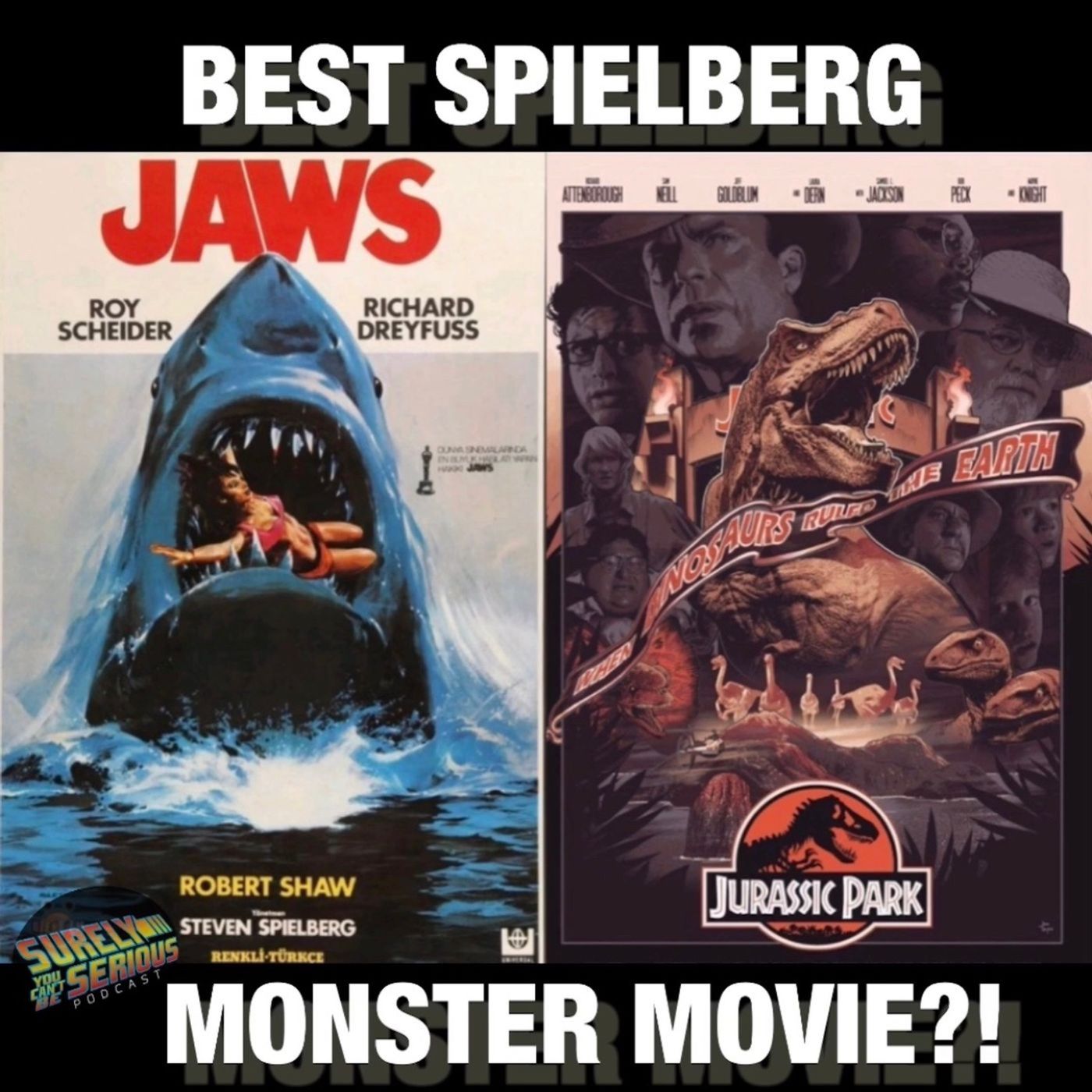
Jurassic Park ('93) vs. Jaws ('75): Part 2
Charlton Heston as Chief Brody? Michael J Fox as Ian Malcolm? Join us as we discuss the Jaws and Jurassic Park that might have been and more in our second episode on the iconic monster movies of Steven Spielberg.
2020-07-07
47 min
Transcript
Available Results
Generated results are saved to the knowledge database for reuse and search.
No generated results are available for this episode yet.
Extract Knowledge
Pick what you want extracted first. Model, scope, and chapter options appear after a template is selected.
Generated results for public episodes are saved to the knowledge database so they can be reused and searched later.
Transcript
<v Speaker 1>Boom boom.
<v Speaker 2>All right, everybody, welcome back to episode two of the
<v Speaker 2>Jaws Versus Jurassic Park podcast on the Shureley You Can't
<v Speaker 2>Be Serious Podcast, the what do you think? Uh?
<v Speaker 3>Now? Eventually do plan to have dinosaurs on your dinosaur podcast? Right? Hello? Hello?
<v Speaker 4>Yes, I really do hate that, man, That's not true.
<v Speaker 5>Hello everybody, and welcome to the Surely You Can't Be
<v Speaker 5>Serious podcast, discussing and debating the iconic and the forgotten
<v Speaker 5>of eighties and nineties pop culture with your co hosts
<v Speaker 5>James D. Graves and Jason Kolovin.
<v Speaker 3>Welcome back, everybody, Thank you for joining us again. We
<v Speaker 3>are here to talk about sharks and dinosaurs.
<v Speaker 4>Dinosaurs and sharks tonight, let's look at the cast and
<v Speaker 4>crew of each of these movies, who they thought about
<v Speaker 4>bringing in, who they ended up hiring, and then what
<v Speaker 4>it meant to them. All right, let's start with Jaws,
<v Speaker 4>since it's the first one here sounds good. Initially, Peter
<v Speaker 4>Benchley went to Spielberg and said, I've got an idea.
<v Speaker 4>I think we should hire Paul Newman as Quint, Robert
<v Speaker 4>Redford as Chief Brody, and John Voight for Hooper. And
<v Speaker 4>then they told him, here's the deal. The shark is
<v Speaker 4>the star of the movie.
<v Speaker 3>Right. Yes, Spielberg had all kinds of guys in mind
<v Speaker 3>for these different parts, and of all of the people
<v Speaker 3>that he had in mind, the only one, the only
<v Speaker 3>first choice that he actually got was the mayor.
<v Speaker 4>That's right.
<v Speaker 3>So Murray Hamilton is his name, and he was the
<v Speaker 3>choice that Spielberg had for the mayor that actually came through.
<v Speaker 3>I mean, that guy's perfect as the mayor. He is perfect.
<v Speaker 4>He nails it. He has that sweet coat that has
<v Speaker 4>the anchors on it that I a couple of jealous of. Yeah.
<v Speaker 3>Now, he had been in an at me of a
<v Speaker 3>murder and he had been the cuckold husband and the
<v Speaker 3>graduate if you've ever seen that. And he's this weird
<v Speaker 3>scene with him having a drink with Justin Hoffman who's
<v Speaker 3>having an affair with missus Robinson. He's mister Robinson.
<v Speaker 4>There you go.
<v Speaker 3>But he is the perfect slimy, bad decision making but
<v Speaker 3>going to push my bad decisions on you mayor for
<v Speaker 3>this movie. Fantastic.
<v Speaker 4>And later he does a great job in my opinion
<v Speaker 4>of you know, he was all gung ho on keeping
<v Speaker 4>the beaches open for economic reasons, and then when there's
<v Speaker 4>an attack at the beach, he does a great job
<v Speaker 4>of sort of emotionally saying, my kids were on that
<v Speaker 4>beach too.
<v Speaker 3>Yeah. I mean the part where he's he convinces people
<v Speaker 3>to go out and swim, I mean, why why would you?
<v Speaker 3>Why would you do that?
<v Speaker 4>Okay, so the part of Chief Brody, this is interesting.
<v Speaker 4>Steven Spielberg wanted several different people for this part. One
<v Speaker 4>person in particular really wanted it. Charlton Heston really wanted
<v Speaker 4>the part of Chief Brody. Yeah, and Spielberg was like,
<v Speaker 4>no way, dude, No.
<v Speaker 3>Yeah. Heston had been in these parts where he was
<v Speaker 3>always the conquering hero, like you just knew he was
<v Speaker 3>going to win. And Spielberg didn't want people in the
<v Speaker 3>theater to get you know, just be relaxed knowing, Hey,
<v Speaker 3>Heston's got this right.
<v Speaker 4>Roy Scheider is every man. He is the representative of
<v Speaker 4>the audience. I taught between his a sticky situation. I
<v Speaker 4>got my job responsibilities, I've got my family responsibilities. I
<v Speaker 4>got the shark that's screwing up everything and I'm scared,
<v Speaker 4>but I got to do my job, you know. And
<v Speaker 4>it was interesting that Spielberg had never met Roy Scheider
<v Speaker 4>until he went to a party. So Spielberg wanted to
<v Speaker 4>offer the role of Chief Brody to Robert Duvall, but
<v Speaker 4>he turned him down. He saw the movie as a
<v Speaker 4>potential phenomenon, but he was worried it might make him
<v Speaker 4>too famous.
<v Speaker 3>Steven Spielberg was specific about, I don't want somebody that's
<v Speaker 3>too big and too famous, because he had this idea
<v Speaker 3>that Brody needed to be vulnerable and somebody that the
<v Speaker 3>audience could identify with. But he had talked to five
<v Speaker 3>or six actors and he couldn't find the right person
<v Speaker 3>for the job. And so he's at this party at
<v Speaker 3>Andrea Eastman's house, who was the casting director for The Godfather,
<v Speaker 3>and Roy Scheider also happens to be there and several
<v Speaker 3>other Hollywood folks and Roy Scheider over here's Spielberg talking
<v Speaker 3>to some writer about the scene where the shark comes
<v Speaker 3>out of the water, and he kind of becomes fascinated.
<v Speaker 3>And then you know, parties, you move on, you you
<v Speaker 3>have your drinks, and then he sees Spielberg just kind
<v Speaker 3>of sitting alone by himself, and so he just goes
<v Speaker 3>over for instance down and he's like, you know, Hey,
<v Speaker 3>what's up, what's wrong? And he just Spielberg just spills
<v Speaker 3>all of his depression and anxiety about, you know, talking
<v Speaker 3>to all these actors, he can't find the right person
<v Speaker 3>to be the to be his Chief Brody and be
<v Speaker 3>the every man. And finally, after listening very quietly and
<v Speaker 3>patiently for a while, Roy Scheider goes, what about me,
<v Speaker 3>I'm an actor. I would love to be in Jo's
<v Speaker 3>and bingo bogo. There you go, Yep, going to the
<v Speaker 3>right party.
<v Speaker 4>That's awesome, that's awesome. I love that story. So Chief
<v Speaker 4>Rody is Roy Scheider, and he had been in the
<v Speaker 4>French Connection. Later he did all that Jazz and Blue.
<v Speaker 3>Thunder, and he was on a series a little bit
<v Speaker 3>later on where it was kind of a deep sea
<v Speaker 3>SeaQuest man.
<v Speaker 4>Yeah, yeah, that was on for about five and I
<v Speaker 4>remember I was all excited about it.
<v Speaker 3>And then yeah, Star Trek for the Water or something
<v Speaker 3>like that. He had been in a few things, but
<v Speaker 3>he really found his way as a cop. He was
<v Speaker 3>in Clute, he was in and then he was in
<v Speaker 3>the French Connection and just something about him said cop.
<v Speaker 3>And that's why he's the chief of police in this one.
<v Speaker 4>For Matt Hooper. The studio wanted Jeff Bridges or Jan
<v Speaker 4>Michael Vincent or Timothy Bottoms, and like we said before,
<v Speaker 4>John Voight was considered, but George Lucas was the one
<v Speaker 4>who said, Hey, how about Ricky?
<v Speaker 3>Right, Richard Dreyfus. Yeah, the other guys were more pretty boys,
<v Speaker 3>which was kind of the way that he was that
<v Speaker 3>the character of Hooper was portrayed in the book that
<v Speaker 3>he was kind of this handsome, young just out of college,
<v Speaker 3>kind of dashing figure. And obviously Richard Dreyfus is not
<v Speaker 3>that kind of guy, especially not in this movie.
<v Speaker 4>Yep, this is really interesting to me that the process
<v Speaker 4>of the hiring of Richard Dreyfus. Okay, now, Spielberg calls
<v Speaker 4>him and says, Hey, I've got this project I'm working
<v Speaker 4>on called Jaws, and I need this guy Hooper, who's
<v Speaker 4>a shark expert and all this stuff. Would you like
<v Speaker 4>to play him? And rich drefs sayes, no, way, man, no, and.
<v Speaker 3>He it was like a great movie to watch. It's
<v Speaker 3>like a terrible movie to be a part of.
<v Speaker 4>That's what he said. He said, Well he was right
<v Speaker 4>about that too, though. He was absolutely right. So he
<v Speaker 4>kept asking him, right, He was very emphatic, like no,
<v Speaker 4>I'm not doing this, and he's like, how about we
<v Speaker 4>all say it at the same time. Already one, two, three,
<v Speaker 4>I'm not doing this.
<v Speaker 3>But yeah, kind of it started to be a little
<v Speaker 3>bit of a d about it. Yeah.
<v Speaker 4>Yeah, But he had recently started a movie called The
<v Speaker 4>Apprenticeship of Duddy Kravitz.
<v Speaker 3>Yeah. It was his first starring role where he was
<v Speaker 3>the lead man.
<v Speaker 4>And when he sat to watch the premiere, he watched
<v Speaker 4>himself on screen and thought, I suck. He thought he
<v Speaker 4>was terrible.
<v Speaker 3>Oh my gosh, I am never going to get cast
<v Speaker 3>in anything again. I better go take this thing before
<v Speaker 3>news gets out that I think it's terrible, terrible performance.
<v Speaker 4>He immediately called Spielberg and begged for the part of
<v Speaker 4>Matt Hooper, which was funny, and when he showed up.
<v Speaker 4>He showed up to talk it over with him. He
<v Speaker 4>had that scraggly beard and those remless glasses and the
<v Speaker 4>little stocking gap, and they were like, that's it, you
<v Speaker 4>got it. Don't change the thing. Joel Gray wanted to
<v Speaker 4>play the part of Hooper too. I don't know if
<v Speaker 4>you are familiar with him, but oh yeah.
<v Speaker 3>Joel Gray was in Caparet For those interested in the
<v Speaker 3>eighties movies, he was in Remo Williams.
<v Speaker 4>And then the third main role he had to fill
<v Speaker 4>with Quinn. The one guy that Spielber had in mind
<v Speaker 4>for this part was Lee Marvin. But Lee Marvin he
<v Speaker 4>was fishing off of the coach Mexico. Yeah, and they're like, well,
<v Speaker 4>we want to talk to you about fishing sort of.
<v Speaker 4>He's like, I'm on vacation. I'm on vacation. Uh huh,
<v Speaker 4>And he refused to talk to them, so like, well,
<v Speaker 4>I guess we got to move on without Lee Marvin.
<v Speaker 3>He also offered it to Sterling Hayden. For those of
<v Speaker 3>you who don't know Sterling Hayden. If you've seen Doctor Strangelove,
<v Speaker 3>he's the American general who kind of puts everything into
<v Speaker 3>action to cause the destruction of the world, who only
<v Speaker 3>drinks vodka because of fluoridation of the water. He's that guy.
<v Speaker 4>The producers of the show said, well, you know what
<v Speaker 4>about Robert Shaw. They had just worked with him on
<v Speaker 4>the Sting and said, you know, he can be a
<v Speaker 4>little honery, but he's a good actor. He's he's Shakespeare
<v Speaker 4>and he's a professional.
<v Speaker 3>What do you think about him?
<v Speaker 4>And they decided to.
<v Speaker 3>Go with him. You know, we talked about them starting
<v Speaker 3>the movie without having things done. Nine days before they
<v Speaker 3>started filming, they still didn't have the parts of quent
<v Speaker 3>or Hooper cast. It's crazy nine days, which means for
<v Speaker 3>those actors, hey you're hired, see you in less than
<v Speaker 3>a week and a half start production.
<v Speaker 4>Here's a copy. Still memorize it.
<v Speaker 3>Yeah so, but even I mean, we know there wasn't
<v Speaker 3>even a script. There was not a complete There was
<v Speaker 3>multiple scripts that were completed, but they weren't scripts that
<v Speaker 3>they were going to use. They were working on new
<v Speaker 3>lines every night. Spielberg and Carl Gottlieb were working on
<v Speaker 3>fresh dialogue that people would have to learn that next day.
<v Speaker 3>So I guess that's part of the production. Robert Shaw
<v Speaker 3>is an interesting choice for Quin because he had kind
<v Speaker 3>of been in his early career a more of a
<v Speaker 3>dashing leading man type of guy, swashbuckling type of guy,
<v Speaker 3>and then he was like maybe one one of the
<v Speaker 3>best villains for James Bond and from Russia with Love.
<v Speaker 3>He was like the evil James Bond. I mean, he
<v Speaker 3>was awesome, but he's now got to play the part
<v Speaker 3>of this kind of crotchety old man. You know, it's weird.
<v Speaker 3>And I looked at this, he's only forty seven. When
<v Speaker 3>he was filming this, I'm thinking, I'm thinking he's in
<v Speaker 3>his sixties and he's forty seven years old. He was
<v Speaker 3>doing a part unlike any part that he had done before,
<v Speaker 3>and so he was looking for kind of inspiration on
<v Speaker 3>how to play the part. And one of the guys
<v Speaker 3>that he looked to was was a guy named Craig
<v Speaker 3>Kingsbury who was just a local fisherman. But the guy
<v Speaker 3>that they cast as Ben Gardner in Gardner's head. But
<v Speaker 3>this is an interesting story. I just got I pitched
<v Speaker 3>to pick this one up today. So when they were
<v Speaker 3>there and they were putting together like the boat and
<v Speaker 3>stuff like that. They're putting together other boats, making all
<v Speaker 3>the props for the set. Some spray paint that they
<v Speaker 3>were spray painting like blue over to the neighboring house.
<v Speaker 3>And as it out, there was a crotchety, old, angry
<v Speaker 3>man who lived in that house. And his name's Lynn Murphy.
<v Speaker 3>And so he you know, you've just blown paint over
<v Speaker 3>the guy who you shouldn't cross and at any point
<v Speaker 3>in life, and so he goes and balls them out,
<v Speaker 3>and then somehow, because I guess he's the local mechanic
<v Speaker 3>and knows how machines work, they're like, hey, could you
<v Speaker 3>help us out with this boat stuff? And then hey,
<v Speaker 3>could you help us out with a shark? And so
<v Speaker 3>he becomes like a guy on the set who's like
<v Speaker 3>teaching them how to do stuff like he There have
<v Speaker 3>been several actors who have said, had it not been
<v Speaker 3>for Lynn Murphy, the movie Jaws might not have come out.
<v Speaker 3>And he's gotten like no credit. He's not created in
<v Speaker 3>the credits of the movie. It's nowhere. It just just
<v Speaker 3>just happens to be this old car mudgeon league guy.
<v Speaker 3>And I looked at him, and he was in his
<v Speaker 3>forties too. I guess I'm just thinking. I think I
<v Speaker 3>thought I had like twenty years before I could become
<v Speaker 3>a car budget. I guess I could do it right now.
<v Speaker 3>And so Robert Shaw is having trouble with this line
<v Speaker 3>on the reading. He's talking to Spielberg and as they're talking,
<v Speaker 3>Lenn Murphy over yelling at the crew about stop doing
<v Speaker 3>what you're doing. You're messing everything. He's just like yelling
<v Speaker 3>at him because of how stupid they are, and Steven
<v Speaker 3>Spielberg goes you hear that, read it like that, and
<v Speaker 3>that was the inspiration for shop for the rest of
<v Speaker 3>the movie. Quit. That's awesome.
<v Speaker 4>So those three roles are hugely important. Obviously, there's the
<v Speaker 4>three main roles of the movie, right, right, Except I
<v Speaker 4>would argue the most important hire in the cast was
<v Speaker 4>Lorrange Gary as the role of Ellen Brody. And let
<v Speaker 4>me tell you why.
<v Speaker 3>It is not who I thought you were going to say,
<v Speaker 3>but okay, go for it. Okay.
<v Speaker 4>She was the most important hire because she was the
<v Speaker 4>wife of Sid Sheinberg, who was Steven Spielberg's boss, so
<v Speaker 4>he and her and her husband had skin in the
<v Speaker 4>game here, right. The fact that she had an important
<v Speaker 4>role in this movie meant that he was less likely
<v Speaker 4>to fire Spielberg and shut it down.
<v Speaker 3>Yeah, yeah, probably so.
<v Speaker 4>And when you're a twenty seven year old director and
<v Speaker 4>you hire your boss's wife, it's never a bad thing, right.
<v Speaker 3>And you could you know, you can say that maybe
<v Speaker 3>she had she had preferential treatment or whatever. But she
<v Speaker 3>did a great job.
<v Speaker 4>She did a great job.
<v Speaker 3>I thought she was a perfect wife in this one.
<v Speaker 3>I mean, she acted well. She it was very real.
<v Speaker 3>You just she was very believable as the displaced wife
<v Speaker 3>of a New York family who's now in amity. So
<v Speaker 3>who I thought you were going to say as the
<v Speaker 3>most important casting was.
<v Speaker 4>A mo on pins and needles here. I can't wait
<v Speaker 4>for you to tell me who in the world this
<v Speaker 4>is Susan Becklanine. You know what? She was pretty dagonam
<v Speaker 4>important now that she was.
<v Speaker 3>Vital because that first scene, if you don't sell that
<v Speaker 3>first scene the rest of the movies like mah right, yeah,
<v Speaker 3>and that first scene is all her, It is all her.
<v Speaker 4>Let's talk about No, you're exactly right, Let's talk about
<v Speaker 4>her for a second. So she was a competitive swimmer
<v Speaker 4>and a stunt woman, not really an actress.
<v Speaker 3>They knew what had to happen in the scene, and
<v Speaker 3>so they had three very important things that they had
<v Speaker 3>to consider. Right, They had to have somebody who was tough,
<v Speaker 3>who could handle the physical demands of the scene. They
<v Speaker 3>had to have somebody who was beautiful because it was
<v Speaker 3>supposed to be a girl that this guy is going
<v Speaker 3>to be chasing after. And they had to have somebody
<v Speaker 3>who was willing to get naked.
<v Speaker 4>Thank you, Susan Beckliny.
<v Speaker 3>Yeah, And so she pointed out. She was like, you know,
<v Speaker 3>so they do a casting call. You know, it's just like, hey,
<v Speaker 3>this part exists. Here's what we got. And I'm sure
<v Speaker 3>part of it was, hey, we need beautiful, tough, willing
<v Speaker 3>to get naked. And so she comes in. Before she
<v Speaker 3>goes in, she thinks, ah, they always make you take
<v Speaker 3>your clothes off. And I'm like, you haven't been in
<v Speaker 3>that many moves, at least not ones that are on IMDb.
<v Speaker 3>I wonder, I wonder how many auditions you had that
<v Speaker 3>you had to take your clothes off for. It was
<v Speaker 3>the seventies, it was a different time anyway. So she decides,
<v Speaker 3>instead of, you know, giving them that option, what I'll
<v Speaker 3>do is I will stick a naked picture of me
<v Speaker 3>in my portfolio folder.
<v Speaker 4>And when she went to the audition, he went and
<v Speaker 4>talked to Bill Gilmore, showed him that picture and he
<v Speaker 4>said when he saw the picture all he could do
<v Speaker 4>was blush. Right, So he went to Steven Spielberg with
<v Speaker 4>the picture and said, hey, Steve, here you go.
<v Speaker 3>What do you think of this?
<v Speaker 4>And Stephen's like, well, yeah, but can she act? He's like,
<v Speaker 4>Steve would look at this picture again?
<v Speaker 3>On come on? So she was very important.
<v Speaker 4>She screamed her lungs out too, and she made that
<v Speaker 4>scene super believable. She was screaming like she would die
<v Speaker 4>in you know.
<v Speaker 3>They well, the way that they rigged her up. They
<v Speaker 3>had ropes on either side of her. I mean, you
<v Speaker 3>see her like moving one way through the water and
<v Speaker 3>the other way, because it has to be like this
<v Speaker 3>nonlinear movement through the water like a fish would do.
<v Speaker 3>And what they did was like they had guys with
<v Speaker 3>rope and three hundred pound weights and this thing wrapped
<v Speaker 3>around her underneath the water and she was really just
<v Speaker 3>being thrown back and forth. And there was there was
<v Speaker 3>rumors that went around like that she's screaming like that
<v Speaker 3>because her ribs were breaking, but that's apparently false. You know,
<v Speaker 3>she did a fantastic job. And then when they had
<v Speaker 3>to go back in and and put in more sound
<v Speaker 3>before the scene, she had to scream while Steven Spielberg
<v Speaker 3>was pouring water down her throat, which you know now
<v Speaker 3>is called waterboarding. We don't do that anymore.
<v Speaker 4>Rights the Geneva Convention, Steven Spielberg is guilty of a
<v Speaker 4>war crime. So that pretty much is the cast of Jaws.
<v Speaker 4>If you don't include Bruce the Shark. Let's switch over
<v Speaker 4>to Dress and Kark and talk about who was almost
<v Speaker 4>cast in these roles. All right. So Spielberg now has
<v Speaker 4>a little bit more clout in Hollywood, and so he
<v Speaker 4>can a little bit I think, yeah, little scream a bit.
<v Speaker 3>I've directed The Sugarland Express. Hey, I've directed every single
<v Speaker 3>great movie of the eighties.
<v Speaker 4>Seriously. So here's here's who was considered for these roles.
<v Speaker 4>All right. So the role of doctor Alan Grant went
<v Speaker 4>to Sam Neil does a great job. Or He had
<v Speaker 4>been in the Hunt for Red October. He was later
<v Speaker 4>in The Piano and Event Horizon. He was an Australian actor.
<v Speaker 4>All right, here's who was considered for the role of
<v Speaker 4>doctor Allan Grant. So, just off the top of his head,
<v Speaker 4>Steven Spielberg was like, how about Harrison Ford. I think
<v Speaker 4>that was a little bit overkill for that role. You
<v Speaker 4>don't need Indiana Jones, you just need doctor Grant. So
<v Speaker 4>he considered Harrison Ford, he considered Kurt Russell. Right, he
<v Speaker 4>offered the role to William Hurt, who didn't even read
<v Speaker 4>the script and just said, no, I'm not interested in dinosaurs.
<v Speaker 3>Yeah, William Hurt's kind of famous for turning stuff down.
<v Speaker 4>Yeah, I'm not a fan of his. I don't really
<v Speaker 4>like him, Okay. And then finally they thought about Richard Dreyfuss.
<v Speaker 3>That would have been interesting.
<v Speaker 4>So that's who was considered for the role of doctor
<v Speaker 4>Allan Grant. Now, then doctor Ellie Satler is kind of
<v Speaker 4>like the Susan Sarandon Roland Bull Durham. They considered a
<v Speaker 4>ton of actresses for that role. They looked at Robin Wright,
<v Speaker 4>Gwyneth Paltrow, Julianne Moore, Helen Hunt, Terry Hetcher, Elizabeth Hurley,
<v Speaker 4>cheryln Flynn, and then Christina Applegate was considered. But some
<v Speaker 4>people think that they were looking at her for doctor
<v Speaker 4>Satler or maybe like an older version of Lex. It's
<v Speaker 4>kind of a strange deal. She was young at the time,
<v Speaker 4>she was like twenty, right, But they ended up going
<v Speaker 4>with Lord Dern, who had been in Wild Heart. And
<v Speaker 4>you may know her from The Last Jedi.
<v Speaker 3>I was going to ask you about that one. How'd
<v Speaker 3>you feel about her performance in the Last Jedi?
<v Speaker 4>Jason, we don't talk about the Last Jedi. Uh in
<v Speaker 4>her purple hair, we don't talk about the Last Jedi.
<v Speaker 3>Have you seen Wild at Heart. No, it's pretty weird.
<v Speaker 3>It's pretty weird. This is David Lynch movie, of course.
<v Speaker 4>And David Lynch makes the weirdest movies.
<v Speaker 3>He's got some weird stuff, he really does, and it's
<v Speaker 3>it can be amazing and weird and then it can
<v Speaker 3>be just plain old weird. Yeah.
<v Speaker 4>Okay. For the role of doctor Malcolm, this is where
<v Speaker 4>it gets super interesting.
<v Speaker 3>Yeah.
<v Speaker 4>Spielberg says that he wanted Jeff Goldblum, he offered Jeff Goblum,
<v Speaker 4>and he got Jeff Goblum, And so that really is
<v Speaker 4>the end of it, except listen to these guys that
<v Speaker 4>the casting director wanted, all right, okay, Michael Keaton, Michael J. Fox,
<v Speaker 4>Johnny Yeah, Michael J.
<v Speaker 3>Fox, Yes, Yeah, that's weird.
<v Speaker 4>Okay, go ahead, Johnny Depp, Yeah, Ted Danson, Steve Guttenberg.
<v Speaker 3>Tom Selick, a baby.
<v Speaker 4>Go ahead, and just offer everybody a three minute a baby.
<v Speaker 4>But here the person who did the best in the audition,
<v Speaker 4>this will blow you away. You're ready for this. Jim Carrey.
<v Speaker 4>Jim Carrey was a fraction of a hair away from
<v Speaker 4>getting the role of doctor Gan Malcolm.
<v Speaker 3>That's crazy.
<v Speaker 4>I think he would have been great. I think that
<v Speaker 4>that would have been cool. It would have changed the
<v Speaker 4>trajectory of his career. Right after this, he did a
<v Speaker 4>Centura and The Mask and Dumb and Dumber, and he's
<v Speaker 4>off down that path. And I'm thankful for that. I
<v Speaker 4>enjoyed those movies, but it would have been interesting at
<v Speaker 4>least to see him as that kind of rule.
<v Speaker 3>Yeah, but Jeff Goldbloom, like he set the mold for
<v Speaker 3>the sexy geek, right, Yeah, I mean, was was nerd
<v Speaker 3>them ever as sexy as Jeff Goldbloom was in Jurassic
<v Speaker 3>Part I don't think.
<v Speaker 4>So he got buffed up and yeah.
<v Speaker 3>And he's supposed to be like a math nerd and
<v Speaker 3>he comes and he's all tan and got his long black,
<v Speaker 3>curly hair and all flirting with the ladies and touching
<v Speaker 3>their hands and stuff and rubbing their hair and cheek
<v Speaker 3>in a weird kind of creepy way, but still somehow
<v Speaker 3>sexy because he's so pretty.
<v Speaker 4>All Right, the role of John Hammond. When they were
<v Speaker 4>casting this, they wanted somebody to be a dark Walt Disney.
<v Speaker 4>I thought that was really cool.
<v Speaker 3>So, yeah, the character in the book was certainly a darker,
<v Speaker 3>much much, much darker version of John Hammond than then
<v Speaker 3>it is portrayed in the movie. Have you read it? Yeah? Yeah,
<v Speaker 3>what did you think?
<v Speaker 4>It may be the only book I've ever read where
<v Speaker 4>I think the movie is better than the book.
<v Speaker 3>Did you see the movie first? No, that's impressive.
<v Speaker 4>I just think that the movie was streamline and it's
<v Speaker 4>just action like a bullet, right, And there's a whole
<v Speaker 4>lot of chaos theory and sort of scientific bs that
<v Speaker 4>I didn't.
<v Speaker 3>Care about, right, And and Spielberg has got a knack
<v Speaker 3>for doing that. I don't think he obviously did it
<v Speaker 3>with Ready Player one, which we saw together.
<v Speaker 4>But we need to talk about it.
<v Speaker 1>Yeah, that's a shame podcast, right, But just to speak
<v Speaker 1>about that on Jaws, you know, after he got done
<v Speaker 1>reading the book, Spielberg said, I kind of wanted the
<v Speaker 1>shark to win.
<v Speaker 3>Like nobody, no character in the book was actually likable.
<v Speaker 3>That's why the film is really nothing like the book
<v Speaker 3>at all. He even told Dreyfus, He's like, don't read
<v Speaker 3>the book, Okay, just don't read it.
<v Speaker 4>That makes me want to read the book. I want to.
<v Speaker 4>I want to order Jaws and check it out.
<v Speaker 3>Welcome to a Jurassic Book.
<v Speaker 4>The role for John Hammond, you know who he originally wanted,
<v Speaker 4>Sean Connory.
<v Speaker 3>Shan Connery, And I gotta say, I think he'd have
<v Speaker 3>been awesome. I really if I just imagine him with
<v Speaker 3>his what's the Jungle movie that he was in doctor.
<v Speaker 4>Something or other, medicine man, medicine man.
<v Speaker 3>Oh yeah, the medicine man is right. So I just
<v Speaker 3>imagined him with his medicine man, long white hair and
<v Speaker 3>a pony tail, you know, and his khaki vest saying
<v Speaker 3>welcome to a Jurassic Park. I would get, yeah, that's
<v Speaker 3>awesome when this guy does it. I'm kind of like,
<v Speaker 3>that's a little cheesy, little, a little round cheesy guy.
<v Speaker 3>But doctor so to blasphemy Richard Attenberg. I mean, he
<v Speaker 3>did a good job, but.
<v Speaker 4>He did h Yeah, Sean Connery, I.
<v Speaker 3>Think he would have. I think he would have made
<v Speaker 3>a better like I'm a billionaire developing a park kind
<v Speaker 3>of character. But I don't think he would have been
<v Speaker 3>as good as the lovable old grandfather that he also
<v Speaker 3>has to be in this movie.
<v Speaker 4>That's true. That's true. So Richard Attenborough had been in
<v Speaker 4>the Great Escape and A Bridge too Far, but he
<v Speaker 4>had pretty much been a director so he had directed
<v Speaker 4>the movie Gandhi and he was in the middle of
<v Speaker 4>finishing Chaplain, which stars Robert Downey Junior, which is a
<v Speaker 4>great movie. But he was pretty much a director. And
<v Speaker 4>when Spielberg called him, he's like, well, I'm in post
<v Speaker 4>production for Chaplain. He said, don't worry, we'll work around
<v Speaker 4>your schedule. If you want to come back and shoot
<v Speaker 4>this part, we'll let you have the time you need
<v Speaker 4>to finish Chaplain. And so he said, great, got me
<v Speaker 4>in the part of Muldoon. They hired a guy named
<v Speaker 4>Bob Peck. Shootah, that guy. Yeah, he did a good job.
<v Speaker 4>They considered Tom Sizemore.
<v Speaker 3>Yeah, I can kind of see that. Yeah, I really
<v Speaker 3>feel like that they didn't do that character just in
<v Speaker 3>this movie. I felt like he could have been way
<v Speaker 3>more than he was in this movie.
<v Speaker 4>Yeah, he didn't do a whole lot.
<v Speaker 3>And he's I mean, he's supposed to be the Australian
<v Speaker 3>like out back safari hunter man, the great White hunter, right,
<v Speaker 3>and this guy he's okay, he's just not. I don't know,
<v Speaker 3>he's just not.
<v Speaker 4>At the beginning his watch, a construction worker gets eaten
<v Speaker 4>by a raptor.
<v Speaker 3>Right, you have the ability to make dinosaurs from mosquitoes,
<v Speaker 3>but you can't get a cage that locks. Okay.
<v Speaker 4>So for the part of Lex, Arianna Richards was hired
<v Speaker 4>based mostly because she could scream really loud and really long.
<v Speaker 3>Yeah, and she did a great job at that. She's
<v Speaker 3>a good screamer.
<v Speaker 4>Okay. The part of Tim was played by Joseph Mazzello,
<v Speaker 4>and he had actually auditioned for a part in Spielberg's
<v Speaker 4>previous movie Hook, but they thought he was too young.
<v Speaker 4>But when this part came along, they thought he'll be
<v Speaker 4>just the right age, and they actually flip flopped Lex
<v Speaker 4>and Tim's age.
<v Speaker 3>From the book, Tim is the older brother and to
<v Speaker 3>yeher hacker, hacker.
<v Speaker 4>I'm a hacker. I'm a vegetarian, okay. And then mister
<v Speaker 4>Arnold played by Samuel L.
<v Speaker 3>MF.
<v Speaker 4>Jackson.
<v Speaker 3>Are we going to talk about the bloodsucking lawyer? We're
<v Speaker 3>going to talk about Martin Fierro.
<v Speaker 4>Sure.
<v Speaker 3>So he got cast obviously, and I mean one of
<v Speaker 3>the most memorable roles, and not necessarily for his performance,
<v Speaker 3>but because he's the first guy to get eaten by
<v Speaker 3>t Rex. Love it. And how awesome was that. I
<v Speaker 3>was listening to the soundtrack show on Jurassic Park. Shout
<v Speaker 3>out to d. A. W. Collins, But he's talking about
<v Speaker 3>the first time he's he saw the movies, Like when
<v Speaker 3>it comes to that part the t Rex eats the attorney,
<v Speaker 3>the guy in the middle row stands up and just
<v Speaker 3>starts shouting, how the fuck did they do that? And
<v Speaker 3>it's just so Yeah. Martin Fierro, he if you've seen
<v Speaker 3>Playing Drains and Automobiles, he's got a hilarious little bit
<v Speaker 3>part as the motel clerk and it's great.
<v Speaker 4>Do you have thirty two dollars?
<v Speaker 3>And I've watched.
<v Speaker 4>And finally, we can't do this without talking about Dennis Nedrie,
<v Speaker 4>who was played by Wayne Knight. Spielberg actually Newman, that's right.
<v Speaker 4>Spielberg watched the movie Based Againstinct and really liked this
<v Speaker 4>guy in Based Againstinct and he stayed and he waited
<v Speaker 4>for the credits to roll, and then he was like, Okay,
<v Speaker 4>that guy right there, Wayne Knight, write that down and
<v Speaker 4>that's how he got the part.
<v Speaker 3>That's great and he was perfect. He was a perfect
<v Speaker 3>little slide ball on this one too. Uh uh.
<v Speaker 4>He really does. I like that line where they're like,
<v Speaker 4>find Dennis Nedrie checked the vending machines. All right, So
<v Speaker 4>that's going to wrap it up for our discussion on
<v Speaker 4>the cast and crew. Let's dive into the production of
<v Speaker 4>both of these movies.
<v Speaker 3>Ready.
<v Speaker 4>Flipping back to Jaws. Production started in Martha's Vineyard, Massachusetts.
<v Speaker 4>It was used as Amity Island, primarily because even twelve
<v Speaker 4>miles out to see there was a sandy bottom that
<v Speaker 4>was only thirty feet down and they needed an area
<v Speaker 4>that they could get the mechanical shark. And you couldn't
<v Speaker 4>see a.
<v Speaker 3>Coastline, right, and when the mechanical shark sinks to the bottom,
<v Speaker 3>you don't have that far to go.
<v Speaker 4>Which he did all the time.
<v Speaker 3>Right.
<v Speaker 4>So the big story about production in Jaws was that
<v Speaker 4>the shark, the star of the movie, hardly ever worked right.
<v Speaker 3>The shark is not working. The shark is not working.
<v Speaker 4>This movie had so many production problems it's really interesting
<v Speaker 4>to me. Not only did they pull off a complete movie,
<v Speaker 4>but they managed to make an incredible movie for the ages.
<v Speaker 4>The crew had so much trouble with it that they
<v Speaker 4>called it Flaws rather than Jaws. Spielberg called it the
<v Speaker 4>Great White Turd. You know, you mentioned the first day
<v Speaker 4>the model shark was used it sank to the bottom
<v Speaker 4>of the ocean. This is the really interesting part, Okay.
<v Speaker 4>The fact that the shark did not work caused them
<v Speaker 4>to have to get creative. Yeah, so originally the scene
<v Speaker 4>at the beginning with Susan maclinney, we were going to
<v Speaker 4>have a shark that you could see attacking her. Couldn't
<v Speaker 4>get it to work, and so they said, well, that's
<v Speaker 4>all right, we'll just pull on a rope a few times,
<v Speaker 4>drag her under the water and show screen blood murder
<v Speaker 4>and it'll be effective. And it was.
<v Speaker 3>It was better, and they remember that lesson when it
<v Speaker 3>gets to Jurassic Park time. Because even in that first
<v Speaker 3>scene where the dinosaur is attacking and you get the
<v Speaker 3>extreme close up on Muldoon's teeth, even though you can
<v Speaker 3>see the tonsils, you do not see the dinosaur.
<v Speaker 4>That's right, Okay. So at the beginning we did talk
<v Speaker 4>briefly about the first kill, Susan Becklinny. When they were
<v Speaker 4>shooting the part of the dead body, they had a fake.
<v Speaker 3>Hand and they got a fake hand to look.
<v Speaker 4>Right, the fake hand looked fake.
<v Speaker 3>They buried one of the assistant directors, buried her under
<v Speaker 3>the sand and just had her stick her hand out,
<v Speaker 3>so you've got a realistic looking hand and once again,
<v Speaker 3>the what you can't see is more frightening than what
<v Speaker 3>you can see. And they do it so well because
<v Speaker 3>Brody is there with the teenager and then the deput
<v Speaker 3>is blowing his whistle in panic and vomiting on the
<v Speaker 3>side of the dune there because of what he's looking at.
<v Speaker 3>And we don't see what he's looking at other than
<v Speaker 3>a few fingers coming out of the sand. But with
<v Speaker 3>that hidden image, we let our imaginations run wild on
<v Speaker 3>how gruesome this scene is, that it's causing this deputed
<v Speaker 3>paniclick it is ye yep, it's brilliant. It is accidental brilliance.
<v Speaker 3>Once again.
<v Speaker 4>Also, one of the things that they did sort of
<v Speaker 4>out of necessity, is they got a box that they
<v Speaker 4>made around the camera and they set the camera at
<v Speaker 4>water level, like what you would see if you're barely
<v Speaker 4>treading water.
<v Speaker 3>Spielboirer wanted to give the audience the perception of being
<v Speaker 3>in the water, right because when are you the most
<v Speaker 3>scared of a shark when your head is above the
<v Speaker 3>water and the rest of you is underneath the water,
<v Speaker 3>right where you feel like you're vulnerable. If you're from
<v Speaker 3>the shore. If you just you know, if everything's being
<v Speaker 3>fun from the shore, you don't have that fear. But
<v Speaker 3>you've got you know, when you can't see your body,
<v Speaker 3>when you're out there and vulnerable, that's when you're most afraid.
<v Speaker 3>And so that's why he wanted that perspective super effective.
<v Speaker 4>So here's a couple of things. I want to talk about.
<v Speaker 4>Ben Gardner's head.
<v Speaker 3>Yeah, that's fantastic. So the so what happens with Ben
<v Speaker 3>Gardner's head is Spielberg when they're doing their previewing of
<v Speaker 3>the movie. There is such a reaction at that scene.
<v Speaker 3>And let's just talk about that scene for just a second, okay,
<v Speaker 3>because you have this unbelievably brilliant sequence that begins with
<v Speaker 3>this high angle shot of Roy Scheider dropping fish entrails
<v Speaker 3>into the water as shark bait. And he's mad because
<v Speaker 3>they've been out there and they haven't seen a shark.
<v Speaker 3>And you know, Shaw keeps kind of acting like he's
<v Speaker 3>his favorite, but he gets all the crap jobs right,
<v Speaker 3>and so he's there and he's ticked off because he's
<v Speaker 3>having to do the grunt work and he's the freaking
<v Speaker 3>chief of police. I mean this is I can understand, right,
<v Speaker 3>and this I mean, let me just say this polite company,
<v Speaker 3>you would say, you know, a pinon contest, but this
<v Speaker 3>entire movie is measured. I mean, that's what the whole
<v Speaker 3>movie is about. It's about the masculinity fights that go
<v Speaker 3>on between the Mayor and Brody and Hooper and Shaw
<v Speaker 3>and Hooper and Brody and all of those guys. But
<v Speaker 3>he's so he's ticked off that he's got to be
<v Speaker 3>shoveling these fish guts out into the water, and he says,
<v Speaker 3>why don't you guys come down here and shovel some
<v Speaker 3>of this, And just at the moment that you laugh
<v Speaker 3>that you're just about to laugh, the shark's head comes
<v Speaker 3>out of the water and you swallow that laugh into
<v Speaker 3>a shriek and you're like, oh, and that reaction, Spielberg said, Okay,
<v Speaker 3>I gotta get one more of those into this movie.
<v Speaker 3>And so that's where we get Ben Gardner's head right, right.
<v Speaker 3>So they didn't, you know, they filmed all of this
<v Speaker 3>footage in the ocean and then they're done, right, they're
<v Speaker 3>in post production there, they're editing, they're doing sound, they're
<v Speaker 3>doing stuff like that, and he wants to film an
<v Speaker 3>underwater scene. Again. Well, he's over at vernon Field's house
<v Speaker 3>and she's got a pool, and so they make a
<v Speaker 3>fake boat, they stick it in the pool and they
<v Speaker 3>dump milk into the pool to give it the murky effect.
<v Speaker 4>And it's perfect.
<v Speaker 3>It's fantastic. And that scene, man, you are locked in
<v Speaker 3>just like he is, at the size of that tooth
<v Speaker 3>and then all of a sudden, boiling there's ahead with
<v Speaker 3>one eyeball coming out.
<v Speaker 4>Spielberg said, you only get one really great scare per movie,
<v Speaker 4>because from that point on the audience was on guard.
<v Speaker 3>Yeah, the reaction to the shark was about half what
<v Speaker 3>it was before they put that scene. Yeah, after they
<v Speaker 3>put the scene in, because people were they were prepared
<v Speaker 3>for another scare. But I mean that is part of
<v Speaker 3>the joy of the movie, is that tension that you feel.
<v Speaker 3>I mean, yes, the scares are great, but you know
<v Speaker 3>you're watching a great scary movie if you are on edge,
<v Speaker 3>and if you've seen that head pop out, you're gonna
<v Speaker 3>be on edge for the rest of the movie.
<v Speaker 4>Here's the other thing about that, when that shark makes
<v Speaker 4>it appearance, when he's like, hey, you can come down
<v Speaker 4>here and shove some of those this the shark appears.
<v Speaker 4>First of all, you get a great look at him
<v Speaker 4>for the first time the entire movie, and you don't
<v Speaker 4>have John Williams music training you to know that here
<v Speaker 4>he comes. Right, So the entire movie you see the
<v Speaker 4>fin you get a perspective, and you hear the music right,
<v Speaker 4>dun't dun dun dun dun dun, and it's like warning
<v Speaker 4>you here he is. He's in the water, he's close,
<v Speaker 4>he's coming. That moment, you don't get any of that,
<v Speaker 4>and so it's a complete warning music.
<v Speaker 3>Yeah. Yeah, So they when they originally filmed this one,
<v Speaker 3>Chief Brody has the most memorable line of the movie
<v Speaker 3>immediately after it, which was a Roy Scheider ad lib.
<v Speaker 3>It was totally him. It was not in the script.
<v Speaker 3>He stumbles backwards and he says, you're gonna need a
<v Speaker 3>bigger boat, and it is it's the best line in
<v Speaker 3>the movie. But the way they had initially filmed it,
<v Speaker 3>he delivered it almost immediately after the shark, after the
<v Speaker 3>shark's head pops off, and nobody heard it because everyone
<v Speaker 3>was still screaming from having seen So they added like
<v Speaker 3>ten solid seconds of film in between the shark popping
<v Speaker 3>up and him saying the line just so that people
<v Speaker 3>didn't miss that awesome one.
<v Speaker 4>I've got three big things I really want to talk about.
<v Speaker 3>Okay, Okay.
<v Speaker 4>The first thing is Lee Fierro slapping again and again
<v Speaker 4>and again.
<v Speaker 3>Chief Brody Yes, and god rest is sol Lee Fierro.
<v Speaker 3>We are recording this in May. She passed away last
<v Speaker 3>month from the coronavirus. No way, I didn't know, Yeah
<v Speaker 3>said no, Yeah, she just just passed away. And it
<v Speaker 3>was I read an interesting story today. You know, the
<v Speaker 3>actor who played her son, Alex Kidner. Thirty years after
<v Speaker 3>the movie has been made, she wanders into a restaurant
<v Speaker 3>and sees on the menu the Alex Kittner Sandwich, and
<v Speaker 3>she says to the waitress, She's like, oh, you know,
<v Speaker 3>I was in this movie and he's he's like, oh really,
<v Speaker 3>what part did you play. She's like, actually, I played
<v Speaker 3>Alex's mom. And they're like no way and rush off.
<v Speaker 3>And just a few seconds later, the guy who played
<v Speaker 3>Alex comes out. He's the owner of the restaurant and
<v Speaker 3>he hasn't seen her in thirty years, and it's this
<v Speaker 3>fantastic coincidental reunion that they have very.
<v Speaker 4>Sweet that's really cool, all right, So she had to
<v Speaker 4>slap him again and again and again. They did seventeen
<v Speaker 4>takes of this, right.
<v Speaker 3>She couldn't do a fake slap. She couldn't do it.
<v Speaker 4>Bake, so she hit him so hard she knocked his
<v Speaker 4>glasses off a few times. One time she broke characters.
<v Speaker 4>She's like, oh God, I'm so sorry, and he's like,
<v Speaker 4>don't don't be keep doing it. It'll be worth it.
<v Speaker 3>Oh again. One of the most memorable scenes in the
<v Speaker 3>whole movie. Yeah my boy is dead.
<v Speaker 4>And for the next forty years she had fans coming
<v Speaker 4>up to her and said, will you please slap me?
<v Speaker 3>Yeah? I have kind of, I don't know, a kind
<v Speaker 3>of weird special affection for her because she was a
<v Speaker 3>community theater lady in a small town, and after this movie,
<v Speaker 3>she was a community theater lady small town. I mean,
<v Speaker 3>she teach acting in this little town and do small plays.
<v Speaker 3>But this was her one. You know, brush was stardom,
<v Speaker 3>and I encountered so many of those folks in acting.
<v Speaker 3>It's just yeah, when I read about her passing, it
<v Speaker 3>kind of hit mark strings a little bit.
<v Speaker 4>Yeah, that makes me sad. The next thing I want
<v Speaker 4>to talk about is Cooper, quint and Brody are on
<v Speaker 4>the boat and there was a scene where they shot
<v Speaker 4>a harpoon into the shark and they hooked it to
<v Speaker 4>the back of the boat and they were going to
<v Speaker 4>try and tire the shark out, and the shark runs
<v Speaker 4>and they actually jerks the boat in such a way
<v Speaker 4>that they sort of tumble and it gives a real
<v Speaker 4>big pull on the boat. Right, So they actually to
<v Speaker 4>film this, they hooked up a speedboat and they screwed
<v Speaker 4>in a islet into this side of the boat, and
<v Speaker 4>they hooked to a pulley down on the bottom and
<v Speaker 4>they toild the speedboat to take off, and when when
<v Speaker 4>it pulled the slack, it jerked the boat and it
<v Speaker 4>was really effective looking on screen, but they jerked a
<v Speaker 4>big hole in the bottom of the boat.
<v Speaker 3>Right. They had actually built two orchids. They had one
<v Speaker 3>that was supposed to be the boat that they use,
<v Speaker 3>and they had one that was supposed to be the
<v Speaker 3>boat that sinks. And then they do this little bit
<v Speaker 3>with the speedboat, pull a hole in the one that's
<v Speaker 3>not supposed to sink, and it starts.
<v Speaker 4>Sinking, dropping like the Titanic. I mean, it's going down
<v Speaker 4>like a rock and yeah, Bilburgh's on the speaker, going
<v Speaker 4>get the actors off the boat. Get the actors off
<v Speaker 4>the boat. But they have high dollars sound equipment on
<v Speaker 4>the boat, and the sound guy's like, f the actors, get.
<v Speaker 3>The sound equipment right, Dryfus is like, he's a seventy
<v Speaker 3>year old man. To save him.
<v Speaker 4>I'm fine.
<v Speaker 3>Yeah. They actually they had some film footage that went
<v Speaker 3>into the water as well, and they're like, oh crap,
<v Speaker 3>it's ruined. But as it turns out, back in the seventies,
<v Speaker 3>film was bathed in a saline solution and they sent
<v Speaker 3>it off to a film lab and not a bit
<v Speaker 3>of it was lost.
<v Speaker 4>Did not lose one frame.
<v Speaker 3>See.
<v Speaker 4>Okay, this is the type of crap that I would
<v Speaker 4>do with my twenty year old friends. Okay, yeah, we're
<v Speaker 4>making a multimillion dollar movie. But I got a great idea.
<v Speaker 4>We'll just screw a big thing to the side of
<v Speaker 4>the boat and we'll send a speedboat off and jerk it.
<v Speaker 4>Oh whoops, pulled a hole in it. I mean, that's
<v Speaker 4>just dumb, stupid twenty year old stuff.
<v Speaker 3>Yeah.
<v Speaker 4>Okay, And the last thing that I really really feel
<v Speaker 4>like we need to talk about Spielberg sent Ron and
<v Speaker 4>Valerie Taylor to Australia to film real great white sharks.
<v Speaker 3>We talked about them and talked about them in our
<v Speaker 3>last episode. They were the the spear fishermen turned documentary
<v Speaker 3>filmmakers that devoted their lives to catching footage of real
<v Speaker 3>great white sharks.
<v Speaker 4>Right, this is this is a super cool story. So
<v Speaker 4>they go down to Australia and they're looking around and
<v Speaker 4>they're like, hey, we've got great whites down here, but
<v Speaker 4>the biggest we got are like fifteen sixteen footers. Well,
<v Speaker 4>the great white in the movie is supposed to be
<v Speaker 4>a twenty five footer. So Spider was like, well, why
<v Speaker 4>don't you get somebody that's super small and make the
<v Speaker 4>cage really small and that way the shark looked bigger, right,
<v Speaker 4>makes sense?
<v Speaker 3>Right?
<v Speaker 4>Okay, so they drop.
<v Speaker 3>This find a small man.
<v Speaker 4>It's a jockey. He's like four foot six or something
<v Speaker 4>like the real small guy.
<v Speaker 3>So yeah, so he's come in and he's like, i'll
<v Speaker 3>do it, I'll do anything, and they put him in
<v Speaker 3>there and he's in there with real sharks. I mean, yes,
<v Speaker 3>they're only twelve feet, but they're twelve feet. Yeah, that's
<v Speaker 3>freaking huge. I mean, that's twice as big as a man.
<v Speaker 3>I mean, that's scary, scary.
<v Speaker 4>Stuff, especially if you're four foot tall. It seems really big.
<v Speaker 3>Yeah. So, just as an explanation, you've got a limited
<v Speaker 3>amount of air in your tank, and if you're scared,
<v Speaker 3>you use that air up way faster. Well, not only
<v Speaker 3>did they have to make the man smaller and the
<v Speaker 3>cage smaller, they had to make the tank smaller. So
<v Speaker 3>they've got this tiny man with his tiny tank in
<v Speaker 3>this very very scary situation, and like fifteen minutes, he'd
<v Speaker 3>be like, amout of air matter hair.
<v Speaker 4>So they pull him out. They pull him out, and
<v Speaker 4>while he is on the boat, the shark gets entangled
<v Speaker 4>in the cage and proceeds to freak out and roll
<v Speaker 4>and destroy the cage and the lines. And while they're
<v Speaker 4>filming all this and they're like, this is incredible shot
<v Speaker 4>right here.
<v Speaker 3>Yes, it's like it couldn't be any better, right, right,
<v Speaker 3>couldn't be any better unless the actor had been in
<v Speaker 3>the cage at the time. The cage was empty. And
<v Speaker 3>so for the script, the script called for Hooper to
<v Speaker 3>die at this point, right, Yeah, Hooper was supposed to die,
<v Speaker 3>but They've got this brilliant footage of an empty cage
<v Speaker 3>and it's not like today where you can just computer
<v Speaker 3>digitally stick somebody back in there. And so what did
<v Speaker 3>Spielberg decide to do.
<v Speaker 4>He said, well, the Shark's going to rewrite the script.
<v Speaker 4>Hooper is going to swim off and live. We cannot
<v Speaker 4>let this footage go unused. And you know what, it
<v Speaker 4>makes it to the movie, and it's incredible.
<v Speaker 3>Yeah, and I'm glad that Hooper lives. I do it
<v Speaker 3>would have it would have been a bummer. I mean,
<v Speaker 3>I'm I don't know. I just maybe it's because that's
<v Speaker 3>what you know, I've grown up with. But yeah, they've
<v Speaker 3>got to they've got to be paddling back to shore together.
<v Speaker 4>Right, yeap? All right, So that's that's sort of what
<v Speaker 4>we got production wise on Jaws. Let's flip over to
<v Speaker 4>the drafts and park. Jurassic Park started production August twenty fourth,
<v Speaker 4>nineteen ninety two, in Kawai. The scene that takes place
<v Speaker 4>in Montana was actually shot within a two hour drive
<v Speaker 4>of la It was in the Mohave Desert, and it
<v Speaker 4>saved him three hundred fifty grand just shooting it that
<v Speaker 4>close to the studio, but most of it was shot
<v Speaker 4>in Kawai. While they were shooting, Spielberg was determined not
<v Speaker 4>to get behind schedule. So he had gone way over
<v Speaker 4>scheduled with Jaws and and some other movies that had
<v Speaker 4>kind of gotten away from him, and so he kept
<v Speaker 4>it to like four or five takes, and after four
<v Speaker 4>or five takes he's like, Okay, we're moving on. And
<v Speaker 4>that kept everybody disciplined. They were moving so quickly that
<v Speaker 4>they got like the construction company that was building sets
<v Speaker 4>ahead of them. That guy says, we call it a
<v Speaker 4>successful We never see the crew. Well, there are several
<v Speaker 4>scenes where like there's a guy in the back like
<v Speaker 4>putting the finishing touches while they're getting ready to film
<v Speaker 4>a scene. So back to Kawai for a second. All right, Yeah,
<v Speaker 4>So I know that we mentioned kind of in our
<v Speaker 4>Raiders Lost arc episode that I had recently taken a
<v Speaker 4>trip to Kawai. It's the most beautiful place on Earth.
<v Speaker 4>I loved it there, right. I wish I would have
<v Speaker 4>paid more attention to like shooting locations and stuff. I
<v Speaker 4>did see some stuff, but I think I could have
<v Speaker 4>seen more. I drove right by the spot where Dennis
<v Speaker 4>Nedri says Dodson. Dodson, we've got Dodson here, but I
<v Speaker 4>was right by that place.
<v Speaker 3>But anybody cares.
<v Speaker 4>Nobody cares. Don't get cheap on me, Dickson. But they
<v Speaker 4>built an elect that that giant fence, that giant electrical
<v Speaker 4>fence that Timmy gets zapped on. So that scene was
<v Speaker 4>shot like in Wyamea canyon, which seems strange to think,
<v Speaker 4>but it's like the second biggest canyon in the United States.
<v Speaker 4>And so they had to haul all this construction equipment
<v Speaker 4>to build this giant forty foot fence. If you look
<v Speaker 4>closely at the screen, you can see both edges of
<v Speaker 4>the fence, like literally it's only twenty feet white.
<v Speaker 3>Right, but these can climb over when you could have
<v Speaker 3>just walked around, walk around the edge of it.
<v Speaker 4>Yeah, but they had to haul all this construction stuff,
<v Speaker 4>like for days and days and days deep into the
<v Speaker 4>jump to build this humongous fence. The guys who built
<v Speaker 4>it were like, people do not understand the effort and
<v Speaker 4>time it took to build that sucker and make it
<v Speaker 4>look real and right and everything. And they got a
<v Speaker 4>couple of seeds, They're like, okay, moving on.
<v Speaker 3>I wonder how little is done on that side of
<v Speaker 3>things anymore. It seems like everything is digital, largely because
<v Speaker 3>of this movie. Now that it's not even like all
<v Speaker 3>those costs are cut, because why build it when you
<v Speaker 3>can just generate a perfectly good looking one with a computer.
<v Speaker 4>As I mentioned before, I visited Kawhi, and while I
<v Speaker 4>was there in twenty sixteen, I had several people mentioned
<v Speaker 4>to me Hurricane and Nikki, Well, that happened in nineteen
<v Speaker 4>ninety two. That actually happened on the last day of
<v Speaker 4>shooting for Jurassic Park.
<v Speaker 3>Throw back to our Raiders of the Lost Arc versus
<v Speaker 3>Back to the Future episode in case you haven't heard it,
<v Speaker 3>The pilot with the pet snake, Reggie.
<v Speaker 4>Jack tell us the who he started the engine.
<v Speaker 3>And I mentioned then did I couldn't figure out why
<v Speaker 3>he wasn't in the rest of the movie. Seemed like
<v Speaker 3>such a great guy, and then he wasn't in any
<v Speaker 3>other movies. So I thought they did such a good job.
<v Speaker 3>Because it turns out he's not an actor. He is
<v Speaker 3>a pilot. He was the pilot that was helping them
<v Speaker 3>scout locations. They needed a pilot for the movie, and
<v Speaker 3>they said, Fred, would you like to be our pilot,
<v Speaker 3>and he said, sure, sounds great. So fast forward eleven
<v Speaker 3>years and Hurricane Anik comes in and they suddenly need
<v Speaker 3>to fly people out and the only guy who happens
<v Speaker 3>to be flying into a hurricane is Fred Sorenson, the
<v Speaker 3>guy who played Jacques and Steven Spielberg Raiders the Lost Art.
<v Speaker 4>Okay, so this is a great story. I love the story. So,
<v Speaker 4>Kathleen Kennedy, they're set up to shoot the last day
<v Speaker 4>of shooting it for Jurassic Park. It's a dead on
<v Speaker 4>hit for Kawhi. So they the whole cast and crew
<v Speaker 4>go below ground for their hotel and they waited out
<v Speaker 4>with every other person in flip flops and swimsuits, right right.
<v Speaker 3>Jeff Clobloom describes it as terrifying and boring all the
<v Speaker 3>same time.
<v Speaker 4>Terrifying and boring, and Richard Attenborough slept through the whole thing,
<v Speaker 4>and Spielberg's like, how could you sleep through this? He's like,
<v Speaker 4>my dear boy, I survived the Blitz. So hurricane and
<v Speaker 4>Niki takes the turn north and it's a dead hit
<v Speaker 4>for Kawhi. They actually had one more day of shooting,
<v Speaker 4>which I found interesting. I was like, well, what were
<v Speaker 4>they going to shoot. They were going to shoot the
<v Speaker 4>Gala Mimus herd. They originally were going to shoot that
<v Speaker 4>in Kawai. They later had to come back two weeks
<v Speaker 4>later and shoot it in o Wahu because that hurricane
<v Speaker 4>had knocked down all the trees in Kawai. And they
<v Speaker 4>were going to shoot mister Arnold's death scene. The Raptors
<v Speaker 4>were gonna get Samuel L. Jackson and he was supposed
<v Speaker 4>to fly back, and they thought, well, now we'll just
<v Speaker 4>throw a fake arm in there and we'll we'll just
<v Speaker 4>move on, you know. Once the hurricane moved through, they
<v Speaker 4>realized it's complete devastation. But she's got to get all
<v Speaker 4>these people off the island, so she runs to the
<v Speaker 4>airport to see what's going on. When she gets there,
<v Speaker 4>she realizes there's nobody really getting in and out of
<v Speaker 4>here except for healthcare workers and people that are helping
<v Speaker 4>with the hurricane. And so she's weighing her options, trying
<v Speaker 4>to figure out how to to work this out, and
<v Speaker 4>this guy comes up to her and says, hey, do
<v Speaker 4>you know who I am? And she turns around looks
<v Speaker 4>at him. She's like no, and he says, does the
<v Speaker 4>line that's my pet snake, Reggie mean anything to you.
<v Speaker 4>And that's our guy Fred freaking Sorenson there to rescue
<v Speaker 4>the crew.
<v Speaker 3>Of Jurassic Park.
<v Speaker 4>So when the t Rex is attacking the car, of course,
<v Speaker 4>you have the animatronic t Rex, and you have the
<v Speaker 4>cue the kids. All right, kids scream and Steven Spilber gonna.
<v Speaker 3>Have a megaphone.
<v Speaker 4>You're like, he's doing all that, and it made the
<v Speaker 4>cast crack up, right, uh huh to have this gigantic
<v Speaker 4>animatronic t Rex and you have Steven Spielberg's boice. Okay,
<v Speaker 4>let's talk about the ending for Jurassic Park.
<v Speaker 3>Do you know about the story, well, I mean I
<v Speaker 3>know that the ending was different like the I mean,
<v Speaker 3>obviously John Hammond lives and there wasn't this notion that
<v Speaker 3>the t Rex would come in and saved them from
<v Speaker 3>the raptors. That was something that they came up when
<v Speaker 3>they realized how good the digital design was. When they
<v Speaker 3>realized how good the CGI was, they rewrote the end
<v Speaker 3>of the movie. And not only did they do this
<v Speaker 3>awesome CGI of course with and it's that may be
<v Speaker 3>the best I mean, because you don't have them even
<v Speaker 3>in the dark like you can. You can fake a
<v Speaker 3>lot when something's in the dark, right, but this is
<v Speaker 3>a brightly lit room and they still all of the
<v Speaker 3>dinosaurs look very real, very active, interacting with the skeleton,
<v Speaker 3>smashing it up. It's all awesome. And then you have
<v Speaker 3>that awesome scene where the t rex roars and the
<v Speaker 3>giant banner comes floating down saying dinosaur earlier.
<v Speaker 4>You just talking about that scene gives me Chelsea like,
<v Speaker 4>that's like my favorite scene in the entire movie where
<v Speaker 4>the t rex like defeats the veloss of raptors and
<v Speaker 4>like roars in victory.
<v Speaker 3>The t rex roar was a combination of a dog,
<v Speaker 3>a penguin, a tiger and alligator and an elephant.
<v Speaker 4>Well, whatever it is, it it's awesome.
<v Speaker 3>All right. The I believe that the raptors I think
<v Speaker 3>were dolphin and some other sound some sort of oh,
<v Speaker 3>a lion. I think it was like a mix between
<v Speaker 3>a dolphin and a lion of all things.
<v Speaker 4>I think it's like horny dolphins.
<v Speaker 3>Like the it was did you just say horny dolphins?
<v Speaker 4>Horny dolphins. I think they were like in the process
<v Speaker 4>of mating or something, And yeah, okay, he could you
<v Speaker 4>could you play the dolphins out for me.
<v Speaker 3>No, no, no, not that one, the one where they're screwing.
<v Speaker 3>You play the one where they're screwing, because that's what
<v Speaker 3>I need. I think that's the perfect sound for a
<v Speaker 3>lost raptor. All right, that does it for this episode
<v Speaker 3>of the Surely You Can't Be Serious Podcast. Please join
<v Speaker 3>us next week when we dive into Part three. Dive
<v Speaker 3>just catch that nice we dive into part three of
<v Speaker 3>the Jaws Versus Jurassic Part discussion. I am so excited.
<v Speaker 3>We're going to talk about soundtrack, We're going to talk
<v Speaker 3>about character development, we're going to talk about what happened
<v Speaker 3>in the aftermath of these movies, and then we're going
<v Speaker 3>to give final judgment.
<v Speaker 4>I can't wait to talk about the USS Indianapolis scene.
<v Speaker 4>We haven't talked about that yet.
<v Speaker 3>I'm very, very excited to talk about that as well.
<v Speaker 4>Should we sing? Should we sing the.
<v Speaker 3>Song Farewell and do to ye fair Spanish ladies? Farewell
<v Speaker 3>and I do to ye Ladies of Spain? And I
<v Speaker 3>don't know the rest, so you'll have to listen next time.
<v Speaker 3>Here how it goes when I sing it again? Ah,
<v Speaker 3>that's good. And all music, images and movie clips are
<v Speaker 3>used for the purposes of commentary and education, in conjunction
<v Speaker 3>with the fair Use agreement under the US copyright law
Chapters
No chapters available.