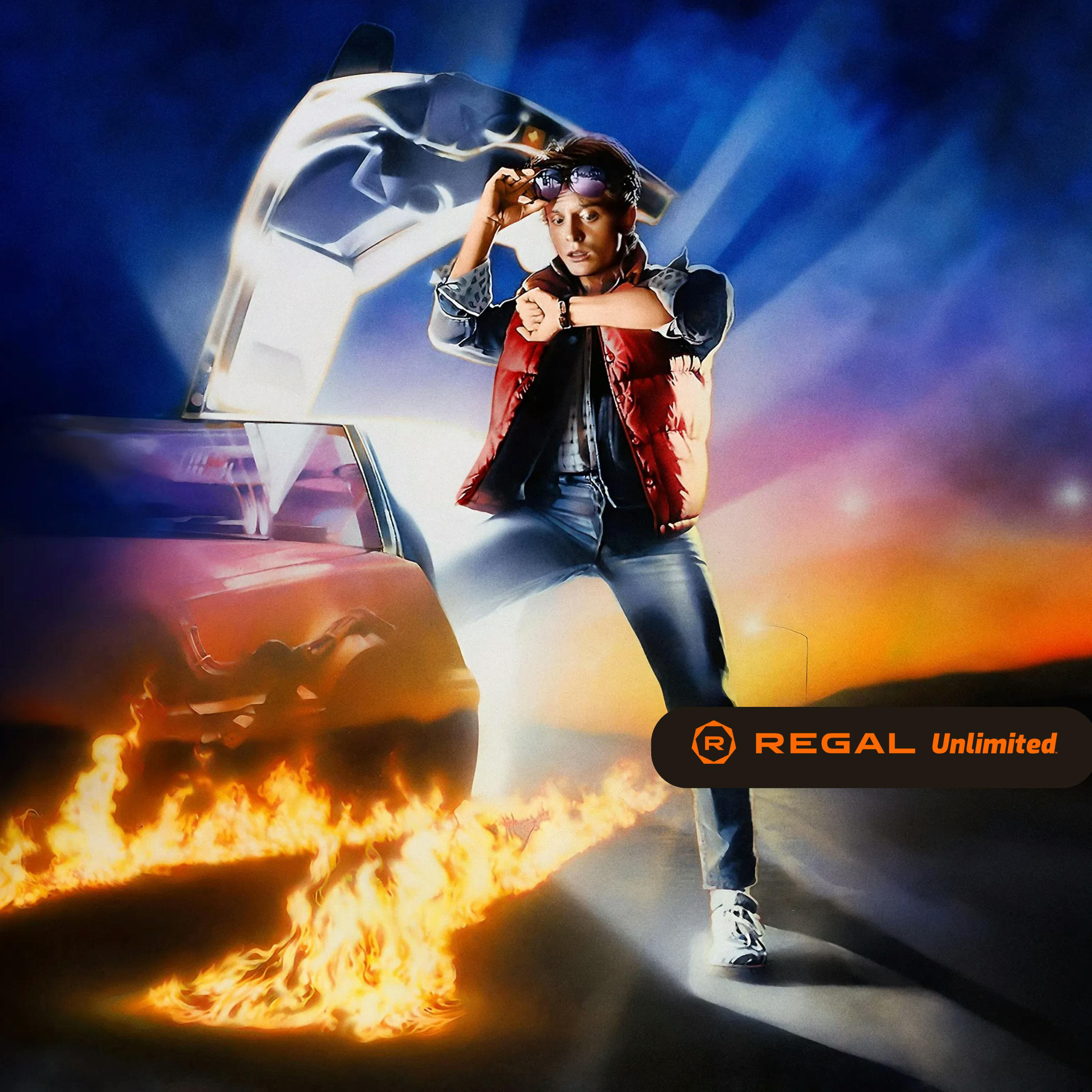
Back to the Future Review (40th Anniv.), Deliver Me From Nowhere, Blue Moon, A House of Dynamite
With BACK TO THE FUTURE back in theaters for its 40th anniversary, Adam and Josh take the opportunity to give it Sacred Cow consideration. Plus, reviews of the Bruce Springsteen biopic DELIVER ME FROM NOWHERE, Richard Linklater’s BLUE MOON, and Kathryn Bigelow’s nuclear thriller A HOUSE OF DYNAMITE.
This episode is presented by Regal Unlimited, the all-you-can-watch movie subscription pass that pays for itself in just two visits.
(Timecodes and chapter starts may not be precise with ads.)
Intro (00:00:00-00:00:56)
Back to the Future at 40 (00:00:57-00:46:31)
Filmspotting Family (00:46:32-00:51:07)
Blue Moon (00:51:08-01:08:36)
Deliver Me From Nowhere (01:08:37-01:19:01)
Notes / Next Week (01:19:02-01:26:01)
Polls (01:26:02-01:34:17)
A House of Dynamite (01:34:18-01:45:43)
Spoilers: A House of Dynamite (01:45:44-01:56:17)
Credits / New Releases (01:56:18-02:00:45)
Links:
-Poll: 2nd Best Zemeckis
-50 Years of Siskel & Ebert: "Lone Star"
-The Mastermind Prize Pack
Email us your favorite Reichardt character
Feedback:
-Email us at feedback@filmspotting.net.
-Ask Us Anything and we might answer your question in bonus content.
Support:
-Join the Filmspotting Family for bonus episodes and archive access.
http://filmspottingfamily.com
-T-shirts and more available at the Filmspotting Shop.
https://www.filmspotting.net/shop
Follow:
https://www.instagram.com/filmspotting
https://letterboxd.com/filmspotting
https://facebook.com/filmspotting
https://twitter.com/filmspotting
https://letterboxd.com/larsenonfilm
https://www.instagram.com/larsenonfilm
https://bsky.app/profile/larsenonfilm.bsky.social
Learn more about your ad choices. Visit megaphone.fm/adchoices
See omnystudio.com/listener for privacy information.
Available Results
Generated results are saved to the knowledge database for reuse and search.
Extract Knowledge
Pick what you want extracted first. Model, scope, and chapter options appear after a template is selected.
Transcript
00:00:00
Speaker 1: Film Spotting is presented by Regal Unlimited, the all you can watch movie subscription pass that pays for itself in just two visits. Sign up now in the Regal app. We're at the link in the show description and use code film Spot twenty five. That's film Spot twenty five to receive your discount. What kind of a show you guys putting on here today?

00:00:22
Speaker 2: You're not interested in armed now? No, Look, we're going to do this thing. We're going to have a conversation from Chicago. This is Film Spotting celebrating our twentieth year. I'm Josh Larson and I'm Adam Kempenar.

00:00:35
Speaker 3: This baby hits Eddie Ay, Boss Brauery, I gotta see something serious.

00:00:44
Speaker 1: Back to the Future is forty and back in theaters. We've fired up the Film Spotting custom built DeLorean and we've got a Sacred Cow review.

00:00:52
Speaker 2: Plus reviews of Richard link Later's Blue Moon, Catherine Bigelow's A House of Dynamite, the Springsteen biopic deliver Me from Nowhere, and more. It's all ahead on Film Spotting.

00:01:04
Speaker 4: All fellows, Wow, I can't kiss who.

00:01:07
Speaker 5: You guys are ready for that yet?

00:01:09
Speaker 4: But you kids are.

00:01:10
Speaker 6: Gonna love it.

00:01:13
Speaker 1: Welcome to film spotting. Somehow, Josh Back to the Future is forty even more distressing. We're a full decade further into the future than the twenty fifteen setting of Back.

00:01:24
Speaker 2: To the Future Part two.

00:01:26
Speaker 7: Still no hoverboards though.

00:01:29
Speaker 2: No hover boards. What's going on? I mean, we've got we've got the electric scooters all over our sidewalks. We've got we have electric skateboards like Marty McFly didn't have and whatever those things. I've seen guys flying around on just one wheel and they're leaning forward with motorcycle helmets. I don't know what's going on there, but I don't think that's a hoverboard either.

00:01:48
Speaker 1: No, no, we need them coming up. We both watched Richard Linklater's Blue Moon with Ethan Hawk as famed American lyricists Laurence Hart. We saw Catherine Big nuclear thriller A House of Dynamite. Will end with that one because we'll likely get into some discussion of the ending, so we'll give you a spoiler warning, but be warned. I made time for the Springsteen biopic deliver Me from Nowhere. Reviews of all of those films later in the show. We also have results and listener comments from our deeply flawed Robert Redford pull and a new poll which is asking you to choose the second best Robert Zamechis movie. A quick reminder, Film Spotting is now available as a video podcast. If you're a Spotify listener, you can toggle between video and audio, or you can watch the show on YouTube or at film spotting dot net.

00:02:42
Speaker 2: But first, Robert Zamechis's first best movie, nineteen eighty Five's Back to the Future toy.

00:02:49
Speaker 3: You want me to make a donation to the cost Card Youth Auxiliary doc.

00:02:58
Speaker 4: I'm from the future. I came here in a time machine that you invented. Now I need your help to get back to the year nineteen eighty five.

00:03:16
Speaker 6: Do you know what this means?

00:03:19
Speaker 2: It means that this damn thing doesn't work at all. Even for a time travel movie, Adam Back to the Future is unusually obsessed with time. It's not only the extended opening shot as the camera pans over the countless clocks in Doc Brown's house, or the fact that the climax involves a literal clock tower. Consider also all the instances in the movie that turn on very specific time markers, right down to the minute. Most of these are even called out in lines of dialogue, So we've got eight twenty five am. This is when Marty realizes he's late for school thanks to Docs setting those clocks to be twenty five minutes late. One point fifteen am that's when Marty is supposed to meet Doc at Twin Pines Mall. Twelve twenty eight am is when Marty wakes up in bed. We see that on his clock and he realizes he's going to be late to meet Doc. And maybe most important, eight fifty five pm, when George is supposed to come to Lorraine's rescue in the parking lot at the school dance. If you watched Back to the Future repeatedly as a kid, as I think we both did, those time stamps became ingrained in your memory. Now, for those who didn't grow up on the nineteen eighty five film, a brief primer, directed by Robert Zemeckis and written by Zamechis and Bob Gail, Back to the Future stars Michael J. Fox as teenager Marty McFly. Christopher Lloyd meanwhile plays Doc Brown, a kooky inventor who Marty helps out with various experiments. Doc's latest device, time travel machine in the shape of a Doloran race car in a I certainly sends Marty back to nineteen fifty five, where he encounters his parents as their teenage selves played by Leah Thompson and Crispin Glover. Every performance here is its own sword treasure. So within the movie's narrative, Marty goes back thirty years in the past, from nineteen eighty five to nineteen fifty five, and here we are forty years after the release of the film in twenty twenty five. I have two questions for you, Adam, and they're not inspired. We tend to ask a variation on them with most of our Sacred Coyle reviews, but given how much the nature of time is at play in Back to the Future, this particular prompt may have never been more fitting. What did you think of the movie back in nineteen eighty five and what do you think of it now?

00:05:48
Speaker 1: It is an appropriate prompt, though I'm disappointed you don't remember when I revealed this ten years ago, when we did our Top five of nineteen eighty five.

00:05:57
Speaker 7: In twenty fifteen, time is a circle. That's true.

00:06:00
Speaker 1: We were marking the thirtieth anniversary then of that movie year, a pretty bad movie year, by the way, Maybe we can come back to that. I put Back to the Future at number two, then just ahead of the Breakfast Club and behind Akira kurasawas Ron.

00:06:17
Speaker 7: Thank you.

00:06:18
Speaker 1: I have impeccable movie taste for the PostScript to that list, As we often do, we did our top five of eighty five in eighty five, and I tried to put myself back in that headspace. I was a grade schooler and I head Back to the Future at number one. I'll regalue with tales of how I showed my Back to the Future fandom later as well. Maybe I might bump it back a bit now. I think i'd still have it behind Ron. I might put it behind the Breakfast Club. I'd think about it in the mix with purple rows of Cairo Cone Brother's blood. Simple, it's definitely still in the top five, Josh, I think I can. I can safely say that, And yes to your point about time your question, it's literally one of the all time ticking clock movies, right, Yes, from the clock tower signifying the pending lightning strike to the fact that that opening scene I had never really thought about how long we sit as viewers with the camera circling Doc Brown's room, just hearing and seeing those clocks ticking and like a hundred of them then going off, all those alarms going off.

00:07:35
Speaker 7: But I'll give you a few more.

00:07:37
Speaker 1: Doc hits his head in nineteen fifty five hanging a clock. Marty is kind of a man out of time even before he goes back to nineteen fifty five, because he's always shaking his watch at the dinner table. There's a bunch of scenes of him shaking his watch. He never knows what time it is because his watch doesn't work. And Jennifer get very aggressively solicited for a donation, you remember early in the film, to save the clock tower. That's when he gets the flyer, and and I like, what what that woman says? She says, basically that they want to freeze it in time. They want to preserve it just the way it is. And and and how does how does Marty respond when mister Strickland I assume he's like the vice principal or whatever, when when he tells him no mcflies ever amounted to anything in the history of this school. He says history is going to change, and that of course, is also foreshadowing his his eventual time travel. What and this is usually what happens with these sacred cows, what makes them so worthwhile? What entirely justified this rewatch for me was connecting a couple of scenes that I had, of course watched a dozen of dozens of times before, but it never paid any attention to. I was too busy paying attention to already playing Johnny be Good and writing the makeshift skateboard and doing all those those fun things he does driving the DeLorean eighty eight miles per hour whatever. I had certainly never given any credence to these scenes or these moments. Marty says history is going to change because he's he's either so confident his band is going to pass that audition and get the gig playing the dance, or he's just able to display the false confidence that his father never can. Because what does he say after he fails the audition and Jennifer is urging him to send his tape to a record company, He says, what if I send in the tape and they don't like it?

00:09:48
Speaker 2: Yeah?

00:09:49
Speaker 1: What if they say I'm no good? What if they say get out of here, kid, You've got no future. I mean, I just don't think I can take that kind of rejection. But the key here is that is that he says, what if they say I don't have a future? Right, He's talking about history and then he's talking about the future, and then he does underline it, Jesus, I'm starting to sound like my old man. And what does Marty say to Doc when Doc thinks he's about to head out of the mall parking lot, he says, look me up. That tells you that Marty is legitimately worried about how he's going to turn out. We think of Marty McFly, even in my recollection of him, as this ultra confident, heroic, you know, high school figure, and that's how I looked up to him as a kid. But he is He is anxious, he is nervous, he is insecure, and he's afraid he's gonna turn out like his old man. And here's the part that really matters. Then it turns out he does sound just like his old man, because George does say almost the exact same thing when Marty asks him in the cafeteria, I believe what he's writing, and he explains that he's writing those science fiction stories about visitors coming down to Earth, and Marty has to say, I didn't know you ever did anything creative? And is what does he say? When Marty says, well, how come you never let anybody read them? He says, what if they told me I was no good? I guess that would be pretty hard for somebody to understand. And Marty says, A no, not hard at all. Marty assumes and he wants to be nothing like his father. He assumes he's nothing like his father, But it turns out they're both artistically inclined. They're both scared as hell Josh of others hearing or viewing their creative output and rejecting not just their art, but rejecting them because of it.

00:11:51
Speaker 7: And that no, not hard at all. And the way Michael J.

00:11:55
Speaker 1: Fox delivers it again something I completely just ignore in the past and now it really kind of hits you hard. And forty years later future back to the future is as fun as ever, but Marty's anxiety and having to confront seeing himself reflected in his father reveals a sneakily resonant story about self doubt and self discovery.

00:12:21
Speaker 2: I very much appreciated that father son rhyme and this particular psychological element that you're calling out on this watch because initially watching Michael J. Fox's Marty McFly, I didn't buy this cocky kid, right. It just didn't seem innate to the performer, let alone the role. And by initially I mean on our recent rewatch, it was something that surprised me, like you and my memory Marty was the coolest, right, And then I'm watching Michael J. Fox and thinking, you know, this doesn't really seem like him. And we can maybe get into more about the performances later. But that element that you just discussed, his insecurity about sending in his audition tapes and how it is later rhymed with George's insecurity or doubts, I thought solved that for me. It solved the performance a little bit and solved also you know, these two characters often seem so far apart, especially when Marty gets to nineteen fifty five and he's always coaxing Georgeohn. It's like, where did this Marty come from? If he came from this George, But there you just keyed in on the psychological element where they really are father and son. So yeah, I appreciated that quite a bit on this rewatch as well. So when I did first see Back to the Future in eighty five, I'm sure we've touched on this over the years on the show. As you mentioned, it was it was like my world. I mean, I was obsessed with Star Wars at the same time as well, but this felt, you know, in it's sci fi, but it's also more reality based, like a little more grown up maybe at that age. Back to the Future, and yeah, I wanted to be Marty McFly. I will credit him or blame him for the hot pink skateboard I had with the you know how the top of the skateboard had the gritty, like the black grit so you could keep your so you wouldn't slip off, right, I'll never forget that, Like the grit was like glistening somehow, it kind of glowed in the santo. Oh yeah, I just I just thought I was the coolest rolling down, you know, in crest with the streets of Crestwood. So yeah, went for this movie hugely. And that being said, haven't revisited many times in recent years. Did a ton as a kid, And what I did remember from those early viewings is something I brought up on the show, which is it was the first time as a kid I realized my parents had lives beyond being my parents, and this was huge for me at that age. You know, we did our top five lessons I learned from the movies, where I listed Back to the Future there and said the lesson was the world existed before me just opened up my own time space continuum. My parents, my grandparents, my teachers, all like, not only in the past, but in the day to day they actually had concerns that didn't involve me. Maybe I was just a particularly narcissistic kid, but I think that's something you have to realize right eventually, and Back to the Future was crucial for that. So I do think that is the movie's philosophical genius, and I do think this is why Back to the Future genuinely needs to be regarded honestly as a work of philosophy. This is about humanity's understanding of ourselves in relation to time and how everything, our relationships, our self identity, which is what you were just touching on a little bit there, our desires, our dreams all defined by time, right, And the reason I respect Back to the future so much is because this is not this quality is not just a side product of like a high concept like what if we send a kid back in fifty five and he ran into his parents, you know, you'd probably still maybe have some of these thoughts. But in Back to the Future, the filmmakers have embedded this existential idea into the movie's conception and also execution. And I want to credit the screenplay here buys the Mechas and Bob Gail, because it continuously balances that adventure slash sci fi element, the one we loved as kids, with this personal slash existential element that we've both already touched on. And here's a clear instance of how they do that. When Marty first arrives in nineteen fifty five, after he gets you know, out of the barn and gets to the town center, he goes to the diner and what happens. He runs right into his father and he sees Beth boeing.

00:16:40
Speaker 5: Hey, McFly, what do you think you're doing? Hey, I'm talking to you, McFly, You Irish bug? Pah Hey this hey guys.

00:16:52
Speaker 3: How are you doing?

00:16:53
Speaker 6: You?

00:16:53
Speaker 5: Got my homework finished?

00:16:54
Speaker 4: McFly?

00:16:55
Speaker 2: And so right away the screenplay gives us an instance where the science fiction immediately becomes personal and all of a sudden, this is about more than the possibility or the rules of time travel. It's about what it means to Marty's actual personal life, and I think maybe a BacT to the future. It doesn't always get credit for having this sort of depth I'm talking about. It might be because and here's my other realization, which is the dumbest realization in the world. You already touched on it on this rewatch. This movie is so freaking fun. I mean, philosophy is not supposed to be this much fun, but this movie is a blast. From the pacing, to the imagery, to the performances to the ideas, It's just an incredible thrill ride with a depth that you know, not all the thrill rides of the eighties necessarily gave us.

00:17:48
Speaker 1: You mentioned that moment when it instantly becomes personal, and the way Zamechas shoots that also so nicely reinforces that. And I don't have the exact breakdown of it, but if you've seen the movie recently, and this was the first rewatch for me, Josh since I was a kid. Now I watched it enough times as a kid too to last a lifetime. Sure, But but I can I can remember how he he reveals the way Marty turns as he almost feels George's presence, right, or or something about that, that moment where Biff walks in and he has to turn. But it's the fact that when he turns to look and then their faces in that moment almost aligne in a way that you realize that that there is a symmetry between them.

00:18:39
Speaker 2: It's right almost.

00:18:41
Speaker 1: I was gonna say it borders on Bergmann as close to as close to Bergman as the mechas gets. That's there in that shot. You're exactly right, and and I really appreciate that. And I'll give you another a counter to that. That's that's more fun, but a nice bit of visual flare that that is obvious, but I had never paid attention to before. When, of course Doc Brown says we're gonna send you back to the future, what does he do? He says that, and he makes that sweeping gesture, Yeah, breaking the fourth wall, looking right at the audience, looking right at all of us who were there in the there in the future.

00:19:22
Speaker 2: If we could somehow harness the lightning.

00:19:26
Speaker 6: Channel it into the Fox capacitor just might work.

00:19:33
Speaker 4: Next Saturday Night where sending you back to the future.

00:19:38
Speaker 7: I'll go back.

00:19:38
Speaker 1: Since you talked about having the skateboard, I was never I was never a skateboard kid.

00:19:43
Speaker 7: I just couldn't. It seemed like too much work to me.

00:19:46
Speaker 1: I suppose I wanted something motorized, and so it was something I never got into. Not even Marty McFly could get me interested in skateboarding. For me, it was, of course the music angle and I've I've shared this before, but it's been at least ten years. This wasn't the movie that inspired me to want to pick up a guitar or a bass and be in a band. I had already seen the Buddy Holly Story fifty times, but it surely contributed. The year after this movie was released is the year my band got together. The band I still play with like once or twice a year. We started the year after this movie came out. We practiced for the first time the fall after this movie, So just two or three months, Josh after this movie was released. I don't know if you remember this or if your family ever watched such vulgar fair, but it came on, but there was a show on in nineteen eighty five. I don't know how long it lasted. There was an early version of lip Sync Battle, effectively called Oh on the Hits, Putting on the Hits. It was realised. I want to say, I could be wrong. I meant to look this up. I want to say that maybe Adrian Zahmed was the host of it for a while. It competition show like Star Search where people lip sync to songs and they got judged on their lip syncing.

00:21:12
Speaker 7: The shame down and.

00:21:21
Speaker 1: It's like October at our grade school, and our classroom decided to have some kind of you know, fall conference with our parents, you know, when we had to put on a show, and we did. We did Putting on the Putting on the Hits, our version of Putting on the Hits, where different groups lip synced, and I got my dad's guitar out. I didn't know how to play it. I found all the clothes I could, including the life preserver. I tried to get a vest like Marty, you know, and I got out there on stage with with on stage in the classroom with some other people and we played Johnny be Good and Josh wo the guitar solo. When the guitar solo came on, I got down on my knees. I imitated. I did the entire imitation that I did, the imitation of Marty imitating Chuck Berry I did there in the classroom. And then the code of this story is then later that next summer, there was a we had this thing growing up in Grenell called Happy Days. They may still do it, you know, very Hill Valley. We would get together in the town square and whatever. And there was a stage where they did a lip sync contest. I guess that's all we could do for creativity back then, and there was a prize and all this stuff. We did Johnny Be Good, and I was doing my guitar thing again, but I think I was even doing the singing the singing too, and we said, we're doing Johnny Be Good, Josh. They played the Chuck Berry version of Johnny Be Good, not the movie version. We didn't even think about that. And of course you were very different, completely lost, no big back to the future, guitar solo, no nothing. It was a disaster. Needless to say, we didn't win. So, yes, I was you imitated to him as a skateboarder. I imitated him as a guitar player, and it set me down the path as a musician.

00:23:24
Speaker 2: In my case, skateboarder is a strong term, so he was probably as much of a skateboarder as you were a guitarist at that point.

00:23:30
Speaker 1: Yeah, and as a lip syncer. I suppose where I'll go with this is how about what do you make of Michael J. Fox as an actor here? Because of course at this time, I was very much a family ties watcher, and I enjoyed him very much as x P. Keaton on that show and famously he replaced Eric Stoltz. And I enjoyed Eric Stoltz as an actor in the eighties with Lea Thompson in a movie like Some kind of Wonderful. And I know he could play now that I'm talking about the Marty McFly character as someone who's insecure and anxious and actually a little bit of an outsider, even though we don't think of Marty that way, you know, er Eric Stoltz could play that. But Zamechis has always said Eric Stoltz was doing a fine job. There was just something that he wasn't bringing to the character that didn't feel right, and as soon as is Michael J. Fox got in the role, it did feel right. And what I don't know if it is that that anxiousness, that anxious quality and that little bit of insecurity that the character needed. He was twenty three during filming, obviously way older than the character was. But the casualness, the comedic chops that he has. The casualness, for example, when when Doc Brown in that opening scene says, oh, you know, by the way, be careful with the speakers. They might overload, and he says, I'll keep that in mind. The way he can casually deliver a zinger like that, The the bug guys that he makes when when Lorraine says You're beginning to sound just like my mother to him, you know, and the physical comedy bits too when he falls over putting on his jeans in her bedroom, and even funnier when he falls over at the end when his parents walk in and he can't believe the sight of them. Those are all those, Those are all moments where I really appreciated Fox as a performer in this film.

00:25:32
Speaker 2: Yeah, I think you hit all the right the right examples, and the key maybe the distinction with Stolts although Stoults could do comedy, can do comedy for sure, but yeah, casual comedic chops. The way you put it is exactly where mind was. My mind was going while while watching him here. And you know this, I think this does come for being honed some on a sitcom like Family Ties, because you need that precise line delivery. But it also has to come across when when actors are doing their best in those scenarios, it is casual, it isn't prescribed. That's when sitcoms are really bad, right, is when when it's just reciting the jokes and Fox is doing so much more here. As you also said, the physical comedy is key. You called out some of those key moments. I always like the one in the car scene with Lorraine, which we're gonna get back to, but where he's desperately trying to avert his eyes from her dress, and then there's that hilarious moment where he fails. It's and then Fox's face of just like utter bewilderment.

00:26:36
Speaker 6: And shame, Marty, Why are you so nervous?

00:26:43
Speaker 3: Rain?

00:26:45
Speaker 7: Have you ever.

00:26:48
Speaker 4: Been in a situation where you know you had to act a certain way, but when you got there, you didn't know if you could go through with it.

00:26:54
Speaker 6: Oh you mean like how you're supposed to act on a first date.

00:26:57
Speaker 4: Oh, sort of.

00:26:59
Speaker 2: I think that Fox is really good. I want to go back to some other performances too, but quickly before we maybe move away from the visual stuff. I want to go back to the persona shot we talked about in the diner. I'm so glad you called that out because one other revelation for me about why I really do revere back to the future so much on a filmmaking level, not just this philosophical or even entertainment level, is because I think it has something. I'm trying to think of a way to describe it. Because we talk about mes and sen in like fancy movies, right, how things are arranged within the frame, And I think, what's mechas, what za mechas manages here is something that's more like pop iconic means and sent and by pop iconic I mean particularly the use of the frame, particularly within the context of an engaging popular narrative, but in a way that will then create a lasting image in the popular consciousness. And you just you just demonstrated this Adam like even it wasn't like necessarily the precise description, but that move, that moment stuck in your mind, where George is sitting at the diner counter looking at the kitchen basically, and we see him in profile. Marty sits next to him, and then Marty recognizes who he is, and we watch his recognition because Marty's face shifts to the left of the screen past George's profile, and we have Michael J. Fox great acting here too, just like his mind being blown in the way the movie was blowing my mind at the time. And Zamechas captures this in that one image that has lodged itself in both of our heads quickly. A couple other of these pop iconic Mesan sent the tire track flames between Marty and Dock's legs when the DeLorean disappears on the test runt right, just the perfect searing image, and we get a reverse shot that complements it, of the license plate spinning on the ground between them. I would include maybe the fading photo in Marty's hand, although it's something more of an insert shot, less about necessarily the framing but than the effect. And then let me give you maybe my favorite one last one here we're back to the diner. This time the camera is looking out through the diner windows at the town square. And this is the big chase scene where Marty makes the makeshift skateboard. Biff Yes and his buddies balls.

00:29:29
Speaker 7: The skateboard in that moment suggests.

00:29:31
Speaker 2: Skateboard exactly, yeah, hanging on to the back of the pickup truck, and Zamechis frames the camera here moving alongside Marty through the window of the diner, So essentially the camera's moving along the diner counter from right to left as the truck out the window is doing it. And the camera comes to a stop right on the rain space. As Marty has left the screen. She turns to the frame and says, He's an absolute dream.

00:30:00
Speaker 1: It's an absolute dream.

00:30:02
Speaker 2: I mean, that's yeah, that's cinema magic, the staging. That's perfect stage right it is.

00:30:08
Speaker 1: And and I'm so glad you mentioned that moment too, because I didn't want us to move on before I got a chance to say that. That chase scene too, it couldn't be more opposite in terms of its scale from something like the Indiana Jones movies we were enjoying at the time as well. Think about Raiders the Lost Arc. Sure, but watching it again, this time, watching Marty on the road being chased by Biff and his thugs on that skateboard, with that Alan Silvestri's score, which has little hints, little remnants of the Raiders score in it. It to to us as kids that age, it actually feels as big and as grand and as important as as Raiders of the Lost Ark. The stakes of that are as high in that chase scene as that's how invested we are in market.

00:31:08
Speaker 2: Personal right now. In some ways they're more personal because of the Lorraine element exactly.

00:31:13
Speaker 1: Yeah, So that that scene, I was really like, wait a second, why why do I feel like I'm watching Indiana Jones in this scene?

00:31:20
Speaker 7: This is incredible. I really felt it.

00:31:22
Speaker 2: And Dean Kundy, we should say, since we've been talking about a lot of the camera work, the cinematography here working with Zamacus, Yeah.

00:31:29
Speaker 7: Absolutely.

00:31:29
Speaker 1: Now I'm going to bring up the thing that, of course I certainly never thought about back in the eighties, because I was not processing back in the eighties to what extent during that decade, Josh, we truly were actually living our parents decade through pop culture. The eighties were actually more like the fifties, and we can only look back on that and realize it now. Back to the Future was part of a wave of films that we're doing that we're looking back to the past and our culture, our culture politically, it wasn't just our pop culture that was doing it. And we're going to talk about Blue Moon in a bit. And in that movie, you'll hear Lorenz's heart say, and I may not be getting the quote exactly right, but he says, there's nothing.

00:32:18
Speaker 7: Wrong with Oklahoma other than.

00:32:19
Speaker 1: The fact that it's nostalgic for a time in America that never existed. And I thought, wow, every time coincidence spotting comes through, because whether it affects how you feel about the movie or certainly how you feel about Back to the Future as entertainment, I think we at least have to talk critically about the fact that Back to the Future, like so many eighties movies, appears to be nostalgic for a time in America that never existed, which is problematic when the dominant political statement of that period was make America great again, which it was under Reagan. And Doc himself says, you know, in that moment, that funny moment the actor like he's president. But that was the case, like Reagan was all about just trying to revert back to the fifties.

00:33:03
Speaker 7: Let's let's go back to this.

00:33:04
Speaker 1: Fantasy version of American life, these these apparent glory days where we'll overlook things like racism and sexism and economic inequality and whatever pollution. We can go on down the go on down the line. And it was the juxtaposition here again never paid attention to these things really before. But the way Hill Valley is depicted in the future, Yeah, I mean, let's let's even look at things like, of course, the family things, Lorraine drinking vodka at dinner, just straight up drinking vodka at dinner, and the fact that the family lives in a crap hole of a neighborhood, it seems. But the town square itself is pretty dilapidated, right, it does not looked like a good graffiti.

00:33:46
Speaker 7: All this stuff. And Josh, I don't know if you noticed.

00:33:48
Speaker 1: Did you see what movie is playing on the Marquee Porno It's it's orgy American style. There is porn and it says triple X, Like apparently Hill Valley is Norman rockwell By way of Travis Bickell, you know, like what is going on here? And and one of the parts in this, in this bad version of Hill Valley, which is the present version, Goldie Wilson is the mayor. Goldie Wilson's the mayor, and and he's he's because he's supposed to be re elected. So apparently even though in the past it's like a triumphant thing that Goldie's going to be mayor, he's apparently not doing a very good job because Hill Valley seems to kind of suck. And when he goes when he goes back to the past, what's the past? The past is indeed, as the slogan of Hill Valley says, a nice place to live. It's idyllic with with Ronald Reagan up on the screen and Barbara Stanwick on the marquee and mister Sandman is playing, and there's green grass and there's blue skies, and you know, if the the other the the other part to this, of course, that that if you really want to extend this line of line of thinking, if you were one of those people that ever made a joke about seb and La La Land being really really into jazz for whatever reason that that was something you made a joke about. You have to be just apoplectic about the suggestion that Marty invented rock and roll right.

00:35:13
Speaker 7: In this film.

00:35:13
Speaker 2: Rough.

00:35:14
Speaker 1: So yeah, and it does just to just to conclude this, the movie does what a lot of movies of this period and even movies from now do that go back and look at historical moments from the past and extend this kind of fantasy version is there. There are examples of chauvinism, there are examples of racism, but what they do is they encapsulated all in obviously evil characters like Biff and his thugs. So it makes it seem like it's easy to overcome. We know who the easily identifiable evil people are, so we can all as viewers go, oh okay, well we feel superior to them. And it really wasn't about any larger systemic things. It was just a few bad apples.

00:36:00
Speaker 2: Yeah. I think it's the what you're describing is it makes it feel like the movie is gesturing towards those concerns, right, yes, and maybe not fully invested in them or taking them seriously. I had similar thoughts watching it, And Yeah, the Mayor Goldie thing was kind of a real red flag. Goldie played by Donald fully Love, who we meet in ninety fifty five, says I'm going to be the first black mayor, right when he's working at the diner, and yeah, what does that mean that they represent? As you said, his mayoral stretch is coinciding with this dilapidated version of the town that's not great. I do think that while it's not thoughtfully and fully considered, the inclusion of things like racism or chauvinism, or even the fact that rape, you know, was a real thing in nineteen fifty five, I think that does puncture the make Americ Great Again sensibility that is partly at the heart of back to the future. I think overall that's a correct reading that it's looking back to the past as so much as the eighties did in a way that yes, never existed, but in our minds, in some people's minds does. I was glad to see that it was at least complicated by the fact that, you know, Lorraine is really almost physically assaulted, and that this was something that women had to deal with. Then it wasn't just you know, everyone courting peacefully and marrying and having babies, and so I think there's a little complicating of it, but over overall it is something that held me back on this rewatch. I think the Johnny Be Good thing is just terrible. I mean, to me, that's the black eye of Back to the Future, because at first, I'm trying to give this movie as much credit as I could, and I'm thinking, Okay, maybe this is so glaring what's happening here, especially to our eyes in twenty twenty five. Is it possible that even in eighty five they were thinking of this as as a bit of meta commentary on white appropriation, Like could the people involved have been smart enough to say, we're gonna make this so ridiculous by the performance that already gives doing the Johnny Be Good song, that we're kind of winking at how ridiculous it is. But when they use the punchline of Marvin Barry, who's the leader of the band, calling his cousin Chuck and holding the phone out, that's when I was like, Okay, no, they just think this is funny and it's not great, not a great choice.

00:38:33
Speaker 1: Yeah, yeah, and no, I take your point. But again, just to make sure I'm clear, I think the issue for me is that throwing a nod to sexism by depicting a scene like that, by doing it through Biff and making it seem like it's a one off. It's a one off through an obviously despicable, almost cartoonishly despicable character, while otherwise not depicting any kind of inequality between men and women. Otherwise, it makes it seem like nineteen fifty five was perfect other than one bad guy, you know, And that was the problem is depicting that past as if it was, as if there was truly this perfect time in America, which of course, and that we need to revert back to it, back to the future. They fill gesture. It fulfilled that vision. Unfortunately that so many films of the of the eighties ultimately did it fit right into that scheme. I was certainly aware of that as I watched the film this time. The effects in the film not something that certainly derailed the movie for me. I remember watching it early on and thinking, how did they pull off the moment where where Marty gets blown back by the speaker as practically as they did. However they pull that off is so effective. And then you mentioned the iconography of the flames. Though that's a fairly bad optical effect looking back on it now, right when the when the fire goes under their legs, you.

00:40:07
Speaker 2: Can tell you there are some shots where they're actual flames, and then you can tell there are others where they've they've had to Yeah, gussie it up.

00:40:13
Speaker 1: Yeah, though you know it is. This is one of those things. Not I'm really not trying to go back to the previous point. It's more just how sometimes movies from the eighties, when we look back on them now, things that we just take for granted, things that never occurred to us then seem kind of insane to us now. Back in nineteen fifty five, make no bones about it, Biff tried to rape Lorraine in a car in the parking lot of a high school.

00:40:44
Speaker 2: Yeah, that's what I'm saying.

00:40:45
Speaker 1: The Okay, but listen, and in the future, he's hanging around the house, you know, like he's in a subservient role to George, but he's still just hanging around the house.

00:40:58
Speaker 2: Yeah. I want to marry either. I think I'd rather just be done with Beth.

00:41:02
Speaker 1: It just is so crazy that that that that occurred, and we're just like, yeah, now we're all just laughing about the fact that he's wax in the car.

00:41:10
Speaker 2: So let's let's talk some more about Lorraine, because I do wanna You know, this is a performance I've I've hailed on the show. I think top five mother son relationship movies I had at number one, and just endlessly amused at how Leah Thompson is so brazen in this worle just how instantly aggressively horny she makes Lorraine when Marty's in her bedroom and look in words and gestures, do you mind if I sit here? And you know, again going back to this mind blowing concept, Uh, it's not just you know, the possibly that maybe your mom was a sexually active teen, right, maybe she was one of the most sexually active teams. This is this is what the Thompson performance digs into. And it's also a very like Michael J. Fox, very physically comic performance when she's he's already show up at school, how she throws herself back against her locker and the whole I went on at length in our Top five Scenes in Cars about the sequence with Lorraine and Marty at the dance in the car. It was my number one pick and Thompson here just transitioning from comedy to tenderness. That expression on her face when she realizes the kiss doesn't quite feel right. I mean, this is just again one of those gems of I think every main performance in this movie is a gem, and this one is still my favorite.

00:42:31
Speaker 6: I think I know exactly what you mean. You do know what I do in those situations. What I don't worry.

00:42:58
Speaker 7: This is all wrong.

00:43:01
Speaker 6: I don't know what it is. But when I kiss you, it's like I'm kissing my brother. I guess it doesn't make any sense.

00:43:12
Speaker 4: Doesn't believe me, it makes perfect sense.

00:43:17
Speaker 1: It may not be quite as strong because of the artistic element and that being so crucial to Marty and that male bond, I think ends up being a little bit more important. He spends more time with George, But there has to be a symmetry, right, He has to discover something. He has to see something in his mother, to your point about recognizing that she's a person too, that she has someone before she was his mother, and that she was someone contrary to his vision.

00:43:47
Speaker 7: Of her early in the film.

00:43:49
Speaker 1: Early in the film, she's the one talking about how you have to behave a certain way you have to be a prude essentially with boys, and then come to find out she's exactly the opposite of that.

00:43:59
Speaker 2: Right.

00:43:59
Speaker 1: So the fact that we get that that depth, and we get that additional layer and that symmetry with the with the characters is a really nice touch with the screenplay and and just in terms of fun moments to satisfying screenplay and and visual payoffs. The of course, the punch, the McFly punch of the Yeah, the way the camera just lingers on the two of them as she takes him in and that moment is extremely satisfying.

00:44:43
Speaker 2: Yeah. Yeah, it's a nice touch just to quickly touch on the other performances. Christopher Lloyd here what I appreciated this time just how he plays Doc's excitement and mania first and the comedy of the moment second. You know, you could you can think so many actors who would just go for the jokes, because almost everything Doc says is funny. I love to Thank God I've still got my hair. His reaction to see the video from nineteen eighty five. I don't know if anyone else in the world would want that hair, but he's happy he still has it. But yeah, overall, Doc is playing the character first and the comedy second, and then Crispin Glover just a living, breathing, apologetic shrug, just incredible.

00:45:28
Speaker 1: Ye had a real person too, Yes, Yes, both both wonderful performances. And my wife was watching it with me, and Sarah said, and I've heard a little bit of this over the years, but she said she just saw something recently about Crispin Glover saying that he kind of renounces this performance or something. I don't know if you've seen that, which I don't know, not that it matters, but what a shame if that's true, because he is. It would be so good. He's so good in this role. Anything you want to add or have we done the talk?

00:45:58
Speaker 2: I feel like we did it justice. Yeah, it was a really it was a more fun revisit than I even could have imagined. I think that fun element is what popped out at me, perhaps because I've been taking it too seriously in recent years, that it was. It was good to just sit with it as a movie ride.

00:46:17
Speaker 1: Sure, and for me a little bit of the opposite still had the fun. Got to take it a little bit more seriously than I ever had before. Back to the Future is back in theaters this weekend. Take it in on the big screen if you can, including some IMAX screens. It's also available VOD on most platforms. I'm sure you've got a beta max copy somewhere VHS LaserDisc. Maybe if you've seen it and agree or disagree with our takes, we would love to hear from you feedback at filmspotting dot net and we may share some of that feedback on a future show. We're talking about, seeing Back to the Future back on the big screen. You can see it in Imax. You can see it in four DX at Regal Cinema right now, coming soon at Regal. Die My Love the new one from Lynn Ramsey Christy. I'll talk about that a little bit next week, starring Sydney Sweeney. One we're probably not going to review, but would be good to see on the big screen. Predator bad Lands, You've got Nuremberg coming very soon. And hey, if Blue Moon doesn't give you your Ethan Hawk fix, maybe you haven't seen it yet. Black Phone two now playing at Regal Cinemas. And you can see any of those movies for free with Legal Unlimited, the All you can Watch movie subscription pass that pays for itself in just two visits. Right now, Regal is offering our listeners endless movies for less. All you have to do is sign up using code film Spot twenty five to get ten percent off a three month subscription. Regal Unlimited is the only truly limitless movie subscription pass. You can see any standard two D movie anytime, no blockout, dates or restrictions. And with Regal Unlimited, you won't just save money on tickets, you'll also save on snacks numbers. Get ten percent off all non alcoholic concessions. Sign up now in the Regal app or at the link in the description and use code film Spot twenty five that's film Spot twenty five to receive your discount.

00:48:21
Speaker 8: This episode is brought to you by Peloton break through the busiest time of year with the brand new Peloton Cross Training tread Plus powered by Peloton Iq. With real time guidance and endless ways to move, you can personalize your workouts and train with confidence, helping you reach your goals in less time. Let yourself run, lift, sculpt, push and go. Explore the new Peloton Cross Training tread Plus at Oneploton dot com.

00:48:46
Speaker 2: Well Listening is the number one thing you can do to support an independently produced show like Film Spotting. There are a couple of other things you could do to help us out. Just take a minute to give us a rating or a review on either Apple Podcasts or Spotify. You could do it in both places. And maybe you're a new listener, please leave those first impressions. If you've been listening to us for twenty years, we'd love to get your thoughts as well. Every new review we get does help us reach new listeners. Now. The most substantial way to support us, however, is to take that step and join the Film Spotting Family, and you can do that at filmspottingfamily dot com. We want to thank advisory board member Andy Bucati from Kansas City. We know Andy because as an advisory board member, he gets to join for those quarterly meetings that we have with the advisory board. If you are on letterbox and you'd like to follow Andy, you can find him ab u ka t Y.

00:49:42
Speaker 7: Andy is basically our boss. That's what that means.

00:49:45
Speaker 2: That's kind of how it works when you're at the advisory board level.

00:49:48
Speaker 7: Yeah, that's right.

00:49:49
Speaker 1: Andy writes that he found the show during the Pandemic via an Apple podcast recommendation based on other movie podcasts I was listening to at the time. There was no specific episode that kept me listening. It just quickly became apparent that this was the perfect movie podcast for me, based on the hosts rapport and sensibilities, obviously thoughtful preparation for every episode, how sadly rare, Andy says, and the balance of insightful and fun segments.

00:50:11
Speaker 7: Well, thank you. Andy.

00:50:13
Speaker 1: Realizing there was an archive that went back to two thousand and six was like revisiting Christmas Morning as a six year old. I've been gradually going back year by year, and I'm currently on twenty eleven.

00:50:22
Speaker 7: A favorite review Yeah.

00:50:24
Speaker 1: Only it's gonna go downhill quick, Andy, I mean it's gonna get rocky. Josh is joining soon. Favorite Reviewer segment. Two of my all time favorite directors now are Agnes Varda and Luis Bounouel.

00:50:34
Speaker 7: How about that.

00:50:35
Speaker 1: I hadn't seen a single film of either of theirs until I followed along with and went way beyond your wonderful marathons.

00:50:41
Speaker 7: That's what it's all about, Josha.

00:50:42
Speaker 2: I love hearing that.

00:50:43
Speaker 1: Well, we don't love hearing this a review we got wrong m Night Shyamalan's Trap.

00:50:48
Speaker 7: Sam knows.

00:50:51
Speaker 2: Sam's traparatingly Yeah, yeah, what was it for? Did he go four on Trap? Four stars?

00:50:57
Speaker 7: Yeah?

00:50:58
Speaker 2: See, this is one of the great things about having the three of us involved. No matter how insane your movie opinion, there's a chance one of us might.

00:51:06
Speaker 7: Share it is crazier.

00:51:07
Speaker 1: Yeah, Letterbox top four almost famous, my wife's and my all time favorite comfort movie. Something we share with each other when we're being uncool. Here here Moonlight, le bon Air, there's Varda, and yes, how about this National Lampoon's Christmas Vacation. Andy provided wonderful recommendations or insights into these picks, but we're a little strapped for time.

00:51:27
Speaker 7: Sorry. Andy.

00:51:28
Speaker 1: A favorite movie he revisited recently. You'll appreciate this, Josh Rear Window, still a five star classic, always in forever, right, all right. A random filmmaker he loves Selene Siama, great choice. A movie he credits with becoming a cinophile is Jane Campion's The Piano Man. Some of my favorites there and just slugging him, just hitting him out of the park. A book about movies or movie making Inside Oscar by Mason Wiley and Damian Bona. You know when you pour through a one thousand plus page tome on the history of the Academy Awards, despite having other pressing obligations, there's probably something wrong with you, and you've confirmed a passion unashamably, unashamedly enjoyed this history lesson. We thank Andy for being an advisory board member, a longtime listener, and for going back through the archive. In addition to keeping us doing what we're doing, your support does come with perks. You get to listen early in ed Free, you get Sam's weekly newsletter, you get to be part of the Film Spotting Family Discord, and other exclusive opportunities like you get to listen to monthly bonus shows that Discord is hopping with over four hundred Film Spotting Family members, and the October Bonus Show. It's going to drop very soon. In fact, by the time some people hear this show, they may already have that October Bonus in their feeds. As we're recording this, Josh, we have just finished taping the Tom Cruise Draft with Film Spotting Family members. Zach Cook, how do you think it went well?

00:52:58
Speaker 2: I mean, Zach gave me a lot of trouble Zach kind of did. I came in with a plan that I thought was gonna work perfectly, and then Zach appeared.

00:53:06
Speaker 1: Yeah, and you inflicted great pain on me. You took it out on me.

00:53:09
Speaker 2: I didser elsewhere.

00:53:13
Speaker 7: Yeah, so I have to be mad at Zach.

00:53:16
Speaker 1: I think for that it was great fun and you will find it in your feed very soon.

00:53:20
Speaker 7: Learn more.

00:53:21
Speaker 1: Film spotting Family dot Com.

00:53:25
Speaker 4: A big smile.

00:53:28
Speaker 2: We write together for a quarter a century, and the first show.

00:53:32
Speaker 7: He writes with someone else is gonna be the biggest hit he ever had.

00:53:35
Speaker 2: Am I bitterer already? Yes?

00:53:38
Speaker 1: One new Richard link Later movie is great news too. I think is even better. Nouvelle Vague his new film about the making of Gadar's Breathless that comes to Netflix Josh on November fourteenth in theaters now sadly mostly empty ones, it seems, is Blue Moon, his ninth collaboration with Ethan Hawk. Hawk plays songwriter lyricists Lorenz Hart, who with Richard Rodgers wrote some of the greatest songs of the twentieth century. The Lady is a Tramp, My Funny, Valentine Bewitch, Bothered, and bewildered hundreds more, including the song that gives the movie its title. The film's setting is March thirty first, nineteen forty three, at the famous Broadway restaurant Sardine's. It's opening night of Oklahoma exclamation point, as his character is always eager to add on. It's Richard Rodgers' first collaboration with someone other than hearrt, and yes, goes on to be a massive success, the likes of which Rogers and Heart never had. Rogers is played by the Great Andrew Scott. Margaret Qually is the Yale co ed that the bisexual, forty seven year old alcoholic Heart is obsessed with Josh. It's a link later, It's It's hak monologuing about language and theater and love. It's a movie about a self destructive artist. If there was ever an Adam movie, this would seem to be it. It checks all the boxes. I'm gonna let you go first. What did you think of Blue Moon?

00:55:08
Speaker 2: Yeah? I think it's pretty self evident. Who's going to really really go for this one? And I did like it and who might not quite as much. I think the litmus test if you're looking for one, if you're unsure where you are. How you felt about Ethan Hawks Jesse in Before Sunrise. You know, this charming, this philosophizing but desperately needy character, I think is maybe a good bar for how you'll feel about hanging out with Hawks Lorenz Heart. I mean they're miles apart in so many ways. Hawks really ladled with some pretty grotesque I think makeup and hair work here, so he doesn't look anything like himself, but there is this strong spiritual resemblance that just hit me as soon as Heart kind of walked into this bar, sat down and started monologuing, launching into these self serving stories and does some Casablanca impressions. It's sort of imagine Jesse if he grew up older but hadn't been challenged by Julie Delpy's Selene is how I thought about it. And so if that's you know, if you want to see that sort of character, he's given full rain here. This is almost literally a one man show, and then you'll probably enjoy it. And I definitely did appreciate Hawk's performance. I mean, you can't get around the level of like technical proficiency he's displayed by becoming this character and juggling all of the dialogue and the impressions, as I said, and the singing, and you know, you can't help but be impressed by that. Now there's another guy we didn't mention there in the setup who's in this bar, kind of tucked in the corner, trying not to be seen, and it's EB White and E B White. You know, I know a little bit more about EB White than I do the musical theater background that the movie also swims in, so maybe this is why I was drawn to him. But I was also drawn to being not the Heart who comes into the bar and regales everyone, but the guy in the corner who's like, oh gosh, I hope this guy doesn't look my way. And that's what happens, and then Heart kind of comes in and barges in on EB White space EB White, editor you know of the Elements of Style, and also author of Charlotte's Webb and Stuart Little, so I kind of fell to ad him watching this a little bit like EB White hiding in the corner hoping Heart would move on. White comes around and is very polite and inspired me to do the same and open my heart to this this movie and this Hawk performance which I think helped me appreciate it as much as I did, even though I'm going to say I'm fairly confident, not quite as much as you did.

00:57:48
Speaker 7: Yeah, this is one I want to put away for later.

00:57:51
Speaker 1: I'm not going to say too much because it's going to come up again. We're already in the end of your swing and it's definitely going to come up again. I do love this film, and I like I like the metaphor you're going with seeing yourself as Eb White, though I think you're being maybe a little bit disingenuous is the wrong word, But I think you're maybe being a little hard on on Heart or or misreading it a little bit in that in that E. B. White is in the corner, but he didn't put himself in the corner. He starts in the corner. That's where he is when Heart walks in, and that's that's.

00:58:28
Speaker 2: The seat someone like that character would pick. That's what I'm resonating with.

00:58:31
Speaker 1: Yes, I get that, And and you do think maybe he's going to be a little bit resistant to a character like Heart because he seems very bookish, and he seems very private, and he seems like maybe he just really wants to to have his time. But there there conversations together. They clearly are kindred spirits, and their their and there, and they're their appreciation for for language and and for life. They share something there in those scenes that I guess all I want to at least say to the audience listening if they haven't seen this movie yet, is what I never sensed. And you aren't necessarily saying this, Josh, but I just at least want to get out there. What I never sensed from the White character was any exasperation, and I thought that might come through.

00:59:24
Speaker 7: Yeah, I didn't feel it.

00:59:25
Speaker 2: Yeah, I'd agree. And Patrick Kennedy, if I haven't said this yet, plays White so good, and it's such a wonderful performance. Because of that, I think there's a note there at the beginning where you can tell, at least this was my impression, he would have possibly been very happy if Hart had just left and not noticed him. Right, So once they do engage, he does open up and they do make those connections you're talking about. I also think, you know, in the performances defense in terms of Hawk and the movie too, is that very self aware of all of this, that it is this somewhat over bearing presence, right and that and and Before Sunrise had that self awareness as well about Jessica. So I think that's to both movies credit, is that they recognize this quality in the character. This isn't something they're not they're not aware of. One more last white thing is I am a little insulted that they imply in that conversation that Heart's sort of drunken story about a mouse in his apartment is what inspired Stuart Little. I mean, come on, you know you didn't need to go that far.

01:00:29
Speaker 1: This this bothered Sam too. He hated it, though only because it's so bad. He thinks it's cutesy. Indeed, and I like it. It just it it means nothing to me. It just I don't see the reason to be offended by it, I guess is my is my issue with it. But because the whole movie is such an invention, It's such an artificial Every aspect of it is an artificial invention. So and I actually like the I like the story he tells the leads to that, And I also like the idea. I love the idea of way it shows how art for both of those artists, for all artists, is such a such a bit of thievery. It's always about not stealing from other artists, but from stealing from life, stealing from every interaction that you have. It's a representation of that. So I didn't mind it.

01:01:18
Speaker 2: But it's not as bad as Marty McFly stealing Johnny be good, it'll say.

01:01:21
Speaker 1: But but yes, thank you and your note about Patrick Kennedy. I watching the film. This was when I watched at home, and after about three minutes, I really did. I paused the movie Josh and and I had to look up who he was because I didn't recognize him, but he also seemed familiar, and I was just kind of stunned by his presence. And I wouldn't have minded, honestly. And there's a vibe to this movie anyway that reminds me of this movie I'm about to mention. And I wouldn't have minded this entire movie actually, as much as I loved it as is if this was just my dinner with Andre, but it was White and Laurence heart Like, it could have been just their conversations the entire time, and I would have been fine with Hawk and Patrick Kennedy. So yes, going back to where This started a link Later film starring Hawk about an exceptionally talented musical artist, mostly talking about art. Of course, I loved it, and not just a talented musical artist though talking about art, but one of the great American writers, almost entirely talking about language, celebrating language with every sentence, every phrase, every word. And I think that's a testament to Robert Caplo's screenplay, of course, and it's a testament to Hawk. Blue Moon is a lyrical showcase for Hawk, whose performance is confrontational yet tender and self effacing, as you said, self aware. You talked about his technical proficiency. He is so agile with those words.

01:02:52
Speaker 7: And he has to be.

01:02:54
Speaker 2: Yeah.

01:02:54
Speaker 1: I saw a quick video I'll mention online where Hawk was doing something we're doing a post screening Q and A I think, or maybe it was a junket, and he was recounting a story where it was like the Friday night, the weekend before they were going to start shooting. And this is a movie that apparently link Later has had in the works for ten years or something. They've been talking about making this for a while, and here they are finally about to make it, and it's the Friday night before and some of the other actors say something to Hawk like, Hey, we're going to head off to Dublin and see this concert somebody's playing. We're gonna go see this concert. You want to go? And Hawk's like, yeah, that sounds like fun. Let's yeah, let's do it. I'm in and link Later is in earshot and he hears this, and he goes over to Hawk and he says, you know, we start filming on Monday, and this movie is only going to be as good as you are in it, and you sure you really want to do that?

01:03:57
Speaker 7: And Hawk's like.

01:03:58
Speaker 1: Yeah, I guess, I'm I guess I'm not. I'm not gonna go, you know. And the point there, of course, is that he's right. Link Later is right, that's the best bit of direction he probably gave him on the film. This movie is only going to be as good as Hawk is in it. And we both agree he's he's pretty wonderful in the film, and and that's a big reason why I think it's it's really great, and I think there's there's something he's doing that makes it great. But I also think there's something that's attributable to link Later.

01:04:26
Speaker 2: Two.

01:04:27
Speaker 1: The staging of it for its confinement, taking place entirely within Sardi's link. Later uses every part of that Sardis Bar like a stage, and he does offer multiple characters, not just white for Heart to bounce off with his ideas, but also also physically too literally bounce off them. There's Bobby Connavali behind the bar, is Eddie. There's Jonah Liss as Mordy Rifkin behind the piano. There's Kennedy, of course, there's there's him, you know, nestled as you said, in the corner. There's the people who stroll in throughout right, like the person who comes through with the flowers a couple of times.

01:05:07
Speaker 2: Right.

01:05:08
Speaker 1: It does give it all a little bit of musicality, like it like it should, like feels appropriate for someone who has made their living writing writing lyrics for musicals that those new characters that stroll in, it feels like they're strolling in from off the stage all of a sudden for him to add just a new dynamic. It shifts the dynamic of the performance and it feels like a performance, and it changes it from a solo performance as it feels at times, into these little duets that happen as he shifts his focus to the different people around the room.

01:05:45
Speaker 9: If I always thought that your interests were more towards my interests, so now you're going to analyze me, Thank you, doctor Bacardi.

01:05:55
Speaker 1: I think Jesse is a good comp I think Heart does something even better than Jesse here, and he has to do it because even though he's got these different people to bounce off, he doesn't have someone like Selene, the force of Selene and Julie Delpy, who's at least an equal to bounce off of. Right, what Hawk does here so generously, Josh, I think is listen. And that's notable. That's notable when you consider how much of the run time of this film is Hawk's character talking. If you looked at the script, what do you think it is? Maybe ninety five percent, at least ninety percent. He is pontifical. He is certainly didactic, but unlike most characters or most people you meet in real life who are that way, when he isn't talking, and I think this is what White latches onto. He never appears to be mindlessly waiting to jump in and say the next thing. He never seems to be just waiting to get to the next urgent thing he has to say. He is laser focused, and that focus guides our focus as viewers. He makes that other person feel as important as he is. He is a genuine observer of human behavior. I never felt that he was a steamrolling blowhard. He moves through the space that way, he doesn't talk to people that way, and that soloist aspect. But then, as I said, turning these into duets, and the way he seems to be as comfortable, if not more comfortable when others are talking despite his dominance of screen time as he actually is the one speaking. That's the thing I was always drawn to. I loved watching him watch others and listen to others.

01:07:49
Speaker 2: I do have to say that was the part of the performance that did hold me back, and I realized it because I think what you're describing for me, what you recognize in some of those earlier interactions, and I do think it's there a bit in the eb White scenes. For me. I saw it come to full fruition and work really well with Margaret Qually where he becomes that fully invested listener. Now, for the reasons are complicated why he's a listener and why she's getting that attention. But when I saw those scenes later in the film between the two of them, I realized, for me at least, like, Okay, this is what was missing a little earlier is I did feel like most of the other characters were like a ping pong tables for him a little bit. I felt that a little bit more obviously than you.

01:08:38
Speaker 1: Yeah, because for me, the ping pongy aspect of it is only in the vibrancy of their ideas. But if he's not listening, you don't get the vibrancy of their ideas because the language is so potent. He has to be listening to the words, to the words they're using, the phrasing, the sharpness of their ideas is so important that if he's just if he's the only one talking, then then there is no there is nothing to bounce off of. And that's what he'll take. That's what was so important.

01:09:06
Speaker 2: Yeah, he'll take like a phrase they use or a comment they make and and riff off it in some way. And I think that's and for me, that was the technical proficiency level that I did appreciate.

01:09:16
Speaker 1: I will also just add that I made a comment about Andrew Scott maybe being our pound for pound greatest actor right now between stage and screen. Well, he he's really good here. He seeds nothing as Richard Rodgers to this powerhouse performer and Ethan Hawk, but also the character Lawrence Hart. And the thing about Rogers is that he's on top of the world here. He's the He's the big dog in this moment right with all of this success and Heart has to be by nature of where he is at at this moment in his life and career has to be the obsequious one. And yet while you still get that power dynamic with Rogers through Scott's performance. The thing that Scott always shows is that undercurrent of pain, you see that there is a wound. There's a wound in him. This fracture in their partnership genuinely hurts him. That there is a scar that has been left by Heart in him.

01:10:19
Speaker 2: Yeah, and the squirming way that reveals itself the particularities of this night right where Heart is in the bar and their next door celebrating in the restaurant, you know, and then you can see in Scott's squirming performance the pain that that's causing him, that those deeper psychological things you're talking about are coming all bubbling to the surface right in this moment. Yeah, he's very good here.

01:10:42
Speaker 1: Blue Moon, currently playing in limited release, sounds like you're you're recommending it. I'm strongly recommending it.

01:10:53
Speaker 3: Lessen and dream Ellsitch nobody but Bruce can tell stories like these Elwhere, but.

01:11:07
Speaker 2: I don't understand why n ours would make this record while and he's channeling something deeply personal. And The Bruce Springsteen biopic Springsteen Delivered Me from Nowhere came to theaters last weekend. It's directed by Scott Cooper, he of Crazy Heart, The Pale Blue Eye, and Out of the Furnace. This stars Jeremy Allen White as Springsteen circa the making of his stripped down nineteen eighty two album Nebraska. Now, Adam, I want to get your Springsteen bona fides here. I Mine will be brief. He kind of falls in that category which I'm guessing this will horrify you of Back when we used to listen to the radio Springsteen song came on. I was glad it came on. Sure I never bought an album, didn't make that next step. You know well and maybe know him best. The biggest Springsteen fan I know, I think is my pastor, Roger Nelson. So I have heard many sermons involving the lyrics of Bruce Springsteen, which I've also appreciated his craft through that avenue. But yeah, not the hugest intense fan of his music. Beyond that, I'm guessing you've spent more time with this work.

01:12:22
Speaker 1: I don't know that I have, or at least too much more. I think I was like you back in the eighties. Born in the USA was a juggernaut album. It was everywhere, and that song is infectious. And of course, as I got a little older and I started thinking about songs a little bit more intently and intellectually, I realized that there was some real depth to that song in addition to its catchiness, and that made me appreciate it even more. But all of those songs from around that time, Born in the USA, I'm on Fire, even Glory Days, I mean, any of those songs that played on the radio, even Hungry Heart, you know, all those songs that were popular I enjoyed as well. But like you, I never owned a Springsteen album until actually much later in my life, when I think I bought Nebraska, when I realized that Nebraska was the one that everyone touted as probably the best Springsteen album, or the one that was the most authentic, the most pure, and yeah, Nebraska's a masterpiece. Here's how I got into Nebraska. Actually, I can tell you because my band from college, when we got together as a band, this is now about twenty years ago, but after college, we played together somewhere and we were looking for some cover songs to play, and one of the guys brought to the band the song Atlantic City, which is on Nebraska. And I don't know that I had heard Atlantic City at that point. I don't know how that's possible, but it wasn't a song that was familiar to me, and I not only loved playing it, I just kind of became obsessed with the song Atlantic City. Atlantic City is from that period, is from Nebraska, and that was my gateway into that era of Springsteen. So I bought Nebraska, and I saw Springsteen and concert in Chicago at the United Center. Got to experience what a live Springsteen show, the full force of a Springsteen live performance, and once you see that, you kind of have to be a fan, because nobody performs like Springsteen. So I am a bigger fan than you. I would say for sure, but I wasn't a huge fan back when I was a kid, and maybe talking about the live performance is a good, good transition into the film, because this probably wouldn't have been a surprise had I known more about the material and this specific period in Springsteen's life and career going in the source material the book Delivered Me from Nowhere. This is a biopic about a musician with a reputation for his incomparable ability to perform for a live crowd, in which Josh there are almost no scenes of him performing for a live crowd, and the emotional catharsis occurs for an audience of one, and that's a therapist.

01:15:09
Speaker 7: Delivering Me from Nowhere is a.

01:15:10
Speaker 1: Movie largely about depression and one of our most personal rock songwriters journey to realizing that he can open his mouth to express himself to someone when he's not on stage. That's the journey of the film, and on that level, I can appreciate any biopic, any music biopick that defies some of those generic expectations. I mean, really, the movie opens with him playing Born to Run to end a tour, so you see about three minutes of a live performance and you see them recording Born in the USA in the studio maybe three quarters of the way through the film, and that's about it as far as Springsteen performing. So that surprised me, and I suppose it surprised me in a good way, right or wrong. You probably know this about me now over the years, Verius similitude in these type the films has mattered to me. It matters to me with music movies. I I think it's more right than wrong to believe that here because Bruce's artistic reputation is all about authenticity, and the movie documents the making of this album, Nebraska, which is his most authentic, or considered his most personal, his grittiest, it's the the most raw. It's the one where he was just recording with him and his guitar in his bedroom and you know, some echo effects and in a in a cassette player, but otherwise it's it's it's just him and Jeremy Allen. White as an actor can embody Springsteen.

01:16:38
Speaker 7: He can.

01:16:38
Speaker 1: He can hit the emotional notes that you need. But but musically it's him playing, it's him singing. He sounds like Bruce. He plays like Bruce. There's there's comfort for me, and how how right he he gets that. One issue is, though, and I have issues with this film, I'm I'm, I'm mixed on this film ultimately, is that when he's not recording Nebraska, he's writing Nebraska. And writer's writing on screen is not only not very compelling, but to communicate whatever transfer is occurring between his brain, his subconscious and the page. He can't talk to himself or that would be odd. So we have to believe he's motivated to scribble things on a notepad or write it in a lyric, and that results in moments like him him writing on a notepad, a yellow pad, double album, question mark circle, or when he started writing lyrics. And then of course he's being haunted by flashbacks black and white memories of his dad in his tumultuous childhood, the drinking and the abuse, problems between his father and mother, but also some tender moments between them. His father is played by Stephen Graham. And after all those flashbacks and he's driving to his father's to the house he grew up in in Jersey and it's dilapidated and everything. He now goes back to his yellow notepad and he returns to those lyrics, and you know what he does, Joshi, He crosses out it's either the pronoun she or he, and he changes them to I because it's his demons that he's wrestling with, and he has to convey that his songs are that personal. He's not going to hide behind these characters anymore. This is Bruce on the page Deliver Me from Nowhere. Can't evoke the magnitude of Springsteen's interiority, straining to literalize the mysteries and anxieties that Nebraska already mined. It's there in the music. The music is doing the work. The album's doing the work, and the movie is just trying to put it up there on the screen. And we have all those black and white flashbacks to reveal all that inner turmoil. But the other way and it feels cliched, and it feels heavy handed, And the other way the movie chooses to allow us into Bruce's psyche. Is this at two or three key points after listening to demos, Josh John Landau, who's like his best friend, longtime collaborator, friend, manager, producer, he's played by Jeremy Strong here, Jeremy Strong in these scenes tells us what Bruce is trying to convey. He articulates the inner turmoil his psyche in scenes with his wife, who's played by Grace Gummer, Poor Grace Gummer. Maybe there was more on the page, Maybe there was more that was shot in the movie. She might have a single line. I'm not sure she even has that. Otherwise, I don't even think we ever hear her name, Josh. Her character is literally only there to be the surrogate for the audience. She's just to be there to be on the receiving end so her husband can explain to her to us what Bruce is going through. Like, I don't know where this falls on the on the Bechdel test, but I think it's way off the chart.

01:20:11
Speaker 7: You know, She's just a.

01:20:13
Speaker 1: Receptacle for huh for for Landau's you know, psychologizing and it's and it feels so awkward. And I found the whole characterization of Landau odd, like like the movie's trying to lionize him as much as it's lionizing Springsteen. It's like glorifying him in the same way it's glory And I know how close they are, but that that's how I felt. So those are the things that really held me back from fully embracing some of the more redeeming facets of the film.

01:20:43
Speaker 7: It is.

01:20:43
Speaker 1: For as awkward as some of those those flashbacks are, and scenes with the father, and as cliched as they may have felt, I will give Stephen Graham, as as Douglas Springsteen, a lot of credit. He he does imbue some of those those moments with some real heartbreaking vulnerability and despair.

01:21:01
Speaker 2: Sounds like my instinct to hold off until you know Jerry Melin White gets his Oscar nomination. Yeah, it is probably a good one. I think I'll wait till that I'll have to see it, then I'll catch up with it. An actor who I really admire, so I did not surprised at all that he's quite good here.

01:21:16
Speaker 1: We've got Catherine Bigelow's a house of dynamite to get to first, a bit of housekeeping next week on the show. We're going to keep the reviews coming, trying to get to as many things as we can. It's that time of the year where screeners fortunately are piling up and it's just about making as much time as we can to see them. Right now, I have five films I am seeing on the docket. I don't know, Josh that we'll both see all of them, but I do know that we've both seen Del Toro's Frankenstein with Oscar Isaac and Jacob Lordi as the creature that's had a limited theatrical run. It comes to Netflix next weekend. You had Pinocchio on your twenty two top ten list. We've been fans. Yes, I was so excited for this one. Can't wait to talk about it next week. I'm looking forward to it as well. Saw it on the big screen at the Music Box at the Chicago International Film Festival, So right environment did that payoff in my reaction? That's a tease in the business, Josh. We will also talk about I need to see this one this weekend. Bogonia, the new one from yourgos Lanthymos that expands this weekend. I was able to see The Mastermind, the new one from Kelly Reikert. I don't know that you are going to be able to see it, Josh.

01:22:33
Speaker 2: So Bogonia is opening around me, relatively near to me, I should say The Mastermind, I might. I might have to beg you to buy me another week on that it is playing in Edinburgh, which I might be able to get to, but that's a little harder to get to than the other theaters I've been going to. But yeah, definitely The Mastermind is on my radar and hopefully we'll be able to discuss that next week as well.

01:22:57
Speaker 1: Christy is also coming out. That's the Sydney Sweeney boxing biopic about Christy Martin. David Misha directed that. I've seen that. I've also seen Peter Hujar's Day, the new one from Iris Sachs that played at the Refocused Film Festival. I think it was on the Chicago International Film Festival lineup as well. So a host of movies coming out and a host of movies that we've seen between the two of us will have a lot for you over the coming weeks, all subject to change as always. You can see what we have planned anyway by going to Film Spotting dot net slash episodes. Speaking of plans, Josh, a press release recently went out and I'm very excited to mention it here on the show for the first time. You know, you would have been part of this, but you had to venture off to Scotland.

01:23:49
Speaker 2: I know I'm missing a handful of things. This one really hurts.

01:23:52
Speaker 1: It felt so honored to be approached by the city's Department of Cultural Affairs. The entire month of November, the Chicago Department of Cultural Affairs is honoring in the Chicago Film Office is celebrating fifty years of Ciskel and Ebert. So every week in November there is a different event going on that will pay tribute to Ciskel and Ebert. And they approached me about having film spotting involved. They thought that seemed fitting because of us being part of this legacy, which is just an honor to even be mentioned as part of that conversation. And they said, what would you like to do? What movie would you like to screen? We're thinking about having a screening and maybe a Q and A afterward. And I came up with a few ideas, and ultimately the one I pitched there could have been so many. I've We did an entire show with Matt Singer right about films that we think of immediately when we think about Ciskel and Ebert, the movies that influenced us, that we identify with them, And one I said was John Sales Lone Star, a film that I remember going to see driving an hour away from me to see. I had never heard of John Sales. I had seen Eight Men Out, but I didn't know it was a John Sales film. I drove an hour to see Lone Star because I watched their review of it and heard them rave about it and said, I have to see that movie. That sounds incredible. They put it on my radar and I want to revisit it. It seems like an important film to see now. And because of that identification with the show, I pitched it and they thought it was a great idea. So we're going to screen that on November twenty fifth, So Thanksgiving Week, Tuesday, November twenty fifth, we're going to screen it. People can come out be part of that screening, and Michael Phillips and I are going to do a Q and A after that screening.

01:25:49
Speaker 2: Yeah, thanks to Michael for filling in for me. And he'll be perfect, right. He'll have stories I'm sure to tell of working alongside Ebert many years, and yeah, it'll be fun for you and Michael. Too bad I'll have to miss it.

01:26:04
Speaker 7: That will take place.

01:26:05
Speaker 1: All of the movie screenings in November will take place at the historic Claudia Cassidy Theater. In downtown Chicago. Some of the other movies that are playing Eaves by You, Breaking Away, Drugstore, Cowboy. It really is going to be a lot of fun. There's there's a part of this, Josh that that involves two actors playing Roger and Gene and doing a live performance.

01:26:25
Speaker 7: So it's it's going to be pretty great.

01:26:27
Speaker 2: I want to hear if you're able to make that. I'm very curious what that's going to be.

01:26:32
Speaker 1: I would love to We will link to more information about this over at film spotting dot net and in the notes for this show. We haven't had a prize pack to give away in a while, but speaking of The Mastermind, our friends at movie have a prize pack for The Mastermind, and all you have to do is send us a note feedback at film spotting dot Net, put Mastermind prize in the subject line, and tell us your favorite Kelly Riikert not movie Kelly Reikert character.

01:27:04
Speaker 7: Josh. We're gonna make a little larder on him.

01:27:06
Speaker 2: Yeah. I love this, and of course I'm immediately thinking who am I going to go with? Which you know, is it gonna be Michelle Williams, Yes, it is. I think I'm gonna go with her and your wife in Meek's cutoff. I think that's where I would go.

01:27:22
Speaker 1: Good choice, Good choice. The prize pack will feature items from the Mastermind's fictional Framingham Museum of Art, so should be very cool. Look forward to giving that out again. Just email us Mastermind Prize in the subject line feedback at filmspotting dot net and tell us your favorite reiker character and yes, it might be just telling us your favorite Michelle Williams character in a Kelly Reikert movie.

01:27:45
Speaker 2: Quick note about our sister podcast, The Next Picture Show Looking at cinema's present via its past. Well, we're about to talk about a House of Dynamite and they are as well. That is part two of their First Strikes pairing. Previously, they discuss Sidney Lumett's Failed Safe, which I'm sure will come up in our conversation Adam. That's a film we revisited as part of our Loumette marathon not too long ago, so a great pairing there. From the Next Picture Show. You can find new episodes every Tuesday wherever you get your podcasts.

01:28:18
Speaker 9: Obviously this is difficult for me. I'm caught in the middle of something and I don't know what.

01:28:27
Speaker 7: What do you think it could be?

01:28:30
Speaker 8: Well?

01:28:30
Speaker 2: I I deal with a lot of important people, people who work for the committee. Hello, for the committee, the committee to re elect the President.

01:28:37
Speaker 1: Yes, time for some poll results, And Josh, I thought this one maybe wasn't actually deeply flawed. I thought by making it a choice between the two clearly best options, we had perfected this poll. We asked listeners to tell us one and only one Robert Redford performance. Choose the best. Make it easy or make it really hard? Is it either Bob Woodward in All the President's Men? Or is it Butch Cassidy? Is it Sundance Kid? I should say, in Butch Cassidy and the Sundance Kid. And this seems appropriate. It should have been difficult, it should have been close.

01:29:16
Speaker 7: How did it come out well?

01:29:18
Speaker 2: As happened with our top five Robert Redford movies Adam, where you and I both chose number one Bob wood Word and All the President's Men. That movie took this poll as well, fifty five percent to forty five percent for Butch, which I think makes it a not flawed pole. I think if you have it relatively close like that, it means we did a good job, but apparently listeners were upset that we limited the options.

01:29:44
Speaker 7: I guess.

01:29:45
Speaker 1: I mean, I'm looking at the feedback and here's Ceball saying just two options. Come on, man, Sam Appenheim, same thing, only those choices. I prefer the Sting.

01:29:55
Speaker 2: Maybe we underestimated the sting Jeremy Webner Berman all. So the sting three exclamation.

01:30:02
Speaker 7: Points yeah sewn means go ahead and take it.

01:30:04
Speaker 2: Without Butch Cassidy and the Sundance Kid, there would not be the Robert Redford that we know, not just the other great movies that rolled out of that star making performance, and not just the perfect teaming with Paul Newman, but also the outlaw spirit that animated Redford's drive to produce movies, direct movies, and create the Sundance Institute to give other storytellers a place to develop work that breaks the rules and pushes the boundaries of filmmaking in the United States and around the world. Okay, so finally someone's willing to play along with our rules, and Sean goes with Butch Cassidy and the Sundance Kid.

01:30:38
Speaker 1: And Shawn would know movie writer out in Salt Lake has has met and interviewed Redford more than once or twice. Here's Josh Broder all the President's Men, such a discipline, unshowy performance. He couldn't suppress his good looks, but he did shut down the charm and became the fact gathering machine that the real Bob Woodward. I should say, who I've met several times was and is now now Josh is showing off. Also, if necessary, please spread the word about All Is Lost, a masterclass in film acting by a master. I had it as an honorable mention. It is a good movie and a very very good Redford performance. We have a new poll, Josh, and that means another opportunity for us to be deeply flawed. We discussed Back to the Future earlier in the show. Who's going to argue with us that that's Robert Zemeckis's best film?

01:31:29
Speaker 7: No?

01:31:29
Speaker 2: One right at this point? I don't think so. I mean prime Forest Gump. I think you had people talking about that as the pinnacle for Zamechas, But that movie's taken its hit over the years. I still like it quite a bit. That's why this poll is kind of difficult for me. But maybe now people would go to Back to the Future.

01:31:47
Speaker 1: Okay, we left that out of the poll because we were going to ask what's his best film? We thought Back to the Future would just just run away with it, so we decided instead to ask you what is his second best film. We gave you five options. Josh, they are.

01:32:04
Speaker 2: Back to the Future too, if you really want to scratch that, it still castaway, contact Forrest Gump, Roger Rabbit, and yeah, this time we are also going to offer other.

01:32:16
Speaker 1: So what's funny about this is I would have never thought to include Back to the Future too, And in fact, I had left it out when I originally sent back to sam my suggestions with the other choices. But I looked at letterboxed and after Back to the Future, and I think Forrest Gump and maybe Roger Rabbit. Back to the Future was the next most popular Zamechis film, so I thought, okay, well, seqel to a beloved first film, maybe it needs to be in the mix. And I will note that right now I think it is finishing last in this poll. So turns out that didn't end up. The letterbox crossover didn't happen here with our audience. But I was thinking about this. It didn't come up in our review. I have said this before on the show. For as much as I loved Back to the Future, and Josh I said, I thought it was probably my favorite nineteen eighty five movie in eighty five, I have still never seen either of the sequels. The fact that the factor I loved that movie as much as I did, and the sequel came out four years later and I was like, no, not interested, And so I was thinking about it. Why did I at that time? Why could I not be bothered to check it out? And I honestly think the only answer is by that time, four years later, going into going into high school, I was I was on I was actually onto music. I was into you know, I was getting into being in my band, and I thought I was into more serious things and Back to the Future felt to me like a kid's movie. Yeah, And I didn't think that's right.

01:33:47
Speaker 2: I think that's right. It's related a little bit to how ironically, so, if I was eleven when Back to the Future came out, it felt a little older than Star Wars that I was still into but had been for a while. I think you're right, that may if it was really four years later, I mean, that's a big transition in your life from what eleven to you know ten to fifteen, eleven to you know, fourteen, whatever it would be. And maybe I did see both sequels, but have not watched them repeatedly or even seen them sense honestly, And I think that was probably part of it for me as well. I felt to some degree I was I'd outgrown it.

01:34:25
Speaker 1: Where are you going in this poll? Is it Gump?

01:34:28
Speaker 2: You know? If I revisited Gump and revisited Roger Rabbit, That's what I would like to do, because I think I would probably lean Roger Rabbit. I just want to see it's been so long since I've watched that if it does as a whole hold up against something like Gump, which, as I said, I really do like. Now these others Back to the Future two wasn't really consideration for me, but Castaway in Contact I think are both incredibly strong, so they gave me pause. But yeah, I think for me it comes down to those two and and I'm gonna play. I'm gonna say probably Roger Rabbit. At this point, I see some of the critiques of Forrest Gump a little bit more clearly than maybe I did when it first came out, not that I think the movie's worthless by any means, So probably today my vote will go with Roger Rabbit.

01:35:15
Speaker 7: Okay.

01:35:16
Speaker 1: I obviously can't consider Back to the Future too, So if I'm allowing myself to vote and just putting that one to the side, I like Roger Rabbit, Okay. It's definitely not above Castaway Contact or Forrest Gump. It comes down to me to the two Hanks movies. It's Castaway or Gump. And what you said is interesting to me, Josh, because I know that there are those critiques out there of Gump. I know there's a lot of people that really have a lot of disdain for that film. I haven't at this point indulged in those critiques.

01:35:50
Speaker 7: I haven't.

01:35:51
Speaker 1: I haven't read them. I don't know what the what the hate for that movie is. I mean, I understand fundamentally or at the core, what it's about, but I really haven't read the depth of it, and I haven't considered it, and I haven't watched the movie through that lens. I haven't revisited it, so I don't really know what the fuss is all about. I only know what I saw when I saw it twice back in ninety four when it came out, and I kind of loved it when I saw it originally, and I'm still going off of that good thing. So yeah, Forrest Gump is going to be my pick. You can vote in that poll and leave a comment at filmspotting dot net. We will share results and possibly your feedback in a couple of weeks. Next up, and to close out the show, we have Catherine Bigelows a House of dynamite, Josh. A nuclear missile has been launched at the United States. We don't know who launched it, but we have nineteen minutes to respond. Rebecca Ferguson, Idris Elba, Tracy Letz and others are on the case.

01:36:52
Speaker 8: Get in the car and just start driving.

01:36:56
Speaker 2: If we do not take steps to neutralize our amies now, we will lose our window to do so.

01:37:05
Speaker 7: If we get this wrong, none of us are going to be alive tomorrow.

01:37:10
Speaker 1: The gambit here Josh by Bigelow and the screenwriter Noah Oppenheim is that they revisit those nineteen incredibly tense minutes from different perspectives. We basically have three different chapters that fold in on themselves. I don't know if we need to get into spoilers just yet. We can signal that to our audience when we do, because I don't know that you can talk about a house of dynamite without reckoning with its conclusion or lack thereof.

01:37:40
Speaker 7: What did you make of a house of dynamite?

01:37:42
Speaker 2: Yeah, before we get to that, I'm positive on it. I don't think it's among Bigelow's best. I don't think it's at the level of filmmaking craft of something like you know, Zero Dark thirty or The hurt Locker. And maybe it's just the technique that's chosen here, the drama style that I feel like we've moved on from where you know, you're in a war room and the camera will you know, zoom in or change focus from one face to another to give us a sense of immediacy. That being said, it was still of course like crisply made, and I was caught in its grip. There's no denying that I was caught in this scenario. I think the multiple perspectives, while not as additive as something similar happened in this year's Weapons, that was you know, that was crucial I think to why Weapons was so good I'm not sure it's as additive here, though you do learn different things about characters and about the scenario, the predicament in general, so I don't think it hurts. I don't know that it helps all that much. My favorite thing about it, And I'm guessing you liked this too, because I remember you were super high on a vulgar Bertlemann's score for All Quiet on the Western Front, and what he brings here is just it feels like some of the movements, the musical motifs here are like my stomach dropping out, which may be the key reason why I was in this film's grip as much as I as much as I was, So yeah, I think if you're intrigued by the premise, it's well worth checking out. If you're a big low fan, which I am, it's worth seeing to put in the context of her career. Maybe there's something lacking there about, you know, the dynamics of men in tight situations and where women might fit in little light on that maybe, but still I would recommend it. And yeah, I do want to talk a little bit about how the ending worked or didn't work, or just affected you.

01:39:36
Speaker 1: I do really appreciate the score the way that you described it, I think it throws at just the level that it needs to. Meaning it it doesn't overwhelm anything that's happening. It adds just enough extra tension without without feeling like it it's trying to do too much.

01:39:57
Speaker 2: Yeah, it chooses this moment's.

01:39:58
Speaker 1: Pers overwhelming us. And that's the thing too. I think it's used, it's used appropriately, and and you used all the right terms to describe the intensity of this movie. I'm really I'm really conflicted by it because there's no doubt that I was hooked with no disrespect at all to Bigelow, who I do greatly admire as a filmmaker. I have been wondering if what I'm going to say next, which is a variation on what I just said, would be true almost regardless of how well it was crafted or who crafted it, just based on the plot, just the structure. Yeah, however unsatisfying that plot and structure may ultimately be I was locked onto the screen through mounting annoyances, through general dissatisfaction with how each chapter gets progressively weaker. I think, not stronger. I mean I think one is the best, and then two and then three. As as it builds to its conclusion. The stakes are so high and so urgently real, and and with the score or in some of the other elements is propelling you along that even if it stretched out over an hour and fifty two minutes of runtime, it's all playing out over those nineteen minutes of screen time, and that countdown to extinction Mega death reference is gripping, and I think it almost can't be anything but gripping. And to illustrate my point, I started the movie Saturday night, and I wasn't able to finish it before Sarah and I went to see the Springsteen movie, so I had to finish it Sunday morning. It was basically part three, except I had started Part three had already begun Saturday night. They were already at the basketball arena, let me put it that way, so maybe twenty some minutes left. And I was kind of thinking about this when I started it. I knew that Sarah was just behind me in the kitchen as I was watching the movie, and I was pretty sure I was like, with no context at all, not even knowing the name of the film, what's happening, and no interest in watching this movie on a Sunday morning, I bet she's going to start hearing this movie and picking up on what's going on, and she's going to start paying attention. She's going to start the next and the next thing. I knew, Josh, sure enough, the last like fifteen minutes of the movie, she's on the couch next to me watching the end of the film, like it's just that kind of thriller. If you're in the room, you are going to end up watching it. So so why is it? Why is it frustrating? Why why am I mixed on it? You talked about the structure, and is it additive enough. If you're going to take the raw Schoman approach show us the same event from different perspectives, then you do have to do something to justify it. What makes raw schomn ra Schoman is it isn't showing us the same event from different perspectives. It's that all of the participants have a different perspective on the event, a different version of the truth, a subjective version that projects a more suitable image of themselves. I'm not criticizing a House of Dynamite for not taking the same approach the Raschoman did. Chapter two's retelling. You know, doesn't make us question chapter one's and they're both different than Chapter three. And there's no universal truth, No, there's one. There's one version of the truth here. But what what am I getting? Am I getting deeply drawn characters with enough nuance to warrant watching the same conversations just with the camera pointed at a different person? Am I getting enough political depth with nuances to justify that shift? Am I getting enough emotional depth? Am I really learning anything new about the difficulty of decision making as each chapter develops and we move up the chain of command?

01:43:38
Speaker 7: I didn't.

01:43:39
Speaker 1: I didn't really think so. And in some cases, I was questioning, why are we spending any time with some of these characters at all? Willa Fitzgerald is a CNN representative at the White House who we cut. We cut two a few times. Moses Ingram is a FEMA official. Yeah, these these feels so so just clunky in terms of how they're used. And this is a movie that is gripping with real world urgency and it's ticking clock premise, but struggles to justify its repetitive structure. That's how I felt it was offering diminishing returns. And then ultimately it had for me what was a frustratingly hollow ending.

01:44:23
Speaker 7: That's where I came out.

01:44:25
Speaker 2: On it real quick, and then we'll jump to spoilers. I think you're largely right as you were going through the possibilities, though the one that did resonate was which is somewhat related to her ongoing concerned about, you know, men in action and what that social dynamic is, the difficulty of decision making. I did feel got amped up because one stressor I kept having during the movie was surely someone's in charge here, who will know what to do? And you learn early on we're screwed. It's like, in this scenario, we're screwed, but yet that hope still clings to you. And when you shift perspectives, it's sort of like, Okay, this group is going to know what decision to make or how to handle what we've previously seen differently. So again, overall, I agree with you. I don't think the perspectives are necessarily hugely additive, but the difficulty of decision making element I did think was one thing that I at least resonated with. It's almost like, yeah, I.

01:45:22
Speaker 7: Want to talk about that more.

01:45:23
Speaker 1: With the ending, but let me give a couple other quick things, one bad, one good for me. The other attempts to humanize the characters and add additional weight to the story. With the constant insert shots that we got. I also found heavy handed flags waving on cars, portraits of former presidents overlooking the decision making, the toys that some of these parents have bought for their kids. Again, the minion that falls out of the locker as they go off on their mission, and the camera has to tilt down to make sure that we see it.

01:45:55
Speaker 2: Now.

01:45:56
Speaker 1: You know who I liked a lot speaking of a decision maker in chapter two was Tracy Letts. I really like Tracy Letts as General Brady. He's the combatant commander. That's his title of Stratcom because this is the general character we have seen so many times before in Failsafe and lots of other films. He is the hawk by nature of his role the combatant commander, he is the hawk. He is always, or he should be, always a little too eager or a little too willing to let the nuclear arsenal fly to strike first at our enemies. By the nature of his position, he has to be the one to present that reality to everyone to make everyone realize, hey, by the way, we maybe have to launch our missiles and actually be the aggressors here in this scenario. And I will say that there's a real laugher in the script when and Let's does his best with it when the president, who we don't see at this point, says this is insanity, and let's has to say, no, mister president, this is reality. But it is the reality. And let's present the strike options in a way that we've never seen a general character like this in one of these movies before. That betrays no truth to me, betrayed no true leaning. He was objective, he was detached, almost in a way that never felt inhuman though I thought it was a real tightrope walk that Let's walk in this film.

01:47:23
Speaker 2: Yeah, he's good, His scenes are good, and the decision making comes in there. You do get more information about what he has at his disposal to have that response when we do get to his section a little bit more, which which I thought added something there is.

01:47:36
Speaker 7: I am being We did everything right right, we did every right.

01:47:46
Speaker 6: We do.

01:47:46
Speaker 9: This makes sense making all his bombs and all his plans was just ready to blow.

01:47:59
Speaker 1: So here's where let's go ahead and get to the ending. Let's talk about the spoilers, because it does seem from a little bit I've seen online, this is a divisive ending, and I can understand because my immediate reaction, probably like a lot of people, was what, So let's talk about it. What was your reaction to the ending and were you surprised, surprising in a good way, a bad way, ultimately disappointed by it or not.

01:48:27
Speaker 2: I was surprised. I did not think it was going to end there. But I don't think I have a problem with it. And here's where we can bring in the Lumette film Failsafe, which we discussed as part of our marathon not too long ago. I think I immediately made the connection that fails Safe ends not exactly the same way. I think there's a bit of a question mark over House of Dynamite. Maybe I'm reading it differently than you are, but it is still a question mark where any answer that we get is a doomsday answer. So to me, the two films shared a whether you want to call it, political or philosophical position about nuclear proliferation in general that both endings to me served well. Fail Safe had to end the way it does, which I don't know if we want to spoil that as well, but is not good. And a house of dynamite ends again, as I said, a little bit of a question mark, not exactly the explosion, but still clearly to me not good. And so I guess that's why it didn't bother me.

01:49:38
Speaker 1: Maybe I'm misremembering the ending of fail Safe, but I see the endings as very different because fail Safe ends with the decision being made. Fail Safe ends with a clear conclusion as to a doomsday scenario, and this film wants to end on a note of ambiguity that supposedly, I think, leaves us to question what could happen next, and to send us off our couches to have a larger conversation about the absurdity of nuclear war and the absurdity of any human being being put in these types of decision making scenarios. Because what happens at the end is we don't even see that Chicago actually gets blown up. There's a potential world where we could believe, maybe perhaps naively and optimistically, that Chicago actually doesn't get destroyed, even because as we hear throughout that sometimes they misfire, sometimes they're duds, but let's assume. Let's assume Chicago's hit because that seems likely. And at the end, the closing image we see is all the people who have been sent to Ravens Rock.

01:50:47
Speaker 4: Is it?

01:50:48
Speaker 1: That's the place where that's the bumper, basically where the government is now going to be holed up. Raven's Rock is the place where the new government is going to have to operate. So we have to assume we're operating in a world where a decision has I suppose the decision has had to have been made, but we don't know what the decision is. We don't know whether or not we have we have struck, or whether or not others are more missiles are coming at us. So it's ambiguous in a way that Failsafe isn't ambiguous. And I guess I can applaud a good rug pole, but I actually think and it feels like a rug pole because the movie has been building to a decision. You can't say the movie hasn't been building to it. It's decision. I think on some level Bigelow and Oppenheim must believe that structuring it the way they have and not having it actually chronologically build to a decision and to a declaration or declarations of war that maybe they can get away with the ending because they can, they can point to the structure as proof that, hey, it was never about the payoff. It was always about the decision, the provoking a conversation around the decision, uminating on our tenuous reality and that absurdity of any human making a decision, because look, we're we're showing how they how they the process, that's what we're showing. It's not about it's not about genre thrills, and we're going to show you an ending. But as as one character, you know, as one character in the movie says, it really comes down to this idea of of suicide and surrender, And so what they're saying is we're not going to give you that that choice happening at the end. But I kind of disagree, Josh, because actually that structure only amplified for me the importance of seeing a character have to make actually have to make that decision, the president have to make that crazy decision between suicide and surrender, like the president in Failsafe does have to make potentially have to accept and live with the consequences of that decision. And to see the movie speculate on then what what the fallout of that that is? I thought I thought it was a little bit of a cop out.

01:52:59
Speaker 2: Actually, okay, I can see that, And of course there's no way of equating. I mean, Idris elba is fine here as the president, but he's not Henry.

01:53:06
Speaker 1: Thinking Mighty less than fine, but he's not Henry Fonda for sure.

01:53:09
Speaker 4: Ye.

01:53:09
Speaker 2: So there's this whole more personal dilemma that fail Safe has that House of Dynamite does not. And perhaps that's why, which I think is to fail Safe credit, which is perhaps why you found it lacking here. The reason I didn't and you were essentially getting towards it is that the bottom line to me point for both films is that there is no right decision to make in this scenario. The decision has been made by humanity to proliferate nuclear arms or by particular countries, let's say. And so for me, the answer it would be almost more of a cop out for House of Dynamite to say, choose a decision that might hint at the possibility that this was the right way to handle this situation. Again, going from my early frustration with the movie, I think the movie is all about how we can have millions of billions of dollars spent on this, we can have so many departments, so many people who are the smartest in the world, and when you're dealing with the power like this, it's like the cat is out of the bag like that, there isn't a right decision. And so I think that leaving us in that ambiguity is part of the movie's strength. In leaving us in that space sure.

01:54:33
Speaker 1: That that is definitely what the movie is going for. And I do see, I mean, I do see that argument. I'm I'm on I'm obviously on the other side of it a little bit, a little bit more because what I struggle with to some extent is that the reality is, while all that's true, and you know, the movie War Games back in the eighties told us the answer that like, the only winning move is to not play the game, right, Yeah, we know, we know that, Okay, the reality is that if this ever happens, someone will be making this choice. There won't be a move to stop the movie. We won't get to say let's get off the game, let's stop playing the game. And so that actually is the more interesting dilemma for me to see someone wrestle with is to actually not only wrestle with it, but then have to actually make the choice. I think the other thing I'm thinking about with this film is what conversation are you provoking to some extent that hasn't been provoked and discussed so many times before. This dilemma of suicide or surrender has been true since the beginning of the Cold War. That anxiety has been played out in films like Failsafe. The new wrinkle here. What's really fascinating, and this film does get into it, is that back then we at least knew that if a nuclear missile was coming at us, it only came from one place and only one enemy. And now we have nine nuclear armed countries, and there could be a scenario like this one in the movie where we don't even know who fired it. We don't know if some countries may be capable in a way that we weren't aware of, and that adds to this kind of chaos and confusion and that element, then that new wrinkle that's added into the current state of nuclear geopolitics. I guess that to me actually could have been something really interesting for this movie to be about that. Obviously the movie's not about at all. Really, it's just part of the plot, but it's not really what the movie's about.

01:56:37
Speaker 2: Yeah, it's a terrifying part of the plot. I mean, as you said, that new added element, you know, just gives me one more thing to be awake at night about. I don't, you know. And as much as I don't enjoy that a movie will make me do that, I don't think there's any harm in having these conversations again and again, you know, And I totally get your point, Like, just having the president make the decision it makes it a more personal moral dilemma, which is easier as viewers to latch onto, and perhaps makes it a more engaging narrative. But in terms of what you know, both this and fail Safe are interested in, I think I'd rather go home deeply distressed about this. This is still it's been decades and decades, this is still a terrifying scenario to live with under. Then, you know, a fund fund quote unquote fund debate about whether the president's decision was the right one, Like, I think that would have brought the concerns down to a very singular moral question, which would probably be interesting and reveal some things, but I think it is the bigger conversation that House of Dynamite wants to have. Whether you feel there's much value in that, you know, may differ.

01:57:47
Speaker 1: Obviously, I see your point, and I don't necessarily disagree, but I would also say I still felt provoked the same way you're describing by fail safe.

01:57:56
Speaker 2: Yeah, and that for me up and down to Fonda, right, like, that's what Fonda does well.

01:58:01
Speaker 1: In contrast, Idris Elba really appreciate him as an actor. It seemed like the only decision he made for his character was to play exhausted.

01:58:12
Speaker 2: And not impressed with these performance Huh.

01:58:14
Speaker 1: No, sleepy, Sleepy isn't really, you know, a compelling choice I'm going to say, for a character. And that's that's all I really got, unfortunately, out of his president. After a brief limited run, House of Dynamite currently available exclusively on Netflix, Josh, that's our show.

01:58:33
Speaker 2: If you want to connect with us on social media, you can find Adam and the show on Instagram, on Facebook, on letterboxed, and on YouTube. At film spotting look for him there. You can find me at all those places. As Larsen on film we are independently produced and listener supported. If you want to be one of those listeners who supports us, you can do so by joining the Film Spotting Family at Filmspottingfamily dot com. You'll get to listen early week. You'll also get ad free episodes. Sam's newsletter will come your way every week. And yes we do record monthly bonus episodes. We've got a new one coming up here pretty soon, a Tom Cruise draft that was very fun. Also, as a Film Spotting Family member, you get access to the entire show archive. Now. For show t shirts and other merch you can go to film spotting dot net slash shop.

01:59:25
Speaker 1: Speaking of that Film Spotting archive, would you believe and I mean I can believe it, there is not a single review of another Robert Zemeka's film over twenty years of doing the show. The only one I should say is Beowolf episode's kind of crazy. That's crazy, it is, but it's a different story entirely. I mean I was gonna say, look at some of the titles. I mean, Flight probably deserved a full review, but that was a movie that came out at the end of the year and it was just lumped into all the end of the year discussion link later a completely different story. Looking at twenty five to twenty twenty five, every movie has gotten some kind of in depth conversation except me and orson Wells and Last Flag Flying.

02:00:09
Speaker 2: So that's I think a lot of them have been reviewed at least twice on the show.

02:00:13
Speaker 1: Some of them have been discussed at least twice. Indeed, streaming or out vod this weekend, you could see Ballad of a Small Player on Netflix. I did see this Edward Berger movie with Colin Farrell. It's it's my first disappointment from Edward Berger. I like All Quiet on the Western Front. I like Conclave, and you know, I equated those two movies Josh's as films that were both about machinery, you know, about about the machinery of war and then the machinery of picking a pope, and I thought he documented those really well. And this this in a way, isn't about that. It picks up though on this this idea coming out of Conclave though about salvation and redemption in a very heavy in a very heavy handed way. Unfortunately, with Colin Ferrell's character as a poker player, it certainly is not subtle in his character being someone who through his poker playing, is he a character who can be redeemed. We'll see if any of you find it redeeming. I'd love to hear your thoughts. It is worth seeing, Josh. It's not one of those films I'm saying, like, skip it, especially on Netflix if you're looking for something to watch Visually. It's almost like one of those films where the contrast is turned up to a hundred to give it that that feeling of everything just being too vivid, you know, where where like the character's life is in is in another dimension in some way, and then there's something interesting about that, like he's like he's in another realm, almost a purgatorial realm. So there's some interesting things going on with with that and with Ferrell's performance. But that's that's Ballad of a Small Player. I'm interested in Heda Nia Dacosta's adaptation of the Ibsen play with Tessa Thompson and Nina Haass.

02:01:55
Speaker 2: That's on. I hope we can maybe throw that one into the mix. Next week. We'll have to see.

02:01:59
Speaker 7: Yeah.

02:02:00
Speaker 1: Back to the Future re released of course, recommended by us Bogonia expanding next week we'll talk about Bogonia, Frankenstein, a few other movies as well. Jafar Panahi's It Was Just an Accident. Another film that's expanded us that I'm going to try to fit in.

02:02:16
Speaker 2: Let's throw that into the mix too. Film Spotting is produced by Golden Joe Dessou and Sam van Holgren. Without Sam and Golden Joe, this show wouldn't go. Our production assistant is Sophie Kempinar. Special thanks to everyone at wb eazy Chicago. More information is available at wbeazy dot org. For film Spotting, I'm Josh Larson.

02:02:37
Speaker 7: And I'm Adam mckempinar. Thanks for listening.

02:02:39
Speaker 3: This conversation can serve no purpose anymore.

02:02:43
Speaker 6: But barn.

02:03:00
Speaker 1: Film Spotting is listeners supported. Join the film Spotting Family at filmspottingfamily dot com and get access to ad free episodes, monthly bonus shows, our weekly newsletter, and, for the first time, all in one place, the entire film Spotting archive going back to two thousand and five. That's a Film Spotting Family dot com panibly