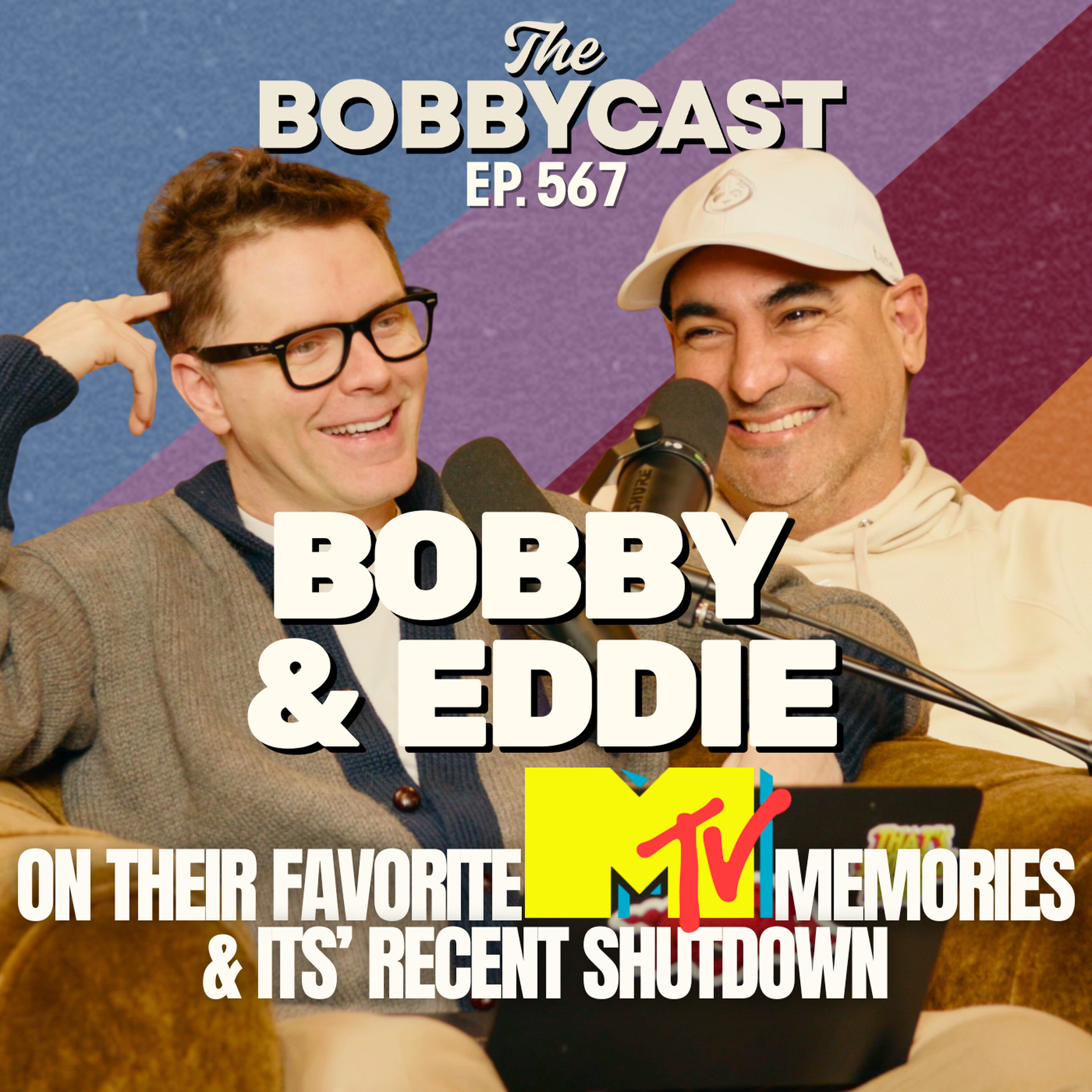
#567 - Bobby on MTV’s “Music” Era Officially Ending + The Video That Started It All + Why It Changed Pop Culture Forever + Most Memorable MTV Moments with Bobby and Eddie
MTV’s “music” era is officially over, so Bobby and Eddie rewind to how it all started and why it mattered way beyond just music videos. Bobby takes you back to the first video that kicked the whole thing off, then breaks down how MTV became the ultimate tastemaker: the place that could turn a song into a moment and an artist into a star overnight. Along the way, they ran through the MTV staples that defined a generation from must-see countdowns, late-night weirdness, the shows everyone talked about at school the next day and how the network slowly shifted from music to something else entirely. It’s part nostalgia, part pop culture history, and a rapid-fire tour of the most unforgettable MTV memories through Bobby and Eddie’s eyes.
Follow on Instagram: @TheBobbyCast
Follow on TikTok: @TheBobbyCast
Watch this Episode on Youtube
See omnystudio.com/listener for privacy information.
Available Results
Generated results are saved to the knowledge database for reuse and search.
Extract Knowledge
Pick what you want extracted first. Model, scope, and chapter options appear after a template is selected.
Transcript
00:00:07
Speaker 1: Another episode of the Bobbycast, where we'll talk about MTV and kind of the end of MTV, at least if you read the headlines, it's the end of MTV, but only sort of, and it ended quietly, no big farewell special, although it would have been cool.

00:00:23
Speaker 2: Had they done one, no countdown.

00:00:27
Speaker 1: I did see I think it was someone from Dan Patrick's radio show say that they thought it would be cool that since MTV is ending, and we'll get to what that means in a second, if MTV just started from scratch, airing the very first video they ever played, which is video Killed the Radio Star, even on a stream, and they just ran it back as it aired, really no commercials, so would air a little faster this time because out the commercials, I mean probably what fifteen percent faster, but just randomly, if you went over to the stream, you would see what was airing on this date in nineteen eighty seven, this date in nineteen ninety six.

00:01:12
Speaker 2: I think that would be pretty cool.

00:01:14
Speaker 1: I don't know that it would really warrant a full channel, especially because of what you're going to hear about next. But MTV is over and at the end of twenty twenty five, MTV shut down. It's last remaining twenty four hour music video channel worldwide. Whenever I saw that MTV was ending, I thought they were just changing the network because I think Paramount used to be Spike used to be Comedy sent those networks on cable, and less and less of us use cable as much now because there's so much streaming, there's so much YouTube TV, there's you know, all these different things that it's it's rarely just flipped the channels.

00:01:55
Speaker 2: Like it was in the old days.

00:01:57
Speaker 1: But MTV the chan isn't going away, the brand isn't going away, but they're just not showing music anymore. So MTV Music, MTV Eighties, MTV nineties, MTV Live all gone. And so that's it as far as MTV, the m and music meaning music television.

00:02:15
Speaker 2: There's no more music.

00:02:16
Speaker 1: So the brand still exists, the main channel still exists, but MTV as a place where music videos live on television completely over.

00:02:24
Speaker 3: Now.

00:02:24
Speaker 1: If we go back and just do a little bit of history and what we're going to do in a few minutes as well as Eddie and I are going to talk about our personal memories of MTV in the eras that we grew up, so that'll be fun. But I kind of wanted to walk through a little history here. MTV launches August first, nineteen eighty one. The first video is video Killed the Radio Star. I think when you look back at history, you think that that song must have been huge. The song wasn't that big at the time. It's now a you know trivia answer? You know what was the first video ever played on MTV and the band was the Buggles, But that song was kind of played as a testament the videos were killing audio. That didn't quite happen obviously, but it did force artists and songs to be more three dimensional, to either embrace the visual or get left behind. Artists and labels needed to now focus on not just making good music, but also branding the artist and branding the visual. So labels had to now invest millions of dollars on the things that we could see, the videos, the production, the hair, the makeup. So there were multiple ways now to break an artists that there really wasn't. But also it costs a lot more money as well. MTB in the eighties started gaining momentum, and it started in eighty one, but I would say around eighty three eighty four it really popped because you got to remember, too, it wasn't on everybody's cable, and not everybody even had cable back then, so it was very much a slow process to get MTV. But around eighty three eighty four is when it really started to become a cultural phenomenon. And if I were to assign artist pillars to this era, it would be three artists Michael Jackson, Madonna, and Prince. Now they were the pillars then, not just because they were super popular. They were, I mean there were plenty of artists that were popular, but because they had I would say, a deeper, a more rich vision as artists, because they were already not just singing into a camera. I mean, they were already doing three dimensional art. So Michael Jackson, Madonna, and Prince, and we'll start with Michael Jackson. When Michael Jackson put out Thriller, it wasn't meant to just be played at a three minute clip in between two other videos. It was not your standard video. Nothing about it was standard. There really wasn't a super standard because music videos hadn't been around a long time. But because they were all figuring it out, they were all pretty much the same. You just got on a microphone and you sang in front of the camera and sometimes you cut shots. But Michael Jackson put out Thriller. It's fourteen minutes long. Thriller has a spoken dialogue, which is wild now but at the time groundbreaking. There was actual like acting. Music videos were new at the time. Spoken dialogue just wasn't done, especially between folks. Sometimes I guess the artist would talk to the camera just for a couple seconds before the video started. But this video also had a full storyline, It had movie level makeup. It was directed by John Landis, which again at the time is something else that was completely absurd for a music video. That just wasn't how that worked yet. Music videos again quick play the song cheap basically commercials. Thriller did not feel like a commercial for many reasons. The length, the artist, the financial investment, which I mentioned earlier in things that did not involve simply music. I mean, this was a big deal for the label too, to pay that much money towards this project when there really hadn't been a project like this that had been successful ever. So it was big for Michael Jackson, it was big for Thriller. It was big for the record label, it was big for the art, but it was also big for black artists. Early MTV had avoided playing a lot of black artists, and they would use excuses like it doesn't fitter a format. That excuse kind of stopped whenever Thriller hit, and not because of a moral awakening, but because ignoring it would have been bad for business. After Thriller, music videos weren't just background noise somewhere, but there was a level that you could reach if you invested in your art and your creativity and financially, and these videos were now part of the identity of the artist that the video created a standard. Video created a standard. I hate to say the word standard again, so I would say more than a standard, because a standard is something that other videos now meet, and no other video has really met it. But the new standard was if you're gonna make a video, people expect vision art something more than just lip syncing the song. So I apologize for saying standard four times because it was more than the standard. It was the seediling. The next pillar is Madonna. Madonna understood something very early that a lot of artists get now because we have social media and we've been able to see it through trial and error, and you can just fire off a lot of things because social media is easy and you're connected with people immediately. This wasn't the case back in the eighties. What Madonna got was how engagement works now. You couldn't you hit reply to her music video, but a lot of engagement because people would send letters in. There was a tension that was felt from Madonna's music videos and she knew that. She knew that tension was rewarded. Madonna thirty years ago, over thirty years ago, understood that MTV rewarded tension. And that's what people now do all the time. I mean, it's really how you rage abait. I mean, that's just tension, right. It wasn't approval she was looking for. She knew that she would get it from some not from others, but it was tension that she wanted. So, for example, she performed like a virgin at the VMA's in a wedding dress and that irritated a lot of people. She was rolling around on stage in it, and this was not impulsive. She didn't just throw on the dress right before and think, oh, I wonder what will happen? Here because it wasn't reckless, It was very deliberate. She wasn't trying to shock for the sake of shock. She was trying to create conversation because she knew that getting talked about was currency. It made parents uncomfortable, critics loud one way or the other, either saying they didn't like it or saying they loved it, and that the people that didn't like it were just old and out of touch. And it kept kids interested one of the music and if not the music, hopefully her, and if not the music or her, just interested in the controversy that it brought. And that combination was powerful. You know, before Madonna, a lot of female artists were shaped by other people, and this still happens today some as well. But before Madonna, labels would tell a lot of the female artists who they needed and who they would be.

00:09:32
Speaker 2: Producers would do the same.

00:09:36
Speaker 1: The expectations were often, we need a female artist to be this kind of person, so we will make you to be this way. Madonna flipped that dynamic. She wasn't reacting to the attention. She was more directing the attention, like purposely creating it. The sexuality wasn't accidental. The religion wasn't a decoration. It was all about control, and it was all about her controlling the narrative. She showed that if you could be controversial and also still put out quality product, that she and the next artist could actually be let's say, steering the car. MTV did not make Madonna provocative. Madonna showed MTV and America and the world how to weaponize being provocative. And once that was clear, I think a lot of other artists saw it, emulated it, tried it, some successful, some not. I think there are a lot of artists that have been heavily influenced by Madonna.

00:10:37
Speaker 2: Lady Gaga is one.

00:10:38
Speaker 1: I think Lady Gaga is definitely her own person, but it's you know, she walks on the shoulders of the giants who got her there. So Madonna would be pillar two. And I mentioned Prince at pillar three. And when I was coming up with the reasons why Prince was a little harder one, I gotta say, all these artists made great music. Now you don't have to like their music, but they all made great decades, genre lasting music. The thing about Prince is he never really explained himself. Prince wasn't a single genre. I mean, if I were to go what genre is Prince, you could say pop. But if you're a fan of musicianship, you don't put him in that because he's one of the greatest musicians, like with an instrument of all time. I mean, there was rock for sure, there was pop for sure, there was funk. He was a singer, he was a performer, He danced, he was a lead guitarist. He was masculine, he was feminine. So where do you put him? He didn't care, just know his name and then know the name that he wasn't once he changed his name. But that's a whole different story. In the end, Prince just made great music. He didn't care to be understood. He didn't ask to be a sign to a certain genre. He was put in a lot of them, but he just cared to make art. And because his musicianship was so strong, MTV couldn't edit him into something that was more digestible. They had to let him be strange. They had to let him be uncomfortable, they had to let him be brilliant, they had to let him be purple. That's in a message to other artists that we're watching. If you're good enough, you don't have to sand yourself down. I think Prince, had he just been a guitarist, would be one of the greatest guitarists of all time. But because he was so much more, he's not even really lumped into that conversation. Because he was such a great songwriter, great performer, just great artist. But just his guitar skills alone, I think Prince is one of the greatest guitarists to ever play. There is a video I believe it is Prince and Tom Petty and a lot of artists playing while my guitar gently weeps. I'm pretty sure that's the video. If you look that up on YouTube, watch it. I think you'll be blown away. And also, you can just look for other artists talking about Prince being a guitarist, and they all say the same thing, that he's one of the greatest guitarists to ever live. Prince did not make MTV cooler. Prince made MTV more flexible. And why those three Michael Jackson, Madonna and Prince matter together. Michael Jackson showed the visuals could hold attention longer than just sound, and MTV was already trying visuals, but like real dedicated invested in visuals. Madonna showed that image could be intentional and controversial and not accidental, and Prince showed that expression didn't have to be explained to be valid, and a lot of expression you would assign to how you were feeling because you wouldn't know exactly why he was expressing that, but you still resonated. It still resonated with you. That was MTV in the eighties that set it up for the nineties. This is when I watched it the most. Obviously. I remember once when I was in Hot Springs, I think I was eighteen or nineteen years old. The cable network that we had, I don't remember the name of it.

00:14:16
Speaker 2: They didn't have MTV.

00:14:17
Speaker 1: And I think one of the first if I do finger quotes stunts that I ever did as a radio personality was I got MTV added to the cable system where we lived in Hot Springs because they didn't have it. And I'm not sure if it's because Hot Springs, Arkansas was very traditional. They didn't care for MTV. They didn't care about the values of MTV.

00:14:36
Speaker 2: Rock and roll hip hop. Because we did have CMT, but we did not have MTV.

00:14:41
Speaker 1: And I created a petition and had thousands of signatures in a small town of Hot Springs, Arkansas, and I took it to the cable company and they added MTV.

00:14:51
Speaker 2: I haven't thought about this I.

00:14:52
Speaker 1: Forever, but that was the first thing that I ever did that was I would say newsworthy. It's not really newsworthy, meaning it wasn't of like significant value, but it didn't make the news.

00:15:02
Speaker 2: And it was one of those first early things that I did where I thought.

00:15:06
Speaker 1: I kind of have a voice, and not a physical voice, but a voice that can actually take people that have like minded ideas, combine them and make change. And that's when I started watching MTV. My VJA class. I didn't talk about this in the eighties because I didn't. I know them now a little bit, but I didn't watch it in the eighties. Mine and the nineties were Carson Daily and Dave Holmes and Kurt Loder would do the news and Jesse. I think Jesse won the one to be a VJ competition a Dave Holmes finished second. When I think of the nineties, I think of MTV Unplugged. I loved the series. It might have even started in the eighties. I don't know, I watched almost all of them.

00:15:50
Speaker 2: In the nineties.

00:15:53
Speaker 1: TRL, I would be in college and I watched TRL most days, and maybe I was a little too old for TRL, but it wasn't like I was a big win anyway, but I watched all of TRL. I think of the boy bands when I think of MTV in the nineties, obviously the boy bands, Battory, Boys, in Sync, ninety eight Degrees, LFO, they launched so many of those careers. And I'll add Real World because of its significance. Even though I never really watched Real World. I was never a massive fan of and maybe because I just worked a lot, I didn't have a chance to watch shows that I had to keep up with because it's not like we had DVR back then, so I think I just didn't keep up with it enough. But I'll mention Real World. So my three would be MPTV Unplug, TRL, and boy bands. But I'll add Real World because it was significant. Let's do MTV unplug first. Why it was amazing to me is because it slowed things down, and that doesn't sound super radical now, but at the time, it was no effects, no dancers, no quick cuts, just artists sitting down playing songs for the most part that people already knew, and sometimes exposing parts of songs not only lyrically, but the meanings in a way that it wasn't super obvious before, and you could hear mistakes, you could hear nerves, you could hear how good someone actually was, and that mattered in the nineties because image was everywhere. Videos were polished at this point, performances were tight. Everything felt produced. MTV Unplugged cut through that. My favorite MTV unplugged album ever is also on our favorite albums ever period. It's Nirvana Unplugged and more about that later. If I go over to TRL, which is Total Request Live, it does sound simple now when I was making notes about it. It's a countdown, fans vote, videos go up and down the list. But at the time it felt live in a way that TV rarely did back then, and you watched it after school. For me, I watched it in the middle of classes. I was in college in Arkadelphia, Arkansas, and I would go back and I would watch TRL. I was also working at a pop radio station at the time, and I don't want to have an excuse because I liked TL and a lot of times it was the only way I knew what these artists look like, especially the ones that were just launching. And you know, you talk to other people who watched it at the same time, you talk about who hit number one, and maybe I just think of me doing that because I would go on the radio and.

00:18:16
Speaker 2: Have to talk about this stuff.

00:18:18
Speaker 3: You talk about who fell, who showed up in the studio, who didn't show up in the studio, and all the people that would pile up outside the window was always super cool.

00:18:28
Speaker 1: And I never went to New York at that point. I'd never been to New York anyway. It was way later in life that I went to New York for the first time. But I always thought it would be cool to go and stand outside and look up in the window.

00:18:42
Speaker 3: Though.

00:18:42
Speaker 1: That'd be so cool because if there was a big artist, or even a pretty big artist, or even no artist, there would still be people out there.

00:18:48
Speaker 2: But I remember the boy band days, it would be thousands and.

00:18:50
Speaker 1: Thousands of people, even like Limp Biscuit when they were popping in Britney Spears. So it would just be you know, seventy five aisles of people deep, maybe more than that. The boy bands, though I keep talking about that, I mean TRL launched them. The boy band videos were played all the time, and I'm gonna be honest, back then I hated them until I submitted to Yeah, I think I might actually like them. And TRL was a massive part of the boy band revolution, and boy bands were a massive part of the TRL revolution. TRL made fandom visible. When I talk about how many people would be outside, you would see it, and then you'd have an understanding of just how famous these people actually were. And again, this is without social media, screaming crowds outside, signs in the audience, fans knowing or learning every move, every room, or every hairstyle change. MTV didn't tell people to care. It actually showed us watching at home that other people actually cared. So TRL massive and we can talk about the real world for a second only because it created the template for the next thirty years of reality television.

00:19:55
Speaker 2: And this is someone who didn't watch.

00:19:56
Speaker 3: The Real World. I mean the real world did it.

00:20:00
Speaker 1: I've had trouble saying World like four times now, but no scripts, no prizes, no competition, just people living together and being uncomfortable on camera. It felt awkward, but that awkwardness turned out to be the point of it. And most of you guys listening now probably remember the late nineties or even two thousands on MTV.

00:20:17
Speaker 2: I mean the two.

00:20:17
Speaker 1: Thousands were definitely when music shifted off of MTV. Jersey Shore, the Hills, the Challenge, but that started as road Rules All Stars, which was road Rules but all that. But when I think about MTV in the eighties and the nineties, I don't think about it as a channel that just played music. I think if I were a little older, I would because that would have been most of what my watching was.

00:20:42
Speaker 2: But I think about it as a place that decided.

00:20:44
Speaker 1: To show everybody what everybody else cared about. In the eighties, it taught artists how to be seen. It taught us we could actually see the artists more than possibly a random page of a magazine, because that would be the only time, really you would see them unless they were doing Saturday Night Live or a network television spot. In the nineties, it became routine. You turned it on and you trusted it to show you what mattered that day. The two thousand's definitely different. There are still a little music, but then all those shows that created and ridiculousness, twenty hours out of twenty four hours a day.

00:21:26
Speaker 4: Let's take a quick pause for a message from our sponsor, and we're back on the Bobby Cast.

00:21:41
Speaker 1: So you missed the first part of this. I was talking about MPTV and EMPTV was done. They have you heard that?

00:21:48
Speaker 3: They cut that network? It's over. So Emptv's dead in that no more music. But what about all the reality shows? Well, the brand still exists. Okay, good. I just wondered what you caught in the news. Nothing. Nothing.

00:22:01
Speaker 1: Any of the music channels, MTV nineties, MTV eighties, MTV World they cut all of that. So basically, it's the end of music on MTV as of December thirty. First, they ran a little thing that said that's it and we're out.

00:22:16
Speaker 3: Basically MTV as we knew it from the very beginning, MPTV as we used to remember it. Yeah, there we go. So uh, because you didn't hear that whole first thing at all, I wanted to ask you if you were to list three things we can go back and forth that you remember most about MTV. What are they? Number one? So well, to kind of explain I didn't have MTV growing up, My cousin did, and like anytime we went to my cousin's house, that's what we did. Like it was like did you have to sneak it like Cinemax after dark? No? No, but like you know, my parents would hang out with my aunts and uncles while the kids went into like someone's bedroom and watched MTV, and like that was that's that's my glimpse of MTV. Dude. So the beginning to me was eighties, eighties videos like like hair metal stuff like Guns n' Roses. Pour some Sugar on Me. I'll never forget that video because I remember watching it on MTV patients. It's pour some Sugar on Me. When she's on the front of the hood. No, no, you're thinking of twisted Sister. No, that's we're not going to take. Yeah, she's in the front of the hood. No you think that's that's not that twisted sister. Were the dudes that look like chicks? Yeah yeah, yeah, yes, he had the big blonde hair. D Snyder, yeah, d Snyder. Yeah, they didn't have a girl in the hood. You're thinking of like the white Great White or something white, lion white. We're all around it. Yeah yeah, yeah, no, no, pour some sugar on me. Was was purely a concert performance, and it was awesome because it was just like their big stage set up them singing to the camera. It's just awesome. I'll never forget it. And I love that patience where he stomps on that knee on phone. Stuff like that is what I think of like first first recollection at MTV. Because you had a.

00:24:00
Speaker 1: Older brother and an older cousin, you're gonna have older music memories than me. We never had MTV growing up either. And what I was talking about a minute ago two was in Hot Springs, which I grew up in Mountain Pine and Hot Springs was town. Little Rock was the city, but Hot Springs was town and Hot Springs was It was a town big enough to have its own cable and they didn't have MTV on the cable at all. And so when I became old enough, when I was working at kla Z, I petitioned the cable network.

00:24:29
Speaker 3: It was the first ever, like big radio thing I did.

00:24:32
Speaker 1: I petitioned the cable network to get MTV that went around Hot Springs the whole community. Yes, So the first time we ever got it was when I made a big stink about it on the air and we got it.

00:24:43
Speaker 3: So did people sign your petition? Yeah? I went outside Walmart. What was your pitch? Like, what was your let's get MTV? Yeah, we don't have MTV. I wouldn't it be cool if we had MTV? And when people say like, oh, yeah, that'd be awesome, where do I sign?

00:24:56
Speaker 1: Yeah?

00:24:57
Speaker 3: Or like what are you talking about? Kid? Mostly people signed, mostly though I knew who to go to ask, like younger people. Dude, I've never heard that story. That's amazing. I hadn't thought about it until I was talking about this.

00:25:07
Speaker 1: And my earliest memories of MTV weren't until I was nineteen and I had petitioned my town to get it because I still worked in my town.

00:25:15
Speaker 3: I had moved away to go to college.

00:25:16
Speaker 1: I was like an hour and a half away, but I drove back to Hot Springs to work every night, and so I petitioned Hot Springs on the cable.

00:25:23
Speaker 3: Is it a network cap carrier? Yeah?

00:25:26
Speaker 1: Provider provider And so they got it. So that's when I started watching No Way.

00:25:31
Speaker 3: Yeah. So my memories are all nineties. So you never saw white Snake Girl in the tram no unless it was one of those specialty shows head Banger's Ball something like that, and then Headbanger's Ball though got to be a little more alternative. Yes it did, I think, right, Yeah, I did it. Did that Headbanger's Ball for sure became the Pearl Jam Nirvana Soundgarden. Yes, Allison Chains, my number one thing is going to be TRL. Watched it every day? Wow, every day Carson daily. Yeah, because it was on like three maybe it was early in the day, whenever a kick was getting out of school. I have a story. It's one of mine is TRL, but for a different reason. So yes, I will say it's about three o'clock. What time did TRL air? Three thirty Eastern times? Right?

00:26:19
Speaker 1: And I was in college and I would come back, but I was also working on a pop radio station, so I would watch it because I was interested to see what the artists look.

00:26:28
Speaker 3: These were the artists.

00:26:28
Speaker 1: And what was crazy to me about TRL was the amount of people that would line up outside and just watch piles and piles of people, yep, and boy bands, and it was a lot of boy bands. Brettany Spears, Christina Aguilera, Eminem, Eminem.

00:26:45
Speaker 3: And I just saw clip recently of Eminem and Marky Mark being awkward on it together. Really, it just popped up on TikTok.

00:26:55
Speaker 1: So my number one is going to be TRL because I watched it all the time.

00:27:00
Speaker 3: You're number two. Okay, my number two is Beavis and butt Head. That was gonna be one of mine. Yeah, yeah, but I'll go to TRL. But for a different reason. But Beavs and Buttthead to me, was you talk about like Skinemax after dark. That's parents did not want me watching Beavs in but Heead. So I would go to my cousin's house and be like, hey, can we watch Beason Buthead? Did you record any look, so we'll go back and watch it.

00:27:21
Speaker 1: Yeah, you had to record because there was a DVR. And Beavis and buttead, if I'm guessing, would come on around nine.

00:27:30
Speaker 3: Man, by the time I started watching, it was all around the clock. It was almost if you turned on MTV, it was on for the most part. Beavis and butthead airtime Central nine thirty. You're nailing these when they would do the original area. Yeah.

00:27:49
Speaker 1: Beavs and Buthead was awesome for a couple of reasons, and very much. It reminds me of Suck It from DX because that's what everybody did now. D X was before Beavis and butthead.

00:27:57
Speaker 3: But at school in eighth grade, you would do suck it and besbd head you would do the fire fire fire.

00:28:07
Speaker 1: Yeah, that was awesome. My number two is gonna be it was gonna beeps about it And Tom Green. Yeah, because I would watch and I thought Tom Green was the craziest, coolest, funniest dude ever.

00:28:19
Speaker 3: What was his show on there? Was it? The Tom Green Show Talk Show?

00:28:22
Speaker 1: Yeah, And we've had him on this podcast before and was talking to him. It was actually a show he did in Canada and it was first with public access and it grew from there and when they came down into the first season of The Tom Green Show, which exploded in America, it was a lot of his bits that he'd did on the Canadian show. They would sit in his studio and throw the bits and it was those bits he did back in Canada. That's cool, But things like sucking the udder of the cow, like the milk out of it, like, yeah, crazy.

00:28:53
Speaker 3: I never saw that live. That was always just later on I saw that stuff. I didn't watch a lot of Tom Green live on HIMTV.

00:28:58
Speaker 1: You did, no, never, I was working a night show when Tom Green would come on. But I remember if it was like, you know, nine or ten on a Thursday, I might have to look at the original airtime.

00:29:14
Speaker 3: You'll nail it. Nor.

00:29:16
Speaker 1: I would watch the show and then watch the timer of the CDs because it's that radio station. We had CDs, and I would do very small segments so I could watch more Toms hilarious.

00:29:26
Speaker 3: Mike, what do you have? I'm gonna guess Thursdays at ten Central. He's gonna be like, yeah, Thursdays, ten thirty Central for the Tom Green Show.

00:29:36
Speaker 5: The one I'm looking up is said midnight. That can't be right.

00:29:38
Speaker 3: That's so late. Maybe that's Canada. Yeah, it's ten Central? Are you making that up? What night? Did it come on? Ten? Sounds about right? Because jackasses, is that era too? Eleven eleven pm on the Eastern? I bet on what what? What night? Day y?

00:30:00
Speaker 1: You?

00:30:01
Speaker 3: Of course you did. I watched religiously. Yeah, I love I love that you were in the radio station doing this. That why you're watching it? You had to, yeah, because in my dorm, we didn't record. We didn't have DVR or anything. I mean, nobody had DVR at this time. No, no, no, you'd had to plug in the VCR at the TV, and then you had to know how to do it, and who knew how to record? One? Out of like a thousand people knew how to do that. Okay, So I have TRL and have Tom Green, I have you have eighties eighty videos like hair Band, Yes, Beavis and butthead go ahead? And then TRL but not because I'd watch it on TV when I was twenty I think I was twenty nineteen twenty. My parents decide when was it? When was nine eleven? Twenty twenty one, two thousand and one? Okay, it's twenty twenty two, because it had just happened. Wait, you mean two thousand and two, two thousand and two, it had just happened. Yes, you give me money here, And my parents decided to take us to New York City never been in two thousand and two. In two thousand and two, right after nine to eleven, I remember, because it was still ground zero as a big hole in the ground. Uh wow, really yeah, oh yeah, and people they were still.

00:31:09
Speaker 1: I'd never been to New York when nine to eleven happened, and I didn't go for years for the first time, and to me, that seemed like Hollywood, like not even in real place.

00:31:17
Speaker 3: New York. Yeah, same, Yeah, dude, I'm from I'm from South Texas. I didn't know if you'd ever been, though I'd never been. I've never been. And so the fact that I was watching you know, the World where the World Trade Center was, and they're still digging stuff out of there, and I was like, we need to go to Times Square And so we went to Times Square and Carson Daly was at his window, were doing TRL and I was and I'm not kidding. That was the moment where I was like, that's Carson Daily and I don't know who that artist is with him, but it's all happening right here and I'm here. That's the first time I realized that like anything was possible. I know it sounds like cars, sounds lfo, but dang it, anything is possible, dude. It was the first feeling I had where I thought like, wow, like anyone can come here and do it like he's I can throw over seeing them in real life, organic matter is doing those things that like when I said New York seemed like Hollywood, somewhere people real people didn't go correct. That was my thought, did you just walk up on it? He was up No? No, did you just walk up on a taping a TRL while they were up there? It wasn't like you knew it was happening, and it was thirty blocks It happened to be four thirty on a whatever day, you know, Like it was just they were taping it and you can see all the lights. You could see the studio and it had MTV written on it, and you can kind of sell, oh, that's a studio. And then he came up with a mic and he's talking and the artist is there and they were pointing at people on the street. Do you know who the artist was? No? No clue. Do you know exactly what day that was? Though?

00:32:45
Speaker 1: Could you track it back to know exactly what day and we could figure out what artist it is?

00:32:49
Speaker 3: I want to say, I can take it down to the month. It would be February two thousand and two. And was it a weekend? No, it couldn't have been, because it'd be a Friday. Head it was a did they air on Fridays? Yeah, Friday? Okay, so it had to be that Friday. Yeah, it was probably a long weekend for us. So it's Friday in and my sister's birthday. It was her trip and I want and her birthday is on the third, February third, so it had to be the first week of February two thousand and two.

00:33:21
Speaker 1: Okay, we'll have our and we'll see we're research team, look and see who on that Friday, the first week of February two thousand and two.

00:33:32
Speaker 3: Who was on TRL? Correct? No, I would have known Brittany.

00:33:37
Speaker 1: I mean maybe was that, but Brittany would have had a massive pile of people. It would have been so hard to even see it on the street.

00:33:43
Speaker 3: Yeah. No, we were all moving along. It was just like if you wanted to stop and look, you could.

00:33:48
Speaker 1: So whenever a big artist went, they would go down and there would be it was seventy five layers deep.

00:33:54
Speaker 3: Dude, I was out of touch with pop music at that point. But I would have known Brittney Spears for sure. And the other fridays it wasn't it was a female artist though, Shaka there was a female artist, Shakita.

00:34:07
Speaker 6: Shakira was heavily promoting laundry service in early two thousand and two and appeared on the Late Show with David Letterman and TRL on February fifth, two thousand and two.

00:34:16
Speaker 3: I mean, possibly Shakira. It feels like it.

00:34:19
Speaker 1: Was someone that people wouldn't have known if there were because when they would shoot down, there'd be so many people down there. If it was a big star and they have signs, I.

00:34:26
Speaker 3: Never saw those signs. D I. Yeah, I don't remember those details, but I don't remember us being like, oh, this is a pain to get through. Nothing like that, just the fact that, oh, cool, look there's big sign there, and oh there's the dancing cowboy with his guitar, and oh look there's MTV. That's Carson Daily. Oh my gosh, that's TRL. Like that's all I really remember of all that anybody else. You guys found the fifth of February tuesdays, so there. I mean, I'm assuming if that was ye.

00:35:00
Speaker 1: Where the first Friday of February is February first, let's see.

00:35:04
Speaker 3: Just somebody raised their hand. If they find who it could be, that'd be cool. I do remember it was a female artist. Didn't recognize who it.

00:35:11
Speaker 1: Was when they said the name. You couldn't really, no one even told you down there. You couldn't even like that's Michelle Branch. You couldn't hear what they were saying. You just saw them.

00:35:22
Speaker 6: It's almost Michelle Branch was on February twenty first.

00:35:24
Speaker 3: That's what I remember. That's why I say that Rember twenty No, I don't remember that. Gosh, how do you remember that? And also you may not have been in the first week. Maybe track it down let us know. Okay, okay, I'll have to think about it. That would be fun. I know it was my sister's birthday trip.

00:35:38
Speaker 4: Let's take a quick pause for a message from our sponsor.

00:35:48
Speaker 2: Wow, and we're back on the Bobby Cast.

00:35:52
Speaker 1: My number three and it's specifically a few videos and it's three in particular that Aaron Lewis stained. Yeah, but it was Aaron Lewis and Fred Durst doing outside I'm on the outside, yeah, and.

00:36:08
Speaker 3: Then staying it was their song. Yeah, but that video was them together with they just singing. I feel like it was a live show. Yes. Yeah, Aaron Lewis was like looking down and that song was massive. They showed it all the time. That video. That one the Backstreet Boys. All I have to give because your love is all I have to give. Yeah.

00:36:30
Speaker 1: My roommate Courtney and I we acted like we hated boy bands, but we practiced the dance on the chair. They had a chair dance, and we would that video would be on all the time. But it was known that you guys didn't like boy bands. Yeah, like alrighty, that was established. So you guys were an apartment dorm, no apartment apartment Yeah, okay, so it's just you two and there just us. Yeah, and we practiced the chair dance, which is like thirty seconds of that thing, and we were.

00:36:54
Speaker 3: Good at it. You had your dining room chairs. And I liked boy bands. I just didn't say it out loud. Same with Courtney probably.

00:37:00
Speaker 1: Yeah, probably more so him. But I had a job where I had to play boy bands. Uh huh, So you knew I wasn't anti boy bands, but I'd be like, we did this.

00:37:07
Speaker 3: Because it's it's so absurd we did this. Hey, you can't use the excuse of its content, man, Yeah, there wasn't. There was no content then. But that song and then Limp Biscuit.

00:37:19
Speaker 1: I know, I said Fred Durst, but Limp Biscuit and Faith when that song came out, it was wild how big they got so quick doing a cover?

00:37:28
Speaker 3: Yeah, because it was. It was such a different sound of a very familiar song. It even sounded like the original song at the beginning until they biscuited it. Uh we going to have yeah, so that would be my thoing. I don't remember that video. Do you remember that video? Oh? Yeah, heavily. They were in between buses. It was mostly that, like them just walking and singing.

00:37:49
Speaker 1: Yeah, like cutting clips and stuff with them, like just dicking around and then them doing music.

00:37:53
Speaker 3: Dude, how about like Kurt Loader one of the.

00:37:55
Speaker 1: Guys I mentioned in this earlier Because I picked certain people that Kennedy Kennedy, I felt like was pre so Kennedy would have been And I'm friends with Kennedy now, but I didn't know her when she was a VJ. I feel like Kennedy was pre Carson Daily, Dave Hall, she was Kurt Loder. Yes, when I first got into it, it was Carson Daily. When Jesse won the VJ competition and Dave Holmes finished second, Jesse was like the stoner dude, really tall, had the really wild hair.

00:38:23
Speaker 3: He was like, hey, buddy, I'm Jesse. Oh he was a VJ. Yeah, he won the competition and Dave Holmes finished second, But they both got a job on the show. But I know there were those rock shows like Matt Penfield had the rock showed, like the Hard One twenty or something. Yeah, I saw Matt Pinfield at south By Southwest and that was awesome. Bald dude, Bald dude still looked the same. He was a little older, obviously, but still had the same look.

00:38:46
Speaker 1: I feel like Kennedy was right before that group, right before my class.

00:38:52
Speaker 3: We've talked about Goo Goo Dolls before. Oh yeah, do you know what Goo Goo Doll song is written about Kennedy and I don't want the world to see you now, Iris Kennedy, Iris and Johnny Resnick has talked about it before. But it's name and I won't tell me your name. Oh did they date?

00:39:13
Speaker 1: I think they had a very brief but not I don't think so. I think it was like super brief and he.

00:39:19
Speaker 3: Wrote it about that fun fact.

00:39:22
Speaker 1: I can look it up. But yeah, her name, her real name is Lisa Kennedy. But like me, her and charlettne would make a point, we haven't done it in a couple of years. To go to dinner once a year when we were all in New York and I was there five times a year, not a time, but we would all go and I haven't seen her in a while.

00:39:39
Speaker 3: Do we run in a car together? You, me and Kennedy? And I was like, this is crazy. We did, yeah in Vegas. I think she was there for something, maybe heart for a bit too. Yeah. So and we were going from I don't know, a hotel to hotel or something and she ran the car with us, and I was like, this is crazy that Kennedy's in the car. Yeah. She was awesome. She still is awesome. She didn't die, so yeah. The inspiration of brief, a flirtatious relationship between singer John Resnick and then MTVVJ Kennedy, The Secret. Kennedy revealed her full name, Lisa Kennedy Montgomery to Resnick, who promised to keep it secret. Smote the names. Oh wow, that's really cool.

00:40:20
Speaker 1: Resnick has confirmed Kennedy's story, stating he was trying to capture a moment from their time together.

00:40:24
Speaker 3: That's really cool. Now, won't tell me your name. Man, that's a cool story. Yeah, even though you didn't think the Google dolls were great, it's still not great. But great story. Great story though, Yeah, that's a good one.

00:40:37
Speaker 1: Mike, Well, your MTV history. You're ten years younger than us though, so it has to be the television shows.

00:40:43
Speaker 7: I started with Jackass, Yeah, Jackass, into Bevilabam and then into like the later MTV.

00:40:48
Speaker 3: Oh yeah, so for you it was never about the music.

00:40:51
Speaker 5: Nah, I cut it probably the tail end of TRL.

00:40:54
Speaker 7: But I was more into all the reality shows like the Osbourne once that started, That's when I was in what.

00:40:58
Speaker 3: About like road Rules? Do you guys have watched that? Not really? And I didn't watch Real World. Oh Real World, dude. The first Real World was mind blowing. I put that as one of the pillars of MTV because it not just shaped created the road for reality telegra It's what Survivor, It's what all those early network shows were based off of. Were was the formula that the Real World had developed. Big Brother, that would be no Big Brother with that Real World. So I didn't watch it, but I appreciated it also since we can record shows, and that one probably came on when I was in class. What time was up?

00:41:35
Speaker 1: I didn't watch it, you know, probably five or six, when I was driving to work or something. I never watched Real World, but it understood its significance and value. But I would see road Rules sometimes I'd watch a little bit of that, But road Rules is what launched the Challenge.

00:41:49
Speaker 3: Okay, Like yeah, once you get to the Challenge, I get lost With all the different spin offs. I've never seen an episode of the Challenge, neither of I and.

00:41:57
Speaker 1: Like Lunchbox loves the Challenge. People love the Challenge, but still it still goes on the Challenge.

00:42:02
Speaker 3: Yeah. I think they aired it on.

00:42:03
Speaker 1: CBS on Paramount too for a bit. Now I think not just a game show for people some from Real World, road Rules, other MTV shows, but they take people from other shows too, right, Mike, Yeah, they do, so that that brand, but yeah, that the Challenge is from, like road Rules one of the versions of that show.

00:42:19
Speaker 3: Do you remember when a Real World came to Austin. Yeah, because I was working in radio there, we would talk to them, we would see them. Oh, would they go to the RADO station, so a couple of times. Yeah, did they come with cameras and everything? No, I don't think so did. One of the coolest things ever was when people came to visit, Like you want to drive by the Real World house and you go by the house or whatever, which later became a Vince Young steakhouse and then not sure what it is now, but it's still it's still kind of a flex to drive by there and be like, hey, that used to be the real old house. Yeah, but kids now be like, what's real World? Yeah? I know you can't do it to just anyone.

00:42:53
Speaker 1: When they finished recording and they did an auction of all the furniture inside the house, Lunchbox went and bought two chairs from it the way and.

00:43:00
Speaker 3: Share its from it.

00:43:01
Speaker 5: Yeah, it's now a warehouse.

00:43:02
Speaker 3: It is just a warehouse.

00:43:04
Speaker 5: A warehouse.

00:43:04
Speaker 3: Wow. And it's right by sixth Street. Because that was such a big part of the show.

00:43:09
Speaker 1: It was crazy that Real World wasn't Austin while we were there. Yeah, and you felt it, yeah, because people talked about it. But also we probably felt it because I mean I was twenty four.

00:43:19
Speaker 3: Yeah, and we were out, you know, and I remember sometimes you would see the cameras and the lights and some would be like, oh, there's real World. You try to get close, but you really couldn't because there were too many people around. But I remember all that.

00:43:30
Speaker 1: It's crazy that Mike doesn't have a music association from his own experience with MTV.

00:43:36
Speaker 7: And I think peak MTV for me was Jersey Shore when that first came on like two thousand and nine.

00:43:40
Speaker 5: That like changed everything.

00:43:42
Speaker 3: Well now it's twenty two hours ridiculousness every day.

00:43:45
Speaker 2: Yeah.

00:43:45
Speaker 3: Oh, they canceled that. It's over.

00:43:48
Speaker 5: It's over.

00:43:49
Speaker 3: They canceled that show.

00:43:50
Speaker 5: Yeah.

00:43:51
Speaker 3: Oh wow.

00:43:51
Speaker 1: That feels like it was such a and I should say, inexpensive show to make because of how they shoot it. Yeah, and they used it so often. He must have been charging a lot per episode then because they were just using other that was that was covering a lot of hours.

00:44:05
Speaker 5: It was over fourteen years, forty six seasons.

00:44:07
Speaker 2: Wow.

00:44:09
Speaker 3: Yeah, wow.

00:44:09
Speaker 5: So it just got to air this year and then it's done.

00:44:11
Speaker 3: Rob dear Dick Yeah, Rob Derdick.

00:44:14
Speaker 1: So I didn't know much about him, but my wife loved watching Big and Rob and so we first moved in together during COVID. That was like her comfort show. So we watched Big and Rob on Amazon.

00:44:27
Speaker 3: Yeah, Robin Big was great. Is that what it's called?

00:44:30
Speaker 1: Yeah?

00:44:30
Speaker 3: Yeah, what did I say? Big? It doesn't matter, but it does because big and rich Yeah, rich and big.

00:44:35
Speaker 1: Yeah exactly. So I want to make a whole day but I did kind of like that show. And then I think he built Fantasy Factory.

00:44:41
Speaker 3: Yeah that was good too, so that that was the first time you'd watch it with your when before you were married. Yeah, twelve thirteen years after I had to air.

00:44:48
Speaker 1: Uh Chanelle West Coast, who's now trying to be a country singer or trying to be an artist.

00:44:52
Speaker 3: And like her videos will come through. On the show, she looked like super cool and like someone you want to hang out with.

00:44:58
Speaker 1: I don't know what she is, but it's been fifteen years. People changed. She doesn't look like the same person. Obviously we're all older, but she also didn't seem like a country singer on that show. I just missed the transition period from when she went from n to whatever artist she is now.

00:45:17
Speaker 3: But you know what comes with cool in the show? Did you ever tell Bob Pittman the story of Bob Pyman, by the way, our ceo who started MTV, did you ever tell him, which who you talked to many times? Yeah? Do you ever tell the story that you petitioned to get MTV? Because I haven't thought about it. You have to tell him that story, like you have to one of these days. It's just like I never told you this. I thought you'd get a kick out of this. I don't know if you care. That's amazing that you brought MTV in to Hot Springs, Arkansas. Yes, that's amazing.

00:45:46
Speaker 1: I was trying to remember the cable network when I was telling the story earlier, and I couldn't. But it was like one of those memories because I didn't have it planned.

00:45:54
Speaker 3: A local, a little local provider. Yeah, so it wouldn't be like Time Warner, no cocks.

00:46:01
Speaker 1: But I was telling the story of the first time that I saw'm TV and I was saying, and the people that are listening now heard it, and I went, oh, yeah, I got I'm the one who got it for our hometown.

00:46:10
Speaker 3: But it wasn't that big of a deal. It is the fact that you know it is it is that I'm saying that you changed that town. It wasn't like it wasn't like Kevin Bacon a footlooset rob brought danced to the town and think it's the same thing. Actually, well, Rest in Peace to MTV. Yeah, just found out Rest in Peace the brand is not dead, but they don't show music anymore. You talked to Bob about that. Nah. Nah, just sent him a text. Sorry, dude, rest in peace your baby. Did you see the clip, Michael when they shut it down? Yeah, it was just like a graphic.

00:46:50
Speaker 5: It's weird.

00:46:52
Speaker 1: Was Max Headroom MTV Max Headroom? I watched Max Headroom? And do you know the real story about that? How they they hacked into I think it was Chicago the Chicago News.

00:47:01
Speaker 3: Yeah, a local TV station. Yeah, during the news and they came back on and be like, we don't know what that was. It looks like somebody took over our signal there for they searching on YouTube. You can watch the original. It's really cool to see. It's crazy. But I just remember I don't really remember, and I said there was a network television show, but it may have been like an MTV cartoon or something.

00:47:20
Speaker 6: It was MTV and music videos, like they brought him into to introduce certain videos, almost as his own VJs.

00:47:31
Speaker 3: They had a network television show too, so so his identity was revealed eventually. No, the guys that I don't think, so, I don't think the guy hacked. I mean, it wasn't a thing, right, Like, hacking wasn't a word because no one hacked. And then I was watching how they made the television show with him, and they actually had a guy in makeup. Oh yeah, and they shot him moving around.

00:47:58
Speaker 1: It wasn't all just like computer animation cause I didn't have the ability to do that at a high level.

00:48:01
Speaker 3: Yeah, dude, that TikTok video is cool. I mean it comes on once in a while, just to the original hacking.

00:48:06
Speaker 1: So I can read you about the Max Headroom signal hijacking because it's not even called hacking.

00:48:13
Speaker 3: And is that what hacking is? Signal hijacking?

00:48:16
Speaker 5: Yeah, slijacking.

00:48:18
Speaker 3: What's the signal hijacking? Hacking?

00:48:21
Speaker 5: Unless hacking is specific to Internet, I.

00:48:23
Speaker 3: Would call it sacking. The Max Headroom signal hijacking was the hijacking of the television signals of two stations at Chicago in nineteen eighty seven that briefly sent a pirate broadcast of an unidentified person wearing a Max Headroom mask. So Max Headroom had to.

00:48:41
Speaker 1: Have already be been a person of some kind if there was a mask, right, unless they created themselves eerie looking Oh no, no, no no, it looks like Joe Biden. It was a handmade, like a handmade mask Oh it wasn't like he wasn't already a person.

00:48:54
Speaker 3: It looks like a young Joe Biden though, yeah, well like kind of cool. It's sunglasses, right, yeah. Yes.

00:49:00
Speaker 1: The first incident took place in a sports segment WGN nine o'clock. A person wearing a mask swaying radically in front of a semi swiveling metal panel. But I need to know about Max Headrum the person, like, did this person invent Max Headrum?

00:49:16
Speaker 5: The character already existed before this?

00:49:18
Speaker 1: Oh it did, okay, in what like comics that I don't know, interesting, let's look it up here. Max Headrum is a fictional character played by actor Matt Frewer. Advertises the first computer generated TV presenter CGI character. So he did.

00:49:43
Speaker 3: Music videos in nineteen okay.

00:49:48
Speaker 1: He debuted nineteen eighty five on Channel four in the British cyberpunk TV movie Max Headroom Twenty Minutes into the Future, So it must have been right after this movie.

00:50:00
Speaker 3: That's when the hack. So the hacking probably was something completely different. Oh, it wasn't Mac the real Max Headroom. It was somebody wearing something somebody wearing his Max Headroom apparently was big in Europe. Two days After the TV movie was broadcast, Max hosted Channel fours The Max Headroom Show, a TV program, but they spell it European with the E at the end, oh where he introduced music videos, comments on various topics, and interviews guests. During its second and third year, it aired in the US, and then it was on ABC in nineteen eighty seven after the hacking. I always thought it developed from that hacking. I did too. I guess I had nothing to do with it. I didn't know it was European either. I like it less and I'm glad it's connected MTV because I had no idea I thought it was. I just didn't. I wasn't sure of.

00:50:43
Speaker 1: It because I think it was introduced music videos right right now on MTV. Yeah, well, there we go, we spun out.

00:50:49
Speaker 3: I love that. Okay, that's what's up. Thank you guys. This has been a resting piece to MTV sort of. Yeah, resting piece. And who knew that ridiculousness was canceled. I guess Mike was the only one of the news. Thank you guys for listening, and we will see you guys later.

00:51:04
Speaker 4: Goodbye, everybody, Thanks for listening to a Bobby cast production.