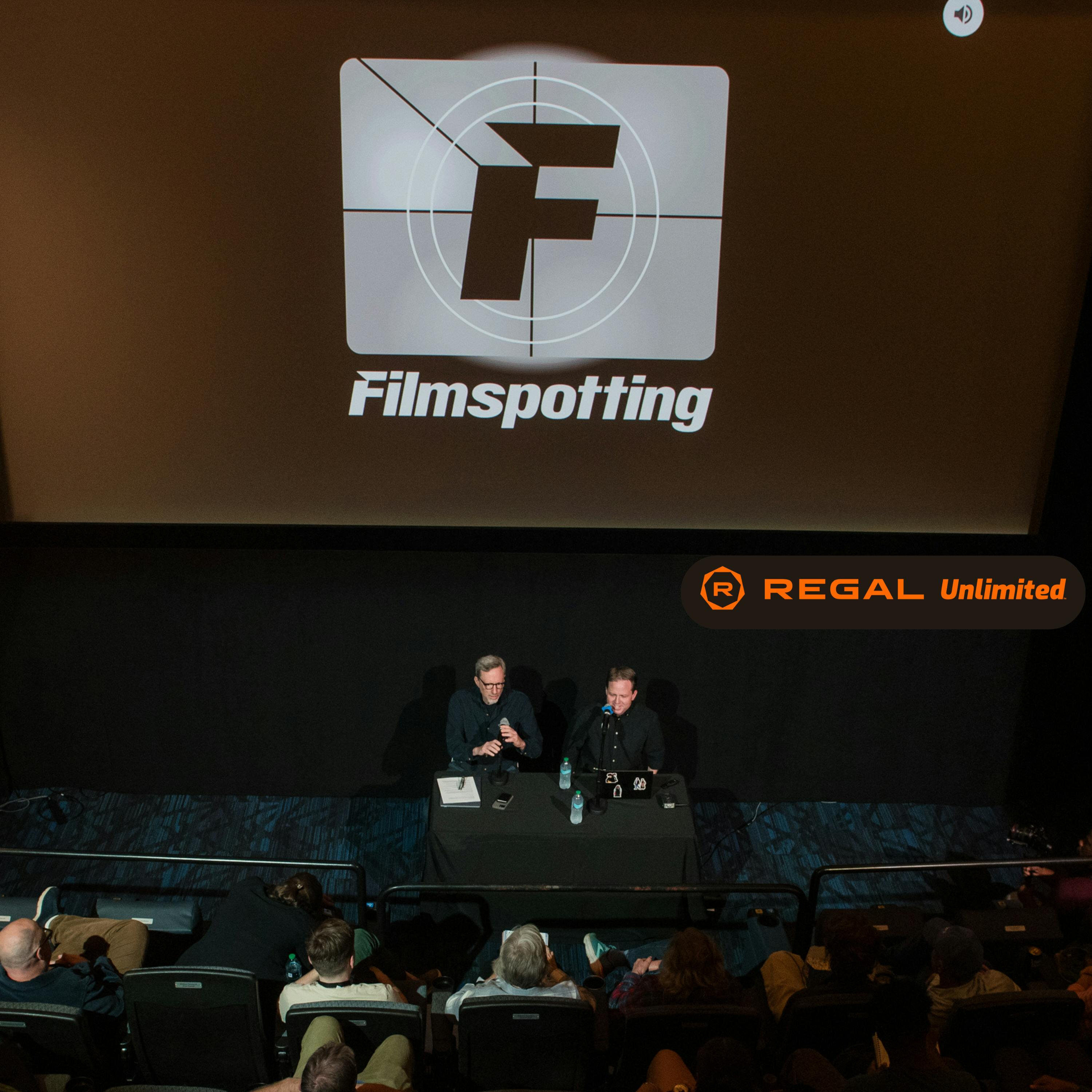
Top 5 Movies Adapted From Iowa Writers – Live at Refocus Film Festival
Back in October, Michael Phillips joined Adam at Iowa City’s Refocus Film Festival for a live recording of the Top 5 Movies Adapted From Iowa Writers. The town is home to the University of Iowa’s famed Writers’ Workshop, so picks were not confined to "Field of Dreams" and "The Music Man" (but those get shout-outs, too).
This episode is presented by Regal Unlimited, the all-you-can-watch movie subscription pass that pays for itself in just two visits.
(Timecodes and chapter starts may not be precise with ads.)
Intro (00:00:00-00:03:59)
Top 5 Iowa Writer Adaptations (04:00-00:35:37)
Next Week / Notes (00:35:38-00:38:45)
Top 5, continued (00:38:46-01:02:46)
Credits / New Releases (01:02:47-01:05:34)
Links:
-Poll: ‘25 Scene Stealers
-London Meetup w/Josh on Dec. 11
https://forms.gle/rUcgUKicTddzwFBs5
Feedback:
-Email us at feedback@filmspotting.net.
-Ask Us Anything and we might answer your question in bonus content.
Support:
-Join the Filmspotting Family for bonus episodes and archive access.
http://filmspottingfamily.com
-T-shirts and more available at the Filmspotting Shop.
https://www.filmspotting.net/shop
Follow:
https://www.instagram.com/filmspotting
https://letterboxd.com/filmspotting
https://facebook.com/filmspotting
https://twitter.com/filmspotting
https://letterboxd.com/larsenonfilm
https://www.instagram.com/larsenonfilm
https://bsky.app/profile/larsenonfilm.bsky.social
Learn more about your ad choices. Visit megaphone.fm/adchoices
See omnystudio.com/listener for privacy information.
Available Results
Generated results are saved to the knowledge database for reuse and search.
Extract Knowledge
Pick what you want extracted first. Model, scope, and chapter options appear after a template is selected.
Transcript
00:00:00
Speaker 1: This episode is brought to you by Peloton break through the busiest time of year with the brand new Peloton Cross Training tread Plus powered by Peloton Iq. With real time guidance and endless ways to move, you can personalize your workouts and train with confidence, helping you reach your goals in less time. Let yourself run, lift, sculpt, push and go. Explore the new Peloton Cross Training tread Plus at one peloton dot com.

00:00:26
Speaker 2: Film Spotting is presented by Regal Unlimited, the all you can watch movie subscription paths that pays for itself in just two visits. Sign up now in the Regal app or at the link in the show description and use code film Spot twenty five. That's film Spot twenty five to receive your discount.

00:00:45
Speaker 3: What kind of a show you guys putting on here today? You're not interested in Armed?

00:00:49
Speaker 2: Now?

00:00:49
Speaker 4: Well, look we're going to do this thing.

00:00:51
Speaker 3: We're going to have a.

00:00:51
Speaker 5: Conversation from Chicago.

00:00:55
Speaker 2: This is Film Spotting celebrating our twentieth year. I'm Adam Kempenar and I'm josh Iowa has a lot to be proud of to have turned out two major Broadway musicals as settings as far as I know, and they're both worth talking about. And Rewatching, that's Michael Phillips pandering to the crowd during the live show he and I recorded recently as part of Iowa City's Refocus Film Festival.

00:01:16
Speaker 6: One of those musicals has to be The Music Man. I guess I'll have to listen to the show to find out the other one. The top five movies adapted from Iowa writers, that and more I had on film Spotting.

00:01:36
Speaker 2: Welcome to film Spotting. So we do have some original content, unheard content this week. But we are taking a week off of sorts, and that is because it is our prep week. It is the week before the end of year storm really begins. And next week, Josh, our listeners are going to get from us our performances of twenty twenty five, and after that it's our top ten films of twenty twenty five, the big end of year roundtable, our Chicago Film Critics Association ballats are due. And the fact is we need to watch some movies.

00:02:12
Speaker 6: I'm watching a movie as we're talking, Adam, that's not unprofessional.

00:02:17
Speaker 2: You were always such a good multitasker. This week, then what you're going to hear is me and our friend and frequent contributor Michael Phillips at a live taping of the show from earlier this fall as part of Film Scenes Refocus Film Festival. This was the fourth year of the fest and we've been involved every year. It takes place in mid October and it has a pretty narrow theme. Every film that gets programmed is an adaptation, but they get very creative with that theme. Another reason the adaptation theme makes sense for a film festival set in Iowa City is that the University of Iowa is the home of the famed Iowa Writers' Workshop, which has dozens of famous alumni, students and instructors going back to the nineteen thirties. So the top five movies adapted from Iowa writers is what we came up with, inspired by the opening night film of the festival, Train Dreams, that was adapted from Dennis Johnson's twenty eleven novella Train Dreams. He was a grad of the Writer's Workshop. He was an instructor at the workshop, and that's where we started.

00:03:28
Speaker 5: Josh.

00:03:29
Speaker 2: We thought, okay, if you're a grad, or if you then went on to teach at the workshop, that work. If that was adapted into a film. You're eligible, but we opened it up. I don't know if we ended up picking any of these people, but if you were a graduate of the university, you qualified. And then we said, well, why are we just keeping it to people who went to the University of Iowa. If you were born in the state of Iowa, you are an Iowa writer and you are eligible for this list. That's that's how we approached it.

00:04:05
Speaker 6: It's starting to sound like the I had a layover in this airport and so I visited that state. But you know, I wasn't involved your rules. So I think it's all fine.

00:04:16
Speaker 2: How dare you? It wasn't It wasn't quite that broad. I think I think you'll approve of the picks here, Josh, And well if you don't, you know what the damage is done. The show, the show was taped, the show was recorded, The audience enjoyed themselves, at least they seem to, and you weren't there to boo us. So from October, here is our top five movies adapted from Iowa writers.

00:04:42
Speaker 5: Is it not on?

00:04:43
Speaker 2: What?

00:04:44
Speaker 3: Wow? Wow?

00:04:45
Speaker 5: There we go?

00:04:45
Speaker 2: Oh oh we are we are in business, all right? Think about how about an on switch. We are, we're we're cooking with gas now, so a little bit about film spotting. Then we'll jump in if you're if you're not familiar, yeah, we've we've been around for a while twenty twenty plus, going back to the early days of podcasting, and are also broadcast on the NPR affiliate in Chicago and a few other stations around the country, not here in Iowa City.

00:05:10
Speaker 5: Maybe we can work on that. Oh yeah, I don't know.

00:05:13
Speaker 2: Maybe we can get on the airwaves there eventually here eventually. But we're excited about this top five. We do this regularly, a segment here on the show that goes back to the early days of the show. Stole it right from or or maybe I should say we adapted it.

00:05:27
Speaker 5: We adapted it.

00:05:29
Speaker 2: We adapted it from Nick Hornby's book High Fidelity, which was later made into a movie where you might recall if you've read it or seen the movie, the guys in the record store sit around and do top five lists, and I thought, well, I think I could steal that for Actually a radio show that I did first as a grad student here at Iowa KRUI. It was a live show on Monday nights where I did top five lists and then I just adapted that for Film Spotting, the podcast when that began. So my co host Josh Larson actually might have been here, but he's off in Scotland at the moment, and Michael's a regular contributor on Film Spotting and just aim overjoy that you made the trip again, So thank you, thank you. Okay, so what are we going to do? We decided we always try to tie the topic to the festival, and this year, with Trained Dreams opening up the fest, we thought that we should do a top five where the topic is top five movies adapted from Iowa writers, So movies based on novels novellas that could be by University of Iowa Writers' Workshop alums like Trained Dreams of course Dennis Johnson, who also taught at the Writer's Workshop, but it could also mean Iowa graduates. They could have a bachelor's degree, they could have a master's degree. Enrollment in the Writer's Workshop isn't mandatory for this list, Michael.

00:06:51
Speaker 7: Okay.

00:06:51
Speaker 2: Now you may be asking, Adam, could they have gone to Iowa State University And the answer is no. The answer is no, they are not eligible for this list. But they could also just be Iowa born writers. The key here though, since this is Refocus is adaptation. Otherwise there there might have been a place on my list for a movie like Juno Diablo Cody a two thousand grad of the University of Iowa Comm Studies grad, or maybe maybe a quiet place Scott back in Brian Woods also Comm Studies grads two thousand and seven. Though interesting screenplay. I haven't looked at it, but I've always heard that, you know, you see Emily Blunt. I think shushing there. It's mostly a quiet movie. I think the screenplay has some of the pages just have like one word on the screenplay on the page.

00:07:43
Speaker 5: You know? You know who else has a com Studies degree from New Niversity of Iowa. Who me?

00:07:48
Speaker 7: Me?

00:07:48
Speaker 2: Because after I finished my undergrad down the road at Grannell, and I wanted to just study film because there were no film classes at Grannell. I came to Iowa, but there was no cinema arts at the time. It was in the com Studies program. So came here and just studied studied film in the Comp Studies department. Des Moin's Peter Hedges Michael wrote and directed a few different films, including Nick Hornby's About a Boy, pretty decent movie about a boy. Chris and Paul Whites directed that film. There Nick Hornby getting a reference again, wouldn't make my list, but as I said, pretty decent movement movie and just for fun. So that's that's a reverse adaptation where the know, the the iowin is is adapting someone else's work. But in that movie, have you seen about a Boy?

00:08:35
Speaker 3: Yeah?

00:08:36
Speaker 2: Okay, So Hugh Grant plays a character who loves just being on his own, not having any responsibilities, no cares in the world, doesn't want to be tied down. And for anyone out there who studied English or maybe an English major out there, you'll never guess what his name is. And I'm saying you'll never guess, but actually you could guess it. His name is Will Freeman. Get it like Freemen? You see, he's free, Will and free. Okay, so we can we can. We can now move on to the movies that actually did make our list.

00:09:15
Speaker 5: Michael, what do you have at number five?

00:09:18
Speaker 3: Tough list? Tough list. And it was great to cram like like I was back in the school, you know, rushing through novels. I should have taken more time with, but it's been wonderful to kind of get to know some of the source materials, some of this my number five. I have a different feeling about the bridges of Madison County. Just a few facts there. I mean, that thing sold fifty to sixty million copies, one of the most popular books of the previous century. Does any does anybody not know the basic setup of that? Well, you know, Francesca, the Italian woman, Mary's the US soldier after World War Two, the come to Iowa, to the farm to live in Madison County, and there she meets the novel's narrator, the irresistible photographer Robert Kincaid, when her husband and her two children are away at the Iowa State Fair four day affair. It's a workable premise time frame for any any story. Waller wrote the Damn Thing in eleven days. And then, you know, I mean, like a lot of books that come along, like Eric Siegel's Love Story, Mitchard Box, Jonathan Livington, Seagull. Quality not really an issue in popularity in my view, in my personal view, but then, and there's a lot of speculation about who are you going to cast in this thing? Because it was a very I mean, like the popularity of the book was it was the national book for a few years there, for like three years, everybody had it. And and then Eastwood, Clint Eastwood picked it up and played the title role, Meryl Streep. And the key thing is they got a writer, Richard Legrevine's a screenwriter to actually decrudify it, and a very clever framing device about the grown the now grown children of the Streep character finding these diary entries as they pack up the old house, and that sort of leads you into the flashback about the whole story, about how it happened, and the entire kind of orientation of the story tilted very craftily, I think, more in her direction, her character's direction, and they actually seem like human beings on planet Earth in the movie. And and I think with east with Eastwood, I think having Streep just on screen and and them playing these scenes of all kinds, you know, together, I think suddenly he was really forced, minute by minute on camera to become an actor. He wasn't before. I mean, by the end of that film if and this is what I remembered having not seen it for a long time, but having we seen it just recently, when he's in the pickup and it's the last ten minutes of the film or so, and he's just kind of wordlessly. I mean, he is distraught, kind of a ruined, temporarily ruined man right emotionally, and I just that's the Eastwood that I had never seen, and I don't think anybody had, And that film had a really sneaky way of turning, you know, right Sou's Ear Silk Purse. So I think I think it's probably the best movie ever made from a truly terrible book, and that really it's gotten nut snowslide on Iowa. Okay, but yeah, that's my feeling about it.

00:12:53
Speaker 2: Okay, So you all have to work decrudify into your weekend now. I urge all of you to do that. My number five pick, I'm going back to nineteen fifty a different a different kind of relationship, a lot of sex involved Michael, but more violent, I think than we see in the Bridges of Madison County. This is Gun Crazy, the Joseph Lewis film noir. It's adapted from a McKinley Canter short story that appeared in the Saturday Evening post and Canter was born in Webster City, just about two and a half hours northwest of here. Maybe you guys can find me later and tell me I'm wrong. In the conversation for most prolific Iowa born writer, I think he'd have to be in the conversation with Mildred Wirt Benson Trivia time, Mildred Wirt Benson, Michael you know which. He's famous for writing Nancy Drew, all of the Nancy Drew stories. But he was a journalist, novelist, and screenwriter. He wrote more than thirty novels. He won the Pulitzer Prize for Fiction in nineteen fifty six for his fifty five novel Andersonville. And he did initially write this screen play, but then Dalton Trumbo rewrote wrote it, and because of the Blacklist, it was actually under Millard Kauffman's name. Of course, now you'll find it under Trumbo's name and there if you google it, just google Martin Scorsese on Gun Crazy. You'll find a one minute explanation of why this movie is amazing. That that's better, more succinct than anything I can say about it. But I'll summarize it quickly, even more succinctly, I'll try. He says that it focuses on criminals over the victims. We become accomplices, the way it combines realism and expressionism, and the way the sex and violence are intertwined. The bottom line is, you don't get Arthur Pens, Bonnie and Clyde without this movie. You don't get Terrence Malick's bad Lands without this movie. You definitely don't get Quentin Tarantino's Reservoir Dogs without this movie. And specific sequences and specific shots without this movie. And I actually wanted to show one of those sequences and one of those famous shots from this film, a pretty famous long take, unbroken shot. I'm not going to show the entire thing, even though I would love to. So we're gonna watch the famous heist sequence from nineteen fifties gun Crazy, or at least a portion of it.

00:15:16
Speaker 3: You're right, it is pretty crowded.

00:15:18
Speaker 1: I wonder if there's going to be a parking space.

00:15:20
Speaker 3: There's a car just pulled out, you can get in there.

00:15:24
Speaker 5: I have to be yet, yeats as you can.

00:15:29
Speaker 7: Don't worry. I really have a minute longer than I have to hear it goes okay.

00:15:35
Speaker 2: So one way, you know, I think that a single take like that, an unbroken shot, justifies itself is that when you play just a clip from it and I lopped off a little bit at the beginning and a little bit at the end, you get a good sense of why it works, but you definitely don't get the full effect right. You need the entire shot to play out the mendanity of it. Right the way they're looking for a parking space, so they're looking for a place to go the same way we would look for a parking spot downtown when we're going to Prairie Lights or something, right like, But they're setting up for a heist, this intense moment that we know it should be and it inevitably does become. And the fact that we have to wait in the car, you know, and the way she's talking out loud to herself, but it's almost like she's talking to us there in the back seat. And as you know, the venerable mister Score says, he said, we are accomplices because we're there in the car with them as they're setting up for it, and then as there later going to be driving away. Because things do go very badly in that sequence. It becomes discomforting just waiting there patiently in the back seat.

00:16:38
Speaker 3: Yeah, I mean audiences in nineteen fifty would not have experienced that kind of downtime where you're just designed to kind of provoke this odd sort of anxiety that is not like the usual movie anxiety, because it's like, I feel like they've been dropped into the wrong documentary, you know. But then, I mean, just from the title on down, and this is one juicy, trashy melody. It's great. And and if you haven't seen it, there's a couple of titles we're going to talk about. I think we haven't shared everything that you may not know, and this may be one that you know, few know, but see it. It's it's also like eighty five minutes out of your life. It's wonderful, morally depraved, but you know, wonderful.

00:17:18
Speaker 5: The best kind of eighty five minutes.

00:17:20
Speaker 3: Yeah, your number.

00:17:21
Speaker 5: Four, number four?

00:17:23
Speaker 2: Yeah, Well, all right, there's two big Iowa musicals. I probably am missing one here right that made it to the movies, and I'm picking of the two. The other ones on my h on my honorable mentions. But the Pajama Game, Okay, I was such a little snob growing up. And the only it was way in the musicals right away. And the only musical that wasn't urban that I liked a lot. There wasn't you know, guys and dolls or you know, like big city stuff. The only one that was that had any had like a farm in it, that I really liked was The Music Man. But then I saw the Pajama Game and I thought, all right, now I got two. I got two Iowa musicals that I love, and I still do. I think the film version of Pajama Game nineteen fifty seven is really enjoyable.

00:18:17
Speaker 3: And this is this little test, this project we're here to do. Here, this list got me to find out, Okay, what's what's up with this? Richard Bissell novel called seven and a half Cents Richard Bissel do we know the name here? From Iowa, Iowa's own. It was a nineteen fifty three novel about a romance, just sort of light comic romance about a Chicago guy, Sid Sorokan and he comes to this town in Iowa. Fictional town, uh and it works as the superintendent of the sleep tight Pajama factory. Arrogant but lonely guy and he but he falls into a romance tentative at first with one of the factory workers, Babe, who is also head of the union grievance committee. So it's actually kind of this great capital and labor struggle, you know that Marx would have loved. And in fact, Jean Lucadard, when he was a critic, said this is a great this is Hollywood's first real communist musical. And and you know, the film version has Doris Day and it has a lot of people that were on the in the original Broadway cast and fifty four big hit John Ray, Eddie four, Eddie Foyd Junior, a great old pavilion dancer. And it had a really good score by Jerry Adler. H'm sorry Richard Adler and Jerry Ross. A new team the Frank Lesser who did Guys and Dolls much more famous at the time. He had a publishing house. He was sort of mentoring these guys, and you know, it's it's it's a movie that you know, it doesn't have Iowa authenticity. Although they sent cameras for a day, I think they do some exteriors of you know, a couple of things. So it's typical Hollywood backlot stuff. But there's something about it just because the story is what it is. It's just kind of this weird middle class you know, sort of exception to the usual musical rule. And uh, it's also just got songs that that stick with you. Hernandel's Hideaway, I mean, it's the it's the dumbest, you know, earworm of a tune. You know, if you if you haven't heard it ever, you could look it up or watch the movie. But I'm I'm very fond of this thing. Why Why did I pick The Music Man, which I love more and is actually a better Broadway musical and you know kind of I mean, you guys have any feeling about The Music Man as islands, right? I mean it's yeah, yeah, me too.

00:20:41
Speaker 2: I'm not an island.

00:20:44
Speaker 3: But I find that both of these movies are a little bit uh point and shoot in terms of how we're going to handle these big Broadway properties. It's not they're not amazingly cinematic accomplishments. It's more like, we got these performers, we want to just enshrine these performances and get and deliver this preordained hit, you know, more modest in the case of Pajama game and you know, a bigger deal with with the music man, you know, to the public. But I think Pajama Games got more juice because of two words Bob Fosse. It was his first Broadway show as a soul choreographer. And we're going to see just a little example of Fosse's work right here in the what was on stage the second act opener, steam Heat.

00:21:32
Speaker 5: They told me to shove them a cod. They told me to shove them cod. They told me to shove con.

00:21:43
Speaker 3: Don't do no good they I mean, okay, So why are you watching that number? And as you watch the film, this is in the union meeting hall, and they're just trying to rouse the you know, the rank and file to go on strike and get their seven and a half cents raise an hour, which translates to about a buck an hour today. And you know, there's the lamest to pretext for this number. You know that somebody just says, you know, this is a tune about getting hot some guy. Some guy comes out and says, and that's all we gotta do is a union, you know, And so that's the thematic thing. And then you get this number that it was was typical in one way opening a second act of a musical on Broadway at the time. The whole point of your first number in act two was to make it so disposable and optional and dispensable that people can kind of drift in late with their drink, you know, having late from intermission to sit. It's what they call this shappoopy slot because that's that's what Shappoopy did. And music, you know, first thing in the second act doesn't matter. It's just kind of a novelty number. Well with Bob Fosse and Carol Haney, especially in the middle. I mean, I can't think of a music that I would I mean, I can't tell you how many times I've seen things like ley Miz or Phantom where I would just I would just pay big money for steam Heat to open the second act and how just because it just kind of delivers what you know was was he just with a new talent like Fosse with a different kind of dance. Anyway, that's it and the movie's got that kind of pleasure. So that's my number four. For God's sake.

00:23:27
Speaker 5: I love it.

00:23:27
Speaker 2: I love that we can mix Iowa and Fosse, that works for me. So my number four, I'm going full on Iowa boy cliche. I'm going field of dreams. And you know, you know who's not an Iowa boy. The author of the book Shoeless, Joe W. P. Cancella, not only not an Iowa boy, he was Canadian. And yet he did earn an MFA at the Iowa Writers Workshop, and he did make one of the definitive movies about our national pastime. I remember reading the book in high school and thinking that this was this was a movie adaptation that did better than the book. I don't know that I was that sophisticated of a reader back in high school, and I was certainly under the spell of the movie. Back in high school. I didn't think the book captured the magic that the way the movie did. Now, maybe if I reread it, I'd find that it indeed wasn't as magical, and that would be one of the redemptive qualities of the book. Who knows, but that was my reaction.

00:24:27
Speaker 5: Then.

00:24:27
Speaker 2: Now I see one of my colleagues, Tom out there in the journalism department.

00:24:31
Speaker 3: Tom.

00:24:31
Speaker 2: I didn't put it on my sport in Film syllabus, but we did talk about it as you know, of course, this Reagan era movie nostalgically pining for an idealized America as a pass that James Earl Jones in the movie, you know, as he says, reminds us all of that once was good and that could be again, of course, as long as we overlook pesky things like racism, which is especially galling when you one change you may from the novel is, instead of the novelist, the character the James Earl Jones plays, instead of it being JD. Salinger as it is in the book, you make it a black author, a fictional black author, and Terrence Mann. And he's the one saying these things, pining for this time. But of course his hero, as we learn in the movie, is Jackie Robinson. Jackie Robinson wouldn't have been allowed on the field, this Field of Dreams, right because this is set before baseball was integrated. Does that diminish the power this movie has over me? No, it doesn't.

00:25:35
Speaker 5: Really.

00:25:35
Speaker 2: It's interesting to critically analyze and discuss, of course. But recently I had never gone to the Field of Dreams, and just just a couple months ago, actually I had a birthday and my wife was surprising me I didn't know where we were going, but we were driving somewhere else and she was driving because I was probably grading or something on my laptop, and she and I looked up. At one point I saw the sign and said, like Dyersville eight miles and I and I totally jokingly said, oh, are you taking me to Field of Dreams? And then I went back to my laptop. And the next thing I knew, we were pulling into Field of Dreams. And we went in. And did I get on the mound like Kevin Costner? And did I throw? Did I throw the ball? Did I pitch to another guy who knows if we have anything in common in the world? We helped each other take batting practice at the Field of Dreams and it was It was as magical as it felt in the movie. Did I play catch on the field? Did I spend like four hours there and feel like I was, you know, a little boy watching you know, playing baseball watching the movie again? Did I disappear into the corn? You bet I disappeared into the corn. I absolutely disappeared into the corn. And I will always love Field of Dreams.

00:26:52
Speaker 3: Oh that's great.

00:26:53
Speaker 7: People will come ray, They'll come to Iowa. Thereisa is the Kenny and fathom it's und of your driveway, not knowing for sure why they're doing it. They'll arrive at your door as innocent as children longing for the past. Of course, we won't mind if you look around, you say, it's only twenty dollars per person. It'll pass over the money without even thinking about it.

00:27:22
Speaker 3: Yeah, we showed it at the music Box and she cot anybody's been in the music Box in Chicago? Oh man, good get out? Excellent. Well, I was to see that, you know again with five hundred and six hundred people in the house, and we had a couple of the actors from the guy who played Shoeless Shoe in fact there and it's like everything this is it states the obvious. To see it with a crowd again in a good print and a huge it really and all the favorite My favorite objection was, I mean, somebody was crying at the end. He's saying, you know, you know, it's weird with this fantasy. I mean, like this crazy premise to believe. And yet the most fantastical thing in this movie is that this guy bought a family farm in the late nineteen eighties. You know he is you know, how is he going to survive? You know? So that's Sam. He couldn't get over that part of it.

00:28:11
Speaker 5: But all right, your number three.

00:28:17
Speaker 3: This is another writer new to me, Philip Strong, who wrote State Fair the novel, and it was published in nineteen thirty two, and that has had three screen versions nineteen thirty three and then fully musicalized versions. The Rogers and Hammerstein score written for the nineteen forty five film and reused and then changed a bit in nineteen sixty two. And Strong was born in a town called Pittsburgh, Iowa, which was a village no longer on the map, actually southeast corner of the state near Kiyosauqua. Yeah, Kyosakua. And you know, i'd never seen this film front to back until two days ago. Uh And and that's that maybe along with gun Crazy, that's probably the least scene of the ones we're going to talk about tonight. But I found that that film version of this. You know, it's a simple story. The freak family, this farm family going to the State Fair prize Hog. Will Rogers plays the father Abels. He really wants blue Boy, this massive prize hog, to win the Blue Ribbon and his wife competing in uh, not just you know, sour pickles, but sweet pickles and mincemeat. I mean, you know, big big, you know, so of some tension there, and and the kids were young adults one of and the daughters played by a beautiful performance by Janet Gainor when she was you know, this is like five years before she did A Star is Born. It's just kind of what happens over the weekend, you know, as these to the at the fair, and Uh, I did what I knew it was going to be. Like, Okay, folks see humor with Will Rodgers. Although he's very low key and easy to take, which is nice. There's a lot of things about this movie I did not expect, and mainly that the these dual romances that the two adult young adult children of the Freaks uh kind of find in the course of this weekend are really tender and kind of difficult and very moving. And also this is a pre code film. There is a year before they started enforcing the code, so it's clearly implied they both lose their virginity over this weekend. I'll talk about something that would not have been allowed a year later. And then for many decades later after that. That's why I love pre Code, but that was truer to the novel. And somehow this mixture of you know, very corny humor in many ways, but you know, just enough feeling that this old warhorse title that is famous, you know, mainly just for being kind of what it is. You know, it's been it's been almost a century in the culture. But well we're seeing man, I mean, really good, really good. And the reason I love the film I found very charming. But it's also not candy colors black and white, so you wouldn't get much candy out of black and white. But but it's it's a little ceed, you know, like a like a good state fair has to be. You know, they run into some unscrupulous Carnie Parkers and you know, but it's it's a it's a They filmed more than the usual location work just for background then Hollywood would do at that time typically. They sent a camera crew in August thirty two to the State Fair and got just enough really good crowd scenes, some you know packing up and packing up of the fair and taking it down that you just felt like again you were a little a little more you know, where you needed to be for a quintessentially Iowen story. So yeah, that's that's it.

00:31:50
Speaker 5: Okay, my number three.

00:31:51
Speaker 2: I don't know if this qualifies truly as a sports movie or not, but I'm going with the Color of Money Martin Scorsese, nineteen eighty six. This is an attation of a Walter Tevis novel. Tevas was the nineteen sixty grad of the Iowa Writers Workshop, his sixth and final novel. I believe a bookend to his career that started with The Hustler.

00:32:13
Speaker 5: I don't know.

00:32:13
Speaker 2: The Hustler might have been a good choice for this list. Maybe it will come up again.

00:32:18
Speaker 3: Might have been Adam.

00:32:19
Speaker 5: We'll see.

00:32:20
Speaker 2: So from what I gather, I haven't read the novel The Color of Money, but if you go to Walter Tevis dot org you'll get a nice description. I do want to read this here because you'll see how the movie changes on one pretty key detail as you look up at the screen and you see Paul Newman playing fast Eddie Felson, and you see Tom Cruise, of course playing Vincent, his protege.

00:32:44
Speaker 5: Here's the description.

00:32:45
Speaker 2: Eddie walked out on his talent and for the next twenty years ran a pool room, got married, and watched pool games on television. One evening, he watches a fat pool player who reminds him of Fats and the night he played him. When the television show ends, Eddie gets up and goes to his pool room to play straight pool alone for hours, missing dinner for doing it, playing with the old excitement, and finally he allows himself to feel the feeling that has nagged at him since watching the show on television.

00:33:08
Speaker 5: It was grief.

00:33:08
Speaker 2: The best part of him had died and he grieved for it. So there's a lot that's different, but there's something that is fundamentally the same, this idea of kind of grieving for your past and being reinvigorated by seeing a version of someone from your past. Only the difference is it's not Fats Minnesota, Fats played by Jackie Gleason and the Hustler. It's seeing himself. It's seeing a version of himself, which is Vincent Tom Cruise's character here. And I know that there was talk and maybe there is still talk about this Oscar when for Newman at the time being a lifetime Achievement award, And then I suppose the subtext of that is that maybe he wasn't fully deserving. I haven't seen the movie Mona Lisa Michael, so I can't speak to Bob Hoskins's performance. But I have seen Round Midnight, I've seen Salvador, I've seen Children of a Lesser God. With all due respect to Dexter Gordon and to James Woods, and this is the only time I'll ever use the word respect in the same context as James Woods and to William Hurt. I'm going to take Newman as fast Eddie Felson in The Color of Money every day of the week and twice on Sunday. I think it's an incredible performance. And for those who say maybe it's lesser Scorsese, sure, but next to what Goodfellas Raging Bull, it's still Sorecese. It's the same editor as both of those films. Film a Schoonmaker and it's the same dp as Goodfellas Michael Balhaus, and it's all there on the screen.

00:34:36
Speaker 3: Cool.

00:34:37
Speaker 2: That's the thing is, even if it is just for bangers, everybody's doing it.

00:34:47
Speaker 4: Everybody's doing it.

00:34:51
Speaker 3: There's a lot of guys doing it. I haven't seen this film in a long time. Are other people like that too? Where he spent a long time where I have not seen color of Money, but it what I remember is that, uh, like he said, up he had had this you know, this challenge and raging bull like every fight has to be he took on this idea like every fight has to be shot and can see visually in a very different way. And and it's like five times the action in terms of separate individual games of pool going on. And and this is actually a pretty this is like the one ruminative kind of quiet, you know, stealthy rhythm to to any of it. I mean, because of course is he was really jumping that he was like really really out with h out with the electrodes with this movie, because it was just you know, it's just very propulsive. And this is this is a nice change of great scene too when Forrest Whittaker. My favorite scene in the film.

00:35:44
Speaker 5: Yeah, it's probably the scene of the movie.

00:35:46
Speaker 3: Forrest Whittaker is uh, basically you know, hustling you a hustler in us, Yeah, hustling the new character. And it's it's a it's a it's a really stunning come up. It's and that's that's great. And it plays out again in kind of a more methodical way than I would have expected from Scorseatma. I'm really sorry.

00:36:03
Speaker 2: There's nothing I can do. It's non ball, Phil, you need it.

00:36:14
Speaker 3: Come on anyway, look good Hush.

00:36:23
Speaker 5: Movies.

00:36:23
Speaker 2: You might be able to check out for free right now as a Regal Unlimited member Marty Supreme number nine on Alison Wilmore's list an eleven through twenty pick for me incredible performance from Timothy shallow May that is playing right now at Regal. And we've talked a little bit about some of these picks. We've highlighted some of these repertory movies, the limited engagements, Josh that Regal has been showing at some of their theaters, and I'm looking at r egmovies dot com and they have a limited engagement right now for It's what is it? It's fortieth anniversary, It's thirtieth, Okay, only thirty years. Shouldn't age it like that thirtieth anniversary of a movie. I somehow I can't believe I've admitting this. I have somehow never seen this film, despite the fact that it stars two incredible actresses, including one who I've always claimed to be a huge, huge fan of, and I may have to rectify this now by seeing it on the big screen. Getting a chance to see it on the big screen at a Regal Cinema. Sense and Sensibility.

00:37:36
Speaker 3: Angling way to do it.

00:37:37
Speaker 2: Great director too, Kate Winslett, the actress, I'm referring to the great Emma Thompson, never seen Sense and Sensibility. And if you're like me, maybe you're embarrassed about it. Like me, you can check that out now at Regal Cinemas and maybe see it for free with that Regal Unlimited membership. Regal Unlimited is the all you can watch movie subscription pass that pays for itself in just two two visits, and Regal is offering film spotting listeners, endless movies for less. All you have to do is sign up using the code film Spot twenty five. That's film Spot twenty five, and you'll get ten percent off a three month subscription. It is the only truly limitless movie subscription pass. And you don't just save money on tickets, you also save on snacks. You get ten percent off all non alcoholic concessions. You can see any standard two D movie anytime, no blockout dates or restrictions. We encourage you to sign up now in the regal app, or just click the link in this show description and use that code film Spot twenty five to receive your discount. Before we get back to the I were Writers Top five with Michael Phillips me, let's talk about what's on deck for next week, our favorite lead and supporting performances of the year. I'd ask you if you've been being a list, but I know you have. You're one of those critics who who keeps that running list at least of the movies of the year. Have you been good about keeping the performers as well?

00:39:11
Speaker 6: Oh yeah, I mean it started just with top ten movies, and then expanded it with our Chicago Film Critics Association ballots, knowing I needed to keep on top of that, and then expanded it again, Adam, since we've been doing our rap party each year, which gets into you know, most moving moment, funniest moment, I've got to drop those in this document too. Basically, if this document were to disappear, I would be in big, big trouble.

00:39:41
Speaker 2: Could I just borrow your homework?

00:39:44
Speaker 3: Maybe?

00:39:44
Speaker 5: Could you just share it with me?

00:39:46
Speaker 2: You'd think, I'd think, after all these years, maybe that would that would bleed over. I would, I would sharn that from you, but but I haven't. I don't do this well.

00:39:57
Speaker 6: I can't explain that, and I would share it. But what's the p scentage chance that you'd agree with what I have on there?

00:40:02
Speaker 3: Anyway? So I don't know.

00:40:03
Speaker 2: There'll be some crossover. We we always have some, but a little bit. We'll have to see how much. Also next week, we hope to get to it. It depends on how how the movies line up in terms of releases, because I'm in one part of this country, the United States, and Josh is in another part of the world, and movies don't don't always appear the same.

00:40:27
Speaker 6: Do They have to get I have to get on like a hamster wheel and run to get my Netflix powered up. That too, We'll see how much energy I have.

00:40:36
Speaker 2: But there's a lot of great movies that have just opened or are opening, like Hamnet, The New Knives, Out Mystery, We've got what else were we thinking about? Oh, sentimental value, which I'm just going to keep rubbing in that as we're taking this I've already seen. So we'll we'll just have to We'll have to see how things transpire. One thing we do know is we'll get to the results of or you can actually just vote in right now, the current deeply flawed film Spotting poll where we're asking you to choose one and only one twenty twenty five scene Stealer. We thought this one was pretty easy to vote on, but we like the poll a lot, Josh, give our listeners the option one more time.

00:41:17
Speaker 6: Amy Madigan in Weapons, Benicio del Toro in One Battle after Another, Marisa Abela in Black Bag, Michael Sarah in The Phoenician Scheme Refines in twenty eight years later would be Masako in Sinners. Or you can vote other.

00:41:34
Speaker 2: You can vote in that poll and leave a comment at film spotting dot net. It's right there on the main page if you scroll down, or there's a link at the very top. And now we go back to Iowa City with Michael Phillips and me at this year's Refocus Film Festival and our top five movies adapted from Iowa writers.

00:41:58
Speaker 3: Good pick, thank you, and you can beat it. Yeah, Jah, And yet I really I gotta go with the Hustler in my number two, the nineteen sixty one Robert Rosson original which I I may be an age thing Adham, I have a year or two for you, but very different for you. And they are fascinating to kind of see his book ends made almost what is it twenty three years apart, which is rare for a sequel, and it's to see Newman playing fast Eddie, you know, at a point in his career when he was a star but he really hadn't kind of dealt with that sort of character study. It's a very stark movie, shot in black and white, gorgeous, and I mean, my god, the supporting cast like here but like the generation bank. George C. Scott is just the most adversarial, you know, presence. Jackie Gleeson couldn't couldn't be more perfect at thing for Minnesota fats and uh, it's it's just got a look and a and a and a kind of lean as super Piper Laurie is really amazing in it, and she was relatively new I think to the cameras then, and let's see just a little scene of Newman's earlier iteration of fast Eddy at the table. And this is where the movie actually is sort of like pre Scorsese, and it's technique a little bit before Scorcese came along very good shot.

00:43:33
Speaker 4: You know, I got a hunch, fat man, I got a hunch its meat from here on one corner part.

00:43:41
Speaker 1: I mean that ever happened to you all of a sudden you feel like you can't.

00:43:45
Speaker 3: Miss Yeah, I mean, the character's been down a long time. So this is like his like his reintroduction to like your confidence and just you know, on indomitability really even Yeah, No, I love the hustler. I like the color of money a lot.

00:44:01
Speaker 5: I'll take it. I'm good with that. Michael. All right, all right, let's go to are we good?

00:44:07
Speaker 7: Yeah?

00:44:08
Speaker 2: Go to my number two. Yeah's okay, let's let's go for it. I think I know you approve of this pick one.

00:44:13
Speaker 3: Okay, Okay, I didn't preapprove it, but.

00:44:16
Speaker 2: No, but I have I have a hunch that that you're going to be on board with it. So remember that AFI list, the top one hundred films list, like ninety eight. It came out, and then they did an update in two thousand and seven. From that two thousand and seven list, I have I have three remaining blind spots. There are three films on that list I haven't seen. And maybe we can play a parlor game later and everyone can guess what the three films are that I haven't seen. I'm not going to get into that now, but I was really only ever embarrassed about the fourth film. There was a fourth blind spot up until just last year. It was the impetus for us over on film spotting to do a William Wyler marathon so that I would have no excuse. I could finally say I have seen and I would finally get to see the best years of our lives. Yes, I'm going back to McKinley Canter from my earlier pick. This is the movie about three servicemen returning home from World War Two and their struggles to adjust back to civilian life, and watching it, I found it just stunningly clear eyed for a movie in nineteen forty six about those struggles and the country's desire to move past those struggles as swiftly as possible. And Canter wrote it. It was an adaptation. The book was called Glory for Me and it came out in nineteen forty five, and it is considered a novel, but doing a little bit of research, it's actually a novel in verse, so sometimes it's referred to as a as a poem, and I found this on a substack called screen splits. Glory for Me is written in unrhymed iambic lines that vary in number of feet, generally between three and five, sometimes up to seven, or as few as two, with no particular scheme. It's an interesting mid century artifact, and I wanted to like it as a poem despite some moving passages, though the verse form tends merely to make everything sound frightfully earnest. Here's Fred working at the drug store. I'll do my best, Olivia. Here he set the cotext boxes true when they had tumbled down. So that's this person's take on the verse. But there's a notable another, you know, or at least a major change from the source in terms of my affection for this movie. One of the scenes that just cemented it really is an as an all time favorite for me. There's a character in the movie and in the source material named Homer. Harold Russell won the first Oscar ever given to a non professional actor. He plays a double amputee in the story. He comes back from the war with athatoid cerebral palsy, so the condition's a little bit different and actually instead of the incredibly moving scene, I'm going to play a clip from here in a moment his relationship with Wilma I think there high school sweethearts. She's she's with him before the war and the whole movie. She's just trying to get close to him, and he's ashamed because of his condition, and he just keeps her away, away, away, And finally in this scene you're going to see he shows his vulnerability. But in the in the novel, he actually tries to commit suicide and she has to convince him that life is worth living. But that's kind of what ends up happening in this scene too, in a less you know, dramatic way. That's that's what she ultimately convinces him of as well, and that they can have a life together. So this is a scene, you know, from a production code standpoint, the entire this entire film, where there are multiple married couples, right, every time someone goes to bed, they go to different rooms to go to sleep, and this is the one time where she comes in the room and helps him undressed to get ready, you know, for bed, And and it slipped by because of the fact that it seems so somehow safe and it doesn't seem like it's pushing boundaries, and yet it is so intimate.

00:48:12
Speaker 4: This is when I know I'm helpless. My hands are down there on the bed. I can't put them on again without calling to somebody for help. I can't smoke a cigarette or read a book. That door should blow shed, I can't open and get out of this room. Mister Pennant does a baby that doesn't know how to get anything except cry.

00:48:31
Speaker 2: For the way, Wiler just lets the camera stay still, doesn't doesn't try to do anything ostentatious, lets the emotion of the scene play out because it is such a heavy scene. We haven't we haven't witnessed Homer be this vulnerable up until this moment. And it's almost like I remember watching it the first time and feeling like, for a moment I was watching a documentary, almost like it was about servicemen coming home from the war and in this situation, what it's like, what their what their nighttime routine might be like, and if you're a spouse, how you would understand how to deal with them and how you might handle at night at nighttime, and what you might expect. And I think that was, you know, based on some things I've read about Wyler in this film, that's what he wanted to do. He almost wanted this movie to be in this scene in particular, to be like a how to guide, an empathy guide for people who, as I said earlier, maybe we're a little bit too quick to say, well, we won and we're just going to try to move past this war now, and we're going to try to pretend that people like Homer don't exist and we don't have to deal with it. But but they do. And and that's that's what he's showing.

00:49:42
Speaker 3: The dealt with the issue of PTSD, which is what the Dana Andrews character is dealing with. So it's all the conflicts inner and sort of external. Both are are absolutely what the audiences had been, you know, surrounded by during the war shortly after, and no studio I'm saying the producer Samon Golden believed that it option did, but the studio system in Hollywood had no belief in anybody wanting to kind of revisit all this. Where's the escapism, That's the argument, right, you know, the economic thinking. And the film is the biggest hit since Gone with the Wind seven years earlier. Everybody went. They just needed it and it was damn good. It wasn't just the good for you, it was just it just worked. Like I mean, Teresa Wright's amazing in it. I mean, every performance is good. And one let I just want to say one thing that's important about it released in forty six, and it would not It's likely, many film historians have speculated, and I think it's true it would five six years later never would have got made because you name it, every reason. It just seemed anti American. The Frederick Marsch character comes back. He's a bank executive, he's you know, he's arguably you know, tipping into alcoholism.

00:51:05
Speaker 5: Uh.

00:51:05
Speaker 3: But he's also very friendly about giving loans to fellow servicemen that everybody who works with thinks about. They're bad bets. They won't they're not going to do. We will never get our money back from these guys. It seemed very kind of skeptical about lending practices, all of it, and it would not have been that film would not have gotten made five years later. And so these the reminder I think for us all is that we we cannot take our relative lack of censorship for granted with depending on how how the winds are blowing in d C. Right sermon, you know.

00:51:40
Speaker 2: But we're not done talking about this film, are we. I mean, this is your number one?

00:51:46
Speaker 3: Yeah, yeah, no, it's my It is my number one. So we we we.

00:51:50
Speaker 5: Have we exhausted years of our lives.

00:51:52
Speaker 3: No, no, no, no, I think this it's ye I I just think it's uh uh. It's got visual things in it that, like Adams says, it's not ostentatious at all. But if you just look at it as film Hollywood film craft. Wyler was working with a cinematographer, Greg Toland, who worked with Wells on Citizen Kane, And there's a deep, focused technique at work in many shots, and the composition is really not ostentatious in the way it sort of like brings the audience into what is happening in the foreground and in the background at the same time, where you'll see what's going on in the phone booth in the back of the bar and maybe hear a bit of it, but it's all very you know, and it's some perfect clarity there, and it's some perfect clarity on the foreground. And that kind of technique was relatively new then, not brand new, but certainly in the service of any kind of home front war movie. It was brand new, and and Wyler had one other, I think visual strategy that paid off wonderfully, which is, like, keep everything ground level. I don't want all a bunch of like sweeping establishing shots of the street or whatever, except the one moment when Dana Andrews kind of confronts this graveyard of bombers of planes, you know, uh, decommissioned planes, and and just to get the sweep of this unbelievable sight when he's when he's kind of about to revisit, you know, the worst of what he went through in the war, you know. Then you get the traditional massive Hollywood booms, and it's and by withholding visually that even again you don't even notice it consciously as a spectator maybe, but you just you feel it. And that's what film is about. It's about It's not always about the shot you can recognize as flashy or the cut and you can recognize is beautifully right, but just it's so the technique is just sort of absorbed into what the story needs.

00:53:49
Speaker 2: Right then, Yeah, I'm glad you said that, Michael, because he's not a filmmaker that draw the attention to himself, and yet he's my go to filmmaker when I'm talking to students about composition, or if you're in a film analysis class and you need example of mes on Sen. Look at this is from the wedding at the end of the film, right, and just look at how he packs a frame right, every aspect of the frame, and as Michael said, focus, there is and there's there's so much being communicated. Even in this next shot, which is also from the wedding sequence. Think about just without knowing the dynamics of the scene and the characters, you still have a sense of the drama of the scene just based on how characters are positioned within the frame. Wiler is a master at that. I didn't know that until I did the marathon, but when you watch about six of his films in succession, you start to see how he uses the camera so expertly, but again in a way that sometimes is it can feel a little bit invisible, but that's that's the magic of it.

00:54:44
Speaker 3: Yeah, But the whole, the whole, and the whole idea that nobody had any face in that material. It just does prove that William Goldman, the screenwriter, the axiom that he came up with, you know, decades later, nobody knows anything out there, the three words Hollywood, three words about nobody knows anything. You know, you don't really know who knows what's going to work? And and and why why would some film that could comes straight off of a wartime, a big you know, the global war conflict? Why would it? Why do? But it takes this level of achievement to make it work. I mean audiences have been force fed a lot of second rate propaganda coming out of the studios with good actors, but you know, nothing more on their mind than to sell war bonds and to make the Japanese and Germans look sub human maybe understandably, maybe not, you know, for the time. But this film was working at a different had different aims, and it took its time. It's almost a three hour, three hours two what is it? Almost three hours? You know, longer than average, But yeah, no, it's it's I don't want to see this film too often in my life. I see every five, you know, I don't like want, I don't really love the to revisit stuff too much. I just don't I want to keep it sort of surprising me. And and so I see it every few years just to be reminded that, you know, it's, uh, it's not just it's a classic that many people regard as such, but it's it's it's both of its time and and it's still it still speaks to us.

00:56:17
Speaker 2: Yeah, so there's after all that, there's there's probably no top five that should have a movie ahead of the best years of our lives. But I'm gonna do it anyway, because Yeah, these top fives are personal. That's the that's the whole point.

00:56:29
Speaker 3: One last year has to change your mind and just say it's good point.

00:56:32
Speaker 2: It is five thirty, But I'm gonna I'm gonna be I'm gonna be quick here as quick as I can. I do have one pick, and it is a very personal pick. And it's a it's a nostalgia or nostalgic pick as well, and it's the world according to Garp John Irving, my favorite John Irving book, my favorite John Irving adaptation, of course, John Irving here at Refocus. Last year, cider House Rules Right was here, and as a latchkey kid of baby boomer parents with TV, I watched this deservingly R rated film way too many times as a youngster, and as I said recently on Film Spotting, when it came up on a top five, I just found it so mysterious. And how to even summarize the movie. The synopsis is this a nurse during World War Two, Jenny Fields, played by Glenn Close, conceives with a dying pilot and bears a boy named t Scarp Robin Williams, whom she raises alone. I mean, that doesn't begin to describe a fraction of what happens in the world, according to Gart, But I just I so there was so little about it I understood or could process about the behavior of these adult characters when I was a kid, and I'm not sure I can process a whole lot of it now, which is why I still keep coming back to the world. According to Garth, and you know, joking about the best years of our lives. Number thirty seven on that AFI list in ninety eight, number thirty seven on the list in two thousand and seven. The world, according to Garb will make no such list. Ever, it's it's probably not one thousand and thirty seven, but that doesn't matter.

00:58:00
Speaker 5: I love it.

00:58:01
Speaker 2: And when I appeared on a podcast several years back that was kind of about the movie that just talking about going in depth on the movie that made you as a critic, and I had to think about it. I ultimately landed on on this movie, and it's because it's the movie that got me fascinated with artists and the artistic process. And I point to this scene, the scene I'm going to play here, where it's a relatively early scene, about forty five minutes into the movie, Garp is just finding his voice as a writer. He's writing short stories. He hasn't written a novel yet, and he is finishing it, and then he is seeking his mother's approval, or at least his mother's opinion.

00:58:44
Speaker 5: I'm not sure I understand it.

00:58:48
Speaker 7: It's very simple.

00:58:49
Speaker 8: He can do wonders when he's wearing his magic gloves. If his wife is sad, he just touches over his gloves and she's happy. If his children are crying, he just touches them and they smile, but he can't feel them. He yearns to feel. He can even hold off death with his magic gloves, but he can't feel life. So he takes off the gloves and he dies. But he finally feels life as he's flying into the arms of death. I like that.

00:59:17
Speaker 5: If that's what it means, I like it.

00:59:23
Speaker 2: So what I love about that scene, I think what just captured my imagination so much first was just this idea. I think this is what put the idea in my head of what a critic in some ways could do. And it's not so much her being critical of his work, but the way he for her and I understand he's the artist in this scenario, but the way he unlocked for her the meaning of it, and it helped her then to appreciate ultimately the work. And I think I hope that on our good days, that's what we're striving to do. That sometimes with films were by talking about whether it's some of the formal elements or thematically or the personal resonance it has with us, we can sometimes help unlock meaning in films. And sometimes maybe the people listening or watching didn't have that strong of a reaction, and then they have a stronger reaction to it. They may not enjoy it anymore, but maybe they do have a stronger connection to it in some way. And so for me, it's the sort of voice of a critic or the birth of a critic in a way that really connected with me. But here's the other thing I thought of in light of us being here at Refocus and this whole idea of adaptation. It just thought of this today. Watching the scene. It depicts the writing process. And you see this a fair amount in movies, right because you have to visualize it somehow. It's not very dramatic to watch people clanking away on a typewriter or scribbling. It depicts it as him putting onto the page what's playing out in his head the movie. You might say, that's playing out in his head, almost like he's adapting the movie in his head onto the page. And so I'm sure we have some writers in the audience, fiction writers, and they'll have to tell me later whether or not that's actually how.

01:01:16
Speaker 3: It works or not.

01:01:18
Speaker 2: Are you ever are you ever actually just having the movie play out? Are you seeing the scenes? Are you inventing the characters? Are you inventing the scenario? And you're watching the film of your book before someone else has adapted it. Are you watching the first version of the film? Is that how it goes? And then you're just you're just transcribing your your imagination. Is that how it works? The imaginary movie? I don't know the answer. I've I've never been able to write fiction. That's why I'm up here talking about movies.

01:01:47
Speaker 3: I gotta say. It's the state you dream of getting to, and you maybe occasionally get there. You know where you just it's you have all the obstacles are gone, and you're actually doing that. It's like free writing or and you know the critic in your head, the one you don't want to listen right is gone, is out for lunch. So you know, you just you follow. But that's it. You know. I haven't seen this movie since nineteen eighty two.

01:02:11
Speaker 2: Okay, well I would say don't watch it because I'm afraid you'll hate it.

01:02:14
Speaker 3: No, no, no, no, no. If this way, but you get that many decades between when you've seen something and I liked it, I've seen something and you know you are you are not the same person, and the film isn't the same film, and it's time to revisit. So I yes, speak grudgingly say thank you for Actually it's a good scene too, and yeah, I now I'll see I'll see it.

01:02:35
Speaker 2: Okay, good good work, thank you, well, good work as well, Michael we Are it's a film spotting event, so of course we went a little bit over time. But to wrap up any any others, any couple honorable mentions that you need to honorably mention, or did we get to all the big ones?

01:02:50
Speaker 3: I mean, you know, I think I was searching more for normously, I tell you last night it was very good. I thought, I thought that that was a very good a train dream. Yeah, And and I would sneak The Music Man on there because I'm kind of a sucker for musicals and it's and it's uh. Iowa has a lot to be proud of to have turned out two major Broadway musicals as settings as far as I know, and they're both worth talking about and rewatching. So that's my that's my honorable.

01:03:19
Speaker 2: Winchent Okay, well, I would I would take The Hustler, which was on your list. And also Tesnis wrote The Man Who Fell to Earth, which is a very good sci fi film from the seventies.

01:03:28
Speaker 3: Oh and who's saw The Queen's Gan Bit here? Yeah?

01:03:31
Speaker 5: The Netflix the Netflix series that was Ts' that's a.

01:03:33
Speaker 3: Fascinating not long resume. But he I mean, he was born for the movies.

01:03:37
Speaker 2: Apparently, Yeah, and maybe just a closing thought if you were at the screening last night, the opening night movie, the showing of Trained Dreams and the Q and A afterwards, I wonder if you had a similar thought, Michael, because I know how you feel about what makes a good adaptation, and it comes down to it really not being faithful at all. The lack of fidelity the better, and and I wonder if as a good rule of thumb, it should be almost what Cindy Johnson, the wife of Dennis said, which is her first reaction to the screenplay when she got it, was everybody needs to be fired. She said, she hated it so much that everybody should be fired. And then then someone who fortunately she really trusts read it and said, Cindy, you have to just take a breath for a second. This is actually really good and it's probably as good as it's going to get. Like this is as good as this adaptation can get, and you need to just, you know, deal with it. And she did have a few notes, and they listen to her notes, but otherwise that's the film. And of course now she's seen it three times and it's an emotionally you know, arresting experience for her, and she loves the film, And I almost wonder if that's how it should be. Is like if you if you wrote it, or you were close to someone who wrote it, or you absolutely adore the material, like are obsessed with it, your first reaction to the screenplay or the movie should be nobody should be fired. That means it's a good adaptation.

01:05:03
Speaker 3: Yeah, I do wonder. I think I think, well, what in coach she was just saying, I do not know how to process the fact that so many things did not make the final screenplay version, because that would be a very long movie. And that's that's where that's where you have to just start living with the fact that they are two different, barely related not barely you know, related, but but separate enterprises. But I could see I can see why she would have it, but and also uh straightforward, and her ego is in the right place to be able to talk about it openly, you know. I mean, that's if we can't talk about changing our mind then, you know, I mean, I've already rewritten my top five.

01:05:42
Speaker 2: So well, thank you, Michael Phillips, think thanks to all of you for coming out. This was a lot of fun. Hopefully you had fun and we'll see you. Uh Refocus five Bye everybody. If you would like to see that full list of Iowa writers the best works adapted from their works, you can do that film spotting dot net slash lists a lot of fun to be there, Josh. Maybe next October you'll be back in the country and you can come back by with city. We can hang out. Maybe you can return to Refocus and we can do our top five thing together. Who knows.

01:06:19
Speaker 6: Yeah, would love to do it and been there I think two of the years I made it there, so yeah, always a good time.

01:06:26
Speaker 2: Okay, Well that is our show.

01:06:29
Speaker 6: If you'd like to connect with Adam and the show on social media, you can find him at Instagram, Facebook, letterbox, and YouTube. At film spotting you can find me at Larsen on film. Film Spotting is independently produced and listeners supported. You can support the show by joining the film Spotting Family at film spottingfamily dot com. You can listen early in ad free. You'll get a weekly newsletter, monthly bonus episodes, and access to the entire show archive. For show t shirts and other birch go to film spotting dot net Slash Shop.

01:07:00
Speaker 2: Streaming or available vod this weekend. Well, it's streaming because I think it's on Netflix, isn't. Noah boundbacks Jay Kelly with George Clooney and Adam Sandler and Netmlick.

01:07:10
Speaker 5: Don't know me, Adam, don't ask you. You may not see it.

01:07:13
Speaker 2: Yeah, out wide, you can probably get to five nights at Freddy's two. That's playing in Scotland. I'm sure, Josh, I'll have to check on that. Also out Tarantino's Kill Bill, the Whole Bloody Affair. I don't know if I'm going to be able to get to that one, but it would be intriguing to see both of those films together. Next week it is our Performances of twenty twenty five, our favorite lead and supporting turns. We will be recording that show the day after our ballots have to be turned in for the Chicago Film Critics Association. So we'll see what regrets we have when Josh Josh says some supporting actress or some lead actor, and I go, oh, man, I completely forgot about them. How did they not make my list? Well, it'll be too late to that point.

01:08:00
Speaker 6: It is what it is, film spotting is produced by Golden Joe to So and Sam Van Hoggren. Without Sam and Golden Joe, this show wouldn't go. Our production assistant is Sophie Companar. Special thanks to everyone at wbe Z Chicago. More information is available at wbez dot org for film spotting, I'm Josh Larson and I'm Adam Kempinar.

01:08:20
Speaker 5: Thanks for listening.

01:08:21
Speaker 8: This conversation can serve no purpose anymore.

01:08:25
Speaker 7: Burn.

01:08:42
Speaker 9: We all want to stay in the know, especially when it comes to our money. With the US Bank Smartley Suite, you take control and make confident money moves while staying connected to your finances. The US Bank Smartley Suite lets you bundle your checking, savings and credit card in one place, working together to give you more as part of the US Banks Martley Suite and tailored rates and rewards just by bundling your accounts. Switch today and get financial tools built to grow with you. When our Bank Smartly solutions meet your financial goals, we are stronger together. That's the power of US member fdic

01:09:15
Speaker 7: Pannicly