Desert Ferns with Dr. Michael Windham
This is a science-heavy episode with Dr. Michael Windham, specialist in Cheilanthoid Ferns curator at Duke Herbarium. Even if you're not interested in this group, they're a great case study in numerous fascinating phenomena including convergent evolution, biogeography (dispersal vs. vicariance), why DNA sequencing is important to taxonomy, self-cloning to escape the limitations of being a fern in a desert, etc.
"Cheilanthoid Ferns" are a remarkable group of ferns - they grow in habitats where ferns seemingly shouldn't be able to grow - out of cracks in rocks and cliff faces in regions that are both usually very hot and very dry. Genera like Astrolepis, Myriopteris, Notholaena, Argyrochosma, Pellaea (the "coffe fern" in California), Cheilanthes, and more have been blowing my mind years as I frequently encountered them co-occurring in habitats with Cacti and spiny legumes. To the East, Myriopteris alabamensis grows all over drier rocky "microsites" throughout the Eastern half of North America.
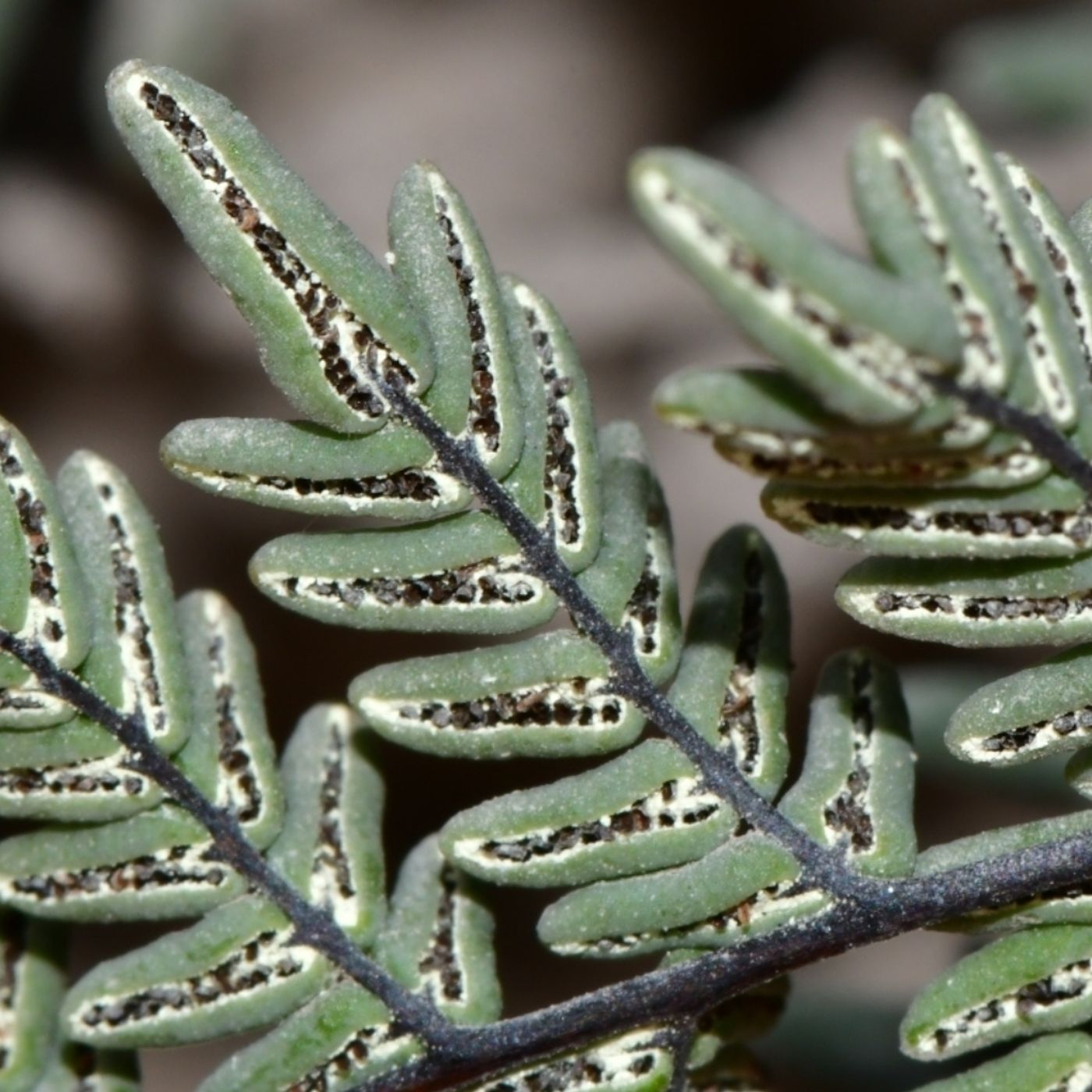
These ferns are often either fuzzy as hell or blue, chalky-mint-green, and waxy with a wirey rachis. It'd be hard for anybody who takes a look at them to not be taken with how cool they look.
But how do they get it done? What are some of their adaptations? What is the evoutionary age of the family and where is the origin of diversity? What the hell is a "gametophyte" and are they unisexual or the fern equiavelent of being protogynous (and what the hell does "protogynous" mean anyway?). Why is molecular sequencing (looking at the DNA) so important for figuring out how all these plants are related to each other? What is convergent evolution and why have so many genera in this subfamily evolutionarily converged on the same strategies to cope with life in a dry environment? How do you identify species when so many of them look superficially alike and don't produce flowers (what we normally use to identify plants)? How long can their damn spores last (answer : centuries, in some cases).
We cover it all in this two hour podcast. If there's a term we use that you're not familiar with, look it up or join the Crime Pays patreon and send me a message. A brief list of topics somewhat sloppily-arranged in an "episode map" is below. Note: until I can alienate the casino advertisers, they seem to be especially herpetic on this episode. Ad-free episodes can be found on the Patreon.
apomixis : 1 hour 20
evolutionary age ; 75 ya
synapomorphies : revolute margins and pseudo-indusia
convergent evolution
center of diversity indicates center of origin
no farina in Notholaena, but flavonoid compounds on capitate hairs resembling cotton-candy
talking about cheilanthoid ferns to explain convergent evolution and how dna can resolve evolutionary relationships
difference between eusporangiate ferns and leptosporangiate
age of viability of fern spores
alternation of generations
antheridiogen
dispersal vs. vicariance 1:31
apomixis 1:36
"Cheilanthoid Ferns" are a remarkable group of ferns - they grow in habitats where ferns seemingly shouldn't be able to grow - out of cracks in rocks and cliff faces in regions that are both usually very hot and very dry. Genera like Astrolepis, Myriopteris, Notholaena, Argyrochosma, Pellaea (the "coffe fern" in California), Cheilanthes, and more have been blowing my mind years as I frequently encountered them co-occurring in habitats with Cacti and spiny legumes. To the East, Myriopteris alabamensis grows all over drier rocky "microsites" throughout the Eastern half of North America.
These ferns are often either fuzzy as hell or blue, chalky-mint-green, and waxy with a wirey rachis. It'd be hard for anybody who takes a look at them to not be taken with how cool they look.
But how do they get it done? What are some of their adaptations? What is the evoutionary age of the family and where is the origin of diversity? What the hell is a "gametophyte" and are they unisexual or the fern equiavelent of being protogynous (and what the hell does "protogynous" mean anyway?). Why is molecular sequencing (looking at the DNA) so important for figuring out how all these plants are related to each other? What is convergent evolution and why have so many genera in this subfamily evolutionarily converged on the same strategies to cope with life in a dry environment? How do you identify species when so many of them look superficially alike and don't produce flowers (what we normally use to identify plants)? How long can their damn spores last (answer : centuries, in some cases).
We cover it all in this two hour podcast. If there's a term we use that you're not familiar with, look it up or join the Crime Pays patreon and send me a message. A brief list of topics somewhat sloppily-arranged in an "episode map" is below. Note: until I can alienate the casino advertisers, they seem to be especially herpetic on this episode. Ad-free episodes can be found on the Patreon.
apomixis : 1 hour 20
evolutionary age ; 75 ya
synapomorphies : revolute margins and pseudo-indusia
convergent evolution
center of diversity indicates center of origin
no farina in Notholaena, but flavonoid compounds on capitate hairs resembling cotton-candy
talking about cheilanthoid ferns to explain convergent evolution and how dna can resolve evolutionary relationships
difference between eusporangiate ferns and leptosporangiate
age of viability of fern spores
alternation of generations
antheridiogen
dispersal vs. vicariance 1:31
apomixis 1:36
2024-03-12
123 min
Transcript
Available Results
Generated results are saved to the knowledge database for reuse and search.
No generated results are available for this episode yet.
Extract Knowledge
Pick what you want extracted first. Model, scope, and chapter options appear after a template is selected.
Generated results for public episodes are saved to the knowledge database so they can be reused and searched later.
Transcript
Okay, welcome to the Crime Pages of Body Doesn't Podcast. I'm here with
doctor Michael Wyndham, who actually was on the podcast last week talking about Duke
University or Bury him which is where he works, and we're here to talk
about this week about kylanthoid ferns, which are a for anybody who doesn't know,
I mean, it's probably my one of my favorite groups of ferns.
It's a subfamily of the family Terra decey with a p pteridacey. But kylanthoids
are especially adapted to one of my favorite types of biomes, which is the
deserts. So anyway, I woke up, woke up kind of late.
I was I was burning the midnight oil last night writing this book. I
was like three in the morning. But but but yeah, Michael, let's
just for for anyone who doesn't know, just for layman, let's talk about
kylanthoids and what I mean, how would you give an intro about this really
cool clade, this really cool a group of organisms. Well, probably have
to set it in context in the broader context of the evolution of plants,
especially land plants, and you know what what's required of plants to be able
to go from moist habitats, which you typically associate them with, what special
things they have to do. Two to colonize deserts, to colonize xeric habitats.
So the the primary problem there, of course is water availability. Most
plants require a fair amount of water and predictably available, and so you get
your greatest diversity of plants and in generally and in moist habitats the rain forests,
and so it's they're only specialized lineages that can move into the deserts.
Uh And but that's happened in a lot of different groups of plants. Otherwise
we wouldn't have a diversity in the desert, which we do. But so
it's it's all it's all about conserving water, right, right, And these
things are making these things are growing out of like cracks and rocks, they're
going and they're just they've got such a unique look to them too. I
mean the first you know, the first some of the first taxa that I
was introduced to, or of course in the genus Peleia, the coffee ferns
out west. First off, yeah, there shouldn't be I mean conventional thinking
for people who aren't bond This is that ferns shouldn't be growing in the desert.
We normally associate those with you know, darker under stories of forests,
you know, like New Zealand is rich in ferns, those dark understories of
those cool, wet potocarp forests, you know, or temperate rainforests in the
Pacific Northwest. But you know, you'll be in the desert and you come
on these things growing out of cracks and limestone rock or out of cracks and
you know, volcanic exposures of rhyolite, and they look you know, the
fronds can either be really fuzzy or they can look almost like they're made out
of plastic, with you know, the rackets, the stem that holds the
leaflets, like the central part of a fern frond, you know, will
you know, look all wiry and in some cases orange or black. I
mean, they're just they're the most bizarre and cool looking ferns in my opinion.
Well, I guess there's a couple that could be close. You know,
some of the maradioid ferns are cool, but the angiopteris can be angioptres
to see a firm with a twenty foot long frond that could be pretty impressive
too. But you know, I think kylanthoids are really high up there,
right. They're on the they're on the small leaved the microphillis end of of
the evolutionary scale and adaptation. So that's what you see in kyle athoids is
a combination of just about every pathway evolutionary pathway they can use to to exploit
zeric habitat. So, as you said Angiopteris with its huge leaves, kyl
aanthoids are at the other extreme, usually very small leaves and and those leaves
are divided into very small segments. And the strategy, the evolutionary strategy there
is reducing the surface to volume ratio. So to conserve water, you need
to lose as little of it as possible. And so by having very small
segments on small leaves, you see that adaptation across desert plants that they tend
to have small segments, and a lot of them are deciduous. They drop
the leaves or the segments, you know, in the driest, hottest part
of the year. So the very small leaves are an important adaptation. The
very fine division of those leaves. What I want to point out a little
different about ferns is that the majority of species, the stem is underground.
So the stems not even a consideration. It's subterranean in the what is the
best habitat in in the xeric environment, it's going to be a little wetter
uh and and uh a little cooler than what the actual leaves space. So
what you have with a with a fern, with most ferns is uh an
underground rhizome. And then the only part that you see of the plant,
the scorified it is the leaf. And uh, those leaves, like I
said, highly divided, uh and frequently either completely deciduous when when it gets
hot and dry, or they'll go dormant. So what are called the resurrection
ferns, that adaptation of a leaf because enrolling it tight, make a tight
little ball and uh and ride out the bad conditions. And then when rain
comes along then they will reopen those leaves. Then they can reactivate sort of
synthesis in a very short period of time, usually within an hour of getting
a decent rainfall. Because sometimes when you see these things, obviously they look
like total shit. I mean, there will dry it out there. The
leaves are curled up and so someone might see that and think it's dead,
but that's obviously it's not. It's still very much alive. It's just laying
in wait. It's just lurking, waiting for the rain to come back.
And so that leaf, that leaf, and so in all cases, will
that leaf rehydrates and become turget again upon moisture or does it just sprout new
ones or what I'm not in all cases, so there are some groups of
kylanthoids that that leaf will come back and will will be the primary photosynthetic apparatus
for weeks, maybe even months. Typically those species that the resurrection species will
will immediately produce new leaves as well. And then once those are fully functional,
they'll they'll they'll drop the older leaves, which you know, in in
the process of dormancy and such, often those leaves are damaged, but they're
in good enough shape when the rains return that they can get a start on
photosynthesis, they can get cooked in a little bit and and then enough to
get a new leaf going. And so right, okay, so for anybody
in that because these things are everywhere, I mean, these this subfamily is
everywhere, correct, I mean, it's certainly in the America's I've remember seen
some in South Africa. Do you get many in Australia and Southeast Asia too
or what? Yeah, wherever you have there are habitats in the world.
Kylanthoids have gotten there and diversified there. But the interesting thing is it's oftentimes
it's convergent, very convergent evolution. They're only a limited number of solutions to
the xeric problem. And so the plants in Australia are completely well, not
completely unrelated because they're all in the same subfamily, right, you know,
separate, separated by fifty to seventy million years, right, But they rip
off each other's material a lot, is what you're saying, because it's I
mean, right, like you said, there's only so many Russians you can
go if you're you know, getting around this hamset. So the same thing
ends up evolving numerous times, not surprisingly the same strategy. So they the
clades, the groups of related species tend to be confined to a particular region.
So you have an Australian evolutionary group and you know Brazilian and Mexican the
greatest concentration of their greatest diversity of species is Mexico and that from what our
phylogenies are DNA molecular phylogenies indicate that the earliest diverging caylanthoids calanthoids essentially originated in
the Mexican can region and spread to the other parts of the world where every
time they came upon a favorable habitat and were successful, then they diversified in
that area. So you have a bunch of a bunch of endemics to South
Africa and a bunch of endemics to Brazil and and so. But they started
in Mexico and have spread out over the last seventy five million years or so
to the rest of the to the world, but focusing on the zero habitats.
That's their specialization, right. So Okay, so Mexico's center of diversity,
and you know, like many plantling it is center wherever is the center
of diversity kind of hints that that might also be the origin, uh,
you know, like for ast racing in South America. It's like most diverse
in South America, and that's where that it's likely that you know, the
sunflower family got started. But but I guess that's how what's the evolutionary agent
of family that you guys have gotten from molecular clock or you know, dating
or from fossils. And then and then let's go into some snapomorphies for the
sub family. Let's go into some sanapomorphies for the subfamily. Uh well,
there essentially aren't any, uh so, so in the you can see snapomorphy
sanapomorphic sites in the molecular data, you know. So that is the basis
for establishing our understanding of the phylogeny. Because this group has been worked and
reworked for two hundred years, people trying to figure out what, you know,
what is a genus? Does this belong to what genus? Uh?
And and what we've discovered as we've gone through the the DNA work is that
you know, very often usually they were wrong in the past, which which
is one reason that we are having to re circumscribe genera name new genera,
because our classification needs to reflect the relationships among the species. And so we're
just now starting to see the relationships too, because the DNA can help us
overcome the problem of convergent evolution. You know, the two things looked a
lot like morphologically, but they've been separated for fifty million years. Yeah,
I was going to say that the convergence here, the evolutionary convergence, seems
to be the issue, which is why so many you know, why you
know, the genus khyl Anthes existed or a one time existed, now it's
it's split up, uh or hasn't been split up. I don't know,
but one time exists between South South Africa and and the Americas. Now that
would be kind of weird because there's that whole Atlantic Ocean in the middle,
and those ecosystems have been isolated from each other, and those lineages have probably
been isolated from each other for a long time too. That's so, you
know, as has happened with many genera on either side of the Atlantic that
were presumed to be one, they were later split up, so you know,
that's yeah, the convergence here seems to be the big issue. They
just look too damn much alike in a beautiful way, in a wonderful way.
But so okay, on that note, go ahead, go ahead,
no, you go ahead, you go. Well, yeah, I was
just I was just going to say that we're talking about the limited number of
pathways that these plants could take to survive, you know, their their genetics
is incredibly diverse, but they are only a limit. There are a limited
number of solutions to the xeric problem. Yeah, and and so they're constrained
in those ways. But then oftentimes, when we finally have a phylogeny that
we can trust based on the DNA, if you look carefully enough, there
are characters there. It's just that they've been overlooked. Other characters, the
convergent ones have because they're so obvious, have been driving the classification, the
categorization of the species ever since they were first discovered. And and so you
know, now we get this insight from from DNA, and we can start
to look, Okay, are there characters that support these groupings, that reflect
these groupings, and they're they're usually usually there. So the genus, the
genus kyle Anthes, uh that you were you were just citing, So we
now know, you know, what species are related to the type species of
kyel Anthes, type species of kyle anthes Is is kyle Anthes micropteris from Andean
South America. Well not Indians, the cone, the southern cone of South
America. Uh. And so the DNA now tells us Okay, these other
species uh, are the closest relatives. You know, it gives us a
list of the species that are closest relatives of that type species, because the
type species is what carries the name. Kyle Anthees, that wasn't the first
one that discribe. That wasn't the first one described though in that group was
it probably not the first one described. But when the genus was founded,
was established by Sports in eighteen oh six, then you know, he he
identified a group of species that he thought represented this new genus. And the
one of the difficulties for modern taxonomous is that the rules that we follow now
for nomenclature weren't in place at that time, and so these days you would
designate a particular species as the type species. So whenever we describe a genus
now we say this particular species is the type and that carries the name.
So but in eighteen oh six, Swartz listed I believe at least a dozen
species. So instead of identifying one particular thing to be representative of the genus,
he just gave a list of the things that he thought were in it.
He's twelve, just pick one, it's fine, just pick one of
them. Well, so, but you know, that reflects his thought that
he's all belonged together. So it really didn't make any difference. It was
just kind of, well, it's eighteen oh six. Wait, so did
he think all these twelve He didn't think all these twelve species were the same
things. No, No, he listed them by their species epithets, so
he recognized them as thing. But he just listed them and he didn't say,
but I think that this one is the best example. So that's what
we have to do now, is we have to say this is the name,
that is the species that is going to be the type. It's going
to bear the name kyle Anthes, and that genus kyle Anthes always goes with
this species no matter what else. And so with kyle Anthes, then we
have this list of twelve or maybe more, I don't remember species that sports
put in kyle Anthes, but he didn't designate any one of them as the
type species. So what has to happen then is that in more modern times,
somebody has to go in and pick one of those twelve based on trying
to figure out what Swartz was thinking, and and you know, use all
of the information that he provided in publication to figure out which of the twelve
should be designated what's called a lecto type. Lecto type, just like,
okay, so how does that I'm not even familiar with that word. So,
and of course, for anyone listening who doesn't know what a type species
says, it's the species that defines, yeah, the whole, the whole
genius. Maybe you said this already, but either way, I'm just reiterating
it. For any layman, it's this, you know, the herbarium voucher
of the collection that that serves as the main specimen that describes the whole genus
or clay or whatever. So so we have to make a distinction there between
what's happening at the species level. So a species is that name is fixed
by reference to a particular specimen, right, and if somebody designates that specimen
that's a holotype, the one and only the name bearing at the level of
genus, then you're not designating a particular specimen, You're designating a species.
And so in this case, we have twelve to choose from and different people.
So the problem with lecto typification is you have more recent authors have varying
opinions about you know, which of those twelve species is should be the name
bearer. And so you have people, you know, you have one person
who you know, chooses one species and one person who chooses a different species,
and trying to figure out which of those is proper. Uh, you
know who was right? These ms get heated? This is that? Does
it does it ever come to does it ever come to blows? You know,
like somebody hits somebody else with a stick or something very close? And
this this is really prominent among the kyle Anthroid ferns because of this problem with
with convergence and trying to figure out how these things are related. Yeah,
so with Kyle anthe's uh. Then the the species that ultimately won the competition
was my was micro micro micropteris. Uh. Like I said, this this
southern cone of South America species, that's kind of nice. Look at that.
I'm looking at it right now. Well, that thing is weird.
Jesus Christy, that looks like a damn astro leap. How the hell is
it? That's the kind or Jamesonius, I fucking love I love this subfamily
so much. Man, They're so fucking weird looking. Anyone who's listening who
doesn't know Kylanthoid ferns. And I don't think you get that many in the
eastern half of the United States. It is mostly a western jeus. You
get Maria Actress Alabama and sis what else what? I don't know. We
can get into that in a minute. But anyone who doesn't know, go
to a naturalists and just type in Kyle Anthoid c H E I L A
N T H E O I D E A E in the in the tax
on search and just type in United States or your state or whatever, and
just or wherever the hell type in you know, Arizona, and just see
what comes up. You'll see such cool. God, they're so cool.
Yeah, we're okay. So that the reason that my cropt has won the
UH won the battle. So there were multiple authors came along and said,
I think the type of kyl Anthe should be this. You have to use
the right words, you know, you have to have the right incantation to
get people to convince people that your argument is is that you know to be
accepted over other people's and is with all matters, nomenclatural priority is is really
important. And so the first person who lecto typified Kyle Anthy's or any other
genus or any species. The first person to come along and do that,
that name that their choice should stand. Except that then the arguments start over.
Well, they didn't do it the right way. This is like this
is like a rich guy, you know, leaving a like having like twelve
kids and leaving a will but not designated the same thing. And the steaks
and the steaks are are pretty high. So but that with Kyle as that
that one genus. Uh, the argument was was set in place by the
Botanical Congress by a choice that they made, which was they conserved the name
Kyle Anthes. So there is an older name that could be applied. What
was what was that? Alosaurus? What is it? Alosaurus alisaurs? Yeah,
sounds like a like a dinosaur in fact, I think, in fact,
I think there is a genus. Yeah, that's nice. I like
that. And Sosaurus would of course, you know that refers to the sporangia,
that clusters of sporangia, I would assume in that right right, But
that that name has some terrible nomenclatural problems. And so I don't know which
Botanical Congress it was like back in the fifties or something. They rejected,
they served the name Kyle Anthe's. So. One way that you can get
around priority is if the Botanical Congress, which governs all nomenclature in plants,
if they decide to conserve a name based on a particular type and reject another,
you know, reject an older name and conserve of a more recent name
than that action of the Congress makes that name, makes the conserved name the
right one. And so the Congress conserve Kyle Anthees, and they conserved it
on my Micropterus as the type species. When you say congress, is so,
is this like a meeting, this is like an actual event or is
it just the figurative? Wow, it is okay, because in the fifties
of nomenclatural Congress in the fifties seems like a good candidate for spiking the punch
bowl with LSD. I'm just saying, because you talk about a stiff bunch
that would be that would get it. You know, that would probably be
fun. I would love, I mean, plants and psychedelics for me go
to get a great But anyway, that so, this is so, this
is when this is this name was decided upon. But okay, I'm looking
at a Yeah, okay, here's a whole other paper by Oh yeah,
this is you. Actually, I didn't I didn't realize that with a with
Amanda Lee Gruzh the Ferrn genus Kylanthes has perplexed taxonomous more than two centuries.
So this this said, where the hell did the hamster? I just saw
a sentence that I found in the Google search, and I can't find here.
That's when I'm looking at the paper that said, oh, here we
go. Yeah, because the type species of Kylanthes Kindlanthes my craftriss is only
distantly related to this clade, we resurrect the genus Myriopterus. Oh, this
is the one where you Okay, so this is where you pulled because I
wanted to get to this anyway. This is where you pulled. Mariopteris out
of, out of So let's talk about this. So what was because Marie,
I remember, I was getting into botany when this happened. When all
these things that were formerly called Kaylanthes suddenly became you know, people like,
oh no, that's meriopterus. So what what happened there? Let's talk about
that. Well, so that actually is an extension of the story that we're
talking about. So with uh so kyl Aanthes by an action of the Botanical
Congress, uh kyl Anthes Micropteris is the type species of Kylanthes, so that
the name Kylanthes then only applies to Micropteris and its close relatives. So what
we discovered in in doing the phylogenetic work, Amanda and I, that the
species in North America that have been called kyl Anthes are not at all related
to my micropteris, right right, So so convergence and and you know,
misinterpretation of characters and and you know, all of the the North American stuff
had had pretty much always been called kyle Anthes, but it's it's not related.
It's probably separated by at least fifty million years. Oh wow. And
all almost every other genus recognized genus of kyle Anthes, of kylanthoids in the
tree falls between kyle Anthes and Meriopteris. So if you were to define kyle
Anthes in a way that includes Mariopteris, then almost every other kylanthoid fern is
kyle Anthes. So all those accepted genera that people have named over the last
two hundred years are gone, you know, they if you take that approach,
right and we yeah, yeah, Like if you're looking at one of
those cladograms, those those pyramid just like a pyramid clatogram, like real simplified
one, you'd have to loop. They're so distant apart that if you were
to draw a loop around them and rate, you know, you'd be you'd
be catching all this other stuff in the net too. And they all have
to be called right, right, and and so to avoid that because you
know, as you know, there are some very distinct looking groups and and
uh and uh regional clades and and all of those things that that are very
convincing that they should be recognized. Uh. And so we we don't want
just to dump everything, all five hundred species of kylanthoid ferns into into one
genus. We want a hierarchy of names that reflects what we know about the
relationships. Yeah, yeah, and so so Mariopteris and kyle Anthes are on
opposite ends of the tree. So it's so what, so what's kyl anthes
now? So what about those, I mean, the South African kylanthes.
Are they part of that myria or that Kythes my cropterus or are they turns
out they're actually not or what so they're they're separate clad So so right right
now we're we're working on a paper, uh to to try to clean up
the last vestiges of confusion in kylanthoid classification UHA, a paper where we present
a three gene phylogeny of that includes uh two thirds of all species of of
kylanthoid and ferns, so good representation, uh, three flasted genes. It
would be nice to have some nuclear but those are only just coming online for
for fern phylogeny. Uh. And so at this point we're about to do
a major another the largest reorganization of generic boundaries in kylanthoids, and under that
system, kyl Anthe true kyle Anthes is restricted to South America and Australasia.
Oh wow, you think do you think that's a result of dispersal or like,
you know, just the breakup of Gondwana or what. It's not as
deep as the breakup of Gondwana. It's it from the look of it.
Kyl Anthy's the genus originated in South America and then there was a dispersal event
to to Australasia, and then there's been a you know, a diversification of
species within the Australian Asian region. So there's that the Australasian divergence is what
we've phylogenetically called nested within the South American species. So it was, you
know, that this group was going along in South America making making species,
and then one of them jumped to Australasia and then that went on to be
making more species. Yeah, okay, well I guess, I mean,
I guess the convergence thing here makes sense. You know, especially when you're
a fern you don't have flowers, which I mean flowers, you know,
represent a really easy character to look at. You know, when you're just
making spores, that things are a little can be a little more convoluted and
in harder resolve when you're just looking at plant morphology when you don't know the
DNA. But that DNA certainly seems like it's clearing everything up. So this
just seems I mean, pardon my friends, it just seems like such a
clusterfuck of taxonomy for so so they're getting back to an earlier point that we
made that if you look so when the DNA tells us this is a related
group of species, but that group hasn't been separated before. Nobody's recognized that
it's just been dumped in some other genus or other general been dumped within it.
In the case of of kyle Anthes, the cool thing is that the
kyl Anthes as we are now getting ready to re circumscribe it to to uh
come up with new new characters to distinguish it. The genus kyle Anthes,
it has a character, a striking character, which is the number of spores
persporangium like a striking thing to most people. But so the vast majority of
Leptos sperangiate ferns. This is that the more than ninety percent of all ferns,
the Lepto sperangiates, have stabilized their number of spores in a sporangium at
sixty four. So so the sorry, no, no, it's okay,
I want to I want to add in there really quick. We're mentioning Leptos
sprani if anybody listening, as opposed to you spranji U. Sporangiate Is are
plants like angiopteris, the maradioid ferns. They're kind of unique for ferns,
you know. It's the way that they build, they compose their sporangi.
It has come from one cell or many, and I think it's for leptosprandi
it's they all come from one cell, right right. So eleptospranjits are arise
from one cell and the U sperandiates arise from multiple cells. And this the
spore number character plays a role here with the U sporangiate have an indeterminate large
number of spores, so they have a they have a big sprandium. It's
it's created from a number of different cells and it's loaded with spores hundreds,
just just belting them out there, getting them out there right right. And
and leptos are the evolution in terms of sporangia e. Leptos sprandiates are the
derived character, the synapomorphic character of this clay that constituting ninety percent of ferns,
and that involves some major chain changes in the sporangia, but one of
those being reducing the spore number, so that there are a few of the
earliest diverging leptos sporangiates that have one hundred and twenty eight or two hundred and
fifty six. There's a path. Notice the pattern here, yeah, double
yeah, but the but the leptos well actually having so as we're going into
the leptos, we're reducing. We're going from one hundreds to two fifty six.
Oh so the twenty sixty four is the derived sixty four is the new
The Taxonymus hated when you say this, but I always, I always,
you know, comfort derived. I always come to make derived just mean the
new and improved. They fucking hate it when you say, but that's the
newer version. It's the derived trade. It's obviously what's working in his most
whatever's most appears to maybe be most successful compared to the other. So anyway,
sorry, go on, So so most right, they at the in
the early branches among leptos, they went down and they locked in sixty four
uh spores pers brandium, and that is stable over generally stable over you know,
a huge span of evolutionary time, which is why this is the situation
with Kyle Anthes is a monumental character because Kyle l Antes and and you know
it marks the origin of Kyle Anthes that they went down to thirty two.
Oh shit, so only the genus Kylanthes in that sub This has happened a
couple of other times in unrelated lineages. So there is some instability in spore
number per sporangium where the vast majority of leptos are sixty four, and then
you have these picular, occasional particular lineages that drop to thirty two. Would
there be an adaptive benefit in reducing spore number by half? And are they
presumably increasing the sporangium number then or what nobody's looked at? As far as
I know, nobody's looked at sporangium number. You could potentially provision the spores,
you know, with more nutrients and such, if you're only provisioning thirty
two rather than sixty four, But we don't really see any evidence of that
either. What it's it may not be an adaptive trait, It may just
be. So what's happened here is they've with sixty four. You start out
with sixteen spour mother cells and you go through myosis and that gets you the
six sixty four spores. With these thirty twos, you're starting with only eight
spore mother cells. So what they've done is they've lost a mitosis in the
process of making spour mother cells. Yeah, right, and so they reduced
the number they've start with four size comparisons suggest that the thirty twos don't have
any more boomphs to them, you know, any more advantage in terms of
nutrients. They're they're the aim size as their six, as the spores from
their sixty four sport compatriot. Right, it's just the starting material was reduced.
So it's not like it's a juicy or spore that can live longer and
get going faster. It's just the starting number was reduced, and it might
test. But the end, you know, the interesting thing there is that
that's a defining character for the as we look over the clades that marks the
kyle Lanthes plate, so anything anything that's got anything that's got sixty four is
outside that clade. And so we looked at essentially every species in the Kyelanthes
clade. Uh, they're all thirty two except for the problem of appamixes,
which will probably get into shortly. Oh my god, get that, I
forgot about that. Yeah, well in app in appa mix not not yet.
I didn't say yet. Hold on, I'm still i gotta I need
to emotionally prepare. But wait, so this is like a key break you
get to in a in a flora where you just I would start crying,
like I just have the moment I look at the the spore number and I
just and I look up from the page and I'm just sitting there just with
a blank stare, just comprehending whatever, right, because this is not something
you can really do in the field. So, but you would need a
microscope. You take this thing back and then what resolution of microscope? Like
how do you count the spore number coming coming out of a uh, sporangium?
Sporangium. So I have a binocular dissecting scope and so I'm I'm probably
doing that at about four e X. So you can you can do that
in the field? Uh No? Okay? So like when you're standing on
like a rocket on a ledge of the chihuahua, does it? You can't?
Really, you can't, Okay, So you got to take that home.
You got to make a collection of pressent taking home, right that that
what becomes useful in that case is is the geography associated with that. So
you know we know that that Kyle Anthe's with with thirty two spores in sexual
diploids that that's confined to South America and Australasia. So that's not going to
appear as a character in a key in North America. Right, So we
we do this if you think about this, you know, in botany,
in in biology in general, we we use geography incredibly extensively when we're identifying.
Oh absolutely, because a flora is you know, a book that or
a resource that helps to you know, that allows you to identify plants of
a particular area. So by by using a flora that restricts itself, it's
not the world. You've already used geography to weed out two hundred thousand plants
I want to. It also helps that you're you're the curator of an herbarium.
So we got this like a huge part in discussing all this stuff.
Because you're working in an urbarium, you obviously have a much broader lens and
you know, though you work with a specific group, you're you know,
I would, God, I love that. I want to, Like I
want an herbarium uh incense smell, you know, or like a little spray
you know that just mimics the spray of like the paper in the leave the
penstamens out maybe, but just get the you know what I mean, just
get like that smell of paper and old planet there. Wouldn't that be nice.
I'd buy that in a minute. I'd use it as like a little
colone dapper paridichlorobenzene. And yeah, anyway, okay, sorry, so we're
getting this straight. Okay, really quick, I want to bring this back
down. Just get away from this for a minute. Let's put a bookmark
and then get but get into kylanthoids. Just talk about them in a general
sense for laming because I think this is so they're just such a cool fucking
clade. I mean, they're hard to grow there, they're extremely I mean
there's a sight online about growing them, and it's like one of the things
they say is humidity is good standing water is not like you want the humidity
you know when when you're growing these gametophytes and sand And of course we're talking
about alternation to generations, which for people that don't understand that, you could
email me. You can. Maybe I'll try to put them up on the
website that just explains it lay people terms. But you know, you get
a commuta fight and you get to get the that's the in these ferns.
The commuto fight's the little guy you can barely see, and then the spori
fight is the big actual furnacy. But you know, growing these things,
you grow them in petri dishes sometimes or closed trays on sand, and that's
how you germinate the spores. And then I've tried before, I've never had
luck. My friend Martin Grantham has grown astro lipis and a few others.
But but just going back to the general sense, if we can't for a
minute pulling it out of this very specific and wonderfully science heavy topic, like
what about I mean, there are some traits for kylanthoid ferns people can use
to identifying, right, I always use that revolute margin that pseudo indusia.
Can we talk about that for a minute, because first off, what's it
in pseudo and duzia and what's going on with this folded over lip and a
lot of the kylanthoids, I mean all of terodacy, but the kylanthoids especially,
right, So, in stepping back to an indusium, so, an
indusium is a protective structure, usually membranaceous that that covers the developing sporangia.
So the sprandi are the key to the future. They need to be protected.
Different ferns use different ways to protect them different so, but often that
involves this membrane, this indusium uh and in the in a lot of ferns
that sort of the standard ferns that you see in the in eastern North America
that the sorei, the clusters of sprandia are located on the undersurface of the
leaf some distance from the margin, usually sort of halfway between the midrib and
the margin, and an indusium in that case typically arises either at the side
of the of thesaurus and laps over it, or it can arise in the
middle and cover it, sort of like an umbrella. The latter is the
genus polisticum if you're familiar with that, and that indusium can take all different
manners of shape and and we use that. That's those are our primary characters
for distinguishing the genera of of ferns in the world, like the flowers,
the reproductive structures. Right, so the the the genus a splenium, the
spleen words have an indusium that is, that is along the vein on one
side of an elongate saurus and it and it's so it has this linear membrane
that overlaps this barangio while they're developing. And then when the sprandi are ready
to shed spores, you want that out of the way, and so it
shrivels or it folds back right, yeah, slit, Yeah, they got
the slits. You flip You flip a spore full of a splenium over,
you know, Okay, that's an a spleenium. That's that's really so.
And like I said, most in a lot of groups, that is the
is the main generic character that you'll encounter in a key. You know,
linear indusium or umbrella like indusium, those are the things that your key furns
out with. So what's different about kylanthoids. But it's it's I want to
point out, it's not just kylanthoids, as you said, it's the broader
family teridac and that's not the only family that can have a marginal uh dusium
uh so. But the the pseudo indusium of the pteridace is the margin of
the leaf. So instead of arising on the somewhere on the bottom of the
leaf. The indusial membrane forms at the edge of the leaf, and the
edge of the leaf rolls becomes revolute, rolls over the sparangia and keeps them
protected in the early stages of development, and then it'll it'll typically open up
more, you know, once the sprandia already, because you don't want the
dusium and interfering with sport dispersal. So the pseudo indusium is a a membrane
like an dusium, but it's called pseudo because it's just the modified leaf margin.
And how long can some of these bores live once they're you know,
out of the story. So I did a paper on that back in the
eighties, looking at the germination of spores from herbarium specimens in one particular group
of species in the genus Polea, which is kyl anthoid a chylanthid genus,
and just you know, plants that weren't intended for the purpose. They were
just stuck in a plant press and pressed and glued to a sheet like every
other normal herbarium specimen. Some of them, under the right storage conditions were
still germinating after one hundred years. That's fucking crazy. The way. Goddamn
it. That's amazing, that's amazing. So these were varium vouchers that were
collected one hundred years prior and the spores were still viable. Yeap, Oh
my god, what species of plaa was it? That's a great genus too,
man, God damn that is that's like a you know, the waxy
blue desert, you know, mountains of the Mojave desert, fern. I
mean what, yeah, what genus or what species was it? You know,
play a truncta which is southwest US. Wow. And you know,
one of the one of the more adapted to to Xeri habitats that you can
find it in the mountains outside of you, Marizona, which is always a
measure for me of survivability in the doer. Yeah, that's wild. I
got pulled off a freight train in you Arizona when I was U. I
was like twenty twenty one. Maybe. Yeah, it's not a it's not
a it's it's a pretty rough place at least, you know, it's not
not just in one way. But of course the yeah, the aridity there
is like that is that is like as hot and dry as it gets,
you know, that's right. That's what and that paper that research helped to
establish. Uh, well, the idea was to reflect on herbarium curation techniques
as well. You know what is it that are buria do and at the
different way the different things that are burier due to specimens to prepare them and
protect them and uh, you know which of those things promote h spore longevity,
uh and and which of them seem to detract from spore longevity? And
Arberia do a lot of things in the name of a pest control, because
that's one of our greatest threats is if if particular pests get into the collection
where the most monumental was cigarette beetles and and lay their eggs in the larvae
goat, they can devastate an urbarium collection. And so that's the reason in
the past that we've used you know, use mothballs and uh oh, mercury
compounds and fine eye compounds. If you go far enough back in time,
uh, you know when people were were still using mercury for making hats.
The mad Hatter, you know that that. Yeah, mercuric chloride was used
as a as a fumigant. You go in, go into an irbarium and
you know, depending on the age of the specimen, most of the modern
collections will will not not have had anything weird done to them. But you
know, you get back to the older collections, especially in the big older
Herbarian and they're labeled, you know, treated with mercuric chloride or so,
you know, the idea is to handle them a little more careful, lick
the page, don't lick the page, which I've been inclined to do sometimes,
but you hold I'll hold it back, so okay, So go with
these. So it's it's not surprising. I mean, ferns were you know,
supposely after the k T extinction, after the asteroid you know, changed
the course of life on Earth, made it possible for the mammals to get
going, took out the dicers. Ferns supposedly, you know, there's this
this fern bloom around that time, right obviously because spores, you know,
and you could I you could see it in the microfossil record. Is all
the fern spores that that appear because obviously a lot of fern spores are extremely
hardy, and they were the first thing three colonized. The same thing you
see, you know, after a after a you know, volcanic eruption in
Hawaii or something. So usually it's likens first lost second. God, that's
cool though, So these so this is okay, So one hundred year lifespan,
but that's not the limit. It could be longer in terms of viability.
And then when they get going, when they get when they germinate.
I mean, how you know if you're growing out of a rock crack in
the New York Mountains in the Mojave Desert, how how do you joy?
Yeah? How do you? I mean how does it walk us through this?
Like? How? I mean do you know? How does that get?
How does how do these things get established? Well, so the spore
has an innate dormancy that you know, as we've just discussed with Playa.
Uh, it can be one hundred years at least in an urbarium collection that
hasn't been the inappropriately sanitized. And so the dormant spore winds up in an
appropriate habitat and and then some moisture comes along, which can be pretty sporadic
in the New York Mountains, which are not far from Death Valley, and
so a sufficient amount of moisture is enough to break dormancy and cause the spore
to germinate and what that spore is forming. As you implied earlier, ferns
are distinctive among plants in having two independent generations in the life cycle. So
the spores germinate to make gametophytes, and these are the little hidden treasures,
often heart shaped in the majority of leptosprandiate ferns, you know, maybe a
millimeter across on average, basically single cell thickness, but it's photosynthetic and that
it's independent of of the sporophyte, which is the other generation. And the
way that you cycle between the two generations is spore germanates makes gametophyte. Gametophyte
makes scammeats, so egg and sperm those fews they make a zygote. So
you've now gone to the diploid level the young sporophyte. But you need you
need two different gametophytes, like they've got to be approximate each other, right,
that depends. So in some ferns they have they have strict out crossing.
Uh that you know, prevents the extreme inbreeding of sperm and egg from
a single gametophyte fusing. So that's that's overall, that's not a good strategy
evolutionarily because it's the most extreme form of inbreeding you possibly have. Uh.
The sperm, the sperm, and the egg are exactly identical to one another.
Uh, and so the resultant product of that would have no heterozygosity whatsoever,
and that's not good usually, right, There are ferns that can do
it, but in general it's it's adjacent to metaphytes. Uh. So you
have to wind up with two spores from the same species in the same spot
and they make make their gamme eats. And then the thing about ferns,
and we're gonna have to come back to this from the standpoint of zeroic adaptation.
In ferns, the sperm has to swim from gametify to gametoft So you
can immediately see a problem with living in the desert. Yeah, one of
the big problems. Yeah, I was gonna say, so, okay,
first off, so at least just in Kyle anthority, are the gammy Are
the gametophytes unisexual or do they does a communify produce both sperm and egg,
so typically they are let me see, trying to remember which which one comes
first. I think they're they're female first, most of them. Uh so
they produce eggs and then if those don't get fertilized by some other gamutify,
if there's not another gamata fight around to provide sperm, then they late later
in life will develop sperm producing structures. Okay, so they got they got
a work around. Okay, they got an insurance. Yeah right. So
so so female first. And one of the cool things about firm breeding systems
is have you heard of anthidigen? No? What is that? So?
Anthidigen is a hormone that is produced by by some gametophytes that when you have
one of these all female gametophytes, produces anthidigen, which forces gametophytes around them
to become male. Oh my god, I was going to say, so,
how do you spell that anther? Obviously there's the prefix indicating male and
then it's G E N or what anth ridio gen? Oh? There,
I go, okay anth radio yeah in the radio gen, I see it.
Okay, wow. Yeah. Anthidiogens are a class of chemicals secreted byophytes
that have been shown to influence production of the male gamut TANGI I love that
word. That's amazing. So so it's it's pretty cool that you know one
of these you need you need more than one, just more than one spore
for the most part to wind up in the in the same place. And
then the first one out, the first one to get the right conditions and
germanate and go female produces anthidiogen So the later germinating uh gametophytes then are are
immediately become male. Uh they skip the female state, like there's not we
don't have enough men. We don't got enough enough enough, you know,
dongs. We gotta get you just you've got to start making more of them.
It's amazing. Yeah, So, uh, where would you like to
go from the Sorry, yeah, I just that was inappropriate. I just
I'm just amazed that the strategies. I'm I'm looking up New York mountains right
now because I forget whether they were This is how bad my ad d is
whether they were limestone or rhyolite, but uh it seems like it might be
right. I can't tell. But anyway, so okay, so let me
let me go back to this because okay, so so the anyways go ahead,
So the uh so, the comedia, the the comta fights get going.
You need to there the sperm and egg are mating, you get a
sporo fight popping up. Is there a lot of ferns need Michael Risey,
Michael rseel symbians. Do you think that is the case here or probably not?
I would imagine probably not since just the desert. So I'm not I'm
not familiar with the literature on Mike RISEI and for and certainly there are some
groups where the microzal stories are amazing. So the whisk ferns, for instance,
you know, they don't even they don't have roots, you know,
their their their uptake of nutrients is dependent upon uh, the the microrizal association
and their relatives the moonwartz, where moonwartz can uh completely dispense with their above
ground photosynthetic uh structures, they can they can not have chloroplasts at all.
Uh. There there's a species called the little goblin and uh because they have
this intimate association with with the mic horizon. Right, and you know,
to to the to the effect that it's we have borderline on parasitic on the
the fungive. Yeah, like botrichium has got them them micro rhyzel gametophytes.
Right, Yeah, but there are a lot of them growing in dense you
know, duffy uh rich microbial rich soils, but obviously the desert. So
a number of the lycophytes have uh completely micotrophic gametophytes and as you said,
betrichium, so there are there's some of that going on. But sorry,
where were we? No, No, So, I would just I was
just wondering if the if the the gametophyte or the sporofied of a lot of
the kylanthos like plaaf, they have any microhisal associations, but I would doubt
it, and I wouldn't think that, you know, needing obviously needing that
in the desert wouldn't work out too well. But right, right, So,
so I was saying, I don't really know the literature, but as
you just said, I respect minimal micro rhizo involvement in the in the kylanthoids.
But anyway, so well, these things when they're when the spores are
germinating, it's quite likely not in the middle of July, it's probably you
know, and like the cooler wet season, they're getting going. And then
how what is the actual how long does it take you know for these gametophyte
uh stages to you know, bring on the sporophyts. I mean, how
long are they sitting? How long does this process take? And can they
can they? Can they? How long live are the gametophytes of like Palaya,
you know, any playa species, et cetera. Oh yeah, there's
some cool research again on Playa dates back to the twenties or the thirties on
how resilient the gametophytes are. So you know, we were talking about in
Playa in the one species that I studied extensively, the spores under the right
conditions could remain dormant for one hundred years. So that this work by the
author I think was picket on gametophyte resilience. So they allowed gametophytes to you
know, basically dry out, turn gaminofytes to dry out completely, so they
you know, they just didn't water the substrate. And I believe they discovered
that some of the Playa gametophytes would still come back after five years. That's
insane, man. And these are things. So these are and of course
the gamutified I mean it would be almost it'd be like finding a needle in
a haystack. For a human. Uh, you know in habitat. I
mean, there's they're so impossibly tiny, correct, right, So we've been
on a couple of fur and forays in the tropics where tropical g meta fytes
are a different beast. Uh, you know, they they are probably longer
lived, they're larger, they're easier to find. But as you said,
most of the kyle anthoids are growing out of rocks, and so you never
see the gamuta fight. It's it's down in that crack, you know,
waiting for a drop of water so that it can release the sperm, you
know, with which then will will swim to an egg and and fertilize it.
God. That's so these things are all around you. When you're out
in habitat and there's Calanthi ferns around, there could be gametophytes anywhere. They
could just be hanging out, lurking, and you know suddenly just one day.
You know, they could be there for years and then suddenly just one
day, boom, there's a sporo fight. You see a little frond of
margin, right, So so we know that that they can survive, you
know, in beyond the year. In the extreme, the picket experience picket
experiment, uh five years. Uh So the gammatophytes are pretty resilient themselves,
waiting for the right conditions because for them to do their job, they need
they need to wait for sufficient water in the soil for the sperm to be
able to swim. And what's the length that we're talking about here, like
a one one hundredth of a millimeter or what typically the gametophytes that I've seen
are you know, a little a little more scattered than that, so you
know, mill millimeters, you know, centimeter potentially, that's great. The
fern sperm are the craziest things you've ever you've ever seeing. They have multiple
tails and they whirl around following the chemical signal from the from the egg.
People don't normally think of ferns being able to swim, you know, that's
like such a I mean, and it's centimeter. It's got to be like
multiple football fields for one of these things. That's wild man. I didn't
I was always so curious about this. I mean, first off, whenever
I encounter them in the desert, I was just we were just doing a
survey for a couple of different cacti species in West Texas, you know,
peyote Aerocarpus, et cetera. And there's a not the Lena Greggi population that
occurs on this this one cliff, probably quite a few cliffs, but uh
and I just you know, I look at it and it's like eight feet
above the ground, growing out of a crack, and I'm just like,
how does that? How old is that? How deep do those roots go?
How long does it take to get established? I mean, what is
it? It's just wild to think about that. There's this whole other story
going on that you just don't see, you know, on like a microscopic
scale or I mean, you know one centimeter one centimeter length. Yeah,
God, it's so cool, man, It's just nuts to think about.
Okay. So anyway, so once the SPORTI fight gets going, I mean,
can you can you consider a lot of these ferns technically poikilo hydric in
terms of you know, them being resurrection plants and being able to I mean,
did they completely dry out or does the root just kind of stay alie?
I mean what? So? So different groups of kyle anthoids are are
doing different things. Some of them, you know, when they're faced with
drought conditions, they'll they'll just drop the leaves just you know, like so
many other desert plants, when the bad conditions come along, the leaves become
a danger to the survival of the plant because as they represent the major source
of water loss, and so some kyle anthoys will will drop the leaves or
the leaflets that they might just you know, get rid of all the photosynthetic
tissue and and keep sort of a skeletonized the racus. Not that that's has
an evolutionary evolutionary advantage that we can think of, but you never know,
might keep uh, those those poking things out of the crack, might keep
the potential predators from from digging in on the on the rhizome. Yeah,
yeah, I see that a lot though those black wiryke I suspect that's a
reasonable idea that that helps to keep predators at bay from the from the rii
zome during the dry season. So others, the really strong resurrection species will
just as soon as it rains again, the leaves unfold. So when they
go dormant, they roll up, they you know, form a fist basically,
uh, with the upper typically with the upper surface of the leaf enclosed
in the center of the ball the fist, and and they can they can
be like that for presumably even a few years, given you know that the
periodicity of rainfall in some of these areas. So they were talking about they
could just go into dormancy and just hang out there for a few years if
need be right. And those especially those that keep the leaves that do the
resurrection thing, they will they have various adaptations too to help that leaf to
cut down on the water loss from that leaf, so they'll have a you
know, thick covering of hairs or a thick covering of scales. Usually these
white are lighter in color than the leaf itself. And when they when they
go dormant in these little balls, almost all the light hitting them gets reflected
back, so keeping them keeping them from overheating. Yeah, yeah, that's
that's that's the notable thing. I mean, I think for when people when
you see genera like you know, myriaptrus or Astrolepis and they're just these fuzzy
blue blue to chalky green or sometimes white. Uh, you know, when
at least when they're even when they're thriving, when they're turgent and actively metabolizing
and photo synthesizing. It's such a cool it's such a cool thing to see,
like, what the fuck, what is this? Like this this it
looks like a being a coral reef or something. This you know, elongated
narrow fern that's covered in you know, tricombs and scales that's bursting out of
a crack in a limestone rock right so, and and those hairs and scales
the species that have adopted that as their primary strategy against water loss when when
they're hydrated, when they're doing photosynthesis, they're in the desert, they don't
need to harvest all of the light. So even though those surfaces, those
scales and hairs are reflective of light, plenty still gets through in a desert
habitat, so they're not their photosynthesis isn't impaired by that, you know,
by the dense covering of hairs. And in fact, usually it's lower surface
that that is covered by hairs and scales, and what those what that represents
is basically a blanket that helps hold moisture on the underid helps to keep the
lower surface of the leaf at at higher humidity, which keeps them right,
which which then keeps it lowers the water loss from the plant because the stommates
are on the underside. To do photosynthesis, you've got to take up CO
two. You open the stonemates and you're going to lose water. And so
having a having that extra layer of of insulation there, trapping water close to
the to the plant is is a great advantage. Yeah, it's I always
use the analogy it's like a it's like a wind break, like a tree
went up, you know, when someone plants a windbreak of trees on like
a prairie farmhouse, on a great planes or something, reducing that airflow.
Because airflow is what dries things out. It doesn't even have to be that
hot, just you get a lot of airflow movement on. It can pull.
If it's dry air especially, it'll pull, you know, pull moisture
out of those stamata like a like a dry sponge. Right. So that's
so you know, all of these adaptations come to come together, you know,
becoming dormant, losing your losing your leaves, or or just rolling them
up and reflecting all the sunlight and keeping the stowemates from losing water. Small
segment side, small leaves, all of those are our classic adaptations to the
desert to the xeric environment. I want to talk about, Okay, I
want to talk about our Gyracosma. The genus are Geyracosma and Nolina. Because
these these at least they appear to not have scales. Instead, it looks
like they've got a farina, like a layer of wax on those ab axial
services at a leaflets, like the undersides. But you told me that it's
not actually wax, right, it's it's nothing different, right. So in
the case of Nosolena, they're mostly flavinoid compounds in an arger cosma, which
used to be in North Alena. I moved them. I moved those species
out of Nottholena and darger Cosma back in eighty seven, and one of the
reasons was that they they both have this farina. They both have this reflective
waxy quote looking covering on the lower surface of the leaf. But they're completely
they're complete different chemical composition. So the North Atlantas are are flavonoids. The
Ardya cosmas are diet bibenzals and diterpenes, which which I can't really explain,
but I know those are different. So there are two there are two distantly
related groups of kylanthoid ferns, again different plathes separated by probably fifty million years
or more, that have independently come to this adaptation of covering the lower surface
of the leaf with a reflective with both insulative and reflective chemical compounds. That
are they're extruded by little glandular hairs on the under surface of the leaves.
Why they formed this? Those are little hairs, they are they are small,
but they completely covered. You know, they sort of look if you
see one of them isolated, it looks like a serving of cotton candy.
Damn, because there's a little stock, there's a little round gland up on
top of the stock, and then there's all this this wild. The the
compounds, the flavonoids and such are extruded as just like cotton candy would look
like as as tangled filaments. They completely covered the ball. My god,
my mind, that's wild. So I think I've been I've been incorrectly referring
to it as wax, and the videos I gotta I gotta change. That's
incorrect. It was given bad. It's not. It's not wax. That's
so cool. What resolute what like what microscope resolution you gotta use to see
this to see one of these cotton candy Uh, that's slit see, yeah,
that's probably two to four hundred. It's they're hard. They're hard to
pick out because they because there's just this carpet of them and all hot and
candy balls merged together to give you what looks like a pigmented surface. They're
typically either white or sort of golden yellow. A few of them beautiful bright
orange. Yeah, Arena, it's fucking cool. They look so cool when
you're just holding one of these fronds in your hand. And then and then
so what does a sporophill look like? It's still got those but it's the
story are like on the margin of the leaflet or what so. As with
the the other kylanthoids, there's a there's a pseudo enthusium, sometimes more developed
than than other times, and and that covers that when it's developed, uh,
it covers over the young uh sporangia, and then it it'll tend to
to fold back a little bit at the point for for sport dispersal. But
these the sporangia in this in these phair noose ferns are just popping up through
that layer of of Farinata in Man. Whatsis I could tell me, are
you familiar with that one? Where's that one from? Uh? That I
believe is Caribbean? So at Antopsis is a is a new world genus uh
Mexico, Caribbean, South America, it says for this So so there is
still one species that's supposedly at Antopsis in in Africa. We don't believe it
because because there's very little shared between. It turns out even though people for
centuries have been you know, comparing Africa and South America the kylanthoid ferns and
saying these are are cognate you know, uh, vicariate species between the two,
it turns out that every case that people have proposed, they are not
close relatives. They're just the results of convergent evolution. And so we suspect
the same thing with with the Adantopsis that has been reported. I believe it's
Madagascar, given everywhere else attsis you know that it's otherwise new world. That
makes us very suspicious. Unfortunately that that Madagascan uh Adiantopsis is among the species
we haven't managed to get our hands on yet for for the molecular work.
Yeah, I got I'll go there, I'll get you one just finished.
God, that's a cool one. I'm looking at this this photo on aid
of adie Atopsis like atoma. It is like it's got divericate branching with like
a like a bronze raccus and these like beautifully turkos leaves. Goddamn. Yeah.
Yeah. There actually was a recent paper by one of our former students,
uh where something that had been called an addientum, a species in South
America turned out in the molecular work to be an Adiantops, which you know,
given the names there, addi Antopsis is like addy antem. Yeah,
but typically those two are not confused with one another. Daddy antem of course,
the maiden hair ferns, they are in the Pteridace and their sister to
the kyle Anthoids. But that's a lot of time depths. Yeah, and
lot and a lot of change that's occurred. I was going to ask you
what is the what's the proposed evolutionary age of this of the kyle anthoidy the
subfamily, well, shooting from the hip one of our students, it's not
not published, but one of our students estimated around seventy to seventy five million.
But the problem is that we don't have thoughts to calibrate the molecular clock.
So if you you know, with a molecular clock, you decide that
evolution in these genes is moving forward at a standard rate, But you need
to calibrate that with a fossil record, with a dated fossil record, and
we have There are no pilanthoid fossils, as one might predict, because they're
not living in a habitat where fossilization, which almost always involves flooding and water
fossilization, is not occurring much in pylanthoid habitatducive to fossilization. Yeah, right
on one. Uh. One cool sub fossil kind of situation is the the
packrat nests in the southwestern deserts uh so pack rats uh I guess, I
guess. The story is that they have an area, so they bring things
in all manner of things from around their nests. They bring it into the
their heidi hold, you know, the place where they live. Uh And
they also use that deposit as a place to make their deposits as in Europe.
Yeah right, and and so what is it is? It is really
cool is being able to carbon date these these nests and then dissolve the urine
and look at the at the variety of plants in them, and you know,
this is an amazing step in the reconstruction. You know, what did
the deserts of southern Arizona look like during the peak of glaciation, you know,
fifteen thousand or twenty thousand years ago? And that's there are a few
interesting stories there. Hylanthroid ferns are in there are in some of the nests
in places where they don't grow today, your favorite genus Astrolpus. Yeah,
and they're growing in places I mean they're not really, they're not present in
those same habitats today. Are there is there a different species composition some of
them, some of them are and some of them are And a lot of
these ferns have a fair amount of of latitude in terms of you know,
what they what they can tolerate. And you know, some of them the
displacements of elevation and life zones. I don't know for southern Arizona. I
know for Utah, where I spent a lot of time, they estimate about
a half mile in elevation, you know, and a lot a lot of
these ferns potentially can it can occur in both of those, you know,
at either extreme of that habitat. So it's just neat from these packrat middens
to be able to reconstruct what plants were in the immediate vicinity of a nest,
you know, a nest that you can date. Oh yeah, yeah,
some of the stuff for West Texas has got to be insane too.
I mean, I bet those those those regions have changed so much in fifty
thousand years. Is things dried out and you know, certain tree species moved
up, and that's yeah, that's all fascinating stuff to think about it.
I mean, it's you know, you'll see like pinion pines and juniper's growing
in at elevations where they're you know, it's like a yeah, half mile
mile below where they occur today. So it's a kind of a hint at
what things were like to then okay, really quick to move to let's pellea
rufa. This is a disjunct in South Africa. Is that is this legit
or what it is comes out in the molecular work comes out right in the
right in the middle of playa. So this was a discuss this. We
see that so there are a few uh. So we suspect that its closest
relative is in South America. Uh. It's one of the species that we
haven't managed to get our hands on for for molecular sampling. That's a Polea
mertilifolia in Chile. Uh. And so morphologically those two look most similar.
And the discovery that Rufa really is a playa suggests that maybe the relationship is
is is vicariance between South America and Africa, which we've dismissed in almost every
other case, but that looks like it could be a real case. But
it's interesting that Africa also, so in Merriopteris, there's a Merryopteris in Africa,
like legit, Mary Aptress, Yeah yeah, which came as a total
surprise to to everybody, but you know, they were all in kyl Antes,
so nobody knew what they really were anyway, But yeah, Mary opt
rassny in the Namib Desert region. Interesting. Interesting, Palaufa is also Namib
Desert region. So the two disjunct African things that whose relatives are in the
Americas are both in the Nameb desert. The observations for are like what is
it is that in Northern Cape or something. It looks like it's just South
Africa, but or I can't tell what. Oh well, so yeah maybe,
but it occurs in the maybe A two I believe. I believe that
it does the the area, the area called the Maqua Land. Yeah,
so you know, maybe maybe I'm overstating the the with the namb the southern
end of the nabb Uh it integrates with the a Maqua area of Maqua Land,
which is the book along the border of Namibia and South Africa. Yeah,
but either way, I mean, this is but so you would think
that would be vicarians and not dispersal for this one, right, So so
victarians. So now I screwed that up. So not vike vicarians in terms
of, you know, separating by by rafting on continents, moving away from
one another. So I misused the term vicarians there. These are These are
definitely long distance dispersal. So going back to my earlier thing about people having
hypothesized vicarians between South America and Africa, we see no evidence of that.
Everything that we can that we every one of these oddballs distributions that we have
to explain is clearly long distance dispersal. Yeah, Sola Rufa, it's relative
from South America, play Ortilofolio. The cool thing about very opterous rassny is
its closest relative is not South America, it's North America. God, that's
crazy. So that was either a bird making a very long distance flight or
a chance raft like the bris raft that made it or and I want to
age on that too, you know, like how long ago did that that
branching happen? You know that evolutionary? Yeah, I wish, I wish
we knew. Hopefully someday we'll we'll find some fossils and get a better calibrated
uh uh molecular clock. And that's that's cool. Okay, I'll let you
go in a minute here. I really appreciate you being down to this.
Let's talk about let's finally get to let's talk about apple mixus. What's going
on here? All right? Well, so we've been talking about how the
kyle anthoid ferns, you know, they're morphological adaptations to being in the desert,
and you know, smallly small leaf segments, losing the leaves, losing
the leaf segments, going completely dormant, hairs scales, farina but one of
the one of the adaptations that we find most intriguing is is apple mixes,
which when I talked about the monumental character in Kyle Anthe's of thirty two sportes
ers Brandium app of mixus is also one of these microscopic situations. But you
can imagine that the weakest link in a fern life cycle where sperm have to
swim to egg, they have to swim in environmental water. That that is
a potential weak point for any fern growing in desert habitats. And that's that's
the sexual life cycle. So you're the quick life cycle. Sporophyte makes spores
through myosis, spores germinate and through mitosis form a gametophyte and it makes sperm
and egg. Those come together and fertilization and you form a new sporophyte.
So that completes the cycle with app and and the sperm require have to swim.
So in the apomictic life cycle, which has developed repeatedly among kylanthoid ferns,
it's it's quite common. What happens is the sporophyte produces spores that are
the same chromosome number, the same genetic makeup as the sporophyte. So you
now have it. You now have a spore that has doubled the chromosome number
of a normal spore. It's got the number of chromosomes in the sporophyte.
So say that again. So it would be like if a flowering plant produced
a seed that was just a clone of itself. But yeah, right,
and flowering and flowering plants do that as well. So appamixis is the general
phenomenon the uh it's it's very prominent in flowering plants, it's very prominent in
ferns. It occurs in a variety of animals. There are appaintic lizards,
and so it's a it's a widespread phenomenon evolutionarily, and uh so, and
so it's the sporophyte. The obvious plant body that you see makes spores.
Usually those would have half the chromosome number the sporophyte. Here they have exactly
the same chromosome numbers the sporophyte. Germinate and make a gometophyte that has exactly
the same number of chromosomes as the sporophyte, which means the other Go ahead,
I was just gonna say, I mean it's a way to basically say
it's you know, it's it's not ideal because you're not getting genetical combination.
You're not shaking up the gene bag, getting you know, more viability in
a population. But it's better than nothing. It's not ideal, but it's
better than nothing, and you still get to make more of yourself. Right,
So so you know, coming around to complete the cycle, you have
the production of unreduced spores and unreduced gametophytes. Now, if you if fertilization
went ahead as normal in that gametophyte, you'd be doubling the number of chromosomes.
So with every turn of the life cycle, see you double the number
of chromosomes. That can't happen. And and so the other piece of the
puzzle you have beyond the non reduction of chromosome number, is no fertilization.
So the gametophyte usually doesn't form either sperm or egg. It just buds a
new sporophyte right out of the gammutofyt Just does it do that? That's such
as don't know the we don't know the genetics of that. Those are under
active investigations. The whole mating part just yeah, right, I'm just going
to go that. I mean, it's pretty go ahead. Sorry, well,
yeah, because it you know, it allows you then in a habitat
where there isn't free water for the sperm to swim, it allows you to
complete the cycle. Did you get like you get a genetic bottleneck then and
a population kind of or what the populations actually are are fairly uh diverse.
Within a population, usually all the plants are the same. But between populations
and these appomatic ferns, there can be quite a bit of a variability.
But that that mostly has to do with them for over and over again.
So so the transition from from sexual to apamittic has occurred thousands of times and
and there's got to be some you know, standard environmental and genetic trigger that
that allows them to to do this. And and we're that's one of the
things that we're exploring further now. So you'll have a whole mountain side that's
a that's the whole population of that species is all apimittic. It's not sexually
reproducing right there. There are quite a few species that are just apamittic.
They are mostly the result of hybridization. So two ferent species get together and
and make a uh a gametia. Sorry, they make commutofytes. Those gammutofytes
cross fertilized. You get a spot a fight that is a hybrid between the
two and their app miixs is is probably favored as well because of myotic problems,
so they can skip miosis or implement a a bizarre alternate myosis that that
gets around the chrimson pairing problems that are associated with a new hybrid. So
what's what's the population because apatic can it ever go back or what not?
As far as we know, That's an argument in the among the appomixus community
is to what degree you can have reversal? Yeah, the general the general
thought is not yeah, right, well there it's so I work on in
addition to the ferns, I work on a mustard genus Bukera, which is
the poster child for the app mixes, one of the poster children for the
Appa mixes community, which is all of the scientists out there in the world
studying app of mixes, which is which is a lot of people. Because
if you think about it, the installation of an appa mixus gene in crop
plants has become something of a holy grail. What so what what would the
yeah, so what would the I don't really so why and why would that
be? I mean I'm maybe I'm just being obtuse and not seeing it for
for productivity. So okay, because instead of grafting or cloning, you could
just I mean is that the benefit there? Because you want to you don't
want that variation in agriculture, that genetic variation and agriculture or what. Well,
now you you want you want you want genetic variation, but typically you
want the genetic variation that you have installed. So I think you know you're
thinking about domestication and modern genetic modification. Uh, they're trying to create these
these genotypes that are resist disease resistant and able to deal with zero conditions,
and you know, all of these traits that they want in a domesticated plant
in a p and but you want to lock them all in. You don't
want it to astray as genetic recombination happens and you know, pollen goes to
stigma, et cetera. Okay, yeah, so there's a financial incident.
I mean, it's it's a it's a this is big. So the mixers
community is big. This is a big they have conventions, yep. I
mean it's a fascinating evolutionary bigger than the International Botanical Congress. Damn, oh
got it. Oh yeah, you got that big corporate money. I mean,
it's a fascinating evolutionary phenomena. I mean it's you know that especially obviously
in the the kylanthoids. The the arid desert environment selected for this trait to
pop up. But it's you know, god, it's yeah, it's it's
wild stuff to understand. It's kind it's so it kind of messes it messes
up the whole alternation to generations. Well it doesn't mess it up, but
it just it changes things up. There's no sex required on the gamta between
the gameta fights now, right. The crazy the crazy thing is that they
actually continue with alternation of generations that that you know, shows how ingrain that
is in the evolutionary history that they haven't escaped from. That they still alternate
between sporophyt and and gamatifight, but that it's an interesting question of how they
do that if you've got the same genetic programs and sporofight and gamatify. How
do you decide which one, you know, what's going to be a sporifyight
and what's going to be a good Yeah, that's cool man, that's like
it's because it's it's kind of like on that. I mean, you would
think it would be pragmatically unnecessary to still to still do that, you know,
to just why not just go right to to sporophyt Well, because it
doesn't, it doesn't proceed along our are logical constrains. Yeah, so just
because we don't understand it. What what species? So what were the species?
Like, what were the case studies in you studying It's like, what
were a few of the calanthoid species that you were looking at that do this?
Or I mean you're talking about so a species can have a sexually reproducing
species that's not apamtic, can have populations that become apamittic, and then there
are species that are entirely apamitic. Right, right, So let's see what's
a good example. You mentioned the coffee fern earlier. So Palaia andromeda folia
in California, So it has sexual populations and apomictic populations, so it does
both. And then let me think of a good there's a meriopterous whutney which
occurs in it gets out into West Texas in the Jeff Davis Mountains, but
it's mostly southern New Mexico and southern Arizona. It is of hybrid origin.
And so any all whutinies are going to be are going to be hybrids.
Yeah, okay, So and they're all the same. I mean that species
is entirely all the same clone like every individual that you see. No.
No, So it's happened multiple times independently because there's something there is there is
a strong selective factor involved in going you know, in things going apemic.
They plants have done it repeatedly, and as I said, some animals as
well, and and so they're it happens over and over again. But the
scientists in the apple mixes SYSMIC community, having having quite figured it out because
it's a complex genetics system. They're looking for the holy grail of apple mixis
genes. But there's probably epigenetics going on in there is probably environmental influences.
It's a it's a complex topic. But just momentarily rolling back, uh to
the advantages of apple mixes. Uh. There they may not you know,
because of the fact that they're largely clonal, and they may not have a
great evolutionary just a great evolutionary future, but in the short term they are
very successful. And so there if if you look at a species, it's
got both sexual diploids and and apamix. If you look at them geographically,
they it's typically the apamic that's dominant. In some cases, there's play Atribucuria,
which is the most widespread play in North America. As far as we
know, it's it's all apamic. Every everything we've looked at across the entire
range, across all of North America is apimictic. We suspect that at one
point there was a sexual diploid, but the the apomict is so much more
successful that we can't even find the diploys. You have to look through every
varium specimen and we have looked through hundreds of them and we still not found
it sexual for jenitor, So apple makes are incredibly sensitive successful in the short
term evolutionary you know, a few million years range. Yeah, and presumably
presumably that's because that's because that presumably that's because they don't need they don't need
the you know, they don't need the sexual stage of the gameto fight.
They don't need that moisture. I mean, and presumably that's why they're they're
so so in a way, it makes them more drought resilience and more you
know, unneeding of of the right conditions, I guess, right. And
and another thing to think about. You know, we talked about a lot
of ferns have uh the sorry, that's okay. We've been doing this an
hour and fifty minutes. Man, you're believe me, it's understandable. I'm
grateful to you. So let me think, all right, you there,
yep, okay, ye, okay. So earlier, earlier where we're talking
about, you know that that ferns are the gametophytes are potentially bisexual. Uh.
The the expression of the genders is is often somewhat separated in time to
try to uh it's provide an opportunity for outcrossing before using the nuclear option of
of crossing gammets from the same gametophyte. Right, like being protogenoists, like
a lot of gametophytes we were talking about. He like, they're kind of
like being protogenists and angiosperms like female first and then male, right, right,
But but they have a potential to be bisexual, you know, and
the nuclear option is sperm and egg with inegraminophyte, which totally wipes out your
heterozygosity. But some plants are capable of handling that if they have no no
lethals, you know, in that one set of chromosomes that they've got,
then they can do okay. But most ferns for dispersal require having two spores
from the same species wind up in close proximity, like we said with swimming
sperm within the seor But think of the advantage of the appamic which doesn't have
to do fertilization, so one spore and spores are small, they can go
hundreds thousands of miles drops into an appropriate habitat no need for a partner.
Okay, yeah, I see that's a huge advantage too, right, you
don't need to you just so that that probably explains this pattern that we see
where I said that the sexuals are more restricted in their range than the app
mix in a typical situation in a typical fern, that the sexuals are more
restricted the ap mix are more widespread makes perfect sense. It only takes one
s four for the ape mix to extend their range right, because that commedify
is gonna that that spoor is going to germinate. It turned to a gamina
fight and that communified boom, just go straight to spori fight. It doesn't
need to be in close proximity to another spor that also germinates into a gametophyte
and they're there at the same time. And and then this you know that
they can cross sperm and egg et cetera. Just boom, it just cuts
right to the chase, gets it gets a fern front going right. And
and that the that phenomenon of the of the apomics being more widespread than the
sexuals is repeated across the tree of life, such that in the nineteen twenties
there was a term that was proposed for that pattern, which is geographical parthenogenesis.
Okay, so that some so that the apemic tends to be more broadly
distributed and often higher in latitude, higher in elevation. In that case,
you know, moving into habitats that have been cleared, that have been cleared
by glacial melt. So the number of appomics increases as you go north in
the northern hemisphere up mountains into into zerg de Desert have a tats we'd okay,
So, so what's selecting for it there? I mean it's as you
go off there, you're saying there's certain factors in a regional versability. Yeah,
any anytime a new habitat opens, it's easier for an apomic to get
into it than it is for a sexual that requires at the crossing of two
commutes. So like a lot of pioneer species are going to be app mix
then right, Yeah, I can see why there's an appo mix's community.
It's a pretty ecologically and evolutionarily. It's a pretty fucking cool strategy, it
is, and I thank you for taking the time to explain it to me.
I know, it was kind of like that was part of the reason
why I was like, it's just so hard. Not hard, but it's
initially it's it goes against everything that you normally think of in terms of how
you know, plants get it done, guess, and then of course thinking
about the advantages too. Yeah, it's fascinating stuff. Man, you've been
You've been a troop where I really appreciate this. We're just we're coming up
on two hours now and so, uh, you can split, you can
split it into two. Well, I'm gonna put the whole thing out.
This is good science, heavy ship and I think I'll probably like make a
little map of the conversation too for people who want to if they if there's
a topic they want to get to or something. I should start doing that
for all my podcasts actually, But I mean, I learned so much,
man, and this is one of my I could go on for another two
hours. This is one of my favorite groups of ferns. They're so mysterious
to me, and there's so much I mean, just to see a fern
growing in the desert, You're like, what the fuck are you? What
are you doing here? Like how'd you? You know? How are you
getting this done? It's it seems counterintuitive, but there they are, and
they're disclayd Is, you know, exceptionally successful in deserts, which are you
know, my favorite one of my favorite regions to botanize after cloud for us.
So yeah, really really fascinating stuff, man, Thank you so much.
I really is there anything else you want to you want to talk about
or throw out there or what? No? I think that's uh, that's
good for now. If you have any more questions. Yeah, we did
two hours already. Is it okay? If I just email you anytime I
got a question about any of these groups too, sure, Okay, cool.
I appreciate that. I won't I won't light you up. I promise,
I just you know, I'll keep it. I'll keep it. I'll
keep it simple and short. But you know, I the identification and stuff
like that, I mean, there's just so much. Yeah, like,
thanks for the help with that Brazilian one that was would you say doryopteris but
it's probably getting split up into light on neuron or whatever. Well, yeah,
I don't know whether that's a dor opteris or a light of neuron.
Yeah, the characters are just you can't see them in a photograph like that.
Yeah. In fact, in fact, I've discovered from my spore work
that though no one has sighted did that as a difference between Doriopterus and light
a neuron, that there are spore differences that allow you to sort most of
them out just by using the spores. Yeah. God man, it's you
picked the hard group to work with. But I'm glad. I'm glad you
did because you're apparently very excellent at it and uh, you know, I
mean just how many before we leave, like how many? How how many
acts of resolution in terms of you know, taxonomic resolution you have you done
in terms of splitting and kind of figuring out how these things looking at elect
doing molecular work, figuring out how these things have split, uh and moved
around the globe. So it doesn't it doesn't. Well, So you know,
one potential measure of that is is how many nomenclatural innovations I've you know,
I've proposed over the years, and I don't I don't have an exact
number, but it's it's scores. Uh. It may it may be in
the realm of a hundred or so of name changes that have been uh that
I've proposed because of the out of the results of this work that I do
and that you know that varies on the the low end, you know,
to uh, naming a new subspecies or something and then or moving one thing
from from moving something from one genus to another to you know, at the
high end, they're trying to totally reorganize the the kylanthoids and some of the
mustards that I work on at the generic level. Yeah, so naming naming,
naming new genera, recircumscribing old genera like maryopters naming new genera like Gaga
and Baja. Yeah, it's managed such a tough group. I mean,
you basically need molecular work for this group because there's again because of all that
convergence, because so many of them just can look a lot alike, and
because the same thing has evolved repeatedly again and again. Yeah, all right,
well there's still questions I want to ask, superficially, superficially look like
the same thing is what is the the watchword there? Because once we have
the once the molecules tell us what the groups are. If we go back
and look like thirty two spores in Kyle Anthey's, you almost almost always find
something that was a character nobody paid attention to. They were too you know,
jazzed about the suit enthusium and you know how far how far it rolled
over this brandy right right, So the characters are there, They're just subtle
and no one was looking. But they do kind of provide the smoking gun.
It's like, oh, yeah, here's the molecular work that confirms it,
and there's the hint. Yeah, morphologically, oh, man, good
stuff, good stuff, all right. Man, Well, I'll let you
go. It's been two hours and three minutes. Thank you so much,
doctor Michael Wynham. I appreciate it. Man, you're welcome. All right,
talking to you you too, take care, Bye bye
Chapters
No chapters available.