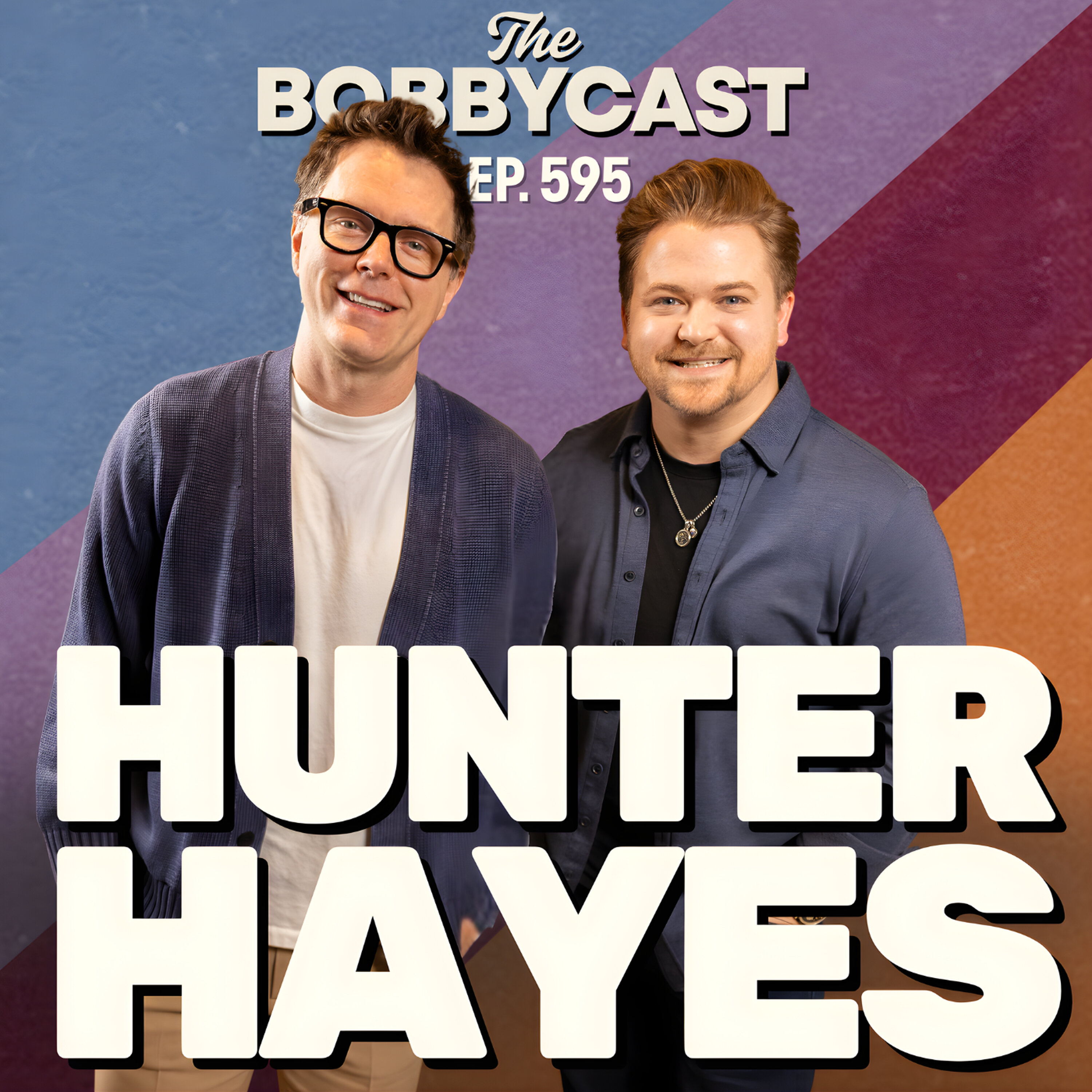
#595 - Hunter Hayes on Child Stardom, Leaving Nashville, His Love of Coldplay & New Music
Hunter Hayes sits down with Bobby to talk about what it was really like growing up in music, from performing at just 4 years old to becoming one of country music’s young stars. He opens up about the pressure of child stardom, why he eventually stepped away from Nashville, and what led him back to making music on his own terms. Hunter also shares what it felt like living a double life at times, balancing the expectations that came with early success while still trying to figure out who he was away from the spotlight. He talks about the freedom that came with leaving, the perspective he gained during that chapter, and how it shaped the way he creates now. Plus, Hunter gets into his love of Coldplay, the inspiration behind his new album, and why this next season of music feels different than anything he’s done before.
Watch The BobbyCast on Netflix!
Follow on Instagram: @TheBobbyCast
Follow on TikTok: @TheBobbyCast
See omnystudio.com/listener for privacy information.
Available Results
Generated results are saved to the knowledge database for reuse and search.
Extract Knowledge
Pick what you want extracted first. Model, scope, and chapter options appear after a template is selected.
Transcript
00:00:06
Speaker 1: I realized how much community was something that I hadn't worked towards. So I took it as an opportunity to be intentional about making new friends and giving them space and giving myself space to be human.

00:00:22
Speaker 2: He's a five time Grammy nominee, multi instrumentalist, which we talk about, platinum selling artist.

00:00:28
Speaker 3: He does it all musically. It's Hunter Hayes.

00:00:31
Speaker 2: He's been doing this since he was a small kid in Louisiana. He played for the President at seven. He toured with Taylor Swift and Carrie Underwood. He had his first number one in twenty twelve with Wanted, which we talked about, which was a jam. His album Evergreen is out now and you can see him on his Evergreen tour. Get tickets at Hunterhayes dot com. Here he is Hunter Hayes. H Good to see you, man, to see you, man. It's been a while.

00:00:55
Speaker 1: I was trying to remember the last time.

00:00:57
Speaker 3: I'm glad you asked, Thank you for asking. I was just talking to the guy. It's about the last time that I saw you.

00:01:01
Speaker 2: So I was playing and you may not remember this, but it talks to your generosity. But I was playing a show at the Bluebird for a charity and you played and it was me, you, John Party and Larkin.

00:01:12
Speaker 3: Poe and so we played it wow man in the round at the Bluebird.

00:01:16
Speaker 2: Yeah, and I was like, because I was trying to figure out the last time that I'd seen you. And also social media is weird because like I see you on social media or pictures or you feel like you've kind of seen everybody.

00:01:27
Speaker 1: Yeah, I totally agree. I totally agree, especially at Nashville right because, like you know, I'll run into Derk Spinley at the coffee shop next to her, uh, and I feel like I've seen him every day for the past six months. But it's just because he's on social media. Yeah.

00:01:42
Speaker 2: What's awkward is whenever you feel like you've seen someone a lot and they're like, oh my god, I can't believe it. It's great to see you again. And I didn't meet with the same energy because I've seen you thirty times in my mind, and I'm like, what's up, Hunter, And You're like, oh, yeah, that's always all awkward.

00:01:57
Speaker 3: Hey, yeah, yeah, we'll good to see him.

00:01:58
Speaker 1: Good to see him, man.

00:02:00
Speaker 2: Let's start with the record you brought, because yeah, we have a lot of people to stop buy and bring music. Grab that right there and show the cameras because I do love this album. When you walked in. I'm a Coldplay guy myself, and so we have people come in and bring records that have meant a lot to them for whatever reason. Hold this up so the camera can see it and tell me why you brought it here.

00:02:15
Speaker 1: I love an artist or a band that is comfortable or seemingly comfortable evolving in big ways rapidly. And I love how many layers there is to the Coldplay discography musically. If I'm being honest, I'm gonna say something I haven't said yet. Every time I'm prep for doing like interviews, I just listen to Chris Martin doing interviews because he just has such a centered energy. But we're talking about Brian Eno as well. When we talk about this project. This kind of blew my mind open. And even though like I think big records, sometimes conversations about massive records like this can kind of lose sight of how revolutionary some pieces of it can be, especially this one in my opinion, and I just I still reference this record.

00:03:03
Speaker 3: What songs are on biv Lavida, Well, I mean Vida obviously.

00:03:07
Speaker 1: I think of Violet Hill or Strawberry Swing. There's a lot of stuff that I do that references Strawberry Swing. Life and Technicolor is something that I think about a lot because I'm always trying to figure out how to open an album and there's a lot of thought and intentionality behind it, but not all of us can get away with an instrumental opening. There is something that they keep on everything that they do right, which is this sort of the first song is an introductory piece into the world that they're creating that I've pinpointed and kept. So this felt appropriate.

00:03:39
Speaker 3: Well, yeah, I love it too, and I.

00:03:40
Speaker 1: Have fifty versions of this final I felt okay with.

00:03:43
Speaker 3: Well, thank you for these here.

00:03:45
Speaker 2: We have a lot of people that donate really great music, and that's one of my favorites of all time as well the Coldplay that I really love because I said this to Kenny Chasney when he was in There are different versions of artists that I think I'm drawn to the most, and it's always the saddest version of any artist, Like for me, the sadder it is, the more piano bass it is, like, the more that it makes me feel. So with Kenny, I don't really like beach Kenny. I love freaking Sad Kenny. Yeah, like You Went Tequila, like any of the songs about time.

00:04:17
Speaker 1: I get where you're at with that.

00:04:18
Speaker 2: With Coldplay first two records freaking crushed me. I remember watching and seeing Yellow the video on MTV when he's just walking on the beach.

00:04:28
Speaker 3: I was shaken by the whole thing.

00:04:29
Speaker 2: And then I did this trick where I've always had trouble sleeping, And I think I have trouble sleeping for a couple of reasons. One I have like hyper adhd. My brain doesn't stop enough for me to relax, and the only time it feels like it's threatened is when I stop, so that's when I'm laying down. So I have trouble sleeping. So I trained myself to go to sleep to a rush of blood to the head. So every night I would listen to that record. It was the perfect record for it, too, because it's it's down for the most part. But now anytime that I hear a song like that.

00:05:01
Speaker 3: At the grocery store, I feel sleepy. It's I cant hypnotize.

00:05:04
Speaker 1: I just can't stop listening to the first song in my head now yes, well, where are you out on ghost stories?

00:05:10
Speaker 2: Anything that starts to grow as far listen, I respect an artist growing and changing, like you said, because you're risking.

00:05:18
Speaker 3: Money by doing that.

00:05:20
Speaker 1: Yeah, that's fair.

00:05:21
Speaker 2: Because let's say you come out your experiment and people don't love it, and wow, we don't like the sound. Maybe people don't love you as much they don't buy the record, where you could just keep replicating the same sound and selling a ton of records. But I love when an artist tries new things because again, they're risking everything to do that. So but when Coldplay started to be real anthemic and started to put in you know, techno beats and but they were building out what you see now where they can play stadiums, right Like, I don't think they could play stadiums without that version of themselves because it's what grew them internationally. So that's my ted talk on Coldplay. I love Coldplay, but the sadder it is, the more it.

00:06:00
Speaker 1: That's so funny because I feel like there's still like every day life has some sad shit on it.

00:06:04
Speaker 3: So can I say whatever you want?

00:06:06
Speaker 1: Okay, I feel like every day life has some sad shit on it. But that's also what I loved about it. But also I think when they switch gears, I feel like they do it because they have to. Not business, have to personal, have to like it's inside out. The anthemic stuff I feel like comes from a place of and I'm making all of this up. But again, just after studying, watching interviews, and like my class that I made for myself off of their career, I feel like someone's I feel like it's coming from a place of I have to do this, I need to do this. This is I feel this sense of like we want to create joy, we want to bring unity, et cetera, or like ghost stories every day life. I'm doing this because I have to. I feel that with them, and that's what I love about their evolution. It doesn't feel forced, it doesn't feel calculated. It feels the opposite. It feels like you have to calculate to understand it, which I love. And I feel like that is a common thread for all the artists that I study in that there are so many eras with all of my favorite artists where people will say I only liked this era, or I like I liked this era more. I think it kind of takes that to be a timeless artist. And I think maybe that's because I believe that if you're doing that, if you're doing something that polarizing or that like challenging to yourself to grow, then it has to be coming from a real place.

00:07:27
Speaker 2: I think they are artists that have, even in our lifetime, have made call it drastic art because it was so much different than the last piece of the last couple of pieces they put out. I think even like a machine Hunt Kelly did that where he's a rapper and then he completely grabbed a guitar art and was like, dude.

00:07:45
Speaker 3: Now I'm punk.

00:07:46
Speaker 2: Yeah, And you have to be so good to get people to accept you doing something different.

00:07:50
Speaker 3: If you're really switching it.

00:07:51
Speaker 1: Up, you got to be committed.

00:07:52
Speaker 3: I remember when Maroon.

00:07:53
Speaker 2: Vibes started to putting technobeats in, but that made them so much bigger and I don't like it that much, but that also made them a mass a brand, not.

00:08:01
Speaker 3: Just a band.

00:08:01
Speaker 1: Yeah. Also, that's like what I love about posts.

00:08:05
Speaker 3: That's a good point. That's another one.

00:08:07
Speaker 1: My god, did I love Hollywood is bleeding? And then Circles was like, hang on a minute, and then to hear this some of the first songs that he made in the country world. I was like, Oh, this, this feels real, this feels studied, this feels present.

00:08:23
Speaker 2: Do you think that people felt the same way about post Malone that people did about Bob Dylan when he went electric?

00:08:30
Speaker 1: I have no idea, Like hip hop fans.

00:08:33
Speaker 2: On what is happening, He's singing country songs the same way that Bob did when people were so mad that he plugged in and started playing electric.

00:08:40
Speaker 1: Yeah, it's so funny to think about things like that. I have no idea because I have no context for really, honestly either, I just have my own perspective.

00:08:48
Speaker 2: I've read one book and seen one documentary, so I have all the context. You know, So I should I know every chance at school? Yes, well, I'm going to say, yes, I'm going to say post Malone is our Bob Dylan.

00:08:58
Speaker 3: Uh clip that put that on a tie card?

00:09:00
Speaker 1: Love that?

00:09:01
Speaker 3: Yes? What was your first single? Storre Morning and how did that do?

00:09:05
Speaker 1: Really well? To my memory, it got to eleven on the chart and it had been fifty two weeks. So I think we all kind of collectively said I think we should probably take the take the foot off the gas for a second, because we also had Wanted in the queue. We knew that that was the next single, and you know, we were getting closer to the Carry Underwood tour that I had just accepted or just gotten invited on, and a lot of things were happening at that time, and we were like, okay, we should probably shift.

00:09:31
Speaker 3: Did you feel like Wanted was going to be a massive hit.

00:09:34
Speaker 1: I think I had so many people telling me that it was going to be the songs that I knew would be, because I always preface with like, I don't know what's going to work really well because there's so much involved with it, and I think I've spent a lot of my life struggling to sort of like make an algorithm, and it's changing every day, so it's impossible to figure that out. But like I knew Crazy. I believed in Crazy, even when I played it for the label and they were like eh, I was like, okay, all right. I also felt that way about Somebody's Heartbreak. I did three different versions of that song before everybody was like, oh, okay, we get it. Wanted I think I didn't know, but also like for me, it was just a piano love song ballad. I was like, I don't know how big this is, you know, did.

00:10:16
Speaker 3: It feel like a shot out of a rocket ship?

00:10:18
Speaker 1: Though?

00:10:18
Speaker 2: Once they committed to it? I mean, or is that just revisionous history where I think that because I saw how big it was in the end?

00:10:24
Speaker 1: Well, I think that is a credit to all the people in the marketing department, because they did a really good job of positioning everything and putting everything at the right time, and it did light off like a firework. But obviously I remember years of going around and introducing it to people and a lot of time spent figuring out all the bits and pieces to the timeline of it all.

00:10:44
Speaker 2: Is that the first time you felt super famous when that song was at its peak.

00:10:48
Speaker 1: And honestly, I felt a lot of momentum. Read like as soon as again, you know, from the outside looking in, I went out on my radio tour and things just went nuts. And I remember obviously years of getting to that point. So when radio tour came around, I was like, let me go, let me go, I'm ready, I'm practicing, I'm waiting. So like, to me, the storm warning timeline is nuts. More so I think so yeah, because I also had this vision and I had been watching artists and studying timelines, and because I analyze and study all these things like a nerd, and to me, you know, it was going to take about three times longer than it did for all the things that happened in the lifetime of Storm Warning being on the radio. To me, we're going to take another two or three years and then bam, we were just like of off the races.

00:11:39
Speaker 3: Was that song bigger than Wanted?

00:11:41
Speaker 1: No?

00:11:42
Speaker 2: Okay, I didn't think so, But again, I don't know that. That's a while ago, and I think my brain now associates with again the end parts of all those stories more so than the actual story. Yeah, when one had happened, were you getting these TV show spots that were kind of crossing over a bit?

00:11:59
Speaker 1: Well, Wanted was the first, let's call it crossover. So yeah, so like Wanted was the first song that went to anything, you know, anything other than country radio.

00:12:06
Speaker 2: But that's gotta be weird too, rite like that wasn't the plan. But all of a sudden, now they're playing you on pop.

00:12:11
Speaker 1: Well, I came to town wanting to be on every single radio station. I remember pitching my idea that I wanted a song from my debut album on on country radio. I wanted a song on pop radio, and then I wanted a song on Christian radio, because that's all the places where I had been influenced. I mean, honestly, everything Hotty see you.

00:12:28
Speaker 3: Know in your mind was the same song or different songs.

00:12:30
Speaker 1: You name it. I think I saw different different songs, especially obviously for Christian. At the time. One of the rules was for the debut album was it is one version. We're not going to remake it for anything. I'm trying to remember kind of how that conversation went. I think we all kind of agreed that we really wanted the album to just be like Wanted. The pop version was the exact same as the country version, with the resonator and everything, with the slide, with the steel with everything. So Somebody's Heartbreak was the only one that we kind of broke away and did a slightly different mix for, but we didn't add anything. We just kind of rebalanced some things in the mix. Yeah, I remember that part.

00:13:12
Speaker 3: So I Went Wanted. After Wanted, it was.

00:13:15
Speaker 1: Somebody's Heartbreak, then it was I Went Crazy, which was my intage for I Went Crazy was to be part of the second record and we went back and forth a lot. I remember, like to the degree that you can call it fighting, I was. I remember fighting with my sort of manager at the time. So I was like, no, this is this first single for the second record. And the point that was made that made me change my mind was yes, and what if this would feel more like an update, like a real time check in of the music that you're making, versus like this structured this doesn't go here, this goes here. And I was like, Oh, that makes a lot of sense because I'm playing to a lot of people right now and they're hearing something I made two three years ago, and it would be really nice if I could play them when I'm making now.

00:14:08
Speaker 3: So was it put on like a target re release or something.

00:14:10
Speaker 1: We did a deluxe? We called it Encore.

00:14:12
Speaker 2: Yeah, those deluxes, if they were, that's pretty awesome.

00:14:16
Speaker 1: Yeah. So I'm kind of trying a new thing. I call them series now, so any album can be born out of the series. So I make series because I love making albums, but I you know, it works better to release singles. But I believe in albums. I believe in projects with themes and mess you know all that stuff. So I work in albums, but I release in singles. I mean it's not uncommon. I've seen a few different people doing it and doing it really well. My version is they're all you know. Evergreen is a series, so season one is an album and then like there's also a season two, And what that means is anything from the past can come back in a season. There are still like six songs for the album While Blue that came out in twenty nineteen, that even didn't make it to the complete version of Wile Blue, so there has to be a season three of that at some point.

00:15:08
Speaker 2: Do you have a bunch of music do you've recorded locked up somewhere that if you died, they could keep releasing music.

00:15:12
Speaker 3: I'll lot tupac.

00:15:14
Speaker 1: I mean I have a lot of music, yeah, on unreleased that could be probably released for probably.

00:15:23
Speaker 3: Yeah, one song a week for what five years?

00:15:26
Speaker 1: One song a week that's fifty two probably three years worth.

00:15:31
Speaker 3: Safely, we could keep the hunter Has still alive.

00:15:34
Speaker 1: Because you also couldn't do christ As time. I mean, if I'm being technical, you'd have to cut off at Thanksgiving, so you'd have to like subtract a couple of weeks from that.

00:15:42
Speaker 3: So maybe three and a half years, probably three years. We can keep it up safely.

00:15:45
Speaker 4: Let's take a quick pause for a message from our sponsor, and we're back on the Bobby Cast.

00:16:00
Speaker 3: Did you leave Nashville for a while?

00:16:01
Speaker 1: I did?

00:16:01
Speaker 3: Did you move or did you just go away?

00:16:03
Speaker 1: I just kind of went away. I just tried did you leave time? I needed a reset. Why I needed a reset because I had been going I had been just sprinting for so long that I needed space to be a human. And I didn't even know that at the time, but I felt it. I think I was struggling with not having enough lenses to choose from to sort of see all the things that I was experiencing. I didn't have enough like elevation as it were, to like to get the big picture, you know, echo chambers or like, you know call it the people that you're around, things that you hear, combined with limited beliefs, combined with just kind of you know, circumstances. All of the above kind of happened. And in this like storm and right before the pandemic, so I was like, well, there's never been a better time to disappear. So I decided to, yeah, just find a new thing and kind of give myself time to grow up as a human.

00:17:11
Speaker 3: Did you stop playing music at all?

00:17:13
Speaker 5: No?

00:17:13
Speaker 3: Oh, you kept playing music.

00:17:14
Speaker 1: Oh my god. No, I never took a day off.

00:17:16
Speaker 3: Yeah.

00:17:16
Speaker 1: I learned how to take a day off during that time to be fair, Yeah, no, I made parts of Evergreen during that time period.

00:17:25
Speaker 2: Did you pack up a car or did you get on a plane packed up a car in a box truck?

00:17:30
Speaker 4: Oh?

00:17:30
Speaker 1: Really? Yeah, I like said goodbye to my house. For a while, I was just it was I'd rented an Airbnb. I brought kind of my team slash friends. At the time. The goal was just to be gone for a couple of months and change scenery. And then I found a spot that I had been looking at for four months and kind of had on a vision board. It was still available, and I was like, oh my god, I could build this like studio retreat. I could host retreats.

00:17:59
Speaker 3: Are you still be musical? Though? For sure?

00:18:02
Speaker 2: You didn't like put on a mustache and go wait tables in Mississippi or something.

00:18:06
Speaker 1: I did not do that. Okay, I infacted none of those things, but I in particular the mustache, I didn't try that. No, My thing was just like I need a new place. I need to shake up the energy. I need to shifted to get out of some habits. I need to get out of some ways of thinking. I need some new perspective, I need some new energy. Yeah, just kind of shocked my system on purpose, and that helped you. Yeah, well, I mean both and right like, there was definitely some like. I mean, I wanted to grow up, and I feel like I did. There's some challenges to that, for sure, but I yeah, it helped. It helped immensely because it helped me fall back in love with Nashville.

00:18:43
Speaker 3: Ironically, being away from it helped you.

00:18:45
Speaker 1: Well, I was still living here too, right like, I was still back and forth. So the more I came back, the more my circle grew because I wasn't just kind of in the same and my my friends helped me a lot. I was very intentional about my community at the time, because I think being away for a minute made me realizing the pandemic. I mean, tale as old as time, right like, we all kind of realized. I'll speak for myself. I realized how much community was something that I hadn't worked towards because I was just busy and I used that as an excuse. So I took it as an opportunity to be intentional about making new friends and giving them space and giving myself space to be human and learning from people and really just allowing opportunities to show up. And it allowed me to really rebuild my relationship with with Yeah, with being here, I.

00:19:35
Speaker 3: Was looking some stuff up on you. So my algorithm now feeds me a lot of Hunter Ay stuff.

00:19:40
Speaker 1: Yeah, and i'd all I ever wanted.

00:19:43
Speaker 2: I had never seen the video of you. I don't know how old you were, like four playing the henk?

00:19:49
Speaker 3: What is this? What's the thing to the accordion? Is that what it is? Yep? I should know what an accordion is.

00:19:54
Speaker 2: Playing the accordion at four years old and you're you're on stage and you're dancing around. Now, I don't remember anything before five. Like, my earliest memory is five years old birthday party. Yeah, I've tried to get back. I can't see before that. Do you remember stuff at four some? Do you remember that?

00:20:09
Speaker 1: Which was it with the one with Hank Williams? It was on a stage, Yeah, yes, it was Hank Williams coach first nineteen nineteen ninety seven. It was outside, right, it was outside Texas Motor Speedway. I barely remember that. Well, here's what I remember. I remember Leon Rhymes and Brian White were there, and I was a huge Brian White fan and Leon Rimes fan at four at.

00:20:29
Speaker 2: Five or six y okay, oh, I don't know how old you are, so you're five or six at this point, yeah, got it.

00:20:33
Speaker 1: So I say it was I need to say I am a Brian White fan and always have been. And Leon Rymes was there, an Travis Trupp was there and I loved like his rock and roll approach to music. And Hank was there, and that's and Charlie Daniels was there, and so I remember. I remember the catering tent because they were they were doing like acoustic sets, and I was like, this is weird. And you know, now, having done thousand of them, I understand that now. I remember standing side stage and my dad gave me some sharpies to play drums to keep me busy while I was waiting for my little, my little moment on stage, and I broke every sharpie that he gave me, so there was ink everywhere on the accordion case. I don't remember being on stage at all. I don't know how you could, but I remember being around. I also remember there was a little racetrack in the in the field earlier that day with lawnmowers, and you could race lawnmowers. They obviously didn't have blades, but those are the things that I remember about that. I also remember the hotel room. You could look out and see the festival grounds, Texas Motor Speedway and this giant area with hundreds of There were two hundred and sixty thousand people there during Hank's set. I have no idea what that part was like, because I was that was a out of body experience as much as you can have one when you know were.

00:21:52
Speaker 3: Your parents musical? No, that's crazy. Then how did they know you were so musical?

00:21:58
Speaker 1: Oh, that's a good question, I should ask them. I don't know, my hm, I have no idea.

00:22:06
Speaker 2: Because the legend of Hunter Hayes is you're a small child. And the legend, wow, that's well because people don't start playing instruments at four. Yeah, because that's I guess when they say you started, When do you say you started?

00:22:18
Speaker 1: Well, so here's what I do know, and I don't remember any of this either, but the stories that I've heard from my mom and my grandmother consistently, I had a babysitter who watched a TV program with live music, and also we were always like every restaurant in Louisiana for a while, and still to this day, a large percentage have live music every night, bands everywhere, their festivals every weekend. So there's a lot. There's a huge music scene, right, all kind of Cajun centric, Cajun zotiko. So I think my babysitter noticed that I was picking things up around the house and making instruments out of them, and she suggested, I think to my grandmother, you should get them on accordion, And my grandmother got me a toy accordion for my second birthday.

00:22:58
Speaker 3: That's the first instrument someone suggests they get a kid an accordion.

00:23:01
Speaker 1: I know, Wow, I know, And how I got here, Heaven only knows.

00:23:05
Speaker 3: So when you learn the accordion, you have to learn the keys.

00:23:08
Speaker 1: Yeah, it's not chromatic. It doesn't make any sense. Still to this day, I don't understand the scale.

00:23:13
Speaker 2: Was that your first instrument the accordion? And who taught you the accordion?

00:23:18
Speaker 1: I allegedly I learned. I just listened to the radio and just picked up certain songs that were easy enough to play. You know, a lot of the melodies and Cajun music, accordion melodies are kind of one or two notes max, so it's like a lead line. So if you can hum it, you can probably play it. And I think that's what my dad says. He heard me play along to a song on the radio, and that was kind of I just learned. It was by ear thing. I didn't really have my little brain. I've learned so much about my brain in the recent months, but lessons were not something that were going to work for me. I had no patience, my ADHD, etc. Yeah, I kind of had to figure out everything on my own. I figured that out on my own and everything since then it's been just a I'll figure it out on my own.

00:24:07
Speaker 2: Some people are born they can run fast. Some people are born they have great vision. Like I'm pretty quick, like my brain works quick.

00:24:14
Speaker 3: You are, yeah, but yours.

00:24:17
Speaker 2: Is very musical, Like there's a there's a really natural element of music in your brain right that.

00:24:22
Speaker 3: Yeah, that you probably don't even know what it's like to not know how to know music.

00:24:28
Speaker 1: No, No, in fact, just you saying that scares the shit out of me. No, I don't know, thank God.

00:24:35
Speaker 2: Like I bought a chord sheet from Walmart because I and I was in college and I thought I want to play the guitar because I was doing comedy.

00:24:43
Speaker 3: But I was just doing parody music. I was somebody else's.

00:24:45
Speaker 2: Went to Walmart. I don't remember the big flaps. They had the big flaps of the posters in it at Walmart. Yeah, So I went through and I found a chord sheet. I bought that, and I went home and I just c c cc gggg d d, just the big chords and I I did that. And I struggle because one obviously hurt your fingers, but two I just don't have a good ear like I still struggle finding like singing harmonies. I can double somebody like crazy, I can't really sing a harmony.

00:25:13
Speaker 3: I don't have that in me.

00:25:14
Speaker 2: Where you have an inate ability to hear and then create based on your hearing espectually at four or five years old?

00:25:23
Speaker 3: Did that?

00:25:23
Speaker 2: Did that happen with other instruments as well? Could you pick up a guitar and hear the notes and go I got it? Here are the chords as well.

00:25:32
Speaker 1: I mean, yes, and it kind of started my I have to give credit my technically speaking. So my parents weren't musical, aren't musical now. My mom for a year decided that she was going to There was one summer where she there were offering guitar lessons at her school, and so she took two weeks of a guitar class and she would come home every night and teach me the chords. And she just you know, I mean she was working two jobs, you know what I mean, she was. She she never really picked it up again, and I never put it down so like I did, Like there are times when I have learned from I don't know how to answer the question. I guess what I'm getting at.

00:26:15
Speaker 3: It's gotta be so hard to be so elevated and answer a dumb question. Though too, I don't mean that in a way. No, that's really what I mean.

00:26:21
Speaker 2: And that was my point with this, Like you don't know what it's like to not know, because it's naturally built inside you. Like somebody who runs fast, U they naturally are able to do that. They can improve by working, but they but you're not gonna make them slow.

00:26:35
Speaker 1: Well, I mean, but that's just because you don't see the times when when when they're struggling to figure it out.

00:26:42
Speaker 2: I hear you, but not fully because an Olympic sprinter doesn't know what even if they're slowest, they're still faster than everybody else.

00:26:51
Speaker 3: Like they're working to be.

00:26:53
Speaker 2: In that margin of the point one percent to get better, and yeah, they got to do a lot of work to get there, but you have to naturally have this ability I feel.

00:27:00
Speaker 3: Do you feel like that.

00:27:01
Speaker 2: Ever inhibits you because you don't know And I'm not saying this be funny.

00:27:05
Speaker 3: You don't know what it's like to like talk to dumb guys about music.

00:27:09
Speaker 1: Well, I disagree, but I think because I've spent so much time studying music and analyzing music, and I enjoy that a lot of times the difficult for me, So being my own producer, I love producing. It is so much easier to like produce other people because I know exactly what they want. Whereas for me, what is it called decision part? Like, there's so there's so many options and I hear things, and for me, when I hear something, it means so many different things. There's depth to every part on the album, and every sound that I choose has a story. You know, people listening might not might not even give a shit. So I think it took me a while to like trust myself as a producer because my analytical brain enjoys the details of it and value use some parts of it that in the listening experience might not necessarily come across.

00:28:05
Speaker 2: I would say most doesn't to the general consumer. And I mean this in a complimentary way, Like you're hearing and seeing things so.

00:28:13
Speaker 3: Different even in your own music. We're not going to hear that.

00:28:17
Speaker 1: Right, Yeah, which is great. I mean fine, it's like and that's I think that's the understanding. But that's just being a good conversationalist, right, Like, that's just being able to sit and say, what do you hear and listen?

00:28:34
Speaker 3: Are you a genius?

00:28:36
Speaker 1: That is such a bizarre question. What is I don't know.

00:28:43
Speaker 2: The fact that you're struggling with that answer. I mean, yes, no, you're being humble about it.

00:28:46
Speaker 1: No, I'm struggling with that answer because for Christmas. Over Christmas, I got drunk and asked my parents about a test that I took when I was a kid, and it came out that I was in a book. You'll never find it. My name's not in it, but I was is in a book that studies like, you know, kids that are very invested in their in their in their craft. So no, I don't think that, And it's a weird word to use when I need affirmation. For sure, I'll put that in my journal and I'll be like, that's the goal. But I don't. Yeah, I don't know. I don't know that I see it that way.

00:29:28
Speaker 3: You really don't.

00:29:28
Speaker 2: You're not playing humble like a little bit. You have to think musically, you're a genius because you're able to see, You're.

00:29:33
Speaker 1: Able to and if you spend enough time, if you've spent as much time as I've spent with music, with anything, you know, I think you'd you'd probably, yeah, you'd you'd probably feel very comfortable with your craft or with your tools, with your art. Yeah, I think anybody. I think anybody. I think everybody is really I don't.

00:29:55
Speaker 2: Let's talk about the instruments that you play proficiently, Okay, because on the Internet says Hunter plays thirty instruments. Now, if I say, man, you can crush thirty instruments, you're gonna do that thing. Well, I played them all different levels. What instrument do you play that somebody can just hand you and you feel great about just going to.

00:30:14
Speaker 3: Town on it. Love being on an electric guitar, that's your number one instrument? I'd say yeah, probably, okay, yeah, electric guitar one. We're drafting instruments here.

00:30:21
Speaker 1: Number two okay, piano. I love writing on a piano because I could close my eyes and that is the place where I feel flow the most was sitting at a piano.

00:30:32
Speaker 3: Number three.

00:30:34
Speaker 1: Drums. I love playing drums.

00:30:36
Speaker 3: Man.

00:30:38
Speaker 1: Every now and then my tracks will make it to the album. Most of the time it's just the template, but I love crafting the h and I also just love when other people to hear other people's interpretations of the parts that I hear because it gives the album so much more depth than when it's just one person. But I love playing drums.

00:30:54
Speaker 3: Do you ever just want to skate and go be the drummer for a band for like six months?

00:30:57
Speaker 1: Oh dude, I had that. That's been a goal. That's like a like I wouldn't say twenty percent right, like the whole like twenty percent thing, but meaning like my interpretation of it is just like here's something I really want to do for fun. I'm gonna, I'm gonna, I'm gonna dedicate twenty percent of my time to doing that. But there have been bands that I've wanted to join as a as a guitar player.

00:31:18
Speaker 5: The Bobby Cast will be right back. This is the Bobby Cast.

00:31:33
Speaker 2: There's a guitar right there if you need it, and it's tuned. Okay, great, he's grabbing the guitar. This is what I now.

00:31:39
Speaker 3: We're in my world where I just get to sit back and enjoy the show.

00:31:43
Speaker 1: So so, like Reharmy, I'm gonna do a terrible job. All the musicians watching this are gonna roast man. That's fine. So like if you know, so, that's a one six four C A F. But you could also do uh, you could do an A on the bass. You could do an A. So you do a six on top of the one.

00:32:12
Speaker 2: So and that's what you like doing it? Three in the morning, three yeah, yeah, yeah, I like watching Netflix.

00:32:21
Speaker 3: You can just lay it right over there. It's fine, safe.

00:32:22
Speaker 2: Yeah see we have yeah, different different minds for that yet. Okay, so bass, thanks give me two more.

00:32:29
Speaker 1: Man. I love mandolin. It's upside down, meaning the string, the tuning is. If you know how to play a guitar, if you're comfortable playing the guitar, playing a mandolin is just like it's like doing a totally different workout.

00:32:43
Speaker 3: I thought you were gonna say crack. I thought you were gonna say crack doing crack?

00:32:46
Speaker 1: Really? Yeah, okay?

00:32:47
Speaker 2: And I thought you stopped yourself. Were you gonna say doing crack?

00:32:49
Speaker 1: I had not thought about Okay.

00:32:51
Speaker 3: I didn't know. I didn't know if that's where you were going.

00:32:53
Speaker 1: Not yet, Okay, there's still time to think about that. Uh, and I will on my drive home, but to think about it, not do crack. No, no talk about it. Yeah for sure, I have to drive. I am very sober the no. I love mandlin because it's upside down scale wise, so it's like it's a challenge to play and uh and it just like it's made me more just capable on guitar as well. It's made so much easier because mandolin's nearly impossible. I mean I was, I'm the huge punch Brothers sand so like I followed Chris everywhere he's gone, Nickel Creek, etcetera.

00:33:30
Speaker 3: So give me one more.

00:33:34
Speaker 1: Steal.

00:33:35
Speaker 3: Oh, that's cool.

00:33:36
Speaker 1: Steel bends your brain, dude, Like you play a chord. First of all, there's no frets, so you're on your own. You got you got the bar, right, and then like every so every single thing that you can use to like press, So there's petals, there's levers, and every single muscle move changes one string in some kind of way. So as you're hearing parts, it's a as somebody who loves playing guitar, it's so challenging to know that here my hands can't actually do anything other than like sliding from one place to another. Everything else has to think. My knees have to move, this foot has to press this pedal and probably this pedal but also like there's a volume pedal too. It's like it's the ultimate, like sobriety test.

00:34:23
Speaker 3: Did you ever try to play any wind instruments I have?

00:34:26
Speaker 1: Yeah? I really want to. I have failed miserably every time I've grabbed a wind instrument and a violin. Funny enough, I struggled with those fretless things.

00:34:35
Speaker 3: But you just said, still don't they do not have friends?

00:34:38
Speaker 1: Well a little different just because you do have like fret lines, I think so that helps. But yeah, violin. I mean, yeah, did you do normal school?

00:34:49
Speaker 2: I did so, even as you were playing and you're playing big shows and you were a much celebrated child, you still went to normal school.

00:34:56
Speaker 1: I love a much celebrated child. That's a great book title. I yeah, I mean I was. That was the rule for for mom and dad. I really wanted to do homeschool or travel. There was a family band I really wanted to travel with. And they were like, listen, someday you're gonna thank us for this, but you're gonna keep doing this, and and meaning like they were really adamant that I have an experience that was that allowed me to have community and consistency, and I'm really grateful for that, even though all I wanted to do was run off and you know, join the family band or like which I'm an only child, so I think part of that was just wanting to have siblings. But yeah, school five days a week and then and then there was one point where my grade started slacking and Dad was like, all right.

00:35:44
Speaker 3: That's it.

00:35:45
Speaker 1: No more weekend, no more weeknight gigs, no more checking out of school if we can't get to it after school on Friday, or if it's not on a Saturday or Sunday, then you can't do it. Wow.

00:35:55
Speaker 3: Good for him?

00:35:56
Speaker 1: Yeah, good? Yeah, so I suppose you could say that, yeah, I love it.

00:35:59
Speaker 3: Good for good for him in the consistency.

00:36:01
Speaker 2: Yeah, so regardless of how how you felt about it, or even you feel about it now, at least he was consistent with his message.

00:36:07
Speaker 3: And I think that's where I say good for him for sure.

00:36:10
Speaker 1: And like there was a year where like, because you know, all kind of one thing leads to another. I mean, it is crazy to think about. It's crazy to tell my story because obviously I've seen it from different different sides, and I've seen all the different pieces and but and there was a year starting, you know, we just said yes to everything. I said yes to everything. I always wanted to play music, and you know, it got to a point where I was like fifteen or sixteen, and we're playing you know, eighty shows a year, festivals, you know, clubs, whatever I can get into. And there was definitely that moment Dad sat me down at the beginning of one of the years and he was like, listen, I just want to make sure that this is what you want to do. I want to make sure that you're doing this because you you want to, and not because this is you know, I'm using my words, but like not but just because this is momentum and you're you know, just doing it because you have to. And that was the most miserable year of my life because I didn't have any shows. That's everything for me. And you know, the pandemic felt very similar. Worst year just because I didn't have any of the things that I loved. I did have the studio and i'd had the songwriting sessions, and I had music that I could make, which saved me. But yeah, that one year. And but but again credit to him, he was just like, I'm not booking anything this year. He was disciplined about that.

00:37:32
Speaker 2: You know, I didn't have a lot of friends growing up. I was kind of a weird kid. Same, how was junior high high school for you?

00:37:41
Speaker 1: Weird? I mean, I say, I say same. I have to acknowledge, like I did have a small group of friends. We were all I see them very much as all very creative and very weird as well. And I think that I loved that about all of them. I didn't know how to connect with them. I was sort of living this sort of double life at the time. You know, the more I think about it, the more I'm like, yeah, okay, they had a Montana like it was. It was it was weekends and I was out with my band and totally different group of people. And then I had school and I had, you know, my friends.

00:38:14
Speaker 3: So I was older too, right, everybody was older, Like everybody was older.

00:38:17
Speaker 1: Yeah, everybody was grown ass adults. So I was kind of like trying to fit in with grown ass adults. And yeah, so like I, I I think maybe because of that I but also like I was an only child, so I attended and music was such an addictive, happy place and safe place that I think that that was. You know, the responsibility that I take is just that I was if I couldn't figure something out, if it was awkward trying to make friends or awkward trying to be at parties or be social, I kind of always had that to fall back on. I could. I always look forward to going home and making music and I still do.

00:38:58
Speaker 2: Would that I used to do, Yeah, I don't. I have trouble connecting with people in our social setting. Yeah, and a setting like this, I'm great at it. But as soon as the microphones go away and the cameras go away, and it's just supposed to happen organically.

00:39:10
Speaker 3: I'm really bad at it.

00:39:12
Speaker 2: And maybe I've manifested that by always thinking and saying I'm really bad.

00:39:15
Speaker 3: At it too, right, I think there's something to that.

00:39:18
Speaker 1: Yeah.

00:39:18
Speaker 2: If I had a tool, though, like a guitar and we were just at a group of people or a piano, I would go sit down at the piano and I would just rip out some music and use that. Did you ever use that in those situations? Or take a guitar to a party so you could have that?

00:39:33
Speaker 1: No?

00:39:35
Speaker 3: Yeah, no, did you go to parties at all?

00:39:37
Speaker 1: Never tried that. Not as a kid. No, not as like high school or anything. Even now, I mean no saying bro, yeah dude, I'm not. I will not. Yeah, there's one person and sitting in this room who I say invited me to a party. I'll go, But that that list is very small.

00:39:56
Speaker 4: Let's take a quick pause for a message from our sponsor, and we're back on the Bobby Cast.

00:40:10
Speaker 2: Your new record, Are you doing that? Are you taking chances? Are you sounding sonically different?

00:40:18
Speaker 1: I would The way that I've described this record is my dream because I can't. Obviously, I can't determine how people are gonna hear or feel it. But for me, it feels like a new home that has pieces from everywhere I've traveled. It feels like home, but there's memorabilia, there's things from all different places. It feels traveled to me because it's got a lot of pieces. One of the best compliments that I got was one of my friends was like, you, I don't feel and I guess we did this on purpose, which is why it felt like a compliment. I don't guess we did it on purpose. I didn't want it to be like, oh, this is a pop song, right, this is a rock song. This is I wasn't reaching for that. I very much wanted. I wanted to break all the rules I thought existed. I'm not saying that there are rules, but all the self imposed rules I think were things that I wanted to kind of break through. And I wanted every song to have a little bit of the pieces that make me.

00:41:24
Speaker 3: Why don't call it evergreen?

00:41:26
Speaker 1: It's been evergreen for a minute. Since twenty eighteen, I started with a project called Wild Blue, which was this sort of optimist letter to the world. You know, I made that in my basement. It was the first time I made an album without a spreadsheet and a lot of people voting on what songs went on the album. To be honest, I didn't think the album would ever come out. I just made it, and then Dear God found its way around the label and surprisingly had its own little fan base in the label, meaning people that I didn't think would connect with it or understand what to do with it. Still insisted that that be a song that we put a lot of effort and energy behind promoting, which was a huge green flag for me. And while I was making Wild Blue, which ended up getting out into the world and I ended up putting a you know, extended version of it out, Red Sky was born because I wanted this duality. I realized that there was this duality with the optimist comes somewhere to put all the other shit. And it was more angsty, it was more experimental. It felt like a very not angry, but it felt like I mean, and it kind of was me getting in the car and disappearing. I left Nashville and got in a car and went to you know, went to a place I'd never spent a lot of time in kind of close to a place i'd been to before, but a new life for a minute, and Green always sat as a third piece to the puzzle, and it just always felt really grounded, and I think parts of me felt like I didn't know what to do with it because I didn't see myself as grounded enough to justify me calling an album evergreen. And then I think it clicked. You know, we all talk about this quite often now, which I'm really grateful that it's more of a conversation in the world. But the you know, healing, learning, all the stuff that we talk about is a process that is never ending. You grow and you heal. It's not a destination, right, It's a it's a it's a mindset, and it's a way of living. And when I kind of downloaded and realized, oh, that's that's what Evergreen is. Evergreen is the desire to grow, the desire to be grounded, the realization that you're not always there, the realization that it's it's not a destination, but that it is the most beautiful part of living. And so that was There's songs that were written for it early on that I didn't know what to do with until she comes Along has been there for a hot minutes in twenty sixteen, that song has been kind of hanging out. Evergreen was written in twenty eighteen as the like poster child of the song or as the theme song of the record, and the yeah, and then every song that I've written since then, A lot of it was actually just like manifestation practice. A lot of it was written about things that I hadn't lived yet, and I decided that that's what I wanted the album to be. I wanted it to be a place where people can pray manifest dream you know, letters from your future self of sorts.

00:44:48
Speaker 3: And you're going out on the Evergreen tour? Do you play all the hits?

00:44:52
Speaker 1: Yeah?

00:44:53
Speaker 3: I don't know.

00:44:54
Speaker 2: Sometimes geniuses like you were like, I don't want to live back in the past. I'm going to play songs that I just wrote today, and that's all I'm going to do.

00:45:01
Speaker 1: Man. Something I'm really grateful for is when I listen to because I started my year within intensive it was my third one. I say that only because I love them. And if you get the chance to do something.

00:45:16
Speaker 3: Like that, I've done one life changing.

00:45:18
Speaker 1: It's life changing. And I made a promise to myself that I would do it at least every other year. When I did it, I'm a year behind. But I did it, and I was on a plane back and I was like, Okay, I got to prep for this tour. I got to know what's working. I got to know what's feeling good man. I dug back through some old stuff and I love all of it, like I love because I hear versions of me and that too, and I think I feel love, And I mean immense gratitude that I was surrounded by people who allowed me to try the things I tried, do the things I did musically, and I'm still really proud. There's not much that I'm not still very humbly attached to.

00:45:54
Speaker 2: What song do you play? And they know what it is immediately and go the loudest, the craziest, For.

00:45:59
Speaker 1: It depends on where we are, fiends on what the context is. I mean, wanted also crazy, those two do.

00:46:07
Speaker 3: You remember writing?

00:46:08
Speaker 1: I wanted Yeah, I do Yeah?

00:46:10
Speaker 3: How old were you?

00:46:12
Speaker 1: Oh god, I'm seventeen, I guess, yeah.

00:46:15
Speaker 3: Seventeen And did the thing just fall out of you?

00:46:18
Speaker 1: It was something that a mentor of mine had said about his relationship. What works about us is that we don't operate on a need each other basis, we want and it was it was like his lesson was like, it comes from a choice. We choose each other every day, right, And I thought that was beautiful and so yeah, I remember taking the idea into to Troy and this really cool historic old house and Troy had this room that we'd never written and we'd always written in this other room around guitars, but he had this piano in this other room and it was painted sky blue and it like had it faced the south, so it had all the natural light. And I was like, should we try that? And so I jumped on and like though sort of walk down riff was just kind of was just me trying to do something on the piano. It was just like see position walk down from a four to three to two to a one kind of felt like a just background music for a conversation. I mean, I've written with so many incredible songwriters. Troy is one of those that just makes it seem so easy. It's remarkable how easy it feels to write songs with him. And we got it in like forty five minutes. It was all there.

00:47:29
Speaker 3: You wrote the whole song of forty five minutes.

00:47:30
Speaker 1: Yeah, maybe less, but I don't want to like go it, and I could be wrong. If Troy wants to, if Troy has a better memory of it, then I'd love to hear his recollection because I think sometimes also like we remember it differently, but I remember that song having very fast.

00:47:46
Speaker 3: Do you start with the chorus? Do you go with I want to make you feel? Or do you go you start with lyrics?

00:47:51
Speaker 1: I think that one we started with the I think we started with the verse, because that's what I was playing first. Is that riff you know, and fall apart without you? I don't know how you do what you do? Like at the time, I really thought those were going to be placeholder lyrics. I thought we were going to sit around and really work on it, you know. But it works, thank God. And then everything that don't make sense about me, it makes sense when I'm with you. I mean that that's just that's the results of Troy and I just tossed some stuff back and forth. You know, he'll sing a line, I'll sing a line, and it's very stream of conscious.

00:48:19
Speaker 3: That that's crazy. It was forty five minutes.

00:48:20
Speaker 1: You got that the best songs kind of do that. The ones that you make that you feel like are supposed to be there. You're kind of just along for the ride as they fall from the sky and you're just collecting it as.

00:48:30
Speaker 3: I never read a song like that before. When I wrote Hobby Lobby, Bobby took me like eight days.

00:48:36
Speaker 1: But there are parts of it that you know, you.

00:48:38
Speaker 2: Don't take me that seriously because I'm not like you, and I appreciate you, know, like what I said made sense to be fair.

00:48:44
Speaker 1: Yeah, to be fair that, But you know those moments when it's like, oh, that's it.

00:48:47
Speaker 2: I agree, Yeah, but I appreciate you humoring when I reference the stupid comedy song that I wrote and you're.

00:48:54
Speaker 3: Like, yeah, of course, of course.

00:48:55
Speaker 1: Hey man, I'm a big fan.

00:48:56
Speaker 2: Okay, Look, I hope the record is everything you want to be. I'm sure it is, or you wouldn't put it out. And I hope everybody comes to the tour. We're talking about it before you come in. Uh, it was really great to see you again.

00:49:07
Speaker 1: Good to see you man. Thanks for the time.

00:49:08
Speaker 3: Yeah, I feel like it's been great. How do you feel about this great?

00:49:11
Speaker 2: Will you go back and reevaluate everything you said, or do you just let the pass live for sure?

00:49:15
Speaker 3: Oh? You do, Yeah, you'll be analytical about all.

00:49:17
Speaker 1: Yeah, I'm still reliving yesterday's interview, but yeah, I'll do that.

00:49:21
Speaker 2: He that was terrible, terrible, like a couple of days. Yeah, person interviewed you not good. I heard Huh I heard the person that interviewed it was terrible.

00:49:28
Speaker 1: Yeah, no, disagree, No I heard it.

00:49:31
Speaker 3: I have no idea who interviewed yesterday. Uh, Hunter, good to see you, Good to see you it.

00:49:36
Speaker 5: Thanks for listening to a Bobby Cast production