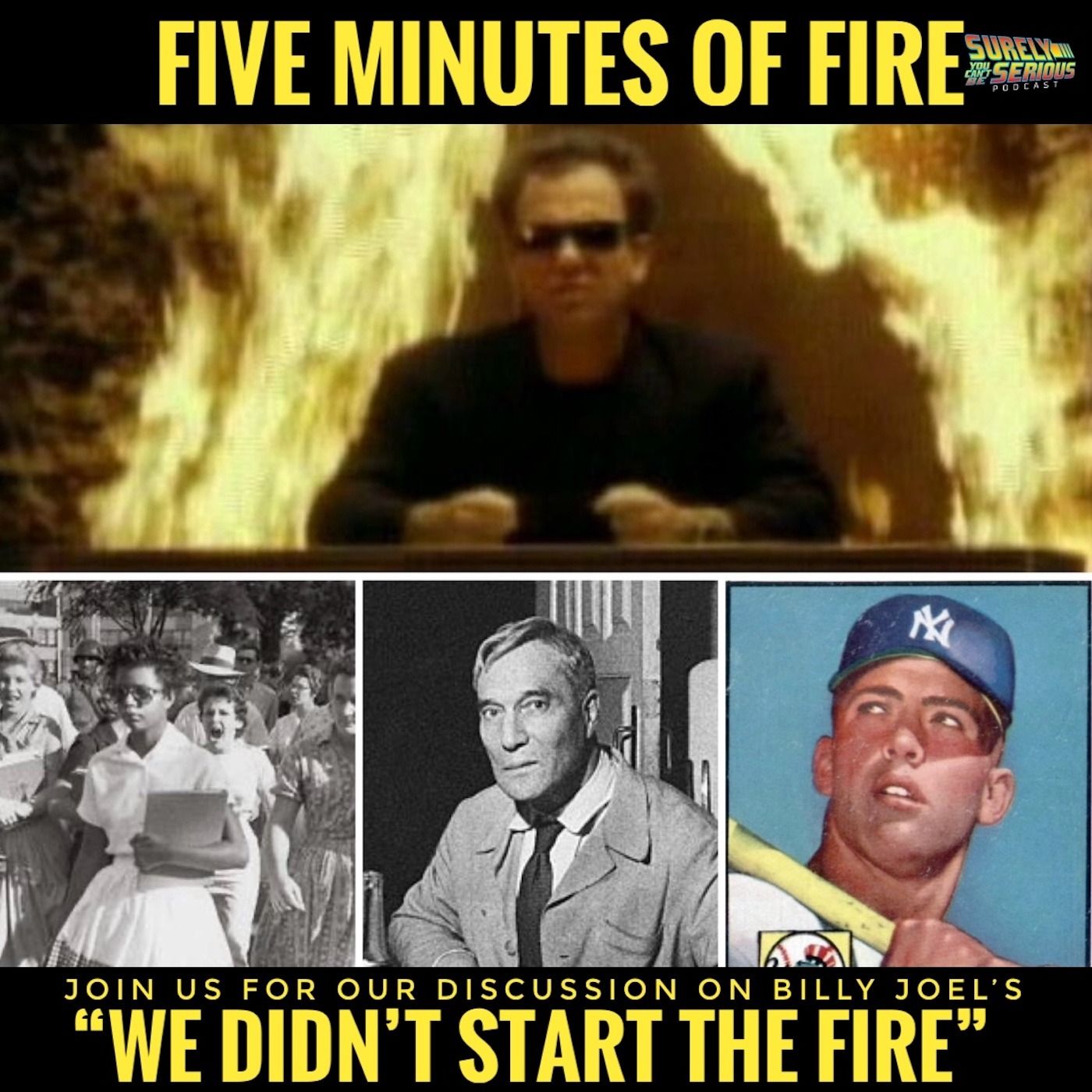
"Five Minutes of Fire": Little Rock, Pasternak, Mickey Mantle
Embark on a daily expedition through history with "Five Minutes of Fire," the podcast series that untangles the threads of Billy Joel's iconic anthem, "We Didn't Start the Fire." Join us twice a day for a concise exploration of the historical names and events that have left an indelible mark on the 20th century.In today's episode, the flames of history flicker with the courage of the Little Rock Nine, a group of brave students who stood against segregation in the American education system. The narrative then shifts to Boris Pasternak, the acclaimed Russian author who faced political challenges for his masterpiece, "Doctor Zhivago." The episode concludes with a swing through the world of sports, spotlighting the legendary Mickey Mantle and his impact on baseball history.In just five minutes, we'll guide you through these historical snapshots, providing context, anecdotes, and a deeper understanding of the individuals and events that defined their times. Whether you're a dedicated Billy Joel fan or someone eager to explore the stories behind the lyrics, "Five Minutes of Fire" is your daily dose of historical enlightenment.Subscribe now to join us as we unravel the verses of "We Didn't Start the Fire," offering insights that breathe life into the captivating tales behind the names etched into the song. "Five Minutes of Fire" - where history unfolds swiftly and vibrantly, twice a day. Don't miss your daily spark of historical exploration!
2024-01-09
5 min
Transcript
Available Results
Generated results are saved to the knowledge database for reuse and search.
No generated results are available for this episode yet.
Extract Knowledge
Pick what you want extracted first. Model, scope, and chapter options appear after a template is selected.
Generated results for public episodes are saved to the knowledge database so they can be reused and searched later.
Transcript
<v Speaker 1>I'm Jason Colvin, I'm d Graves.
<v Speaker 2>Give us five minutes and we will give you the fire.
<v Speaker 1>Hello everybody, and welcome back to the Surely You Can't
<v Speaker 1>Be Serious Podcast Special Edition five Minutes of Fire. We
<v Speaker 1>are here talking about the lyrics of We Didn't Start
<v Speaker 1>the Fire by Billy Joel. We're covering only five minutes
<v Speaker 1>at a time, which is about to link with the song,
<v Speaker 1>so it works out kind of nicely. So please join
<v Speaker 1>us as we dive into some new lyrics today.
<v Speaker 2>All right, guys, so here are the topics that we're
<v Speaker 2>going to be covering today.
<v Speaker 1>Little Rock Kasternak, Nicky Mantle, Jason, what can you tell
<v Speaker 1>me about Little Rock, Arkansas?
<v Speaker 2>I feel like I'm stealing this one from you, that's
<v Speaker 2>all right. This is about the Little Rock Nine, which
<v Speaker 2>were a group of black students that enrolled at Little
<v Speaker 2>Rock Central High School in nineteen fifty seven. On May seventeen,
<v Speaker 2>nineteen fifty four, the US Supreme Court issued a historic
<v Speaker 2>Brown versus Board of Education that declared all laws established
<v Speaker 2>segregated schools as unconstitutional. So by nineteen fifty seven, there
<v Speaker 2>were nine black students that have been selected by the
<v Speaker 2>NAACP to enroll at Central High School in Little Rock,
<v Speaker 2>Governor Orville Babas called out the National Guard to prevent
<v Speaker 2>these students from enrolling. Babas claimed that the white supremacists
<v Speaker 2>were on their way and he was just watching out
<v Speaker 2>for their safety. Well, that caused Dwight Eisenhower to get
<v Speaker 2>involved and said, you guys, get out of the way,
<v Speaker 2>because these students can enroll. And so that began the
<v Speaker 2>integration of schools in Little Rock, Arkansas. Okay, tell me
<v Speaker 2>about Pastornak.
<v Speaker 1>Okay, So Pastornak refers to Boris Pastornak, who was a
<v Speaker 1>poet in the Soviet Union. His family was from Russia.
<v Speaker 1>His father was actually a great painter illustrator for Leo
<v Speaker 1>Tolstoy novels. They were high society, hung out with Rachmaninoff
<v Speaker 1>and other kind of elites of the day. But ultimately
<v Speaker 1>the revolution happened and he at the time thought it
<v Speaker 1>would be a good idea. But his family soon realized
<v Speaker 1>that the elites were not well regarded their in the
<v Speaker 1>Soviet Union anymore, and his mother and sisters went to
<v Speaker 1>Germany for some medical procedure and decided not to return.
<v Speaker 1>He and his brother, who was an architect, however, stayed.
<v Speaker 1>But as you may or may not know, it was
<v Speaker 1>tough to be an intellectual and elite and a literary
<v Speaker 1>person in the Soviet Union back in those days. And
<v Speaker 1>so this novel that he had been working on for
<v Speaker 1>probably forty years at the time, called Doctor Javago, which
<v Speaker 1>he believed was completely in line with what happened during
<v Speaker 1>the Russian Revolution, was not well regarded by the literary
<v Speaker 1>elite that the Soviets had working for them, and they
<v Speaker 1>refused to publish it. Well, and he gets a knock
<v Speaker 1>at the door and the Italian Communists Society says, hey,
<v Speaker 1>we'd love to publish your novel, and Italian and brilliant
<v Speaker 1>Pastornak says, well, that's perfect, because if you publish it,
<v Speaker 1>then the Soviets will see how great it is and
<v Speaker 1>they will welcome me with open arms. It could not
<v Speaker 1>have been more wrong. The novel gets published, the Soviet
<v Speaker 1>Union does everything it can to stop it from getting published,
<v Speaker 1>but it still ultimately comes out it is not in
<v Speaker 1>line with what their version of history is, and so
<v Speaker 1>that upsets them. But ultimately he wins the Nobel Prize
<v Speaker 1>for it. He's asked to come out to Germany to
<v Speaker 1>accept his Nobel Prize, and the powers in the Soviet
<v Speaker 1>Union say if you go, you better buy a one
<v Speaker 1>way ticket, so he does not go. So then a
<v Speaker 1>cartoonist creates a cartoon that has two Siberian prisoners and
<v Speaker 1>one of them says, I won the Nobel Prize. What
<v Speaker 1>are you in prison for it? He wins the Pulitzer
<v Speaker 1>Prize for that cartoon the next year.
<v Speaker 2>Oh wow.
<v Speaker 1>Yeah. So Pasternak has a friend who is a writer
<v Speaker 1>who is arrested for his views. He turns into apostle
<v Speaker 1>Peter and says, I don't know this guy. I don't
<v Speaker 1>know this guy. Please, I don't know this guy. Please.
<v Speaker 1>He's terrified and he makes such a fuss about it
<v Speaker 1>that Stalin actually calls him on the phone and says,
<v Speaker 1>what are you freaking out about? And he's like, please,
<v Speaker 1>don't do anything to me about it. He's like, dude, man,
<v Speaker 1>stand up for your friend, and hangs up the phone
<v Speaker 1>on him. Wow. He is reported to have been on
<v Speaker 1>a death list, but Stalin thought he was just such
<v Speaker 1>an imbecile that he took him off the list because
<v Speaker 1>he thought he was an idiot. So ultimately the book
<v Speaker 1>becomes a movie in the United States, a very famous
<v Speaker 1>movie starring Omar Shariff and the CIA and MI six
<v Speaker 1>order thousands of copies to be distributed as a way
<v Speaker 1>of propaganda. Wow, what have you got for me? On
<v Speaker 1>Mickey Mantle?
<v Speaker 2>Can you see how these lined up for me?
<v Speaker 1>Here? Pretty tricky? How you did that? I wonder how
<v Speaker 1>we got out of order earlier?
<v Speaker 2>So Mickey Mantle big number seven for the New York
<v Speaker 2>Yankees baseball player. I'm gonna get that out of the way. Yeah,
<v Speaker 2>aka the Mick or the Commerce Comet. Played his entire
<v Speaker 2>career with the New York Yankees from nineteen fifty one
<v Speaker 2>to nineteen sixty eight. This was my dad's favorite baseball player.
<v Speaker 2>I was almost named Mickey in honor of him.
<v Speaker 1>Wow.
<v Speaker 2>Widely considered to be the best of the hitters and
<v Speaker 2>fielders and overall athletes of the time. Warn in Spavnaugh, Oklahoma,
<v Speaker 2>his dad trained him every day to switch hit and
<v Speaker 2>would get mad at him if they were playing like
<v Speaker 2>a pickup game. If he saw his son and the
<v Speaker 2>guy he was facing was pitching right handed and he
<v Speaker 2>didn't switch hit, and his dad caught him big trouble.
<v Speaker 2>He hit for power and average from both sides of
<v Speaker 2>the plate. Was a sixteen time All Star, seven time
<v Speaker 2>World Series Champ, three times al MVP. He won the
<v Speaker 2>Triple Crown in nineteen fifty six. And that's a major thing.
<v Speaker 2>Best average, most home runs and most RBIs for the
<v Speaker 2>entire season. Also known for the nineteen sixty one home
<v Speaker 2>run chase. If you saw that movie by Billy Crystal
<v Speaker 2>called sixty one, where Roger Marris actually bested in by
<v Speaker 2>hitting sixty one homers in nineteen sixty one, man All
<v Speaker 2>finished with only fifty two. Known for his winning personality,
<v Speaker 2>fast living, hard drinking, and infidelities, died of liver failure
<v Speaker 2>due to alcoholism in nineteen ninety five.
<v Speaker 1>I always feel a little bit awkward about that when
<v Speaker 1>I'm having a beer at Mickey Mantle's here in Oklahoma City. Okay, guys,
<v Speaker 1>that does it for today's episode. Join us next time
<v Speaker 1>for five minutes of fire.
Chapters
No chapters available.