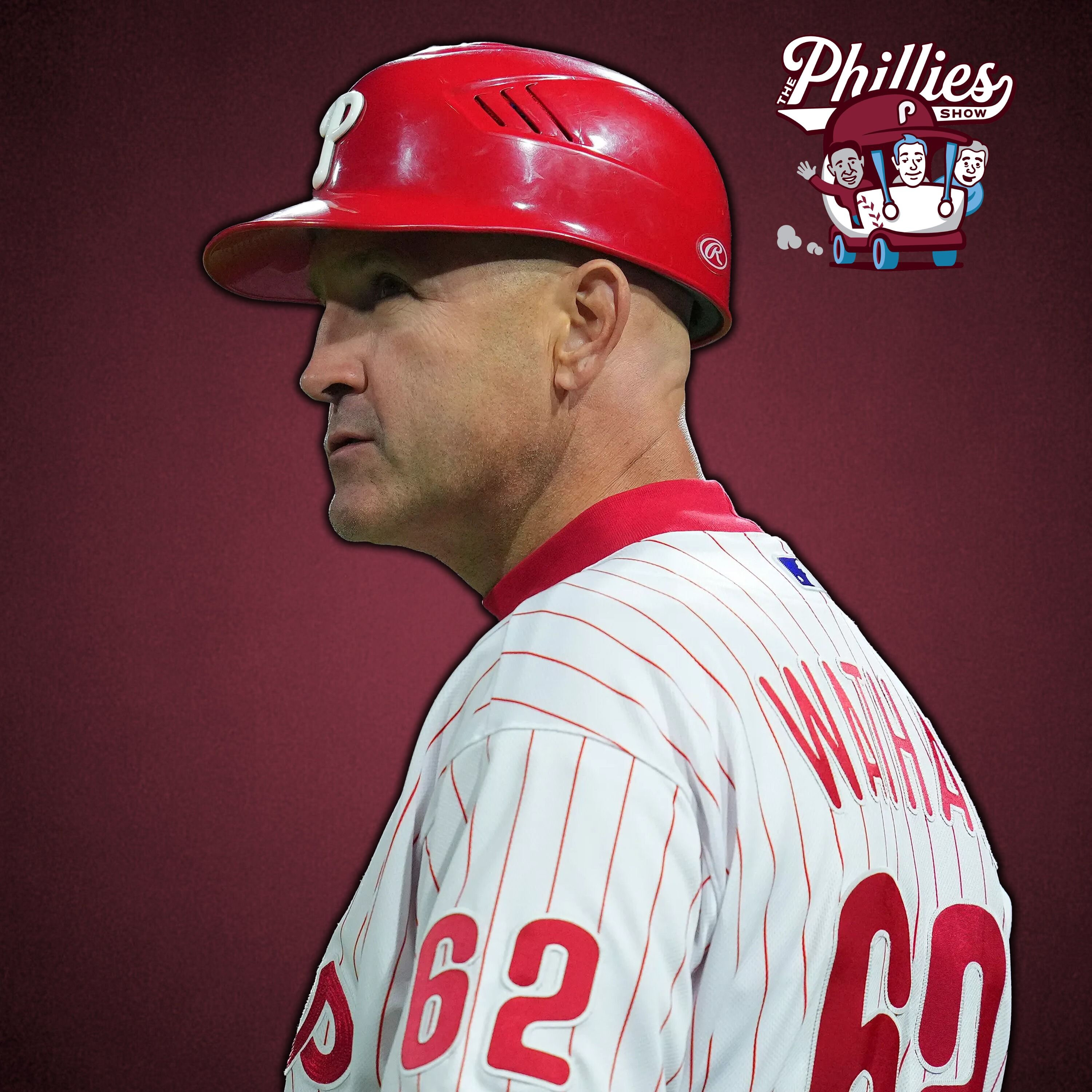
Phillies third base coach Dusty Wathan sends 'em home!
If you see Phillies third base coach Dusty Wathan waving home a player this postseason – you certainly hope it happens a lot – you should know plenty of preparation has gone into it. Wathan is one of Major League Baseball’s best third-base coaches, and we’re confident you’ll see why after listening to this show.
You’ll also see why Wathan keeps getting interviewed for managerial vacancies.
Parx Casino and betPARX are the official casino and sportsbook of TPS. New customers can download betPARX now and get up to a $1,000 dollar casino bonus back if you're not a winner in your first 24 hours. Visit betPARX.com for terms/conditions. You must be 21 and in Pennsylvania, New Jersey, Maryland or Michigan. Gambling Problem, call 1-800-GAMBLER.
Love The Phillies Show? Get your Phillies Show gear at The Phillies Show Shop!
@The Phillies Show Subscribe to the show on YouTube and follow us on social media!
@Foul Territory We’re part of the Foul Territory Network. Follow FT and find more shows, including Fair Territory!
If you like The Phillies Show, subscribe and give us a five-star review!
See omnystudio.com/listener for privacy information.
Available Results
Generated results are saved to the knowledge database for reuse and search.
Extract Knowledge
Pick what you want extracted first. Model, scope, and chapter options appear after a template is selected.
Transcript
00:00:03
Speaker 1: Hi, this is Rob Thompson and welcome to The Philly Show.

00:00:08
Speaker 2: Binamar Junior, Jim Salisbury, Todd so lucky. It's the Philly Show. It's Thursday, October second, twenty twenty five. Hope everybody is doing well as red October gets started for the Phillies on Saturday with Game one of the National League Division Series at Citizens Bank.

00:00:24
Speaker 1: Park, Jim.

00:00:25
Speaker 2: Earlier this week we had phillyas hitting coach Kevin Long on the show. If you haven't listened to that, definitely checked out a lot of great stuff. Wednesday we had Pennsylvania Governor Josh Shapira on the show. That was a lot of fun. And today we have another great guest, Phillis third base coach Dusty Wathin, and I think everybody is going to learn a lot about it. Let's talk about what we liked about Dusty with the parks first Pitch, First Pitch, which is brought to us exclusively by our partners at Park Casino, Pennsylvania's number one casino. Dusty third base coach, very good third base coach, dare I say, and I liked learning a lot about the preparation that kind of goes into some of these things, you know, I asked him, you know, do you guys do you have to go in before every series and kind of like, you know, besides studying who's on bas what the situation is, but how about just how an outfield plays, actually how a ballpark plays. And he had a I did not know this. I mean, you know, he talked about how they prepare for every ballpark they go in and how the ball might play off the wall with some very interesting details. So a lot of really cool stuff that does.

00:01:48
Speaker 1: He talked about third.

00:01:50
Speaker 2: Base coach prep, run prevention, you know, working with the catchers, JT. Real mute, all sorts of great stuff.

00:01:57
Speaker 3: Great stuff, I mean him talking about they have video clips of the way you know, the ball scoots around certain outfield walls in the league. That was amazing. And as he's talking about you know, you know, you think about third base coach, right, and you think it's all just using your eyes and you feel and your instinct and your knowledge of the game. And you're picking up that runner and you're measuring the outfield and the cutoff man and if the guy's got a big arm or whatnot, and you're making a decision to wind him or not. There's so much that cloes into it. They've already had, you know, data breakdowns on the outfields and the ballparks, and that runner in the game situation. You can almost like picture like him needing a computer chip in his brain to process all that and make a split second, split second decision to send a guy that might win or lose you a ball game.

00:02:51
Speaker 1: So I thought it was.

00:02:53
Speaker 3: He very appropriately said, it's as close as you can get to actually being a player in the game. And as you mentioned, he is a very good third base coach. You know why he's been one for a long time. You don't last that long if you're not really good at your job. And then that's only part of his job. He instructs the catcher as he works on the running game. He's a great, great baseball man, one of those guys you come away feeling like you learn something. And I you know, if anybody who doesn't feel like they learned something after listening to this interview ain't paying attention, And then you know he's got a great personality on top of it, tells a great George Brett's story. I'll make you laugh a little bit, so and a couple of great JT stories because I asked him about JT's You know what jumps up to me about JT's his toughness. The guy is like like a bulldozer. He's always getting dinged and run over and he always comes back for more. So he's to me an amazing athlete and tough tough man. So Dusty's very close to him, so great to hear some stuff there. I don't want to give it all away. You got to click the button and you got to watch the whole thing because it's really good.

00:03:59
Speaker 1: It is really good.

00:04:00
Speaker 2: I think everybody is really going to enjoy Philly's third base coach, Dusty Wathon.

00:04:05
Speaker 3: That was first pitch presented exclusively by our partners at Parks Casino, Pennsylvania's number one Casinoparkscasino dot Com is the website. You must be twenty one to participate, and if you have a gambling apartum, call one eight hundred gambler.

00:04:21
Speaker 2: And Dusty thank you so much for joining the Philly Show. How's it going? Ay, one Red October.

00:04:29
Speaker 1: It's right.

00:04:30
Speaker 2: I mean, you've been in the organization forever, you've been around, You've seen the good times, you've seen the not so good times. You've been on the big league staff since what twenty seventeen, so you've seen it all over the years. What do you think about this team right now in terms of mindset, headspace, you know, going back to the postseason for the fourth consecutive year unfinished business.

00:04:56
Speaker 4: I think we're in a really good spot right now. I think health wise, Sack, everybody's pretty healthy. I think everybody's been through this before. I like the consistency of the of the team this year, you know, setting the record for most series one in a season.

00:05:11
Speaker 1: By the Phillies, so I think that says a lot.

00:05:13
Speaker 4: I think a lot of times last year, you know, we came out of the gate pretty good, kind of played five hundred ball really the second half of the season, so there was some question marks on well, you know, did they peak too soon?

00:05:24
Speaker 1: I think this team really hasn't hit their peak yet.

00:05:27
Speaker 4: I think, you know, most of the guys in the clubhouse and on the staff have been through this before, so we know what to expect. Last year we had to buy fortunate to have it again, and I think we're just in a good.

00:05:38
Speaker 1: Spot right now. And you know, our mentality.

00:05:41
Speaker 4: Has been what Rob preaches is win series, and that's what's going to get it done here in October.

00:05:48
Speaker 3: Dusty, we're not really sure yet who the Phillies are going to play starting on Saturday. But when you get an opponent firmed up, what will be your role in game planning? What will you dig in on and try to impart you know that info to the players.

00:06:08
Speaker 4: Well, most of my job is well, first preparing to coach third base, checking who's gonna play outfield for whatever team we're gonna play.

00:06:17
Speaker 1: And then the second biggest.

00:06:19
Speaker 4: Job would be preparing for their runners, the run game prevention, so digging in on their guys, what counts they like to run in as an organization, as a player, you know, do they do this? You know how the Yankees kind of started the little leap off the base? You know, can we find something where we can exploit that. Do guys like to steal second base on the first pitch? All those types of things to help prevent their run game and help ours? And then really go through on the base running side for us, checking on how they defend certain things. You know, if we get into a first and third situation, are they called that returns the ball. Do they throw it through, do they not throw through? Do they like to throw it at a second base with a runner on first base? On balls down the line, they throw to the cutoff man towards home.

00:07:10
Speaker 1: Things like that to prepare yourself to maybe make a decision in game.

00:07:15
Speaker 5: So, Dusty, one of the fun things that I had as a first base coach, I actually had an opportunity to coach third base one spring and it was a totally different experience. Obviously, you are impacting the game in a very different way. Can you talk about how much how exciting it is to be on that third baseline and how much how many different things you actually have to think about as you get into certain situations and during gameplay.

00:07:47
Speaker 4: Yeah, I tell people it's the closest thing to playing that you can get when you're done playing. So you're actually impacting the game in a play As most other coaches, you've gained plan.

00:07:58
Speaker 1: You've done all your work, you're you know, giving the guys the knowledge and they got to kind of go do it.

00:08:04
Speaker 4: But a coaching third base, there's gonna be a situation where in a series or in a season that you're gonna impact it by sending a guy not sending a guy making a decision. But I'm really grateful for managing in the minor leagues from third base because it really makes you think about a lot of things people.

00:08:19
Speaker 1: Probably don't think about.

00:08:20
Speaker 4: It's you know, who's coming up next, how's he swinging the bat? How's our bullpen look today? Are we going to play for a tie? Are we playing for a win? There's just so many things. Are we gonna pinch hit?

00:08:31
Speaker 1: Possibly? Are we not going to pinch?

00:08:32
Speaker 4: It is so and so banged up, so he can't pinch hit, So maybe we're a little bit more aggressive.

00:08:37
Speaker 1: Is Kyle Schwarber coming up with two outs?

00:08:39
Speaker 4: Maybe we're gonna be a little bit a little bit more not as aggressive with with somebody like that coming up with the season that he's had. So there's so many things that go into it. And then on top of that, the physical things of the other club. You know, how well do the guys throw, how well do they go left right? Come in field ground balls? Do they throw better when they catch a fly ball than a ground ball? So there's so many things that go into your decision prior to the ball getting put in play.

00:09:03
Speaker 1: So I feel that for the most part.

00:09:08
Speaker 4: Managing in the minor leagues really helps that because you're thinking of so many things and coaching third base on top of it, and then also obviously being here, being with Topper the last four years, being with Paco and I uh first and third for seven years. Like Paco says, like he said, there's times where he looks at me and he just knows what I'm gonna what we're gonna do. So it makes it a little.

00:09:28
Speaker 5: So it feels like almost like you talked about being as close to a player as possible, I think it's the it's almost melding as close to being a player as it and as close to being a manager as you could possibly get at the same time, which I think really brings out the juice in the in the position.

00:09:45
Speaker 4: Yeah, definitely, I think, Yeah, you're making a lot of decisions in your head, you know, talking to top before I go out there. Hey, what are we thinking here? You know how we looking in the bullpen? Just double check this, you know this happens. Are we going to possibly bunt? We're not gonna a bunt?

00:10:00
Speaker 1: You know? Is there a chance that we could hit and run?

00:10:02
Speaker 4: Because this guy's a sinkerballer and and we got an Alec.

00:10:05
Speaker 1: Bomb up that it's going to put the ball in play.

00:10:08
Speaker 4: So we talk about a lot of those things prior to inning starting, prior to prior to games starting, prior to series starting.

00:10:14
Speaker 1: So you know, yeah, a lot goes into it, and I really enjoy it. It's it's a lot of fun.

00:10:19
Speaker 2: But this might be a dumb question, Dusty, but how much do you also know how an outfield ballpark plays? Like if I said to you, tell me about Dodger Stadium and how the ball plays off the wall or Great American Ballpark? Are those do you study those types of things as well?

00:10:36
Speaker 4: Yeah, oh yeah, so one. Having done it for a number of years, you kind of get a good idea. You've been out there for batting practice multiple times over the years, so you've seen it with your own eyes. But also, our video department does a great job and send Paco and.

00:10:53
Speaker 1: I a nice video of balls.

00:10:58
Speaker 4: Starting in left field and going all the way around and watching how they stick in the corner, how they roll around the corner, how they hit a chain link area or the fence, crazy bounces that they've seen happen in video, So you know, It's probably a two to five minute video going from left to right, just watching balls bounce and how they bounce. And then we also get one more Poco than I, but I watch it too. It's an infield video that shows all the video and the ground rules from dugout to dugout, Like if a throw comes from third base at what angle, how's it gonna bounce off? Is Paco gonna yell at him and say go ahead? Or is it gonna stick to the paddy? Is it gonna bounce towards the right field corner? Is it gonna bounce back to the first baseman?

00:11:40
Speaker 1: Is their net there? So I get that from my side too.

00:11:44
Speaker 4: Doesn't happen as often, but still going to be prepared on stuff like that.

00:11:48
Speaker 2: And then you get feedback to like postgame right on. Don't you get like on every send or is that my.

00:11:53
Speaker 1: Right or yeah? Yeah.

00:11:55
Speaker 4: So when I first my first year in eighteen, hired in seventeen, but I went into the year and I said, you know, my dream would be to not have the people in the stands being the second guest machines. I'd like you guys to build something, and so they built me a post mortem that takes into account the speed of our runner, the velocity the guy throws the ball, the distance he has to travel to throw to get to the ball. So it kind of is the ultimate second guessing machine, and it gives you the probability of them scoring with a guy's average tools, the probability of him scoring on that actual play where he threw it, because we can measure everything, how fast the guy's running and all, and then the break even probability of hey, was that chance of him scoring better than the break even in that situation?

00:12:46
Speaker 1: So that takes into account, you know, outs innings.

00:12:49
Speaker 4: The only thing that doesn't take into account it's hard to do is is who's.

00:12:53
Speaker 1: Coming up in the lineup and how they're going at the time.

00:12:56
Speaker 4: So there's still a little bit of you know, hey, sometimes I'm going to be more aggressive than what the second guessing. The post mortem says, sometimes I'm going to be a little bit more passive on that situation. But it definitely gives me some good feedback and you know, a chance to study things the next day and you know, did you make a mistake?

00:13:14
Speaker 1: But you know, sometimes you just got to get lucky too.

00:13:19
Speaker 2: Is there a send in your mind that you got the report after the game, like, holy crap, I can't.

00:13:26
Speaker 1: There's a lot of them, actually, but is there one lot of them? Really?

00:13:30
Speaker 4: I mean not a lot, but you know there are some where you're like, you're sending them and you know there's a guy on deck that's not swinging the bat well and you're like, I hope he throws this one offline, or I hope it short hops the catcher.

00:13:40
Speaker 1: And that's another thing I look at.

00:13:41
Speaker 4: I look at, you know, how the catcher's tag You know, there's some guys that that are really good taggers.

00:13:46
Speaker 1: Some guys don't handle bounces very well. So you're like, I'm gonna give it a shot, and you know he's fifty to fifty, I'm gonna catch this ball anyway.

00:13:54
Speaker 4: So but the thing that the fans don't want to hear is that, you know, I personally probably should get more guys thrown out sometimes, you know, you look at that too. So but it's hard with our lineup and then the guys that we have, you know, I mean, we're not dealing with the lineup of a bunch of guys hitting two fifteen with thirty RBIs a year. So you always feel confident the next guy can get that hit. If if you think it's a fifty to fifty situation where a guy's gonna score.

00:14:22
Speaker 3: Yeah, I've always thought if a guy, you know, if some guys don't get thrown out over across a one sixty two, if you guys get thrown out, maybe the third base coach is not being aggressive enough. But with all this data, maybe that throws that out the window.

00:14:38
Speaker 1: And well, I think so, I think you're right.

00:14:41
Speaker 4: I think I think there's some times where you're like, hey, I'm gonna take a shot at this thing.

00:14:46
Speaker 1: So I think guys are gonna get thrown out.

00:14:49
Speaker 4: And if you don't get some guys thrown out here and there in the right situation, I mean, like, you know, you get a guy thrown out, you're down by four with nobody out, then probably.

00:14:57
Speaker 1: Shouldn't have got that guy thrown out.

00:14:59
Speaker 4: But you get guys on out with two outs, and and and situations like that.

00:15:02
Speaker 1: You know, Thai games down by one, stuff like that.

00:15:06
Speaker 4: You know that you get into a situation those x RA inning games where we put the runner on second and and there'll be no outs, and you know, if we're swinging the bat. You know, I'll tell Paco, hey, I might just automatically send this guy no matter what.

00:15:16
Speaker 1: And you send that kind of second base, how do you tell him that?

00:15:18
Speaker 3: How do you tell him that.

00:15:24
Speaker 1: He's watching guys, everybody's watching. Hey, So I did, I had this, so I will confess this.

00:15:29
Speaker 5: When I was a GM, I used to tell all our third base coach coaches.

00:15:33
Speaker 1: Send them all boys sound.

00:15:39
Speaker 6: And honestly, I just felt like the the ability for for outfielders, even though you know they have arm strength and that you know under game situation, they had a really tough time making a good, solid throw from the outfield.

00:15:54
Speaker 1: To home plate. It's just a hard throw to make under duress.

00:15:57
Speaker 5: And I just felt like that's something that's it was important to go ahead and send that.

00:16:01
Speaker 1: Now, not nobody out or you know somebody.

00:16:03
Speaker 5: I think that's different, but I would I would tend to be more aggressive.

00:16:07
Speaker 1: But I see that you have been in your career as well.

00:16:10
Speaker 4: Yeah, I think I think that's right. I think you know, it is hard for guys to throw guys out. I don't think outfielders practice throwing to the bases as much as they used to. They don't, so I think it is more difficult. You see them throwing spring training. I tell you what, Paco gets our guys thrown to the bases, and you know, I don't see that very often.

00:16:30
Speaker 1: Course I'm not always out on the field when we're playing.

00:16:32
Speaker 4: Other teams, but I very rarely see a team throw into bases, especially home. You know, you'll see the guys do their little drills whe they're throwing a ball into second base from the outfield, but yeah, you don't. You don't see it very often. It is a hard play. And I do think that getting guys thrown out and saying send them all. And there are some organizations believe it or not, rubined that that do say that. The analytical department says just send them no matter what. And then a guy gets thrown out by forty feet and you know that guy that's him to send them all isn't standing in third base.

00:17:05
Speaker 1: Who's got the Who's got the arm?

00:17:08
Speaker 3: In the National League? That you think is the most dangerous outfield arm?

00:17:12
Speaker 1: Uh tati secunya?

00:17:15
Speaker 2: Uh?

00:17:15
Speaker 1: Those two?

00:17:16
Speaker 4: I mean, I have a place stuck in my mind. We were losing five to nothing. It was the ninth inning. JT's on third Bohmer was hitting and he hits a ball to right field. We're down by five, so you know, typically you're like, I'm not going to send him. But the ball was almost to the warning track. Cunya caught it flat footed and I told j T to go and he scored, but only because it was JT. He threw it flat foot at like one hundred and one or something, right on the money, and JT was safe.

00:17:44
Speaker 1: But I was like, you have got to be kidding me that he just made that throw.

00:17:48
Speaker 4: I mean, typically like no, no, no, no, but I mean, this ball was at the warning track and he just threw an absolute bullet to the plate right on the money.

00:17:54
Speaker 1: And JT was safe, thank god.

00:17:55
Speaker 4: But I was like, God, if that would have been somebody else, you know, he probably gets thrown out there, and you.

00:18:00
Speaker 1: Know, I'm walking off the field getting killed. You're like, nope, for next time.

00:18:05
Speaker 2: I'm gonna keep that in my head for next time.

00:18:08
Speaker 1: Yeah.

00:18:09
Speaker 3: So you bring up JT. You work very close with closely with him. He work very closely with the catchers. You were a catcher, your dad was a catcher. JT's amazes me for a lot of reasons. His athleticism, But honestly, the thing that amazes me most is his toughness. He takes a beating back there, he gets hit in the head, he gets hitting the fruit bowl, he gets hit all over the place, and he never stops coming back.

00:18:34
Speaker 1: You got any tails about his.

00:18:36
Speaker 3: Toughness or just just you know, your impressions of his overall toughness behind there.

00:18:41
Speaker 4: Yeah, I mean, he's something special. You know, there's not many guys built like him. I think his background growing up as a wrestler, with his family, they probably I'm sure they didn't let him complain about anything, you know, with the history of his uncle's wrestling and Olympic medals and things like that, and.

00:19:00
Speaker 1: Then playing football and stuff like that.

00:19:01
Speaker 4: And you know, there's something to be said about a good Midwestern boy that it's tough back there, that won't take any crap from anybody and stuff like that.

00:19:11
Speaker 1: So he's impressive, I tell you.

00:19:13
Speaker 4: I mean, it's it's tough to get him to come out of the game for anything, but sometimes it's necessary. The other day, with that foul ball, I was like, this guy's going to be out for two weeks with this thing, and he shows me the next day and it's black and blue and everything. He said, it's not broke, it'll be fine, and I said, can you throw?

00:19:31
Speaker 1: And then that night he throws like a one seven Ford at second base right on the money. I said, I guess you're fine. Huh. I told you I'm fine. It's just bruised. It was black and blue. It looked terrible.

00:19:40
Speaker 4: But you know, he's out there, and to his credit, he wants to play.

00:19:44
Speaker 1: Not every guy wants to play as much as JT does.

00:19:47
Speaker 4: So he's a great, great catcher obviously, but a great person and a fun person to work with.

00:19:53
Speaker 1: And we've had a pretty good run with.

00:19:55
Speaker 4: Each other, and you know, hopefully there's more years to come.

00:19:59
Speaker 7: Bark. You know, it is my casino of choice, and they have it all action, excitement, headline entertainment plus.

00:20:05
Speaker 1: If you live in central Northern Jersey or even in New.

00:20:08
Speaker 7: York, the closest live tables are at Parks Casino off Exit six of the Jersey Turnpike. Parks Casino, Pennsylvania's number one casino play thousands of hot slots, state of the art sports book of beautiful poker room, the Liberty Bell Beer garden, and collection of award winning restaurants, tons of places to go eat.

00:20:29
Speaker 1: Parks Casino. This is how you win. Tickets are on sale now for all of these headliners.

00:20:33
Speaker 7: Now listen to this just announced coming November twenty sixth comedian Joey Diaz. You have September twenty sixth, The Revivalist, September twenty seventh, comedian Russell Peters, October fourth, Kansas to the twenty fourth Ever Clear, the twenty fifth Almost Queen, and then the twenty first Air supply Man. Remember that you're all out of love, man, You're all out.

00:20:55
Speaker 1: Of love Now.

00:20:57
Speaker 7: November twenty second is comedian Brian Reagan Parkscasino dot com to buy tickets for all these shows.

00:21:03
Speaker 1: Parks Casino, This is how you win. You must be twenty one gambling problem called one eight hundred gambler.

00:21:10
Speaker 2: It is funny how every spring Rob goes and I'm going to try to monitor his workload and we're going to try to get him down. And then every year one thirty two, every year.

00:21:22
Speaker 4: I looked the other day, I think he caught fifty more innings than anybody else in baseball.

00:21:26
Speaker 5: Yeah, I'm not shocked by that at all, in any stretch of the imagination to talk to us about his I mean, you've seen him for seven years, and I know that he's always had a positive reputation of his work and his preparedness, But talk about the relationships that he has built and the confidence that the pitching staff has in him, and how that's developed. I'm not sure it was like that when he first got here, and how that's all sort of come come to full circle.

00:21:54
Speaker 1: Yeah, I think you're right there.

00:21:56
Speaker 4: I don't think there was I think everybody knew the physical ability.

00:21:59
Speaker 1: That Jay he had when we got him.

00:22:01
Speaker 4: I don't think everybody knew the preparation that he does and how good he wanted to be at call in a game and having his pitchers trust him, and I think that's the last box to check to be an elite catcher. I think, you know, the guys realized quickly and watched him do all his homework and be prepared for everything that you know, there's not many guys really shaking him out there. There's some guys on the staff that I don't think do any homework anymore and just say JT's got it. I trust him. And there's something to be said about that. I think you look back in this organization and when the Phillies took the next step the last time we had a good run, that's when when Chuch really learned how to call a game and everybody started trusting Chuc and we took off.

00:22:46
Speaker 1: And I think you can kind of see the same thing that happened here with JT.

00:22:49
Speaker 4: You know, the pitching staff really trusted him and realized, you know what, this guy knows what he's doing. He's prepared, he's back there all the time, he's reading the swings, he's back.

00:22:57
Speaker 1: There for every inning. I'm not out there for every inning.

00:22:59
Speaker 4: He might have seen something yesterday or the last time we played these guys or in the first inning, and I'm coming in in the eighth inning as a reliever. So I think that's a big key. And then obviously we had success as a pitching staff and as an organization and as a team. So I think that gives a lot of confidence to JT and the pitching staff.

00:23:19
Speaker 3: So Dusty hot topic in baseball, hot topic sign stealing. And you know it's even now a lot of focuses on the base coaches picking up stuff, tipping it to their guys, looking for stuff.

00:23:34
Speaker 1: It's everywhere.

00:23:36
Speaker 3: What can you tell us about that? Are you looking for you know, on the bench, you know, trying to prevent it, or how do you guys dig into that?

00:23:45
Speaker 1: Well, I can tell you this has been going on since they started playing baseball. The thing that's.

00:23:51
Speaker 4: Happening now is there's more cameras on more people. I mean, back in the day, there are three or four cameras covering a game, so no one wanted to pay sure of the third base coach while he's in between pitches.

00:24:03
Speaker 1: You know, they didn't care. Now there's cameras everywhere.

00:24:06
Speaker 4: There's people with cell phones, so it's just out there social media stuff like that, it gets blown up. And also the ability to watch the game through video prior game to see things the different camera angles. Everybody has to see the tipping, you know of pitchers. It's so slight, but if you can slow it down and zoom in and things like that, you can pick things up a little easier now than even five ten years ago. So I think that's where you see it most and most of it, I would say ninety nine percent of it now is off of somebody on the field.

00:24:47
Speaker 1: It doesn't have anything to do.

00:24:49
Speaker 4: I think Major Baseball has done a pretty good job with the pitchclm and cleaning up all that stuff. Is most of it is the catcher, the pitcher and infielder moving something like that that advanced scouting has picked up or somebody's picked up in the dugout. So I think, like I said, it's just old fashioned gamesmanship, but it's out there a little bit more now because of social media and all the cameras.

00:25:13
Speaker 1: You know.

00:25:14
Speaker 2: I'm curious. Next year, Major League Baseball is going to introduce to ABS automatic ball strike System, and I'm wondering if you think the implementation of that. Is that going to change the focus on pitch framing and whatnot, or is the fact that it's only two challenges not change anything. You have any thoughts on that.

00:25:34
Speaker 4: Still working through that right now, but I think it's going to change things. I think there's going to be more concentration on just catching the ball.

00:25:41
Speaker 1: I'm not sure if.

00:25:44
Speaker 4: You're going to see the guys move their glove as much as they are now just because all you're trying to do is catch it, you know. I think the most important thing I think next year is going to be that the catcher knows the strike's own better than anybody. So if he does catch a ball, you know, he catches a nasty sinker that's running out of the zone and he's like, I know that clip the bottom of the zone. Even though my glove ended up in the dirt. You know, he's going to be able to challenge that. So we're still talking through it. We do have the ABS system on the iPads now so that we can look which is what we had in spring training, so you can look at what was called during the game and then see, hey, was that an ABS strike? The only thing I question about right now, I think left and right, in and out is good at the ABS. The up and down I don't know if the one we're looking at is the actual percentage what we use in spring training, So up and down is kind of questionable, but you know it's stuff we talk about. You know, hey, would we have challenged that one? Should we not challenge that? But that's something definitely in spring training next year we're going to try to do as much receiving, whether it's off a machine or catching bullpens with the ABS slash track man on and you.

00:26:59
Speaker 1: Know, question guys like less technique and more was that a ball or strike?

00:27:05
Speaker 5: Hey, I did have a question for you personally. I know that you've had some discussions with some organizations. I'm not trying to get to kick out of Philadelphia, but I think that you're one of those guys that really should be considered as a manager for a major league team. You've had the experience in a variety of ways, particularly here in Philadelphia with a great organization. But do you still have aspirations of being a manager and is that something that is still a personal goal for you?

00:27:37
Speaker 1: Yeah, I think so.

00:27:38
Speaker 4: I think you know, if you would asked me three, four or five years ago, I would have probably said I'll take any job. I don't care if they lost one hundred and fifty games last year or they got a chance to go to the playoffs this year.

00:27:48
Speaker 1: I think I'm in a different situation now. You know. I love the organization.

00:27:54
Speaker 4: This is my twentieth year being a player, minor league manager, coach in the big leagues, So that's something's about Obviously, the Phillies have been like a family to me. If you would have told me when I started playing this game nineteen ninety four that I would have been with an organization for twenty years, I would have said, you're crazy, So I really enjoy it I'm doing here. That being said, I'd still love to manage, but for me now, it has to be the right opportunity, the right place, the right city for myself and my family. I have one left in high school, so he's a sophomore in high school. So probably to go to the West Coast would be a little bit much at this point. But you know, staying on the East Coast, maybe somewhere in the Midwest, being a little bit closer to home, I would probably like the opportunity, depending on what the situation ends up being with that organization, how close are they to winning, what their front office looks like. So, you know, I went into an interview last year and then I led with you know, you guys are interviewing me today, but I'm interviewing you as much as your interviewing me, just because I want to hear what you guys have to say. This has to be a right fit for me. I'm not here just to answer questions and try to get this job. I want to find out about your organization, what you see going forward, and you know it just wasn't a good fit. And that's how I look at it now. It's got to be the right spot. I won't just jump at anything, Dusty.

00:29:16
Speaker 3: Maybe we can lighten it up a little bit. You and Ruben have something in common. Your dad's were both in the dugout in nineteen eighty for the World Series. Your dad as a catcher with the Kansas City Royals. Ruben's dad, former Phillies player, was a coach on the eighty team Phillies win the World Series that year. Ruben was a bad boy, but you both intimately involved with those two World Series combatants. What is your memory of nineteen eighty as a kid in the Phillies Royals World Series.

00:29:47
Speaker 4: Well, we had big plans for steak and lobster dinner. We ended up with hamburger. Ruben got the steak and lobsters.

00:29:53
Speaker 1: I think.

00:29:55
Speaker 4: I was seven years old. Then didn't come to Philadelphia, went to some relative house. My mom came to Philly, so never got to Philly for that. But so I was a little bit younger in that one. The nineteen eighty five one was my dad's last year playing, so I was thirteen, started kind of bat boying and doing stuff like that at that time. So that was a lot of fun out That's the one I really remember. I do remember parts, bits and pieces of the eighty I remember being at the game when when Dicky threw at George and they say it changed the whole dynamic of the World Series. But yeah, we were at those games, skipping school a little bit back in the day, old school day game World Series games, So yeah, it was.

00:30:37
Speaker 1: It's pretty cool.

00:30:37
Speaker 4: I think Ruben and I have a lot, a lot of good memories from bat Boyan and being in clubhouses, and I think we've seen a lot and we were fortunate to see all that stuff and keep it in our mind's eye and probably not let a lot of it out.

00:30:49
Speaker 3: Who was your favorite player other than your dad.

00:30:52
Speaker 4: Oh, there's a lot of them, A lot of great guys to me. George Brett obviously really good friend of my dad's.

00:30:59
Speaker 1: They lived together in spring training for years. Bud Black was a great, great, great guy.

00:31:05
Speaker 4: He was one of the great guys I ever saw get traded, you know, as a kid, and and that that really hit hard. And uh, one of the first probably autographs I ever got when he got traded. I grabbed a picture of him and said, hey, can you sign this?

00:31:18
Speaker 1: And he said.

00:31:19
Speaker 4: Yeah sure, and you know, typical Blackie fashion, He's he put hey man, love all love you or something like that and signed it for me.

00:31:28
Speaker 1: So sweet man, great man.

00:31:29
Speaker 5: Oh he was a locker made of mine in in ninety five when he was in Cleveland.

00:31:35
Speaker 1: Yeah, and just a super human being.

00:31:37
Speaker 5: Just with him in the ninety five uhen we had the reunion there.

00:31:42
Speaker 4: But yeah, yeah, great guy, George Blackie. There are so many good guys growing up there.

00:31:48
Speaker 1: I mean I grew up with a bunch of us, played on the same.

00:31:52
Speaker 4: Little league team together, Paul's foot or son, Jamie, Dennis Lennard Jr.

00:31:58
Speaker 1: Steve Busby went to school with his daughter.

00:32:00
Speaker 4: Like we all kind of lived in the same little town outside about eight ten miles from the stadium.

00:32:06
Speaker 1: So there was a lot of great guys.

00:32:09
Speaker 4: But Bo Jackson was He played for my dad's roommate in the minor leagues, Hal Baird, at Auburn, so I met him before he even signed with the Royals at Auburn Alabama game and then my dad ends up managing him. So you know, I know him pretty good. But what good guy, great guy?

00:32:28
Speaker 3: How about a you got a great George Brett story. I used to love George Brett.

00:32:32
Speaker 1: One that I can tell on here.

00:32:33
Speaker 2: Uh, I mean, if you want to get really crazy, you could tell the one you don't want to tell on here.

00:32:39
Speaker 1: Yeah, there's a couple of them. Ruben's probably got a couple of stories from the from the clubhouse that. Yeah. No, George is funny guy. He So.

00:32:48
Speaker 4: I know one time my dad bought a Bronco from him for like five thousand bucks and like five home cooked meals, which I worked twice as much as that because George was single at the time. But yeah, I mean George would come over for Thanksgiving. I have one good story of George I could tell that that. This kind of tells where he.

00:33:06
Speaker 1: Was at that time of his life.

00:33:08
Speaker 4: So he's coming over for Thanksgiving Giving dinner and he tells my mom I got a half peace. He said, Okay, I'll get your fresh piece. He goes, no, no, no, I need frozen piece. She says okay.

00:33:16
Speaker 1: So George comes over.

00:33:17
Speaker 4: It's early in the day, my mom's starting to cook or whatever, and he goes, you got the piece.

00:33:21
Speaker 1: He goes, yeah, I haven't cooked itim yet. He goes, no, no, I just need the piece.

00:33:23
Speaker 4: So he gets the peas out, he puts one on his lips, leans back on the on the next to the kitchen sinks, and he's blowing it up in the air and he thinks, this is the greatest trick he's ever done in his life. He's got this peece floating up above his mouth. And that's the only reason he wanted peas at Thanksgiving dinner was so he somehow found this trick out and he thought this was the greatest thing ever.

00:33:42
Speaker 1: So that was where George was at the time. It was like, that is great, Oh my god.

00:33:48
Speaker 2: It well, Dussy, thanks so much, and I'm sure Billy's fans are hoping that in about a month you're doing what you did not do after Game six of the nineteen eighty World Series, that you're having a nice steak and lobster dinner, yes, sir.

00:34:07
Speaker 1: And a nice cigar with maybe a little I don't know, there you go.

00:34:10
Speaker 2: Thank you, Thanks again to Dusty Watthon for the time.

00:34:14
Speaker 1: Jim.

00:34:15
Speaker 2: We're going to be back on Friday with our Game one nl DS previews, so make sure you check it out on Friday morning. Don't forget guys. If you love the Philly Show, you can show your support. You can go to the Phillies Show Shop dot com. If you're watching on YouTube, scan the QR code on your screen or go to the Phillies show Shop dot com. We've got a lot of great stuff, all sorts of gear, swag, whatever you want to call it. And yeah, check us out on Friday, Big NLDS. Previous show, Can't Wait, a lot of fun, Todd, Smelly Jim. The Philly Show is brought to you by the Foul Territory Network. Subscribe to The Phillies Show on YouTube and wherever you get your podcasts.