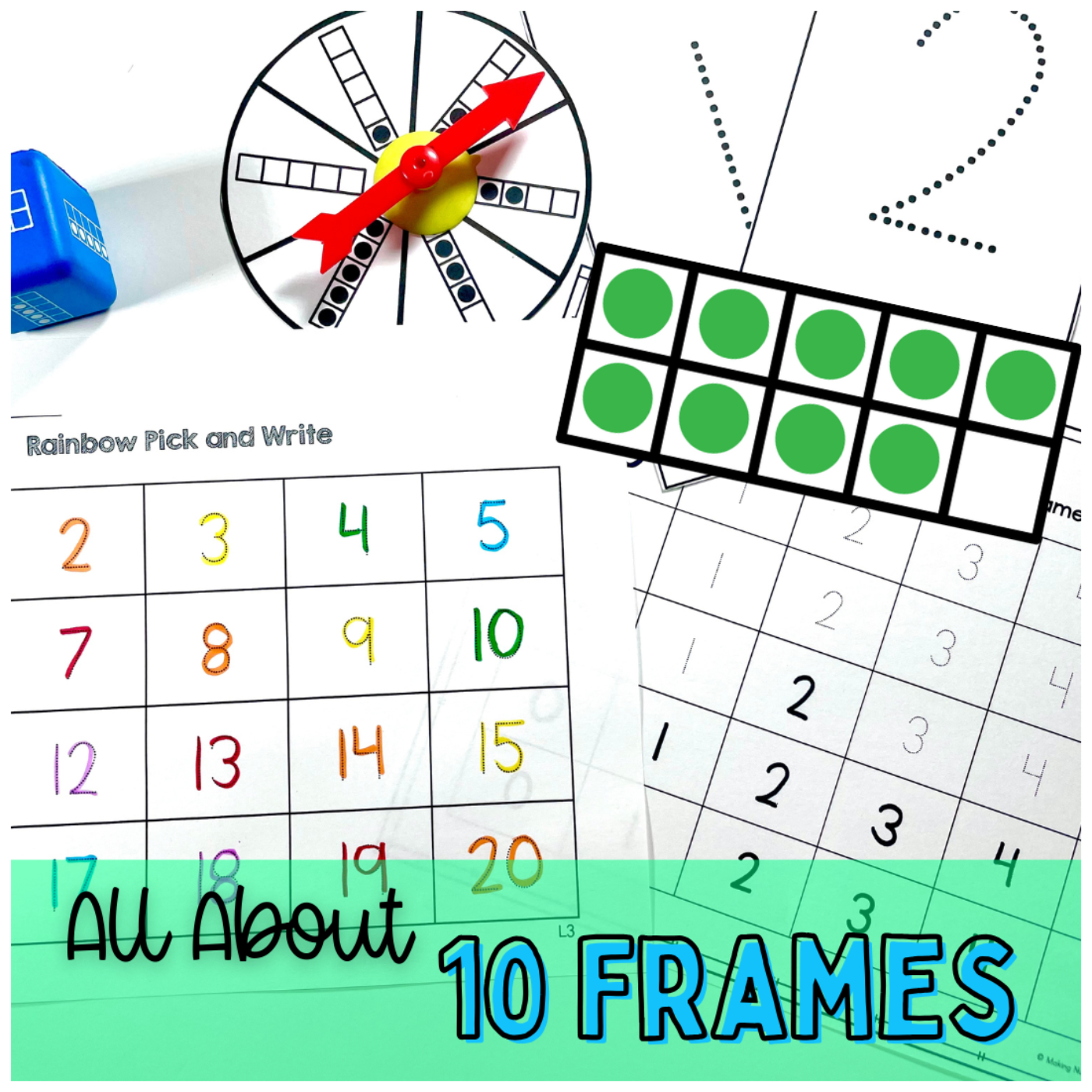
Ep 31: All About 10 Frames
Making Number Sense Make Sense: A Math Podcast for Early Elementary Teachers
This week we are talking all about 10 frames! Ten frames are a math tool that can help students develop anchors to 5 and 10 which are important pre-place value skills! I levels of the concept of 10, and 5 frame, 10 frame, and 20 or double ten frame activities you can use in your classroom today!
Have a topic you want me to discuss? Fill out the Google Form!
Helpful Links
Time Stamps
0:37 What is a 10 Frame?
1:52 Levels of Concept of 10
4:03 Activities with 10 Frames
Let's Connect!
Available Results
Generated results are saved to the knowledge database for reuse and search.
Extract Knowledge
Pick what you want extracted first. Model, scope, and chapter options appear after a template is selected.
Transcript
1
00:00:00,000 --> 00:00:05,760
Today I'm going to talk all about 10 frames, which are amazing tools or models for your

2
00:00:05,760 --> 00:00:12,200
students to use to develop the concept of five and 10 as reference points, which is

3
00:00:12,200 --> 00:00:18,300
a pre place value skill that can be really helpful when students start to work with larger

4
00:00:18,300 --> 00:00:19,300
numbers.

5
00:00:19,300 --> 00:00:28,300
Hello and welcome to Making Number Sense Make Sense, a podcast for all of you.

6
00:00:28,300 --> 00:00:33,480
Make Sense, a podcast for elementary teachers, specifically early elementary teachers, looking

7
00:00:33,480 --> 00:00:37,080
to really make an impact in the number sense of their students.

8
00:00:37,080 --> 00:00:43,160
If you are not familiar with what a 10 frame is, like I said, it's a math tool that has

9
00:00:43,160 --> 00:00:46,360
10 squares, five on the top, five on the bottom.

10
00:00:46,360 --> 00:00:54,980
I've seen it most often be used horizontally, but it can also be used vertically.

11
00:00:54,980 --> 00:01:00,040
And so when using a 10 frame or a five frame, which is just half if you're really just starting

12
00:01:00,040 --> 00:01:05,360
with numbers, it helps kids see numbers instead of 10 being a long line.

13
00:01:05,360 --> 00:01:09,000
It's kind of stacked on top of each other, which can be really helpful when starting

14
00:01:09,000 --> 00:01:15,880
to develop subitizing and understanding how many 10 is and maybe how close a number is

15
00:01:15,880 --> 00:01:19,120
to 10 or how far a number is to 10.

16
00:01:19,120 --> 00:01:23,120
So why are five and 10 even important as reference points?

17
00:01:23,120 --> 00:01:28,440
Those numbers tend to be friendlier numbers or easier numbers for students to remember

18
00:01:28,440 --> 00:01:32,480
that help develop number sense and build their basic facts.

19
00:01:32,480 --> 00:01:37,440
And they can start to reason with how close or how far a number is from 10.

20
00:01:37,440 --> 00:01:42,520
And that knowledge and that understanding of how the number system works then can be

21
00:01:42,520 --> 00:01:45,480
applied to larger numbers.

22
00:01:45,480 --> 00:01:50,240
When kids are just kind of learning the concept of 10, there's three levels.

23
00:01:50,240 --> 00:01:52,960
The first level is the initial concept of 10.

24
00:01:52,960 --> 00:01:56,000
So they don't really understand 10 as a unit.

25
00:01:56,000 --> 00:01:59,400
They will still see 10 as individual things.

26
00:01:59,400 --> 00:02:05,080
When using a 10 frame and bringing that in, they start to see 10 things as a unit and

27
00:02:05,080 --> 00:02:11,040
eventually can move on to different models that do not need to show 10 things exactly

28
00:02:11,040 --> 00:02:13,000
like base 10 blocks.

29
00:02:13,000 --> 00:02:16,600
But when they're just starting out, they really need to see it to understand how many

30
00:02:16,600 --> 00:02:17,980
10 is.

31
00:02:17,980 --> 00:02:21,720
And when students are in this level, this first level, when they're solving addition

32
00:02:21,720 --> 00:02:26,000
problems or subtraction problems, they really need to count everything by ones.

33
00:02:26,000 --> 00:02:31,000
They're not really able to see 10 as a group of 10 ones.

34
00:02:31,000 --> 00:02:36,120
So when they get to level two, they kind of have the understanding that 10 is a unit,

35
00:02:36,120 --> 00:02:37,960
but still really need to see it.

36
00:02:37,960 --> 00:02:45,040
So in this case, a base 10 rod wouldn't necessarily be something that they would just see and

37
00:02:45,040 --> 00:02:47,360
know, oh, that represents 10 things.

38
00:02:47,360 --> 00:02:52,200
Whereas when they see it on a 10 frame, they'd still be able to understand that frame is

39
00:02:52,200 --> 00:02:53,200
10 things.

40
00:02:53,200 --> 00:02:59,360
So they really need to mentally construct that unit of 10 to be able to then manipulate

41
00:02:59,360 --> 00:03:01,980
it or add to or take away from it.

42
00:03:01,980 --> 00:03:06,600
And when they're at level three or the facile concept of 10, they're easily able to work

43
00:03:06,600 --> 00:03:10,040
with units of 10 with or without the physical representation.

44
00:03:10,040 --> 00:03:13,880
They can see it, they understand how many it is, they understand how to decompose it

45
00:03:13,880 --> 00:03:15,400
or recompose it.

46
00:03:15,400 --> 00:03:20,340
They're able to find the nearest 10 or create the nearest 10 when solving problems.

47
00:03:20,340 --> 00:03:24,160
So these are all things that we're wanting students to work on or to be able to work

48
00:03:24,160 --> 00:03:25,400
towards.

49
00:03:25,400 --> 00:03:31,800
But it takes a lot of time for them to really understand how many things 10 is and how to

50
00:03:31,800 --> 00:03:36,200
use it, which is why the 10 frame comes in so handy.

51
00:03:36,200 --> 00:03:39,680
Now the 10 frame is a very versatile tool.

52
00:03:39,680 --> 00:03:43,700
You can use 10 frames in your warm up, you can use them for counting, you can use them

53
00:03:43,700 --> 00:03:49,040
at centers, and a great way to spice up anything you're doing with a 10 frame is to change

54
00:03:49,040 --> 00:03:50,120
the manipulative.

55
00:03:50,120 --> 00:03:52,600
You know, variety is the spice of life.

56
00:03:52,600 --> 00:03:55,960
Change your manipulative and all of a sudden it's a brand new 10 frame.

57
00:03:55,960 --> 00:04:00,860
So next I'm going to share with you some of my favorite ways to use 10 frames in the classroom

58
00:04:00,860 --> 00:04:02,880
and some activities that you might want to try.

59
00:04:02,880 --> 00:04:05,200
The first one is quick images.

60
00:04:05,200 --> 00:04:09,600
In quick images, you would show students a 10 frame with a certain number of items on

61
00:04:09,600 --> 00:04:13,120
it, show it to them for three seconds, and then quickly put it down.

62
00:04:13,120 --> 00:04:18,640
And so students would have to figure out how many items were on the 10 frame without counting.

63
00:04:18,640 --> 00:04:20,640
So that's where the reasoning really comes in.

64
00:04:20,640 --> 00:04:25,440
They might be able to think, okay, I know that if they're all full, then it's 10, but if

65
00:04:25,440 --> 00:04:28,560
I saw three empty, well, what's three away from 10?

66
00:04:28,560 --> 00:04:29,560
It's seven.

67
00:04:29,560 --> 00:04:33,560
Or they might see that there's only three things on it and realize there was a lot left

68
00:04:33,560 --> 00:04:34,900
before they got to 10.

69
00:04:34,900 --> 00:04:41,180
Quick images is a very easy to implement number sense routine or warm up that you can do with

70
00:04:41,180 --> 00:04:43,440
your kids before your math block.

71
00:04:43,440 --> 00:04:47,240
You can do it with them in centers and small group if they're really needing it.

72
00:04:47,240 --> 00:04:50,280
And then they can build the same 10 frame that they saw.

73
00:04:50,280 --> 00:04:52,960
They can try and build a matching set.

74
00:04:52,960 --> 00:04:56,320
Also something for if you're waiting in the, you have a 10 frame and a dry erase sleeve

75
00:04:56,320 --> 00:05:00,320
and a marker, you can play that in the hall while they're waiting to go into their specials.

76
00:05:00,320 --> 00:05:03,640
It's an activity that you can pull out everywhere and your kids always really like it.

77
00:05:03,640 --> 00:05:07,040
They like being able to see if they can figure out the 10 frame.

78
00:05:07,040 --> 00:05:09,240
And because you're quick, it adds a game like element.

79
00:05:09,240 --> 00:05:14,840
I mentioned briefly about using 10 frames in small group, like students would have to

80
00:05:14,840 --> 00:05:16,480
build a matching set.

81
00:05:16,480 --> 00:05:22,180
And that's another hands-on way for them to start constructing the idea of 10.

82
00:05:22,180 --> 00:05:26,800
And the next couple games I'm going to share with you definitely leverage that skill.

83
00:05:26,800 --> 00:05:29,120
The first one is pick, build, and cover.

84
00:05:29,120 --> 00:05:31,160
So your students would have a playing mat.

85
00:05:31,160 --> 00:05:36,720
They would pick up a card and then they would have to pick up a 10 frame card or a numeral

86
00:05:36,720 --> 00:05:38,720
card depending on what they're working on.

87
00:05:38,720 --> 00:05:41,360
The 10 frame card, they would just have to create a matching set.

88
00:05:41,360 --> 00:05:46,120
A numeral card can be for your students who are working on number recognition or matching

89
00:05:46,120 --> 00:05:47,360
numerals to a value.

90
00:05:47,360 --> 00:05:52,600
So they pick up their card and they would need to create that same number on their 5,

91
00:05:52,600 --> 00:05:54,320
10, or 20 frame.

92
00:05:54,320 --> 00:05:58,240
And once they've created that number, they would put a counter on that number on the

93
00:05:58,240 --> 00:05:59,240
counting mat.

94
00:05:59,240 --> 00:06:03,080
The goal is for them to build all of the numbers and they can keep track of the numbers that

95
00:06:03,080 --> 00:06:05,680
they've built by covering it up on their frame.

96
00:06:05,680 --> 00:06:11,200
And like I said, you can do a 5 frame for students who are needing just working on numbers

97
00:06:11,200 --> 00:06:16,060
to 5, 10 frame for students who are working on numbers to 10, and 20 frame if your students

98
00:06:16,060 --> 00:06:17,560
are a bit beyond numbers to 10.

99
00:06:17,560 --> 00:06:21,960
And working with a 20 frame is a great way to develop the concept of teen numbers as

100
00:06:21,960 --> 00:06:25,940
a teen number being one full group of 10 and ones.

101
00:06:25,940 --> 00:06:28,800
And they can start to see that the more they work with 20 frames.

102
00:06:28,800 --> 00:06:30,920
So there's a little something for everyone.

103
00:06:30,920 --> 00:06:35,660
Another game that is similar to that is spin and build instead of pick and build.

104
00:06:35,660 --> 00:06:40,240
So for spin and build, they actually have a spinner with a 5, 10, or 20 frame on it.

105
00:06:40,240 --> 00:06:45,420
They would spin and create that number on their frame.

106
00:06:45,420 --> 00:06:49,660
And in this one, I like to bring in some number writing into it as well.

107
00:06:49,660 --> 00:06:53,160
So they would have a recording sheet where they would write the number that they spun

108
00:06:53,160 --> 00:06:57,680
and they could draw or fill in a 10 or 20 frame depending on what it looked like.

109
00:06:57,680 --> 00:07:02,200
So they can get some number writing practice in while they're working on those numbers.

110
00:07:02,200 --> 00:07:08,120
And if you can, there are dice, like actual dice available that have 5, 10, and 20 frames

111
00:07:08,120 --> 00:07:09,120
on it.

112
00:07:09,120 --> 00:07:14,520
That is a great thing to put on your classroom wish list or see if you can get because those

113
00:07:14,520 --> 00:07:16,520
are so versatile as well.

114
00:07:16,520 --> 00:07:20,100
And my kids really love anything that they can use a die for.

115
00:07:20,100 --> 00:07:21,100
They love it.

116
00:07:21,100 --> 00:07:22,640
With those die, you can also create.

117
00:07:22,640 --> 00:07:28,400
There's tons of dice templates online and you can just put your 5, 10, or 20 frames

118
00:07:28,400 --> 00:07:30,720
on it and create them yourself as well.

119
00:07:30,720 --> 00:07:34,340
And with that, you can do roll and write 5, 10, or 20 frames.

120
00:07:34,340 --> 00:07:38,400
So again, all of these are really similar, working on the same skills, but giving it

121
00:07:38,400 --> 00:07:41,760
a little tweak makes it feel like a different activity.

122
00:07:41,760 --> 00:07:45,360
For example, in Pick, Build, and Cover, you're using cards to make your matches.

123
00:07:45,360 --> 00:07:49,000
In Spin and Build, you're using a spinner, which is also an amazing tool that you can

124
00:07:49,000 --> 00:07:50,000
get.

125
00:07:50,000 --> 00:07:54,200
They're not very expensive and I use them all the time and I can use them for everything.

126
00:07:54,200 --> 00:07:58,980
I use spinners so much because they're, again, another really versatile tool you can use

127
00:07:58,980 --> 00:08:00,560
for so much.

128
00:08:00,560 --> 00:08:03,880
And the roll and write is really focusing more on writing your numbers.

129
00:08:03,880 --> 00:08:07,840
So they would roll their die, figure out which number it is, and write the number because

130
00:08:07,840 --> 00:08:13,160
a lot of times kids can recognize their numbers before they can actually write them with reversals

131
00:08:13,160 --> 00:08:14,160
and such.

132
00:08:14,160 --> 00:08:17,720
And so when you're working with kindergartners, first graders, it's still developmentally

133
00:08:17,720 --> 00:08:22,120
appropriate for them to be reversing their numbers, so maybe writing their 5 backwards.

134
00:08:22,120 --> 00:08:27,560
But it starts to become an issue when they start writing teen numbers as 51 instead of

135
00:08:27,560 --> 00:08:28,560
15.

136
00:08:28,560 --> 00:08:32,240
So I think it's an opportunity to practice it, but in a more interactive way than just

137
00:08:32,240 --> 00:08:34,680
filling out a worksheet is really helpful.

138
00:08:34,680 --> 00:08:35,680
So there you have it.

139
00:08:35,680 --> 00:08:37,560
I hope that you got some ideas from this.

140
00:08:37,560 --> 00:08:45,080
I will have a link to images of the centers I listed in the show notes, and feel free

141
00:08:45,080 --> 00:08:51,240
to let me know what your favorite 10-frame activities are, either by sending me an email

142
00:08:51,240 --> 00:08:52,240
or finding me on Instagram.

143
00:08:52,240 --> 00:08:59,240
And until then, I will talk to you next time.