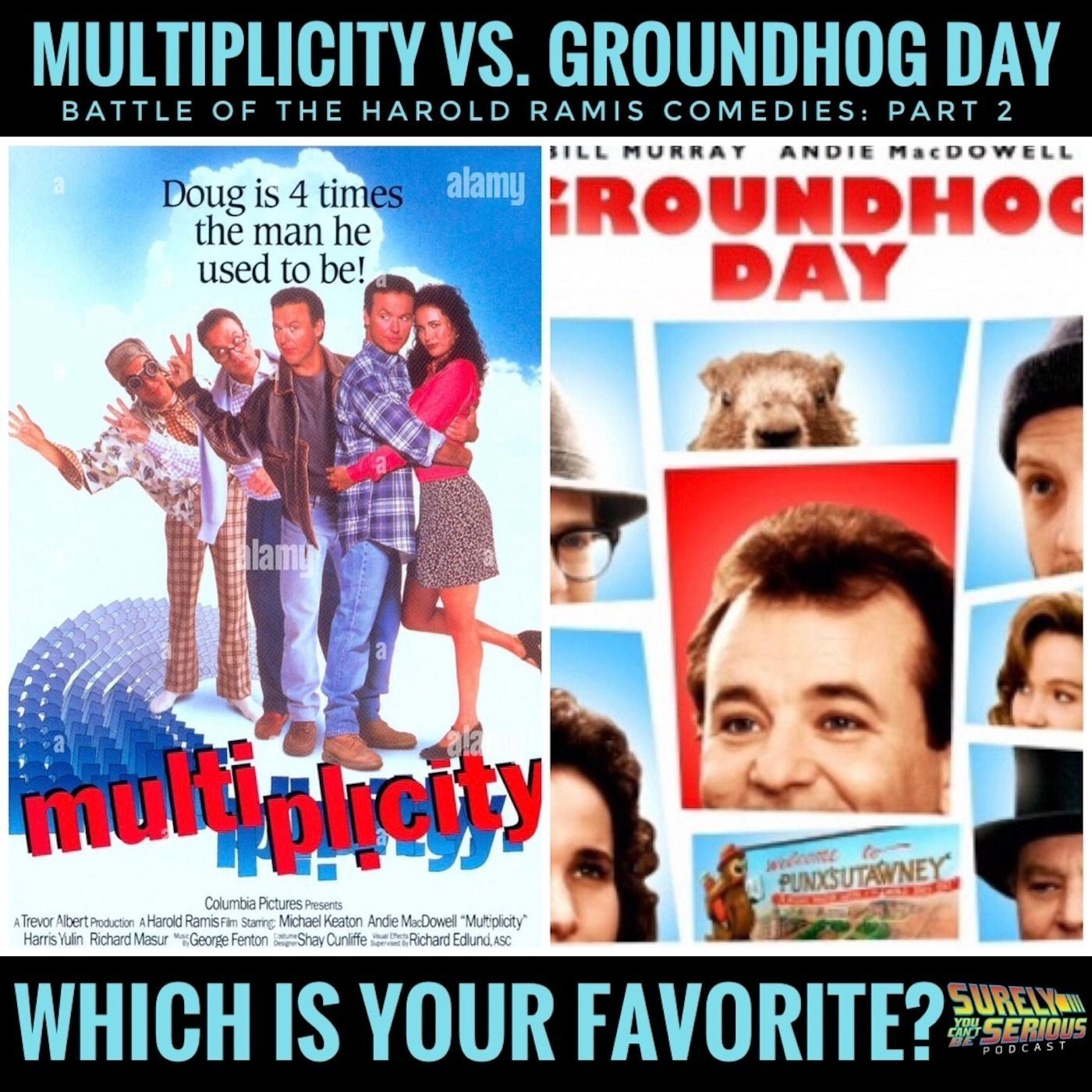
Groundhog Day (1993) vs. Multiplicity (1996): Part 2
Bill Murray and Michael Keaton were powerhouse men of comedy in the 80s and 90s. They combined with Harold Ramis to give us two great comedies with a science fiction flare in the 1990s. Join us this week as we give you the stories behind each movie and give our "sure as heckfire" final judgment on which movie is best!
2023-02-07
42 min
Transcript
Available Results
Generated results are saved to the knowledge database for reuse and search.
No generated results are available for this episode yet.
Extract Knowledge
Pick what you want extracted first. Model, scope, and chapter options appear after a template is selected.
Generated results for public episodes are saved to the knowledge database so they can be reused and searched later.
Transcript
<v Speaker 1>Hey, everybody, welcome back to the show that You Can't
<v Speaker 1>Be Serious Podcast D. Today we are talking about a
<v Speaker 1>movie about clones.
<v Speaker 2>Yeah, Life finds a Way.
<v Speaker 1>No, not Jurassic Park.
<v Speaker 2>Oh, why do I get the feeling You're going to
<v Speaker 2>be the death of me?
<v Speaker 1>Good Lord? Not Attack of the Clones either.
<v Speaker 2>Oh, everybody dies, Sally the thing is.
<v Speaker 1>To die well, not oblivion either.
<v Speaker 2>Okay, what clone movie are we talking about?
<v Speaker 1>We are talking about Multiplicity versus groundhog Day. Hey, listen.
<v Speaker 1>We talked about this earlier today. Yeah, okay, so the
<v Speaker 1>funny version is Groundhog Day, where somebody's stuck in a
<v Speaker 1>time loopp versus Multiplicity about a guy who clones himself,
<v Speaker 1>and we talked about how the serious version of that
<v Speaker 1>really is the Edge of Tomorrow, where Tom Cruise is
<v Speaker 1>stuck in a time loop lived I repeat, versus oblivion. Yeah,
<v Speaker 1>where he is he encounters a clone of.
<v Speaker 2>Himself, right exactly. It's kind of crazy two sci fi
<v Speaker 2>movies that take these two harold for bramous comedies and
<v Speaker 2>do it in a whole new way with Tom Cruise.
<v Speaker 1>Hey, I'm telling you those movies are awesome. I would
<v Speaker 1>not be opposed to that matchup.
<v Speaker 2>Right there. No, absolutely not. Now. We talked about Oblivion before.
<v Speaker 2>Whenever we talked about our Top Gun Maverick episode. Fantastic
<v Speaker 2>movie that you encouraged me to watch. I finally got
<v Speaker 2>to get Caleb to watch it. When I watched Multiplicity.
<v Speaker 2>I mentioned in our last episode this was the first
<v Speaker 2>time I'd ever seen it. Although today I asked Casey,
<v Speaker 2>I'm like, have you seen the movie Multiplicity. She's like, yeah,
<v Speaker 2>we watched it together. I'm like, no, it didn't because
<v Speaker 2>I saw it like two days ago when you weren't there,
<v Speaker 2>and she's like no, like when we were dating. I'm
<v Speaker 2>like nope. She's like, I wouldn't have seen it with
<v Speaker 2>anybody else. I'm like, I'm just telling you, honey, I'm
<v Speaker 2>one hundred percent sure I've never seen this movie before.
<v Speaker 2>But then I started thinking, could I have forgotten this movie? Well, yeah,
<v Speaker 2>I think I could have.
<v Speaker 1>Yeah.
<v Speaker 2>Now there are some folks out there who love it.
<v Speaker 2>They'll go back to it again and again and again,
<v Speaker 2>and they saw it when it first came out. But
<v Speaker 2>there's something that happened in between Groundhog Day and Multiplicity
<v Speaker 2>that changed things. Whereas Groundhog Day was this amazing nuclear
<v Speaker 2>bomb success, and Multiplicity didn't even earn half of its budget.
<v Speaker 1>I still cannot put my head around what happened.
<v Speaker 2>Well, here's the thing, I'm going to propose this theory now.
<v Speaker 2>So we did an episode just a few episodes ago,
<v Speaker 2>where we interviewed the creator of The green Light Project,
<v Speaker 2>Alex Collegiate, and we started talking about our favorite eighties movies,
<v Speaker 2>and he kind of got onto this idea that eighties
<v Speaker 2>movies didn't really start until nineteen eighty four, right like
<v Speaker 2>before that, those were seventies movies, like they had a style,
<v Speaker 2>and that the style changed in eighty four. And I
<v Speaker 2>think it could be wrong, but I think he said,
<v Speaker 2>and that blasted to ninety three, and then in ninety
<v Speaker 2>four the style changed. Keep in mind ninety four, we've
<v Speaker 2>got Natural Born Killers, we've got pulp fiction, we've got
<v Speaker 2>Shawshank Redemption. I mean all of these incredible, serious, not
<v Speaker 2>remotely eighties style movies. Right now, the two movies that
<v Speaker 2>we're talking about, one came out in ninety three, and
<v Speaker 2>that's Groundhog Day, and it was a very eighties movie style,
<v Speaker 2>like you've got the intro in the clouds and it's
<v Speaker 2>the credits and it's this kind of cheesy, kind of
<v Speaker 2>bad Newman sounding song to go with it. It's his name,
<v Speaker 2>Randy Newman? Is it Randy Newman?
<v Speaker 1>Yes?
<v Speaker 2>Yeah, Harold Ramis wrote that Weatherman song, by the way,
<v Speaker 2>he was he was one of the writers on that song.
<v Speaker 2>It's so dumb, it is so bad, like and I
<v Speaker 2>just and and multiplicity starts the exact same way. It's
<v Speaker 2>the credits. We have this fun little hey, let's show
<v Speaker 2>Andy McDowell's name several times, and let's show Michael Keaton's
<v Speaker 2>name several times. Just the multiplicity idea. But it's still
<v Speaker 2>credits in the clouds. But from nineteen ninety three to
<v Speaker 2>nineteen ninety six there had been a paradigm shift, and
<v Speaker 2>Multiplicity did not get on the bus.
<v Speaker 1>Yeah, I think we talked about that. For me, I
<v Speaker 1>think there's a case to be made that Jurassic Park
<v Speaker 1>is the last of the eighties movies, and then you
<v Speaker 1>have pull fiction and all that, and there is that shift.
<v Speaker 1>That comedy seemed a little bit outdated.
<v Speaker 2>It did, it did. Harold Ramis was a master of
<v Speaker 2>a particular style, and unfortunately, around nineteen ninety four that
<v Speaker 2>style fell out of favor. Like hair metal in ninety two.
<v Speaker 1>Do you know what the next movie after Groundhog Day
<v Speaker 1>that Harold Ramis did was No, Stuart saves his family.
<v Speaker 2>I don't even know what that is.
<v Speaker 1>You remember the Stuart from Saturday Night Live, the guy
<v Speaker 1>that's I'm good enough, I'm smart enough, and.
<v Speaker 2>Oh that steaming pile of burning tired.
<v Speaker 1>You have maybe one of the greatest comedies ever and
<v Speaker 1>then you fall off the cliff. Yeah it's crazy, right,
<v Speaker 1>yeah GiMA. By the way, ninety three is known as
<v Speaker 1>year for the family movie. Did you know this? No?
<v Speaker 1>I didn't, so listen to this. You got so you
<v Speaker 1>have Jurassic Park, which can be considered a family movie, right,
<v Speaker 1>You've got Missus Doubtfire. Yeah, You've got The Nightmary Before Christmas,
<v Speaker 1>and you've got Free Willie. You've got some big, heavy
<v Speaker 1>hitting family movies.
<v Speaker 2>I can't believe you said Free Willy and all of that,
<v Speaker 2>but keep going.
<v Speaker 1>Hey, Free Willy was a box office smash.
<v Speaker 2>It was.
<v Speaker 1>It's true, no stupid movie. But so ninety three is
<v Speaker 1>known as the year of the family movie, right, not
<v Speaker 1>ninety six we talked about in our last episode. The
<v Speaker 1>movies that came out in ninety six. Ninety six is
<v Speaker 1>not a good year for movies.
<v Speaker 2>It's not a good year for movies, but it was that.
<v Speaker 2>I think Hollywood was scrambling at that moment trying to
<v Speaker 2>figure out what was the new end thing to do,
<v Speaker 2>because you had all these independent directors who had come
<v Speaker 2>out and given us a whole new idea about what
<v Speaker 2>movies could be. And this I mean someday we will
<v Speaker 2>have this debate because you maintain that the eighties is
<v Speaker 2>the best decade for movies, and I maintained that it
<v Speaker 2>was the nineties. But this would be an interesting if
<v Speaker 2>we decided to do that episode. Do we draw our
<v Speaker 2>dividing lines up on eighty and ninety or do we
<v Speaker 2>divide it up on eighty four and ninety four?
<v Speaker 1>That complicates things?
<v Speaker 2>It does, Yes, Okay, so let's jump into these movies.
<v Speaker 2>Talk a little bit about the production of Groundhog Day.
<v Speaker 1>Then put y'all in little hand in line. There in
<v Speaker 1>no ill mountains.
<v Speaker 2>We can't find. Okay, Shirley fans, rise and shine and
<v Speaker 2>don't forget your booties because it's cool.
<v Speaker 1>It's cold out there every day. What is this Miami beach?
<v Speaker 2>Jason? Do you have daja voo?
<v Speaker 1>I don't know, but I can check in the kitchen.
<v Speaker 2>Do you think Phil is gonna come out and see
<v Speaker 2>his shadow todays Donny Phil? That's right, Wood, Chuck, chuckers,
<v Speaker 2>it's ground on day now. One of the key questions
<v Speaker 2>for this movie is how long is he in the
<v Speaker 2>time loop? Right? Right now? Harold Ramis has answered this question. Okay, Okay,
<v Speaker 2>here's the problem. Yeah, he's answered it at least two
<v Speaker 2>different ways.
<v Speaker 1>Okay.
<v Speaker 2>At some point he said about ten years. Yeah, at
<v Speaker 2>some point he was like, I think it's more like
<v Speaker 2>thirty or forty years, which is a huge distinction. Right.
<v Speaker 2>When Danny Rubin first wrote the script, his idea was
<v Speaker 2>that it was ten thousand years, right, ten thousand years,
<v Speaker 2>And the question was how could he possibly keep track
<v Speaker 2>of how long it was? Right? How do you if
<v Speaker 2>you can't mark a calendar and it's going to be
<v Speaker 2>there the next day, how do you keep track? So
<v Speaker 2>here's how we answered that question. Right, there is a
<v Speaker 2>library in the bed and Breakfast that he's at a
<v Speaker 2>whole bookshelf full of books, right, And so what he
<v Speaker 2>does he goes to the top left book on the
<v Speaker 2>bookshelf and reads one page, and then the next day
<v Speaker 2>reads the next page. And so that way he can
<v Speaker 2>keep track of how many days have passed. And there's
<v Speaker 2>this very poignant moment in the script where he reaches
<v Speaker 2>the final page of the final book in the bookcase
<v Speaker 2>and he walks over, picks up the first book again,
<v Speaker 2>starts again, Wow. So I think ten thousand years is
<v Speaker 2>definitely too long. But when they were talking about it,
<v Speaker 2>the studio executives wanted to know. They're like, hey, there's
<v Speaker 2>no way we're going to let you go with ten
<v Speaker 2>thousand years. That's just absurd that nobody's going to believe that, right.
<v Speaker 2>So you know, Harold Ramis, being the psych ward let's
<v Speaker 2>see where you're coming from kind of guy, was like, well,
<v Speaker 2>what do you guys think? And they're like two weeks
<v Speaker 2>and they're like, come on, right, I mean that's nothing,
<v Speaker 2>that's meaningless.
<v Speaker 1>Commit suicide after two weeks you got problems.
<v Speaker 2>With right exactly. I mean you miss out on all
<v Speaker 2>of the stages of grief if you try to if
<v Speaker 2>you try to cram all right, right, right, right, it's
<v Speaker 2>not believable not to mention the fact that he becomes
<v Speaker 2>a proficient piano player, right, I mean, it just falls apart.
<v Speaker 2>And so Harold Ramis just kind of uses his politico
<v Speaker 2>power and just says, how about we just don't answer
<v Speaker 2>that question. How about we just let the audience gets
<v Speaker 2>at it, and that's what they end up with.
<v Speaker 1>So I've got a theory on this. So you're right.
<v Speaker 1>He does things like he goes from a complete can't
<v Speaker 1>play the piano to like jazz, you know, leading the
<v Speaker 1>charge in the in the dance hall. Right, and his
<v Speaker 1>piano teacher is like, oh, I'm so proud of him, right, yeah,
<v Speaker 1>which is funny because why would you be proud of
<v Speaker 1>your student after one day? Right? So he does things
<v Speaker 1>he knows everybody in the diner, and that takes time. Okay,
<v Speaker 1>so somewhere between ten years and ten thousand years is
<v Speaker 1>probably your answer. But on screen, you see I think
<v Speaker 1>they said it's exactly forty two.
<v Speaker 2>Days, okay on screen on screen?
<v Speaker 1>Okay, so he slapped you know a certain amount of times,
<v Speaker 1>and he does this or that, you know, and you
<v Speaker 1>see this suicide attempt and that death, and that adds
<v Speaker 1>up to on screen we see forty two different days. Yeah,
<v Speaker 1>to actually see we as the audience.
<v Speaker 2>Side note, sweet vermouth with a twist of lemon sounds
<v Speaker 2>like the worst drink I've ever heard of my life.
<v Speaker 2>Please continue.
<v Speaker 1>That is exactly six weeks. Okay, six weeks of winter.
<v Speaker 2>Well, that's interesting, but there's no way it can be
<v Speaker 2>only six weeks. So it's interesting, but we see six
<v Speaker 2>weeks worth of days. Yeah, but there's there is there
<v Speaker 2>are changes that occur and let me just let me
<v Speaker 2>jump into this with both feet. Now, we said that
<v Speaker 2>this is based on the five stages of grief, right, Okay, Now,
<v Speaker 2>the first stage of grief is denial. So if you
<v Speaker 2>think about the movie, there's Bill Murray and he's in
<v Speaker 2>his first repeat day and he's like he's confused. He's like, yesterday, yeaheah, yeah,
<v Speaker 2>what day is it? It's Groundhog Day? Will you be
<v Speaker 2>checking out today, mister Connors, I'd say the chance of
<v Speaker 2>departure is eighty percent. Only do that once a year, right,
<v Speaker 2>And when she asks him, you know, are you going
<v Speaker 2>to be checking out the day? Chances are eighty percent,
<v Speaker 2>which has gone down twenty Like he's yeah, he's identified
<v Speaker 2>that there's a problem because it was one hundred percent
<v Speaker 2>the first day, right, And so he's in denial. Then
<v Speaker 2>that night he breaks the pencil to test it yes,
<v Speaker 2>wakes up the next day, the pencil is back in
<v Speaker 2>the drawer and full, and he's he's jumping for joy, right, yeah,
<v Speaker 2>he because he's like, hey, I'm in a magical world.
<v Speaker 2>But it takes very little time in that magical world
<v Speaker 2>before he is off drinking with the guy, saying I'm
<v Speaker 2>mad about the way that life has treated me and
<v Speaker 2>I'm not going to play by their rules anymore. And
<v Speaker 2>so that is stage two anger.
<v Speaker 1>Phil, Phil, Hey Phil Connor?
<v Speaker 2>Ned right?
<v Speaker 1>Right?
<v Speaker 2>How is it going to be? Right?
<v Speaker 1>So then the next stage is bargaining.
<v Speaker 2>Right, So this one, this one kind of is bookended
<v Speaker 2>with punching ned right, Like, if there are no consequences,
<v Speaker 2>is what you do? Why wouldn't you punch the d
<v Speaker 2>bag that keeps bothering you every day?
<v Speaker 1>Right?
<v Speaker 2>Why not? Why not go to jail? Why not steal
<v Speaker 2>a bag of money or whatever?
<v Speaker 1>I love that scene. I love that that's such a
<v Speaker 1>fantasy because he's sitting there one car, yep, dog bark, two,
<v Speaker 1>drop the coins bag and they turn around and he's
<v Speaker 1>got money. You know, It's it's kind of fun.
<v Speaker 2>And so the third stage is the bargaining stage, and
<v Speaker 2>that's where he starts trying to manipulate things. Right, He's
<v Speaker 2>after Rita. He realizes he's you know, he gets involved
<v Speaker 2>with this woman who he knows won't know who he
<v Speaker 2>is tomorrow. But then is there in their makeout session,
<v Speaker 2>he's calling a Rita because hey, I realize that I've
<v Speaker 2>got the houtse reata. So he just decides, I'm going
<v Speaker 2>to try to manipulate her. Right, He's got a goal.
<v Speaker 2>He's going to use this repeat day thing to figure
<v Speaker 2>her out, figure out what her favorite drink is, figure
<v Speaker 2>out that she likes French poetry, figure out and it's
<v Speaker 2>all manipulation. And on that final you know, he goes
<v Speaker 2>through and finally has the perfect day with her, and
<v Speaker 2>then at the end you see him making notes to
<v Speaker 2>himself and she's like, what are you doing it? It ends
<v Speaker 2>up with a slap. Yeah. It's after that that he
<v Speaker 2>realizes he can't do it. He can't seduce her with
<v Speaker 2>these tricks, and that's when he falls into the fourth stage,
<v Speaker 2>which is depressional, right, and you get the infamous kidnapping
<v Speaker 2>of Punksatani.
<v Speaker 1>Film Don't Drive Angry.
<v Speaker 2>This is a classic moment. Is a classic moment where
<v Speaker 2>they're driving in this old red Ford pickup. I don't
<v Speaker 2>know why they picked that truck of all trucks, but
<v Speaker 2>is the perfect truck for this scene. And they get
<v Speaker 2>to the strip minds or whatever it is where Yeah, yeah,
<v Speaker 2>this is a real groundhog that Bill Murray is working with. Yeah, now,
<v Speaker 2>he's got gloves. It bit him through the gloves, bit
<v Speaker 2>him three times and the third time it punctured the
<v Speaker 2>glove and they had to take a few days off.
<v Speaker 2>Bill Murray is always getting hurt by these little woodland creatures.
<v Speaker 2>He's got the groundhog, He's got Carol Caine.
<v Speaker 1>Carol Kane, ripping his lip off, scrooged.
<v Speaker 2>Yeah.
<v Speaker 1>So the depression stage is where certain funny things happen. Yeah,
<v Speaker 1>there is a commercial that came out a couple of
<v Speaker 1>years ago. Did you see that commercial? He steals a
<v Speaker 1>jeep right right, and so it's a jeep commercial. His
<v Speaker 1>day in the commercial is every day he steals his
<v Speaker 1>jeep just to go crazy with his jeep.
<v Speaker 2>So he's full in depression. You see multiple suicide attempts
<v Speaker 2>for a movie that is the comedy like this. Watching
<v Speaker 2>him jump off of the top of a building was
<v Speaker 2>pretty intense.
<v Speaker 1>The worst one for me is him putting the toaster
<v Speaker 1>in the bathtub.
<v Speaker 2>See, I thought that was funny. That part, it was
<v Speaker 2>funny to me. The leaping to his death, that was
<v Speaker 2>the one. Yeah, that was rough.
<v Speaker 1>Here's the other thing I wanted to bring up in
<v Speaker 1>the depression stage, Yeah, because this is where he sinks
<v Speaker 1>to his lowest, like the lowest of low. Okay, there
<v Speaker 1>is never anything really really depraved that we see, Okay,
<v Speaker 1>like why not go on a killing spree? Or you know,
<v Speaker 1>who knows what depraved things that a person like that
<v Speaker 1>could think of.
<v Speaker 2>Sure, the most depraved that he gets is pretending to
<v Speaker 2>be Clint Eastwood with what I can only guess is
<v Speaker 2>the local hooker I get, I don't. She's in that
<v Speaker 2>one scene and doesn't explain.
<v Speaker 1>Any more than that, call me Bronco. But the conclusion
<v Speaker 1>that I reach from that is that he's not a
<v Speaker 1>bad guy. Right, He's he's grumpy, and he's arrogant, and
<v Speaker 1>he's got some issues.
<v Speaker 2>He's got some limitations, like he's got some self limitations
<v Speaker 2>that he's not going to go murder people even though
<v Speaker 2>he could, right he could, and these in that there's
<v Speaker 2>still hope because probably if you are not murdering somebody.
<v Speaker 2>It means that you think there may still be a tomorrow.
<v Speaker 2>Sure may still be a tomorrow.
<v Speaker 1>I mean, the worst thing that he's trying to do
<v Speaker 1>is bed rita right.
<v Speaker 2>And once he's given up on that and he's in
<v Speaker 2>this depression state. It's at that stage much later on
<v Speaker 2>when he's talking to her, and it's again another scene
<v Speaker 2>in the diner. We've moved from he's eating all of
<v Speaker 2>this horrible food to he's in the diner and he's
<v Speaker 2>talking to her about how he is a god. You're
<v Speaker 2>a god. I'm not the god. I'm a god.
<v Speaker 1>I think that's what he says, right.
<v Speaker 2>And so it's at that moment where he opens himself
<v Speaker 2>up and he makes himself vulnerable. He's no longer the
<v Speaker 2>prima Donna. He is bearing his soul. And if you
<v Speaker 2>think about the hero's journey here, this is where he
<v Speaker 2>faces his biggest fear of being completely honest with this
<v Speaker 2>girl that he loves, and this love is changing. It's
<v Speaker 2>not just I'm looking to better, I'm looking to tricker
<v Speaker 2>and manipulate her. This is I'm reaching out to you
<v Speaker 2>as a fellow intelligent human being and telling you the
<v Speaker 2>circumstance that I'm in and she spends the whole day
<v Speaker 2>with him as he talks about all of this stuff,
<v Speaker 2>and it's at that moment that night where she goes,
<v Speaker 2>you know, I don't know, Phil. I mean, some people
<v Speaker 2>would love to have to be able to repeat the
<v Speaker 2>same day over and over again to finally get it right.
<v Speaker 2>You know, some people would look at it us as
<v Speaker 2>something great. And he says, gosh, you're a beat. But
<v Speaker 2>that is the pivotal moment where we move into act
<v Speaker 2>three and he switches from depression to acceptance. And what
<v Speaker 2>his acceptance is is I'm not here for me, I'm
<v Speaker 2>here for everybody else, and so he makes his purpose
<v Speaker 2>to better everybody else's life. And you have this little
<v Speaker 2>vignette in the middle of all of that, in the
<v Speaker 2>middle of the acceptance, where he goes through the whole
<v Speaker 2>cycle again in a brief moment with the vagrant with
<v Speaker 2>the bumb Yeah, okay, he gives him money and then
<v Speaker 2>he discovers that but you know, hey, he's not doing well,
<v Speaker 2>takes from the hospital and he dies and she's like,
<v Speaker 2>sometimes people just die, and he's not today, and you
<v Speaker 2>see him again and again and again trying to save
<v Speaker 2>this guy and it doesn't give us closure about what happens,
<v Speaker 2>but you have to at that point go. He probably
<v Speaker 2>just had to accept it, and that's why we're in
<v Speaker 2>this stage here. We're in the acceptance stage. And you
<v Speaker 2>get to the final point where he's bettered himself as
<v Speaker 2>a person, learned to play the piano, read countless books,
<v Speaker 2>helped everybody be their best self, and he isn't chasing
<v Speaker 2>read it anymore. She is now chasing him. And it's
<v Speaker 2>there that finally you get the end and I'll do
<v Speaker 2>I'll blow your mind with this. You ready, yeah?
<v Speaker 1>Yeah?
<v Speaker 2>Okay. So at the very beginning of the cycle of
<v Speaker 2>the time loop, they're trying to get out of town, right,
<v Speaker 2>he's predicted that the blizzard is not coming. Right, They
<v Speaker 2>try to leave town and the road is blocked, and
<v Speaker 2>this kind of lets us know, Hey, this is why
<v Speaker 2>he can't leave, why he can't get out of this
<v Speaker 2>place and go do something somewhere else. Right, right, the
<v Speaker 2>trooper says, you can either go back to bucks a
<v Speaker 2>tawny or you can die in the cold. Yes, you pick, right,
<v Speaker 2>I'm thinking about it. Right at that moment, it's snowing.
<v Speaker 2>You see the snow falling right, you do not see
<v Speaker 2>snow falling again for the entire movie until that last
<v Speaker 2>night of February second and he's dancing with Rita, dancing
<v Speaker 2>in the pavilion and while they're dancing, it starts to
<v Speaker 2>snow and that's the first time you see snow again.
<v Speaker 2>And it's like the book ends of his time with
<v Speaker 2>Predicament start with snow and with snow.
<v Speaker 1>I like it. I like it very cool. Okay, you know,
<v Speaker 1>you brought up something that I wanted to touch on.
<v Speaker 1>So Rita is his everest, right, that is his number
<v Speaker 1>one goal. But he has like all these side missions, right,
<v Speaker 1>because you can tell because when he walks through the
<v Speaker 1>diner and he's actually explaining it to her, he's like, well,
<v Speaker 1>this guy does this, this.
<v Speaker 2>This, and this.
<v Speaker 1>I mean, how many days did he spend with that
<v Speaker 1>guy to learn about that dude?
<v Speaker 2>Right?
<v Speaker 1>You know, Nancy makes a funny noise when she gets excited.
<v Speaker 2>Right, that only took one day.
<v Speaker 1>Yeah, But he spends time with all these people. He
<v Speaker 1>gets to know everybody, you know, and so to me,
<v Speaker 1>that's just really cool to think about the amount of time.
<v Speaker 1>And then you know he catches that kid. It falls
<v Speaker 1>out of the tree. He's like, hey, thank you. You know,
<v Speaker 1>say thank you you, Brad, I'm here every day is
<v Speaker 1>save your life. You never say thank you.
<v Speaker 2>Right, So let me just say this. I got I had.
<v Speaker 2>I knew I was going to have to tell this
<v Speaker 2>story at some point. Okay, So I watched this movie
<v Speaker 2>in preparation for this. But the last time I saw
<v Speaker 2>it before that, yeah, I was on a flight. I
<v Speaker 2>don't remember where I was flying, but it was a
<v Speaker 2>long enough flight that I could watch the whole movie right,
<v Speaker 2>And I'd seen Groundhog Day a few times before, and
<v Speaker 2>I had enjoyed it. When I saw this movie this time,
<v Speaker 2>this second most recent time, I was weeping at the end.
<v Speaker 2>Now we've talked about how all of these religions and
<v Speaker 2>psychoanalysis and all these other things, there's this universal concept
<v Speaker 2>that they all have said, Hey, this is a you know,
<v Speaker 2>the time loop, the repeating the same day is something
<v Speaker 2>we all deal with. But on this particular watching it
<v Speaker 2>hit me hard. It hit me really hard. I literally
<v Speaker 2>when I got done with the flight, I was like, Jason,
<v Speaker 2>I got to figure out how to do a podcast
<v Speaker 2>minute by minute On Groundhog Day, I did not realize
<v Speaker 2>how incredible a movie this was And then I googled
<v Speaker 2>emotional overreaction on flights and it turns out that's a thing.
<v Speaker 2>There you go, Okay, I love this movie. I did
<v Speaker 2>not cry this most recent time. But this movie it
<v Speaker 2>hits in a spot that it needs to hit. And
<v Speaker 2>like you pointed out, the first time you saw it,
<v Speaker 2>you're twenty. Yeah, so you didn't really appreciate this idea
<v Speaker 2>of hey, I'm stuck and doing this same routine over
<v Speaker 2>and over like you do when you're in your forties. Right.
<v Speaker 2>But and Ramus actually talked about this. He was talking
<v Speaker 2>about the Jews reading the Torah and how it has
<v Speaker 2>a different meaning every time they read it, as they
<v Speaker 2>go through it each year, and he's like, and it's
<v Speaker 2>like this movie. You know, every time somebody watches it,
<v Speaker 2>they get something new from it. And he's like, not
<v Speaker 2>that I'm comparing Groundhog Day to the Torah, but that's
<v Speaker 2>what happens. And it's true, every time I see it,
<v Speaker 2>there's something new about it that hits home.
<v Speaker 1>I wanted to bring up a couple of things. So
<v Speaker 1>Bill Murray was going through a divorce at the time
<v Speaker 1>he was filming this, Yeah, which was hard.
<v Speaker 2>Sure, Well, yeah, it was. It was marital problems that
<v Speaker 2>ended in a divorce about three years later.
<v Speaker 1>Yeah, yeah, it was bad, so angry Phil could come
<v Speaker 1>out pretty easily.
<v Speaker 2>Yeah, by the way, that's what Bill Murray would say
<v Speaker 2>before each take. He's like, am I angry Phil in
<v Speaker 2>this one? Or? Am I happy? Film?
<v Speaker 1>It's all he needed to do. That's hilarious. So we
<v Speaker 1>talked about how Harold Ramis and Bill Murray had a
<v Speaker 1>fall out after this movie. Yeah, and I think one
<v Speaker 1>of the things was this divorce was causing him to
<v Speaker 1>be cranking difficult more so this anyway.
<v Speaker 2>Yeah, he's notorious anyway for is he going to show it?
<v Speaker 2>They didn't know whether he was going to show up
<v Speaker 2>the Gobusters or not, right exactly. I mean, he's just
<v Speaker 2>notorious for you never know what he's going to do.
<v Speaker 2>And there's this whole cow of Bill Murray and the
<v Speaker 2>Bill Murray stories out there where he'll just randomly show
<v Speaker 2>up at a sorority party and start washing dishes. He'll
<v Speaker 2>randomly show up at a urinal and rub somebody's ear lobes,
<v Speaker 2>and when they turn around and see it's him, he'll say,
<v Speaker 2>nobody will ever believe you, Right, you know, he does
<v Speaker 2>weird stuff, and part of the conflict that he had
<v Speaker 2>with Harold Ramis is Harold Ramis was trying to make
<v Speaker 2>a good, funny Hollywood movie and Bill Murray got kind
<v Speaker 2>of caught up in this, as you do when you're
<v Speaker 2>in depressed states of life, wanting to dive deeper into
<v Speaker 2>the philosophical side of things. Right right, This movie does
<v Speaker 2>a perfect combination of both. I don't know how their
<v Speaker 2>headbutting ended up with good dose of philosophy with a
<v Speaker 2>good dose of comedy, perfect mix together. But at some
<v Speaker 2>point I think you're coming to this. Harold Ramis, who
<v Speaker 2>is just the gentlest, nicest guy in the world, grabs
<v Speaker 2>Bill Murray by his shirt and pushes him against the wall.
<v Speaker 1>Yeah. I mean they had a collision of egos here.
<v Speaker 1>But one of the things that kind of I think
<v Speaker 1>got under Bill Murray's skin, and Harold Ramis doesn't really know,
<v Speaker 1>and I haven't heard Bill Murray talk explicitly about it. Yeah,
<v Speaker 1>but he delegated the talking to Bill to one of
<v Speaker 1>his aides. Did you hear this? No, So, Harold Ramis
<v Speaker 1>said that they were asking him in the interview, They're like,
<v Speaker 1>you know, does Bill Murray show up early for work
<v Speaker 1>or is he involved in the process, And Harold Ramis said, well,
<v Speaker 1>we always know where he is, which is in his
<v Speaker 1>trailer he goes. Sometimes you got to rouse him to
<v Speaker 1>get him going, and a lot of times he doesn't
<v Speaker 1>like to be roused. He doesn't like to be pushed.
<v Speaker 1>He doesn't like to be prodded. And so he delegated
<v Speaker 1>that to an aid, right, And I think Bill Murray took.
<v Speaker 2>That personally, Yeah, well, how do you not well?
<v Speaker 1>And during this divorce, like Bill Murray would call him
<v Speaker 1>at like five o'clock in the morning or two am
<v Speaker 1>questions and of course you're trying to direct a movie
<v Speaker 1>and you know, why are you calling me in the middle.
<v Speaker 2>Of the night.
<v Speaker 1>And so he finally just said you handle Bill to
<v Speaker 1>one of his aides.
<v Speaker 2>Right, I don't know what Bill Murray is going to
<v Speaker 2>complain about with this sort of communication technique. Bill Murray
<v Speaker 2>has no agent. I know he has a red phone hotline.
<v Speaker 2>I know he has a one eight hundred number. And
<v Speaker 2>you leave a message. If you're like, hey, Bill, I'm
<v Speaker 2>directing a movie for the very first time. I'd love
<v Speaker 2>for you to come be a part of it. He
<v Speaker 2>might call you back. He might, You don't know, he might,
<v Speaker 2>but there's no agent to call. There's it's he is
<v Speaker 2>a free agent in the truest source of the world.
<v Speaker 1>And you talk. We've talked about how likable he is, right.
<v Speaker 1>You know who had a problem with him, Chevy Chase,
<v Speaker 1>Harold Ramis, Richard Dreyfuss wanted to kill him on what
<v Speaker 1>about Bob? Yeah, right, Lucy lou hated his guts when
<v Speaker 1>they made Charlie's Angels. Yeah, he just rubs people the
<v Speaker 1>wrong way.
<v Speaker 2>Yeah, he's he's an interesting cat.
<v Speaker 1>In fact, Tom Hanks said they didn't bring him on
<v Speaker 1>to be, you know, in the movie groundhog Day because
<v Speaker 1>he's too nice. And Tom Hanks's quote was, well, Bill
<v Speaker 1>Murray is the meanest son of a bit to walk
<v Speaker 1>the earth, so he ought to be fine. So I
<v Speaker 1>thought that was hilarious.
<v Speaker 2>Wow.
<v Speaker 1>By the way, real quick, I've got some information on
<v Speaker 1>the song I Got You Babe by Sonny and Cherry. Okay,
<v Speaker 1>all right, all right, just why not. I'm just touching
<v Speaker 1>on it, Okay, because it's it's featured prominently in the movie.
<v Speaker 1>It's the song that's played by his alarm clock every
<v Speaker 1>time it wakes him. Up. Okay, So here's the deal.
<v Speaker 1>That song hit number one August fourteenth, nineteen sixty five.
<v Speaker 1>This top ten from again August fourteen, nineteen sixty five. Yeah,
<v Speaker 1>get ready for this is gonn blow your socks off?
<v Speaker 2>Okay?
<v Speaker 1>Number ten Down in the Boondocks by Billy Joe Royal,
<v Speaker 1>I don't know. Number nine California Girls by the Beach Boys.
<v Speaker 2>Hey, daf Dave right? Yeah?
<v Speaker 1>Number eight Don't Just Stand There by Patty Duke. Number seven,
<v Speaker 1>it's the same old song the four tops. Number six
<v Speaker 1>Unchained Melody by the Righteous Brothers.
<v Speaker 2>Nice okay.
<v Speaker 1>Number five, what's new? Pussy Cat by Tom Jones. Number
<v Speaker 1>four I'm Henry the eighth I Am by Herman Hermit's
<v Speaker 1>Number three, Save your Heart for Me Gary Lewis and
<v Speaker 1>the Playboys number two again blocking it from the number
<v Speaker 1>one spot. I Can't Get No Satisfaction by the Rolling Stones.
<v Speaker 2>Wow, that's a pretty big hitter.
<v Speaker 1>And number one I Got You Babe by Sonny and Share.
<v Speaker 2>It's probably going to fall in that category of the
<v Speaker 2>perfect most annoying song to wake up to every day
<v Speaker 2>of your life for me.
<v Speaker 1>I think that was the idea, right, Oh my gosh,
<v Speaker 1>for you it might be the Makarina or all I
<v Speaker 1>Want for Christmas?
<v Speaker 2>Is you true? Both of those are true, solid choices.
<v Speaker 2>I had a day where was he like on the beach,
<v Speaker 2>made love? You know, that would have been a nice
<v Speaker 2>day to repeat.
<v Speaker 1>It was a pretty great day.
<v Speaker 2>I was in the Virgin Islands. Once I met a girl.
<v Speaker 2>We ate lobs, drank pinut coladas at sunset, we made love.
<v Speaker 2>Lexianis that was a pretty good game. Why couldn't I
<v Speaker 2>get that day.
<v Speaker 1>Over one other thing on Groundhog Day that I don't
<v Speaker 1>want to mention. Okay, this movie is not shot in Pocksatani, Pennsylvania.
<v Speaker 2>No, they shot it in Illinois.
<v Speaker 1>Woodstock, Illinois. Yeah, the Pocksatani people were super mad about that,
<v Speaker 1>right right, Well, the people in Woodstock, Illinois were also
<v Speaker 1>super mad that he was filming in their town square,
<v Speaker 1>messing stuff up, messing stuff up.
<v Speaker 2>It had more the Woodstock town had more of a
<v Speaker 2>down home feel, like you go to Pusatani and there's
<v Speaker 2>a McDonald's in the middle of the town square, which
<v Speaker 2>not just appealing, not a good appeal for And also
<v Speaker 2>you know copy or trademark issues so well.
<v Speaker 1>And Gobbler's Knob is like two miles out of town.
<v Speaker 2>Yeah, it's like in the woods. Yeah, they don't even Yeah,
<v Speaker 2>they don't even do the ceremony in town square. They
<v Speaker 2>definitely made a Hollywood production, but who cares. Nobody knows that.
<v Speaker 1>I didn't know.
<v Speaker 2>I thought this was perfect spot on ceremonially accurate pucksatani
<v Speaker 2>phil stuff when I saw it. Right at Woodstock, the
<v Speaker 2>town that they filmed it in. There are now plaques
<v Speaker 2>all over the place, including the whole.
<v Speaker 1>With the puddle Bill Murray stepped here.
<v Speaker 2>Watch out for that first step.
<v Speaker 1>It's a diasy Okay, let's flip back to Multiplicity for
<v Speaker 1>a second. She picked Peppy Stief. So the interesting thing
<v Speaker 1>about the filming of Multiplicity and the production of Multiplicity,
<v Speaker 1>So this is at the beginning of all that computer
<v Speaker 1>you know, the CGI stuff that they did in Jurassic Park.
<v Speaker 1>This is still kind of the infancy of all that stuff.
<v Speaker 2>Yeah, this is they used a lot of old techniques
<v Speaker 2>to create the multiple. Michael keatons the multiple Doug Kenny's right.
<v Speaker 2>I mean, you look at Patty Duke in the Patty
<v Speaker 2>Duke Show. It's just one actress, right, but they they
<v Speaker 2>had her and they would use a double and he
<v Speaker 2>would talk talk to him. But for this one, he
<v Speaker 2>would perform the scene. This is kind of how the
<v Speaker 2>fun way that they did it with this. He performed
<v Speaker 2>the scene as one of the characters, over and over
<v Speaker 2>a few times, and somebody would record it on just
<v Speaker 2>a handheld cam quorder, right, like a high eight cam quorder, right,
<v Speaker 2>and then he'd go change wardrobe. They would transfer it
<v Speaker 2>over and put it in the VCR, and so literally
<v Speaker 2>he would he would play off of himself from this
<v Speaker 2>handheld camcorder for the lines. Right. Yeah, So it's it's
<v Speaker 2>really quite brilliant, like they're bringing in some new technology.
<v Speaker 2>And then of course they used a lot of green
<v Speaker 2>screen technology on this as well to make things work.
<v Speaker 2>But can I tell you about them. I mean, I
<v Speaker 2>mentioned that we've got the same guy who did this
<v Speaker 2>the special effects for Fright Night. Remember he's the.
<v Speaker 1>Guy who the pencil through the hand on the.
<v Speaker 2>One of those guys, of those guys. Yeah, and there's
<v Speaker 2>you think to yourself, well, there's not a whole lot
<v Speaker 2>of special effects here, right, You've got the whole you know,
<v Speaker 2>him and the goo getting transferred and cloned and all
<v Speaker 2>of that, but not a whole lot of special effects,
<v Speaker 2>but there were because he had to interact with himself.
<v Speaker 2>And there's this one scene and I remember as I
<v Speaker 2>was watching it, I was like, holy crap, that was perfect.
<v Speaker 2>How the heck did they do that? And it's when
<v Speaker 2>Doug Kenny one brings in Doug Kenny three and introduces
<v Speaker 2>him to Doug Kenny two for the first time, and
<v Speaker 2>Doug Kenny two number two throws him a beer. Yes, right,
<v Speaker 2>And so what they were, what their plan was was
<v Speaker 2>to digitally erase the beer and then put it so
<v Speaker 2>that it didn't you didn't miss a sequence, it didn't
<v Speaker 2>hop out of place or whatever. Michael Keaton's throw was
<v Speaker 2>so perfect, both catching it and throwing it that they
<v Speaker 2>when they spliced the film together, it fit perfectly. So
<v Speaker 2>they literally called it the million Dollar Beer can Toss.
<v Speaker 1>Yeah, if you don't have to digitally do all that
<v Speaker 1>crap and you're just like, oh my gosh, it lines
<v Speaker 1>up perfectly.
<v Speaker 2>Yeah. I mean, just think about how difficult it would
<v Speaker 2>be with nineteen ninety six technology to have three of
<v Speaker 2>the same person shaving in front of the same mirror
<v Speaker 2>like they're's right next to each other. Yeah, this isn't
<v Speaker 2>something where like I'm talking to you from the right
<v Speaker 2>side of the screen and you're responding to me from
<v Speaker 2>the left side of the screen. This is they are
<v Speaker 2>standing in a line looking at their reflection in a mirror.
<v Speaker 1>I mean, that's difficult, it's crazy.
<v Speaker 2>And I will say this about that movie. They pulled
<v Speaker 2>all of it off seamlessly. I mean you just think
<v Speaker 2>about Attack of the Clones a few years later, or
<v Speaker 2>the Phantom Menace where they're staring at the top of
<v Speaker 2>jar Jar's head and it's just awful. It looks terrible,
<v Speaker 2>and I'm just like, guys, they knew how to do
<v Speaker 2>this back then. What are you missing out on here?
<v Speaker 1>Yeah, the characters that Michael Keaton is playing. You have
<v Speaker 1>Doug one, Doug original, Yeah, Dug two. I saw him
<v Speaker 1>interviewed about this. He's like, I get Dug two sort
<v Speaker 1>of out of this region. Wins to his crotch. Yeah, right,
<v Speaker 1>And Doug three is a little bit more the homemaker,
<v Speaker 1>the more nurturing, and he's like, I get Doug three
<v Speaker 1>out of this region. He pointed at his heart. And
<v Speaker 1>then Doug four is a copy of a copy, which
<v Speaker 1>I thought that was brilliant and funny. Yeah, he said,
<v Speaker 1>that is my inner like five year old.
<v Speaker 2>Kid, right right. It is the duality of man, the
<v Speaker 2>components of man. The first one is his macho workhard self. Right,
<v Speaker 2>it's not perfectly him. It is a guy who goes
<v Speaker 2>out and kicks butt, right yep. The second one he
<v Speaker 2>has soft. It is the feminine side to its max
<v Speaker 2>as far as a married man goes right. Sure, he's
<v Speaker 2>even wearing the ascot. At some point, I just you know.
<v Speaker 1>Harold Ramis described to him he wanted him to be
<v Speaker 1>Martha Stewart on steroids.
<v Speaker 2>Right right. And the obsessive compulsive comes out when he's
<v Speaker 2>explaining to her how to wrap up the meat loaf.
<v Speaker 1>All that is ad libd.
<v Speaker 2>It's so good. It's so good you can full it.
<v Speaker 1>Twice, right, I even full of three times.
<v Speaker 2>Sometimes Annie mcdeal would laugh so hard that they had
<v Speaker 2>to stop production for a while because she couldn't stop
<v Speaker 2>laughing at how funny Michael Keaton was in this movie.
<v Speaker 1>Uh huh, the clips that I saw. I laughed with her.
<v Speaker 1>She could not get control of herself. Michael Keaton said.
<v Speaker 1>She would laugh, they'd have to stop production, they'd go
<v Speaker 1>to lunch, they'd come back she was still laughing, which
<v Speaker 1>that just makes me love.
<v Speaker 2>Her even more, you know, yeah, for sure, for sure.
<v Speaker 1>Okay, so the special effects on this are truly amazing.
<v Speaker 1>They're great. Wrong time, it's just it just missed the
<v Speaker 1>mark a little bit, it did. I guess we're moving
<v Speaker 1>Are we moving to final judgment?
<v Speaker 2>So we talked about how Multiplicity was not well received,
<v Speaker 2>didn't even make half of its budget. Do you have
<v Speaker 2>the figures on what Groundhog they did?
<v Speaker 1>Yeah? So Groundhog's Day's budget was thirty million dollars. Wow,
<v Speaker 1>and it made one hundred and five million. It was
<v Speaker 1>the tenth biggest movie of nineteen ninety three.
<v Speaker 2>Wow. And that was a year that Yeah. Jurassic Park, Yeah,
<v Speaker 2>Jurassic Park. When you're talking about a very I mean
<v Speaker 2>or thirty million kind of a low budget, low effects,
<v Speaker 2>not a whole lot.
<v Speaker 1>To do there, not a lot of actors, not a
<v Speaker 1>lot of sets. I mean, it's the same place, yeah,
<v Speaker 1>same people.
<v Speaker 2>We talked. We didn't talk about this a lot, but
<v Speaker 2>can you imagine, like every scene that you see that's
<v Speaker 2>in the same place on a different day. They recorded
<v Speaker 2>all of those scenes on the same day, right, So
<v Speaker 2>scene one with needle nosed Ned occurs on the same
<v Speaker 2>day as I don't know where you're going between you
<v Speaker 2>call in six. Yeah, like those all were on the
<v Speaker 2>same day, one after the other, and all of the
<v Speaker 2>scenes at the bar, so you get all of these things.
<v Speaker 2>Makes the directing and production part easy. I would think
<v Speaker 2>it makes the editing a little more difficult because you
<v Speaker 2>got to move stuff around so much. But it's just
<v Speaker 2>they did such a good job with continuing a time
<v Speaker 2>sequenced despite the fact that they were all you know,
<v Speaker 2>each bit was its own recording process.
<v Speaker 1>The needle nosed Ned Ryerson stuff. Stephen Tobolski talks about
<v Speaker 1>how he had to hit the same mark a bunch
<v Speaker 1>of times in the row. It's like step one, step two,
<v Speaker 1>finger up turn, you know Phil, Phil Connors right, And
<v Speaker 1>he had to do that exact same thing several times
<v Speaker 1>in a row. And he said, you never know what
<v Speaker 1>Bill was gonna do.
<v Speaker 2>You know? Yeah, yeah that that I don't know where
<v Speaker 2>you're headed, But can you call him sick? That was
<v Speaker 2>an ablute. That was like Bill said, Okay, I'm gonna
<v Speaker 2>do something here and just go with it. And so
<v Speaker 2>Steven Tobolavski's response of gotta go running away in like
<v Speaker 2>the Heinee run. It was all ad libbed. Great moment.
<v Speaker 1>Yeah, okay, are we ready for final judgment?
<v Speaker 2>Do we even need to bother at this point?
<v Speaker 1>I meanally we can't. We didn't hide it very well,
<v Speaker 1>did we.
<v Speaker 2>Well we didn't. But I mean it's Groundhog Day to day, right,
<v Speaker 2>or at least it was last week when we started
<v Speaker 2>this process.
<v Speaker 1>Right right right right right right right right right right right.
<v Speaker 2>Yeah, So I mean, yes, sure, final judgment. Multiplicity definitely Okay,
<v Speaker 2>Well I thang, okay, so let me just defend multiplicity.
<v Speaker 1>For a second. Okay, Okay, Yeah, So I'm gonna go
<v Speaker 1>ahead and say this is a landslide for Groundhog Day.
<v Speaker 1>Groundhog Day is a comedy classic. It never gets old.
<v Speaker 1>It's sweet, it's funny, it's poignant, it's meaningful. Multiplicity Doug
<v Speaker 1>treats his wife and his family bad the entire time.
<v Speaker 1>I don't think he's a bad guy, and I like
<v Speaker 1>Michael Keaton a lot. Michael Keaton is one of those
<v Speaker 1>guys like Tom Hanks or Harrison Ford or Bill Murray
<v Speaker 1>even that I'll watch whatever he's in because I like
<v Speaker 1>him as an actor. And there are some real laugh
<v Speaker 1>out loud moments in Multiplicity. When I watched it just
<v Speaker 1>the other day to prep for this, I laughed out loud,
<v Speaker 1>I myself in my house cracked up at several scenes,
<v Speaker 1>the restaurant scene where he runs into two, you know,
<v Speaker 1>one runs into two and his girlfriend is there, right,
<v Speaker 1>and then of course four doing all his stuff. So
<v Speaker 1>I like Multiplicity, but it's just missing something that groundhog
<v Speaker 1>Day has in spades. It doesn't have the same heart
<v Speaker 1>and the same sweetness.
<v Speaker 2>For me.
<v Speaker 1>It's groundhog Day all day, again and again and again.
<v Speaker 2>Well, that certainly his home for me. I feel like
<v Speaker 2>I would have enjoyed Multiplicity more had I seen it
<v Speaker 2>back in the nineties. In the watching it this time,
<v Speaker 2>it did virtually nothing for me. I doubt I will
<v Speaker 2>ever watch it again, honestly. Okay, but that's just me
<v Speaker 2>missing out on the moment, right, Yeah, But that's what
<v Speaker 2>happened with Multiplicity. It missed out on the moment. It
<v Speaker 2>missed out on the moment for me. I wasn't interested
<v Speaker 2>in a Michael Keaton comedy romantic goofy cloning thing at
<v Speaker 2>that time. I wanted to see more pulp fiction. I
<v Speaker 2>wanted to see more natural born killers. I was into
<v Speaker 2>the hard hitting, edgy movies by that point in history.
<v Speaker 2>Let Me see Seven, you know.
<v Speaker 1>One of the best movies of the nineties.
<v Speaker 2>Yeah, yeah, right, But Groundhog Day is kind of like
<v Speaker 2>the perfect ending to the eighties decade of movies, even
<v Speaker 2>though it hits in ninety three. It is a comedy
<v Speaker 2>that hits you deep in the heart. It's something you
<v Speaker 2>can identify with. You are identifying with a guy who
<v Speaker 2>you recognize is a complete jerk. But because he's going
<v Speaker 2>through what we all struggle with, we all as the
<v Speaker 2>human race struggle with. You want him to win. You
<v Speaker 2>want him to find a way out, You want him
<v Speaker 2>to find an answer. And the question that has to
<v Speaker 2>be answered is why are we doing all this? What
<v Speaker 2>are we here for? What is our purpose? Right? And
<v Speaker 2>I love that he finds it and that it's special.
<v Speaker 2>It is. Stop thinking about me and start thinking about others.
<v Speaker 2>Yeah right, make myself a better person, not better circumstances,
<v Speaker 2>and make everybody's circumstances better.
<v Speaker 1>And then then the lesson of multiplicity is if you
<v Speaker 1>lie to your wife, well enough, we'll never know.
<v Speaker 2>Yeah, multiplicity. Did you see that at the end when
<v Speaker 2>they drive off together like like literally halfway into the movie,
<v Speaker 2>I'm like, how is he going to get rid.
<v Speaker 1>Of the Like?
<v Speaker 2>I like that literally, like my mind went to a
<v Speaker 2>really dark I'm like, is this going to be a
<v Speaker 2>really dark ending to this comedy? And then they just
<v Speaker 2>drive away in a car and they go start a
<v Speaker 2>pizza business down in Florida or something, and their logo
<v Speaker 2>is an obvious knockoff of the pet Boys. I mean,
<v Speaker 2>what's going on here?
<v Speaker 1>But I'm telling you they should have cloned Rita.
<v Speaker 2>Well that's one option. That is certainly one option. But
<v Speaker 2>I think that this movie could be remade as a
<v Speaker 2>much darker movie and be really good, like where he
<v Speaker 2>has to kill him at the end.
<v Speaker 1>Yeah, we're like Number two wants to take over the family?
<v Speaker 2>Right? Which is I mean that would have been the
<v Speaker 2>honest reaction. I mean, because number two wakes up and
<v Speaker 2>thinks he's the original. Can you imagine waking up tomorrow
<v Speaker 2>and somebody telling you, no, you have you only exist today.
<v Speaker 2>Your entire memory of your life we put there. It's
<v Speaker 2>not real, right, you're full of bologna. Yeah, let me
<v Speaker 2>show you the tattoo of a two on your ear right. Uh,
<v Speaker 2>that's that's for me. Losing my mind, not being a
<v Speaker 2>cool little I'll go get your work done guy. For you.
<v Speaker 1>Somebody telling you rule number one. Nobody seeps with my wife, right,
<v Speaker 1>I mean my wife?
<v Speaker 2>Yeah, yeah, so, And I was talking to Jet about
<v Speaker 2>this as well. Jet. I love Jet. He called me
<v Speaker 2>the other day and he was literally angry for us
<v Speaker 2>that were not like world famous because of this podcast.
<v Speaker 2>Yet He's like, your podcast is so good. I'm like,
<v Speaker 2>thank you, man, I need to hear that from time.
<v Speaker 2>That's somebody whose opinion I value. But I talked to
<v Speaker 2>him about that concept and he's like, oh, I think
<v Speaker 2>there's a black mirror that's like that, And I looked
<v Speaker 2>it up. There's not one. But maybe, hey, you know,
<v Speaker 2>retell the same story a different way. Maybe it's the recipe.
<v Speaker 2>I don't know. Don't steal that idea, Shirley fans. I
<v Speaker 2>may write that myself.
<v Speaker 1>Let's go to Let's go.
<v Speaker 2>All right, guys. That brings us to the end of
<v Speaker 2>groundhog Day versus Multiplicity. I didn't mention it, but if
<v Speaker 2>you couldn't tell, groundhog Day is definitely my pick. Be
<v Speaker 2>sure and come back and join us next week. We
<v Speaker 2>have a matchup that you are going to Love.
<v Speaker 1>Next week we are doing The Outsiders versus Rumblefish. Now,
<v Speaker 1>for those of you might think, oh, that's kind of
<v Speaker 1>a weird thing. Both Francis Ford Coppola, both Matt Dylon
<v Speaker 1>and Dian Lane, both Tulsa movies. So this is a
<v Speaker 1>little Jason episode will matchup.
<v Speaker 2>Yeah, both came out in eighty three, yes, forty years old.
<v Speaker 2>This March is when it will be the fortieth anniversary
<v Speaker 2>for the Outsiders.
<v Speaker 1>Yeah, so that's going to be a lot of fun,
<v Speaker 1>really cool, and come back next week for that.
<v Speaker 2>Yeah. Some of you have been asking why did it
<v Speaker 2>take us so long to get to the Outsiders. Well,
<v Speaker 2>because we wanted to land on the number forty. That's why.
<v Speaker 1>That's right. All right, we'll see you next week.
<v Speaker 2>Thanks guys, see you then,
Chapters
No chapters available.