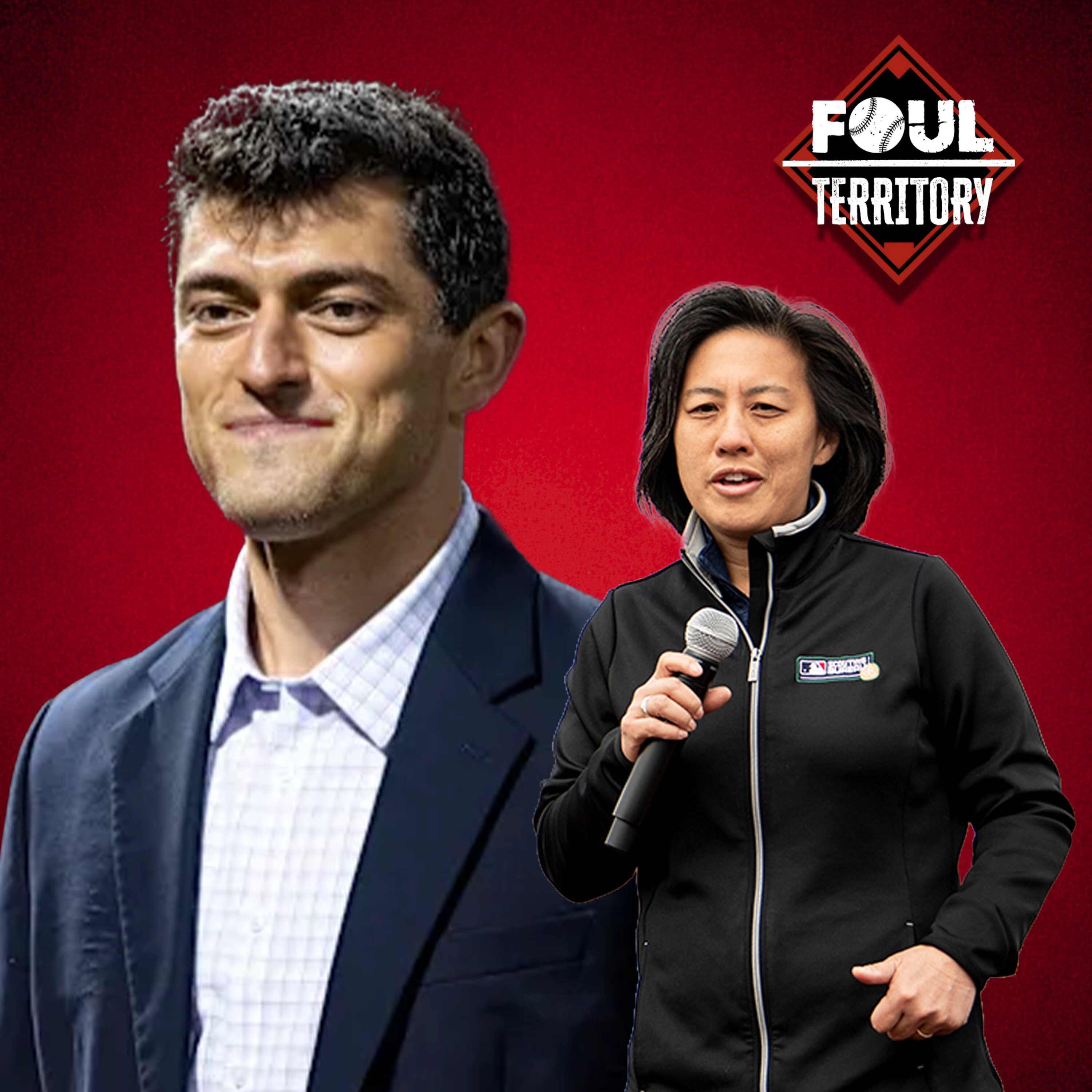
Cardinals POBO Chaim Bloom joins FT, Kim Ng & Sierra Romero talk AUSL
Will the Cardinals keep moving their vets to continue a lil rebuild action? We ask new Cardinals POBO Chaim Bloom about trade rumors surrounding Brendan Donovan and others, expectations in 2026, and we revisits the Mookie Betts trade.
(7:23) AUSL Commissioner and former MLB GM Kim Ng along with Volts softball star Sierra Romero hop on to discuss the AUSL and how the league can be a game changer for future softball stars.
Hosts: AJ Pierzynski, Erik Kratz, Scott Braun
See omnystudio.com/listener for privacy information.
2025-12-14
21 min
Transcript
Available Results
Generated results are saved to the knowledge database for reuse and search.
No generated results are available for this episode yet.
Extract Knowledge
Pick what you want extracted first. Model, scope, and chapter options appear after a template is selected.
Generated results for public episodes are saved to the knowledge database so they can be reused and searched later.
Transcript
00:00:08
Speaker 1: Hey, it's the sweet life.

00:00:09
Speaker 2: It is time for heim Bloom to join the show right now, and it is time for him to take over the Cardinals front office, which is what he's been doing now this offseason.

00:00:17
Speaker 1: Great to see you.

00:00:19
Speaker 2: I feel like it's like you're back in the wild again. Does it feel that way?

00:00:24
Speaker 1: It does?

00:00:24
Speaker 3: Yeah, yeah, a little less time, yeah, a little tougher work life balance, and we don't have a time in the segment.

00:00:37
Speaker 1: So I want to get right to the go here.

00:00:38
Speaker 4: But here, here's my thing.

00:00:39
Speaker 5: So I saw you two years ago in spring training, right after you had got hired by the Cardinals, and I see you. I thought I was only in the laundry room. Maybe you're washing your own underwear. It was crazy, and I asked, hey, come come out and talk to us, and You're like, I'm behind the scenes guy now right, So now there's no more behind the scenes.

00:00:57
Speaker 4: Now again you're the face.

00:00:58
Speaker 1: We're making up for lost time. Well, it's good to be back. Okay.

00:01:03
Speaker 2: So what are we talking about here at the winter meetings? Do you think that there's a next step here coming soon for your team as you guys go through this transition period. Sonny Gray was the first, you know, as you've been asked a billion times already, Wilson, Contreris, Brendan Donovan, where are we at.

00:01:19
Speaker 6: Yeah, well, we have nothing up our sleeves ready to drop at this particular moment. But you know, when you're here, everything's a phone call away. Look, you know, we've been I think maybe more than usual. There's obviously a lot of phone calls, just because we've tried to be very clear publicly about what our goals are and then if that involves hard decisions in the short term to build this thing to where we can be in position to win this division and keep doing it, We're going to make those hard decisions. We're fortunate to have a lot of good players here, and so when you have that, there's going to be interest in those guys.

00:01:51
Speaker 1: My job is to listen.

00:01:52
Speaker 6: I think, especially in the first winter in this job, it's really important to have your ears open and just understand how the league sees our team, our players, and at the same time, we're hunting players from other clubs that we feel can be part of this core that we like and seeing if we can match up.

00:02:08
Speaker 7: Is it just gonna be twenty twenty all over again? Minus COVID. But when you were with the Red Sox, you went twenty twenty. You guys stunk. It was a COVID season. Whatever. Jad Martinez didn't hit twenty one. We were in the playoffs. So is that the route? Because it's worked, and because now you can look at the Red Sox and go, oh, yeah, him did that. He built this, He built this metric, He built it. You know, he built this group around these people. Are you just gonna kind of recycle it? And is that what Cardinal fans can expect or hope not expect?

00:02:42
Speaker 6: Hope for well sandwiched around maybe some other comments. There were some very kind words there about the work with the Red Sox, which I appreciate. Look, we're never going to go into a season conceding anything. Obviously, when you have the goals that we have, you're gonna make moves accordingly. That may lead to some short term sacrifices, and you know, sometimes you are going to pay the price in the short term for those sacrifices. But I think one thing that's really important anytime you're doing something like this, especially in an organization like this. This organization historically has really made its name on dominating details, and on holding a really high standard. So regardless of what we're doing from a strategic standpoint, we're going to hold a really high standard every day in terms of what we expect from ourselves, how we work, whatever's on our plate that day, what we bring to that job, and also what we expect of our players. So I would love to get to those heights without going through as deep of a valley. We're not going to try to make compromises on our plan to avoid going into that valley. But I think we have a lot of good young talent here. Part of the reason we're doing this is because we just want more young talent so we can really build a core that we can sustain. And I am optimistic that regardless of what this winner holds, you know that talent is going to show through in a lot of different ways over the course of the season. And actually, you know, sometimes you know, you cite the Boston Time as an example, there were a lot of ways that we leaned into that project. I'm not going to sit here and tell you we did it perfectly, but we leaned into that project in ways that when we did that, not only was the long term payoff there as we've seen, you know, in recent months. But sometimes we read benefits in the short term because we were willing to make those hard decisions and willing to make those sacrifices, and the baseball gods will sometimes reward you for that. So we are going to be focused on our goals. But I think the more steadfastly we focus on them, the more we stand to realize some benefits in the short term with young players who can surprise you, you know, contributions coming from places you might not have seen, and hopefully it all adds up to us having a lot of fun on the way to getting where we want to go.

00:04:44
Speaker 5: Okay, so you're going to make lots of trade with the Red Sox because you know all the players, you drafted them all.

00:04:48
Speaker 4: So we got that down.

00:04:51
Speaker 5: How hard is it because you come into a new job, like when you went to the Red Sox, the first thing you were told, I got to trade Mooki bets and you're the guy everyone's like, hind bloom trade of Mooki bets.

00:05:00
Speaker 4: But you were told to do that, right. So now you come to Saint Louis and.

00:05:03
Speaker 5: Like you, Donovan Arnatto, you already traded Sonny Gray possibly Contreras.

00:05:08
Speaker 4: Dude, when are you gonna get to just run a team and not have to make all.

00:05:11
Speaker 1: These crazy moves? You know what you have to do, what you have to do.

00:05:18
Speaker 4: I know, my gosh, dang, I just want you to get a chance to not have to do all this stuff.

00:05:21
Speaker 2: For that other one was brutal, though, Hey, welcome to the party. Mookie Bets like is a freaking legendary Hall of Famer. You have to trade him, you know what?

00:05:28
Speaker 6: Was funny? Look, I don't want to really rehash too much about that. You know, we probably should probably be at a later hour at a bar or something like that. We're going to do that.

00:05:38
Speaker 1: Actually we did.

00:05:39
Speaker 4: Told Star and you said you coming, and now he's not Tea.

00:05:43
Speaker 6: But uh, that one we could rehash that maybe later tonight, but I hope we're too busy to do that. Look, it's actually funny with with that deal. So my my boys like love baseball, and now they're old enough they really follow this very closely. They're way worse than anybody in the media in terms of how hard they are at me. And they were young enough when that happened that they weren't really aware of it. And now my oldest who's just locked in on all this stuff, realize last year that I traded Mookie back.

00:06:11
Speaker 8: Oh no, and he was just He's like, Dad, what are you doing. It's like, it's a long story. Yeah, look for me.

00:06:22
Speaker 6: Obviously, again, sometimes there are hard decisions you have to make in the here and now. If you're not ready to make those, then this is not the business for you. There's also a lot of really good things happened in the organization that are energizing every day in terms of taking our young players getting the most out of them, not even just our young players, like player development should never stop, even in the big leagues, even with veterans. If there's anything the last five ten years in this game should teach us, it's that there's always pathways to improvement for any player, any team, any organization. It is awesome every day to get a chance to wake up and say, how can we get better today? How can I help all the talented people that we have get us better today? And there's so many pathways to do that. We have a lot of really good young talents, some of it's on our team, some of it's coming and so it's it. You don't have to squint that much to really be able to dream big about what a lot of these guys can do. Our job with that is to keep our feet on the ground, stay realistic about what it's going to take to get there, and help these guys see it for themselves so that they can't.

00:07:22
Speaker 4: I love it.

00:07:23
Speaker 2: Hey, we're back ft live in Orlando, and we have two guests joining us now, so athletes Unlimited Softball League is what you should know about. And the commissioners Kim and you know that name, longtime baseball executive Kim.

00:07:37
Speaker 1: Great to see you.

00:07:38
Speaker 2: And then also we've got four on the set here, plus Aroscraft who will ask some questions to Sarah Romero is a star in the league, joining us here.

00:07:45
Speaker 1: Sierra, thanks for joining us as well. Thank you, Kim. Great to see you. How are you?

00:07:49
Speaker 9: Oh good?

00:07:50
Speaker 4: Thanks?

00:07:50
Speaker 9: Thanks for having us.

00:07:51
Speaker 2: Of course I'm gonna let you got.

00:08:01
Speaker 1: It's going right right in.

00:08:05
Speaker 4: Yesterday but.

00:08:09
Speaker 1: Oh yeah, you forgot your mic fell off there.

00:08:12
Speaker 10: Yeah, so before I've been banging this drama, there's other people I thought you could get into the voting for. I know you're not going to take us through it, but how hard was where I don't know how hard was how incredible?

00:08:28
Speaker 9: It's incredibly hard. This is my second time I've done it.

00:08:31
Speaker 11: And listen, this ballot was there were so many good players on the right, and so you're trying to make great decisions. You know, we just didn't get the votes for some that I'm sure other people wanted. But it's, uh, it's it's a crazy process.

00:08:51
Speaker 4: It's a good process.

00:08:54
Speaker 5: Is it like going there and you guys just throw up a steel cage and then whoever wants their vote, they just you got kind of rumble until one winner comes out something like that.

00:09:07
Speaker 1: Oh, go ahead, Cratz.

00:09:10
Speaker 7: No, I just I just really first, Ken, I'm so glad. Are you able to hear me?

00:09:16
Speaker 9: Yeah?

00:09:16
Speaker 7: Faintly, Okay, I'm glad you're I'm glad you're able to come on here. And when you have, did you when you became the commissioner of the league, did you say I want to name it something different because everybody thinks commissioner of Baseball, they think Rob Manford, and they're like, when I think of Kim Hang, I don't think of Rob Manford. I think it's something way different. Are you handling that position? Differently than say what you saw Rob do in your time in Major League Baseball.

00:09:45
Speaker 11: I think some of the responsibilities are different. You know, clearly major League Baseball has been in existence for one hundred plus years and so our issues probably aren't the same. But there's a lot to get off the ground, you know. There there are number of things that I learned from both of the commissioners that I worked for, So you know, it's really just about trying to do, you know, use all of my skills and experience from my thirty plus career and put that to good use for the for the women here.

00:10:16
Speaker 5: All right, now we'll get to the softball Sierra Michigan. Sorry, I'm not a Michigan fan.

00:10:22
Speaker 7: I'm not a.

00:10:22
Speaker 5: Michigan person, not a Big ten person. I'm an SEC guide.

00:10:25
Speaker 1: What though played Midwest?

00:10:28
Speaker 5: Yeah, I mean just because I played there. It's like Notre Dame. See you you're out stop crying, go to your bowl game.

00:10:34
Speaker 4: But how is Michigan good in softball?

00:10:38
Speaker 9: How are they?

00:10:38
Speaker 1: Yeah?

00:10:38
Speaker 4: Because they've been good for a long time.

00:10:41
Speaker 12: The Michigan softball is I feel like, you know, it's one of those programs, you know, especially after being under Carol Hutchins a legend in the softball world in general. She left the program in really good hands when she retired. And you know, now Bonnie's there, you got Jen Brundage, you got Manda Chittister. You have these really big names in the softball world to keep the tradition going. And that's what Michigan softball is all about, is that tradition.

00:11:06
Speaker 4: And then how do you transition to professional softball.

00:11:09
Speaker 12: I think they prepped me. I mean they prepped me with knowing what it took when it comes to hard work, with dedication, when doing the things you don't want to do because you know you have to. I think, like every pro baseball softball player knows, you don't always want to work out, you don't always want to max out and do all the lifts and do all the things. And for me, it was an easy transition because I already knew what it took. But I definitely think the speed of the game is what took the most getting used to. I feel like it's probably the same, you know, going from college baseball to MLB, it's a lot faster. You're playing with grown women. You're playing now with women that are established who know how to throw who know who are so smarter on the mounds. They know how to read certain things mid game and make changes like that and kind of play with you a little bit, you know, mess with your head, and it's just a different beast. And so it's it's a lot of fun to play that back and forth game of Okay, you got me there, but hey, I'm not going to let you beat me next time up and in or on that change up in that count. So it's a lot of fun.

00:12:03
Speaker 7: Sierra, my daughter's thirteen years old. She wants to know where can this league go? I mean, it's a fledgling league right now. She's thirteen. She obviously has to go through high school. She wants to play in college. Where can this league go? Because if it goes to where you want it to go, you'll be known as one of the pioneers to push the league to that point.

00:12:28
Speaker 12: I mean, I think with the backing of the MLB, we are in very good hands. I think of all the other women's pro leagues and how once they had the backing of their male counterparts, it just blew up. We got the fans from that league. We also just got more eyes on it in general, and I think that this league is here to stay. I've been a part of a lot of pro leagues in my career, and unfortunately they all folded and they just there was nothing there for us. And so for us, our career has always felt unsure and we've always been a little bit uneasy. And that's not how we feel anymore. Now it's here to stay. This is my career. I feel more confident saying I'm a professional softball player. I love that now when I say it, the answer isn't always oh, I didn't even know there was a pro league. Now it's oh, wow, yeah, are you what team are you on? You know, I saw a lot of it's I saw the talents win. Unfortunately, I'm not on the talents. I did not win last season, but I'm on the bolts, and so it's cool to see that these players and these fans they're paying attention, they're looking at us, and they're seeing what we're doing, and they like what they see.

00:13:26
Speaker 4: All right, So, Kim, how do you scout?

00:13:30
Speaker 5: Because you're your baseball background, So how does the scouting go to find players like Sierra?

00:13:36
Speaker 4: How do you find the players?

00:13:38
Speaker 11: So our general managers and head coaches are a big part of that process. You know, some of them still are collegiate coaches, so they have that in their pockets, and so it's it's easy for them to you know, to understand who's out there. And then the others who are not necessarily part of the NCAA collegiate world, they're just doing it off of tv PM and you know a lot of word of mouth as well.

00:14:04
Speaker 4: Awesome, awesome.

00:14:04
Speaker 5: So I when I was with the Giants in two thousand and four, we had a guy named Barry Bonds on the team, okay, and they brought in Jenny Finch.

00:14:12
Speaker 4: This is when she was going around and she was pitching to.

00:14:15
Speaker 5: Everybody and I got to catch her, and Barry Bond stood him, but he wouldn't swing because he said, I doesn't want to hurt her. Now I got to catch Jenny Finch and she was the biggest thing in softball at the time, and she was every pitch I thought she threw. I was like, okay, I could see this one, but the rise ball right, So I'm I and I know she struck out like pool holes and all these guys, right.

00:14:34
Speaker 4: I didn't want it to back because I would have punched out.

00:14:37
Speaker 5: How good because I would have loved to have seen Barry tried to hit it, because if he would have struck out, have been the greatest.

00:14:42
Speaker 4: Thing ever for softball.

00:14:43
Speaker 5: But how good are the players? Because I watch it on TV and I love it. I think it's great. Did the cheering in the dugout everything that you guys do? I love it, like especially in college, and I can now have to tune into the pro league.

00:14:54
Speaker 4: But how good are the players?

00:14:56
Speaker 12: I mean, these players are elate, They're everybody. Everyone wants to beat everyone. We are all extremely competitive. We may be friends outside of the softball field, but when we are playing against each other, we want to beat each other and we want to beat each other bad every single game. You know, the competitiveness is there. Everybody is working day in and day out to be the best and to be the top athlete in the league. And you'll see it when we play.

00:15:19
Speaker 4: Like, what's the hardest pitch for you to hit?

00:15:20
Speaker 9: For me?

00:15:21
Speaker 1: They're all easy.

00:15:22
Speaker 4: They're all easy.

00:15:24
Speaker 7: I like it.

00:15:25
Speaker 4: I love it.

00:15:27
Speaker 12: Hardest pitch the rise ball when I swing at it.

00:15:30
Speaker 4: But how do you not swing? I don't know, Crouchy, your daughter practice. Watch it again.

00:15:35
Speaker 5: When I was catching it, she was telling me is coming in with and for a baseball player, because everything goes down down, down right. But she'd throw that ball that would start at your knees and would end up at your chest. How do you not swing that? Because when it comes out of her hand, you're like, oh, that's a strike. I'm going to crush that, and the next thing you know, it's over your head.

00:15:49
Speaker 12: I mean, the biggest adjustment is you're trying to meet the ball where you think it's going to end up. The really good rise ball pitchers they can change the level at which the rise ball crosses the strike zone. So you might have some who throws one out of the zone, but the next time she might say, you know what, actually, I want to throw this one for a strike now. So it's really about meeting the ball where you think it's going to land, making sure you're flat to the ball. You can't be underneath it. You're gonna pop it up or you're gonna swing and miss. So definitely trying to come at the ball level or think to almost miss above it. Since the ball is going to continue to rise, it's just like a little trick you play on your brain. You're like, Okay, I'm trying to miss above the ball, but really you're going to be flat and barrel it up. But you got to really try to make sure you're meeting it where you think it's about to end up.

00:16:30
Speaker 7: Sierra Siah, this is my opportunity. Sometimes in life you have to ask quite. I have arguments with my dad. My dad teaches fast pitch softball. He pitched fast pitch for forty years. A riser true or false, does not technically rise. It's the spin that keeps it on plane and so it has that late life effect correct or not correct? Oh, it's rising, But analytically when you have it on track, man, does it technically.

00:17:00
Speaker 9: Rise on track?

00:17:01
Speaker 4: Man?

00:17:01
Speaker 12: I don't think that it.

00:17:02
Speaker 9: I don't know that.

00:17:03
Speaker 12: It shows that I can't speak, So I'm not a picture who's gonna check the analytics on that. I could ask Montana for you. But as a hitter, it is jumping. It's definitely jumping. It's one of those things. As a hitter, you're definitely reading the spin because that's how I know where I'm trying to get my barrel to end up. When it comes to the contact point. But I mean when I look back after I've swung and miss, when I usually swing at those, it's definitely much higher than I thought it was when it was coming through the zone.

00:17:33
Speaker 7: All Right. One of the other things you said was or Aj even said it. And it's one of my favorite times a year when the College World Series, the women's College World Series is on. I love watching it. It is on our TV as love as there's games. It's on. My daughter and I get to watch it. She leaves, I still get to watch it. Can you girls take the same energy that we see in that college game to pro because if you can, to me, I think you're ahead of major league baseball in that sense, because I think we lose some of that energy and like amateur amateur fire that the college game creates is lost than in the big leagues, even in the minor leagues and then into the big leagues.

00:18:19
Speaker 12: Personally, I think it's already there. I think that if if you're a fan, or if you're just curious about like what you just asked, show up to a game, Show up to a game and you'll see it, you know. I think about when we played this past season, we played in Round Rock versus the Bandits, and we had over six thousand fans there and you know, Bandits were we're beating us. But that was a very hype game. There was a lot of a lot of emotion. There's a lot of great plays. We celebrate every little thing throughout the game. It doesn't matter if you made you know, ordinary, you know, everyday type of play, or you do some type of Jeter throw. Everybody's going to celebrate it the same because we know how hard it is to make those simple plays. And for us, playing fiery and being that like fierce competitor is something we truly enjoy doing. And I think that you'll see that at every single game because we're really competitive.

00:19:08
Speaker 9: We want to win.

00:19:09
Speaker 12: We all know each other, we've all played against each other for a long time growing up, so I think that there's a lot there with wanting to beat each other. It's just very competitive and very fast paced too, which makes it all the more fun.

00:19:20
Speaker 7: Kim, I got a question from you. This is for you from a mutual friend, Okay, and the question is, Okay, what kind of player were you like when you played softball? And the question also said he said your college team University of Chicago. Do I have that correct?

00:19:40
Speaker 4: Yes?

00:19:41
Speaker 7: How good were you guys.

00:19:44
Speaker 9: When we had pitching? We were okay?

00:19:47
Speaker 4: Is that every team?

00:19:50
Speaker 9: My last two years we didn't have pitching. We were not so good.

00:19:54
Speaker 11: I was, you know, I was a fiery player, tons of home runs, big power.

00:20:00
Speaker 4: He's like a you're a slapper, right slapper.

00:20:03
Speaker 9: I was not a slap.

00:20:04
Speaker 4: We were not a slapper.

00:20:05
Speaker 11: Gap power tools, gap power line drive. Hitter had some speed played. I played all the infield positions, but I would say scrappy.

00:20:14
Speaker 5: Okay before before I win his opening day for the for the lead June night, it's on ESPN.

00:20:20
Speaker 9: We we have so we just signed a three year deal with the.

00:20:23
Speaker 4: ESPN's so awesome.

00:20:25
Speaker 11: Fifty games that are going to be on this season. Our championship game, one of our championship series is going to be on ABC for I love pretty exciting.

00:20:35
Speaker 5: I love it. I can't wait. And then before we let s hear I go. Will the SEC never not win another softball championship?

00:20:41
Speaker 4: Between Oklahoma and Texas Florida?

00:20:44
Speaker 5: Will the SEC never not win another National Softball championship?

00:20:48
Speaker 12: Well, since Oklahoma decided to grace you guys with their presence. I think you're in good.

00:20:52
Speaker 1: Hands now, you're good, you're clear. Well, thank you both for stopping by. Yeah, we'll look forward.

00:21:00
Speaker 4: I can't wait.

00:21:00
Speaker 2: Super we'll make sure yet we talk about it and all that too, So enjoy the rest of the Winter meetings.
Chapters
No chapters available.