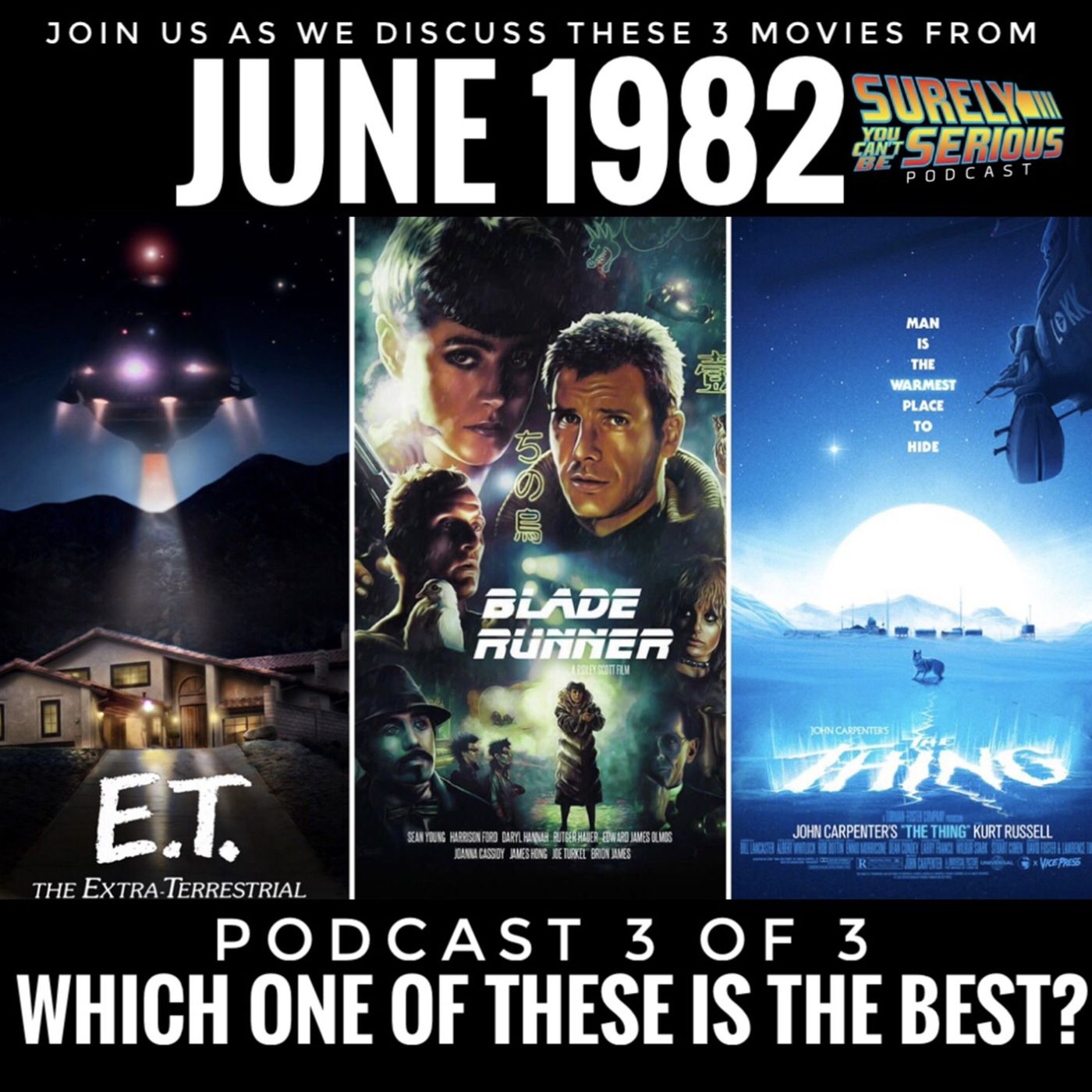
Blade Runner (1982) vs. The Thing (1982) vs. E.T. (1982): Part 3
Join us this week for our epic conclusion as we finish our comparison of three classics released in June of 1982. This week we discuss the big questions! Is Deckard a replicant? Which of the remaining guys is "The Thing"? Why are there so many versions of Blade Runner? Is E.T. a Jedi? We tackle these fun questions and offer our own final judgment! Grab your Reeses Pieces and Beeeeee Goooood!
2022-06-14
76 min
Transcript
Available Results
Generated results are saved to the knowledge database for reuse and search.
No generated results are available for this episode yet.
Extract Knowledge
Pick what you want extracted first. Model, scope, and chapter options appear after a template is selected.
Generated results for public episodes are saved to the knowledge database so they can be reused and searched later.
Transcript
<v Speaker 1>This is a podcast from Minute Media.
<v Speaker 2>Hello everybody, and welcome back to the Shirley You Can't
<v Speaker 2>Be Serious Podcast. The Epic Conclusion Part three et versus
<v Speaker 2>The Thing versus.
<v Speaker 3>Blade Runner Shirley fans, Jason and I have spent the
<v Speaker 3>day making origami, playing E T on the Atari, and
<v Speaker 3>drinking J and B whiskey.
<v Speaker 2>That will get us prepared for this epic conclusion and
<v Speaker 2>he won et cheating. That is not true. The FBI
<v Speaker 2>guy got me every time.
<v Speaker 3>Okay, Before we get roll on this awesome episode, Part three,
<v Speaker 3>Kapper of our epic three part series on these awesome movies,
<v Speaker 3>I got to give a shout out to the thirty
<v Speaker 3>something meter movie podcast guys. They are killing it over there.
<v Speaker 3>They're doing such a good job. This week they came
<v Speaker 3>out with their Encino Man episode, which is one of
<v Speaker 3>my favorites. And it also stars, as you noted in
<v Speaker 3>one of our last episodes, mister Richard Masser, who plays
<v Speaker 3>Clark in The Thing.
<v Speaker 2>That's right.
<v Speaker 3>It does, yeah, and it also involves whizzing the juice.
<v Speaker 2>Hey, weezing the Jews. There'd be the juice. The cheese
<v Speaker 2>is old and moldy. All right, Well, let's dive in, man,
<v Speaker 2>get ready to pass the final.
<v Speaker 3>Here, you're you're ready to bring up Okay, well, we
<v Speaker 3>are going to talk about some kind of big, amazing
<v Speaker 3>ideas in the movie. Before we jump into that, let's
<v Speaker 3>talk about the fact that these are three special effects
<v Speaker 3>amaze ball movies. Yeah right, I mean the Thing, of course,
<v Speaker 3>because it's a horror movie and so you're going to
<v Speaker 3>have the extra special effects. But the things that are
<v Speaker 3>going on with the scenery, and the blade Runner, and
<v Speaker 3>the animatronics that are going on with et these are
<v Speaker 3>things worth noting. As a matter of fact. They're not
<v Speaker 3>only worth noting, there are things that we could probably
<v Speaker 3>spend an entire episode on for each movie. So I'm sorry, listeners,
<v Speaker 3>we are not going to go as deep and in
<v Speaker 3>depth as we normally would on these things, but we've
<v Speaker 3>got to at least touch base on these.
<v Speaker 2>Yeah, let's do it. Yeah, okay, So.
<v Speaker 3>Let's start with the thing again, as we it seems
<v Speaker 3>to lead out every time. We've got Rob Boteen, who
<v Speaker 3>we've mentioned before. Now, he just before this had done
<v Speaker 3>the fog, yes, and he had also done.
<v Speaker 2>The howling, oh, the hewling. That's right.
<v Speaker 3>Yeah, nineteen eighty one, be sure and check out our
<v Speaker 3>the Howling versus American Werewolf in London episodes.
<v Speaker 2>Those were great episodes. That was the a movie that
<v Speaker 2>he turned De Wallace into an ewok.
<v Speaker 3>Yes, yes, right, and so he did some incredible, incredible
<v Speaker 3>stuff with this. He had met John Carpenter when he
<v Speaker 3>was like twenty one and wanted to work with him,
<v Speaker 3>ended up getting a part in The Fog. Yes, And
<v Speaker 3>so we're going to talk about those in just a second.
<v Speaker 3>But I also got to mention a couple other guys.
<v Speaker 3>Number One, you got Albert Whitlock. He was the Matt artist.
<v Speaker 3>So those scenes where you're seeing the spaceship and the snow,
<v Speaker 3>those are painted no CGI back in nineteen eighty two,
<v Speaker 3>mind blowing. They would have the guys go stand on
<v Speaker 3>like you know, sheets on the ground out in the grass,
<v Speaker 3>filmed them and then Albert Whitlock would go in and
<v Speaker 3>paint over them. Now, Albert Whitlock is a guy who
<v Speaker 3>was the guy to go to, starting with Alfred Hitchcock,
<v Speaker 3>like Olver Hitchcock Houston for virtually all of his movies.
<v Speaker 3>But let me throw out some others that he was
<v Speaker 3>involved in. Okay, he was involved with Dune, which would
<v Speaker 3>come up just a bit later as Ridley Scott was
<v Speaker 3>almost the.
<v Speaker 2>Director, almost directed Dune.
<v Speaker 3>He did Never Ending Story too. I did Grimlins two.
<v Speaker 3>He did Coming to America, which is you know one
<v Speaker 3>we've covered before, but you get those Africa scenes. That's
<v Speaker 3>Albert Whitlock who painted those. Wow. And he did the
<v Speaker 3>Best Little Whorehouse in Texas.
<v Speaker 2>The movie that had the sign out front that WELLcom
<v Speaker 2>Kurt Russell and John Carpenter to the movie studio when
<v Speaker 2>they were shooting the thing.
<v Speaker 3>Yes, and if I can tie in just one more
<v Speaker 3>episode of ours. He also did Spaceballs.
<v Speaker 2>Wow.
<v Speaker 3>Yeah, So he's an icon, Roboteen's icon. And then of
<v Speaker 3>course Roboteen had to have some animatronics involved with his
<v Speaker 3>special effects. And who did they have Stan Winston?
<v Speaker 2>That's right, they did. I did see that.
<v Speaker 3>So Stan Winston we talked about him on our Jurassic
<v Speaker 3>Park episode. He is another icon in the field involved
<v Speaker 3>with Star Wars and a million other animatronics style movies
<v Speaker 3>of the eighties.
<v Speaker 2>The stuff that is done on the monster special effects
<v Speaker 2>and the thing super fascinating.
<v Speaker 3>Right.
<v Speaker 2>So there is a scene where the chest cavity opens
<v Speaker 2>up and this little flower like thing comes out. Well,
<v Speaker 2>that flower is made up of dog tongues.
<v Speaker 3>Yeah, if you'll remember it, because it looks like the
<v Speaker 3>Little Shop of Horrors Venus like.
<v Speaker 2>It really does, right, feed me Seymour yeah.
<v Speaker 3>Or if you're a Stranger Things fan, it kind of
<v Speaker 3>looks like the dog demon things on Stranger Things, right.
<v Speaker 3>John Carpenter had sent Rob botein down. They had a
<v Speaker 3>comic book artist there at the studio. They both work
<v Speaker 3>together designing these things, just in kind of picture format
<v Speaker 3>to start with, and then Rob botem go in and
<v Speaker 3>create these characters. Stan Winston came in and he's like, Okay, well,
<v Speaker 3>you know it's going to be hard to do animatronics
<v Speaker 3>on this, but if you've gotten no real definition on
<v Speaker 3>the way it's formed, if you can just mold around
<v Speaker 3>my arm, I could just work it like a puppet. Yeah.
<v Speaker 3>And so a lot of the dog mouth action that
<v Speaker 3>you see, I mean that's literally a guy's arm in
<v Speaker 3>a puppet making that happen. You know.
<v Speaker 2>One of the effects that's really stunning to me, and
<v Speaker 2>I still don't really understand how they did it. But
<v Speaker 2>when the thing breaks open and all that like spaghetti
<v Speaker 2>like stuff is started whipping around. That creeped me out
<v Speaker 2>to no end. Man, that stuff is disgusting.
<v Speaker 3>So in that scene, there are a couple of things
<v Speaker 3>going on. Number One, he was making stuff up as
<v Speaker 3>he went. And so at one point when they're filming
<v Speaker 3>that scene, they've got all these chemicals there that have
<v Speaker 3>been flying around and shooting out and doing all this
<v Speaker 3>other stuff, and suddenly John Carpenter's like, wait, wait, wait, wait,
<v Speaker 3>in this part of the scene, he's just shot a
<v Speaker 3>flame thrower right before this, and the thing's on fire.
<v Speaker 3>So I can't just shoot this with no fire. It's
<v Speaker 3>not going to be consistent. And so they're like okay.
<v Speaker 3>And I mean they've got guys under the table doing
<v Speaker 3>all these mechanics and stuff like that, so they're like, okay, well,
<v Speaker 3>let's set it on fire. Well, those chemicals they had
<v Speaker 3>been using had just been filling the room with flammable gas,
<v Speaker 3>and all of a sudden, it just goes like the
<v Speaker 3>whole room in gulfs and flames and these things that
<v Speaker 3>Rob Boutin had spent weeks and he slept at the studio,
<v Speaker 3>right and I mean he was exhausted. He had spent months.
<v Speaker 2>He hospitalized at the end of this.
<v Speaker 3>Yeah, I mean it was. And so he's this monumental
<v Speaker 3>effort and all of a sudden he just sees it
<v Speaker 3>burned to a crisp. Fortunately it wasn't completely destroyed and
<v Speaker 3>he could patch it back up. But yeah, So the
<v Speaker 3>part where the guy's arms get bitten off, you know,
<v Speaker 3>they've got that animatronic thing that opens up his chest, yes,
<v Speaker 3>and clamps stand on it. Well, the way that they
<v Speaker 3>did that is they had a guy who was an
<v Speaker 3>amputee come in and they made him fake arms out
<v Speaker 3>of jello and other stuff like that, so that whenever
<v Speaker 3>the chest clamps shut, he can pull his arms out
<v Speaker 3>of the fake arms. Right. And so, since you know
<v Speaker 3>the actor who's playing this part isn't an amputee, they
<v Speaker 3>were like, well, what do we do there? You're going
<v Speaker 3>to see his face. They made a fake face. They
<v Speaker 3>made like a wax face and put it on the
<v Speaker 3>amputees face, so that when you see him like thrashing
<v Speaker 3>around with no arms, it's the guy is wearing a mask.
<v Speaker 2>Really, that's cool. Hey, I did see something that was
<v Speaker 2>really funny to me. They used a ton of ky jelly, right,
<v Speaker 2>who doesn't They used a ton of kyjilly and it
<v Speaker 2>makes everything look super slimy and slick and all that stuff. Yeah,
<v Speaker 2>and one of the guys I heard marveling was he's like,
<v Speaker 2>we bought this in fifty five gallon drums. He goes,
<v Speaker 2>who needs fifty five gallon drums of ky jelly? You know,
<v Speaker 2>it's crazy, that's funny.
<v Speaker 3>Okay, let's jump over to Blade Runner. So in Blade
<v Speaker 3>Runner there's not as many special effects per se. You
<v Speaker 3>don't have a lot of core going on, you don't
<v Speaker 3>have a lot of weird stuff. What you have is
<v Speaker 3>some of the most amazing scenery I've ever seen in
<v Speaker 3>any movie in my life. We talked about how Ridley
<v Speaker 3>Scott wanted to use the Bradberry and they're like, no,
<v Speaker 3>everybody uses the Bradberry. He's like, not the way I'm
<v Speaker 3>going to do it right. Well, the entire thing is
<v Speaker 3>like that, and it all comes from this artist named
<v Speaker 3>Sid Mead, And Dude, I looked at this guy's life.
<v Speaker 3>Holy smokes. I mean, he's just he is a god
<v Speaker 3>among men. I mean, he just He worked for car
<v Speaker 3>design companies, he worked for building design companies. He was
<v Speaker 3>doing movie after movie. He did Tron at the same time,
<v Speaker 3>as he was doing he's designing, like he's drawing these
<v Speaker 3>city scapes, he's doing all of that stuff in his
<v Speaker 3>art work is just amazing. This is what he used
<v Speaker 3>for inspiration. Hong Kong on a very Bad Day and
<v Speaker 3>Nighthawks by Edward Hopper. Those were his kind of instegrational points.
<v Speaker 3>And I think that's probably one of the most amazing
<v Speaker 3>features about Blade Runner, is the way that they put
<v Speaker 3>you in this future world and you buy in. I mean,
<v Speaker 3>when I'm watching it, I'm not thinking to myself, well,
<v Speaker 3>that's fake. That wouldn't really it, right. It all is
<v Speaker 3>stuff that you're just like, Oh, I can completely see
<v Speaker 3>this as our dystopian future.
<v Speaker 2>Absolutely. One of the possible futures that they proposed in
<v Speaker 2>nineteen eighty two was this idea that Los Angeles and
<v Speaker 2>San Francisco would grow together as one giant urban area, huh,
<v Speaker 2>and that you would have this sort of street language
<v Speaker 2>that included like Japanese and English. There's actually some Chinese lettering.
<v Speaker 2>This is how detailed they got.
<v Speaker 3>Yeah.
<v Speaker 2>I don't speak Chinese, but apparently it says Asian's good,
<v Speaker 2>Americans bad or something like that. All they steered away
<v Speaker 2>from that one big urban area. But Demolition Man picked
<v Speaker 2>that up, idea up and ran with that a little bit.
<v Speaker 3>Yeah, and they did a great job of taking Sidmead's
<v Speaker 3>paintings and bringing him to life. And the guys that
<v Speaker 3>did that, that was Douglas Trumbull that I talked about
<v Speaker 3>in our last episode, who was kind of the man
<v Speaker 3>as far as those set designs go. And then we
<v Speaker 3>have et kaya swear.
<v Speaker 2>It one more time. I have that some absolute power.
<v Speaker 3>The biggest effect on ET is E T. Right, so
<v Speaker 3>you've got the creature of e T. He was created
<v Speaker 3>by Carlo Rumbaldi. Okay, Carlo Rumbaldi also involved in Doune
<v Speaker 3>and the original Never Ending Story and he before this
<v Speaker 3>movie he did the alien head an alien Yeah, like
<v Speaker 3>the effects where the mouth would come out. That was
<v Speaker 3>Carlo Rumbaldi. And he also did the alien effects on
<v Speaker 3>Close Encounters. Okay. After this movie he did a ton
<v Speaker 3>of movies. But one of them was the Werewolf suit
<v Speaker 3>in Silver Bowl.
<v Speaker 2>Oh nice.
<v Speaker 3>Did you see the seventy six version of King Kong?
<v Speaker 3>I have he did that one? He did King Kong
<v Speaker 3>as well. Yeah, he's another icon of the We've got
<v Speaker 3>icon after icon. The Matt paintings for this movie were
<v Speaker 3>done through ILM and as Christopher Evans, who was like
<v Speaker 3>the chief of Matt paintings for them. You get the
<v Speaker 3>spaceship animation and that sort of thing, but really, this
<v Speaker 3>isn't a movie that's super full of these special effects
<v Speaker 3>except for the Et, and the Et creature was something
<v Speaker 3>I was looking at the operators. I counted at least
<v Speaker 3>seven different operators on the and obviously they're doing it
<v Speaker 3>at different times. They had different suits that they used,
<v Speaker 3>but Carlo Rombaldi's design looks very similar to another thing
<v Speaker 3>that we've talked about just a bit before that. I
<v Speaker 3>wanted to get in a little bit more detail about. Okay,
<v Speaker 3>you ready for this?
<v Speaker 2>Yeah?
<v Speaker 3>Sure, okay, So here I am. I'm looking at the
<v Speaker 3>biggest special effects science fiction movies of nineteen eighty two
<v Speaker 3>and probably conceivably of all time. And there's a name
<v Speaker 3>that's missing. Okay, it's Rick freakin Baker. Where is Rick Baker?
<v Speaker 3>I can't. I'm like, Okay, Well, he did Ghost Story
<v Speaker 3>before this, and he did some other like Videodrome after this.
<v Speaker 3>What was he doing in nineteen eighty was he on vacation?
<v Speaker 3>I'm looking I can't figure it out. Why wouldn't you
<v Speaker 3>have Rick Baker? Right, why wouldn't you have Rick Baker
<v Speaker 3>involved and in some capacity in one of these movies?
<v Speaker 3>Let me tell you why. Okay, so you talked about
<v Speaker 3>in our first part of this series, Night Skies. Yes, so,
<v Speaker 3>Night Skies was this script that was written by John
<v Speaker 3>Sales that ended up spawning Poulter, Guys, E T and
<v Speaker 3>Grimlin's the movie right.
<v Speaker 2>Right, Yeah, that's correct.
<v Speaker 3>And so the way it was originally written, instead of
<v Speaker 3>Grimlins being the creatures that were running around creating havoc,
<v Speaker 3>it was little aliens like et running around creating the havoc.
<v Speaker 3>And I think you listed off some names last time.
<v Speaker 2>Yeah, Squid and there's Squirt and Scar yeah something like that, right, yep,
<v Speaker 2>Well here's what happened.
<v Speaker 3>Okay. Spielberg thinks he's going to be making this movie
<v Speaker 3>called Night Skies, right, and so he goes to the
<v Speaker 3>most logical guy, Rick Baker. Okay, Rick, I'm gonna make
<v Speaker 3>this movie. I've got lots of aliens that I need
<v Speaker 3>and you helped me out, and sir Rick Baker starts
<v Speaker 3>creating aliens, which they end up looking very similar to
<v Speaker 3>what we finally end up with with Et just a
<v Speaker 3>little rougher and tougher, but that same kind of style
<v Speaker 3>for sure. Okay, Well, then the movie changes and Spielberg's like, well,
<v Speaker 3>I'm not going to make one movie called night Skies.
<v Speaker 3>I'm going to make three movies, none of which are
<v Speaker 3>night Skies, right, and so hey, Rick, thanks for your trouble,
<v Speaker 3>but I'm going to not do this right. Well, Rick
<v Speaker 3>had spent seven hundred and fifty thousand dollars of his
<v Speaker 3>own money, not to mention all of the hours that
<v Speaker 3>he put in to build these things. And he's like,
<v Speaker 3>what you're just saying, No, We're just done. And that's
<v Speaker 3>just it. I mean, at the time, you could think, hey,
<v Speaker 3>this is Spielberg telling me he's going to do a movie.
<v Speaker 3>I can feel safe and secure in doing this, right.
<v Speaker 3>So it really pissed him off. Yeah, of course, and
<v Speaker 3>he's like, I'm never going to work with that guy
<v Speaker 3>ever again. And if you look, they have never done
<v Speaker 3>a mill Wow. So there it is. That's the answer
<v Speaker 3>to the question. I couldn't figure out. The reason Rick
<v Speaker 3>Baker wasn't doing this is because he had been spurned
<v Speaker 3>by Spielberg in trying to do something that ultimately was
<v Speaker 3>a precursor.
<v Speaker 2>I can't believe he stiff team on that, man, I know. Gosh.
<v Speaker 3>Okay, okay, you ready to talk deep questions.
<v Speaker 2>Let's talk about the big issues in these movies. Okay, ready, Yes,
<v Speaker 2>let's start with Blade Runner.
<v Speaker 3>Let's do it.
<v Speaker 2>So before we get to the biggest question, we have
<v Speaker 2>to ask ourselves. Why are there multiple versions of this movie?
<v Speaker 3>That's a good question. Okay. Yeah.
<v Speaker 2>In fact, I think you watched I watched the final
<v Speaker 2>You watch the final cut. I watched the director's cut. Okay,
<v Speaker 2>there's some differences between those two movies, right.
<v Speaker 3>I think the first time that I watched it, I
<v Speaker 3>didn't watch director's cut or final cut. I watched like
<v Speaker 3>the original version.
<v Speaker 2>Okay. So, just for those of you who are listening,
<v Speaker 2>I mean, there's the work print prototype, there was the
<v Speaker 2>San Diego sneak preview. There's the US theatrical release which
<v Speaker 2>people saw in theaters. There was an international release. There
<v Speaker 2>was of course the TV version. Then we have the
<v Speaker 2>director's cut. So this is the interesting one. The original
<v Speaker 2>theatrical release in nineteen eighty Twoerson Ford did some narration. No,
<v Speaker 2>because when they had screened it, test audiences didn't really
<v Speaker 2>understand what was happening.
<v Speaker 4>Skin jobs, that's what Bryant called replicants, and.
<v Speaker 2>So the studio said, you got to clarify for these
<v Speaker 2>dumb people, you got to tell them what's going on.
<v Speaker 2>And Harrison Ford is like, no, this is stupid. I'm
<v Speaker 2>not going to dumb it down and tell these people.
<v Speaker 2>And basically they had to make him. Yeah, and you
<v Speaker 2>can tell by his performance that he does not want
<v Speaker 2>to be there.
<v Speaker 3>He seems extremely disinterested.
<v Speaker 2>Now, Harrison Ford has said, I didn't nail it in.
<v Speaker 2>I gave it my best.
<v Speaker 3>Sure you did, right, right, right, Sure you did, Harrison. Okay,
<v Speaker 3>because you're really good at hiding how you feel.
<v Speaker 2>He's grumpy. And then you had the happy ending at
<v Speaker 2>the end of the US theatrical release.
<v Speaker 3>Okay, yeah, for those of you who haven't seen it,
<v Speaker 3>the happy ending is that Deckert and Rachel are driving
<v Speaker 3>off into the sunset, right, They're going to go live together,
<v Speaker 3>and we find out that Rachel doesn't have the four
<v Speaker 3>year limitation, so they could potentially have their happily ever after.
<v Speaker 2>Here's the interesting thing about the happy ending. Yeah, they're
<v Speaker 2>going off into this mountains and snow and lakes and
<v Speaker 2>you know, beautiful, those were the castaway shots from the Shining.
<v Speaker 3>No, I know what you're talking about. You've got the
<v Speaker 3>ominous music playing as things are flying.
<v Speaker 2>Over Jagni Lin. Yeah, yeah, yeah, it was driving out
<v Speaker 2>to Colorado and that those shots were taken from leftover shots.
<v Speaker 3>Of the Shining. That's fantastic. I did not. You blew
<v Speaker 3>my mind right there? Cool, Where to go?
<v Speaker 2>So that's the original release. Well, really, Scott was dissatisfied
<v Speaker 2>with it. Harrison Ford was certainly dissatisfied with it. So
<v Speaker 2>ultimately it didn't help audiences. They still didn't understand it,
<v Speaker 2>they still didn't get it, and it didn't help it
<v Speaker 2>be a success.
<v Speaker 3>It wasn't. Yeah, it was a failure.
<v Speaker 2>Okay. So listen to this. In nineteen ninety two, we
<v Speaker 2>get the director's cut, okay, and now listen to how
<v Speaker 2>this came about. In October of nineteen eighty nine, this
<v Speaker 2>guy named Michael Eric was looking for an old cut
<v Speaker 2>of the movie Gypsy. Okay. Now, he worked at the
<v Speaker 2>todd Ao Vaults, which is one of these places that
<v Speaker 2>store old movies and kind of preserve them and keep
<v Speaker 2>them or whatever. So he stumbled upon this version of
<v Speaker 2>Blade Runner. Okay, Okay, Well, it turns out it was
<v Speaker 2>the work print version, which means it did not have
<v Speaker 2>the happy ending and it did not have the narration.
<v Speaker 3>Okay.
<v Speaker 2>So this theater in La the Cineplex Ordan Fairfax Theater
<v Speaker 2>got wind of this discovery and said, hey, Warner Brothers,
<v Speaker 2>is it okay if we show this version in our theaters?
<v Speaker 3>Right?
<v Speaker 2>Well, when they showed it, people were like, oh, this
<v Speaker 2>is so much better, right right, and then it sort
<v Speaker 2>of built up some of them and some of the
<v Speaker 2>people wanted to see this different cut of Blade Runner,
<v Speaker 2>and it caused a surge in popularity. And so Ridley
<v Speaker 2>Scott said he didn't work and he didn't edit it himself,
<v Speaker 2>but he okayed it.
<v Speaker 3>Yeah. He I think there was an he was in
<v Speaker 3>the middle of some other movies at the time, Thelma
<v Speaker 3>and Louise, I think if I remember, and I think
<v Speaker 3>that's right. Yeah, And there was somebody else who he
<v Speaker 3>trusted to make the cuts, and he said, here's what
<v Speaker 3>I would do, and that's how you get the title
<v Speaker 3>director's cut. Okay.
<v Speaker 2>So in the director's cut, you have the removal of
<v Speaker 2>Deckard's voiceovers, right, you have the of the Unicorn dream sequence,
<v Speaker 2>which is huge. It's huge, it's so huig. I can't
<v Speaker 2>believe they took it out. I know, right, it doesn't
<v Speaker 2>make any I mean it, it's crazy. We'll talk about
<v Speaker 2>that more here in just a second. Yeah, and then
<v Speaker 2>they took off the happy ending.
<v Speaker 3>Well.
<v Speaker 2>In two thousand and seven you have the final cut version,
<v Speaker 2>which is actually Ridley Scott sitting down, going through with
<v Speaker 2>a fine tooth comb and making his own version of it.
<v Speaker 3>And let me just say, George Lucas could learn something
<v Speaker 3>from Ridley Scott, Yes, because you don't have any new
<v Speaker 3>like shiny spaceships coming in that are all cgi' and right,
<v Speaker 3>and you have a genuine effort to make the original
<v Speaker 3>product look better, not different. It was so much better
<v Speaker 3>looking than the originals.
<v Speaker 2>By the way. Yeah, I don't want to get into
<v Speaker 2>this too much. Yeah, but in two thousand and two,
<v Speaker 2>Steven Spielberg sat down and did a cut of Et,
<v Speaker 2>a twentieth anniversary cut. Whereas in the original theatrical cut
<v Speaker 2>you had ET's heart light when he's running from keys
<v Speaker 2>at the very beginning. Yeah, they're pulling him on a rail,
<v Speaker 2>and so that heartlight just goes evenly and in two
<v Speaker 2>thousand and two, Spielberg added a little bit of CGI
<v Speaker 2>just to make the heartlight jump like it had movement.
<v Speaker 2>Oh okay, And so it's subtle changes like that instead
<v Speaker 2>of Grido getting shot, you know, you know, subtle changes,
<v Speaker 2>Lucas subtle Okay, all right, so that's the multiple versions.
<v Speaker 2>Let's talk about Harrison Ford and Ridley Scott in their battle.
<v Speaker 3>Okay.
<v Speaker 2>Now, really, Scott has said that the toughest actor he
<v Speaker 2>has ever worked with is Harrison Ford.
<v Speaker 3>Okay, all right, He's probably not alone.
<v Speaker 2>Harrison Ford was not speaking to Ridley Scott by the
<v Speaker 2>end of this movie, and Alan lad Junior said even
<v Speaker 2>more than that he wanted to beat the crap out
<v Speaker 2>of him, like he was ready to go to fisticuffs
<v Speaker 2>with Ridley Scott. Now here's the interesting thing about it.
<v Speaker 2>It has to do with the big question of whether
<v Speaker 2>or not Deckard is a replicant or not.
<v Speaker 3>That is the big question.
<v Speaker 2>That's the big question.
<v Speaker 3>Okay. Let's talk about some iconic magery in this thing
<v Speaker 3>to lead us down this path.
<v Speaker 2>Okay, yes, okay.
<v Speaker 3>So let's start with Tyrel's pyramid. Okay, it is not
<v Speaker 3>an Egyptian pyramid. Is in a pyramid like the old
<v Speaker 3>Incas or Aztec type of pyramid, which is important because
<v Speaker 3>in their religion, the god or gods that existed created
<v Speaker 3>man not for loving but for service, as in you
<v Speaker 3>are my workers, my slaves, which is exactly what Tyrell
<v Speaker 3>has created his replicants for. Yes, okay, yep number two. Okay,
<v Speaker 3>the snake. Yes, now we get into the biblical imagery right, Yes,
<v Speaker 3>you've got the snake tattoo on Zora and then of
<v Speaker 3>course she owns the snake, but it's not a real snake. Well,
<v Speaker 3>this of course immediately brings up images of the garden
<v Speaker 3>and the serpent, but also the idea that the animals.
<v Speaker 3>I mean, you're kidding me. I couldn't afford something like
<v Speaker 3>that if it was a real snake because it doesn't
<v Speaker 3>really detail it. But all of the animals have died off,
<v Speaker 3>which brings me to the owl. It was one of
<v Speaker 3>the first animals to die off, which is why you
<v Speaker 3>have that owl as a replicant. Here's the big one
<v Speaker 3>for me. Okay, where we're getting into it. Yes, fake
<v Speaker 3>family pictures. Yeah, so you know that Rachel when she
<v Speaker 3>comes in, she's like, I know I'm real because I
<v Speaker 3>have these memories of when I was a kid, and
<v Speaker 3>he describes the memory to her, and she has this
<v Speaker 3>picture of her sitting on her mom's lap.
<v Speaker 2>Right.
<v Speaker 3>But he's like, no, Terrell just put the memories of
<v Speaker 3>his niece into you, and that's why you have these memories.
<v Speaker 2>Yes, And the idea that you have.
<v Speaker 3>Memories is directly connected to whether you are real or
<v Speaker 3>not real? Right? Yeah? I mean whenever Roy is talking
<v Speaker 3>to the little Chinese guy who makes the eyes, right,
<v Speaker 3>he's like, Oh, if you could have only seen the
<v Speaker 3>things with your eyes, with my eyes that you made
<v Speaker 3>for me, that's a big deal because Roy, even though
<v Speaker 3>he's a replicant, still has these memories. And so it
<v Speaker 3>seems to be that the memories and the family pictures
<v Speaker 3>are related to that are directly correlated to are you
<v Speaker 3>real or are you not real?
<v Speaker 1>Right?
<v Speaker 2>And even says I've seen things you people wouldn't believe.
<v Speaker 3>Yeah, you have her fake family picture. But you also
<v Speaker 3>just before that scene, you have Deckert sitting at the
<v Speaker 3>piano looking at old photographs, and if you're familiar with
<v Speaker 3>the movie at all, you have to go, Okay, are
<v Speaker 3>these really his old photographs from his past? Or has
<v Speaker 3>he been programmed like all of the other replicants.
<v Speaker 2>Yes, that's true.
<v Speaker 3>Okay, Now that brings me to Gaff and the origami. Okay,
<v Speaker 3>so what's the first origami that we see Gaff making?
<v Speaker 2>First one is a chicken, that's right.
<v Speaker 3>And when is he making it?
<v Speaker 2>When he's being a coward?
<v Speaker 3>Right, it's whenever Deckert is like, I don't want to
<v Speaker 3>go do this. I'm not I am not a Blader
<v Speaker 3>Runner anymore. I don't do that stuff anymore. Well, you're
<v Speaker 3>gonna do this, right, So he makes the chicken. So
<v Speaker 3>that's simplism, very simple symbolism.
<v Speaker 2>Number one, you are being a chicken, right.
<v Speaker 4>Huh.
<v Speaker 2>What's the second one? The second one is a match man, right.
<v Speaker 3>It's little match stick Man, which literally is a human
<v Speaker 3>creating another human, just like the subject of this movie.
<v Speaker 3>And then finally, and this is the big deal because
<v Speaker 3>we talked about the unicorn, right right, Deckert has a
<v Speaker 3>dream about a unicorn, and really that's the whole dream,
<v Speaker 3>Like you just see the unicorn like round in the corner,
<v Speaker 3>and that's it towards him and that's it. At the
<v Speaker 3>very end of the movie, just after Gaff says.
<v Speaker 2>Too bad, she won't live. But then again, who does.
<v Speaker 3>Right, perfect, Decker goes back, finds Rachel. We don't know
<v Speaker 3>until he lifts up the blanket whether she's already been
<v Speaker 3>retired or not, right, but lifts it up. She's not retired,
<v Speaker 3>she's alive. But then he finds that orgami sitting there,
<v Speaker 3>which means Gaff has been there and he did not
<v Speaker 3>retire her.
<v Speaker 2>That's right.
<v Speaker 3>But then what is the orgamie of It's.
<v Speaker 2>Of a unicorn, which is Decord's dream.
<v Speaker 3>Right, So how would Gaff know what Decord was dreaming
<v Speaker 3>unless he was a replicant?
<v Speaker 2>Right?
<v Speaker 3>And that brings that brings us to that main question.
<v Speaker 3>Will You talked before about how the replicants could be
<v Speaker 3>identified by the little red glint that's in their eyes, right,
<v Speaker 3>It's correct, And there's just that, I mean, it's less
<v Speaker 3>than a second long whenever Deckert is talking to Rachel
<v Speaker 3>and they both look the same direction at the same time,
<v Speaker 3>and you see a red glint in his.
<v Speaker 2>Eyes, but it is so brief, it's out of focus.
<v Speaker 2>It's in the background, yeah, but it's definitely there.
<v Speaker 3>Right, So you were talking to me about how where
<v Speaker 3>they got the you know, the camera magic to make
<v Speaker 3>this work.
<v Speaker 2>Tell me about that, Okay, So I don't fully understand it.
<v Speaker 2>This is a special effect, like an old school special
<v Speaker 2>effect that Fritz Lange did in the movie Metropolis. And
<v Speaker 2>so he used a light and he sort of shined
<v Speaker 2>it off a mirror at a forty five degree angle
<v Speaker 2>and thus it lit the black part of their eyes
<v Speaker 2>and made it red.
<v Speaker 3>Right. Yeah, So the camera would be facing them at
<v Speaker 3>one spot yep, and they would put this mirror that
<v Speaker 3>reflected the red lfe forty five degrees from that.
<v Speaker 2>Spot, and it caused their eyes to glow red. And
<v Speaker 2>every replicant, including the owl, has red eyes. Yeah, you know,
<v Speaker 2>it comes and goes, but you see it. And like
<v Speaker 2>you said, at one point in the movie, Deckert has
<v Speaker 2>red eyes yea, which definitely hints that he is a replicant.
<v Speaker 2>Right now. Then, when Harrison Ford was signed on to
<v Speaker 2>play the part of Decker, really Scott was hoping to
<v Speaker 2>get somebody who would just come in and play a
<v Speaker 2>part and go home. Well, Harrison Ford's very collaborative, so
<v Speaker 2>he wants to be involved in the whole creation. In
<v Speaker 2>the storyteller at the beginning, he's like, okay, now we
<v Speaker 2>are agreeing that Deckert is not a replicant, right, really
<v Speaker 2>at the very beginning, Okay, So Harrison Ford's like, I
<v Speaker 2>feel like it's super important so that the audience has
<v Speaker 2>a representative in the movie that's human, and so they
<v Speaker 2>need to be able to identify with Deckert as being
<v Speaker 2>a man.
<v Speaker 3>Okay.
<v Speaker 2>So then really Scott sort of started to kind of
<v Speaker 2>change his mind, right, and in the middle of it,
<v Speaker 2>he wanted to make it sort of ambiguous, and so
<v Speaker 2>Harrison Ford's like, no, that's not true. He is not
<v Speaker 2>a replicant. And Hampton Fancher, the guy who wrote the screenplay,
<v Speaker 2>in his screenplay, Deckard wasn't a replicant, right, And so
<v Speaker 2>when Harrison Ford went and saw the movie, he was
<v Speaker 2>mega pissed because Ridley Scott was doing stuff behind the scenes.
<v Speaker 2>You know, he agreed up front that yeah, he's not
<v Speaker 2>going to be a replicant, and then he would do
<v Speaker 2>stuff like insert the red eyes, right, And that made
<v Speaker 2>Harrison Ford super mad.
<v Speaker 3>Right, And I think it's I think it's also fascinating
<v Speaker 3>everybody who's a real human is not a really great person, right,
<v Speaker 3>Like they're not they don't seem to value life, and
<v Speaker 3>they're I mean, for lack of a better term. They're ugly,
<v Speaker 3>like they're they have ugly souls and ugly faces, and
<v Speaker 3>the only ones that are beautiful are the replicants. Are
<v Speaker 3>the replicants. I mean, you've got Rachel, you've got Roy,
<v Speaker 3>you've got I wouldn't say that, Leon, Leon, it's beautiful
<v Speaker 3>at all, right, But that wasn't his that wasn't his making, right.
<v Speaker 3>He was supposed to be strong, and he was definitely strong.
<v Speaker 3>And you've got Chris, who's beautiful, Zora who's beautiful, and
<v Speaker 3>then you've got him surrounded by these ugly people. And
<v Speaker 3>it's kind of this idea of fallen angels. Right. They're
<v Speaker 3>the ones who are concerned about their imminent demise. Right.
<v Speaker 3>They want to have a longer life, which is what
<v Speaker 3>all of us want, right, we don't want to have
<v Speaker 3>that death looming over our heads. And so that's their objective.
<v Speaker 3>Find their creator and convince him to give them longer life,
<v Speaker 3>that's right. And so then of course when he says
<v Speaker 3>it can't do that, then they kill them. They kill
<v Speaker 3>the god.
<v Speaker 2>I'm going to squeeze your head off, Yeah.
<v Speaker 3>Yeah, I'm going to put my thumbs.
<v Speaker 2>Through your eye.
<v Speaker 3>But so that creates as the fallen angels. That creates
<v Speaker 3>this idea that maybe they're demons, right, maybe Roy bat
<v Speaker 3>He's a demon, and he's certainly going after Deckert, knowing
<v Speaker 3>he's about to die, still going after him and breaking
<v Speaker 3>his hand and chasing them around and all of this
<v Speaker 3>other stuff. And then we have this moment where Roy
<v Speaker 3>has a nail pushed through his hand. Yes again, so biblical, right,
<v Speaker 3>And I'm like, wait, is the bad guy supposed to
<v Speaker 3>be Jesus? That doesn't make any sense, right, right? And
<v Speaker 3>then of course later on they're up on the roof
<v Speaker 3>deckerd is not going to make it.
<v Speaker 2>Decert is falling to his death.
<v Speaker 3>And he gives this last defiant spit, right, And it's
<v Speaker 3>that moment that Roy Baddy decides to save him instead
<v Speaker 3>of letting him die. But also the same moment that
<v Speaker 3>Roy Baddy himself sees his end happen, yeh, and he
<v Speaker 3>gives this amazing speech about his memories. Right, it's all
<v Speaker 3>these things that are going to be disappearing, like tears
<v Speaker 3>in the rain, which, by the way, that was a
<v Speaker 3>Ruggerhuer improv line, by the way, yes, but it perfectly
<v Speaker 3>sums up the idea that's going on in this movie,
<v Speaker 3>that he's been redeemed, he sacrificed himself to save someone else,
<v Speaker 3>and then at the moment that he dies, what happens.
<v Speaker 3>He lets go of this dove that he's been whole things,
<v Speaker 3>which flies up to heaven as if it is his soul.
<v Speaker 2>It's really good, it's really good. And that's a great
<v Speaker 2>way to wrap up that story. But I got one
<v Speaker 2>more thing I want to throw in, sort of the
<v Speaker 2>additional information of why deckerd may be a replicant.
<v Speaker 3>Okay, sure, so just a.
<v Speaker 2>Couple of things. Rachel asks him in the movie, Well,
<v Speaker 2>how about you, mister big shot? Have you ever take
<v Speaker 2>the void comf test? He doesn't answer, Okay, So again ambiguous.
<v Speaker 2>One of the things that sort of added to the
<v Speaker 2>confusion whether or not Decord is a replicant or not.
<v Speaker 2>So we know that there are six replicants, okay, but
<v Speaker 2>there are five rogue replicants. Okay, so you've got Rachel.
<v Speaker 2>She's not rogue. She's kind of in a category by herself.
<v Speaker 3>Well, she ran off from Turrill's house.
<v Speaker 2>Right, Well, but she's not why Deckard is hired. Deckard
<v Speaker 2>is hired to track down these five replicants, okay, Roy
<v Speaker 2>PRIs Leon Zora. Who's the fifth? So Bryant says in
<v Speaker 2>the movie that there are six applicants, okay, okay, And
<v Speaker 2>in the original theatrical cut he said one of them
<v Speaker 2>got fried, one of them.
<v Speaker 3>I thought that there was two.
<v Speaker 2>Well in the final cut it's two.
<v Speaker 3>He's changed it.
<v Speaker 2>He changes it, okay. So that leads to the confusion.
<v Speaker 3>Okay, yep, right, yes.
<v Speaker 2>So when people in the original who saw the original
<v Speaker 2>movie or saw the director's cut, they're like, well, what
<v Speaker 2>do we what?
<v Speaker 3>Who's number five?
<v Speaker 2>Who's number five? So who can it be? Well, most
<v Speaker 2>people are like, it's gotta be Decker, right right, Well,
<v Speaker 2>apparently there was a character of Marv.
<v Speaker 3>Marv, Marv, Marv, what are you doing Marv?
<v Speaker 2>Hey Marv? Yeah, the web bandit Marv. But that character
<v Speaker 2>was written out, So that led to the confusion and
<v Speaker 2>the question of who is number five? And then of course,
<v Speaker 2>really Scott being as ambiguous as possible on whether or
<v Speaker 2>not it's it's Decker or not.
<v Speaker 3>Okay, have you seen later On.
<v Speaker 2>Of twenty forty nine, I've not seen it.
<v Speaker 3>Okay, I'm going to, but I haven't seen it yet.
<v Speaker 2>Man, I saw it, but I don't remember it very well,
<v Speaker 2>and so I don't remember what kind of I.
<v Speaker 3>Don't know what resolution. But it's a different director, different writer,
<v Speaker 3>different everything except for Deckert and the idea, right right, right,
<v Speaker 3>So what do you say?
<v Speaker 2>I say Decert is not a replicant because I think
<v Speaker 2>it's important to the story at the very end that
<v Speaker 2>it's man versus machine, that it's creator versus creation for
<v Speaker 2>that to be that poignant. Plus Deckert, every replicant kicks
<v Speaker 2>his butt, so he doesn't appear to have any superhuman
<v Speaker 2>powers in any way.
<v Speaker 3>Okay, what do you think? I think he's a replicant. Okay,
<v Speaker 3>and I think it's he's a replicant because in this movie,
<v Speaker 3>the replicants are the real human like they're the ones
<v Speaker 3>that we should identify with. We don't really identify with
<v Speaker 3>any of the other humans. We identify with the replicants
<v Speaker 3>who don't want to die, the replicants who have memories
<v Speaker 3>that are going to be lost. I mean, if the
<v Speaker 3>main character is a guy should be a with that
<v Speaker 3>means he needs to be a replicant too. Plus he's
<v Speaker 3>one of the pretty people.
<v Speaker 2>Well, and the real question is is Baddie a good
<v Speaker 2>guy or a bad guy.
<v Speaker 3>I think that it's important. I think that it's important
<v Speaker 3>that you that he has changed. We have to have
<v Speaker 3>a character arc. So he's bad at the beginning, right,
<v Speaker 3>or at least self serving at the beginning, only to
<v Speaker 3>become sacrificial at the end. That's huge. That's very important
<v Speaker 3>the story. I also think it's important to the story
<v Speaker 3>that the question of whether Deckert is a replicant or
<v Speaker 3>not isn't answered. I agree with that. It's the reason
<v Speaker 3>we're talking about that's exactly right. So it is supposed
<v Speaker 3>to be ambiguous. I'm glad it's ambiguous. I like talking
<v Speaker 3>about the different pots of.
<v Speaker 2>It's really cool. Yeah, I mean there are people out
<v Speaker 2>there that nerd out to this question. Okay, we're done
<v Speaker 2>talking about the big issues with Blade Runner.
<v Speaker 3>They're literally again, there are podcasts that the entire podcast
<v Speaker 3>week after week is about Blade Runner. So we can't
<v Speaker 3>give as much attention as this needs. But yeah, I
<v Speaker 3>think we probably done at this point.
<v Speaker 2>Okay, let's go to the thing. Okay, I got two
<v Speaker 2>big questions from the thing. Okay, all right, my first
<v Speaker 2>biggish question to you is the beast the thing? The alien.
<v Speaker 2>Was it the pilot of that spacecraft or was it
<v Speaker 2>a parasite that that alien craft got taken over by
<v Speaker 2>and crash landed on Earth?
<v Speaker 3>Wow? So I don't think there's any way that it was.
<v Speaker 3>I don't think it was a parasite. I think it
<v Speaker 3>was the alien.
<v Speaker 2>Do you think it was flying that spacecraft?
<v Speaker 3>Because we have the scene where they follow the hole
<v Speaker 3>that goes down out of where they've been keeping Blair
<v Speaker 3>captive the whole time. It goes underneath the snow and
<v Speaker 3>they follow it back and they find a spaceship that
<v Speaker 3>is being built by Blair the alien. I mean, if
<v Speaker 3>it was just a parasite on the ship, he wouldn't
<v Speaker 3>be building another ship.
<v Speaker 2>What if they take your brain and your memories or
<v Speaker 2>something like that.
<v Speaker 3>They do, so you're saying that he's taken the memory
<v Speaker 3>of the Aliens from the original ship. And yeah, but
<v Speaker 3>why why do we have that as a Why is
<v Speaker 3>that a concern?
<v Speaker 2>It's just interesting? Why did that UFO crash land on Earth?
<v Speaker 2>What happened?
<v Speaker 3>I don't know. It was before I was born, nice.
<v Speaker 2>See, I think years before. I think that that alien
<v Speaker 2>spacecraft was overtaken by this animal.
<v Speaker 3>Huh.
<v Speaker 2>And therefore caused it to crash, and therefore Earth is
<v Speaker 2>now contaminated. Okay, all right, yeah, all right, I'd be
<v Speaker 2>interested to hear what people think.
<v Speaker 3>It's just a thought, okay, Okay.
<v Speaker 2>Now, then the real question is which one of the
<v Speaker 2>guys or both or neither at the end of the
<v Speaker 2>movie is the thing?
<v Speaker 3>Well, the question throughout the movie is which one of
<v Speaker 3>the guys that's the true that's true? Right, And so
<v Speaker 3>that I'm gonna I promise I won't go on as
<v Speaker 3>long about the thing as I did about That's.
<v Speaker 2>Okay, that's it.
<v Speaker 3>But there's just so many So this, of these three movies,
<v Speaker 3>this is the horror movie, right, yes, So can I
<v Speaker 3>talk about for just a second the elements that trigger
<v Speaker 3>our fear response. So, number one, climate, They're in the
<v Speaker 3>middle of the harshest weather in the world, right, I mean,
<v Speaker 3>this is the place where it's going to be more
<v Speaker 3>than one hundred degrees below zero. I mean, it's just
<v Speaker 3>absurd how cold it can get. And that's something that
<v Speaker 3>we as humans fear. The other thing isolation. Sure, they
<v Speaker 3>are stuck where they can't communicate with anybody despite windows
<v Speaker 3>best efforts, right, I mean, the nearest camp is still
<v Speaker 3>they say, like two hours away or something like that.
<v Speaker 3>That couldn't get beer all the way up there, It
<v Speaker 3>could get fear. That is an isolation that I truly fear.
<v Speaker 3>And then you've got this claustrophobic element because with that
<v Speaker 3>outside weather, you're stuck inside these close quarters with all
<v Speaker 3>of these other guys, which then brings us to the paranoia.
<v Speaker 3>And that's the key element, the key fear element that
<v Speaker 3>goes on with this. So fear is confronting a threat. Right,
<v Speaker 3>You've got a threat in front of you, and you're afraid.
<v Speaker 3>That's fear, right right, You're going to get anxiety if
<v Speaker 3>you're anticipating that feared threat. But paranoia is where you
<v Speaker 3>believe that the threat is all around you, including people
<v Speaker 3>who you should trust as friends that might ultimately be
<v Speaker 3>bad guys conspiring against you. And that paranoia is what
<v Speaker 3>bills this movie and what makes it great. Right, that's
<v Speaker 3>special effects, Yeah, I'm with you. It's yeah.
<v Speaker 2>Unlike like say Aliens, where it's just a threat and fear, Yeah,
<v Speaker 2>paranoia adds that added element.
<v Speaker 3>Because it's the unknown. It's my brother might be the monster.
<v Speaker 3>And then I love, I love what they do on
<v Speaker 3>the very first change. I mean the changes that we have,
<v Speaker 3>we have different monsters. Each time that we see a
<v Speaker 3>creature change happen is a completely different looking thing. But
<v Speaker 3>the very first time when the dog changes, yes, is
<v Speaker 3>so impactful. So we've I just want to I want
<v Speaker 3>to list some stuff that you see as that first creature, right, Yeah,
<v Speaker 3>you see blood yep, you see slime, Yes, you see dogs,
<v Speaker 3>vicious dogs, snakes, spiders, insects. All of these attributes are
<v Speaker 3>connected to this creature. Well, those are all the most
<v Speaker 3>commonly feared things that we have. Blood, slime, vicious dogs, snakes, spiders, insects.
<v Speaker 3>I mean, the only thing they're missing is sharks, that's true.
<v Speaker 3>So again, they've got the storyline that captures are paranoia
<v Speaker 3>and fear, and they've got the special effects that tap
<v Speaker 3>into all of those primal fears.
<v Speaker 2>That we have. When that one guy's head falls off
<v Speaker 2>the body and the tongue like anchors it to a
<v Speaker 2>chair and he grows spider legs, and when I saw
<v Speaker 2>that for the first time, my eyeballs almost fell out
<v Speaker 2>of my head.
<v Speaker 1>Yes.
<v Speaker 3>Yeah, So our friend David Wright was asking about before
<v Speaker 3>he saw Maverick. He likes there, you know, taking a
<v Speaker 3>kid anything to be concerned about. I said, there's one
<v Speaker 3>F bomb, right, but it's earned right, like it's a
<v Speaker 3>it's an F bomb that if I was in the situation,
<v Speaker 3>I probably would be saying the same thing, right, same
<v Speaker 3>is true for that scene, right. You watch that thing
<v Speaker 3>crawl out the door, and you're gonna say, you gotta
<v Speaker 3>be fing kidding me.
<v Speaker 2>Oh man.
<v Speaker 3>So ultimately we've got this paranoia the whole time, and
<v Speaker 3>still we managed to end with the same paranoia. We've
<v Speaker 3>got Child's and we got mccredy. Yeah, which one is
<v Speaker 3>the alien or either of them? Are both of them?
<v Speaker 3>Could one be and the other one's not? Who is it? Okay?
<v Speaker 2>So here's the thing. Carpenter has sort of gone back
<v Speaker 2>and forth on this. He's done the Ridley Scott game
<v Speaker 2>here right, where yes they are yes, one is, no,
<v Speaker 2>they're both not. They even shot a happy ending, right,
<v Speaker 2>they shot a happy ending where both McCready and childs
<v Speaker 2>were rescued and everybody gets to go home. Well, instead,
<v Speaker 2>they chop that off and you're left wondering. The interesting
<v Speaker 2>thing to me, there's a there's an eye theory in
<v Speaker 2>the thing as well as Bladeerner okay. And this goes
<v Speaker 2>back to when they're testing the blood, which is maybe
<v Speaker 2>the best scene in the entire movie. They draw everybody's
<v Speaker 2>blood and they're going to burn the blood because McCready
<v Speaker 2>theorizes that the thing is made up of everything, and
<v Speaker 2>so we'll react when it's burned. And when he burns
<v Speaker 2>Palmer's blood and that Petri dish and that thing leaps
<v Speaker 2>out of the dish, it scares the heck out of
<v Speaker 2>everybody in the audience, and Kurt Russell jumps out of
<v Speaker 2>his skin, and then everybody's tied to the couch with
<v Speaker 2>that guy. He starts shaking.
<v Speaker 3>Didn't see that as a problem.
<v Speaker 2>Good timing. Right before that happens, they actually changed the
<v Speaker 2>positioning so that there will be no light, no what
<v Speaker 2>they call it the eye gleam r reflection, no reflection
<v Speaker 2>of light in his eyes, and if you look closely
<v Speaker 2>at it, it's not there, and that that is the
<v Speaker 2>indicator that it's the thing.
<v Speaker 3>Okay, So the thing has no eyeling, the thing has
<v Speaker 3>no igling, gotcha? Okay, But upon further review, that theory
<v Speaker 3>doesn't hold up. Okay, because like the dog, when it's changing,
<v Speaker 3>it has igling. Okay, and other people when they're changing,
<v Speaker 3>they have igling, right, But it's a really cool thing,
<v Speaker 3>and it definitely when Palmer changes, they did that intentionally.
<v Speaker 3>So at the end, Child's and McCready both have iyegling.
<v Speaker 3>Okay they did, yeah, okay, Okay.
<v Speaker 2>However, John Carpenter points out that Child's has no breath.
<v Speaker 3>This is true. I watched this one with Brock, and
<v Speaker 3>Brock is like, why can't you see his breath?
<v Speaker 4>Right?
<v Speaker 3>Like, he wasn't. It wasn't tuning in that you can't
<v Speaker 3>see his breath because it's he's the alien. It was
<v Speaker 3>just it seems weird that I'm watching this guy huff
<v Speaker 3>and puff and there's steam coming out of his mouth
<v Speaker 3>and there's no steam coming out of Child's mouth.
<v Speaker 2>Yes, here's the other theory. Yeah, there is a the
<v Speaker 2>Molotov cocktail theory. Have you heard this?
<v Speaker 3>Tell me?
<v Speaker 2>Okay, So, right before the end the final McCready is
<v Speaker 2>using his jamb whiskey bottles to throw Molotov cocktails all
<v Speaker 2>over the place. Well, at the end, when it's just McCready,
<v Speaker 2>he's got a bottle of jamb whiskey, Child comes and
<v Speaker 2>sits down, and it's theorized that maybe McCready is testing
<v Speaker 2>Child's and offers him a drink from the whiskey bottle,
<v Speaker 2>that maybe gasoline, oh okay, right, yeah, and that the
<v Speaker 2>thing wouldn't react adversely to drinking gasoline, and so McCready
<v Speaker 2>would then know and he kind of laughs knowingly after
<v Speaker 2>he drinks, right, he kind of smiles, and so some
<v Speaker 2>people have speculated that he served him gasoline to drink
<v Speaker 2>and the thing did and was fine, didn't react bad.
<v Speaker 2>The only problem is when McCready's by himself and Child's
<v Speaker 2>is behind him and he doesn't know he's there, McCready
<v Speaker 2>is getting ready to take a drink and then Childs
<v Speaker 2>walks in, So that theory doesn't really hold up for
<v Speaker 2>me either.
<v Speaker 3>Well, unless he knew that he was done for anyway,
<v Speaker 3>and he was looking for a quicker way out than
<v Speaker 3>freezing to.
<v Speaker 2>Death drinking gasoline. Sure, okay, well, I mean you have
<v Speaker 2>a gun. Yeah, And our buddy James Buckley did send
<v Speaker 2>us a picture, like a comic book picture. There is
<v Speaker 2>a Child's thing monster that showed up in the comics
<v Speaker 2>and it was pretty cool. It was just this big
<v Speaker 2>scary beast that was made.
<v Speaker 3>Of child's nice Okay, time for ET.
<v Speaker 2>Let's go to ET. I've been waiting to talk about
<v Speaker 2>this one.
<v Speaker 3>I'm excited. You lead the way, my friend.
<v Speaker 2>All right, So before we get to the big, big question, Yeah,
<v Speaker 2>I want to know what happened when Eat died and resurrected.
<v Speaker 2>Let's back it up. Let's back it up, because when
<v Speaker 2>they set up the transmitter, Elliott goes to sleep. When
<v Speaker 2>he wakes up, ET's being you know, chewed on by
<v Speaker 2>a raccoon, which as a kid, I was like, get
<v Speaker 2>that raccoon away from e tea right right? And he
<v Speaker 2>looks like powder dump. Yeah, and he's not doing well.
<v Speaker 3>Right.
<v Speaker 2>He went from being fine phoning home to being lost
<v Speaker 2>in what's going on?
<v Speaker 3>Worst hangover ever?
<v Speaker 2>Right, and they can't find Elliott doesn't know where he is.
<v Speaker 2>I mean, he wanders off and raccoons are carrying him off. Right,
<v Speaker 2>So what happened? Why does he get sick? Why has
<v Speaker 2>he died?
<v Speaker 3>All right?
<v Speaker 2>What's going on?
<v Speaker 3>So is this a question that you're asking you? It's
<v Speaker 3>not rhetorical? Well, I mean, okay, what's going on? Well,
<v Speaker 3>he's an alien. He is a stranger in a strange land,
<v Speaker 3>Yes he is, and so he can probably handle our
<v Speaker 3>air for a while, but he can't handle it indefinitely. Right, Okay,
<v Speaker 3>So I mean the fact that he's not not able
<v Speaker 3>to live forever on our world doesn't bother me too much, right.
<v Speaker 3>I think the most interesting question is how does he
<v Speaker 3>come back to life? And what all that really means? Right?
<v Speaker 3>We talked about the biblical similarities to the Christ story
<v Speaker 3>in this and so what you have in this situation,
<v Speaker 3>you have E t who has become connected to humanity,
<v Speaker 3>but in order to save humanity must become disconnected with humanity,
<v Speaker 3>which is strong on the biblical Christ image of dying
<v Speaker 3>on the cross, right, right, And then we don't get
<v Speaker 3>a how did Christ rise again other than he just
<v Speaker 3>did right? He just did right? And so for Edi
<v Speaker 3>to come back, the why is he?
<v Speaker 2>Who's e?
<v Speaker 3>For Et to come back? The why isn't the big question.
<v Speaker 3>It is just a part of his relationship and a
<v Speaker 3>part of what has to happen for him to be
<v Speaker 3>able to leave, because just like Jesus is like, don't
<v Speaker 3>try to hold on to me. If I stayed here,
<v Speaker 3>you wouldn't have the counselor inside of you. I must
<v Speaker 3>go for you to have him, which is exactly the
<v Speaker 3>same as Et going, I'll be right here. That's good.
<v Speaker 2>And you know Steven Spielberg, who was born and raised
<v Speaker 2>as a Jewish person, he rejects that idea. Of course.
<v Speaker 2>Of course, he said his mom would be very upset
<v Speaker 2>if it was a Christian allegory. But it is an
<v Speaker 2>interesting question. As soon as Et disconnects from Eliot, he
<v Speaker 2>then resurrects, which as a kid, I bawled my eyes
<v Speaker 2>out in that scene, and actually I was already. There
<v Speaker 2>are about five times as a grown man where Et
<v Speaker 2>I'm watching it and I have to choke back tears.
<v Speaker 2>When they're doing the defibrillator on Et and Gardi's there
<v Speaker 2>watching and tears are flowing. The lump is prominent.
<v Speaker 3>I understand, you know what I mean. I understand.
<v Speaker 2>And then when Elliott notices the red light and he's back,
<v Speaker 2>Oh my gosh, et vone home, and I'm like, ah, he's.
<v Speaker 3>Back, I mean phone home, e d vone.
<v Speaker 2>Home, and it's just the lump is there many times. Okay,
<v Speaker 2>But here's the real question. Okay, the real question is
<v Speaker 2>is Et a Jedi?
<v Speaker 4>What?
<v Speaker 3>Now?
<v Speaker 2>What is Et a Jedi?
<v Speaker 3>Okay, so you asked this at the end of our
<v Speaker 3>at the end of last episode, and you're just gonna
<v Speaker 3>have to elaborate, my friend.
<v Speaker 2>Okay, I'm gonna give you the case for yes, Et
<v Speaker 2>is a Jedi. Okay, right, yeah, okay. First of all,
<v Speaker 2>uses the force through the entire movie fifteen thousand times.
<v Speaker 3>He certainly can make things float with the wave of
<v Speaker 3>his hand.
<v Speaker 2>She makes objects levitate.
<v Speaker 3>He has mind control over Elliott.
<v Speaker 2>There is something going like Jedi mind trick.
<v Speaker 3>Hey, yeah, similar in their features. Okay, okay, all right.
<v Speaker 2>In episode one, the Phantom Menace, Oh no, yes, I'm
<v Speaker 2>going there. Yes, no, no, no, I am going there
<v Speaker 2>in the Galactic Council meeting. If you weren't asleep during
<v Speaker 2>all the politics going on in Phantom Menace, there you.
<v Speaker 3>Locked it out of your mind.
<v Speaker 2>Like the rest of the world. Our man Terence Stamp
<v Speaker 2>is given a vote of no confidence and the council
<v Speaker 2>goes crazy, and there is very clearly at least three Assogians.
<v Speaker 2>Now that is ET's race. I bet you didn't know that.
<v Speaker 3>I did not know that.
<v Speaker 2>Assogians in Star Wars the Phantom Mena, so clearly the
<v Speaker 2>Asogian Et is in the Star Wars universe. We've established
<v Speaker 2>that with the Phantom menace. Yeah, okay, yeah, now that
<v Speaker 2>he also force heels Elliott's finger. True, Okay, yeah, he
<v Speaker 2>wears a white Jedi rope, the blanket.
<v Speaker 3>He was dressed up like a ghost.
<v Speaker 2>No, no, no, no, no, that's my big one. That's
<v Speaker 2>the one on cut. That's my uppercut right here, okay,
<v Speaker 2>my little jab Here is the the little white blanket
<v Speaker 2>Jedi rope. Okay, all right, here's the uppercut. You're ready
<v Speaker 2>for this. When e T is dressed as a ghost
<v Speaker 2>on Halloween and they're dragging him around the neighborhood. Yes,
<v Speaker 2>And the kid dressed up as Yoda, who is actually
<v Speaker 2>I think dever Winger.
<v Speaker 3>No, dever Winger is dressed up as a zombie carrying
<v Speaker 3>a dog. Okay, she's just the voice. Okay.
<v Speaker 2>So somebody is dressed up as Yoda.
<v Speaker 3>Yep.
<v Speaker 2>And he walks right up to Et and Et recognizes him. Yeah, buddy,
<v Speaker 2>I freaking know this guy. And he even says home. Yeah,
<v Speaker 2>and you get the cool little musical cue from John Williams.
<v Speaker 2>There you get yogastin eat back at his planet. He
<v Speaker 2>recognizes Joda.
<v Speaker 3>Good bam, thinking that's the Jedi.
<v Speaker 2>Huh, listen.
<v Speaker 3>I like the idea, okay, the fact that it relies
<v Speaker 3>on episode one.
<v Speaker 2>You're not liking that?
<v Speaker 3>Du not like that idea?
<v Speaker 2>Okay? The case, here's the case against already. Where's his lightsaber?
<v Speaker 3>Right?
<v Speaker 2>No Jedi leaves without his lightsaber?
<v Speaker 3>Right? He's he's a lowly worker picking up plants. He
<v Speaker 3>is not a Jedi master, no.
<v Speaker 2>Our buddy, Jeff Mazukah, Yeah, he came at me pretty strong.
<v Speaker 2>That can't we just let these two movies be separate
<v Speaker 2>and enjoy them without trying to crossming a limit.
<v Speaker 3>No, this is what we do, sorry, Jeff.
<v Speaker 2>So I'm going with yes, Absolutely, Et is a Jedi.
<v Speaker 3>Okay, what do you say? No, he is not a Jedi?
<v Speaker 2>Why not?
<v Speaker 3>You can't just say no, Well he did because he
<v Speaker 3>is not a He does not have a lightsaber. He
<v Speaker 3>is not a member of some large organization that is
<v Speaker 3>empowered with protecting the universe.
<v Speaker 2>How do you know that?
<v Speaker 3>Because he wouldn't have gotten left behind it. Okay, they
<v Speaker 3>wouldn't have left Yoda behind, they wouldn't have left Luke behind,
<v Speaker 3>they wouldn't have left Darth Vader behind. No way, not
<v Speaker 3>a Jedi.
<v Speaker 5>All right, sounds good. Okay, all right, are we ready
<v Speaker 5>to move on to composers. Yeah, let's talk composers real quick.
<v Speaker 5>And again I'll try to fly pass this as quickly
<v Speaker 5>as I can. Okay, right, ready, So again the thing
<v Speaker 5>our composer Ineo Morricone man and icon right, no.
<v Speaker 3>Man, the guy who did all of the uh Sergio leone.
<v Speaker 2>Esde matt and the ugly the one that we know
<v Speaker 2>so well, fistful of dollars, ecstasy of gold and icon
<v Speaker 2>right right.
<v Speaker 3>So, and he does what he's the composer for the thing.
<v Speaker 2>The thing.
<v Speaker 3>Now, what's interesting is this music isn't really like his
<v Speaker 3>style of music. It's really much more like the style
<v Speaker 3>of John Carpenter's music. So John Carpenter is a musician,
<v Speaker 3>like he's still doing live stage performances and stuff. And
<v Speaker 3>he composed one of the most iconic musical pieces in
<v Speaker 3>film history from Halloween.
<v Speaker 4>Yeah.
<v Speaker 3>Absolutely, And so I had to think that they, I mean,
<v Speaker 3>all of the all directors talked to their composer about
<v Speaker 3>what their thoughts and ideas are for the music sound
<v Speaker 3>But there is a clear similarity to what Anniomorcone's soundtrack
<v Speaker 3>sounds like and what John Carpenter's music sound like, sounds
<v Speaker 3>like sure, so say this real quick, okay. Twenty sixteen,
<v Speaker 3>he won the Oscar for the Hateful eighty when he
<v Speaker 3>gave a speech. I mean he just passed away, not
<v Speaker 3>too long ago, like a couple of years ago, and
<v Speaker 3>I think he was ninety one. He lived a long
<v Speaker 3>time because in his eighties when he gets the Oscar, right,
<v Speaker 3>he gives special thanks to John Williams, who is also
<v Speaker 3>nominated that year for the music in Force Awake.
<v Speaker 2>Really.
<v Speaker 3>Also in twenty sixteen, John Carpenter was performing Morriconi's The
<v Speaker 3>Thing live on stage.
<v Speaker 5>Wow.
<v Speaker 2>Yeah, by the way, the Thing score, Yeah, won a
<v Speaker 2>Razzie for Worst Score. It's terrible.
<v Speaker 3>It's terrible that that that has happened. The main theme.
<v Speaker 3>I mean, we can't we can't possibly go through all
<v Speaker 3>of them, but the main theme, if you just listen
<v Speaker 3>to it, you've got this pulsing, heartbeat like thing going on,
<v Speaker 3>and then you've got these dissonant chords that are overlapping
<v Speaker 3>with each other just I mean, they just create anxiety
<v Speaker 3>just to listen to the music, which is exactly what
<v Speaker 3>you want if you've got a horror movie going on, right,
<v Speaker 3>So it's perfect. It is perfect music for this movie. Now,
<v Speaker 3>I could go on for days and days about Anyo Morriconi,
<v Speaker 3>but I'm not going to. Okay, but I will say
<v Speaker 3>one fascinating tidbit I found out. Yeah, nineteen eighty seven,
<v Speaker 3>he co wrote a song called it Couldn't Happen Here
<v Speaker 3>with the Pet Shop Boys, which was on their album. Actually, man,
<v Speaker 3>I got it.
<v Speaker 2>We got to hear that. That's cool, Mutch, there you go. Okay,
<v Speaker 2>now to play run? Yes we have ours?
<v Speaker 3>Yes? Who just passed away less than a month ago,
<v Speaker 3>like May nineteenth, I think, Yeah, not very long ago
<v Speaker 3>at all, just a couple of weeks ago. But here's
<v Speaker 3>a guy who's done some amazing film scores that you
<v Speaker 3>just don't ever hear about. He's really a very private guy.
<v Speaker 3>He just I did get to see one interview where he,
<v Speaker 3>if I could sum up, he basically said, I don't
<v Speaker 3>operate the way that people want me to operate because
<v Speaker 3>I don't want what they want. I don't want fame,
<v Speaker 3>I don't want this other stuff. The only reason I
<v Speaker 3>really did the things that are big that I did,
<v Speaker 3>that I kind of operated in that system, was because
<v Speaker 3>it allowed me to do all of the other things.
<v Speaker 3>That I wanted to do, which was creating music. Ineo
<v Speaker 3>Morriconi born in Rome Begallis was Greek. He was a
<v Speaker 3>member of a couple of rock bands, none of which
<v Speaker 3>are super important. But another interesting bit that I found
<v Speaker 3>from seventy nine to eighty six, he was in a
<v Speaker 3>duo group with Joby Close a John that spells his
<v Speaker 3>name Jon.
<v Speaker 4>Oh.
<v Speaker 3>Okay, but it's John Anderson of the group. Yes, they're
<v Speaker 3>in a group called John and Van Gallis.
<v Speaker 2>Really. Yeah, you want to hear a quick tie into Yes, Yes,
<v Speaker 2>I'm gonna throw this in real quick. Do that?
<v Speaker 3>All right?
<v Speaker 2>Everybody, listen up. We are doing a exclusive Patreon episode
<v Speaker 2>every month. Now We're going to pick one song from
<v Speaker 2>the eighties or nineties or whatever, and we're gonna deep
<v Speaker 2>dive into that song. One of the things I found
<v Speaker 2>out about the guys from the Buggles because we're getting
<v Speaker 2>ready to do video killed the Radio Star. You know
<v Speaker 2>two of those guys were in the band.
<v Speaker 3>Yes, very good, nicely done. Do you want to hear
<v Speaker 3>the rest of that episode? Go to patreon dot com.
<v Speaker 3>Slash Shirley Podcast. Okay, so we know that Vangelis won
<v Speaker 3>the Oscar for Chariots of Fire, which also hit number
<v Speaker 3>one on the Hot one hundred. I mean, that's pretty
<v Speaker 3>impressive for a music scorer song.
<v Speaker 2>Let's talk about that for just a second. Okay, okay,
<v Speaker 2>because people who weren't born early enough to remember how
<v Speaker 2>big the Chariots of Fire theme song was. It was everywhere,
<v Speaker 2>absolutely and it I mean was in the movie Vacation
<v Speaker 2>when Chivi and Chase runs towards Wally World.
<v Speaker 3>Right, Yep.
<v Speaker 2>It was huge.
<v Speaker 3>So he didn't read music. He was very musical from
<v Speaker 3>a young age, very musical, like was playing their piano
<v Speaker 3>when he was four. He would experiment with it and
<v Speaker 3>put nails and kitchen pans in there and play it
<v Speaker 3>to make different sounds, which is I mean, you could
<v Speaker 3>tell from the way that he writes music he's got
<v Speaker 3>a taste for a different sound than everybody.
<v Speaker 2>Else wants, right, kind of like Nick Rhoades in when
<v Speaker 2>we talked about our Rio episode where he banged the
<v Speaker 2>chords of the piano.
<v Speaker 3>Yeah, yeah, exactly. When it was time for him to
<v Speaker 3>score Blade Runner, he got videotapes and so he would
<v Speaker 3>watch the videotapes and he wasn't writing down music. I mean,
<v Speaker 3>it's not John Williams writing down a sketch on notebook
<v Speaker 3>paper because he doesn't read or write music. He would
<v Speaker 3>just sit there on his keyboard, which was a Yamaha
<v Speaker 3>CS eighty. He'd used a whole bunch of stuff, but
<v Speaker 3>that was the primary one. That's the recognizable sound that
<v Speaker 3>you hear there. And he would just improvise based on
<v Speaker 3>what he was watching on those videos.
<v Speaker 2>Wow, that's incredible. That's the talent I don't have.
<v Speaker 3>Well. This soundtrack was called the best film score of
<v Speaker 3>all time by Pitchfork in twenty nineteen.
<v Speaker 2>It is.
<v Speaker 3>I mean, there are multiple sources that say this is,
<v Speaker 3>if not the best soundtrack, it's the best synth soundtrack
<v Speaker 3>of all time.
<v Speaker 2>Here's the interesting thing about this soundtrack from Blade Runner. Okay, Yeah,
<v Speaker 2>the release of the official soundtrack recording was delayed for
<v Speaker 2>over a decade.
<v Speaker 3>Yeah, with and there have been three or four different
<v Speaker 3>soundtracks that have come out in the meantime, and none
<v Speaker 3>of them had all of his music. They would have
<v Speaker 3>things that were in the film that weren't on the soundtrack.
<v Speaker 3>They would have things on the soundtrack that weren't in
<v Speaker 3>the film. There's been a huge mishmash of songs. As
<v Speaker 3>far as the Blade Runner soundtrack goes. Wow, the one
<v Speaker 3>that I listened to has little sound clips from the
<v Speaker 3>movie in it, like the little dialogue parts, which I
<v Speaker 3>think is pretty innovative for the early eighties. I don't
<v Speaker 3>remember any movie doing that that early.
<v Speaker 2>On, but Queen did it in Flash Gordon.
<v Speaker 3>Right right, which was eighty right yep, same time that
<v Speaker 3>he's recording this stuff. So yeah, it's pretty impressive. When
<v Speaker 3>Hans Zimmer and Ben Walfish did the score for Blade
<v Speaker 3>Runner twenty forty nine, they use the Yamaha C S
<v Speaker 3>eighty to capture that same feeling, and they were largely
<v Speaker 3>inspired by Van Gelis's soundtrack.
<v Speaker 2>Awesome.
<v Speaker 3>It's got components of those film noir sounds in parts,
<v Speaker 3>but then obviously very futuristic, very dystopian, saw teasingly mystical.
<v Speaker 3>I thought that's pretty spot on. Okay, yeah, I'll go
<v Speaker 3>with that. Yeah, So there you go. There is the
<v Speaker 3>soundtrack for Blade Runner, arguably one of the best soundtracks
<v Speaker 3>of all time.
<v Speaker 2>Wow, blow muscart up about that one. Finally, we ready
<v Speaker 2>to talk about the goat here.
<v Speaker 3>Who's the composer for e T I don't think I
<v Speaker 3>remember his name?
<v Speaker 2>Mister Johnny Williams.
<v Speaker 3>Oh my gosh, Johnny.
<v Speaker 2>So he won the Oscar for this score. Okay, he
<v Speaker 2>won it het well well deserved.
<v Speaker 3>Right, as you mentioned just a second ago, there's a
<v Speaker 3>song on the soundtrack called The Magic Falloween, and he
<v Speaker 3>puts a little sound cue from Yoda's.
<v Speaker 2>Theme from The Empire Strikes Back, The.
<v Speaker 3>Empire Strikes Back, which, of course he also wrote that right.
<v Speaker 3>And then, of course, as you also mentioned, George Lucas
<v Speaker 3>springs at full circle by having the little et neogens
<v Speaker 3>or whatever you call Themsojians. Yes, sure has them in
<v Speaker 3>that horrible, horrible movie.
<v Speaker 2>Hey, don't forget that. Johnny Williams was friends with the
<v Speaker 2>guys in Toto.
<v Speaker 3>Oh, that's right. The Toto guys used to hang out
<v Speaker 3>of his house all the time, and his son became
<v Speaker 3>their lead singer. That's exactly right.
<v Speaker 2>Yep.
<v Speaker 3>If you want some more in depth John Williams info,
<v Speaker 3>go check out our Jaws versus Jurassic Park episode as
<v Speaker 3>well as our Indiana Jones versus The Future Future episodes. Okay,
<v Speaker 3>last bit, he was having trouble timing the music right
<v Speaker 3>to the chase sequence. Yes, and so Steven Spielberg was
<v Speaker 3>sitting there and he said, turn off the projector. Yeah,
<v Speaker 3>turns off the projector. He says, just do it the
<v Speaker 3>way you want to do it. Yeah, And so John
<v Speaker 3>Williams that last bit, which is the best, the best
<v Speaker 3>cinematic experience because of that music. He did it his
<v Speaker 3>own way. And then Spielberg went back and he edited
<v Speaker 3>the chase scene to match what John Williams had composed.
<v Speaker 2>Okay, I'm not ready to spike the football on et
<v Speaker 2>being the best John Williams composition good because it's not well,
<v Speaker 2>it's in the conversation.
<v Speaker 3>It's it is in the conversation. I told you it
<v Speaker 3>wasn't before and listened off about seven.
<v Speaker 2>Well, that's it. It's like talking about Michael Jordan's best game, right,
<v Speaker 2>because you're like, oh, well, the Jaws.
<v Speaker 3>I mean, come on, Jaws, right, right?
<v Speaker 2>And then I'm like, well, I mean Raiders of the
<v Speaker 2>Lost Arc man he kills it. I mean, Indy has
<v Speaker 2>a theme, Marion has a theme, The Arc has a theme,
<v Speaker 2>the Nazis. And then you're like, well, crap, what about
<v Speaker 2>Star Wars?
<v Speaker 3>Right? What about Superman?
<v Speaker 2>What about Superman? What about Close Encounters? What about Jurassic Park.
<v Speaker 3>What about Harry Potter.
<v Speaker 2>He's the best.
<v Speaker 3>Yeah, he's the best. Yeah.
<v Speaker 2>ET is phenomenal. The music carries me emotionally through the movie.
<v Speaker 2>It's fantastic.
<v Speaker 3>If the music isn't in this movie, it's not good.
<v Speaker 2>It might be Mac and me.
<v Speaker 3>Yeah, that's exactly right. It might be some sort of
<v Speaker 3>schleppy nothing.
<v Speaker 2>Yes, I agree, I agree. It's incredible.
<v Speaker 3>Okay, that is all I have for the composers. We've
<v Speaker 3>talked already about the reception. Obviously, E T was the
<v Speaker 3>number one movie for weeks and weeks until it got
<v Speaker 3>bumped by Zapped right, and then it was like Officer
<v Speaker 3>and a Gentleman, and then it was ET again for
<v Speaker 3>weeks and weeks.
<v Speaker 2>Curiously, the Empire Strikes Back reached the number one spot
<v Speaker 2>during a re release in nineteen eighty two There You Go,
<v Speaker 2>and then E T. Retouching ran with it.
<v Speaker 3>All right, So obviously, as far as box office concerned,
<v Speaker 3>ET is the clear winner for best of these three,
<v Speaker 3>clear winner. But as we mentioned before, financial failures, Blade
<v Speaker 3>Runner and The Thing.
<v Speaker 2>Right all right, d it's almost time for final judgment.
<v Speaker 2>I've got one last item of discussion. Okay, we briefly
<v Speaker 2>mentioned it in our last episode, I feel like we
<v Speaker 2>should talk briefly about the et Atari game. Okay, did
<v Speaker 2>you play the et Atari game?
<v Speaker 4>No?
<v Speaker 3>I did not.
<v Speaker 2>I played it, Okay, I played it. It was created
<v Speaker 2>by the same guy who made the Riders of the
<v Speaker 2>Lost Art game. Both these games were maddening to me.
<v Speaker 2>They were sort of those journey games where we had
<v Speaker 2>to go and collect items and try to do this
<v Speaker 2>and that and figure it out. And I just wanted
<v Speaker 2>to see the completion of the game for Raiders of
<v Speaker 2>Lost Ark and ET and I could never do it.
<v Speaker 2>And it was freaking hard. Yeah, the stupid FBI agent
<v Speaker 2>would always grab me and I could never I could
<v Speaker 2>never do anything in the et game and it was frustrating.
<v Speaker 2>And you know what what, I wasn't the only one
<v Speaker 2>that found it really frustrating.
<v Speaker 4>Now.
<v Speaker 2>In fact, Atari bet the company on this game and
<v Speaker 2>lost and it was a bust.
<v Speaker 3>Yeah. We talked in our previous episode about the fact
<v Speaker 3>that all the companies that you see in the Blade
<v Speaker 3>Runner Future Verse are actually companies that went out of
<v Speaker 3>business or had some real financial setback at the time,
<v Speaker 3>and Atari is definitely one of those. And it was
<v Speaker 3>because of et There's a documentary out there on I've
<v Speaker 3>watched it. The land fell where like two hundred and
<v Speaker 3>fifty thousand and the or something et cartridges were buried.
<v Speaker 2>Yeah, during the in the documentary they actually go to
<v Speaker 2>the landfill. They figure out like look at the catalog
<v Speaker 2>and figure out the date and then go to that
<v Speaker 2>spot and then have to go eight feet down to
<v Speaker 2>find the.
<v Speaker 3>It's a good documentary and making a cameo appearances. Ernest Klein,
<v Speaker 3>writer of Ready Player one. I think it did you
<v Speaker 3>drive us Delarean over there?
<v Speaker 2>I think he did?
<v Speaker 3>Yeah, I think that's right. Has definitely something to check out.
<v Speaker 3>All right, good TIDBT.
<v Speaker 2>Okay, guys, let's hear from our buddy James Buckley and
<v Speaker 2>hear what he has to say on these three movies.
<v Speaker 4>Hey, Jason, Indeed, this is James Buckley chiming in from
<v Speaker 4>the North Louisiana chapter of the show You Can't Be
<v Speaker 4>Serious Appreciation Society. I've been asked to chime in on
<v Speaker 4>the three movies you guys are looking at this week.
<v Speaker 4>And while I definitely have a favorite, there's no going
<v Speaker 4>wrong with any of these three films. Each one is
<v Speaker 4>a classic in its own right, and each one deserves
<v Speaker 4>all the praise it's received over the years, starting with
<v Speaker 4>et this is a perfect fairy tale, I'll be at
<v Speaker 4>A slightly dark fairy tale in some points, extremely well
<v Speaker 4>acted by the kids, Lots of tense action scenes. The
<v Speaker 4>old botanist, as I believe the alien was called in
<v Speaker 4>some promotional material, was very well done, especially considering the
<v Speaker 4>level of special effects at the time. Oh, in all,
<v Speaker 4>it's a perfect movie for kids and adults. I love
<v Speaker 4>it as a twelve year old, and I love it now.
<v Speaker 4>Blade Runner, it's a slightly different story. I saw this
<v Speaker 4>when I was twelve with a buddy of mine, and
<v Speaker 4>confession I was a little bit of a geek. So
<v Speaker 4>I had read Philip K. Dick's novel beforehand and I
<v Speaker 4>was puzzled. And I saw the movie and I was
<v Speaker 4>still puzzled. There were some great action scenes, a topless
<v Speaker 4>scene but don't tell my mother, But overall, the question
<v Speaker 4>about what it means to be human? Yeah, this was
<v Speaker 4>not what I was looking for in a movie at
<v Speaker 4>the time. Subsequent versions of the movie really straightened a
<v Speaker 4>lot out for me and gave me a greater appreciation
<v Speaker 4>for the overall narrative. But from a visual sense. This
<v Speaker 4>movie was amazing. The cyberpunk, vaguely post apocalyptic city in
<v Speaker 4>which Decker lived, Decker's cool gun coat and flying car,
<v Speaker 4>all this was amazing to look at. Rutger Howard was
<v Speaker 4>outstanding as Roy Batty. His improvised rooftop scene was amazing
<v Speaker 4>of work and stands the test of time. Now we
<v Speaker 4>get to John Carpenter's The Thing. I had read Alan
<v Speaker 4>Dean Foster's novelization of this movie prior to actually seeing
<v Speaker 4>the movie, so I was pretty pumped up and I
<v Speaker 4>was not disappointed. It's an amazing science fiction horror movie.
<v Speaker 4>I had seen the original with James Arness as the
<v Speaker 4>bloodsucking Vegetableman from Space and it was okay, But this
<v Speaker 4>movie was mind blowing. John Carpenter really created a palpable
<v Speaker 4>sense of isolation in Paranoia, which was really helped by score.
<v Speaker 4>Kurt Russell was amazing as always, as was the rest
<v Speaker 4>of the crew, including the dog and the special effects man.
<v Speaker 4>Not to give anything away, but when the guy's back
<v Speaker 4>splits open and tries to eat somebody, yeah, that was
<v Speaker 4>pretty shocking at the time. I think it's safe to
<v Speaker 4>say that this is my favorite of the three it
<v Speaker 4>was such a well made movie. I still enjoy watching
<v Speaker 4>it today, always rank it as one of my favorite
<v Speaker 4>films regardless of genre. So yeah, you can put me
<v Speaker 4>down in team McReady, but honestly, as a earlier all
<v Speaker 4>these films are great and uh well what you guys
<v Speaker 4>have brought out about them. So that's it for tonight,
<v Speaker 4>keep on keeping on. You guys really have the greatest
<v Speaker 4>podcast out there.
<v Speaker 2>We'll talk to you later, all right, James, thanks a
<v Speaker 2>lot for weighing in there. From northern Louisiana. We can
<v Speaker 2>hear the crickets as they are chirping. Appreciate you as always.
<v Speaker 2>Wake up, time to die, reay for final judgment.
<v Speaker 3>Let me have it, buddy. What do you think? All right?
<v Speaker 3>And my first? You're first?
<v Speaker 2>Okay, Listen, we don't pick any losers, right right. We
<v Speaker 2>pick nothing but winners, although we're going to make an
<v Speaker 2>exception in July. I feel actual pressure on this one
<v Speaker 2>to like make sure that I cover all my bases
<v Speaker 2>and then I think through my judgment and stuff like that.
<v Speaker 2>So here's where I am. My heart says et okay,
<v Speaker 2>my head says blade Runner okay, and my balls say
<v Speaker 2>the thing. Say your balls yes. Pg. Thirteen. I can't
<v Speaker 2>say that.
<v Speaker 3>I'm just gonna keep going. They say balls is PG
<v Speaker 3>thirteen time.
<v Speaker 2>Okay, all right, so when I was a kid. So
<v Speaker 2>let's get in the Doloreum and go back to nineteen
<v Speaker 2>eighty two. I mentioned before that et was one of
<v Speaker 2>the greatest cinematic experiences I've ever had in my entire life.
<v Speaker 2>I laughed, I cried, I was moved, I was entranced.
<v Speaker 3>Better than cats. I'll see it again and again.
<v Speaker 2>I loved it, absolutely loved it as a nine year old.
<v Speaker 2>So I was nine and eighty two, so basically I'm
<v Speaker 2>the same age as Elliott.
<v Speaker 3>Okay.
<v Speaker 2>When I finally saw Blade Runner, I guess I saw
<v Speaker 2>the director's cut in the early nineties. I didn't quite
<v Speaker 2>get it, but ever since that time, it's one of
<v Speaker 2>those movies you can't really shake, and every time I
<v Speaker 2>watch it, I like it a little bit more every time.
<v Speaker 2>I'm also a big believer that sort of modern movies.
<v Speaker 2>Sometimes it can get cluttered with characters. I love the
<v Speaker 2>final Mono Emano scene with Harrison Ford and Roy Batty.
<v Speaker 2>There can be only one and so I really love
<v Speaker 2>that part about Blade Runner. I also love the ambiguity
<v Speaker 2>and the questions and the discussions that go along with that,
<v Speaker 2>and the thing I was thrilled by. I was scared,
<v Speaker 2>I was paranoid about it. Really was a heart thumper
<v Speaker 2>for me. So it all comes down to it. I
<v Speaker 2>can't even say rewatchability because I don't rewatch ET very much,
<v Speaker 2>but when I do, it still moves me. Okay, So
<v Speaker 2>here's what I'm going to say of these three, and
<v Speaker 2>it's razors Sharp in the number three spot.
<v Speaker 3>I'm going to go the thing.
<v Speaker 2>I love it, the poster, the plot is exciting. I
<v Speaker 2>love Kurt Russell. I love it. Number two, Blade Runner,
<v Speaker 2>It's very interesting. It makes me think. I love the
<v Speaker 2>futuristic stuff. I'm a big fan of Ridley Scott. But
<v Speaker 2>for me, number one has to be ET. I'm an
<v Speaker 2>old school guy. John Williams, Steven Spielberg and a little
<v Speaker 2>man from space. Come on, I get a lump in
<v Speaker 2>my throat just thinking about the movie ET. So that's
<v Speaker 2>how I'm gonna go. Spike in the football ET number one.
<v Speaker 3>Okay, where yet? All right? So when we started on this,
<v Speaker 3>I was pretty confident where I was going to end up. Right, ET.
<v Speaker 3>I loved when I was a kid. I was Gertie's age.
<v Speaker 3>I was due Barrymore's age. Okay, so a little bit younger.
<v Speaker 3>So I didn't quite get all of it, but there
<v Speaker 3>wasn't much that I didn't get. It was pretty simple story.
<v Speaker 3>The thing was something that I watched with my dad
<v Speaker 3>because he preferred the kind of scarier, tougher movies, and
<v Speaker 3>this one didn't have any nudity in it. You got
<v Speaker 3>some f bombs, but you know, when we watched the
<v Speaker 3>TV versions, it was probably those were edited out right.
<v Speaker 3>So I've got nostalgia with my dad associated with the thing,
<v Speaker 3>and so the last one for me was definitely gonna
<v Speaker 3>be played Runner because I had seen it. I hadn't
<v Speaker 3>seen it. I didn't see it in the eighties. I
<v Speaker 3>don't even think I saw it in the nineties. I
<v Speaker 3>think it was twenty first century before I ever sat
<v Speaker 3>down and watched the movie. I wasn't super impressed with it.
<v Speaker 3>I didn't know why it was such a big deal
<v Speaker 3>when I watched it the first time, and it literally
<v Speaker 3>was the one that I had to force myself to
<v Speaker 3>watch this last time. So when I watched ET, I
<v Speaker 3>was impressed by the simplicity of the story, right, And
<v Speaker 3>I had to keep asking myself the question like why
<v Speaker 3>did this one win? Right? Why did this one break
<v Speaker 3>all the records? And the other two were cut and
<v Speaker 3>left to die right, and only became cult classics later
<v Speaker 3>on after years and years go by. And then when
<v Speaker 3>I watched the thing, I was like, Okay, how much
<v Speaker 3>of this do I remember for being a little kid,
<v Speaker 3>and how much of it did I really love? The
<v Speaker 3>thing was the reason I became a fangor a ficionado.
<v Speaker 3>Okay like that, I mean the makeup effects like Blew
<v Speaker 3>Me Away, and so I became obsessed with Ye, yes, yeah,
<v Speaker 3>I became obsessed with movie makeup special effects because of
<v Speaker 3>that movie. But when I watched it, there were parts
<v Speaker 3>in the plot that I, as an adult, I went,
<v Speaker 3>this doesn't make any sense. Yeah, Like they're burning down
<v Speaker 3>the camp at the end of the movie, which is
<v Speaker 3>kind of an important feature, and it doesn't make any sense,
<v Speaker 3>Like why is this going to solve the problem? It
<v Speaker 3>really just seems like a way for you to have
<v Speaker 3>a bunch of explosions and everybody dead at the end, right,
<v Speaker 3>I mean, it just does It didn't need shelter, Yeah, yeah,
<v Speaker 3>it didn't make it. I mean, the idea is we're
<v Speaker 3>going to burn him out and then he can't, you know,
<v Speaker 3>hide in the ice. Well what if he watched twenty
<v Speaker 3>yards away where it's freezing cold. You guys are about
<v Speaker 3>to freeze to death right now in the middle of
<v Speaker 3>all of this stuff. It didn't make any sense. So
<v Speaker 3>I was troubled by that, and so I thought, Okay, well,
<v Speaker 3>the thing is going to finish second to ET, because
<v Speaker 3>Et is still amazing. And the thing that ET did,
<v Speaker 3>and this is really what I believe is the key here,
<v Speaker 3>is that it was the pepsi cola of these three movies.
<v Speaker 3>When they had the pepsi challenge, everybody picked pepsi. And
<v Speaker 3>why do they pick pepsi Because it's sweeter? Yeah, right right.
<v Speaker 2>You take that first drink and you're like, oh, that's it.
<v Speaker 3>But here's the thing. If you have an extended test,
<v Speaker 3>you don't pick pepsi. You pick coke because that's sweet.
<v Speaker 3>For that amount of time, it's not that great. So
<v Speaker 3>you've got it long enough for a year worth of
<v Speaker 3>great movies and some rewatches, but I don't go back
<v Speaker 3>and revisit it. And when I watched it with my daughter,
<v Speaker 3>I didn't get choked up. I thought, this is a
<v Speaker 3>pretty simple, straightforward movie. The thing that Spielberg hit the
<v Speaker 3>nail on the head with was the emotional vantage point
<v Speaker 3>of a child, and he lowered the camera. I mean,
<v Speaker 3>you got crop shots at the beginning, right, he lowered
<v Speaker 3>the camera and he let the kids go chronologically through
<v Speaker 3>the story, all to capture the emotions of a child.
<v Speaker 3>And so that's great if you're nine or if you
<v Speaker 3>were six, But as a forty five year old, I'm like, Okay,
<v Speaker 3>this is a pretty simple story. The effects aren't that great.
<v Speaker 3>You've got compelling music, which is really the reason that
<v Speaker 3>this movie is so great, but if you really analyze it,
<v Speaker 3>it's not super impressive. And so that left me with
<v Speaker 3>Blade Runner, which I didn't even like the first time.
<v Speaker 2>I fall out of my chair if you say Blade Runner.
<v Speaker 3>I watched Blade Runner this time and I was engrossed.
<v Speaker 3>I was like, holy cow, how did I not realize
<v Speaker 3>how good the movie this was? And maybe it was
<v Speaker 3>because I didn't watch final cut the first time, and
<v Speaker 3>I watched final cut this time, and there are those
<v Speaker 3>various versions. So probably in the eighties I would not
<v Speaker 3>be picking Blade Runner. I wouldn't want the voiceover. I
<v Speaker 3>wouldn't want the happy ending, but you give me the
<v Speaker 3>final cut Ridley Scott's original idea, and you give me
<v Speaker 3>those iconic imagery that sid Mead does, and you give
<v Speaker 3>me the little pieces of deeper meaning as far as
<v Speaker 3>historical fiction goes, and religion and meaning and the question
<v Speaker 3>of life, and you put all that together in a
<v Speaker 3>detective story. Blade Runner overtook me. WHOA, I didn't even
<v Speaker 3>want to watch it again, and it overtook me, and
<v Speaker 3>it overtook the Thing, and it overtook ET. So Blade
<v Speaker 3>Runner is my number one pick. Cinematically incredible, visually incredible,
<v Speaker 3>acted incredibly. The guys you identify with are the bad guys,
<v Speaker 3>and it's still great. Wow, it's for me number one,
<v Speaker 3>Blade Runner, number two ET, and number three the Thing,
<v Speaker 3>only because the Thing had some plot problems with it.
<v Speaker 2>Okay, that's fascinating because when, like before I knew that
<v Speaker 2>you hadn't seen Blade Runner, I may have guessed that
<v Speaker 2>because you're kind of the thinker and I'm kind of
<v Speaker 2>a feeler, and so that kind of makes sense for
<v Speaker 2>me to take ET and you to take Blade Runner.
<v Speaker 2>But you were like, I didn't like it, not really
<v Speaker 2>and for now for it to emerge number one. That
<v Speaker 2>makes me want to fall out of my chair, and
<v Speaker 2>that makes me feel great because I love it when
<v Speaker 2>we change opinions, and maybe we changed yours, maybe we
<v Speaker 2>changed the people out there.
<v Speaker 3>Shirley fans. If you have not seen these movies in
<v Speaker 3>a while, go give them a second look, especially the
<v Speaker 3>final cut of Blade Runner, which is on HBO Max
<v Speaker 3>right now. If you happen to have a subscription to that,
<v Speaker 3>it is well worth the rewatch. And speaking of rewatch,
<v Speaker 3>I will be watching it again soon before it's gone
<v Speaker 3>off of HBO because I want to just drink it
<v Speaker 3>all in.
<v Speaker 2>Wow. Fantastic. All right, d So that's the Kapper three
<v Speaker 2>parter et Blade Run of the thing. What do we
<v Speaker 2>got coming next week?
<v Speaker 3>So next week we have a special unplanned episode. We
<v Speaker 3>talked briefly in Top Gun about the Top Gun soundtrack,
<v Speaker 3>but those episodes have been so popular for us that
<v Speaker 3>we have decided we are going to cover the Top
<v Speaker 3>Gun soundtrack in depth, track by track, and we're going
<v Speaker 3>to give you some bonus tracks from the Maverick soundtrack
<v Speaker 3>as well.
<v Speaker 2>It's gonna be awesome. One of my favorite albums nineteen
<v Speaker 2>eighty six hands down, I can't wait to dive into that.
<v Speaker 2>After that, we got Motley Crue Versus Whitesnake. We're back
<v Speaker 2>to stripper music. It's gonna be great.
<v Speaker 3>Great stories to go along with both of those albums.
<v Speaker 3>I can't wait.
<v Speaker 2>Come back next week. Don't forget Patreon. You now get
<v Speaker 2>additional Patreon episodes once a month. It's gonna be awesome.
<v Speaker 3>One hit Wonders of the Eighties and beyond. If you're
<v Speaker 3>a Patreon subscriber. If that's not within your budget, totally understand.
<v Speaker 3>If you could do something free for us, leave us
<v Speaker 3>a review hit the five Stars. It just help us
<v Speaker 3>out tremendously and it doesn't trout you had done.
<v Speaker 2>Plus, we love it. It's great.
<v Speaker 3>Yeah, builds our ego too. Thank you guys, look forward
<v Speaker 3>to seeing you in next week.
<v Speaker 2>See you next week.
Chapters
No chapters available.