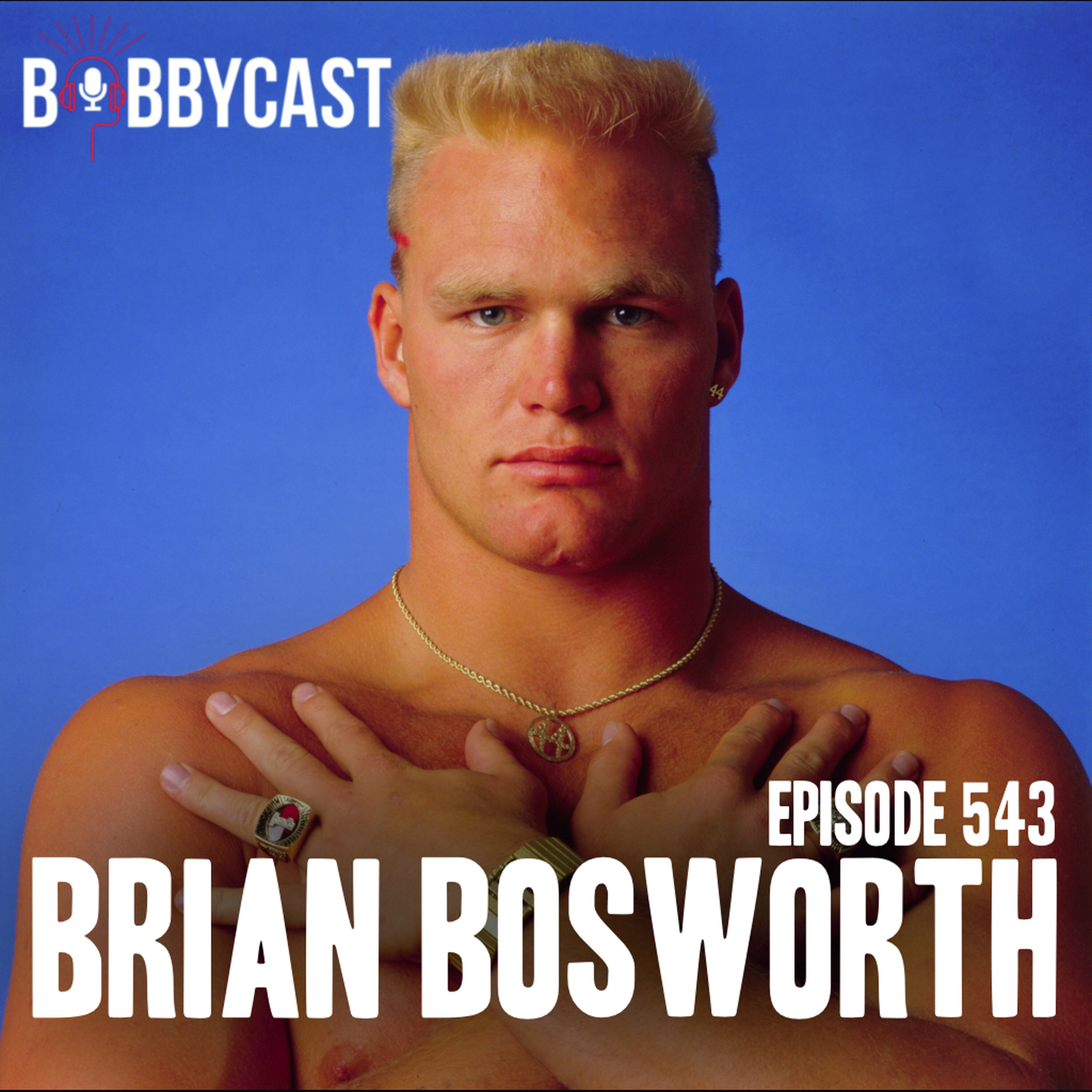
#543 - Brian Bosworth on the Moment He Realized Just How Famous He was in College + Playing at Oklahoma for His Grandad + Why His Dad is the Reason for His Infamous Haircut + Bobby Found Inspiration in Something Boz Did to Create Haters
On this episode of the BobbyCast, Bobby sits down with 1985 college football national champion, 2x Butkus Award winner and 2015 College Football Hall of Fame inductee, former Oklahoma linebacker, Brian Bosworth. Bobby asked The Boz if he ever realized how famous he was while playing at Oklahoma. The Boz told the story about the time his team was playing against Washington in a bowl game and the players from Washington were asking him for pictures, and that is when he realized how famous he was. The Boz also talked about his grandad being the reason he chose to go to Oklahoma after he told him he could only go to those games. Bobby asked him what the inspiration behind his infamous haircut was, and The Boz said it was all in spite of his father, who would never let him get anything other than a $7 bowl cut while in high school. Plus, Bobby told The Boz how he found inspiration in a marketing technique he used to create more haters while playing, and much more!
Check him out on Cameo: www.Cameo.com/BrianBosworth
Follow on Instagram: @TheBobbyCast
Follow on TikTok: @TheBobbyCast
Watch this Episode on Youtube
See omnystudio.com/listener for privacy information.
Available Results
Generated results are saved to the knowledge database for reuse and search.
Extract Knowledge
Pick what you want extracted first. Model, scope, and chapter options appear after a template is selected.
Transcript
00:00:06
Speaker 1: And we were on some cruise and I think that's when it first hit me. All of the players from Washington were going, hey man, hey boss, and I'm gonna get a picture with you.

00:00:14
Speaker 2: And I'm thinking, is this weird?

00:00:17
Speaker 1: Why am I taking pictures with the opposing team.

00:00:22
Speaker 3: Welcome to Episode five point forty three The Bozz. Brian Bosworth. A couple of things before we get started. I want to clue you in on a few of the people we talk about, just so you know, but Brian Bosworth is kind of a sports cultural icon. We've had a couple of sports figures in this We had Stone Cold, we had Chase Elliott, and so if it becomes a certain level of icon, I enjoy sitting down for an hour and talking about sure, the sports part of it, but also, you know, kind of the elements that were involved as they were getting so famous, and with Brian Bosworth the background.

00:00:57
Speaker 4: He was a linebacker at Oklahoma.

00:00:59
Speaker 3: He was really the most famous college player that I remember from my childhood.

00:01:04
Speaker 4: Then he went to the NFL.

00:01:05
Speaker 3: He was so famous, people rooted for him, hated them, and it was you know, a lot of marketing. And now whenever you see these players and they get paid and I owe money, and you know they're doing things to set themselves apart.

00:01:18
Speaker 4: Like Brian Bosworth was that guy.

00:01:20
Speaker 3: He then became an actor and Stone Cold was actually a movie he did that I loved when I was a kid. And now if you see those Dr Pepper Fansville commercials, he's the sheriff. But we talk about all of that. And so he's a national champion at Oklahoma. He's a two time Buckus Award winner, only person to ever do that, two time All American, he's in the College Football Hall of Fame, just super famous. And so there's also a documentary. If you listen to this and you're like, I'm kind of interested, it's called Brian and the Boss. It's really good. And I remembered a stunt that he did in his NFL career, and it's what motive to do the billboards when I bought the billboards here in town, because he did that with T shirts. He was just making money and he knew people hated him so much that he made all these T shirts that were like the Boss sucks.

00:02:10
Speaker 4: And they even.

00:02:11
Speaker 3: Talked about that in that documentary, and I was able to talk to him about that in this so super interesting. I loved it. Maybe this isn't for everybody, but you can also get a cameo from Brian Bosworth over at Cameo. I have bought a cameo from Brian Bosworth before for my wife's birthday, and Mann he sent back like five minutes.

00:02:30
Speaker 4: It was like a Ted Talk and Brian Bosworth's Ted Talk.

00:02:33
Speaker 3: So here he is the great Brian Bosworth, the boss. Oh, by the way, I need to mention a few people, so there are people we reference early in this. Joe c that is the athletic director at the University of Oklahoma, the current athletic director that's about to retire.

00:02:49
Speaker 4: Great guy.

00:02:51
Speaker 3: Patty is Patty Gasso, the head softball coach at Oklahoma. I think she's won eight national championships. She is my brother in law's mom. DJ Gasso reference her. I think if you know that, you're kind of good going in bent. Vnables is the current Oklahoma coach in case. He just kind of says brand or Venerables, Okay, I feel like we're pretty.

00:03:13
Speaker 4: Good here he is.

00:03:14
Speaker 3: This was super cool and we did this on like a Friday night at seven pm, so it felt totally different. From me too, because I wasn't fighting sleep deprivation. Also, the Boss curses a lot in this, so if you don't like bad words, it's probably ain't for you because we didn't bleep it. It takes a minute, but he does curse a bit. So just a heads up, Brian Bosworth, here we go. What do people call you, Brian Boz? What are people that know you but don't know you? Because like, I know you, but I don't know you Bozz. Most people call you bozz pretty much. Yeah, they see at the airport boz. Yeah, yeah, all right here here with Boz. You have a boss hat on though.

00:03:53
Speaker 2: That's true, I don't. My wife forgot it for another same as a chair, yeah, my wife coach.

00:03:59
Speaker 3: Well, for those listening, what you may not know is apparently we're sitting in burnt orange chairs. And I'm pretty vocal about my hatred for Texas, and I would have never said this was burn orange. I'm pretty color blind, but I'm not a Texas guy, and I guess you're not a Texas guy. And the first thing you see is that you're being put in a burnt orange chair.

00:04:17
Speaker 2: Yeah.

00:04:17
Speaker 4: I thought it was like a joke, like a prank.

00:04:19
Speaker 2: I thought, you're just trying to trigger me.

00:04:21
Speaker 4: No, No, definitely not.

00:04:24
Speaker 3: This is my wife picked out the color and the chairish chair.

00:04:28
Speaker 4: But super cool for you to be over here.

00:04:30
Speaker 3: I got a couple of things that I wanted to talk to you about specifically. One is I am now in a family like I grew up. I'm a diehard Arkansas Razorback fan, grew up in a small town in Arkansas, so I am Razorback all the way red.

00:04:42
Speaker 4: But my family, they could not be more pure.

00:04:45
Speaker 3: Sooners like it is it's soon and the fact that Oklahoma is good again this year. It's difficult for me because we are not good. If we were both good or we're both bad, that works for us. But I have like, there's aye a bye week this week. My wife's like, I can't even watch us win this week. I just have to watch you guys lose. That's literally what she said when I was walking down here. So that that's where we are. Yeah, But how intertwined are you? Still with the program?

00:05:11
Speaker 1: Very much so? I mean I go up to most of the games. I spend a lot of time with Coach Venables and the family and close with the staff. They usually asked me to come in and do as much as possible, even though I'm not on Pyo Hant Hant put me on payo. Yeah, I just I just love the university and I love the program. I just want to see it do well and continue to do well. So, you know, whatever I can do to help you facilitate any goodwill, I guess I'm one of the Godfather ambassadors to it.

00:05:43
Speaker 3: You know who I love is Josie Yeah, who's the athletic director there. And again, I have no ties to Oklahoma except for my family. They're massive Sooners. And also my brother in law's mom is Patty Gasso, who coached the Plumbas softball.

00:05:55
Speaker 2: She's the best lover. Yeah yeah, well close with her too.

00:05:59
Speaker 1: Get I get the go to like the games and she invites me into the you know, oh love her.

00:06:05
Speaker 2: Spent a lot of time with her.

00:06:06
Speaker 4: Pat He wants to ring my neck sometimes. I love her.

00:06:09
Speaker 2: She's she's the best thing Oklahoma's got right now. Yeah, I mean she's our m v P.

00:06:12
Speaker 3: She got a statue and she's alive. She's still coaching with the statue. Yeah yeah. So that's that's how entertwined my family is to Oklahoma, like I am in as much as I possibly can be. So that was the first thing I want to talk about. But I love Jose him and I text a good amount and good guy.

00:06:29
Speaker 1: He's done so much for the program. He built it back, you know, brought it back from the dead from the nineties, and you know all of the hires that he brought in and just working with you know, the outside donors and making all the right moves and you know, he's hands on, but he's a great architect. He knows what he likes and he he he brings the right guys in that can build that. He's a great captain of our of our university right now, and he's on his way out. He's just you know, anounced his retirement, so we're going to miss him.

00:07:02
Speaker 4: I went to a game in Norman last year.

00:07:05
Speaker 3: I knew Toby Keith and so they asked me to come out and lead the Toby Keith sing along. It was like the second home game or so, and it was the first time I'd been to a home game because if there's a Saturday, I'm either in Fayville or I'm on a television. But I knew Toby and a tour with Toby, and they said, hey, would you come out and do this? And so I got to spend a lot of time there at the stadium. It's it's hard to say it's awesome. It's a great environment, it really is.

00:07:27
Speaker 2: It's a really special place.

00:07:29
Speaker 1: And our fans, you know, it's it's it's different because I hear, you know, people talk about fans from other schools, you know, how rude they are, and I've experienced it. I've gone to places where fans are just downright rude or mean, or you know, they they're just ugly. Our fans when we host we do our best to accommodate everybody we want.

00:07:55
Speaker 2: We we let them know what.

00:07:56
Speaker 1: We appreciate that they came in to experience it. You know, it's Norman has grown so much since I played there. It was special when I played there, but now I go back and it really feels like a magical place. They've really done a great job of building out the university, the stadium, and we're going to do another stadium renovation. Some of the dorms. You know, I envy the guys because I mean, we lived in Squalor. We had bathrooms that we shared, you know, with fourteen, fifteen, twenty different guys on the floor. And these guys are you know, they go to school and they've got kitchens. What it's you know, these young kids, they don't know how good they got it. They really don't.

00:08:44
Speaker 3: And what's gonna be true is in twenty years those kids are going to go.

00:08:49
Speaker 2: Man.

00:08:49
Speaker 4: The kids today are going to go.

00:08:50
Speaker 1: Man.

00:08:51
Speaker 4: These kids don't even know how good they have it.

00:08:52
Speaker 2: I know, it's just.

00:08:53
Speaker 4: Going to keep getting bigger and better.

00:08:54
Speaker 2: Well, they got everything's got to be shining new.

00:08:56
Speaker 1: It's got to be, you know, something that tracks, especially recruits, because you walk.

00:09:01
Speaker 2: In the locker rooms. Now.

00:09:02
Speaker 1: I remember walking in our locker room and there's nothing special, but for us, you know, back in the eighties, it was special because of the tradition of the people that walked in before we got there.

00:09:13
Speaker 2: So they built the house.

00:09:15
Speaker 1: But our locker room smelled like you know, dirty jockstraps, you know, I mean it was.

00:09:19
Speaker 2: It was a nasty place, you know.

00:09:22
Speaker 1: And now you look at these the locker rooms and they got TVs, they got barbetary, they get all kinds of toys. It's like so many distractions but I guess that's the only way you can attract some of these kids to get them to come. That's just one part of it now, now you know, it's all you know. I was talking to coach Venables this this summer because they had the recruits come in in June and I went in to visit with him.

00:09:45
Speaker 2: I said, how do you really deal with his nil stuff?

00:09:49
Speaker 1: I mean, nowadays, you go to a kid and they should be super excited, wanted to get the letter and get the invitation to come here as a visit, But do they have their hand out thumb up with a handshake or hand out palm up? How much are you gonna give me conversation first? And he goes it's it's a little bit of both. But we use that as a tracker and a filter because if we do have that kind of conversation with them right up front, then we know that's a red flag and they're probably not going to be one of our family members.

00:10:21
Speaker 3: And that's a motivation and a priority to them, and that's probably not matching priorities of what you want from someone.

00:10:26
Speaker 1: Absolutely not not from Ounklahoma standpoint. But I don't know if it's necessarily a born priority for them, as much as it may be cultivated in the house and the family, because the mamas and the dads, and the uncles and the sisters and the brothers, and the family just unit. You know, sometimes family feels like they're entitled to the you know, the rewards of what the athlete, the son and or daughter you know, has been blessed to do, and yet now they're pushing them. And you know, I can only speculate, but it just seems like the stories I hear with the asks, you know, I'll come, but I want to make sure that my mom and dad they get to come to every game, and they need they need you know, sliphe and so they need per diem when they get there, they need a hotel, they need we're recruiting the athlete, we're not recruiting the family. And it's it's really kind of crossed over to where, you know, some of the asks are just so ridiculous that you just you don't want them in your locker room because it does become, you know, a poisonous environment.

00:11:39
Speaker 3: There have been instances where kids have gotten really bad advice. I made really big, bad decisions, and I won't mention it by name, but like transferring schools, and all from advice from their circles, obviously their parents or the people they're older than them, going hey, hold out for more money. Yeah, and turns out it is bad for everybody.

00:11:58
Speaker 1: Yeah, this leveraging. You know, they play a year, you know, and they have a great year or a decent year. There's already dark conversations happening behind the scenes, usually with family.

00:12:09
Speaker 2: That's that's how it's filtered in, you know.

00:12:12
Speaker 1: And then the inn the player, they immediately go, well, I'm going to leverage what I have and what I have done so that I can go to another university. Not because I'm a fan of the university. I've always wanted to play there. It's just because I can get paid more there.

00:12:28
Speaker 2: And I get that.

00:12:29
Speaker 1: It's football now has become transactional. It's there's no tradition that you're really buying into. You don't you don't really care about legacy because you've got nothing. You're not planting any seeds, there's no roots. And these guys that go from one school to another, and but by the time you look at their career, they played at four or five different schools, maybe they've had, you know, great numbers, great career, but they don't have anything to fall back on because if once the four years is done, and then they if they get to the NFL, you know, fantastic, but you know that ride doesn't generally last very long. I think the career expectancy is probably under three years now. Back when I was playing with three point two, and I played exactly three point two, not by design, but that's the way it worked out. But you know, having the relationship building that I did in that four years that I was at University of Oklahoma, even though I left with one year remaining, bad advice, but that building of those relationships was the foundation of all the things. All the great things are happening to my life right now. And if I had the nil afforded to me back in those days, there's no way that I would have leveraged playing for Oklahoma to go play at another school just for the dollar of it. Because I was a true fan of Oklahoma. I just wanted to be a Sooner more than anything. It was a promise I made to my grandfather, I think in nineteen seventy four, seventy five, because you know, he couldn't come watch me play. He was a farmer in Oklahoma. But I begged him, come come watch me play. Come do you know, come watch me do what I would really love to do. And you know, I was living in Texas at this time, and he said, I just.

00:14:23
Speaker 2: You know, I can't leave the farm. I do the whole farm. The whole farm is me. I don't have hands that I you know, can just you know, you do this, you do that, and I'll be back in a week.

00:14:32
Speaker 1: So and I got that, but you know, he said, if you're good enough, there's a little school that's down the street here, I'll come watch you play there. So I remember running to the farmhouse that day and that's Grandma.

00:14:43
Speaker 2: Where's the school that's down the street.

00:14:44
Speaker 1: Granddad said, he'll come watch me play football if I make it down there. And she goes, you mean the University of Oklahoma. And I said, I don't know, weren't Meeker? What's the school down the street? She goes to school down the street in University of Oklahoma? I said, are they any good? And she goes, I think they want the national championship last year. Yeah, I think they're pretty good. So I made it a promise that I would go play there. I was seventy seventy fourth, sir, I was nine or ten years old. So that's when I became like, you know, aware of you know, one a plan, but a promise and something that I could work towards with, something that I loved. Was something I was passionate about in sports for not only myself, but you know, for a man that was one of the most important men in my life at the time.

00:15:36
Speaker 4: So Barry Switzer didn't have to recruit you hard.

00:15:38
Speaker 1: Oh yeah, I still had to recruitment, right, yeah, because during the recruiting process, I had doubt problems just about my ability because of the missas mixed messages I was getting from my head coach. I had two position coaches in high school that just loved me.

00:15:57
Speaker 2: One was a punter.

00:15:58
Speaker 1: He was an offensive coordinator, but he was a punter in Texas Tech, and he and I would stay after practice for hours punting and he made me into a really great punter. And then the other guy was a defensive coordinator, and he made me a really great you know, you know, defensive player. But my head coach was going, you know, it might be good enough to maybe get a Division two scholarship, maybe a Stephen F.

00:16:20
Speaker 2: Austin.

00:16:21
Speaker 1: I'm going some doesn't math math here, because I've getten. Like, my mailbox is full of letters from all of the Division I schools from West Coast, East Coast, North South.

00:16:32
Speaker 2: All of them.

00:16:34
Speaker 1: Notre Dame wants me to come and play tight end, which didn't make any sense. Scratch my head on that one. I looked at their roster. I'm going six five sixty six six, I'm six two. I know I played tight end here, but I don't. That doesn't make any sense. I want to play defense. But the stories were there, and so when I finally you know, narrowed it down after conversations, after really my father's saying, this is this is where you're going kind of conversation. Every school that I went to to visit, uh I would I would commit, Like the s m U went to SMU first, and I remember that that game they'd won the Southwest Conference championship against Arkansas. I think that night they played there was the old Texas Stadium and walked in the locker room. Everybody's hooping and holler and having a great time, and I'd never won, you know, a district championship or any kind of championship really in football just struggled, you know, as far as a team winning, uh went.

00:17:38
Speaker 2: So I just loved that energy, and I got I'm coming here.

00:17:41
Speaker 1: Yeah, this is great, knowing that I had four more visits left. And then and then I go to uh, the Baylor, you know, and I'm sitting down with Grant Taff. Baylor was a kind of a tired, you know campus, and you know, they their their stadium was like in the bottom of a bowl, and you know, it just didn't look great. But I looked over at Grant Taft and kind of reminded me of my grandfather a little bit, and he'd passed away by the I said, a man, I can't say no to Grant. I'm coming here, man, I'm coming here. And then I went to l s U. I didn't commit to LSU because the guys down there and they you know, they take you out for the you know, for the visit, and they took me to some seafood place and said, this is how we do it. You got to you know, this is this is kind of a tradition that we do. We'll know if you belong here, if you can do this. And so they sat set me down a big platter a crawfish and I said, yeah, I love crawfell t.

00:18:37
Speaker 2: Yeah, but you got to suck the head.

00:18:38
Speaker 4: Sucked the head.

00:18:39
Speaker 1: I said, what are we doing? Said yeah, I sucked a head and I did all of them. And I was on pepto bismol the entire week that I said not going there. So and that that campus looked a little old. As a matter of fact, I remember seeing that they had the cage out front if it's still there, but they had a cage where they had the tiger, and I think I saw like the bones of like the previous tiger, like they didn't feed him or something. It was just like, this is depressing, So I'm not coming down here.

00:19:07
Speaker 2: And then it went to A and M.

00:19:08
Speaker 1: And that was really that first place that felt like one I can play here.

00:19:14
Speaker 2: I've seen the roster. It's a great campus.

00:19:19
Speaker 1: Uh.

00:19:19
Speaker 2: Jackie Cheryl was a coach.

00:19:22
Speaker 1: Jerry Pettybone was the the was the coordinator who was recruiting me. He really started talking about relationships with Jesus and there's like this is kind of cool. It reminds me a little bit of you know, being on the farm and you know, and you know, being a place that felt like home, and and I feel like I can play here because I looked at Oklahoma's roster and Oklahoma was my last visit, but I looked at a roster and I thought, man, I don't know if I'm good enough to play there. I mean, they've got they just got the all state linebacker from Lake Highlands and they signed him last, so I'm gonna have to go in and compete against him for the starting job.

00:20:05
Speaker 2: And I don't know. I just had a lot of doubts.

00:20:07
Speaker 1: So I committed A and M and canceled Texas, or Texas committed A and M and canceled Oklahoma. And then coach Switzer found out that I canceled, and then came to my high school cafeteria like the very next week and pushes.

00:20:24
Speaker 2: The doors open.

00:20:25
Speaker 1: And we got a thousand kids, and you know, we had three thousand kids in the school, so we had thousand kids each launch three lunches. And here's Coach Switzer's walking in in February wearing the mink coat. He's got all the bling bling, all the you know, rings on his fingers from all the Big j Big Eight Championships in the National Championships, and he's hollered my name across the capit Where's Bos?

00:20:46
Speaker 4: Where's Boss?

00:20:47
Speaker 2: Bos?

00:20:47
Speaker 1: Is in here right And I'm just sinking in my chair and I'm gonna know, no, this isn't happening to me right now. And he goes, I know you want one of these. I know you want one of these, and I go, so, let's have the conversation. So he he talks me into coming up, you know, and visiting. And you know, at the end of that weekend visit, the I guess the tradition as you just go in, you talk to the coach, and generally I think the coach either tells you, you know, we like you, would like to offer your scholarship, or we like you, but we don't like it enough, so we like to offer you a preferred walk on or thanks but no thanks. But before we even got into that conversation, I just said, hey, coach, oh, why are you recruiting me? You can get any linebacker you want in the country. And my senior season we were two and eight, and I thought, why do you want me to come here so bad? And he just said, because you don't believe in yourself, do you? And I said, I don't really have an answer for you there, No, I probably don't know.

00:21:48
Speaker 2: And he goes, I believe you.

00:21:51
Speaker 1: I believe in you, and I think if you come here, I will pull out what you don't think is in there, but i'll pull it out of here.

00:21:58
Speaker 2: I'll make it in all American. I'll make you a champion.

00:22:01
Speaker 1: But the thing that really that really grabbed me, put a trouble hook in me was uh. He said, I just want you to come home. I want you to come home because this is where you belong. And that was the first time that I felt like coach knew who I was and wanted to make me better than I imagined myself to be.

00:22:25
Speaker 4: Did he do that?

00:22:26
Speaker 2: Absolutely?

00:22:28
Speaker 3: How quickly until you realized that Coach Switzer was actually the guy that said he was going.

00:22:33
Speaker 4: To do what he said he was going to do.

00:22:38
Speaker 1: The reminder came the first year I was there, we red shirted, so I had to watch. You know, we didn't play well. We had we we're kind of off you know, hot and cold. We would win games, but not Oklahoma style, and we had some great players on both offense. Indeed, we had a we had first rounders on defense, but we didn't we couldn't get passed. We lost to Texas, we lost to Missouri, we lost to We lost Ohio State at home. We lost to Nebraska at home, and we were seven and four and eligible four bowl game. For some reason, we had Hawaii on our schedule as a regular season game, but it was the last game of the season. I don't know how that happened, but I remember Coach Switcher came into the meeting room after the Nebraska loss and he just said, we're bowl eligible, but we're not bowling. I want to thank all the seniors for what you've done here. Unfortunately, we're not playing Oklahoma style football, so I don't want to reward the effort that we had this year by going to a bowl game. We're going to use the Hawaii game as the bowl game, and we're going to celebrate that. But we're going to start all over in the spring and we're going to revamp this team and we're going to build this thing back. And while we were over in Hawaii, I remember being in one of those big, you know, big rooms that we you know, would eat and it'd be big buffet and stuff. But I came in late. It was like a breakfast and they had I don't know, big giant tables where everybody sits around, and I was basically in there with me and a couple other guys just scattered around the big room and and I'm and I'm I'm sitting there eating and then you hear this unmistakable voice that coach Switzer had, and I hear him go, I'm going to need you to play like a like a senior next year. I'm gonna need you to be my leader. Are really counting on you. Just thinking to my I said, what a lucky son of a bitch that guy is. And I'm looking around and I'm going, there's nobody here. And I turned around and looked at him. I said, you're talking to me, coach, and he goes, yeah, I'm talking to you. I said, but I haven't even played yet. And he goes, you don't remember that conversation we had in my office, do you? And I said, no, I remember it. I just you know, I figured it would happen, you know, when I was on the field, not like in a cafeteria setting that you're kind of sparking this thing to life.

00:25:12
Speaker 2: And and from that moment on, it's like.

00:25:14
Speaker 1: I knew that that he was he was trying to be the coach that that's you know, that started me, that sparked you know, was my spark plug. And then there was another another event that happened in spring ball. I got my shoulder dislocated, like day four of spring ball, and I think you only get like twenty days of spring spring ball. So I'm thinking, you know, man, I'm down, I'm out, can't, can't practice. And back in those days, practice was like a practice. We were beating the hell out of each other. There was there was none of this crap that they do. And I was, you know, shorts and shoulder page. It was full gear, NonStop, full speed, and I separated my shoulder and I figured, man, I'm out for a while. And here I am now seeing that that linebacker that was in front of me, his name was Evan Gate, would never made a mistake. And I had a cerebral defensive coordinator and linebacker coaching, Gary Gibson, man. The only way to get in his in his in his favor was to know exactly what he knows, be prepared all the time, and never make a mistake.

00:26:29
Speaker 2: And and a mistake.

00:26:30
Speaker 1: Could be as small as a you know, a misread or a misstep. I mean you could you could, you could read the play right, you could uh, you could get the tackle for a loss, cause a fumble and recover it. And because you had a misstep, he'd give you a minus. So I'm just seeing Evan and he's never made a mistake, and he's pulling away from me, and I'm going, ah, I'm gonna end up standing behind this guy for the next three years.

00:26:57
Speaker 2: Uh.

00:26:57
Speaker 1: And I remember going into the uh, the training room. I said, that's the worst is going to happen. He goes, It's gonna hurt like a mother. But I mean, I mean, I can't shoot you. I can tape you down, but you know it's your call. I said, tape it up, let's go. And I remember running out there and Coach Gibbs is going, what are you doing out here?

00:27:17
Speaker 2: And I said, I'm practicing. I got to get a job, and he goes, all right.

00:27:20
Speaker 1: So back in those days, two scrimmage against one. So I was running second team and there was a there was a pitch play and it was one of those moments that you just have where there's so much frustration and you don't have control.

00:27:34
Speaker 2: But I just said, the hell with it.

00:27:37
Speaker 1: Just put the put the metal to the put the foot to the floor, and just pedal the metal and just fucking go, man, just fucking go. And and I shot through the gap and picked the dude up and drove him into the ground and one of those hits where you know, everybody on the side.

00:27:56
Speaker 4: Oh god, yeah.

00:27:58
Speaker 2: And then all of a sudden I hear which, who the hell was that?

00:28:01
Speaker 1: And he's pulling guys off, and you know, he sees me on the bottom of the pilony goes pauseword.

00:28:05
Speaker 4: I knew it.

00:28:06
Speaker 2: That's what we got to do. That's that's that guy. That's our guy.

00:28:09
Speaker 1: And I'm going, holy fuck, are you gonna do is run around here like a fucking maniac, you know, without without care of your body.

00:28:16
Speaker 2: To fucking go.

00:28:18
Speaker 1: So that kind of was the the instigation of I know, the formula play it like like it's the last player' ever gonna play, but just do it balls out And that's kind of the way I played, you know, in Oklahoma, just with everything I had, and uh, you know, it's just it just it worked.

00:28:37
Speaker 2: Out beautifully.

00:28:38
Speaker 5: Let's take a quick pause for a message from our sponsor, Wow, and we're back on the Bobby Cast.

00:28:53
Speaker 3: Was there a moment where that insecure kid from high school who didn't know if he belonged or was good enough? Was there a moment where that flipped to Okay, I'm now either super secure or like I do, I will mask insecurity with things like we're big glasses. I do things to kind of create like a superhero costume.

00:29:10
Speaker 4: What was the switch for you?

00:29:12
Speaker 2: I don't know if it's a switch, it's probably like a dimmer.

00:29:16
Speaker 1: It happened during the during the the first year that I played, so in eighty four. Coach Gibbs was great at this. He didn't let me know or anybody know who's who's going to start. Our first game was against uh was against Stanford at home. And you know, for some reason, I had my girlfriend and dated in junior high and then a little bit in high school, and she followed me up to you know, to college, and she did one of these, you know, broke up with me, like the week of the Stanford game, and I went into all emotional hole. I don't know why, probably because my brain wasn't developed, and I thought, oh my god, I'm never going to get a girl ever never. I mean, she was beautiful whatever. And it's like, how dare she break up with me? And what's the problem because all you think about is Football's football, football for mus That's why I'm up here. I'm up here to be a fucking football player. And so she breaks up with me. So I go into a hole. Coach Switzer tells me go home and figure it out and then get your ass back here, which was unheard of of game week, and then I can come go home, go to go home and try to fix or figure it out or do whatever. And I was down there for about a day and a half and then I came back. And because it didn't get it didn't get fixed. That's a different story. And uh so I remember laying there on the on the on the practice field like week of Stanford game, and I'm looking up through my face mask at the sky and I see Coach Gibbs's head just kind of coming to my vision and he goes, you're my guy. You got a big boy, And I just started bawling, and I just thought, fuck all that work. And finally get validation that you know that that I'm gonna I'm gonna, I'm gonna actually be the starter. And then that first game, I was scared to death. It was like eighty thousand people and I'm running out there and I'm going, well, it's do or die now I got to prove it game. It was a home game, and I remember Stanford got the first to get the first series and it was like dank, dank, dank touchdown. I'm going, holy shit. I mean it's like five plays. I barely even remember him. And then we shut him down from there. We won nineteen to seven, but I got an interception that game. I had played a pretty good game, but it was kind of me feeling it out. I felt and I felt like that I still had a little bit of governor on the on the accelerator. And then the next week we were going to Pittsburgh and Pittsburgh was ranked pretty high. I think there were seven or eight and there was a defensive end that I really he was my mentor, and I played against him and as a scrimmage in high school, and I knew that he had gotten a scholarship to Oklahoma, so I kind of watched him vicariously during my senior year, and so Kevin was one of those guys I'd look over and it's like, you know, you're kind of like my Linus's blanket.

00:32:04
Speaker 2: While I'm out here.

00:32:06
Speaker 1: About halfway through the second quarter, he blows his knee out and I'm thinking panics is setting in.

00:32:13
Speaker 2: It's like, shit, there's my guy.

00:32:15
Speaker 1: I mean, that's the guy that I'm counting on because if I break the huddle and I call the plays, and I look over at him and we're sitting there talking, We're we're communicating with each other and we're spreading that information across the defense. And now now I see him getting carted off the field and he calls me over before before they take him completely off the field, and he goes, Boss, this is your team. They'll they'll follow you. You're the leader. Go out there and get it done. And I just from that moment on, I just took the governor off and just played like I played in that scrimmage in the spring, and it just it just accelerated from there. And that's when I started to feel like as long as I play with that kind of reckless abandon and full of emotion and just give everything I have. This guy's the limit because I got the talent around me. We were really talented as a team. But I was very intelligent in the fact that I knew what the coach wanted to do and I knew how he wanted it done. And there was the one thing I never wanted to do was ever look over at the sideline and see that I had disappointed coach Switch. I never wanted to see him shaking his head and like, you know, shit, you know, picked the wrong guy or he's not what I thought he was. So I always use that as kind of this this motivating like you got to play you know more than you know the expectations that are out there, and it just kind of dimmed. It went from you know where I was used that term kind of a dimmer.

00:33:49
Speaker 2: It just kept growing and growing and growing, and then then it kind of.

00:33:52
Speaker 1: Exploded with a Texas game because that's Texas was number one that year and my girlfriend had the audacity ex girl whatever came. I had the same one from before the same one from before. She was she was finishing up school that semester, she broke up with me to go date some dude from the university of Texas whose name was Duke.

00:34:15
Speaker 2: I mean, you can't make that ship up.

00:34:17
Speaker 4: Unless sounds very unlikable, right, yeah, Duke.

00:34:20
Speaker 1: And she has the audacity to come over in Texas weekend or Texas week to say, Hey, Duke and.

00:34:26
Speaker 2: I would like to come to the game. No, you can get us tickets to the Cotton Bowl, and I'm going.

00:34:30
Speaker 4: You bitch, Duke. She wants to bring Duke.

00:34:33
Speaker 1: She wants to bring Duke to the game, and uh, And of course the answer was no. Uh, but I walked it was that was the same day that we had our press, you know, would have access to us. I think it was a Tuesday, And I walked across the parking lot for Bud Wilkinson's dorm, into the into the stadium, you know, and one of the one of the reporters goes, hey, this is your first AU Texas game. I know you're a Texas kid, and know, uh, you know what's you're feeling about it. And I go, first of all, I'm not a Texas guy. I'm an Oklahoma gainst born Oklahoma. Get your fact straight. And I was pissed. And he goes, well, but it's gonna be a big game. Your first aldu Texas game. What do you feel like? I said, you know what, Bernoid's makes me puke. The arrogance and the idiots and those guys. I can't wait to play. These guys want to fucking rip their heads off. And I wasn't thinking straight. I was just being all emotional and honest about it, because I really did hate Texas, you know, just like all of it. And the very next day, all of the stuff's on the you know, it's the bulletin board, front front page news of you know, of our sports page. And back in those days, they would they would pin all that stuff up in our locker room, just you know, so the guys could read about the teams coming in and you know, they could kind of size up the guys and stuff, you know, and all of a sudden, it's now it's splashed this other stuff and coach, what's it? Calls me up to the office. Matter of fact, went to get to my my equipment. You know, you check in and they give your your jock, your socks, you're you know, you're undershirt, and then but before you could before I could get it, the equipment manager goes, Switcher needs to see you and I go, oh shit. So I walk upstairs and walk in his office and he goes, sit down, Yes, sir, you say all that stuff in the paper And I said, yes, sir. Well that doesn't help you know there number one. I said, yes, sir. I said, why did you say all this stuff? Because I was just answering it honestly. He goes, well, now you got to target on your back. You better back it up. I said, yes, sir. So it was kind of like he wasn't mad at me. He was just like, you know, he could have said that's not the way we do it here, or let's be a little bit more politically correct, or let's soften that tone up a little bit.

00:36:47
Speaker 2: But he didn't say any of that shit. He just said, you just better back it up. And that was the fifteen to fifteen tie.

00:36:52
Speaker 1: But that that was the game that that we dominated him to the point where it's like, this is the number one team of the country. Fuck that, we're the number one team in the country. We just kicked their ass. They know, we know, and the whole fucking world saw us, and the refs took it. So it is what it is. But now our confidence as a team has risen and it just it just escalated from there. We had a chance to win the national championship that year, had we beaten Washington and the Orange Bowl.

00:37:26
Speaker 2: But we went down there, we got.

00:37:27
Speaker 1: Distracted and we lost sight of a focus for a second because I think we got so excited that we that we knocked off for number one Nebraska in Nebraska to get to the Orange Bowl and win the Big Eight championship again. That was the first time that Oklahoma had done that the previous four years, So I think the the the energy and excitement of doing that, and then we got to the Orange Bowl and we thought that's Washington. We beat these guys, and we didn't, you know, we just failed made too many mistake and we didn't realize we left the national championship on the field because that year they gave it to BYU beating the six and five Michigan in a Holiday Bowl, and had we won that game, it had either been a split or we won it outright. But we did learn a lesson about the opportunities that you get like that are very rare and far between, and don't ever missed out opportunity again, and we made sure we didn't do that that following year when we went to play Penn State in eighty five.

00:38:32
Speaker 3: Did you ever feel while in college famous more so than just on campus or was it extremely insulated.

00:38:41
Speaker 1: It got to the point where I felt kind of famous. Yeah, because every school that we would go to on the road, all of their players and even when we got to you know, when we played in the Orange Bowl, I remember Washington's players. They'd get us together on these little you know, Orange Bowl like trips and stuff, and we were on some cruise and I think that's when.

00:39:05
Speaker 2: It first hit me.

00:39:08
Speaker 1: All of the players from from Washington were going, hey man, hey, boss man, I'm gonna get a picture with you, you know, and they gave us those little Kodak cameras and stuff. I guess it's like the little freebie stuff that they would give you in in the swag bag. And I'm thinking, is this weird? Why am I taking pictures with the opposing team. I don't know how my teammates are going to feel about that. But the team my teammates were also they they kind of enjoyed the ride too, because you know, I would just say shit, because I felt like we were good enough we could back it up, you know, and it was just all organic. I wasn't doing it to like, you know, you know, market myself. I was just you know, living my best life in the best you know school possible, and everything was working. All the stars were aligning. So I was a long for the roller coaster ride, but I was bringing everybody along with me, and we were all having such a blast. And then it just kind of everywhere we went, you know, we you know, at the end of the game, the cheerleaders would come over, Hey, we want to get a picture, and I'm going, you know, I don't sing, I don't dance, I just play football. We're really good. I'm not as good without these guys. But it just seemed like all the notoriety was was was.

00:40:24
Speaker 2: Coming down on me.

00:40:26
Speaker 1: I mean I helped a little bit because I you know, I cut my hair weird.

00:40:29
Speaker 2: You know, I didn't think it was weird.

00:40:31
Speaker 1: I just cut it because my old man wouldn't let me cut it in high school. And I was just like, well, he's not he's not you know, here now, so I can do whatever I want to.

00:40:39
Speaker 4: So that wasn't.

00:40:40
Speaker 3: Like a big statement when you cut your hair the first time, like to the world.

00:40:43
Speaker 1: No, I mean it was more of a fuck you to my dad, because my dad was like, you know, you know, not cutting your hair. I pay seven dollars to get that bowl cut, and that's the cut you're getting. I said, but Dad, everybody in this you know, in high school, right before fall ball, they all go get their hair buzzed, and well, you're not doing that. You're going to get your your bowl cut, and that's what you're getting. So, I mean, my dad was one of those you live by his rules or you don't live and I appreciated that. I mean, I would rather have a dad that was that way than a dad who was trying to be my friend, because I see the consequences of parents trying to be their kids' friends instead of their parents. And they're not supposed to be their friends. They're supposed to be there to make them hate life so they can get the hell out of the house and grind their own foundation and build their own house with the tools of hard love, tough love, you know. And I thank God for that kind of relationship. I mean, I wish he was a little more warm, warm and fuzzy and and happy, but I know that that was what he was capable of. He gave me as much as he had, and you know it, you know, it was what it was. I wish it was more, but I appreciate what I did get from him. But you know, all of the stuff that really happened really was. It just really happened organically. I remember when we were going to the Orange Bowl that first year, I went and got the haircut. I want to say I got that haircut about halfway through the season. It was after I know it was after the Texas game because I've seen pictures with me with just long, scraggly hair. So sometime during during that season, and I remember going to the Orange Bowl, I asked the girl, said I used to be a tow head. I'd love to be a towhead again. Can you do that? And she goes, yeah, just sit down. And we were leaving that day to go on the bus to the plane to get to you know, to go to Miami, and I was already packed. So I had made the appointment so I had I could get trimmed up nice and clean and then get on the bus and then go and back. In those days, if you missed the bus, you're paying your own way. I mean, they might be upset with you, but to get down there, you got to pay your own way. And I'm sure you'd have to get up and do some stadium stairs five thirty in the morning. But I remember sitting in the chair and I'm looking at my watch and I'm going, holy shit, I'm gonna miss the bus. You got to get this stuff off, man, I gotta go. So she washed it off. I didn't even look at it, and I got to the bus, walked on the bus, and the guys just started donkey laughing. I mean, I'm just what, what's what's the matter? Get your hair? Says yeah, what do you what's wrong with it? Because it's orange? It's orange and looked in the like the reflection, I can't see it. Is it orange? Really says yeah, Well, we're going to the Orange Bowl. That's why.

00:43:37
Speaker 2: That's right, I'm going to the Orange Ball. I'm just trying to get everybody fired up. How do we feel?

00:43:43
Speaker 1: So it was like everything happened, you know, accidentally, you know, with a slight bit of on purpose. I corrected it later after I got back, but you know, it was like, you know, everything that I did was like how outrageous?

00:43:58
Speaker 2: Can I push this how much further?

00:44:01
Speaker 1: Is there really a line in the sand or is it just kind of an imaginary Just keep pushing it, keep pushing and keep pushing it. And and I think that was I was always like that because when I was a kid, man, I was a fucking hellion. I mean, my dad used to beat the shit out of me. Uh to keep to just discipline me, I mean, just uh. I was one of those kids in elementary school. I got kicked out out of preschool no way. Yeah, that's why I had to go to Oklahoma all the time in the summertimes, because my mom and dad worked and I was just so fricking mean that they asked me, please, don't bring your son back here.

00:44:39
Speaker 2: We can't.

00:44:40
Speaker 1: We can't. He's destructive. He beats up everybody. He's a bully. Da da da da. And even though my dad would, you know, discipline me, it didn't really fix anything. But they finally said, well, and if they left me at home when they tried to do that, they have left me at home with the girls, my sisters, I'd beat the hell out of them.

00:45:01
Speaker 2: I'd chase him around, I'd beat him with my whip.

00:45:03
Speaker 1: I'd beat him to the point where they'd have to lock themselves in the bathroom. So I had to access to all the food in the kitchen because they would eat all the they would eat all the stuff that I wanted to eat. So and they were they were older than I was, so it was easy to punch them, and they could catch them because they were slow. But you know, it just got to the point where we got to get rid of it. You got to get rid of him in the summertime because you know he's going to tear the house down. And so back in those days, they just stuck me on a trailways bus.

00:45:34
Speaker 2: You know, nobody would do that to a kid.

00:45:36
Speaker 1: Nowadays, you just take a little five year old on a Torailways bus by himself, and your grandma and grand they'll pick you up at the bus station.

00:45:42
Speaker 4: Okay, they'll be there to receive them.

00:45:44
Speaker 2: They'll be there.

00:45:45
Speaker 1: And then I was on the farm, you know, by myself, for you know, for three months and then but that was such a peaceful time in my life. But every time I would come back, the chaos would start. I'd go to elementary school. I was in the principal's office, daily, sometimes couple of times a day, for doing something disruptive in the classroom. And it got to the point where I just walk in and say, mister Hewtt, just bend over and you know, soon the position and he'd get the paddle out of the out of the clause and he'd whip my ass two three times and I'd go back and I said, ILL see you later this afternoon. I remember beating my girlfriend at the time over the head with my metal lunchbox because.

00:46:23
Speaker 2: I liked her.

00:46:24
Speaker 1: That was the way I, you know, expressed them the way I liked her. She didn't like it that much. But you know, I was just one of those kids that I had like a Tasmanian devil that lived inside me, and I couldn't control the energy, so it came out in the waves of of of violence. So yeah, the only way that I could figure out how to there was a man in junior high school. My father was my coach in every sport that I did when I was young, so he controlled all of it. So I felt like I could get away with any because there was really no consequences. But at some point in time, your your dad can't be your coach and now you transition into school. And there was a school my it's called Sam Houston Junior High School and it was going in from sixth grade to seventh grade. Seventh grade was the first year that was going to be school sponsored sports. And it was that going coming out of sixth grade going into seventh grade that that spring before going into summer, and the guy that was in charge of all the sports calls me in his office and he goes, look, I understand your great athlete. I read the papers, you know, you know the you know people talk, you know, I see it. Unfortunately, you're not invited to uh to participate in sports at Sam Houston.

00:47:43
Speaker 2: And I go why, he goes, because you're disruptor.

00:47:46
Speaker 1: You're if you're in mister Stenson's office every day, you're class bully. The teachers tell me your class clown. You're constantly disrupting class. Your grades aren't very good. So I just can't. I can't reward having the you know, the blessing of being involved in sports, because it really is, it's an invitation to do this. It's not a privilege to play. So I'm sorry, I just can't. I can't let you expose your poison onto the players that are out here that have the right to play. And I remember going home that night and going, Oh my god, my dad's gonna kill me. He's gonna beat the hell out of me. How am I going to tell him that that's something that's almost getting that's almost worse than getting expelled, because at least can go back. And that was the first night I remember laying in bed and then praying, God, I don't know what is wrong with me. I need your help because I don't want to lose the one thing that I love more than anything. And if if you can just settle me down, point me in the right, fixed me. I don't know what the hell's wrong with me, but please fix me. And I remember going to Coach Graves, what a great name to end a career, Coach Graves's office and say, hey, give me a chance, give me one chance. For the rest of the trimester. You won't see me at Stintson's office. I'll be the I'll be the teacher's pat I'll break up all the fights at the bike rack because I'm the one that's starting them anyway.

00:49:23
Speaker 2: And I'll get on the honor roll.

00:49:26
Speaker 1: And he goes all right, if I don't, if I don't hear one bad thing the rest of the year, I'll invite you to football next year.

00:49:35
Speaker 2: And and from that moment on.

00:49:38
Speaker 1: There was like a calm that came over me because there was a purpose that I had, you know, to yet achieve. But the plan was follow the plan so that you can that you can achieve your purpose. And from that moment on, it was like, Okay, life kind of straightened up a little bit.

00:49:59
Speaker 6: The Bobby asked, We'll be right back. This is the Bobby Cast.

00:50:13
Speaker 3: I got three final questions for you. At Oklahoma. Did you ever start to get heat from opposing fans? Were they booing you ever?

00:50:22
Speaker 1: Yeah, yeah, of course that's part of the part of the course. But I kind of took that as I'm doing my job because when you're you're a linebacker, your job is to disrupt and destroy anyway. So you know, getting in the head of whatever player on the other side was was the most important, you know, thing I could do early and often, you know, during the course of a game.

00:50:47
Speaker 2: But getting into the heads of the of the.

00:50:52
Speaker 1: Of the fans just made me realize that I must be doing a really good job. If they're if they're using their energy to all me out. Boomy what call me?

00:51:03
Speaker 2: Names? Those stuff at me?

00:51:04
Speaker 1: It was we were in we were in Colorado one year and uh, I remember that game well because they were gonna kick me out. They actually did try to kick me out because I used to write stuff on my shoes, and referees came over and said, if Boz has anything written on his shoes, we're throwing them out of the game. And of course I already had stuff written on my shoes doing warm up. So right before the game started, Coach Witcher comes over to me, get you got to cover all that stuff up. They're gonna kick you out of the game, and I'm going out. What we're We're leaving the locker room now right now to.

00:51:35
Speaker 2: Get to get go to the field.

00:51:36
Speaker 1: So I had the equipment managers grab a bunch of markers, little sharpie'es and just cover it all up and first play the game, they throw the flag Boss out and Coach is going, what are you talking about?

00:51:48
Speaker 2: Coach?

00:51:48
Speaker 1: We told you if you've got anything written on it. She doesn't anything written on his shoes. His shoes are black. We're playing Nebraska next week. We want to see what it's gonna look like. We wear black shoes and that's our model.

00:51:59
Speaker 2: And they go, okay, he can play.

00:52:03
Speaker 1: So halfway through that game, I'd made a couple of plays on their side, and I gave him one of.

00:52:09
Speaker 2: These, like you know, a little nephew, you know, to the to the stands.

00:52:13
Speaker 4: After like a sacra play like on the field.

00:52:15
Speaker 1: You do that on the And it was, of course, it was late. You know, it's like in mid November, so it was cold up there, and uh, one of the plenty of their players of their student section were throwing frozen bottles down and trying to hit me with it, and they missed me, and they hit one of their own own cheerleaders in the back of the head and they had had caught her off the field.

00:52:40
Speaker 2: And we we won that game twenty eight to nothing.

00:52:43
Speaker 1: But they pulled me out like in the fourth quarter, and I'm standing on the sideline and uh, and I'm standing next to coach Switzer and all of a sudden, some ship's climbing down and he looks over at me.

00:52:55
Speaker 2: Goes, don't stand next to me. You can get me killed.

00:52:59
Speaker 1: Coach Man just wanted to say thank you for you know, stepping up and taking you know, and taking up from me. And he goes, yeah, don't worry about that, but just get the hell away from me. You know.

00:53:08
Speaker 2: Just damn communists up in Indiana, they got it out for you. Man.

00:53:10
Speaker 1: You got to be careful with those guys. That's that kind of that's that spurned the whole T shirt thing. And you know, in Miami, but you know, yeah, everywhere I went, I knew that the fans both loved me and they hated me. But you know, it really made me feel good because I felt like, if if that's the case, I must be doing not only my job right, but I must be doing it very very well.

00:53:37
Speaker 3: I want to talk about the T shirt thing. So just a brief story from my career. I'd lived in Austin for a long time. I'd built my own company. Nobody really wanted to syndicate my show, so I did it myself kind of a different way. Came here, was very disliked, felt very disliked, and the only thing that I could figure out how to do is kind of reverse engineer. I knew I was good enough, but I knew I was very different and it was going to be hard to get people to accept me. So I went and I paid like twelve thousand dollars for two of the biggest billboards in Nashville, massive billboards that said go away Bobby Bones, and there was nothing else on him.

00:54:10
Speaker 4: I didn't say it was me.

00:54:11
Speaker 3: It in credit me for it, and until I wrote my first book, nobody ever knew it was me. But the reason I did it was because big letters go away Bobby Bones. People were going to agree with it, or they were going to go, who is Bobby Bones, or they were going to go like, no, I got his back. That's all from you. So when I watched your documentary, I was in a really bad place because I was like, this is going terribly And I watched your thirty for thirty and you were talking about the T shirts and how you would make anti boss T shirts.

00:54:38
Speaker 4: That inspired me to do what has been the.

00:54:40
Speaker 3: Biggest thing in my career was to reverse what people normally do. So I created all of this negative to create the positive. And I've never you know, and I never talked, but that story is so instrumental in like my career. You doing that motivated me and inspired me to do that.

00:54:55
Speaker 2: Well, you know, fans are super important.

00:55:00
Speaker 1: Both the fans that love you and the fans that love you that hate you.

00:55:03
Speaker 2: You need them both.

00:55:07
Speaker 1: It's always nice to have fans that just adore you and have none that hate you. But all the haters out there make the fans that love you dig in deeper and ask question, why do you hate him?

00:55:20
Speaker 2: Why do you hate him so much? And it starts conversations.

00:55:24
Speaker 1: And I think now that you know, back when I was young, I look back on myself as a young, younger person, and I was an asshole, no question.

00:55:38
Speaker 2: I didn't like me. And now.

00:55:42
Speaker 1: I look at where I'm at now and the person that I've been blessed to be and now born again and have a relationship with Jesus, and and really really know the impact because I still scratch my head. I'm in awe that here, here we are forty years later and we're talking about something that occurred forty years ago, and yet the impact that people have and I can't understand it because it's not my impact, it's their impact.

00:56:16
Speaker 2: But they talk with such reverence and emotion, and.

00:56:22
Speaker 1: It's something deep inside that that I'm I'm honored that that whatever it is that I did allowed them to free themselves and have confidence to do whatever it was that they were afraid or in doubt, much like I had to go through. I think we all go through doubt. We all have, you know, these things in our and our souls that go, You're not good enough, you can't do that, You're not capable, no one's going to love you, you're not likable, whatever it is. And if you really just kind of stop and and and grind on it and work on it and believe in yourself and have people. But I think you got to be a genuine person. You can't be fake. And that was one of the things. As much as of an asshole I was back in those days, I wasn't fake. I wasn't faking to be that. I was just genuinely being that person in that moment. Not do I want to be that person for the rest of my life, No, because that person is unsustainable. I really only wanted to be that person for the sixty minutes so I was on the football field that was really the bass. And then once I got away from that, I could just be Brian, and Brian's really just you know, I'm a quiet kid that just you know, I'm a piscey, so I'm full of emotion. I care about what people think. I care about how I interact with people. I don't ever want to like be you know, I'm around actors all the time. It's like, you know, they're just conceded and they're full of themselves, and they have these expectations that everybody should do this for them or that for them, or I don't want It's like, dude, get up and do it yourself, Like mow your own damn yard. I mean, if you got the skills, mow your damn yard, don't pay somebody mowed You're You're never too big to go dig a frickin' hole in your yard and plant a plant. Do shit that you know nobody else wants to do, because one day you're not going to be able to do it and you're gonna wish man, I wish I had done it. So just live your life authentically, but be kind to people and care about what impacts them, you know, and if there's something that you've done for them.

00:58:39
Speaker 2: Appreciate the hell out of it.

00:58:41
Speaker 1: Because that was a blessing that God gave me that I then passed on to them. I didn't know that at the time, and it wasn't until you know, I got saved March third, twenty thirteen, when it all came to back and the pastor said, now you can't keep this a secret. I go keep what a secret. All the things that you've been ashamed of, don't be ashamed of them. Talk about them because you don't know. Your journey is going to impact people in a way that will change their lives and you won't know it, but and they probably won't tell you, but they're gonna see or hear something that resonates in their heart and their mind and their soul that it suddenly wakes them up and go, huh, I have value. I am valuable. I am important, and I can do something with my life. It's not I'm just not living and breathing and walking until the day I die.

00:59:35
Speaker 2: There's a purpose from me. That's good.

00:59:39
Speaker 3: Yeah, yeah, and yeah that what you did then influence and affected my career, like the strategy of it.

00:59:48
Speaker 2: Yeah, look what you built. You got this. There's great stuff. I do.

00:59:50
Speaker 4: Go, I do got a nice house. I appreciate you.

00:59:52
Speaker 2: It's got a great house. But I think keep this in mind, there are no u holes that go to heaven. You can't write or rent this stuff up upstairs.

01:00:00
Speaker 1: So the greatest gift that you're going to have is is the is the love and hope in your heart that you don't that one. You get the cherish and hold, but then you get to give that away to the people you love the most. Your wife, you're you're a new baby that's coming, the people that you work with, You appreciate the energy and effort that they give, the supporters, the people that love you, your fans, and the ones that hate you that looked at that sign and go, what the hell's Bobby?

01:00:29
Speaker 4: We agree he should go away.

01:00:30
Speaker 2: He should go away.

01:00:31
Speaker 1: No, I want to know what he's got to say, because if, if, if, if he's that good, he must have something like Charlie Kirk. I mean, the dude was probably you know, and I'm not exaggerating, he's probably the most christ Like person that we've had on this planet for the last two thousand plus years, and we've just lost him. Now we know the impact of why he's gone and what we're gonna miss, but we'll always hear is words because we've videotaped it, and now we really appreciate and our heartbroken that we've lost somebody that was so eternally valuable to humanity, and yet now we get to celebrate him. And that's how that's how fast life can change. So I just you know, I appreciate any and all the things that happened to me, But I'm just a small little dust, you know, with all the other stuff that's happening in the important part of you know, this planet.

01:01:33
Speaker 5: Let's take a quick pause for a message from our sponsor, and we're back on the Bobby Cast.

01:01:47
Speaker 3: All right, final question. I love Stone Cold as a kid. Do you watch your acting tape much like you would watch a game film to see what you can do better?

01:01:56
Speaker 2: Yeah?

01:01:57
Speaker 1: Yeah, And I actually use because when I first went into acting, it was like I went and kicking in, screaming. I had no desire at all to be an actor. It was my agent's you know dream. He wanted to be a you know, an agent that had a player that transitioned into Hollywood. And we had that conversation before I signed with him. I said, I don't I didn't really care. I'm not interested in that. If you want to, you know, pursue that. I just want to play, and so you know, I thought I was going to be playing for ten years and then boom, it's over in three years. And and I go into a hole and the next thing I know, he's calling me up, and you go, you got to get back here.

01:02:33
Speaker 2: We got a movie. I'm gonna do the What are you talking about. I'm not doing a movie. I have no clue what to do in a movie. No, don't stick me in that.

01:02:39
Speaker 1: That's the most uncomfortable thing I can possibly Then I'm going to be fully exposed as a fraud. I do not want to do that. I'm not I'm not trained. I don't I don't want to do any of it. And Michael Douglas, who was one of the producers on the film, called me up and he said, look, I know where you're at. You know you're down, you're depressed. We got to build it back. We're gonna We're gonna do it together. Trust me. I won't put you out there until we feel like you're ready. You're gonna have all the supports that you're gonna need around you. Just just come back and let's rebuild your life. Your your life is not over at twenty two, and you know, I took those those words of advice and said, you know what, I'm gonna look at look at acting much like it's a football team, and you got to train for it, and you gotta work out for it, and you got to practice and and and you've got to do things like when you're playing football.

01:03:32
Speaker 2: It's not you don't just show up on game day.

01:03:35
Speaker 1: The hours, weeks, months, that the prep that you put in, all of the stuff that you do extra when eyes aren't watching and you're doing the work because you know that's the right thing to do.

01:03:48
Speaker 2: That's when your growth actually happens. Not when you get you get.

01:03:52
Speaker 1: A sheet, here's your here's your weight workout, and you go in there and do just that and you and you walk away. No, it's that plus you do this and more and more and more, because that's where your growth actually happened. So I looked at it like that's how I got here, That's how I'm gonna try to conquer this new you know, this new thing that's gonna, you know, I guess now involve my life. Maybe that will fill the hole that's now in my life. And I and I and I approached it with those with that with that mindset, you know.

01:04:24
Speaker 2: And and I treat.

01:04:25
Speaker 1: Everybody on the set the same way I would treat you know, guys on the team. And you know, it's just you got a head coach, he's a director. You got the you know, the cast. There are the guys you play with. You got the guys behind the scenes, the taping, your you know, your equipment managers. And those are the guys are hold new camera and putting you in focus. Uh, there's rules and regulations. You got to be on time. You gotta be you got to be appreciated, all of it. And it's all part of it. And the fact that you know, I remember my when when I was a kid, I used to ride motorcycles all the time.

01:05:00
Speaker 2: I was a dirt right dirt bike rider.

01:05:01
Speaker 1: And my dad had a bike, and I remember I stole his bike one day when he was at work because these two girls that were cute called me, Hey, we want to go to stop and go get some food. All right, I'll come pick you up on a motorcycle. And I took pick both of them, had two girls on the back of the bike and I'm going down the street.

01:05:18
Speaker 2: You know, I'm like fourteen years old. Thirteen.

01:05:20
Speaker 1: What I was, I was in high school, I think, No, I think I was like I think I was fifteen years old, right before I got my license, and uh, there was a truck that was in front of me, and instead of just stopping and waiting for him, I just decided to go around him and he ended up turning into me and I stayed on the bike. One chick you know flew off and the other chick you know was staying. But I crushed my entire foot and my dad was like, you're going to miss football.

01:05:50
Speaker 2: I was.

01:05:50
Speaker 1: I remember being the hospital, screaming as they're scrubbing the black top out of my foot, and he's.

01:05:56
Speaker 2: Not, you, okay, you all right? You're going to miss football? What is wrong with you?

01:06:00
Speaker 1: And I'm going I'll never do it again. He goes, you, damn right, You're never gonna ride another motorcycle. Your football career is over, all right? I promise I won't and I and I never did. And as soon as a football career was over, I went down in Seattle and got me a motorcycle, riding around in the rain and stuff. Little did I know that, you know, the first movie that they would make would be like a motorcycle movie, you know, and there's such a freedom when you get on a motorcycle.

01:06:24
Speaker 3: I don't know if you ride. I'm too scared now. Yeah Rick the mopad once when I was twelve, Never again, dude.

01:06:29
Speaker 1: It is such a it's such an awesome feeling, especially when you're on a big, heavy bike and you got that much horsepower between your legs and you could do some dangerous stuff, but there's such a lifting of it's so free. You know, you're you're it's like you're you're you're flying and uh, there's just like it kind of it's kind of an adrenaline rush. Uh, and you start to and I kind of started living a biker's lifestyle.

01:06:59
Speaker 2: And it was just ironic that they came up and go, here's your first movie.

01:07:03
Speaker 1: You're a motorcycle it's you're You're infiltrated in a motorcycle club, and I'm going, okay, sounds fun. I just don't know how to act, so we've got to figure that part of it out. I'll ride the ship out of a motorcycle, but we've got to figure out how I can talk. So uh, it turned out to be great, you know, and uh you know, I do watch, you know, I do create, create critique myself a lot when I'm when I'm watching the playback on whether it be.

01:07:30
Speaker 2: TV, whether it be film.

01:07:33
Speaker 4: Did you think Fansville would go this long?

01:07:36
Speaker 2: No?

01:07:37
Speaker 1: I hoped it did. I really enjoyed doing Fansville. We were trying to trying to do Fansville the TV series for a minute, but I don't know how that that would work. But I think it's just it's ironic because when they when they when they came to me, it said, Dr Pepper wants you to be their sheriff in Fanville. I said, that's amazing. Doctor Pepper was my go to drink when I was a kid. How cool is that? So, you know, it's just funny how all this stuff kind of lands in your lap and you're just you don't expect it, but ends up being just an amazing blessing. And we've had eight great years and hopefully we have another eight more.

01:08:18
Speaker 4: Yeah, that's awesome. Well, this has been a real thrill. So I really appreciate the time.

01:08:21
Speaker 3: I really appreciate the inspiration in different ways that you didn't know you provided me. And so for me, I think that was my number one motivator for having you come by. And then too, my family are such massive Oklahoma fans. My family's ingrained in the school obviously with Patty, and so I know they're going to love this too. So yeah, for so many reasons, it's been a real honor to have you over.

01:08:42
Speaker 4: So thank you for spending an hour with me.

01:08:43
Speaker 2: Well, I really appreciate you.

01:08:44
Speaker 1: Bringing me on makes me makes me feel important because I get to share the stories and then hear how whatever it is that I did in my past.

01:08:54
Speaker 2: Had a positive influence on you, and it got you these two.

01:08:57
Speaker 3: Bernorn's chairs that I didn't know were born. You better believe these chairs are not going to be here much longer after you get out of here. It's got to be weird to live in Austin, though, and be an ou guy.

01:09:06
Speaker 2: You know, it was, it was, It was.

01:09:08
Speaker 1: It was awkward at first, but then I went out a couple of times and people's you know, the fans are fans, and they I think fans, especially of your rival. They appreciate the effort that you gave because rivalries are fun, especially when they're really good rivalries like Texas and oh you are and fans like to see their team's challenge to the nth degree. How good are we can we beat that team? And sometimes you know, the Ou Texas game, you know, it goes in weird ways. But I have found that that the Texas fans truly appreciate the effort that I gave as a Sooner, because I think they appreciate how much I love Oklahoma. Because you want the players to play for your team, love the team and tradition as much as I did for Oklahoma, because it just makes the team better. Because the guys will will, will, live, eat, breathe, kill themselves in order to get that w you know, And that's the thing that they're going to remember forever, the effort that you gave. And I've actually gone to a few Texas Texas games by invitation.

01:10:21
Speaker 2: At first, I was a little nervous about going.

01:10:23
Speaker 1: I said, they they don't want me in their house. I'm pretty sure they're not gonna want me in there. And then every time I've gone, it's it's just been just a great, a great warm welcome. You still do cameos, I still do lots of lots of Cameosy, how about one of those ones I appreciate those two because I get deep on them. You know, I always Yeah, you sent me a four minute went back about for my wife's birthday.

01:10:45
Speaker 4: As you sit back like a four minute.

01:10:46
Speaker 3: When talking about all the specifics of the things that I had mentioned, it was the most elaborate, awesome cameo we'd ever buy.

01:10:52
Speaker 1: Well, because I look at them sometimes I look at some of these, some of these guys that have they're on a cameo and they're going there. They're like, you know, for five hundred dollars or fifteen hundred US, dude, your time's not worth going to give him like a like a thirty second blow off.

01:11:07
Speaker 2: Whatever, Dude, give them something.

01:11:10
Speaker 1: They go to the effort of if they want something special, they give you specific informations.

01:11:16
Speaker 2: But then open up your heart and talk to them.

01:11:19
Speaker 1: Don't just give a message, talk to them so that they realized the person that that they wanted to hear from and see.

01:11:30
Speaker 2: Is more than just a person.

01:11:31
Speaker 1: He's he's a genuine human being that has you know, that has feelings.

01:11:36
Speaker 2: He's up, he's down, he's been through some stuff.

01:11:38
Speaker 1: He can give you advice, but more than anything, it's it's like an honor It's like somebody's taking the time and they want me to express something important to that other person, whether it be a happy birthday, lift them up, you know, congreat and congratulations. You know, job well done. You're you're retiring, you're going into the next phase of life. You know, he's covering from surgery, he's super down and he needs you know, he needs some encouraging words. Whatever it is. But somebody went to the effort to do that. So give one hundred and ten percent effort back. Otherwise don't do it. Yeah, get a boss cameo.

01:12:14
Speaker 4: It was a plus.

01:12:15
Speaker 3: Yeah, we bought one. Was it was one of the best ones.

01:12:17
Speaker 2: Nice.

01:12:18
Speaker 3: That's how life is. One day you're buying a cameo from BOS. The next day is over at your house in Burns chair and his burn Oorng's chair.

01:12:25
Speaker 1: Hey, now, if you don't want these and you want to give them away, I won't say no because it is a comfortable it's a comfortable chair.

01:12:36
Speaker 4: Yeah, it's a comfortable chair.

01:12:37
Speaker 1: And I have learned to appreciate you know there there You need things in your life to remind you how you got to where you where you are.

01:12:46
Speaker 2: You know where you're.

01:12:47
Speaker 1: From, where you're at where you're going, and what did you give up to get there?

01:12:52
Speaker 3: So which part of that would this chair b to you?

01:12:57
Speaker 2: What did I give up to get here?

01:12:59
Speaker 1: So I gave up hating burnt orange so that I could sit in a burnt orange chair and have an amazing.

01:13:05
Speaker 3: I'm going to say they're not burnt, but okay, I'll accept it.

01:13:08
Speaker 4: There he is, the great Brian boss Worth.

01:13:11
Speaker 6: Thanks for listening to a Bobby Cast production