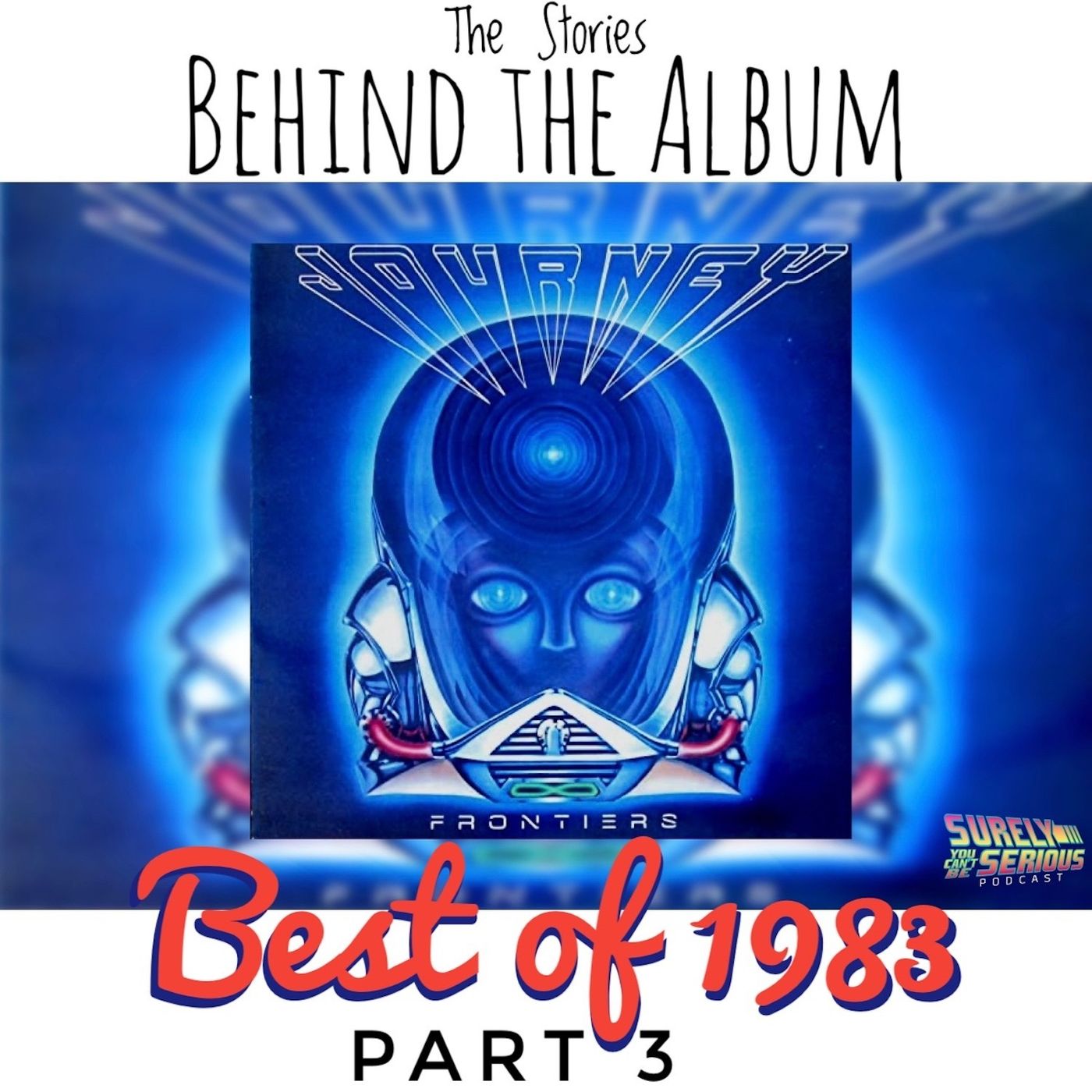
Journey Frontiers (1983): Track by Track
Join us in this episode as we dive into the history of Journey and then examine their 8th studio album, Frontiers, track by track, and arrive at our final judgement as to which is the best album of 1983.
2023-01-13
49 min
Transcript
Available Results
Generated results are saved to the knowledge database for reuse and search.
No generated results are available for this episode yet.
Extract Knowledge
Pick what you want extracted first. Model, scope, and chapter options appear after a template is selected.
Generated results for public episodes are saved to the knowledge database so they can be reused and searched later.
Transcript
<v Speaker 1>Hello everybody, and welcome to the Surely You Can't Be
<v Speaker 1>Serious Podcast, discussing and debating the iconic and the forgotten
<v Speaker 1>of eighties and nineties.
<v Speaker 2>Pop culture with your co hosts James D. Graves and
<v Speaker 2>Jason Callipans. Welcome back, everybody.
<v Speaker 3>Here we are for our second part in the Synchronicity
<v Speaker 3>Versus Frontiers debate, and Jason.
<v Speaker 2>I've got a great idea for a video.
<v Speaker 3>You should play the air keyboards and I will play
<v Speaker 3>the air guitar, and we'll get somebody else to play
<v Speaker 3>the air drop.
<v Speaker 1>We think invisible instruments. Yes, that sounds incredible on a wharf,
<v Speaker 1>and have a lady walking around.
<v Speaker 2>Now now a minute a minute.
<v Speaker 3>That would be absolutely the worst video in the history
<v Speaker 3>of the world.
<v Speaker 2>We can't do that. I don't know what I was thinking.
<v Speaker 1>Let's hang out. We'll be out there in our jeans
<v Speaker 1>and tennis shoes. We'll get some lady off the street
<v Speaker 1>just to walk around.
<v Speaker 2>Awesome tank top.
<v Speaker 1>That you got it Target last night, and.
<v Speaker 3>I'll get my haircut right beforehand. Well, welcome back everybody.
<v Speaker 3>As you can see, we're already having fun with this one.
<v Speaker 2>Today.
<v Speaker 3>We're here to talk about Journey if you didn't catch
<v Speaker 3>our last episode, we talked about The Police and we're
<v Speaker 3>comparing the two albums that came out in nineteen eighty three.
<v Speaker 3>The Police had Synchronicity and Journey had Frontiers Synchronicity.
<v Speaker 1>That album was released in June of nineteen eighty three.
<v Speaker 1>Frontiers is actually released in February of nineteen eighty three.
<v Speaker 3>Yeah, so today we will cover Frontiers and then finish
<v Speaker 3>up with our decision on which one we think is
<v Speaker 3>the best.
<v Speaker 1>I'm anxious to hear what you think I really am
<v Speaker 1>because most of the time I have kind of an
<v Speaker 1>inkling of where you are. I have no idea where
<v Speaker 1>you're on these two.
<v Speaker 3>So it is very, very difficult because these are two
<v Speaker 3>phenomenal albums. Like I said last episode, Police was the
<v Speaker 3>best band in the world, and this was their best
<v Speaker 3>album with the most hits and a Journey this one
<v Speaker 3>has a ton of hits. It's got my favorite of
<v Speaker 3>all Journey songs to kick things off, and so it's
<v Speaker 3>hard choice. I'll tell you when we get there. Okay,
<v Speaker 3>stay tuned, Okay, So let's jump in. You know, the
<v Speaker 3>only member of Journey that was an original member of
<v Speaker 3>Journey is Neil shown.
<v Speaker 2>You know Neil shown story.
<v Speaker 1>The only thing I really know about him is that
<v Speaker 1>he picked up the guitar at like age five, and
<v Speaker 1>he was born at Tinker Air Force Base, which is
<v Speaker 1>about twenty miles from where we're recording right now.
<v Speaker 3>So right right, yeah, I doubt he remembers Oklahoma, but
<v Speaker 3>we'll we'll claim him anyway, right.
<v Speaker 1>He is in the Oklahoma Hall of Fame, so we're claiming.
<v Speaker 2>Yes, yeah, Neil shwon.
<v Speaker 3>I'm sure he tells everyone he's from Oklahoma.
<v Speaker 1>This band was very nearly named Oklahoma City, but instead
<v Speaker 1>they settled on Journey.
<v Speaker 2>Well, they had some wild names to go through. But
<v Speaker 2>let's back it up a little bit.
<v Speaker 3>So Neil shown after Obviously the big important part about
<v Speaker 3>being born on Tinker Air Force Bace here in Oklahoma.
<v Speaker 3>He ends up in California, has a turntable in his room,
<v Speaker 3>listens to Jimmy hendrickson Cream every night, falls in love
<v Speaker 3>with the guitar. And I guess that's sleep hypnotism work,
<v Speaker 3>because at fifteen years old, he is an amazing guitar
<v Speaker 3>play already.
<v Speaker 1>He's a professional guitarist by age fifteen. You and I
<v Speaker 1>have talked. We both have fifteen year old boys in
<v Speaker 1>our house right now. The idea of him going out
<v Speaker 1>on the road and playing in a rock band.
<v Speaker 3>It's kind of weird how that fifteen thing keeps coming up.
<v Speaker 3>I mean, you had Eddie Murphy doing stand up when
<v Speaker 3>he was fifteen. You had Rick Allen who started playing
<v Speaker 3>with def Leppard at age fifteen, and then you have
<v Speaker 3>Neil Shoan who's playing the guitar at fifteen. It's crazy,
<v Speaker 3>but he got noticed. Of all people, he.
<v Speaker 2>Got noticed by Greg Rawley, who was the keyboardist and
<v Speaker 2>lead singer for the band Santana.
<v Speaker 1>I mean Santana. I mean that's a big time band.
<v Speaker 1>Huge joins them at age fifteen.
<v Speaker 3>I mean we're talking. They played at Woodstock. I mean
<v Speaker 3>this is this is not small potatoes here. I mean,
<v Speaker 3>these guys are an amazing band. And this guy, Greg
<v Speaker 3>Rawley was so impressed with Neil Show's ability at age fifteen,
<v Speaker 3>he would go and pick him up from high school
<v Speaker 3>in the morning, not after our school was done. Listen, dude,
<v Speaker 3>you don't need to bother with school because you.
<v Speaker 2>Were going to be a rock god. Okay, so come on.
<v Speaker 3>Herbie Herbert was manager for Santana at the time, and
<v Speaker 3>he heard Neil shown play and he was like, we
<v Speaker 3>need to have this guy come around a little bit
<v Speaker 3>because he was blown away, blown away by a fifteen
<v Speaker 3>year old.
<v Speaker 1>Neil Showan is a phenomenal guitar player, and I think
<v Speaker 1>he's vastly underappreciated. We talked in our Van Halen podcast
<v Speaker 1>about Eddie is a rock god, but when he wants to,
<v Speaker 1>he can make his guitar scene. And Neil is that
<v Speaker 1>type of guitar player. It always compliments the song. He
<v Speaker 1>never stands out there and says, look at me, watch
<v Speaker 1>me go crazy. His guitar always helps the song.
<v Speaker 3>It might be yeah, absolutely, And to say that means
<v Speaker 3>a lot because this time and history was it was
<v Speaker 3>all about the guitar solos, and so he definitely had
<v Speaker 3>that opportunity to be out there and being that guy.
<v Speaker 3>But I would say that it took some doing, but
<v Speaker 3>he appreciated what they were and where he needed to
<v Speaker 3>be in the scheme of things and didn't try to
<v Speaker 3>didn't try to take that spotlight over. So he joined Santana,
<v Speaker 3>and I mean, it's crazy you watch some of the
<v Speaker 3>old Santana videos that they have that are all psychedelic
<v Speaker 3>and weird technicolor DreamWorks things going on. And he's just
<v Speaker 3>a baby out there with his guitar playing with these
<v Speaker 3>guys who are veterans of the hard rock scene.
<v Speaker 2>But he's amazing.
<v Speaker 3>I mean he's a baby, but he's like, as they
<v Speaker 3>said in Bull Durham, the gods reached down and touched
<v Speaker 3>his hand and his arm became a lightning bolt.
<v Speaker 1>You know. So he doesn't stay with Santana.
<v Speaker 3>Yeah, well, Herbie Herbert says, hey, guys, you know, we
<v Speaker 3>need to do something different. He and Greg Rawley they
<v Speaker 3>split off. This was kind of like part two of Santana.
<v Speaker 3>And obviously they're not going to be Santana because Carlos
<v Speaker 3>Santana and Santana you can't really take that from real.
<v Speaker 3>So they go out on their own and they start
<v Speaker 3>this band called Golden Gate something or other. I don't
<v Speaker 3>even rhythm section. We think, yeah, I think so that
<v Speaker 3>sounds good. It was not a good name. It was
<v Speaker 3>a horrible heat. Air Force Base would have been a
<v Speaker 3>better name, but yes, or Oklahoma City it was a
<v Speaker 3>better names. And so they're a band unlike the Journey
<v Speaker 3>that we know today. I mean, they are a band
<v Speaker 3>that is in the kind of fusion rock progressive rock scene,
<v Speaker 3>which is a lot of instrumental solos. That's the band
<v Speaker 3>that they were for a long time, and they developed
<v Speaker 3>a significant following.
<v Speaker 1>Is that kind of band they did, But they didn't
<v Speaker 1>have any hits.
<v Speaker 3>Yeah, they were selling tickets, they weren't selling any records.
<v Speaker 3>The CBS was like, hey, guys, you want us to
<v Speaker 3>keep playing for your concerts, you better give.
<v Speaker 1>Us a hit something. We need something we can play
<v Speaker 1>on the radio.
<v Speaker 3>And Herbie Herbert realized, we need a singer. We need
<v Speaker 3>a singer who can sing well. And they went through
<v Speaker 3>a couple of guys that just didn't quite have it.
<v Speaker 3>And in the meantime, while all of this is going on,
<v Speaker 3>you got young Steve Perry who's been playing in rock bands,
<v Speaker 3>going through those same motions that early rock and rollers
<v Speaker 3>go through, and he actually gets in with the band
<v Speaker 3>called Alien Project. Looks like this band is going to
<v Speaker 3>be good. You know, they've they've got a decent song.
<v Speaker 3>They're just about to sign their record deal. And then
<v Speaker 3>the bass player gets killed in a car crash with
<v Speaker 3>a train, and when he dies, the band dies.
<v Speaker 1>I mean, Steve Perry at that time felt like, man,
<v Speaker 1>just when I'm on the cusp of my dreams coming
<v Speaker 1>true whatever it is, the universe is stacked against me. Yeah,
<v Speaker 1>you feel like that was my chance and now it's dead.
<v Speaker 2>Yeah, he went back home. I mean he was done.
<v Speaker 1>We're talking about Steve Perry, who arguably has the greatest
<v Speaker 1>singing voice of the nineteen eighties.
<v Speaker 3>Journey is arguably the definitive eighties band, at least the
<v Speaker 3>definitive early eighties band in my book. I mean, if
<v Speaker 3>you want to say what was the sound of nineteen
<v Speaker 3>eighty through nineteen eighty five for bands, I'm gonna go, well, Journey.
<v Speaker 3>Journey's pretty darn good example.
<v Speaker 1>You could do a lot worse than Journey, that's for sure.
<v Speaker 1>If they had this formula of pumping out hits that
<v Speaker 1>everybody liked. Bon Jovi was kind of that towards the
<v Speaker 1>latter half and just everybody sort of mainstream like these songs.
<v Speaker 3>But before they get there, Herbie Herbert is thinking, what
<v Speaker 3>do we gotta do to get a decent hit? We
<v Speaker 3>got to have a singer. And he's going through these
<v Speaker 3>demo tapes and he hears this tape and he's like, no,
<v Speaker 3>tell me that this is Steve Ferry? Because I just
<v Speaker 3>keep running into this guy, and sure enough it was
<v Speaker 3>Steve Ferry. And he's like, all right, where is he?
<v Speaker 3>And somebody's looking and they're like, looks like he's living
<v Speaker 3>back with his parents and working on a turkey ranch.
<v Speaker 2>He's like, no, really, what's he doing? Then Nope, that's
<v Speaker 2>what he's doing.
<v Speaker 3>He went back home, he had no money and he's
<v Speaker 3>working on a turkey ranch.
<v Speaker 1>And he was grateful to have that job. His step
<v Speaker 1>dad's like, hey, come back home, you can fix the
<v Speaker 1>turkey cages. I'll give you a paycheck. And he was like, oh,
<v Speaker 1>thank god.
<v Speaker 2>So when Herbie Herbert calls him up, he's like, nah,
<v Speaker 2>I don't think so.
<v Speaker 3>Well.
<v Speaker 2>I'm good, yeah, yeah, yeah, I got it. Now you know.
<v Speaker 1>I got a pay rent, I got an no where,
<v Speaker 1>I got a guy on the other line sowing some
<v Speaker 1>white walls.
<v Speaker 3>So Herbie Herbert says, I tell you what, I'll pick
<v Speaker 3>up your paycheck for a week. I mean, you know what,
<v Speaker 3>in the seventies was probably like thirty five bucks. Right,
<v Speaker 3>So he Herbie Herbert is making plans to fly him
<v Speaker 3>out there, and so he plays a demo of Steve
<v Speaker 3>singing for Greg and for Neil, and both of them
<v Speaker 3>are like, no hard pass, no, no, no, this guy's
<v Speaker 3>a crooner, right, we don't we want somebody who screams,
<v Speaker 3>and we want to play our.
<v Speaker 2>Music loud and we're going to rock.
<v Speaker 3>And Herbie Herbert says he's going to be the lead
<v Speaker 3>singer of this and that's the.
<v Speaker 1>End, and thankfully he did that. I mean, where would
<v Speaker 1>we be without Steve Perry. I mean this band would
<v Speaker 1>be in obscurity, right.
<v Speaker 3>So Steve gets flown out, he meets Neil. They actually
<v Speaker 3>kind of hit it off. Surprisingly, Neil's obviously against him
<v Speaker 3>at the beginning, but they get to know each other.
<v Speaker 3>They end up hanging out at a hotel room in
<v Speaker 3>Denver and Neil starts playing a little bit on his
<v Speaker 3>guitar and Steve starts singing some lyrics and they literally
<v Speaker 3>in five minutes write the song patiently, so.
<v Speaker 2>Nice.
<v Speaker 3>So it looks like it's going to be a good fit, right,
<v Speaker 3>Neil decides, Okay, I don't need to be the rock god.
<v Speaker 3>I don't need to be the guitar hero. I want
<v Speaker 3>to put my stuff in there, but I'm not going to.
<v Speaker 2>Overpower this guy. Because this guy's got chops.
<v Speaker 3>I mean, he's got a great voice, and the audience,
<v Speaker 3>you know, their diehard fans are like, what's going on
<v Speaker 3>a little bit, but a whole lot of people were like, hey,
<v Speaker 3>these guys sound good with this new lead singer. They're
<v Speaker 3>getting some more radio play, they were getting more tickets sold,
<v Speaker 3>and it looked like it was going to go. Well.
<v Speaker 1>It's funny because a band is kind of like a
<v Speaker 1>basketball team. You get one or two great players and
<v Speaker 1>all that a sudden you've got a great team. You
<v Speaker 1>get Neil Sean who is an amazing guitar, and you
<v Speaker 1>pair him up with a voice like Steve Perry's mean,
<v Speaker 1>I could play drums and they could pump out hits,
<v Speaker 1>you know what I mean.
<v Speaker 3>Right, So, both Neil and Greg Rawley both kind of
<v Speaker 3>pulled themselves back, you know, they said, Okay, this is
<v Speaker 3>a new direction that we're going and it seems to
<v Speaker 3>be working.
<v Speaker 2>That sounds good. We'll do that.
<v Speaker 1>Unfortunately, the drummer, Ainsley Dunbar didn't really feel.
<v Speaker 2>The same way.
<v Speaker 3>I mean, he was a hard rocking drummer and he
<v Speaker 3>wanted to bang his drums and as the band went on, Steve,
<v Speaker 3>you know, Steve was a kind of a reserved guy.
<v Speaker 3>He's not a cocky, in your face kind of guy.
<v Speaker 3>But when they start having more success with him singing,
<v Speaker 3>he starts to assert himself and say, listen, you know
<v Speaker 3>the drums are overpowering what's going on. You need to
<v Speaker 3>pull it back, And Ainsley Dunbar is like, no, I don't.
<v Speaker 3>I like drumming hard, and I'm going to drum hard.
<v Speaker 3>And eventually it just, you know, came down to an
<v Speaker 3>ultimatum and ains Dunbar didn't win that one.
<v Speaker 1>Yeah, he's out for sure.
<v Speaker 3>So then they replace him with the drummer from montros
<v Speaker 3>throw Back, Steve Smith.
<v Speaker 2>Then they do a tour.
<v Speaker 3>Things are going well, actually having a whole lot of success, right,
<v Speaker 3>and some really great songs, and Greg Rawley comes to
<v Speaker 3>Herbie Herbert and says, I don't want to do this anymore. Yeah,
<v Speaker 3>what you know, we're having the biggest success we've ever had.
<v Speaker 3>He's like, I know, and I don't understand it either,
<v Speaker 3>but I just don't want to be in this band anymore.
<v Speaker 3>And I'll just tell you what, I don't think that
<v Speaker 3>you're going to be with these guys very long anymore.
<v Speaker 2>Either.
<v Speaker 1>That's interesting. I mean getting off the train as it's
<v Speaker 1>leaving the station. It's always an interesting decision looking back,
<v Speaker 1>you know, well, I mean he was I mean they
<v Speaker 1>were on their way to the destination. I mean he
<v Speaker 1>was dead where they're making some big hits. But his
<v Speaker 1>departure ends up being a huge blessing because what happens
<v Speaker 1>is Jonathan Kane joins the band to replace him, and
<v Speaker 1>Jonathan Kane is responsible for so many of their hits.
<v Speaker 1>He really really adds that hit making formula to the band.
<v Speaker 3>He's got a very similar personality to Steve Perry. They're
<v Speaker 3>very much about the music. They're very kind of self conscious,
<v Speaker 3>but very good at what they do, and so they
<v Speaker 3>immediately form a comrade. And at one point, Cain starts
<v Speaker 3>playing this melody and I'll play it for you right now,
<v Speaker 3>and Steve Perry's like, hey, that's good.
<v Speaker 2>What is that? And He's like, oh, it's just something
<v Speaker 2>I've been messing around with. You know.
<v Speaker 3>I played it for John, but he wasn't really interested
<v Speaker 3>in it. So John is John Waite from the band
<v Speaker 3>Baby and Bad English as well later on. But yeah,
<v Speaker 3>so John Waite, here's this melody that ultimately ends up
<v Speaker 3>becoming Open Arms, and he was like, it's kind of
<v Speaker 3>sentimental rubbish.
<v Speaker 2>I'm not interested.
<v Speaker 1>That's ridiculous. I mean, he turns down one of the
<v Speaker 1>greatest power ballads of all time and then goes on
<v Speaker 1>to make Missing You, which is one of the biggest
<v Speaker 1>weenie songs of the eighties.
<v Speaker 2>Yeah, I mean talking about sentimental rubbish.
<v Speaker 1>Yeah, I know.
<v Speaker 3>But when Steve Perry hears this melody for Open Arms,
<v Speaker 3>he puts the lyrics to it, He's like, yeah, this
<v Speaker 3>is good, this is just I know it's going to
<v Speaker 3>be hit. And Jonathan Kaine's obviously in love with that idea,
<v Speaker 3>and Neil Sean's like, this sounds like Mary Poppins.
<v Speaker 2>What is his crap?
<v Speaker 3>And I'm like, okay, because I don't know what what
<v Speaker 3>am I supposed to do in this song? And they're like, Neil,
<v Speaker 3>just chillax man, It's just you don't have to be
<v Speaker 3>the guy in every song. He butted heads with him
<v Speaker 3>during the recording like he was mad. It was one
<v Speaker 3>of those standard Prima Donna tantrums. And then once they
<v Speaker 3>have it down, they played in concert later on and
<v Speaker 3>the crowd goes nuts, of course, and then Steve looks
<v Speaker 3>at Neil and Neil is just like in shock. He's like,
<v Speaker 3>what it had no anticipation of how they were going
<v Speaker 3>to react to this song.
<v Speaker 1>Thankfully, he said, you know what, I changed my mind.
<v Speaker 1>I think I can play this song and I think
<v Speaker 1>we can do more like it. Yeah, all right. So
<v Speaker 1>the song that we've just been talking about, Open Arms,
<v Speaker 1>was off their Escape album, which came out in nineteen
<v Speaker 1>eighty one, huge, huge power ballad. You've heard it a
<v Speaker 1>billion times. That album also contained a song you may
<v Speaker 1>have heard of it. It's called Don't Stop Me Think.
<v Speaker 2>Let me think about that? Pretty sure heard that one?
<v Speaker 2>Could you have a few bars?
<v Speaker 3>No?
<v Speaker 1>So I mean you have these two major, major songs
<v Speaker 1>right at the beginning of the eighties. So that brings
<v Speaker 1>us to nineteen eighty three. We're going to talk about friends.
<v Speaker 3>Right, And I got a question. I failed to look
<v Speaker 3>this up. I feel like it was not nineteen eighty three.
<v Speaker 3>I feel like it was nineteen eighty four. But do
<v Speaker 3>you know what year the Journey video game came out.
<v Speaker 1>It had to be eighty three. It had to be
<v Speaker 1>eighty three. I played that game in the arcade.
<v Speaker 3>Yeah, I played Actually in Fort Smith, Arkansas, they had
<v Speaker 3>that game in the arcade for a little while, and
<v Speaker 3>then it went away and it was devastating. And then
<v Speaker 3>the big new movie theater opened up, the AMC, and
<v Speaker 3>they had the game in the movie theater, and I
<v Speaker 3>found myself going to the movie theater just to play
<v Speaker 3>the game. I probably missed out on the beginning of
<v Speaker 3>a few movies because of that game.
<v Speaker 1>I mean, you walk around with Neil Sean and he's
<v Speaker 1>You're shooting out of the end of your guitar.
<v Speaker 2>Favorite song, favorite part of the game.
<v Speaker 1>I think would they play? They played. They played like
<v Speaker 1>separate Ways. Yeah, Neil Sean was the one doing separate
<v Speaker 1>ways and shooting things.
<v Speaker 2>With his guitar.
<v Speaker 1>Yeah, nineteen eighty three.
<v Speaker 3>It was out of nineteen eighty three Bingo Bongo, And
<v Speaker 3>it has the logos. It has the same logo as
<v Speaker 3>the Frontiers.
<v Speaker 1>Yep, sure does.
<v Speaker 3>Yeah, which to me is I mean, that's every time
<v Speaker 3>I think a Journey, I think of that logo. I
<v Speaker 3>don't think of the Beatle or anything else like that.
<v Speaker 3>It's always the large blue head which that game.
<v Speaker 2>You know.
<v Speaker 3>Our one of our listeners, Arlon Bullard, pointed out to
<v Speaker 3>me that that game and the Tron game are very similar, which, thinking.
<v Speaker 1>Back, they are, Yeah, definitely, very very similar.
<v Speaker 3>Yeah, and so you even that big Head is kind
<v Speaker 3>of similar to the tron Giant Head and the Rainebow
<v Speaker 3>Spinny Thing, both awesome soundtracks on a video game. I
<v Speaker 3>mean I could just stand there and listen to people
<v Speaker 3>play the game.
<v Speaker 1>Yes, for sure, for sure. I gotta give a quick
<v Speaker 1>shout out to I tell you, I've got these two
<v Speaker 1>women that I go to church with who are eighties
<v Speaker 1>music freaks. One was Melissa Mingle and she helped me
<v Speaker 1>with Synchronicity. The other is Cindy Smith, and she was
<v Speaker 1>a big Journey fan. And I was asking her what
<v Speaker 1>she remembered about Frontiers.
<v Speaker 2>Uh huh.
<v Speaker 1>What she told me She was a freshman in high school.
<v Speaker 1>She got caught sneaking the car out at a friend's
<v Speaker 1>house and got grounded and could not attend the Frontiers
<v Speaker 1>concert in Oklahoma City. Oh devastating to her, And I
<v Speaker 1>thought that is a very eighties She said, her friend
<v Speaker 1>didn't get in trouble, still got to go. She couldn't
<v Speaker 1>go to concert.
<v Speaker 2>Oh that's rough, that's rough.
<v Speaker 1>All right. Frontiers was released February first, nineteen eighty three.
<v Speaker 1>Are you ready to dive in and talk about the tracks.
<v Speaker 2>Yeah, let's do it all right.
<v Speaker 1>So the first song, the first track in the album,
<v Speaker 1>Separate Ways.
<v Speaker 2>I'm banging my head right now. So freaking good. Such
<v Speaker 2>a good song.
<v Speaker 3>I mean, I don't care about any other song on
<v Speaker 3>this album. This song seals the video for him fan
<v Speaker 3>freaking test two.
<v Speaker 1>It's a great song. It's a pump your fist sing along.
<v Speaker 1>Top down, turn it up, summertime, crank it out.
<v Speaker 3>You know, I've said it before. I was listening this
<v Speaker 3>when I've been running. This song gives me legs more
<v Speaker 3>than any Like if I'm if, I'm like even and
<v Speaker 3>I'm like I can't make it, I'm like okay.
<v Speaker 2>Siri plays several ways.
<v Speaker 1>Several ways, has this great i mean, pounding chorus, you know, yeah,
<v Speaker 1>the synthesizers and the guitar.
<v Speaker 3>This is one that I was like, Perry's vocals, My gosh,
<v Speaker 3>You've got this very interesting thing where you've got this
<v Speaker 3>melody playing the.
<v Speaker 1>And so it's the same melody, but then the chords change.
<v Speaker 3>So despite the fact that the chords are changing, the
<v Speaker 3>melody stays the same even over different chords.
<v Speaker 1>Sounds perfect.
<v Speaker 3>And then the bass keeps pumping this same bassline throughout
<v Speaker 3>the whole thing. It's a beautiful, beautiful mixture of musically
<v Speaker 3>that I you know, I just sound like Chris Farley R.
<v Speaker 2>I love it. It's really great.
<v Speaker 1>Okay. So this this song was actually written in nineteen
<v Speaker 1>eighty two while they were on the Escape tour. Yeah,
<v Speaker 1>so that's kind of unusual for them.
<v Speaker 3>Yeah, Jonathan Kine wrote this on a thirty dollars cassio keyboard.
<v Speaker 2>That's insane. I mean he had the same keyboard that
<v Speaker 2>like I had at my house.
<v Speaker 1>The thirty dollars one you get a radio shack, right.
<v Speaker 1>So this song reached number one on the Hot Rocks,
<v Speaker 1>number eight on the Hot one hundred, number one that week.
<v Speaker 1>Billy Jeane by Michael Jackson got one.
<v Speaker 2>Yeah, that guy's always in there spoiling people's fun.
<v Speaker 1>He's he blocked Paramania, he blocked Synchronicity, and he's blocking
<v Speaker 1>Journey right now.
<v Speaker 2>It was a good thing the police blocked him for
<v Speaker 2>at least a little bit.
<v Speaker 3>For a little bit before we take back over, right,
<v Speaker 3>So this one the basis for this song. While they
<v Speaker 3>were on tour, Neil Showen and Ross Valerie were both
<v Speaker 3>going through painful and expensive divorces, and Perry said to Caine,
<v Speaker 3>hey man, there's got to be a more soulful way
<v Speaker 3>to look at what's going on. And they worked up
<v Speaker 3>after Jonathan had put the music together on his thirty
<v Speaker 3>dollars cassio keyboard.
<v Speaker 2>Perry does the melody and the lyrics.
<v Speaker 3>And they're like, yeah, this is actually this is actually
<v Speaker 3>pretty decent. And so they show it to the band.
<v Speaker 3>They were, like you said, they were on tour while
<v Speaker 3>this was going on. They work on it during their
<v Speaker 3>sound check, you know, like before the concert starts, they're like, Okay,
<v Speaker 3>let's see if we can play this.
<v Speaker 2>They work on it for a little I mean, you
<v Speaker 2>have that long on stage.
<v Speaker 3>They work on it for a little bit, and they
<v Speaker 3>played it that night, played it that night, live, love
<v Speaker 3>it it. I mean, I think I think Steve Perry
<v Speaker 3>even had to like mumble through half the lyrics because
<v Speaker 3>he couldn't remember what he just read three hours before.
<v Speaker 2>But people went insane.
<v Speaker 1>Listen to what Neil Shan said about the song. He said,
<v Speaker 1>like many other songs from this band, motown mixed with
<v Speaker 1>R and B and blues. So that's what Separate Ways is.
<v Speaker 1>But it's got heavier guitar than an R and B.
<v Speaker 1>But he said, that's what I think makes it sound
<v Speaker 1>like Journey.
<v Speaker 2>And then they decided to make the video.
<v Speaker 1>Let's talk about the video.
<v Speaker 2>I have an idea.
<v Speaker 3>We let us have the band that some of the
<v Speaker 3>best musicians of all time play the air.
<v Speaker 1>Jonathan Kine is like, he looks like a bear or
<v Speaker 1>something so hard.
<v Speaker 2>I can't even imagine being the band.
<v Speaker 3>And the direct I mean, you get got to remember
<v Speaker 3>this is early early eighties, so you know, you get
<v Speaker 3>guys who the day before were directing like a bud
<v Speaker 3>Light commercial or something. I mean, those are the directors
<v Speaker 3>you have because because nobody's thinking, nobody's gone coming out
<v Speaker 3>of USC going, let's think I'll make us a music video.
<v Speaker 3>Because nobody cared. Nobody knew what that was. It was insignificant.
<v Speaker 3>And so you get this director who's like, Okay, you guys,
<v Speaker 3>let's put your instruments away. Okay, what are we gonna do?
<v Speaker 3>You're gonna play your instruments? Wait a minute, what, No,
<v Speaker 3>it's gonna be awesome.
<v Speaker 1>They're invisible, and then we'll flash them in and then
<v Speaker 1>all of a sudden you'll be playing them for real.
<v Speaker 1>Oh and then oh, hey, honey, you're you're one of
<v Speaker 1>the guy's girlfriends. Okay, I want you to walk across
<v Speaker 1>the screen, Just just walk across the screen. Yeah.
<v Speaker 3>Actually, when Steve Perry showed up and he had just
<v Speaker 3>cut his hair, like, I mean, he had his fresh
<v Speaker 3>mullet going on, and his girlfriend Sherry, who the song
<v Speaker 3>Oh Sherry is all about, who he dated all the time,
<v Speaker 3>and he was in Journey. She was livid about the
<v Speaker 3>fact that there's another girl in the video, and she's
<v Speaker 3>a good looking lady. But I mean, how do you
<v Speaker 3>come to the video. I mean, you're not like a
<v Speaker 3>world renowned actress or something. How do you come in
<v Speaker 3>and say I don't like this some other girls.
<v Speaker 2>In the video?
<v Speaker 1>It's crazy crazy.
<v Speaker 2>And then you see the video and I don't even think.
<v Speaker 3>I don't even think Steve Perry and the random, very
<v Speaker 3>very eighties looking girl, even.
<v Speaker 2>In the same scene one dime, it's like he was
<v Speaker 2>kissing her.
<v Speaker 1>My gosh, she just walked in front of him while
<v Speaker 1>he was singing.
<v Speaker 3>Screaming in somebody else's face as she walks in between him.
<v Speaker 3>So ross Valerie has the porn stash and porn glasses on.
<v Speaker 3>Yes he does, and Steve Smith is wearing a foosball switch.
<v Speaker 3>I mean, these guys, I just I'm looking at this
<v Speaker 3>video and I'm like, did you guys like fall in
<v Speaker 3>the mud and have to stop at Walmart on the
<v Speaker 3>way over to the video.
<v Speaker 1>It looks like it's just like they got the call.
<v Speaker 1>Hey guys, listen, be down the wharf in twenty minutes.
<v Speaker 1>I'm playing now, I'm meant the arcade. That's okay, just
<v Speaker 1>come on over. Yeah, where's it gonna be. It's gonna
<v Speaker 1>be at the wharf. Well, good news. There's a giant sign.
<v Speaker 1>This is wharf across the building. It's a big important
<v Speaker 1>part of the video. It's an industrialar area. Nobody bothers there.
<v Speaker 1>Don't worry, it's it's gorgeous. Listen.
<v Speaker 2>Talk song is a god awful video.
<v Speaker 1>Okay, let's talk about that, because we talked during the
<v Speaker 1>def Lebert His Stereo podcast a few weeks ago. Yeah,
<v Speaker 1>Poor Some Sugar on Me had a terrible video along
<v Speaker 1>with this great, great song. Yes, and we questioned whether
<v Speaker 1>or not Poor Some Sugar on Me would be as
<v Speaker 1>remembered as it was as it is because of that
<v Speaker 1>crappy video.
<v Speaker 3>Right, Well here the difference well, but the difference here
<v Speaker 3>of five years is huge as far as music videos
<v Speaker 3>are concerned.
<v Speaker 1>Well, that's true, but this video has a great song
<v Speaker 1>and a horrible video.
<v Speaker 3>Yeah, this this song is great because of the radio.
<v Speaker 3>I mean, it wasn't much longer before songs had to
<v Speaker 3>be great on MTV, before they were going to be
<v Speaker 3>great on the radio. But this was still when the
<v Speaker 3>radio waves ruled the day.
<v Speaker 1>Oh man, And this song is great. This song was great. Okay,
<v Speaker 1>second track of the album Center My Love. This was
<v Speaker 1>the fourth single released in September of nineteen eighty three.
<v Speaker 2>Yeah, this one was written by Jonathan Kane.
<v Speaker 3>He had been listening to a lot of Beatles albums
<v Speaker 3>and he had this experience like he was on stage
<v Speaker 3>and he got called backstage and somebody said something about Virginia,
<v Speaker 3>and Virginia was like this girl he dated when he
<v Speaker 3>was a teenage and they said, you know, she still
<v Speaker 3>talks about you and your relationship and he said, you know,
<v Speaker 3>it was just one of those off handed comments that
<v Speaker 3>you make. And he said he looked at her and
<v Speaker 3>just said send her my love.
<v Speaker 2>Wait a minute, that's a song.
<v Speaker 3>That's a song we got to make that song, and
<v Speaker 3>my gosh, break out the cassio.
<v Speaker 1>This song has that wonderful eighties synth rock mix. I mean,
<v Speaker 1>it's just I mean, how many people learn to skate
<v Speaker 1>backwards to this song. It's just one of It's one
<v Speaker 1>of those roller skating ring specials.
<v Speaker 2>You know.
<v Speaker 1>Yeah, write a couples back out to the center of
<v Speaker 1>the drink, turn it on, crank it.
<v Speaker 2>Up this one. He says.
<v Speaker 3>I went home and I called Steve Perry up and
<v Speaker 3>I said, I came up with this idea and I
<v Speaker 3>wrote it on the spot, and a lot of stuff
<v Speaker 3>was just on the spot, very spontaneous. We kind of
<v Speaker 3>wrote with an urgency because we didn't have a lot
<v Speaker 3>of time together and the road was hard enough. And
<v Speaker 3>when we did write, we wrote very intensely and all
<v Speaker 3>the lyrics were like within hours, which didn't mess around.
<v Speaker 3>And so once again they have this amazing song that
<v Speaker 3>they put together spur of the moment.
<v Speaker 2>Off handed comment. Beautiful song.
<v Speaker 1>Yeah, I love it. I love it. This reached number
<v Speaker 1>twenty three in the US charts. I'm surprised didn't get higher. Frankly,
<v Speaker 1>it's a great It's on the makeout mix of nineteen
<v Speaker 1>eighty three for people.
<v Speaker 2>Right, I'll give that tape back to you next week.
<v Speaker 1>Okay, we're adding to our makeout mix list here. Okay,
<v Speaker 1>the next song. This song is called Chain Reaction.
<v Speaker 2>This song I told you before.
<v Speaker 3>I'm listening to these songs running and as listening to
<v Speaker 3>this one, I feel good. But I'm like, I feel
<v Speaker 3>like I'm in a rocky montage moment right now, Like
<v Speaker 3>I'm rocky running along this song, and I'm pretty sure
<v Speaker 3>that it's gonna We're gonna do a fast cut to
<v Speaker 3>me getting punched in the stomach or something.
<v Speaker 2>I don't know.
<v Speaker 1>I think this is kind of a fist pumping song.
<v Speaker 1>This would be great in concert. They released this it
<v Speaker 1>was a video but not a single. It was a
<v Speaker 1>hit on the Hot Rocks chart. It's featured in the
<v Speaker 1>Journey video game that we talked about a few minuts ago.
<v Speaker 3>Yeah, but unfortunately, this one is a song that is dated,
<v Speaker 3>like dated.
<v Speaker 2>Yeah.
<v Speaker 3>If I listen to this song now, it just says
<v Speaker 3>eighties to me. These other songs, I'm like, I don't
<v Speaker 3>care when this came out, It's still good now.
<v Speaker 2>This one, I'm like, this is stuck in the eighties, right.
<v Speaker 1>Here see. I like this song, okay, and I didn't
<v Speaker 1>have a relationship with it before we dove into this podcast,
<v Speaker 1>but I like it. It's catchy. Once again, anything Steve
<v Speaker 1>Perry sings automatically kind of has a head start with me. Yea,
<v Speaker 1>but I like it. Have you seen the video Di
<v Speaker 1>George the video for this?
<v Speaker 2>No, I haven't seen the video.
<v Speaker 1>Okay, so picture this. All the guys that you saw
<v Speaker 1>in the Separate Ways video are now in tuxedos. They
<v Speaker 1>look like they're at the senior prom though they don't
<v Speaker 1>look like James Bond. They look like my seventeen year old. Then, right,
<v Speaker 1>and there's this you know, it's this pumping sort of
<v Speaker 1>rocker chain reaction and Steve and Neil are sort of
<v Speaker 1>like yelling at each other and d'ur In the course
<v Speaker 1>of the video, Neil actually pushes Steve to the ground.
<v Speaker 2>It's weird.
<v Speaker 1>It's eighties.
<v Speaker 2>But does anybody have a tuxedo shirt on tuxedo tea?
<v Speaker 1>No, it's actual tuxedos. I like it. I like it
<v Speaker 1>all right. Next, the number four track on the album
<v Speaker 1>third single is called After the Fall. Now it's.
<v Speaker 2>What'd you say?
<v Speaker 1>Well, okay, this is another song written by Jonathan Kane
<v Speaker 1>and Steep Perry, peaked at number twenty three on the
<v Speaker 1>Hot one hundred. This song appeared in Risky Business. You
<v Speaker 1>might recognize the Risky Business.
<v Speaker 3>That's what I was gonna say. Yup, it appeared in
<v Speaker 3>the film Risky Business. Is the only fact that about
<v Speaker 3>this song.
<v Speaker 1>Did you see this video?
<v Speaker 2>Nope?
<v Speaker 1>All right, this video same guys from the Separate Ways video,
<v Speaker 1>the band, Yes, all dressed in khaki pants like Jake
<v Speaker 1>from the State Farm. Right now, they're all falling out
<v Speaker 1>of the sky past an open window. What they're falling like?
<v Speaker 1>You see this open window and they're like falling. They
<v Speaker 1>keep falling right after the fall, and you get told
<v Speaker 1>they're diving into a swimming pool or something, fully dressed
<v Speaker 1>in their khakis.
<v Speaker 2>Oh my word.
<v Speaker 3>Yeah, that was the That's the other thing about directors
<v Speaker 3>of early eighties music videos. Let's treat this song as
<v Speaker 3>literally as we possibly can.
<v Speaker 1>But I like the song. It's catchy, that sort of
<v Speaker 1>power ballad.
<v Speaker 3>This one, like a lot of these songs, kind of
<v Speaker 3>falls into that category of it's the filler.
<v Speaker 2>To me, this is another this is a filler.
<v Speaker 1>It doesn't stand out. It doesn't belong in our greatest
<v Speaker 1>hits for sure.
<v Speaker 2>Okay.
<v Speaker 1>Now, then fifth song on the album. This song's called
<v Speaker 1>Faithfully where.
<v Speaker 3>You rom you go around and round.
<v Speaker 2>Love so beautiful, So so beautiful.
<v Speaker 3>We covered this one when this was one of the
<v Speaker 3>songs my band covered in high school. And just the way,
<v Speaker 3>the way the piano comes in and then then the
<v Speaker 3>guitar comes in leading over the piano is just if
<v Speaker 3>it doesn't pull out your heartstrings, you are a soulless creature.
<v Speaker 2>I don't. I have no pity for you.
<v Speaker 1>Every time I listen to this song, it blows me away.
<v Speaker 1>It crescendos, and when Steve Perry is singing that whoa
<v Speaker 1>you know, yeah, I want to pull over and light
<v Speaker 1>up my lighter and like wave to nobody. You just
<v Speaker 1>sway with the crowd.
<v Speaker 3>You know.
<v Speaker 1>It's so good that.
<v Speaker 3>This one was written completely by Jonathan Kane, and he says,
<v Speaker 3>God gave.
<v Speaker 2>Me that song.
<v Speaker 1>You heard this, This is interesting to me, he said.
<v Speaker 3>He's on a bus heading to Saratoga Springs and then
<v Speaker 3>he wakes up the next day and there's a napkin
<v Speaker 3>on his nightstand and he looks at the lyrics which
<v Speaker 3>are in his handwriting, but he doesn't even remember writing him.
<v Speaker 3>He just sees Highway run into the midnight sun and
<v Speaker 3>he says, I got this supernatural download. And that was
<v Speaker 3>the rest of the song. He wrote like frantically, trying
<v Speaker 3>to get it to it as quickly, put it down
<v Speaker 3>as quickly as it just seems to supernaturally come into
<v Speaker 3>his brain. And in thirty minutes he had written the
<v Speaker 3>entire song on that napkin, which he then took to
<v Speaker 3>his piano. This wasn't on this gassio.
<v Speaker 2>This one. He had his big grand piano and played
<v Speaker 2>it through and thought to himself, this is good.
<v Speaker 3>If somebody were to say, name a song by Journey
<v Speaker 3>that is divinely inspired, I wouldn't have any hesitation but
<v Speaker 3>to say Faithfully, Yeah, I'm.
<v Speaker 2>With you on that.
<v Speaker 1>Brian Adams opened for Journey on their nineteen eighty three
<v Speaker 1>Frontiers tour.
<v Speaker 2>Yeah.
<v Speaker 1>During that time he wrote the song Heaven, which he
<v Speaker 1>believes was heavily influenced by Faithfully, and actually on that track,
<v Speaker 1>Journey drummer Steve Smith place.
<v Speaker 3>The guy who directed this video was found by Herbie Herbert,
<v Speaker 3>and it was a guy who shot NFL films like playing.
<v Speaker 2>Footage that you just see.
<v Speaker 3>So like, the guy who's shooting Walter Payton scoring touchdowns
<v Speaker 3>is now filming Steve Ferry shaving his mustache.
<v Speaker 1>Right exactly. That's cool. I thought this was super interesting.
<v Speaker 1>After recording the song purple Ring, Prince called Jonathan Kane
<v Speaker 1>worried that it might sound too similar to Faithfully and
<v Speaker 1>asked him to listen to it. Kane reassured Prince and
<v Speaker 1>told him the songs only shared the same four chords.
<v Speaker 1>I'm not a musician, but it's that just as interesting
<v Speaker 1>the video. It's like the first road video you actually get.
<v Speaker 1>I mean, throughout the eighties, I mean, bon Jovi does it,
<v Speaker 1>Guns of Roses does it, Genesis does it, Poison does it,
<v Speaker 1>Richard Marx, Motley Crue, I mean, everybody has this sort
<v Speaker 1>of here we are out on the road making a video.
<v Speaker 1>It kind of became a staple for the eighties.
<v Speaker 3>I got to say that that bon Jovi's Wanted Dead
<v Speaker 3>or Alive is my favorite of this.
<v Speaker 1>I'll take I'll take Motley Crue Home Sweet Home.
<v Speaker 3>So Journey hated making videos and I can talk because
<v Speaker 3>not good. They don't look like they like being there.
<v Speaker 3>For the most part, but they couldn't ignore how much
<v Speaker 3>of an impact MTV was having. And MTV loved them
<v Speaker 3>because they were a huge favorite with the audience, and
<v Speaker 3>as we've mentioned before, they were really trying to promote
<v Speaker 3>that rock format which was just coming back into style.
<v Speaker 2>Again.
<v Speaker 1>Here's the deal. When with Steve Perry's voice, and I
<v Speaker 1>know I keep harping on this, but his voice is
<v Speaker 1>made for arena rock. So when you show this song
<v Speaker 1>being played to tens of thousands of people and you
<v Speaker 1>get the feel of being at the concert, I mean
<v Speaker 1>the video really I think helped launch the song. It's
<v Speaker 1>just they go together well, and I like the video.
<v Speaker 1>I love the song. If they'd have made this in
<v Speaker 1>tuxedos in a sound stage, it would not have worked
<v Speaker 1>as well.
<v Speaker 3>Right the road videos are they're classic, they're good to
<v Speaker 3>and it kind of it sounds like this one was
<v Speaker 3>the one that kind of set the stage for that.
<v Speaker 2>You know.
<v Speaker 3>We talked about Jonathan Kane being a devout Christian he
<v Speaker 3>had actually wanted to be a priest, went to the
<v Speaker 3>Lady of the Angels School in Chicago, Philly about this.
<v Speaker 3>Yeah no, and he actually there was a huge fire
<v Speaker 3>there that killed ninety five people. He survived that, but
<v Speaker 3>he stepped away from his faith for a while. And
<v Speaker 3>then when he was going through turmoil with Journey and
<v Speaker 3>going through two failed marriages, he had this epiphany on
<v Speaker 3>the road to Florida and he found himself calling out
<v Speaker 3>to God and he joined this church down in Florida.
<v Speaker 3>In twenty fifteen, he married the pastor there, Paula White,
<v Speaker 3>and twenty sixteen he released an album of worship music
<v Speaker 3>called What God Wants to Hear.
<v Speaker 2>It's a cool story.
<v Speaker 3>Yeah, well, and he said, he said, looking back on faithfully,
<v Speaker 3>he started to see it in a different light. And
<v Speaker 3>if you replace the words oh girl with oh God,
<v Speaker 3>you've got a Christian.
<v Speaker 2>Song, all right.
<v Speaker 1>So interestingly enough, Jonathan Kane wrote this song about his
<v Speaker 1>then wife Tony Kane, this beautiful ballad professing his love
<v Speaker 1>to her, I will stand by you faithfully. They divorced
<v Speaker 1>like shortly after the song was released.
<v Speaker 2>Yeah it's terrible, which is terrible.
<v Speaker 1>And then he's kind of go up there on stage
<v Speaker 1>and play this wonderful song that everybody loves about a
<v Speaker 1>woman that is dumping you. You know, I feel bad
<v Speaker 1>for him, And what a terrible thing to happen, all right.
<v Speaker 1>So that ends side one. Pushedop in your tape player,
<v Speaker 1>kick out your tape, flip it over. First song on
<v Speaker 1>side two is called Edge of the Blade. Edge of
<v Speaker 1>the Blade. To me, this is like the biggest rocker
<v Speaker 1>on the album. I would call this heavy for them.
<v Speaker 1>Neil Shown's guitar playing on full display on instrum.
<v Speaker 2>They're introing side too with a big heavy fist pumping.
<v Speaker 3>Yeah, this is rocking out and it's an isn't angry song.
<v Speaker 2>This isn't angry, elf.
<v Speaker 1>He's not using his love song voice on this.
<v Speaker 3>And I can't tell you know, it almost seems to
<v Speaker 3>me like he's singing to some record ezech or somebody
<v Speaker 3>who's making money off of it. Doesn't seem like he's
<v Speaker 3>singing to a girl too. You know, the contracts and
<v Speaker 3>lawyers and the champagne downtown. You're caught up in the
<v Speaker 3>power and you better see which side of the blade
<v Speaker 3>you're holding. I don't know, man, that's to me, he's
<v Speaker 3>he's kind of angry at somebody who's taken advantage of
<v Speaker 3>their fame or something.
<v Speaker 1>This is a head bomber. I really like Nil Shawn's
<v Speaker 1>guitar on this one, he's demonstrating what he can really
<v Speaker 1>do with the guitar. All right. So the second song
<v Speaker 1>on side too is a song called Troubled Child. Okay,
<v Speaker 1>to me, this track sounds like it needs to be
<v Speaker 1>played on Miami Vice after Crockett get Somebody Killed.
<v Speaker 2>Yeah, I was thinking. I was thinking.
<v Speaker 3>Okay, so if Chain Reaction is like the working out montage,
<v Speaker 3>this is the song that plays.
<v Speaker 2>Whenever Rocky is doubting himself.
<v Speaker 3>You know, at some point he's throwing his helmet, his
<v Speaker 3>motorcycle helmet at.
<v Speaker 2>The statue of itself.
<v Speaker 1>That's the song.
<v Speaker 3>This is the song that should be playing it is.
<v Speaker 3>I think that'd be a great idea if we could
<v Speaker 3>just like re engineer all of the music in the
<v Speaker 3>old movies and just throw in completely different so totally
<v Speaker 3>could Yeah, yeah, that'd be fantastic.
<v Speaker 2>I want to.
<v Speaker 3>So I'm gonna put this on. Two songs off of
<v Speaker 3>Frontiers are gonna go onto rock Okay, that sounds like
<v Speaker 3>playing this one is. Yes, it's sad and it's sweet,
<v Speaker 3>and I knew it complete when I wore a younger
<v Speaker 3>man's clothes. But to me, it does again, it doesn't
<v Speaker 3>sound quite like Journey. It sounds like a group's trying
<v Speaker 3>to sound like Journey.
<v Speaker 1>Okay, it's got a darker tone, but the chorus is great,
<v Speaker 1>and I think the vocals are great. It is very dated, Okay,
<v Speaker 1>it's the sense and the tone sounds. I mean, like
<v Speaker 1>I said, it belongs in Rocky three or Miami Vice.
<v Speaker 2>It's probably that sound on the tape that you.
<v Speaker 1>I don't know, man, if you skip past this one,
<v Speaker 1>I'm worried about the next two on this side.
<v Speaker 3>Yes, yeah, So the next track that we have on
<v Speaker 3>the album is back Talk.
<v Speaker 1>Backtalk, heavy drums. I think this sounds similar to Jon
<v Speaker 1>Jet's bad reputation.
<v Speaker 3>So this is the song that I play when I
<v Speaker 3>get home from work every day, not for me, but
<v Speaker 3>for my kid.
<v Speaker 1>Right, no, right, I work all day, Megan A.
<v Speaker 3>Liven, No one needs your kind of attitude, your sharp tongue.
<v Speaker 3>This is this is another angry song. We got a
<v Speaker 3>couple of angry ELF songs on this one. And this
<v Speaker 3>is a guy who's he's had his day and he
<v Speaker 3>doesn't want any of the nonsense that he's getting. He
<v Speaker 3>walks through the door tonight.
<v Speaker 1>All right. I'm not a fan of this song. This
<v Speaker 1>is just silliness. I mean Neil Showan's guitar solo, I
<v Speaker 1>mean it's pretty good on this song. The drums are
<v Speaker 1>a little bit heavier, you know, Steve Smith gets a
<v Speaker 1>chance to show off a little bit. But for me,
<v Speaker 1>this is a stinker.
<v Speaker 3>I really wish I mean the drums. For me, the
<v Speaker 3>drums on this one. I'm thinking to myself, these could
<v Speaker 3>be good drums if we had a better recording, like
<v Speaker 3>if munt Lang were there and had the perfect sampling
<v Speaker 3>of drums or something. I don't know, but that he's
<v Speaker 3>hitting them hard. But the recording on this is just
<v Speaker 3>not good for the sound of the drums.
<v Speaker 1>I mean, I don't want to bash it. It just
<v Speaker 1>lacks heart, but I do want to make mention. Okay,
<v Speaker 1>Trouble Child is the one we listened to previously. This
<v Speaker 1>is the one that belongs to Miamy Vice in my opinion.
<v Speaker 1>Then we have Backtalk, which we degree, you know, not
<v Speaker 1>that great, right Doggy? Are those because those were last
<v Speaker 1>second additions to Frontiers, Okay, and the songs that they
<v Speaker 1>replaced I want to talk about here. Once we get
<v Speaker 1>to the end of this tape.
<v Speaker 2>It sounds good. Yeah, let's do that all right.
<v Speaker 1>So the fourth track on side too is a song
<v Speaker 1>called Frontiers.
<v Speaker 2>We Thank You.
<v Speaker 3>This is I mean this, This song really had the potential,
<v Speaker 3>I think to be a big hit for a Journey.
<v Speaker 3>I mean, it's got that, it's got that solid lead,
<v Speaker 3>it's got Steve doing his great voice. The only problem
<v Speaker 3>I think is that I had no idea what he's
<v Speaker 3>talking about. I can't understand what he's saying.
<v Speaker 1>It's funny that you say that to me. This is
<v Speaker 1>my least favorite song on the entire album. There's no
<v Speaker 1>real course, there's nothing to see with on this one.
<v Speaker 1>It gives the album a good title, but it's my
<v Speaker 1>least favorite track on the entire album.
<v Speaker 2>This is your least favorite track on the four album? Yeah?
<v Speaker 2>You like this less than Edge of the Blade and
<v Speaker 2>less than back Talk? Yes? Wow?
<v Speaker 3>Yeah, Now we're on different pages on this one, my friend,
<v Speaker 3>we're on the same page as far as there's a
<v Speaker 3>problem because you don't have anything to sing along with her.
<v Speaker 3>And that is the difference that this that that makes
<v Speaker 3>this song not a big hit. Had you had a
<v Speaker 3>something that is understandable and sing alongable.
<v Speaker 2>The rest of this song is great. The melody is great.
<v Speaker 2>The instruments are great.
<v Speaker 1>That's why I listen to the journey. I want to
<v Speaker 1>sing along with Steve Perry, you know.
<v Speaker 2>I guess.
<v Speaker 3>But but I mean, even if I get yeah, yeah,
<v Speaker 3>I'd pick listening to this song one hundred thousand times
<v Speaker 3>over either one of those last two.
<v Speaker 1>Okay. So that brings us to the last song on
<v Speaker 1>the tape, song called Rubicon. Rubicon, in my opinion, is
<v Speaker 1>the best song on side two, and it's not even close.
<v Speaker 3>Well okay, I don't dislike the song. I mean, it's
<v Speaker 3>it's all right. I guess Side two is just not
<v Speaker 3>really a very good side. Honestly, this song's okay. I
<v Speaker 3>can't say that it blows me away. I like the
<v Speaker 3>guitar as it comes in. The melody for the verse
<v Speaker 3>is kind of humdrum for me. The chorus is solid,
<v Speaker 3>and it's got this junglesque kind of feel.
<v Speaker 2>I don't know why I said that word.
<v Speaker 3>It's just got this. It's got this. It has an
<v Speaker 3>eye of the tiger. Not the song, but just kind
<v Speaker 3>of the added feel about it.
<v Speaker 2>I guess. But this, to me again, it's one that
<v Speaker 2>doesn't stand the test of time.
<v Speaker 3>It's still going to be one of those ones that
<v Speaker 3>I go, Okay, this is a generic eighty song.
<v Speaker 2>You know, we're just picking generic eighty songs.
<v Speaker 1>Okay, okay. In my opinion, I think this could have
<v Speaker 1>been a successful single. I think it's every bit as
<v Speaker 1>good as After the Fall. For instance, crossing the rubicon
<v Speaker 1>means to make an irreversible decisions, kind of like burning
<v Speaker 1>the ships.
<v Speaker 2>I like it.
<v Speaker 1>This song is good. This is a foot tapper for me.
<v Speaker 1>Put a cool video with it. I think it's every
<v Speaker 1>bit as good as After the Fall.
<v Speaker 3>So you mentioned that the two songs that we find
<v Speaker 3>the least favorite on the album were last minute throw ins,
<v Speaker 3>and they actually ended up replacing something else.
<v Speaker 2>Right.
<v Speaker 1>Troubled Child and Backtalk were last minute editions. This, to me,
<v Speaker 1>is the most interesting story regarding this album. This was
<v Speaker 1>a huge success. I mean, this sold six million albums
<v Speaker 1>in the US right charted as high as number two
<v Speaker 1>on Billboard. But they put in two crappy songs and
<v Speaker 1>took out two potentially I mean, huge songs they removed
<v Speaker 1>at the last second. They took out a song called
<v Speaker 1>only the Young Yes, and they took out a song
<v Speaker 1>called Ask the Lonely. Both of these were top ten
<v Speaker 1>hits down the road?
<v Speaker 2>That right, And maybe who knows, maybe that was their thought.
<v Speaker 3>Maybe they were like, there's too many good songs on
<v Speaker 3>this one when I don't know what we're going to
<v Speaker 3>have a hit on the next album, Let's save these.
<v Speaker 2>To be hits.
<v Speaker 1>You think, I think that that is a legitimate theory. Yes,
<v Speaker 1>we know, we've got faithfully, we've got separate ways, we've
<v Speaker 1>got chain reaction. Why would we try to make thriller
<v Speaker 1>when we can stretch this thing out and make more money.
<v Speaker 1>I think that's a legitimate idea. But only the young
<v Speaker 1>you may recognize it's it's on the soundtrack for Vision Quest. Yeah,
<v Speaker 1>I had the soundtrack for Vision Quest. I love this song.
<v Speaker 1>It is a fantastic song.
<v Speaker 3>So at some point, the band gets this letter from
<v Speaker 3>a mother who's frantic in her letter and she explains
<v Speaker 3>that her little boy, Kenny, loves the band. He loves
<v Speaker 3>loves the band. All he wants to do all day
<v Speaker 3>is listen to the band, and he's dying. He is
<v Speaker 3>dying of cystic fibrosis, which is a terrible lung condition
<v Speaker 3>makes it difficult to breathe, but like hearing Journey play
<v Speaker 3>gives him light in his life, and she writes the
<v Speaker 3>band to say, he doesn't have much longer and it
<v Speaker 3>would mean the world to him if you guys would
<v Speaker 3>come to see him.
<v Speaker 2>And so they read this letter and they said let's go.
<v Speaker 2>Let's go right now.
<v Speaker 3>And so they go and he's I mean, he's in
<v Speaker 3>his hospital bed and they come in and his eyes
<v Speaker 3>light up and his breathing improves, and he feels, you know,
<v Speaker 3>he's just he's ecstatic at being able to meet these
<v Speaker 3>guys who were his heroes, and it's like the pain
<v Speaker 3>goes away for a little while. And then as it happens,
<v Speaker 3>they happen to have a tape with only the young
<v Speaker 3>on the tape, and no one else other than the
<v Speaker 3>band has heard this song yet, right, nobody's heard it.
<v Speaker 3>They haven't released it. It didn't come out on Frontier. It's right,
<v Speaker 3>It's Vision Quest isn't out yet. This is gonna be
<v Speaker 3>this is an up and coming and so they're like,
<v Speaker 3>would you like to hear the song that we that
<v Speaker 3>were gonna release next, you know, on our next album.
<v Speaker 3>He's like, oh, that'd be great, and they put the
<v Speaker 3>headphones on him, and the way that Jonathan Kane describes it.
<v Speaker 3>It's like it looks like he has gone to heaven,
<v Speaker 3>and twenty four hours later he went to heaven for real.
<v Speaker 1>Yeah.
<v Speaker 3>It was a momentous and life changing moment for every
<v Speaker 3>member of the band.
<v Speaker 1>Yeah, I mean Jonathan kan when they asked him about this,
<v Speaker 1>I mean, he breaks down and not just not just
<v Speaker 1>wipes tears, but is broken over this event. It's incredibly touching.
<v Speaker 1>But the song has an interesting history. They actually sold
<v Speaker 1>it to the band's Scandal, which it was on their
<v Speaker 1>Warrior album in nineteen eighty four, which, Yeah, and has
<v Speaker 1>Patty Smythe who I think has a one of the
<v Speaker 1>best female rock voices of the eighties. Check it out
<v Speaker 1>all right, So Only the Young would become a top
<v Speaker 1>ten hit in nineteen eighty five. The other song that
<v Speaker 1>was left off is a song called Ask the Lonely.
<v Speaker 1>This song was left off of Frontiers and placed on
<v Speaker 1>the Twist of Fate soundtrack. Twist of Fate was a
<v Speaker 1>movie that starred John Travolta and Olivia Newton.
<v Speaker 2>John remember that.
<v Speaker 3>One, Oh did you say grease?
<v Speaker 2>Because I thought you said something else?
<v Speaker 1>The song is grease Lighting. No, I'm just kidding, but
<v Speaker 1>this would become a hit from that soundtrack as well.
<v Speaker 1>So so you have two vastly better songs. Asked the
<v Speaker 1>Lonely and only the Young left off of Frontiers and
<v Speaker 1>replaced with Troubled Child, which believe the.
<v Speaker 2>Term they're stinkers. These are stinkers.
<v Speaker 1>They're stinkers. But for the sake of this argument, we've
<v Speaker 1>got to leave only the young and ask the lonely off. Okay,
<v Speaker 1>they don't count.
<v Speaker 3>Nope, we're talking about the albums that came out in
<v Speaker 3>nineteen eighty three and not the re issues that came
<v Speaker 3>out in two thousand and six.
<v Speaker 2>We got to compare apples to apples here, right.
<v Speaker 1>Yes, all right, so are we ready to get down
<v Speaker 1>to it.
<v Speaker 2>Let's do this.
<v Speaker 3>It is nut cutting time, if you will, think about
<v Speaker 3>Stuart Copeland's shorts, and that's what time.
<v Speaker 2>I can remember coming over to your house for a
<v Speaker 2>run one day, and I had the shorts that were
<v Speaker 2>like a little the shorts that really usually wore, and
<v Speaker 2>your wife went, we call those nutcutters.
<v Speaker 3>Here, we got to decide, you know, looking at these two,
<v Speaker 3>I'll go ahead, I'll go out there, all right, So
<v Speaker 3>let's just let's let's start with Frontiers. We've just to
<v Speaker 3>do a quick track listing. We've got Separate Ways, Center
<v Speaker 3>My Love, Chain, Reaction After the Fall, Faithfully, Edge of
<v Speaker 3>the Blade, Troubled Child, Back Talk, Frontiers, and Rubicon. To me,
<v Speaker 3>I'm really only excited about the songs that have lasting
<v Speaker 3>value on this which are Separate Ways, Send Her My Love,
<v Speaker 3>and Faithfully. I mean, the other songs are all right,
<v Speaker 3>and I'm okay to listen to them, but it's not
<v Speaker 3>like I turn them up when the radio would play
<v Speaker 3>them if the radio still played them, which it doesn't.
<v Speaker 3>So really three, I'm looking at three songs here, Separate Ways,
<v Speaker 3>Center My Love, Faithfully, whereas I enjoy the other songs
<v Speaker 3>and don't enjoy a couple of them at all. Only
<v Speaker 3>three songs doesn't make this a strong enough album for me. Now,
<v Speaker 3>I will say Separate Ways is the best song by
<v Speaker 3>the definitive early eighties rock band, and so that has
<v Speaker 3>a lot of clout with it. I mean that weighs
<v Speaker 3>heavy on the scales for me, But overall, when I
<v Speaker 3>then look at synchronicity, I mean, you have got several
<v Speaker 3>so it's kind of like it's kind of like, you know,
<v Speaker 3>Separate Ways weighs heavy as almost as much as Mother
<v Speaker 3>ways against on.
<v Speaker 2>Right right.
<v Speaker 3>Okay, So then on Synchronicity, you have Synchronicity one, Walking
<v Speaker 3>in Your Footsteps, OMG, Mother, Missus Grindenko, Synchronicity two, Every
<v Speaker 3>Breath You Take, King of Pain, Wrapped Around your Finger,
<v Speaker 3>Ta in the Sahara, and Murder by Numbers. Okay, So
<v Speaker 3>one of those songs is definitive for the band, and
<v Speaker 3>that is Every Breath You Take, and it's the most
<v Speaker 3>played song on the radio. In addition to that, you've
<v Speaker 3>got King of Pain, You've got Wrapped around your Finger,
<v Speaker 3>and you've got Synchronicity two. All of those are mind
<v Speaker 3>blowing hits. And I really enjoy Synchronicity one, and I
<v Speaker 3>really really enjoy Murder by Numbers.
<v Speaker 2>And I dig Tea in the Sahara. I won't skip
<v Speaker 2>past Tea in the Sahara. Walking in Your.
<v Speaker 3>Footsteps is one of those acquired tastes OMG and Mother.
<v Speaker 3>I'm gonna fast forward through them probably every time, Miss Grindinko.
<v Speaker 2>It just depends on the mood of the'm in. But overall,
<v Speaker 2>Synchronicity is a better album.
<v Speaker 3>It's got more, It's got again, a monstrous hit. You
<v Speaker 3>got monstrous hit. On Frontiers, but it's not enough to
<v Speaker 3>save the totality of the album in my opinion, what
<v Speaker 3>are your thoughts?
<v Speaker 1>Sadly you've stolen my thunder. But here's the deal.
<v Speaker 2>Okay, Now, can I say this?
<v Speaker 3>Can I say that when we started this out, well,
<v Speaker 3>the way this conversation began, you were going year by
<v Speaker 3>year and you're like, here are the bands that I
<v Speaker 3>didn't like, and when you hit eighty three you put
<v Speaker 3>the Police and I went what And that's how this
<v Speaker 3>that's how this podcast became a thank so go ahead,
<v Speaker 3>go ahead.
<v Speaker 1>And talk about that.
<v Speaker 2>Okay.
<v Speaker 1>Yeah, So when we started this podcast the first time,
<v Speaker 1>and like we said, we had not had a prior
<v Speaker 1>relationship really with either of these two albums, I would
<v Speaker 1>call myself a journey greatest Hits type of guy. Right,
<v Speaker 1>give me the greatest hits album. I'll listen to Awesome.
<v Speaker 1>I had it, I owned it, Police, I the Police.
<v Speaker 1>I had never really had an album by them, Okay.
<v Speaker 1>I was familiar with their hits, but never really fell
<v Speaker 1>in love with them. They seemed a more mature band
<v Speaker 1>that was somebody my mom or my uncle might listen to. Okay,
<v Speaker 1>So when we started this, I listened to the first
<v Speaker 1>four songs of Synchronicity, I texted you and I'm like,
<v Speaker 1>this is a landslide for Journey.
<v Speaker 2>Yeah you did, Yeah I.
<v Speaker 1>Did, and I fully I thought, Man, what are we
<v Speaker 1>even wasting our time thinking about debates on this? But
<v Speaker 1>I listened to Synchronosity too. Then every breath you take,
<v Speaker 1>king of pain wrapped around your finger. You know, I'm
<v Speaker 1>not big on tin the Sahara, but Murder by Numbers
<v Speaker 1>is fun and interesting and sophisticated. Those are mammoth songs.
<v Speaker 1>And when I look at Frontiers, if you have only
<v Speaker 1>the young and you have asked the lonely in there
<v Speaker 1>instead of backtalk, we've got a discussion. But I'm with you.
<v Speaker 1>Separate Ways and Faithfully are mind blowing songs. Chain Reaction
<v Speaker 1>I think is good. I even like Trouble Child a
<v Speaker 1>little bit. I like Rubicon a little bit, but everything
<v Speaker 1>else is just kind of filler. So very surprisingly, I
<v Speaker 1>am going to say Synchronicity is the better album.
<v Speaker 2>Holy cow, I'm doing my little happy dance right now. Yes,
<v Speaker 2>I'm my mind is blown. I'm just like, what what what?
<v Speaker 1>I'm surprised to hear myself say that.
<v Speaker 3>I really I can't believe it, Like I, I, this
<v Speaker 3>must this must have been how you felt when I
<v Speaker 3>picked Pyromania over Hysteriaiz, even though you still pick Hysteria
<v Speaker 3>over Pyromania. It just the idea that the taking the
<v Speaker 3>time with well with these albums that you've you went from.
<v Speaker 2>I don't like these guys too. They have the better
<v Speaker 2>album than the guys that I loved at the time.
<v Speaker 2>That's that's amazing. That's that's awesome, man, that's great.
<v Speaker 1>I think I texted you about a week ago and
<v Speaker 1>I said, Synchronicity's got it.
<v Speaker 2>Sucks in me.
<v Speaker 3>Yeah, I guess I missed that one because yeah, you
<v Speaker 3>texted me today and you're like, do you know which
<v Speaker 3>one you're picking?
<v Speaker 2>And I'm like, yeah, of course I do. I mean,
<v Speaker 2>and and you had me convinced.
<v Speaker 3>You sent me that Landslide text and I called or
<v Speaker 3>texted back and I said, I don't know.
<v Speaker 2>After listening to the first four songs.
<v Speaker 3>I don't know that I can argue for Synchronicity, but
<v Speaker 3>once you hit Synchronicity two, it's a clear winner. And
<v Speaker 3>then again I went back just it just takes it
<v Speaker 3>a little bit of time with some of those other
<v Speaker 3>songs and you're like, no, these are actually good too.
<v Speaker 2>Synchronicity one is a really good song.
<v Speaker 1>One of the things that kind of helped me make
<v Speaker 1>my final decision is today I was listening to Frontiers
<v Speaker 1>in my car and I wanted to switch to Synchronousity.
<v Speaker 2>Nice, so nice.
<v Speaker 1>I mean, how can you really argue with that? I mean,
<v Speaker 1>that's that's what my heart wanted to do.
<v Speaker 2>You know, yeah, wow, Well that's fantastic.
<v Speaker 3>I can't I cannot wait to hear what you are listeners,
<v Speaker 3>think about the decisions and your opinions on it.
<v Speaker 2>Where do you put it?
<v Speaker 3>Does Frontiers hold up for you? Do you think we're
<v Speaker 3>crazy on picking the police? Please check with us on Facebook,
<v Speaker 3>tweet us on Twitter. You can reach us at Shirley
<v Speaker 3>Podcast on both of those formats or email lists so
<v Speaker 3>you can email us at shirleypodcast at gmail dot com.
<v Speaker 2>But we'd love to hear what you think as well.
<v Speaker 1>I have had a fantastic time getting to know these
<v Speaker 1>albums and I'm having a blast doing this. I hope
<v Speaker 1>you guys are having fun listening to us. Send us
<v Speaker 1>some suggestions that you think would be good matchups. We'd
<v Speaker 1>love to have that yeah.
<v Speaker 3>Absolutely, we've gotten We've had quite a few folks sending
<v Speaker 3>ideas and some of them, some of them were like, yep,
<v Speaker 3>that's right, that's what we need to do.
<v Speaker 1>Yep, yep. D appreciate you, man.
<v Speaker 2>Yeah, youtuoe man, it's been great. I'll look forward to
<v Speaker 2>the next one.
<v Speaker 1>Okay, we'll talk to you later.
<v Speaker 2>All music, images and movie clips are used for the
<v Speaker 2>purposes of commentary and education in conjunction with the fair
<v Speaker 2>Use agreement under the US copyright law.
Chapters
No chapters available.