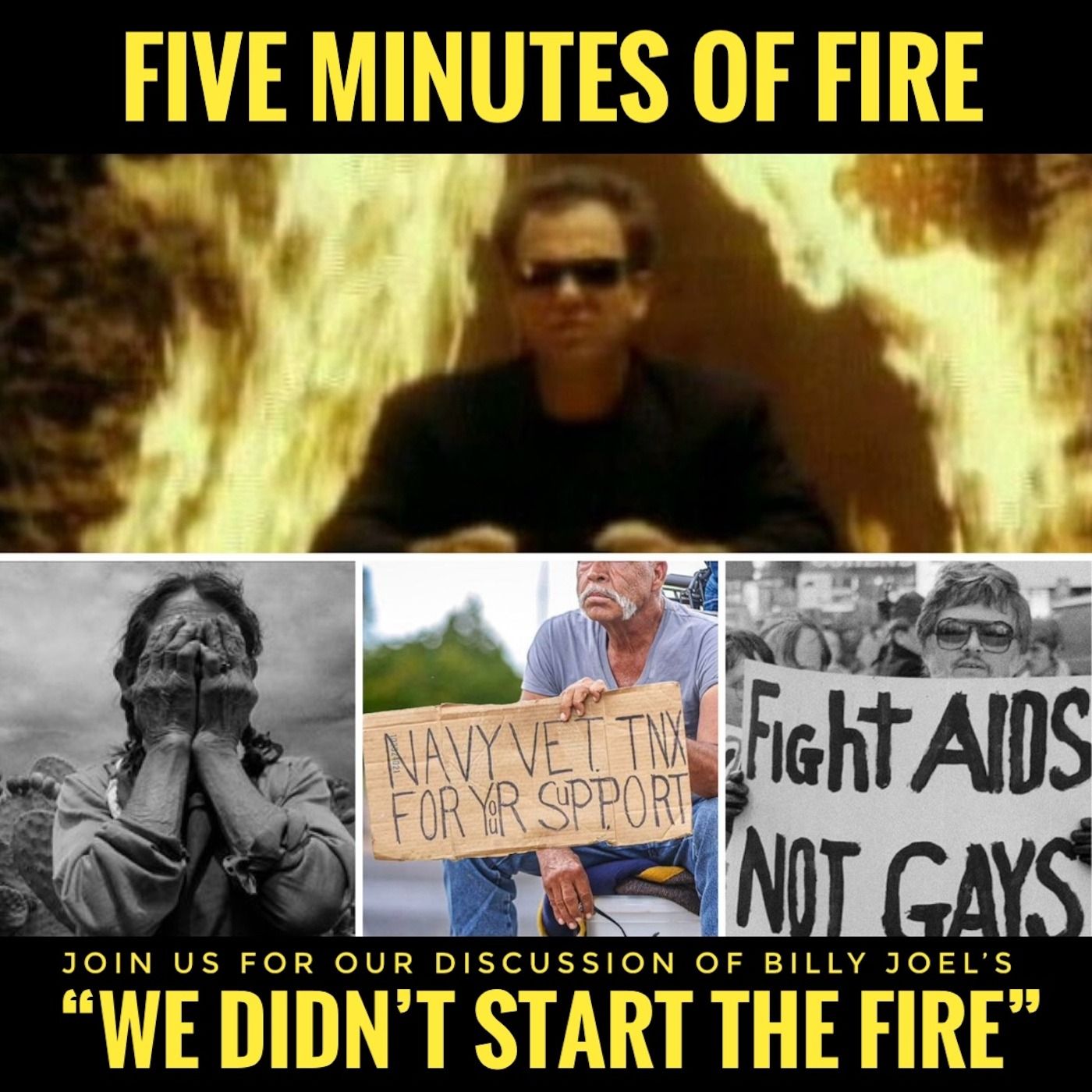
"Five Minutes of Fire": Foreign Debts, Homeless Vets, AIDS
Embark on a daily time-travel experience with "Five Minutes of Fire," the podcast series that unravels the historical layers within Billy Joel's iconic anthem, "We Didn't Start the Fire." Join us twice a day for a quick and insightful exploration of the historical names and events that have shaped the 20th century.In today's episode, the flames of history burn bright with the Latin American Debt Crisis of 1982, a pivotal moment that reverberated across the global financial landscape. We then shift our focus to the pressing issue of the homeless veteran problem, shedding light on a concerning societal challenge. The narrative takes a somber turn as we delve into the AIDS epidemic, an era-defining crisis that brought forth both tragedy and resilience.In just five minutes, we'll guide you through these historical snapshots, providing context, anecdotes, and a deeper understanding of the individuals and events that defined their times. Whether you're a devoted Billy Joel fan or someone eager to explore the stories behind the lyrics, "Five Minutes of Fire" is your daily ticket to historical enlightenment.Subscribe now to join us as we unravel the verses of "We Didn't Start the Fire," offering insights that breathe life into the captivating tales behind the names etched into the song. "Five Minutes of Fire" - where history unfolds swiftly and vibrantly, twice a day. Don't miss your daily spark of historical exploration!
2024-01-22
4 min
Transcript
Available Results
Generated results are saved to the knowledge database for reuse and search.
No generated results are available for this episode yet.
Extract Knowledge
Pick what you want extracted first. Model, scope, and chapter options appear after a template is selected.
Generated results for public episodes are saved to the knowledge database so they can be reused and searched later.
Transcript
<v Speaker 1>I'm Jason Colvin, I'm d Graves.
<v Speaker 2>Give us five minutes and we will give you the fire.
<v Speaker 1>Hello everybody, and welcome back to the Surely you Can't
<v Speaker 1>Be Serious Podcast Special Edition five Minutes of Fire. We
<v Speaker 1>are here talking about the lyrics of We Didn't Start
<v Speaker 1>the Fire by Billy Joel. We're covering only five minutes
<v Speaker 1>at a time, which is about to link with the song,
<v Speaker 1>so it works out kind of nicely. So please join
<v Speaker 1>us as we dive into some new lyrics today.
<v Speaker 2>All right, guys, so here are the topics that we're
<v Speaker 2>going to be covering today.
<v Speaker 1>Warn debts, almost vets, aids, debt okay, Jason, tell me
<v Speaker 1>about foreign debts.
<v Speaker 2>Okay. The Latin American debt crisis of nineteen eighty two
<v Speaker 2>originated in the late nineteen seventies when Latin American countries
<v Speaker 2>reached a point where their foreign debt exceeded their earning
<v Speaker 2>power and they could not repay it. A few things
<v Speaker 2>contributed to this, the rise of the international interest rates,
<v Speaker 2>the global economic slow. Latin American countries relied heavily on
<v Speaker 2>raw material exports like oil, minerals and agricultural products. The
<v Speaker 2>global prices began to fall. To make up for this,
<v Speaker 2>the Latin American countries borrowed at higher rates. This put
<v Speaker 2>them in a very risky position. International banks began to
<v Speaker 2>lose confidence in Latin American countries. In nineteen eighty two,
<v Speaker 2>Mexico declared its inability to pay back its debts. Many
<v Speaker 2>countries experienced deep depressions, which led to widespread unemployment, and
<v Speaker 2>it continues to have widespread and lasting effects today. Okay,
<v Speaker 2>do you tell us about homeless vets?
<v Speaker 1>Okay, Veterans being homeless has been a problem in the
<v Speaker 1>US since as early as nineteen thirty two. In nineteen
<v Speaker 1>thirty four, there were as many as a quarter million
<v Speaker 1>veterans living on the streets. During the Truman administration, there
<v Speaker 1>was one hundred thousand homeless vets just in Chicago and
<v Speaker 1>another twenty five thousand in Washington, DC. And then by
<v Speaker 1>nineteen eighty seven the number had reached an epidemic proportion.
<v Speaker 1>It was something in the neighborhood of three hundred thousand
<v Speaker 1>homeless vets. And this became a big concern, and so
<v Speaker 1>they begin to try to not only address the homeless problem,
<v Speaker 1>but they addressed some of the other mental health issues
<v Speaker 1>that go along with veterans being homeless. Typically they suffer
<v Speaker 1>from PTSD anxiety disorder, and they have a lot of
<v Speaker 1>emotional trauma, either involving their the war itself or injuries
<v Speaker 1>that they might have received there. But since nineteen eighty
<v Speaker 1>seven there's been a push to end this problem. It's
<v Speaker 1>not over yet, but in two thousand and seven the
<v Speaker 1>number was down to about one hundred and fifty four thousand.
<v Speaker 1>By two thousand and twelve it was down to around
<v Speaker 1>sixty two thousand, twenty thirteen, down to fifty seven thousand,
<v Speaker 1>two thousand fourteen, down to fifty four thousand, and twenty fifteen,
<v Speaker 1>down to forty seven thousand, So the numbers keep getting
<v Speaker 1>chipped away, but it is still a continuing problem even today,
<v Speaker 1>thirty five years after this song, all Right, Jason aids
<v Speaker 1>all Right.
<v Speaker 2>AIDS AIDS stands for acquired immune to fision syndrome. In
<v Speaker 2>nineteen eighty one in the US, rare forms of pneumonia
<v Speaker 2>and cancer begin being reported in high rates for young
<v Speaker 2>gay men and injection drug users. AIDS we know now
<v Speaker 2>attacks and destroys infection fighting c D four cells in
<v Speaker 2>the body. In nineteen eighty two, it's learned that this
<v Speaker 2>virus can be transmitted sexually and is caused by the
<v Speaker 2>HIV virus. Cases are now being reported by blood transfusion patients.
<v Speaker 2>By nineteen eighty three, women start becoming Effective nineteen eighty five,
<v Speaker 2>the pronouncement of AIDS was like a dessence. In nineteen
<v Speaker 2>eighty six, we learned that women can pass HIV through breastfeeding.
<v Speaker 2>In nineteen ninety eight, to ten million people are estimated
<v Speaker 2>to be living with HIV. The virus was located in blood, semen,
<v Speaker 2>and even saliva, which scared the heck out of everybody.
<v Speaker 2>It's much more treatable now, although there still is no cure.
<v Speaker 2>Famous people who have had HIV include Ready Mercury, reg
<v Speaker 2>Luganis Gia Keurengi, Arthur Ashe, Liberachi, Anthony Perkins, Isaac Asimov,
<v Speaker 2>Danny Pintaro, Robert Reid, Roy Cone, Rock Hudson, Ryan White,
<v Speaker 2>Charlie Sheen, and Magic Johnson.
<v Speaker 1>Okay, guys, that does it for today's episode. Join us
<v Speaker 1>next time for five minutes of fire
Chapters
No chapters available.