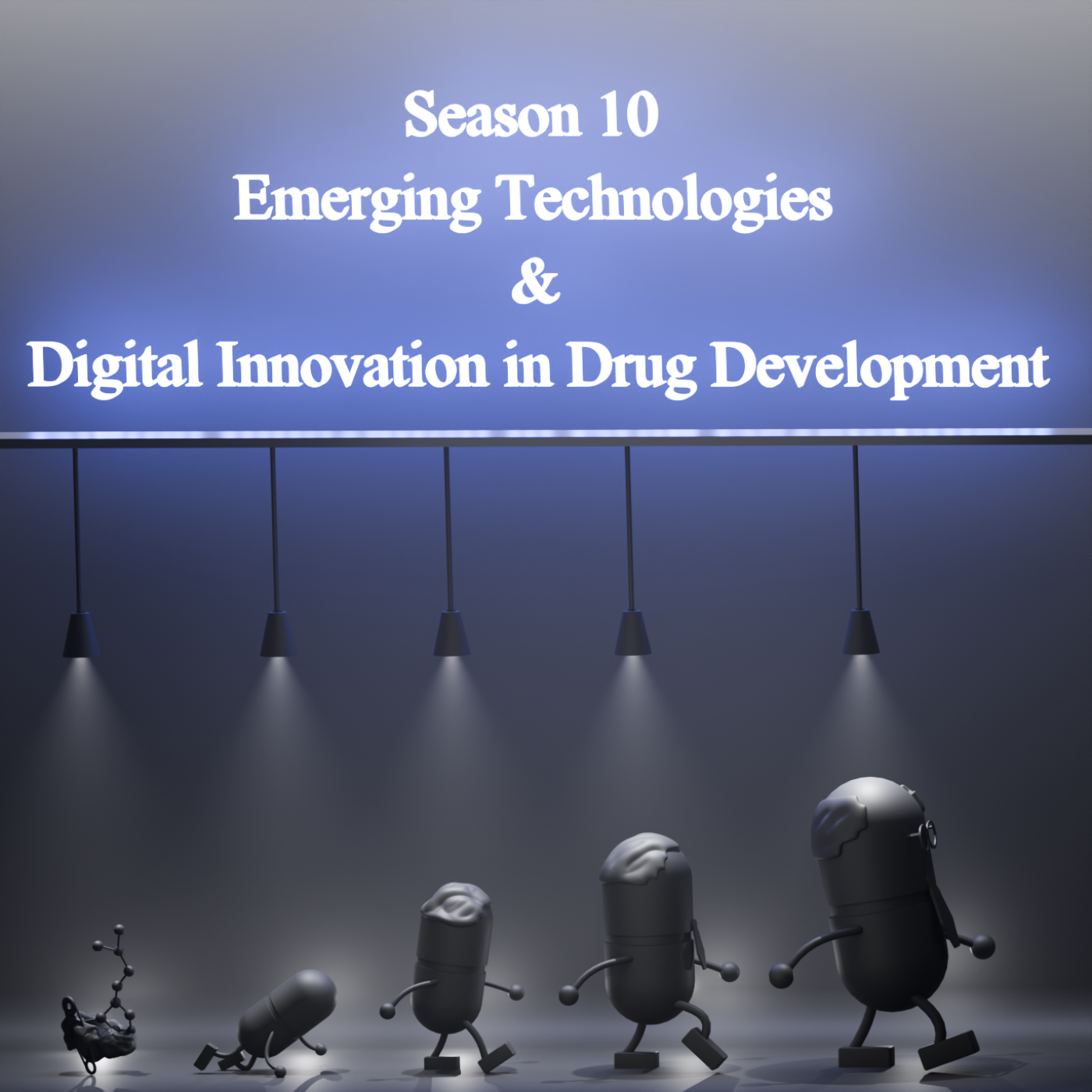
136 - Digital Transformation in Pharma (S10E1)
From Concept to Medicine - A Comprehensive Drug Development Journey
This episode introduces how digital technologies are revolutionizing the pharmaceutical industry, from research and development to manufacturing and beyond. It highlights the pivotal roles of artificial intelligence (AI), automation, and innovative digital platforms in reshaping every aspect of the pharmaceutical pipeline. The discussion emphasizes how these technologies are transforming the way medicines are discovered, developed, and even manufactured, pushing the boundaries of what's possible in modern healthcare. The potential impact on personalized medicine and cancer therapy is particularly highlighted, showcasing the shift from mere correlation to a deeper understanding of causation.
The episode delves into real-world applications, such as the GNS REFS platform used by GNS Healthcare and Gentech. Key trends in automation and the growing importance of data analytics are explored, with a focus on case studies that demonstrate the practical implementation of these technologies. Real-world literature examples are pulled from OPR&D sources, providing concrete illustrations of the concepts discussed. By pulling apart the complex interplay of these digital tools, it aims to equip listeners with a clearer picture of how the pharmaceutical landscape is evolving.
Available Results
Generated results are saved to the knowledge database for reuse and search.
Extract Knowledge
Pick what you want extracted first. Model, scope, and chapter options appear after a template is selected.
Transcript
Welcome to the Deep Dive. Today, we're jumping
into a really dynamic area, digital transformation
in the pharmaceutical world. It's moving incredibly
fast. Absolutely. We've gathered insights from
a lot of scientific and pharma literature, really
focusing on how AI, automation, and these new
digital platforms are changing everything, how
medicines get discovered, developed, even manufactured.
Yeah, here's the whole pipeline. Right. So our
mission, if you will, for this Deep Dive is pretty
clear. We want to pull out the key ways these
technologies are reshaping pharma, giving you
a good handle on this evolving landscape. And
it's not just theory, is it? We're seeing real
-world applications right now, like the GNS REFS
platform. Oh, right. Tell us about that. Well,
GNS Healthcare and GenTech are using it. And
the interesting part isn't just that it's machine
learning, but it's causal machine learning. It
helps them simulate and understand why certain
treatments might work for specific cancer patients.
So it's not just correlation. It's getting closer
to causation. Exactly. That's a huge step for
personalized medicine, particularly in cancer
therapy. It shows this isn't just future gazing.
It's happening. OK, let's unpack this AI angle
a bit more. We're talking about a whole range
of things, right? Machine learning, deep learning,
neural networks, even natural language processing.
That's right. It's a whole toolkit. And these
tools are essentially amplifying what health
care practitioners and researchers can do in
drug development. Amplifying how? Exactly. Well,
AI offers really powerful computational methods
for a couple of key things. First, designing
completely new drug molecules. From scratch.
From scratch. And second, for drug repurposing,
basically. Finding new uses for drugs we already
have. Repurposing, that sounds efficient. It
can be incredibly efficient. There was that famous
example, Eve, the AI system. It helped identify
potential new uses for existing drugs against
parasites causing tropical diseases. Right, I
remember reading about that. That work really
showed the potential for tackling diseases that
might not get the big R &D budgets, didn't it?
Precisely. It can dramatically speed up finding
potential treatments in those areas. That's amazing.
Finding hidden value in existing medicines. It
must also help with the sheer amount of data.
Farmer research generates tons of it, right?
All different kinds. Oh, absolutely. That's a
massive challenge. Integrating data that's often
sparse comes from different types of studies,
biology, pharmacology, clinical results. It's
like putting together a puzzle with half the
pieces missing and the other half not quite fitting.
Yeah, I can see that. AI is really changing that.
These solutions can handle that complexity, integrate
diverse data sets more flexibly. This allows
for cross -dataset analysis, which deepens our
understanding of diseases and how drugs actually
work in the body. So AI helps connect the dots
across all this varied information? Essentially,
yes. It fills in the knowledge gaps, which is
crucial for developing more targeted and effective
drugs. Okay, so AI is helping analyze data, find
new uses for old drugs, even design new ones.
What about the hands -on lab work? Is digital
changing things there, too? Definitely. Automation
is a big trend. Take the idea of an automated
synthesis and purification laboratory and ASPL.
ASPL. Yeah, basically a lab where robots do a
lot of the chemical synthesis and purification
guided remotely by researchers. So chemists could
direct experiments from anywhere. That's the
concept. Right. It could make research more efficient,
maybe enable collaborations across the globe
more easily. It's a glimpse into a more automated
future for lab work. Sounds very sci -fi, but
also practical. But you made a point earlier,
AI is augmenting researchers, not replacing them.
Yes, and that's a really important distinction.
AI and automation are powerful tools. But drug
discovery? It's incredibly complex. It still
needs human creativity, intuition, critical thinking.
Things AI can't quite do yet. Exactly. AI is
fantastic at handling data, finding patterns
humans might miss, suggesting paths. It speeds
things up enormously, gives researchers better
info for decisions. But the human element, the
innovation, the problem -solving that remains
absolutely central. That makes sense. It's a
partnership, really. Human insight combined with
computational power. Okay, let's shift gears
a bit. Further down the pipeline. High -throughput
screening, HTS, that's where they test thousands
of compounds, right? Correct. Huge libraries
of chemicals tested against a biological target.
How does digital tech help manage that? That's
where chemoinformatics comes in. After HTS flags
potential hits molecules showing some activity,
chemoinformatics helps sort the wheat from the
chaff. How? One common way is clustering the
hits based on their chemical structures. grouping
similar compounds together. This means researchers
don't have to follow up on every single initial
hit. They can focus on a representative sample
from each structural cluster, saving a lot of
time and resources. So you group them by similarity
and pick a few from each group to study further.
Smart. But I imagine just looking at structure
has limitations. You're right, it does. Relying
solely on structure or descriptor -based clustering
isn't perfect. Sometimes molecules with subtle
but important differences get lumped together.
Oh. That's why understanding the structure -activity
relationship SAR is so critical. SAR, how the
structure relates to what the molecule actually
does. Exactly. Chemoinformatics tools help analyze
those SARs so we don't accidentally throw out
good candidates because of flawed clustering.
It's about the link between structure and function.
Got it. It's more nuanced than just grouping
shapes. Yeah. OK, let's move to... Manufacturing
and analysis. Quality control is obviously paramount
in FORMA. How are digital tools helping there?
Automation is key here, too, for both quality
and efficiency. Take Raman spectroscopy, for
instance. Spectroscopy. Yeah. It's being used
for both offline testing and, significantly,
for online measurements during manufacturing.
For example, checking drug content in real time
as drug -loaded films are being extruded. Online.
So checking quality as it's being made, not just
at the end. Precisely. That's a core idea behind
process analytical technology, or PET. It's about
building quality into the process through understanding
and control. You see Panerzi being applied to
improve control over other crucial processes,
too, like granulation, which is fundamental for
making many pills and tablets. Digital tools
allow much tighter control, leading to more consistent,
higher quality medicines. So it's a shift towards
proactive quality assurance baked into the manufacturing.
Makes sense. What about clinical trials? That's
another huge data heavy phase. Absolutely. And
while things like electronic records and signatures.
You know, 21 CFR Part 11 set the stage for digital
data management years ago. Right. That's been
around a while. We're now seeing more advanced
uses. AI, for example, is increasingly used to
analyze the massive amounts of adverse event
data from large trials. Sifting through all the
side effect reports. Exactly. AI can potentially
spot subtle safety signals or patterns in that
huge data set that might be hard for humans to
catch. It strengthens our understanding of a
drug safety profile. With thousands of patients,
I can see how AI would be invaluable there. Can
we talk about some real -world examples? How
has this tech actually changed a drug's path?
Sure. Crezotinib is a great case study. It was
initially developed as a meat inhibitor for solid
tumors. But during early trials, analyzing the
data revealed it was also active against ALK,
a different target involved in a specific type
of non -small cell lung cancer. So the data pointed
in a new direction. Yes. And that discovery driven
by the trial data analysis, led to its approval
specifically for ALK -positive lung cancer. It
really shows how dynamic development can be,
guided by emerging data. Wow. So a drug for one
cancer finds its place treating another, based
on data insights. That's powerful. Any others?
Another good one is Trastuzumab imtansine. The
clinical trial showed significantly better outcomes
for certain HER2 positive breast cancer patients
compared to the existing standard of care. Better
survival rates in response. Markedly better progression
-free survival, overall survival response rates.
The data was compelling and based directly on
that robust trial data, it got FDA approval.
It shows a clear link. Strong data leads to approval
and new options for patients. These examples
really highlight the impact. Now with all this
tech AI, advanced analytics, How is the regulatory
side keeping up? Are agencies like the FDA adapting?
They are definitely adapting, though it's an
ongoing process. An important step in the US
was the 21st Century Cures Act amending the definition
of a medical device, specifically carving out
certain software functions. Acknowledging software
isn't the same as a physical device. Kind of,
yes. And for AML -based medical technologies,
the FDA has different approval pathways. 510K,
PMA, de novo, depending on the risk and novelty
of the tech. A tiered approach based on risk.
Exactly. And interestingly, sometimes the regulatory
path for an AI -based device can be less complex
than for a whole new drug molecule. Really? Why
is that? Well, it varies, but it might involve
demonstrating substantial equivalence to an existing
cleared device, for instance. This has partly
led to faster adoption of AI tools, especially
in areas like radiology. We've seen quite a few
FDA clearances for AI diagnostics there. So the
regulatory framework might be enabling quicker
uptake for AI in devices compared to drugs. It
seems to be contributing to the spread, yes.
It signals growing confidence, too. That's a
key point. What about investment? Are pharma
companies putting their money where their mouth
is with digital transformation? Oh, absolutely.
The investment trends are clear. A survey back
in 2022 showed AI was the top priority for planned
investments by pharma companies and professionals.
Number one, ahead of other things. Ahead of big
data and digital media, which were next on the
list. It shows a real strategic commitment. They're
investing heavily across the board, R &D, manufacturing,
commercialization. It's not just talk. So significant
resources are flowing into this. Okay, let's
try and wrap this up. To bring our deep dive
to a close, what are the main takeaways for listeners?
I think the biggest takeaway is that digital
transformation isn't just coming. It's here in
pharma. It's affecting every single stage. Right.
From using AI to find and repurpose drugs faster,
to using automation for better manufacturing
quality, to getting deeper insights from clinical
trial data. It's reshaping everything. Even the
regulators are evolving. And hopefully, for you
listening, this dive gives you a clearer picture
of how these digital tools are changing the game,
potentially leading to faster, safer, more effective
medicines. Which leads us to one final thought,
perhaps. As AI and data science advance so rapidly,
what are the big ethical questions, the practical
hurdles, especially as these technologies get
woven even more tightly into healthcare and how
we create these lifesaving drugs? That's something
we'll all need to keep Grappling with you know
the ethical and practical side is this integration
deepens. It's definitely food for thought