Plant Tissue Systems Lecture
A reminder: the ads on this podcast (as well as most podcasts) are terrible. You can get AD-FREE versions of this podcast episode on the crime pays patreon (https://www.patreon.com/CrimePaysButBotanyDoesnt)
In this episode:
We talk about the three main types of tissue systems in plants :
Dermal (trichomes, guard cells)
Ground (Parenchyma, Collenchyma, Sclerenchyma) &
Vascular (xylem and phloem)
What the hell are these tissues? Whatta they mean? Whatta they do?
In this episode:
We talk about the three main types of tissue systems in plants :
Dermal (trichomes, guard cells)
Ground (Parenchyma, Collenchyma, Sclerenchyma) &
Vascular (xylem and phloem)
What the hell are these tissues? Whatta they mean? Whatta they do?
2024-10-12
56 min
Transcript
Available Results
Generated results are saved to the knowledge database for reuse and search.
No generated results are available for this episode yet.
Extract Knowledge
Pick what you want extracted first. Model, scope, and chapter options appear after a template is selected.
Generated results for public episodes are saved to the knowledge database so they can be reused and searched later.
Transcript
<v Speaker 1>Okay, so today we're doing another lecture series, and I
<v Speaker 1>wish I had a better background. I do. You could see,
<v Speaker 1>you know, I don't even have anything hung on the wall.
<v Speaker 1>Back there. I hung a mirror because nobody photos. But
<v Speaker 1>you know, it's really fucking depopera. It's just the white room.
<v Speaker 1>It's bleak, it's fucking you know, it's not the decor
<v Speaker 1>I would have chosen. If you could see what I got.
<v Speaker 1>And you know, I got some nice stuff up there,
<v Speaker 1>but not here. And then I'm wearing this this cat
<v Speaker 1>shirt that a friend I think he stole it from
<v Speaker 1>a truck stop for me years ago. You know, it's
<v Speaker 1>kind of a gag because he knows I hate feral cats.
<v Speaker 1>He knows I've got a fucking undying hatred for feral cats.
<v Speaker 1>No offense to them, you know, I think they're better
<v Speaker 1>off as fertilizer. You know, they kill a ton of wildlife.
<v Speaker 1>You know, people, people pity the feral cats. They don't
<v Speaker 1>pity the wild life that they fucking murk. Can't blame people,
<v Speaker 1>I guess they don't. You know, everyone's so disconnected. They
<v Speaker 1>don't think like that. They just see a cute animal.
<v Speaker 1>But uh, you know whatever, it's a it's a you know.
<v Speaker 1>I swear this will be the last cat I will
<v Speaker 1>ever bring home. I swear this will be the last
<v Speaker 1>cat I ever put in the ground, you know, to
<v Speaker 1>fertilize my native plants. I'm just kidding, ah kind of. Anyway,
<v Speaker 1>So today we're gonna talk about I love indoor cats.
<v Speaker 1>Think they're great. You keep your cat indoors are fucking great.
<v Speaker 1>You don't give it treats, built fucking ramps for it,
<v Speaker 1>you know, ladders and shit. Make sure it's cozy as hell.
<v Speaker 1>Take good care of it and empty its litterbox. That's good.
<v Speaker 1>You let that thing outside, it becomes a scourge in
<v Speaker 1>the environment, and especially if you if it newted it,
<v Speaker 1>then you start, you know, a burgeoning feral cat problem.
<v Speaker 1>I digress. Let's share the screen now, and we're gonna
<v Speaker 1>If this doesn't work, I'm using I'm using a different
<v Speaker 1>app for recording because the YouTube has just fucked me
<v Speaker 1>so bad anytime I do these line live streams. Okay,
<v Speaker 1>and I'm also recording this for the podcast too, because
<v Speaker 1>I figure some of you on long drives, you know,
<v Speaker 1>you want to learn about tissues, You want to learn
<v Speaker 1>about parent Kima and all this stuff. Uh so this
<v Speaker 1>will be your opportunity. Hopefully this is. Let me make
<v Speaker 1>sure this is working. There we go look at that.
<v Speaker 1>It's screen sharing. Nice all right, but I got a
<v Speaker 1>backup too in case it's not. YouTube has just fucking
<v Speaker 1>me so many times. I gotta drive. I'm driving to
<v Speaker 1>Mona Hans, Texas later tonight. Gonna gonna go say hi
<v Speaker 1>to the Mona Hans County Sheriff for fucking cop whatever. Yeah, hi, police,
<v Speaker 1>I just want to let you know. My name's Joey Santur.
<v Speaker 1>I'm gonna be in town for tonight. I've got a
<v Speaker 1>history as a petty criminal, used to do graffiti as
<v Speaker 1>a as a teenager. Anyway, Okay, never mind, I don't
<v Speaker 1>know what I'm talking abou let's just cut to the
<v Speaker 1>fucking chaser here. Going to the Oklahoma City Fungus Fair.
<v Speaker 1>I'll be talking there Saturday, doing a presentation on lawn
<v Speaker 1>and killing h you know, selling some merched t shirts, books,
<v Speaker 1>that kind of stuff. Anyway, so let's talk about plant
<v Speaker 1>tissues because this gets really confusing. I was hearing these
<v Speaker 1>words Paring Kaima, Colin Kai, all this stuff on and
<v Speaker 1>off for so long and not really knowing what the
<v Speaker 1>fuck it is. So plant tissues. Got three tissue systems. Okay,
<v Speaker 1>then some of these have Each one of these tissue
<v Speaker 1>systems has different subclassifications, subunits. Okay. The three tissue systems
<v Speaker 1>are surface tissue, dermal tissue. I don't like the word surface.
<v Speaker 1>Let's forget about the word surface. Okay, dermal epidermis okay,
<v Speaker 1>guard cells for stomata, tricombs okay, hairs cuticle. You know
<v Speaker 1>of the weed bros always say try combs. They just
<v Speaker 1>think weed. Maybe not so much anymore. Maybe people are
<v Speaker 1>a little more versed in botany these days. I remember
<v Speaker 1>when I first was doing videos and I mentioned tricombs,
<v Speaker 1>people just immediately thought of weed, not realizing that many
<v Speaker 1>plants have tri combs, even some mosses. Okay, three tissue systems,
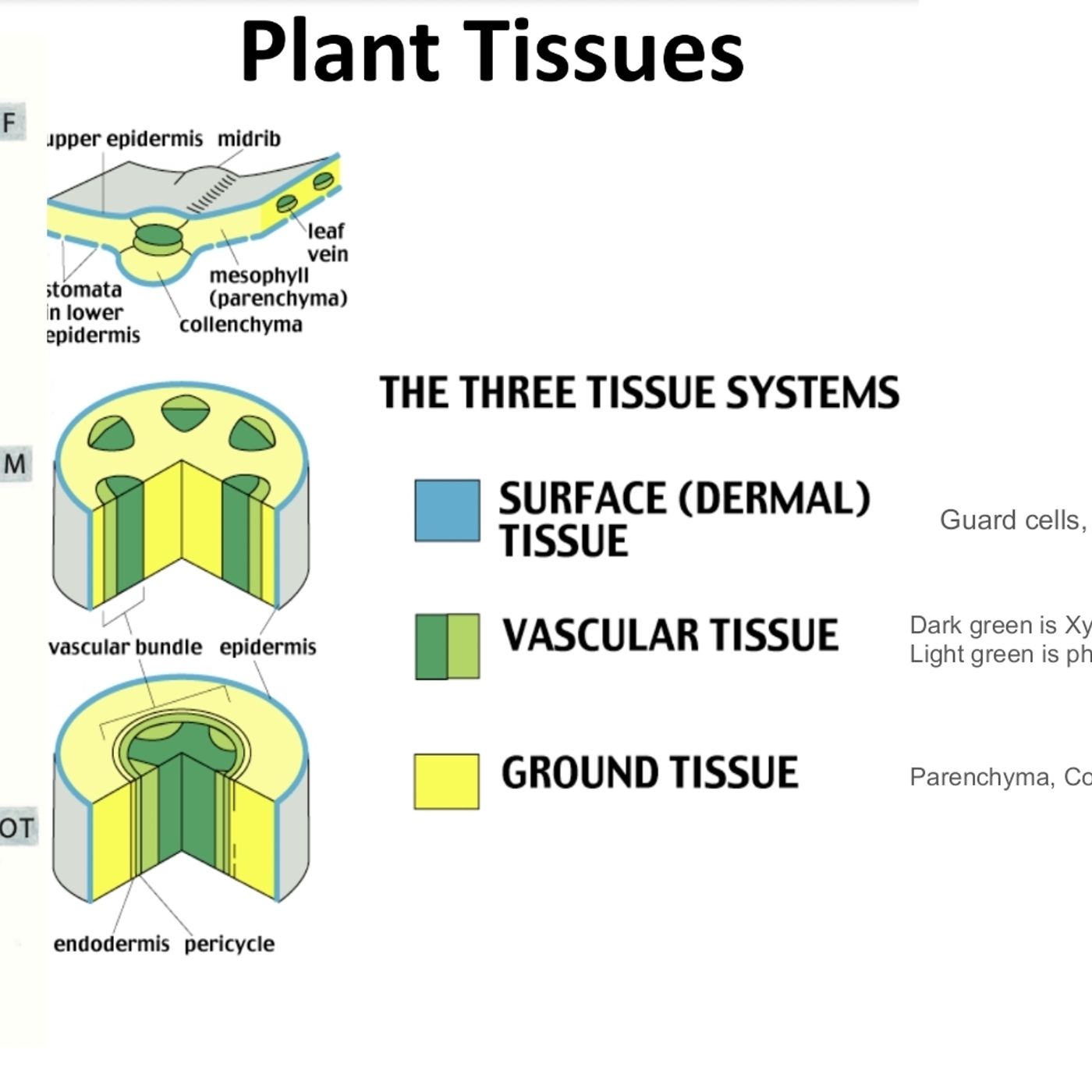
<v Speaker 1>epidermal tissue, vascular tissue, and ground tissue. And you got
<v Speaker 1>these nice little these nice little graphs right now, graphs
<v Speaker 1>diagrams that I stole from my friend Matt Ritter, who
<v Speaker 1>teaches boutany of California Polytechnic over there. Wonderful man. Okay,
<v Speaker 1>you got a vascular bundle which is comprised of both
<v Speaker 1>xyleum and flowam, which occur together. Xylem takes water up,
<v Speaker 1>flow them takes sugars down, up, down, and all around. Okay,
<v Speaker 1>distributes the sugar's made and photosynthesis to the rest of
<v Speaker 1>the plant. Okay. Ground tissue, What the ship is ground tissue?
<v Speaker 1>You got Parenchyma, Colin Kima, Sclaring Kima. Okay, what the
<v Speaker 1>hell are those? You could say parankam I, you could
<v Speaker 1>say Colin Kami, you could say Sclaring commite. It doesn't matter.
<v Speaker 1>Anyone who's gonna correct your pronunciation is probably going to
<v Speaker 1>be a knob just to ignore them. What matters that
<v Speaker 1>you understand what the fuck these tissues do? Okay, So
<v Speaker 1>we have, uh, these three tissues, parent Chima, Colin Kima,
<v Speaker 1>Sclaring Chima, which are considered ground tissue. We have epidermal tissue,
<v Speaker 1>and we have vascular tissue. Three tissue systems. Okay, the
<v Speaker 1>tissue types right. Simple tissues are made of only one
<v Speaker 1>cell type. Complex tissues are made of multiple cell types. Okay.
<v Speaker 1>Vascular tissue and dermal tissue are complex tissue. They're composed
<v Speaker 1>of many different cell types. Ground tissues, simple tissue. Okay,
<v Speaker 1>excuse to me, I'm really sorry about that. Okay. They
<v Speaker 1>someone get mad at me they heard me talking that voice,
<v Speaker 1>like what are you making fun of gay people? He
<v Speaker 1>was like, fuck, no, I don't know. None of my
<v Speaker 1>gay friends actually talk like that. None of my my
<v Speaker 1>gay friends don't. I don't know what gay friends you have,
<v Speaker 1>but they're not. You know, that's my like white woman
<v Speaker 1>calling the police voice. You know, that's like my North
<v Speaker 1>Berkeley lady calling the police or yelling at you because
<v Speaker 1>your dog's off leash voice. Okay, that's like a bullshoes.
<v Speaker 1>It's more of a bourgeois thing, all right. Anyway, Okay,
<v Speaker 1>so tissue types, simple tissues, complex tissues, don't worry about
<v Speaker 1>that so much. We're not going to get into it.
<v Speaker 1>You got this nice little cross section, vascular tissue system,
<v Speaker 1>the tubes going through the leaf. You got the dermal
<v Speaker 1>tissue system, cross section of the stem dermal at dermis.
<v Speaker 1>It makes sense ground tissue that the green corky stuff
<v Speaker 1>right in the center, quirky and well, cork's not the
<v Speaker 1>well cork is a ground okay. And vascular system and
<v Speaker 1>vascular tissue the plumbing all right, same thing going on
<v Speaker 1>in the root, dermal ground vascular all right, apical marasimes.
<v Speaker 1>Back to the apical marasims are the points on a
<v Speaker 1>plant that undergo new growth, found at the tips of
<v Speaker 1>all roots and stems. An initial cell undergoes mitosis mitosis,
<v Speaker 1>excuse me. Contrast that with myosis, which only goes on
<v Speaker 1>on the gonades. Myosis is making haploid cells from diploid cells. Okay,
<v Speaker 1>initial cell undergoes mitosis and one of the daughter cells
<v Speaker 1>stays an initial cell. Contrast that with derivative initials and
<v Speaker 1>derivative while the second cell develops a wall which more
<v Speaker 1>or less stops it from dividing anymore. Apical marasimes can
<v Speaker 1>be thought of as the perpetually young part of the plant.
<v Speaker 1>I think I talked about this and shoots and roots
<v Speaker 1>in the last one of these podcast classes I did.
<v Speaker 1>So you got initial cells and derivative cell, derivative cells.
<v Speaker 1>Initials the cells that maintain the meristem. Okay. As a
<v Speaker 1>continuing source of new cells, member maristimes can turn into
<v Speaker 1>one of three different there's there's stem cells. Basically, it's
<v Speaker 1>it's undifferentiated tissue. Okay. Initials are the cells that maintain
<v Speaker 1>the marastem. Is a continuing source of new cells. Initials
<v Speaker 1>are the actively dividing plants sell in a meristem, and
<v Speaker 1>each division, one daughter cell remains in the mirrorstem is
<v Speaker 1>a new initial and the other is added to the
<v Speaker 1>growing plant body. All right. Initials are thought of as
<v Speaker 1>the perpetually young cells. Derivatives are cells that will eventually
<v Speaker 1>differentiate differentiate keyword into specialized cell types. Okay, now right here,
<v Speaker 1>we got a nice graph. We got appical mirrorstem. But
<v Speaker 1>there are three types of primary mirrorstems. Protoderm which turns
<v Speaker 1>into epidermis, protoderm EpiDerm miss all right, dermal tissue system.
<v Speaker 1>I mean, these turn into one of the three tissue
<v Speaker 1>systems ground meristem. Okay, So, protoderm, ground marasteme, pro cam.
<v Speaker 1>Ground maristem turns into ground tissues parent chyma colin chima,
<v Speaker 1>clarin chyma or parent comma colon kima whatever the ground
<v Speaker 1>tissue system, and the pro cambium turns into the primary
<v Speaker 1>asylum and the primary flowing the vascular tissue system. So
<v Speaker 1>the three primary marastims, protoderm, ground marisdem, pro cambium, these
<v Speaker 1>are all located in the appical maristime. When that shit
<v Speaker 1>is dividing when you're getting a burst of new growth. Okay,
<v Speaker 1>a burst of new growth, which we say in are
<v Speaker 1>that's at of like a mirtha steward voice. That's the
<v Speaker 1>the North Berkeley woman who's calling the police sending for
<v Speaker 1>having your dog off leash. Not not just you know,
<v Speaker 1>not just a gay man. Okay, it's not a game man,
<v Speaker 1>right the fuck someone took that? And Jesus Christ always
<v Speaker 1>I just a shit that people just want to get
<v Speaker 1>upset about. Fucking drives me nuts. Okay, So okay, so
<v Speaker 1>this this page is extremely important. You're gonna need to
<v Speaker 1>reference it again. Primary you get the three primary tissue
<v Speaker 1>types epidermis, ground tissues and vascular tissue, and primary marisims protoderm,
<v Speaker 1>ground maristem, and pro cambium. Okay, all right, nice little
<v Speaker 1>chart of the appicle marastem, got leaf, primordia, active new
<v Speaker 1>cell growth. You can see get the protoderm, the pro
<v Speaker 1>cambium in there. The ground maris them axillary bud systems,
<v Speaker 1>which will themselves turn into new apical marras stems when
<v Speaker 1>they get going. You also have apical marras stems on
<v Speaker 1>the root the root appical maris stem you get that
<v Speaker 1>root cap which acts like a little helmet, all right,
<v Speaker 1>and it can lose cells. The cells just get a
<v Speaker 1>braided off. Is that's that roots That root elongates through
<v Speaker 1>the soil, and then you've got appicle maris them pro cambium, protoderm,
<v Speaker 1>ground marast and then you get the root hairs in
<v Speaker 1>the vasket developing vascular cambium and cork cambium. If it's
<v Speaker 1>not a monocap, remember cork cambium and the lateral marason.
<v Speaker 1>The vascular cambium. If it's not a monocons don't don't
<v Speaker 1>have that. Monocots do not have secondary growth. They don't.
<v Speaker 1>They just grow up and down. They don't grow laterally.
<v Speaker 1>Some monocots, some of the aloes Xanthoria in Australia, the
<v Speaker 1>grass trees, maybe some yuccas, they have anomaloust secondary growth.
<v Speaker 1>But it's not true secondary growth, all right. A palm
<v Speaker 1>tree grows up and doesn't get much wider. It's just
<v Speaker 1>that's why they stay skinny and tall. The most monocots
<v Speaker 1>do not have uh, lateral marastimes. They have what is
<v Speaker 1>it interclorie marastimes. I forget what it's called. It's a
<v Speaker 1>special specialized type of maristhem and monocots. It's the way
<v Speaker 1>you can mow. That's the way you can mow the lawn.
<v Speaker 1>Do you like to do that? If that kind of sick,
<v Speaker 1>twisted shit is your is what you're what you're into.
<v Speaker 1>Let's see, do you get how about an interclorie mirror?
<v Speaker 1>Is that? Yeah, interclorie maras stems. But we're not going
<v Speaker 1>to get into that. We'll get into another interclorie maherstems
<v Speaker 1>are plant tissues that promote grow in alongation and plants,
<v Speaker 1>especially grasses in the monocots. Right there, you go, Okay,
<v Speaker 1>so move on along. You know what, The most of
<v Speaker 1>the root that's actually doing the absorbing is the new tissues. Okay,
<v Speaker 1>the stuff that's further back in the root, the older
<v Speaker 1>tissue is just doing. And there's a there's a part
<v Speaker 1>in Raven Biology of Plants, which is a PDF you
<v Speaker 1>can download from lib gen or from the Google drive folder.
<v Speaker 1>I might have shared. There's this is section twenty three
<v Speaker 1>that's dealing with this. I should have mentioned that in
<v Speaker 1>the first part. But there's a section. There's a section
<v Speaker 1>in Raven when he's talking about or the book is
<v Speaker 1>talking about because it's two authors, it's what is it
<v Speaker 1>Ikorn and Susan Everett, and they're talking about roots and
<v Speaker 1>the older tissue on roots, like the thicker roots are
<v Speaker 1>just involved in transport. It's the lateral the tips of
<v Speaker 1>the lateral roots and the tapper or whatever. The new
<v Speaker 1>growth basically with all the root hairs is what is
<v Speaker 1>doing most of the absorption of water and nutrients. And
<v Speaker 1>then the root hairs de is that thing keeps growing.
<v Speaker 1>So when you dig up a plant out of the ground,
<v Speaker 1>you're mostly breaking the new shit, the new tissue. That's
<v Speaker 1>why it's it's so easy to mess up if you're
<v Speaker 1>not getting a big chunk of root all because you're
<v Speaker 1>you know, you might think that, oh I keep I
<v Speaker 1>have the big roots. It's good, but you've severed all
<v Speaker 1>those are just doing transport. The new stuff, the new growth,
<v Speaker 1>the finer roots are what are doing most of the
<v Speaker 1>absorption of water and nutrients. Good to keep in mind. Okay,
<v Speaker 1>so there are three primary marisims, protoderm grimeris them in
<v Speaker 1>pro cambing. We already talked about this the primary tissues.
<v Speaker 1>Let's move on to the dermis, the epidermis. Okay, epidermis
<v Speaker 1>the outermost layer of cells more than one cell type,
<v Speaker 1>so they're complex. They're not simple tissues covered with a
<v Speaker 1>waxy cuticle layer to prevent water loss. Cuticle which is
<v Speaker 1>exuded by the epidermis. Okay, and it's that also, you
<v Speaker 1>can have a farina on there, you can x, you
<v Speaker 1>can have extra cuticular wax. The shit gets deep, all right,
<v Speaker 1>especially when you go with arid land plants. Zero fights
<v Speaker 1>where they got to have a thicker cuticle. Okay, that
<v Speaker 1>thicker wax or waxy layer, that hydrophobic layer. All right,
<v Speaker 1>you got the guard cells form stomata. Hopefully everybody listening
<v Speaker 1>to this podcast knows what stomata are. It's how plants
<v Speaker 1>take in CO two and let out water, vapor and oxygen,
<v Speaker 1>as well as some of the wonderful smells that they
<v Speaker 1>plants exude. On a warm summer night, say you know,
<v Speaker 1>by a railroad diamond in Chicago. Some of have some
<v Speaker 1>fucking wonderful smells I remember coming off of like the
<v Speaker 1>golden rods out of the leaves, not the flowers coming
<v Speaker 1>out of the leaves, and warm summer nights in Chicago
<v Speaker 1>as a little kid, just say, God, that smell. It's
<v Speaker 1>just thought, so it's what my front yard smells like,
<v Speaker 1>all right, because it's all just thick thornbrush, all right, Right,
<v Speaker 1>the tree crickets start up when the sun goes down.
<v Speaker 1>It sounds awesome and fucking smells great anyway. And tricomb's
<v Speaker 1>slash hairs part of the epidermal system. Epidermal system, there
<v Speaker 1>you go. Okay, tricombs can be living or dead. So
<v Speaker 1>you got you get a nice cross section of the
<v Speaker 1>epidermal system. You got the tricomb cuticle, stomata, guard cells,
<v Speaker 1>gases going in, going out, okay. Leaf is mostly composed
<v Speaker 1>of epidermis okay, which is dermal tissue, parentama, which is
<v Speaker 1>a ground tissue which we're gonna get to, and klinkama
<v Speaker 1>colin kamma is mostly like the harder parts of the leaf,
<v Speaker 1>like the veins, a little bit more structure than just
<v Speaker 1>the puffy parentcomma in the middle, right, the low density parentomma.
<v Speaker 1>So moving right along, nice beautiful picture of Aeriocarpus phisseratus flowering.
<v Speaker 1>All right. I use this because that's a good that's
<v Speaker 1>a good good plant to use as an example of
<v Speaker 1>the dermal tissue system. Look at the fucking epidermis on
<v Speaker 1>this thing. Thick cuticle, thick epidermis as well, Got a
<v Speaker 1>little bit of farina on there, got plenty of tricombs.
<v Speaker 1>All right, great, great specimen plant to use for a
<v Speaker 1>presentation about the epidermal system of plants. Okay. The cuticle
<v Speaker 1>is made up of a polymer called kutin, consisting of
<v Speaker 1>fatty acids, glycrol, and wax. It seals the inside of
<v Speaker 1>insides of plants oft from the atmosphere and protects against
<v Speaker 1>drying out. All plants had to evolve a cuticle when
<v Speaker 1>they evolved out of the green algae roughly four hundred
<v Speaker 1>and fifty million to five hundred million years ago. You
<v Speaker 1>should all have that fucking landmark on your geologic timeline.
<v Speaker 1>Degenerates along with the evolution of life three point eight
<v Speaker 1>billion years ago, a great oxygenation event two point two
<v Speaker 1>billion years ago, et cetera. The fuck you doing? Huh?
<v Speaker 1>If you don't know your geological landmarks, geologic time scale landmarks,
<v Speaker 1>you caryotic life when you caryotic life evolve one point
<v Speaker 1>seven million years ago, something like that? Look at that nice,
<v Speaker 1>nice money shot of this bee, would bee? Was that
<v Speaker 1>I forget one of the solitary bees. One of the
<v Speaker 1>beautiful desert solitary bees pollinating Aerocarpus phizzeratus, which are going
<v Speaker 1>off right now in the West Texas Desert. Okay, Acarpus
<v Speaker 1>pizzeratus has some of the thick cuticle of any plant,
<v Speaker 1>up to two hundred and fifty micrometers stick. Most plants
<v Speaker 1>have leaves with cuticle that is nine micrometer stick. There
<v Speaker 1>you go, tubercle of Aerocarpus piseratus showing waxy, wordy textured
<v Speaker 1>excuse me, cuticle and epidermis. Look at that nice drawing
<v Speaker 1>of it on the side too. That is fucking insane.
<v Speaker 1>That wardy, just that weird texture to that living rock cactus. Okay,
<v Speaker 1>this is cuticle on a gave. Have alreadyana during a
<v Speaker 1>salvage event. Some rich moron was killing a bunch of
<v Speaker 1>plants in his yard because he wants to just dump gravel.
<v Speaker 1>I don't know what he's doing. He's out of his mind,
<v Speaker 1>but anyway, and moving some of this atgave, I've alreadyana.
<v Speaker 1>I accidentally damaged it. That is probably not just cuticle.
<v Speaker 1>It might be, but actually talked to Jim Mossuth about this,
<v Speaker 1>who taught at U T Austin for a while, and
<v Speaker 1>that is probably a little bit epidermal tissue too, all right,
<v Speaker 1>but it's like a thick, plastic y translucent film. And
<v Speaker 1>then you can see the photosynthetic tissue of the agaya
<v Speaker 1>leaf blade below that, and all those fibers, whose wonderful fibers. Right.
<v Speaker 1>Peoti also has a thick cuticle but also has epicuticular
<v Speaker 1>waxtone as farina. I mean, all the other plants I
<v Speaker 1>showed you just now did too, but that's what gives
<v Speaker 1>them that kind of blue glaucous color as well. Right,
<v Speaker 1>that glaucous blue glaucus basically means chalky blue color reflecting UV.
<v Speaker 1>All right, onion peel epidermis, this is Ritter's slide that
<v Speaker 1>I stole. I got it close up with that the
<v Speaker 1>stomate right there with the guard cells, all right, number
<v Speaker 1>an onion bulb is just a stem and the onion
<v Speaker 1>peel are just leaves, all right. Okay, So stomata singular stoma,
<v Speaker 1>you got guard cells, and you gotta pores. Those guard
<v Speaker 1>cells inflate with water, become more turgid. The cells squish out,
<v Speaker 1>they buckle out because they got nowhere to go, thus
<v Speaker 1>allowing for the exchange of gases with the inside of
<v Speaker 1>the cell. Well water vapor out CO two in. All right.
<v Speaker 1>We should also mention a lot of aquatic plants don't
<v Speaker 1>have stomata or cuticle because they don't need it, all right,
<v Speaker 1>they secondarily lost it. Okay, So anyway, guard cells swollen,
<v Speaker 1>stoma opening, all right. There's also a lot of other
<v Speaker 1>shit going on here with potassium ions, and it's in
<v Speaker 1>ebsysic acid too. It's not as simple as just water in,
<v Speaker 1>water out, but blah blah blah, alright, it's there's a
<v Speaker 1>little bit more going on, but generally speaking, that that
<v Speaker 1>was guard cells filled with water, giving them more turgidity,
<v Speaker 1>and that's how they open. When they close, it's a
<v Speaker 1>little bit different, involves maybe some hormones, but anyway, all right,
<v Speaker 1>so cell wall vacuuole in there. We'll cover that next.
<v Speaker 1>The next class and cells chloroplasts, of which any plant
<v Speaker 1>cell can have twenty two one hundred chloroplasts. Chloroplas are
<v Speaker 1>one of three main types of plastid and then nucleus ocase. Anyway,
<v Speaker 1>so stomata opened, turgid, stomata closed, flacid. It's like Mitch
<v Speaker 1>McConnell's neck stomata in lofa for a cactus Payota, you
<v Speaker 1>can see little stomach, so it's a beautiful looking at
<v Speaker 1>it up close. Carbon dioxide goes in water, vapor and
<v Speaker 1>oxygen come out Payoti, like all cacti do cam photosynthesis,
<v Speaker 1>crass lece and acid metabolism, whereby they take in carbon
<v Speaker 1>dioxide at night so that they're opening their stomata at
<v Speaker 1>night when it's not hot as balls out, and then
<v Speaker 1>they close their stomata during the day and they take
<v Speaker 1>that carbon dioxide in when they're taking it at night.
<v Speaker 1>They store it in the form of malleate or malic
<v Speaker 1>acid and then can use and store that and then
<v Speaker 1>use it during the day for photosynthesis. All right, plenty
<v Speaker 1>of plants do crass lace and acid metablism. Fuck, there
<v Speaker 1>was a really cool cladogram that showed all the goddamn
<v Speaker 1>plants that do crastoles and acid metabolism. I wish I
<v Speaker 1>would have included in the It was in a paper.
<v Speaker 1>It was circular cladogram to a really nice one, you know,
<v Speaker 1>and showed all the plant families orchids, bromeliads, there's a
<v Speaker 1>couple of ferns. Really cool stuff and then carry offight lalies.
<v Speaker 1>The order has some of the most cam photosynthesis, you know,
<v Speaker 1>the ones that engage into camp photosynthesis. Right anyway, Stillmata
<v Speaker 1>and Christmas cactus aka Shlamburgera trancata. All right. Tricombs another
<v Speaker 1>part of the epidermal tissue system leaf hairs. You can
<v Speaker 1>see you got two different kinds of tricombs right here.
<v Speaker 1>One a glandular tricomb, a tricomb with a gland on it.
<v Speaker 1>The gland exudes a secondary metabolite of some sort. Okay.
<v Speaker 1>Carnivorous plants do this, they have glandular tricombs. Cannabis does this,
<v Speaker 1>has glandular tricombs, living tricombs. Okay, because remember tricombs can
<v Speaker 1>be dead or alive. And then you've got these other
<v Speaker 1>hairs too, Okay, So what a hairs do they do?
<v Speaker 1>A shit done? All right? They can be many uses.
<v Speaker 1>They can act like a frost cloth. Okay. During that
<v Speaker 1>Texas freeze, I had heliu at this Argophylus, the silver
<v Speaker 1>leaf sunflower outside. Though the temperatures got down to twenty
<v Speaker 1>eight degrees, it pulled through fine. Why because its leaves
<v Speaker 1>are densely coated in tricombs not for frost. It evolved
<v Speaker 1>on the hot and dry South Texas sandsheet. But you know,
<v Speaker 1>it initially evolved those to reduce the avapple transporation of
<v Speaker 1>water from its stomata by those hot, drying winds, and
<v Speaker 1>also reflects from sunlight. But it had the added benefit
<v Speaker 1>of acting like a frost cloth too, same thing like
<v Speaker 1>citrus farmers in Florida do when they're gonna get a freeze, right,
<v Speaker 1>it'll buy you that frost cloth, or the hairs will
<v Speaker 1>buy you four or five degrees fahrenheit of protection. It
<v Speaker 1>gets down to twenty you're fucked. But we're only getting
<v Speaker 1>out of twenty eight for a few hours in the
<v Speaker 1>morning that those hairs will protect you. Okay, But hairs
<v Speaker 1>also reflect uv light. Like we said, they act like
<v Speaker 1>a wind break and a little farmhouse on a prairie,
<v Speaker 1>right like you you know, you get the those flat landers, right,
<v Speaker 1>the winds just come ripping across the fucking flat lands.
<v Speaker 1>You got a little farmhouse out there, They just beat
<v Speaker 1>the shit out of your house. Whatever, what do you do?
<v Speaker 1>You build? You put up like a wind break. Okay,
<v Speaker 1>that's exactly what the tricombes are doing. On a leaf.
<v Speaker 1>They call it boundary layer humidity reduces the boundary layer
<v Speaker 1>or it increases the boundary layer of humidity, okay, which
<v Speaker 1>is confusing as fuck, But basically what it's doing is
<v Speaker 1>it's reducing airflow across the leaf, because airflow is anyone
<v Speaker 1>who's ever put a hot you know, put a fan
<v Speaker 1>on a clothesline in a garage, like you if I
<v Speaker 1>am trying to dry a fucking blanket because you know,
<v Speaker 1>my dog pissed on it or you know, or puked
<v Speaker 1>on it because she's been eating grass, you know. Uh,
<v Speaker 1>And I wash it and then I don't want to
<v Speaker 1>put in the dryer because it's going to take it
<v Speaker 1>makes the lumping sounds of painting ass. I'll go hang
<v Speaker 1>it in my hot ass garage in South Texas because
<v Speaker 1>I don't want to get beat by the v But
<v Speaker 1>I'll put in my hot ass garage, put a fan
<v Speaker 1>on it. Thing drives in like fucking ten minutes, right
<v Speaker 1>because airflow. If I don't turn the fan on, it'll
<v Speaker 1>take five times as long. It'll still dry, but it'll
<v Speaker 1>take five times as long. Okay, You put a fan
<v Speaker 1>on things, even if it's not that hot out, it'll
<v Speaker 1>that airflow will help that moisture evaporate. And that's exactly
<v Speaker 1>what's going on on a lot of leaves. So what
<v Speaker 1>is what do the hares do, especially in like windy, hot,
<v Speaker 1>dried desert. It's like the mojave where it could the
<v Speaker 1>winds can just be crazy that you know. Some of
<v Speaker 1>the hairriest plants come from the Mohave desert. Those hairs
<v Speaker 1>break up that airflow. They break up that airflow from
<v Speaker 1>hitting the leaf and prevent it from pulling moisture out
<v Speaker 1>of those stomata. Okay, okay, so anyway, glandular tricombes one
<v Speaker 1>of those types of tri combs. Some dows have glandular
<v Speaker 1>tricombes that act this fly paper all right. There you
<v Speaker 1>can see got a little drocera. All right, there's drascera
<v Speaker 1>traci from Florida. Wonderful illustration. You can see you've got tinier,
<v Speaker 1>much tinier tricombe on this unfurling leaf, and then you've
<v Speaker 1>got really long ones with the little gland on top. Right.
<v Speaker 1>Both are tricombs. All right, That was a fucking cool plant,
<v Speaker 1>all right, really long sticky leaves. Okay, These glandular tricombs
<v Speaker 1>are dermal tissues and part of the dermal tissue system,
<v Speaker 1>of which there are two other systems. Remember ground tissues
<v Speaker 1>and vasco tissues. Just give you a little reminder there.
<v Speaker 1>This is real rigula, then Tata the flypaper plant, this
<v Speaker 1>shit eater from South Africa. Okay, I'm not being mean.
<v Speaker 1>It literally eats shit. Okay, It's got this bug which
<v Speaker 1>co evolved with it. What is it palm Palmeridia marlothii
<v Speaker 1>or rorigulae. There's two species of Origula, both in South Africa.
<v Speaker 1>They grow in different much different environments. One grows on
<v Speaker 1>very dry soil, one grows in boggy typical carnivorous plant substrate.
<v Speaker 1>They both each has their own species of this bug
<v Speaker 1>that can walk on the leaves without getting stuck, eat
<v Speaker 1>the bugs that do get stuck. Takes a dump and
<v Speaker 1>then the plant uses that as it's nitrogen source. So
<v Speaker 1>the plant is not actually secreting enzymes to break down
<v Speaker 1>the bugs like many carnivorous plants through it's eating the shits.
<v Speaker 1>The gg on plant. Okay, this is where Originla gorgonas
<v Speaker 1>right here with a different species of that insect. But
<v Speaker 1>look at those really glandular tricombes. Look at that. This
<v Speaker 1>was such a cool spot. Goddamn, there were so many
<v Speaker 1>cool plants there. You can see all this land's been
<v Speaker 1>converted to agriculture. It's not okay, now we're moving out
<v Speaker 1>of ground tssues my favorite parent chyma, colon chyma, and
<v Speaker 1>sclaring kaima. What the fuck does this mean? The kimas? Okay,
<v Speaker 1>they're present in most organs of the plant. These ground tissues,
<v Speaker 1>of which there are three that I just mentioned, present
<v Speaker 1>and most organs of the plant. This packing and supportive
<v Speaker 1>tissue accounts for much of the bulk of the young plant.
<v Speaker 1>It also functions in food manufacture, photosynthesis, and storage such
<v Speaker 1>as starch. Okay, this is a nice reminder. It's showing you.
<v Speaker 1>This yellow stuff is the ground tissue. Vascular bundle. Flow
<v Speaker 1>them on the outside, Okay, towards the towards the dermal
<v Speaker 1>tissue side xylum, towards the inside of the plant. All right,
<v Speaker 1>all right, parent chyma. These cells have thin cell walls, Okay,
<v Speaker 1>thin cell walls, and only have a primary wall too,
<v Speaker 1>which we'll get into cells later. Sorry. Most plant cells
<v Speaker 1>can have a primary cell wall and a secondary cell wall.
<v Speaker 1>Animals don't have cell walls. Right. That's one of the
<v Speaker 1>big differences between animals and plants, which there are many,
<v Speaker 1>not to mention chloroplasts all right, but animals don't have
<v Speaker 1>cell walls. They've got membranes, cell membranes, right. Plants have
<v Speaker 1>cell membranes, they also have cell walls. Fungi have cell
<v Speaker 1>walls as well. They make them out of kiten. Plants
<v Speaker 1>make their cell walls out of cellulose. Radiolaria and diatoms
<v Speaker 1>make their cell walls out of silica out of glass.
<v Speaker 1>That's how you get biogenic hirt. Limestone is made from
<v Speaker 1>the trillions of dead bodies of single celled cocoa, lithophores
<v Speaker 1>and forumnifro, which make their cell walls out of helse
<v Speaker 1>seemed carbonate bacteria make their cell walls out of peptidoglycan
<v Speaker 1>et cetera. So anyway, parent chyma, these cells have thin
<v Speaker 1>walls and are primarily responsible for functions like photosynthesis and
<v Speaker 1>food stories. Right, so most remember most of the mass
<v Speaker 1>of I think most of the mass of a plant
<v Speaker 1>is going to be parent chyma. Okay, like in a
<v Speaker 1>big saguaro cactus, a saguaro ass cactus, or a cardon
<v Speaker 1>or whatever, most of that tissue, all right, The low
<v Speaker 1>density tissue is going to be parent chyma a right,
<v Speaker 1>primary cell wall, no secondary cell wall, Okay, same with
<v Speaker 1>klon kima, primary cell well, no secondary cell well. Sclarin
<v Speaker 1>chyma has a secondary cell wall, right, And so going
<v Speaker 1>from top to bottom, par chyma, colon kyma, sclerin kyma, parenchyma, parenchyma,
<v Speaker 1>you want to call it that, And again, it doesn't
<v Speaker 1>matter how you pronounce it, really don't give a fuck.
<v Speaker 1>This matters how you understand it. That you do understand it.
<v Speaker 1>Parent chyma is the softest if you want to think
<v Speaker 1>of it like this. Colon Kyma is intermediate density in
<v Speaker 1>sclarin chyma is hard. Okay. So cactus spines are a
<v Speaker 1>good example of sclerin chyma, right, and sclarin kyma possesses
<v Speaker 1>you know it says right here, possessing highly dignified cell walls.
<v Speaker 1>These cells provide strong support to mature plant structures once
<v Speaker 1>growth has ceased. Sclarin kima is dead at maturity, all right.
<v Speaker 1>So that and any of the hard shit that gives
<v Speaker 1>you a good example, a good idea of what like
<v Speaker 1>an acorn cap probably mostly sclarin kinma. The shell of
<v Speaker 1>an acorns mostly sclaring kmma. Cactus spines mostly almost entirely
<v Speaker 1>sclarin kima okay. Colon chyma with thickened cell walls at
<v Speaker 1>corners okay. And this is a trademark of them is
<v Speaker 1>if you look at their cells, they've got looks like
<v Speaker 1>structural reinforcements on the corners of the cell walls. These
<v Speaker 1>cells provide support the growing plants like young stems and leaves.
<v Speaker 1>But it's not debt to maturity. So parent chyma alive
<v Speaker 1>at maturity, klon kyma alive maturity, Sclarin chima debt of maturity,
<v Speaker 1>all right, and sclarin kima has a secondary cell wall
<v Speaker 1>all right. Ground tissue is the tissue that fills the
<v Speaker 1>space in between the epidermal tissue and the vascular tissue. Okay,
<v Speaker 1>so you can get those three tissue systems epidermal ground
<v Speaker 1>of vascular. Ground tissue consists of parentemma, sclerin comma, and
<v Speaker 1>coloncama parent committas tissue is made of living cells and
<v Speaker 1>thin walls of cellulose. Parent comma cells are unspecialized and
<v Speaker 1>can differentiate into other cell types. Sometimes they're just used
<v Speaker 1>for storage, okay. Sometimes they're used for photosynthesis. They are
<v Speaker 1>found in the soft parts of plants like leaves and
<v Speaker 1>fruits and are involved in storage, secretion, and photosynthesis. Colon
<v Speaker 1>Chyma This tissue is made up of living cells with thickened,
<v Speaker 1>non lignified no lignan primary walls, no secondary walls. Colon
<v Speaker 1>Comma cells are found in leaves, petioles, young stems, and
<v Speaker 1>provides support interbaceous plants. Sclerin Chyma just tissue is made
<v Speaker 1>up of dead cells with thick lignified cell walls secondary
<v Speaker 1>cell walls. Scleric Comma cells are fun and mature parts
<v Speaker 1>of plants like wood, fibers and water conducting cells like
<v Speaker 1>zyme and provide support, protection, and transportation. Xylum, which transports water,
<v Speaker 1>is dead at maturity all right. Prankamat tissues living at maturity,
<v Speaker 1>thin primary cell walls just reiterated. Just running through this
<v Speaker 1>shit hammer and large central vacuole can take in many shapes,
<v Speaker 1>function in photosynthesis, storage, and transport of food and water. Look,
<v Speaker 1>you got a picture of a potato there, all right,
<v Speaker 1>excellent example of parankama. Potato is most entirely paranama. It's
<v Speaker 1>all parentkama. Right, But look at these Look at this
<v Speaker 1>close up right here. It's thin primary cell walls, okay
<v Speaker 1>on these drawings, and large intercellular spaces in between the cells.
<v Speaker 1>Remember that's why it said load density. It is the
<v Speaker 1>soft shit, all right, just like the inside of a cactus,
<v Speaker 1>the potato, et cetera. All right. The parentkama real nice
<v Speaker 1>perankama cells are the most numerous cells in the plant body.
<v Speaker 1>Chlorophyll is mostly found in parentkama tissue. The majority of
<v Speaker 1>photosynthesis occurs in parankamat tissue specifically and especialized kind of
<v Speaker 1>tissue called chlorinkama. I don't think that's even used that
<v Speaker 1>much anymore, all right. Chloricma is just prankama cells with chloroplasts.
<v Speaker 1>Chlorinicommie is a specialized type of plant tissue, specifically a
<v Speaker 1>prankama cell that contains chlorophyll, the green pigment responsible for
<v Speaker 1>photosynthesis of shit, and it's primarily found in the leaves
<v Speaker 1>of plants, enabling them to capture light and produce food
<v Speaker 1>through photosynthesis. Essentially, it's the quote green tissue of a
<v Speaker 1>plant that actively participates in photosynthesis. Key points about chlorinicimma. Fuck,
<v Speaker 1>i'd see I fucked up this this slide anyway, all right, Yes,
<v Speaker 1>that's correct. The majority of photosynthesis in plants takes place
<v Speaker 1>within the prankama tissue, specifically in the palisade prankamas cells
<v Speaker 1>located in the leaf mesophyl. And then this other part
<v Speaker 1>got cut off, so whatever, and then this is ritter slide.
<v Speaker 1>Look he's look, he's got the potatoes in here, and
<v Speaker 1>nice got these relatively low density cells, large intercellular spaces
<v Speaker 1>all right, palis mesophyl, spongy mesophyl, both are parankama, right,
<v Speaker 1>upper rapid dermis, different tissue system. That's the epidermal tissue,
<v Speaker 1>wax secutical. You got the air spaces in between the
<v Speaker 1>cells right there, lower epidermous waxecutical guard cell. Yes, the
<v Speaker 1>potatoes primarily composed of prank of with tissue. The majority
<v Speaker 1>of the edible part of potato is made of a
<v Speaker 1>prankama cells, which your responsible for storing starch to main
<v Speaker 1>carbohydrate found of potatoes. Then you go fry it and
<v Speaker 1>a bunch of fucking greasy oil, add a bunch of salt.
<v Speaker 1>Then you get diabetes in ten years. Key points about
<v Speaker 1>potatoes and perankama prankama cells and potatoes and primal leaves
<v Speaker 1>for food storages. Filled with starch grands. Remember, storage and
<v Speaker 1>photosynthesis are the main the main jammers of parankama tissue.
<v Speaker 1>All right, Sedum, Like there's a little sedum, some sort
<v Speaker 1>of crass relations, bastard. Okay, The majority of that succulents
<v Speaker 1>in that plant is parentma all right. Yes, the succulent
<v Speaker 1>part of a cactus is primarily composed of pranka my cells,
<v Speaker 1>which are specialized to store water and food. Make it
<v Speaker 1>tissuy responsible for the cactus ability to restore moisture in
<v Speaker 1>a fleshy stem. Okay, highly vacuolated. The parent cooma cells
<v Speaker 1>in a cactus have large vacuoles, all right. The inner
<v Speaker 1>cellular space, all right, that's a whole different. Uh, we'll
<v Speaker 1>get into that when we get into cells. They can
<v Speaker 1>expand to store water when available and contract during drought periods.
<v Speaker 1>I like to think of vacuoles one of their roles,
<v Speaker 1>aside from containing pigments. I right, they're the part of
<v Speaker 1>a plant cell, which I shouldn't even talk about because
<v Speaker 1>I don't want to fuck you guys up. But this
<v Speaker 1>is part of a this is for the this should
<v Speaker 1>be for the cell. Actually, the vacuole is like you know,
<v Speaker 1>if you got a mail like I got this fucking
<v Speaker 1>lamp on Scamazon. Shit broke within a week, as you
<v Speaker 1>would expect something you buy on Scamazon. Uh. And so
<v Speaker 1>I got to send it back and I got to
<v Speaker 1>find some shit to put in this box so that
<v Speaker 1>it's not rattling around. I mean, I don't give a shit.
<v Speaker 1>Maybe the thing should just break, you know, Maybe they
<v Speaker 1>should put some dried dog shit in there too. I
<v Speaker 1>don't know. I'm a little bitter about this thing. But
<v Speaker 1>this little you know, it was a little touch lamps.
<v Speaker 1>It's a small one. It was like fifteen bucks. But still,
<v Speaker 1>come on, you know. So I got to figure out
<v Speaker 1>some packing materials to put in there. That packing material
<v Speaker 1>would be analogous to the vacuole of a cell. Okay,
<v Speaker 1>and parenchyma cells are highly vacuolated. I didn't know there
<v Speaker 1>was a word, but apparently it is. Thin cell walls,
<v Speaker 1>no secondary cell walls, highly vacuolated, large ento cellular spaces
<v Speaker 1>used for storage and photosynthesis. See, there you go, There
<v Speaker 1>you go, thin walls, thin cell walls, large spaces spaces. Erenkima,
<v Speaker 1>a specialized type of parent chyma with a very large airspace,
<v Speaker 1>is often found the aquadic plants or points. You don't
<v Speaker 1>worry about that, but remember that low density stuff. Okay,
<v Speaker 1>So now we're moving on to the next tissue type,
<v Speaker 1>colin Chyma, composed of living cells with thick primary cell walls,
<v Speaker 1>flexible support for organs such as leaves and herbaceous stems.
<v Speaker 1>Colin Kyma, the example they always give in bodany classes
<v Speaker 1>are those stringy parts of a cellar rece. I don't
<v Speaker 1>know why they couldn't come up with a better example
<v Speaker 1>than that, but that's what they use. Okay. But it's
<v Speaker 1>intermediate and density I like to think of. It's not
<v Speaker 1>soft and fluffy and light like prankama. But it's not
<v Speaker 1>dead at maturity either. It's still alive maturity, and it
<v Speaker 1>still doesn't have secondary cell walls. Okay, see close up
<v Speaker 1>on next image. There you go, there you go. See
<v Speaker 1>you the fucking celery. Last time I had a piece
<v Speaker 1>of celery like that was a long time ago. It's
<v Speaker 1>always limp and soft, and you know, I live in
<v Speaker 1>a small town of West Texas. We get ship produce
<v Speaker 1>out here. A prominent example of kanakama tissue is this quote.
<v Speaker 1>Strings found in celery stocks, which provide flexible support to
<v Speaker 1>the plant. Other examples include the young stems of herbaceous plants,
<v Speaker 1>petioles of leaves, and the veins within leaves, where kalon
<v Speaker 1>kama cells are often located just beneath the epidermis, providing
<v Speaker 1>structural support while allowing excuse me for bending without breaking
<v Speaker 1>key points about kala kama function provides flexible support mechanical strength,
<v Speaker 1>particularly in young growing plant parts. Sell Jesus Christ, it's
<v Speaker 1>a fucking topo Chico cell structure, elongated cells with uneven
<v Speaker 1>lea thick and primary cell walls made of cellulose and pectin,
<v Speaker 1>and location typically found just below the epidermis in stems
<v Speaker 1>and leaves, all right. Other examples of plants with noticeable colon, well,
<v Speaker 1>you know what, Maybe that other leaf tissue I mentioned
<v Speaker 1>was not priankam, it was kla kama. I don't know anyway.
<v Speaker 1>Other examples of plants with noticeable colacama potato stems, tomato stems,
<v Speaker 1>sunflower stems, begonia leaves, and deadly unite shape stems. So
<v Speaker 1>you could see a lot of stem tissue on herbaceous
<v Speaker 1>plants holding things rigid while still being alive, not being
<v Speaker 1>dead like wood or cork is all right, tissues that
<v Speaker 1>can be dead at maturity. Right, But the big giveaway
<v Speaker 1>right here is look at the corners of those cell walls.
<v Speaker 1>They're reinforced with those thickened corners, those structurally reinforced thickened corners, right,
<v Speaker 1>cell wall thickening, all right. The characteristic feature of Klonkama
<v Speaker 1>cells is uneven thickening of their primary cell walls, particularly
<v Speaker 1>at the cell corners, which reduces the size of the
<v Speaker 1>lumin and it's space inside. Unlike Sclerincama, colon kama is
<v Speaker 1>a living tissue, meaning it cells contain a nucleus and
<v Speaker 1>cytoplasm within the lumin lumin don't really hear that word
<v Speaker 1>too much, but anyway, colonkama. The hypodermis of any cactus
<v Speaker 1>with a tough, hard skin consists of several layers of calankima.
<v Speaker 1>Hypodermis is just below the epidermis. The hypodermis is the
<v Speaker 1>specialized layer of cells directly beneath the epidermis of a plant.
<v Speaker 1>Cacti with really soft skin have a hypodermis of parancamma. Instead,
<v Speaker 1>we got a nice tubercle transverse section of Leuketenbergia precipis
<v Speaker 1>principis with beta cyanins, which are a type of betaal
<v Speaker 1>aine pigment which members of kophylelies have instead of anthocyanid pigment.
<v Speaker 1>The red. The red pigment still accumulate mostly in the
<v Speaker 1>hypoderma cells and in lesser amounts on some chlorincama cells,
<v Speaker 1>which is parent comma with chlorophyllin it. Okay, moving right along,
<v Speaker 1>Why do I conclude a center, oh, for where the
<v Speaker 1>hypodermis is. Yes, see epidermis hypodermis chlorin kyima, all right,
<v Speaker 1>just parent comma with with chlorophyll in it. And then
<v Speaker 1>you got the vascular bundle down there, all right, the
<v Speaker 1>flow them, the flow them, and the metasyland, protosylan, et cetera,
<v Speaker 1>ground tissue surrounding all of it. All right, diecot stem,
<v Speaker 1>monocot stem, diecot stem. All right. That's look look at
<v Speaker 1>how different the monocot stem looks in terms of its
<v Speaker 1>plumbing layout in the dicot stem. Right, Dicot's got a ring,
<v Speaker 1>all right. Epidermis hypodermis cortex colin koma, chlorincomma, parent coomma, etcetera.
<v Speaker 1>Cortex is mostly parancamma, right, endodermis et cetera endo dermis,
<v Speaker 1>primary meadullary ray pith I. Don't worry about it, all right,
<v Speaker 1>clerkomma tissues deata maturity, thick and rigid secondary cell walls
<v Speaker 1>function in support and protection. And then two types two
<v Speaker 1>subunits of classification for scerankmma, scleroids and fibers. The principal
<v Speaker 1>characteristics of scrankama cells is they're thick, often dignified secondary
<v Speaker 1>cell Well, so we were harder now right, We're ad
<v Speaker 1>a harder tissue from parankama, which is soft, colon kama,
<v Speaker 1>which is intermedia in sclerin kima, which is thick, thick,
<v Speaker 1>debtit maturity. The fact that it's debt at maturity and
<v Speaker 1>it's got a secondary cell wall is what makes it
<v Speaker 1>so hard. Cactus cells sclerin chima, the things that give
<v Speaker 1>a sunflower leaf that sandpaper like feeling. Okay, the leaf
<v Speaker 1>itself is parankama and a little bit of konkoma, but
<v Speaker 1>those bits of grit that give it that sandpaper feelings sclerincimma. Okay,
<v Speaker 1>those are stone cells. Sclareids all right. In secondary cell
<v Speaker 1>wall too, not to be confused with secondary growth in
<v Speaker 1>the lateral maristem's aka vascular cambium. Two different things right there,
<v Speaker 1>all right, He said to throw them in their cactus spines.
<v Speaker 1>Consists of sclerankmma and a sclarified epidermis, mostly sclerankimma. There
<v Speaker 1>you go, stenoserriou squashta kana right there, pack is serious.
<v Speaker 1>Webre right there. Just want to any chance I can
<v Speaker 1>get to throw those photos of those in there. Fibers, Okay,
<v Speaker 1>those are a type of sclerancima, all right. Fibers for
<v Speaker 1>structural reinforcement. Not the same as plumbing. Okay, fibers are
<v Speaker 1>not the same as plumbing. They can be. Fibers can
<v Speaker 1>be in xylum tissue, but it's not the same, all right.
<v Speaker 1>Fibers are elongated sclercicma cells that provide structural rigidity and
<v Speaker 1>stiffening to leaves, stems, and roots. Okay, structural rigidity, all right.
<v Speaker 1>Sclareds stone cells from the hard tissues of nuts, seed, coats,
<v Speaker 1>et cetera. Sclereids from pair the tissue of a pair,
<v Speaker 1>same thing, depending on what type of pair you're eating,
<v Speaker 1>all right, can have some of that same like sandpapery
<v Speaker 1>gritty feel as a sunflower leaf. Right, Those are stone cells, right,
<v Speaker 1>They may also be present together with thin walled parankama cells.
<v Speaker 1>The three basic types of plant tissue. I don't like
<v Speaker 1>the parentamas in the middle right here, it should be
<v Speaker 1>the left, and it should be colon kamma, sclerin comma.
<v Speaker 1>That I ripped this off from online. What are you
<v Speaker 1>gonna do? Right, prankama, colin kamma, and sclerankama. Prankama has
<v Speaker 1>intracellular spaces, low density uh colacma tissue. Those cell walls
<v Speaker 1>reinforced corners of the cell. Remember, prankama and colacama both
<v Speaker 1>only have primary cell walls and their secondary Scrankama tissue
<v Speaker 1>has cell walls with lignan, secondary cell walls with lignin
<v Speaker 1>debt of maturity. All right, and you can have stone cells,
<v Speaker 1>the scleroids or the fibers, all right, sclernkama simple pit pair.
<v Speaker 1>The pit pair is what that's the what the plasma
<v Speaker 1>does mota go through. That's how one cell communicates with
<v Speaker 1>another in a plant. All right. Pit pairs contain plasma desmata,
<v Speaker 1>which are just strands of cytoplasma. But don't worry about that.
<v Speaker 1>We'll cover that in cells next class. Narrow lumin lignified
<v Speaker 1>thick wall. The fuck is this? Lumin ravens by alogie
<v Speaker 1>of plants doesn't use the word of lumine, all right,
<v Speaker 1>primary cell wall in middle lamella, secondary cell wall impregnant
<v Speaker 1>with lignid pick canal, et cetera. Right. Examples of scrinkma
<v Speaker 1>include the husk of a coconut, the stone cells and
<v Speaker 1>fruits like pears, the fibers and a plant's them, the
<v Speaker 1>shells of nuts, and a hard outer layer of seeds
<v Speaker 1>sunflower seeds, great example, all right, The inside is what
<v Speaker 1>it would that be parentama okay, and the outside the
<v Speaker 1>black part is sclerincimma. Scrin Coma tissue is primarily responsible
<v Speaker 1>for providing structural support the plants due to its thick
<v Speaker 1>lignified cell walls. Calancmma tissue can provide structural support as well,
<v Speaker 1>but mostly interbaceous plants. Right, and it's not as strong
<v Speaker 1>as s clerincimma. Okay. Key points about sclen comma. Cell
<v Speaker 1>types consists of two main cell types fibers fibers excuse me,
<v Speaker 1>long narrow cells and sclereds short irregular cells aka the
<v Speaker 1>stone cells aka the cells on a sunflower leaf or
<v Speaker 1>the skin of a pair. Function provides rigidity and macarenical
<v Speaker 1>strength to the plant. Cell wall composition, thick cell walls
<v Speaker 1>heavily lignified with cellulose and hemi cellulose and lignin lignan
<v Speaker 1>as well. Why the fuck is it not? That's weird.
<v Speaker 1>I don't know why I didn't mention lignin maturity stage
<v Speaker 1>clearrn commas cells are usually dead at maturity. Okay, there
<v Speaker 1>we go, and there we go, another nice drawing of
<v Speaker 1>the cells. All right, right. Vascular tissue, all right, continuous
<v Speaker 1>tissue throughout the plant. So now we're moving from ground
<v Speaker 1>tissue to vascular tissue. Continuous tissue throughout the plant, in
<v Speaker 1>which substances are transported. Complex tissues made of numerous cell types,
<v Speaker 1>all right, not simple complex xylemin floam okay, the dark
<v Speaker 1>green and the light green, all right. Xyleum function transports
<v Speaker 1>water and mineral salts via capillary action being transpired out
<v Speaker 1>of stomata and pulled up through the roots. Right. Composed
<v Speaker 1>of different types of cells, including vessel elements and traekeas.
<v Speaker 1>Remember tracheads found in conifers. Conifers don't have vessel elements.
<v Speaker 1>Vessel elements are are more h what's the fucking word?
<v Speaker 1>I always I always forget this word. What is the word?
<v Speaker 1>They're they're more efficient? Why I forget it? Confused with significant?
<v Speaker 1>Vessel elements are more efficient. They're what angiosperms evolved. Conifers
<v Speaker 1>and gyminal sperms don't have vessel elements, they have tracheads.
<v Speaker 1>But angiosperms have tracheads too. As you could see from
<v Speaker 1>this microscope pot you got trachids right there and or
<v Speaker 1>the scanning electron microscope photo and vest elements. Vessel elements
<v Speaker 1>are bigger, all right. And the way that water moves
<v Speaker 1>through a vessel element, it can just go right up right,
<v Speaker 1>and it's got these perforation plates on the end boom boom,
<v Speaker 1>like a conveyor belt of water, whereas on tracheads it's
<v Speaker 1>got it. It's gotta you know. They're just these these long,
<v Speaker 1>narrower cylindrical cells that taper at the ends, and they
<v Speaker 1>don't line directly up. They you know, they just kind
<v Speaker 1>of make a wedge shape one end of one cell
<v Speaker 1>against the end of another cell, and then the water
<v Speaker 1>has to kind of you know, turn, make a turn.
<v Speaker 1>Its slight turns going up it turns a little bit
<v Speaker 1>forty five grangle and continues up through the rest. Okay,
<v Speaker 1>so best elements are much more efficient, right tracheads, well,
<v Speaker 1>they both have their pros and cons. I guess tracheads
<v Speaker 1>tapered at the ends but do not have holes at
<v Speaker 1>the ends. Water passes from trachy to trachied through thin
<v Speaker 1>areas in the cell wall called pits. Vessel elements long
<v Speaker 1>tubular cells, much bigger, generally speaking, can hold much more
<v Speaker 1>water open at both ends arranged end to end, forming
<v Speaker 1>vessels that function like water pipes. Okay, like the pipes.
<v Speaker 1>The tubes. You know, this is just the tubes. You know,
<v Speaker 1>the coffee machine broke. It's just the tubes aren't working
<v Speaker 1>no more. I don't know why what am I going
<v Speaker 1>to do with the tubes broke? It's broken with the
<v Speaker 1>tubes filthy, dirty, fucking Oh god. You know we had
<v Speaker 1>this nice coffee machine. But you know I haven't cleaned
<v Speaker 1>the tubes in a way. I think. I think out
<v Speaker 1>the hard water, you know, from the pipes and stuff
<v Speaker 1>clogged that up all right? Anyway, Uh, flow them, flow them.
<v Speaker 1>Function transports sugars and other substances xylum only transports water up.
<v Speaker 1>Flow them can transports water can transport excuse me, sugar
<v Speaker 1>and other organic substances dissolved in water. Uh, down up
<v Speaker 1>all around all right, okay. And flow consists of a
<v Speaker 1>sieve tube member, a sieve plate, and a companion cell.
<v Speaker 1>Because that flow them cell is empty and it's so
<v Speaker 1>it's performing such a critical task and it's moving and
<v Speaker 1>it doesn't you know, it's moving moving the juices, the
<v Speaker 1>products of carbo the products of photosynthesis, uh, to the
<v Speaker 1>rest of the plant, right, the carbohydrates and minerals, et cetera,
<v Speaker 1>and nutrients Okay, because that that space is empty, well,
<v Speaker 1>not empty, but doesn't it doesn't have a lot of
<v Speaker 1>room for this other components. So it's got this backup cell,
<v Speaker 1>the companion cell. All flow them cells have a a
<v Speaker 1>companion and cell, right, which is where the nucleus is.
<v Speaker 1>And it's it's kind of running. It's run running the
<v Speaker 1>given the machinery for the flowm cell. Right, Okay, it's
<v Speaker 1>kind of running the bait. It's like the shed where
<v Speaker 1>the generator is right. Composed of different types of cells, okay,
<v Speaker 1>seve tube elements, long tubular cells with sieve plates and
<v Speaker 1>the end walls arranged end to end the live but
<v Speaker 1>lacking a nucleus. Companion cells help seeve tube members function
<v Speaker 1>flowing fibers, flowing pran comma. Okay, so there you go,
<v Speaker 1>seeve plate, seeve tube member. Look, they got a nice
<v Speaker 1>drawing on the right to simplify this abstract bullshit on
<v Speaker 1>the left, which looks like a fucking you know, a
<v Speaker 1>nine inch nails cover from you know, the late nineties. Right.
<v Speaker 1>I don't know what that's, you know there is. That's
<v Speaker 1>why always like the drawings better. They're much clearer than
<v Speaker 1>the microscope slide photos right, Seve plate, seeve tube member,
<v Speaker 1>companion cell, flowing prankama. Anytime you hear seve plates, seve
<v Speaker 1>tube member, companion cell, you know they're talking about flow them.
<v Speaker 1>You know they're talking about moving sugar and carbohydrates. You know,
<v Speaker 1>they're talking about the part of the God damn it,
<v Speaker 1>why can any think of the word anyway, They're talking
<v Speaker 1>about the part of the basket lushure, not the not
<v Speaker 1>the xylum, which is moving water. They're talking about moving sugar, right,
<v Speaker 1>moving stuff to the rest of the plant. Okay, Interestingly,
<v Speaker 1>when you tap a maple tree, did I talk about
<v Speaker 1>the guess I can't remember if I did. When you
<v Speaker 1>tap a maple tree, you think you're tapping the flow
<v Speaker 1>them for the sugar, but you're not. You're actually tapping
<v Speaker 1>into the xylum. And you're doing it at that time
<v Speaker 1>of year, right in early spring, when the days are
<v Speaker 1>not freezing, but nights are still freezing. And so since
<v Speaker 1>the days aren't freezing anymore, it's starting the the all
<v Speaker 1>that sugar that's stored in the bottom of the plant,
<v Speaker 1>that's starting to push that back up towards the leaves,
<v Speaker 1>towards the rest of the plant getting ready for spring.
<v Speaker 1>And so you're you're hitting it when it's, yeah, when
<v Speaker 1>free the knights are freezing in the daytime is is
<v Speaker 1>is not freezing, and so it's starting to move again,
<v Speaker 1>and so you're it's all that sugar that's been stored
<v Speaker 1>at the base of that maple tree over winter is
<v Speaker 1>starting to get pumped up. It's super concentrated. It's going
<v Speaker 1>to the rest of the plant. That's when you're tapping
<v Speaker 1>the maple tree. And she's tapping the xylum, not the floam.
<v Speaker 1>But you wouldn't think because the flow is what transports
<v Speaker 1>the sugar. But you know, maple syrup is super rich
<v Speaker 1>compared to the stuff that's being you know, produced by
<v Speaker 1>compared to the stuff that's moving through through the floam
<v Speaker 1>in summer, right, and it's just sugar is being transported down.
<v Speaker 1>It's that stuff. The summer flowam material is probably very
<v Speaker 1>dilute compared to what you're getting coming up from the
<v Speaker 1>xylum from being stored in those dormant roots over winter, right,
<v Speaker 1>which is super concentrated case. The tissues review appical maras
<v Speaker 1>them and lateral maras stems all right, three main tissues
<v Speaker 1>epidermal for example, somata tricom's ground prankama, colon kama, sclerankama
<v Speaker 1>which scurrincum is divide up into fibers and scleroids. Vascular system,
<v Speaker 1>vascular tissue, xyleum, tracheods, invest elements. You hear the words
<v Speaker 1>tracheads in vest elements, you know they're talking about moving
<v Speaker 1>water and they're talking about the xyleum flow. The doesn't
<v Speaker 1>have tracheods in vessel elements and flow them sieve tube
<v Speaker 1>members and companion cells. Sieve tube members, sieve plates and
<v Speaker 1>companion cells automatically means flowam okay, and automatically means, you know,
<v Speaker 1>moving sugar and nutrients, right, not just water and uh
<v Speaker 1>and minerals up from the ground from the roots, which
<v Speaker 1>is what xylem does. Okay, there are three primary marastims, protoderm,
<v Speaker 1>ground marastem, and pro cambium. Okay, there are three primary
<v Speaker 1>mirystims because there are three primary tissues. Protoderm turns into epidermis,
<v Speaker 1>ground marastem turns into ground tissues, perkama colon comma and
<v Speaker 1>sclaring comma, and procmbium turns into primary xylum and primary
<v Speaker 1>flowing there you go, all right, and is that it
<v Speaker 1>that said? Okay, so congratulations, we just finished the tissues system.
<v Speaker 1>You should be able to look at any part of
<v Speaker 1>a plant tissue and give a rough guess based on
<v Speaker 1>its density, how hard it is, et cetera. What kind
<v Speaker 1>of tissue you're looking at right, whether it's prankama, colin
<v Speaker 1>kama or sclaring kima, the ground tissues, or whether it's
<v Speaker 1>epidermal tissue, or whether it is a vascular tissue. And
<v Speaker 1>next week we'll cover cells. Look at it. The shit
<v Speaker 1>eater plant. Real rigular datata here, let's hear it for
<v Speaker 1>the shit eater plant. Everybody Origula dantata in real Rigula Gorgonias.
<v Speaker 1>I was really stoked to put that in this book
<v Speaker 1>that was gonna come out and fucking spring of twenty
<v Speaker 1>twenty five. But the publisher can't get their shit together.
<v Speaker 1>And the lady who I'm working with, who I'm it's
<v Speaker 1>actually a friend of mine, you know. She sounds like
<v Speaker 1>she's at her fucking wits end. Uh there too, But
<v Speaker 1>it is coming out so and it's got the Ken
<v Speaker 1>Davis just did the cover for it. God damn, I
<v Speaker 1>really fucked my haircut up that much. Maybe I don't know.
<v Speaker 1>I gotta do. I gotta do a new haircut. I'm
<v Speaker 1>gonna go sleep in many hints to night in the
<v Speaker 1>back of the truck with the dogs like a lonely bastard,
<v Speaker 1>and I'm gonna be thinking about all this kind of stuff,
<v Speaker 1>you know, reading more of Ravens Biology of Plants again,
<v Speaker 1>that was from chapter twenty three. I just book Ravens
<v Speaker 1>Biology of Plants. Buy a fucking hard copy, your reference
<v Speaker 1>it for the next ten years is not gonna hurt you.
<v Speaker 1>They get some nice photos in there too, and get
<v Speaker 1>Plants Systematics as well. You can also get those all
<v Speaker 1>on libgen dot is or the Google pdf drive that
<v Speaker 1>at one point was attached to this. I don't know
<v Speaker 1>if it's still attached, but I gotta take this fucking
<v Speaker 1>shirt off. Man. This is just I was working. I
<v Speaker 1>was out crawling, putting irrigation tubing under the desk, under
<v Speaker 1>the deck because I just planted some fucking Quirkus rugosa
<v Speaker 1>and Qurcus grissia. You know, you want those hairy oaks,
<v Speaker 1>the oaks with the hairy leaves for for the dry
<v Speaker 1>the dry climates, they get so fucking windy. It's not
<v Speaker 1>just the heat, it's the wind. And that's something about
<v Speaker 1>West Texas. I was talking to some guy who's growing
<v Speaker 1>paoti and Belgium where it's legal. It's like it's legal
<v Speaker 1>in Canada. He's growing peyote, is growing fucking turbinic carpas,
<v Speaker 1>all these cool cac diye and he's he's not just
<v Speaker 1>some collector nerder while fitting in the collection. He's doing
<v Speaker 1>these habitat recreations or recreations with all the native plants.
<v Speaker 1>And he was he's always amped whenever I post pictures
<v Speaker 1>of companion plants for any of these cac die like
<v Speaker 1>for astrophytum or aerocarpus, et cetera. I posted a picture
<v Speaker 1>of manda Villa Macrosciphon out here in West Texas, the
<v Speaker 1>right of the big old Paoti next to it, and
<v Speaker 1>Mandavilla Macrosciphi has a beautiful fucking moth pineated plant. Some
<v Speaker 1>of the grasses that you find growing out here, just
<v Speaker 1>the companion plants, you know, noting those ecological relationships. And
<v Speaker 1>he got so he got so stoked about it, and
<v Speaker 1>I was, I was telling him, you know, I'm like,
<v Speaker 1>the habitats between South and West Texas are so different.
<v Speaker 1>South Texas is exponentially hotter. It's got more humidity, so
<v Speaker 1>the knights don't cool off, right. That humidity really fucks
<v Speaker 1>with the day and night temperature fluctuations. And then West
<v Speaker 1>Texas is like much more pleasant to walk through much
<v Speaker 1>of the year. It's not hot, You're not gonna be
<v Speaker 1>bathed in sweat like you're you know, sitting there in
<v Speaker 1>a bickram yogurt studio, you know, huffing someone else's farts
<v Speaker 1>while you're doing downward dog. It's not like that. It's
<v Speaker 1>much more pleasant, but it's much windier and it's much drier.
<v Speaker 1>The West Texas wind is nothing to fuck around with.
<v Speaker 1>I've seen dust storms here really fuck up people's windshields,
<v Speaker 1>like they got sand blasted, not cracked, but just so
<v Speaker 1>ubraided with sand particles from these harsh winds that it
<v Speaker 1>looks like someone literally sand blasted their wind shield. The
<v Speaker 1>whole thing's fucked. It just looks it's blurry because the
<v Speaker 1>wind is just moving so fast. So that wind is
<v Speaker 1>so drying, and it just sucks moisture right out of plants.
<v Speaker 1>So what do you want? You want hairs on leaves.
<v Speaker 1>It's why as you start moving west to the North
<v Speaker 1>American content, more of the plants that you encounter have
<v Speaker 1>hairy leaves because that hair does fucking wonders for acting
<v Speaker 1>as a wind break against the leafs, sir, and preventing
<v Speaker 1>those winds from sucking moisture out of those dolmata. So
<v Speaker 1>that's what I did for the oaks, right, So that's
<v Speaker 1>what I you know, that's why the fucking you know,
<v Speaker 1>this old couple that used to live where I lived,
<v Speaker 1>that wanted really nice people, but they were they built
<v Speaker 1>the cages for all their plants, you know, and I
<v Speaker 1>was like, what the fuck, Like the deer don't bother
<v Speaker 1>too many of my things. The deer got my madron,
<v Speaker 1>but you know, for which I'll beat them with a
<v Speaker 1>stick if I catch them, but it'll rep it's re sprouting.
<v Speaker 1>But you know they said that, they cause I talked
<v Speaker 1>to the guy when they left that when I got
<v Speaker 1>this house, and they were like, yeah, you know, the
<v Speaker 1>deer would just destroy our plants. But then I realized, well,
<v Speaker 1>they're mostly growing. They were bringing the shit in from
<v Speaker 1>like the Home Depot garden section that didn't evolve here.
<v Speaker 1>They were just bringing in like a salad buffet, just
<v Speaker 1>like the deer were going to loubies, just bringing in
<v Speaker 1>a salad buffet of non native horticultural atrocities, which the
<v Speaker 1>deer loved. And they don't mess with the native plants.
<v Speaker 1>White Well, the native plants evolved here and involved with them,
<v Speaker 1>and they've also probably taste bad. They've got hairs on
<v Speaker 1>the leaves, they got spines, et cetera. So another reason
<v Speaker 1>to plant native. This is why I don't get it.
<v Speaker 1>You know, this is we fucking As much as I
<v Speaker 1>hate to say it, I would love to see Home
<v Speaker 1>Depot sell native plants. I hate Home Depot whatever, But
<v Speaker 1>I love this. I'd love it if this shit was available.
<v Speaker 1>You know, quit trying to pretend were you're not all right.
<v Speaker 1>That's all I got. Have aggressive day, go fuck this up.
<v Speaker 1>By There we go. Ground tissues, everybody, ground tissues, epidermal
<v Speaker 1>ground tissues, and vascular system. That's all I gotta go.
<v Speaker 1>Fux it by
Chapters
No chapters available.