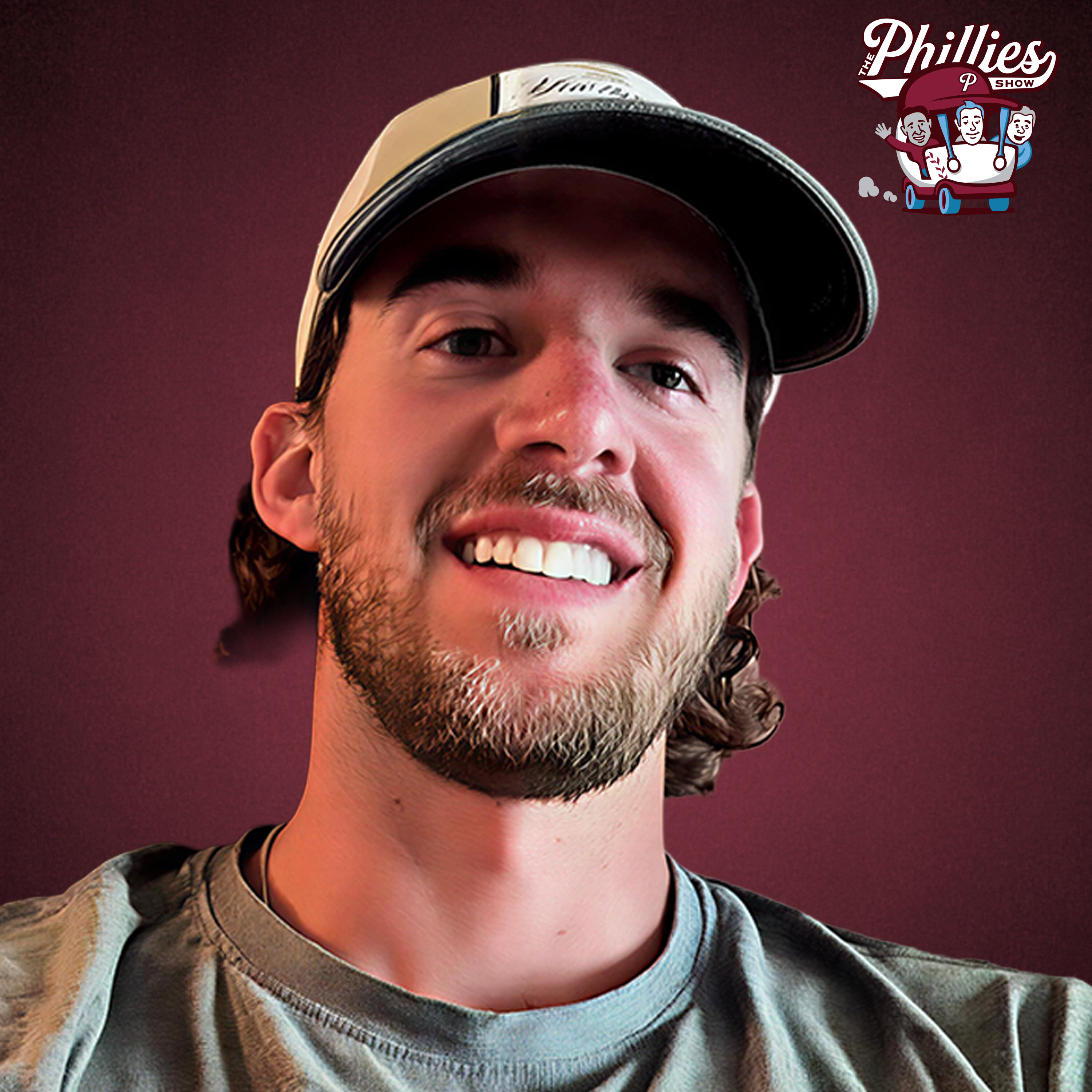
Aaron Nola joins The Phillies Show
Phillies starting pitcher Aaron Nola joins The Phillies Show to discuss why he loves throwing to J.T. Realmuto, what impresses him about Andrew Painter, how he got a little extra zip on his fastball this season, learning from Carlos Ruiz, Cole Hamels and much more!
Check out the brand new items over at The Phillies Show shop!
See omnystudio.com/listener for privacy information.
2026-04-19
32 min
Transcript
Available Results
Generated results are saved to the knowledge database for reuse and search.
No generated results are available for this episode yet.
Extract Knowledge
Pick what you want extracted first. Model, scope, and chapter options appear after a template is selected.
Generated results for public episodes are saved to the knowledge database so they can be reused and searched later.
Transcript
00:00:02
Speaker 1: Is Aaron Nola and welcome to The Philly Show.

00:00:08
Speaker 2: Ruben Tomorrow, Junior, Jim Salisbury, todd Z A Lucky. It's the Phillies Show. Philly's wrighty Aaron Nola joins the show this week. Aaron has a charity poker tournament on Thursday night at Citizens Bank Park, so we thought this would be a good time to have him on the show. We talked to him about that, but we also talked to him about much more. A lot of it relates to what has made him one of the game's most durable, reliable, all star quality, cy young quality pitcher over the past ten years. Everything from his pre start routine to what he has learned over the years from everybody from Carlos Ruiz to JT. Realmuto and much more. Here we go, everybody, Aaron Nola. Aaron, thanks for joining The Philly Show. You're a returning guest, so we really appreciate you coming back on the show, and we've been wanting to have you on for a while now, but we think we've thought this week would be perfect timing because you're having your second annual Aaron Nola Charity poker tournament that's at Citizens Bank Park on Thursday night, and are you looking for.

00:01:26
Speaker 1: How do you do?

00:01:26
Speaker 2: How did you do last year?

00:01:30
Speaker 1: Uh?

00:01:30
Speaker 3: Well I got to the last table, but I bought in like three times.

00:01:37
Speaker 4: Well, it is your tournament.

00:01:41
Speaker 3: No, it was fun though. We had a good time.

00:01:44
Speaker 1: It's good talking to a lot of people, sitting down at the tables and meeting new people. And I feel like there's just a little bit better than the bowling event, just in that in that sense where it's a little smaller setting and able to hang out with a lot more people.

00:01:59
Speaker 2: And So, if if I was going to play at this thing on Thursday night, who are your teammates that? Whose table would I not want to be at?

00:02:06
Speaker 4: You know what I mean?

00:02:06
Speaker 1: Like?

00:02:07
Speaker 2: Who would who would bluff me and push me all in when I'm holding seven to two off suit?

00:02:14
Speaker 1: I don't know always wins everything, So probably I don't know Long Kevin Long and Shba though last year they were at the last table.

00:02:24
Speaker 2: Oh they were okay, yeah, okay, and this and this.

00:02:29
Speaker 4: I could see k Long being, you know, a strong candidate to be a winner. He's in this event.

00:02:36
Speaker 2: This event benefits phil Abundance. Event benefits Team Red, White and Blue, Phil Abundance everybody and Philly knows very well Team Red, White and Blue that benefits veterans and health and wellness programs, right Aaron, As you want to talk about either of those programs and why you're kind of working with those guys.

00:02:58
Speaker 3: Yeah, I met him years ago. Uh. I love what they do. Mike Irwin, the head of it Team Red White and Blue. I love what what his mission is. I mean you said it.

00:03:10
Speaker 1: You know, help gets veterans back on their feet and live a healthier lifestyle. And uh, and they put their life on the line for us, so to give back.

00:03:19
Speaker 3: To them is awesome. I love all of them. They're they're great people too.

00:03:23
Speaker 5: Uh.

00:03:24
Speaker 1: And then phil Abundance been with them for quite a while now, and I really love what they do to make food and give food to a lot of the families around Philadelphia that really need them.

00:03:35
Speaker 3: And uh, just great people over there.

00:03:38
Speaker 5: Hey, before we start peppering you, I wanted to ask you. I know, you know the people that that that raised you, your parents, Uh, the great people. Why is giving back to the community important to you?

00:03:53
Speaker 3: I feel like.

00:03:56
Speaker 1: For for all of us baseball players and athletes, we have a platform right now that we're a use and to reach people. Especially being in a market like Philadelphia, I feel like I feel like it's a little bit easier for us to do that, and for myself, I just really like I enjoy doing it.

00:04:13
Speaker 3: I enjoy helping people out.

00:04:14
Speaker 4: I enjoy.

00:04:16
Speaker 3: I enjoy doing these charity events.

00:04:19
Speaker 1: I enjoy going to my other teammates charity events, learn about what they're doing, what they're doing in the community or the organization that they support. It's really cool. And those guys support me and my wife at the charity events over the years, so I love going to do that for them. But I feel like for us, with our platform that we can use right now to be able to reach people and to help them out, it goes a lot farther and a lot longer in the long run. Because, oh, I don't as y'all know, you don't play baseball for you know, most of your life. You only play for a certain amount of time. And to be able to be on a stage as like we are, we can use it in a way that can help people out.

00:05:05
Speaker 5: Yeah, for someone who's been in the front office for so many years, I I just want to let you know I appreciate that because I know how important it is for the organization, the Phillies organization, for you to be involved and to make that connection so on behalf of of all you know, you know, organizations that.

00:05:26
Speaker 4: You know, particularly the Phillies.

00:05:28
Speaker 5: You've represented him so extremely well, so pretty cool, and I appreciate that.

00:05:32
Speaker 4: We appreciate that, I think, and.

00:05:33
Speaker 5: I think that other people do too. I mean, at the end of the day, it's you know, it's it's not just the market that you make on the field. It's really the market that you make in the community and the stamp you put on it's and it's been.

00:05:45
Speaker 4: Uh, it's it's not doesn't go unnoticed with you and your family.

00:05:50
Speaker 6: Awesome, well, said Reuben, Well said Aaron. You mentioned j T is a good poker player, He's a good golfer. This guy is and everything isn't he?

00:06:02
Speaker 3: He has a well rounded human being.

00:06:08
Speaker 4: How much does he mean to you as a as a battery mate?

00:06:12
Speaker 5: I mean, I know if you throw into other guys stub Stubby and Marshawn and others over the course of your career, obviously, but why what makes him so special?

00:06:24
Speaker 1: Well, he's got a lot of good tradeses, I mean one of the most athletic catchers that I've ever played with. I mean, probably the most athletic catcher I've ever played with. So he does he does pretty much everything on the field besides you just catching. We've been together since twenty nineteen now, so also seventh year or so.

00:06:49
Speaker 3: With each other's battery mats, I think not.

00:06:52
Speaker 1: I think I know that helps out a lot with us and the other picture just being able to be together for that long amount of time and the experience that we have together and all the games we've been together, we I feel like we we bounce things off each other a little bit easier, just because you know, we've been in the of the National League East for a while, so we've played a lot of the same team as all the same guys. Especially these days with the pitch clock, it's a little.

00:07:24
Speaker 3: Bit easier to.

00:07:28
Speaker 1: I feel like for him to call the game with us and for us to be on the same page just because we know we know each other pretty well. So I think that helps out a lot. And it's been awesome to be with him for this this amount of time.

00:07:44
Speaker 2: And you told a great story. I asked in spring training about what it means to have JT back, And you told he told this funny story about how smart he is behind the plate and why he has a purpose behind every pitch, And you told this story about Christian Asquez homering off you first pitch. Yeah, sinker can you can you retell that story because I think that just kind of shows how smart of a catcher is and why you should never doubt what JT finger the fingers.

00:08:15
Speaker 4: He puts down.

00:08:18
Speaker 1: I know, Yeah, it was a Minnesota last year, at the end of the season. I think it was my last regular season start at home and Vasquez comes up. I think it was, I can't remember.

00:08:29
Speaker 3: It was later in the game.

00:08:30
Speaker 1: I think he was the first hitter and I was like, yeah, he's gonna I was thinking he's gonna take this first pitch. Oh no, he was the third hitter of the inning and I had thrown I think I had thrown four pitches. This was gonna be my fourth pitch, and I'm like, God, he's not He's not going to swing. So JT calls a sinker in and I'm like, all right, I'm just gonna I think he caught a sinker in. Yeah, Yeah, he caught a sinker in, and I'm just kind of like, didn't lob it up there, but I'm like, he's going to take this pitch us A. He's a veteran catcher, like four p didn't want a four pitch inning, you know. And he swung and hit a homer and so so I told JD go, Hey, that's my bad. I you know, I didn't think he was going to swing. Being the fourth pitch of the inning. He's like, well, that's why I caught a sinker in because I knew he was going to swing.

00:09:21
Speaker 3: I'm like, well, that's on me. That's my bad. And of course it goes over the wall.

00:09:29
Speaker 4: Hey, DoLS, I wanted to take you down memory lane a little bit.

00:09:32
Speaker 5: It can you believe that it is actually twelve years almost to the month that I saw you pitch against Alabama. I was in the in the stands. I don't know if you know or remember that. I was there with Pat Gillick behind home plate. But you pitched a gem.

00:09:51
Speaker 1: Uh.

00:09:52
Speaker 5: It was to me it sort of sealed the deal as far as and our scouting people had already done a great job with you, but sort of sealed the deal.

00:10:00
Speaker 4: You happen to remember us being in the stands.

00:10:02
Speaker 5: I know you can imagine that there are others in the stands because you were so highly regarded.

00:10:07
Speaker 4: But do you remember that at all by any chance?

00:10:11
Speaker 1: Honestly, don't remember. I didn't even know you are in the stands. The only guy I knew that was there was Mike Stofford.

00:10:19
Speaker 5: That's right, because staff has been had been our area guy, and they'd been on you for a long time, and you obviously had He built sort of a relationship with you.

00:10:26
Speaker 4: Haven't seen you for so long, and he was the one who was pushing hard for you.

00:10:29
Speaker 5: But what I remember about that, there's a bunch of things I remember about it, but I was sitting next to Pat Gillick when you were pitching till The first thing that I remember was your long toss routine prior to the game. Can you talk a little bit about that, because I was astonished by the length and breadth of what you went through before you even took the mound to throw your first pitch.

00:10:56
Speaker 3: Yeah.

00:10:57
Speaker 1: I don't know how that came about. I think it just started in college, my first year of college, to just to long toss A long tossed a lot. But that was kind of my pregame routine every game that I threw.

00:11:12
Speaker 4: Did you throw it was like ten or fifteen minutes? I mean it looked like you longed long toss.

00:11:17
Speaker 5: I'm thinking of myself, is he gonna have enough bullets to finish this game?

00:11:20
Speaker 4: To be able to pitch in this game?

00:11:22
Speaker 3: Is that?

00:11:22
Speaker 5: I mean I didn't even know do you Did you have enough like a set number of throws that you made or amount of time or was it just when you find loose?

00:11:32
Speaker 1: Back then, not really, I mean, heck, I was twenty years old, twenty years goes, I could throw forever. Not really, I didn't really have a like I said, amount of throws.

00:11:43
Speaker 3: I mean.

00:11:46
Speaker 1: Those days, I kind of I had a set amount of throws, like each kind of each distance going back. But then I would just once I got to to the length I kind of toward center field, out to the wall, I would throw several just until I felt really good, and then I would just come back in and start firing some. Honestly, back then, I don't really know how many pitches I threw in the bullpen pre game bullpen. But back then, my pitching coach Alan Dunned. We all the pictures made. Most of all the pitchers had the like a throw in schedule, so we would go we would go like five throws at each distance up until like one hundred feet, like when we were long tossing, So we would go like five all the way up ti one hundred, and then it would cut down to four at like one twenty, and then three at like one fifty, and then it'd be like three three two two two, and then once you get back, you throw however.

00:12:43
Speaker 5: Many needs I mean when he I'm serious, guys, I think he was doing at two hundred and twenty five feet by the end. He was like I'll launch him, and I'm like, oh my goodness. And it just circling back to this season. In this offseason, you talked about going back to some of that routine. Is that something that would you consciously worked very conscious of based on, you know, how things finished last year and how you wanted to feel preparing for the WBC.

00:13:15
Speaker 1: Yeah.

00:13:18
Speaker 3: I feel every every year.

00:13:22
Speaker 1: After every season, because I have been fortunate to make all my starts and throw decent amount innings, I take a good bit of time off and I kind of used spring training to ramp up, but actually worked out really good this year just from getting hurt last year, and I didn't throw that many as through around one hundred, so I wanted to start a little bit earlier and obviously get get ready for the WBC. And for me, starting a little bit earlier, I was able to to long toss get my arm actually conditioned prior to spring training. So it was nice to long toss again because I didn't really like I toss any of the off seasons for like I don't know, seven and seven years or so, because I like to give my body arrest after after a full season. So it was kind of nice to be able to to long toss before spring training and obviously still do it now. And it helps out too because spring training feels like it's so short now for starting pitchers at least, like it's quick, like it comes really quick.

00:14:24
Speaker 3: You get there. You don't have.

00:14:27
Speaker 1: You don't have you know, six six bullpens and two two or three live bad practices like we used to.

00:14:34
Speaker 3: You know, you got a couple of bullpens, a couple of lives, and you're in the game real quick.

00:14:39
Speaker 1: So I feel like I was a little bit my arm was a little bit more ready and my body was a little bit more ready this year than it had been prior prior years.

00:14:49
Speaker 6: And it looks like Aaron Maybe that long toash routine has a bit of a difference on your fastball. I mean, case in point against the Cobs on Tuesday, and I'm watching that game and in the third inning, You've struck out Suzuki to end the third on fastball had two seam action. It was ninety three. But as I'm looking at that pitch from the center field camera, you could actually see it take off and the finish on that pitch was very noticeable. Did you feel did that pitch feel good coming out of your hand? And have you noticed a big difference just on the action of your fastball, maybe because of the long toss commitment this winter.

00:15:38
Speaker 1: Yeah, Well, that pitch actually felt really good coming out of my hand, but the location wasn't where I wanted to.

00:15:43
Speaker 4: Well, you had enough on it.

00:15:44
Speaker 3: You got to buy him right above his bad so it was good.

00:15:48
Speaker 6: I mean, you got it buy him.

00:15:50
Speaker 1: Yeah. Yeah, So I feel like getting back to the long toss, the thing most that it's helped me out with is on the ball a little bit more true. So I pronate a lot and over over my It's just kind of how I've always been. And long tossing really helps me use my middle finger a little bit more and throw the ball a little straighter.

00:16:12
Speaker 3: I can't cheat it when I get along with the ball, with the ball flight.

00:16:16
Speaker 1: So when I'm at you know, one hundred, one hundred and fifty feet, it's it's a little bit easier to throw the ball straighter. But when I get farther back, if I pronate, the ball is gonna the ball is going to sail on me. So it's kind of helped me get through the ball a little bit better, use my middle finger a little.

00:16:35
Speaker 6: Bit more, adding a lot too.

00:16:41
Speaker 5: Yeah, I'd use my middle finger a lot, but that's for a different Hey, Aaron's when I'm being one with my detractors.

00:16:51
Speaker 2: Year, Ruben was asking you about getting drafted, you know, getting drafted, and you've obviously been in the big leagues for ten years, and what you have Andrew Painter right now coming up and he's gonna be making his what is uh, well, I guess it's technically his third start on Sunday. What what do you make of him? And can you do you see any of yourself and him as a rookie. Does he look different to you? I mean, do you remember how you felt at making your first three or four starts. What's kind of impressed to you about Andrew Painter so far?

00:17:28
Speaker 3: Yeah, well he's a lot bigger than I was, and then he was a lot harder than I did, and so those two things are really different.

00:17:39
Speaker 1: Yeah, I remember I remember my first my first he starts, Uh, honestly, I only I remember more my first two starts. Uh after that, not really, I think I remember. I don't know if it was my third over in in San Diego, but I I just thought it was super cool. I mean, I didn't have a spring train. I didn't I didn't go to big league spring training like he has before. So my first time in the big leagues and around the big league guys was in the big league. So being able to step on the mount and having like Utly at second base and Howard at third and breddy Galavis is short. Like just seeing seeing that those guys around me was pretty cool, obviously really new, and it felt like like, dang, this is the big leagues.

00:18:32
Speaker 3: This is pretty cool. So I never took that for granted. And I feel like.

00:18:39
Speaker 1: I feel like sometimes it could be easy to take the big leagues for granted nowadays, because like there's so many young guys. I'm not saying that's a bad thing at all, but there's so many young guys. And when I came up, there was a lot of older guys, and especially on the Phillies team, then you had the guys I just wanted the.

00:18:59
Speaker 3: World Series, so.

00:19:02
Speaker 1: We wanted to be wanted to be as disciplined and respectful and and all that is possible and do my work and be consistent with everything I did and not get anybody's way.

00:19:13
Speaker 3: And I think that's to me, it looks like that's what Painter. Painter is doing.

00:19:17
Speaker 1: He's really consistent in his work and he knows what he needs to do to get prepared for the game. He's a he's a really big competitor, so it's been really fun to watch him do that. And he's got good stuff on top of that. So the more experience he gets on the mound, the more things he go through, the better better off he's going to be. The more he's going to figure out what kind of what kind of player he is, what kind of picture he is and what kind of duty he is he.

00:19:43
Speaker 2: After that start in San Francisco, he goes in and he comes back out and finishes watching the game and the dugout, and he said part of it was because he's like, you know, I wanted to, but also like I'm a rookie, I probably should do this. He didn't really know, but he's like, I'm gonna go out there and watch the game because a loud of you guys when you finish, obviously you finish watching the game and in the in the clubhouse. And I asked him kind of what he talks about with you guys on the rail there, and he says, a lot of pitch sequencing and just talking about hitters and swings and pitch grips and whatnot. Is that kind of what you guys talk about. I think a lot of people see you guys on camera chit chatting you and Wheels you and you know, Painter you and Lozardo and Sanchez. What do you guys? What are you guys talking about there? Like what are those conversations like, uh, just yeah, just.

00:20:28
Speaker 1: Kind of what you said, I like, pitch secrets and sometimes just kind of just the hitters kind of studying the hitters a little bit. I tell him sometimes if he ever needs any anything on some hitters, like I can give you some information just because I face the face certain guys a lot. But I mean, he's a he's a rookie for so a lot of guys are seeing him for the first time, so you know, there's not like a ton of information on him, which is actually which is actually it's actually a good thing, good thing for him. But yeah, just kind of stuff like ted and just watching the game, watching what hitters like to do, and just a little stuff like that.

00:21:14
Speaker 4: Just doubling up on that. How important is that for you?

00:21:18
Speaker 5: As far as I don't know, I think I just feel like the fact that you guys are on the rail watching and just dissecting and talking about that stuff. How important is that as a teammate. How important is that as a team, and how important is it as a you know, to have success. I mean, I always felt like that's a really important part actually watching the baseball game rather than watching it on an iPad.

00:21:42
Speaker 4: Tell us about the importance of that and how you guys feel about it.

00:21:46
Speaker 3: Yeah, it's important.

00:21:49
Speaker 1: I knew it was important when I first came up being around those guys with with Aaron Harang in the dugout, cheuch And and Chad Billingsley Cole, all those guys, Jeff Frank cor So. I would always sit on the bench the whole game, and uh, Harang would always tell me, he was like, You'd always like, yeah, watching it on TV is good, but during the game, like you learned a lot more watching the game and the dugout. You can pick up on things that you can't pick up on TV, the reactions and and and whatever from from hitters and stuff like that.

00:22:33
Speaker 3: Uh.

00:22:34
Speaker 1: And I would always obviously being the dug out, I would always see Joos when he wasn't playing, he was sitting on the bench the whole game, just watching the picture.

00:22:43
Speaker 3: And I'm like, it's.

00:22:45
Speaker 1: Probably this is probably why this guy is super good and he's had a long career. He's just like, really, this his homework. His homework is just sitting and watching the picture and watching watching hitters and the catcher. Uh So, I thought that was really cool, and I just enjoy it. I enjoy watching the game. I enjoy talking to the guys about the game, about the hitters. I mean, for me, that's kind of that's our homework. You know, we don't go to school anymore, so I mean something I like to do. And being around my brother too. He enjoys doing all that kind of stuff. And him moving to catcher years ago. That's kind of his his deal, game planning and stuff. So it's just fun, fun to talk about it.

00:23:28
Speaker 6: So, Aaron, you've had a remarkable career. I mean, from the start of seventeen until the end of twenty four you led the major leagues and innings. Your durability is remarkable. When I look at the Phillies Top ten list in all time pitching, you are all over that list. You will be on the Wall of Fame someday. But on Tuesday Night you reached nineteen hundred strikeouts. That's a lot of strikeouts, number two behind Steve Carlton. Do you ever gaze at that top ten list and and your your third, fourth, fifth, second in so many of these categories, and it just sort of chronicles what a great run you've had.

00:24:16
Speaker 1: I appreciate it, uh. I looked at it a couple of years ago, just because I didn't know. I think it was when I passed curved up for what was that like wins or something I can't remember, and then I passed cool up or something and he was at the field, so I had looked it up one day. I think it was I think it might have been the strikeouts, and I was like, I got you on the strikeouts, but you got me on the innings a good bit, So I'm coming for the innings for you. Yeah, I liked obviously it's it's pretty cool if you be on the list with a lot of those those Philly greats. I think the innings standings and the games started would be obviously a goal to keep keep shooting for.

00:25:07
Speaker 4: Is that something that you thought about at all? I mean as you were getting drafted by the Phillies. I mean at that point you said you're twenty years old obviously, but.

00:25:15
Speaker 5: Did you think about the imprint that you might make in the game or were you just going day by day?

00:25:20
Speaker 4: How does that work for you?

00:25:22
Speaker 3: No, not at all. I had no I had no idea.

00:25:25
Speaker 1: First of all, I didn't know who the Philadelphia Phillies were when they drafted me. Like I was like, Philadelphia Phillies, Like I've never even heard of this team, because I being in being from the being from Louisiana. Like all I knew was l shut. I didn't really watch I didn't really watch pro Major League Baseball. The only teams I really watched was like the Yankees Red Sox matchups the Braves every now and again, because the Braves and the Astros were the closest teams to us down Ben Rouge. So I can never really I never watched Philly sports, but reubind No, I never thought I would be on the list with some of these guys.

00:26:04
Speaker 3: I never thought.

00:26:07
Speaker 1: Any of this would happen when I when I came in, I just wanted to I wanted to be healthy and have good have a good season. When I in twenty fifteen, when I came up, and then twenty sixteen, after getting my feet wet a little bit, I had a decent first half.

00:26:25
Speaker 3: And then ended up getting hurt. I had a really bad second half, and then.

00:26:33
Speaker 1: Did all the rehab and stuff like that, and twenty seventeen came around and got hurt for the first month, so I was like back to back kind of getting injured, and then after that I felt felt really good, and so I just wanted to make as many.

00:26:47
Speaker 3: Starts and throw as many as as I can.

00:26:48
Speaker 1: And that's what I was told when when I came up, when Bob McClure was my pitching coach those first couple of few years, and the starters are supposed to eat the innings and put all the load on their back, so that's why we start. I was like, all right, so, but tracing back to college, I threw in twenty fourteen, I threw that season LSU, and I wanted to sign early so I can go finish the season out in minor league ball and get my innings up so I could be ready for for a full minor league season in twenty fifteen. So that's what I did, and I can't remember how many innings I threw total. I think I threw like one sixty or something from college to the minor leagues, and then twenty fifth I was like, that's pretty good amount. And then twenty fifteen I was kind of I was ready to go for full my first full season, and I think I ended up at like total from the minor league so big leagues think ended up to around like one fifty or something around sixty. And then after that I was like, I'm good to go. I come ready to go to try to get to two hundred, and I was able to reach it. So after that, that's just out of the bar. The two hundred innings kind of the two hundred strikeouts make every start. It's kind of the bar that it starts that we want to set. And being able to do that early in my career too be healthy, I knew I could. I was able to do it, So that's kind of that's what I trained for and and you know, study for and did a lot to keep my body healthy for that.

00:28:26
Speaker 6: Aaron, hearing you talk about Baton Rouge, it's jarring my memory. I once had a conversation with you, like I think, I said, I I would love to see a Saturday night football game at LSU, and we were talking about the environment and how it relates to you know, sports crazy town like Philly, and you said, Philadelphia is Baton Rouge on steroids. What is the fan experience like in between you know, a big college town, great football, basketball, baseball, women's basketball, and a big sports crazy pro town.

00:29:07
Speaker 3: Mm hm, oh yeah, it is.

00:29:10
Speaker 1: Philadelphia is LSU on steroids. I mean, you got everything's bigger. Obviously passionate fans. LSU fans are really passionate. They travel really well, no matter where it is. Philadelphia fans same way. They travel really well. They're really passionate. Ah, they're similar in that that aspect. They're tough on the opposing team. I've played with several guys that I've played against in college over the years that have come through the Phillies organization or that I've played against in the major leagues that I've seen on the uh, that I've talked to around the league, and UH, They're like, oh yeah, man, LSU, they would wear me out when I was on the on the mount warming up because our our pitchers mouths used to be on the field over there when I was over there, and.

00:29:59
Speaker 3: They would wear They're like, they would wear me out.

00:30:02
Speaker 1: So yeah, it sounds like Philly's because the guy's up in the opposing team up in the other bullpen to get worn out too.

00:30:09
Speaker 3: I've heard obviously, like the city Baton Ridges is not.

00:30:18
Speaker 1: Really like a city anything like Philly. We got more grass and more parking spots, but it's kind of slow, a lot of traffic college town. Obviously, I grew up right right next to Teleshoe, so just a gostion it's really different. So when I first came to Philly, it was it was good culture shock. Like it was, it was weird, just because I'd never really been been in a big city before.

00:30:48
Speaker 6: Well, you mentioned the the upstairs bullpen at Citizens Bank Park. That was originally when the ballpark opened. That was originally the Phillies bullpen, and the fans were wearing out the Philly's relievers so they changed it to the lower one.

00:31:04
Speaker 3: That.

00:31:06
Speaker 2: Yeah, that's a true story. They played an on deck series right before opening day two thousand and four. Billy Wagner was in that bullpen. He's warming up and some fans started to wear him out. So the game ends, he walks right over to I guess it was Ed Wade at the time the GM and Rubeny goes, we're not We're not going We're moving down down below. We're moving down below. We are not going to be up there, no way.

00:31:30
Speaker 4: Billy Wagner was a brilliant move.

00:31:33
Speaker 2: Billy Wagner took one game, one exhibition game, and Billy Wagner says, we are moving bullpens. We're moving to the lower tiers. So you can thank Billy Wagner for that. Aaron but Aaron, thanks so much for the time, and again I want to mention your charity poker tournament Thursday night. You and Hunter of your wife, Hunter raised over the years a million dollars for phil Abundance, over eight hundre or grand for Team Red, White and Blue h I wish you all the luck in the in the tournament, Aaron, hopefully you can knock out JT. Because he deserves to lose every once in a while. So but thanks, thanks so much.

00:32:17
Speaker 3: Shouldn't have to worry about me if he's playing so.

00:32:21
Speaker 4: Well.

00:32:21
Speaker 2: Thank thank you, thank you. Thanks again. We appreciate it. Thanks a lot. The Philly Show is brought to you by the Foul Territory Network. Subscribe to The Philly Show on YouTube and wherever you get your podcasts.
Chapters
No chapters available.