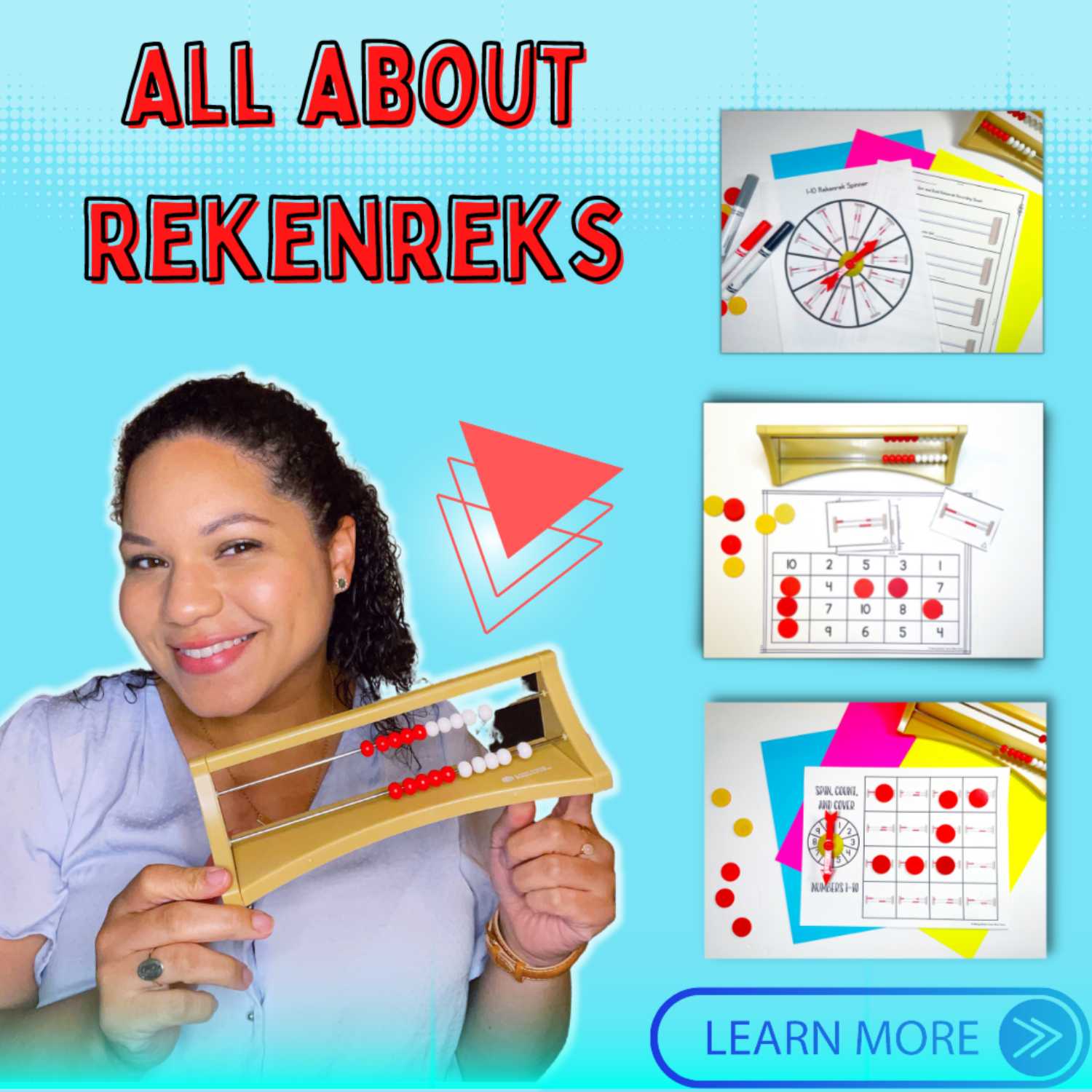
Ep. 8 All About Rekenreks
Making Number Sense Make Sense: A Math Podcast for Early Elementary Teachers
Would you like to try some of these activities for free?Do you have rekenreks sitting around your classroom and are wondering what to do with them? I remember getting given some with ESSRS funds and was like, what am I going to do with this? I dove in and did some research so you don't have to and let me tell you, my students love using them!This episode is for you! I talk all about what number racks or rekenreks are, how to use them, and what they are great for! I also give you some ideas of how to use them in your room to practice:
Subitizing
Making matching sets
One-to-one correspondence
Anchor to 5 and 10
Number recognition
Number Writing
Don’t forget to Grab the Free Bonus!
Spin, Count, and Cover Rekenreks
Rekenrek Decomposing Numbers Recording Sheets
Pick and Record or Spin and Record with numeral or number rack spinners and cards
I encourage you to try some of the free activities and consider investing in the activity bundle or mega bundle! Some teachers like you said, “Thank you so much for creating this resource! I loved how easy it was to implement into my classroom and my students really enjoyed it. ”“I have used this with my kindergarten students and they really enjoyed it. I found it to be engaging and educational. I would recommend it to other teachers to use in their classrooms as well. It’s a good resource to have and will help benefit your students’ kindergarten learning experience.”If you try the freebie, send me a DM and let me know how you like it!Blog Post All About RekenreksYT Video: All About RekenreksWant to see some rekenrek centers in action? Watch this video!FREE Rekenrek ActivitiesRekenrek Activity BundleRekenrek Activity Mega Bundle (with clip art so you can create to fit your needs!)
Available Results
Generated results are saved to the knowledge database for reuse and search.
Extract Knowledge
Pick what you want extracted first. Model, scope, and chapter options appear after a template is selected.
Transcript
1
00:00:00,000 --> 00:00:12,800
Hello and welcome to Making Number Sense Makes Sense, a podcast for elementary teachers,

2
00:00:12,800 --> 00:00:17,680
specifically early elementary teachers, looking to really make an impact in the number sense

3
00:00:17,680 --> 00:00:19,680
of their students.

4
00:00:19,680 --> 00:00:22,440
Hello and welcome back to Making Number Sense Makes Sense.

5
00:00:22,440 --> 00:00:25,920
Today I'm here to talk with you about the Wreck and Wreck.

6
00:00:25,920 --> 00:00:28,200
Have you ever seen one before?

7
00:00:28,200 --> 00:00:34,840
The Wreck and Wreck is basically a tool that is great for lots of different things when

8
00:00:34,840 --> 00:00:40,480
working with kindergarten, first grade, second grade, in moving past counting things one

9
00:00:40,480 --> 00:00:45,400
by one and starting to unitize, starting to subitize and developing more sophisticated

10
00:00:45,400 --> 00:00:46,760
counting strategies.

11
00:00:46,760 --> 00:00:48,280
So let's learn about it.

12
00:00:48,280 --> 00:00:56,680
So a Wreck and Wreck has two rods with 10 beads each, five red and five white.

13
00:00:56,680 --> 00:01:00,920
And the setup of the Wreck and Wreck with the 10 and 10 and five and five really helps

14
00:01:00,920 --> 00:01:05,440
students with a lot of things that we need to be able to be really sophisticated counters

15
00:01:05,440 --> 00:01:09,240
and move from counting to addition and subtraction strategies on and on and on.

16
00:01:09,240 --> 00:01:13,560
When introducing a Wreck and Wreck to my kindergarteners, I usually like to wait a little bit until

17
00:01:13,560 --> 00:01:19,360
they've had a lot of practice counting and really developing their counting number sequence

18
00:01:19,360 --> 00:01:23,560
and one-to-one correspondence before we move on to a Wreck and Wreck.

19
00:01:23,560 --> 00:01:25,320
How do you introduce it to your students?

20
00:01:25,320 --> 00:01:29,040
Well, I usually start by asking them what they notice about it.

21
00:01:29,040 --> 00:01:32,200
That there's 20 beads, that there's five and five, there's some on the top and some on

22
00:01:32,200 --> 00:01:33,200
the bottom.

23
00:01:33,200 --> 00:01:37,160
And very important when using any math tool, I want to give them a chance to really play

24
00:01:37,160 --> 00:01:40,760
with it, shake it, see what it feels like, move the beads around before it becomes a

25
00:01:40,760 --> 00:01:41,760
tool.

26
00:01:41,760 --> 00:01:47,040
They're play out of it, though we still have lots of fun games to play with it.

27
00:01:47,040 --> 00:01:52,000
After I've introduced it, I like to try and have them show me different numbers.

28
00:01:52,000 --> 00:01:53,680
Like, oh, can you show me this number?

29
00:01:53,680 --> 00:01:57,440
Can you show me this number and tell me what they notice about when we move the numbers

30
00:01:57,440 --> 00:01:58,440
around?

31
00:01:58,440 --> 00:02:03,960
What it looks like, what it feels like, what the other side looks like, that is not in

32
00:02:03,960 --> 00:02:05,640
play, all those different things.

33
00:02:05,640 --> 00:02:10,800
So to use a Wreck and Wreck, I usually like to remember the rhyme white on the right.

34
00:02:10,800 --> 00:02:15,840
So the white beads belong on the right side and that is the zero position or starting

35
00:02:15,840 --> 00:02:16,840
position.

36
00:02:16,840 --> 00:02:19,880
And then from there, the kids slide the beads over.

37
00:02:19,880 --> 00:02:25,440
Now, like I said, they can slide one by one, but the benefit of a Wreck and Wreck is you

38
00:02:25,440 --> 00:02:29,400
really try to get them to see, instead of seeing like one, two, three, four, five, actually

39
00:02:29,400 --> 00:02:34,960
get them to see five and swipe them all at one time so they can start to think of numbers

40
00:02:34,960 --> 00:02:37,880
as bigger chunks versus one by one.

41
00:02:37,880 --> 00:02:42,280
The Math Resource Learning Center has a great PDF about Wreck and Wrecks and how to introduce

42
00:02:42,280 --> 00:02:45,800
them and some activities and lessons you could do with them, and I will have that link for

43
00:02:45,800 --> 00:02:47,200
you in the description below.

44
00:02:47,200 --> 00:02:51,280
Now, when students are using the Wreck and Wreck, what you're really looking for is if

45
00:02:51,280 --> 00:02:53,760
they can start to group numbers together.

46
00:02:53,760 --> 00:03:00,120
So instead of moving over seven one at a time, they would do five, six, seven, or if they

47
00:03:00,120 --> 00:03:02,720
can just push seven along the whole time.

48
00:03:02,720 --> 00:03:07,080
Something that'll really help with that is if they get to use them a lot.

49
00:03:07,080 --> 00:03:11,840
A lot of visuals, a lot of being able to play with it and see it and start to remember what

50
00:03:11,840 --> 00:03:16,280
those numbers look like or suputizing, which is one of the great things about a Wreck and

51
00:03:16,280 --> 00:03:20,480
Wreck, similar to a ten frame that you can suputize that way, is a different way to see

52
00:03:20,480 --> 00:03:24,760
numbers, a different way to play with them, and a different way to learn to suputize or

53
00:03:24,760 --> 00:03:26,560
see numbers without counting.

54
00:03:26,560 --> 00:03:31,840
Because of the structure of the Wreck and Wreck with five red and five white beads altogether

55
00:03:31,840 --> 00:03:37,160
making ten, it really helps to support an anchor to five and an anchor to ten when kids

56
00:03:37,160 --> 00:03:41,160
are counting and eventually using addition and subtraction strategies.

57
00:03:41,160 --> 00:03:45,760
So they can think of those friendly numbers and then from there build on or build backwards

58
00:03:45,760 --> 00:03:46,760
from it.

59
00:03:46,760 --> 00:03:50,800
Something else that Wreck and Wreck are really great for is learning about doubles and near

60
00:03:50,800 --> 00:03:52,520
doubles and what they might look like.

61
00:03:52,520 --> 00:03:55,960
If your question was eight plus eight and they put eight on the top and eight on the

62
00:03:55,960 --> 00:04:01,480
bottom, they might start to see that eight is also the same as ten.

63
00:04:01,480 --> 00:04:06,600
Eight plus eight is also the same as ten plus six is also the same as ten on the top and

64
00:04:06,600 --> 00:04:07,600
six on the bottom.

65
00:04:07,600 --> 00:04:12,000
There's lots of different ways that they could see it, which helps them with their fact fluency

66
00:04:12,000 --> 00:04:15,360
and applying their previous knowledge to new problems, which is what we want.

67
00:04:15,360 --> 00:04:19,280
We want to develop their number sense so that they can approach any problem that they might

68
00:04:19,280 --> 00:04:20,280
have.

69
00:04:20,280 --> 00:04:23,880
Building off of the doubles and near doubles, it's also really helpful to see the different

70
00:04:23,880 --> 00:04:27,600
ways that kids think about numbers and think about solving problems.

71
00:04:27,600 --> 00:04:31,520
A lot of times in math people are pigeonholed into thinking there's only one way to do

72
00:04:31,520 --> 00:04:33,920
everything, but that's just simply not true.

73
00:04:33,920 --> 00:04:37,800
And lots of kids, depending on their level and how familiar they are with the Wreck and

74
00:04:37,800 --> 00:04:43,240
Wreck might help them change or think about things in a different way, working with partners,

75
00:04:43,240 --> 00:04:45,600
working with our partners and just seeing things differently.

76
00:04:45,600 --> 00:04:50,680
For example, if you are doing nine plus six, some students might need to make the nine

77
00:04:50,680 --> 00:04:55,680
on the top row and nine on the bottom row to figure out what that was, whereas others

78
00:04:55,680 --> 00:04:57,920
might be able to start compensating.

79
00:04:57,920 --> 00:05:00,360
Understanding that nine and ten are really close.

80
00:05:00,360 --> 00:05:04,480
So instead of moving nine and six, they might move ten and five and start to develop more

81
00:05:04,480 --> 00:05:10,040
sophisticated counting strategies and addition and subtraction strategies moving into first

82
00:05:10,040 --> 00:05:12,240
grade and continuing into second grade.

83
00:05:12,240 --> 00:05:16,880
We've talked about what a Wreck and Wreck is, how to introduce it, and the benefits

84
00:05:16,880 --> 00:05:19,080
of using a Wreck and Wreck in your classroom.

85
00:05:19,080 --> 00:05:24,080
Let's dive into some full group, small group, center activities that you can use Wreck and

86
00:05:24,080 --> 00:05:25,080
Wreck for.

87
00:05:25,080 --> 00:05:28,840
So the first one kind of goes along with subitizing is quick images.

88
00:05:28,840 --> 00:05:33,600
To play quick images, you will flash a number really quickly, and then the students either

89
00:05:33,600 --> 00:05:40,040
have to think about in their head what that might look like or build that number on a Wreck

90
00:05:40,040 --> 00:05:43,160
and Wreck or whatever you're using for subitizing.

91
00:05:43,160 --> 00:05:47,600
So in this case, we would be using the Wreck and Wreck cart or your own Wreck and Wreck

92
00:05:47,600 --> 00:05:51,560
and show them for three to five seconds, put it down and see if they can recreate or figure

93
00:05:51,560 --> 00:05:54,000
out in their head the number that you showed.

94
00:05:54,000 --> 00:05:59,240
The next activity could be done small group or full group, and it's called one push two

95
00:05:59,240 --> 00:06:00,240
pushes.

96
00:06:00,240 --> 00:06:04,960
So like I said before, the Wreck and Wreck is really great about developing strategies

97
00:06:04,960 --> 00:06:07,460
that are beyond just counting from one.

98
00:06:07,460 --> 00:06:12,200
So with one push two pushes, you would give your students a number, for example, seven,

99
00:06:12,200 --> 00:06:17,400
and have them think about how they might make a seven on their Wreck and Wreck in the least

100
00:06:17,400 --> 00:06:18,400
number of pushes.

101
00:06:18,400 --> 00:06:21,200
So just one push to make the number seven.

102
00:06:21,200 --> 00:06:24,640
So they might discuss like, oh, well, you might have to move it like this.

103
00:06:24,640 --> 00:06:27,960
Some students might say, oh, I just know five and two is seven.

104
00:06:27,960 --> 00:06:30,760
So I'm just going to have two white beads and move them over.

105
00:06:30,760 --> 00:06:35,360
But other students might be like, oh, well, see any five, six, seven, or some might still

106
00:06:35,360 --> 00:06:39,800
have to count it out in their head to know how many to move over in just one push.

107
00:06:39,800 --> 00:06:43,000
And then two pushes would be for a double digit number.

108
00:06:43,000 --> 00:06:48,280
So from 11 to 20, like how can you make the number 12 in just two pushes?

109
00:06:48,280 --> 00:06:51,440
So for that one, you would try to move 10 and two.

110
00:06:51,440 --> 00:06:55,840
The next game is something that you can do as a math center or math station.

111
00:06:55,840 --> 00:06:57,720
It's called pick, build, and cover.

112
00:06:57,720 --> 00:07:01,680
So the way that you play pick, build, and cover is you pick a Wreck and Wreck card,

113
00:07:01,680 --> 00:07:07,400
you build it on your Wreck and Wreck, and then find that number on your counting mat.

114
00:07:07,400 --> 00:07:11,680
And I'll have a link to that below that you can use in your classroom.

115
00:07:11,680 --> 00:07:14,320
The next game is called spin and slide.

116
00:07:14,320 --> 00:07:17,840
So for this one, they'll have a spinner that has the Wreck and Wreck's on it, either one

117
00:07:17,840 --> 00:07:23,240
to 10 or 11 to 20, depending on their counting level.

118
00:07:23,240 --> 00:07:27,480
And they would spin whatever number it is, and then figure out how they would slide to

119
00:07:27,480 --> 00:07:29,400
make their Wreck and Wreck match the number.

120
00:07:29,400 --> 00:07:33,080
And if you want to make it a little more challenging, instead of giving a picture of the Wreck and

121
00:07:33,080 --> 00:07:36,480
Wreck, you can just do numerals, and then they have to figure out what that numeral

122
00:07:36,480 --> 00:07:39,320
would look like instead of doing a direct match.

123
00:07:39,320 --> 00:07:43,120
In the next two games, you can access for free in the link in the description.

124
00:07:43,120 --> 00:07:45,600
The first one is called spin, count, and cover.

125
00:07:45,600 --> 00:07:50,440
So for this one, the students have a spinner, and they will spin it and see what number

126
00:07:50,440 --> 00:07:52,720
they get, and whatever number they get, numeral they get.

127
00:07:52,720 --> 00:07:58,800
They'll have to find that number on their counting mat and cover it with whatever you

128
00:07:58,800 --> 00:08:01,240
might have in your classroom.

129
00:08:01,240 --> 00:08:03,280
And then they keep going until they finish the board.

130
00:08:03,280 --> 00:08:06,920
And that one also has the version for one to 10 and 11 to 20.

131
00:08:06,920 --> 00:08:11,680
The last game is called how many combinations can you find?

132
00:08:11,680 --> 00:08:15,040
And this one has more to do with composing and decomposing numbers.

133
00:08:15,040 --> 00:08:17,920
So you would either give your students the number that they're working on, or they could

134
00:08:17,920 --> 00:08:22,480
roll a dice, whatever they need, to figure out which number they're going to be working

135
00:08:22,480 --> 00:08:23,480
with.

136
00:08:23,480 --> 00:08:27,960
So for example, if they're working with a number five, they would work with a partner

137
00:08:27,960 --> 00:08:33,560
or on their own to figure out how many different ways they can make a five on their Wreck and

138
00:08:33,560 --> 00:08:34,560
Wreck.

139
00:08:34,560 --> 00:08:38,520
So you can have one student be the top and one student be the bottom, or you can have

140
00:08:38,520 --> 00:08:42,360
them just working out, see if they could figure it out together, and record their answers

141
00:08:42,360 --> 00:08:45,840
that they got on their recording sheet, which like I said is available in the link in the

142
00:08:45,840 --> 00:08:46,840
description.

143
00:08:46,840 --> 00:08:51,600
That was a lot of information about Wreck and Wreck, and I hope that you found it helpful.

144
00:08:51,600 --> 00:08:55,400
If you're looking for a digital version of a Wreck and Wreck, I will have that link down

145
00:08:55,400 --> 00:09:00,760
below that you can access for free, a zero to 20 Wreck and Wreck and a zero to 100 Wreck

146
00:09:00,760 --> 00:09:02,600
and Wreck that you'll be able to use.

147
00:09:02,600 --> 00:09:07,120
Again, don't forget to grab your free products in the link in the description.

148
00:09:07,120 --> 00:09:11,360
And there'll also be a blog post that goes with this as well, if you'd like to see everything

149
00:09:11,360 --> 00:09:12,360
right now.

150
00:09:12,360 --> 00:09:14,080
I hope that you found this helpful.

151
00:09:14,080 --> 00:09:31,440
Make sure to subscribe for more math videos, and I will see you next time.

152
00:09:31,440 --> 00:09:51,280
And to play quick images, you basically flash something for...