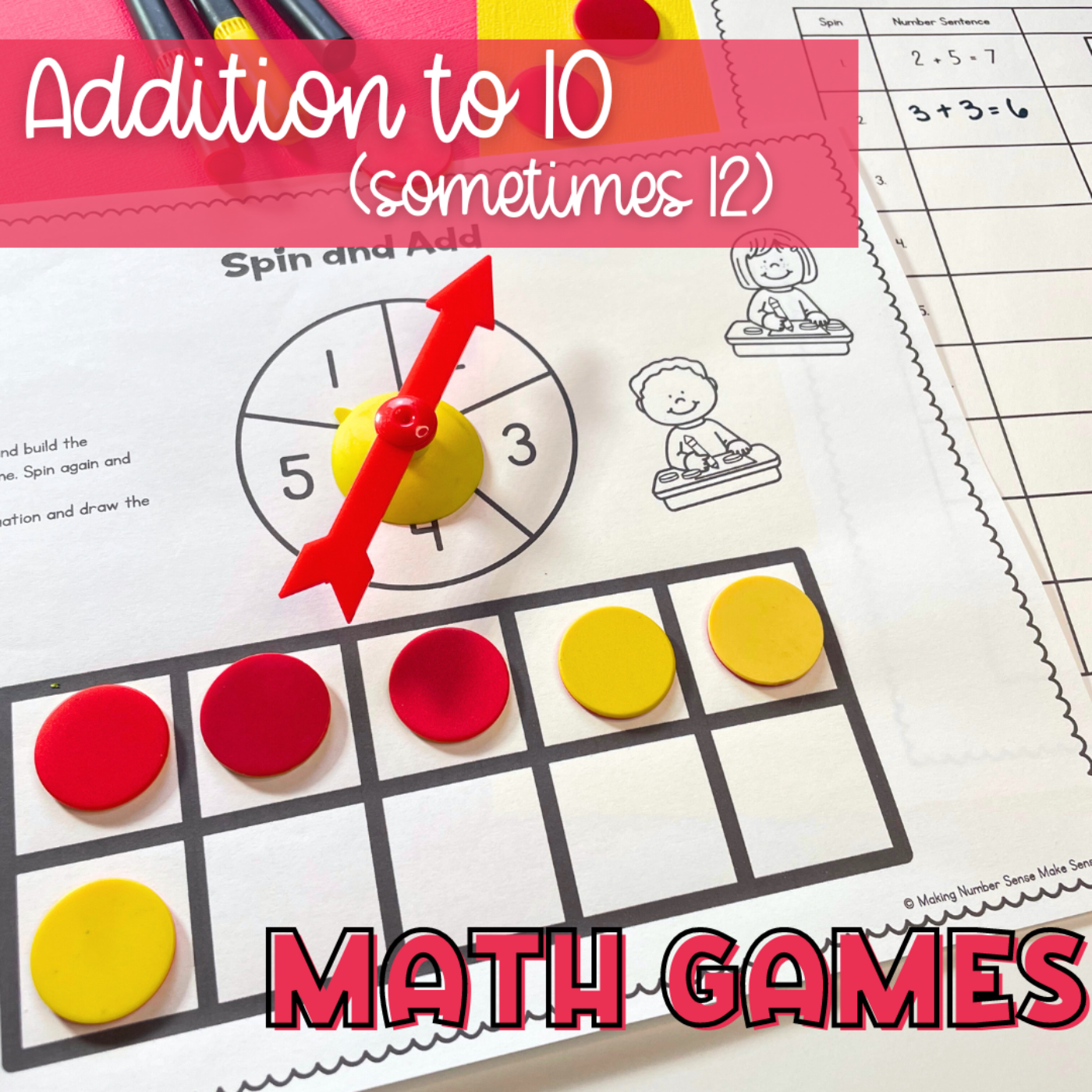
Ep 37: Print-and-Play Addition Games for Numbers to 12
Making Number Sense Make Sense: A Math Podcast for Early Elementary Teachers
I love a good game to have kids learning and practicing math! The applause my students give when in math center time is music to my ears!
These addition games are pretty simple and don't include a lot of varied directions, perfect to free you up to circulate the room if you need to or pull students one one-on-one or in a small group because they're engaged in these fast-paced games that are accessible to them and easy to differentiate.
Have a topic you want me to discuss? Fill out the Google Form!
Timestamps
1:14 - Spin and Add
1:46 - Roll A Two-Color Tower
2:57 - Ladybug Addition
3:41 - Add Them Up
4:46 - Sevens
Helpful Links
Addition and Subtraction Games Bundle
Let's Connect!
Available Results
Generated results are saved to the knowledge database for reuse and search.
Extract Knowledge
Pick what you want extracted first. Model, scope, and chapter options appear after a template is selected.
Transcript
1
00:00:00,000 --> 00:00:02,880
Let's talk today about introducing the addition,

2
00:00:02,880 --> 00:00:07,080
subtraction, and equal signs and making them stick.

3
00:00:07,080 --> 00:00:09,560
To Making Number Sense Makes Sense,

4
00:00:09,560 --> 00:00:11,680
a podcast for elementary teachers,

5
00:00:11,680 --> 00:00:13,840
specifically early elementary teachers,

6
00:00:13,840 --> 00:00:15,600
looking to really make an impact

7
00:00:15,600 --> 00:00:17,280
in the number sense of their students.

8
00:00:17,280 --> 00:00:20,320
After you've spent the whole year working on letters

9
00:00:20,320 --> 00:00:24,360
and numbers and giving students all of those squiggles

10
00:00:24,360 --> 00:00:27,020
to have meaning, do we really need addition,

11
00:00:27,020 --> 00:00:29,480
subtraction, and equal signs on top of it

12
00:00:29,480 --> 00:00:30,840
for young students?

13
00:00:30,840 --> 00:00:32,760
The answer is no.

14
00:00:32,760 --> 00:00:36,880
But they do eventually need to learn those symbols

15
00:00:36,880 --> 00:00:40,860
and they can seem really abstract like most symbols.

16
00:00:40,860 --> 00:00:44,020
So you'll see this a lot when students are trying

17
00:00:44,020 --> 00:00:47,340
to write number sentences and the equals in the wrong place

18
00:00:47,340 --> 00:00:51,060
and the plus sign is at the end of all of the numbers

19
00:00:51,060 --> 00:00:55,160
because it doesn't really have any meaning.

20
00:00:55,160 --> 00:00:58,080
It's something that students just kind of saw

21
00:00:58,080 --> 00:01:02,520
or if you have families having their kids do workbooks

22
00:01:02,520 --> 00:01:05,580
and the like, they might start to remember the facts

23
00:01:05,580 --> 00:01:09,360
but not really understand the actual symbols

24
00:01:09,360 --> 00:01:11,800
and be able to apply it to something else.

25
00:01:11,800 --> 00:01:14,200
So I'm gonna share with you a way that I can make

26
00:01:14,200 --> 00:01:17,000
those symbols have more meaning.

27
00:01:17,000 --> 00:01:21,320
If a student is still having trouble with a lot of symbols

28
00:01:21,320 --> 00:01:24,640
like letters and numbers, I would not introduce

29
00:01:24,640 --> 00:01:26,800
the addition and subtraction symbol.

30
00:01:26,800 --> 00:01:29,160
Students can solve addition and subtraction

31
00:01:29,160 --> 00:01:31,680
way before they can read a number sentence.

32
00:01:31,680 --> 00:01:33,500
So you're gonna wanna make sure that your kids

33
00:01:33,500 --> 00:01:36,640
have a strong foundation of those concepts

34
00:01:36,640 --> 00:01:38,720
even if they don't have a name for them.

35
00:01:38,720 --> 00:01:41,440
And one way you can start to introduce the idea

36
00:01:41,440 --> 00:01:44,760
of a number sentence is through the discussions

37
00:01:44,760 --> 00:01:47,520
that you're having when students are solving problems.

38
00:01:47,520 --> 00:01:52,520
So if there were three fish and five swam to join them

39
00:01:53,540 --> 00:01:56,360
and the student explains to you that they used five fingers

40
00:01:56,360 --> 00:01:59,480
and then three more, you can actually scribe out

41
00:01:59,480 --> 00:02:04,180
five plus three equals eight as they're talking

42
00:02:04,180 --> 00:02:05,860
as a way to note what they said

43
00:02:05,860 --> 00:02:09,240
but not necessarily draw attention to it.

44
00:02:09,240 --> 00:02:11,880
When they're ready, there are things you can do

45
00:02:11,880 --> 00:02:14,120
to bring those symbols to life.

46
00:02:14,120 --> 00:02:17,760
When kids learn and they see something one way,

47
00:02:17,760 --> 00:02:21,420
it creates a neural pathway, a little pathway to remember

48
00:02:21,420 --> 00:02:22,480
but it's really thin.

49
00:02:22,480 --> 00:02:26,560
It's like if you go to the gym one time,

50
00:02:26,560 --> 00:02:28,740
you're not gonna have giant muscles,

51
00:02:28,740 --> 00:02:31,200
you're not gonna be able to lift really heavy weights

52
00:02:31,200 --> 00:02:32,960
because you've only done it once.

53
00:02:32,960 --> 00:02:35,520
But if you continue to go to the gym,

54
00:02:35,520 --> 00:02:37,020
you're gonna get stronger.

55
00:02:37,020 --> 00:02:39,760
And as you continue to build on knowledge

56
00:02:39,760 --> 00:02:41,640
that the students already have,

57
00:02:41,640 --> 00:02:44,200
those neural pathways get stronger.

58
00:02:44,200 --> 00:02:48,220
So just writing a number sentence like I described

59
00:02:48,220 --> 00:02:49,060
is one way.

60
00:02:49,060 --> 00:02:51,280
But you can take advantage of the other ways

61
00:02:51,280 --> 00:02:53,600
that students learn to build on that

62
00:02:53,600 --> 00:02:56,480
and make your neural pathways stronger.

63
00:02:56,480 --> 00:02:59,840
One of the ways is to get their emotions involved.

64
00:02:59,840 --> 00:03:02,000
You might be thinking what emotions could you have

65
00:03:02,000 --> 00:03:05,320
in an addition and subtraction symbol?

66
00:03:05,320 --> 00:03:09,240
Give a story problem that kids would actually care about

67
00:03:09,240 --> 00:03:13,560
and give that plus minus and equal sign a personality.

68
00:03:13,560 --> 00:03:17,360
Involve them in a story to make it more sticky

69
00:03:17,360 --> 00:03:18,840
to help students remember.

70
00:03:18,840 --> 00:03:21,120
So instead of abstract symbols,

71
00:03:21,120 --> 00:03:22,640
you're making them characters,

72
00:03:22,640 --> 00:03:23,740
you're giving them a story,

73
00:03:23,740 --> 00:03:26,040
you're giving them emotions and feelings,

74
00:03:26,040 --> 00:03:31,040
enter Gus the plus, Linus the minus, and Zico the equal.

75
00:03:31,400 --> 00:03:33,340
If you need Spanish version,

76
00:03:33,340 --> 00:03:38,340
it's a Tomas el mas, Memo el menos, and Pascual el igual.

77
00:03:38,340 --> 00:03:39,520
Since I was an immersion teacher,

78
00:03:39,520 --> 00:03:43,520
I used the Spanish versions, but the idea is the same.

79
00:03:43,520 --> 00:03:46,440
So when you introduce Gus the plus,

80
00:03:46,440 --> 00:03:49,600
you can talk about Gus as being a helpful person

81
00:03:49,600 --> 00:03:51,120
who always wants to give.

82
00:03:51,120 --> 00:03:53,760
So whenever you see Gus the plus,

83
00:03:53,760 --> 00:03:56,040
you know that you're gonna end up with more

84
00:03:56,040 --> 00:03:57,440
than what you started with.

85
00:03:57,440 --> 00:04:00,340
And give students a chance to play with that,

86
00:04:00,340 --> 00:04:01,800
present story problems and say,

87
00:04:01,800 --> 00:04:03,960
oh, look, there's Gus, he's right in the middle.

88
00:04:03,960 --> 00:04:07,000
Are you gonna have more or less than what you started with?

89
00:04:07,000 --> 00:04:10,500
And after Gus comes in, Zico the equal.

90
00:04:10,500 --> 00:04:11,880
And I like to tell my students

91
00:04:11,880 --> 00:04:16,100
that Zico just wants everybody to be in balance.

92
00:04:16,100 --> 00:04:18,820
He wants both sides to be the same.

93
00:04:18,820 --> 00:04:21,400
So when you see Zico the equal,

94
00:04:21,400 --> 00:04:24,560
you know that you need numbers for young kids,

95
00:04:24,560 --> 00:04:27,320
numbers on both sides of Zico,

96
00:04:27,320 --> 00:04:29,240
and the two should be the same.

97
00:04:29,240 --> 00:04:32,160
You have Gus the plus who likes to show people more,

98
00:04:32,160 --> 00:04:34,020
and you'll end up with a larger number

99
00:04:34,020 --> 00:04:35,440
than what you started with.

100
00:04:35,440 --> 00:04:37,800
You know that if you see Zico the equal,

101
00:04:37,800 --> 00:04:39,800
gonna be equal on both sides.

102
00:04:39,800 --> 00:04:43,360
But when Linus the minus comes around,

103
00:04:43,360 --> 00:04:46,400
he is the opposite of Gus the plus.

104
00:04:46,400 --> 00:04:48,600
When you see Linus the minus,

105
00:04:48,600 --> 00:04:50,480
you know you'll be left with less.

106
00:04:50,480 --> 00:04:54,500
Now I probably would not explain all three on the same day.

107
00:04:54,500 --> 00:04:58,920
I would give students a chance to work with Gus the plus.

108
00:04:58,920 --> 00:05:00,480
When you start to introduce Zico,

109
00:05:00,480 --> 00:05:03,260
I love to actually get a balance

110
00:05:03,260 --> 00:05:05,880
and present them with the beginning of a number sentence.

111
00:05:05,880 --> 00:05:08,400
And students will tell you two plus two equals four.

112
00:05:08,400 --> 00:05:10,540
So you have four on one side,

113
00:05:10,540 --> 00:05:12,720
and then show them four on the other side,

114
00:05:12,720 --> 00:05:15,920
because Zico's job is to balance those things out,

115
00:05:15,920 --> 00:05:17,440
and they'll see that it's the same.

116
00:05:17,440 --> 00:05:20,400
Kids can get confused about the equal sign,

117
00:05:20,400 --> 00:05:23,040
thinking that just means now it's time to do math

118
00:05:23,040 --> 00:05:25,120
to find out what it means.

119
00:05:25,120 --> 00:05:27,200
But they can also start to get confused

120
00:05:27,200 --> 00:05:29,920
if the equal comes earlier in the number sentence.

121
00:05:29,920 --> 00:05:32,680
So instead of five plus three equals eight,

122
00:05:32,680 --> 00:05:35,120
you'd get eight equals five plus three.

123
00:05:35,120 --> 00:05:37,200
It can start to be a little confusing.

124
00:05:37,200 --> 00:05:40,160
If they understand that no matter where the equal is,

125
00:05:40,160 --> 00:05:42,200
the two sides need to be balanced,

126
00:05:42,200 --> 00:05:44,200
it can cut down on that confusion.

127
00:05:44,200 --> 00:05:46,080
And if you're working with Linus the minus

128
00:05:46,080 --> 00:05:47,760
and the minus sign,

129
00:05:47,760 --> 00:05:50,040
it can be helpful to make sure that when you read it,

130
00:05:50,040 --> 00:05:53,240
you read it as minus or subtracting.

131
00:05:53,240 --> 00:05:56,200
Because often you might say you take away this number,

132
00:05:56,200 --> 00:05:57,440
you take away that number.

133
00:05:57,440 --> 00:06:00,160
Taking away doesn't necessarily apply

134
00:06:00,160 --> 00:06:02,680
to all subtraction situations.

135
00:06:02,680 --> 00:06:04,880
So that could be a little point of confusion

136
00:06:04,880 --> 00:06:05,840
that students have.

137
00:06:05,840 --> 00:06:07,440
When you're reading the minus,

138
00:06:07,440 --> 00:06:10,660
is a subtraction or a minus sign.

139
00:06:10,660 --> 00:06:13,260
And when you're working with these symbols,

140
00:06:13,260 --> 00:06:17,360
take the opportunity to write the equal on both sides.

141
00:06:17,360 --> 00:06:21,720
So the sum on the left and also the sum on the right.

142
00:06:21,720 --> 00:06:24,160
So they can see that those things are the same.

143
00:06:24,160 --> 00:06:26,960
Now, if you're looking for actual teaching slides

144
00:06:26,960 --> 00:06:29,900
that have Gus the plus, Linus the minus,

145
00:06:29,900 --> 00:06:31,800
and Z equal the equal all in,

146
00:06:31,800 --> 00:06:33,680
I will have a link to that down below

147
00:06:33,680 --> 00:06:36,480
where students will get to meet the characters

148
00:06:36,480 --> 00:06:37,800
and practice using them

149
00:06:37,800 --> 00:06:40,880
and practice writing their own number sentences

150
00:06:40,880 --> 00:06:44,000
in games, in a project,

151
00:06:44,000 --> 00:06:46,520
and have actual digital math stories

152
00:06:46,520 --> 00:06:49,320
that they can apply number sentences to.

153
00:06:49,320 --> 00:06:52,040
Let me know if you try using Gus the plus,

154
00:06:52,040 --> 00:06:55,160
Linus the minus, and Z equal the equal in your classroom

155
00:06:55,160 --> 00:06:56,420
or the Spanish version.

156
00:06:57,440 --> 00:07:00,880
Tomas el mas, Pascual el igual,

157
00:07:00,880 --> 00:07:01,920
and Memo el menos.

158
00:07:01,920 --> 00:07:04,080
And let me know what your students think.

159
00:07:04,080 --> 00:07:06,080
If you are enjoying the podcast,

160
00:07:06,080 --> 00:07:08,500
make sure to leave a review

161
00:07:08,500 --> 00:07:11,080
and I will catch you next time.