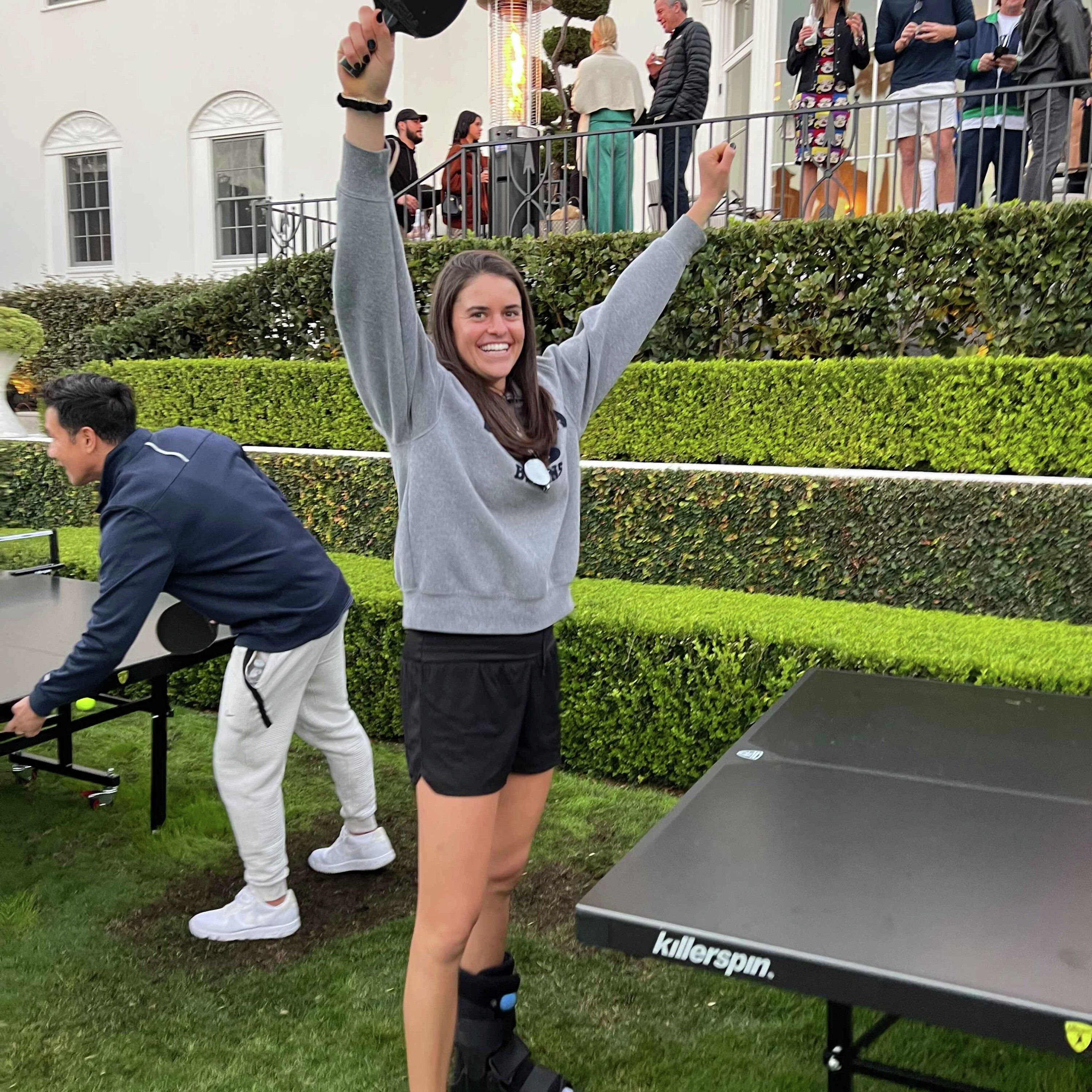
Jenny Brady
The UCLA standout sits down with Rennae to talk about her transition from collegiate star to finding success on the WTA tour, rehabbing an injury and where it all goes from here.
Hosted on Acast. See acast.com/privacy for more information.
See omnystudio.com/listener for privacy information.
2022-04-27
61 min
Transcript
Available Results
Generated results are saved to the knowledge database for reuse and search.
No generated results are available for this episode yet.
Extract Knowledge
Pick what you want extracted first. Model, scope, and chapter options appear after a template is selected.
Generated results for public episodes are saved to the knowledge database so they can be reused and searched later.
Transcript
00:00:16
Speaker 1: Renee. It's my favorite time of the year. It's clay court season.

00:00:20
Speaker 2: We know how excited you get about that red stuff.

00:00:24
Speaker 3: You get excited about the red stuff too, Come on.

00:00:26
Speaker 2: Yeah, I mean I do. I do enjoy watching turns on clay a lot. I just think the variety of shots, the drop shots, the sliding. I was never a fan as far as my results were concerned on clay, just because it was it really requires patience to be a great clay court player and sort of waiting for the right shot. But I loved playing on clay because I loved to slide, so that in itself really I enjoyed it. Especially Paris. There's nothing like clay in Paris, Caitlin. You play like through the season. You know, Rome and Madrid and all the courts are beautiful, right, but then all of a sudden you turn up in Paris and you step onto the courts there at Roland Garros, and the courts are just I don't know what they do, I don't know how they treat them better, but they just are so much better than everywhere else in the world, and it's just always a pleasure.

00:01:23
Speaker 1: So that's yeah.

00:01:24
Speaker 2: I do like the clay too.

00:01:26
Speaker 3: I am shocked constantly because we the racket team tends to attract a mix of people who have maybe grown up playing tennis and a few super fans, but a lot of people who haven't really spent a lot of time on court. And I'm always shocked to hear that people have never really played on clay before, if especially if they're like kind of on the more recreational side of the sport, and I tell them like, oh my god, this is it's totally going to get better. Like if you've only played in the hard court, that's the worst version of tennis. Like clay tennis is amazing to play. I mean, I love grass too, but it's a little harder to find. But clay court tennis on your body, it's fun to slide.

00:02:03
Speaker 1: You know.

00:02:03
Speaker 3: If you can find some red clay courts, which you know we actually have some here in New York, you know you're not going to get much better of an experience playing And you know, de bye, the fact that it was not it was the only Grand Slam that you never that you never won.

00:02:18
Speaker 2: Oh thanks, just rub that in well.

00:02:20
Speaker 3: The fact that the fact that you want every other one is is you know, no one will ever take that away from you. But I also feel like the you know, the French Tennis Federation is so difficult, the French Open is always doing its own thing, and yet we love it because maybe because it's so persnickety, you know what I mean.

00:02:38
Speaker 2: Persnickety. Yeah. Well I made the finals of mixed end doubles there. Yeah, so I wasn't a complete boob on it, and I won the Italian Open in doubles, so I wasn't a complete like. You know, as I said, I really liked to pine play, and it was just the way that you had to play doubles on clay. It was a little bit different. You had to really be, as I said, a little bit more strategic with your volley, and it really pushed me to be better, and also being a servant voluer. Playing on clay was a little bit more difficult because she didn't quite have that footing at the net you did on any any other surface.

00:03:13
Speaker 3: But when the Italian Open, I mean that to me looking at the Force Italia, like that's the most beautiful tennis court in all of the world.

00:03:21
Speaker 2: It was great. Yeah, Lisa and I beat a girl called Maui Sona and Ranchasentis for gai Her. Yeah you've heard of her. Well, Maui's great SONA was a great player. She was a lefty, super super super ultra talented. You know it was a good player in your day, like very good singles player and a very good doubles player. And so that was a lot of fun to win that tournament. Yeah, I mean it was great. Yeah. That court is so cool. It's like you're in a you really feel like you're a bit of a gladiator when you walk in.

00:03:52
Speaker 3: Totally it's covered with you know, those Mussolini era like Olympian statues, like they've just you know, sort of ambled down from Mount Olympus.

00:04:02
Speaker 1: It's really cool. It's breathtaking.

00:04:03
Speaker 3: I've never been to the tournament, and I would like to go very very much. That seems like a fun one to visit. I love the clay season. I just love having the red on my screen in the background. It's always like during this part of the year where it's a little warmer in southern Europe, so you kind of wish you were there because in New York it's still clinging to hold their temperatures.

00:04:21
Speaker 4: You know.

00:04:21
Speaker 3: It's the whole I get really swept up in this sort of like emotion of the clay court season. I think that's why I like it so much. Yeah, now anyway, moving on, moving on, Well, we should get in today's interview, but before we do, I feel like we should address something that is looking a little bit further ahead. But it has been on everybody's mind, which is grass court season, but mostly Wimbledon, the All England Lawn Tennis Club and their current decision and I call it current because it might change their current decision to ban Russian and Bela Russian players from playing this year's tournament, which has caused obviously a lot of controversy. A lot of people have come out against it, saying that it sort of penalizes the players unfairly who don't even seem to have direct ties to Putin. On the other hand, people you know, are are sort of saying, you know, if if we don't make a case out of every you know, every every corner of the world that Putin has his tender hooks into, then we're missing an opportunity to make a big statement about what is clearly an atrocity going on in.

00:05:25
Speaker 1: Ukraine, LTA and Wimbledon.

00:05:28
Speaker 3: And are on one side, and as well as some you know, former players Pam Drivers come out and support of the band as has you know, the royal family seems to be keen to support it. But the ATP and W t A on the other side, and some of the players are saying like this is a you know, unfair, it's a boondoggle. What do you think, What's what's what's on your mind when you look at something like that.

00:05:49
Speaker 2: Well, you know me, Caitlin, I tend to not be too ambiguous with my decision making, but I will say this situation really, honestly, I'm a little perplexed with it. I mean, I'm just sad overall about the whole thing, to be quite honest. I mean, obviously what's happening in Ukraine, a country I've been to, it's just it's horrific. It's absolutely horrific. And I really I just have no words for what that country and the families and people and all the players on tour, and I've spoken to many of them about, you know, the predicaments that they've been in and just you know, their father's still being there. It's just horrendous. I do feel sorry for the Russian players in some respect, because obviously I know a bunch of them and I know that they would never be okay with this war. But you know, the flip side is, look, I've spoken, as I said, to some some Ukraine players, and you know they one in particular I spoke to was a little upset that the players, the Russian players didn't come up to them or her personally. I'm not going to tell you who it was, because you know, I don't want to get into all of that, but she said, you know, one of the things that upset her was that they did not come to a lot of the Russian players did not come to her just to sort of say something to her, whether it just be Look, I'm really sorry. I can't say anything publicly because you know, this guy's crazy. You could kill my family, could you make my life a nightmare in the future, But I just I can't say anything publicly, but privately, can I just tell you this is how I feel. And I think the Ukraine players would have been a little bit supportive of not banning them that warn if they'd been more supportive of them privately, even maybe to go as far as to talk to the all England club and say this, and they have come to us and approached us, and we feel badly for them. Because they've come to us privately, they can't say anything publicly. So I don't know. I just oscillate back and forth. I feel because as I said, there are some players from Russia that I know would are just appalled by this, but they can't. They really feel badly. And Putin really uses sports athletes to promote his propaganda, and that is just a fact. I mean, he had those Russian athletes and one gold medals and metal at the Olympics up on the stage when he had that what the hell whatever that was at Trump rally in Moscow, and and that that is a concern because he does use sports athletes to proper get and you know, to use his propaganda around the world and especially to his Russian people. So I don't know, I'm caught between a hot rock and a hard place with this one. I really feel badly for some of the Russian players and I but I think it's a statement maybe that Tennis needs to make. I don't I don't know, I honestly don't cat one.

00:08:31
Speaker 3: Yeah, I mean, I think if you know, our friend, Krek Sapiro, on his podcast, had an interview with Alexander Dolgolklav. He's talked to a couple other Ukrainians, sergeigez Stakowski, who like went back home and enlisted for a time. You know, you're it's really heart running, you know, obviously hearing about players who are trying to compete on an international circuit but also having the lives of their families, you know, some of whom have been like I remember his drump because family at one point was living in a garage. You know, it's just it's, yeah, you know, absolutely horrific, you know, and obviously I don't think there are many players from what I understand. You know, I'm thinking specifically about rube Lev writing no war, you know, in supportive peace, which to me felt like a very radical statement on a camera after one of his wins, right after the war had started. You know, I don't know how realistic it is to think that these players are going to speak out, you know, to me, it's I think taking international incidents. You know, I believe that sports and politics are inextricably interlinked, but I don't I don't know that players themselves banning the teams absolutely, which is what tennis has done and a number of other sports have done. Obviously, we have seen the Bell Russian and Russian teams not able to compete in team competitions, which to me seems right. You know, Banning individual players, many of them don't even live in Russia, feels strange.

00:09:57
Speaker 1: It feels like a loyalty test, and it also sort of.

00:09:59
Speaker 3: Opens up a whole other can of worms, which is to say, you know, in two thousand and five, when America was conducting an illegal war in Iraq, was Andy Braddock or Venus Williams or you know, Lance Armstrong band from international competition? We like here to play should have been for other reasons, but you know, was are we banning Chinese athletes for an autocratic Chinese government? You know and the fact that they disappeared a WTA player under our noses?

00:10:27
Speaker 1: You know.

00:10:27
Speaker 3: I For me, it's it's more, if you want to go after Russia, take all the Russian money out of tennis, donate all of the proceeds to Ukraine. Make the oligarchs who have access to your fancy clubs and your fancy cars and their fancy yachts and your fancy schools.

00:10:41
Speaker 1: Like Oxford and Cambridge.

00:10:42
Speaker 3: And I kind of am limiting this to Britain because I think US has frankly done a better job and has less of its hands dirty on this particular issue with Russian money than than Britain has, which is why this strikes me as being very performative without being you know, having much.

00:11:00
Speaker 1: But yeah, I agree with you.

00:11:01
Speaker 3: It's it's a tough, tough situation all around, and it's just sort of sad or you know. And the reason I said it was a current, current decision is, you know, we'll see whether it you know, whether it stands after all this blowback from a lot of international bodies. But I do think like other tournaments are going to be looking form to sort of set the tone. The Italian Open reportedly has been looking at a similar band. I don't know if the US Open plans to do that. I just think I think banning people for loyalty pledges is a pretty bad precedent. But I do agree that, you know, any time the sporting world can demonstrate how wonderful it is to have players from all sorts of places setting aside their differences and coming together in celebration of sport. You're kind of summing your nose at any autocrat by by having, you know, the power of uniting us rather than dividing us being evident. So yeah, it's it's it felt like addressing just because I've spent on the minds of everybody in the tennis world and it doesn't seem like it's going to go away.

00:11:58
Speaker 2: Yeah, I as I said, I mean the WTA at POD. I'm sure they're talking about what they can do about it, because I think they feel a responsibility to protect the players individually. But I know that they're also hearing it from the players from Ukraine, you know, and what are you guys going to do about it? Kind of thing. But as I said, they're looking at maybe taking points away from Wimbledon, and if they do that, it'll become a very glorified exhibition. But having said that, if I won Wimbledon this year without points and they told me I wasn't getting points when they gave me that trophy, I probably wouldn't care too much.

00:12:33
Speaker 1: Yeah, you still put the trophe in your tropic case.

00:12:35
Speaker 3: You know, I'd still probably make out with rosbatter dish in front of you. Know, a crowd of a couple of million people. So yeah, it totally take your point.

00:12:44
Speaker 2: Yeah, So I mean, I don't know, As I said, I think overall, my my take on this is just very very sad. That's that's that's how I feel.

00:12:52
Speaker 3: I'm just disappointed that it looks like Medvedev is like one of the few people who can you know, who hasn't hit a hit strata on grass, might be denied the chance to play it, Like watching him get to the finals would be extremely fun, especially because it looks like, you know, the real changes in the guard has already happened, at least on the sort of like play specialist side of the men's tour, you know what I mean.

00:13:13
Speaker 2: But I mean, and also sabole Anka who made the semi finals.

00:13:17
Speaker 3: Yeah, I mean, she has a ton of titles on grass, not a ton, but she's got she's got grass titles, Like she's a real contender on the grass.

00:13:25
Speaker 2: Well, how are they gonna Yeah, and I thinking, how how the w T going to manage that? They're just gonna let her points drop off because she couldn't play. So that's a you know, that's and that's a lot of points semifinals is a lot of points to drop off, so it'll be interesting to see how they handle that in particular situation, because she's going to drop a lot in the rankings because of it, and not really any fold of her own except for the flag that's next to her name. I'll tell you what. Tell you who's happy? All the Russian players that left Russia and decided to represent kazik Stan.

00:13:55
Speaker 3: I mean, per usual, Yulia Putin Sava has the last laugh.

00:13:58
Speaker 2: You know, you might she's crazy, but she's really not crazy, like a fox exactly all right.

00:14:05
Speaker 3: Well, speaking of people who are very smart, I am delighted that you were able to sit down with Jenny Brady, who is a phenomenal American player who's had a similar sort of semi final and final showings at Slams in the last couple of years, has been sidelined by injuries, which she's working her way back from at the moment. But I'm talking about, of course, Jennifer Brady, a UCLA player, a college educated player.

00:14:35
Speaker 2: A.

00:14:37
Speaker 1: Humble kid from Pennsylvania.

00:14:38
Speaker 3: As far as I can tell, give me a sense of how Jenny's sort of seen on the tour. Obviously, she's a beast on the court. But it's interesting getting into her personality a little bit, as you guys do, how she's seen and how do other players sort of think about her.

00:14:50
Speaker 2: Oh, she's the best. I mean the sudden players that would sort of walk around and you can't not like them, and that is with sure Jen Brady. I mean, she's just constantly, always in a like fun loving mood, always making fun of herself, always you know, joking around, finding humor in most most everything. So she's a bit of a dichotomy as a human being though, and we discussed that a lot on the pod, But she's just a joy to be around. It was such a bummer she was having such a great like twelve months making, as you said, that US Open semi final against Osaka, where she played, in my opinion that was the best match of the tournament that year, and then of course made the finals of the Australian Open, and we get into sort of the mindset of you know, being in a final as opposed to a semi final and all that sort of stuff in the pod. But she's just she's such a talent. I cannot wait to have her back on tour. She went through obviously, you know, disaster with the injuries with you know, her feet and plan of fashion, and then got into a knee issue.

00:15:51
Speaker 1: You know, I sort of.

00:15:53
Speaker 2: Put a little bit of blame on her ex coach because I just have to think that Jenny's that type of person that doesn't need to be put and you know, she kept pushing herself and you know he's a hard worker as well, and I think that's where maybe some some issues had to have cropped up because she just, you know, is that you don't need to push her. And as a coach, you need to recognize, is my play a little lazy? And there are players out on the tour that you kind of need to push a little bit more, like let's do a half an hour more or maybe get into the gym a little bit more. And some you never have to do that with. I won't name a couple that I think are a little bit lazy, but certainly Jenny Brady doesn't. Yeah, I feel like I'm in the second category.

00:16:33
Speaker 1: I had a coach.

00:16:34
Speaker 3: I need somebody to get on my ass and get out of bed, do it more more, you know, Like my coach was always like, you're our physical trainer would be like, you've been on the elliptical for five minutes, and I'm like, are you sure it hasn't been.

00:16:43
Speaker 2: For to five minutes?

00:16:44
Speaker 4: You know what I mean.

00:16:46
Speaker 2: As one of those tapes you know, no, well, yeah, I mean me in the gym if I had a little issue with something. You know, if I said to my trainer, my car feels a bit, so we're stopping book, you know, because he just knew not to push me. If I was could.

00:17:00
Speaker 3: Pressure yourself, you were never going to make excuses. But if something it was because you were really aware of something, maybe if that was going to be a problem.

00:17:08
Speaker 2: Well yeah, And I mean I was fragile, okay, when let me just fragile? But no, So I think with Jenny, I mean that was kind of the issue. She kept playing through the pain and she needed to shut it down earlier. But you know, the rest retrospect of her career is that she had the smarts to go to college and realize that she wasn't quite ready to be a pro you know, mature what maturity wise and also game wise. But in this respect, she kind of blew it with the injuries and really kept pushing through and needed to have people around her sort of saying no, but hey, listen, mistakes get made. Players make these stupid mistakes all the time with injuries, and you know, push through them too much and she paid the price. So hopefully when she comes back, she's going to be a threat. And I really hope that she continues to believe in herself in every aspect because in my mind, she is as good as they come, and there's no doubt she can win a Grand Slam. I mean, she has a very similar game to someone like Ash where she hits a great first and second serve. She is a massive fourhanded back and is excellent. I think she could like even get her slice a little better. I think that will set her up more. I mean, we saw how much that helped Ash Barty in her career with the slice, how much players hated it. And you know, she can play the net, so she's she's a terrific athlete, moves around the court as well as anybody. So let's hope when she gets back we see the old Jenny Brady back in in a hurry because we need her. She's she's such a great player, especially in American tennis on.

00:18:37
Speaker 1: The tours, better with her on.

00:18:38
Speaker 3: It was really funny when a party at a at a racket house last year lead in Beverly Hills and both Australian Open finalists Nami Osaka and Jen Brady were both playing ping pong back to back on separate ping pong tables, and it was just sort of funny to see the two of them. I think we're both safely described as introverts at a massive party, you know, really finding finding a friend this piece at the ping pong table. So it was sort of nice to make them feel like they obviously were welcome in the racket universe. And it was great to hear Jenny talk. So without further ado, I'll get to it. Thank you, Jenny Brady. We're happy you're on your way back. And yeah, I agree, the tennis world is better with her in it, healthy, playing well and you know, here's to having a swift recovery.

00:19:20
Speaker 2: Yeah, and just for everybody, the photo that you will see on this pod is her playing ping pong at that party with her boot on. So anyway, is it Jen, Jenny or Jennifer? Either way? Either way, Caitlin, here you go. All right, Well, let's get stuck into this Jenny Brady. First of all, thanks for joining me on the pod, and it's just it's great to see you. I know people aren't going to see you, but they're going to hear your voice finally for the first time in a long time. But firstly, before we get to where you've been and what's been going on over the last year or so, I always ask my guests why tennis, Like why and how did you get into tennis?

00:20:15
Speaker 4: Oh, that's a good question. Well, nobody in my family played tennis. My dad played sports growing up, He played football, so he kind of was the one who got me into it. One day, he took my sister and I to the courts and we just in Pennsylvania and we just started playing there. And then eventually, I guess, you know, he started putting me in lessons, and then my whole family we ended up moving to Florida, not just for tennis, but it also ended up helping because there is more it's more competitive here than in Pennsylvania. So and then I started to grow from from just playing at a local park to then being in an academy at ever and then just kind of progressing from there. But I think my parents always told me that I when I was younger, I like playing It's gonna sound weird, but like I like always like had a ball in my hand, like whether it's a football, basketball, baseball, tennis, ball something like, and I like playing with falls, okay, And.

00:21:15
Speaker 5: But yeah, so my parents told me that I always always just playing playing sports, and I guess just from a young age, like being somewhat decent at tennis, and then you know, they kind of just instilled it in me.

00:21:28
Speaker 2: It's that's interesting because you are you're a little bit of a dichotomy as a human being, because I find you to be. First of all, you're one of the easiest person to ever be around. You're one of the most like players on tour. You're always funny, totally taking jabs at yourself all the time. But yet it's a solitary sport tennis, and you you were more sort of like a team type of person in some respects, but yet you are quite a shy person. So it's kind of like you're this interesting person to pick tennis, but yet was that tough for you or because because your dad played a different sport, were you interested in any other sport?

00:22:07
Speaker 4: No? I was never really interested in another sport competitively. I mean I always just played other sports outside of tennis practice, and.

00:22:15
Speaker 2: Again till what age, well, till what age, like you know.

00:22:20
Speaker 4: Up until I was probably like fifteen sixteen years old, I was always just playing, not not competitively, but just like for fun, always playing sports with my neighbors, with other boys. And I was a bit of a tomboy growing up. And yeah, it was just always outside doing something active. But yeah, it is, Uh, it is interesting because I do love being on a team, Like, I love the camaraderie, I love I love shooting the shit, so uh anytime, even just in locker room with players, I like seek out people just to just to go and kind of you know, bother them, and uh, tennis is very individual and that's also something that I do enjoy too, because like you said, I am shy and I enjoy just being out there on my own and no one telling me what to do and just being just kind of being free and not having to answer to anyone or take you know, take advice or anything from anyone.

00:23:22
Speaker 2: Yeah. Yeah, I always try and ask you know, fellow players or you know, anyone who's been successful, certainly in sports about how important it is to not individualize so early sometimes and if you're a good athlete like you you are, you know, parents need to hear that sometimes you don't want to individualize your kid too early if they're a good sports athlete. And it sounds like that's sort of the route that you went with your tennis.

00:23:48
Speaker 4: Yeah, yeah, I mean going to an academy definitely helped. I think just having other people there, I can understand how how people can get burnt out at a young age. I mean it's it's really tough, just like all the travel, you know, just grinding a challenger, is doing all that sort of stuff on your own, it can be it can be very very challenging.

00:24:10
Speaker 2: What would you tell a kid then, before we get to sort of like why you went to college, but what would you tell a kid you know about that sort of grind and how important it is to hang in there.

00:24:20
Speaker 4: Yeah, I mean, it's it's really important to hang in there. And I think there's other players, not that you have to like go and be best friends with everyone, but there's always at least another player that you know is looking for someone to hang out with or just spend time with outside of the court. So I think it's also important to Yeah, they're not going to be you know, they're also your competitors, but they can also be your friends at the same time. So it's it's kind of finding that balance of Okay, yes, when we step on the court, like we're out for blood and both of us want to win. So it's it's not being you know, being soft on them. Oh I feel bad if I beat them, no, like, because they want the same thing. So I think it's important to find at least people or just someone to kind of keep you going because it's really really tough if you're alone. I mean when I was playing Challengers and stuff just coming up, I actually I loved it because I was always sharing a room with like two girls one girl something. There was always somebody for me to to just hang out with and past time. So and we were always just you know, in it, complaining together. So it's not easy. And just know that it's not gonna be easy. It's not going to be you know, it's not gonna be glamorous. There's gonna be times where you're staying at the Red roof in or Econ Lodge and you hear mice and in the in the you know, just running around. So but you go through that and everybody goes through it to then, you know, put yourself in the position of playing Grand Slams and traveling to nicer tournaments.

00:25:49
Speaker 2: Yeah, it's funny because you know, everyone sees these big checks that everyone makes, you know, and I do air quotes right now, like huge checks, But what they don't see is all the shit that goes on prior to getting to even a big, reasonably big tournament like a one twenty five. Is like I'm making it now, you know, but they don't see you playing fives and ten thousands in the middle of nowhere, Texas or in the middle of nowhere Pennsylvania. Right, Yeah, So was that a what was the catalyst to go to college for you? Because some and I also stress this to parents, you know, and I hope some parents listen to this podcast. It's like, if your kid is not necessarily prepared to really go out there, and it's the grind and the challenges, but it's also a grind on tour. So what would you what was your reasoning to go to college as opposed to going straight pro.

00:26:36
Speaker 4: Yeah, I didn't really have the results that that my other years had. You know, I think Maddie at the age of fourteen was already playing professional tournaments, winning winning matches, and I was still maybe graining in grade four itfs losing first or second round. And I did have a good like a couple of runs in like Orangeville. Eddie heard doubles, So my my junior ranking was solidified solely on doubles.

00:27:04
Speaker 2: But yeah, he don't don't knocket it, man, we've a knocking it.

00:27:08
Speaker 4: I'm saying it helped me. It helped me, for sure. I mean to be honest, I I just didn't have the results. I didn't have the results, I didn't have the confidence, and there was no reason whatsoever for me to go pro. The only thing was that I was training with these other players that were already turning pro. And I was probably the only one in my age group in the ninety fives that were, you know, looking to go to college. And I felt like a little bit of a failure because everybody else was turning pro and you know, signing some deals with sponsors and stuff like that. But yeah, I was. I was excited to go to college, and when I went there, I was planning on going all four years, and I didn't know what I was gonna do. To be honest with you, I didn't. I didn't say, Okay, I'm gonna go for one year and then I'm gonna turn pro and tried out. I was like, okay, I'm going to school. I never was the type of person to plan ahead. I was just you know, lived life that's you know, day to day basis, and never thought, never thought ahead, never thought never thought about playing professionally, you know, never thought about what it was going to be like in the real world. If I didn't play, I just went to school and enjoyed it. And yeah, that that was That was my reason.

00:28:21
Speaker 2: You told me back a while ago that basically Stella Samprass, who was your coach at UCLA. Of course, if people are born like maybe yesterday, don't know that Stella samprssis Pete Samprus's sister. You told me that she kind of had to push you out the door, like Jen you got this star. Did you believe her when she was telling you that?

00:28:40
Speaker 4: Yeah, both her and Rants and also at the time like my freshman year or a volunteer assistant, Laura Gordon, They were. They were just like telling me, I mean I played three in the lineup. I never I played one and two. I played h. I played a couple of matches at two, but I played Smarrily number three, Robin Anderson was one, Chanel van Win, Kyle McPhillips, they were around two. Uh. But yeah, I mean I ended up getting a foot injury and I told Stella to put me out like four or five because I was like, let's win n C double as again. So I didn't care about the lineup. I just wanted to win the win the Natty. But yeah, they all just kind of not treated me differently. But you know, I felt like, Okay, I am like a pretty good tennis player, and I think like I was seeing you know, other players doing well at tournaments like around Miami Open, Indian Wells. It was around that time when I was still in school and you know, I was going to class and they were in the third round and I was like, oh God, I wish I was playing, And so something in sad me was like, all right, I need to work harder to do some stuff on my own. And they they totally supported me, and I actually ended up my after my freshman year, I was playing some tournaments over the summer, like twenty five k's, fifty k's, just like all the challenges in the US, and I ended up doing pretty good and got me ranking up to like two twenty. And I was like, okay, do I do I go pro? Like do I keep playing or do I go back to school? And you know, I talked to Stella and it was it was a decision that I decided to go back. And then you know, UCLA would honor my scholarship so I could go back and return anytime and they'll pay for my tuition. So I was like, okay, what's what's four more months and then when I leave, I'll have ranking and and then I can play. So yeah, that that was that was the reason why I left after my second year.

00:30:36
Speaker 2: I think the key to that when I when you, when I hear that story from you, is also for parents and for kids that go to college or think about going to college or not. It's just you know, really be honest with yourself, like deep down inside, because first of all, college is tough, Like you've got a lot of hours on court, you're doing your school work. It's it's not a walk in the park. It's a little bit of fun too. But but I would say, like turning pro, it's like you that's it, You're pro. This is your profession now, so now you have to put everything into that basket, and like, this can be a little bit scary. So I'm glad you did it though.

00:31:11
Speaker 4: Yeah, yeah, it definitely was a little bit scary. In the beginning. I was like, I don't know if I could do this, and yeah it was. It wasn't easy, like I said before, but but nothing's easy. And I was like, what am I going to do, like to behind a desk in work, you know, I was like, no way.

00:31:32
Speaker 2: That's not you ain, no way, So you're going to cut to You're going into pros. You sort of get your feet wet, you're starting to develop your game a little bit. I guess what was sort of the catalyst to like push. You obviously changed coaches, you got away from the USCA system, you went to Germany, you got a different coach, you gave you a different mentality. But what are the things that like you felt like in that six month period, well you really you know, I saw you qualify in China, you had a great year the next year. What mentally changed because I saw a little bit of a different person from you from that period on to making the austrain open.

00:32:12
Speaker 4: Fine. Oh yeah. I the whole time I'd been playing, since I left college, I was always just not necessarily going through the motions, but like when I would play matches, like one year I played Simona hallup in Toronto and I lost in three sets. It was a close three set match, but the whole time, I never believed that I would win, Like, I never believed that I could win the match. I always was just kind of quote satisfied that I would get a set off of you know, a top twenty player or a top ten players. So I never actually believed that I could be that player, that I could be the one, you know, where someone was playing against me and I was the one who was seated, or I was the one going into the match being the favorite. I was always just used to being the underdog and being okay with with having a having a tough loss. So I think my mentality changed when I started seeing and realizing that you know, I have I have the game, I have the tools, I have what it takes to to beat these players and and they're just people like, they're not you know, they're not God like, they're just people like I am. And they also they also make mistakes and they're not perfect. So I always just put the players who were, you know, ranked maybe inside the top fifty, always just on a pedestal. And you know, after maybe getting a win or two, I was like, holy shit, like that's me, Like I'm better than that, you know, I can, I can take it all the way. And then the results started coming. I started working a lot harder and started believing in myself, and yeah, I think that's kind of how it started.

00:33:55
Speaker 2: It's it's I talk about this all the time, Jen, It's about like it's the subconscious mind and the conscious mind, and the conscious mind is the you know, is the thing that you talk about, you say in press or you say to yourself. But then there's that little little tiny Jenny in the back of the brain, or me it used to be the little tiny Stubbsy in the back of my brain, going yeah, but you're not really quite ready yet, you know, I don't think you can win this match yet. And then all of a sudden, when the conscious mind and the subconscious mind are on the same page and they actually believe that they can win. That's when your life starts to change as a professional. So that's what it sounds like for you a little bit there, because I have a funny story to tell because we all know you know, me doing courtside at ESPN and it was one of your bigger matches. I think it was the third round of the Year's Open against Blushkova. Fourth round, fourth round. Sorry, I should have had that correct, you know, way to go, way to get your research right. Fourth round. You're sitting there, it's the biggest match of your career. At that point, you run out, You've got the wrong like signage or whatever on your shirt. The umpire tells you you got to go run off the court. Can you take me through that little five minute stint there and explain to people this is one of the reasons why maybe things changed a little bit, because I think you were still a little bit like, what the hell am I doing out here? Tell me that story? Please?

00:35:18
Speaker 4: Yeah, I can actually tell you a little bit more to that story. Even before I went out to the court. Great, So I was warming up in the gym and ash and I'm first on at eleven, and all of the courts were being called ten minutes before. So at ten fifty, I stop my warm up. I go downstairs and I'm there waiting, and you're there too, and You're like, what are you doing here? You're like you still have about like twelve minutes, and I'm like what. I'm like, Oh my gosh, I'm already warned off. I'm ready to go. And I'm like, uh, what do I do now? And I literally just go into the locker room and I sit on the on the bench for like ten twelve minutes until one of the supervisors comes in and it's like, Okay, are you ready? And I'm like, oh, yeah, I guess. I mean, I've been ready for fifteen minutes, already psyching myself out. I'm like, oh my gosh, I'm going to play on the biggest stadium in tennis. I'm I did a warm up twenty minutes ago. I'm really the warm up up. I'm not warm. I'm not mentally or physically prepared for this match. So I'm just going out there. And then you know, we did our court site interview and then, like you said, I was wearing a patch and the patch apparently was too big or they put it on wrong, and so I had to go run off the court, use the change room and put on a different top. So I was just running in to match, all out of sorts, and I was just like and from that point on, honestly, I think my whole pre match stuff lasted longer than the actual match. So it was it was not my best performance, I would say, And yeah it was. It was fairly quick.

00:36:50
Speaker 2: All I remember is you running back onto the court and most people, you know, this happens. You've got to go change you shot or maybe go to the bathroom. You come back out, You kind of sit down and take a simple water. Do you kind of bring your heart rate back down, You get yourself back focused. You ran back on the court, ran got your racket, ran back to the baseline, ran and got a ball from the ball kid, turned around and served within about thirty five seconds. And I'm sitting there courtside going, oh, this is going to be an ugly start, and I thought, I think you double folded the first point and I thought.

00:37:24
Speaker 4: So, I was like, oh my god, they're winning for me. This is my first time on a thedium. I got a camp. You late. I don't know what to do. I was freaking out.

00:37:32
Speaker 2: I was like, holy shit, it was a quick match. But the good thing is flip too. A couple of years later, okay, and you make that run to the US Open semifinal when you walked under the court for that match, because for me, that was the match of the tournament. You know, when you walked under that court. First of all, take me to the perspective of not having a crowd there during that year and if that actually helped helped you a little bit, because your one player that I've said publicly that I think it helped because you were starting to get really good as a tennis player, starting to really believe in yourself, and then not sort of having the crowd expectation on you. I think helped you find the best Jenny Brady out there. But take me through that maturation of you know, a couple of years before and being like, oh my god, this is all too much for me to Hey, I'm here to stay, So take me through that match.

00:38:25
Speaker 4: Yeah, I mean, I think I agree the whole crowd thing. I mean, our first turn at back in like someton, I won that and there was no crowd, and then leading into the US Open having no crowd, I was just I just felt like I was hyper focused on every single point in the matches. And I was also so hungry to just compete again because it had been so long, and I was training so hard on my own here in Orlando, and I knew I'd put in the work, so I had a lot of confidence in myself and my game and my fitness everything, and I think it kind of showed that I was putting in a lot of work during that time. But I think that match absolutely If you even asked Naomi that, I'm sure she would say that was probably one of the best matches she's ever played, too. I mean, it was just such high quality from the beginning until the end. It was just an unfortunate tiebreak for me. In the first set, I did not play a good tie break at all, and I had a couple on four stairs. But then it was a good second set, and then the third set she just broke me once.

00:39:25
Speaker 2: But yeah, I mean.

00:39:28
Speaker 4: Almost every point was very, very high quality. It was one hundred percent better that match than the match we played in the finals in Australia. I think both of us honestly didn't play good at all. I think she served really well in that match with the US Open. That's one thing that I felt a lot of pressure on was when I was serving. I felt like I really had to play almost not a perfect game, but close to perfect game with a lot of firs, high first serve percentage and like aggressive from the very beginning because I felt her pressure when she was serving. That was huge for me in the second set to get to get the break at four to three I think it was. And then.

00:40:08
Speaker 2: Yeah, it was.

00:40:09
Speaker 4: It was a really really high quality match and just kind of showed the improvements that I made three years later from twenty seventeen to twenty twenty.

00:40:19
Speaker 2: Yeah, was the subconscious Jenny and the conscious Jenny on the same path in that semi and also the final the Aussie well, were they still battling.

00:40:29
Speaker 4: Each other In the final, she was battling, She was battling herself bad. But in the semi, like I wasn't thinking ahead, wasn't you know, thinking about any of it. I just wanted to win the match, like, but that final, I was actually so more disappointed in myself after the semi because I played such a good match, and I was like, gosh, if I bled that good, Like how did I not win? And I mean tennis is just a matter of inches, Like a couple points here and there to me make a huge difference. So I mean, and when people say I play every point like it's your last, like I think every point does matter. And that's kind of the perspective that I that I had sort of taken over the last couple of years, just just playing every single point the same. You know, whether I'm up forty love or talent forty love, I think, you know, just just trying to to win every single point. It makes a huge difference because there's games where you know where you know I'm out of it, and then all of a sudden, you know, I end up winning it. And then I'm looking back at that match and I'm like, holy shit, I didn't like stay in there and believe in it, like I probably would have lost the match instead of winning two and two. Like it's a huge difference. And but yeah, that that Australian Open final, I went into the match and I was like, I'm not ready. I'm not ready to be a Grand Slam champion, Like not that I don't want it, but I was like I didn't. I didn't know what to expect, and I was like, oh my gosh, it's just all happened so fast, making my first Grand Slam semi finals and then making my first Grand Slam final right away. I was like wow, like, I don't know if I'm ready yet, but so can tell.

00:42:10
Speaker 2: You what if you could go back, if you could go back, or or if you could be that person like this is what happens when you get into coaching. Right, not yet, there's a long way to go yet, but no go back and say to Jen Brady in the Australian Open the day before or maybe even the morning before, what would you tell yourself and that.

00:42:31
Speaker 4: Oh, that that I'm ready, that I'm ready to hold the trophy to be a Grand Slam champion. Just just play, just play your game, believe in it and just have fun out there. I think you know, every single one of the matches that I played, I may have not played my best tennis. And that's also important too, that you don't have to play your best, but you just have to find a way. You have to find a way to to just grind and hang in there at any moment, you know, the match can can shift. You know, the opponent can get a little bit nervous serving for it, and then you kind of capitalize on that and also just being aware of how they are mentally and physically, just kind of paying attention to that to the other side of the court as well. So yeah, we told myself just just go out there and fucking win it.

00:43:18
Speaker 2: I love it good. I'm going to remind you of that the next time you're in a final, because you will be one day. Isn't it funny to think that you played Naomi like in the middle of nowhere Texas and some challenger. I know that you guys played like first round, isn't it Yeah, But did you think about when you when you think about the match in Texas against Naomi, we like, yeah, yeah, she's gonna be number one in the world one day and I'm going to play her in a Grandson final.

00:43:44
Speaker 4: No. I was like, oh my god, I just have to put two balls in the court, and she like this is I was like, oh my gosh. She the ball so hard though, but I was like just running side aside for literally two balls, and I was like, yeah, this is easy. Like I just have to make football, Like put it in the court, she's going to mess.

00:44:02
Speaker 2: Well, she's improved her ability to make a little bit. So unfortunately, Jenny, you know, when you're having this incredible run, bang, terrible injury plan a fashion issues, foot issues probably overtrained when you had them, because this is unfortunately we tennis players, you know, or athletes in general, get injured and they just keep pushing, right, they just keep pushing through because it's like they can do it, and you don't want to lose six months or you don't want to lose a year. Go through that a little bit just quickly with the injury and where you're at now.

00:44:39
Speaker 4: Yeah, so start having pain in my heel and during Miami Open, I didn't really think anything of it, you know, like you were just a little bit here and there, and then went over to Europe for the clay season and then you know, after my first round match with Stutgard the next day, I was like, oh my gosh, like we I remember I was going to go into the gym mc daniel and we started like jogging and I was like I can't do this, Like I can't even Like I was like it so much pain and I just kept pushing it, pushing it, pushing it, played it. Roalm played a match, ended up retiring, and then went to Roland Garros. So I was like, okay, I'm not gonna play. You know, I'm gonna come here. I'm gonna withdraw Sunday night. I'm like, screwt, I'm gonna play like. And I told myself, I was like, I'm only gonna play like, but I'm stepping out there and I'm finishing the match like I'm not gonna do you know. I was like, that's why they came up with this lucky loser, you know, fifty percent prize money. Because I was like, okay, you know, I go out there, I play a couple of games. I'm not gonna you know, I'm gonna get fined. And I totally respect that and ended up winning. Around next day, couldn't really walk. Played my second round, won that, and then third round I was playing Coco and and I didn't only just have pain at that point because I was just like compensating with the rest of my body, like I started having back spasms, I couldn't serve. Everything kind of went and I just had to end up retiring but yeah, like you said, like I just kept pushing my body and pushing it and pushing it and pushing it. And I never really had like a bad injury like that before. Uh So it's always just been something like, oh, okay, you know, just play through it and then it'll go away. And yeah, no, it wasn't one of those. And then ended up skipping the whole grass season, played the Olympics, uh and then was playing in a tournament in Cincinnati. Was way too soon. Uh. Still was having a lot of pain, Like I remember practicing and just like crying during practice, and but like always just keeping to myself like I've never I'm also not very good. I like to just you know, push through it, and I'm like, okay, like you know, you're not weak, you know, just keep keep playing, like keep playing. You know.

00:46:56
Speaker 2: Do you get that from? Where? Do you get that from my dad?

00:47:01
Speaker 4: My dad for sure? Yeah, he instilled like a football mentality in me. And uh yeah.

00:47:07
Speaker 2: I you know in football that just injected a little like steroid in there and go go and play this game and there a six year professional career pretty much. That's like that.

00:47:17
Speaker 4: I know, I know, but you know, you live and learn. And I was playing a match against Austin Panko in my second round match and I ended up tearing my plan of fascia. So and while this started going on, like back in July, I started having a little bit knee pain and so, uh, because I was compensating so much, went to the US Open with a torn polane of fascia. I didn't know it was torn, didn't get an MRI. H And I was having pretty bad knee pain. And I always remember I was like practicing, I was hitting some serves and I felt like a crack in my knee and I was like, oh my god, ouch. And I ended up getting an MRI and they were like, okay, it was dress fracture. So I pulled out a US Open. Funny enough, I was supposed to play em rod Accon in first round, so that's right. Yeah. So uh hey, uh she said, she.

00:48:14
Speaker 2: Said for life because of you pulling out.

00:48:16
Speaker 5: Hey.

00:48:17
Speaker 4: Yeah, you're welcome, Emma, You're welcome. You can thank me later. So yeah, and uh, I've been rehabing both my injuries, been out since August.

00:48:31
Speaker 2: Uh.

00:48:32
Speaker 4: My foot's feeling pretty good. My knee ended up having Uh, it was a lot worse than expected. It was. Uh so, I have cartilage piece that kind of broke off. So I a couple of weeks ago, I had surgery and they went in there and and and scoped it and cleaned it up, and so, uh yeah, I was hoping to be on court six week post surgery.

00:49:01
Speaker 2: But you know, it always always go a little.

00:49:06
Speaker 4: I also was kind of pushing it on my own. I was doing some stuff on my own. I like to test my injuries. And uh not that I made anything worse, but I've kind of given myself a little bit of a setback because I wanted to, because I was just going mad, like it's been so long since I've played, and you know, really like done anything. You know, sort of pushed myself basically.

00:49:31
Speaker 2: So I mean, I mean, the the ultimate question is what would you tell yourself a year, you know, a year and a half ago. And I think the answer is just you know, when you when your body screaming at you take the time.

00:49:40
Speaker 4: Yeah, when your body is screaming and you stop, like I probably would still be I would probably be playing. I mean probably you never know, but I could have prevented it from getting this bad if I had just listened to my body in the first place and shut it down for you know, a couple of weeks a month, listen to my body before, you know, just trying to keep pushing it and pushing it and pushing it.

00:50:04
Speaker 2: Is that the I think the lasting legacy of someone like Ashbarty, who you were good buddies with, played doubles with on the tour from time to time, and you know, Ash is pretty similar to you, a total tom boy, can play any sports. You know, shy but yet easy going. You're very similar in that respect. Is it the legacy of Ash to say, if you don't want to play, don't play. If you're injured, don't don't play. You've got plenty of time on your hands. Obviously Ash is retired now, but don't you feel like, you know, her not playing throughout that whole pandemic year because she just didn't want to travel and deal with all that quarantine. Do you think something in that is to help other players say you've got plenty of time, like calm down, like you still got so much time on your hands, and so hopefully you're taking that to heart.

00:50:53
Speaker 4: Yeah, in the moment, it's really tough to think. It's tough to think, you know, oh my gosh, you're missing one tournament. But even then, like you don't have to play every single week. It's it's absolutely draining mentally and physically. The tennis season is almost eleven months long, so there's plenty of tournaments to play, and I think it's also being smart with how you schedule your tournaments, how you schedule practice, giving yourself time to rest. I also never took you know that last year and a half, I was a little bit of a Nazi, Like I just kept going and going and going, and no wonder my body was just so broken down. I mean, to even just get to tear your plan of fascia, it's like it's very tough to do. And to get a stress fracture in your knee and cartilage damage at the same time, it's very hard to do. So it's something that obviously, especially your age, Yeah, exactly. So it kind of just my body was just telling me just slow down, like don't why are you doing so much? And I didn't listen to it, and then you know, it just got to that point. So yeah, I saw something, you know, Christianne shared something with me, like a video and it was like, there was this former athlete who she retired, and she was just so used to going to the gym and just grinding and leaving like feeling like she like is exhausted and just you know, accomplished everything that you want to accomplish, did so much and just was used to like torturing herself and torturing her body. And I was like, oh my gosh, that's how I feel. That's how I felt. I was like, that was I mean, that's not normal, you know. I mean it is like you do have to push yourself and push your body, but to a certain point, like to a certain point where it's like, Okay, I'm not getting injured. I don't have pain. Yes, you can be sore, you can feel tired, but to a point where you have pain. And if you keep going and going and going and the pain gets worse and worse, then you have an injury. And that's when you kind of have to be like, Okay, let's slow it down here, let's ticket easy.

00:53:01
Speaker 2: Are you at all not scared? But I guess worried or scared a little bit to like go to that threshold, because I mean, I know how how hard it is and how much training has to go into being a great tennis player. I mean, these points are getting longer, the matches are getting longer, the players are getting better. Is there any part of you that's a little bit trepidacious about pushing yourself to that extreme again?

00:53:28
Speaker 4: Now? If anything, it's like keeping people are like preventing me from like pushing myself. Like two days post surgery, I was like getting on the assault bike and like trying to like push myself like eighty percent. And you know, I didn't tell anyone, And then I'm telling people now, like telling the doctor and they're like, what are you doing, Like you know, wonder your knee is like not recovering, Like you can't be doing that shit like and I'm just like yeah, but like I have to. I have to get better, like you know, have to be I have to be ready, like you know, like if I if I want to come back, like if it knocks off two weeks And they're like, no, you're only like giving yourself setbacks, And I'm like, oh, okay, so no I'm not. I'm not afraid of going there. It's more of like listening to my body. The only thing I'm scared of is like, uh, I mean I'm not afraid of any No, I'm not afraid of it.

00:54:22
Speaker 1: No good.

00:54:24
Speaker 2: I think the lesson here again is sometimes listening to people that might know a little bit more than you when it comes to actually the way the body works, that's all. That's all I'm saying.

00:54:33
Speaker 4: Yeah, no, I don't really know how it works. I just I just know how to do what I'm told, and and more, well.

00:54:38
Speaker 2: No, you don't do what you're told because the doctor told you're probably not to do that.

00:54:42
Speaker 4: But anyway, story, yeah you're ready, don't listen.

00:54:45
Speaker 2: I guess what do you what other than the competing pot? And what do you miss about being on tour?

00:54:51
Speaker 4: I miss I'm miss seeing everyone every single week all my friends are on tour. I mean being home in Orlando, I'm like so bored. There's nobody here. The only people who like when Caroline dahl Hyde comes back, like you know, the second she comes back, I'm like, hey, what are you doing? And I'm like, oh, or Maddie, and yeah, it's just I miss like seeing people. I miss the competition. I miss uh, I miss the training. I miss you know, feeling like waking up and feeling accomplished or like yeah, like like feeling like oh okay today, like today I'm I'm doing this, this and this, and then at the end of the day, like I feel like I got better, So like I just missed like the process. Really, yeah, that's one thing. Yeah, besides the competing obviously.

00:55:42
Speaker 2: What's the belief system and the belief in you once you're healthy and you're back and hopefully it sounds like to me that the maybe the the coming out of Jenny Brady again might be the US Open swing. Is that?

00:55:55
Speaker 4: Yeah, that is my absolute goal. That's my goal. And the doctor told me, if I lease do anything more stupid, I'm gonna have another step back. So I'm listening now. Uh yeah, that's one hundred percent of my goal is to to to start the US the US Series and oh man, I'm like so looking forward to it. But I know it's not gonna be easy. That's gonna be Probably the hardest thing for me is to to know that I'm not gonna just I mean, you never know, but I'm not gonna come back and win with my first term at back and I mean you never know though, so uh but yeah, I know it's not gonna be easy. It's gonna be a grind even just getting back on court, getting back you know physically, uh, you know, like just getting back into tennis shape, into playing shape. It's gonna be it's gonna be tough. But I'm like so looking forward to blood, sweat and tears.

00:56:45
Speaker 2: Baby, all right, Jenny, Last couple of questions, like coaching wise, for you, what's the most important? Like you try and help develop sometimes coaches into understanding how important it is to help players in certain ways where they be emotionally, physically, the game plans, structure on the practice court, all of those things. Is what a coach is? You need a coach for. What are the attributes you know that that you would like to pass on to, Like people out there that are listening maybe that want to go into coaching or are looking for a coach for their kids.

00:57:22
Speaker 4: I would say that the coach and the player have to have the same goal. They have to have the same they have to believe and want the same things because I think it motivates each other. And also you start to believe in yourself a little bit more as a player when the coach believes in you. And I think that's really important because in those moments it's about the tennis, but it's also mental. Like I'm watching a lot of these tournaments and I'm seeing a lot of mental shifts on the court, and I'm like, oh my gosh, yeah, you know, I can see it right there. You know, if they don't win this point, it's like all hell breaks loose. So I think it's just knowing believing that regardless of the score, regardless of the points, when you look up at your box and you see someone there, you're like, they believe in me, Like I need to believe in myself. So I think that's that's really important. And then also just having the structure on court, the practices, you know, having a game plan, having using utilizing your weapons, making your weapons better, but also recognizing they recognize their weaknesses and they're not afraid to point those out. So I think because players can can I mean, I can name weaknesses of every player you know, and I think, you know, if the coach doesn't know that, I don't think then that's the right fit. I think that they have to recognize the player's weakness and make that better and then also make their strengths better. So I think just kind of like developing their game and then also helping them believe in themselves.

00:58:53
Speaker 2: All right, go back to being twenty Jenny, What would you tell your twenty year old self.

00:58:57
Speaker 4: You're a lot smarter than you think you are. You you can play tennis better than you think you can, and uh, it's just it's just a matter of time before before you know, things, things good things happen.

00:59:16
Speaker 2: Wow, look at you getting all philosophical and old year old. What are you twenty six.

00:59:20
Speaker 4: Now twenty seven? Like seven days ago?

00:59:24
Speaker 2: Oh, that's you're a co aries. I five on that one, my friend. Yeah, a lot of great tennis players were arias my friend Ny. I mean, I could talk to you for hours and hours, but I'm just really happy that we got to spend a little bit of time with you today. And I can speak for a lot of people not only in the talent television industry, coaching industry, other players. Man, we cannot wait to have you back because you're missed out on two of my friend.

00:59:55
Speaker 4: Yeah. No, I can't wait to be back. I can't wait.

00:59:59
Speaker 2: Yeah, And I can't wait to see you five minutes before at your introduction time on Arthur Ash stadium.

01:00:04
Speaker 4: In the near future, I'll be a different person, don't you worry.

01:00:07
Speaker 2: Yeah, yeah, you know. It's a super focused now, super focused Jenny, great job over the last couple of years. I know you're going to be back. Trust in the process, my friend. Trust in the process. You'll be back and you'll be You'll be kicking everyone's ass again with that monster servant monster forehand, So trust it.

01:00:25
Speaker 4: Well, well, all right.

01:00:27
Speaker 2: Jenny, thanks for joining me and my friend. I miss you out there, so we'll see you soon. Yeah, thanks to the rehab. Yes, all right, buddy, thank you.
Chapters
No chapters available.