Talking Philosophy with Kerry Knudsen
Kerry Knudsen is a Lichen Biologist who originated outside of academia and worked in construction until becoming fascinated by the natural world and immersing himself in desert lichens.In this episode we talk about the modern human approach to the living world, why the study of natural sciences is becoming increasingly popular among people outside of academia, the biosphere as a living machine, self-education using the internet, and more.
A lichen is the symbiosis between a fungus and algae or cyanobacteria, many of which can go dormant for extremely long periods of time and tolerate harsh winds, drying out, being blasted with UV radiation, and slowly cooked on the rocks that they grow on. Some of them can live for thousands of years.
If scrolling through the obnoxious ads is getting tiring, then join the Patreon, where you'll have early access videos and ad-free access to every podcast episode, plus photo posts, patreon-only lectures and other benefits.
A lichen is the symbiosis between a fungus and algae or cyanobacteria, many of which can go dormant for extremely long periods of time and tolerate harsh winds, drying out, being blasted with UV radiation, and slowly cooked on the rocks that they grow on. Some of them can live for thousands of years.
If scrolling through the obnoxious ads is getting tiring, then join the Patreon, where you'll have early access videos and ad-free access to every podcast episode, plus photo posts, patreon-only lectures and other benefits.
2024-12-16
112 min
Transcript
Available Results
Generated results are saved to the knowledge database for reuse and search.
No generated results are available for this episode yet.
Extract Knowledge
Pick what you want extracted first. Model, scope, and chapter options appear after a template is selected.
Generated results for public episodes are saved to the knowledge database so they can be reused and searched later.
Transcript
<v Speaker 1>Okay, we're recording unless this thing unless this thing foks. Okay,
<v Speaker 1>there we go, carry canuts and self taught like anologist
<v Speaker 1>and autodidak. How are you doing?
<v Speaker 2>Oh? Real good, working on a project on Utah.
<v Speaker 1>Oh yeah.
<v Speaker 2>And one family lichens. Oh, a lot of undescribed diversity.
<v Speaker 1>Yeah, what was that? What is it? Akarospra? That's their
<v Speaker 1>main genus, Yeah, Acoros bracy. Those are the ones that
<v Speaker 1>you don't notice some when they're dormant, and then when
<v Speaker 1>they when they light up, they turn like a bright,
<v Speaker 1>vivid green.
<v Speaker 2>Yeah they're moist. Yeah. Well almost all lichens are like that,
<v Speaker 2>but a lot of these are are kind of plaine looking,
<v Speaker 2>some of them are, and most of the yellow yellow
<v Speaker 2>stuff you see as them.
<v Speaker 1>Oh really okay? Yeah, I saw one in the Mojave
<v Speaker 1>Desert in southwestern Utah and it was it was near
<v Speaker 1>Saint George and it was I think we talked about
<v Speaker 1>this this podcast we did, and it was, Yeah, it
<v Speaker 1>looked like Slimmer from Ghostbusters, you know, to use it
<v Speaker 1>to use in eighties reference an eighties kids movie. Beloved
<v Speaker 1>eighties kids movie. How are you doing?
<v Speaker 2>Man?
<v Speaker 1>It's I haven't talked to.
<v Speaker 2>In a year or two, you know, yeah, just working
<v Speaker 2>away on this grant. Yeah mm hm.
<v Speaker 1>And so what what is it con? I mean, so
<v Speaker 1>what so you're in Prague, you're living in Prague, which
<v Speaker 1>I don't blame you the fuck out of the US,
<v Speaker 1>you know, because it's it's kind of a fucking zoo
<v Speaker 1>over here. To put it lightly, it's.
<v Speaker 2>Kind of it's kind of a zoo everywhere in the
<v Speaker 2>world right now. But but it's good to be in
<v Speaker 2>somewhere different than where I grew up, you know, for
<v Speaker 2>the just for the experience. Yeah, and I got a
<v Speaker 2>good woman here.
<v Speaker 1>So but you guys, you guys have I mean, you
<v Speaker 1>have healthcare over there, right.
<v Speaker 2>Yeah, way better. Yeah, it's yeah, it's complete healthcare, one
<v Speaker 2>of it, and that's disappearing in Europe. By the way,
<v Speaker 2>we have trouble not having enough doctors because they split
<v Speaker 2>and go to America to make money. So you got
<v Speaker 2>a lot of really old guys and old women working
<v Speaker 2>on the healthcare system here.
<v Speaker 1>Yeah, what's going on? What's going on? Are the companies
<v Speaker 1>Are the companies trying to I mean, are they trying
<v Speaker 1>to privatize it? Like everywhere? That's kind of like the
<v Speaker 1>you know, the No, it.
<v Speaker 2>Looks like it's it looks like it's gonna hold. We
<v Speaker 2>got it, we got so I think it'll hold. Yeah,
<v Speaker 2>the people here aren't gonna let go a bit easy.
<v Speaker 2>Why why are.
<v Speaker 1>Moving to the US though, that's crazy to me, Like
<v Speaker 1>why would they want to come here?
<v Speaker 2>Doctors, doctors, our doctors are going there to make some.
<v Speaker 1>Money, okay, but then you have to live here.
<v Speaker 2>So yeah, well that's they don't mind. They can make like,
<v Speaker 2>you know, a couple of hundred thousand dollars a year
<v Speaker 2>instead of what they're making here.
<v Speaker 1>Yeah. Man, I knew a guy. I knew a guy
<v Speaker 1>in Mexico. Cool guy. He was a trail runner. I
<v Speaker 1>actually asked them to get me a gave gentry. I
<v Speaker 1>seeds from Nuevo Leone, which is that high altitude giant eggavated.
<v Speaker 1>He sends out pups and he was doing he was
<v Speaker 1>trained as a surgeon doing apendectomies and then and then
<v Speaker 1>now and then he I talked to him last He's like, yeah,
<v Speaker 1>I moved into plastic surgery. It's like, oh god, why
<v Speaker 1>you know, like given given phrases, butt lifts are fucking
<v Speaker 1>you know, injecting and what do they do with they
<v Speaker 1>inject the lips that looks like a you know, you
<v Speaker 1>end up looking like a fifty five year old lizard
<v Speaker 1>or something, you know, I don't.
<v Speaker 2>Know, some sort of like weird move those move those
<v Speaker 2>wrinkles from your face so you look like you get
<v Speaker 2>your face doesn't move anymore.
<v Speaker 1>Yeah, the Kardashians have just ruined. They just fucking so
<v Speaker 1>poisoned the well of anyway of beauty, standards of beauty,
<v Speaker 1>what's considered but anyway, man, so with your uh so,
<v Speaker 1>with acharospo and all the so what how are you
<v Speaker 1>working remote? How are you You're writing a li like
<v Speaker 1>in Flora? On the are you writing a like in Flora?
<v Speaker 2>I'm I'm not. I'm only working on one part of Utah,
<v Speaker 2>this and this one family which is really diverse. There
<v Speaker 2>we right now I have I'm in the process that
<v Speaker 2>described me over fifteen new species for science from there.
<v Speaker 2>So Jesus give you an idea and we're trying to
<v Speaker 2>figure out other ones.
<v Speaker 1>Do you think, I mean, do you think a lot
<v Speaker 1>of just likings aren't on many people's radar because there's
<v Speaker 1>not there's not a human like an anthropocentric use for
<v Speaker 1>them or.
<v Speaker 2>What that's right, that's right. There isn't much use for them.
<v Speaker 1>I mean aside from being a you know, a piece
<v Speaker 1>of the living machine that is the biosphere there there,
<v Speaker 1>you know, unless you can monitor there's no way there's
<v Speaker 1>no pharmacological uses for them.
<v Speaker 2>I suppose huh, Well, they know, but like see for instance,
<v Speaker 2>we have I've even worked on a paper too with
<v Speaker 2>with people looking for for chemicals in them. And there
<v Speaker 2>are there are assets in them. But once once they
<v Speaker 2>can discover them, they once they can discover them, then
<v Speaker 2>they can synthesize them if they think they really have
<v Speaker 2>a use. But so far the research, which has been
<v Speaker 2>mostly on cancer cells, has not produced anything that I
<v Speaker 2>know of anyway.
<v Speaker 1>Mm hmmm. Isn't there there's some sort of vitamin D
<v Speaker 1>supplement that's synthesized from like in Is that true? Is
<v Speaker 1>there isn't there something?
<v Speaker 2>Well, I hadn't heard about that one. No.
<v Speaker 1>I forget, Yeah, I forget that. I'd have to get
<v Speaker 1>my competitor on my computer with me Jesus Christ. I
<v Speaker 1>forget that.
<v Speaker 2>There's there's a few things that that are commercial and
<v Speaker 2>it's some of them here in Europe are used to
<v Speaker 2>make perfume bases, and so some are some are collected
<v Speaker 2>every year in like oak forests. And we have a
<v Speaker 2>cough drop here that's made from Icelandica and it's it's
<v Speaker 2>it's a it's a lichen and it makes a darn
<v Speaker 2>good cough drop better than doctor Smith's or whatever they're
<v Speaker 2>in the United States.
<v Speaker 1>Okay, there we go. Okay, So what were you saying
<v Speaker 1>about when I paused there, I just heard you you
<v Speaker 1>mentioning What are you mentioning? You're mentioning it some sort
<v Speaker 1>of radiation and a family.
<v Speaker 2>Well, yeah, no, I said. You asked me if I
<v Speaker 2>was doing a like in Flora, Utah, and I'm not.
<v Speaker 2>I'm just working on one family there and that. And
<v Speaker 2>these Acaros bracy are really good pioneer species and in
<v Speaker 2>arid habitats. So when at the end of the ice
<v Speaker 2>age they would have moved into this area or and
<v Speaker 2>we we we think this happened to it depends, but
<v Speaker 2>they radiated and speciated. So we're at about in the southwest,
<v Speaker 2>from from the Mojave Desert in California all the way
<v Speaker 2>up to the Colorado Plateau. There's over one hundred and
<v Speaker 2>twenty species of them.
<v Speaker 1>Okay, and so why what what drives speciation and likings?
<v Speaker 1>I mean it takes isolation and different environments, right, I mean, well.
<v Speaker 2>For instance, in these Zacharos bracy, they have genetic variability
<v Speaker 2>in like the it s, the LSU and UH and
<v Speaker 2>and that variability under under select active pressures from the
<v Speaker 2>from the environment will lead to speciation. With a big
<v Speaker 2>giant event like that happening the end of the ice
<v Speaker 2>age here and the drying out of the southwest. This
<v Speaker 2>that's what caused a speciation.
<v Speaker 1>Okay, So so tell everybody who's listening again, familiarize them
<v Speaker 1>again with likings, you know, if they may not know,
<v Speaker 1>it's a it's a fungus and that's what is used
<v Speaker 1>to classify farming. An algae, right, It's so it's it's
<v Speaker 1>sometimes just three organisms, the fungus and algae.
<v Speaker 2>Yeah, an algae or cyanobacteria. Yeah, it's the main they
<v Speaker 2>mainly live off of. They mainly live off the the
<v Speaker 2>algae or the cyanobacteria which they preserve inside themselves.
<v Speaker 1>So the the case of like acarasp or socialist, which
<v Speaker 1>is that that slimer woman and.
<v Speaker 2>That and oh yeah that's that yellow one.
<v Speaker 1>Yeah, what is it. What is there?
<v Speaker 2>Well, actually in where you saw it, it's radio radikata,
<v Speaker 2>is what we've found out.
<v Speaker 1>Okay, radicada is that a that's say, what's the photosymbiont?
<v Speaker 1>Is that an algae or a cyanobacteria?
<v Speaker 2>Now those are all of the ac rosperraci have algae.
<v Speaker 1>Just green algae, okay, and they're pretty common, like the
<v Speaker 1>photobind is normally a common green algae. And then the
<v Speaker 1>fungus is what's special?
<v Speaker 2>Oh no, man, it's kind of interesting. We did this
<v Speaker 2>study in the in the in the California, for instance,
<v Speaker 2>I collected a lichen at every five hundred meters going
<v Speaker 2>up to the top of the Sanjacino Mountains, and at
<v Speaker 2>every five hundred meters it switched this it switched the
<v Speaker 2>species of algae it was using. And then the person
<v Speaker 2>I was working with, Imka Schmidt, she was up in
<v Speaker 2>central California at that time, and she went did the
<v Speaker 2>same study and picked up the change going all the
<v Speaker 2>way up elevation, and then the actual species of algae
<v Speaker 2>match between our two locations.
<v Speaker 1>Why do you know what the reason? I mean, what
<v Speaker 1>are what are some reasons you might think why it
<v Speaker 1>would change up? What algae is whatever is available or
<v Speaker 1>whatever does something work better?
<v Speaker 2>And one niche than yeah, well, you know, the algae
<v Speaker 2>is is since we found that there was a since
<v Speaker 2>we found there was an elevational gradient, Okay, the algae
<v Speaker 2>was best adapted for each of those locations. You know
<v Speaker 2>how California is right at the base it you know,
<v Speaker 2>it rained and stuff, but hardly ever snows. By the
<v Speaker 2>time we got to the top, that area is almost
<v Speaker 2>stowed in every year. So so the algae's were apparently
<v Speaker 2>adapted to each elevational gradient. And so that's really sensitive actually,
<v Speaker 2>you know.
<v Speaker 1>And so these things, how do they establish these connections?
<v Speaker 1>Is it? I mean, is that when the when a
<v Speaker 1>spore is you know, caught on the wind.
<v Speaker 2>Yeah, it comes down And usually usually when the sporing
<v Speaker 2>event happens, when the spores are ejected from the from
<v Speaker 2>the from the lichen, They usually come down during a
<v Speaker 2>rainstorm or during a wet period because it's hydraulic pressure
<v Speaker 2>that fires the spores out of the lichen. So when
<v Speaker 2>when it's raining or it's real wet, that squeezes this
<v Speaker 2>assi and the spores shoot out at about two hundred
<v Speaker 2>and fifty miles an hour. Jesus of course, for as
<v Speaker 2>small as they are ten microns long, they don't go
<v Speaker 2>very far unless the wind picks them up. But then
<v Speaker 2>that lands on the that lands on the ground, and
<v Speaker 2>at that particular kind of events is also a time
<v Speaker 2>when algae is active, so then they form their symbiosis. Also,
<v Speaker 2>lichens grow through through just as a fungus. A lot
<v Speaker 2>of the lichens that in in fact, all the lichens
<v Speaker 2>you see have a hypothalus in the rock, and that
<v Speaker 2>hypothalus can also come up near the surface in one
<v Speaker 2>of those events grow grow near the surface. Usually it's
<v Speaker 2>they're in the top one millimeter part of them are,
<v Speaker 2>at least, and when when all they have to do
<v Speaker 2>is to come into contact with an algae at the
<v Speaker 2>right point, And likenization can also happen from from from
<v Speaker 2>a direct relationship like that.
<v Speaker 1>The hypothelus, so that it's in there they like embed
<v Speaker 1>themselves in the rock like a porous run.
<v Speaker 2>Yeah, yeah, they have the fungus embeds itself in the rock.
<v Speaker 2>Some fungi that you some fungi have the algae, like
<v Speaker 2>some of the ones we're studying right now have the
<v Speaker 2>algae in the rock. And then then all you see
<v Speaker 2>is their flower, which which will be like a black
<v Speaker 2>in the stuff we're studying as a black corrugated type
<v Speaker 2>brown disc that's producing spores in it. But the algae
<v Speaker 2>is in the rock and not in the in what
<v Speaker 2>you see.
<v Speaker 1>Okay, so it's analogous to a flower. But what's the
<v Speaker 1>term for it. It's like the reproductive structure of these things. Oh,
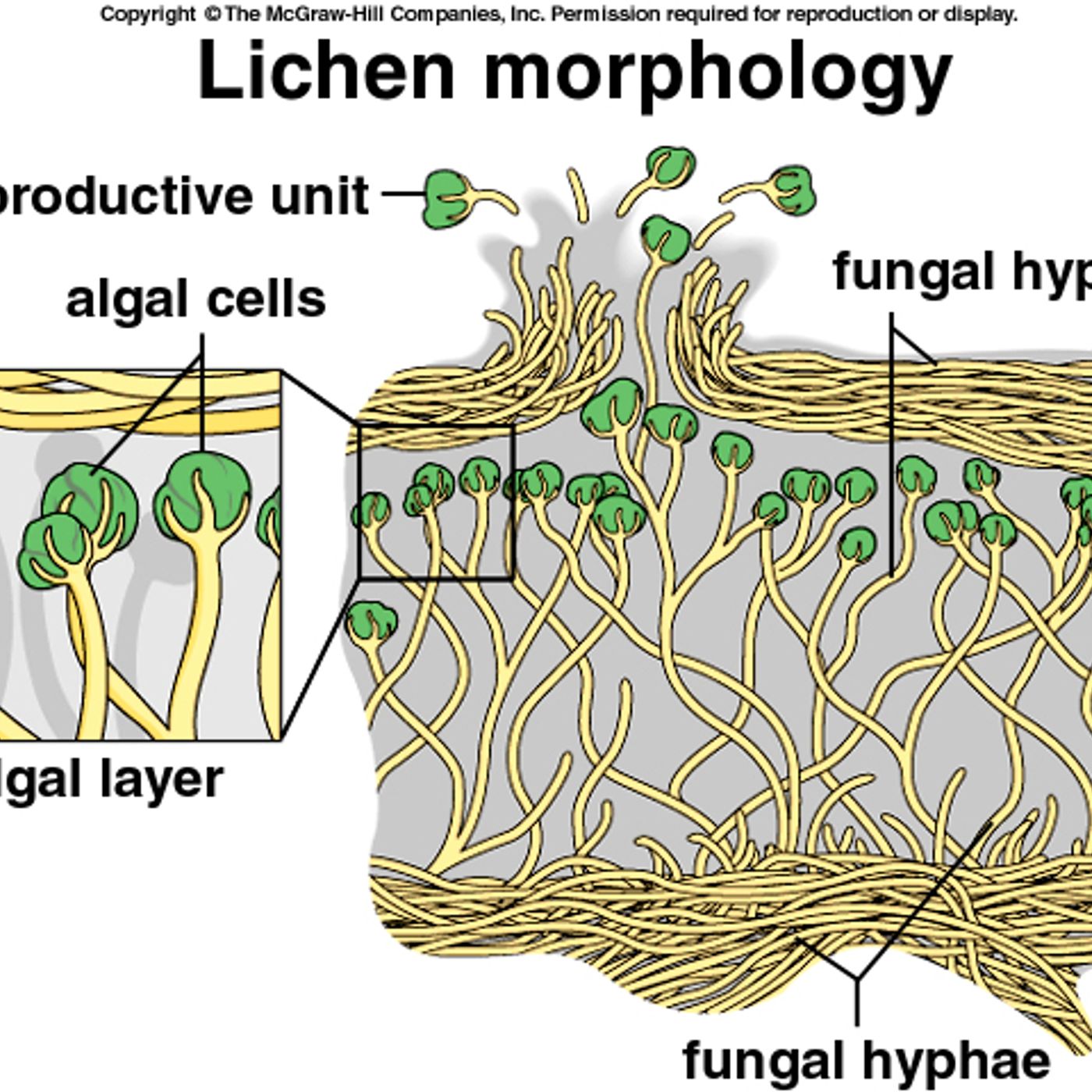
<v Speaker 1>Apathesia apathesi, and so most of the lichens. For anybody
<v Speaker 1>listening to you got to look up, look up diagram
<v Speaker 1>of a lichen. It's a really psychedelic yeah, drawing, it's
<v Speaker 1>fucking beautiful. It's these fungal hyphie, these strands of fungal
<v Speaker 1>hyphie wrapped around these little globules of algae. I suppose
<v Speaker 1>those are just algae cells or clumps of algae cells
<v Speaker 1>of photosynthetic.
<v Speaker 2>Yeah, there are algae cells. They they develop a chemical
<v Speaker 2>relationship with them, so they can get sugar from them
<v Speaker 2>and also make them divide. And also when the algae
<v Speaker 2>is inside the uh, inside the thallus, it doesn't die
<v Speaker 2>right away. The normal life span of an algae, saying
<v Speaker 2>the desert may be very short a week or so.
<v Speaker 2>If it's inside the lichen, It'll be there for a
<v Speaker 2>long time.
<v Speaker 1>They thrive more at cooler temperatures. Huh like that, Like
<v Speaker 1>higher latitudes. Are there many tropical algae like I mean.
<v Speaker 2>Lichens? Yeah, there's there's a lot. There's lichens developed for
<v Speaker 2>all all of different habitats. Now, the family eye study
<v Speaker 2>usually prefers arid habitats, and when you get up past
<v Speaker 2>a certain elevation that they there's very few of them.
<v Speaker 1>Wow.
<v Speaker 2>These ones are usually because they've adapted to the arid
<v Speaker 2>habitat deserts. The ones you see, the ones you see
<v Speaker 2>up at the top of the mountain are ones in
<v Speaker 2>fact in the Southwest are ones that used to be
<v Speaker 2>at the base during the ice Age and have moved
<v Speaker 2>up the mountain. So those will be the first one
<v Speaker 2>that become extinct in areas. It's like some of the plants.
<v Speaker 1>I've got really into all this lately, just because I mean, well,
<v Speaker 1>first off, likings are everywhere in the desert, and some
<v Speaker 1>of them just look incredible when you get up close,
<v Speaker 1>you know.
<v Speaker 2>Yeah. The other thing is is that bothering me? Is
<v Speaker 2>I'm studying this group. It's adapted to temperatures now, and
<v Speaker 2>if we're you know how it is. You're hot in
<v Speaker 2>Texas right now and it's winter. If we get to
<v Speaker 2>where the southwest is as hot as Saudi Arabia, it'll
<v Speaker 2>be just like Death Valley, where the only place you
<v Speaker 2>can really find likings is way up on top of
<v Speaker 2>the mountains.
<v Speaker 1>Yeah, Jesus.
<v Speaker 2>And so a lot of the stuff I'm studying I
<v Speaker 2>expect to become extinct. They they won't die, they won't
<v Speaker 2>like just disappear, but they'll be habit harder to harder
<v Speaker 2>to reproduce, and maybe one hundred to two hundred years
<v Speaker 2>from now they may not be there.
<v Speaker 1>Yeah. I think about that with plants all the time.
<v Speaker 1>I was in the Davis Mounds of West West Texas
<v Speaker 1>two weeks ago, and there's all these cool oaks up there,
<v Speaker 1>Quircus rugosa, Quirkus hyper lucoids, like beautiful oaks, and they
<v Speaker 1>all look like shit. There's all die back. They all
<v Speaker 1>have die back on them, except at the very higher
<v Speaker 1>reaches of the mountain. The mountain got you know, pathetic
<v Speaker 1>amount of rainfall this year compared to normal. Uh. And
<v Speaker 1>then there's madrones up there too, the Texas madrone, which
<v Speaker 1>is a fucking I love that whole genus.
<v Speaker 2>It's a beautiful I love the Madrones are beautiful.
<v Speaker 1>And they and they require this you know, specific, not specific.
<v Speaker 1>I think they associate with a lot of you know,
<v Speaker 1>bisidio my seat and uh mostly basidio my seat, Michael,
<v Speaker 1>rhizol ecto, Michael. But you know, there's I'm looking at
<v Speaker 1>this mountain and it's like a it's like an island,
<v Speaker 1>you know, it looks it's basically like the analogy of
<v Speaker 1>like a pond that's slowly drying up from the outside
<v Speaker 1>in and and everything that lives in that pond is
<v Speaker 1>gonna get wiped out at some point as it, you know,
<v Speaker 1>as temperatures continue to dry. And of course it's not
<v Speaker 1>that it's not the heat that's the issue, because Earth
<v Speaker 1>there's been this out before. It's the rate at which
<v Speaker 1>it's happening, and it happens so quick that things can't
<v Speaker 1>adapt the natural selection.
<v Speaker 2>They can't evolve fast enough. That's the problem, right.
<v Speaker 1>But I was thinking about that because I'm like God
<v Speaker 1>the fungal and I looked up, you know, I looked
<v Speaker 1>up on iatros, the fungal diversity that's been observed for
<v Speaker 1>the Davis mountains and it's there's nothing. I mean there's
<v Speaker 1>because it's all private land, fir ust except you know
<v Speaker 1>Nature Conservancy owns that that's private. They let you in
<v Speaker 1>like four times a week or four times a year.
<v Speaker 1>They have a public day, but if it hasn't been
<v Speaker 1>after a rain, you're not going to see that much.
<v Speaker 1>So it's, uh, you know, we really need to get
<v Speaker 1>somebody out there and you know, do a proper ass
<v Speaker 1>fungal survey. But you know it's too hard to get
<v Speaker 1>a hold of Nature Conservancy people because they're so busy
<v Speaker 1>mailing out so much fucking junk mail probably you know,
<v Speaker 1>they don't have time to actually let you into.
<v Speaker 2>They Also they also have funding problems too. It research,
<v Speaker 2>research costs money, so there's there's only for instance, for likens,
<v Speaker 2>there's only a for what I do taxonomy, and there's
<v Speaker 2>very little available funds. So I didn't start out doing
<v Speaker 2>this for money. And even though we have a large
<v Speaker 2>expensive grant working with BYU right now, I may not
<v Speaker 2>be able to get another one. I've been lucky enough
<v Speaker 2>to have two in a row, you know, Yeah, but
<v Speaker 2>there's just not money. And then look at Musking, them
<v Speaker 2>are going to be cutting down on funding for science.
<v Speaker 2>So I mean, you can't you can't listen micans. Micans
<v Speaker 2>are basically useless, so I mean the funding for them
<v Speaker 2>is going to be really hurting.
<v Speaker 1>I wanted That brings up something that was one of
<v Speaker 1>the main reasons I wanted to talk to you was
<v Speaker 1>about this, the concept of I mean just studying. I've been,
<v Speaker 1>you know, just I've been thinking of just the whole ecosystem,
<v Speaker 1>the biosphere as a living machine, and every organism in
<v Speaker 1>it is a piece to that machine. That's right, generally
<v Speaker 1>important and very you know, has a key role somewhere,
<v Speaker 1>and it is tied, you know, interlocked with all these
<v Speaker 1>other gears of the machine, et cetera. But that's not
<v Speaker 1>the common that's not the common view. I mean that
<v Speaker 1>that seems if we were an enlightened intelligence society, that
<v Speaker 1>would be the way that we would see things. We
<v Speaker 1>wouldn't have to justify, you know, studying this stuff, you know, but.
<v Speaker 2>They can see it way.
<v Speaker 1>Yeah, but there's so little there's so little interest. I mean,
<v Speaker 1>it just every It's like the thing I go through
<v Speaker 1>all the time when people tell me, you know, I
<v Speaker 1>tell people I'm into plants, They're like, oh, it is it?
<v Speaker 1>You know, I tell them about a plant, and if
<v Speaker 1>they're not into plants at all, they're like, is it edible?
<v Speaker 1>Is it? What's the point. It's like that kind of
<v Speaker 1>just that depoperate worldview. And I don't ship on them
<v Speaker 1>for it, because we're all just the product of the
<v Speaker 1>society that we're raised in, right, But like that's this
<v Speaker 1>anthropocentric use. How do you get around it? Like with
<v Speaker 1>you you see the beauty in these things? A hold
<v Speaker 1>on one second. Fucking Jehovah's witnesses. You know, they came
<v Speaker 1>with the neighborhood, but I didn't know it was that
<v Speaker 1>kind of neighborhood. It's uh, you know, it's we've.
<v Speaker 2>Got them here in Prague too. I don't know what
<v Speaker 2>the hell they're doing here in Prague tho. We've got
<v Speaker 2>them in Prague.
<v Speaker 1>Too, so depressing. It really bums me out, you know,
<v Speaker 1>it does the high religious ship if they you know,
<v Speaker 1>it's not all religions, of course, not all religious people.
<v Speaker 1>I'm just saying that, you know, it's such a they've
<v Speaker 1>got they've got all the answer, yes.
<v Speaker 2>But they are a little bit bothersome.
<v Speaker 1>You know, they got all the answers. Okay, anyway, So,
<v Speaker 1>but how do you when you think about this, I mean, well,
<v Speaker 1>how do you? How do you? Because I we all
<v Speaker 1>have to figure out our ways to like jibe with
<v Speaker 1>the world that we're forced to live in. How do
<v Speaker 1>you when you tell people you're studying likings. I'm sure
<v Speaker 1>if you're talking to like, if you were talking to
<v Speaker 1>someone who's like a financial advisor, you know, maybe you're
<v Speaker 1>in another field that's so distant or related economics, they'd
<v Speaker 1>be like, why do you study that? What's the point? Like,
<v Speaker 1>how do you? But obviously you see the beauty in
<v Speaker 1>these things and you understand I'm port there. How do you?
<v Speaker 1>How do you rationalize this out with the world that
<v Speaker 1>doesn't respect Basically, what I'm asking carry is how do you?
<v Speaker 2>I don't rationalize it? Very irrational anyway, I don't rationalize it.
<v Speaker 2>I was out taking out people when I gave give
<v Speaker 2>liking walks, and you get you always have one guy
<v Speaker 2>going what I'm studying is useless basically, Yeah, in terms
<v Speaker 2>of capitalism, the kind of economic system we have, they
<v Speaker 2>are useless.
<v Speaker 1>And then there's people studying things emory.
<v Speaker 2>Liking in the United States disappeared. Very few people would know.
<v Speaker 1>Yeah, I know. I mean they notice eventually because it's
<v Speaker 1>the biosphere starts collapsing.
<v Speaker 2>Well, they noticed that the trees and everything start going too. Yeah, right.
<v Speaker 1>But but you know, it's just because that's what I'm
<v Speaker 1>trying to rationalize all the time. And I don't even rationalize.
<v Speaker 1>I've just taken this more nihilistic approach. It's like a
<v Speaker 1>joyful kind of nihilism, a joyful biocentric nihilism. But I
<v Speaker 1>look at I'm like, man, you think what I'm studying
<v Speaker 1>is ridiculous. I look at what you study like someone
<v Speaker 1>who works in like fucking I don't know, investment or something,
<v Speaker 1>And I'm like, what that's yeah, I mean that's you're
<v Speaker 1>living in a made up world. At least the world
<v Speaker 1>that I'm studying is real. Like you're living in this
<v Speaker 1>fucking stupid, you know, world of make believe economies and shit.
<v Speaker 1>That's so that's just driven by like our primate, you know,
<v Speaker 1>obsolete hoarding complexes. I don't know, I just I guess
<v Speaker 1>I just think about I'm like.
<v Speaker 2>Well, I accept that what I'm doing is useless, you know.
<v Speaker 1>But according to what, according to the values of what society?
<v Speaker 1>You know, that's what I think is.
<v Speaker 2>The key according to the according to the values of
<v Speaker 2>of a of a capitalist society, where everything has to
<v Speaker 2>be a commodity.
<v Speaker 1>Right, so who gives a shit fuck them? You know,
<v Speaker 1>That's what I think.
<v Speaker 2>Yeah, it's not I'm not dealing with a commodity. I mean, what,
<v Speaker 2>what's the most I could get out of it? I
<v Speaker 2>get money for research, or maybe I write a book
<v Speaker 2>and it sells a little bit. But even liking books,
<v Speaker 2>there's too many of them now, so that wouldn't even
<v Speaker 2>be a good deal. I think I do it for that.
<v Speaker 2>I do it for the love of love of looking
<v Speaker 2>at them.
<v Speaker 1>Uh. And and also just these these incredibly small things
<v Speaker 1>that are everywhere and just weaved into daily life. It's
<v Speaker 1>I mean, fuck man, there, what are what are some
<v Speaker 1>of the most you know, urban tolerant, urbanized lichens? Are
<v Speaker 1>there many like the ones that can tolerate not?
<v Speaker 2>I don't know. Let's say, let's stay Los Angeles. I
<v Speaker 2>see some stuff on roofs, uh, candelarreas or something that's
<v Speaker 2>that's a yellow lichen. They grow on roofs here in
<v Speaker 2>the here, in Prague and in the in we have
<v Speaker 2>a lot of forests and stuff in the city so
<v Speaker 2>there's there's lichens on the trees there, but but not
<v Speaker 2>a whole lot. But around here there's like orange caliplacas
<v Speaker 2>growing on concrete. Uh, even the genus. I'm studying one
<v Speaker 2>species that we think is not Glaucocarpa, but but we
<v Speaker 2>we're working on separating it. It can grow on concrete.
<v Speaker 2>Mm hmm. I was going to say that there's a.
<v Speaker 1>Is there a difference between lichens that can grow on
<v Speaker 1>limestone versus on volcanic rock, because that's a big thing
<v Speaker 1>for a lot of plants. The difference.
<v Speaker 2>Well, yeah, yeah, no, no, there's definitely. Well, so I'm
<v Speaker 2>I'm studying in an area where there's both limestone and
<v Speaker 2>silicate rock in fact sometimes just one layer over the
<v Speaker 2>other in the sandstone, you know, and uh, there's some
<v Speaker 2>species that are only on on on calcareous rock. And
<v Speaker 2>then then like here in here in Utah, some of
<v Speaker 2>the species are they grow on sandstone, can grow on
<v Speaker 2>regular sandstone, can show up on calciferous sandstone, which is
<v Speaker 2>sandstone that if you put hydraulic I mean if you
<v Speaker 2>put acid on, they barely bubble. And then and then
<v Speaker 2>on calcareous rock. In fact, the species I just described
<v Speaker 2>we're working on describing this last week occurs on those
<v Speaker 2>different habitats, but mostly the ones on limestone stay on limestone.
<v Speaker 1>Yeah, that's probably the ones.
<v Speaker 2>That preferm or acid rock stay on acid rock. And
<v Speaker 2>then there's an in between zone of ultra base rock
<v Speaker 2>like some of the basalts and stuff, and you've got
<v Speaker 2>things that grow on that from either group.
<v Speaker 1>Is it? So it's I guess with the limestone, it's
<v Speaker 1>just like a pH issue. It's just the excess of
<v Speaker 1>calcium car that prevents other things from.
<v Speaker 2>Well yeah, yeah, they're full of and they're full of
<v Speaker 2>they're full of calcium inside. They absorb a lot of
<v Speaker 2>the crystals inside. You can't. I have to clear clear
<v Speaker 2>them on a slide in order to look at them.
<v Speaker 2>So I maybe have to put some acid on there
<v Speaker 2>to dissolve some of the crystals if I really need
<v Speaker 2>to see something.
<v Speaker 1>Gee, that would the what just the high high fail
<v Speaker 1>like and absorble the calcium.
<v Speaker 2>Or yeah, yeah, the hyphies Remember, Okay, the high pee
<v Speaker 2>is growing in the rock as it grows out. As
<v Speaker 2>it grows out, it's picking up all these crystals. So
<v Speaker 2>the medulla, the lowest part of the of the thallus
<v Speaker 2>usually is filled with these crystals. The top part that
<v Speaker 2>that's the flower, the apotheesia that usually doesn't have too
<v Speaker 2>much crystals up in that part unless they're from chemicals
<v Speaker 2>within the like it.
<v Speaker 1>God, that's wild. So they're actually breaking down the rock
<v Speaker 1>and then absorbing it.
<v Speaker 2>Oh yeah, yeah, they play an important part in erosion.
<v Speaker 2>You know, one of the factors have been of erosion.
<v Speaker 1>Yeah, yeah, yeah, I would assume there does Uh where
<v Speaker 1>do they get nitrogen from? Is it just do any
<v Speaker 1>of these photosymbind?
<v Speaker 2>No, they're living off They're living off the algae.
<v Speaker 1>Uh huh, but where's it? But the algae is getting nitrogen.
<v Speaker 1>I mean they've got to have Do they have nitrogen
<v Speaker 1>fixing abilities? They liken it all? Are the algae?
<v Speaker 2>No, there's there's there's those are the cyanobacterias. They have
<v Speaker 2>nitrogen fixing qualities. Right, Basically you're just living off of
<v Speaker 2>sun power and water. That's all the algae needs to
<v Speaker 2>produce sugar.
<v Speaker 1>But then the fungus is also secreting enzymes that help
<v Speaker 1>break down whatever it's growing on too.
<v Speaker 2>Right, Well they yeah, they're they're producing acids to eat
<v Speaker 2>through the rock.
<v Speaker 1>What about some of these lichens that you'll see growing,
<v Speaker 1>like I see lichens growing on the barren floor of
<v Speaker 1>the South Texas thorn scrub habitat. Are those just eating
<v Speaker 1>soil particles?
<v Speaker 2>I assume yeah, those are those. Yeah, some lichens are evolved,
<v Speaker 2>are turriculous. They grow just on soil. And those ones
<v Speaker 2>that you see like that have adapted have evolved to
<v Speaker 2>grow on soil.
<v Speaker 1>God, that's crazy. Do they do they ever associate with soil?
<v Speaker 1>Fungy Like, is there ever any connection between the like in.
<v Speaker 2>Yeah, they're there there. They have bacteria in it from
<v Speaker 2>the soil. Uh they may have see they have a
<v Speaker 2>microbiome basically inside of a lichen's kind of hollow. It's
<v Speaker 2>got the it's got this algae layer, it's got this hypha.
<v Speaker 2>And and especially the soil crusts have like I mean,
<v Speaker 2>pick up this stuff from the soil. So you can
<v Speaker 2>get bacteria. In fact, you can get bacteria in any
<v Speaker 2>any like and that's growing and uh and other other
<v Speaker 2>elements like that. Sometimes there's there's fungi the soil fungi
<v Speaker 2>that are entered into the thallus and uh so those
<v Speaker 2>things we even have trouble with sometimes sequencing because they
<v Speaker 2>get in the way.
<v Speaker 1>There's all kinds of other stuff in there, basically other organisms.
<v Speaker 2>Yeah, yeah, yeah, it's kind of you got to imagine.
<v Speaker 2>It's kind of like, well, hey, listen, it's not any
<v Speaker 2>different than us, except maybe all of them are in
<v Speaker 2>my stomach, you know.
<v Speaker 1>Yeah, yeah, yeah. So when when you I guess do
<v Speaker 1>you when you when you tell people that you're studying, like,
<v Speaker 1>I mean, what what is the what does the conversation go?
<v Speaker 1>Like Like when they when they say this.
<v Speaker 2>Okay, the first reaction is, uh, what And I say, oh,
<v Speaker 2>have you ever you know, I said, you've been up
<v Speaker 2>in the mountains? You ever see on rocks big orange
<v Speaker 2>patches or yellow patches? And they go yeah, And I go, well,
<v Speaker 2>that's what I study. And most people most people don't.
<v Speaker 2>Most people don't really notice things like that. Yeah, they
<v Speaker 2>don't know the really Yeah, plants too, and like look
<v Speaker 2>at lots of beautiful plants that are small. People wouldn't
<v Speaker 2>even notice, you know, unless there's a whole field of
<v Speaker 2>them blooming or something like poppies.
<v Speaker 1>Right, if it's just green and not flowering, there's no
<v Speaker 1>there's no context that we do.
<v Speaker 2>Yeah, or even if it's it's got little tiny flowers
<v Speaker 2>that you know, unless you get down and lay down
<v Speaker 2>there on the ground and pull out your anlins, you
<v Speaker 2>can't see.
<v Speaker 1>What drives me nuts the most, though, I think, is
<v Speaker 1>when you know that in terms of just like planting
<v Speaker 1>stuff in a landscape, like people's idea of plants is
<v Speaker 1>really rooted. It's not tied to place. It's it's it's
<v Speaker 1>tied to the the home despot garden center, like the
<v Speaker 1>fucking big box garden center. It's not like the context.
<v Speaker 1>The concept of a native plant and why you use
<v Speaker 1>natives because they've been selected for for for that region,
<v Speaker 1>escapes people. It's just such this short term whatever's pretty,
<v Speaker 1>which drives me nuts too, because a lot of the
<v Speaker 1>stuff that's listed is or that's thought of is pretty
<v Speaker 1>and sold in garden centers is fucking so gaudy and
<v Speaker 1>tacky and makes me want to puke, you know.
<v Speaker 2>It's this, yeah, and then you will look at why
<v Speaker 2>are they selling it? Because it's easy to produce, right,
<v Speaker 2>You clone grow a whole bunch of geraniums, real easy,
<v Speaker 2>you know.
<v Speaker 1>Right, But but then when you open people up to
<v Speaker 1>when you open their minds up to the concept of
<v Speaker 1>native and it's not just this idea of you know,
<v Speaker 1>logical purity, but that it's actually spent time evolving here
<v Speaker 1>and evolving with the other things that live here, you know,
<v Speaker 1>Like again, that it's a piece to that living.
<v Speaker 2>With miss appreciation grows.
<v Speaker 1>Yeah. Yeah, and I've seen it growing a lot lately,
<v Speaker 1>which is cool, but it's it's uh, it's still wild, man.
<v Speaker 1>I just that the whole idea of native plants are
<v Speaker 1>messy or weedy or overgrown or they're going to bring
<v Speaker 1>in ticks always drives me. I've been writing a book
<v Speaker 1>about this later, So that's why I've been thinking about
<v Speaker 1>all this stuff.
<v Speaker 2>Well, you know, and we're from California, man, I mean
<v Speaker 2>you know, I mean we spent a lot of time
<v Speaker 2>in California where there's a real native plant culture.
<v Speaker 1>Yeah, and there's land that people can have access to
<v Speaker 1>as well. I mean there's a lot of public land.
<v Speaker 1>There's a lot of parks and reserves. I mean in
<v Speaker 1>Texas there's there's nothing you mentioned. Oh, you know, whenever
<v Speaker 1>I say Texas and that public land, people like, oh,
<v Speaker 1>there's tons of state parks, like what I mean? Yeah,
<v Speaker 1>but it's a fraction of the land. There's there's what's
<v Speaker 1>a lot like that. I don't think there's a lot
<v Speaker 1>of state parks here. There's a good handful per region.
<v Speaker 1>They all cost money to go to, and you know
<v Speaker 1>there's regulations, there's someone fucking with you. You're not allowed
<v Speaker 1>to do this or that, or just walk out. I mean,
<v Speaker 1>it's not It doesn't compare it actually having publicly accessible
<v Speaker 1>land like BLM land or Forest Service land. And if
<v Speaker 1>people can't see this stuff, they they no wonder, they
<v Speaker 1>don't give a shit about it. They don't even know
<v Speaker 1>it's there. You know, there's no context, but it's it.
<v Speaker 2>You know, look at what we're look at what we're doing.
<v Speaker 2>I mean, for myself, I get contacted you know how
<v Speaker 2>they're growing plants on buildings now? Yeah you know, yeah,
<v Speaker 2>I get contacted all the time about people wanting to
<v Speaker 2>grow lichens on buildings. They can't do it.
<v Speaker 1>Yeah, how could you.
<v Speaker 2>Can stick all You can grow mosses in big you
<v Speaker 2>can grow mosses and big things in big panels and stuff,
<v Speaker 2>and that'll work. But the lichens, you just you just
<v Speaker 2>don't stick a whole bunch of them up there and
<v Speaker 2>they're going to stay.
<v Speaker 1>How would one cult theveda liking is that. I mean,
<v Speaker 1>it's not even possible in a lot of cities.
<v Speaker 2>Oh you do it in a petri dish or something,
<v Speaker 2>you know. It's that's I've had at my house in California.
<v Speaker 2>I did a lot of work at home breaking up
<v Speaker 2>the rock, part of getting them so I could put
<v Speaker 2>them into packets for herbarium for study. Yeah, and I
<v Speaker 2>so I'd always have these pieces of rock with liking
<v Speaker 2>on it. Now I have my daughter's living in my
<v Speaker 2>house now. And I was just back there and where
<v Speaker 2>I spread the rock along the side of the north
<v Speaker 2>side of the garage where there was a big area.
<v Speaker 2>I went back there and I hadn't looked at it
<v Speaker 2>for seven or eight years, and none of them made it.
<v Speaker 1>Oh wow, no, shit, was it? What do you think?
<v Speaker 1>It was? Black? A sun?
<v Speaker 2>It's just that they're so sensitive that you move them
<v Speaker 2>around and they're completely look at one the size of
<v Speaker 2>a quarter might be twenty years old. Jesus and used
<v Speaker 2>to just one one way of growing one one relationship
<v Speaker 2>to the sun, one relationship to the shade, one relationship
<v Speaker 2>to the water. You take that rock from maybe fifty
<v Speaker 2>miles away, it breaks it up. You lay it out
<v Speaker 2>there with piles of other rocks that looked like it
<v Speaker 2>should grow and it dies.
<v Speaker 1>Yeah, yeah, at different angle or something, or not in
<v Speaker 1>a flight or whatever.
<v Speaker 2>Yeah. You know a good example of that was when
<v Speaker 2>I was growing up, my dad worked for Southern California
<v Speaker 2>Edison and they had a big project they were putting
<v Speaker 2>in and they wanted and that they really wanted to
<v Speaker 2>save the Joshua trees there, but they had to move them.
<v Speaker 2>And they moved them. Okay, they moved them and didn't
<v Speaker 2>realize that by just by turning them the wrong way
<v Speaker 2>and stuff, almost all of them died.
<v Speaker 1>Yeah. That's the idea of moving plants is it doesn't
<v Speaker 1>work most of the time. Especially and also but the
<v Speaker 1>thing too, I think most people don't realize the parts
<v Speaker 1>of the roots that are doing all the absorption are
<v Speaker 1>the are the root tips like this, the you know,
<v Speaker 1>eighty percent of the root that's closer to the plant
<v Speaker 1>doesn't do any absorption, you know, unless it's like a
<v Speaker 1>branch with a tip on it. I mean, it's they're
<v Speaker 1>just plumbing. It's just transit. So when you dig these
<v Speaker 1>things up, you're automatically severing so many root tips unless
<v Speaker 1>you get a huge soil ball that you're sending it back.
<v Speaker 1>You know, you're just you're you're shocking, you're shocking it back.
<v Speaker 1>So then you've got to take off some shoot. You know,
<v Speaker 1>they could maintain the root to shoot ratio or or whatever.
<v Speaker 1>But I see all these people who are like, oh this,
<v Speaker 1>what's fine, We'll just move the plant. It's like you
<v Speaker 1>could do it with cactie because they can just grow
<v Speaker 1>new roots since they have energy stored up to do so.
<v Speaker 1>But it's still shocking them. You know, there was a
<v Speaker 1>solar project out here where they they God, I tried
<v Speaker 1>to get them to just give them to us so
<v Speaker 1>we could put them at our conservation property or something.
<v Speaker 1>There was a bunch of star cactus, you know, or
<v Speaker 1>give them to uh San Antonio Botanic Garden or something.
<v Speaker 1>I'm friends with some people that work there. And they
<v Speaker 1>didn't do it. The contractor didn't do it. They don't
<v Speaker 1>know shit about plants either. The you know, the contractor
<v Speaker 1>for British Petroleum that was the one setting up this
<v Speaker 1>massive fucking I sore of a solar project in South Texas,
<v Speaker 1>and god, it was brutal. There was tons of payota,
<v Speaker 1>tons of Astro fight them this rare cactus and and uh,
<v Speaker 1>they're like, no, we would like to use it as
<v Speaker 1>a pr The guys, the manager literally told me, they said,
<v Speaker 1>we'd like to use it as a PR thing for
<v Speaker 1>the company to show that we're saving you know, we're
<v Speaker 1>carrying like they're not gonna it's July. You can't transplant
<v Speaker 1>these things in July unless you can have someone there
<v Speaker 1>to water them every day and help the new roots
<v Speaker 1>get established. And the fucking things died. I knew someone
<v Speaker 1>who was working on the project. That's how we got
<v Speaker 1>into it, and he told me was like, oh yeah,
<v Speaker 1>those old died like six months later. You guys just
<v Speaker 1>merked like a you know, an eighth the the US population,
<v Speaker 1>the population on this side of the border of this
<v Speaker 1>rare cactus. Good job. It's it's madden. But for me,
<v Speaker 1>I think what I wonder about, what drives me nuts
<v Speaker 1>is at what point is the development going to stop?
<v Speaker 1>And then the more I think about that, I realized
<v Speaker 1>it's never going to stop. They're going to take everything.
<v Speaker 1>It's just it's just the society. There's no respect and
<v Speaker 1>no reverence for life, and so it's going to take everything.
<v Speaker 1>Because especially when you have these religions that tell you
<v Speaker 1>it was all put here for you, you know, there's
<v Speaker 1>nothing that's going to stop it. They'll they'll take everything.
<v Speaker 1>They were trying to take state parks in Florida to
<v Speaker 1>put in golf course. They were trying to.
<v Speaker 2>Look Derry Trump's thing. They may they may be trying
<v Speaker 2>to privatize national parks and sell them off the businesses.
<v Speaker 1>Yeah, oh yeah, they're gonna the privatization thing is that's
<v Speaker 1>still gonna that's I mean that it's again that you
<v Speaker 1>were you were alive. I mean, I was alive during
<v Speaker 1>Reagan two, but I was like five when all this
<v Speaker 1>ship was going on, this this idiotic talk about this
<v Speaker 1>Randian trickle down economics and privatized because government kind of
<v Speaker 1>do the job. That's what they like to say. Government
<v Speaker 1>can't do the job. Okay, well it depends on who's
<v Speaker 1>in the government. You think corporations are going to do
<v Speaker 1>it better, and they've got a motive just to make profit.
<v Speaker 1>They're gonna fucking cut corners whatever they can, at least
<v Speaker 1>with government. That's just in competence with a corporation. It's malevolent.
<v Speaker 1>You know, like what when all this ship was coming up.
<v Speaker 1>I mean what were you you were you working in
<v Speaker 1>construction then? Still were you still working in construction?
<v Speaker 2>Yeah? I was, I was working in construction back in Reaganstein.
<v Speaker 1>How did how does how do you working? How did?
<v Speaker 1>How do you get working class people to believe this
<v Speaker 1>stupid shit? And what do you think it is? It's
<v Speaker 1>just it's just image, It's just superficial and shallow. Those
<v Speaker 1>are just the qualities people look at them.
<v Speaker 2>Yeah, he had, he had, he had. He was a
<v Speaker 2>good actor. Yeah, in terms of being a politician. Otherwise
<v Speaker 2>I'm not sure he got He got elected with a
<v Speaker 2>big popular vote, okay the first time, and it just
<v Speaker 2>because who were fed up with Carter? So you know,
<v Speaker 2>it's and and you know, it comes down to just
<v Speaker 2>like people talking in this last election, Uh, the groceries
<v Speaker 2>are costing too much. This is costing too much a
<v Speaker 2>lot of times it's just stupid things like that. And
<v Speaker 2>well it's not really stupid. I mean, if you can't
<v Speaker 2>if food prices go up, it really is a big
<v Speaker 2>deal insurance. But yeah, but but it's things like that
<v Speaker 2>that they are manipulated or or and also during his
<v Speaker 2>time was freeing the hostages from Iran, so these things
<v Speaker 2>are manipulated in a way that that draws votes in
<v Speaker 2>most people. I don't blame them either. Most people they
<v Speaker 2>just think about their pocketbook and and they're not going
<v Speaker 2>to be watching MSNBC or or CNN and listen to
<v Speaker 2>that bullshit shit, especially like on CNN, listen to these
<v Speaker 2>guys arguing from both sides. You know who wants to
<v Speaker 2>listen to that when you can watch Yellowstone?
<v Speaker 1>Yeah? Yeah, I know. The thing that the thing that
<v Speaker 1>gives me hope though, is when you see left and
<v Speaker 1>right coming together over something like healthcare, insurance companies fucking people.
<v Speaker 1>You know, it's like it's like a universal and you
<v Speaker 1>could tell that scares people up top too. You could
<v Speaker 1>tell that gets some really nervous. And I'm sure there
<v Speaker 1>are memos being sent out to you know, podcasters and
<v Speaker 1>pundits me like you gotta, we gotta, we gotta nip
<v Speaker 1>this in the butt. We gotta nip this, this class
<v Speaker 1>rage against the upper class and these companies. We gotta
<v Speaker 1>nip it in the butt. Don't let this get out
<v Speaker 1>of distract them with something else, talk about you know,
<v Speaker 1>culture warship something I see. You know, there's people on
<v Speaker 1>the right or piss there's people on the left. If
<v Speaker 1>they come together, this could be a real issue for us.
<v Speaker 1>People were pissed like with this, with the claims adjuster,
<v Speaker 1>the CEO whacker. You know, it's been nice to observe.
<v Speaker 1>The commentary that came out of that was, you know,
<v Speaker 1>because it's it's people are just getting fucked in the
<v Speaker 1>United States, and it doesn't It's just.
<v Speaker 2>Like I think Trump said a couple of days ago.
<v Speaker 2>Now I don't know if it's true because I just
<v Speaker 2>see it on the internet, but says that, uh, it's
<v Speaker 2>he says, I won't be able to fix grocery prices,
<v Speaker 2>but we'll still have the successful government. And I don't
<v Speaker 2>know how many times watching that election I heard people
<v Speaker 2>complaining about how much groceries cost.
<v Speaker 1>Yeah, I know that was the big thing. It's like
<v Speaker 1>neither If you think either party is going to do
<v Speaker 1>anything the lower grocery prices, you're out of your fucking mind. Man.
<v Speaker 1>It's uh, the oligarchs will never let either They're never
<v Speaker 1>gonna let either party get get shitped done.
<v Speaker 2>But yeah, in fact, the only way you bring grocery
<v Speaker 2>prices down is they get too high and then they
<v Speaker 2>can't sell enough and then then they'll start to go
<v Speaker 2>down again. It's early, but they never go down. Your money,
<v Speaker 2>Your money is constantly at two percent a year roughly
<v Speaker 2>is changing value every year. So you have that that
<v Speaker 2>much inflation and just money normally. So if so, when
<v Speaker 2>I started construction, I got five dollars an hour, and
<v Speaker 2>that was a big deal. That was a union job,
<v Speaker 2>was there. And now if I had the same job
<v Speaker 2>right now, I'd be making one hundred and twenty thousand
<v Speaker 2>dollars a year according to my friends, and for the
<v Speaker 2>amount we worked, and it'd be worth about sixty to
<v Speaker 2>seventy thousand ten years before, fifteen years before. So it's
<v Speaker 2>it's people don't always understand that either that that there's
<v Speaker 2>been a constant inflation. That's why you can you can
<v Speaker 2>hear about somebody buying a farm back and one hundred
<v Speaker 2>years ago or two hundred years ago for five hundred dollars.
<v Speaker 1>You know, the lack of the lack of affordability of housing,
<v Speaker 1>and the fucking healthcare thing is so big here and
<v Speaker 1>it's never I feel like it's never going to change.
<v Speaker 1>It's so it's so easy to distract people with bullshit
<v Speaker 1>that doesn't really affect them and get them to not
<v Speaker 1>pay attention to this. The housing thing's fucking nuts. I mean,
<v Speaker 1>when you've got an entire generation that's been priced out
<v Speaker 1>of ever owning their own home, it's.
<v Speaker 2>Oh, I know, listen, my daughter and her husband and
<v Speaker 2>their their child. Okay, if I didn't own a house
<v Speaker 2>that they live in, they wouldn't they wouldn't be able
<v Speaker 2>to afford to live in the area that I lived
<v Speaker 2>the last thirty years, which is not as is not
<v Speaker 2>you know, an upper class area, just it was. It
<v Speaker 2>was a middle class area, and it was also poorer
<v Speaker 2>middle class that was moving away from Los Angeles and
<v Speaker 2>where it was cheaper. And now they live in my house,
<v Speaker 2>and I just I let them stay there for the
<v Speaker 2>just for the price that they paid. You know that
<v Speaker 2>I have to pay taxes and that stuff. And uh,
<v Speaker 2>they couldn't afford to live there. They can't. They couldn't
<v Speaker 2>afford to live in the neighborhood they grew up in.
<v Speaker 1>Yeah, the last time that housing was affordable was after
<v Speaker 1>the crash, for which none of those fucking companies got punished,
<v Speaker 1>of course.
<v Speaker 2>And then you have no man, nobody had any.
<v Speaker 1>Money, right and then but then in like twenty fourteen,
<v Speaker 1>they started going up and just going ridiculously up and
<v Speaker 1>just basically being price gouged, you know, for investment purposes.
<v Speaker 1>People are fucking gambling on it. You know, there's no
<v Speaker 1>regulation about that. I mean, if a person can own
<v Speaker 1>as many houses as they want, that they're never going
<v Speaker 1>to live in that they're just treating as as.
<v Speaker 2>As Oh well, this is even getting worse. This is
<v Speaker 2>even getting worse now because people from other countries are
<v Speaker 2>buying upper houses.
<v Speaker 1>Yeah.
<v Speaker 2>So for instance, we stopped and we're talking with these
<v Speaker 2>people that run a gift shop on our way to
<v Speaker 2>Bryce Canyon, and they were telling me we were talking
<v Speaker 2>about the price of housing just like we were. And
<v Speaker 2>they were saying that in this air area around them,
<v Speaker 2>which was all ranch land or you know, small small houses,
<v Speaker 2>you know, small houses here and there on small properties,
<v Speaker 2>that that was all being bought up by Indian people in.
<v Speaker 1>India, Indian individuals or investors like investment.
<v Speaker 2>Companies, Yeah, Indian investors. And and now the people that actually,
<v Speaker 2>just like I was talking about my daughter, the people
<v Speaker 2>that actually grew up there cannot afford to get a house. Yeah,
<v Speaker 2>unless they managed to inherit it. You know, and it's
<v Speaker 2>owned by Indians. Yeah, guys that they don't even live there.
<v Speaker 2>There's Chinese people buying up loads of houses. And by
<v Speaker 2>the way, this is in California. This is what pushed
<v Speaker 2>up all the rental fees. Well, it's Chinese companies buying
<v Speaker 2>up houses.
<v Speaker 1>Yeah, it's Chinese companies. It's not it's not like it's
<v Speaker 1>individuals or people who are just Look, I play my.
<v Speaker 2>Head really on these Indian guys. There are you know,
<v Speaker 2>big corporations too.
<v Speaker 1>Yeah, these fucking companies. I I went to do some
<v Speaker 1>presentation in Austin when was it last March, and uh
<v Speaker 1>for a friend and and he's like, where do you
<v Speaker 1>want to stay? I should have just fucking said days in,
<v Speaker 1>give me like the filthiest days in. You know, that's
<v Speaker 1>not gonna fuck with me having a dog like on
<v Speaker 1>like give me the fucking day, give me a days
<v Speaker 1>in by the fucking airport or something, you know. But
<v Speaker 1>I was like, just give me an Airbnb. I didn't know.
<v Speaker 1>I had only stayed in one air and be Airbnb before.
<v Speaker 1>I didn't even know. You know, Airbnb is fucking more
<v Speaker 1>expensive than hotels almost eighty percent of the time, and
<v Speaker 1>it's a fucking scam, and the pert you know it's
<v Speaker 1>and they all look the same, this bland gray, this
<v Speaker 1>miserable like gray black white, gray, black and white, you know,
<v Speaker 1>tricolor decoor with the plastic plants and the fucking live
<v Speaker 1>laugh love style, that stupid shit. And he got me
<v Speaker 1>this Airbnb. When I found out the price, I was like,
<v Speaker 1>holy fuck, that's obscene. Why did you do that, Like
<v Speaker 1>just you should have just said no, we're going to
<v Speaker 1>get you a day's in, you know, or tell me
<v Speaker 1>like I didn't. I don't want you to spend that
<v Speaker 1>much money. But then it was a fucking scam too.
<v Speaker 1>I couldn't get into the thing. It was in a
<v Speaker 1>It was one unit in this giant condo complex, this
<v Speaker 1>soulless condo apartment building that was like eight stories tall
<v Speaker 1>in Austin, like one of these horrible places, like this
<v Speaker 1>hive of just fucking broken values. You know, it's like
<v Speaker 1>expensive hive of broken We have.
<v Speaker 2>Ahead here in Prague. We have the problem with this
<v Speaker 2>RB and these uh yeah, these in this they own
<v Speaker 2>so many apartments around the city and there's a shortage
<v Speaker 2>of apartments for people, and so the city's trying to
<v Speaker 2>close them down.
<v Speaker 1>Good.
<v Speaker 2>Yeah, there's just there's more apartments for people, Yeah, to
<v Speaker 2>regulate them out.
<v Speaker 1>There was. But there was funny though, because this Airbnb
<v Speaker 1>I ended up, there was some fucking weird thing with
<v Speaker 1>the parking and the parking card. This building is new, right,
<v Speaker 1>It didn't. It didn't exist ten years ago. And uh,
<v Speaker 1>I've had some And I got the fucking car got
<v Speaker 1>towed like it was a rental car I had to
<v Speaker 1>get because mine had gotten fucking I re rendered some
<v Speaker 1>moron who was on his phone and stopped at a
<v Speaker 1>yield like this was this whole month was just the
<v Speaker 1>real fucking runner for me. And uh, the car got
<v Speaker 1>towed and just it was just a fucking pain in
<v Speaker 1>the ass and I couldn't get in. And it was
<v Speaker 1>just such a bleak place to live, too, Like the
<v Speaker 1>fucking decor was so shiny and nice. Like I'd rather
<v Speaker 1>if I'm gonna stay in bleak, I'd rather stay like
<v Speaker 1>where that, you know, in a like truly bleak hotel
<v Speaker 1>where the sink is held up by a two by
<v Speaker 1>four and there's some mold on the wall, rather than
<v Speaker 1>one of these spiritually bleak places that's shiny and has
<v Speaker 1>a new countertop, but just as has the personality of
<v Speaker 1>a fart, like gray walls and the plastic. But I
<v Speaker 1>ended up stealing a uh some of the wall decor
<v Speaker 1>from this place just because I I just out of spite,
<v Speaker 1>you know. It was just one of those It was
<v Speaker 1>like one of those peer one imports things. Yeah, it's weird, man,
<v Speaker 1>it's weird. I think I find ways to to work with.
<v Speaker 1>I hear these young kids say like, oh, the world
<v Speaker 1>is so fucking bleak, and I'm never gonna you know,
<v Speaker 1>it's so fucked and I'm like, you just gotta you
<v Speaker 1>can accept all that, but find a way to work
<v Speaker 1>it into like a lighthearted, cynical, dark humor, you know,
<v Speaker 1>like find the fuck, you know, to find a way
<v Speaker 1>to rationalize it, because nobody wants to hear a constant
<v Speaker 1>complainer unless you're funny. So find a way. Find a
<v Speaker 1>way to fucking talk about the declining dystopia, the end
<v Speaker 1>of empire, all that shit in a way that can
<v Speaker 1>at least make people laugh or make yourself laugh. And
<v Speaker 1>that's the way I cope that in the geologic time.
<v Speaker 2>Score, yeah, we need some black humor, that's for sure.
<v Speaker 1>So anyway, so Okay, so you're writing a paper on acorospiration.
<v Speaker 2>I'm writing a bunch of papers.
<v Speaker 1>And just describing a species that have not been described yet.
<v Speaker 1>I mean, who is working on lichens before you were
<v Speaker 1>in this region?
<v Speaker 2>Okay, working there? There has been a group at BYU
<v Speaker 2>that I'm that I'm working with that have been in
<v Speaker 2>that area and been collecting lichens for thirty hey wait
<v Speaker 2>almost fifty years now, going back into the eighties. The herbarium.
<v Speaker 2>I'm actually working with the people and his students. Steve
<v Speaker 2>Levitt there, who's, by the way, enjoys your show. He
<v Speaker 2>has his students. He's training his students in molecular work
<v Speaker 2>bioinformatics using li Likens. So there's a tradition there of
<v Speaker 2>li Likens. But still, I was in New Mexico and
<v Speaker 2>mostly down near Las Crusis in that part, in the
<v Speaker 2>Chiuahuan desert part, and I did not I honestly, I'm
<v Speaker 2>connected in the liking world, and I didn't know of
<v Speaker 2>anybody in the whole half of the state that was
<v Speaker 2>studying li Likens. Right, Yeah, That's what drives me to
<v Speaker 2>And I don't even know if in the other half,
<v Speaker 2>if there was anybody.
<v Speaker 1>Why not you got these fucking kids playing Call of
<v Speaker 1>Duty all the stupid shit. No offense to anyone who's
<v Speaker 1>playing video games out there and is a little sensitive,
<v Speaker 1>But the video game thing especially depresses me to a
<v Speaker 1>certain extent because I feel I just feel like it's
<v Speaker 1>that's somebody else's world, that's a make believe, bullshit world.
<v Speaker 1>There's a real world here that's really fucking cool. You
<v Speaker 1>can get out there and just yeah, I mean, people
<v Speaker 1>might be like, why is it, what's the point of
<v Speaker 1>studying this shit? The point of studying is you get
<v Speaker 1>out there and you learn. You're inherently going to learn
<v Speaker 1>more by even by studying something like li Likens about chemistry,
<v Speaker 1>about biology, about life, about evolution, about your role in it.
<v Speaker 1>It's it fulfills this philosophical underpinning that can determine your
<v Speaker 1>opinion about the world you live in or your understanding
<v Speaker 1>of the world you live in. You know, I just
<v Speaker 1>the whole thing of like and go ahead.
<v Speaker 2>Go ahead, no, you go ahead. Yeah. The other thing
<v Speaker 2>is is it connects you. It connects you with nature.
<v Speaker 2>So it's just it's something that we've lost in most
<v Speaker 2>of our urban and suburban type environment. Right and that,
<v Speaker 2>and by studying things like this or being even interested
<v Speaker 2>in them, to go out and look at plants, to
<v Speaker 2>go out and look at like and go see if
<v Speaker 2>you can spot a mountain lion or something that that's
<v Speaker 2>something primal in us, that that we're losing, right, And
<v Speaker 2>so you get to make connection again.
<v Speaker 1>Two million years of human evolution, living and you know,
<v Speaker 1>having a relationship with the living world. And now we're
<v Speaker 1>walled into these fucking cars, especially if you're in America,
<v Speaker 1>the car centric, the car slum cars, and fucking human infrastructure.
<v Speaker 1>And we've been able to dupe ourselves into believing that
<v Speaker 1>we don't need any of this stuff. It's meant it's there.
<v Speaker 1>We evolved with it, you know, this is we need it,
<v Speaker 1>whether you know it or not. And what I love,
<v Speaker 1>what gives me hope because I don't have a lot
<v Speaker 1>of it. I'm pretty cynical and misanthropic, upbeat, you know,
<v Speaker 1>but still I fucking nihilist in my own way, at
<v Speaker 1>least about you know, human civilization. I've got a lot
<v Speaker 1>of disrespect for most of human civilization. But the thing
<v Speaker 1>that gives me hope is watching people who weren't into
<v Speaker 1>something like that before, experience it, experience going on a
<v Speaker 1>fucking you know, bushwhacking hike, trail off trail, hike up
<v Speaker 1>a mountain range, seeing cool shit, asking questions, immersed in it,
<v Speaker 1>and excited too, like when you can when the excitement
<v Speaker 1>is palpable, That's what gives me hope. I'm like, oh,
<v Speaker 1>we're not We're not so fucked. There's still like blood
<v Speaker 1>in those veins. We haven't been fully you know, synthesized
<v Speaker 1>and integrated into the fucking bleak machine the matrix yet.
<v Speaker 3>So I yeah, In fact, I get a lot of
<v Speaker 3>thrill out of our grandkids here in the in the
<v Speaker 3>Czech Republic, this is a great mushroom area, like four
<v Speaker 3>hundred species.
<v Speaker 2>The weather's just right for mushrooms in the forest easy,
<v Speaker 2>and just taking them out to the forest and just
<v Speaker 2>showing them mushrooms, you know. Yeah, and they can actually
<v Speaker 2>collect some of them and take them home and eat them.
<v Speaker 2>But but just to see that connection that they're they feel,
<v Speaker 2>you know, and and uh and then of course they
<v Speaker 2>go back and they're on their video games, but still
<v Speaker 2>they get that extra they get that extra connection there,
<v Speaker 2>I mean, and and are thrilled every time Grandma comes
<v Speaker 2>and is ready to take them out into the woods.
<v Speaker 2>You know.
<v Speaker 1>Yeah. And video games, you know, they're fine. I get it.
<v Speaker 1>They're fine for you know, when you're younger and I
<v Speaker 1>used to play Super Mario and shit whatever. But I
<v Speaker 1>just think when you meet people who don't and at
<v Speaker 1>least if you're getting that outside time too, it's fine.
<v Speaker 1>But when it's just like your whole world is just
<v Speaker 1>work in video games, I just can't imagine. That's got
<v Speaker 1>to be such a just a disconnection, like you're not
<v Speaker 1>interacting with anything else alive besides other people or pets.
<v Speaker 1>There's no living world, there's no living fabric that you're
<v Speaker 1>touching and learning about, and I just, yeah, I don't know.
<v Speaker 2>It's yeah, And it's also more addictive because you're interacting
<v Speaker 2>with it instead of just turning on the TV and
<v Speaker 2>watching the show. You're making the show. Yeah, and that's
<v Speaker 2>that's that's addictive in itself.
<v Speaker 1>What is Chech Czech Republic is? I mean what is
<v Speaker 1>the Is there still a lot of intact forest there
<v Speaker 1>or is it mostly like planted forest for lumber or
<v Speaker 1>what is it?
<v Speaker 2>Like? No, no, what happened here is is uh? Well,
<v Speaker 2>as you know, in an old in in nineteenth eighteenth
<v Speaker 2>and earlier, wood was a major for everything. You know,
<v Speaker 2>wood cups, would this, would that, and by the by
<v Speaker 2>by the nineteenth century. For instance, up where the family
<v Speaker 2>house is in uh in Ezertine, when you look at pictures,
<v Speaker 2>they cut down every tree for as far as you
<v Speaker 2>could see. And so now basically what you have here
<v Speaker 2>is managed forests. So so you have or you know
<v Speaker 2>the same thing like a uh you know, like a
<v Speaker 2>wild forest that that's filling in a trashed area where
<v Speaker 2>everything's growing too close all the all the trees are
<v Speaker 2>too thin, they're too close together, there's too much shade
<v Speaker 2>for the lichens. Uh. And in a lot of cases
<v Speaker 2>where they've allowed non native plants to come in, then
<v Speaker 2>there's no mushrooms because they have they have no connection
<v Speaker 2>with those kinds of plants. So here here and in Europe,
<v Speaker 2>most of the forests were cut down. And then if
<v Speaker 2>you see a forest now that they're managed forests and
<v Speaker 2>uh and uh and and here we have a forestry
<v Speaker 2>whole forestry group that that and the wood industry here
<v Speaker 2>of cutting these down, so it's monol cultures now for instance,
<v Speaker 2>instead of cutting them all down, they cut down part
<v Speaker 2>of them, let that part fill in and then cut
<v Speaker 2>down another part next to it, and let the other
<v Speaker 2>one start to grow.
<v Speaker 1>You know, But there's I mean, there's not much. There's
<v Speaker 1>not much diversity in other words, though like it's it'll
<v Speaker 1>be a monol not in those Is there any intact
<v Speaker 1>ecology in your region of Eastern Europe that you know
<v Speaker 1>of or is it it's all big cut.
<v Speaker 2>No, there's areas. If there No, it's not all destroyed.
<v Speaker 2>But people have been living here a long time, so
<v Speaker 2>it's not it's not how it was. If we went
<v Speaker 2>back five hundred years in time or a thousand years
<v Speaker 2>in time, we probably wouldn't even recognize how much trees
<v Speaker 2>there are.
<v Speaker 1>That's what I am agin.
<v Speaker 2>You know, there's areas. There's enough areas because because of
<v Speaker 2>development here, there is enough areas that you can get
<v Speaker 2>into a natural forest here and there, you know, and
<v Speaker 2>then up on the higher elevations there's natural forests and
<v Speaker 2>they have some extent forests here. So it's not as
<v Speaker 2>bad as bad as I made it just sound. But
<v Speaker 2>if you're normally driving through the Czech Republic on a highway,
<v Speaker 2>you'll be seeing managed forests usually off to each side.
<v Speaker 2>Of the road.
<v Speaker 1>Yeah, that's what you know. That's been one of the
<v Speaker 1>reasons why I've never been into Europe. People have asked me, like,
<v Speaker 1>would you ever go. I'm like, yeah, I guess maybe
<v Speaker 1>to go to like museums and stuff. But in terms
<v Speaker 1>of I mean, I don't travel for human culture because
<v Speaker 1>I find.
<v Speaker 2>It no man, if you're traveling for plants, stay where
<v Speaker 2>you are.
<v Speaker 1>Yeah, well I do. I want to go to I
<v Speaker 1>want to go.
<v Speaker 2>We have a lot of plants here. I mean, we
<v Speaker 2>have a really thriving botany community and there are plants
<v Speaker 2>to study. But it's not like it's not like in America.
<v Speaker 1>Yeah, everything was wrecked pretty early on. Well in the
<v Speaker 1>United States. What it's like, the East Coast got got
<v Speaker 1>fucked so much, you.
<v Speaker 2>Know, three hundred years prior example.
<v Speaker 1>But I do want to go. I want to go
<v Speaker 1>to Portugal and Spain to see Drosophylum lusitanicum, this really
<v Speaker 1>cool carnivorous plant. I want to see those Mediterranean habitats.
<v Speaker 1>I do want to see some of those those Mediterranean
<v Speaker 1>being you know, because I'm so into arid land plants,
<v Speaker 1>I want to see some of There was a rock rose,
<v Speaker 1>a really glandular rock rows that they had at UC
<v Speaker 1>Berkeley Botanic Gar and that was really sticky, and I
<v Speaker 1>could tell. I'm like, this thing's adapted to fire. This
<v Speaker 1>thing I bet goes up and it's probably comes back
<v Speaker 1>and the rootstock goes up in a fire, low morning
<v Speaker 1>wildfire like Mediterranean climates. Get where the summer is the
<v Speaker 1>dry season, and I forget it was as cisus. I
<v Speaker 1>forget what's but yeah, I mean overall, and I'd like
<v Speaker 1>to go to Italy to see if you know, my
<v Speaker 1>own fucking neurosis are indeed hereditary. If there's a hereditary.
<v Speaker 2>Case, probably mine are.
<v Speaker 1>Yeah, I know, I was. I was. I rewatched Sopranos
<v Speaker 1>for the first time like eight years and still I'm like,
<v Speaker 1>Jesus Christ, my fucking relatives growing up, you know, some
<v Speaker 1>of the terms and behaviors and ship and just it's
<v Speaker 1>fucking but Central Italy would be interesting. Yeah, but uh yeah,
<v Speaker 1>I don't. I don't know, man, I it's it's wild
<v Speaker 1>to think about.
<v Speaker 2>Well, man, most people, most people that come here are
<v Speaker 2>are if if if you're into like like like the
<v Speaker 2>experience that we have had in America, like you and
<v Speaker 2>I have had in nature, it's kind of disappointing sometimes here,
<v Speaker 2>you know, and I mean now I have got my
<v Speaker 2>wife knows the whole area. We go to places that
<v Speaker 2>you wouldn't go to. But still it's if your first
<v Speaker 2>reaction would be disappointment, I think, yeah.
<v Speaker 1>Wait till the whole world is like that. Not to
<v Speaker 1>be negative, but wait till we've homogenized the flora of
<v Speaker 1>the whole world in diversity has just been reduced.
<v Speaker 2>A tree of heavens everywhere.
<v Speaker 1>Yeah, yeah, that's some Yeah, that's an Asian species that
<v Speaker 1>wasn't there. I was in Brazil and I remember the
<v Speaker 1>drive from Rio Dijonio and we were going to minajer Ice,
<v Speaker 1>which is one of those seasonally dry areas with a
<v Speaker 1>ton of diversity, and just the drive, you know, we
<v Speaker 1>had to drive through just so much shit, like monocultures
<v Speaker 1>of yuka non native eucalyptus, and barren hillsides, a couple
<v Speaker 1>of fires that were burning. God, it was just so,
<v Speaker 1>you know, and you think about what would have grown
<v Speaker 1>there before. That's the other thing that drives me nuts
<v Speaker 1>about human the way humans do things. It's like, we
<v Speaker 1>you can have all that just save you know, for
<v Speaker 1>every four hundred acres you clear, save one hundred acres
<v Speaker 1>maybe even fifty of habitat, There's still gonna be shit
<v Speaker 1>that goes extinct. There's still gonna be something. But like
<v Speaker 1>if you if you recognize the biosphere as a living machine,
<v Speaker 1>then you realize the importance of you know, if you
<v Speaker 1>just operate on that principle the biosphere is a living machine.
<v Speaker 1>We needed the native plants in a region. And you
<v Speaker 1>operate on that principle, you you know, you end up steal.
<v Speaker 1>You can make space in society and the popular consciousness
<v Speaker 1>for it to save it, or even just have a law,
<v Speaker 1>like there's got to be this much space set aside
<v Speaker 1>just so that living machine can function. It can fucking
<v Speaker 1>you know, if apotranspiration, it can act as a seed
<v Speaker 1>stock and a you know, reserve for the local life forms,
<v Speaker 1>et cetera. Just even that. But they don't they don't
<v Speaker 1>do that now. They take everything, Like you look at
<v Speaker 1>the development going on in Fort Worth or Dallas, which
<v Speaker 1>are two of the biggest overdeveloped shitholes in Texas, and
<v Speaker 1>they don't leave anything. They take everything, like they bulldoze everything.
<v Speaker 1>There have been like precious prairie habitats destroyed in the
<v Speaker 1>last year. You know, I've got friends that have work
<v Speaker 1>on that. It's fucking mindflel It's just like, what kind
<v Speaker 1>of deaf cult is this? And everyone's caught up in it,
<v Speaker 1>like so few people realize, you know. When I was younger,
<v Speaker 1>I always thought like, oh, at some point, like people
<v Speaker 1>set things aside, at some point, maybe the development will stop,
<v Speaker 1>maybe they won't take everything. But that's not like I
<v Speaker 1>said before, that's not happening. I don't know, what do
<v Speaker 1>you think about that?
<v Speaker 2>I think you got to You're onto something there, because
<v Speaker 2>it is true. It's I see. I saw where we're living.
<v Speaker 2>Where my house is in southern California is in the
<v Speaker 2>Lake elsin Or Valley, and I used to go up
<v Speaker 2>there and click plants and stuff. Back in nineteen early
<v Speaker 2>nineteen seventies, there was just one road through the place,
<v Speaker 2>one basically one road going towards San Diego that went
<v Speaker 2>through this valley, and there was houses near the lake
<v Speaker 2>from the fifties. And in fact, my wife from Europe,
<v Speaker 2>I took her out and I said, I'm going to
<v Speaker 2>show you the oldest buildings here, and she almost I
<v Speaker 2>had to laugh when she's when I showed her some
<v Speaker 2>bungalows from the nineteen forties.
<v Speaker 1>Compared to Europe. Yeah, oh god, what do they got
<v Speaker 1>going sixteen?
<v Speaker 2>Oh yeah, listen, I'm living in a city that's two
<v Speaker 2>thousand years old. You know.
<v Speaker 1>Yeah, that's crazy and that's kind of feel weird. But anyway, but.
<v Speaker 2>Yeah, so so that area, like was, there was areas
<v Speaker 2>you could pull off, great for collecting plants. I was
<v Speaker 2>really into plants at that time, native plants, and it
<v Speaker 2>was just fantastic. That area has a highway down the
<v Speaker 2>center of it now right up to the hills or
<v Speaker 2>houses everywhere.
<v Speaker 1>And.
<v Speaker 2>It's just, uh, it's just not gone. It's just gone.
<v Speaker 2>The whole valley is gone. Nobody could ever experience it
<v Speaker 2>like I did, even and that was in the seventies.
<v Speaker 1>I bet they put them to the dumbest shit. They
<v Speaker 1>always build the dumbest shit. That's the thing is, like
<v Speaker 1>they don't. It's not like, oh, we're just having to
<v Speaker 1>put up like we're building beautiful things at least. It's
<v Speaker 1>like it's always just the lowest common denominator, bottom of
<v Speaker 1>the brains them. Shit these strip malls, fucking car dealerships, billboards,
<v Speaker 1>it's like shit that I would hate on its own,
<v Speaker 1>even if it wasn't destroying things that I loved.
<v Speaker 2>Yeah, I know, where does it?
<v Speaker 1>Where does it go?
<v Speaker 2>Yeah, you know it, it's gonna keep going. We need
<v Speaker 2>more houses in southern California.
<v Speaker 1>Yeah. But if you preserve things, or you make certain
<v Speaker 1>things off limits, and there's a reason for it, and
<v Speaker 1>it's justified, and people under stand, I think that's the thing.
<v Speaker 2>I think. I think there's a certain amount of people
<v Speaker 2>that understand that, or at least we have a tradition
<v Speaker 2>of it, you know.
<v Speaker 1>Yeah.
<v Speaker 2>So even Ronald Reagan, by the way, I was working
<v Speaker 2>at the Theodore Payne Foundation there for a little while.
<v Speaker 1>Yeah, And and.
<v Speaker 2>He wrote a letter he wrote he wrote a letter talking.
<v Speaker 2>He wrote a letter to the people there at the
<v Speaker 2>Theodore Payne Foundation about how when Theodore Payne had his
<v Speaker 2>first native plant garden in Los Angeles, he used to
<v Speaker 2>go there and buy native plants for his ranch.
<v Speaker 1>The Gipper. The Gipper said this, Yeah, the Gipper ship.
<v Speaker 1>Where's the tell everybody where Theodore Payne.
<v Speaker 2>Theodore Payne Foundation is out there in the on the
<v Speaker 2>in a valley off of the San Fernando Valley.
<v Speaker 1>Yeah, So Southern californ What is it.
<v Speaker 2>But but but his actual his actual nursery. He was
<v Speaker 2>an Englishman and he he's he's he he got he started,
<v Speaker 2>he came to California and he got turned on to
<v Speaker 2>the how beautiful the shrubs were and everything. And then
<v Speaker 2>some rich people that he was doing some gardening for
<v Speaker 2>wanted native plants on their property because they liked them,
<v Speaker 2>and they also you know, especially like ceanothus and stuff,
<v Speaker 2>and so he had a nursery down in Los Angeles. Bruh,
<v Speaker 2>I don't know, I think forty years or so.
<v Speaker 1>That's crazy. What blows my mind is how groundbreaking shit
<v Speaker 1>like that is, like in the nineteen twenties, like people
<v Speaker 1>that were in the native plants then, because it takes again,
<v Speaker 1>it takes seeing all these things together and habitat to
<v Speaker 1>appreciate them. Whereas conventional European horticultural ideas, as fucked as
<v Speaker 1>they are, they always tend to view things like it's
<v Speaker 1>in a pot, like the plant just exists by itself.
<v Speaker 1>It's this autonomous entity. It misses the connections to everything else.
<v Speaker 1>But when you see you know, like Modelly.
<v Speaker 2>On Europe though completely well.
<v Speaker 1>While Eurasian too, you know, there was a history. I
<v Speaker 1>mean where do you think that comes? I know, I
<v Speaker 1>know where do you think those range were?
<v Speaker 2>I'm saying, like, look at look at look at Jepson's flora.
<v Speaker 2>For instance. The people that were growing native plants then
<v Speaker 2>could could could go into the Orange County and see
<v Speaker 2>like fantastic flowerings every year. Now now luckily we still
<v Speaker 2>have some like in in on the mountains in the
<v Speaker 2>Elsinore Valley, we still have those so big of blooms
<v Speaker 2>of poppies that I could see him from an airplane
<v Speaker 2>flying in during the pandemic, see the whole hillside. And
<v Speaker 2>for twenty years I lived there, I never saw a
<v Speaker 2>native poppy along that area.
<v Speaker 1>So it takes seeing it, obviously, it takes being It's
<v Speaker 1>hard to stand in front of something like that and
<v Speaker 1>not be amazed by it and then want to share
<v Speaker 1>a shit. So that and that for me is the
<v Speaker 1>big that's the bummers, Like that's how you get to
<v Speaker 1>the shifting baselines area. When there's none of it left
<v Speaker 1>to be seen, then there's no reason to care about it.
<v Speaker 2>Like you're living this this this new this new life
<v Speaker 2>we have where you don't have to go outside, you
<v Speaker 2>don't have to, you don't and if you go outside,
<v Speaker 2>you're going out to in and out Burger or going
<v Speaker 2>to the mall. You know, you don't ever get outside.
<v Speaker 2>You don't ever get outside of that. I like in
<v Speaker 2>and out burgers, but but I.
<v Speaker 1>Can't do any I can't do all the fucking chains
<v Speaker 1>and stuff. I mean, it's I don't even when I'm
<v Speaker 1>doing it.
<v Speaker 2>I feel like I'm doing some Hamburgers, a good Hamburger.
<v Speaker 2>I know.
<v Speaker 1>A good Starbucks bathroom is a good Starbucks bathroom. You
<v Speaker 1>go in there, you wash your ass. You know, they
<v Speaker 1>got nice soap. They're not going to harass you. You know,
<v Speaker 1>unless you're in here too long or something. The Starbucks
<v Speaker 1>bathroom is nice. And I'll get coffee too, you know.
<v Speaker 2>There you go there, you go talk.
<v Speaker 1>Anybody who's gonna judge me on using a Starbucks. But anyway,
<v Speaker 1>I just, uh, my thing is just trying to get
<v Speaker 1>this on people's radar mora and show them and really
<v Speaker 1>with like with kill your lawn, that's been really really
<v Speaker 1>fun is because like here's something you can do, get
<v Speaker 1>rid of fucking lawn and plant this stuff. And I
<v Speaker 1>mean the amount of people that write me being like, man,
<v Speaker 1>I planted this, I planted this native It's amazing. It's
<v Speaker 1>so cool. They're so excited. I'm like, that's fucking that's
<v Speaker 1>so nice to see. That's so nice see humans excited
<v Speaker 1>about the living world. You know, I think that's probably
<v Speaker 1>know best. But you could put that stuff. I mean,
<v Speaker 1>you could put native plants in like commercial shitty strip
<v Speaker 1>mall landscaping too. You know. That's the part. That's why
<v Speaker 1>it's so important to normalize this, you know what I mean?
<v Speaker 2>Yeah, I agree. I In fact, my property there was
<v Speaker 2>nice going back to it because I lived there thirty
<v Speaker 2>years and my uncle that I got the property from,
<v Speaker 2>he just had some garbage plants there. But right next
<v Speaker 2>to behind the house is oaks growing along a creek,
<v Speaker 2>and so where the house was, they had cut down oak.
<v Speaker 2>So whenever an oak came up, I can't it and
<v Speaker 2>and man, now I was sitting there under the oak trees.
<v Speaker 2>They're now thirty forty years old, and it's uh, it's
<v Speaker 2>it's really beautiful.
<v Speaker 1>No, that's dope. That's so nice. It's so nice to
<v Speaker 1>sit in the shade of a tree that you planted
<v Speaker 1>or nurtured or like knew when it was you know, ceiling.
<v Speaker 2>And courses Coursus agrifoli. I've always loved that tree.
<v Speaker 1>Yeah, oh there's God, there's California's got a ton of
<v Speaker 1>cool oak diversity. I really liked there was a Quarcus
<v Speaker 1>tormentally they do that island oak, and I guess it
<v Speaker 1>existed on the maland but that and Qurcus chrystolopus the
<v Speaker 1>canyon live oak. But talking about all this stuff, it
<v Speaker 1>makes me think of this thing. My friend Hunter brought
<v Speaker 1>it up once. He was like, he's a cactus guy,
<v Speaker 1>and he was like, you know, I think he did.
<v Speaker 1>I've never done ayahuasca. He had done ayahuasca, which sounds like,
<v Speaker 1>at this point's so cliche. Everyone's done ayahuasca, you know,
<v Speaker 1>depending on where you are, what circles you hang around,
<v Speaker 1>and but he had mentioned, you know, he like it
<v Speaker 1>was he was talking about he like started crying a
<v Speaker 1>little bit, almost like I could see the tears welling
<v Speaker 1>up in his eyes, Like you could tell how fucking
<v Speaker 1>much this impacted him and helped him deal with shit.
<v Speaker 1>And I've done the same thing. I mean, I'll like
<v Speaker 1>fucking tear up when I think of, you know, times
<v Speaker 1>I did psychedelics and they made me realize something that
<v Speaker 1>I needed to change in my life or about myself.
<v Speaker 1>You know, they made me sniff, They made me able
<v Speaker 1>to sniff my own bullshit and work around it. But
<v Speaker 1>he then later brought up and this is kind of funny.
<v Speaker 1>Maybe it was a little too woo woo, but he
<v Speaker 1>was like, I think he's like, it could be maybe
<v Speaker 1>the psychedelics are a way to, you know, for the
<v Speaker 1>plants to like wake people up and protect themselves, which
<v Speaker 1>I think is that. I mean, it would be a
<v Speaker 1>really cool storyline for like a sci fi.
<v Speaker 2>For his sci fi movie.
<v Speaker 1>But it's like, in a way, it kind of it
<v Speaker 1>is I think, what you can't do. You can't experience
<v Speaker 1>that and not have this reprints. You know. Maybe it'll
<v Speaker 1>take a few times of getting it hammered in until
<v Speaker 1>you get the message, but you can't do those things
<v Speaker 1>and have a reverence and not have a reverence for
<v Speaker 1>the living world around you. It just it makes me
<v Speaker 1>want to dose everybody, you know, I think, because I
<v Speaker 1>just I just want to see. Yeah, man, it's just
<v Speaker 1>about you know, not what he needs it obviously, but
<v Speaker 1>I think it's certain people do and it would wake
<v Speaker 1>them up.
<v Speaker 2>Hey. I think, hey, listen when a person loves something
<v Speaker 2>like you love plants, or a person like me loves
<v Speaker 2>something like like lichens. The people that you touch, you're
<v Speaker 2>a drug yourself.
<v Speaker 1>Right, Yeah, yeah, that's true.
<v Speaker 2>You pass on that perception. They these they feel the excitement,
<v Speaker 2>the joy, but it takes it and that really communicates nature.
<v Speaker 2>That does it with our kids, our grandkids for instance,
<v Speaker 2>you know, Yeah, but they see how excited we are
<v Speaker 2>about native plants or seeing this mushroom, and then the
<v Speaker 2>excitement goes to them too, because it's something they can
<v Speaker 2>see and name.
<v Speaker 1>No, you're right, you're right, but don't ruin my plans
<v Speaker 1>for dos and everybody. I'm gonna dose of water supply
<v Speaker 1>some time, right. I just think, I think, I think, seriously,
<v Speaker 1>some people are hard to They're hard to reach. They're
<v Speaker 1>too embedded in the fucking matrix, whatever you want to
<v Speaker 1>call it. They're too like embedded in the death culture.
<v Speaker 1>I think that there's a way. And again, if people
<v Speaker 1>can't see the living world in front of them, they're
<v Speaker 1>not going to wake up to how cool it is
<v Speaker 1>and how how worth preserving it is. You know. I
<v Speaker 1>it's a massive cultural failing, I think, and and it's
<v Speaker 1>that's what needs to change. It's not laws, it's not
<v Speaker 1>any of that. I mean, it'd be nice to obviously
<v Speaker 1>have a lot of things protected. But when you've got
<v Speaker 1>a culture that respects the living world around it and
<v Speaker 1>sees a place for it, maybe it doesn't need to
<v Speaker 1>worship it like I do. But I mean it's you know,
<v Speaker 1>when you've got a culture that respects it, there's gonna
<v Speaker 1>be there's gonna be space for that living world within
<v Speaker 1>that culture. And right now they're not any space for it.
<v Speaker 1>You don't put any space.
<v Speaker 2>I am actually concerned that there's less and less space, yes.
<v Speaker 1>But I mean just you know, I mean, and even
<v Speaker 1>with like restoration project, just like take somebody's fucking, you know,
<v Speaker 1>burnt agricultural fields that you know, got fucking overused, blown
<v Speaker 1>out four decades ago and are now becoming tracked house subdivisions.
<v Speaker 1>Like for every four that gets built, mandate that one
<v Speaker 1>of them's got to be returned to like a restoration
<v Speaker 1>project and put money into, you know, funding ecologists and
<v Speaker 1>native horticulturalists whatever to replant it and establish it to
<v Speaker 1>be so. And then that enriches everybody's life. I mean,
<v Speaker 1>that's the thing that is having this stuff around, you know,
<v Speaker 1>drastically improves human life. It does. It's just being able
<v Speaker 1>to go take a walk through it or experience it.
<v Speaker 1>You know, I don't know how we got to.
<v Speaker 2>Yeah. That's one thing I love about this city is
<v Speaker 2>they have a lot of trees, even if they all
<v Speaker 2>are native trees. You know, they had a lot of
<v Speaker 2>trees all through the place. And that alone to just
<v Speaker 2>just when the fall comes. I'm right here in the
<v Speaker 2>in the middle of a big city, and when I
<v Speaker 2>can walk around and uh, I can walk right up
<v Speaker 2>on the hill over here where they used to hang
<v Speaker 2>people and uh and walk through loads of oak leaves
<v Speaker 2>laying on the ground, you know. I mean even that's
<v Speaker 2>that's and people here that are living mostly in flats
<v Speaker 2>like we are, they were building Communist times. They they
<v Speaker 2>go up on that hill and sit out there a
<v Speaker 2>lot and so and and you can go up into
<v Speaker 2>the back parts all covered with trees and and man
<v Speaker 2>in fall, it's it's just just beautiful. So Progs, that's
<v Speaker 2>what everybody needs.
<v Speaker 1>So Progue's got. I mean, like where you live, you've
<v Speaker 1>got a lot of trees, a lot of maybe not
<v Speaker 1>necessarily wild nature, but you've got plant life around at least.
<v Speaker 2>Yeah, a lot of deciduous trees. Yeah, so it gets
<v Speaker 2>and if you if you, if you, for instance, stand
<v Speaker 2>on the top of the University here and look across.
<v Speaker 2>We were doing it with Danish guy one day, having
<v Speaker 2>some beers up there, and he went, wow, he says,
<v Speaker 2>this city is really green.
<v Speaker 1>Yeah, that's cool, man.
<v Speaker 2>I've not I mean, you know, the noticeable. It's not
<v Speaker 2>like New York. You get up and yeah, a Central
<v Speaker 2>Park looks great, but but uh yeah, they're not turned
<v Speaker 2>to the left a little bit, or look out the
<v Speaker 2>back windows.
<v Speaker 1>I was on. Some of those fucked up industrial canows
<v Speaker 1>like the Gowanas or Newtown Creek or whatever in New
<v Speaker 1>York actually have a lot of a lot of life
<v Speaker 1>on them. It's surprising for what they are. You know,
<v Speaker 1>there might be a garbage bush, you know, floating by
<v Speaker 1>at some point, but uh yeah, I don't know. It's
<v Speaker 1>I think it's so important to make space for nature
<v Speaker 1>or whatever you want to call it in in cities
<v Speaker 1>and around new developments. You know, I just I get
<v Speaker 1>so fucking depressed seeing lawns and then like the lone
<v Speaker 1>non native oak tree planted in yards, and I think
<v Speaker 1>it's I'm hopeful. I think it's I think it's changing.
<v Speaker 2>But uh yeah, I like the idea that people have
<v Speaker 2>to get rid of lawns because it's just their water
<v Speaker 2>bills are too high. That's great.
<v Speaker 1>Yeah. So with well, anyway, with your work, So what
<v Speaker 1>where do you plan to go on with it? I mean,
<v Speaker 1>you've got a bunch of papers you're working on. You're
<v Speaker 1>describing your species. I take it with most of those.
<v Speaker 2>Oh yeah, yeah, I like over two hundred and fifty papers,
<v Speaker 2>you know.
<v Speaker 1>So yeah, I just go.
<v Speaker 2>I just keep looking at new stuff. People send me stuff. Right,
<v Speaker 2>since I'm specializing in the In California, I worked on inventory,
<v Speaker 2>so I was dealing with all all likings. Now I
<v Speaker 2>work on just one group that's around the world, and
<v Speaker 2>that's that's what I'm going to finish my career doing.
<v Speaker 2>So in fact, I'm old enough that that most people
<v Speaker 2>have have have already quit having a career.
<v Speaker 1>But it's your passion.
<v Speaker 2>Seventy five in just a couple of months, you know.
<v Speaker 1>Yeah, holy shit, So this is okay. So but this
<v Speaker 1>is like a I mean, this is obviously a passion,
<v Speaker 1>Like this is you made this your career, transferring from
<v Speaker 1>construction to this to studying.
<v Speaker 2>Like, yeah, yeah, I got disabled and needed to do something.
<v Speaker 2>I could get a I could get a her I
<v Speaker 2>could get a space at or herbarium. I could get
<v Speaker 2>involved in and the work on it all the time
<v Speaker 2>because I couldn't get a job.
<v Speaker 1>How did you familiarize yourself it's disabled. How did you
<v Speaker 1>familiarrself with familiarize yourself with writing papers like and all
<v Speaker 1>the scientifics?
<v Speaker 2>Oh well, yeah, well what happened is like normal people,
<v Speaker 2>I wrote poetry when as a kid, and then then
<v Speaker 2>I thought maybe I'd try and write some novels I wrote.
<v Speaker 2>I wrote a couple of shitty ones, but I learned
<v Speaker 2>to doing that, how to sit down and write instead
<v Speaker 2>of just staring at the blank page. I mean, you
<v Speaker 2>just get it moving. I learned that it doesn't matter
<v Speaker 2>that those novels were shitty. I was doing that for
<v Speaker 2>fun basically, and just from that experience, and I learned
<v Speaker 2>how to sit down and write.
<v Speaker 1>So but I mean, obviously to write a paper, I mean,
<v Speaker 1>where did you to write a scientific paper? It's the
<v Speaker 1>there's a lot of.
<v Speaker 2>Just you have to learn it step by step. We're
<v Speaker 2>training people how to do that now. Of course that
<v Speaker 2>you're doing that in any scientific group at a university,
<v Speaker 2>they have to you have to read them. Well, I
<v Speaker 2>mean just like if you're don't write novels, you have
<v Speaker 2>to watch novels. If you're don't make movies, you have
<v Speaker 2>to watch movies. You start reading all this stuff and
<v Speaker 2>then pretty soon you can learn from it how to
<v Speaker 2>write if you if you know how to sit down
<v Speaker 2>and write.
<v Speaker 1>And then you would submit them to different journals for
<v Speaker 1>pub and see if they would want to publish.
<v Speaker 2>Yeah. Well I started off just like like Rancho Santa
<v Speaker 2>Ana had had a journal that, you know, like a
<v Speaker 2>fans inc for plants that they've been putting out for
<v Speaker 2>a long time. So so I would send liking papers there.
<v Speaker 2>So some of the first things I published with in
<v Speaker 2>Crosis Soma, which is which is just it is not
<v Speaker 2>even an impact journal. It's just a small journal that
<v Speaker 2>was put out by people at Rancho Santa Ana. I
<v Speaker 2>started out doing that. Then I then I found this
<v Speaker 2>liking group, the California like in Society for their bulletin.
<v Speaker 2>To this day, I still write for and have written
<v Speaker 2>the most amount of articles of anybody for it in
<v Speaker 2>the last twenty five years.
<v Speaker 1>Jesus.
<v Speaker 2>But it's just and that that's not worth worth anything
<v Speaker 2>in science, science, for in all sciences. The way it's
<v Speaker 2>set up is you've got to get a game for
<v Speaker 2>the highest impact paper. You got to get get it
<v Speaker 2>in the biggest journal of Nature. You and anything else
<v Speaker 2>is not of value. And so I started out in
<v Speaker 2>those places that were no value. And still I still
<v Speaker 2>publish stuff there too.
<v Speaker 1>I think that's good though. I mean again, it's what
<v Speaker 1>I didn't. I'm not coming from academia either, you know.
<v Speaker 2>I do mean neither, I mean me either. I'm a
<v Speaker 2>construction guy, and even at the university here where where
<v Speaker 2>I'm doing research, I know little little about what's going on,
<v Speaker 2>you know, in terms of the academic world.
<v Speaker 1>But there's so you know, if I was if I
<v Speaker 1>were to write papers, for instance, it would be strictly
<v Speaker 1>that's the thing is, like, I'm not doing it to
<v Speaker 1>advance my career or make a name for myself. It
<v Speaker 1>would strictly be because I'm coming from the perspective of
<v Speaker 1>somebody who I'll I'll think about something an ecology that
<v Speaker 1>I've noticed, or a propensity.
<v Speaker 2>You want to write it down that a.
<v Speaker 1>Certain plant has to grow on a certain type of substrate,
<v Speaker 1>and I look it up and there's nothing there, and
<v Speaker 1>I'm like, fuck, I got to put something up there now.
<v Speaker 1>Same thing I do with e naturalists. I'll be like,
<v Speaker 1>there's not a good photo of the flowering structure this
<v Speaker 1>rare plant. Now, I got to go find it and
<v Speaker 1>get a good macro photo and put it up so
<v Speaker 1>that other people, you know, it's contributing to a body
<v Speaker 1>of knowledge that will I started.
<v Speaker 2>I mean, you know, I just started doing this. I
<v Speaker 2>didn't think, you know, that i'd marry achnologist. I didn't
<v Speaker 2>think that I'd end up peered working on somebody's grant.
<v Speaker 1>I forgot your wife like anologists too. Fuck, that's got
<v Speaker 1>power couple right there. That's got to be amazing. Man
<v Speaker 1>like that.
<v Speaker 2>Yeah, yeah, you can make love and talk about Lichens
<v Speaker 2>and the other person is not going to go crazy,
<v Speaker 2>you know.
<v Speaker 1>Yeah, just to be like, especially like dating someone that
<v Speaker 1>you know, you can talk about the ship you're into
<v Speaker 1>with and go down a wormhole and they reciprocate. That's nice.
<v Speaker 2>We can even argue about it.
<v Speaker 1>About text. You ever argue about taxonomy. I guess likings
<v Speaker 1>aren't going through massive taxis.
<v Speaker 2>Yeah, yeah, sure you do. You know she'll go like,
<v Speaker 2>what do you how can this structure be? How can
<v Speaker 2>you do this? And then I have to she'll go,
<v Speaker 2>She'll and I'll have to explain, well, you know, look
<v Speaker 2>at look at I checked it all out. Here's how
<v Speaker 2>it works. Okay, she'll go, Okay, Yeah, that one's gonna
<v Speaker 2>be hard to identify. I think, what's cool, you know,
<v Speaker 2>I mean, and yeah, we disagree about some stuff like that,
<v Speaker 2>but but we but you know, we work it out.
<v Speaker 2>It's not like it's not like getting mad about like
<v Speaker 2>where you put your slippers in the house.
<v Speaker 1>Right, or someone left the fucking jar open and now
<v Speaker 1>it's got bugs in it or something like left the jar.
<v Speaker 2>No, this is about doing, you know, this is about
<v Speaker 2>understanding or.
<v Speaker 1>Didn't through their dishes. I think what I what I
<v Speaker 1>find remarkable about you is that, especially like you came
<v Speaker 1>at this from outside of academia, which I think is
<v Speaker 1>gonna be the way that a lot of people come
<v Speaker 1>at the natural sciences now, especially since the Internet is
<v Speaker 1>around and it gives you this. I mean, but you
<v Speaker 1>did you did this bit of time before there were
<v Speaker 1>smartphones and there were as many there were as many
<v Speaker 1>Internet resources as there are now, which is like, how
<v Speaker 1>the fuck you were I guess you were. You were
<v Speaker 1>living in southern California in an area that's rich with
<v Speaker 1>natural sciences and natural scientists. But you know, back then,
<v Speaker 1>to be into this stuff and to be able to
<v Speaker 1>access information on it must have been hardy. You actually
<v Speaker 1>had the go to Orberia. You actually had to get
<v Speaker 1>out into the field.
<v Speaker 2>No. Actually, actually when now, when I was into native
<v Speaker 2>plants and for a while I was a native plan horticulturalist,
<v Speaker 2>I took a break from contry struction and did that
<v Speaker 2>for a little bit, and it just I didn't like
<v Speaker 2>working for non private for private uh you know, non
<v Speaker 2>private foundations, so I went back to construction work. But
<v Speaker 2>the thing was is that that was before the Internet.
<v Speaker 2>What made my career possible is the first windows, the
<v Speaker 2>first Apple that made a way to interconnect with people.
<v Speaker 2>So I have a whole interconnection with people around the world. Yeah.
<v Speaker 2>And and actually my career and the ability to make
<v Speaker 2>an impact has been all influenced by the Internet.
<v Speaker 1>Yeah. But still, I mean what years were you really,
<v Speaker 1>like were you starting to really get into this, like
<v Speaker 1>what like early nineties?
<v Speaker 2>Okay, well listen, like in the nineties though, see I
<v Speaker 2>was in the native plants.
<v Speaker 1>Back in the seventies, okay, pain in the ass, you know,
<v Speaker 1>I would be fucked. I mean, I guess you just
<v Speaker 1>got to up to go to the library or the
<v Speaker 1>barium and just lurk harder.
<v Speaker 2>But go on, sorry, yeah you did. That's what you
<v Speaker 2>would have to do. That's back in the seventies. You know,
<v Speaker 2>you'd have to go. You'd have to go, you'd have
<v Speaker 2>to go dig into some books, you know, and learn
<v Speaker 2>how to read months and all that stuff. You know.
<v Speaker 2>But but when I when this started, it made it
<v Speaker 2>easy to communicate with people. And uh, and and luckily
<v Speaker 2>likens is a small, relatively small scientific group of people
<v Speaker 2>that are usually botanists or other stuff that actually do
<v Speaker 2>it teach botany maybe, and but but actually lichens are
<v Speaker 2>their their passion, like Tom Nash and Arizona was and uh,
<v Speaker 2>and I met people that way. So for me, if
<v Speaker 2>there hadn't been an Internet, I'm not sure what would
<v Speaker 2>have happened. Now I started studying, well, I was on
<v Speaker 2>disability and they were talking about sending me back to work,
<v Speaker 2>you know, and uh, there's a problem with me sitting.
<v Speaker 2>I have to do a whole bunch of things Yeah,
<v Speaker 2>to make sure my blood's glowing in my legs. But
<v Speaker 2>so so, anyway, I was I was going to go
<v Speaker 2>back and study botany. But I was fifty years old.
<v Speaker 2>They said, they told me. I said, they said, you're
<v Speaker 2>you're a construction worker. We're not going to let you
<v Speaker 2>go back to college. We're not going to pay for
<v Speaker 2>you to go to college.
<v Speaker 1>Who is this?
<v Speaker 2>And uh? And my doctor said, My doctor got pissed off.
<v Speaker 2>He says, you know, you're too smart. He says, I've
<v Speaker 2>been loving you, like bringing in mosses and showing them
<v Speaker 2>to me and stuff. He says, I've got He wrote
<v Speaker 2>up a big thing and I stayed permanently disabled. Yeah,
<v Speaker 2>and then I was like depressed because I was going like, hey, man,
<v Speaker 2>I was hoping to be at Rancho Santa Anna studying Pinsteman.
<v Speaker 2>Wait wait wait wait, who said we're not going back
<v Speaker 2>at the house.
<v Speaker 1>Who said we're not going to pay for you to
<v Speaker 1>go to college? What was that?
<v Speaker 2>Yeah, that's these people that in California. Well anyway, it's
<v Speaker 2>in every any part of a disability program, they a
<v Speaker 2>certain periods they check everybody, uh, you know, and see
<v Speaker 2>if anybody's improved in their health and stuff I hadn't improved,
<v Speaker 2>you know, yeah, so so I mean it was It's legitimate.
<v Speaker 2>I have a legitimate problem, you know. I mean it's
<v Speaker 2>even affects me not being able to hide more within
<v Speaker 2>a couple hours now, you know. Yeah, the only don't
<v Speaker 2>get enough oxygen in my lege.
<v Speaker 1>My only disability, my only disability is my fucking mind.
<v Speaker 1>It's I can't focus.
<v Speaker 2>But oh no, it is it, but listen. No.
<v Speaker 1>But the thing that's cool though now is like I
<v Speaker 1>can be in my garden looking at you, and I
<v Speaker 1>grow a ton of plants too, and I'm always paying it.
<v Speaker 1>I mean, that's the I learned so much just by
<v Speaker 1>growing plants, by just observing them why they're failing with
<v Speaker 1>their respond learning to read their behavior, if they're yellowing,
<v Speaker 1>if they're growing fast, if they're just you know, uh,
<v Speaker 1>atrophying and not not growing or what. But I can
<v Speaker 1>I can think of something, have a question, which I
<v Speaker 1>think is the most important part of learning, and then
<v Speaker 1>look it up in this pocket computer that I carry around,
<v Speaker 1>which is also the bane of my systems in some ways,
<v Speaker 1>because it's constantly distracting me. You know, I'd be like,
<v Speaker 1>I got to check this email from this thing, and
<v Speaker 1>then I checked my email, I got another one from
<v Speaker 1>someone else, and suddenly I forgot what I was there
<v Speaker 1>for in the first place. But you've got this oracle
<v Speaker 1>that you can just ask. And now with the fucking
<v Speaker 1>AI too. It's why, I mean, it's crazy. You can
<v Speaker 1>you can check your own material with AI, asking questions,
<v Speaker 1>you know, asking it questions whatever. I mean. There's a
<v Speaker 1>lot of dumb shit about AI, and you have to
<v Speaker 1>parse through it because sometimes I have used just just
<v Speaker 1>a Google search.
<v Speaker 2>Now are some of our students are already using it
<v Speaker 2>to throw their papers in and check check for ye information.
<v Speaker 2>You can ask help and just writing advice.
<v Speaker 1>Yeah, you can ask Google. I remember because I would
<v Speaker 1>look up questions before AI, and it would, you know,
<v Speaker 1>I would The question wouldn't be directly answered. You'd have
<v Speaker 1>to look through it would look for keywords, right, and
<v Speaker 1>you have to go through the material and find it,
<v Speaker 1>find a keyword and then parss through it. But now
<v Speaker 1>I'll ask it a question and I will literally get
<v Speaker 1>an answer from the fucking AI, which I'm not gonna lie.
<v Speaker 1>Is kind of cool. You still have to read through
<v Speaker 1>it because sometimes it's wrong, but but it's it's really
<v Speaker 1>like for a learning tool, it can be really cool,
<v Speaker 1>but then for like certain things, it doesn't. It won't
<v Speaker 1>touch it. Like if you ask it like a political
<v Speaker 1>question or something about you know, the something that's in
<v Speaker 1>the news, it won't the AI won't touch it with
<v Speaker 1>a ten foot poll. But for natural science stuff, it's it's.
<v Speaker 2>Uh, yeah, they're not too good at least uh, they're
<v Speaker 2>not too good for lichens. But now finally on Google,
<v Speaker 2>I can put in a species name and at least
<v Speaker 2>I get something from the genus, you know, or or
<v Speaker 2>in some cases stuff that I describe will show up
<v Speaker 2>on the Internet and just a short amount of time. Yeah.
<v Speaker 1>Yeah, it's pretty remarkable, you know. And if you're for
<v Speaker 1>for me, like if I'm curious about plant like these,
<v Speaker 1>I mean, you can't tell a lot from a photo
<v Speaker 1>and a lot of plant like these, but there's a
<v Speaker 1>lot of digitized there barium specimens, which are you know,
<v Speaker 1>like invaluable, that's invaluable material when you've got a pressed
<v Speaker 1>plant there, right, you know. Uh, it's so it's so
<v Speaker 1>that's something like the main reason I collect a bearium
<v Speaker 1>vouchers now because or barium that I accession them at
<v Speaker 1>is this small or barium in West Texas that few
<v Speaker 1>people are going to go physically visit, but they digitize
<v Speaker 1>everything so then it gets automatically uploaded to a database. Cool,
<v Speaker 1>which is cool. So yeah, I don't know that. Do
<v Speaker 1>you get Do you get emails from like younger people
<v Speaker 1>studying this, like people twenty five or thirty or younger.
<v Speaker 2>I get emails. Yeah, I get emails from all over
<v Speaker 2>the place. I mean, you know, I it's not unusual
<v Speaker 2>to have, Yeah, to get from people I don't know
<v Speaker 2>or I get I have people write me and go
<v Speaker 2>I want to know about what it's like to become
<v Speaker 2>a scientist, if they should go ahead with it, and
<v Speaker 2>and you know, I explain kind of the reality of
<v Speaker 2>it to them.
<v Speaker 1>Yeah, what do you say?
<v Speaker 2>And what? It's not easy?
<v Speaker 1>Yeah, there's no money in it.
<v Speaker 2>Find it's easy if you're co Yeah, you know, I'm
<v Speaker 2>I'm lucky. I got some kind of talent that worked.
<v Speaker 2>But uh, it's it's it's not easy. It's like listen,
<v Speaker 2>science is like your your radio show. You got to
<v Speaker 2>make a new one. You can't just keep doing the
<v Speaker 2>same show over and over again. You got to make
<v Speaker 2>another new one and another new one, I have to write.
<v Speaker 2>Every paper I write have to be about something new.
<v Speaker 2>I mean that's like that feels forced being an artist,
<v Speaker 2>you know, it feels forcible.
<v Speaker 1>It feels forced after a while, like if I didn't,
<v Speaker 1>you know, I think it's that's what's cool about not
<v Speaker 1>having it as your career. Like I I do podcasts
<v Speaker 1>when it's about when I think there's something to talk
<v Speaker 1>about that's interesting and I want to do. It's not
<v Speaker 1>like it's just I've got to come up with material.
<v Speaker 1>I've got to constantly be creating content. But I think
<v Speaker 1>that pressure is definitely on you when you do have
<v Speaker 1>this as a career. And so yeah, you know it's
<v Speaker 1>maybe I don't want to do it for two weeks.
<v Speaker 1>Maybe I want to go fucking I don't know, you know,
<v Speaker 1>learn to fucking croche.
<v Speaker 2>Yeah. Well, like I mean, I'm doing this for the
<v Speaker 2>love of it. So so you know, if I don't
<v Speaker 2>feel like doing it, I don't do it. You know,
<v Speaker 2>when we got a grant like this, I have agreed
<v Speaker 2>to do a certain amount of things. So like, for instance,
<v Speaker 2>right now, I work seven days a week, but I
<v Speaker 2>do it slow. I get up at four in the morning,
<v Speaker 2>get to work, at six, work straight through till noon
<v Speaker 2>or two, and then call it a day. But in
<v Speaker 2>doing seven days a week, I can easily get in
<v Speaker 2>more time. I can get in a lot of work done.
<v Speaker 2>I'll only do that for a certain period and then
<v Speaker 2>slow down a little bit. But you know, I have
<v Speaker 2>We're at a point in the job where I have
<v Speaker 2>to really bring everything together, so I have to work
<v Speaker 2>on it. We have a lot of specimens for processing.
<v Speaker 1>Yeah you've got no one. That's cool. I mean that's
<v Speaker 1>the thing with me is I can't. I have so
<v Speaker 1>much trou I'm distracted so easily, especially.
<v Speaker 2>If I yeah, well in my yeah, yeah, and yeah,
<v Speaker 2>you know. And there's two parts of this too, you know,
<v Speaker 2>like if if if if it was just if if
<v Speaker 2>it was for the money or anything, yeah, or for
<v Speaker 2>the ego. If it's for that, it's it's and we
<v Speaker 2>have a lot of scientists that are just into this
<v Speaker 2>for their ego and and and it's not I mean
<v Speaker 2>not lots of them, but they and and they can
<v Speaker 2>never be satisfied because they're doing it for ego or
<v Speaker 2>they're or there. They can't be satisfied because they have
<v Speaker 2>to make money. And uh, I'm not under that kind
<v Speaker 2>of pressure. So when I have a I'm working on
<v Speaker 2>a grant. I I agreed to do certain things. That's
<v Speaker 2>fine and uh, and have to really throw some energy
<v Speaker 2>into it right now. But it's it's what I want
<v Speaker 2>to do. And the other thing is is just like
<v Speaker 2>with what you do, you stop and you may be
<v Speaker 2>wanted saying, get these ideas for a show or whatever,
<v Speaker 2>but you you sit there and you start just digging
<v Speaker 2>on what's there. I mean, it's and man, I'll be
<v Speaker 2>working on a microscope and I have to be writing
<v Speaker 2>down details and stuff, and then I'll just stop and
<v Speaker 2>like look at it in the microscope and just just
<v Speaker 2>dig on it.
<v Speaker 1>I get. I get fucking brown. Like like right now,
<v Speaker 1>I'm trying to learn like blues piano, Like I bought
<v Speaker 1>a fucking hundred dollars keyboard and I'm like, I just
<v Speaker 1>want to learn blues piano because it's nice and it
<v Speaker 1>sound good to play, and it'd be fun to fuck
<v Speaker 1>around and be able to do that. And I and
<v Speaker 1>so it's like I don't know if I want to
<v Speaker 1>work on botany that. I don't know if I want
<v Speaker 1>to do this. I mean, I always feel the urge,
<v Speaker 1>but I think there's it's definitely important to make room
<v Speaker 1>for shit like that, for art, for whatever, to give
<v Speaker 1>yourself space, you know, as long as you're not just.
<v Speaker 2>I agree, I'm in the art on like for instance,
<v Speaker 2>I'm and reading like check check novels, you know, like
<v Speaker 2>their whole their stuff. I wouldn't read maybe in America,
<v Speaker 2>you know, but just just for to go somewhere else
<v Speaker 2>in my mind.
<v Speaker 1>Were you uh, were you reading philosophy like when you
<v Speaker 1>were younger, Like where did you get your ideas? I mean,
<v Speaker 1>what did you? Because I think stuff like that is
<v Speaker 1>important too, Like it's good to have a philosophy. It's
<v Speaker 1>good to have a bunch of different viewpoints as a
<v Speaker 1>way of coping with the world. And I think that
<v Speaker 1>a lot of if people don't have that, And that's
<v Speaker 1>why I think I see these younger kids sometimes commenting
<v Speaker 1>on the internet. They're like, ah, everything is pointless, this
<v Speaker 1>is you know, it's so fucked and it's just like
<v Speaker 1>this utter negativity, you know again, And I always just
<v Speaker 1>say laugh it off, like it's yeah, it's fucking bleak,
<v Speaker 1>but you know, find a way to you know, make
<v Speaker 1>the turn easier to swallow with dark humor or something whatever,
<v Speaker 1>find a way you could get into the far.
<v Speaker 2>Be Like the guys on the Titanic, the band that's
<v Speaker 2>playing to the lef askmate it before they went under. Yeah,
<v Speaker 2>that analogy is they could get off the thing.
<v Speaker 1>Right and just realized there's an inherent pointlessness in everything.
<v Speaker 1>So it fucking doesn't matter, None of it matters, So
<v Speaker 1>do it. That's that shouldn't be a reason to give up.
<v Speaker 1>That's a reason to do whatever the fuck you want
<v Speaker 1>in terms of art or learning a new thing or whatever.
<v Speaker 1>Why not. I mean that's my kind of thing with
<v Speaker 1>with you know, studying botany, or or with studying like ands,
<v Speaker 1>Whi's the point in doing that? There's there's no point.
<v Speaker 1>There's no point in anything. We live where these fucking
<v Speaker 1>semi sentient you know, apes that think we're not animals
<v Speaker 1>that you know, are driving the world and through a
<v Speaker 1>fucking uh, you know, cesspool and causing mass extensions. There's
<v Speaker 1>no point than anything. It's that everything is absurd. So
<v Speaker 1>that's why I do this, and why because it gives
<v Speaker 1>me dopamine. It feels good, you know, it's a sustainable,
<v Speaker 1>hippy way to get dopamine. But I think the main
<v Speaker 1>I think what's gonna I think the main demographic that's
<v Speaker 1>going to be doing a lot of science, not the
<v Speaker 1>main the main ist demo rab' still going to be academics.
<v Speaker 1>But I think that there's a growing certainly a growing
<v Speaker 1>population of just random futs like you and me who
<v Speaker 1>get into this and go down a wormhole and then
<v Speaker 1>really end up trying to contribute something to the the
<v Speaker 1>body of human knowledge around these subjects, you know, putting together.
<v Speaker 2>It's because we love what we're doing.
<v Speaker 1>Man, Yeah, yeah, putting putting together, the love put trying
<v Speaker 1>to trying to put together the instruction manual of the
<v Speaker 1>living world, you know, and document each piece.
<v Speaker 2>But hey, man, I'm studying like a totally useless group
<v Speaker 2>in terms of any economic value. Yeah, but I might
<v Speaker 2>as well just be writing poems again, I fucking love it.
<v Speaker 2>Though it's breaking pot and writing poems, I might as
<v Speaker 2>well just be doing that, you know. I mean, it's
<v Speaker 2>the same thing. I'm doing it because I want to
<v Speaker 2>do it.
<v Speaker 1>I wanted I wanted to ask. Yeah, but those things
<v Speaker 1>are like integral again, They're a piece of the Junga tower.
<v Speaker 1>They're an important part of this larger living machine.
<v Speaker 2>Yes, of course they are.
<v Speaker 1>So it's and I would say that to anyone who doesn't.
<v Speaker 1>I mean again, it's like the whole like trying to
<v Speaker 1>explain biodiversity to like squares that work in finance or
<v Speaker 1>something you know and don't see it. It's like, well,
<v Speaker 1>it's it's here. It's part of the living world we
<v Speaker 1>see in front of us. There's a reverence for it.
<v Speaker 1>It's got a function. Do you fuck? I forgot. I
<v Speaker 1>was going to ask you. I forget. Oh that was
<v Speaker 1>what I What made you pick this question?
<v Speaker 2>It's okay, I'll do that all the time before we go.
<v Speaker 1>What made you pick this group that you're working on?
<v Speaker 1>The acrospirasi?
<v Speaker 2>There was one growing on soil around my house and
<v Speaker 2>h and uh, this guy hasa that was the pioneer
<v Speaker 2>licnologist in southern California. He named it. He named it
<v Speaker 2>with Nylander twice and it had already been named once before.
<v Speaker 2>And when they were doing the Sonor and Flora on Lichens,
<v Speaker 2>the first volume had come out, and and I had
<v Speaker 2>and I wrote them that. I wrote them and said, hey, man,
<v Speaker 2>I said this, when you have somebody get to study
<v Speaker 2>these acorosper acey. Uh, this one they got wrong. Here.
<v Speaker 2>It should be called across for but delkaloids, and it's
<v Speaker 2>been named before. I said, so make sure they don't
<v Speaker 2>screw that up when they're putting together the flora. And uh,
<v Speaker 2>the guy in Arizona they had they Tom Nash came
<v Speaker 2>out to California and said, hey, you know, we got
<v Speaker 2>a Spanish lady working on acorosper acy, but she doesn't
<v Speaker 2>want to do that. She only wants to do the
<v Speaker 2>yellow ones. Can you you know you're you're disabled, you
<v Speaker 2>know you have the time. Can you come out and
<v Speaker 2>take a look at how to do if you want
<v Speaker 2>to contribute to the flora, come out and take a look,
<v Speaker 2>visit and sit down with the lady and see if
<v Speaker 2>you want to do it. I got there in the
<v Speaker 2>first I'd already been studying plants. So the first thing
<v Speaker 2>I do is listen to this lady, who I really love.
<v Speaker 2>But I just went man, this lady doesn't know how
<v Speaker 2>to do taxonomy. And that's how I got into it.
<v Speaker 2>They because all because of this one thing that grows
<v Speaker 2>on soil only in the southern from central California down
<v Speaker 2>to Baja Shit, what what species this is? Oh acoros
<v Speaker 2>berate alkaloides it's a really beautiful small small, uh small
<v Speaker 2>like and that grows on soil, has rounded globe globes
<v Speaker 2>that that the aplethesia are in and covered with a
<v Speaker 2>ring of white crystal around the aplethesia.
<v Speaker 1>Real beautiful when you're looking at I mean, what do
<v Speaker 1>you use to classify? Is it like plants use reproductive
<v Speaker 1>structures for taxonomy or what?
<v Speaker 2>Oh? Yeah, yeah, you know, like well I use I
<v Speaker 2>use like every character, so I go through like describing
<v Speaker 2>every part of it, and then sooner or later, you know,
<v Speaker 2>there's something that there's some combination of those things that
<v Speaker 2>distinguish it. So so that's that's typical morphological taxonomy. But
<v Speaker 2>we also use of course DNA stuff to check stuff,
<v Speaker 2>so so we have another way to support what we learn.
<v Speaker 2>But usually every every species is usually still discrete, you know.
<v Speaker 1>Yeah, yeah, yeah, Well it's mostly for most of the lichens.
<v Speaker 1>I mean, there's a couple of basidio li likens, but
<v Speaker 1>they're they're mostly what is I forget the fucking word,
<v Speaker 1>what is the other group of I don't know why
<v Speaker 1>I'm blanking on this, the other main clay of fun.
<v Speaker 2>Don't worry, man, I'm I thought it's getting old, but
<v Speaker 2>I've been blanking since I was eighteen.
<v Speaker 1>Yeah, it's the pot the asco my seats. Why are
<v Speaker 1>why are most lichens asco my seats and not not
<v Speaker 1>basidio my seats? Do you know? Why are there anything?
<v Speaker 2>Because that's just that's just the way the evolution shouldn't
<v Speaker 2>happened over millions of years. You know, it started out
<v Speaker 2>with one or two made the crossover that that you know,
<v Speaker 2>formed an order that that led to this order.
<v Speaker 1>Yeah, is there something like? Yeah, is there something about this?
<v Speaker 2>That's just how it's just what happened.
<v Speaker 1>It just is because the way it is. But it's
<v Speaker 1>what's interesting though, is like when you see basidio likens,
<v Speaker 1>I mean you can tell because of the shape. Like
<v Speaker 1>I saw this blue one in Brazil and it I
<v Speaker 1>mean I thought it was a shelf. Yeah, I thought
<v Speaker 1>it was a shelf fungus at first. Like there's the
<v Speaker 1>whole I mean, I guess it makes sense. The form
<v Speaker 1>that it takes is is much different. But when you're
<v Speaker 1>when these things are are dried, well, like if if
<v Speaker 1>it's if they're not active, because they can go dormant
<v Speaker 1>for long periods, how.
<v Speaker 2>Do you and then then eventually they die in their herbarium.
<v Speaker 1>Yeah, how do you I mean, can you put water
<v Speaker 1>on them and wake them up? Or what do you
<v Speaker 1>do if you're collecting them.
<v Speaker 2>Well, if you're collect well, if you're collecting them, you're
<v Speaker 2>going to be drying them, and so they'll eventually So
<v Speaker 2>when you're working on them, if you're used to working
<v Speaker 2>on them dry, you can you can see them as
<v Speaker 2>you can you can see them as alive. Okay, but
<v Speaker 2>but yeah, you know I have to wet them and
<v Speaker 2>cut them and whatever, you know, to put them on
<v Speaker 2>slides and stuff.
<v Speaker 1>Yeah, I mean that's what I thought to put them on,
<v Speaker 1>like to put it on a slide or for diagnostic purposes.
<v Speaker 1>If it's dry, it's not going to be very helpful.
<v Speaker 1>I think about that with a lot of stuff like liverwool.
<v Speaker 2>Actually no, actually, with these it works pretty good. The
<v Speaker 2>trouble is is we can't get DNA out of them
<v Speaker 2>if they get too old. So oh, really, we're doing
<v Speaker 2>real good. We get we get DNA from from ninety years,
<v Speaker 2>from the nineteen nineties, we're doing pretty good.
<v Speaker 1>Oh, but it's hard to I mean, if older than that,
<v Speaker 1>you can't really use specimens for DNA.
<v Speaker 2>Yeah, I mean there are ways to do mushrooms and
<v Speaker 2>stuff for older but it's way more expensive than what
<v Speaker 2>we could, you know, I mean it's just too expensive. Yeah,
<v Speaker 2>but a lot, and it doesn't work all the time.
<v Speaker 1>Like that achorospros Socialist or what was it radicans radic? Yeah?
<v Speaker 1>Does that? I mean, when it's alive and it's well,
<v Speaker 1>when it's active and not dormant, it's like this brilliant green,
<v Speaker 1>it looks incredible, it's really cool. But then when it's dry.
<v Speaker 1>I mean a lot of these things, probably the yellow
<v Speaker 1>it turns yellow. Well, this is like a green.
<v Speaker 2>They stay yellow. Yeah, it's a green. They actually stay
<v Speaker 2>yellow green. The green is bades inside.
<v Speaker 1>And then it turns kind of like a yellow.
<v Speaker 2>No, the yellow that you see that it's the pigment. Well,
<v Speaker 2>it's actually some fatty acids that are that make it
<v Speaker 2>make it yellow. Those preserve really well.
<v Speaker 1>Well in this in this this one is like bright,
<v Speaker 1>vivid green. It's like that slimer green.
<v Speaker 2>That's because you've seen it when it's wet.
<v Speaker 1>Yeah yeah, yeah. And then but that's what I'm saying,
<v Speaker 1>how different do they look versus like dry versus and
<v Speaker 1>dormant versus uh actively.
<v Speaker 2>Well that that likeen when it's dry, just looks yellow.
<v Speaker 2>It looks bright yellow, and is that it's you don't
<v Speaker 2>you don't see any green or anything, and.
<v Speaker 1>It could just i mean, going dormant. It just seals
<v Speaker 1>itself off from the atmosphere and fully a yeah.
<v Speaker 2>Yeah, yeah, that big that that that yellow for instance,
<v Speaker 2>protects it from from a certain amount of inflowing light,
<v Speaker 2>you know, so it's protective. Or that's why you see
<v Speaker 2>a lot of white lichens too, Yeah, because the white
<v Speaker 2>reflects off some of the heat and light off of them.
<v Speaker 2>So in the desert it's really a common to see
<v Speaker 2>also white lichens.
<v Speaker 1>Yeah, the desert, the desert ones. I mean, I'm I'm
<v Speaker 1>just interested in any plants, whether it's bryophytes or Selaginella's
<v Speaker 1>or even some of the kylanth ferns that can grow
<v Speaker 1>in these really dry areas and tolerate those long periods
<v Speaker 1>of just not I suppose they're not metabolizing, they're just
<v Speaker 1>kind of hybernating.
<v Speaker 2>They're they're dormant, Yeah, they're kind of Yeah, they're hibernating,
<v Speaker 2>is probably the best way to talk about it. That's
<v Speaker 2>what alichen does part of the time.
<v Speaker 1>Yeah, there's very few, you know, there's very few flowering
<v Speaker 1>plants that can do that. You know, like Velosia, that
<v Speaker 1>plant that's in the gunner Alis. The Oh god, man,
<v Speaker 1>my mind is just blank. And this is dry. I
<v Speaker 1>mean that begins with an M. It's in the Miybia.
<v Speaker 1>I've got it. I did a video on it. But
<v Speaker 1>this is this is like why one of the main
<v Speaker 1>reasons I use inat so I can just remember because
<v Speaker 1>I'll remember, you know, one of the levels of taxonomy.
<v Speaker 1>That's but I'll forget the genus name or something happens
<v Speaker 1>all the time.
<v Speaker 2>Yeah, it's normal if you especially, it's normal if you're
<v Speaker 2>dealing with lots and lots of them.
<v Speaker 1>Yeah, I'm sure when you're older, I'm fucked too, but
<v Speaker 1>you know, oh anyway, but it's yeah. But the point
<v Speaker 1>is it's just that dormancy. That that dormancy is so
<v Speaker 1>it's such a cool trait and it's why a lot
<v Speaker 1>of these things are just you know, are where they
<v Speaker 1>are where a few other things can grow.
<v Speaker 2>I'll tell you a great liking story right now. There's
<v Speaker 2>a there's down in that, there's there's a there's a.
<v Speaker 2>There's a lichen that's yellow called zograph rhizocarpa geographicum okay,
<v Speaker 2>and it grows down in Antarctica too, And it just
<v Speaker 2>so happened that recently somebody had some pictures from from
<v Speaker 2>found in a in a collection of pictures from Antarctica,
<v Speaker 2>found a picture of this lichen growing on a rock,
<v Speaker 2>and they had the exact coordinates for it, so they
<v Speaker 2>checked it out and and when in photographed it like
<v Speaker 2>sixty years later, and it had only grown like less
<v Speaker 2>than one or two microns.
<v Speaker 1>Jesus god, how some of that.
<v Speaker 2>And that particular that particular liken has been estimated sometimes
<v Speaker 2>to be as old as seven thousand years. So it's
<v Speaker 2>it's not only it's not only it's probably been it's
<v Speaker 2>probably been dormant most of that that's that time.
<v Speaker 1>Oh god, yeah, I would imagine how long is the
<v Speaker 1>growing you know.
<v Speaker 2>An Antarctica you don't be under snow and you know
<v Speaker 2>over part of the year.
<v Speaker 1>Yeah, some of these things must be incredibly old. I
<v Speaker 1>was I mean, I was going to ask you, it's
<v Speaker 1>are there any that grow fast? Not really? Probably? Oh yeah, yeah,
<v Speaker 1>I mean what is fast?
<v Speaker 2>Some of them up? Like, yeah, fastest you know, grow
<v Speaker 2>a couple of inches.
<v Speaker 1>Yeah, in a century.
<v Speaker 2>In ten years, Yeah, no, I don't know. It just depends.
<v Speaker 2>It depends on the environment. Yeah, some of the stuff
<v Speaker 2>like that ramline amens eazy eye you see in California,
<v Speaker 2>that big lay see stuff growing on the trees. Yeah,
<v Speaker 2>that goes pretty fast.
<v Speaker 1>Yeah, but yeah, you know, I mean wolf like in
<v Speaker 1>two is another cool one, that day glow green one
<v Speaker 1>you'd see everywhere in northern California. Yeah.
<v Speaker 2>Yeah, yeah, that one's cool too, what if you Yeah, anyway,
<v Speaker 2>I like one thing I like about fungi, both mushrooms
<v Speaker 2>and lichens, is they've got a lot of unusual shapes
<v Speaker 2>and colors and stuff. Yeah, back mushrooms outd do lichens
<v Speaker 2>for for sure. Sure, visual diversity, you know.
<v Speaker 1>Yeah. Yeah. What's crazy to me too, I think is
<v Speaker 1>that a lot of people, well initially they don't a
<v Speaker 1>lot of people. I think it's changing again because there's
<v Speaker 1>more interest in this stuff, but a lot of people
<v Speaker 1>don't even know that. Like a mushroom is just it's
<v Speaker 1>analogous to the fruit on a tree, like the actual
<v Speaker 1>thing that's alive that's producing. It's just the reproductive, reproductive
<v Speaker 1>structure the thing that's alive that's producing it. Are these
<v Speaker 1>webs of my celium and hyphie, uh you know underground
<v Speaker 1>or within the body host plant or the dead log
<v Speaker 1>or whatever. But most of the color and achen comes
<v Speaker 1>from the algae or is there's there's pigments created by
<v Speaker 1>the fungus.
<v Speaker 2>To no, it comes from pigmentations. The whole the whole
<v Speaker 2>idea of colors with lichens have to do with their
<v Speaker 2>inner relation to light and heat.
<v Speaker 1>Yeah, yeah, god.
<v Speaker 2>It so like like you go out on the Channel Islands,
<v Speaker 2>you know, in California, and there's a lot of white likes,
<v Speaker 2>and then you go like out in the certain parts
<v Speaker 2>of like the valleys and stuff, and they're all brown.
<v Speaker 2>I still don't know why they're all brown. And then
<v Speaker 2>you get out in the desert and then suddenly they're
<v Speaker 2>like white and yellow and especially or a lot of
<v Speaker 2>brown too. So something about brown works for him. You know,
<v Speaker 2>there's not there's not there's very few ones that are
<v Speaker 2>really black, you know, that would be absorbing a lot
<v Speaker 2>of heat.
<v Speaker 1>For instance, I'll see pink pink like ins sometimes on rocks,
<v Speaker 1>like on bolders, yeah and stuff. How is this affected?
<v Speaker 1>How is studying likings affected your general approach to life,
<v Speaker 1>like your general philosophy. Like I know that seems like
<v Speaker 1>an absurd connection to make, but how is it.
<v Speaker 2>No, it's not absurd. I do something because you love it. See,
<v Speaker 2>there's two ways to do it if you're a scientist.
<v Speaker 2>I have to use one part of my mind that's analytical. Okay,
<v Speaker 2>So that's the part of me that's looking at something
<v Speaker 2>and going, okay, the leaves are this way, the or
<v Speaker 2>that liking is looks like it's up on a on
<v Speaker 2>a squaw, it's a squabbal and on an aerial. And
<v Speaker 2>I that's that's that part. And then maybe I'm there
<v Speaker 2>with that analytical thing saying I've got to click these
<v Speaker 2>ones and these ones and these ones to go to
<v Speaker 2>the lab. But I always I always stop on and
<v Speaker 2>off when i'm collect and just dig it, just be
<v Speaker 2>mindful or whatever you want to call it. You know. Yeah, yeah,
<v Speaker 2>we have my and and it's not just aesthetic, it's
<v Speaker 2>you know, and and stop and use that non rational
<v Speaker 2>part of my mind.
<v Speaker 1>Yeah, absolutely, absolutely so.
<v Speaker 2>So I some scientists, some like anologists I know, are
<v Speaker 2>just into that they have They don't always have that,
<v Speaker 2>you know, but it's it's a real part of my
<v Speaker 2>It's a real part of my inner relationship with nature.
<v Speaker 1>I think. I think that's such an important part of
<v Speaker 1>all the natural sciences, man, especially. I mean if you
<v Speaker 1>look at like people, especially people like astronomers and ship
<v Speaker 1>I mean, where those some of those guys. I'm sure, yeah, man,
<v Speaker 1>some of them are probably just you know, you're straight,
<v Speaker 1>like I diect that a slinky once when I was younger.
<v Speaker 1>But I'm sure there's other also, others that are just
<v Speaker 1>you know, you get them loose.
<v Speaker 2>Man, look at this fucking alexy.
<v Speaker 1>You get them loose, and they just they let it out.
<v Speaker 1>You know. It's just like the fucking there's blood in
<v Speaker 1>those veins, you know. And I think that's so required.
<v Speaker 1>That's such a requisite for all science.
<v Speaker 2>There's got to be like it is, because you lose
<v Speaker 2>that and then it just becomes if it just becomes accounting.
<v Speaker 1>It's just like writing code, right, yeah, same thing. It's
<v Speaker 1>just the accounting. My accountant is cool, by the way,
<v Speaker 1>you know, she's a she girls mushrooms on the side,
<v Speaker 1>so cool anyway. But well, man, thanks for thanks for
<v Speaker 1>being down to do this. I won't take too much
<v Speaker 1>of your.
<v Speaker 2>Okay, let's do this some other time. This was fun, man, Man,
<v Speaker 2>hit me up when some people will enjoy it.
<v Speaker 1>Hit me up. Whenever you come back to the US.
<v Speaker 1>I'd love to, you know, get together and hang out.
<v Speaker 2>So yeah, we got to do that sometime. I'm on
<v Speaker 2>a kind of I'm on this pressure schedule right now.
<v Speaker 1>But yeah, all right man, Well, good luck with everything,
<v Speaker 1>Kerry Knutson, and thank you so much.
<v Speaker 2>Same with you.
<v Speaker 1>All right.
<v Speaker 2>Take care, okay, take care.
Chapters
No chapters available.