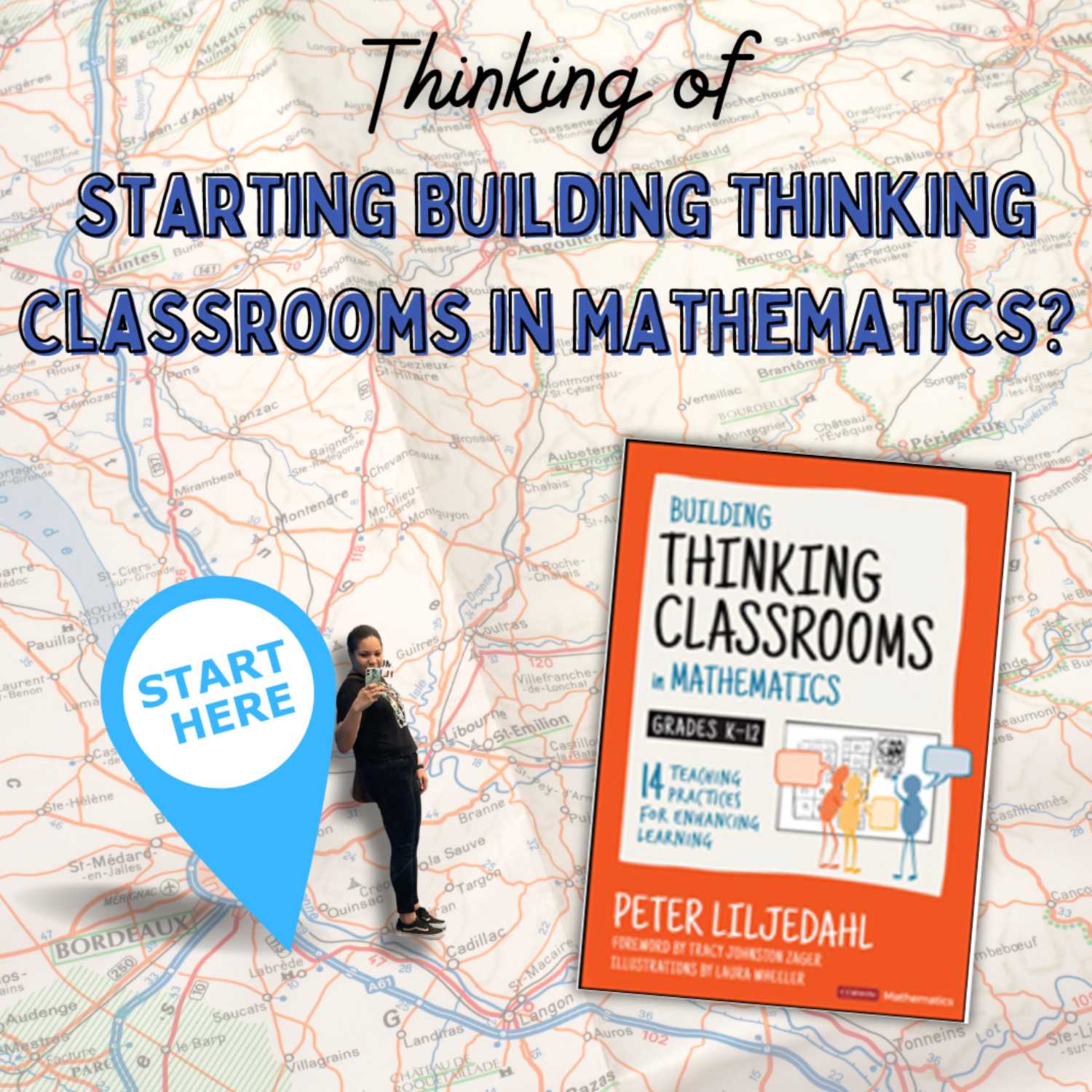
Ep 9: Thinking for Starting Building Thinking Classrooms? Start Here!
Making Number Sense Make Sense: A Math Podcast for Early Elementary Teachers
Are you ready to try? Try this Free Task!
You may have read the Building Thinking Classrooms in Mathematics book and are pumped to start, but are not sure where. This episode is for you I talk about my experience and what you need to think through before starting. This methodology will transform your math classroom and your students as problem solvers. Watch them go from hesitant and afraid to make mistakes to jumping in head first, and doing math in a way that makes sense to them that is more valuable than any algorithm you could teach!
In this podcast, I talk about spaces, materials, tasks, and more!
Any podcast episodes you want me to make?
Let me know in this Google Form!
Helpful Links
Building Thinking Classrooms Tasks Starter Pack
See my other posts about BTC or watch the videos in the Building Thinking Classrooms playlist!
Let's Connect!
Feel free to reach out on Instagram to learn more!
Available Results
Generated results are saved to the knowledge database for reuse and search.
Extract Knowledge
Pick what you want extracted first. Model, scope, and chapter options appear after a template is selected.
Transcript
1
00:00:00,000 --> 00:00:02,720
You've read the Building Thinking Classroom's book.

2
00:00:02,720 --> 00:00:06,440
You're ready to get started, but need help working through exactly what you're going

3
00:00:06,440 --> 00:00:07,440
to do.

4
00:00:07,440 --> 00:00:09,880
The nitty gritty of setting up a building thinking classroom.

5
00:00:09,880 --> 00:00:10,880
This is for you.

6
00:00:10,880 --> 00:00:23,440
Hello, and welcome to Making Number Sense Makes Sense, a podcast for elementary teachers,

7
00:00:23,440 --> 00:00:28,280
specifically early elementary teachers, looking to really make an impact in the number sense

8
00:00:28,280 --> 00:00:29,280
of their students.

9
00:00:29,280 --> 00:00:34,880
If you're here, I think you've read the Building Thinking Classroom's book and have

10
00:00:34,880 --> 00:00:38,680
heard teachers raving about it and you are ready to get started.

11
00:00:38,680 --> 00:00:41,400
Now, I read this book last year.

12
00:00:41,400 --> 00:00:47,280
I did it for an entire year and I have a previous episode all about my results.

13
00:00:47,280 --> 00:00:52,880
If you're curious about how it worked out, spoiler, it worked out awesome.

14
00:00:52,880 --> 00:00:57,680
But there's lots of little nitty gritty things that you need to think about in order to make

15
00:00:57,680 --> 00:00:58,680
it work in your classroom.

16
00:00:58,680 --> 00:01:01,680
I'm going to share with you those things today.

17
00:01:01,680 --> 00:01:04,280
The first thing you need is a place for your students to work.

18
00:01:04,280 --> 00:01:10,760
Now, if you're in a K to 2 classroom, you're going to want enough spaces for each pair.

19
00:01:10,760 --> 00:01:15,960
If you're in a 3 and above, you're going to need spaces for each trio.

20
00:01:15,960 --> 00:01:20,960
Now, for younger kids, I have had them work in trios before.

21
00:01:20,960 --> 00:01:24,640
If I had an odd number of students or something like that, it did not work as well.

22
00:01:24,640 --> 00:01:25,840
It really didn't.

23
00:01:25,840 --> 00:01:32,440
They're still working on developing group work mentality and having it being able to share

24
00:01:32,440 --> 00:01:36,240
work and space and the marker between three people.

25
00:01:36,240 --> 00:01:40,240
So, two people definitely works best, but it can work with three people.

26
00:01:40,240 --> 00:01:45,120
So, you're going to need to think about the spaces or where they're going to be working.

27
00:01:45,120 --> 00:01:49,680
What vertical non-permanent surfaces are they going to be using and what materials do you

28
00:01:49,680 --> 00:01:51,080
need to gather?

29
00:01:51,080 --> 00:01:56,680
Now, speaking of materials, you're going to need a vertical non-permanent surface.

30
00:01:56,680 --> 00:02:01,240
Now, I was really lucky that school that I was in just got renovated so they did have

31
00:02:01,240 --> 00:02:03,160
whiteboards all over the place.

32
00:02:03,160 --> 00:02:05,680
I realized that is not the case for everyone.

33
00:02:05,680 --> 00:02:10,520
So, what you can use instead is a dry-race sleeve and paper.

34
00:02:10,520 --> 00:02:16,080
Now, their workspace is not as big, but it's definitely something you can use and it can

35
00:02:16,080 --> 00:02:23,160
make shift any corner into a space where they can potentially work.

36
00:02:23,160 --> 00:02:26,000
And overall, the biggest thing is that they're standing.

37
00:02:26,000 --> 00:02:29,240
I did have some spaces that were not vertical.

38
00:02:29,240 --> 00:02:32,360
I just didn't have the area.

39
00:02:32,360 --> 00:02:38,440
It was just a U-table that was flat, but if the kids were sitting down, they did not stick

40
00:02:38,440 --> 00:02:40,280
with it as long as if they were standing up.

41
00:02:40,280 --> 00:02:44,880
So, once they removed the chairs, even though it wasn't vertical, not ideal, it still worked

42
00:02:44,880 --> 00:02:45,880
out.

43
00:02:45,880 --> 00:02:51,840
So, make sure that your surface is non-permanent and that your kids can stand when they are

44
00:02:51,840 --> 00:02:52,840
working.

45
00:02:52,840 --> 00:02:54,840
You'll also need erasers.

46
00:02:54,840 --> 00:02:55,840
Big thing.

47
00:02:55,840 --> 00:02:57,360
Erasers for them.

48
00:02:57,360 --> 00:03:01,960
So, dry-race markers, erasers, vertical non-permanent surface.

49
00:03:01,960 --> 00:03:07,400
I also used magnetic clips to clip the dry-race sleeve so that's something you might want

50
00:03:07,400 --> 00:03:12,000
to consider if you're looking into making your own spaces.

51
00:03:12,000 --> 00:03:16,120
And the last thing that I used is your partner cards.

52
00:03:16,120 --> 00:03:20,560
Now I have these color-coded partner cards that you can get for free at the link below

53
00:03:20,560 --> 00:03:23,240
along with a task that you might want to try.

54
00:03:23,240 --> 00:03:28,840
But when I was randomizing, which brings me to my next step, choose your randomizing method.

55
00:03:28,840 --> 00:03:35,720
Now I used classroom screen for computer-generated partnerships or the partner cards.

56
00:03:35,720 --> 00:03:42,240
I started off with partner cards and the kids definitely preferred picking an actual physical

57
00:03:42,240 --> 00:03:47,120
card than getting a computer-generated partner.

58
00:03:47,120 --> 00:03:50,840
For a while, I think they really secretly thought that I was still picking their partners,

59
00:03:50,840 --> 00:03:52,640
but I definitely wasn't.

60
00:03:52,640 --> 00:03:57,640
But even towards the end, when they understood that I'm not picking it, it just kind of spits

61
00:03:57,640 --> 00:04:00,120
out partnerships, they preferred the card.

62
00:04:00,120 --> 00:04:01,960
So I would suggest using cards.

63
00:04:01,960 --> 00:04:05,080
The next thing you're going to want to do is pick your schedule.

64
00:04:05,080 --> 00:04:07,280
Then are you going to do building thinking classrooms?

65
00:04:07,280 --> 00:04:12,160
I'm not sure if there's a right or a wrong way, but I'm just going to tell you what I

66
00:04:12,160 --> 00:04:14,160
did and how it worked out for me.

67
00:04:14,160 --> 00:04:20,360
So I did my big building thinking classroom task on Mondays.

68
00:04:20,360 --> 00:04:23,320
My reason for Monday is because it was a weird schedule.

69
00:04:23,320 --> 00:04:29,040
I had a double special, so there wasn't a lot of time to get into a full math workshop

70
00:04:29,040 --> 00:04:33,920
or anything like that, but the perfect amount of time to get into a task, give them work

71
00:04:33,920 --> 00:04:37,560
time, give them time to consolidate their learning.

72
00:04:37,560 --> 00:04:39,000
So that just was what worked out for me.

73
00:04:39,000 --> 00:04:47,000
So I did a full building thinking classroom session once a week, and I sprinkled in different

74
00:04:47,000 --> 00:04:51,000
partnership activities throughout the week when we were doing other things.

75
00:04:51,000 --> 00:04:55,960
And that really worked out for the kids to practice the social skills involved with working

76
00:04:55,960 --> 00:04:57,800
in a partnership.

77
00:04:57,800 --> 00:05:01,760
And they came to prefer working in partners versus working on their own.

78
00:05:01,760 --> 00:05:02,760
And I was all right with it.

79
00:05:02,760 --> 00:05:03,760
I'm okay with it.

80
00:05:03,760 --> 00:05:07,680
I prefer them working together, especially working on the social skills, which is so

81
00:05:07,680 --> 00:05:09,160
big for young kids.

82
00:05:09,160 --> 00:05:11,920
And it's something that is really challenging for them.

83
00:05:11,920 --> 00:05:16,160
Now I was a little concerned about, like, how are they learning this?

84
00:05:16,160 --> 00:05:19,680
Like, when they have to do an assessment, they're going to have to work on their own.

85
00:05:19,680 --> 00:05:21,920
They're not going to be able to work with a partner.

86
00:05:21,920 --> 00:05:26,560
I didn't need to have worried because they did fabulous on their assessments, working

87
00:05:26,560 --> 00:05:27,800
on their own.

88
00:05:27,800 --> 00:05:33,960
But I think the experience of having a year full of being really creative thinkers and

89
00:05:33,960 --> 00:05:38,000
listening to other people and gaining other ideas really helped them to be able to take

90
00:05:38,000 --> 00:05:43,280
that and apply it to new situations, especially even if they were working on their own.

91
00:05:43,280 --> 00:05:47,400
So I wouldn't worry too much about that, especially for younger kids.

92
00:05:47,400 --> 00:05:52,000
Their assessments are not as high stakes, especially if you're in the United States

93
00:05:52,000 --> 00:05:56,200
when high stakes testing doesn't really start until third grade.

94
00:05:56,200 --> 00:05:58,360
They're in kindergarten, first grade, second grade.

95
00:05:58,360 --> 00:06:01,160
They don't necessarily need to be so concerned about that.

96
00:06:01,160 --> 00:06:02,160
They won't have to do that.

97
00:06:02,160 --> 00:06:04,840
So I kind of just let that go.

98
00:06:04,840 --> 00:06:08,440
The next thing you're going to want to think about is defining your goals with your students

99
00:06:08,440 --> 00:06:10,840
and how you want your classroom to run.

100
00:06:10,840 --> 00:06:16,960
So you need to picture in your head, if you had a perfect problem solving session, what

101
00:06:16,960 --> 00:06:18,560
would that look like?

102
00:06:18,560 --> 00:06:23,400
So I'll describe to you kind of what I envisioned, and then you might think about how you might

103
00:06:23,400 --> 00:06:26,800
use that for your classroom and how you might tweak it.

104
00:06:26,800 --> 00:06:34,240
So when I thought of the perfect problem solving session, I wanted to see both partners discussing

105
00:06:34,240 --> 00:06:35,880
discussing the problem.

106
00:06:35,880 --> 00:06:41,600
I wanted to see both partners sharing the marker and really listening to each other.

107
00:06:41,600 --> 00:06:46,360
I wanted to see kids who, if for some reason they needed to go to the bathroom, get a drink

108
00:06:46,360 --> 00:06:50,760
of water, they would go do that really quickly and come back, not necessarily needing to

109
00:06:50,760 --> 00:06:55,720
ask for permission, but just kind of go let it be free flowing.

110
00:06:55,720 --> 00:07:00,120
That's not the case for all teachers who want that, but that's kind of what I wanted.

111
00:07:00,120 --> 00:07:04,480
And I wanted them to be really respectful to each other and listen to each other and

112
00:07:04,480 --> 00:07:10,320
understand that your partner might have some valuable input, but also your classmates might

113
00:07:10,320 --> 00:07:17,320
have some valuable input, that your classmates are a great resource for you to use and that

114
00:07:17,320 --> 00:07:22,880
if you are a partner and you noticed another team, another group, looking at your paper

115
00:07:22,880 --> 00:07:27,840
or looking at your, excuse me, whiteboard, that you didn't assume they were trying to

116
00:07:27,840 --> 00:07:28,840
copy you.

117
00:07:28,840 --> 00:07:33,520
You wanted to assume that they were trying to think of an idea from you that might help

118
00:07:33,520 --> 00:07:35,920
them solve their problem.

119
00:07:35,920 --> 00:07:40,560
I also kind of wanted them to be able to flow in and out in a purposeful way.

120
00:07:40,560 --> 00:07:45,440
So what I mean by that is I wanted the kids to be able to, if they were really stuck,

121
00:07:45,440 --> 00:07:51,080
they could ask me, they didn't usually ask me, they preferred to ask another group what

122
00:07:51,080 --> 00:07:55,000
they were doing or kind of how they were solving the problem and they listened better to each

123
00:07:55,000 --> 00:07:57,960
other than they ever did to me for something like that.

124
00:07:57,960 --> 00:08:02,880
So listening to a peer and how they figured it out really supported them in growing their

125
00:08:02,880 --> 00:08:03,880
own thinking.

126
00:08:03,880 --> 00:08:09,040
So I wanted them to have the freedom to be able to move around the room and get ideas

127
00:08:09,040 --> 00:08:10,440
from other kids.

128
00:08:10,440 --> 00:08:13,240
Now, my caveat is it did not start like that.

129
00:08:13,240 --> 00:08:16,920
They started more in their spaces and then once they got the hang of it and understood

130
00:08:16,920 --> 00:08:19,640
that if I'm going somewhere else, it's for support.

131
00:08:19,640 --> 00:08:23,000
It's not to just talk to my friend who's on the other side of the classroom.

132
00:08:23,000 --> 00:08:24,680
That's kind of what I envisioned.

133
00:08:24,680 --> 00:08:29,880
So to make that work, I really needed the kids to practice sharing their marker.

134
00:08:29,880 --> 00:08:32,480
I needed them to practice talking to each other.

135
00:08:32,480 --> 00:08:37,000
I needed them to practice understanding that they had a common goal and working towards

136
00:08:37,000 --> 00:08:38,240
that goal.

137
00:08:38,240 --> 00:08:43,160
So when it came to my tasks, especially my non curricular tasks, that's kind of what my

138
00:08:43,160 --> 00:08:44,240
focus was.

139
00:08:44,240 --> 00:08:49,480
My focus was focus concentrating on one outcome.

140
00:08:49,480 --> 00:08:54,280
Our goal is to do X and we need to work together to make that happen.

141
00:08:54,280 --> 00:08:59,440
My goal for another non curricular task was sharing the marker.

142
00:08:59,440 --> 00:09:03,080
I had them do intervals like you have it for a minute, you have it for a minute.

143
00:09:03,080 --> 00:09:08,560
I didn't love that just because it ended up being more work for me to kind of like set

144
00:09:08,560 --> 00:09:11,520
the timer or make sure that it was working or make sure that they were switching.

145
00:09:11,520 --> 00:09:13,680
I wanted it to be more free flowing.

146
00:09:13,680 --> 00:09:14,800
So I started that way.

147
00:09:14,800 --> 00:09:19,760
So they got kind of a feel of it, but needed to make sure that both of them had the marker.

148
00:09:19,760 --> 00:09:22,480
I also wanted them to practice getting to the right space.

149
00:09:22,480 --> 00:09:27,760
If you've taught kindergarten, you know that especially at the beginning of the year, it's

150
00:09:27,760 --> 00:09:31,640
like herding cats, trying to get the kids to walk in a line.

151
00:09:31,640 --> 00:09:32,840
I'll face the right way.

152
00:09:32,840 --> 00:09:35,840
It's a mess and it requires a lot of practice.

153
00:09:35,840 --> 00:09:38,320
So that was another thing I wanted them to focus on.

154
00:09:38,320 --> 00:09:42,120
I gave them something super engaging to do once they got to their space, but they needed

155
00:09:42,120 --> 00:09:45,320
to make sure that they found their partner and figured out what space they were supposed

156
00:09:45,320 --> 00:09:46,320
to be at.

157
00:09:46,320 --> 00:09:51,200
So I think the task that I used for that was I said, there's a box of blocks in your space.

158
00:09:51,200 --> 00:09:54,760
You need to find the right space and see if you can build the tallest tower that you

159
00:09:54,760 --> 00:09:56,640
can together.

160
00:09:56,640 --> 00:09:58,400
And so they were really motivated to get over there.

161
00:09:58,400 --> 00:10:02,000
They found their partner right away, went to their space and that practice really helped

162
00:10:02,000 --> 00:10:05,320
them get used to how to get started.

163
00:10:05,320 --> 00:10:08,960
So thinking about what you want and what you might see, those are things you want to think

164
00:10:08,960 --> 00:10:13,960
about how you want the classroom to look and how you want it to run and what tasks or what

165
00:10:13,960 --> 00:10:16,440
items you might need to do in order to make that happen.

166
00:10:16,440 --> 00:10:19,480
Speaking of tasks, that was kind of your next step.

167
00:10:19,480 --> 00:10:25,000
Figure out how you want your tasks to work, what access you want kids to have to manipulatives,

168
00:10:25,000 --> 00:10:28,080
how they go about getting them, can they just get anything that they need?

169
00:10:28,080 --> 00:10:30,280
Are you putting stuff out for them?

170
00:10:30,280 --> 00:10:33,240
One of those little things to make it really flow.

171
00:10:33,240 --> 00:10:37,640
And speaking of the non-curriculars, I really feel like the non-curricular tasks job was

172
00:10:37,640 --> 00:10:42,720
to get us in the routine of getting to the right space, working with any partner and

173
00:10:42,720 --> 00:10:44,920
really listening to each other and being a partner.

174
00:10:44,920 --> 00:10:49,280
So those are my first tasks that I did with the kids.

175
00:10:49,280 --> 00:10:53,400
Had those things in mind, really not too much to do with math at all.

176
00:10:53,400 --> 00:10:58,860
And because we laid that groundwork, once we started to get into more curricular tasks,

177
00:10:58,860 --> 00:11:02,040
they had the routine down, they knew what to do, they knew where to go, they knew that

178
00:11:02,040 --> 00:11:06,360
even if this partner was not my best friend that I wanted to really work with, they might

179
00:11:06,360 --> 00:11:09,560
get their best friend next time and it's just for today.

180
00:11:09,560 --> 00:11:12,560
Next time you'll get a new partner, any new partner.

181
00:11:12,560 --> 00:11:15,680
So that's what worked out for me.

182
00:11:15,680 --> 00:11:22,360
Now if you're wanting some ideas for tasks, I will leave below some links to some really

183
00:11:22,360 --> 00:11:26,760
helpful teacher collaboration groups that are working on building thinking classrooms.

184
00:11:26,760 --> 00:11:32,640
I'll also send you a link to a blog post that I did about some of my tasks and kind of how

185
00:11:32,640 --> 00:11:34,040
I go about doing them.

186
00:11:34,040 --> 00:11:38,440
And if you're looking for an example of a free task, you can get that at the description

187
00:11:38,440 --> 00:11:40,720
below as well.

188
00:11:40,720 --> 00:11:46,040
If you have any questions, make sure to send me an email or you can DM me on Instagram.

189
00:11:46,040 --> 00:11:51,040
I am happy to help you and help you talk through what you need to get started for a successful

190
00:11:51,040 --> 00:11:58,040
year of building thinking classrooms.