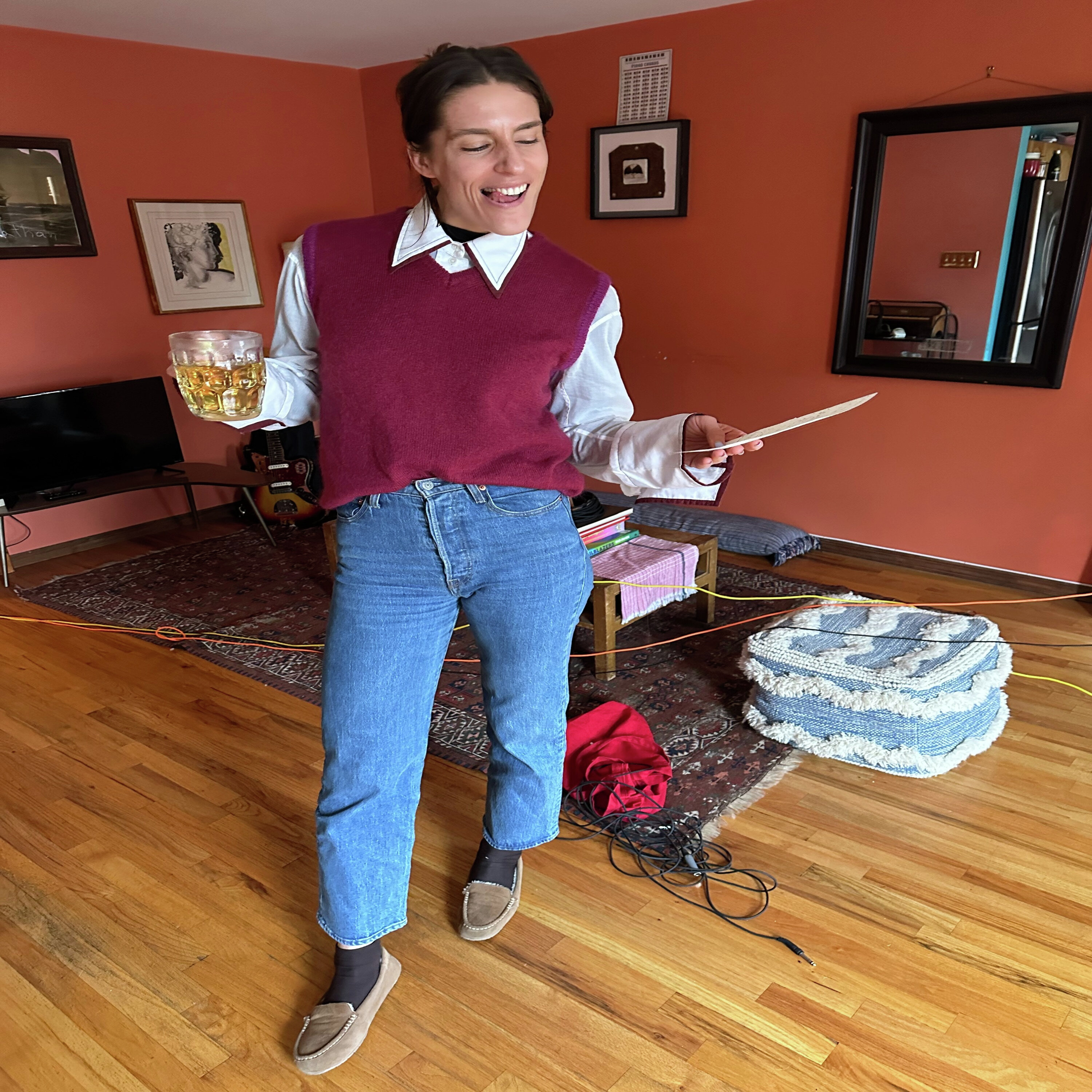
Back in the New York Groove
Petko's in town to record her audiobook and she Rennae catch up on the week in tennis news while back together—and in the closet—in New York. Shoutout to guest editor Jesse Kotansky.
Hosted on Acast. See acast.com/privacy for more information.
See omnystudio.com/listener for privacy information.
2024-02-23
60 min
Transcript
Available Results
Generated results are saved to the knowledge database for reuse and search.
No generated results are available for this episode yet.
Extract Knowledge
Pick what you want extracted first. Model, scope, and chapter options appear after a template is selected.
Generated results for public episodes are saved to the knowledge database so they can be reused and searched later.
Transcript
00:00:04
Speaker 1: Ever since he threw up in Beijing. I don't know what he's all right?

00:00:10
Speaker 2: Everybody, Hi, and welcome to the Renee Stubs Tennis podcast. We are back in New York City and I am joined by my trusty left hand because you're on my left side today, Andrea Pekovitch, Hi, picko, how are you?

00:00:23
Speaker 1: I'm doing really well and I'm going to set I'm going to set you up for this joke that you will make.

00:00:30
Speaker 2: We are in the closet, literally we If we sound really great today, it's because we have a setup in literally the closet of your apartment in Brooklyn. Because your amazing boyfriend Jesse is also a musician, and so he records a lot of stuff in here.

00:00:48
Speaker 1: Correct, Yeah, he does well. He has a studio a little further away from here, but for some smaller stuff that doesn't involve drums, for example, he sometimes records here. And I actually recorded my audiobook for the last two days here. So if my voice sounds very sumptuous today.

00:01:05
Speaker 2: It'll probably sound like mine didn't.

00:01:07
Speaker 1: That would be like I wish I had my voice was always like this, But unfortunately, we will go back to the squeaky mess that I have smoke.

00:01:14
Speaker 2: A couple of packs of cigarettes, and you might just sound like that any day you want. But anyway, the point is that I'm back in the closet, is what Petco would like to let everybody know. I'm back in the closet but I will be exiting that closet in about.

00:01:28
Speaker 1: Forty five minutes.

00:01:29
Speaker 2: You, of course, have never really been in the closet, so there you go.

00:01:33
Speaker 1: I didn't have to be so we are here, and I'm excited. I really got used to First of all, living with you. I thought we had a really good vibe. And second of all, I really enjoyed that daily thing with it with a podcast at the Austria and Open podcast set. It's a color podcast. But not only that, we got great feedback and thank you for everyone who listened. But also what I really liked is it gave me clarity of mind as well, just talking through the day. The next day when I arrived at the at the side and when I went into the commentary booth, I felt like I was clearer in what I saw, just because we see tennis so differently and still but it's like you.

00:02:15
Speaker 2: And I see each other things differently.

00:02:17
Speaker 1: We see different things, but both are correct, you know, so differently put you see things that I don't see, and then when you point them out to me, it feels like my view of tennis becomes more complete. Yeah, you know what I mean, because that's the blind spot that I have that you see and and so I really enjoyed it. I thought it made me better as an analyst when I was calling matches.

00:02:38
Speaker 2: Actually, yeah, I think we talked about that the other night. We went to dinner and we were sitting there and you listened to a couple of the podcasts, and that's one of the things that you said is that there were things that I said that you were like, oh, And then there were things that you said that I was like oh. And I think that's the good thing about, you know, us doing the podcast as opposed to people that really haven't played on to or played professionally, is that we see it with a three D dimensional. You know, we see what players go through. We can empathize with, and we can sympathize, we can understand, but we also really admirable, we admire what we're seeing now as well as well as being tough on them at times, but also mostly I think we just look at it with different eyes to expert eyes, but two different eyes, and you played very different to me.

00:03:22
Speaker 1: Yeah, that's and I think that's good. Yeah, because like I remember when I was going on and on about Chinwen's return position and returning and you were like.

00:03:32
Speaker 2: Oh, it's like glazing over.

00:03:33
Speaker 1: No, I'm just kidding, no, no, but you were like, oh, yeah, I never because you didn't think about return so much. But when somebody misses the po to move to the.

00:03:42
Speaker 2: Net, I need to pause you on that. I thought about my return all the time, about how can I make it a little bit more? So there you go. But I think the thing that you're saying is like you were so good at returning of serve and it came so naturally to you, whereas for me, for example, transitioning into the net, it was just like, what do you mean you don't know how to do that?

00:04:02
Speaker 1: Yeah, exactly.

00:04:03
Speaker 2: Like there's things that came naturally to us we could talk to each other about. But anyway, so let's get into it.

00:04:08
Speaker 1: I actually made a little bit of a list that I was interested and it's funny, and I think the first theme that I wanted to talk to you about is I think it's going to set the tone. I think I want to talk a bit more about general things because a lot of people and players too, feel a bit of a letdown after a Grand Slam tournament ends. It's exactly exactly I do too, And I'm going on, Yeah, I was a tennis player, now I'm an audience member, and it feels like, you know, it feels like it feels like a nicotine patch when you want just want a real cigarette, you know, when there is a two fifty going on. Anyways, anyways, but let's talk about the letdown after a Slam, and let's talk about it in terms of how the players feel. I have never won major tournaments, but you have. And I read this is something really interesting to me, and I read a lot of things on that. And Michael Phelps when he broke all the records at the Olympic Games, he talked very openly about feeling depressed afterwards, losing motivation. Same with Naomi Osaka when she came forth with her mental health struggles. She said, after she won the US Open for the first time, it was really hard for her and she actually had the press ave bouts. And we have two very different examples. After the Australian Open. Zabalenka won the Australian Open, she was the player of the tournament. Now she's lost to Donavekch quite early, surprisingly maybe, and then Jan Nixy now just seems to not be able to lose anymore. Can you talk a little bit on how you felt after you reached such a holy grail in tennis? Did you feel happy? Did you feel like, oh my god, what else comes afterwards? Can you talk a little bit about that?

00:05:54
Speaker 2: Well, you know, clearly, look, winning doubles is a little bit different because you do have someone there to help you through, right, that can motivate you to be better or whatever it is. But after my first victory at a Grand Slam, actually won the doubles and mixed doubles at the Australian Open, I went straight to another tournament and played Tokyo, and I think Lisa and I I'm trying to remember, but I think we may have lost in the semis. We definitely went to Tokyo, so I don't know if we won the tournament after that, but it didn't really It wasn't really a letdown for us because we had been quite good leading into the astraight up and were like the number one team in the world for a year, and it was more about can we finally win one, and when we did, we actually it motivated me to want to win a lot more, do you know what I mean. So it was very different to put pressure on us as a team to now we're like the hunted again, and so for us, it gave us motivation to be better. We actually had a better year. The following year. We won a couple more Grand Slams, we won the WTA finals, we won like eight tournaments. We won like seventeen tournaments in two years through that span and then twenty twenty two. So for us, it was more on the lines of no we wanted, more like if we lost in a semifinal, it was a friggin disaster, kind of similar to what I think Serena would feel, you know, when she started winning Grand Slams and then losing in quarters. It was just like what and don't worry everyone, don't I'm not comparing myself to Serena, but like when you want to be really great, Serena, Stephie, you know, Novak Rafa, Roger, you when you talk about the greats the last couple of years. They want more, They're never satisfied. And you know, one of the stories that I always tell about Stephie is that Stephie told me in retirement she wished she had the only thing she regrets about her career is not enjoying the wins more. Ah interest, And I said, yeah, but you know that you probably wouldn't have been as great as you were. I mean, she won twenty two Grand Slams by the age of twenty nine. So I'm like, I think that if if you are happy and this is the issue now, if you are happy with it and you get complacent, and then you don't have the desire to want to put yourself on the line anymore, because it is so stressful to win a Grand Slam. You've got to want to have the desire to go through that pain and not be satisfied and not be content, I think is the word. If you're content with winning one, you probably won't win two. But if you win one and all you can think about is ruminating over the next Grand Slam, chances are you probably will win. Yeah, And so I think Sabalanc is fine. I think she's probably focused on Wimbledon and that you were open, but it was interesting that she lost so early. Look, Donald Beckich is a great player, Yes, Donna's greatly and I'm sure I don't know how much practicing Sabalanca would have been doing after these strain open so who knows. But yeah, it's definitely very different to what Yannick Sinner was able to do immediately after winning the austrain Open.

00:08:46
Speaker 1: Well, and that's that's what I wanted to get that. First of all, what you said reminded me of another thing you said before, where you mentioned that when you see a player celebrating a quarter finals win, for example, sensively, and you see them falling to the ground and running to the to the team, You're like, in your mind you check them off the list for winning possibly winning the Grand Slam. You're like, oh, you're done for right, certainly more difficult, more difficult. Yes, it just reminded me of it, but yeah, so it seems with Yannick so similar, like maybe to what you said about you and Lisa before you won the Austian Open. Yannick has been the player of the ATP Tour for a few months now, I think really since the atp Finals before that too. Ever, since he threw up in Beijing, I don't know what exactly. I don't know what he threw up, but he threw up something. But it's not it wasn't surprise. Yes it was surprising, but it wasn't surprising. But now it just seems like he can't lose anymore. Has he unlocked a new level of Janick Sinner?

00:09:53
Speaker 2: There's absolutely no question in my mind. I think that he lost that doubt and that you know, I used to get remember when he was playing he kind of got a little bit injured at the US Open, and he was complaining about an injury, but yet he played two more three almost three more sets against the Verev. He lost the match, But it's kind of little. He would always have a little bit of a niggle here and a niggle there, and it was almost like, is that his like defect when things aren't going well, is that he maybe has a little bit of a oh my leg kind of thing. I don't know. I mean, that's we don't see that from him ever anymore hardly, And I think that he's gotten to the point now he knows and this is the difference. He now knows he can win a Grand Slam. He now knows he can beat anybody in the world. Every time he walks onto the court, and when you have and that's the one thing that like, for example, Lisa and I like when we were at our very best, we didn't think there was a team that were better than us, and that didn't say we lost matches, But there was never a time I walked on the court going, I don't know today we walked on the court going, we're supposed to win this match.

00:10:57
Speaker 1: That's a great feeling. I'm sure I never had that.

00:11:00
Speaker 2: It is a great feeling. But it's also that's where the pressure becomes, Right, that's where the pressure comes because you're thinking I shouldn't lose.

00:11:07
Speaker 1: So you're basically thinking, technically I shouldn't lose any match at all. Yeah anymore, Yeah in the future.

00:11:16
Speaker 2: No, that's right. And when you start to that's when you start to doubt, do I have it anymore? Kind of thing. But I think when you get on a roll like that, and he's on a roll now, there's never a time he walks on the court. And I took about this, I've talked about on the podcast. I've talked about it in other discussions. It's your conscious and subconscious mind. Like we've had this conversation, you and I. The conscious mind is, yeah, I can win this match, Yeah I can win this tournament. Yeah I'm good enough win a Grand Slam. And there are several players that are out there that I could probably point to that I won't just because I don't want to throw them under the bus, but I would say they'll be like, yeah, yeah, I'm good enough to win this tournament. But subconsciously, the little man and the little girl, you know, the little boy and the little girl that's in the back of their mind or the front, depending on where you want to put him, is going no, you can't, No, you can't. You're really not good enough yet. Well, and you're just like fighting that. When you're fighting those things in your own brain, you're not going to win. But it's when the conscious and subconscious mind are all saying, yeah, you're good enough. And I've had that experience where my subconscious and conscious mind were like, yeah, you're you're going to win this match, or you should win this match. It's not a guarantee you're going to win it. But when I had the subconscious and conscious minds that were not aligned in big matches is the ones that I lost my first Grand Slam final and my last Grand Slam final. My subconscious and conscious minds didn't believe that I could win. Like the subconscious like, oh you're playing the whims Sisters last Wimbledon. Oh my god, like you know, and ten years prior in a Grand Slam final, I would have said, there's absolutely no way I'm losing this match. Now, that's not a guarantee that I was going to win it. My conscious and subconscious minds were together, they were aligned.

00:12:56
Speaker 1: Yeah, And it it makes me think of because a few people, well a few German journalists asked me, like, what do you think is still lacking for Alexander Zverev to win? Right? And and I said a similar thing that you said now. I said, well, first of all, he has the diabetes. That's a challenge, that's a physical challenge for a man that has to play a best of a best of five match. That's definitely there. But and it's interesting because I feel like to win a Grand Slam there is a little mental obstacle that you have to overcome, and it feels once you overcome that you can win any slam any you know, after that you go to a slam and you're like, I can win this, of course, and he hasn't overcome that yet. And we saw that the best the two matches where he was up too sets to love with the US Open final and the semi finals at the Austrian Open against Daniel Madridev. So clearly he hasn't quite overcome that mental obstacle yet.

00:13:56
Speaker 2: No, and until he does it, he won't. You know, the hardest thing to do with something you never done before, and so that will be an issue for him going forward forever. And obviously him going over at his ankle against Rafa like maybe maybe karma isn't on his side. I don't know anyway. I know you're going to stay away from that one.

00:14:12
Speaker 1: Well, let's move on. Let's move on to the next.

00:14:15
Speaker 2: We don't want to want it just before you, before you do, go on. I know that I've had a conversation with Darren Cahill about this, and one of the first things that Darren said was that their main focus with Janick now was to absolutely make him focused on the next couple of tournaments that he was playing. Oh, and that to get him back, And I'm sure he probably went back to Italy and probably went skiting for four or five days and had a great time and relaxed and then banged straight back into work ethic. And I think that is the one great thing about having a coach on your team that has been through this and can guide you through these things, to sit you down and be like, look, what you just did was absolutely incredible. But your goal is number one in the world and the next Grand Slam and the next Grand Slam. And to do that you have to set your You're not your boundaries, but you have to set your goals. Have to be every time you walk on the court, you're giving one hundred percent because that will translate into Grand Slam victories. Novak didn't turn up to a tournament or Rafa Roger or Serena turn up to a regular tournament like I don't really care about this. I mean maybe later in their career when they were like, you know what I mean, I've won twenty Grand Slams, Like do I really need to hustle my ass in Cincinnati every time? But they every week knew they weren't supposed to lose, right, So they went in there going I'm going to win this tournament.

00:15:30
Speaker 1: Well and talking about Janick Sinner because I was in Europe the last few weeks, so I saw a few things and there was a big controversy in Italy about him not going to san Remo. There is a huge music festival in Italy and san Remo, and it's very well regarded and not only in Italy and all of Europe and all every musical act that goes there and gets invited to perform there becomes a huge star blows up overnight basically, and it's a big honor to be invited to Theo festival as anybody, not only as a musical act. And Yannik actually didn't take the invitation. He refused to come because he had to train and go to Rotterdak and and it was a controversy because everyone was like, oh, he's not, you know, honoring the you know, he's not honoring the invitation. And Sandremo is such a big thing, and I I would have gone, I want to be in Sandramo. So that's maybe that's why I haven't won majors. But I at the same time, I really respected it and then seeing him when Rutter dumb was like, yeah, you did the right thing, You did the right thing.

00:16:32
Speaker 2: Yeah, of course. And I mean that's the one thing that I would have to say against Mateo Bertini for example. You know, and look, listen, we call spades spades on this podcast, okay, And I love Mateo. He's a great guy. He's very good looking, all the stuff that we all love about him, and he's an amazing tennis player. And yes he's had terrible injuries over the last couple of years, but when he was at his peak, when he was doing really well, he was going to the met Gala, he was going to this, he was doing photo shoots. You know, it's like, and I'm fine with that because Yanni's got his Gucci stuff and clearly Matteo has the boss stuff. But that's where you have to maybe fault him a little bit. I know a lot of people are given Emma Radikanu shit for that.

00:17:12
Speaker 1: You know.

00:17:13
Speaker 2: It's like, yeah, that's where it's important to have people around you that are advising you to say what is your priority?

00:17:18
Speaker 1: And that's such a good point. And I'm sorry I'm yelling, but that's such a good point because these kids, these are kids that we are talking about. These are eighteen, nineteen, twenty year olds, twenty one year olds. I was twenty one, you were twenty one. I was not an adult. When I was twenty one. My frontal cortex of my brain was not fully developed. You can't expect those guys to make the sound decisions every time. And that's where it's important. And this is a great segue, maybe the greatest segue that has ever been made on a podcast. That's why you need the best people around you. And that's why I want to talk about coaching changes. Yes, coaching changes, and the reason for that is obviously Holgaruna going back to Patrick Morotoglu and I cannot wait for your thoughts on that. But also Maria Sakari announcing her split with Tom Hill, who she multiple times has said she wants to end her career with him, with him by her side, she wants him to be the coach for the rest of her career. So let's just hear your general.

00:18:17
Speaker 2: Thoughts on We're gonna hear. I'm gonna hear from you two. Don't think that you're just getting away with it.

00:18:23
Speaker 1: No, I will give my own I mean.

00:18:24
Speaker 2: Listen, I don't know. I guess you know. Look, results are results, right, so we'll see how the results go. When it comes to Runa, I you know, as a joke put out on Twitter that I was available, and then of course some ding dong social media department decided to put me up revealed Renee stubs coaching hold of a Runa with a tiny little question mark It's like and then I got twenty people texting me, is this true? Is this true? Are you coaching? I'm like, no, I'm not coaching him, but if I were, I think that would be a good choice. But anyway, the whole point is he's gone back to Patrick Morituglu. It's like he feels comfortable with him. I don't know. It's a surprise to me. We literally were having dinner about and talking about this the other night and we didn't think that that's going to happen. I think for various reasons, I don't know why he's going back. But as I said, results will show. We'll see what happens.

00:19:14
Speaker 1: Results will show. The one thing I have to say about this boris Becker was right there, Holger, He's right there. I'm not saying ka Patchick is a bad coach. He might even be the perfect coach for Holger Runa. But come on, it's Boris becker Man. Yeah, it's Boris becker becker What are you doing like a guy that's been there, has done.

00:19:33
Speaker 2: That, who's been a young phenom, who's produced incredible results, who helped and Novak said that he was a huge help for him through those period of time when he won a lot. I don't know, As I said, we'll see, results will tell the story. I'm not a fan of the selection. I just think that he could find somebody that could be a better fit for him. But we'll see, we will see. What do you think?

00:20:00
Speaker 1: Yeah, I don't know. I mean, obviously there is something to Patrick that resonates with Hulga. Right, Sometimes we're not in this relationship, does it.

00:20:07
Speaker 2: I mean it didn't before.

00:20:09
Speaker 1: Well, that's the thing, right, I think he is a very impulsive and emotional guy, Holgar run Is, and I think he acts on his whims and that's what that circles back to the things we talked about before, that you need people in your kana and that's the complicated part of a tennis player's relationship with their coach. This is the only sport where the tennis player pays the coach to be an authority on you. That's not going to work. If you need somebody to tell you the truth and that guy is reliant on your salary, he's not going to tell it to you, unless it's somebody like Darren Cahill who doesn't need the job because he knows he can get a job tomorrow. He's with ESPN, he's well off, he's fine. He has a reputation that cannot be stained anymore. He's one of the best coaches we have in the world. He doesn't need to hold back the truth. But there are many coaches out there that are great coaches, but that are at the beginning of their career and that can't afford to just tell a player, I think you're messing up. I don't think you should go to Sanbramo. I don't think you should do that. But they can't afford to do that because their salary is dependent on them and they have a family to feed, they have a house to pay off. And that is a terrible system really for those players. And if you are and I'm not faulting Hulger again, it comes back to what we talked about. He's a young guy, he's a kid. I don't fault him, but it's about the system is not great for players, and especially players who are impulsive, who act on their whims. You're about to make some decisions that you might end up regretting. And I don't know if this is one of them. I hope certainly not, because I think Olga is a very exciting player and I hope it goes well for him. But yeah, I think this system is really really fraud in tennis. Yeah.

00:21:51
Speaker 2: I mean I can say. Look, I've had a couple of coaching stints, and I can say that one of the things that I say, and I have said this to a player that I worked with, is I don't need this job. And listen, it's not to say that I don't I won't take the money. It's not to say that I don't like the money. If they do well and I get a nice bonus check and all that sort of stuff, but I don't need it to live, right. I have my ESPN gigs, I've got at other stuff going on. I had my own career and I said to a player one time, I don't need this job, so if you want to hear the truth, you're going to hear it from me. And this person literally turned around to me and said, well, I'm not used to someone like being not tough on me, but I'm not used to someone telling me these things and being like this. And I said, well, I don't need this job, so if you want me to help you, this is what I'm going to say. And I also say, I don't take things personally until you make it personal, right, So if someone snaps on me on the tennis court because I've told them something and they're like, you know, I don't want to hear that right now, you know, step back or whatever it is. I mean, Serena told me that one time, or I don't want to doc to you right now, it's like okay. But if they say, you know, shut up, you dyke right, and they make it personal to me, and I'm like, okay, that is I'm out, see you later. But if they're losing their shit to me, it's a different thing. Because I was the worst person to coach probably ever, so I understand that feeling out there, But the most important thing is that you are absolutely telling your player what they need to hear at that time to make them better. And if it's a tough conversation then and so be it. But there are so many players that have coaches that are absolutely reliant on them, and I have to say, I mean, that's one of the things about Tom that I think with Sakar is that she did have him for a long time. I'm sure he tried to influence her in certain ways, but at some point she wasn't listening and she wasn't doing the things that he was requesting or asking. And you just wonder how tough he was because they were such good friends as well, you know, he needed an more authoritative figure to come in and be like, no, you need to do X. And I think his lack of experience in big moments and just you know, he was never a great player. He was a college player, and that's no slide on him. There's been plenty of players, you know that weren't great players that became phenomenal coaches. But he lacked that experience in the big matches. And I do think that she needed someone who had been there or done it, whether it be with another player or as a player. And I think that that's probably where it's hurt her a little bit to not have a more authority figure over top of her, to not let her carry on like a pop chop on the court, which she does half the time.

00:24:23
Speaker 1: Well, and I wonder can you maybe let us in a bit on the thought process that goes on, because as I mentioned before, marias said, Maria said many times before that she wanted to end her career with Tom Hill by her side. She clearly didn't. What do you think how much has the pressure risen on her and how much has the lack of results maybe just become a thing, a cloud in her head where she or somebody else in her team was like you need a change, or maybe she thought I need a change. What do you think how does that function in the tennis players? Yeah?

00:24:57
Speaker 2: I mean, you know as well as I do. Like you just get to a point where, like, you know, it's stale, and you know you're not listening to them anymore, and then the things that they're telling you are not working. I mean, you tell me you've had coaching changes. You know what it feels like to get to a point where you just feel like, Okay, you need a new voice and then you get the new voice and you're like, oh, it's great, and they could be telling the same thing just in a different way.

00:25:18
Speaker 1: Well, I have this experience with because my dad is my coach. He's a tennis coach, and he was my coach for a long time, so I have this experience firsthand that especially when you're young, when you're a teenager until I was maybe twenty four, I want to say my dad, I always thank god. He always said I think you need a travel coach. I don't think I can travel with you because it will jeopardize our relationship as a father and a daughter. And I'm really glad that he had the clarity of mine to make this decision for us as a family. But he would say many things that were exactly the same that my traveling coaches would tell me. And I'd be like, ah, Dad, you know, like stop it. Why are you telling Because he's my dad, you know, I don't want my dad to tell me like maybe turn your record on your forehead that way. And then my coach would come and say the same thing. I was like, oh, my god, you're a genius. You think so so much. Yeah, but understand probably was in the background, like, oh my god, fuck you Andress.

00:26:13
Speaker 2: Yeah, but that's the case. I mean for me, it was I had some coaches that would tell me stuff, and then I had, you know, other people tell me stuff, and it resonated differently. So I do think that at some point when things do get stale. And she won Guadalajara, but let's face it, it wasn't the strongest one thousand, but she beat who she had to beat to win the tournament, so I think that gave him a little bit of life. But I think long before that she should have had a change. And that's nothing against Tom. I just think at some point she needed to have fresh eyes and a fresh attitude with her. So we'll see. I kind of sort of know who she's going to be working with. I don't want to say it here because I don't think it's public yet, but it'll be interesting to see how she responds and how she can change things. She lost early again in Dubai. Things are not looking good for her, so it's going to be a big necessity to turn around. I mean, and if you watch Breakpoint, I mean every week she's like, I'm quitting. So she's got to get away from that mentality, that's damn sure, and start finding the joy much like as your burd But os you know, this knee is an ongoing issue. But I also think that Ons is just fucking miserable on the court, and Marie is the same. So you know, I said this to Sam when I started working with her, when she had you know, her ranking was really, really quite low and she was struggling. I said, Sam, you gotta find the joy in what you're doing on the tennis court. And if you don't find the joy, don't be here, you know. And so if you're not finding joy in the work and the matches and the stress and the travel, don't do it. And if you can find that joy, you will have the results that you want because you will find the you'll find the joy back in what you're doing, which is it's friggin hard to be a tennis player.

00:27:46
Speaker 1: It is hard. And I'm sorry I don't have as brilliant the segue to the next subject as I had. Shame for that. Shame, yes, shame, shame shape from relationship with coaches to relationship between tennis players and the chair umpires.

00:28:08
Speaker 2: Oh my god, can you believe that? Did you see it. Have you seen the replay of what happened with Coco.

00:28:13
Speaker 1: I actually I was watching the match, so I missed kind of the entire conversation because I watched it without it. I watched it without a tone, and then when I saw it kept because it kept going on and on and on, I turned on the tone and so the sound, and then I caught the Why just explain to me, why did Pierre not call the supervisor diickad I know he doesn't have to.

00:28:40
Speaker 2: So just for those In actual fact, if you ask for the tour supervisor, he has to call the to a supervisor. I'm fairly certain, okay that what Coco mistake Coco made was continuing to talk. She should have walked down. Now I've already tweeted about this what he was saying. If it's a rule like, if it's a rule interpretation, you can ask for the chair of the supervisor. If it's a judgment, judgment call on the court, like if it was a double bounce, or if it was what he said, I called the ball out when she hit it, I put her off kind of thing, that's his call. So in actual fact, the supervisor would have come out. This is what would have happened. The supervisor would have come out. She would have said, what's the problem, and she would have said, he said out after she hit the ball in the net. And then she would look at the umpire and said, what's the Is that the what happened? And he would say, no, I thought that I called when she hit the ball, so that's why I'm playing a lit. And then the supervisor would looked at Coco and said, sorry, Coco, I can't do anything about this. That's his judgment call.

00:29:44
Speaker 1: Okay.

00:29:44
Speaker 2: So he was correct in what he was saying. Where he was incorrect is not sending the supervisor out just to appease her, because she was doing that just to make a point, because Coco knew she was never going to win that point. Coco knew that what had happened was too late, and the judgmentcall was the umpires. She was trying to make a point, and I don't blame her, but the mistake she made was going on. She should have sat down and she said I'm not playing until you call the supervisor, and then he would have to call the supervisor, right because just to appease her. But what he did in his tone and the way he spoke, he should have known better that he said for a fact out after the ball was basically in the net. That was the worst fucking call I've seen in a long time.

00:30:29
Speaker 1: But don't you think that's why he did it? Because he knew that he was wrong, and if he now called the supervisor, I think in the end it did go viral. But maybe he hoped because if he calls the supervisor, everyone will see it. Do you think he knew that he was wrong so to know?

00:30:44
Speaker 2: I mean, listen, if the serve was out, which it wasn't, but if the server was out and Kaya had hit the ball into the net, she would have said challenge, why are you fucking overruling that call? And everyone's like, oh, it's the best line for him to overall. No, it's not. It's actually a very difficult line to overall because you're like, well, it's the closest line to the umpire. Well, actually it's really hard to see the space sometimes with the ball between the ball and the line. When the ball's in front of you, in front.

00:31:09
Speaker 1: Of the line, well, and the angle is really that's right from there.

00:31:12
Speaker 2: I just don't understand why he decided to overrule in the first place, like, shut the fuck up. If it's out, Carolina is going to be like, dude, challenge it was a fault and clearly it wasn't, so he could have just let her walk to the other side, which Carolina was basically doing, and then he's like out and then he's like, no, I called. I mean he it was just horrible. It's horrible, and not calling the supervisor out was that's on him. And you know what, it really changed things because she played really well after that, so I think it gave her incentive. If Carolina had been smart, she probably would have walked to the other side of the court knowing that she she knew that that call didn't interrupt her.

00:31:48
Speaker 1: Yeah. Yeah, well, and it's interesting because Coco's dad posted on Instagram today, I don't know if you saw it. I was like, I'm so proud of her, and she did handle it really well. But I think there where he was correct was that the situation couldn't have been changed. He couldn't have altered his decision. And that's a really weird thing because because we have the we have all these replaced now, and still these things are this strangely and set and stone traditions of tennis that cannot be changed, and one of them is if the chair umpire makes a call, it's set in stone for the next two hundred and fifty years plus. Yes, what do we do that?

00:32:33
Speaker 2: Well, it'd be interesting to see if that happened at the US Open, because you know, now we have that system where you can actually look at double bouncers, you can. That would be if it was me, we should include that. We should include an umpire fucking up royally and being like, oh actually no, just like Va, oh no, actually in a penalty shootout the ball did go over the line or you came out early as the goalkeeper. So for me, we need to get it right. And you know, everyone and every Tom Dick and Harry that was like, you're so mean, like getting rid of the lines. People, it's what they do and they love tennis. I'm like, then go and watch tennis, like I'm sorry, this is someone's livelihood. And quite frankly, if if if Coco had lost that point after and then subsequently lost that game, Carolina would have served for the match at five to four in the second set. So it was an absolutely massively pivotal moment of the match. It's just a Coco won the point and won the game and then ended up breaking actually to win the set six to four. But frankly, like that was bullshit what happened, and that umpire. I hope he gets big time scolded for that. And if I'm Coco, I'm refusing to have him in my chair anymore, because once you lose trust and faith in somebody like that, and she did handle it well. She even shook his hand, which I can guarantee you I wouldn't have. I mean, I would have been so pissed at that guy.

00:33:53
Speaker 1: Would you would go up to him and be like, I meant a fense by not shaking your hand.

00:33:58
Speaker 2: Yes, I would have gone to shake your hand. I said, you know what, now the past review, I'm not shaking.

00:34:02
Speaker 1: Your hand, and they do mean offense.

00:34:04
Speaker 2: And by the way, go and look at the videotape your wanka. I hope he apologized to her after the match because he said he was going to. Of course, of course, of course, he said, whatever.

00:34:16
Speaker 1: Well, Coca lost to a player that I have to give us to compliment, we said, Anna Kalinskaya is going to be very dangerous this season, and she has gone on to prove our points. She is very dangerous this season, and she played a great match and beat Cocoa gov Yep.

00:34:36
Speaker 2: She's a good player. And you know, speaking of coaches that she's had for a long time, is Patricia Tarabini, who was a former player on the WTA two or one of my peers, a little bit older than me, but really good coach, somebody that's been with her for years and years and years and years, and they trained down in Miami and she's put I know how much Pato has put into making this player the player she is today. Happy for that relationship because Collin skuy I could have pulled the plug and gone with somebody else and because she wasn't having the results that she might have hoped to have had. But also Kellin skuy will be the first one to say that she was a bit of a nightmare, a little bit pissy pants, a little negative, like the whole thing. But now now that she's starting to actually see the benefits of behaving, working hard, putting all the efforts in, we're seeing it and she's a really good tennis player. And this was, you know, a little bit of a surprise in some ways but not in others. I mean, I think Coco's really struggled a little bit. You know, She's either been really good winning in Auckland going into the Strain Open, but she hasn't looked great since winning the US Open. And you know something, And I don't want to rag on Brad Gilbert because I'm going to never hear the end of it because they work with him at ESPN. But you know him saying to Chris mckendrey at the Austraiin Open when she said, well, are you concerned about the forehand? And he said no, and he said, well are you working on and he put his hand up and he said zero, zip zip nada. I'm not going to Angel I'm not going to work on it. And I was like, well about that.

00:36:04
Speaker 1: You know my thoughts on that. I think that Para Riba did a tremendous amount of work on that forehand, and I think that a lot of the improvement we saw was not only from Para Riba, but a lot of it was from Para Riba because I saw him work with chin Win on it before he came back to chin Win, before he went to Coco and he does the Spanish thing where they work on the quick rist, the quick wrist, the acceleration right before you hit the point, right before you hit the ball, right before you kind of the strings touch the tennis ball. When you accelerate right there, that's when you get that extra rotation. That helped Coco and not missing that was what made her so strong. We talked about it a million times. Backhand, great movement, great serve good most.

00:36:48
Speaker 2: Of the time I can serve.

00:36:49
Speaker 1: Not good, yeah, but most of the times very good serve. She was hitting two hundred k's an hour I think one hundred what is that one hundred and twenty miles an hour serfs in Australia, but forehand sometimes not that good. She didn't miss it in the US series, she did not miss it. And then as the opponent, you don't know where to go anymore, and it's just a nightmare to play. And she's reversed. And we saw that again in the match against Marta Costume, who was very disciplined for most of the match except for in the most important moment in just going there over and over and over again. Who has the physicality to just run the balls down even if Coco puts it back fifteen times and eventually Coco would miss the forehand and I.

00:37:30
Speaker 2: Or you would get such a short ball that you could crush it anyway.

00:37:33
Speaker 1: Yeah, and I agree with you that. Well, let's see, let's see whether it's maybe we talked about it in the beginning of the podcast, is just the letdown after winning a Grand Slam tournament and maybe she just needs to readjust with that new type of expectation, or whether it is something in the game really and you.

00:37:53
Speaker 2: Know, getting her back into the US obviously with Indian Walls and Miami, sh'll have tremendous support, so that really does helpen and she does play great with support and with the crowd really behind her. In the Middle East, it's just like very just stay yeah, just nobody really watches until maybe the final because you know who's going to go and watch tennis in the Middle East. I mean it's like you've got people that are either billionaires or people that are working, do you know what I mean, there's no in between the yeah so so or you know, millionaires who don't want to watch tennis. But it's not the best place to promote women's tennis.

00:38:24
Speaker 1: But anyway, well let's move on to the last. Like general, we're going to touch on a few results and in the end, but.

00:38:30
Speaker 2: Like when you take control of the producing of.

00:38:32
Speaker 1: This, hey yeah, I mean somebody has to write. It's just the two of us.

00:38:37
Speaker 2: I had plenty of things written down. I believe, did your German thing? I am, that's on a pad of paper.

00:38:43
Speaker 1: This is I do. I mean, honestly, this is really it's a proper become it's a problem. It's become a problem. It's just like I'm writing down things when I when I don't have anything to do, just to write something down. So but let's move on another thing we talked about. Actually in the last podcast were recorded together. You did the men's final with Caitlin Hi. Kitlin was Rebeccina and Rebeccina scheduling, and I wanted to touch back on that because she kind of did it again, not in the same manner as she did before the Australian Open. But she went on to play every single tournament that was possible in the Middle East and she played great. She won in Abu Dhabi, she made the finals in Doha, and then she had to pull out in the biggest of the three tournament, the Master is one thousand, the one where you do get the biggest points, the biggest prize money. She had to pull out before the semi final with a guestro and I can't pronounce.

00:39:35
Speaker 2: That gas your enter writers, And I can tell you this person talking right now had gastro in Dubai. So I don't know what she had, but I want to know because if it's the same as what I had, that's why. And I can tell you for two days it was not a fun time. Yeah, I was over there with Carolina and I was just like, oh my god, I gotta go. Oh it was terrible. So listen, that's not an injury, but it is.

00:39:56
Speaker 1: No, that's bad. That's bad luck. That's kind of bad luck. But still but still well, it's again this theme of playing so well in the tournaments that lead up to the important not that the others are not important. There were big tournaments, there were five hundreds, yeah, but especially Doha is a big tournament. A lot of top players play there. But again, you know the because then if she.

00:40:18
Speaker 2: Plays ab Adhabi and then she goes Doha Dubai and then she has a wake up and straight into innuos, there's a lot of tennis, whereas yeah, you're right, I mean, if listen, well, I think more I keep an eye on her schedule exactly.

00:40:29
Speaker 1: I think that's what I want to say. I don't think this has been a nightmare schedule. I don't think it was a thing with as it was at the US, at the Australia and Open where I thought she won Brisbane. She was playing the best tennis of all the women that have started the season. And why the hell is she going to Adelaide. This is not this, right, This is not the same thing. This is just a thing that reminded me of her scheduling at the Austria and Open, where I made a note, a mental note. This is something to keep an eye on. And and I'm just afraid of the hurricane situation. I said it to you before hurricane. Amazing, yes, amazing footballer. I love him so much, great guy. He scores so many goals and he's at Bayern Munich now in Germany, so that's why I know this well. But he did similar things in England. He's such a great scorer and then it comes to an important game and he just can't find the goal and he's missing big chances. And now well, and now he's getting that reputation. He's not that young anymore. Now he has gotten that reputation in England and beyond that he can't score in the big games. And that's not exactly true, of course, he has scored them big games, but that's just the reputation. You always talk about a locker room reputation. That's the reputation he has now and I hope that doesn't happen for all.

00:41:50
Speaker 2: Between the injuries and you know, going to Adelaide, she certainly had a bit of an issue with her achilles. You said that in Melbourne, and so yeah, one thing I do want to bring out, speaking of tall, lanky players, I want to give some props to Carolina Plishkobos because Plishkiva, you know, has had a struggle over the last few years with injuries, with talk about a lot of coaching changes, Holy cow. But she's had a great couple of weeks. She wanted inclusion and then she did well again in the Middle East. She lost three sets to Coco, but able to pull out against IgA with the with the injury, I think to a rist I'm not sure anyway, Yeah, it's nice to see her back because she had a lot of points to defend in the Middle East, and she was almost going to be if she didn't do well outside of the top one hundred. Can you imagine a player that good?

00:42:36
Speaker 1: Talk about pressure, talk about pressure.

00:42:38
Speaker 2: Anyway, she's managed to keep her ranking up, which is good. So I want to just throw out a little well done to her.

00:42:43
Speaker 1: Well, and it has to be said, I think because we are so hard on Rebecca, it is a lot harder for these tall, lanky players. They do get injured more because it's just they have to carry so much more weight on this really tall size. It's it's really not easy. So it's not only it's a similar obviously not comparing size of a body with diabetes, but there are just inherent challenges that you have with the way your body is built. The positives a great serve comes with some negatives that you do have injuries, and I think Arelina was actually quite lucky for for a long yes, for a very long time before.

00:43:22
Speaker 2: But yeah, but you know, a great week for eager Shriantec last week again she came back out like you said it though, it's going to give fuel to these players. When you see Saberlenka win, you're like, fucking hell, I gotta get my shit together. And she played great well.

00:43:37
Speaker 1: And Rebeccina winning Abu Dhabi, playing finals at Doha, Ega winning Doha and now again in the in the final of Dubai. That's exactly what I want, And that's why I want Rebuccina to be there at the biggest tournaments because I think the one thing, yes, and I'm sure she will, because that's the one thing I want is I want Sableenka, Rebuccna, Coco Ega and possibly on when she's back at finding the joy in her game. I want them to play well at the same time at the big tournament that we have a packed semifinals and you can take your eyes off a similar vibe that we got from the Golf Sabalanka match in Australian Open, right where everyone the whole stadium was you could feel the energy that was vibing off the girls because everyone knew this is the match of the tournament, this is the one that decides who's going to win.

00:44:26
Speaker 2: That it would be nice to see like an eager Sablenka or eager Rebekina Sabolenka Coco semifinals at the US Open or something, and the place will be going new. Don't you want to see that semifinals at the French because I'm not sure how comfortable Rebarkkina and Sabolenka are the French Sablenka, I take that back, probably should have been in the final last year, so she can certainly do it. I don't know Rebekina how comfortable she is on clay. Her movement, she's not great on that surface. So I think people can take advantage of that. I mean, you throw in a drop shot against her, I would drop short her every point, every point at the French Open.

00:45:01
Speaker 1: So if she plays on.

00:45:02
Speaker 2: Shibbo, she will lose, so just because she can't slide very well. So sliding is a very important thing to be able to do on clay, and if you don't slide well, you're going to be in all sorts of trouble. So yeah, so anyway, hega, well done. That was great Rebekina winning, as you said in Abu Dhabi. So the top women are sort of putting their hand back up there, going we are all good.

00:45:22
Speaker 1: I think they got a wake up call from Arena's forum are and we mentioned that Janik Sinner winning in Rotterdam. That's a great, great showing in my opinion, after yes, just after winning your first Grand Slam tournament, just going out there, going out there at all and then winning is I think really and he didn't he defend this title to win the last year.

00:45:44
Speaker 2: Can we just talk about Alcarez? I mean talking about injuries? Yeah, I mean now he's done his ankle. They're all hoping he's going to be back for his Netflix thing in Vegas because there's a lot of money on the line. But you know, Jesus man, he just it's a worry. It's a real worry. And when you think about if you had to put money on a player doing better in their career over the next decade, between Sinner and Alcaraz, I put it on Sinner. I think he's physically better. I think he has more game. I actually think he's a better all round player at the moment. The biggest issue with al Karaz is his serf. It doesn't get him enough free points. Yannick has a huge serve. I think he plays a little bit too defensively on certain surfaces. I think he is attackable to the forehand on a fast court, running to his forehand. If you if you compare Sinner and Alcoraz of their weaknesses, for me, Yannick has less weaknesses.

00:46:44
Speaker 1: Right the only thing that I will and less venture against. That's true. And I also see Janik ahead right now. However, what I will put against I think at the very best both of them. Alcaraz has more weapons he can play it than Do you think that, Yes, I do. He has more. He has more variety in his game for sure. Yes, he can play the high spin forehand, he can hit it hard, he can play drop shots, he can come to the net. He comes to the net, he plays serve and volley. That's all things. Janick is getting much better at. Yes, but it's not natural. It's not natural yet. So I do think that when they play at their best, it's the best drivalry because it's such clean ball shriking, and then Carlos bringing in the variety which challenges Yanick to also do a little bit more and a little bit different. I love the matches between them. I mean I remember the match in Miami and the US Open, all of them was that a semi final. I don't know. That was crazy, So I think that's a really good matchup. So I do think that Yanick has less, fewer weaknesses, but I also think that at the best, Carlos has more possibilities in his game.

00:47:46
Speaker 2: I think the Sinner has more upside because I think that Yanick has it can get better. Yes, at hitting the drop shot, which he's doing. He's implementing that fourhand drop shot, which is great. He won a couple of really big points against Alex Demonor, who's arguably the best mover in the tennis. He hit that a couple of times against him on some big points, a couple of break points. I think his net game is improving exponentially. I think Darren's had a huge, you know, influence in that department. So I think he's moving forward his drop shots and his variety his sliced backhand. He that's a work in progress.

00:48:25
Speaker 1: Yeah, So you.

00:48:26
Speaker 2: Think about where's he attackable? Where do you win the point against him?

00:48:30
Speaker 1: You don't.

00:48:30
Speaker 2: You can't.

00:48:31
Speaker 1: Well you see it now, you can't.

00:48:32
Speaker 2: There's no there's nowhere to go. He's like very He's like the same version of Novak Jo. Yes, that's exactly I mean, Novak improved his.

00:48:41
Speaker 1: Novak and Novak troubles al Chorazy. Even old Novak quote unquote is troubling al Choraz because he's so solid. And that's why I think Janik has been a bad matchup for Carlos before he found Janick Senna the Australian Open chaternet Cet the Australian Open chap. I think, and I do think that Yannik, because of his solidity, is actually going to win more matches against Carlos than Carlos. But I do think put next to each other, Carlos has more yet as of now, has more variety in his game. And the problem is when you have that much variety, and you can probably talk more on that than I can. But I have a lot of friends that have that type of game. When your confidence goes off, it really goes off. Because I always yes exactly, so I always take myself as an example. I'm the perfect example. I had one quite one dimensional game, which made it hard to win against the best, but it also made it very easy when I was not playing well. I knew exactly what I had to get back on track to play well. I needed to grind I needed to be fit, and I needed to hit a lot of balls, and I needed to open a few angles, right, that was the thing that I had to do. Now, when you have the drop shot and the netplay and you can get kicksurf and you can hit fast surf and you can hit the forehand, but you can also play spin, and you lose a little bit of ca confidence. You get so much confusion in your head. And we see it with Aunts when she's not confident, all of the sudden, she's hitting the drop shots from five meters behind the baseline, from defensive positions instead of from inside the court. And that's a problem with people who are very talented and have a lot of variety in their games that they get confused when they lose confidence. Whereas somebody like jan Nick, if he one day loses confidence, which doesn't seem to be the case right now, he will know what to do to play well again. He needs to get his forehand and check, he needs to have a solid backhand, and a serf needs to be on point, and he will win most of the matches.

00:50:34
Speaker 2: Yeah. I mean, for me, I had a lot of variety with the way I played, and so for me if I didn't have confidence, I was like, God, should I serve volley? Should I stay back? Should I go down? Should I slice? Should I hit over my back? There's too many choices, and so when you have no confidence, you're like, oh shit, what do I do now? When I got on grass, it was simplified for me. But I was calm, and I was like, I knew exactly what I needed to do every single time. Obviously I need to get into that not as much as possible. I needed to serve and volley, I need to vary this and that. But I was so calm, and so it was so easy for me to play on grass because I was finally all the ten shots became three. And so I think that when you have variety like Carlos does, and he does have so much right, it's almost like if he's not confident, he doesn't know when to go for it, he doesn't know when to like hit that. When he was playing great like last year when he won Wimbledon, and that he was so simple with the way he was playing, and then he figured it out on grass so quickly and grass became fun for him, and fun is great on grass, ons is great on grass because she can use her variety. So grass is important for that. But on a hard court or on a clay, you got a grind and you gotta be disciplined. And that's where someone like Janick Sinner, for example, he loves playing indoors because it just suits him so much. But he's good on every court now because honestly, I honestly don't see a weakness in his game now.

00:51:55
Speaker 1: The only thing we will see is on clay because obviously he hits the ball flatter. This is a quote unquote. He still has a lot of grinds. Yes, he grinds. I mean he lost to Altamaya last year the French Open.

00:52:09
Speaker 3: That was strange, but I think that was a very different well and also they were and looking back at it now, I'm so glad he lost that match, not because he lost it, but that he And this just shows me why he's so good.

00:52:23
Speaker 1: His mentality is so different until so many out there that I see where he thinks long term or he has good people telling him how to think long term. They were teeing with his serf. You know how I'm missing the word, but you know they were trying tinkering with her serf. They were trying things out. He was doing the pinpoint decision and he was pulling his leg. Then he wasn't And that was exactly around that time when they were like kind of starting to figure it out but hadn't quite sure. And so of course his forehander. Yes, So of course you're going to lose a few matches because you're trying, you but exactly.

00:53:00
Speaker 2: Investing in winning the Australian Open and winning and beating you know, Novak and winning Davis Cup and things like that. And so for me at the moment, he's the best player in the world. And you know, when Novak comes back, obviously he's going to be the guy to beat again because he's always the guy to beat, and he will always be the guy to beat until.

00:53:18
Speaker 1: He does he does. I mean when he's eighty. I feel like if he came back, I would still beat most of the guys just because he's smart.

00:53:27
Speaker 2: I mean, we don't know what's happening there. You know, obviously we're going to have two bulls going into this.

00:53:34
Speaker 1: Now you have to say one word under this. I mean you don't have to. But Nikos, retweeting Andrew Tait was surprise. Actually, I don't surprise me.

00:53:46
Speaker 2: I don't even know if it surprised me.

00:53:47
Speaker 1: Just that's what I wanted to be Okay, but that's what I wanted to know because I think we don't have to talk about what it means blah blah blah, because I think we all know that this is bullshit. But did it surprise you? Honestly, because I was sitting there thinking that at the same time. Yes, and no, and this is weird. Yeah.

00:54:05
Speaker 2: Nick is that kind of guy. He's such a such a enigma.

00:54:10
Speaker 1: You know.

00:54:11
Speaker 2: It's like because we spent I spent a lot of time with him in Melbourne this year because he did a lot of work for ESPN, as he did with your sport and things, so you would have spent some time around here. He's very pleasant to be around, so pleasant to be around he you know, he can really have a nice conversation with him. He becomes like a little bit of a boy, yeah, a little kid. You know, seem very young, yes, you know when you're not in like a dumb way.

00:54:31
Speaker 1: No.

00:54:31
Speaker 2: No, he's less like interested or you know, wants to talk about stuff, and so you think, okay, he's not a bad guy. You know, Nick's the decent guy, and then he does stuff like that and you're like, what the hell, dude, this guy is up for like rape and and children and assault and trafficking children and or whatever whatever you think. If you think he's guilty or not guilty, you do not touch this guy. You do not go on Internet and retweet or say anything to this bro at all.

00:55:00
Speaker 1: Unless you want to provoke attention and provocation. And I don't know why he would need that. He had in terms of broadcasting and just attention wise, he had a great Australian open. People loved his commentary. People loved that he brought something news, a new kind of energy. It was new, it was it was younger, and he had a great Australian open. So did he just did a week or two go by and he felt I don't know, left out, yes, or left out and he needed to It's crazy that was that.

00:55:34
Speaker 2: We also had the incident with Taylor Fritz liking a tweet about you know, I mean obviously slandering lgbt Q I plus people. Basically a guy had written something very derogative and and he had liked it. He had liked the quote from the guy retweeting or liking the bad tweet. And so he came back and said, and listen, I I know Taylor, and I would be I believe him when he says that he fucked up and he liked the tweet not looking at the tweet that was being retweeted above it. So let's hope that that's true, because that wouldn't be make me very happy. But I do believe him. And you know, just look guys, like when you're retweeting and doing stuff on the internet, you've got to be really careful. And you know, the nick thing that was just outrageous.

00:56:25
Speaker 1: But anything else you want to say, I don't know.

00:56:27
Speaker 2: Do you have any thing written down your little bit of paper?

00:56:29
Speaker 1: Well, I just have the one thing. Christia coming back from six match points and five to one down against Wonders, what's.

00:56:35
Speaker 2: Your biggest comeback? I think I might know this, but what's your biggest comeback?

00:56:39
Speaker 1: Oh my god, I don't remember you put some of.

00:56:41
Speaker 2: Those snatch points down.

00:56:43
Speaker 1: Oh actually I do know that. So it was actually I won the tournament in the end, I won an Antwerp And by the way, Kim Cleisters, she was the tournament director then I have a bone to pick with you. So in the first round, I came from fat Cap and I had played Guydosova. Then at that time she was growth. I beat her eight six in the third. And then I came out the next day and I played Sam and I beat her twelve ten in the third, I remember, and then I played I went to Antwerp and I was thinking about pulling out, and they scheduled me on Monday night, so I played on Sunday. I traveled to Antwerp and I had to play on Monday night, and I no, I don't think that I had anything to do with him. I played a Belgium. I played Alison van Outank and I came back from nine match points, nine match points. I think I was down six, four or five too. I came back from nine match points. I won the match and I ended up winning the tournament. And here's the bone I have to pick with her. They had a record that was gold diamonds because Antwerp is the city of diamonds, so I had diamonds like I don't know, one hundred and fifty diamonds. Put on this record, and if you won the tournament twice in a row. You would get this trophy, right, it was only for me to hold and then I had to give it back. But if I were to defend my title, I would get this record with the diamonds. And then the tournament wasn't there. Next Year's discontinued the tournament, and I was like, where is my diamond record?

00:58:14
Speaker 2: Well, they should have given you a little one that you can put around your neck, a little diamonds so you can hang on a neck thing. That's that's notice.

00:58:19
Speaker 1: I got zero diamonds. I got zero diamonds. But I did say, if that was the biggest comeback match point, that's impressive. What was your biggest comeback?

00:58:28
Speaker 2: My my biggest come I did know I have a great comeback down six match points, which now makes mine seempathetic. I should have gone first. Yeah, I was six match points indoors in Quebec. Oh my god against Lisa Ramona.

00:58:48
Speaker 1: That's crazy.

00:58:50
Speaker 2: In singles, I want she had six match points.

00:58:55
Speaker 1: Whether any of those on her surf, I don't think so. But where they like continuing So was it like a forty fifteen.

00:59:02
Speaker 2: I don't think so. I think it was always a single one six of them. But still yeah, and then I won that. I won that and I lost the Land and Leader coats in the semifinals, but six match points against Lisa Raymond. That's my best ever comeback, so real, Lisa, I rubbed that in so many times.

00:59:17
Speaker 1: So I've finished my list.

00:59:19
Speaker 2: Oh that's great. Well, listen, everybody, we are in the closet. As I said here in Brooklyn, we intend on trying to do as many of these as we can for you guys. We do really appreciate you listening to us and supporting us. And Indian Wells is coming up. Obviously, the tournament still hasn't finished in Dubai. Eagerson Tech looking very good there again, and now with Coco out and obviously Rebarkina out and Sabalanca out, you can't imagine that not Egason Tek's not going to hold up that trophy. But we'll see the men's tennis. There's still tennis and that's what we play, and obviously the guys are playing as well in the Middle East. So we look forward to Indian Wells Miami and all the big tournaments. You're going to hit pet go on Tennis Channel and me you're just gonna hear me here on the point. Hopefully with Petco as much and as many times as possible, we're gonna try and do as many as we can for you guys coming up through the year. All right, guys, thanks for joining us again Petco. What do we say now we're in Brooklyn? Do we still say?

01:00:15
Speaker 1: Jeez?

01:00:15
Speaker 2: Now we're gonna do that together.

01:00:17
Speaker 1: Ready, Cheers?

01:00:20
Speaker 2: Thanks, Jeff, go, thank you, Jesco. Don't care.
Chapters
No chapters available.