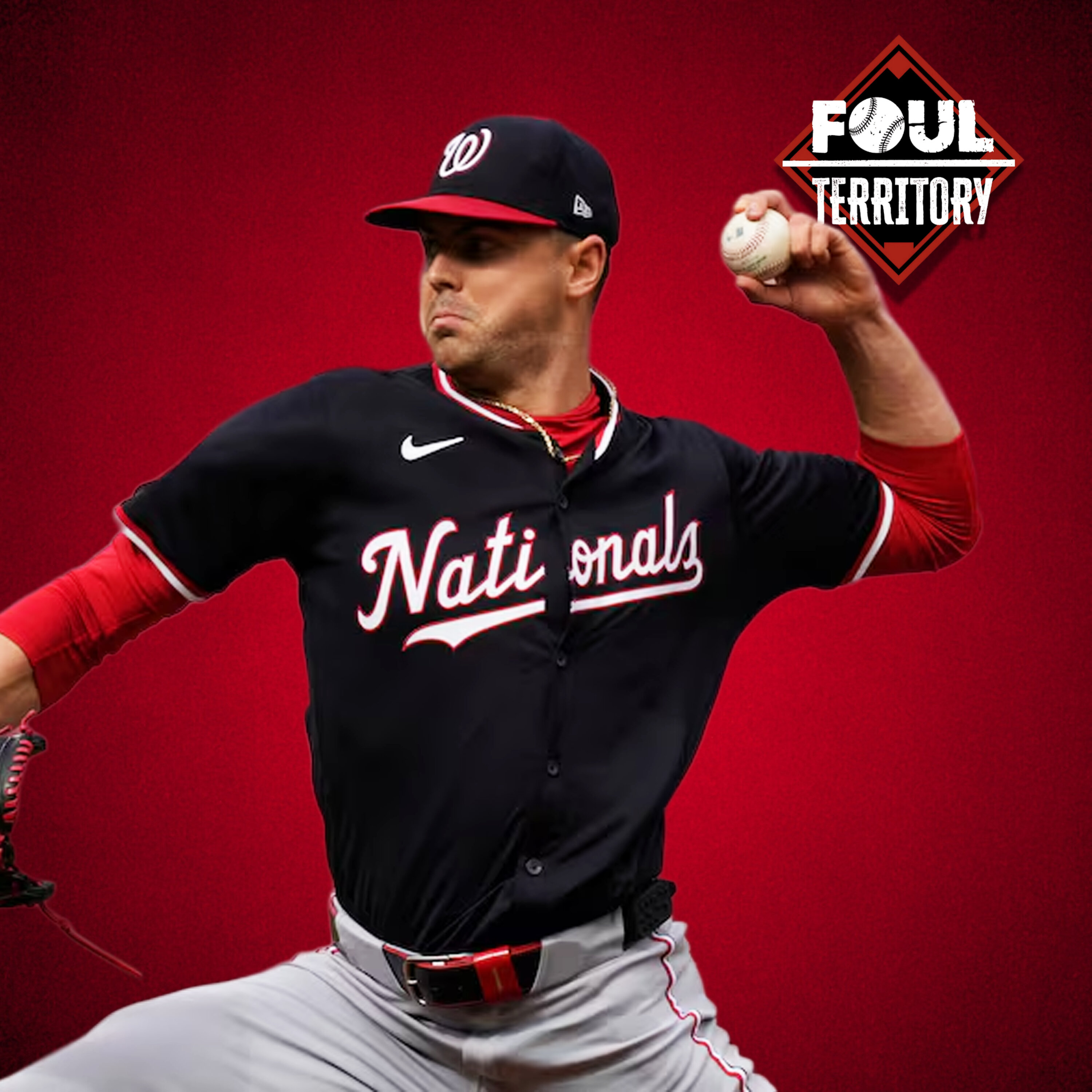
What MacKenzie Gore can bring to the Rangers and the trade aftermath for the Washington Nationals
Will MacKenzie Gore take his game to another level with the Rangers? Washington Post Nationals writer Spencer Nusbaum watched every start and then we talk about the state of the Nationals. Who might get traded out of D.C. next?
Hosts: Todd Frazier, Erik Kratz, Scott Braun
GET YOUR FOUL TERRITORY MERCH HERE!
See omnystudio.com/listener for privacy information.
2026-01-24
15 min
Transcript
Available Results
Generated results are saved to the knowledge database for reuse and search.
No generated results are available for this episode yet.
Extract Knowledge
Pick what you want extracted first. Model, scope, and chapter options appear after a template is selected.
Generated results for public episodes are saved to the knowledge database so they can be reused and searched later.
Transcript
00:00:03
Speaker 1: Spencer Nstbaum joining us right now. He covers the Nationals for the Washington Post. Spencer, great to have you on the show and perfect timing to have you on. So tell Rangers fans first off, what they need to know about Mackenzie Gore, who has just picked up to join a rotation that includes de grominy Baldi.

00:00:20
Speaker 2: I was happy to be here. I'd say the biggest thing for Rangers fans to know is that this is a guy who has a lot of untapped upside. And that sounds a little weird to say about a twenty six year olds who's been in the majors for a few years now. But the biggest thing about Mackenzie is he's got three plus pitches, He's got all this stuff, and he's really someone who just hasn't fully been unlocked yet. Whether that's the National's fault, whether that's injuries, whether that's you know something here there, the fact of the matter, he's looked like an all star pitcher at times during his career, and he's looked like an incomplete project at others. So I think what you're getting is a leader in the room and someone who's probably going to be but to tap into that in Texas.

00:01:02
Speaker 3: Wait, it looks like an All Star pitcher? No? No, he was in the All Star Game. He literally was an All Star pitcher. What did you see in the in the different the difference in the first half and the second half. That won't again happen this next year for the Rangers because obviously, if you if you paid for the first half, the prospects that the Nats would have been getting back in exchange would have been massively different than what they ended up getting. So what is the difference in Where does he need to get to be that first half pitcher all the time? Yeah?

00:01:37
Speaker 2: And part of why I say it looks like an All Star even though he was one, is because the year before it was almost the same exact thing. It was, Hey, great numbers, great strikeouts, and then in the second half fallen off. I think I would attribute it to a few things. The biggest thing is that his fastball, which he loves to throw, is in the mid to upper nineties, gets hit pretty hard, and I think teams start to adjust to that as the course of the season goes on and see it in the scouting report, and that's that's kind of a big thing that was kind of hit around in the second half. So I think it's maybe trusting the secondaries, which are really, really, really good, trusting them a little more. And I know Texas has had a great kind of pitching operation in the past handful of year, so I expect them to unlock that. In addition to that, I you know, McKenzie is someone who's very in tune with his body, which has helped him be athletic and be really good in these first halfs, but there has been some fatigue I think in the second half, whether or not he'll go out and admit it. So just making sure that they have him on a plan where they're not overstressing his arm, they're not overstressing his body, and making sure that you can pitch through a full year, because you know, the year before it was a drop in the arm angle. This year was just the the stuff didn't work as well in the second half. So I think it's a combination of making sure his body is right and making sure he's storing those secondaries a lot.

00:02:56
Speaker 3: How much of his numbers or some of his subsequent drop off year is a personnel around him. When I look at a guy that has leads the league two years in a row in wild pitches, the catching corps has to take If I'm catching on that team, I have to take some of the ownership in that. And so when there's when that pops out to me, then how much is this defense that was playing behind him, the fact that he was the number one, the fact that he maybe cast more as like a number three with a hot high ceiling of a two. How much of that was maybe dictated by the fact that, you know, the people around him. Maybe it wasn't wasn't a very good team, and he's super emotional. We've seen him yelled his teammates, I think warrantedly, but you know his teammates, it just seemed like there was something more there. Did you see that on a day in and day out basis within that?

00:03:50
Speaker 2: I would kind of put that twofold to your point about being a teammate. I think mackenzie grew a lot as a leader the last year, you know, the year before there was the incident where he and Nick Senzel got into a bit of a scuffle in the in the dugout. But kind of to your larger point here, I think the biggest thing to know with McKenzie is, Yeah, it is a lot of the stuff around him, Like the defense behind him is one of the worst in baseball. The catching defense has repeatedly been some of the worst in baseball. That's taxing and that that goes into the numbers. And I think that's why you saw the market for McKenzie was so strong, is because teams thought like, not only can we fix him, but we're going to give him better support when he's here. And you know, when you talk about first half versus second half, it's the same thing with everyone else in the Nationals. James Wood had an unbelievable first half, fell off in the second. C j Abrams fantastic first half, fell off in the second. You know. So it's you know, comparing pitchers and position players isn't always one to one, but I think you can see that maybe it was a trend with the Nationals. So Texas, I think should be able to fix that.

00:05:00
Speaker 4: And here we go again with the Nationals to another rebuild. I mean, you had Rizzo as their guy and he got fired for pretty much that situation. And now, if I'm a fan, I mean, what are the fans thinking right now? It's another go at it, so they got to be a little frustrated now.

00:05:16
Speaker 2: Absolutely, it's a very tough pill to swallow. I think, you know, you started to figure it out, and maybe nationally last year, just how much the Nationals have struggled. No one's lost more games than the Nationals other than the Rockies since twenty twenty. It's been really brutal for this fan base. I think there is a sect of the fan base who is optimism just because hey, like there wasn't a vision before, or there wasn't a strong vision conveyed and there is one now. But it's really really tough to say, hey, keep showing up to the ballpark when we haven't won more than seventy one games since we won the World Series. Like, it's really brutal on them, and I feel for them. What I would say is that I do like the hall that they got back, but man, I do empathize with them because it's not it's not a perfect picture. Right now.

00:06:04
Speaker 3: How much smoke did the fans actually take in from from Rizzo saying we're close? He started he started selling that rhetoric towards the end of his tenure. Yeah, we're close. Fired his manager well, it's not me, it's these guys. How much of that smoke do you think fans actually believe, like, oh, we love Rizzo, we want us a World Series? And do you think that that expectation with the rebuild now was like wait a minute, there was way more smoke than there was actually any fire from what Rizzo was saying.

00:06:40
Speaker 2: Yeah, I mean, I don't think the Nationals were ever all that close to making the postseason or having those sorts of aspirations last year. But the counterpoint of that, and kind of what you're touching on is if you're in the fourth year over the rebuild, the fifth year of the rebuild, you do have to do something or else there are going to be drastic changes. So yeah, I understand from Rizzo's perspective in the front offices perspective of saying, maybe not that we're close, but hey, we've got a product here to be proud of, and we're going to take this big leap this year. Because I think whether or not you say that, you're going to draw frustration from your fans, because ultimately what matters is how many wins you're putting out there. And the Nats won sixty six games last year. So yeah, I think that fans were right to be frustrated. Some did feel misled, And I think to Bony has been very clear that they have a long term vision and may not be in October this year, which I think is a fair thing to say. But when you're a GM in charge of a rebuild and it's fourth or fifth year, I think I understand the impetus to kind of sell something.

00:07:42
Speaker 4: Well, you're talking about selling too. So we got a question from the chat here basically asking who's next, who's next in line to go? And you know, is this going to happen sooner and later? What do you think?

00:07:56
Speaker 3: So?

00:07:57
Speaker 2: Andrew Golden and I at the Washington Post reported this yesterday that the Nationals have shopped both shortstops CJ Abrams and center fielder Jacob Young. At the moment, the price on both of those guys is pretty high. Young is a Gold Glove caliber center fielder whose bat hasn't really caught up to that, whereas Abrams, again is kind of not the position player version of Mackenzie but great first has really high ceiling, but has struggled at times. And so I think that's also baked into the package. There As for when that happens, I wouldn't be shocked if CJ's traded closer to the deadline than this winter. But I would also say if he got traded a day from now, I also wouldn't be all that shocked. And I know that's maybe not a fair head, but I think the Nationals have more possibility to wait on CJ than maybe they did with Mackenzie, given the injury risk there. As for Jacob Young, they have a full outfield right now and a number of exciting young players competing for those spots, and so I would be shocked if you know a team that's looking to really either upgrade in center field or get a really impact fourth outfielder. I think that that the Nationals could be inclined to move him, but neither of those moves is as much of a certainty as I always felt that Mackenzie was.

00:09:15
Speaker 3: This offseason all right, fans look at it and they say, Okay, they're not spending in free agency. Something that somebody from the Nats organization told me that I'm blows my mind. Do you know what the traject system is? Correct? Yes? Project For anybody who's listening, traject is the system where it's a pitching machine, but it shows any pitcher and it makes that pitch that that pitch or throws, and it shows essentially you're just facing this pitcher in the batting cage. The Nats did not have this. Every big league team had it. And Thents now have bought four from the person that I found out from, two down in the spring training complex, one in Rochester and one in d See. For a team, a big league team that truly wants to compete to be that far behind, is this the free agent that they purchased, because that's a round two million dollars for four of those machines. Maybe they got a discount because they bought in bulk, but is this their free agent move? And how could an organization that competes in Major League Baseball truly believe that they're going to compete without one of the most integral pieces of equipment that every other team has.

00:10:27
Speaker 2: I mean, I don't know if they shopped at Costco to get a better deal art, but I will yeah, no, it was a good purchase. What I will say is, and I did some reporting on this last year. At this point last year, I think they were one of three or four teams that didn't have it in baseball. But it really was egregious and I talked to players at the time and said, hey, do you know what this is? Are you interested in it? And almost every single one of them said, yeah, we would love to have this. It's frustrating that we don't. We can make do without it, but you know, when you think it's a it's a five hundred thousand dollars investment to get in the big leagues, and it could maybe help a guy pick up a couple extra hits a year or strike out a few less times. It was really really not good that the Nationals didn't have it. It has become kind of the standard, and kind of the larger point I would make here, even outside of traject is that the Nationals are investing a lot this offseason, not just in technology, but in you know, having more personnel in the player development side, and you know, adding to those sorts of things as opposed to, hey, let's go get you know, a big ticket free agent that we'd either have to overpay for who'd never want to come here. So they're kind of looking at the roots and the kind of the blueprint of the issue rather than maybe plug and play, let's pay ped Alonzo two hundred million dollars and see what happens. So I think that there's a way to kind of hedge with both approaches. But the Nationals are definitely kind of investing more on that side of things, and the traject is a great example of something that they've done to add in that facet.

00:12:06
Speaker 3: Anything, because we're talking money, anything new to report on the sale of the team. Is this going to be the standard wait and see what happens in the next CBA and then hopefully we get this and that and then that'll increase the franchise value.

00:12:21
Speaker 2: Nothing new on that front. I think, like most teams that it's just kind of in wait and see mode, see what happens with twenty twenty seven, and then move from there, which is all stuff we've covered in the past. So nothing new to report. But you know, most fans that you talk to in DC are very frustrated with this ownership group and have have asked, you know, obviously for change. We will see what happens in twenty twenty seven beyond. But I think they've taken some steps in the right direction in terms of again putting the right front office in place, putting the right coaching staff in place, and getting some of those traject and other things paid for. But the Nats are still a ways away all.

00:13:02
Speaker 3: This to be said. They just got rid of Mackenzie Gore, maybe cg Abrams, maybe Jacob Young. What's a good season for the Nets? What is considered a good season for a brand new general manager, a brand new entire coaching staff, and new manager on the field, and you lost your number one pitcher? What is a good season this year?

00:13:24
Speaker 2: That's something that I've been trying to wrap my head around too, because no fan wants to hear seventy one wins as a good season. And I don't blame him. I think again, like and it sucks to sell this, and I understand that it really is about the individual progress. It's like all of these guys, Dylan Lyle, who I'm really high on, James Woods, you know, whoever else has left, Kid Cavali is it? Can they put together a full season? And I understand that that's frustrating, and you know, you'd want, you know, at least like seventy five, seventy eight wins. I think that'd be a great season. Frankly would be to still be in it in August and kind of early September. But yeah, for the most part, it's can the All stars look like stars? Can the role players look like regulars? And can we get some sort of some sort of process here where it looks like, you know, both the farm system and the big league club are having a better future. Which is way too vague of an answer, but it's the best one I got at the moment.

00:14:25
Speaker 1: Top ten market, it's a top ten market. It's frustrating, is it?

00:14:30
Speaker 3: Top ten? Mar Yeah, six seasons ago a World Series, Spencer, it should not get to this point.

00:14:38
Speaker 1: Spencer doesn't work for the team, but he covers them, and it is frustrating.

00:14:43
Speaker 3: Yeah.

00:14:44
Speaker 2: Maybe maybe that Gus Marlin Weaver claim is going to put them over the top. I don't know.

00:14:51
Speaker 1: Discussed the next Louis, But hey, Spencer, this was fun. Thank you for joining us, Thanks for the real talk, insight, and we'll have you back. You'd appreciate it.
Chapters
No chapters available.