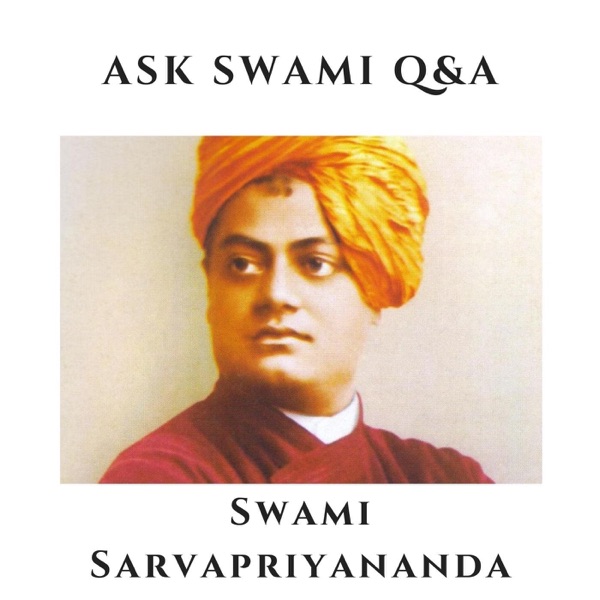
Ask Swami with Swami Sarvapriyananda | Apr 12th, 2026
Q&A session led by Swami Sarvapriyananda at the Vedanta Society of New York on Apr 12th, 2026.
List of questions with timestamps:
00:00 - Invocation and opening
01:40 — Is enlightenment just a brain event, or different from dissociation and neurological experiences?
19:17 — How does one move from witness-consciousness to Turiya in practice?
29:31 — What should one do when mantra japa brings up disturbing thoughts and impurities?
40:41 — If awareness and experience seem mutually dependent, how can awareness be the ultimate reality?
51:22 — How should a student deal with pressure, competition, and still find life’s real purpose and peace?
01:12:53 — Can the Katha Upanishad’s chariot analogy be reinterpreted through chidabhasa and reflected consciousness in Advaita?
🙏 Please Support the Vedanta Society of New York
http://www.vedantany.org/donate
🌐 Please Visit Us
- Website: https://vedantany.org
- Apple & Spotify Podcasts: https://www.vedantany.org/media-channels
- YouTube (Main Channel): / @vedantany
- YouTube (Archives): / @vedantanyarchives
- Facebook: / vedantany
- X / Twitter: / vedantany
📙 Books by Swami Sarvapriyananda
Lecture Series by Swami Sarvapriyananda
📓 Introductory Lectures: https://www.vedantany.org/introductor...
📚 Vedanta Scriptures: https://www.vedantany.org/by-scriptures
🧩 Lectures by Topics: https://www.vedantany.org/by-topic
💬 AskSwami Q&A: https://www.vedantany.org/ask-swami-qa
📖 Scriptures Taught by Swami Sarvapriyananda
• Aparokshanubhuti | Swami Sarvapriyananda
• Bhagavad Gita | Swami Sarvapriyananda
• Brihadaranyaka Upanishad | Swami Sarvapriy...
• Dṛg Dṛśya Viveka | Swami Sarvapriyananda
• The Gospel of Sri Ramakrishna | Swami Sarv...
• Isha Upanishad | Swami Sarvapriyananda
• Katha Upanishad | Swami Sarvapriyananda
• Kena Upanishad | Swami Sarvapriyananda
• Mandukya Upanishad | Swami Sarvapriyananda
• Mundaka Upanishad | Swami Sarvapriyananda
• Vedantasara of Sadananda | Swami Sarvapriy...
🪔 About Vedanta
Vedanta is among the world’s oldest spiritual philosophies and one of its most inclusive. Rooted in the Vedas, India’s sacred scriptures, Vedanta upholds the unity of all existence, the divinity of the soul, and harmony among religions.
🏛️ About This Channel
This is the official channel of the Vedanta Society of New York, a spiritual institution affiliated with the Ramakrishna Order of India and holds the distinction of being its first established Center, founded by Swami Vivekananda in 1894. Swami Sarvapriyananda currently serves as the Resident Minister and Spiritual Leader of the Vedanta Society of New York.
Available Results
Generated results are saved to the knowledge database for reuse and search.
Extract Knowledge
Pick what you want extracted first. Model, scope, and chapter options appear after a template is selected.
Transcript
[SPEAKER_05]: O-o-o-o-o-o-o-o-o-o-o-o-o-o-o-o-o-o-o-o-o-o-o-o-o-o-o-o-o-o-o-o-o-o-o-o-o-o-o-o-o-o-o-o-o-o-o-o-o-o-o-o-o-o-o-o-o-o-o-o-o-o-o-o-o-o-o-o-o-o-o-o-o-o-o-o-o-o-o-o-o-o-o-o-o-o-o-o-o-o-o-o-o-o-o-o-o-o-o-o-o-o-o-o-o-o-o-o-o
[SPEAKER_05]: Om, shanti, shanti, hi, om, gledas from the unreal to the real.
[SPEAKER_05]: Gledas from darkness and to light, gledas from death to immortality, om, peace, peace, peace.
[SPEAKER_04]: Namaste and good morning, everybody.
[SPEAKER_05]: So, this is a session of these questions and so, basically, what we call asked for me.
[SPEAKER_05]: We have questions coming in from all over the world, and our interpreting, collates, shift through those questions and presents a few for discussion in every one of these sessions.
[SPEAKER_05]: So Diane will share with us some of those questions and then I'll call upon you in the audience here.
[SPEAKER_05]: Those who are interested, you can come forward if to come here and ask your question, tell us your name and ask, ask a question.
[SPEAKER_05]: Alright, let's see how it goes.
[SPEAKER_05]: Diane, what do we have for us today?
[SPEAKER_00]: However, this question is from Sangha Mitra Bhattak Chaji.
[SPEAKER_00]: Swamiji Panamas, I am a student of psychology.
[SPEAKER_00]: I have come across a psychological ailment known as Disassociative Disorder.
[SPEAKER_00]: One of the reported symptoms is that one feels they are not the body, as if they are watching their own lives as a movie.
[SPEAKER_00]: You had mentioned about a swamie who had said, when the road outside my window looks
[SPEAKER_00]: that day I will know the time enlightened.
[SPEAKER_00]: So then is enlightenment just a brain phenomenon?
[SPEAKER_00]: Dr. Jill Bolte, a Harvard trained neuroanatomist in a TEDx talk about her brain stroke.
[SPEAKER_00]: Clearly speaks about how she had the outer body experience and she felt like light, space, and joy.
[SPEAKER_00]: all that experience is that spiritual people talk about, so is it all about the brain?
[SPEAKER_00]: The argument, the consciousness is something created in the brain, can it be ignored?
[SPEAKER_05]: So, I'm not the body, not the mind, I'm pure consciousness, so is it dissociative disorder?
[SPEAKER_05]: straight away we can dismiss the idea that it's a disorder.
[SPEAKER_05]: Why?
[SPEAKER_05]: Because the result is not that of a disorder.
[SPEAKER_05]: The result of this is a person becomes a saint.
[SPEAKER_05]: The person becomes enlightened, person feels, not only feels, lives on that.
[SPEAKER_05]: Otherwise, one might either by a stroke in the brain or like this case she mentioned here.
[SPEAKER_05]: This neurologist, which is a doctor also, so she realized when she had a stroke she realized what had happened.
[SPEAKER_05]: And then she found that her sense of self dissolved, that the boundary, I'm different from all the stats that dissolve felt of, and so of oneness, then also a sense of freedom and joy, a light, a spaciousness, something that is reported in mystical experiences.
[SPEAKER_05]: Then she gave a TED talk about it.
[SPEAKER_05]: She wrote a book later also.
[SPEAKER_05]: It's probably the most view TED talk online.
[SPEAKER_05]: If you look at it, one of the most at least, that much I remember.
[SPEAKER_05]: Let's see in the editor and later she wrote a book about it.
[SPEAKER_05]: This is what mystics experience.
[SPEAKER_05]: Now the answer is new and steer.
[SPEAKER_05]: First of all, clear no.
[SPEAKER_05]: If it genuinely is a mystical experience, you would have transformed your life.
[SPEAKER_05]: It would have been stable.
[SPEAKER_05]: And it would have transformed your life.
[SPEAKER_05]: You would have become a saint.
[SPEAKER_05]: Swami Vivekananda says that sleep and samadhi are the same.
[SPEAKER_05]: If your fool enters into sleep, comes out of fool.
[SPEAKER_05]: A fool enters into samadhi, full enters into samadhi, comes out of saint.
[SPEAKER_05]: So there's an actual deep, lasting transformative thing.
[SPEAKER_05]: You don't have to wait for a brain stroke.
[SPEAKER_05]: Those who simply take what is this, you know, high on weed.
[SPEAKER_05]: or some other psychotropic substance.
[SPEAKER_05]: They also have all kinds of experiences.
[SPEAKER_05]: Sometimes they're awful, but sometimes they're very good.
[SPEAKER_05]: Does that transform them?
[SPEAKER_05]: Does it make them enlightened?
[SPEAKER_05]: Does it make them into a saint?
[SPEAKER_05]: We'll see, look, look at the evidence.
[SPEAKER_05]: Look at the history of the world and all religions of the world.
[SPEAKER_05]: There have been so the books and books written about the lives of the saints.
[SPEAKER_05]: these substances were not unknown in ancient times.
[SPEAKER_05]: They were there, equivalent to many of them were plant-based.
[SPEAKER_05]: So they were there.
[SPEAKER_05]: Now tell me of all the saints you know in all the religions of the world across all civilizations, across all of time, one, just one example of a drug addict becoming a saint.
[SPEAKER_05]: I mean, later they might become a saint, but because of the drugs becoming a saint,
[SPEAKER_05]: getting high and then being transformed into a one one example, just one example.
[SPEAKER_04]: Although sometimes the experience is a very similar.
[SPEAKER_04]: Why not?
[SPEAKER_04]: Why not?
[SPEAKER_05]: Why can't you take the pharmaceutical route to becoming a saint?
[SPEAKER_05]: So becoming enlightened.
[SPEAKER_05]: Why all this philosophy and meditation and ethical life and all of these struggles, the chariot and allogy, the mirror and allogy?
[SPEAKER_05]: Why all that?
[SPEAKER_05]: Why not just take drugs, get high on weed, and then become enlightened.
[SPEAKER_05]: That sounds much easier.
[SPEAKER_05]: Why doesn't it work?
[SPEAKER_05]: This was the point of debate between Swami Prabhavan and the G, in the Bananasu Society of Southern California and Hollywood, and I'll just succeed.
[SPEAKER_06]: Yeah.
[SPEAKER_05]: To load the book, the dose of perception.
[SPEAKER_05]: So I'll just succeed as a native in this idea that since these drums seem to give you that experience, why not take that route?
[SPEAKER_05]: And Swami Prabhavan ji warned him against it.
[SPEAKER_05]: It can give you certain experiences, but also disintegrates the personality.
[SPEAKER_05]: It can be addictive, it can be degenerative, generally, the effect of these drugs on a prolonged basis is never good.
[SPEAKER_05]: It's never good.
[SPEAKER_05]: Never good in the sense.
[SPEAKER_05]: Let alone taking one to enlightenment, it's never good in terms of physical and mental health also.
[SPEAKER_04]: That's the data so far.
[SPEAKER_04]: transformation starts at character level discipline, focus of mind, I was reading this
[SPEAKER_05]: in the second world war, on a mass scale, German soldiers in the army and air force and everywhere, they were issued, I forget the name, some kind of methamphetamine, something like that, in order to perform in the war.
[SPEAKER_05]: So they would spend days in a haze, like in almost like a euphoria, fighting and killing.
[SPEAKER_05]: and concentration also for hours and hours, they could concentrate.
[SPEAKER_05]: So, is that equal to training the mindfulness of the mind?
[SPEAKER_05]: No, what happens afterwards when the compression down, do they retain the power to concentrate?
[SPEAKER_05]: No, do they come down to a normal level?
[SPEAKER_04]: No.
[SPEAKER_04]: When the German, the Guerin,
[SPEAKER_05]: The chief of the German Air Force, and the Luftwaffe, when he was arrested by the Allies, it was a fact that I came across recently, I didn't know this earlier.
[SPEAKER_05]: He was dragging with him a suitcase, with thousands of films, some of those anti-tank victims.
[SPEAKER_04]: He was addicted to it, I didn't know that, so does that transform them into saints?
[SPEAKER_04]: No.
[SPEAKER_05]: So, does it even give you super powers of concentration, focus, deep meditation?
[SPEAKER_05]: Not even that.
[SPEAKER_05]: It will be lost, the moment you come down from that idol, it will be lost.
[SPEAKER_05]: So, the yogis, they train the minds and the minds, they increase the capacity for focus, for concentration.
[SPEAKER_05]: What happened?
[SPEAKER_05]: Some people are, can you hear me?
[SPEAKER_05]: Yes.
[SPEAKER_05]: Some people are born with it, some people are born with extraordinary powers of focus.
[SPEAKER_05]: I was reading the life of John von Neymann, the physicist, who was right here in the Institute of Advanced Studies in Princeton.
[SPEAKER_05]: So he was remarkable for his extraordinary powers of concentration.
[SPEAKER_05]: Some of his colleagues, they said, they all Nobel laureates Einstein, others, open hymer, others.
[SPEAKER_05]: Eugene Wigner, a number of others.
[SPEAKER_05]: So they said, amongst all of us, all of us means many of them are Hungarian.
[SPEAKER_05]: They're interesting.
[SPEAKER_05]: Somebody asked, how is this small Eastern European country?
[SPEAKER_05]: How do they add the best mathematicians and physicists on the world?
[SPEAKER_05]: This is the pre-second world world.
[SPEAKER_05]: And they was joked.
[SPEAKER_05]: The Hungarians would joke.
[SPEAKER_05]: We are not actually from Hungary, we are from Mars.
[SPEAKER_05]: But since the people of Earth are not ready for Martians, we say we are from in this obscure little country called Hungary.
[SPEAKER_05]: And they said that group, that extraordinary group of physicists in the 1930s, 40s.
[SPEAKER_05]: They said, amongst all of us, we felt there was only one who was awake, truly awake, and that was one moment.
[SPEAKER_05]: And this interesting, one characteristic as reading or by and by it struck me.
[SPEAKER_05]: He had this feeling that he could crack any problem, solve any problem by sheer concentration of mind.
[SPEAKER_05]: One of his childhood friends says that even in school what Johnny would do, he actually must Janos.
[SPEAKER_05]: So, what he would do is, if he would give him a problem, he would turn his face away from you and he'd plan his face down like this and sit like that for two or three minutes, just like this.
[SPEAKER_05]: He had the ability to become immersed, focus of mind.
[SPEAKER_05]: So, the question are these disorders, they are not disorders.
[SPEAKER_05]: Some people are born with this extraordinary capacities.
[SPEAKER_05]: You may temporarily boost it with some drugs, which is all the bad effects afterwards.
[SPEAKER_05]: at stroke in the brain might give you some effects because the brain is affected by that.
[SPEAKER_05]: But no, these are not dissociative disorders, any kind of disorders.
[SPEAKER_05]: They are rather the higher reaches of the human mind.
[SPEAKER_05]: The human mind has pathologies, has a narrow band of normal, what we call normal functioning.
[SPEAKER_05]: But there are higher reaches also, higher reaches of human mind and spirituality is the highest.
[SPEAKER_05]: Now, the question at two parts shall be say that these are dissociative disorders that I am not the body not the mind, yes a person who gets a stroke or is feeling high on particular drugs might feel that, but that's not the same as the realization that I am not the body the mind through meditation or through Vedantic inquiry.
[SPEAKER_05]: does not even require you to have a new experience.
[SPEAKER_05]: The Vedantic inquiries is an insight into the state of affairs right now.
[SPEAKER_05]: We are actually right now, none of us are literally in the body.
[SPEAKER_05]: We are embodied, not literally the body.
[SPEAKER_05]: Just as the passenger is not the chariot.
[SPEAKER_05]: It would be weird to say, when you get on an Uber and say,
[SPEAKER_05]: No, you're not the car, you're not the steering wheel, you're certainly not the driver.
[SPEAKER_05]: You're the passenger, but which somehow we don't know that.
[SPEAKER_05]: And that knowledge that insight is given by Vedanta.
[SPEAKER_05]: And that's a great freeing thing.
[SPEAKER_05]: is that inside does not come even by an experience of dissociation that I am not the body or body of the mind.
[SPEAKER_05]: Afterwards, when you come back to the body with the experience goes away, it will be back to square one.
[SPEAKER_05]: You just have a remarkable memory of an amazing experience.
[SPEAKER_05]: That's all.
[SPEAKER_05]: You see, that experience.
[SPEAKER_05]: Vedantic inquiry, once more, I will try.
[SPEAKER_05]: Vedantic inquiry does not lead to a specific experience.
[SPEAKER_05]: It leads to a specific insight, revealing what already exists.
[SPEAKER_05]: When you feel I am not the body in the mind, you are not the body mind.
[SPEAKER_05]: When you feel you are the body in mind, you're still not the body mind.
[SPEAKER_05]: It's a mistake.
[SPEAKER_05]: So that's a relief.
[SPEAKER_05]: You don't have to have a special experience to realize I am the passenger.
[SPEAKER_05]: I am not the Uber car.
[SPEAKER_05]: No, it's a fact.
[SPEAKER_05]: That's what Vedanta negates.
[SPEAKER_05]: And all mystical experiences, yogic experiences can only help that insight.
[SPEAKER_05]: That's all.
[SPEAKER_05]: If one has not cultivated meditation or Vedantic inquiry, even a stroke will not help you.
[SPEAKER_05]: After what's also one will not, one will again feel and the body of the mind, afterwards also.
[SPEAKER_05]: It will not be retained.
[SPEAKER_05]: The second part of the question was, are these products of the brain?
[SPEAKER_05]: is consciousness a product of the brain.
[SPEAKER_05]: I will not dwell on it.
[SPEAKER_05]: You know, it's the hard problem of consciousness.
[SPEAKER_05]: And that's the big, big issue in consciousness studies today.
[SPEAKER_05]: You're a student of psychology.
[SPEAKER_05]: The person was written this question.
[SPEAKER_05]: You just Google it.
[SPEAKER_05]: You'll find the hard problem.
[SPEAKER_05]: And enormous amount of material on it.
[SPEAKER_05]: How can a set of objective processes in the brain produce the subject?
[SPEAKER_05]: Will a philosophy will say it's a category mistake.
[SPEAKER_05]: And there are many positions on it.
[SPEAKER_05]: And many, many, many theories.
[SPEAKER_05]: Most
[SPEAKER_05]: Robert Kuhn compiled all these theories and classified them in this document, the landscape of consciousness.
[SPEAKER_05]: And there he has 325 theories, recently I heard a talk he had with Rick Archer, there he said, now it's up to 400 theories, he said, I missed a few people pointing it out from different parts of the world.
[SPEAKER_05]: And, regardless of the question, is there any other, any other phenomenon in the world, scientific phenomenon, which, when you see this so many possibilities of trying to explain it, this is no consciousness is unique that way.
[SPEAKER_05]: We are unable to get a handle on it, although we should, it's nothing is so generic like say black hole, so string theory, not like that.
[SPEAKER_05]: Everybody's conscious.
[SPEAKER_05]: We are all conscious.
[SPEAKER_05]: The data of consciousness is always with us.
[SPEAKER_04]: In fact, that's the primordial data which we have and yet we can't get a handle of it.
[SPEAKER_05]: No, it can be studied.
[SPEAKER_05]: It is being studied.
[SPEAKER_05]: That's why you have 400 theories of it.
[SPEAKER_05]: Yeah, it cannot be studied in the sense, it's not an object to be studied.
[SPEAKER_05]: That's why that's another serious problem with it.
[SPEAKER_05]: You can't study it as an object, because it isn't an object.
[SPEAKER_05]: And most of the theories fail because they try to somehow make it an object, somehow.
[SPEAKER_05]: And then they study it.
[SPEAKER_05]: Now, on the other hand, is one must be honest here.
[SPEAKER_05]: Is the brain uninvolved with all this?
[SPEAKER_05]: Does the brain have no role to play?
[SPEAKER_05]: No, that also doesn't seem to be right.
[SPEAKER_05]: So there is a continuum of brain, that's body, body, nervous system, brain on one hand, and then the mind and then consciousness.
[SPEAKER_05]: There is a link.
[SPEAKER_05]: The mind operates with the brain.
[SPEAKER_05]: Therefore, whatever is happening in the mind, there will be some correlate in the brain.
[SPEAKER_05]: Whatever is being shown in the brain will have some correlating in the mind, in some some way.
[SPEAKER_05]: Pure consciousness itself may not be affected by all this, but pure consciousness does illumine all this.
[SPEAKER_05]: And pure consciousness is reflected in the mind as the reflected consciousness.
[SPEAKER_05]: Therefore, answer to the question, experiences like that of the mystic, will there be correlates in the brain?
[SPEAKER_05]: Yes, if there is something happening in the mind, they will be correlating in the brain.
[SPEAKER_05]: even for a genuine mystic.
[SPEAKER_05]: This is something that has not been clearly studied, although there are some deep studies on the effects of advanced meditators, meditation on the brain.
[SPEAKER_05]: With this lama's were meditated for years and decades, Hindu yogis, they have been tested under modern conditions and they clearly show brain activity which is uniquely
[SPEAKER_05]: which shows that what's happening in the mind has its correlate in the brain and therefore if there's some extraordinary experience happening in the mind, it there will be a correlate in the brain.
[SPEAKER_04]: That's not true.
[SPEAKER_04]: Somebody from the...
[SPEAKER_04]: This is the fact that...
[SPEAKER_05]: Container means it's interacting, the mind is interacting with the brain, brain may be the instrument with which the mind works.
[SPEAKER_05]: In a Vedantic perspective, we have a three-fold view of the human personality, the physical body which includes brain and nervous system, the subtle body which includes mind, intellect and all that, mind, intellect, memory, ego, the pranas, subtle body, and the atman
[SPEAKER_05]: So the up and on the real self is pure consciousness, existence, consciousness, place, the mind is the subtle body and then the brain and the nervous system is physical body.
[SPEAKER_05]: But the subtle body doesn't work without the physical body, so it will survive the death of the physical body, but to be active, it needs the physical body.
[SPEAKER_04]: So it doesn't comprehend each other.
[SPEAKER_05]: They complement each other, yes.
[SPEAKER_05]: So somebody, yes, the lady there, please come.
[SPEAKER_04]: You have to come up here and ask the question.
[SPEAKER_04]: Tell us your name and ask the question.
[SPEAKER_01]: My name is Priya.
[SPEAKER_01]: I'm switching from going to witness consciousness.
[SPEAKER_01]: And you know, being in witness consciousness moment to moment, it's just dissociation in a simple term, being seeing it as a movie.
[SPEAKER_05]: And going to the next level of two years, I thought we had abandoned the dissociation theory.
[SPEAKER_01]: So, you know,
[SPEAKER_01]: just being there as a witness to the world you're in.
[SPEAKER_01]: And then moving to that next level of Turiya, Turiya, how do you practically go?
[SPEAKER_01]: Is it only through Samadhi?
[SPEAKER_01]: Or even keeping your eyes open, you can go to that state.
[SPEAKER_04]: So the question here, it's a good question.
[SPEAKER_04]: So, the witness state, and then going to the Turya, you don't actually go anyway.
[SPEAKER_04]: You are already the witness.
[SPEAKER_05]: You are already the Turya.
[SPEAKER_05]: When we say, I am in the witness state.
[SPEAKER_05]: But it's not a state.
[SPEAKER_05]: When I say, I'm in the witness state, what I actually mean is, I am actually watching now.
[SPEAKER_05]: I am calm and quiet and mindful and watching the sensations in the body, watching the breath, watching the emotions and feelings and memories and ideas bubble up in the mind.
[SPEAKER_05]: Ideally, this is a good, but this is a good, meditative exercise.
[SPEAKER_05]: It's an exercise in mindfulness.
[SPEAKER_05]: It's something that the mind is doing.
[SPEAKER_05]: See, if you stop doing it, it will go away.
[SPEAKER_04]: It takes calmness and attention to retain that.
[SPEAKER_04]: That is not at all what we're done with this talking about.
[SPEAKER_04]: We're done with this, not talking about witnessing.
[SPEAKER_05]: Vedanta is saying that when you are in the frenzy of activity, running the New York marathon or something, not at all, no philosophy can taught you.
[SPEAKER_05]: No thought in the mind at all, you're exhausted, running the marathon, when the frenzy of activity in the stock exchange floor, buying and selling shares, anxiety, intense focus, excitement, fear, that time also the marathon runner and the stock broker is the witness.
[SPEAKER_04]: That is to be understood.
[SPEAKER_04]: That is utterly different from the witness state of the mind.
[SPEAKER_04]: Are they mindful, not at all?
[SPEAKER_05]: They fully engage, but they're not mindful about their own experiences.
[SPEAKER_05]: They're focused.
[SPEAKER_05]: One is focused because of enormous physical activity.
[SPEAKER_05]: One is focused because of engagement with, in abying and selling the stocks and shares.
[SPEAKER_05]: But they're not being mindful about what is happening in the mind, in the body, in the sensation now.
[SPEAKER_05]: doing what sense is Vedanta saying that you are the witness, Vedanta is saying that you are the witness in the sense that you are consciousness, that you are awareness, awareness not in the sense of the mind being aware of something or not being aware of something, awareness in the sense when that man is running, is that person conscious or not?
[SPEAKER_05]: Yes, otherwise you would collapse, that person is conscious, that person like Vedanta says he is consciousness.
[SPEAKER_05]: How would you know his consciousness?
[SPEAKER_05]: Is that person having an experience or not?
[SPEAKER_05]: When you are running in the Indian art market, is that an experience or not?
[SPEAKER_05]: Of course, it's a very intense experience.
[SPEAKER_05]: The very fact that having an experience means that we are conscious.
[SPEAKER_04]: You can't have an experience without being conscious.
[SPEAKER_05]: It's not having an experience, being a table, as far as we know it's not conscious, it's not having an experience.
[SPEAKER_05]: But you are sitting right there, the chair you are sitting on is not having an experience of being a chair.
[SPEAKER_05]: But you are sitting right there.
[SPEAKER_05]: You are having an experience right now without being mindful, without experience shows you are consciousness.
[SPEAKER_05]: What is experience?
[SPEAKER_05]: Consciousness plus some object, something to be aware of gives you an experience immediately.
[SPEAKER_05]: That consciousness, which you are, which I am, which everybody is, Vedanta says, we are that choicelessly, try to be not conscious.
[SPEAKER_05]: You can't be.
[SPEAKER_05]: Even if you fall asleep according to Vedanta's consciousness is still there.
[SPEAKER_05]: Even in general anesthesia consciousness is still there.
[SPEAKER_05]: So that's why we are not talking about consciousness in the medical sense.
[SPEAKER_05]: medical sense that would be correspond to the reflected consciousness, but as the awareness in the absolute nothingness of deep sleep or even deeper the general and its Asia, that is also an experience.
[SPEAKER_05]: It is an absence of the objects of experience, an experience of absence, not an absence of experience.
[SPEAKER_04]: So you are that pure consciousness is always there,
[SPEAKER_04]: What do you have to be to be that?
[SPEAKER_05]: You don't have to do anything.
[SPEAKER_05]: Then what is Vedant all about?
[SPEAKER_05]: It's coming to recognize that.
[SPEAKER_05]: That what I just said right now.
[SPEAKER_05]: Coming to recognize that and coming to realize, I am that.
[SPEAKER_04]: When, now, always was, always will be.
[SPEAKER_04]: And that's the state of affairs.
[SPEAKER_05]: That's the fact right now.
[SPEAKER_05]: What icing of myself is a confusion, is a mix up.
[SPEAKER_05]: This clarity, I am the consciousness and I am conscious of a mind and the senses and the body and through this mind, senses and body of a world, this is the state of affairs.
[SPEAKER_05]: What do we usually think?
[SPEAKER_05]: I am the body mind consciousness.
[SPEAKER_05]: Nobody denies your conscious.
[SPEAKER_05]: We also, we are conscious, yes, who denies it.
[SPEAKER_05]: But I am consciousness mind, body senses, all together it is bundle, no you are not a bundle.
[SPEAKER_05]: You are a principle.
[SPEAKER_05]: You are consciousness itself.
[SPEAKER_05]: Everything else changes, comes and goes.
[SPEAKER_05]: It's like getting on an Uber and saying, well, yes, I am this passenger true, but I'm also the Uber.
[SPEAKER_05]: No, you're not the Uber.
[SPEAKER_05]: Even if you're sitting there and the Uber is taking you very, you're going, but you're still not the Uber.
[SPEAKER_05]: Even when you're in the Uber.
[SPEAKER_05]: Listen, yeah, right, what you're saying is right, but I have to get there.
[SPEAKER_05]: No, no, no.
[SPEAKER_05]: You have to give up your confusion that somehow you are the Uber.
[SPEAKER_05]: You are the Tassin Jack, yes, yes.
[SPEAKER_05]: Whether you are confused or not, does not make a difference.
[SPEAKER_05]: The fact is you are the Tassin Jack.
[SPEAKER_05]: If you are confused about it, if you somehow for some strange reason, if we think I am the Uber, then the problem will be, the moment is time to get down, I will be terribly attached to the Uber.
[SPEAKER_05]: I'll have to be drag, screaming, and kicking from the Uber.
[SPEAKER_05]: That's craziness.
[SPEAKER_05]: No, I'm not the Uber.
[SPEAKER_05]: You already are the passengers.
[SPEAKER_05]: Regardless of being in the Uber.
[SPEAKER_05]: You already are pure consciousness.
[SPEAKER_05]: Regardless of being in the mind senses and body.
[SPEAKER_05]: This is called witness consciousness.
[SPEAKER_05]: Ture as just another way of saying it.
[SPEAKER_05]: this witness consciousness with the mind functioning and the sense is functioning xx experiences itself as a body in a physical world.
[SPEAKER_05]: This is called the wake-up, who is the wake-up?
[SPEAKER_05]: You're the consciousness.
[SPEAKER_05]: And then when the mind falls asleep, this external world disappears, our connection with the senses and the body is lost.
[SPEAKER_05]: But the mind dreams, it dreams a world within itself.
[SPEAKER_05]: World after world comes up.
[SPEAKER_05]: Dream worlds are generated in the mind.
[SPEAKER_05]: That also the consciousness elements.
[SPEAKER_05]: And you experience yourself in the dream world.
[SPEAKER_05]: There you are called the dreamer.
[SPEAKER_05]: And then everything stops for a while.
[SPEAKER_05]: And the consciousness elements that stop state.
[SPEAKER_05]: that is called the deep sea.
[SPEAKER_05]: And then the consciousness will be called the deep sleeper.
[SPEAKER_05]: The only thing is, is the wakeer, it has a sense of self, I am the wakeer, and I experience this world.
[SPEAKER_05]: As the dreamer, your sense of self, I am experiencing this world, which later we will call dream birds.
[SPEAKER_05]: Only in the deep sleep, because everything is stopped, the instruments have stopped, there is no way of acknowledging I am in deep sleep.
[SPEAKER_05]: If you acknowledge you are in deep sleep, you won't be in deep sleep, but to acknowledge that the mind is to be active.
[SPEAKER_05]: Now these three, Waker, Dreamer, Deep Sleeper, they're all that same pure consciousness, which is in respect to 1, 2, 3, Waker, Dreamer, Deep Sleeper is called the fourth.
[SPEAKER_05]: Pure consciousness is not the fourth.
[SPEAKER_05]: It is the one appearing as the three.
[SPEAKER_05]: It is gold appearing as a golden necklace, a golden bracelet and a golden ring.
[SPEAKER_05]: Gold is not a fourth kind of ornament.
[SPEAKER_05]: It is the reality of those three ornaments.
[SPEAKER_05]: Similarly, pure consciousness, the witness is the reality of the vehicle of the dreamer of the deep sleeper.
[SPEAKER_05]: Also, little for that, more difficult to understand.
[SPEAKER_05]: It is not only the reality of the vehicle, dreamer and deep sleeper, it is also the reality of the waking world, the dream world,
[SPEAKER_05]: It's the reality of the subject and the object in all these three pairs.
[SPEAKER_05]: So that's so called fourth Sanskrit word, Tudiyya.
[SPEAKER_05]: Who's actually in Tudiyya the same, but not in the sense of the mindful witness, the mindful witness is a practice.
[SPEAKER_04]: Good, thank you.
[SPEAKER_04]: Yes, in the mind, please come.
[SPEAKER_04]: Tell us your name and ask the question.
[SPEAKER_02]: My name is Aditya Swami.
[SPEAKER_02]: It's a pleasure to be here.
[SPEAKER_02]: I had a question about meditation.
[SPEAKER_02]: I've been doing mantra japa meditation for a few years right now.
[SPEAKER_02]: And one of the major obstacles I'm facing is rising of impurities and that thoughts, imaginations, it's leading to a lot of suffering.
[SPEAKER_02]: And I wanted to get your thoughts on how to get better.
[SPEAKER_05]: Don't worry.
[SPEAKER_05]: The fact those
[SPEAKER_05]: Often we get shaken by this.
[SPEAKER_05]: My mind was fine until I started meditating.
[SPEAKER_05]: Now it is disturbed.
[SPEAKER_05]: It's full of bad thoughts, disturbing thoughts.
[SPEAKER_05]: No, no, no.
[SPEAKER_05]: The mind was disturbed earlier.
[SPEAKER_05]: We never saw it.
[SPEAKER_05]: All those thoughts were already there in the mind.
[SPEAKER_05]: You didn't invent it.
[SPEAKER_05]: They were already packed in the mind.
[SPEAKER_05]: They are down just being exposed for the first time.
[SPEAKER_05]: One of the immediate benefits of meditation is a recognition of the state of our minds.
[SPEAKER_05]: I should add the sorry state of our minds.
[SPEAKER_05]: We feel fine.
[SPEAKER_05]: Sit quietly in meditation for 15 minutes, 20 minutes.
[SPEAKER_05]: At the very least, we will come out of it a more humble person.
[SPEAKER_05]: We realize, oh my God, this is my state.
[SPEAKER_04]: A mantra, can't hold on to it for one minute.
[SPEAKER_05]: Swami Prabhavananda ji says, He is quoting in the book, sermon on the mount according to Vedanta, where Jesus says blessed of the pure in heart, for they shall see God.
[SPEAKER_05]: Now Vedanta, so I'm Prabhavananda just says, how will we know that we are not pure?
[SPEAKER_05]: I might say, I'm pure in heart.
[SPEAKER_05]: Why don't I see God?
[SPEAKER_05]: So good test, you need your test.
[SPEAKER_05]: Take a thought, it could be the name of God, it could be any thought.
[SPEAKER_05]: said quietly focus on it, think about it for one minute, just one minute, you'll find something else has included.
[SPEAKER_05]: See, how just TV is interesting phenomenon, I have decided I will think about this, my mind, one simple thought for one minute, what one minute I will think about it?
[SPEAKER_05]: And I can't.
[SPEAKER_05]: In that a couple of times, two, three times something else will come in.
[SPEAKER_04]: Why?
[SPEAKER_05]: Should be the easiest of things, my own mind, and a simple thought, for only one minute.
[SPEAKER_05]: Why?
[SPEAKER_05]: We can't assess the difference between an ordinary person and great person lies in the degree of concentration.
[SPEAKER_05]: Concentration then depends on purity of mind.
[SPEAKER_05]: That's why the simple thing, the set of the pure in heart, for they shall see God, pure in heart, jiptash on the purification of the basement of the mind, all clutter is in the basement of many lifetimes, packed layer after layer after layer.
[SPEAKER_05]: The harkule is clean the stables, that's the meaning.
[SPEAKER_05]: The stables are there in everybody's minds, the lower realms of our minds.
[SPEAKER_05]: where the integrated Freud went in with the flashlight and pooped around her.
[SPEAKER_04]: It's there.
[SPEAKER_04]: I remember one monk.
[SPEAKER_05]: long ago, I was a newcomer and just joined the order as a primary.
[SPEAKER_05]: He was telling me, it's evening.
[SPEAKER_05]: We were sitting in his room and he looked at me.
[SPEAKER_05]: He was a little dramatic.
[SPEAKER_05]: It was this imposing powerful figure and in the low light of the room to the evening and all the monks in the monastery there meditating.
[SPEAKER_05]: I was against so he had to talk to me.
[SPEAKER_05]: I had come from another
[SPEAKER_05]: And he said, the door was open as utter darkness outside.
[SPEAKER_05]: The whole monastery was in silence because people, everybody was meditating.
[SPEAKER_05]: And he said, there, the door, I looked at what?
[SPEAKER_04]: Just outside the door.
[SPEAKER_04]: There are lions and tigers, growling and gnashing their teeth.
[SPEAKER_04]: They're right there.
[SPEAKER_05]: What he meant was, and just below the conscious layer of the mind, there are powerful forces.
[SPEAKER_05]: Pride was not wrong.
[SPEAKER_05]: He discovered some of that.
[SPEAKER_05]: It's there, layer after layer.
[SPEAKER_05]: In the histories of the Christian, early Christians saints, the desert fathers, you'll find something interesting that there's always fighting the demons.
[SPEAKER_05]: But the demons are products of our own minds.
[SPEAKER_05]: They're fighting with those demons.
[SPEAKER_05]: If you flow along with life, you'll never notice them.
[SPEAKER_05]: If you try to be mindful, try to repeat a mantra, try to focus, stay in the mind, within the mind and try to introduce a high thought there.
[SPEAKER_04]: What will happen?
[SPEAKER_04]: The thought will get picked out.
[SPEAKER_04]: The mind will not tolerate there are.
[SPEAKER_05]: three dwellers in the mind, from ancient times, they will not tolerate it.
[SPEAKER_05]: There is one swan in this way, Sharam, does he have this remarkable way of explaining this?
[SPEAKER_05]: He said, it's like this, we think it's my mind, I can think whatever I want, what's wrong?
[SPEAKER_05]: We'll try.
[SPEAKER_05]: It's like you send your friend, your friend wants to go to the city and says, you have an apartment that can I stay in your apartment and you say, of course, you can, here's a letter to the caretaker, here's my friend, let him stay in my apartment for a few days, you go and show this to the caretaker, so your friend goes to the apartment, drinks the bell and this rather rough looking character comes out and says, yeah.
[SPEAKER_05]: I want to stay here.
[SPEAKER_05]: The owner has said, I can stay.
[SPEAKER_05]: Your friend shows that.
[SPEAKER_05]: And that guy, he takes it and tells it into pieces and few other rough characters come out and pick up your friend and throw him out on the street.
[SPEAKER_05]: Will you still say it's your apartment?
[SPEAKER_05]: Technically it is.
[SPEAKER_05]: It's out of your control now.
[SPEAKER_05]: The people who are squatting there and they are running their rough kind of people.
[SPEAKER_05]: We have invited them over time in past lives.
[SPEAKER_05]: They are existing there.
[SPEAKER_05]: Now.
[SPEAKER_05]: what the japa is doing, a mantra japa never fear, which is a very powerful instrument.
[SPEAKER_05]: The fact that they are coming out, as they are coming out, they are being cleansed, they are being cleansed.
[SPEAKER_05]: One Swami used a modern example, he is a never fear, all those files in the trash, they are being deleted.
[SPEAKER_05]: As they are coming up, it they are just being deleted, but how long will it take, it might take
[SPEAKER_04]: but you are making progress.
[SPEAKER_04]: So, what do you do?
[SPEAKER_05]: The movements, thoughts come up.
[SPEAKER_05]: Whatever's out, good, bad, ugly, whatever it is, back to the mantra.
[SPEAKER_05]: Guru has told you to repeat the mantra, not to dwell on what comes up from the bottom of the mind.
[SPEAKER_05]: So when it comes up from the bottom of the mind, let it take care of itself.
[SPEAKER_05]: I'll back to the mantra.
[SPEAKER_05]: And be happy it has come up because it's being deleted.
[SPEAKER_05]: And that's a good example.
[SPEAKER_02]: It's not necessarily just through the repetition but throughout the day.
[SPEAKER_02]: Yes.
[SPEAKER_02]: And is there any way to do it then get back to normal and get that purity of mind?
[SPEAKER_05]: A whole, a whole run to the, you are getting the purity of the mind.
[SPEAKER_05]: it's like they said earlier there's to be fountain pens ink and the ink well on the ink bottle there's to be a lot of encrusted ink at the bottom and if you put hot water into it suddenly you'll find it'll it'll boil up dark
[SPEAKER_05]: But if you keep putting hot water into it, slowly after time, the water will become clearer and clearer until just clear water which comes out.
[SPEAKER_05]: Exactly like that.
[SPEAKER_05]: So keep at it.
[SPEAKER_05]: And whenever it troubles you throughout the day, back to the mantra.
[SPEAKER_05]: And remember, it's all being deleted.
[SPEAKER_05]: Good way is to keep the mind engaged in work.
[SPEAKER_05]: Masha, are there to say, my daughter, Kaj, look, key, work is Lakshmi, the goddess of prosperity of well-being in this world.
[SPEAKER_05]: Keep the mind engaged in work.
[SPEAKER_05]: Whatever work it is, no matter how important, how important, how important work.
[SPEAKER_05]: The body is engaged in the senses of engaged, the mind will also be engaged.
[SPEAKER_05]: I will mind devil's workshop.
[SPEAKER_05]: All little demons will
[SPEAKER_05]: the little devil, I let me tell you this story, I really like it, it was an old story, I forgot the name of the author, it's actually a very old story, and I thought it was a short story, but then I looked it up, it's an old Christian tale of this, it's probably
[SPEAKER_05]: of all the demons sent by Satan to torture the saint, there was one demon who was little low down in the ranks, it was a little demon, it was not particularly powerful, but anyway he also was in the team to torture the saint and he saw the saint battling the daughter demons and he saw the saint, would sit in the cave and meditate and pray and every day he would not even go out to beg for his good as other of the desert father
[SPEAKER_05]: a crow would come flying and drop a piece of bread and the same food eat that.
[SPEAKER_05]: The little demon was very impressed by this.
[SPEAKER_05]: So at one time, the saint overcame all the demons and then he attained to glory, he passed away.
[SPEAKER_05]: And all the demons they were defeated and they returned, go and went back to hell, but the little demon didn't go back to hell.
[SPEAKER_05]: It was so impressed by the saint, it stayed in the game.
[SPEAKER_05]: And just like the saint used to meditate, and pray, and we forgot, it began to do that.
[SPEAKER_05]: And did it?
[SPEAKER_05]: Would not go out to eat, I don't know if demons eat, but didn't go out to eat?
[SPEAKER_05]: No crow came with bread for it.
[SPEAKER_05]: So it stayed in the cave, it persevered, little demon, and it started, and we can weaker and weaker, and his little and little and little, and what you kept on praying and weeping, till one day, a croaking and dropped the piece of bread.
[SPEAKER_05]: That is the end of the story.
[SPEAKER_05]: Asheet, how it has been transformed?
[SPEAKER_05]: Hold on, you'll see suddenly it will be done.
[SPEAKER_05]: It's very good that you are holding on to the mantra and doing Japa.
[SPEAKER_05]: Is there a certain threshold of, like, lakhs of Japa or anything where the mind gets them?
[SPEAKER_05]: It'll happen.
[SPEAKER_05]: You've already crossed this threshold just because of all the disturbances which are coming up.
[SPEAKER_04]: This is good.
[SPEAKER_04]: I just, thank you, sir.
[SPEAKER_04]: Yes, the question.
[SPEAKER_06]: It's a political pose.
[SPEAKER_00]: I think it's okay.
[SPEAKER_00]: This is from a superb from Chicago.
[SPEAKER_00]: If experience is dependent on consciousness, isn't awareness also dependent on experience.
[SPEAKER_00]: Can we ever be aware and not have an experience at the same time?
[SPEAKER_00]: Even during meditation when activities of mind end, it is still an experience.
[SPEAKER_00]: By the logic presented in Manduqia doesn't this make experience as a reality and awareness, a dependent reality and hence force.
[SPEAKER_00]: Awareness makes experience force, and experience makes awareness force.
[SPEAKER_00]: How can this be explained?
[SPEAKER_05]: This is how the intellect gets caught up in tangles of its own creation.
[SPEAKER_05]: But no, we have actually a very sophisticated observation, I will say.
[SPEAKER_05]: And let me take up three ancient philosophies, which had something to say about this observation.
[SPEAKER_05]: Sankhya, Madhyamaka Buddhism, and Adwaita Vedanta.
[SPEAKER_05]: All right.
[SPEAKER_05]: So what was the observation?
[SPEAKER_05]: The observation was awareness or consciousness.
[SPEAKER_05]: It generates experience.
[SPEAKER_05]: When something comes to awareness, we have experience.
[SPEAKER_05]: So awareness plus an object creates experience.
[SPEAKER_05]: There is no possibility of having awareness without an experience experience.
[SPEAKER_05]: When there are objects present, we have experience.
[SPEAKER_05]: If no objects are present, if you're sitting quietly, you are not seeing hearing, smelling, tasting, touching, no objects of senses are present, you have shut down the mind through meditation, or in deep sleep, natural nature has shut it down for you.
[SPEAKER_05]: Even then, awareness illuminates the absence of everything.
[SPEAKER_05]: That's also kind of experience, we just said, it's an experience of absence.
[SPEAKER_05]: So there's never possible to have awareness without experience.
[SPEAKER_05]: It's an experience.
[SPEAKER_05]: So can we say, in that case, that experience depends on awareness, awareness depends on experience, and we bring into something from Vedanta, which says, dependent reality is always false.
[SPEAKER_05]: So awareness depends on experience.
[SPEAKER_05]: For its existence, it's false.
[SPEAKER_05]: No, no, the answer is no.
[SPEAKER_05]: Now, let us first take up Madhya Makhambuddhism, should never do Buddhism, which says more or less what you are saying, more or less not exactly.
[SPEAKER_05]: What it says is, there can be no awareness without an object and no object without an awareness, how looped your experience or is keeping mind the equation, awareness plus object is equal to experience.
[SPEAKER_05]: Notice, whenever we are aware of the word, first aware this is there and we are aware of the word.
[SPEAKER_05]: But we cannot say I was aware before that.
[SPEAKER_05]: It's only when there is an object to be aware of, then I notice, I'm not only aware of the object which is called experience, but I'm also aware of that I am there as awareness.
[SPEAKER_05]: Are we following?
[SPEAKER_05]: Awareness plus object is equal to experience.
[SPEAKER_05]: in Sanskrit.
[SPEAKER_05]: So, awareness plus object is equal to experience in every experience.
[SPEAKER_05]: When you are seeing something, hearing something, thinking of something, enjoying something, eating something, suffering something, everywhere, something object is there.
[SPEAKER_05]: Nothing, nothing, it will become an object.
[SPEAKER_05]: We have an experience of nothing, deep sleep, samadhi, it is there.
[SPEAKER_04]: This is more or less what he's saying.
[SPEAKER_05]: Here's, you can stay there if you want.
[SPEAKER_05]: But what do the Madhama Kabadhis say, Shunde Vada Vada Vada, what do they say?
[SPEAKER_05]: The state of affairs is the Buddha nature itself.
[SPEAKER_04]: A subject and object rising together and falling together.
[SPEAKER_04]: All right, keep it there.
[SPEAKER_04]: Not that there's nothing.
[SPEAKER_05]: If you sit in, it's all false.
[SPEAKER_05]: There's nothing.
[SPEAKER_05]: All false cannot be possible.
[SPEAKER_05]: False means that there is some truth.
[SPEAKER_05]: What is falseity?
[SPEAKER_05]: A misrepresentation of the truth.
[SPEAKER_05]: The whole universe cannot just be false and there is no truth at all.
[SPEAKER_05]: There is not possible.
[SPEAKER_05]: You can't have only fake currency.
[SPEAKER_05]: The very idea of fake currency means that there is some truth somewhere.
[SPEAKER_05]: There is some real currency somewhere.
[SPEAKER_05]: So, Niraadhar Abhama, error without ground is not acceptable.
[SPEAKER_05]: Now,
[SPEAKER_05]: Nobody except, it's not logical, that there is only error, only mistake, only nothing, only falsity, only illusion, no reality, that's not possible.
[SPEAKER_05]: There must be something which is being mis-presented and that's called the falsity.
[SPEAKER_05]: Lye means that there's a truth, otherwise the lie would not be a lie, lie about what?
[SPEAKER_05]: The only thing is, the madhyamaka Buddhist will not tell you that the ground is the Buddha nature, that the ground is pure consciousness or pure being.
[SPEAKER_05]: They will not tell you that.
[SPEAKER_05]: There is a reason why they will not tell you, because if you state it in language it becomes false.
[SPEAKER_05]: That's why they refuse on matter of principle to tell you that, but they are very careful.
[SPEAKER_05]: If you say that, then you are saying there is nothing through at all, so no, we did not say that.
[SPEAKER_05]: Then you say, oh, there is something through there, no, we did not say that.
[SPEAKER_04]: Whatever you say is false.
[SPEAKER_05]: They say shunnyatha, sarbhadrashteenam, the emptiness of all views.
[SPEAKER_05]: Then Nagarjuna was asked, if this emptiness of all views, then this is your view.
[SPEAKER_05]: Your view is also empty then.
[SPEAKER_05]: Nagarjuna's answer is very indicative.
[SPEAKER_05]: It is very perceptive.
[SPEAKER_05]: He says, if I had a proposition,
[SPEAKER_05]: You could negate that proposition.
[SPEAKER_05]: You could say it's empty.
[SPEAKER_05]: But since I have no proposition and I'm nothing to say to you, you can't say that I'm wrong.
[SPEAKER_05]: If I say something, you can prove it that it's false or absurd, that's the thesis of Nagarjuna.
[SPEAKER_05]: Whatever you say is absurd, it's false, it's empty.
[SPEAKER_05]: This is a technical meaning of emptiness.
[SPEAKER_05]: But he has, now may as deep a thinking.
[SPEAKER_05]: I have no proposition to prove.
[SPEAKER_05]: Therefore, you cannot say my proposition is empty because I don't have any.
[SPEAKER_05]: Then what are you doing?
[SPEAKER_05]: Whatever you say, I will prove you wrong.
[SPEAKER_05]: That's my position.
[SPEAKER_05]: This is a technical term for this in Indian philosophy, it's called Vitanda.
[SPEAKER_05]: So this is the, they shouldn't have argued.
[SPEAKER_05]: The emptiness school, they must have a couple of this few.
[SPEAKER_05]: Remember, the take away from that is not what you are seeing.
[SPEAKER_05]: The awareness is false and experiences false because the awareness cannot exist without experience, cannot exist without awareness.
[SPEAKER_05]: No, the falsity of both points to an underlying reality, except it's not said, just number one.
[SPEAKER_05]: Number two, the song can will come in and say that, no, no, no, no, you're mistaken here.
[SPEAKER_05]: Awareness is not dependent on experience.
[SPEAKER_05]: Experience is dependent on awareness.
[SPEAKER_05]: It's only when an object is presented to awareness or remove from awareness that you have an awareness generates an experience.
[SPEAKER_05]: What is the proof of this?
[SPEAKER_04]: Note, awareness does not change.
[SPEAKER_04]: Experience keeps changing.
[SPEAKER_04]: How do you prove that?
[SPEAKER_05]: Nagarjuna Chandrakirti, they would have said, awareness and experience are rising and falling together.
[SPEAKER_05]: Awareness and object arising and falling together.
[SPEAKER_05]: How are you saying awareness is constant?
[SPEAKER_05]: Well, when the object disappears, then there's nothing, but you yourself said that nothing is also experienced.
[SPEAKER_05]: That means awareness is there.
[SPEAKER_05]: That means awareness is constant.
[SPEAKER_05]: When an object is there, awareness is there.
[SPEAKER_05]: When an object is not there, awareness is there.
[SPEAKER_05]: And it is the same awareness, because you cannot admit change in awareness.
[SPEAKER_05]: Any change, it will be an objective change.
[SPEAKER_05]: The object's keep changing.
[SPEAKER_05]: What would it even mean for awareness to change?
[SPEAKER_05]: If awareness a change in awareness is understood, known, then you have objectified it.
[SPEAKER_05]: So only object's keep changing.
[SPEAKER_05]: Therefore, it explains why experiences are different from each other, because the objects of experience are changing.
[SPEAKER_05]: Therefore, experience is also changing, but awareness is constant.
[SPEAKER_05]: awareness is constant and the objects are coming and going, then you cannot say awareness depends on the object or on the experience.
[SPEAKER_05]: Rather, the experience depends on the awareness to illuminate those changing objects.
[SPEAKER_05]: So, Sankhya says, awareness is real, objects are also real and experience is also real, but awareness is distinct from the objects and you are awareness.
[SPEAKER_05]: What does it say here?
[SPEAKER_05]: A daughter goes a little one step further and says, What is the relationship of the awareness to the objects?
[SPEAKER_05]: The objects of awareness are also nothing other than awareness appearing to itself as its own object.
[SPEAKER_05]: Like looking at your face in the mirror.
[SPEAKER_05]: Except the mirror is also in the dream.
[SPEAKER_05]: Suppose you look at your face in the mirror in the dream.
[SPEAKER_05]: The mirror is also product of the mind, the face, the scene in the mirror is also product of the mind.
[SPEAKER_05]: In fact, the face also is a product of the mind, in the dream.
[SPEAKER_05]: So it is awareness alone, which appears as its object, then it becomes a no-er of that object, producing an experience, non-duality of the awareness.
[SPEAKER_04]: The adroiting says, when you look into a mirror, there is actually not to be.
[SPEAKER_04]: There is not of a real face and a reflected face.
[SPEAKER_05]: There is only your own face.
[SPEAKER_05]: It is experienced as a reflected face and then you become the original of the reflected face.
[SPEAKER_05]: But by itself, the only the face is there.
[SPEAKER_05]: There is no reflection and there is no original face.
[SPEAKER_05]: No reflected face anyway.
[SPEAKER_05]: We'll leave it at that one more question.
[SPEAKER_00]: Can we take the question from the 15-year-old girl?
[SPEAKER_00]: Okay.
[SPEAKER_00]: Yes.
[SPEAKER_00]: Sarah asks, As a school student, I just wanted to understand something about life.
[SPEAKER_00]: Everyone talks about maintaining the first rank, and always being the best.
[SPEAKER_00]: and we keep running after it.
[SPEAKER_00]: But is this really the life we ought to live, only competing with others?
[SPEAKER_00]: It feels like if we don't maintain our position, society will eliminate or ignore us.
[SPEAKER_00]: This is the kind of pressure most students face all the time.
[SPEAKER_00]: I just want to know what our real motive in life should be and how we can find peace while fighting these thoughts.
[SPEAKER_05]: Well, it's a good question.
[SPEAKER_05]: It's a very practical question, often kids have put under a lot of pressure by parents, by teachers, and for good reason also because the system, the societies like that the parents and teachers are also caught up in the system.
[SPEAKER_05]: They can't help it.
[SPEAKER_05]: Now competition, and these children are being crushed by competition, but as she said,
[SPEAKER_05]: Will this give me peace?
[SPEAKER_05]: It won't.
[SPEAKER_05]: If it's not giving me peace, now it will not give me peace later.
[SPEAKER_05]: Even if you are first in the class and you maintain a good rank for years to come, have you noticed the bird which sits on the tallest building, on the spire of a building, is always unstable.
[SPEAKER_05]: It's a struggle to stay up there.
[SPEAKER_05]: Why are you sitting there?
[SPEAKER_05]: And even if you win the race, the winner of the right race is a rat.
[SPEAKER_05]: It's still a rat, if you win the right race.
[SPEAKER_05]: Competition, before I go ahead, let me say one word about competition.
[SPEAKER_05]: Competition is not bad in itself.
[SPEAKER_05]: If you look at the etymology of the word competition, what is the original meaning?
[SPEAKER_05]: The original roots come in Latin.
[SPEAKER_05]: It means together.
[SPEAKER_05]: So if I had run a race and nobody else is running, I can saunter to the end of the race.
[SPEAKER_05]: But if I have a few other people running and all trying to go ahead of me, it makes me perform much better than I would do by myself.
[SPEAKER_05]: So I can develop myself and reach to heights of excellence, which I would not have unleashed these my friends, my brothers and sisters were with me competing with me, together with me, striving for excellence.
[SPEAKER_05]: That's a much better understanding of competition than going ahead of others, being first.
[SPEAKER_05]: So if I'm competing with others, I'm always bettering myself.
[SPEAKER_05]: Doesn't matter if I'm first or second or third.
[SPEAKER_05]: Just by competition, I have done better than I usually would.
[SPEAKER_05]: They're there for, and I also don't dislike others.
[SPEAKER_05]: They are helping me.
[SPEAKER_05]: So in that sense competition is good, but not always trying to be first and pushing everybody else down and then becoming depressed if you are not first or among the toppers in the school.
[SPEAKER_05]: I know that sort of mentality, having come from that background myself.
[SPEAKER_05]: We know that.
[SPEAKER_05]: You will not get peace, that way.
[SPEAKER_05]: Nor get happiness, it's short-sighted.
[SPEAKER_05]: It wears you out, it distorts the character, it damages the mind also and emotions.
[SPEAKER_05]: Rather, one gets peace by being a better person, a bigger person, a greater person.
[SPEAKER_05]: The expansion of the self is life, contraction is death.
[SPEAKER_05]: The more I am for others, the bigger I am, at school, at home, at work, wherever.
[SPEAKER_05]: If I make myself useful, if I think for others, feel for others.
[SPEAKER_05]: We were concerned that the heart is most important.
[SPEAKER_05]: We said, feel like a Buddha, you will be a Buddha, feel like a Christ, you will be a Christ.
[SPEAKER_04]: We were concerned that the development of the heart is most important.
[SPEAKER_04]: So that's one key factor in happiness.
[SPEAKER_05]: The more I feel for others, the more I am for others, the more I am of service and use to others, the more happier I will be.
[SPEAKER_05]: Then focus, concentration, but intense focus when I do something meaningful, that makes me happy.
[SPEAKER_05]: So even in your studies, those things which you like when you do that for long hours intensely, you find you're more integrated, a better person at the end of it.
[SPEAKER_05]: not by grinding just because I have to be first and I'm grinding at my school work hour after hour because my parents are insisting on it or the teachers insist that is kind of soul destroying but because I love it I enjoy it and yes for generating a certain kind of work ethic or discipline that makes me a better person a stronger person and a happier and more peaceful person.
[SPEAKER_04]: another thing, resilience.
[SPEAKER_05]: It is something very important, always and this day and age.
[SPEAKER_05]: One saint, he's a vishnava saint.
[SPEAKER_05]: He said, very interesting thing, he said, he said, one lesson I learned long ago in my life, when I was a young monk, only in my early 20s, he said, I learned it from a drunkard.
[SPEAKER_05]: This is one day,
[SPEAKER_05]: This was in the city of Banaras, this monk, young monk, he was on the bank of the river and then he saw a drunkard coming towards him and his drunkard said, Hey you, come follow me, the monk said I was adventurous as young foolish, so I said let's see what happens, followed him and this drunkard was quite tipsy, he took me to a temple.
[SPEAKER_05]: where they were marble images of Krishna and Ratha and others.
[SPEAKER_04]: And he says, what do you see?
[SPEAKER_04]: And this monk said, the Lord, God, what have they made of?
[SPEAKER_04]: Marble.
[SPEAKER_04]: And this floor, what's it made of?
[SPEAKER_04]: Marble.
[SPEAKER_05]: And then the drunkard said to this young monk, he says,
[SPEAKER_05]: How did that marble become God?
[SPEAKER_05]: How did this marble become the temple?
[SPEAKER_05]: Because it which stood blow after blow after blow after blow of the architect of the artisan and shaped it into this fine image, it did not shatter, did not break.
[SPEAKER_05]: Similarly, this temple, this temple, thousands of people walk back and forth does not shatter, does not break.
[SPEAKER_05]: Therefore, I say unto you, this marble, this tones, the image, all of it is telling us again and again.
[SPEAKER_05]: Never break.
[SPEAKER_05]: All your life, never break.
[SPEAKER_05]: So, this monk said, that happened decades ago.
[SPEAKER_05]: And I bowed down to the drunkard.
[SPEAKER_05]: He said, I said, the Lord has come in your form and has given me a formula, which I will hold on to.
[SPEAKER_05]: I promise you, I will hold on to it for the rest of my life.
[SPEAKER_05]: What a great mantra, he said, in Hindi, toop namat, somebody said that you are told a story about a drunkard teaching a Guru as a drunkard, he said, this is the story.
[SPEAKER_05]: It actually happened.
[SPEAKER_05]: The drunkard told it in some thought had come, never break, he said, yes, you are my Guru.
[SPEAKER_05]: They have given me this great mantra, never break.
[SPEAKER_05]: What a wonderful story I heard.
[SPEAKER_05]: So, these are the things which will give us peace and happiness in mind, becoming a better person, a focused, a focus on a meaningful thing in life, concentrated, endeavour in a meaningful, high pursuit in life.
[SPEAKER_05]: And I must say, I never break resilience.
[SPEAKER_05]: I am not interested in how high a ball goes, but interested in how it bounces when it hits the bottom.
[SPEAKER_05]: When it hits the bottom, do you bounce back, then nobody can defeat you, life cannot defeat you.
[SPEAKER_05]: Have that kind of attitude, and I must say, ultimately it is devotion, faith in God's
[SPEAKER_05]: Who am I?
[SPEAKER_05]: What is God?
[SPEAKER_05]: Can it be realized?
[SPEAKER_05]: This is the one which genuinely gives us deep, lasting peace.
[SPEAKER_05]: Even the quest itself gives us peace.
[SPEAKER_05]: It gives us meaning in life, happiness in life.
[SPEAKER_04]: One last question from somebody?
[SPEAKER_04]: Yes, Bill, we can build the last word.
[SPEAKER_04]: Careful, Bill, please, it's a bit worth it.
[SPEAKER_07]: You said my name on Bill, in the Gospel, over and over again, Ramakrishna repeats this prayer, and I want you to explain it.
[SPEAKER_07]: The prayer is...
[SPEAKER_07]: Mother, here is purity, here is impurity, take them both, but give me pure love for thee.
[SPEAKER_07]: Here is Dharma, here is Adharma, take them both, and give me pure love for thee.
[SPEAKER_07]: Here is truth, no, here is...
[SPEAKER_07]: Virtue here's vise, take them both and give me pure love for thee.
[SPEAKER_07]: What does this mean?
[SPEAKER_05]: Yes.
[SPEAKER_05]: Notice he said that I could never say here is truth and here is falseity.
[SPEAKER_05]: Take them both and give me pure love.
[SPEAKER_05]: No.
[SPEAKER_05]: One thing he could not give up was truth.
[SPEAKER_05]: So these are the two highest, the two ways of looking at spirituality.
[SPEAKER_05]: One is the way of love, bhakti.
[SPEAKER_05]: One is the way of knowledge.
[SPEAKER_05]: And these are the two things.
[SPEAKER_05]: They are actually not two.
[SPEAKER_05]: They are one and the same.
[SPEAKER_05]: Truth is love, love is truth.
[SPEAKER_05]: They cannot be separated.
[SPEAKER_05]: I'll tell you how they cannot be separated.
[SPEAKER_05]: But
[SPEAKER_05]: Ultimately, all of this is meant for getting that pure love for God, all spiritual practices, all rituals, all chanting, all meditation, all scriptural study, all repetition of the mantra is for the beginning, the blossoming of this genuine love of God.
[SPEAKER_05]: This is called pure love.
[SPEAKER_05]: One is the love for God, for we want something in exchange.
[SPEAKER_05]: It's not bad, but there the love is for something else.
[SPEAKER_05]: So when we come to call it a kind of shop keeping, shop keeping in love.
[SPEAKER_05]: But here is love for God and I don't want anything else in exchange.
[SPEAKER_05]: I just want to love God.
[SPEAKER_05]: That's all I want from God.
[SPEAKER_05]: I don't even want Moxia liberation.
[SPEAKER_05]: If God wants to give me that fine, if God wants to keep me here fine, I want to love unconditionally.
[SPEAKER_04]: So, that is one side of spiritual life and the other side is the only thing that he could not give up.
[SPEAKER_04]: That is truth.
[SPEAKER_05]: The nature of the ultimate reality in Vedanta is truth, satth, existence itself.
[SPEAKER_05]: That you cannot give up.
[SPEAKER_05]: And they are one and the same.
[SPEAKER_05]: I will say how they are one and the same.
[SPEAKER_05]: But before that one more word, this virtue and vice, this purity and impurity.
[SPEAKER_05]: These are the ways to go to that love.
[SPEAKER_05]: So I go from impurity to purity to love of God, from wise to virtue to love of God.
[SPEAKER_05]: But from that perspective, both of them are not necessary.
[SPEAKER_05]: Does that mean that the lover of God can be sinful, never?
[SPEAKER_05]: Will be virtuous.
[SPEAKER_05]: Does that mean the lover of God can be impure?
[SPEAKER_05]: No, will be pure.
[SPEAKER_05]: But it is not aiming at purity, is aiming at love.
[SPEAKER_05]: automatically purity comes and impurity goes away, automatically but two comes and vice goes away without trying.
[SPEAKER_05]: That is the beauty, the power of bhakti.
[SPEAKER_05]: Now one monk explained how this love and truth are the same knowledge and devotional, usually does not seem to be the same.
[SPEAKER_05]: It seems that Sri Ramakrishna, the Gospel of Sri Ramakrishna has said, A, M of human life, in two ways he has said, one he has said, God realization, another way he has said to attain bhakti, love of God.
[SPEAKER_05]: That seems a little strange to us, because the way we think about it is, love of God leads to God.
[SPEAKER_05]: So love of God is for the sake of God realization.
[SPEAKER_05]: It's a way to attain God realization.
[SPEAKER_05]: Meditation is a way to attain God realization.
[SPEAKER_05]: Knowledge is a way to attain God realization.
[SPEAKER_05]: Vakti is a way to attain God realization.
[SPEAKER_05]: Curbamy is a way to attain God realization.
[SPEAKER_05]: So why would he say that bhakti alone of all of these is the goal, not a way.
[SPEAKER_05]: That is the beauty of bhakti, that it is both a way and the goal.
[SPEAKER_05]: Let me explain it in two steps.
[SPEAKER_05]: One is a preliminary thing.
[SPEAKER_05]: When you reach your destination, you don't stay on the path.
[SPEAKER_05]: You reach the destination.
[SPEAKER_05]: When you cross the river, you don't stay in the boat.
[SPEAKER_05]: You let go of the boat.
[SPEAKER_05]: You look, let go of the vehicle, the instrument.
[SPEAKER_05]: You realize.
[SPEAKER_05]: Upanishads say, yattra veda, veda, veda, veda, veda, veda, veda, veda, veda, veda, veda, veda, veda.
[SPEAKER_05]: Because you have realized the truth.
[SPEAKER_05]: So you let go of the wave, when we reach the destination.
[SPEAKER_05]: But very interestingly, Bhakti, you don't let go.
[SPEAKER_05]: the love of God.
[SPEAKER_05]: Now will you ever say I love God and love and love until suddenly God revealed himself or herself or itself to me and now I don't need to love God anymore because I've got it.
[SPEAKER_05]: What happened to the great love of God?
[SPEAKER_04]: Oh, he found God.
[SPEAKER_04]: Therefore, doesn't love anymore.
[SPEAKER_04]: No, it doesn't happen that way.
[SPEAKER_05]: Among all of these, it is love which keeps on increasing.
[SPEAKER_05]: Having attained the beloved love keeps on increasing, endlessly so.
[SPEAKER_05]: Why?
[SPEAKER_05]: Why is it different from the others?
[SPEAKER_05]: How is it that love is the goal itself?
[SPEAKER_05]: This great teacher of the Bhagavad-gharata and a knowledge of Vedanta explained very beautifully.
[SPEAKER_05]: He said, it is said in the bhakti-shastras in the text dealing with love of God.
[SPEAKER_05]: God is the master of, that's how good a word is defined, the Lord of everything, the controller of everything, the master of everything in the universe.
[SPEAKER_05]: Only one thing can control the Lord, can bring the Lord under your control.
[SPEAKER_05]: That is love.
[SPEAKER_05]: If you love God, God comes under your control.
[SPEAKER_05]: That is the reason that pure love, that which is asking, the pure love of God, unconditional love of God, God doesn't want to give that.
[SPEAKER_05]: It is a song which I am interested in loved singing, which the meaning of the words, the Bengali song, the meaning of the words is, I am not miserly about giving moxhal liberation, but I am miserly about giving love.
[SPEAKER_05]: Mukti di te kathul noi, mukti di te kathul noi, mukti di te kathul noi, mukti di te kathul noi, this is a Bengali song.
[SPEAKER_05]: Sadambishna loved singing that.
[SPEAKER_05]: Because God is miserly about giving that.
[SPEAKER_05]: Why?
[SPEAKER_05]: Because God doesn't want to come under your control.
[SPEAKER_05]: If one genuinely loves God without the strife, try to try to shed off any personality, any individuality, any want for oneself.
[SPEAKER_05]: Then God comes under God follows such a person.
[SPEAKER_05]: God doesn't want to do that.
[SPEAKER_05]: Who wants to be under control somebody else?
[SPEAKER_05]: The God wants to hide that.
[SPEAKER_05]: So you want enlightenment.
[SPEAKER_05]: You want to realize your Brahman.
[SPEAKER_05]: You want to be one with infinity.
[SPEAKER_05]: Yes.
[SPEAKER_05]: Good.
[SPEAKER_05]: Thank God.
[SPEAKER_05]: This means that fellow with that.
[SPEAKER_05]: Okay.
[SPEAKER_05]: This is one level.
[SPEAKER_04]: The second the deeper level explanation.
[SPEAKER_04]: Why how is it one?
[SPEAKER_04]: What is love?
[SPEAKER_05]: This is all what the teacher told me.
[SPEAKER_05]: What is love?
[SPEAKER_05]: We generally think love is a movement in the mind.
[SPEAKER_05]: It's a feeling.
[SPEAKER_05]: But all movements in the mind, the mind is part of the purity of nature.
[SPEAKER_05]: Body is part of nature, mind is part of nature.
[SPEAKER_05]: And all of nature is under the dominion of the Lord.
[SPEAKER_05]: God is the control of nature.
[SPEAKER_05]: God is not controlled by nature.
[SPEAKER_05]: Therefore, a movement of the mind, which is a product of nature, cannot control God.
[SPEAKER_05]: So love controls God you are saying.
[SPEAKER_05]: Is it the power of God, why this question arises?
[SPEAKER_05]: This is from Vaishnava Theology.
[SPEAKER_05]: According to the Vaishnavas, God has certain powers, Shaktis.
[SPEAKER_05]: And one of those powers is the power of delight.
[SPEAKER_05]: It's called Ladini Shakti, power of delight.
[SPEAKER_05]: And the embodiment of that power of delight is all the Vaishnava Theology.
[SPEAKER_05]: Krishna and Raja in Vindavan, Vindavan, Raja is the power of Krishna, but what power of specific power, the power of delight?
[SPEAKER_05]: So, Raja delights in God.
[SPEAKER_04]: So, E is pure love that one, because Raja had pure love for God.
[SPEAKER_04]: No, not even that.
[SPEAKER_04]: Why?
[SPEAKER_04]: Because even a Shakti belongs to the possessor
[SPEAKER_04]: the one who wields that power.
[SPEAKER_04]: So Rada belongs to Krishna.
[SPEAKER_04]: It's a Shakti of Krishna.
[SPEAKER_05]: Even that is not pure love.
[SPEAKER_05]: Rada had pure love, but Rada is the Shakti of Krishna.
[SPEAKER_05]: What is that pure love which Rada had?
[SPEAKER_05]: The pure love which Rada had is not the same as Rada.
[SPEAKER_05]: rather than the one who manifested that pure love.
[SPEAKER_05]: It's the Shakti of Krishna.
[SPEAKER_05]: So going further, the Shakti is also not pure love is not even a Shakti of the of the Lord.
[SPEAKER_05]: Then there is only one option left.
[SPEAKER_05]: Only one option, a most startling option.
[SPEAKER_05]: Pure love must be Krishna.
[SPEAKER_04]: Love must be God.
[SPEAKER_04]: The only thing that can control God is God.
[SPEAKER_05]: And that's very startling.
[SPEAKER_05]: We started with thinking that Pure Love must be a very high kind of feeling.
[SPEAKER_05]: No, it's can't be a feeling because a feeling is in the mind.
[SPEAKER_05]: It's a product of the mind.
[SPEAKER_05]: The mind is a product of nature.
[SPEAKER_05]: Nature is one of the powers of God.
[SPEAKER_05]: Is it one of the higher shaktis of God, which is like Rada, Lada, Nishakti, the power of delight, not even that, because that's also under the domain of God.
[SPEAKER_05]: The beauty of that, the Rada Krishna episode is Rada reflect Krishna back to him.
[SPEAKER_05]: But in Vedanta, this would be such a dam in the Brahman, an ananda, which is Brahman, which is the ultimate reality, that manifests as pure love, as bhakti, as Prima, in the spiritual seeker.
[SPEAKER_05]: So this is the theology behind it.
[SPEAKER_05]: Therefore now we suddenly realize what Sri Ramakrishna meant when he said the aim of life is God-realization, number one, the aim of life is bhakti, pure love.
[SPEAKER_05]: Why?
[SPEAKER_05]: God realization in pure love are one and the same thing because that pure love is God.
[SPEAKER_05]: You see the chain of reasoning here?
[SPEAKER_05]: It's a logic of love.
[SPEAKER_05]: It's not a logic of Vedanta.
[SPEAKER_05]: But it reveals a most profound secret, a most delicate secret, is that love is God.
[SPEAKER_05]: It's like a rhetoric we use sometimes.
[SPEAKER_05]: But logically it doesn't make sense.
[SPEAKER_05]: Love is a feeling.
[SPEAKER_05]: God is not a feeling.
[SPEAKER_05]: God is the ultimate reality.
[SPEAKER_05]: But Vedant, this shows the analysis shows that ultimate reality and the pure love of God are one and the same thing.
[SPEAKER_05]: Therefore, when Sadhana Krishna says, give me pure love, take the virtue and the advice, take the impurity and the impurity.
[SPEAKER_05]: Give me pure love.
[SPEAKER_05]: He's basically asking Mother, yourself, what you truly are.
[SPEAKER_05]: That's why he couldn't say, here is two ten falseity.
[SPEAKER_05]: Take them both.
[SPEAKER_05]: No.
[SPEAKER_05]: Truth, he cannot give up.
[SPEAKER_05]: That truth, that pure love is adhwananda same, that bhakti and that Brahman are one and the same.
[SPEAKER_03]: The original audio for the following question and beginning part of Swamiji's answer was unfortunately lost.
[SPEAKER_03]: Please accept us and see our apologies.
[SPEAKER_03]: The question was from Kirti Raj Bhattacharji.
[SPEAKER_03]: I have a conceptual doubt regarding the famous chariot analogy of the Katha Upanishad and its interpretation from an Advaiti standpoint, for which I seek your guidance.
[SPEAKER_03]: Traditionally, the Upanishad presents the Atman as the Lord of the chariot, but the as the chariot here, mind as the Reigns, senses as the horses, and sense objects as the paths.
[SPEAKER_03]: Recently, while reflecting on this analogy through the lens of Chidabha's vada and Dhrig Dhrisha Viveka, I consider an alternative framing.
[SPEAKER_03]: I view the Atman as the Sun, Self-Luminous Consciousness, the Antakarana as a mirror, and the empirical sense of self as the reflected consciousness.
[SPEAKER_03]: Chidabha's, with agency and doership belonging only to the reflection, not to the Sun itself.
[SPEAKER_03]: Would such an interpretation be considered valid within Advaita Vedanta as a higher-order explanatory model?
[SPEAKER_03]: Complimenting the Katha Upanishads pedagogical allegory?
[SPEAKER_03]: I would be deeply grateful for your clarification on whether the synthesis is philosophically sound and textually appropriate.
[SPEAKER_03]: Look at the chariot.
[SPEAKER_05]: So, the chariot is used as it has pointed out as a pedagogical tool pedagogical means to teach.
[SPEAKER_05]: as a tool for teaching.
[SPEAKER_05]: How is it used if you see the katoopanishad?
[SPEAKER_05]: What is said after introducing the chariot?
[SPEAKER_05]: What is said afterwards?
[SPEAKER_05]: Three levels of practice are introduced.
[SPEAKER_05]: Sada shawai says if the horses are trained disciplined, then the passenger the chariot will reach the goal.
[SPEAKER_05]: If the horses are not disciplined, if they run right, if they run wherever they wish.
[SPEAKER_05]: then you're going to crash.
[SPEAKER_05]: You'll not reach the destination.
[SPEAKER_05]: Yes.
[SPEAKER_05]: Because the horses have their own autonomy.
[SPEAKER_05]: That's where it's not so much like a vehicle, a vehicle is much more mechanical.
[SPEAKER_05]: The body is not like that.
[SPEAKER_05]: Nor is the senses, nor are the mind like that.
[SPEAKER_05]: They have their own energies and autonomy.
[SPEAKER_05]: So they may run this way
[SPEAKER_05]: they seem to have been infused with intelligence, artificial intelligence and more like it.
[SPEAKER_05]: So each has its own infant intelligence.
[SPEAKER_05]: Now, so the senses need to be trained, self-control.
[SPEAKER_05]: That's the first discipline.
[SPEAKER_05]: Without that spiritual life, it's not possible.
[SPEAKER_05]: In fact, no life is possible.
[SPEAKER_05]: Self-control, restraint, impulse, cultural, what is today's psychology is called postponement of gratification.
[SPEAKER_05]: Yes, it's a very good term.
[SPEAKER_05]: The senses want to be gratified.
[SPEAKER_05]: They want to eat, but postponement is necessary.
[SPEAKER_05]: Otherwise, if they continuously run right, they're instruments, they will do what they want, but then the passenger will not reach the goal.
[SPEAKER_05]: Chariot will crash.
[SPEAKER_05]: Second, so discipline of senses first, first, spiritual practice, ethical practice.
[SPEAKER_05]: Second, mind,
[SPEAKER_05]: What level of practice, what kind of practice is necessary at the level of the mind?
[SPEAKER_05]: Mindfulness.
[SPEAKER_05]: It's interesting to date such a popular term.
[SPEAKER_05]: Thousands of years ago, in the Katu-opinition exactly that term was used.
[SPEAKER_05]: Someone asuka, someone asuka.
[SPEAKER_05]: Someone asuka means mindfully, literally, if it translates, it's mindfully.
[SPEAKER_05]: So the mind needs is focus.
[SPEAKER_05]: A mind which is not focused, mission does not have the power to concentrate, does not have the power to hold on to its content, that will not serve its purpose.
[SPEAKER_05]: Whatever the teaching is like a leaky part, it will leak out, whatever the teaching.
[SPEAKER_05]: So the mind must be focused enough to hold on to that.
[SPEAKER_05]: Viswami Vivekananda says, the greatest power that we have is the concentration of the mind.
[SPEAKER_05]: The difference between an ordinary person and a great person lies in the degree of concentration.
[SPEAKER_05]: Vivekananda gave tremendous emphasis on the concentration of mind.
[SPEAKER_05]: And today we see its relevance with the modern technologies, social media and all that and now AI is coming in.
[SPEAKER_05]: Our focus concentration, power of attention is constantly getting fragmented, constantly dissipating.
[SPEAKER_05]: and with that goes the power of our minds.
[SPEAKER_05]: It's interesting.
[SPEAKER_05]: Now all these teachings, a lot of which we're secret and rarely available in ancient times.
[SPEAKER_05]: All these Upanishads, we don't have to be talking about it openly available online and terrific.
[SPEAKER_05]: It is not so earlier.
[SPEAKER_05]: Many of these things were within a particular culture and within that culture also limited to a few people who would not easily give it out everybody.
[SPEAKER_05]: But they did it, and those people who feel who were qualified, practiced, and attained.
[SPEAKER_05]: And now, the, it's, it's finance to see that these, this knowledge, these teachings are freely available, all over the world.
[SPEAKER_05]: We did not look, we did not look for more ascertaining, more sophisticated, more secret teachings.
[SPEAKER_05]: Some of the most profound teachings are freely available.
[SPEAKER_05]: to live it, and unable to live it, because the mind has become, it's like the steering.
[SPEAKER_05]: If it comes loose in your hand, disaster, unless it's a Tesla, which will drive itself.
[SPEAKER_05]: This steering has come loose in your hand, it's disaster.
[SPEAKER_05]: Now, they tell me that even the self-driving cars, at least the Tesla kind of cars, those were self-driving features.
[SPEAKER_05]: They make sure that you are awake and your hands are on the wheel.
[SPEAKER_05]: They will vibrate and they will watch your eyes, their cameras, which will seek.
[SPEAKER_05]: Make sure that your hands even in a self-driving feature, they want your hands on the wheel.
[SPEAKER_05]: Similarly, the mind should be under our control.
[SPEAKER_05]: So mindfulness, very important.
[SPEAKER_05]: ethical life, mindfulness, important for any pursuit in life.
[SPEAKER_05]: Not just spirituality, not just meditation, enlightenment, that is, of course, the highest goal.
[SPEAKER_05]: You want to make a million bucks on the Wall Street, yes, you have to concentrate.
[SPEAKER_05]: You have to get your life in order in order to focus completely on that task, whether you want to get a degree at Columbia or make a million dollars at Wall Street, whatever.
[SPEAKER_05]: Let alone meditation spirituality, then the third level of practice, the driver, the driver is the charioteer, the driver, the intellect.
[SPEAKER_05]: What is the level of what is the sadhana, what is the practice of the intellect knowledge of course, intellect does only one thing.
[SPEAKER_05]: Knowledge.
[SPEAKER_05]: We garner one sadrathi, the term used in the Upanishad, we garner one sadrathi, the intellect infused with soaked in immersed in Vedantic knowledge, where I am not the body, not the mind, not repeating it like a mantra,
[SPEAKER_05]: So these three levels of practice, discipline, and that includes purity of mind otherwise senses cannot be disciplined, then focus attention and then knowledge.
[SPEAKER_05]: In Vedantic terms Dharma, Upasana, Gyanah.
[SPEAKER_05]: these three levels of practice.
[SPEAKER_05]: So if you see the chariot analogy as you said, it is pedagogical.
[SPEAKER_05]: It is very good for teaching all.
[SPEAKER_05]: A lot of these things you can't do with the mirror analogy.
[SPEAKER_05]: At the mirror analogy what you can do is at most you can say the mirror is dirty, you can scrub it.
[SPEAKER_05]: But these details of practices you won't get there.
[SPEAKER_05]: So, when we Vivekananda uses the mirror analogy, it says, all we can do is scrub the mirror.
[SPEAKER_05]: It's polished the mirror, he says.
[SPEAKER_05]: Yes.