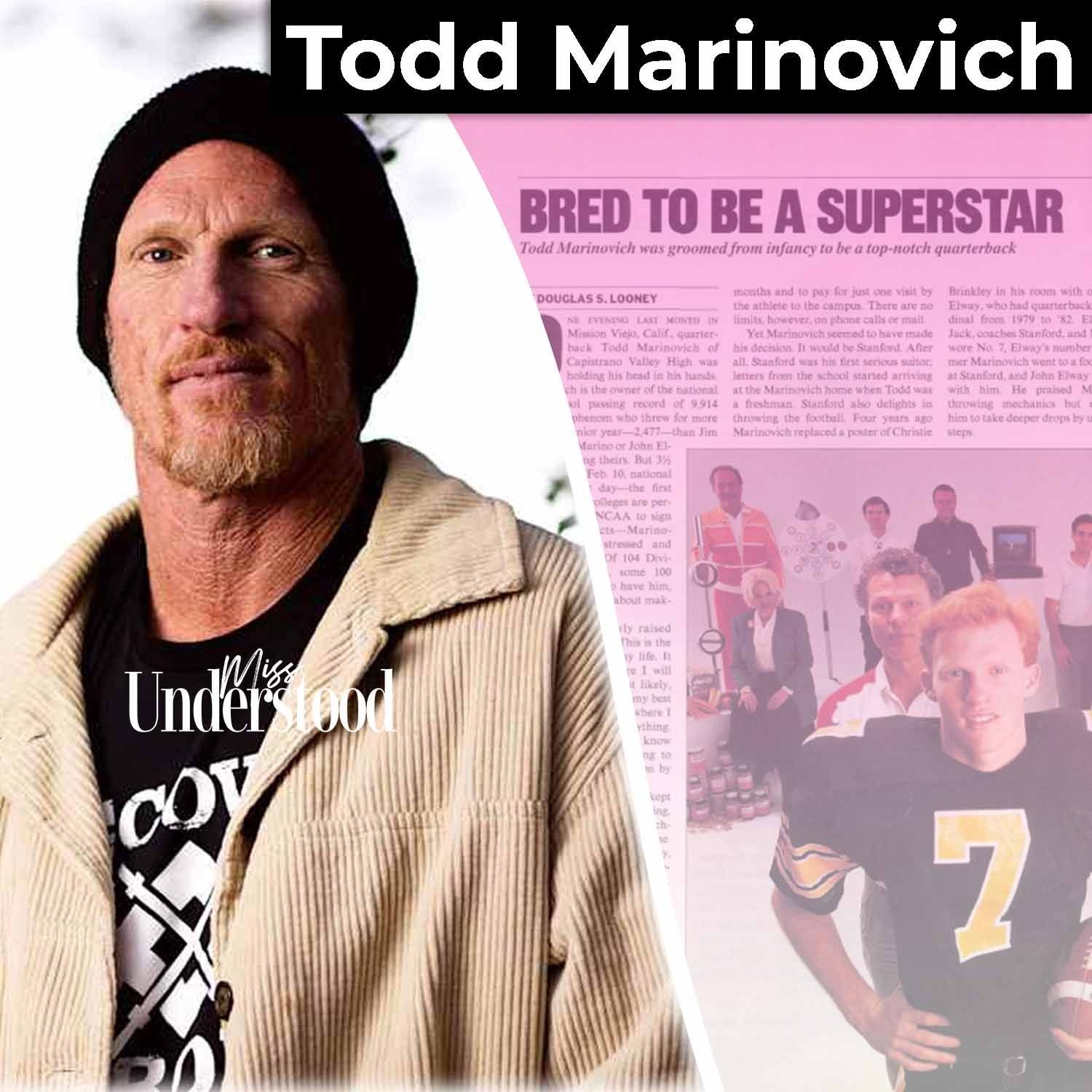
Todd Marinovich: The Man Behind the “Test Tube Athlete” — A Story of Control, Chaos & Healing
What happens when you’re raised to be perfect — and discover it’s destroying you?
In this powerful episode of Miss Understood, Rachel Uchitel sits down with former NFL quarterback Todd Marinovich, once dubbed “The Test Tube Athlete.” Todd opens up about the truth behind his controversial upbringing, his battles with addiction, and the long journey toward self-forgiveness and peace.
From his father’s extreme training regimen to the pressures of fame, substance abuse, and finally finding healing through art and fatherhood, Todd shares a raw, deeply human look at the cost of chasing perfection — and what it means to rebuild your life when the world has already written your story.
📘 Todd’s new memoir Outside the Lines: Football, Art, and Addiction is available now at marinovichbook.com
🎨 See Todd’s artwork: marinovichart.com
--- --- —
VISIT OUR AMAZING SPONSORS!
ROGERS HOOD APOTHECARY
Go to rogershood.com and use code RACHEL at checkout for 10% OFF
--- --- ---
PLEASE LIKE, SHARE, SUBSCRIBE, AND GIVE US A 5-STAR REVIEW!: ratethispodcast.com/missunderstood
Become a Patreon Member: https://www.patreon.com/c/MissUnderstoodwithRachelUchitel
Shop Miss Understood Merch https://missumerch.com/
Follow Rachel on Instagram! https://www.instagram.com/racheluchitelnyc/?hl=en
Follow Rachel on TikTok! https://www.tiktok.com/@itsracheluchitel
Executive Producer: George Carmona
Hosted by Simplecast, an AdsWizz company. See pcm.adswizz.com for information about our collection and use of personal data for advertising.
Available Results
Generated results are saved to the knowledge database for reuse and search.
Extract Knowledge
Pick what you want extracted first. Model, scope, and chapter options appear after a template is selected.
Transcript
[SPEAKER_00]: Today, on Misunderstood with Rachel Yucatau.
[SPEAKER_01]: It's a hot moment of it.
[SPEAKER_00]: You've been caught at the Lyon and Kid.
[SPEAKER_01]: This boy has never tasted a fast food burger or fries.
[SPEAKER_01]: I was really born into a very religious family and have we lived in being football.
[SPEAKER_01]: My dad was a mad scientist when it came to training athletic ability.
[SPEAKER_01]: So in that sense, I was his guy to try new things with him.
[SPEAKER_00]: He would put you in a dark room on a balance beam, bouncing a ball.
[SPEAKER_00]: I mean, are those things true?
[SPEAKER_01]: There were no off days.
[SPEAKER_01]: I couldn't cross the street to the beach until the workout was done.
[SPEAKER_01]: Things can get portrayed in the media that aren't the truth.
[SPEAKER_01]: He was Mr. Misunderstood, Larry Smith, so it was my coach at USC at the time.
[SPEAKER_01]: He just took on the role of my dad.
[SPEAKER_01]: So everything he said and I was doing the opposite, I do regret leaving college early.
[SPEAKER_01]: When I was playing with the Raiders, I felt like this can't be it.
[SPEAKER_01]: This can't be what I spent my entire life training to get to.
[SPEAKER_01]: but I never felt the effects like marijuana gave me.
[SPEAKER_01]: I was like, thank God, I have something now that can ease this tension that I've been feeling my whole life.
[SPEAKER_01]: When I mentioned was arrested, like two bands of all malicoats.
[SPEAKER_00]: Where are you in your relationship with addiction?
[SPEAKER_00]: Is it a constant struggle?
[SPEAKER_01]: Yeah.
[SPEAKER_01]: It's definitely a day to day Rachel.
[SPEAKER_00]: what happens when you're built for greatness, but never asked if you even wanted it.
[SPEAKER_00]: Todd Morinovich wasn't just born, he was designed.
[SPEAKER_00]: From the time he was an infant, his life was an experiment and human perfection.
[SPEAKER_00]: His father, Mark Morinovich, a former USC football player and strength coach, made it his mission to create the ultimate quarterback.
[SPEAKER_00]: No sugar, no fast food, no childhood in the traditional sense, every move, every meal, every breath engineered for one goal to be the best.
[SPEAKER_00]: And for a while it worked.
[SPEAKER_00]: Todd became the prototype, the robo quarterback, the bionic kid, the athlete, America couldn't stop watching.
[SPEAKER_00]: He was brilliant discipline, beautiful to watch, he was also breaking inside, because when you're told your worth is tied into your performance, there's no room for being human.
[SPEAKER_00]: There's no room for curiosity, rebellion or imperfection, and eventually the same drive that made him great, destroyed him.
[SPEAKER_00]: He felt hard.
[SPEAKER_00]: Addiction, shame, homelessness, headlines that made him a national cautionary tale.
[SPEAKER_00]: But the truth is, Todd wasn't a failure.
[SPEAKER_00]: He was the product of a system that doesn't know how to love a person unless they're winning.
[SPEAKER_00]: And here's the question that haunts his story, and maybe all of us.
[SPEAKER_00]: If you're good at something, does that really mean you're meant to do it?
[SPEAKER_00]: Or can you be born with a gift that was never truly yours to begin with?
[SPEAKER_00]: Today Todd Morinovich joins me to talk about what it means to reclaim your humanity after being built to be perfect.
[SPEAKER_00]: We talk about his father, his fall, his art, and the freedom that finally came when he stopped being the quarterback everyone else wanted and started being Todd.
[SPEAKER_00]: Because sometimes the greatest comeback isn't getting back what you lost, it's finally understanding who you are without it.
[SPEAKER_00]: Please enjoy my conversation with Todd Moranovich.
[SPEAKER_00]: Todd, I'm so happy that you're joining me today on misunderstood how are you?
[SPEAKER_01]: I'm good.
[SPEAKER_01]: Thanks for having me, Rachel.
[SPEAKER_00]: So as I was just telling you before we joined on air here, when I mentioned your name and friend of a group of people, everybody started getting animated and screaming about, oh my God, you have to have them on your show, Todd is somebody that I remember from
[SPEAKER_00]: My childhood and, and as I said, everyone had a different version of your story, but the arc of it was, oh my god, that's the guy who was trained like a test tube kid to be an athlete, and when he finally had some freedom and finally was away from his father, he did all the things that he wasn't allowed to do from eating that foods and doing drugs, and it all fell apart.
[SPEAKER_00]: So that was like the arc of the story that I got.
[SPEAKER_00]: You're doing research about you and watching your 30 for 30 and reading, you know, this part of your book and like all the things now that I've researched about you.
[SPEAKER_00]: I find it there's obviously so much more to that, not all of that is like the real version, but I get why that's the, you know, short and version of who you are and I cannot wait for people to hear more from you directly.
[SPEAKER_00]: So again, thank you for being here.
[SPEAKER_00]: Um, I wanted to start with your childhood.
[SPEAKER_00]: I mean, you've written a book.
[SPEAKER_00]: That's why you're here and we'll get into that and how you, the process of writing a book.
[SPEAKER_00]: But if you could kind of walk us through this person that everyone thinks they know.
[SPEAKER_00]: Your childhood is one of the most, you know, recorded famous childhoods that people have looked at and studied.
[SPEAKER_00]: So can you tell people that are listening that might not know a lot about you, where you are born, the family you're born into?
[SPEAKER_00]: I was born.
[SPEAKER_01]: And I was really born into a very religious family and that religion being football.
[SPEAKER_01]: I and my dad was a player in a coach coach in the NFL and played with the Raiders and coach with the Raiders.
[SPEAKER_01]: What really grabbed America's attention was the diet and it wasn't necessarily true.
[SPEAKER_01]: I definitely was very healthy and that part was true, but the part that wasn't was that I hadn't tried a big Mac or a Twinkie or an of course I had.
[SPEAKER_01]: I just didn't want the repercussions of my
[SPEAKER_01]: 15 at the time when all this came out.
[SPEAKER_01]: So when it was national news, I felt like more of a freak than they were reporting that there's this quarterback that you should check out.
[SPEAKER_01]: It was more, there's a freak you need to check out.
[SPEAKER_01]: So that was very uncomfortable, yeah.
[SPEAKER_00]: Yeah, I can imagine.
[SPEAKER_00]: So up until then, though, up until like the media really started getting a hold of your story, I think, you know, I'd like to hear what that, you know, that real childhood was when you were a kid.
[SPEAKER_00]: I mean, your dad has told stories about how he would put you in a dark room on a balance beam bouncing a ball, doing math at the same time.
[SPEAKER_00]: I mean, are those things true?
[SPEAKER_00]: Were you doing all sorts of crazy things?
[SPEAKER_01]: Does it true?
[SPEAKER_01]: Wow.
[SPEAKER_01]: My dad was kind of a mad scientist, so to speak, when it came to training athletic ability.
[SPEAKER_01]: And that was just a big quest.
[SPEAKER_01]: Could you actually enhance somebody's athletic ability?
[SPEAKER_01]: Or are you just dealt with your dealt with?
[SPEAKER_01]: And so in that sense, I was kind of his guy to try new things with and I've tried a lot of things
[SPEAKER_01]: and it, uh, some were great and someone very good at all.
[SPEAKER_01]: So, uh, and that's what that, you know, with anything
[SPEAKER_01]: What what was really blown out of proportion was that I was trained to be a quarterback and that was not true.
[SPEAKER_01]: basketball is my favorite sport and my dad didn't push me towards football.
[SPEAKER_01]: He just wanted me to be healthy as possible.
[SPEAKER_01]: So, but I did spend a lot of time at it and that's there were no off days since I was very, very young.
[SPEAKER_01]: I grew up on the beach and that I couldn't cross the street to the beach until the workout was done.
[SPEAKER_01]: And then I was just part of, I understood that, so it wasn't that big a deal because my reward was I had some time to be a kid, so I couldn't imagine growing up anywhere else.
[SPEAKER_01]: The ocean is just,
[SPEAKER_01]: It's bigger than words.
[SPEAKER_01]: So I am really grateful for my childhood and my upbringing.
[SPEAKER_00]: Well, I'm glad to hear you say that.
[SPEAKER_00]: I'm, I guess I'm curious about, I know you grew up with the sister and you have a last brother, right?
[SPEAKER_02]: Yes.
[SPEAKER_00]: And so, obviously, you're diet, let's say, if we're just starting with that.
[SPEAKER_00]: And you're physical training, because I know you did a lot of physical stuff.
[SPEAKER_00]: They didn't, your dad didn't have her go through any of that, or his, or his other son, correct?
[SPEAKER_01]: No, no.
[SPEAKER_01]: No, and my sister was athletics.
[SPEAKER_01]: She played on the boys golf team and in high school because there was no girls team.
[SPEAKER_01]: Oh, no.
[SPEAKER_01]: Yeah.
[SPEAKER_01]: But she didn't spend the time like he did with me for whatever reason.
[SPEAKER_00]: And not even with his other son.
[SPEAKER_01]: He just, well, had a different mom.
[SPEAKER_01]: And she had different ideas of what she wanted his child that did look like.
[SPEAKER_01]: So it was different.
[SPEAKER_01]: Yeah.
[SPEAKER_00]: got it.
[SPEAKER_00]: So, okay, so while you were going through this as a young kid, you didn't necessarily feel like you were being punished or this was any sort of abuse.
[SPEAKER_00]: Okay, because I think in reading a lot of this and what people thought was that this was very, you know, your father had a very heavy hand and it was almost borderline abusive or way too strong of a father
[SPEAKER_01]: Well, you know, is it some things, you know, I just didn't get to do.
[SPEAKER_01]: However, I didn't know what I was missing.
[SPEAKER_01]: So that we didn't really do those family vacations or camping or anything like that.
[SPEAKER_01]: So it's clear it was clear he held you to a higher standard and a different Yeah, and I got the lesson that there's just no shortcuts and if no matter what you choose to do You have to just spend the time and that's why there has to be a love
[SPEAKER_01]: for what you do or you wouldn't spend the time and I love competing and playing sports so much that it was worth to me the sacrifice of doing something every day to just craft my skills.
[SPEAKER_01]: Yeah.
[SPEAKER_00]: So you actually, I didn't know this.
[SPEAKER_00]: You said you loved basketball more than you even.
[SPEAKER_01]: Yeah.
[SPEAKER_00]: Buff ball.
[SPEAKER_00]: Why not push you in that direction when you were little?
[SPEAKER_01]: Um, it was because he had a history and he was in the NFL and yeah, the, even though basketball was my favorite to play.
[SPEAKER_01]: I was just better at football.
[SPEAKER_00]: Got it.
[SPEAKER_01]: And so I felt that even though I think I could have played college basketball.
[SPEAKER_01]: Anything further than that.
[SPEAKER_01]: I don't, I don't know.
[SPEAKER_00]: Right.
[SPEAKER_00]: So as you become a teenager, again, for people that don't know the story, as you become a teenager and you are so so much better than kids of your age, before you even get into high school, right?
[SPEAKER_00]: I mean, you are already starting to make waves.
[SPEAKER_00]: Is that why the media started to catch on to this to this kid who really stood out or what do you think was the original reason that people started to look at you?
[SPEAKER_01]: Well, I think that what caught people's attention was no freshman in high school.
[SPEAKER_01]: I'd ever started a varsity football game in my area here in Southern California.
[SPEAKER_01]: And so that's what grabbed people's attention.
[SPEAKER_01]: And I was always playing with older kids.
[SPEAKER_01]: And that's, I think, a huge part of it.
[SPEAKER_01]: And when you look at families with a bunch of
[SPEAKER_01]: boys.
[SPEAKER_01]: It's usually the younger one that has, because he's been playing with his older siblings.
[SPEAKER_01]: So it just makes sense.
[SPEAKER_01]: That's not rocket science there.
[SPEAKER_01]: So I always felt that I was playing with more mature guys and older guys, and that was the case.
[SPEAKER_00]: So what was that like for you, though, as a freshman, I mean, I know that every freshman, yeah, going into that first year of high school kids probably don't like you and are like, who the hell is this kid taking away our spot as a quarterback?
[SPEAKER_00]: So what was that moment like when they told you you were starting the game?
[SPEAKER_01]: Oh, my gosh, it was, um,
[SPEAKER_01]: And you're right because that period was far greater than playing at the Coliseum against the New York Giants.
[SPEAKER_01]: It was
[SPEAKER_01]: It was scary, and the dynamics of the team, the older guys, the juniors and seniors, of course, have their all buddies.
[SPEAKER_01]: And I was coming in as a new guy.
[SPEAKER_01]: It was uncomfortable.
[SPEAKER_00]: The day for they mean to you, what did they like it?
[SPEAKER_01]: They weren't nice.
[SPEAKER_01]: They didn't go out of their way to be friendly.
[SPEAKER_01]: But I,
[SPEAKER_01]: I had confidence that my play on the field would win them over and in time it did.
[SPEAKER_01]: Amazing.
[SPEAKER_00]: Amazing.
[SPEAKER_00]: All right.
[SPEAKER_00]: So let's get into, so again, for people that are listening, you start, you, you are succeeding so much earlier than you really should be in life, I guess.
[SPEAKER_00]: And at some point, you are turned on to doing some extra curricular things without your father knowing.
[SPEAKER_00]: I mean, you're still living at home, right?
[SPEAKER_00]: So, so if you're not in college yet, but you do, is this the first time you try pot?
[SPEAKER_00]: Is this the first thing you tried?
[SPEAKER_00]: Yes, I was talking about that as like this eye opening moment like where has this been in my life.
[SPEAKER_01]: Yes, I, you know, since then I've talked with hundreds of people about their first time and their first experience in 15 is kind of late from my research I've done.
[SPEAKER_01]: snuck a couple of hits off a cigarette one time, so I knew what inhaling smoke would felt like, but I never felt the facts like marijuana gave me.
[SPEAKER_01]: And I was blown away to the point of where has this been, it was my solution.
[SPEAKER_01]: I was like, thank God, I have something now that can ease this tension that I've been feeling my whole life.
[SPEAKER_00]: And did it just calm me down and made you, yeah.
[SPEAKER_01]: Yeah, so, and quite the quieted this up here.
[SPEAKER_01]: And, and I found that sports and athletics does that naturally.
[SPEAKER_01]: It places you in the moment to where you don't, you're not thinking about what's going on at home or with your girlfriend.
[SPEAKER_01]: and it's magical in that sense, and so is art the same way with that.
[SPEAKER_01]: It takes you from the day to day Monday.
[SPEAKER_00]: Right.
[SPEAKER_00]: And, and it's able, it helps you compartmentalize.
[SPEAKER_01]: It sounds like.
[SPEAKER_00]: Yeah.
[SPEAKER_00]: Okay, so now you talk about quiet in your mind.
[SPEAKER_00]: I'm just curious to understand you a little more.
[SPEAKER_00]: It's obvious what the stresses were, right?
[SPEAKER_00]: I mean, you're trying to compete at a level that
[SPEAKER_00]: that no one else can, essentially plus you have the pressure of your father making sure that you're living up to your potential and who cares what your team does, but it's all about you.
[SPEAKER_00]: So I'm just curious from your words though, like, what was so choking almost that that was released by being able to smoke pot?
[SPEAKER_00]: What were you trying to, you know, what was so tough on you?
[SPEAKER_01]: There's so much going on, I think, for any kid at that age that's having, I just didn't feel or even if I could even articulate what I was going through.
[SPEAKER_01]: I don't even know if that was possible, you know, at that age.
[SPEAKER_01]: And I wasn't out looking for something to change.
[SPEAKER_01]: I didn't even know it existed.
[SPEAKER_01]: So, um,
[SPEAKER_01]: It just, it fit me just so perfectly that, um, and it worked for a long time and that's the kind of the insidious nature of substances they do work.
[UNKNOWN]: Right.
[SPEAKER_00]: What if I told you that the idea that you only get parasites when you travel to some exotic country is flat wrong?
[SPEAKER_00]: Millions of Americans carry parasites right now, often without symptoms.
[SPEAKER_00]: For example, it's estimated that millions in the United States have been exposed to toxicara, a parasitic worm, yet most never even know it.
[SPEAKER_00]: Paracites do not need a plain ticket.
[SPEAKER_00]: They can enter through tap water, sushi, undercooked foods, or contaminated produce.
[SPEAKER_00]: Some strains live in all stages.
[SPEAKER_00]: Eggs, larva, adults, hidden in your gut, releasing toxins that sabotage your energy and digestion.
[SPEAKER_00]: That's why I'm excited about Parify.
[SPEAKER_00]: Kim Rogers 30-day full spectrum parasite cleanse.
[SPEAKER_00]: The kit works by clearing parasites, worms, candida, and heavy metals.
[SPEAKER_00]: Targeting parasites in all life stages, supporting gut health, detox pathways, and toxin removal.
[SPEAKER_00]: It's taken orally daily for 30 days with precise dosing.
[SPEAKER_00]: I'm actually doing it myself right now.
[SPEAKER_00]: I started with the lymph cleanse than I'm doing the purify.
[SPEAKER_00]: Want to dive deep?
[SPEAKER_00]: I did a full interview with Kim Rogers, the warm queen herself, where we expose all the myths, understand the facts, and show how to protect your body.
[SPEAKER_00]: Listen to that episode if you haven't already.
[SPEAKER_00]: Meanwhile, go to Rogershood.com and use the code Rachel to get 10% off of your order.
[SPEAKER_00]: That's our ACAGL for 10% off.
[SPEAKER_00]: Give it a try.
[SPEAKER_00]: Maybe your body's missing link is hiding inside.
[SPEAKER_00]: Let's do this together.
[SPEAKER_00]: Again, it's Rogershood.com, R-O-G-E-R-S-H-O-D.com and use the code Rachel for 10% off.
[SPEAKER_00]: So actually I'm I'm curious about this because I know that you see that Rachel Well your addiction turned into different things and harder things later Listen, my father died of a cocaine overdose that all before and I was 15 so that's why I'm curious because and I I've you know listen, I've tried everything I always was very nervous that I was gonna have that same addictive personality and not be able to stop So I didn't get into like the harder stuff
[SPEAKER_00]: But marijuana has never worked on me.
[SPEAKER_00]: It just doesn't work.
[SPEAKER_00]: And it makes people that I know lazy, and I just, not my thing.
[SPEAKER_00]: So I'm curious if now that you've gone through all the different things that you've become addicted to, do you believe that thought is something that is a good thing and do you continue to do it?
[SPEAKER_00]: Or is it something you have to quit all or all substance is to be sober?
[SPEAKER_01]: That, well, for me, I can't dabble, oh, not go back and forth, that it really has to be clear.
[SPEAKER_01]: And it worked, like I said, it worked for me for a time.
[SPEAKER_01]: And is it good for, it could be good for somebody and not good for the next person.
[SPEAKER_01]: So I think it's hard to say.
[SPEAKER_01]: I just, uh,
[SPEAKER_01]: I think it's important that young people know their family history about substance abuse because I totally believe a big part of it is genetic, obviously, and then environment places a big part, too.
[SPEAKER_01]: But
[SPEAKER_01]: And today's different, but the strength of these drugs.
[SPEAKER_01]: And it's just a different world.
[SPEAKER_01]: And it's so, it feels so much more dangerous today than I don't want to say that it's harmless.
[SPEAKER_01]: And nothing is harmless.
[SPEAKER_00]: So even though it's legal in certain places, that's the thing that you need.
[SPEAKER_01]: That's great that it is.
[SPEAKER_01]: I truly do.
[SPEAKER_01]: I'm for that.
[SPEAKER_01]: Let the person decide if they want to put it in their body or not.
[SPEAKER_01]: Don't tell me what I can know of that type of thinking.
[SPEAKER_01]: But for one recovery, I think it's dangerous waters.
[SPEAKER_00]: Yeah.
[SPEAKER_00]: Okay.
[SPEAKER_00]: So I'm moving on from that.
[SPEAKER_00]: Then you move into college.
[SPEAKER_00]: And once again, you are the starter as a freshman, which again, I think as I was reading this and watching this on the film, that it must have been again, really scary.
[SPEAKER_00]: And you felt probably a lot of pressure from the older kids that were like, who the fuck is this kid stealing my spot?
[SPEAKER_00]: But you killed it right we walked in there and showed everybody who you are and it seemed like you immediately became part of that team
[SPEAKER_01]: Yes, and the thing about the game of football, the quarterback gets far too much attention because it's really about your supporting cast.
[SPEAKER_01]: And it might seem cliche to say, but I just walked into a team that was loaded with talent and they just needed a guide to take the snap and not turn it over.
[SPEAKER_01]: And I did that to the best of my ability, and we got to win a Rose Bowl and have some really cool experiences.
[SPEAKER_01]: Yeah.
[SPEAKER_00]: So what I've heard from other athletes is like winning at the Rose Bowl is like the equivalent of like hitting the biggest peak ever, and you could officially die after that.
[SPEAKER_00]: Like nothing could ever happen to you like that again.
[SPEAKER_00]: Is that how you felt?
[SPEAKER_01]: Oh.
[SPEAKER_01]: It was a big moment for sure and it's it's hard to describe the feeling of playing in just like a front of a 100,000 people that are passionate about what you do.
[SPEAKER_01]: it's it's it's it's it's it's it's it's it's it's it's it's it's it's it's it's it's it's it's it's it's it's it's it's it's it's it's it's it's it's it's it's it's it's it's it's it's it's it's it's it's it's it's it's it's it's it's it's it's it's it's it's it's it's it's it's it's it's it's it's it's it's it's it's it's it's it's it's it's it's it's it's it's it's it's it's it's it's it's it's it's it's it's it's it's it's it's it's it's it's it's it's it's it's it's it's it's it's it's it's it's it's it's it's it's it's it's it's it's it's it's it
[SPEAKER_00]: Right.
[SPEAKER_00]: And as you get into college, you again start to I guess get into some deeper things you got into cocaine you are partying right am I getting the timeline right you're right on and and do you think that had to do with why you started to have some issues with your coach at the time.
[SPEAKER_00]: Okay, okay, I will.
[SPEAKER_00]: I didn't know if it was the personality thing if you were minded you have your father like I will hear from you what those issues were first you know I didn't know it then, but.
[SPEAKER_01]: Coach Larry Smith was my coach at USC at the time, and he just took on the role of my dad and subconsciously.
[SPEAKER_01]: So everything he said, I was doing the opposite.
[SPEAKER_01]: I was like a teenager, a rebelling.
[SPEAKER_01]: And I feel for him and being put in that situation, I don't know how I would have handled myself.
[SPEAKER_01]: not like you did, but I don't know, so it's any better.
[SPEAKER_00]: Right.
[SPEAKER_00]: Right.
[SPEAKER_00]: So, and again, for people that don't know the story and are listening, there were times when and character, if I'm wrong, obviously, he would make a play or call a play and you would kind of change it up and you would still do the right thing and it would just create it this tension.
[SPEAKER_01]: a lot of tension, and at that time of my life, I was super rebellious.
[SPEAKER_01]: I was fighting every one and everything.
[SPEAKER_01]: And that's part I think of being young.
[SPEAKER_01]: And so being a coach, I coach, you know, today, because of my experience, I try to be understanding.
[SPEAKER_00]: Yeah.
[SPEAKER_00]: So, you know, for people that do know your story, a lot of people think it's just because once you went finally to college and you didn't have your father over you, this is why you had this rebellion and this is why you started to put drugs in your system and eat whatever foods and not stand in a dark room and bounce a ball and stand on a balance mean because you were no longer being trained that way.
[SPEAKER_00]: Do you think it had anything to do with
[SPEAKER_00]: older.
[SPEAKER_01]: I think they just went hand in hand as I got older.
[SPEAKER_01]: At that time of high school 17, 18, I was coming to the end of the daily regimen with my dad.
[SPEAKER_01]: Obviously, I think it's time to go our separate
[SPEAKER_01]: And then I fell into like a lot of freshmen do with the go to college.
[SPEAKER_01]: It's, uh, nobody's waking you up, nobody's making anything for breakfast.
[SPEAKER_01]: So you get that a little exposure to what life is like.
[SPEAKER_01]: And some people blow it up and our outer school with any year, others seem to manage it better.
[SPEAKER_01]: Um, yeah, you never know.
[SPEAKER_01]: I do regret leaving college early looking back on it, you know, I, I was having so much fun at USC and I just felt like the relationship with the coach was so severed that I had to go to the NFL and there was no thought of transferring like today, guys move all over college from college to college and I couldn't think of playing for anybody else.
[SPEAKER_00]: Right.
[SPEAKER_00]: So so plan for the NFL was that at this point like a dream come true or the next half.
[SPEAKER_00]: Okay.
[SPEAKER_01]: Yeah, dream come true.
[SPEAKER_01]: I was my earliest memories are Watching to do that.
[SPEAKER_01]: It was like what else?
[SPEAKER_01]: What I want to do it made sense to me and especially with what I was being exposed to.
[SPEAKER_01]: I mean a real football family.
[SPEAKER_01]: Yeah.
[SPEAKER_00]: Right.
[SPEAKER_00]: So, and as you're in the NFL, you're still dabbling in all these things and you're living in LA, right?
[SPEAKER_00]: It was the LA at the time.
[SPEAKER_01]: Yeah, LA readers.
[SPEAKER_00]: And were you, I mean, I read that you were hanging out with Charlie Sheen and doing all these things.
[SPEAKER_00]: Is this because you had been so famous for so long that they, they all saw you as a celebrity too, and you played for the Raiders, like, how did you get within that crowd?
[SPEAKER_01]: I don't know if any of them really knew my story up to the point of, I mean, when you're at the starting quarterback for a professional football team in a big city, I was kind of a big deal, but, uh, and I hope everyone wanted to hang with you and everyone wanted to give you drugs.
[SPEAKER_01]: And I was welcome to that.
[SPEAKER_01]: I was completely open.
[SPEAKER_01]: And I really didn't give myself the best chance if that was what I wanted to do.
[SPEAKER_00]: Right.
[SPEAKER_00]: And yeah, which then brings me to my question.
[SPEAKER_00]: And I'm going to stress it with this.
[SPEAKER_00]: I had Ricky Williams on my shower.
[SPEAKER_00]: You're fine.
[SPEAKER_00]: You're fine.
[SPEAKER_00]: And the, the, in talking to him, the feeling I got from him is somewhat similar that I get when I listen to your story, which is just because you're good at something.
[SPEAKER_00]: And everyone puts you on a pedestal and says this is what he's meant to do and this is what he has to do because if he doesn't shoot this.
[SPEAKER_00]: He's mentally ill.
[SPEAKER_00]: There's something wrong with him.
[SPEAKER_00]: What a loser, like I would, if I had that talent, I would be doing this.
[SPEAKER_00]: What the hell is wrong with this guy?
[SPEAKER_00]: then it's like they make it your issue whereas maybe just because you're good at something doesn't mean that that's what fulfills you and is your purpose.
[SPEAKER_00]: And that was the my take away from Rick Williams that it's not that he was mentally ill he wasn't a drug he wasn't a drug he and just chose drugs.
[SPEAKER_00]: But Paul did not fulfill him and he had a bigger calling and he did not
[SPEAKER_01]: love Ricky and love that whole idea because when I reached the dream when I was playing with the Raiders, I felt like this can't be it.
[SPEAKER_01]: This can't be what I spent my entire life
[SPEAKER_01]: So I get that.
[SPEAKER_01]: And people, I think people in general, a lot of people can relate with that, whether it's a family that practices a law and they feel like they are pulled into that area of life.
[SPEAKER_01]: And it's really.
[SPEAKER_01]: you got to do what you want to do.
[SPEAKER_01]: It's going to blow up otherwise.
[SPEAKER_01]: It's just a matter of time.
[SPEAKER_00]: Right.
[SPEAKER_00]: Eventually it will happen.
[SPEAKER_01]: Yeah.
[SPEAKER_01]: And I'm living proof and there's countless others that are.
[SPEAKER_01]: Of course you want to listen to those around you, they're input, but it's ultimately your decision.
[SPEAKER_00]: Yeah.
[SPEAKER_00]: So, and not to harp on it, but, you know, it is public knowledge that then it started to all unravel and film it and there is a whole wrap sheet of things, you know, you getting arrested or being caught with things or not passing drug tests and so, you know, a lot of people would say, oh, he's given all these chances and he just kept scaring up because he's an addict.
[SPEAKER_00]: But at some point, you hit some sort of rock bottom to make a change.
[SPEAKER_00]: Can you talk about it a little bit?
[SPEAKER_01]: I have had so many rock bottoms and they were because really that's a whole another topic is what is rock bottom.
[SPEAKER_01]: I think it's an emotional.
[SPEAKER_01]: hopelessness.
[SPEAKER_01]: Because it's not about the things that you lose, because you can always lose things.
[SPEAKER_01]: It's truly about this feeling of hopelessness, and I've been there several times.
[SPEAKER_01]: And it's a messed up place to be where you don't think there's
[SPEAKER_01]: Thank God for people.
[SPEAKER_01]: I tell you what, that have helped me out because I can't, I mean, if you hear nothing that I say here this is I can't do it by myself and I've tried countless times.
[SPEAKER_01]: I need people around me that lift me up.
[SPEAKER_01]: And that's just a people thing.
[SPEAKER_01]: I don't think he's even an addict thing.
[SPEAKER_01]: I just think we need each other.
[SPEAKER_01]: And I wouldn't, I just, I know for a fact, I wouldn't be here today, if it weren't for my friends and family.
[SPEAKER_00]: I think something that a lot of people do when they are having a hard time is they isolate, because they're embarrassed, there's also such a shame, you don't really want people to know you get defensive about answering questions, and there's got to have been a time, and I know from listening to some of your friends talk that there were times when you almost isolated because I think you are still harboring this thought, you do not know what it feels like to be me, like even fathom, and
[SPEAKER_00]: There are times when I have felt a similar thing, you don't know what I've been through.
[SPEAKER_00]: It's too hard for me to even describe the things that I've gone through for you to even understand why I'm behaving this way.
[SPEAKER_00]: So like I can't even connect with you and that has made me isolate too.
[SPEAKER_00]: Do you know what I mean?
[SPEAKER_01]: Absolutely.
[SPEAKER_01]: Absolutely.
[SPEAKER_00]: For people listening that feel that isolation, how would you suggest, first of all, that misunderstanding that no one gets you, and you, of course, have lived a very different life than others, but I think there's a universal feeling of feeling misunderstood.
[SPEAKER_01]: Yes.
[SPEAKER_01]: And what I've grown into is what you think of me is none of my business, and that is true.
[SPEAKER_01]: I don't have any control over what is said about me and that's just been a good life lesson to accept that and let that go.
[SPEAKER_01]: And about feeling helpless and isolating,
[SPEAKER_01]: isolation is so dangerous for somebody like me, like I said, I just need people and and I need to be honest with these people and that's what I found throughout my experience is sometimes honesty is uncomfortable.
[SPEAKER_01]: It just seems that the most uncomfortable things are the
[SPEAKER_01]: that's weird, but it's anti-intuitive, but truly, I don't want to do the things that I should do.
[SPEAKER_01]: And so those are the things that I need to put up the top of my list to knock out for that day.
[SPEAKER_01]: And athletics has given me the discipline to be able to do that, to show up and thank God for sports.
[SPEAKER_00]: Yeah.
[SPEAKER_00]: So do you feel like your life started to turn around when you met your wife?
[SPEAKER_00]: I feel like you met her in rehab or in rehab.
[SPEAKER_00]: And have you guys been an amazing supporter?
[SPEAKER_00]: Has that been hard?
[SPEAKER_00]: Because you guys just got to keep each other on a straightener.
[SPEAKER_01]: We are not together, but she is a very, very close friend.
[SPEAKER_01]: And we co-parent.
[SPEAKER_01]: And she's got her own struggles and things to deal with, too.
[SPEAKER_01]: Like a lot of people.
[SPEAKER_01]: And it was my children that's
[SPEAKER_01]: I've never felt this when she got pregnant and I knew our child or son was on the way.
[SPEAKER_01]: I had this fire that made that I needed to make money and that was not in this person's thought life until that point.
[SPEAKER_01]: And being a dad has been, I can't even put to words.
[SPEAKER_01]: I think it's something that should not be missed if your newment.
[SPEAKER_00]: That's the sweet thing to say.
[SPEAKER_00]: I agree with the I have seen your old and she changed my life.
[SPEAKER_00]: So you guys told me change my life.
[SPEAKER_00]: Like it's also, you know, I think for me, I always struggle to understand love, I had a difficult relationship with my own parents and blah, blah, blah, blah.
[SPEAKER_00]: That's the first time you really know what doing something out of love is and this unconditional love that people always talk about like you will do anything for your children I also feel similar to my dogs like these are things that I will always protect and and do anything for and it just changes you as a person you're you're able to see things in a different way and you're you put them before you.
[SPEAKER_00]: Put yourself first, you know, and you don't really do that for any other human, no matter how much you say you're in love with someone, you know, in my opinion.
[SPEAKER_02]: Yes.
[SPEAKER_00]: Yeah.
[SPEAKER_00]: So you guys live in Hawaii, or even though you're not together with her, do you guys all live there and co-parent?
[SPEAKER_01]: No, no, no.
[SPEAKER_01]: I don't.
[SPEAKER_01]: My kids come out just to Hawaii and I come back.
[SPEAKER_01]: I'm like back in Southern California now.
[SPEAKER_01]: And.
[SPEAKER_01]: Yeah, it works.
[SPEAKER_01]: I'd love to see them more.
[SPEAKER_01]: I just made a decision for me that I'm in the fourth quarter of life Rachel.
[SPEAKER_00]: What?
[SPEAKER_01]: No, yes, but I like to say I had two time out still.
[SPEAKER_00]: Okay, what's going to happen in the fourth quarter?
[SPEAKER_00]: What are we going to do?
[SPEAKER_01]: Well, that's usually when the stars rise.
[SPEAKER_01]: Okay.
[SPEAKER_01]: I'm not saying that's what's happening, but Why not?
[SPEAKER_01]: It could happen, and there's a good chance.
[SPEAKER_01]: I felt I had a connection with why, since I was in kindergarten, because we lived over there for a few years.
[SPEAKER_01]: And I knew there was something special that I needed to check out again.
[SPEAKER_01]: I'm kind of saddened that it took me 50 years to get back, but yeah, yeah.
[SPEAKER_00]: Okay, so like what's a plan?
[SPEAKER_00]: You're you're they're you're coaching or managing some youth programs, right?
[SPEAKER_01]: Yeah, I saw a lot of other things new and stuff with kids.
[SPEAKER_01]: my rap sheet has kind of limited what I can do with kids in the sense of I was coaching high school football until that caught up with me and I don't do that anymore.
[SPEAKER_01]: But I can work a parent and send their kids and there's a lot of those and I just and I love the one on
[SPEAKER_01]: because I've experienced so much and spent so much time at doing this that I feel like I can really, I try to make things easier for the up and comer.
[SPEAKER_00]: Right.
[SPEAKER_00]: Well, wait, that brings me to another question, of course.
[SPEAKER_00]: So do you feel like your fourth quarter is going to be like a comeback?
[SPEAKER_00]: Do you think there's anything to come back from?
[SPEAKER_00]: How do you think people view your life?
[SPEAKER_01]: I don't know how to say.
[SPEAKER_00]: Well, because that makes me sad that because you're rap sheet caught up with you.
[SPEAKER_00]: I mean, who care?
[SPEAKER_00]: You were young and everyone deserves a second chance.
[SPEAKER_00]: And there are plenty of people that, you know, right now in their lives, we've heard about them from decades ago, and they are on a huge comeback.
[SPEAKER_00]: I mean, you see, Mantai Taio on, you know, doing live football commentary now, you know, and everybody shamed him forever years ago.
[SPEAKER_01]: Yeah, I think I'm qualified for the coaching position and I'd love it in a way that if I could, I would do it for free.
[SPEAKER_01]: I just my fourth quarter.
[SPEAKER_01]: I have to create that's who I am as as a human being is I wither and die if I'm not creating and that's a wide range of, you know, mediums to create it.
[SPEAKER_01]: And then for fun, it's giving back, I mean, addiction and in substance abuse is a really selfish.
[SPEAKER_01]: thing.
[SPEAKER_01]: And so
[SPEAKER_01]: What I found is, I am happiest doing something for somebody else.
[SPEAKER_01]: And when I get caught up in this, what do I need to, what do I, what do I, that's mine, I need to get me.
[SPEAKER_01]: It's all bad.
[SPEAKER_01]: It's all bad for me.
[SPEAKER_00]: Yeah.
[SPEAKER_01]: A great day for me is, what can I do for you?
[SPEAKER_01]: And what's next?
[SPEAKER_01]: What can I do for you?
[SPEAKER_01]: Yeah.
[SPEAKER_01]: I'm not, I have amazing experiences and interactions and connections with people.
[SPEAKER_01]: doing that.
[SPEAKER_00]: Right.
[SPEAKER_01]: And but you know, like I said, I don't like to do the things that are good for me.
[SPEAKER_01]: And that is 100% good for me.
[SPEAKER_00]: Yeah.
[SPEAKER_00]: So you are an artist.
[SPEAKER_00]: You studied art and college.
[SPEAKER_01]: Yes.
[SPEAKER_00]: And you do paintings for yourself for commission like where we are commission.
[SPEAKER_01]: OK.
[SPEAKER_00]: Have you ever been in a gallery?
[SPEAKER_00]: Do people just contact you and say make this?
[SPEAKER_01]: Like, uh, yeah, a lot of that, um, I have a website and people, you know, and it's been fantastic.
[SPEAKER_01]: It's, uh, I never thought it was possible.
[SPEAKER_00]: I didn't know I was like, but ball art.
[SPEAKER_01]: No, it's all kinds, you know, like what?
[SPEAKER_01]: This will sports definitely play a big part of what I do because that's what people request, um,
[SPEAKER_01]: You know, and I watch and read a lot about master, the masters of arts and painters and sculptures.
[SPEAKER_01]: And a lot of them have said, don't make art your way of making money.
[SPEAKER_01]: It'll change things and it completely has.
[SPEAKER_01]: But it allowed me to practice.
[SPEAKER_01]: and continue to improve and get better.
[SPEAKER_01]: However, I feel that I'm coming into something big for me creatively when I can step away from answering your email and saying, I'm not doing that anymore.
[SPEAKER_01]: Because it's hard to turn down money.
[SPEAKER_00]: Right, right.
[SPEAKER_00]: You know what I mean?
[SPEAKER_00]: Yeah.
[SPEAKER_00]: Also, again, something Ricky Williams said as well, but you have to make money.
[SPEAKER_00]: I mean, you're a dad.
[SPEAKER_00]: You have to contribute to that and you also want to live where you're comfortable and you don't have to worry about things.
[SPEAKER_00]: So you shouldn't feel bad about accepting money.
[SPEAKER_00]: You know, but the here's the other question I had what what kind of and I know nothing about our, but I've started to buy art from my new house nice kind of gotten into understanding it and I've seen a little bit of your, um, what's your medium or whatever you doing like watercolor oil base like what what do you do?
[SPEAKER_01]: I'm starting to go towards oil, um, but I've been using acrylic mainly because it just dries so fast and then yeah, it's easier.
[SPEAKER_00]: But it's stuff that is 3D, like comes out of the canvas, you know, when they do the oil and it kind of comes out, these are all, let's do the questions but I'm genuinely interested.
[SPEAKER_01]: I try, I'm not a illustrator or realism isn't my thing.
[SPEAKER_01]: I'm trying to create a feeling with color.
[SPEAKER_01]: And when I paint for fun, as I do,
[SPEAKER_01]: It's it's all about color and it's really abstract and I'm fascinated by it.
[SPEAKER_01]: Yeah, it's my passion and
[SPEAKER_01]: any time that I can lose the concept of time, I wanted to do that.
[SPEAKER_00]: Yeah, I hear you.
[SPEAKER_01]: If it's healthy, you know what I mean?
[SPEAKER_01]: Because there's something magical about that and I get into this place that is magical.
[SPEAKER_00]: Yeah, yeah.
[SPEAKER_00]: All right, I want to go back to your, you're being a father.
[SPEAKER_00]: Yeah, I see.
[SPEAKER_00]: Obviously, your relationship with your father, Mark, how have you raised your children?
[SPEAKER_00]: That's either different or similar to how you were raised by your father.
[SPEAKER_01]: I, well, I didn't go down the heavy handed discipline route as my dad.
[SPEAKER_01]: And I was probably too lenient because of my experience.
[SPEAKER_01]: super close with both of my kids, I, and it's been difficult because there's a line of, am I their friend?
[SPEAKER_01]: Well, my parents, or
[SPEAKER_01]: I just was at a time where like I said honesty was the best policy and so I've just been honest with them and they've seen a human being stumbling fall and a lot of parents don't want their children to know that and why not and and I had to ask myself why not.
[SPEAKER_01]: and I got the answer is they should because they will too stumble and fall.
[SPEAKER_01]: It sets them up to think that they have to be perfect and that's just as we know that's just not a thing.
[SPEAKER_00]: Yeah.
[SPEAKER_00]: Do you think that growing up, if your father had let you sort of learn some lessons on your own, like if you used some freedom, that you would have been able to cope better when you got into high school college later in life because you would have learned how to get yourself out of a terrible situation on your own?
[SPEAKER_01]: I think it would have been different, but I don't know how different.
[SPEAKER_01]: Yeah, there's nothing I don't think you could prepare
[SPEAKER_01]: a young person for the media on slot of playing professional sports at a young age that that whole monster is uh yeah it's is super hard.
[SPEAKER_01]: I don't I don't I don't know how young athletes do it today
[SPEAKER_01]: I really don't, because there has to be balance there and I still, that's what I'm doing today is working on how I'm better balancing my life, because I, I'm so one track to get focused, like laser focused and then everything else is falling apart, so I struggle still with that.
[SPEAKER_00]: It seemed that later on in your father's life, he was able to spend some great time with your kids, right?
[SPEAKER_00]: And you were able to have a different type of relationship within where you are closer and friends.
[SPEAKER_01]: Yes, best friends look my dad towards the end and it was truly,
[SPEAKER_01]: beautiful, beautiful.
[SPEAKER_01]: Yeah.
[SPEAKER_01]: And I was scared.
[SPEAKER_01]: And that's what I'm hearing myself say these things is fear was a huge ran my life forever.
[SPEAKER_01]: And I still, I'm dealing with that when my dad was his last years, but dementia, I just wanted to run from that.
[SPEAKER_01]: I didn't, he doesn't know who I am, but he always did.
[SPEAKER_01]: He couldn't put a name to me, but I could feel and see in him that he knew that I was somebody close.
[SPEAKER_01]: And I'm so grateful.
[SPEAKER_01]: that I showed up for that.
[SPEAKER_00]: Yeah.
[SPEAKER_01]: Yeah.
[SPEAKER_00]: I'm so sorry for your for your loss.
[SPEAKER_01]: Yeah.
[SPEAKER_01]: But yeah.
[SPEAKER_00]: Thank you.
[SPEAKER_00]: And it's also most it must be hard for your kids to who didn't get to grow up with us in their lives.
[SPEAKER_00]: And he said such a huge impact.
[SPEAKER_00]: Something I read recently, though, really struck me.
[SPEAKER_00]: It was a headline about, I don't know, some quotes about you with your father.
[SPEAKER_00]: And the headline was the worst father and sports or something.
[SPEAKER_00]: Yeah.
[SPEAKER_00]: Your father.
[SPEAKER_00]: I didn't believe that came from you and I just wanted to ask you if you could clarify about that article and and you're thoughts about your father being a father of someone in sports.
[SPEAKER_01]: No, he death talked about misunderstood.
[SPEAKER_01]: He was Mr. misunderstood for sure.
[SPEAKER_01]: many, many, many of those people out there.
[SPEAKER_01]: And so, can't be that bad of a guy, if you have the decisions of people that would go to bat for you.
[SPEAKER_01]: Yeah.
[SPEAKER_01]: So things can get portrayed in the media that aren't exactly the truth.
[SPEAKER_01]: And that wasn't...
[SPEAKER_01]: the idea behind the book or the documentary that I did, but I thought the more I could hopefully show them, you know, the real me, I maybe can paint a clear picture for them about my dad and he just had a huge heart.
[SPEAKER_01]: It never was about the money.
[SPEAKER_01]: He was trying to help somebody, and that's what I get from his whole, its legacies helping.
[SPEAKER_00]: Right.
[SPEAKER_00]: And it seems like he just loved you in a different way than me.
[SPEAKER_00]: Yeah.
[SPEAKER_01]: Don't be way that he knew how.
[SPEAKER_01]: And as I got older, I and I started to understand that.
[SPEAKER_00]: Right.
[SPEAKER_00]: But loved you so much that he wanted the best for you.
[SPEAKER_00]: Maybe even think he's not had on his own.
[SPEAKER_00]: And I want you to have that.
[SPEAKER_00]: I think that was very evident.
[SPEAKER_00]: That's him out.
[SPEAKER_00]: But you know, he was, you know, coined with creating the methodology for training and
[SPEAKER_00]: I wonder if you've ever talked to him about this before he died.
[SPEAKER_00]: But, you know, he was using you to see how it would be.
[SPEAKER_00]: It's a test to kid, let's say.
[SPEAKER_00]: You tried all these things and we see how life turned out.
[SPEAKER_00]: Do you think now with that methodology?
[SPEAKER_00]: He would have said, listen, now I've learned you do this.
[SPEAKER_00]: You don't do this.
[SPEAKER_00]: Like what would he have had said?
[SPEAKER_01]: Oh, yeah.
[SPEAKER_01]: He was open.
[SPEAKER_01]: definitely to look back on things that didn't really work in things that and training wise, just training, he was honing his skills and by the time I was already long gone, he was really starting to come across some
[SPEAKER_01]: round-breaking ideas and a system that he got to train Troy Polymala who is one of the best football players of all time.
[SPEAKER_01]: So I, I joked with Troy that you got Marvin as best and he truly did.
[SPEAKER_00]: But what do you think those would have been?
[SPEAKER_00]: I mean, did it have to do with the diet?
[SPEAKER_00]: Did it have to do with starting somebody at the age of basically a newborn to create this specimen?
[SPEAKER_01]: He grew into the understanding of just because more does make it better.
[SPEAKER_01]: And as you got older, the time off is as much as important as the time on.
[SPEAKER_01]: So yes,
[SPEAKER_01]: And what do I mean?
[SPEAKER_00]: Totally.
[SPEAKER_01]: Yeah.
[SPEAKER_01]: Because there was no rest when I was going through it.
[SPEAKER_01]: It was just one grind.
[SPEAKER_01]: Yeah.
[SPEAKER_00]: Got it.
[SPEAKER_00]: So a balance.
[SPEAKER_00]: Yes.
[SPEAKER_00]: We're not the same.
[SPEAKER_00]: Yeah.
[SPEAKER_00]: So do you watch football?
[SPEAKER_00]: Are you?
[SPEAKER_00]: I do.
[SPEAKER_01]: Yeah, when I was done playing, I didn't for years.
[SPEAKER_01]: I was done.
[SPEAKER_01]: However, my son now being 16 and playing the high school football, yes, I'm back back and watching it.
[SPEAKER_00]: Amazing, do you have a favorite team?
[SPEAKER_01]: The ones that I played for, I have a, yeah.
[SPEAKER_01]: So I, I, I wrote for the Trojans and also the Raiders.
[SPEAKER_00]: And whatever happened to Coach Smith, did you ever work things out with him?
[SPEAKER_01]: I tried.
[SPEAKER_01]: Coachness passed away, and so I didn't get the opportunity.
[SPEAKER_01]: But I did had an amazing conversation with his wife, Cheryl, and hearing her perspective throughout all our turmoil was so eye-opening.
[SPEAKER_01]: I mean, we cried, we laughed.
[SPEAKER_01]: I mean, truly a connection with Cheryl, and she's
[SPEAKER_01]: She's doing great in Arizona, but you just don't know the other side of the story when you're going through it and when you get those pieces It makes sense, you know, and I and I and I felt bad and that's why I went and spoke with Cheryl about it This oh, that's amazing and ultimately is it that he felt disrespected because you aren't listening to him Or did he love you like a kid and just was just fresh?
[SPEAKER_01]: Yes that one yeah Like would stay up at night like how am I gonna deal with this kid
[SPEAKER_00]: Right.
[SPEAKER_00]: Oh my god.
[SPEAKER_00]: Well, that must have given you some solace and a little.
[SPEAKER_00]: Yes.
[SPEAKER_02]: Oh, yeah.
[SPEAKER_00]: I love that for you.
[SPEAKER_00]: All right.
[SPEAKER_00]: So you're doing hard.
[SPEAKER_00]: You're living in Hawaii.
[SPEAKER_00]: What's next for you?
[SPEAKER_00]: Do you think you'll ever get married?
[SPEAKER_00]: Do you want more kids?
[SPEAKER_01]: Um, gosh.
[SPEAKER_01]: I think I'm good.
[SPEAKER_00]: Okay.
[SPEAKER_01]: I love being because in Hawaii, the uncle and the auntie are big staples in the family.
[SPEAKER_00]: You have a family or world there that you're very close to.
[SPEAKER_01]: Yes, and I love being uncle talk.
[SPEAKER_01]: And it's really the young ones call me uncle sauce.
[SPEAKER_01]: Because they can't say Todd and I love that even better.
[SPEAKER_00]: Um, and I guess just I know people are going to want me to ask is there anything in your past that you would say listen, I really wish that I did this differently because I'd rather be here in my life or are you really good with where you are and you're happy for your past like what would you say about all that.
[SPEAKER_01]: But I wouldn't change anything.
[SPEAKER_01]: I really wouldn't die.
[SPEAKER_01]: You know, my addiction is kept me from being a day-to-day dad.
[SPEAKER_01]: However,
[SPEAKER_01]: the connection I have with my children and the time that we do have together.
[SPEAKER_01]: That's worth it.
[SPEAKER_01]: It's completely worth it.
[SPEAKER_01]: And
[SPEAKER_01]: I just couldn't do it in this area anymore and it was hard for me because I didn't want to feel like I was running from like kids or them feel that way at all.
[SPEAKER_01]: Just for me, it's such a healthier place to be and just to where when I do see them, they get 100% of me.
[SPEAKER_00]: Yeah, that's amazing.
[SPEAKER_00]: I love hearing that.
[SPEAKER_00]: And where are you in your relationship with addiction?
[SPEAKER_00]: Is it a constant struggle?
[SPEAKER_01]: It's definitely a day to day Rachel.
[SPEAKER_01]: I wish I could say, oh, I got that handle.
[SPEAKER_01]: No.
[SPEAKER_01]: It is.
[SPEAKER_01]: I mean, they're seeking a chemical solution or a spiritual solution.
[SPEAKER_01]: There's no in between.
[SPEAKER_01]: So if I'm waking up today, I'm seeking that spiritual solution, which is a connection.
[SPEAKER_01]: And that's what we're having.
[SPEAKER_02]: Yeah.
[SPEAKER_01]: I feel that we have a connection.
[SPEAKER_01]: And this is so good for like the soul.
[SPEAKER_01]: This fills me.
[SPEAKER_01]: It's hard to stay in that and that's what I've struggled with with my addiction is I love being sober.
[SPEAKER_01]: It's just staying there through the marathon as opposed to know me it's not a sprint time.
[SPEAKER_01]: This is a different race because I was so trained to a train for an event or a train for this day that there's no day or that we're training for here.
[SPEAKER_01]: It's just the day to day.
[SPEAKER_01]: I look at it like every day's game day for me and my life that there's no rehearsals and a bad decision can take me out.
[SPEAKER_00]: That's right.
[SPEAKER_01]: Though I need to stay close and honest.
[SPEAKER_00]: And you probably need to really be within your purpose.
[SPEAKER_00]: Like if your purpose is art, maybe that is something that on a daily basis, like hopefully people are, even though it is for money, our requesting you to do that because that can really bring you into something where your mind is lost in that and you're not dealing with the ups and downs that, by the way, every single person goes through in life.
[SPEAKER_00]: and you're just as you know have to retrain or train your mind to know that when you are in those lows and you feel like shit, sometimes it's best to just marinate that because you know you're going to get out of it.
[SPEAKER_00]: Life is a pendulum.
[SPEAKER_00]: So the extent you feel terrible, it's the same extent you're going to feel great.
[SPEAKER_00]: Sometimes you just got to go through it and be like this fucking sucks but I'm going to pick up my paintbrush and
[SPEAKER_00]: you know, do something.
[SPEAKER_00]: So I really am pulling for you.
[SPEAKER_00]: I wish the best for you.
[SPEAKER_00]: I'm here for you as your friend.
[SPEAKER_00]: If you ever come to Palm Beach, Florida, please let me know.
[SPEAKER_00]: And I really do want the best for you.
[SPEAKER_00]: And I'm so happy you're there visiting your kids.
[SPEAKER_00]: Happy to see that you're with your mother.
[SPEAKER_00]: She seems like a wonderful woman.
[SPEAKER_00]: Anything else that I'm missing to ask you
[SPEAKER_01]: I'm glad you mentioned my mom because she is the one and there's so much talk about my dad, but she's why I'm here.
[SPEAKER_00]: Yeah, and you could tell she struggled so much with knowing what the right thing to do was and was really there for all of this with your father and I'm so glad to hear she's there with you now, but obviously has that softer side and a little and softer spirit and I'm sure she's a great grandmother.
[SPEAKER_00]: So two, two, that's what my mom uses for my daughter.
[SPEAKER_00]: So yeah, because her name is Susan, and she can ever stay so so she's too good.
[SPEAKER_00]: I love that.
[SPEAKER_00]: My last question is, what do you think your story teaches about expectation for given us?
[SPEAKER_00]: And what it really means to live on your own terms?
[SPEAKER_01]: Well, my story has all of those things.
[SPEAKER_01]: And what was the question?
[SPEAKER_01]: Sorry Rachel.
[SPEAKER_00]: Well, essentially, I'm trying to have people understand from you that expectation of who you are supposed to be, might not be who you want to be.
[SPEAKER_00]: And it's okay to follow your own path you don't have to live for.
[SPEAKER_00]: Yes.
[SPEAKER_00]: But I mean, I don't want to put words in your mouth, but I want to give a lesson from you on kind of what you've learned throughout being who you are.
[SPEAKER_01]: You know, I've...
[SPEAKER_01]: really brought up some really good questions this morning and it's like a fine line there though that having someone in your corner like my dad was helped me reach places that I didn't think I could.
[SPEAKER_01]: And also, in art, having, like my friend Bob, helped me believe I could do this as a way of life.
[SPEAKER_01]: If it wasn't for the people that encouraged that, because I didn't really know what I wanted to do, I thought I wanted to play football until I was,
[SPEAKER_01]: needy been it and couldn't run.
[SPEAKER_01]: So it's taken me a long, long time, and it's crazy to think that we're turning to our teenagers, going, what do you want to study in college?
[SPEAKER_01]: And it's like, what do you want to be like pump the brakes?
[SPEAKER_01]: I don't know, and it's okay to not know.
[SPEAKER_01]: Yeah, it's, you'll figure it out.
[SPEAKER_01]: And I don't think it's figuring out up here.
[SPEAKER_01]: It's more here.
[SPEAKER_01]: You'll, it's annoying and not put a timeline on that, you can't.
[SPEAKER_00]: And to add to that, I would say it's also about trying different things.
[SPEAKER_00]: Yes.
[SPEAKER_00]: What works.
[SPEAKER_00]: And the failure is part of learning what you want to do and what you not want, what you don't want to do.
[SPEAKER_00]: So I don't think people should shy away or be shameful about failing.
[SPEAKER_00]: It's part of life and what makes you better in the future.
[SPEAKER_00]: Because if you don't know what you're going to fail at, you don't know how to do it a different way, you know?
[SPEAKER_01]: Yes.
[SPEAKER_01]: Yes.
[SPEAKER_01]: And that's the best, really.
[SPEAKER_01]: It's just a best part failing, but if you can accept the fact that that's part of it, that's more a part of it than you want to be part of it, but that's part of the deal.
[SPEAKER_00]: And it can probably take some of that fear you talked about out of it.
[SPEAKER_00]: Yes, you know, you can say all like you can get rid of a little bit of that fear of it because it's going to happen.
[SPEAKER_01]: I was scared, like I said, I was scared most of my life, but I was always in action, and that's
[SPEAKER_01]: That's the antidote.
[SPEAKER_01]: I think it's staying moving towards whatever that place you want to get to is.
[SPEAKER_00]: Yeah.
[SPEAKER_00]: All right.
[SPEAKER_00]: Your new book is outside the lines in football, art, and addiction.
[SPEAKER_00]: Where can people get this book?
[SPEAKER_01]: They can go to Marinavitch, book.com, or Amazon, or anywhere.
[SPEAKER_00]: Amazing.
[SPEAKER_00]: Learns a Noah.
[SPEAKER_00]: Okay, and if people want to commission you for art, where can they reach you?
[SPEAKER_01]: Marinavitch art.com.
[SPEAKER_00]: Okay, and is it just things that you've already done and are on there or can people reach out to you and say, here's my idea.
[SPEAKER_00]: Yeah.
[SPEAKER_00]: I have this size of a wall, you go for it.
[SPEAKER_01]: Yeah, I love those.
[SPEAKER_01]: And I've had some really great requests over the years where it's, I don't care what you do.
[SPEAKER_01]: And it just has to be the size.
[SPEAKER_01]: I love, I love those.
[SPEAKER_01]: but I will, yeah, I love connecting with the person and it's a joint effort of creating something special.
[SPEAKER_00]: Amazing.
[SPEAKER_00]: I love it.
[SPEAKER_00]: Todd, I wish you so much luck and faith and hope and all of the things in the future.
[SPEAKER_00]: I really appreciate it getting to know you and I really hope that people read your book.
[SPEAKER_01]: Thank you, Rachel.
[SPEAKER_01]: I'm a fan now of you.
[SPEAKER_00]: Thank you, Todd.
[SPEAKER_00]: Have a great day.
[SPEAKER_00]: Thank you so much for listening to Ms.
[SPEAKER_00]: Understood.
[SPEAKER_00]: I'm your host, Rachel, you could tell.
[SPEAKER_00]: Please be sure to subscribe to the show and give us a five-star rating and review.
[SPEAKER_00]: You can support the show by joining our Patreon at patreon.com slash Ms.
[SPEAKER_00]: Understood with Rachel, you could tell.
[SPEAKER_00]: Do you have ideas for the show or want to reach out email us at info, Ms.
[SPEAKER_00]: Understood podcast at gmail.com.
[SPEAKER_00]: That's spelled m-is-s-s-understood.
[SPEAKER_00]: Thank you so much, and I'll see you next time.