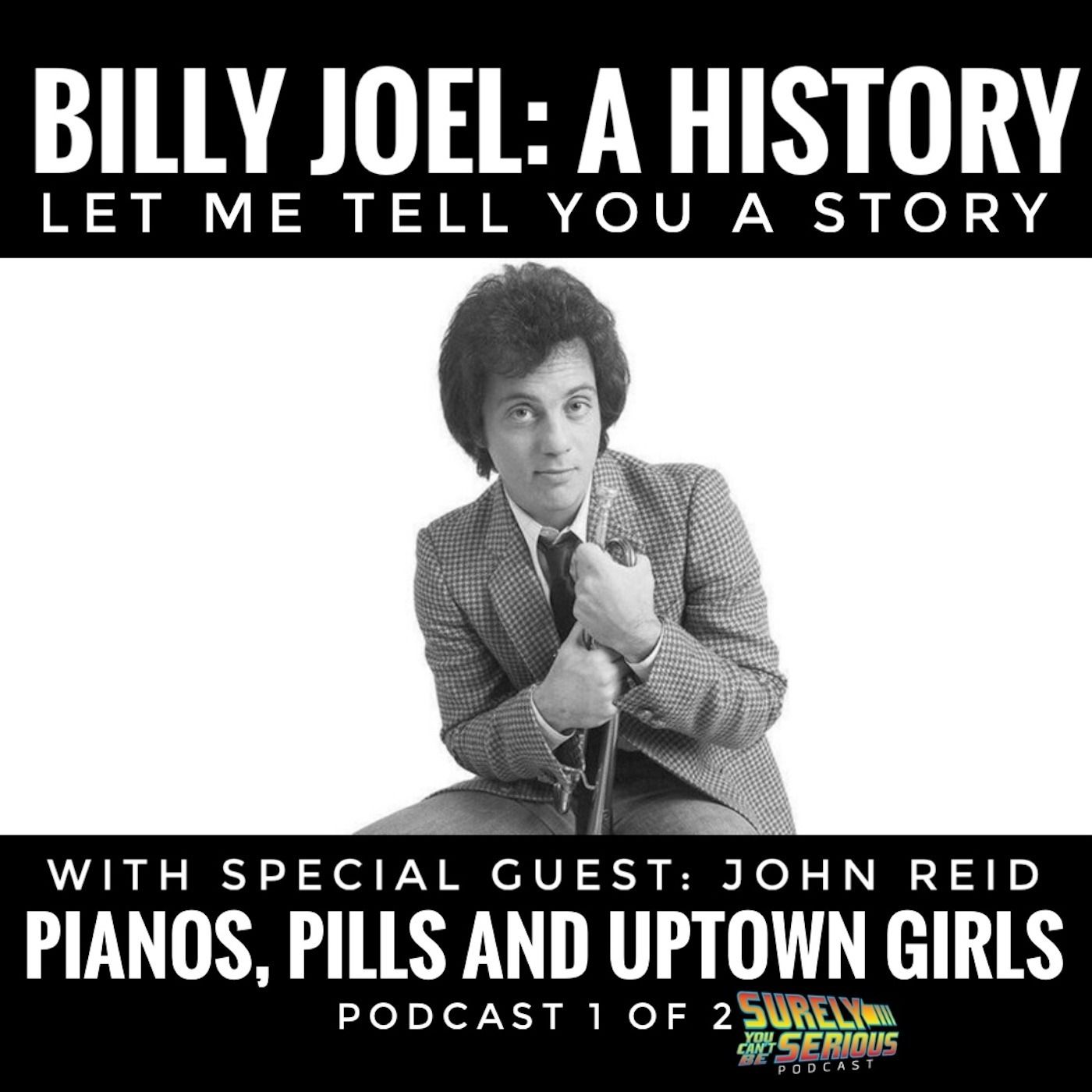
A Billy Joel History to 1983: Pianos, Pills and Uptown Girls
Billy Joel is one of the few artists that is as big today as he was in the 70s. His rise to fame, however, was not an easy one. His history is littered with broken relationships, financial woes and even a couple of suicide attempts. Join us this week along with our friend John Reid of the 30something Movie Podcast as we discuss Billy Joel's history up to 1983. Come back on Thursday to hear us discuss "An Innocent Man" track by track!
2023-03-07
40 min
Transcript
Available Results
Generated results are saved to the knowledge database for reuse and search.
No generated results are available for this episode yet.
Extract Knowledge
Pick what you want extracted first. Model, scope, and chapter options appear after a template is selected.
Generated results for public episodes are saved to the knowledge database so they can be reused and searched later.
Transcript
<v Speaker 1>Shaw m out Virginia anyway.
<v Speaker 2>Hello everybody, and welcome back to the Shirley You Can't
<v Speaker 2>Be Serious podcasts. Ladies and gentlemen, we have a story
<v Speaker 2>coming up for you that involves Billy Joel's manager impersonating
<v Speaker 2>a doctor in order to sneak him out of a
<v Speaker 2>mental hospital that he was in after a failed attempted
<v Speaker 2>suicide in this episode, if you're not going to stick
<v Speaker 2>around to hear that story, then I don't know what
<v Speaker 2>to do with yet. Jason, how are you doing, man?
<v Speaker 3>I'm good man. I've got a story on Billy Joel's
<v Speaker 3>Greatest twenty four Hours in the nineteen eighties that actually
<v Speaker 3>arrived Lionel Richie's Greatest twenty four Hours.
<v Speaker 2>So we are here today doing our second part to
<v Speaker 2>the two parts that we typically do. Last week we
<v Speaker 2>did Lionel Richie Can't Slow Down. This week we are
<v Speaker 2>comparing Billy Joel an innocent man, and because we happen
<v Speaker 2>to know the number one fan in the galaxy for
<v Speaker 2>Billy Joel, we invited our dear friend, mister John Reid
<v Speaker 2>from the thirty something Movie podcast. Mister John Reid from
<v Speaker 2>the Pocket Full of Kryptonite podcast mister John Reid, It's
<v Speaker 2>good to see you, buddy.
<v Speaker 4>How you doing.
<v Speaker 5>Man, Apparently my reputation precedes me, and it's like a
<v Speaker 5>mile long.
<v Speaker 3>That was the longest time, right, there's.
<v Speaker 5>I have looked for when you guys told me about
<v Speaker 5>this one this night in particular, I've looked forward to
<v Speaker 5>for the longest time. So yeah, I know, I know
<v Speaker 5>I'm guilty of that oftentimes, but overall, I'm typically an
<v Speaker 5>innocent man. It's getting to be careless talk, so I'm
<v Speaker 5>just going to leave a tender moment alone.
<v Speaker 2>I'd said, eladies and gentlemen, we're off for the night.
<v Speaker 2>Everybody tip your waitress.
<v Speaker 5>Oh my gosh, No, I'm looking forward to this, And
<v Speaker 5>it's been a while since since I've been able to
<v Speaker 5>talk with you.
<v Speaker 4>Guys.
<v Speaker 5>Are podcast full of Ryptonite still on a little bit
<v Speaker 5>of a hiatus for just a little bit. A Superman
<v Speaker 5>and Lois is coming back soon, so we'll have to
<v Speaker 5>get that back in the rotation.
<v Speaker 4>But it's been a while. It's been a while.
<v Speaker 2>So I was looking up because I needed to send
<v Speaker 2>you the Zoom invite today and we're trying to find
<v Speaker 2>your email and I just searched our texts and look,
<v Speaker 2>and I say to Jason, look, it's exactly three years
<v Speaker 2>ago that I asked him for his email for the
<v Speaker 2>first time. And we just always we pick things that
<v Speaker 2>we know are your favorites. So three years ago we
<v Speaker 2>got together and we did Superman, which of course eventually
<v Speaker 2>spun into podcasts full of Kryptonite. And then we have
<v Speaker 2>of course had you back on to Star Wars Holiday Special,
<v Speaker 2>which was fantastic. And now here we are with mister
<v Speaker 2>Billy Joel. I think the only thing we have left
<v Speaker 2>to do with you is the rocketeer.
<v Speaker 5>Let's do it. We can do the rocketeer in Billy Joel.
<v Speaker 5>At the same time, let's just talk about all.
<v Speaker 3>You ready to dive into the history of mister William
<v Speaker 3>Joel here to sing us a song tonight.
<v Speaker 2>Yeah, let's let's do it. So we're gonna take you
<v Speaker 2>back to eighty nine, eighteen eighty nine. Yeah, that's when
<v Speaker 2>a mister Carl Amson Joel was born. Mister Joel was
<v Speaker 2>born in Germany and in nineteen twenty eight he got
<v Speaker 2>himself invested in a textile factory. Was one of the
<v Speaker 2>key players in this textile factory. The only problem was
<v Speaker 2>is that nineteen twenty eight was about five years before
<v Speaker 2>it became the worst time in all of history to
<v Speaker 2>be in Germany because the Nazis so poor Jewish mister
<v Speaker 2>Joel was forced to sell his textile factory to an
<v Speaker 2>Aryan stooge, if you will. He was then forced to
<v Speaker 2>cut the price in half. Then the money was put
<v Speaker 2>in a trust account which he couldn't get access to.
<v Speaker 2>By this time, he has immigrated over to Switzerland with
<v Speaker 2>his wife and his young son, Helmet, who would later
<v Speaker 2>be called Howard. And they are there for a bit,
<v Speaker 2>but ultimately decide they have to get to the United States,
<v Speaker 2>so via France via England via Cuba. Eventually they end
<v Speaker 2>up in the US and he starts another factory. By
<v Speaker 2>nineteen fifty seven, he finally gets paid for his factory
<v Speaker 2>in Germany. And I tell you all that to tell
<v Speaker 2>you this. His young son, Helmut, whose name was Howard,
<v Speaker 2>also in nineteen fifty seven. He was a family man.
<v Speaker 2>He was married with two kids, a little girl named
<v Speaker 2>Judith and a little boy that they called Billy. Both
<v Speaker 2>of them were music prodigies. Howard was a piano prodigy.
<v Speaker 2>Billy was a prodigy by four years old Billy was
<v Speaker 2>take and piano lessons. And then right about the time
<v Speaker 2>that Billy's grandfather gets all of his money, his dad,
<v Speaker 2>Howard says, you know what, I liked Europe better, I'm
<v Speaker 2>going back. Oh and nobody's coming with me. Yeah, And
<v Speaker 2>so he leaves. He goes back to Europe, where he
<v Speaker 2>gets married again, has a second boy named Alexander, who
<v Speaker 2>is now a internationally famous composer. Billy Joel's half brother
<v Speaker 2>is an internationally famous composer named Alexander Joel.
<v Speaker 4>But back to.
<v Speaker 2>Nineteen fifty seven, when he leaves or Billy is he's
<v Speaker 2>got piano lessons that his mom is scraping up to
<v Speaker 2>give him. He's getting made fun of and bullied by
<v Speaker 2>the local Long Island kids, and so he's got a
<v Speaker 2>tough en up a little bit. And so what does
<v Speaker 2>he take up. He takes up boxing.
<v Speaker 3>He went twenty two and four box.
<v Speaker 2>He went twenty two and four had he had twenty
<v Speaker 2>six matches, lost four of them, the last two of
<v Speaker 2>them were by knockout, and so after that he was done.
<v Speaker 2>In that time, he also kept music, so he and
<v Speaker 2>his friends start this high school band. After he has
<v Speaker 2>fallen in love with the Beatles, and they call themselves
<v Speaker 2>the Lost Souls. Huh, you got a story for me?
<v Speaker 3>I got a story for you. So in the third grade,
<v Speaker 3>little William Joel, during their lunch hour, finds a piano
<v Speaker 3>in the lunch room starts playing hound Dog by Elvis Presley. Okay,
<v Speaker 3>and the fourth grade girls go crazy. Keep in mind
<v Speaker 3>he's a third grader. He's like, my mind was gaving
<v Speaker 3>up when the fourth grade girls were going crazy. I
<v Speaker 3>realized I was onto something, yeah, he said. Then he
<v Speaker 3>started to wiggle his hips and he got yanked off
<v Speaker 3>the stage by the school faculty.
<v Speaker 2>Well the seed was planted at that point.
<v Speaker 4>It's too late.
<v Speaker 2>It's like when Prince watched James Brown. He knew this
<v Speaker 2>was what he was destined.
<v Speaker 4>For in life.
<v Speaker 3>He said that the door locked behind him. He was
<v Speaker 3>going to be a musician the rest of his life.
<v Speaker 2>Yeah.
<v Speaker 3>So he was the.
<v Speaker 2>Type of kid who would go up to his room
<v Speaker 2>at night and say good night mom, and then sneak
<v Speaker 2>out the window and go hustle around, getting involved in
<v Speaker 2>mischief and stuff. And he was also a kid who
<v Speaker 2>was playing in bands.
<v Speaker 3>And he wasn't really a top notch student. He didn't
<v Speaker 3>graduate from high school right until like nineteen ninety two
<v Speaker 3>or three or something like that.
<v Speaker 2>Yeah, honorary ged or something like that.
<v Speaker 3>Right, Okay, mister English teacher may have to weigh in
<v Speaker 3>on this one. But he had a final in English
<v Speaker 3>that was mandatory for his graduation, and because he was
<v Speaker 3>at a gig playing, he slept through that test, didn't
<v Speaker 3>make it. Petitioned the school and they were like, nope, sorry,
<v Speaker 3>you don't graduate, and he's like, well, screw you, guys.
<v Speaker 3>I know I'm gonna be anyway. So what am I
<v Speaker 3>doing fooling around with high school? His words exactly were,
<v Speaker 3>I'm not going to Columbia University. I'm going to Columbia
<v Speaker 3>Records baby.
<v Speaker 5>And then, from what I understand, a quarter of a
<v Speaker 5>century later, he actually submitted his essays to the school
<v Speaker 5>board and they accepted them and gave him his diploma,
<v Speaker 5>like twenty five years after he left the school.
<v Speaker 3>The fact that they actually made him submit those essays,
<v Speaker 3>I mean, with Billy Joe calls and said, hey, kind
<v Speaker 3>of my ged I'd be like, yes.
<v Speaker 2>Never.
<v Speaker 5>In true public teacher fashion, they were like, I don't
<v Speaker 5>care who you are, that that work is late. If
<v Speaker 5>you want the credit you turn it in.
<v Speaker 3>Your essay on to Kill a Mockingbird was due twenty
<v Speaker 3>five years ago.
<v Speaker 2>I'm going to have to mark you down one point
<v Speaker 2>for every year. Latest thick bes Chi can get seventy five.
<v Speaker 2>So mister Joel continues in the music biz. He auditions
<v Speaker 2>for a guy named Erwin Maser Now Erwin ultimately becomes
<v Speaker 2>his manager. At the time, he was just a younger
<v Speaker 2>guy whose dad owned a cool club in a strip center.
<v Speaker 2>Of all places, I did another cool clubs and strip centers,
<v Speaker 2>but that's where Erwin's dad had one, and so he said, hey,
<v Speaker 2>I think you would be the perfect guy to join
<v Speaker 2>the group that I helped manage called the Hassles. The Hassles,
<v Speaker 2>thank you very much. He was still just a piano
<v Speaker 2>player for him, but he started singing more often, especially
<v Speaker 2>when their lead singer left. But ultimately the Hassles ended
<v Speaker 2>up being a hassle. They did two albums, they weren't
<v Speaker 2>well received anywhere, and ultimately the group broke up and
<v Speaker 2>Billy decided to go and form a duo band, a
<v Speaker 2>two piece band with the drummer from the Assholes, and
<v Speaker 2>that guy's name was John Small. What's interesting is that
<v Speaker 2>it's a duo band with a drummer and a keyboard player.
<v Speaker 2>And what's more interesting is they were gonna play heavy metal, right,
<v Speaker 2>that was their plan. They named the band Attila, and
<v Speaker 2>they decided we're going to be super loud, and they were,
<v Speaker 2>in fact so loud they got kicked out of the
<v Speaker 2>one gig that they had.
<v Speaker 3>The.
<v Speaker 1>One and Only California Flies.
<v Speaker 2>Billy is trying his best to find a place to live,
<v Speaker 2>ultimately ends up staying with John Small and his wife, Elizabeth.
<v Speaker 2>Elizabeth isn't super happy with John, her drummer husband, and
<v Speaker 2>so she kind of confides in Billy and is like, hey,
<v Speaker 2>you know here where things are going wrong. And as
<v Speaker 2>typically happens when those types of relationships develop, it very
<v Speaker 2>quickly turned into an affair. The one rule is in
<v Speaker 2>the band, you don't sleep with other band members. Wise
<v Speaker 2>it should be really easy when there's only one band member,
<v Speaker 2>there's only one other guy, only one guy, and he's
<v Speaker 2>the only guy who's married.
<v Speaker 3>Don't sleep with that girl, right, And he couldn't do it. Now.
<v Speaker 3>The interesting thing was they were separated for a time
<v Speaker 3>and Billy Joel thought, well they're separated, it's cool. We're
<v Speaker 3>kind of a trifecta. We were on a break and
<v Speaker 3>so his band member followed them home from a gig
<v Speaker 3>one time and saw them together. When he came in,
<v Speaker 3>Billy had no inkling that what he was doing was
<v Speaker 3>not cool or not all right, and he said, the
<v Speaker 3>guy slugged him out of nowhere. He's like, I've been
<v Speaker 3>punched before, but I'd never been punched that hard when
<v Speaker 3>I completely was not looking for it. Yeah, and then
<v Speaker 3>the guilt rained down on him.
<v Speaker 2>Yeah, and that stopped him right there. He never had
<v Speaker 2>another relationship with Elizabeth again. No that's not true. No, okay, yeah, no, sorry, Yeah,
<v Speaker 2>the relationship continued and he continue to feel guilty, and
<v Speaker 2>he said, I'm going to I have to tell him
<v Speaker 2>that this is still going on. And she said, if
<v Speaker 2>you tell him, I will leave both of you. And
<v Speaker 2>that pretty well ended things, not only for John and Elizabeth,
<v Speaker 2>but it also ended things for John and Billy. So
<v Speaker 2>nineteen seventy, Attila releases its only album, First and Last,
<v Speaker 2>and nobody liked it anyway. So nineteen seventy also is
<v Speaker 2>when Billy runs away with Elizabeth. They would later get married.
<v Speaker 2>She would later become his manager, but what's most impressive
<v Speaker 2>is we're going to talk about a video later on
<v Speaker 2>that one of the directors for Billy Joel's video is
<v Speaker 2>John Small. That's the guy who doesn't hold a grudge.
<v Speaker 3>I forget to forget. Wow. Now, during this time, Billy
<v Speaker 3>was actually suicidal. He had lost Elizabeth, he had lost
<v Speaker 3>his best friend, he had lost his band, he didn't
<v Speaker 3>have a gig.
<v Speaker 2>He was living in a laundromat. I can see how
<v Speaker 2>that might be a downer.
<v Speaker 4>Yeah.
<v Speaker 3>So what he did was he was given some anxiety pills,
<v Speaker 3>and so he decided, well, I got these pills. I
<v Speaker 3>guess I'll just take all of them. Yeah, And he
<v Speaker 3>woke up in the Burgency room.
<v Speaker 2>They had pumped his stomach.
<v Speaker 3>He had survived his half hearted suicide attempt.
<v Speaker 2>Yeah. Erwin, he was living with Irwin Mazer at the time.
<v Speaker 2>Erwin said, he woke up one morning, he walks into
<v Speaker 2>the kitchen and on the kitchen table he sees that
<v Speaker 2>Billy has written a song. They're like, oh, hey, there's
<v Speaker 2>a song Billy wrote. It's called Tomorrow's Today. That's interesting.
<v Speaker 2>He reads it and then you know, a few hours later,
<v Speaker 2>he gets the call from the hospital and he's like, oh, this.
<v Speaker 3>Is a suicide note. Oh okay, my bad.
<v Speaker 2>One thing that I didn't mention about Irwin Massour is
<v Speaker 2>that for a time he was a dental school attendant,
<v Speaker 2>but he dropped out of dental school. But when he
<v Speaker 2>goes to visit Billy at the hospital, Billy's like, they're crazy.
<v Speaker 2>You got to get me out of here. And so
<v Speaker 2>several failed attempts at legally getting him out of the hospital.
<v Speaker 2>Later he decided, I'm gonna throw on my old dental
<v Speaker 2>school attendant lab coat and he walks in and sneaks
<v Speaker 2>Billy Joel out of the mental hospital. Wow, that's creative.
<v Speaker 3>You know what he did to get into the mental hospital.
<v Speaker 2>He committed suicide. He tried to commit suicide. He well,
<v Speaker 2>his second attempt.
<v Speaker 3>Was he drank a bottle of old English.
<v Speaker 2>Oh yeah, furniture cleaner.
<v Speaker 5>What did you did you hear what he said about
<v Speaker 5>the second attempt when he drank the bottle of furniture polish,
<v Speaker 5>He was like, I actually pulled up the quote because
<v Speaker 5>I remember reading this one time and I wanted to
<v Speaker 5>get it right. Well, the furniture polish will probably taste
<v Speaker 5>better than the bleach. So I'll drink the furniture polish.
<v Speaker 5>And then he said all I ended up doing was
<v Speaker 5>farting furniture polish for a couple of days.
<v Speaker 2>And yeah, that's hilarious. Okay, so two suicide attempts.
<v Speaker 5>Oddly enough, that didn't polish him off. Ohuning I went
<v Speaker 5>there real quick. I was I was going to back
<v Speaker 5>up for a second to the Attila album. I was
<v Speaker 5>in a used bookstore years and years and years ago,
<v Speaker 5>and I ended up coming across a cassette tape and
<v Speaker 5>I pulled this tape out because it said Attila with
<v Speaker 5>Billy Joel, and I was like, wait, what, hold on,
<v Speaker 5>hold the phone. If you're a comic book fan, you
<v Speaker 5>might enjoy part of the Attila album because the very
<v Speaker 5>first song is titled wonder Woman. Canonically, I don't think
<v Speaker 5>it has anything to do with wonder Woman, but that
<v Speaker 5>is the name of the song.
<v Speaker 4>So if you want to just.
<v Speaker 5>Check it out to hear what Billy Joel's seventies progressive
<v Speaker 5>rock heavy metal sounds like, go for it. It's a
<v Speaker 5>weird little album.
<v Speaker 3>But I wonder if wonder Woman is an uptown girl
<v Speaker 3>or he's trying to serve me these softballs and I'm
<v Speaker 3>like swinging a mess.
<v Speaker 4>That's a secret that's a secret code for Elizabeth Small.
<v Speaker 2>So less than a month, less than a month after
<v Speaker 2>he has tried to kill himself the second time because
<v Speaker 2>of his failed music career, Irwin is at his brother's office,
<v Speaker 2>and Irwin's brother happens to be the art director for
<v Speaker 2>Paramount Records, and he's playing in one of Billy's songs
<v Speaker 2>and some long haired dude sticks his head through the
<v Speaker 2>door and says, who is that what you got there?
<v Speaker 2>And that dude's name was Michael Lang And if you
<v Speaker 2>don't recognize that name, he's the guy who did Woodstock. Wow,
<v Speaker 2>so not insignificant. Yeah, And he's like, oh you like it?
<v Speaker 2>And he goes no, not really, not my style, but
<v Speaker 2>I know a guy who I think would love it.
<v Speaker 2>And that is how Billy Joel meets the famous, if
<v Speaker 2>not infamous ARTI Rip. So Michael Lang sends the music
<v Speaker 2>to ARTI Rip. ARTI Rip calls up Irwin Maisur and says,
<v Speaker 2>I love Billy Joel. Let's make a deal, and Billy
<v Speaker 2>signs the as shoot as all of our newbie artists do.
<v Speaker 2>Signs the record deal quick because he wants to be
<v Speaker 2>a signed artist right, probably without reading a word of
<v Speaker 2>the contract. So with the signing of the deal, he
<v Speaker 2>gets back together with Elizabeth. They were on again, off again,
<v Speaker 2>and now they're on again and they're ready to produce
<v Speaker 2>mister Billy Joel's first an incredibly famous album, Cold Spring Harbor.
<v Speaker 6>She's gone away about her.
<v Speaker 5>I don't know.
<v Speaker 4>What it is, but I know that I can.
<v Speaker 2>Live with other.
<v Speaker 3>Cold Spring Harbor nineteen seventy one crickets.
<v Speaker 5>If he'd liked me to talk about Cold Spring Harbor,
<v Speaker 5>I could talk about Cold Spring Harbor and maybe one
<v Speaker 5>of the problems that came out with the Cold Spring
<v Speaker 5>Hart when they recorded it and they were I'm sorry
<v Speaker 5>that came out way too fast.
<v Speaker 2>I know, it's like you're a chipmunk or something that
<v Speaker 2>was weird.
<v Speaker 5>They went through and they recorded the whole thing, and
<v Speaker 5>I think it is because of a mastering error. His
<v Speaker 5>voice sounded way too high, you know, and Billy Joel
<v Speaker 5>he can sound he can hit the high notes, and
<v Speaker 5>there are times when when his voice can come out
<v Speaker 5>fairly high. But it ruined the whole album, like it
<v Speaker 5>ruined the sound of it. And he again, it was
<v Speaker 5>kind of feeling like, oh great, my first album and
<v Speaker 5>it's already a flop. It's got some great songs on it,
<v Speaker 5>but yeah, the mastering of it got all messed up.
<v Speaker 2>And truly the responsible party for that was Alardy Ripe,
<v Speaker 2>and he basically just said, the record's already been pressed.
<v Speaker 2>There's nothing we can do about it. It is what
<v Speaker 2>it is, literally, and so here he is. He's got
<v Speaker 2>this terrible album. What's he going to do now?
<v Speaker 3>He went to a listening party. He was at a
<v Speaker 3>listing party and he was listening. He's like, holy crap,
<v Speaker 3>I sound like a chipmunk, and then somebody else started laughing.
<v Speaker 3>So he took the record off, he threw it out
<v Speaker 3>the window and it just busted everywhere. Yeah, he was humiliated.
<v Speaker 2>He was humiliated. So he's not going to make his
<v Speaker 2>name through this first record. So his next alternative and
<v Speaker 2>pretty much only alternative at this point, is to make
<v Speaker 2>his name on the road. And since Arty was the
<v Speaker 2>one who had screwed up his first album, Irwin Maser
<v Speaker 2>was able to convince him, hey, you need to finance
<v Speaker 2>a tour, and so ARTI Rip puts up two hundred
<v Speaker 2>and fifty three hundred and fifty thousand dollars, which was
<v Speaker 2>a fair chunk of change in that time, and Billy
<v Speaker 2>starts touring the country, starts touring in Europe, is making
<v Speaker 2>a name as a live show and doing pretty good.
<v Speaker 2>And then he has a very very important moment where
<v Speaker 2>he appears on the WMMR radio station in Philadelphia and
<v Speaker 2>he plays a song that he has written while on
<v Speaker 2>the road, and that song is called Captain.
<v Speaker 1>Jack Saturday Night, yostill hanging around, tired of living in
<v Speaker 1>all on.
<v Speaker 5>Hostile You like one of the funny things. I mean,
<v Speaker 5>fast forward several years. Billy Joel I think, has said
<v Speaker 5>that's one of his least favorite songs over the years,
<v Speaker 5>he got so tired of playing it because one thing,
<v Speaker 5>and we'll talk about that as we're talking about all
<v Speaker 5>these different songs, is he's much more of a music person.
<v Speaker 4>You know. The lyrics to him always come second.
<v Speaker 5>He's much more about the music, and I think it's
<v Speaker 5>always more interesting interesting to him when he can do
<v Speaker 5>something that is almost classical and more complex. And he
<v Speaker 5>has said in subsequent interviews he's like, oh yeah, Captain Jack.
<v Speaker 5>He even said this was his quote. At this point.
<v Speaker 5>I've demoted him to Private Jack because it's just such
<v Speaker 5>a boring song. There was an interview where he starts
<v Speaker 5>to play it and he's just like, you can just
<v Speaker 5>tell he's bored even just playing it during that interview
<v Speaker 5>and he's like, oh, thank god a chord change, and
<v Speaker 5>then he moves into the next He is not a
<v Speaker 5>fan of that song now, I think because it is
<v Speaker 5>so simple, and I think some of those I think
<v Speaker 5>that's some of the some of the like build up
<v Speaker 5>over the years as to why he got disillusioned with
<v Speaker 5>his own career and his own success. Was he felt like, oh, man, like,
<v Speaker 5>the songs that get me real popular are the ones
<v Speaker 5>that like, I don't even really care for. Like, I know,
<v Speaker 5>I got to put the lyrics in there because that's
<v Speaker 5>what sells albums. But eh, all right, I.
<v Speaker 3>Found this story funny. He was out on the road
<v Speaker 3>to support that first album and they noticed there's a
<v Speaker 3>small group of women that showed up to all the shows.
<v Speaker 3>Turns out they were hookers, Oh, hired by our man,
<v Speaker 3>Ardie Rip to schmooz the DJs and to you know,
<v Speaker 3>support the band, to support the band, keep them up,
<v Speaker 3>you know, and whichever way they can.
<v Speaker 2>If that's moving up, then I'm moving out. So he
<v Speaker 2>plays Captain Jack on the radio station. It becomes their
<v Speaker 2>number one requested song, and as it turns out, a
<v Speaker 2>very important individual is listening, and here's this song, and
<v Speaker 2>that gentleman's name is Clive Davis. And if you don't
<v Speaker 2>know that name, you need to check out No Surprise
<v Speaker 2>by Aerosmith, where they said and then old Clyde Davis said,
<v Speaker 2>I'm surely gonna make you a star, because that's what
<v Speaker 2>Clive Davis did. Clive Davis was the head of Columbia Records,
<v Speaker 2>and he made a whole lot of stars Aerosmith, Bob Dylan,
<v Speaker 2>Bruce Springsteen, just to name a few. And so he
<v Speaker 2>calls up and says, hey, I want Billy on my label.
<v Speaker 2>Well the problem is, of course he's on Arty's label, still, right,
<v Speaker 2>And so Artie says, okay, tell you what, how about
<v Speaker 2>I'll let you have him. I just get twenty five
<v Speaker 2>percent of all of his album sales and all of
<v Speaker 2>his compositions for the next ten albums ten albums, sounds fair,
<v Speaker 2>ten albums, ten albums. By the way, ladies, Jim, and
<v Speaker 2>we're here to talk about album number nine. So you
<v Speaker 2>just know that Artie RiPP got twenty five percent of
<v Speaker 2>this baby too, gosh dang, So mister Joel was none
<v Speaker 2>too happy about that. He ends up firing Irwin Mazer
<v Speaker 2>over the deal because he thinks he's the one who's
<v Speaker 2>set him up for this. They remain friends, but he
<v Speaker 2>just doesn't think he's a good manager, and ultimately he decides, Hey,
<v Speaker 2>you know what, I'm not only going to marry Elizabeth,
<v Speaker 2>I'm going to make her my manager.
<v Speaker 6>Yep.
<v Speaker 5>Have you guys heard that they are talking about making
<v Speaker 5>a biopic of Billy Joel?
<v Speaker 4>No?
<v Speaker 3>Oh nice, that would be awesome.
<v Speaker 5>So they well maybe so they announced in I want
<v Speaker 5>to say it was back in March of twenty twenty
<v Speaker 5>two that they were going to be making the biopic
<v Speaker 5>of his life, the only and it's going to be
<v Speaker 5>directed by or at least the last thing I heard
<v Speaker 5>was it's gonna be directed by Adam RiPP, who is
<v Speaker 5>the son of Artie Rip. And the big hurdle that
<v Speaker 5>they've got is Billy Joel is not interested in having
<v Speaker 5>them make a movie of his early life, so he
<v Speaker 5>is not allowing them to use any of his music
<v Speaker 5>or his likeness. So they're how they're possibly going to
<v Speaker 5>make a biopick. What I've heard is they the biopick
<v Speaker 5>would would focus on the time of his life and
<v Speaker 5>career leading up to like I guess the end of
<v Speaker 5>the movie would be him releasing Captain Jack, him performing
<v Speaker 5>Captain Jack, and that being the first step to his stardom.
<v Speaker 5>It's it would deal with the time that he spent
<v Speaker 5>with the Hassles and and Attila and all that, and
<v Speaker 5>and Irwin Maser and but yeah, apparently they can't use
<v Speaker 5>his likeness or his music, so I'm not quite sure
<v Speaker 5>how you uh. I mean, weird Awl's weird would have
<v Speaker 5>been even more weird if you couldn't have him look
<v Speaker 5>like weird Al or play weird al music.
<v Speaker 2>So this is about a guy named Schmilly Schold a
<v Speaker 2>band named ginghis Khan in the Hustler.
<v Speaker 4>Yeah, so I think you're going to pull that off.
<v Speaker 2>But well, so he now has to pay back some
<v Speaker 2>of the money and is trying to dodge the creditors
<v Speaker 2>that are coming back after him. So what he ends
<v Speaker 2>up doing is playing lowly piano bar gigs in La
<v Speaker 2>under the name Billy Martin. During that time, he meets
<v Speaker 2>a guy named Davy who's still in the Navy, and
<v Speaker 2>a guy named Paul who's a real estate novelist.
<v Speaker 5>And probably that one guy probably will be for life.
<v Speaker 3>Yes, nineteen seventy three, he writes and records Piano Man.
<v Speaker 1>It's nine o'clock gone a Saturday.
<v Speaker 3>I regular crowd shuffles in. Man.
<v Speaker 2>That's a good way to come back in after a terrible,
<v Speaker 2>terribly bad, failed attempt at a first album. What a
<v Speaker 2>great way to reintroduce yourself.
<v Speaker 5>To the world.
<v Speaker 4>Have you guys ever heard any of the demo versions
<v Speaker 4>of his songs?
<v Speaker 2>I don't think so.
<v Speaker 5>They had this entire you can find them on YouTube,
<v Speaker 5>but they had this entire I think it was released
<v Speaker 5>as an album. It was called My Lives and it's
<v Speaker 5>a it's an album of like remixes and demo versions.
<v Speaker 5>And I was just listening to this the other day
<v Speaker 5>because some of these I had not heard before. And
<v Speaker 5>the Piano Man demo is really it's like it's like
<v Speaker 5>the whole alternate universe kind of thing. It's the Mandela effect,
<v Speaker 5>Like it's it sounds like Piano Man, but the lyrics
<v Speaker 5>from the get go are different and so and it's
<v Speaker 5>like you're listening to Billy Joel sing a song that
<v Speaker 5>you're like, no, no, hold on, that's not right. I'm going
<v Speaker 5>to actually bring that back when we talk about some
<v Speaker 5>of the songs on the album that we're here to
<v Speaker 5>talk about, because there's a demo that I actually liked
<v Speaker 5>better than the song that was released. But yeah, that
<v Speaker 5>that album is kind of fun. But to hear that
<v Speaker 5>demo of Piano Man, it's very and it sounds very
<v Speaker 5>different too. It's it's almost very echo we like it's
<v Speaker 5>it's got an echo effect. It's been added to it.
<v Speaker 5>I'm like, that just sounds it's weird.
<v Speaker 6>Said Son calling you play me a memory. I'm not
<v Speaker 6>really sure how it goes.
<v Speaker 4>You know.
<v Speaker 3>In our Patreon episode this month, we're dropping a Patreon
<v Speaker 3>episode on take on.
<v Speaker 2>Me by Aha.
<v Speaker 3>That song went through multiple, like three or four different
<v Speaker 3>variations before it hit.
<v Speaker 4>Yeah.
<v Speaker 3>First one, you have that keyboard riff, but the words
<v Speaker 3>are totally different. Yeah, go to our Patreon page, by
<v Speaker 3>the way, check those episodes out.
<v Speaker 4>It's awesome.
<v Speaker 3>So after The Piano Man is released in nineteen seventy three,
<v Speaker 3>it reaches number twenty five in the Hot one hundred.
<v Speaker 3>By the way, we'll roll through these pretty quick. But
<v Speaker 3>nineteen seventy four, he releases an album called Street Live
<v Speaker 3>Serenade with the song you might know called the Entertainer.
<v Speaker 6>I am the Entertainer and I know just square Eyes
<v Speaker 6>stand an a serenader and another long haired band.
<v Speaker 1>Today I Am You're Champion a male one young you know.
<v Speaker 5>Again his his struggle with the recording industry, and it's
<v Speaker 5>it's got the line in the song, I'm gonna mess
<v Speaker 5>it up here in a second, but it's like, if
<v Speaker 5>you're gonna have a hit, you gotta make it fit.
<v Speaker 5>So they cut it down to three zero five, and
<v Speaker 5>kind of like his commentary on I gotta I mean
<v Speaker 5>the stuff if it's gonna get on the radio and
<v Speaker 5>I'm gonna be a hit, I gotta do this stuff.
<v Speaker 4>But that's not it's not what I want to do.
<v Speaker 5>So you can kind of see the little hints here
<v Speaker 5>and there of it's just like some of the other
<v Speaker 5>creatives that you know, we know and love and talk about,
<v Speaker 5>like you know, George Lucas getting you know, fed up
<v Speaker 5>with the whole studio system and wanting to be free
<v Speaker 5>to create his artwork. And but yeah, I love the
<v Speaker 5>I love the song. The entertainer is just such a
<v Speaker 5>such a fun little microcosm.
<v Speaker 4>I think of Billy Joel's, especially his early career.
<v Speaker 3>Okay, in nineteen seventy six, he releases Turnstiles, and the
<v Speaker 3>song that I know most from that is called New
<v Speaker 3>York State of Mind.
<v Speaker 5>Turnstiles is a great too, like that one You've got
<v Speaker 5>Say Goodbye to Hollywood Summer Highland Falls, that's a great
<v Speaker 5>I love the piano in that one. That's He's referred
<v Speaker 5>to that one as his bipolar song. New York State
<v Speaker 5>of Mind is amazing. James is a fun song. I
<v Speaker 5>mean that one's kind of that's a little underrated James.
<v Speaker 5>And then the song that follows it is The Angry
<v Speaker 5>young Man, And I feel like those two could kind
<v Speaker 5>of go together, Like James, based on the lyrics of
<v Speaker 5>the song, he could develop into an angry young man.
<v Speaker 5>But then the one that I've always loved this song
<v Speaker 5>is it ends with Miami twenty seventeen. It's one of
<v Speaker 5>those kind of like I always love a good alternate
<v Speaker 5>history story, alternate universe kind of a story, and just
<v Speaker 5>and especially when it got to be twenty seventeen and
<v Speaker 5>they kind of made a big deal about this song
<v Speaker 5>again and they started playing it. I'm like, I've always
<v Speaker 5>thought that song is so cool, and it's actually one
<v Speaker 5>of his few songs where he kind of he comes
<v Speaker 5>right out and comments on something political because it had
<v Speaker 5>to do with the city of New York going bankrupt
<v Speaker 5>in the early seventies, and I think it was President Ford.
<v Speaker 5>It was the famous headline in the newspaper. Ford says,
<v Speaker 5>drop dead to New York City, and Billy Joel is like, well, God,
<v Speaker 5>what would it be like if New York City goes
<v Speaker 5>bankrupt and we have to like sell things off and
<v Speaker 5>shut things down. And so that whole song grew out
<v Speaker 5>of that whole battle between New York and President Ford.
<v Speaker 4>Yeah.
<v Speaker 3>Cool. Well, nineteen seventy seven is where I kind of
<v Speaker 3>entered the picture here. I remember this album as a
<v Speaker 3>young kid. The Stranger is released in nineteen seventy seven.
<v Speaker 1>Don't Go Change to Try Please Me You never let
<v Speaker 1>me down before.
<v Speaker 3>Don't That has songs like just the way you are
<v Speaker 3>only the good die young moving out and She's always
<v Speaker 3>a woman to me.
<v Speaker 2>Yeah, there's an important thing that happens the album before this.
<v Speaker 2>Turnstile is where Billy he was initially given a Columbia
<v Speaker 2>producer and given the band the backing band for Elton John,
<v Speaker 2>which seemed like a good fit, but it wasn't working
<v Speaker 2>for him and he was like, no, I don't want
<v Speaker 2>to do that, and he ends up going back to
<v Speaker 2>Long Island and getting buddies that are musicians, like guys
<v Speaker 2>come play on the album. They're the ones that of
<v Speaker 2>course become his band forever after that. And then whenever
<v Speaker 2>that's done, the stranger comes along and he's like, Okay,
<v Speaker 2>I'm kind of done with producing and performing. We needed
<v Speaker 2>a producer and that's where we introduced mister Phil Ramone,
<v Speaker 2>who is also the producer of An Innocent Man.
<v Speaker 5>This is one of those albums, and I could say
<v Speaker 5>this just about any one of his albums, but this
<v Speaker 5>one in particular, I think it's it's gotten better reception
<v Speaker 5>as time has gone on. I think people have gone
<v Speaker 5>back and it got positive reviews when it came out,
<v Speaker 5>but I think since then a lot of people look
<v Speaker 5>back on this one and they're like, this is probably
<v Speaker 5>his most so lyrical album. I think a lot of
<v Speaker 5>people would would argue it may be his best and
<v Speaker 5>there's just so many songs. I mean, if you look
<v Speaker 5>at the songs on that album, moving Out the Stranger,
<v Speaker 5>just the way you are scenes from an Italian restaurant, Vienna,
<v Speaker 5>only the good Die Young, She's always a woman. I
<v Speaker 5>mean you get to the last two songs in the
<v Speaker 5>album before I go, oh yeah, I know those songs too,
<v Speaker 5>Like all the other songs are absolutely like throw those
<v Speaker 5>all on the Greatest Hits albums, and I think they
<v Speaker 5>are on all the greatest hits albums.
<v Speaker 3>Oh yeah, yeah, it's like a greatest Hits album in itself.
<v Speaker 4>Yeah, Okay.
<v Speaker 3>In nineteen seventy eight, he releases fifty second Street. For me,
<v Speaker 3>the biggest song on the album is My Life.
<v Speaker 2>Because of Buds Buddy, Because because of Budding budsm Buddy.
<v Speaker 2>It's a great song, man, it is a great song idea.
<v Speaker 2>It's kind of iconic for me. I think that was
<v Speaker 2>the song that really I was like, this guy sings
<v Speaker 2>this song.
<v Speaker 7>And I made that connection I grew up. We haven't
<v Speaker 7>really talked about this. I really had a lot of
<v Speaker 7>Billy Joel growing up. My dad was a big fan.
<v Speaker 7>My dad loved the Beatles. Billy Joel loved the Beatles.
<v Speaker 7>They were both born in forty nine. There's definitely an
<v Speaker 7>influence there. And so there was tons of Billy Joel
<v Speaker 7>in my childhood. John, same thing for you, right absolutely.
<v Speaker 5>In fact, now that we've gotten to this album, I
<v Speaker 5>would say, growing up in my childhood, same thing. My
<v Speaker 5>dad loved the Beatles, loved Billy Joel. So we were
<v Speaker 5>constantly listening to Billy Joel in the car at home.
<v Speaker 5>And if I had to pick the Billy Joel albums
<v Speaker 5>that were on regular rotation for me growing up, we
<v Speaker 5>actually had I think my uncle had made a cassette copy.
<v Speaker 5>He had gotten the video of Live at Long Island
<v Speaker 5>the concert, and then he had made a copy of
<v Speaker 5>that concert on cassette. So for a a lot of
<v Speaker 5>my childhood, that was the cassette that was just constantly
<v Speaker 5>being played. I still have it somewhere and it still works.
<v Speaker 5>I'm just afraid to play it because I don't want
<v Speaker 5>it to break. But that was on all the time, constantly.
<v Speaker 5>But the two albums in particular, and if I had
<v Speaker 5>to vote and say, what are my two favorite Billy
<v Speaker 5>Joel albums, it's fifty second Street and It's Innocent Man.
<v Speaker 5>So and I know I know some folks, you know,
<v Speaker 5>they look at this album and there's like, yeah, I
<v Speaker 5>mean you got big shot, you got my life. And
<v Speaker 5>then beyond that, there's some other ones on there. I
<v Speaker 5>look at this album and I go, oh, You've got Honesty.
<v Speaker 5>I love the song Honesty. I love the song Rosa
<v Speaker 5>Linda's Eyes is probably one of my favorite songs of
<v Speaker 5>his half a Mile Away fifty second Street. And it's
<v Speaker 5>funny because I always feel like this album is very jazzy,
<v Speaker 5>and I'm not always a huge fan of jazz. Sorry
<v Speaker 5>to Patrick Cannagallo, one of my co hosts on the
<v Speaker 5>thirty something Movie podcast, who loves jazz, I'm not as
<v Speaker 5>much of a jazz guy, but this one is so
<v Speaker 5>very much so, and in particular the song I love
<v Speaker 5>the song Rosalinda's Eyes. And do you guys know the
<v Speaker 5>story behind that one? So it's actually a song his
<v Speaker 5>mom's name was Rosalind And basically the song is about
<v Speaker 5>a I think it's about a Cuban singer who is
<v Speaker 5>singing in a Puerto Rican band and he's kind of
<v Speaker 5>struggling and and it's you know, the song is about
<v Speaker 5>him kind of falling for this woman in this club
<v Speaker 5>and her name is Rosa Linda and Billy Joel has
<v Speaker 5>said that he treats this at this song as the
<v Speaker 5>love letter he feels like his father always should have
<v Speaker 5>written to his mother, and it was also his kind
<v Speaker 5>of his thank you to his mother, like thank you
<v Speaker 5>for getting me all the lessons you gave me, thank
<v Speaker 5>you for supporting me, thank you for being there even
<v Speaker 5>when you know my father left. Thank you for always
<v Speaker 5>being the one that really pushed me to get to
<v Speaker 5>where I am today. And I love that that this
<v Speaker 5>was the love letter that his father should have written
<v Speaker 5>for his mother.
<v Speaker 4>So he's going to do it for her.
<v Speaker 3>That's awesome.
<v Speaker 5>Feat Love love that album fifty second Street. I love
<v Speaker 5>that album.
<v Speaker 3>Okay, in nineteen eighty we have glass houses and this
<v Speaker 3>was a huge album for me as well. Right you've
<v Speaker 3>got It's still rock and roll to me. You may
<v Speaker 3>be right.
<v Speaker 2>Where are you guys? In this one best album cover
<v Speaker 2>of all Billy Joel album covers. I can remember this one.
<v Speaker 2>I told you when we did our Lionel Richie episode
<v Speaker 2>that seeing him sitting on that chair in our stack
<v Speaker 2>of albums was something I remember clearly. This album is
<v Speaker 2>another cover that I remember clearly, him staring at a
<v Speaker 2>giant window about to chunk a rock into it. I
<v Speaker 2>love it.
<v Speaker 5>Yeah, and it fits so much with just the opening
<v Speaker 5>of the very first song. You've got the shattering glass
<v Speaker 5>and you May be Right and it just you're you're
<v Speaker 5>off and running at that point.
<v Speaker 3>Really cool. Yeah, it's a it's a neat thing that
<v Speaker 3>they do there.
<v Speaker 5>Yeah, And this is one of those you know, I
<v Speaker 5>love this album. I mean I love all of his albums,
<v Speaker 5>but this is one of those where obviously kind of
<v Speaker 5>side one of the album. If you if you break
<v Speaker 5>it in half and you do the side one, side
<v Speaker 5>two of the original release Side one definitely much much
<v Speaker 5>stronger than side two, but still some other really great songs.
<v Speaker 5>Having taken French in middle school and high school, I
<v Speaker 5>do love set atois You were the One, but I
<v Speaker 5>mean the whole first side You May be Right sometimes
<v Speaker 5>a fantasy. Don't ask me why still rock and roll
<v Speaker 5>to me? All for Lena. I mean, those are those
<v Speaker 5>are awesome.
<v Speaker 3>Calid, don't don't.
<v Speaker 4>It's old John still older than me.
<v Speaker 2>You may be Right. As one of those year worms
<v Speaker 2>that routinely comes up in my mind player, I think
<v Speaker 2>it might be from the album and the Chipmunks Chipmunk
<v Speaker 2>Punk the album though, just kidding, well not really, That's
<v Speaker 2>probably where I started with it. But it's definitely Billy
<v Speaker 2>Joel that is playing in my head. Chipmunk Punk again
<v Speaker 2>making an appearance.
<v Speaker 6>All right.
<v Speaker 3>Nineteen eighty one, we have the album Songs in the Attic.
<v Speaker 3>This is a collection of live tracks. Are you fan
<v Speaker 3>of this one? John?
<v Speaker 5>You know what, I haven't listened to this one as much.
<v Speaker 5>Typically when I go, if I want to go for
<v Speaker 5>live versions of the song, I will tend to gravitate
<v Speaker 5>towards that live at Long Island album. So I've listened
<v Speaker 5>to this one a bit, but I am so used
<v Speaker 5>to it because it was on such regular rotation growing up.
<v Speaker 5>I tend to gravitate over to that one. But still
<v Speaker 5>a really fun collection from a bunch of his early albums.
<v Speaker 2>The song off of this album that I love is
<v Speaker 2>that you don't hear elsewhere is She's Got Away. It
<v Speaker 2>was one that was actually on Cold Spring Harbor, but
<v Speaker 2>you know what happened with that album, and so the
<v Speaker 2>way that I know it is the live version.
<v Speaker 3>Cool.
<v Speaker 2>Yeah, that's good one.
<v Speaker 5>My wife and I are probably one of our favorite
<v Speaker 5>songs of his is You're My Home off of Piano Man,
<v Speaker 5>and I actually just introduced her the other day to
<v Speaker 5>a cover of it because she also, you know, Helen
<v Speaker 5>Ready that did the song in the in the Disney
<v Speaker 5>movie Pete's Dragon. I was thinking, I think it was
<v Speaker 5>Candles on the Water was the song. She actually does
<v Speaker 5>a cover version of You're My Home, and so I
<v Speaker 5>played that for my wife the other day. I said,
<v Speaker 5>you want to mix two things you really enjoy, Billy
<v Speaker 5>Joel and Helen Ready.
<v Speaker 4>Well, we'll get Ready there you go.
<v Speaker 3>I believe that's the first time that Pete's Dragon has
<v Speaker 3>ever been brought up on our show.
<v Speaker 2>That's a travesty right there.
<v Speaker 4>Hopefully it won't be the last.
<v Speaker 2>All right.
<v Speaker 3>In nineteen eighty two, he releases the album The Nylon,
<v Speaker 3>and this includes songs like Pressure and Alentown, good Night, Sigon.
<v Speaker 5>For me the weirdest one and as a kid, I
<v Speaker 5>don't know, maybe just because he said it was weird
<v Speaker 5>on the live album, I was like, I love the
<v Speaker 5>song Scandinavians guys like it is such a weird song.
<v Speaker 5>It's not my favorite one off the album, but you
<v Speaker 5>know that one. I love that one too, But yeah, Alanown, Pressure,
<v Speaker 5>good Night's Saigon Pressure in particular, it was always funny
<v Speaker 5>to me, like, as a kid, I love these songs
<v Speaker 5>and I would We used to have one of those
<v Speaker 5>tape decks that you know, had a microphone attached to it,
<v Speaker 5>and so I think my parents probably switched off the
<v Speaker 5>microphone just so they didn't have to listen to the
<v Speaker 5>kids sing all the time. But we would take that
<v Speaker 5>thing and try to do our own little lip sync
<v Speaker 5>karaoke kind of a deal. And so I'm sure it
<v Speaker 5>was hilarious to watch, like this seven year old kid
<v Speaker 5>singing the song Pressure, because what kind of pressure have
<v Speaker 5>I had in my life up to this point?
<v Speaker 2>One of the lyrics and that song you're not allowed
<v Speaker 2>to sing it's seven year old?
<v Speaker 5>Well, you know, I think it was because in the
<v Speaker 5>at least in the live version, I'm trying to remember
<v Speaker 5>about the other one, he does mention Sesame Street in
<v Speaker 5>the song, So I think as a seven year old,
<v Speaker 5>I was like, no, it's a Billy Joel song that
<v Speaker 5>mentioned Sesame Street.
<v Speaker 4>I'm all like to do, what does it mean?
<v Speaker 3>All right? Three other really eventful things happen in nineteen
<v Speaker 3>eighty two. On April fifteenth, nineteen eighty two, Billy Joel's
<v Speaker 3>involved in a terrible motorcycle accident.
<v Speaker 2>Yeah, in the midst of recording, like they're not even
<v Speaker 2>finished with the album, and it messes up his hand.
<v Speaker 2>It busts up his hands, which is a pretty bad
<v Speaker 2>deal if you were the piano man.
<v Speaker 3>If you're the piano man, that's a big deal.
<v Speaker 4>Yeah.
<v Speaker 3>And also in nineteen eighty two, he served divorce papers
<v Speaker 3>from his wife while he's in the hospital recovering from
<v Speaker 3>a busted up hand. When you're a piano player, so
<v Speaker 3>you lay hands on you when you're stuck in a
<v Speaker 3>hospital bit, Oh my gosh. And then also in nineteen
<v Speaker 3>eighty two, his good buddy Paul Simon invites him on
<v Speaker 3>a vacation to Saint Bart's Man, that faithful trip. We'll
<v Speaker 3>talk about just a little bit.
<v Speaker 2>Are we there yet? Are we there yet? Are we
<v Speaker 2>there yet?
<v Speaker 3>I think we are.
<v Speaker 2>There, guys. It is time for us to discuss an
<v Speaker 2>innocent man. Track by track. See, we gave a whole
<v Speaker 2>bridge of information. Oh you said abridged. I'm sorry, I
<v Speaker 2>messed all of that up. I did a whole bridge
<v Speaker 2>of history right there. What you wanted was an abridged history.
<v Speaker 3>You know you mean the bridge right.
<v Speaker 2>Oh, there you go.
<v Speaker 5>Bring it back, the bridge which helps us get over
<v Speaker 5>the river of dreams.
<v Speaker 3>There you go.
<v Speaker 2>Okay, you had to be a big shot, did ye
<v Speaker 2>had to open up your mouth?
<v Speaker 4>Yes?
<v Speaker 2>All right, guys, So we will come back next week
<v Speaker 2>and talk about an innocent man. Track by track, John
<v Speaker 2>will be back with us.
<v Speaker 5>I will wait the longest time. Whatever you need.
<v Speaker 3>We will see you guys next week or in a
<v Speaker 3>few days, whatever it is.
<v Speaker 6>So
Chapters
No chapters available.