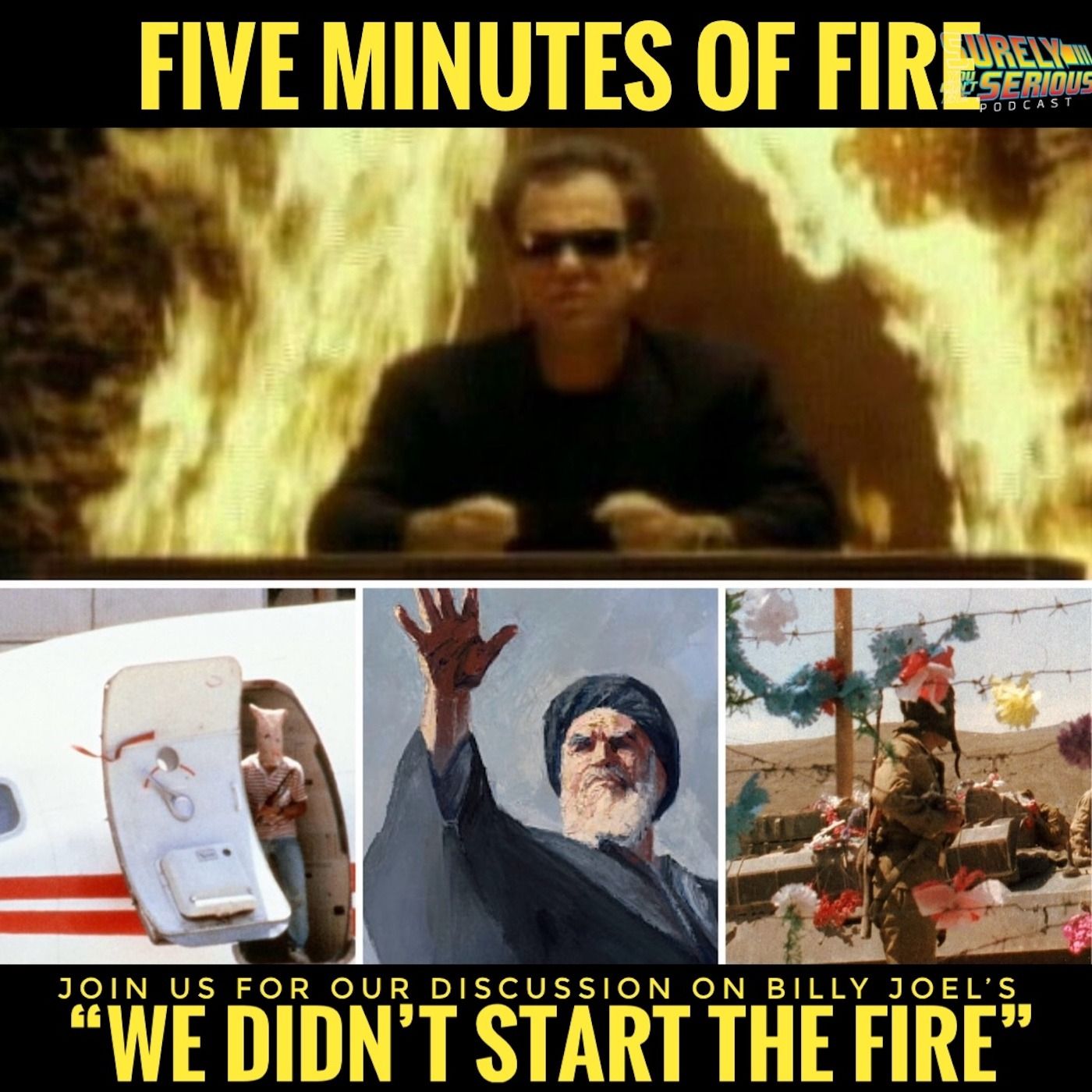
"Five Minutes of Fire": Terror on the Airline, Ayatollah's in Iran, Russians in Afganistan
Embark on a daily voyage through the pages of history with "Five Minutes of Fire," the podcast series that peels back the layers of Billy Joel's iconic anthem, "We Didn't Start the Fire." Join us twice a day for a concise yet insightful exploration of the historical names and events that have shaped the 20th century.In today's episode, the flames of history flicker with the early airplane hijackings, moments that marked a shift in the perception of air travel. We then delve into the transformative era with Ayatollah Khomeini, a pivotal figure in the Iranian Revolution that reshaped the Middle East. The narrative takes a geopolitical turn with Russians invading Afghanistan, setting the stage for a conflict that would have far-reaching consequences.In just five minutes, we'll guide you through these historical snapshots, providing context, anecdotes, and a deeper understanding of the individuals and events that defined their times. Whether you're a devoted Billy Joel fan or someone eager to explore the stories behind the lyrics, "Five Minutes of Fire" is your daily ticket to historical enlightenment.Subscribe now to join us as we unravel the verses of "We Didn't Start the Fire," offering insights that breathe life into the captivating tales behind the names etched into the song. "Five Minutes of Fire" - where history unfolds swiftly and vibrantly, twice a day. Don't miss your daily spark of historical exploration!
2024-01-19
4 min
Transcript
Available Results
Generated results are saved to the knowledge database for reuse and search.
No generated results are available for this episode yet.
Extract Knowledge
Pick what you want extracted first. Model, scope, and chapter options appear after a template is selected.
Generated results for public episodes are saved to the knowledge database so they can be reused and searched later.
Transcript
<v Speaker 1>I'm Jason Colvin, I'm d Graves.
<v Speaker 2>Give us five minutes and we will give you the fire.
<v Speaker 1>Hello everybody, and welcome back to the Surely You Can't
<v Speaker 1>Be Serious Podcast Special Edition five Minutes of Fire. We
<v Speaker 1>are here talking about the lyrics of we Didn't Start
<v Speaker 1>the Fire by Billy Joel. We're covering only five minutes
<v Speaker 1>at a time, which is about to link the song,
<v Speaker 1>so it works out kind of nicely. So please join
<v Speaker 1>us as we dive into some new lyrics today. All right, guys,
<v Speaker 1>so here are the topics that we're going to.
<v Speaker 2>Be covering today.
<v Speaker 1>Terror on the airlines.
<v Speaker 2>Ayatola's in Iran, Russians in Afghanistanine. Okay, do you tell
<v Speaker 2>us about terror.
<v Speaker 1>On the airline? Okay. So, plane hijacking has been a
<v Speaker 1>thing almost as long as there have been planes. It
<v Speaker 1>was actually kind of an epidemic for a long period
<v Speaker 1>of time from nineteen twenty seven to nineteen sixty eight.
<v Speaker 1>But they put screenings and other safety measures in effect,
<v Speaker 1>and the amount of hijacking had seriously decreased by nineteen eighty.
<v Speaker 1>But in nineteen eighty a new form of hijacking began,
<v Speaker 1>and that was the hijacking of planes by organized terrorists.
<v Speaker 1>I remember hearing about these things frequently as a kid.
<v Speaker 1>Some of the most notable ones are Air India Flight
<v Speaker 1>one eighty two, which was hijacked and bombed over the
<v Speaker 1>Irish coast. In eighty eight, we had pan Am flight
<v Speaker 1>one oh three and it was bombed while flying over Scotland.
<v Speaker 1>This created the terror of being on airplanes, and obviously
<v Speaker 1>the nineties saw a significant decrease until, of course, two
<v Speaker 1>thousand and one we had the biggest terrorist plane hijacking
<v Speaker 1>in history. All right, Jason Iatola, who is he? And whyse?
<v Speaker 2>And Iran Okay Iatola Ruhola Komani was an Iranian Islamic revolutionary,
<v Speaker 2>politician and religious leader who served as the First Supreme
<v Speaker 2>Leader of Iran from nineteen seventy nine until his death
<v Speaker 2>in nineteen eighty nine. He opposed the shaw's rights to women,
<v Speaker 2>He opposed land reforms, and he wanted to free Iran
<v Speaker 2>from the influence of the US and the uss R.
<v Speaker 2>He wanted to eliminate religious minorities and no state of Israel.
<v Speaker 2>He was the founder of the Islamic Republic of Iran
<v Speaker 2>and the leader of the Iranian Revolution. Which overthrew the
<v Speaker 2>US supported Shaw that ended the Iranian monarchy. He turned
<v Speaker 2>Iran from a actually a Western friendly country into a
<v Speaker 2>theocratic rogue state. He called America the Great Satan and
<v Speaker 2>Russia the Blesser Satan. Komani served as Iran's ultimate political
<v Speaker 2>and religious authority for many years. He was involved in
<v Speaker 2>the US hostage crisis, and my favorite moment of his
<v Speaker 2>is when Leslie Nilsen punches him at the beginning of
<v Speaker 2>The Naked Gun.
<v Speaker 1>I remember that. I remember that guy. I mean he
<v Speaker 1>the Beard, the white Beard, and the black Turban and
<v Speaker 1>he was the face of evil in the eighties for me. Yes, yeah, yeah, Okay.
<v Speaker 2>Do you tell us about Russians in Afghanistan?
<v Speaker 1>Okay? So. The Soviet Afghan War was a protracted armed
<v Speaker 1>conflict in the Soviet controlled Democratic Republic of Afghanistan. It
<v Speaker 1>went from nineteen seventy nine to nineteen eighty nine. The
<v Speaker 1>war was a major conflict of the Cold War, saw
<v Speaker 1>extensive fighting between the DRA the Soviet Union. The war
<v Speaker 1>was a major conflict of the Cold War. There was
<v Speaker 1>extensive fighting between the DRA, the Soviet Union, and allied
<v Speaker 1>paramilitary groups against the Afghan Mujahedeen and their allied foreign fighters.
<v Speaker 1>The Mujahadeen was backed by various countries and organizations. Most
<v Speaker 1>of their support came from Pakistan or the United States
<v Speaker 1>as part of the Operation Cyclone, the United Kingdom, China
<v Speaker 1>and Iran, and some of the Arab states of the
<v Speaker 1>Persian Gulf. The involvement of these foreign powers made it
<v Speaker 1>really more of a proxy war between the US and
<v Speaker 1>the Soviets. The combat went through the entire course of
<v Speaker 1>the eighties, mostly in the Aft countryside. It led to
<v Speaker 1>the deaths of between five hundred and sixty two thousand
<v Speaker 1>and two million Afghan citizens. Millions more fled from the
<v Speaker 1>country as refugees. Mostly they ended up in Pakistan and Iran.
<v Speaker 1>Approximately six and a half percent of the Afghanistan population
<v Speaker 1>is estimated to have been killed over the course of
<v Speaker 1>the conflict. The Soviet Afghan War caused destruction throughout Afghanistan
<v Speaker 1>and has been cited by scholars as a factor that
<v Speaker 1>contributed to the dissolution of the Soviet Union, formally ending
<v Speaker 1>the Cold War. A sad thing that we know now
<v Speaker 1>is that a lot of those arms that we supplied
<v Speaker 1>to them back then, they began using when they fought
<v Speaker 1>against us, and here in the twenty first century. Okay, guys,
<v Speaker 1>that does it for today's episode. Join us next time
<v Speaker 1>for five minutes of fire.
Chapters
No chapters available.