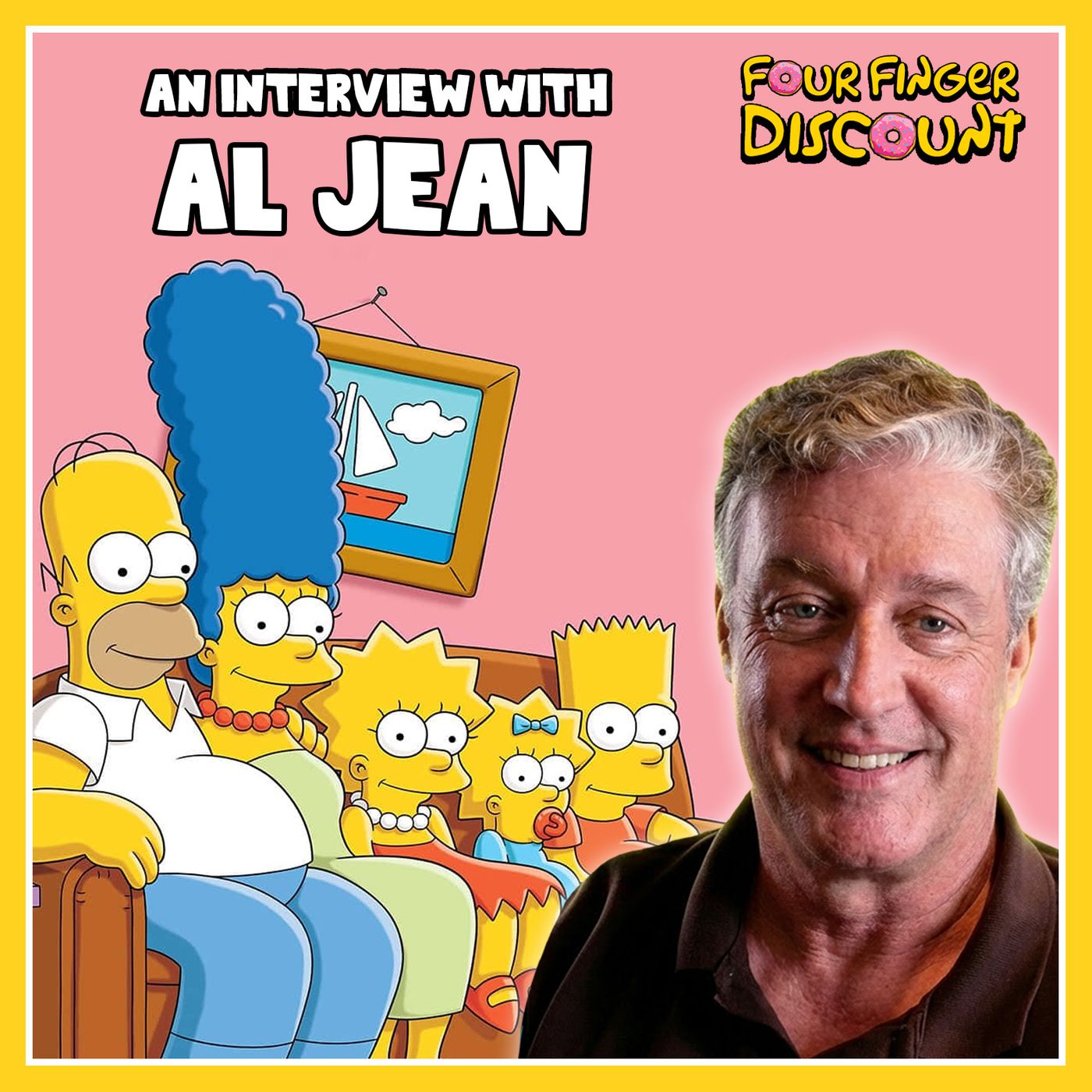
An Interview With Al Jean (Simpsons Showrunner)
Simpsons royalty, Al Jean joined us this week to discuss his storied career working for the show.
We cover a LOT of ground here, including his initial run as showrunner before leaving to create The Critic, (Al also gives us the scoop on The Critic revival), the time The Simpsons was almost cancelled, ignoring the internet criticism's of the show, working with Johnny Carson, the time Conan pitched Marge vs The Monorail and more!
Support the show on Patreon at patreon.com/fourfingerdiscount
Listen on Spotify - spoti.fi/4fDcSY0
Listen on Apple Podcasts - apple.co/4dgpW3Z
CHECK OUT OUR OTHER PODCASTS:
Goin' Down To South Park - spreaker.com/show/goin-down-to-south-park
The Movie Guide with Maltin & Davis - themovieguidepodcast.com
The One About Friends - spreaker.com/show/the-one-about-friends-podcast
Talking Seinfeld - spreaker.com/show/talking-seinfeld
SpeaKing Of The Hill - spreaker.com/show/speaking-of-the-hill-a-king-of-the-hill-
The Office Talk - spreaker.com/show/the-office-talk-podcast
Become a supporter of this podcast: https://www.spreaker.com/podcast/four-finger-discount-simpsons-podcast--5828977/support.
We cover a LOT of ground here, including his initial run as showrunner before leaving to create The Critic, (Al also gives us the scoop on The Critic revival), the time The Simpsons was almost cancelled, ignoring the internet criticism's of the show, working with Johnny Carson, the time Conan pitched Marge vs The Monorail and more!
Support the show on Patreon at patreon.com/fourfingerdiscount
Listen on Spotify - spoti.fi/4fDcSY0
Listen on Apple Podcasts - apple.co/4dgpW3Z
CHECK OUT OUR OTHER PODCASTS:
Goin' Down To South Park - spreaker.com/show/goin-down-to-south-park
The Movie Guide with Maltin & Davis - themovieguidepodcast.com
The One About Friends - spreaker.com/show/the-one-about-friends-podcast
Talking Seinfeld - spreaker.com/show/talking-seinfeld
SpeaKing Of The Hill - spreaker.com/show/speaking-of-the-hill-a-king-of-the-hill-
The Office Talk - spreaker.com/show/the-office-talk-podcast
Become a supporter of this podcast: https://www.spreaker.com/podcast/four-finger-discount-simpsons-podcast--5828977/support.
2026-04-23
52 min
Transcript
Available Results
Generated results are saved to the knowledge database for reuse and search.
No generated results are available for this episode yet.
Extract Knowledge
Pick what you want extracted first. Model, scope, and chapter options appear after a template is selected.
Generated results for public episodes are saved to the knowledge database so they can be reused and searched later.
Transcript
<v Speaker 1>Four finger Discount.
<v Speaker 2>Dude, Hey, everybody, welcome to four Finger Discount. And this
<v Speaker 2>week we are joined by a man who I have
<v Speaker 2>on my Mount rush More of the Simpsons. He is
<v Speaker 2>Al Jeane. How are you doing, sir?
<v Speaker 3>Good to be here now?
<v Speaker 2>What is life like post show running? Cause it's not
<v Speaker 2>post Simpsons. You're still a consultant on the show. What's
<v Speaker 2>it like not being the showrunner again?
<v Speaker 4>It's a step down in stress. Happy to turn it
<v Speaker 4>over to somebody else. Ran it for two years, make
<v Speaker 4>reas and twenty by myself. It's a job where every
<v Speaker 4>day I would constantly go, I don't want to, you know,
<v Speaker 4>let people down.
<v Speaker 3>I'm nervous.
<v Speaker 4>Edward don alf Before the Simpsons, it was a number
<v Speaker 4>ten show in year two, about a year four. It
<v Speaker 4>was after year and I was always nervous to day
<v Speaker 4>would happened with us? I guess at this point I
<v Speaker 4>can say that didn't happen with the Simpsons.
<v Speaker 2>When did you fully realize maybe the Simpsons is actually
<v Speaker 2>just never going to go away.
<v Speaker 4>There was a point that was fairly close to an
<v Speaker 4>ending season twenty three. The network considered the budget projections
<v Speaker 4>to be out of hand, and so they basically wanted
<v Speaker 4>everybody to take a reduction the cast. The writers had
<v Speaker 4>we not we were going to use the Stewart Burns
<v Speaker 4>Christmas episode as the final episode, and it wasn't conceived
<v Speaker 4>of as a final episode, and it was, but it
<v Speaker 4>was a Christmas show, and I always thought it'd be
<v Speaker 4>cool to end on a Christmas show when it started
<v Speaker 4>on a Christmas show, and it was a great episode,
<v Speaker 4>and you know, hadle sort of a future. Here's the
<v Speaker 4>ending of the story attribute to We've had other ones
<v Speaker 4>who have been great last episodes. Behind the Laughter would
<v Speaker 4>have been a good one in season four, The one
<v Speaker 4>where Maggie talk would have been a good one, you know,
<v Speaker 4>the one that was a couple of years ago. Bart's
<v Speaker 4>birthday would have been a good one. So we keep
<v Speaker 4>doing these last episodes and we'll run out of me.
<v Speaker 4>Just be a regular episode. I've had the other dea
<v Speaker 4>you know as well. But just the thought I had
<v Speaker 4>that you actually ended the last episode and the Christmas
<v Speaker 4>passion that the first episode began with it.
<v Speaker 3>It'd be an Internet loop.
<v Speaker 4>So there's no beginning or end, which animation fits perfectly
<v Speaker 4>because nobody ages, nobody changes. But that's just an idea.
<v Speaker 4>It's not in the works. There's no end in the words,
<v Speaker 4>it's that three more years at least.
<v Speaker 1>Well, I'm not about to suggest that you're moving out
<v Speaker 1>of frame just then had an ulterior minded But did
<v Speaker 1>you actually move out of frame so we could see
<v Speaker 1>the plethora of awards that is behind my?
<v Speaker 3>Not my?
<v Speaker 4>Actually, the reason they're here is because we'll say I
<v Speaker 4>can show you I have many others over there.
<v Speaker 3>Uh, I really didn't intend I moved them.
<v Speaker 4>There was a fire in Los Angeles about a year ago,
<v Speaker 4>and we moved most of our stuff out of our house,
<v Speaker 4>which fortunately was fine. But yeah, that's why they're here,
<v Speaker 4>because I intend to show them that everybody. I mean, yah,
<v Speaker 4>they show these are pictures of my daughter and my
<v Speaker 4>younger daughter, So you.
<v Speaker 2>Need to have them in that do it for her?
<v Speaker 2>You need to have that board up there with her.
<v Speaker 3>Well, it's kind of yes, that's what it's for.
<v Speaker 1>Hell, you said your new position or conversation is consultant.
<v Speaker 1>Is a step down in stress. Do you still feel
<v Speaker 1>the same sort of level of responsibility to the show though.
<v Speaker 4>Well, I always feel like I got to do my best.
<v Speaker 4>What I'm doing now just before this session is going
<v Speaker 4>over the read script that is going to be read
<v Speaker 4>at the table Thursday, and I go over it like
<v Speaker 4>eight or nine times. I get it a copy early
<v Speaker 4>to just you know, put all the pitches I can
<v Speaker 4>think I'm in and every whatever I've done on the show,
<v Speaker 4>I've always wanted to do the best I possibly could.
<v Speaker 3>I mean, when I worked as a.
<v Speaker 4>Consultant in year one, I would write all these notes
<v Speaker 4>on a script and I was amazed at this first
<v Speaker 4>script by me pond, the first draft of the Christmas
<v Speaker 4>show that began the series. I had my notes and
<v Speaker 4>I found my old copy of it, and I asked
<v Speaker 4>the Smithsonian if they wanted it, and they said yes,
<v Speaker 4>that's where it is. And I pitched the title Simpsons
<v Speaker 4>Roasting on an open fire, so you can see that
<v Speaker 4>on the draft. It's really, you know, it's like of
<v Speaker 4>the you know, zillions of things that I never dreamed
<v Speaker 4>would happen.
<v Speaker 1>That's one that was about design. That must be an
<v Speaker 1>incredibly surreal kind of feeling. It's like, hey, Smithsonian Institute,
<v Speaker 1>do you want this script scribbling?
<v Speaker 4>It's all the surreal stuff comes daily, I mean at
<v Speaker 4>this point, because what you find, I was realizing somebody
<v Speaker 4>like James L. Brooks must get this all time, and
<v Speaker 4>it's great. People who are fans of work you did
<v Speaker 4>thirty years ago. Everything that happens on this show becomes
<v Speaker 4>this huge deal. I said it before, but like the
<v Speaker 4>original Chu Chu Choose Me Valentine, it was real Valentine
<v Speaker 4>I got in third grade and now it's probably the
<v Speaker 4>most famous val in the world. And I again, it
<v Speaker 4>all just is like nuts.
<v Speaker 2>Do you get a cut of the Merchilese for that?
<v Speaker 2>Because in Australian particular, we have every Valentine's Day there
<v Speaker 2>is just chew choo choose me Gia everywhere.
<v Speaker 3>It's funny.
<v Speaker 4>I wish I did, although the true cut should go
<v Speaker 4>to the writer of the original Valentine in nineteen sixty.
<v Speaker 4>But I do have a credit on twenty nine shows,
<v Speaker 4>so because of that, get rerun money for those twenty
<v Speaker 4>nine shows. And what's great is that most of the
<v Speaker 4>people who've been here this long have a credit on
<v Speaker 4>about thirty episodes, so everybody's got this little piece of
<v Speaker 4>the show when it comes when the show continues to air,
<v Speaker 4>which is great.
<v Speaker 2>How often are you being consulted now? Do you expect
<v Speaker 2>to for you know, someone to call you up and say, hey,
<v Speaker 2>how what do we do here still these days? Or
<v Speaker 2>is it just going to be like sporadically when they
<v Speaker 2>need you.
<v Speaker 4>I say sporadically is the best term. I think that
<v Speaker 4>everybody knows what they're doing, and you know, the new
<v Speaker 4>person here is somebody you know who's been here five years.
<v Speaker 4>And you know, the median age of the writer, median
<v Speaker 4>age on staff of the writers, and the staff is
<v Speaker 4>about twenty. So the directors are great, obviously, the cast
<v Speaker 4>exactly how to play the characters. And I do get consulted,
<v Speaker 4>which is great. But I'm also open minded what I
<v Speaker 4>might do. I certainly had my opportunity to do everything
<v Speaker 4>I thought I actually do in twenty years, so you know,
<v Speaker 4>I'm all for exploring how the show can you know,
<v Speaker 4>adapt and be you know, relevant to everybody today.
<v Speaker 1>I love the notion of being a consultant, though it
<v Speaker 1>must be kind of a bit of an ego, but
<v Speaker 1>it's like there's a problem that only al Jean can solve.
<v Speaker 2>Get me, Get me, Al Jean.
<v Speaker 3>I wish it were so like a bad signal that
<v Speaker 3>clows up.
<v Speaker 2>What's the what's a giant jay in the sky?
<v Speaker 3>Yeah, yeah, exactly.
<v Speaker 2>But Jim Books was pretty much that for you guys
<v Speaker 2>for a long time, wasn't he In the years, he has.
<v Speaker 4>Had in hands this amazing superpower, which is he would say, oh,
<v Speaker 4>I put this line in, or I'm pitching this thing.
<v Speaker 4>And like in Michael Jackson episode, he pitched a line
<v Speaker 4>where one of the kids is to the Lee uncompassed character,
<v Speaker 4>you're a credit to dementia. So Mike and I put
<v Speaker 4>it in, like, well, it's Jim's Lyne, you know, sounds funny.
<v Speaker 4>Every review said, oh, this is the best line in
<v Speaker 4>the show, and they didn't know it was Jim. We
<v Speaker 4>obviously didn't put a little tag on it, you know,
<v Speaker 4>saying who pitched it? And same thing Lisa's substitute, which
<v Speaker 4>I'll probably get back to later. It was we remember
<v Speaker 4>we were sitting in the office, in Jim's office and
<v Speaker 4>he you know, we're trying to figure out how to end,
<v Speaker 4>how this teacher can leave and what he can say
<v Speaker 4>to Lisa. And Jim writes this note and he hands
<v Speaker 4>it and we all look at it and says, you
<v Speaker 4>were Lisa Simpson. First I thought, wait, I'm lisas like you?
<v Speaker 3>I mean yeah, And then we go Oh.
<v Speaker 4>That's what teacher hands are tie again. We thought Jim
<v Speaker 4>did it so that sounds good, sounds like a good conclusion.
<v Speaker 4>People loved it, really loved it was the ending, and
<v Speaker 4>you know I do too. I think it's like a
<v Speaker 4>simple statement that boosts the little girl's confidence, which is wonderful.
<v Speaker 1>Is there a ratio of not just Jim brook notes,
<v Speaker 1>but notes from anyone sort of high in the operational
<v Speaker 1>onsome since and stuff? Eighty percent of this stuff is
<v Speaker 1>going to work. There's maybe twenty percent a dozen. I mean,
<v Speaker 1>are you sort of ever reluctant to go now? We're
<v Speaker 1>not going with that it doesn't quite work or it's
<v Speaker 1>not quite it.
<v Speaker 3>Well.
<v Speaker 4>The famous thing is when Mike and I were running
<v Speaker 4>the show in season four, Conan started, so he brought
<v Speaker 4>him in for a separate session ahead of the time,
<v Speaker 4>before the story retreat. We had several ideas and we
<v Speaker 4>liked them, and one of them was the mono rail,
<v Speaker 4>and we both said, I don't know if Jim's gonna
<v Speaker 4>like it, don't pitch that first, and so he sold
<v Speaker 4>the other two. Okay, try the monorail, and then Jim
<v Speaker 4>loved it.
<v Speaker 3>So what do we know?
<v Speaker 4>But in terms of my rule as a showrunners was
<v Speaker 4>that if someone really really believes in something, then think
<v Speaker 4>about doing it. Yeah, because that's often been our best stuff.
<v Speaker 4>You know, when somebody goes, this is an idea I
<v Speaker 4>just really you know, believe in. And even if one
<v Speaker 4>of them was like deep Space Homer David Murkins, and
<v Speaker 4>it was a little different for that time that Homer
<v Speaker 4>would go into space, but to me, it always had
<v Speaker 4>a grounded reason. It was like Christa mccauliffe, someone who's
<v Speaker 4>like an ordinary person and getting THEND and he, you know,
<v Speaker 4>very funny guy, really believes in it, and it's a
<v Speaker 4>great show, one of people's favorites.
<v Speaker 2>I never felt ridiculous though as a kid growing up
<v Speaker 2>watching it. You know, obviously you're watching a cartoon anyways,
<v Speaker 2>so expected to be have a level of cartoony aspect
<v Speaker 2>to it. But watching that episode, it was just like,
<v Speaker 2>you home, he's going to space, of course he is.
<v Speaker 4>Yeah, I mean, you know, I just saw hel Projects
<v Speaker 4>Hill marrying with Ryan Gasling. It's similar. It's sort of
<v Speaker 4>you know, the character in that movie has no training
<v Speaker 4>and they send him up in space and it's I
<v Speaker 4>don't see, you know why David's episode is any more
<v Speaker 4>implausible than that.
<v Speaker 2>Well, we spoke about it in depth with them, with
<v Speaker 2>Jake Cogan as well, and we particularly loved the press
<v Speaker 2>conference in that episode where Homer realizes that the the
<v Speaker 2>Panel of the Apes.
<v Speaker 3>Oh that was that was my joke?
<v Speaker 2>Well okay, yeah, well yeah, we both We spent that
<v Speaker 2>five minutes just laughing about that during the podcast in
<v Speaker 2>the room Wait a minute.
<v Speaker 4>Because of course, Planet of the Apes is one of
<v Speaker 4>those things like where people my age, it's this reference.
<v Speaker 4>You can't get enough, you know, when they put it
<v Speaker 4>at the to the Barerbe movie, I'm like, wow, still
<v Speaker 4>got power. It's amazing, you know, different Planet of the
<v Speaker 4>Apes things. And I wish I had been in a
<v Speaker 4>movie theater in nineteen sixty eight to see that ending,
<v Speaker 4>because I knew and I think ahead of time it
<v Speaker 4>would have I'm sure what it killed me.
<v Speaker 2>It was just like, well, the way Homer reacted in
<v Speaker 2>the press commence would have been you, yeah, yes, how
<v Speaker 2>did you feel because you weren't working maybe you were
<v Speaker 2>still doing some solo work posts when you left the show.
<v Speaker 2>But when they did it was season seven. Fish caught
<v Speaker 2>sound with the Planet of the Apes musical. What were
<v Speaker 2>your thoughts on that when you first saw it.
<v Speaker 4>This is really funny. I was in my office with
<v Speaker 4>Mike writing for the Critic, and next door we kept
<v Speaker 4>hearing doctor sayis doctors like We heard for about four
<v Speaker 4>hours then.
<v Speaker 3>Two it's really going. It's like drive me crazy.
<v Speaker 4>And of course it's probably the funniest I didn't have
<v Speaker 4>anything to do with the writing of It's probably the
<v Speaker 4>funniest song in the history of the show. I mean,
<v Speaker 4>it's the chimpan eided Chimpanzee line alone. Yeah, put it there,
<v Speaker 4>but yeah, just what they just keep going over again
<v Speaker 4>and again.
<v Speaker 2>So you guys were writing in the next room still.
<v Speaker 2>So when he left the Simpsons, he didn't leave the studio.
<v Speaker 2>He just sort of left the team.
<v Speaker 4>Well, one thing was we didn't I never wanted to
<v Speaker 4>leave the Simpsons ever. I mean, clearly, I'm here after
<v Speaker 4>thirty six years. So when we did the Critic, we
<v Speaker 4>said we would like to still consult on the Simpsons.
<v Speaker 4>When we went to a Disney deal, we said we'd
<v Speaker 4>still like to work on Simpson episodes, and every year
<v Speaker 4>of the show. I've had some involvement with it because
<v Speaker 4>it's the greatest, you know, it's it's I've been in
<v Speaker 4>other great things, but it was such a hit from
<v Speaker 4>the get go that you don't have to explain to
<v Speaker 4>people what you're doing. You'll get the money, you get
<v Speaker 4>the guest stars. It's the ideal job. But it wasn't
<v Speaker 4>his For a writer in LA I get the.
<v Speaker 1>Feeling of this stage of the game as well. You'd
<v Speaker 1>have to be some kind of Grinch or Munty Burns
<v Speaker 1>type to separate al Chine from the Simpsons if you
<v Speaker 1>wanted to go do something else, but it was sort
<v Speaker 1>of in your contract or in your negotiatings. Like, guys,
<v Speaker 1>you've got to give me a little time to sort
<v Speaker 1>of be to pick up the red phone for Simpsons.
<v Speaker 4>ICEQ, Well, I can say we're closer than ever John
<v Speaker 4>Lovetts and me and Mike Reeze to getting The Critic
<v Speaker 4>back as a reboot, So that'll be wonderful.
<v Speaker 2>Has that roadblock being fixed yet? He said there was
<v Speaker 2>a one roadblock block and everything.
<v Speaker 3>It's almost a good right almost. Yes, glad that you
<v Speaker 3>knew that.
<v Speaker 4>I think now, first time I've ever said this, I
<v Speaker 4>think it's more likely than that that it'll happen.
<v Speaker 2>Wow, that's very exciting.
<v Speaker 4>And John is very into it, and we were talking
<v Speaker 4>about who we would cast. I won't say, you know,
<v Speaker 4>nobody else has a commitment or anything. But one of
<v Speaker 4>the things that helped us was John was at the
<v Speaker 4>SNL fifty party and someone walked up to him and said,
<v Speaker 4>you know, The Critic is the best show ever.
<v Speaker 3>And he goes, what do you mean? He goes, I
<v Speaker 3>loved it. I grew up with watching it. It's the
<v Speaker 3>best it was. Jesse Eisenberg, Oh wow.
<v Speaker 4>So we realized that there's a generation now loved it
<v Speaker 4>the way I loved the Bowling Gloe cartoons as a kid.
<v Speaker 4>And Kenya the Hill did great as a reboot. Futurama
<v Speaker 4>has done great multiple times coming back, so I think
<v Speaker 4>we're going to do.
<v Speaker 2>You feel like you have to change the concept, though,
<v Speaker 2>because the idea of a coming attractions existing in twenty
<v Speaker 2>twenty six.
<v Speaker 3>Oh no, there's no.
<v Speaker 4>Such thing as a successful film critic. Now you're one
<v Speaker 4>of one hundred rotten tomatoes. I would think, actually, just
<v Speaker 4>he's on a podcast and he's got nobody watching, and
<v Speaker 4>he's you know, down at the bottom. I think that
<v Speaker 4>the again, this is all so early, but the tentative
<v Speaker 4>arc would be he starts getting popular again, because I
<v Speaker 4>think you need a movie critic to call a bad
<v Speaker 4>movies more than ever. Oh and not like bad movies,
<v Speaker 4>but bad things in real life. So but yeah, I
<v Speaker 4>think my guess would be we'd age and a little,
<v Speaker 4>we'd have the sun be grown. But this is all
<v Speaker 4>you know, so yeah, premature, it's yeah, just the way
<v Speaker 4>we we have taken a look at it.
<v Speaker 2>It must feel like a sense of deja vous because
<v Speaker 2>you left the Simpsons thirty years ago to work on
<v Speaker 2>the Critic and now you essentially done the same thing again,
<v Speaker 2>except this time hype. It doesn't get canceled off the
<v Speaker 2>two seasons, uh.
<v Speaker 4>Well, or even if it does, you know, this will
<v Speaker 4>always be still here if I come running back with
<v Speaker 4>my tail between my legs. And it's so funny how
<v Speaker 4>everything comes around in a circle on this show. And
<v Speaker 4>the other thing I was going to say about Simpsons,
<v Speaker 4>which is very odd for me. I never saw it
<v Speaker 4>as a phenomenon. I was always on the inside as
<v Speaker 4>a writer. You know, Oh this thing I did over
<v Speaker 4>the summer with Mike and oh it came back. It
<v Speaker 4>looks really funny. I thought it would be a good show.
<v Speaker 4>I thought, gee, you got Jim Brooks and I loved
<v Speaker 4>Life in Hell by Matt Greening, and I thought Sam
<v Speaker 4>was brilliant, and it hadn't been any animated Timetime show
<v Speaker 4>in years, so I thought, this is going to get attention,
<v Speaker 4>This is really going to be, you know, special, But
<v Speaker 4>I didn't know nobody. I don't think I knew it
<v Speaker 4>was going to run forty years now.
<v Speaker 1>With that in mind, I mean, when you meet new
<v Speaker 1>people and they were informed that you're that Simpsons guy,
<v Speaker 1>I mean, what some of your action reactions you've ever said.
<v Speaker 1>There's a lot of they're meeting Santa.
<v Speaker 4>I see people who get very excited, and I'm like, what,
<v Speaker 4>what's wrong?
<v Speaker 3>Okay?
<v Speaker 4>I've said this a lot, although I don't think I
<v Speaker 4>could say it too much. The other thing that makes
<v Speaker 4>me really happy is I run into people who go,
<v Speaker 4>I was a kid, my parents were getting divorced. I
<v Speaker 4>was really sad, and I watched the Simpsons. That cheered
<v Speaker 4>me up. And that's the best, you know, I mean
<v Speaker 4>even more than the you know, people you get to
<v Speaker 4>meet or the people you get to work, whether the
<v Speaker 4>money is something like that that you have spent your
<v Speaker 4>life doing that, and it has that outcome.
<v Speaker 2>Well, I've said Tom and Tom again. I was a
<v Speaker 2>bit of a loaner when I was younger, and it
<v Speaker 2>was almost a lot of The Simpsons was like that
<v Speaker 2>a friend, you know, you can always fall back into.
<v Speaker 2>The Simpsons was always going to be there. You recordeous
<v Speaker 2>episodes off TV, and I was ever feeling filling down.
<v Speaker 2>I chuck one of the types and put The Simpsons on,
<v Speaker 2>and I was fine.
<v Speaker 4>I was, for various reasons, at different schools each year
<v Speaker 4>of my childhood. So I was a little bit of
<v Speaker 4>a loner, and I felt that way about something like
<v Speaker 4>Charlie Brown. I felt like, oh this gets me, this,
<v Speaker 4>this is how I feel, and they understand it.
<v Speaker 3>So that means the world.
<v Speaker 1>As a prematurely bolding guy with a crush on unrequired
<v Speaker 1>crush on redheads. Yeah, Charlie Brown was my guy. Absolutely.
<v Speaker 3>Oh yeah.
<v Speaker 4>Now was the Simpsons the other Simpsons of my child
<v Speaker 4>I mean there's no question now was genius.
<v Speaker 1>Now we're in Taylor Switz world now, and so koreas
<v Speaker 1>or bodies of work are kind of viewed as eras,
<v Speaker 1>And I mean, I'm wondering if you view your time
<v Speaker 1>with the Simpsons, your ongoing time with the Simpsons as
<v Speaker 1>like one continuous stream or do you break it down
<v Speaker 1>into bits and pages like, oh, this is this era
<v Speaker 1>of my of my time in Springfield or is it
<v Speaker 1>all one? Is it all of a pace or is.
<v Speaker 3>It you know.
<v Speaker 4>I think era is a little bit overrated when you
<v Speaker 4>consider the diagnosaurs.
<v Speaker 3>Had an era of a hundred million years.
<v Speaker 4>Sure, so like we should talk. The biggest thing I
<v Speaker 4>can say that was definitely changed was the methods of animation.
<v Speaker 4>After season thirteen we went to digital coloring. In twenty
<v Speaker 4>we went to HD. Those necessitated a lot of changes
<v Speaker 4>in the way we would do the show. We actually
<v Speaker 4>predate Google and we predate you know, digital editing, so
<v Speaker 4>those were both huge, huge helps. We used to go
<v Speaker 4>to a research library at five and ask for a book,
<v Speaker 4>you know, do you have the digits of Pie or
<v Speaker 4>something like that. So those would be the things that
<v Speaker 4>I think have been absorbed the most by the show.
<v Speaker 4>In the movie, David Siler and the other directors had
<v Speaker 4>a thing called the Syntique, which was a tablet that
<v Speaker 4>they could draw a scene on and they can pretty
<v Speaker 4>much put it in the rough cut and we could
<v Speaker 4>see it in a day like animated half animated. That
<v Speaker 4>changed differthing for the better too. We now do storyboards
<v Speaker 4>that way.
<v Speaker 2>Speaking of the Simpsons movie, will we be a consultant
<v Speaker 2>for the new Simpsons movie? You're still working on that
<v Speaker 2>or you separate yourself from that project.
<v Speaker 4>At the moment. No, Yeah, I can't really. I'm familiar
<v Speaker 4>with what's going on, but I can't really see any girl.
<v Speaker 2>Oh, that's fine. Yeah, obviously we spoke to someone recently
<v Speaker 2>as well. He said the same thing. But yeah, it's
<v Speaker 2>just nice to know that the Simpsons is still because
<v Speaker 2>it feels like the Simpsons had a bit of a
<v Speaker 2>resurgence in recent years with fans and just I think
<v Speaker 2>a whole younger generation of discovering the show because people
<v Speaker 2>like myself were having who grew up with the show
<v Speaker 2>are having kids and we're introducing the show to our
<v Speaker 2>children and they're loving it. I just think that it's
<v Speaker 2>great that a new Simpsons movie is being green lit
<v Speaker 2>at all.
<v Speaker 3>Yes, I can see.
<v Speaker 4>When the announcement was me the excitement about it was
<v Speaker 4>very gratifying. How nervous I was working now in the
<v Speaker 4>first one, just terrified what if this bombs again? The
<v Speaker 4>biggest thing every day here has been I don't want
<v Speaker 4>to screw it out, and I think the movie pretty
<v Speaker 4>much delivered with what people want at the first one.
<v Speaker 3>Yeah, and you know I'm through second well as well.
<v Speaker 2>How do you go ignoring the outside noise? Because it
<v Speaker 2>feels like for a good while there it almost became
<v Speaker 2>like a running bit of The Simpsons isn't good anymore?
<v Speaker 2>And I was said by people who didn't actually watch
<v Speaker 2>the show anymore, so their opinion wasn't valid. But is
<v Speaker 2>it hard to ignore that crowd when you're working on it.
<v Speaker 4>Well, I'm the least objective person about this, but to
<v Speaker 4>be quite honest, people are saying it wasn't as good
<v Speaker 4>as it used to be. In the middle of season one,
<v Speaker 4>there was an Ali Times film critic but didn't like
<v Speaker 4>the Moaning Lease episode. He hated the season two premiere.
<v Speaker 4>The internet started getting on our case a lot, especially
<v Speaker 4>in season five and six. You know, you can find
<v Speaker 4>people saying, you know, Homer's enemy, you know e grade,
<v Speaker 4>you know the worst, and now people revere it now.
<v Speaker 4>I think it's the highest rate at IMDb. So there's
<v Speaker 4>demes with the other way where you go, Okay, none
<v Speaker 4>of it means anything, so I don't know. My view,
<v Speaker 4>which I'm sure I'll always have, is we always work
<v Speaker 4>really hard. We always have really talented people. I can't
<v Speaker 4>say whether it's as good as it was, but I
<v Speaker 4>think it's always been at least good. And if there's
<v Speaker 4>a decline, I think maybe, well America's decline and we're
<v Speaker 4>just declining a little slower.
<v Speaker 2>Yeah, I mean the Simpsons, even a fifty sixty percent
<v Speaker 2>is better than most shows still these days.
<v Speaker 4>Anyway, So we wanted any two years ago, we wanted
<v Speaker 4>any four years ago. The writers build as an animation
<v Speaker 4>award we've won I think like twelve or fourteen or
<v Speaker 4>some sort of a high percentage.
<v Speaker 3>You know.
<v Speaker 4>And I watched similar shows like south Park. South Park
<v Speaker 4>is in a great year. So I don't get I'm
<v Speaker 4>the last one that you know, make a judgment about this,
<v Speaker 4>but I think people find really funny episodes every year,
<v Speaker 4>and not everything's perfect, but there's a lot of work,
<v Speaker 4>a lot of stuff that's put into each one.
<v Speaker 1>You don't want to make a judgment now, but I'm
<v Speaker 1>about to ask you to make a judgment, Okay, I'd
<v Speaker 1>like you to define a successful or perhaps a bit
<v Speaker 1>of time is satisfying episode of The Simpsons for you
<v Speaker 1>now one way you can sort of sit back as
<v Speaker 1>the as the closing credits for I Want to Go,
<v Speaker 1>We Now Live.
<v Speaker 3>Oh, I can give you one that I just saw.
<v Speaker 3>I just aired about a month ago.
<v Speaker 4>The eight hundredth episode, written written by Christy Nangel was great.
<v Speaker 3>She's a huge.
<v Speaker 4>Dog owner, you know, loves dogs, really really loves dogs.
<v Speaker 4>We have three rescue dogs and it really Then the
<v Speaker 4>funny thing is that her what happened to her happened
<v Speaker 4>to my wife as well, where she fed the dog
<v Speaker 4>grapes and then the dog went to the bad Like
<v Speaker 4>how do you feed the dog grapes? It's horrible, like
<v Speaker 4>nobody knew. And then you know how Marge feels when
<v Speaker 4>she thinks the dog is dead. Like that was very moving.
<v Speaker 4>I thought that was a combination of funny oh and
<v Speaker 4>had a lot of great Philadelphia jokes, Like it was
<v Speaker 4>really really you know, cool for people who've been to Philadelphia.
<v Speaker 4>So funny, you know, like a lot of really interesting
<v Speaker 4>stuff and a clever plot and real emotion.
<v Speaker 2>We review that one of the podcasts went after at first,
<v Speaker 2>and yeah, I found a lot of relatability because my
<v Speaker 2>mother was the same where she always sort of unless
<v Speaker 2>she didn't like the dog. But she goes, I've got
<v Speaker 2>to clean up off the dog after the dog a game,
<v Speaker 2>blah blah blah. But then when the dog got sick, exactly,
<v Speaker 2>she was the one that was the most sad, you know,
<v Speaker 2>she was the saddest.
<v Speaker 3>Nothing wrenches your heart like a dog that. Yeah.
<v Speaker 4>Yes, and then it's just being objective about it. Human
<v Speaker 4>life fans are so much longer than dog life fans,
<v Speaker 4>Like you're you're pretty much buying yourself a very sad ending.
<v Speaker 2>Oh yeah, but the years you have, but the years
<v Speaker 2>you have them as worth it though.
<v Speaker 4>So yes, Also you can always get a new dog,
<v Speaker 4>you know, same, but it's a great new dog. So yeah,
<v Speaker 4>we've gone through that cycle.
<v Speaker 1>It's not cold now.
<v Speaker 3>Well, I I'm not the one that I.
<v Speaker 4>Would pick, like, let you know, get a giant like
<v Speaker 4>Greenland whale that was four hundred years and then you'll
<v Speaker 4>definitely never see it before you.
<v Speaker 1>Break the turtle top. Yes, I don't like to I'd
<v Speaker 1>like to want to type back a little bit to
<v Speaker 1>pre Simpson's I was interested to rate that you worked
<v Speaker 1>on the Johnny Carson Show, that you worked with with
<v Speaker 1>Casson on the I just like to know.
<v Speaker 3>I did, Yes, what that was like?
<v Speaker 1>I mean, working with someone like that. Did you ever
<v Speaker 1>encounter Johnny?
<v Speaker 4>We met him to get the job. There was a
<v Speaker 4>one hour interview, wow, and then we saw him maybe
<v Speaker 4>two more times in person the whole time we were there. Right,
<v Speaker 4>I have to say I never met John F. Kennedy,
<v Speaker 4>of course, but it was like that I think to
<v Speaker 4>have met him. He was an extremely funny, you know guy,
<v Speaker 4>and had a lot of admirable qualities. He was more
<v Speaker 4>nervous about his success, you know, and how he would
<v Speaker 4>do than you might think. When he went on David Letterman.
<v Speaker 4>The first time he went on a Letterman show, we
<v Speaker 4>had to give him eight different bits that Carson writers,
<v Speaker 4>so he had his pockets filled with jokes, and I
<v Speaker 4>pitched the thing. We had this folding desk we're going
<v Speaker 4>to one time have him leave with but I said, no,
<v Speaker 4>have him bring it and set it up because he
<v Speaker 4>needs it next to Letterman and that kind of big laugh.
<v Speaker 4>And Letterman would show it on his subsequent shows. But
<v Speaker 4>like Johnny really wanted that like big thing, you know
<v Speaker 4>that once he got that laugh at the beginning, then
<v Speaker 4>he was like Okay, you know, I can relax and
<v Speaker 4>I could be Johnny Carson.
<v Speaker 2>Was he intimidating in that interview? Was he there for
<v Speaker 2>the entire hour?
<v Speaker 4>No, it's just an interview again. He was Letterman's hero,
<v Speaker 4>you know, beloved.
<v Speaker 3>He was nervous.
<v Speaker 4>I mean, I you know, I think that's one reason
<v Speaker 4>he was so successful because he never took it for granted.
<v Speaker 4>After I never knew any of this director, you know,
<v Speaker 4>and I say, stuff, It's not like, oh Johnny said
<v Speaker 4>this to me. Oh I'm nervous, you know. But he
<v Speaker 4>was an amateur magician as a kid and was great.
<v Speaker 4>So his whole career was kind of I'm going to
<v Speaker 4>do this thing that's really cool and then disappear before
<v Speaker 4>you gets sick of me. And that kind of sums
<v Speaker 4>up his whole career. There's that a great book Cursing
<v Speaker 4>the Magnificent about it that just came out of a biography.
<v Speaker 2>Have you ever felt like you were sick of the Simpsons?
<v Speaker 2>Have you ever got to a point where you felt
<v Speaker 2>you were worked so high I just can't do this anymore.
<v Speaker 3>Well, I'll tell you the truth.
<v Speaker 4>Even though I'm not show running every night now, I
<v Speaker 4>have a dream about being in the rewrite room trying
<v Speaker 4>to think of a joke with the other writers I
<v Speaker 4>just met, you know, saw to them and said, oh, yeah,
<v Speaker 4>I just dreamed about you guys last night. There's usually
<v Speaker 4>some sort of bureaucratic thing like we need to get
<v Speaker 4>ahold of Jim Brooks, but he's traveling or we can't
<v Speaker 4>pitch it to him. So I guess that's my sisyphus
<v Speaker 4>curse every name for the rest of my life. I'm
<v Speaker 4>going to dream them in the rewa room.
<v Speaker 2>Can you is it besides your dreaming obviously? Can you
<v Speaker 2>switch off just during the day now that you've left
<v Speaker 2>the show full time or you just are you still
<v Speaker 2>constantly just feeling and thinking of ideas.
<v Speaker 4>You're always looking at with something hammers and go, oh,
<v Speaker 4>that'd be a good episode for Patty and some you
<v Speaker 4>know like that in every steps.
<v Speaker 2>Do you note them down still or is it now
<v Speaker 2>a case of what doesn't matter anymore? Or you always
<v Speaker 2>note these ideas.
<v Speaker 4>Down now I'm thinking about critic flights.
<v Speaker 1>Yeah, yeah, I was wondering how much sort of real
<v Speaker 1>estate in your head is like Springfield, and how much
<v Speaker 1>of it is Jay Sherman and how much of it
<v Speaker 1>is other projects.
<v Speaker 4>Yeah, I think about it's great about it being a
<v Speaker 4>critic or anything else. If you're pitching a Simpsons story,
<v Speaker 4>you know, I have to mentally run through the seven
<v Speaker 4>hundred nine name previous stories, go is this too similar?
<v Speaker 3>Did we do this? You know that's rough and that
<v Speaker 3>was probably the artist fair? Or is the artist far?
<v Speaker 4>You know, when you're doing a new Simpsons, so it's
<v Speaker 4>liberating on anything else where you're just going, it's just
<v Speaker 4>not like everything's been done.
<v Speaker 3>Yeah.
<v Speaker 1>I al was wondering if you actually had any like
<v Speaker 1>sort of quote unquote secret weapon characters or gags or situations,
<v Speaker 1>ones where you feel like I can punch up or
<v Speaker 1>in bigurette a storyline or a plot point that sort
<v Speaker 1>of needs to needs just a little bit of something.
<v Speaker 4>There are certain ones that would have like huge batting averages,
<v Speaker 4>like Comic book Guy if you would bring him in
<v Speaker 4>for something. That voice just you know Hank's creation. He
<v Speaker 4>said it was based on a college door made of
<v Speaker 4>his used to say you're on my list.
<v Speaker 3>This area That one I always thought was a good
<v Speaker 3>go to mo.
<v Speaker 4>Another of Hank's characters, Homer's Great Where with Homer, what
<v Speaker 4>we would do is just we'd still trapped. For Dan Casseline,
<v Speaker 4>I would say, Homer reenthesies, hungry, but sad noise, so
<v Speaker 4>like just to see what he would do, and that's
<v Speaker 4>always fun. He's always great.
<v Speaker 2>At what point did you realize The Simpsons was becoming
<v Speaker 2>Homer's show and it was no longer.
<v Speaker 4>Bought when people told us it wasn't conscious. What happened
<v Speaker 4>was again, nobody knew the show would be a phenomenon,
<v Speaker 4>and Bart was obviously like the breakout star in the
<v Speaker 4>first season. Good, I mean, Nancy's great. Bart's a great character.
<v Speaker 4>Just again it says four. But by dint of trying
<v Speaker 4>to come up with stories, it's easier to come up
<v Speaker 4>with stories for an adult who can, you know, work
<v Speaker 4>and go places than it is to come up with
<v Speaker 4>stories for a ten year old boy. It's kind of
<v Speaker 4>constrained by reality into what he can go and do.
<v Speaker 4>So you know, you would have Bart being a general
<v Speaker 4>or something, but it would be hard to you know,
<v Speaker 4>think of really fire fetch things as was Homer. And
<v Speaker 4>then people said, oh, you consciously switched it. It's just
<v Speaker 4>the writers were more Homer's age than Bart's. Yeah, so
<v Speaker 4>now it'll you know, my stuff will all be Grandpa.
<v Speaker 4>I started to really think like, yeah, I think like him.
<v Speaker 1>No, actually, I wouldn't ask you. Have you old relationship
<v Speaker 1>with the residents of Springfield? Have they changed as you've changed,
<v Speaker 1>as You've got a few more miles on the matter,
<v Speaker 1>And do you get sort of prepressive, possessive, will proprietary
<v Speaker 1>about certain characters on the show.
<v Speaker 4>I relate to the line you kids get off my
<v Speaker 4>lawn a lot more than I used to.
<v Speaker 1>Yes, we'll do.
<v Speaker 2>I found myself laying to I'm thirty seven, and I
<v Speaker 2>found myself laying to Grandpa already you know, just yes,
<v Speaker 2>what's it is? Weed and scary to me.
<v Speaker 4>Also, Lisa was the one that was closest to me
<v Speaker 4>growing up. My sister was more of a bar So
<v Speaker 4>I feel a little proprietary towards Lisa character, who's been
<v Speaker 4>like in the lead, And many of the scripts I've written.
<v Speaker 2>We've noticed that. So we're about to Sason twenty one
<v Speaker 2>now we've been doing chronologically, and it feels like Lisa
<v Speaker 2>is the real voice of the writers. When they've got
<v Speaker 2>something to say, they say it through Lisa.
<v Speaker 3>Yes, that's true.
<v Speaker 4>And again, another secret weapon is Yardley Smith match is funny,
<v Speaker 4>which he very much is. But also when you give
<v Speaker 4>Lisa an emotion, the character and the early performs at
<v Speaker 4>the table, it really works great, you know, really works
<v Speaker 4>great with Jim Brooks while you're always trying to you know,
<v Speaker 4>reach and you know, make him you know laugh or
<v Speaker 4>cry or whatever, you know, And that is definitely I mean,
<v Speaker 4>that's a secret but weapon.
<v Speaker 2>And you guys, with your what you did, what you
<v Speaker 2>were changing those early nineties, you paved the way for
<v Speaker 2>so many shows, and you change shaped comedy for an
<v Speaker 2>entire generation of viewers. But shows like Bob's Burger's Family Guy,
<v Speaker 2>these shows don't exist without the Simpsons and the success
<v Speaker 2>that you guys created.
<v Speaker 3>I think. So I think South Park probably would have.
<v Speaker 2>South That's why I love South Park out. Yeah, I
<v Speaker 2>think south Park it was a different Yeah.
<v Speaker 3>Don't know. Yeah, I mean, what's so bizarre to me.
<v Speaker 4>In nineteen eighty nine was also the year Little Mermaid,
<v Speaker 4>which we vitalized feature animation, and I don't know if
<v Speaker 4>there would have been a pixere about Little Murmaid. So
<v Speaker 4>I love animation, So I'm thrilled there's so many animated shows.
<v Speaker 4>Now I'm thrilled that the animation category in the Emmys
<v Speaker 4>is so art, and I'm thrilled that there's so many
<v Speaker 4>great animated movies.
<v Speaker 2>Did you ever watch those other shows and go, you've
<v Speaker 2>taken what we didn't just put a clock in it.
<v Speaker 4>Well, the reason I don't watch them is because, as
<v Speaker 4>I just said, eight hundred episodes is making your things
<v Speaker 4>that haven't been done, you know, very small. And then
<v Speaker 4>if you watch the other ones, someone goes, oh, wait,
<v Speaker 4>Family guy did, Like, Oh, it's impossible. If you're watching
<v Speaker 4>them all and you're trying to exclude everything they do,
<v Speaker 4>you're going to just like spend the whole day in
<v Speaker 4>the room just saying no to everything. So I haven't
<v Speaker 4>seen as much of them as people might think. But
<v Speaker 4>there's a reason that has noting to do with whether
<v Speaker 4>I like them or not.
<v Speaker 2>Yeah, do you think it matches if Family God had
<v Speaker 2>done a story and you guys hadn't yet.
<v Speaker 4>Oh, people call you on it, I believe you know. Uh,
<v Speaker 4>they go, you stole and I'm like, what, I didn't
<v Speaker 4>even know about the biggest The biggest thing I can
<v Speaker 4>say being inside is people think ideas are being stolen
<v Speaker 4>all the time, and at least on The Simpsons.
<v Speaker 1>No.
<v Speaker 4>I mean, there's certainly things that we do homages to,
<v Speaker 4>you know, like that we are clearly like emulating like SCTV.
<v Speaker 4>But when when something happens and where you have a
<v Speaker 4>similar thing, it's just coincidence. Just like our predictions, you know,
<v Speaker 4>we steal from the future constantly.
<v Speaker 1>Yeah, let me give you a hypothetical. If you were
<v Speaker 1>going into Simpson's HQ in twenty twenty six with a
<v Speaker 1>spec script that you wrote, what do you think it
<v Speaker 1>would be about? Who do you think it would be
<v Speaker 1>front and center in this It.
<v Speaker 4>Would probably still be about Lisa and Homer if I
<v Speaker 4>really wanted to sell it. One that I wrote not
<v Speaker 4>too long ago, the navierating credit is when I saw
<v Speaker 4>Keill a Mockingbird. I hadn't seen it for, you know,
<v Speaker 4>till I was fifty, and it was so good and
<v Speaker 4>I was in tears, you know, at that scene where
<v Speaker 4>little girl Scout stopped the mob killing her dad, Nica's finch,
<v Speaker 4>and I just thought, oh, this would be a great
<v Speaker 4>relationship to you know, put with Lisa at Homer. So
<v Speaker 4>that's the kind of script I would bring in in
<v Speaker 4>you know, any season.
<v Speaker 1>These are the characters that still sort of resonate with you.
<v Speaker 3>Yeah, and that was a movie from nineteen sixty two.
<v Speaker 4>There's a joke I was really happy with in the
<v Speaker 4>episode where it said, Lisa, I just want to tell
<v Speaker 4>you that the horrible you know, discrimination that occurs in
<v Speaker 4>the movie in the South and you know now occurs everywhere.
<v Speaker 2>I wanted to touch on al you mentioned earlier at
<v Speaker 2>the Critic. I want to get back to the critic
<v Speaker 2>and what is it like working with Mike again on
<v Speaker 2>a project like this.
<v Speaker 4>Well, I've never stat working with me one day a
<v Speaker 4>week when I was show running, and when I would
<v Speaker 4>have a draft of a script that I hit a
<v Speaker 4>writing credit, the first person i'd show would be him,
<v Speaker 4>and in generally he would go, oh, this is really good,
<v Speaker 4>which would make me very happy. You know, he doesn't
<v Speaker 4>you know, see he likes something if he doesn't like it.
<v Speaker 4>So once I got his seal of proof, White Phil
<v Speaker 4>out more confident. But yeah, no, I just emailed him.
<v Speaker 4>He travels a great deal, that's what he loves to do.
<v Speaker 4>So I don't think he'll be full time, but he
<v Speaker 4>definitely wants to be involved with the critic, and of
<v Speaker 4>course I'd love it as much as he wanted.
<v Speaker 3>To do it.
<v Speaker 2>Is there a hesitation to bring in the critic back?
<v Speaker 2>Is there some sort of worry of we made it,
<v Speaker 2>we did it change what we did initially? Or do
<v Speaker 2>you think that the show in its initial run the
<v Speaker 2>world just wasn't ready for it yet?
<v Speaker 4>If that hesitation in me, because first of all, if
<v Speaker 4>people go, you ruined it, I go, well, we created,
<v Speaker 4>like you know, it's ours to do what we will.
<v Speaker 4>And then that, honestly, Lovett and I each tweeted that
<v Speaker 4>there was a chance that would come back.
<v Speaker 3>The respondence was so huge. I was just watching it.
<v Speaker 3>Seth Meyers.
<v Speaker 4>That was recommended to me. Where really great actors, very funny.
<v Speaker 4>Christin Miliotti said, you know, well, as a kid, I
<v Speaker 4>watched the critic and audience cheered like, so, I go,
<v Speaker 4>I would love to see you know how that plays out.
<v Speaker 4>And love It's is great. He does stand up all time.
<v Speaker 4>He's just as funny as ever. Yeah, I mean I
<v Speaker 4>don't as you say, that kind of critic isn't really
<v Speaker 4>a thing now, but the character and what's going on
<v Speaker 4>and it's perfect.
<v Speaker 1>And yeah, Lovets hasn't lost as fossible in any way,
<v Speaker 1>and and and it seems like the years that the
<v Speaker 1>uh that have gone past, and like, you know, where
<v Speaker 1>where Jai Shiman will be at now? It feels like
<v Speaker 1>a fit loveds would be at now as well.
<v Speaker 4>Yes, yeah, Well the thing with him is I just
<v Speaker 4>told him this. He's one of those guys where people
<v Speaker 4>know who he is, you know, people remember him, and
<v Speaker 4>people go, oh, that guy's funny, you know. I mean
<v Speaker 4>that's two things they think, and that's hard to get.
<v Speaker 4>And he's got it, you know, I mean, and you
<v Speaker 4>know it's somebody like Norm McDonald had it as well. Yeah,
<v Speaker 4>and in a different way. And I think that's a
<v Speaker 4>you know, great person to write for.
<v Speaker 1>Yeah, a really distinctive voice that doesn't yeah, I want
<v Speaker 1>to say doesn't age, but yeah, just sort of gets
<v Speaker 1>better with age in a way.
<v Speaker 3>Sounds just the same. Yeah, No, he's just as funny. Yeah.
<v Speaker 2>I feel like even with the critic, you could have
<v Speaker 2>yet if you had a full length show, But it
<v Speaker 2>could also work in short form as well, where it's
<v Speaker 2>just you know, we might not want to dedicate an
<v Speaker 2>entire episode to particular movie reviews or parodies or whatever,
<v Speaker 2>but you could just have Jay just for marketing purposes
<v Speaker 2>reviewing two or three films throughout the week for like
<v Speaker 2>thirty seconds on social media.
<v Speaker 1>Actually have been doing reviews.
<v Speaker 3>Yes.
<v Speaker 4>One of the thoughts was exactly that you we did
<v Speaker 4>an episode where Homer was live, you know where. Yeah,
<v Speaker 4>he was like filmed with Dan Castlemetta, and you would
<v Speaker 4>do certain moves so the credit could review a movie
<v Speaker 4>that just came out, and you put that at the
<v Speaker 4>end of the episode exactly.
<v Speaker 2>So was he actually live when that was going on.
<v Speaker 4>Yes, Dan was in a room. What there were is
<v Speaker 4>we'd programmed you know, like forty hour movements into the
<v Speaker 4>possibilities for the animation. David Silverman was like directing what
<v Speaker 4>the visual would be. So you see, you know, see
<v Speaker 4>Homer looks down, he looks up, he blinked, you know.
<v Speaker 4>I mean, it's just a limited number of reactions.
<v Speaker 3>But yes, that was live.
<v Speaker 4>You could you could have had him say anything, you know,
<v Speaker 4>like read the today's newspaper and it would have been
<v Speaker 4>you know, right up to the current event.
<v Speaker 2>Well, that's another thing of the same as it's not
<v Speaker 2>just the rod is in the people who put the
<v Speaker 2>tank together. It's the cost. I mean, without that cost,
<v Speaker 2>it probably doesn't exceed eight though, you can.
<v Speaker 3>Go without a doubt. I mean, you can't think of
<v Speaker 3>anybody better than any of them for the parts they do.
<v Speaker 2>Just you know, you just like you said, you just
<v Speaker 2>you said to Dan how it was high angry cry
<v Speaker 2>and he just made it work.
<v Speaker 3>Yeah, he's a genius. I mean he.
<v Speaker 4>I remember the Killing Us was like when he was
<v Speaker 4>the teenage kid having a nightmare about zinc and you
<v Speaker 4>know the way he goes ding zing. You know, we
<v Speaker 4>just you know, had to like bite our lips keep
<v Speaker 4>from laughing on the track and he's been like adulted.
<v Speaker 3>But they're all great.
<v Speaker 4>Nancy does these, you know, unbelievably good and different boy voices.
<v Speaker 4>Ralph Nelson Bart you know, I mean, there's no question
<v Speaker 4>that's an enormous part of the success in the show.
<v Speaker 1>Now you're bringing back the critic. There's a show you
<v Speaker 1>worked on back in the eighties that I feel would
<v Speaker 1>be prime for a ray boot in twenty twenty six,
<v Speaker 1>although maybe could be problematic, but you worked on sledge Hammer.
<v Speaker 1>This is a show that not a lot of people remember,
<v Speaker 1>but it's one that I really dug back in the day.
<v Speaker 4>Alan Spencer did write a reboot of it. Oh for real,
<v Speaker 4>which was good, and it went to Fox but I
<v Speaker 4>you know, hasn't been bought yet, but yes he did.
<v Speaker 4>He send it to Mike and me and we both
<v Speaker 4>thought of it was a really good script.
<v Speaker 1>Yeah, for those with me, it was kind of a
<v Speaker 1>pisstake on Dirty Harry. I think the Niked Gun kind
<v Speaker 1>of stole a bit of its thunder with.
<v Speaker 4>A hilarious actor we would have just seen in succession,
<v Speaker 4>David rash Yeah, he was fantastic And Cassinetta told me
<v Speaker 4>s he at Second City at the theater group. Oh, Rashie,
<v Speaker 4>everybody thought he was the best, like he was just
<v Speaker 4>and he is. He's I mean, they're all great, but
<v Speaker 4>he's super funny and talented and you know, a nice guy.
<v Speaker 1>All right, use that cloud or yours l get it,
<v Speaker 1>get it back?
<v Speaker 4>Well, yeah, I know, we could see like a nostalgia
<v Speaker 4>network of all the shows, you know. Alf you know,
<v Speaker 4>I've talked about a little bit. We had Fuzzco do
<v Speaker 4>a cameo on The Simpsons. He sounds great. He's just
<v Speaker 4>the same so almost all my career, everybody but Johnny
<v Speaker 4>and and you know a lot of people can invitate,
<v Speaker 4>you know, Dana Kara, he could do, Johnny, So I
<v Speaker 4>guess you could all back.
<v Speaker 2>Do you think love it would be up for hosting
<v Speaker 2>a podcast as Jay show and interviewing people.
<v Speaker 4>I think, based on what I know about podcasts, it's
<v Speaker 4>a lot of work. It is I think portrayed Jace
<v Speaker 4>Sherman hosting a podcast, but I think in real life
<v Speaker 4>John lovets with that Between The Week the Fur Show.
<v Speaker 2>So when the original Simpsons writing team, you had two
<v Speaker 2>teams within that. What did each of you, so, Jay
<v Speaker 2>and Wally, yourself and Mike? What did you eh bring
<v Speaker 2>to the table? What were you How did your processes differ?
<v Speaker 1>How did that work?
<v Speaker 3>Well?
<v Speaker 4>People always go, oh, one of you writes the you
<v Speaker 4>know story and one of you writes the jokes. That
<v Speaker 4>isn't the case, and neither of those teams. G and
<v Speaker 4>Wally became a team because they were both production assistants
<v Speaker 4>and they you know, started writing for the Trace Salman
<v Speaker 4>Show and both have had great solo careers. And then
<v Speaker 4>Mike and I met in college. We were roommates, and
<v Speaker 4>he got in the Harvard Lampoon because that's something he'd
<v Speaker 4>always wanted to do, and I saw how great the
<v Speaker 4>people were there, so I joined as well, and then
<v Speaker 4>we started. We got an offer to write for National
<v Speaker 4>and Pooon, so we started writing there. The thing on
<v Speaker 4>the team, there's two things. You know, you're writing with
<v Speaker 4>somebody who's funny. First of all, you have a great editor.
<v Speaker 4>Somebody go it's too good, so immediately have a yes
<v Speaker 4>or no, which is good, how very helpful. Plus then
<v Speaker 4>you have somebody who can make it better right away.
<v Speaker 4>So like when you see people like combining to make
<v Speaker 4>a joke, it's really good. Like you can come off
<v Speaker 4>you know great, you know, much better than the something sparks.
<v Speaker 4>The advantage to being solo, which I was suddenly suddenly discovering,
<v Speaker 4>you know when I wrote at least Sacks was like,
<v Speaker 4>oh wait, I could do it whenever I want. I
<v Speaker 4>don't have to do it like between business hours. I
<v Speaker 4>can write it at midnight.
<v Speaker 3>That's wonderful. I never thought it'd be. It get paid
<v Speaker 3>twice as much too, that is it?
<v Speaker 2>And what are the negatives of it?
<v Speaker 3>Oh?
<v Speaker 4>The negative is the total. Now I ever read writers
<v Speaker 4>black and you can say this because I'm not too good,
<v Speaker 4>but it's like the fear.
<v Speaker 2>The way you've got is bad stuffed doubt.
<v Speaker 3>Yeah, yeah, And how do you.
<v Speaker 2>How do you power through that?
<v Speaker 3>You just have to you write.
<v Speaker 4>I write a first draft and oh this sucks, but
<v Speaker 4>you know, further's the plot. Oh this, Oh I hate this.
<v Speaker 4>Oh I kind of like this, you know. So I
<v Speaker 4>get thirty pages of a forty page script that's supposed
<v Speaker 4>to be forty and then they go over it again
<v Speaker 4>and again and again, going oh this sucks.
<v Speaker 3>I can make this better.
<v Speaker 4>And then finally, when it's forty pages of stuff I
<v Speaker 4>kind of like, then I send it to Mike and
<v Speaker 4>he'll give me the thumbs up or down, and that
<v Speaker 4>really helps.
<v Speaker 1>At some stages as well, you've got to realize that
<v Speaker 1>you've got enough runs on the battle hits on the
<v Speaker 1>board that it's probably gonna be good. It might be
<v Speaker 1>better than you think it is.
<v Speaker 3>Never it's never for sure, ye never, ever, ever, never.
<v Speaker 2>Can you have a call times where you thought you
<v Speaker 2>had a solid idea and maybe Mike said, look al,
<v Speaker 2>it needs to be punched off a bit.
<v Speaker 4>Well, we each were vetoed good ideas. The other one
<v Speaker 4>he had when he first pitched Bark the Lover, I
<v Speaker 4>thought it wouldn't work, and I pitched Sherry Bobbins episode
<v Speaker 4>and he didn't think it would work and I was
<v Speaker 4>wrong and he you know, so yeah, I know it
<v Speaker 4>came out great with Sterry Bobbins, So that kind of
<v Speaker 4>loosened me up a little about you know, like Terry
<v Speaker 4>Bobbins was one where I was like, I really really
<v Speaker 4>think combining the Simpsons and that beloved move of you
<v Speaker 4>will work. Like you have a strong feeling, then it
<v Speaker 4>may really be that's the one time the self doubt
<v Speaker 4>vanishes a little bit. But yeah, I know we've both
<v Speaker 4>been right and been wrong, and you learn it's just
<v Speaker 4>impossible to be sure.
<v Speaker 1>Well you've been in the ring crane the Simpsons, or
<v Speaker 1>you've worked as a troubleshooter in that regard for you know,
<v Speaker 1>many years with the show all through you know, different
<v Speaker 1>different phases of society. I mean, when the world's in
<v Speaker 1>a turbulent state as it is right now, one might say,
<v Speaker 1>does it dictate the mood of the show and it's creation.
<v Speaker 4>You know, It's funny because we did an episode about
<v Speaker 4>during the foreclosure crisis, about the family getting their home
<v Speaker 4>foreclosed and Flanders water, and the response surprised me because
<v Speaker 4>people were going, oh, this is you know, it's happening,
<v Speaker 4>But it's so sad, like too much of a bummer.
<v Speaker 4>So you know that made me shay away a little
<v Speaker 4>from that kind of thing. Yeah, but the honest thing,
<v Speaker 4>like when these insane crazes keep happening, to be in
<v Speaker 4>a room with funny people who can make it funny
<v Speaker 4>really makes.
<v Speaker 3>You feel better. The hardest thing is to be alone,
<v Speaker 3>I think when something bad is happening.
<v Speaker 2>When you came back to and so he came back
<v Speaker 2>doing solo scripts from time to time. But you became
<v Speaker 2>showrunner again season thirteen onwards. How had the show evolved
<v Speaker 2>since when you left full time? What were the biggest
<v Speaker 2>differences that you noticed.
<v Speaker 4>Mike Scully had a great idea which I never thought of,
<v Speaker 4>which is to divide the writers into two groups, so
<v Speaker 4>that you could like one would do Act one and
<v Speaker 4>one would do Act two. I played a joke on
<v Speaker 4>him once my room was doing Act too, and I
<v Speaker 4>called him and I said, Okay, we just finished the
<v Speaker 4>rewrite Fract one and you know it's midnight, and he.
<v Speaker 3>Goes, wait, do act too, and I gotah, we did.
<v Speaker 4>But the basic mechanism for doing the show has changed
<v Speaker 4>very little. You know, you sinkired about an idea the
<v Speaker 4>showrunner approves it or approves it through Jim and Matt,
<v Speaker 4>and then you pitched the story out. They go through,
<v Speaker 4>you know, dozens of drafts, you read it with the cast,
<v Speaker 4>and then you know, you recorded, and it keeps getting changed.
<v Speaker 4>We added in season four what it's called the animatic rewrite.
<v Speaker 4>The animatics. In the first season they just used to screen.
<v Speaker 4>Then certain things would come in people would pitch them
<v Speaker 4>in the room, but there wasn't like a separate draft,
<v Speaker 4>which we wound up taking a day or two to do.
<v Speaker 4>And it made the Joe, It made the shows that
<v Speaker 4>people notice denser, and you know, and another great benefit
<v Speaker 4>of all that is what you don't get in live
<v Speaker 4>TV is distance. So something that you thought was funny
<v Speaker 4>three weeks ago, when it comes back, you go, oh wait,
<v Speaker 4>this doesn't work. So you're constantly like looking at it
<v Speaker 4>down the pipeline and refining it based on your objectivity
<v Speaker 4>that you get from distance.
<v Speaker 2>Had any characters changed, do you think?
<v Speaker 3>Very little?
<v Speaker 4>Obviously we had the controversy over at Who, although she
<v Speaker 4>never changed and was always conceived of as somebody who
<v Speaker 4>was extremely smart, smared Hman, almost anybody in town, and
<v Speaker 4>hard working Homer originally was a little angrier and a
<v Speaker 4>little less stupid, although you know, everyone taking over the
<v Speaker 4>show tries to make them a little smarter. Then he
<v Speaker 4>maybe had got like it's constant battle.
<v Speaker 2>So you feel like every time he does a new show,
<v Speaker 2>every time does a new showrunner, they tried to twake Homer,
<v Speaker 2>is that well, he.
<v Speaker 4>Gets a little stupider, and then like you go, okay,
<v Speaker 4>I'm going to bring him back to a little smarter
<v Speaker 4>and then you know, kind of drifts. It's like there
<v Speaker 4>is a thing good. They call it flanderization, which isn't
<v Speaker 4>just in The Simpsons, but it's where a character becomes
<v Speaker 4>the extreme version of that character. You gotta fight that.
<v Speaker 4>Although with Flanders, because I certainly was part of a
<v Speaker 4>quote flanderization. The reason he changed somewhat is because I
<v Speaker 4>think Christian became a term that was more pejorative. You
<v Speaker 4>would find these people who are sort of some quote Christians,
<v Speaker 4>in my view, are power seeking and not really following
<v Speaker 4>what Jesus might say, and he reflected a little bit
<v Speaker 4>of that. Although being basically a nice guy.
<v Speaker 1>Was there a like a Goldie Looks period Bahoma where
<v Speaker 1>he was just smart enough and just dumb enough.
<v Speaker 4>Do you think I can say even bigger than Homer.
<v Speaker 4>People talk about a golden age. I've been here the
<v Speaker 4>whole time. No one and any times said oh, this
<v Speaker 4>is the golden age.
<v Speaker 2>You know this?
<v Speaker 4>In fact, Season four, which many often say is a
<v Speaker 4>golden age, was misery in terms of all the writers left,
<v Speaker 4>because at that time you'd get a big deal somewhere
<v Speaker 4>else if you're a writer on The Simpsons. So we
<v Speaker 4>had v D and George Meyer, who are great, and
<v Speaker 4>Conan we hired obviously is great.
<v Speaker 3>But it was.
<v Speaker 4>Very scary, you know. I remember having a little card
<v Speaker 4>with the list of the episodes in at like Dephalis going, oh,
<v Speaker 4>we're getting there almost at the end. I think we're
<v Speaker 4>going to make it, but it was no sure thing.
<v Speaker 2>Can you describe Swartzwolder in one word? He just seems
<v Speaker 2>like such a unicorn.
<v Speaker 4>I could say two friendly recluse. He's reclusive to a degree,
<v Speaker 4>but if you met him, you would go, oh, what
<v Speaker 4>a friendly guy like He wouldn't run away.
<v Speaker 3>He's very chatty.
<v Speaker 4>He's done a New Yorker interview, he's on Twitter. You know,
<v Speaker 4>for a recluse, he's actually pretty reachable. So that'd be
<v Speaker 4>my description of very funny, very original talent.
<v Speaker 1>So we could just broke up to his house and
<v Speaker 1>he'd be very friendly, that he'd be happy to see us.
<v Speaker 1>I mentioned, well, you know, unannounced.
<v Speaker 3>I believe he was.
<v Speaker 4>Yes, I mean that's always been in my experience, and
<v Speaker 4>I member my wife introduced her to him, and she's like,
<v Speaker 4>he's really friendly.
<v Speaker 3>Now.
<v Speaker 2>We touched on the Simpsons sequel earlier. What do you
<v Speaker 2>think you guys have learned from working on the show
<v Speaker 2>and a movie at the same time. From the burnout obviously,
<v Speaker 2>what have you learned to tweak this time to make
<v Speaker 2>sure that doesn't happen?
<v Speaker 4>This face each one twenty years apart, so you know
<v Speaker 4>season sixty w another. I mean that was the only
<v Speaker 4>real That's another reason why I'm fine with being significantly
<v Speaker 4>less involved with the movie this time, because I.
<v Speaker 3>Was really working seven.
<v Speaker 4>Day weeks, you know, eighteen hour days two thousand and
<v Speaker 4>six and early two thousand and seven. It was huge
<v Speaker 4>amount of pressure and it didn't really lift until we
<v Speaker 4>being a test screening in Phoenix that we revised the
<v Speaker 4>character of Russ Carr Gill. He spoke a lot quicker.
<v Speaker 4>That went great that whole screening and then I thought, Okay,
<v Speaker 4>this audience is pretty happy. I think we're almost there,
<v Speaker 4>But not till then did I feel any sort of relief.
<v Speaker 4>And then, you know, the typical thing. You know, we finished,
<v Speaker 4>and the movie came out and it was a success,
<v Speaker 4>you know, a total gross over five hundred million worldwide,
<v Speaker 4>and I had to immediately go back and keep working
<v Speaker 4>on the next season. So it was like running a
<v Speaker 4>marathon and then you have to swim for two hours.
<v Speaker 2>I was gonna say, did you ever have a time
<v Speaker 2>to sort of just appreciate what you would change with
<v Speaker 2>that film?
<v Speaker 4>I have a little of that time now, and it's
<v Speaker 4>a blessing, you kind of go, I've been very lucky,
<v Speaker 4>very very lucky to have been where I've been.
<v Speaker 3>For forty years.
<v Speaker 4>Systems comparison too, al fare all really lucky experiences.
<v Speaker 1>You need that time to let your creative battery sort
<v Speaker 1>of recharge and to live life, to sort of gain
<v Speaker 1>experiences that can then be sort of translated into art.
<v Speaker 4>Well I had if I had two children, you know,
<v Speaker 4>one born in nineteen ninety one, two thousand and four,
<v Speaker 4>huge chunks of the childhoods of both was working long,
<v Speaker 4>long hours. But you know, so they're Int've got a
<v Speaker 4>really good schools and there's a lot of benefits there
<v Speaker 4>for them, but it's it's trade off.
<v Speaker 2>Well, thank you again, alf your time. Before we let
<v Speaker 2>you go, though, I did say to you, we do
<v Speaker 2>ask all of our guests a certain question, and it's this.
<v Speaker 2>It's nineteen ninety eight and Fox have asked you, specifically,
<v Speaker 2>Al Jane, to put together a five episode Friday Night
<v Speaker 2>Simpsons marathon. Which episodes are you choosing and which episode
<v Speaker 2>particularly will you kick off with.
<v Speaker 4>I thought about it, and I would do it in
<v Speaker 4>a historical progression that shows how the show did changed.
<v Speaker 4>So Episode one would be the Christmas Show. It was
<v Speaker 4>a defact or pilot, even though it wasn't the first
<v Speaker 4>one and recorded, but it introduced people to the characters
<v Speaker 4>in a really good way, although obviously it'd been in
<v Speaker 4>the shorts, and that'd be my first. The second would
<v Speaker 4>be Lisa's Substitute, which I think is the epitome of
<v Speaker 4>the more realistic, emotional driven shows that we did in
<v Speaker 4>seasons one and two. And what I can say about
<v Speaker 4>that was funny was it came back to screen for
<v Speaker 4>the writers in color, and people thought that's not too funny.
<v Speaker 4>But Mike and I thought, you know, this is very
<v Speaker 4>heavy with Jim Brooks stuff, and people really liked what
<v Speaker 4>he writes, so we're not going to make it too silly.
<v Speaker 4>We're not going to like put funny noises in it,
<v Speaker 4>and it's beloved. Number three, I would say Homework the Bat,
<v Speaker 4>which was an idea Sam had to get the baseball
<v Speaker 4>players from the came to LA and that was, you know,
<v Speaker 4>way different from being like sentimental. The read for that
<v Speaker 4>show I've mentioned was there were two reads which we
<v Speaker 4>have done back to back once and ever since, and
<v Speaker 4>it was the second and it was a total disaster.
<v Speaker 4>The players weren't there.
<v Speaker 2>Obviously, the cost went fan were they some were not?
<v Speaker 3>Yes, two of them when they do the you know
<v Speaker 3>eighty airlines were like, oh, this is funny. Again.
<v Speaker 4>Cut to we're at the Hall of Fame in twenty seven. Yeah,
<v Speaker 4>it's be conducted for a year and you know, somebody
<v Speaker 4>like Wade Boggs gets asked every week more than once
<v Speaker 4>about Lord Palmerston and Fit the Elder that four episodes
<v Speaker 4>five would be as I mentioned, deep Space Homer, which
<v Speaker 4>was very cinematic. Obviously Kubrick influenced maybe a little less
<v Speaker 4>real than season two, but I think a classic episode.
<v Speaker 4>And if I could add number six, it would be Home,
<v Speaker 4>the one with the baptism, which I thought was a
<v Speaker 4>great episode and a really emotional and wonderful to show
<v Speaker 4>you wanted you to find this to the first eight seasons,
<v Speaker 4>I think. So I would say that run would show
<v Speaker 4>like a pretty good evolution of the show.
<v Speaker 2>I feel it seems like you're a fan of the
<v Speaker 2>emotional side of things, which is maybe personally as well.
<v Speaker 2>That's what I preferred.
<v Speaker 3>That my favorite at the bat, where there's no emotion
<v Speaker 3>besides that, of.
<v Speaker 2>Course, besides that one, of course, but I'm a big
<v Speaker 2>fan of the sappy endings. That they do it for hers,
<v Speaker 2>and that I mean my wife, she's can you believe,
<v Speaker 2>has not seen many Simpsons episodes, right, but I put
<v Speaker 2>that one on for her and she just bored herized
<v Speaker 2>it at the end. And I think that's what separates
<v Speaker 2>the Simpsons from all the other shows, is that it
<v Speaker 2>can just draw that kind of emotion from you.
<v Speaker 4>Well, when the pilot aired, when the Christmas show aired,
<v Speaker 4>an eighty nine treend calling Goes, my wife had tears
<v Speaker 4>in her eyes because she was crying. Well, wow, never
<v Speaker 4>thought anything i'd work on if I didn't get six
<v Speaker 4>total of the other one. I had my marriage and
<v Speaker 4>the minor rail But again, you know, like in terms
<v Speaker 4>of the evolution of the show whatever, it's like, no arbitrary,
<v Speaker 4>so I can put in as many as I want, absolutely,
<v Speaker 4>but yeah, no, I mean that. You know, we worked
<v Speaker 4>with great people Gary Shandling as well had mentioned. But
<v Speaker 4>in terms of the emotion when I grew up watching
<v Speaker 4>Jim Brooks shows like Mary Taylor Moore, it wasn't just
<v Speaker 4>the comedy, it was the real you know, heart and
<v Speaker 4>emotion that nexted you to the characters that I really
<v Speaker 4>wanted to have and everybody did you know with the
<v Speaker 4>Simpsons when we worked on it.
<v Speaker 2>Well, thank you again, Alphaea. Time has been an absolute
<v Speaker 2>pleasure to finally have you on the show. It's sent
<v Speaker 2>you so much again and all the best with the critic.
<v Speaker 2>I'm really excited to see what you can achieve with it.
<v Speaker 3>Fingers crossed.
<v Speaker 4>Yeah, it's it's again not a sure thing, but it's
<v Speaker 4>fair to say I've never thought I've never been as
<v Speaker 4>optimistic as I am this minute.
<v Speaker 3>Thanks, thank you,
Chapters
No chapters available.