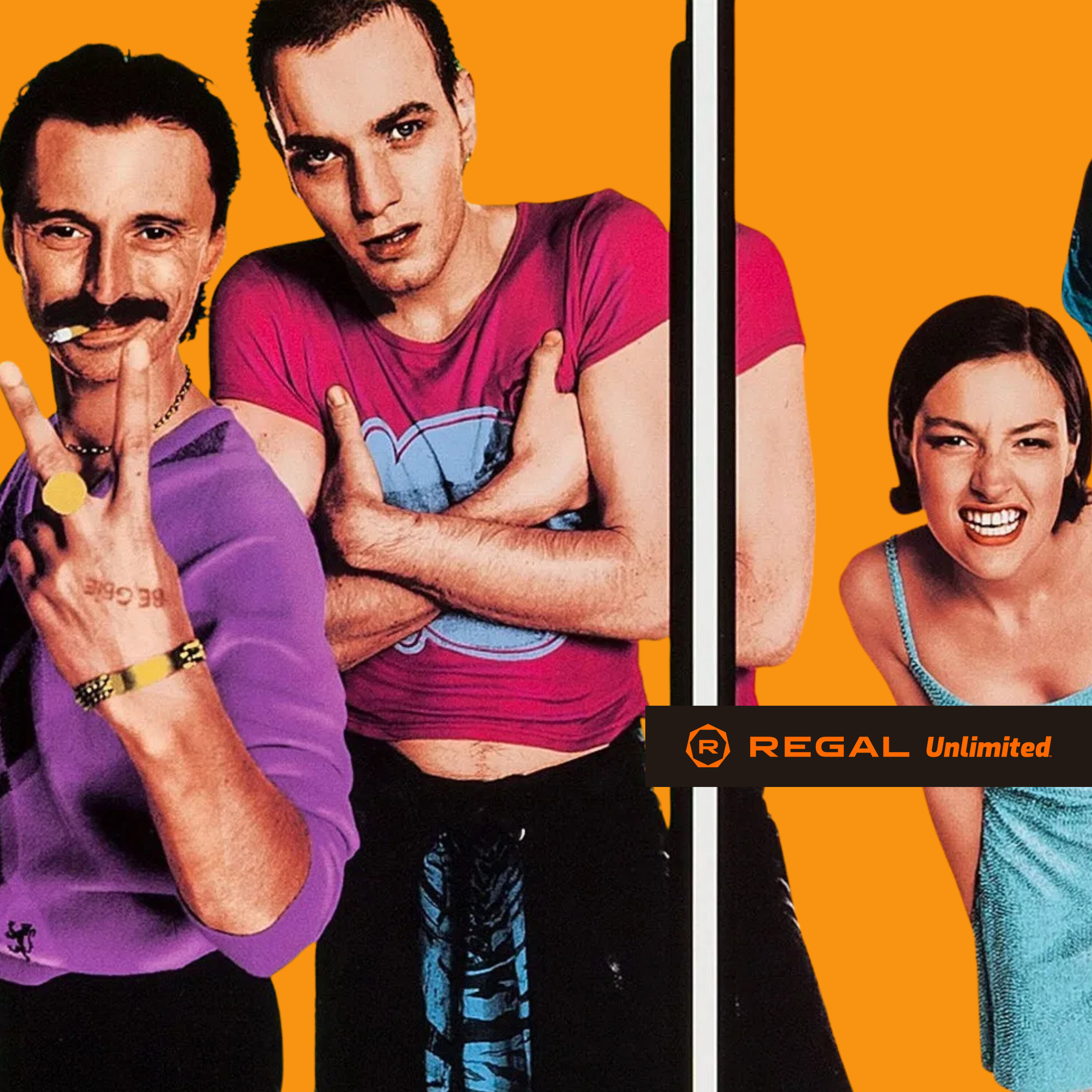
Trainspotting Review (30th Anniv.) and Pantheon Nominations | #1052
Adam and Josh return to Danny Boyle’s drug-addled Edinburgh for TRAINSPOTTING’s 30th anniversary, then bring Producer Sam on to unveil the 2026 nominees for the Filmspotting Pantheon. Plus, Massacre Theatre.
This episode is presented by Regal Unlimited, the all-you-can-watch movie subscription pass that pays for itself in just two visits.
(Timecodes/chapters may not be precise with ads.)
Intro (00:00:00-00:01:49)
Trainspotting at 30 (00:01:50-00:47:32)
Filmspotting Family (00:47:33-00:52:41)
Next Week / Notes (00:52:42-00:56:34)
Massacre Theatre (00:56:35-01:04:43)
Pantheon Nominees (01:04:44-01:48:04)
Credits / New Releases (01:48:05-01:53:10)
Notes/Links:
-Filmspotting Pantheon
https://www.filmspotting.net/pantheon
Feedback:
-Email us at feedback@filmspotting.net
-Ask Us Anything and we might answer your question in bonus content.
Support:
-Join the Filmspotting Family for bonus episodes and archive access.
https://filmspottingfamily.com
-T-shirts and more available at the Filmspotting Shop.
https://www.filmspotting.net/shop
Follow:
https://youtube.com/filmspotting
https://instagram.com/filmspotting
https://letterboxd.com/filmspotting
https://facebook.com/filmspotting
https://twitter.com/filmspotting
https://instagram.com/larsenonfilm
https://letterboxd.com/larsenonfilm
https://facebook.com/larsenonfilm
https://bsky.app/profile/larsenonfilm.bsky.social
See omnystudio.com/listener for privacy information.
Available Results
Generated results are saved to the knowledge database for reuse and search.
Extract Knowledge
Pick what you want extracted first. Model, scope, and chapter options appear after a template is selected.
Transcript
00:00:21
Speaker 1: Film Spotting is presented by Regal Unlimited, the all you can watch movie subscription pass that pays for itself in just two visits. See any standard two D movie anytime with no blackoutdates or restrictions. Sign up now on the Regal app or at the link in our description and use code film spot twenty six to receive fifteen percent off.

00:00:45
Speaker 2: What kind of a show you guys putting on here today?

00:00:48
Speaker 1: You're not interested in art?

00:00:49
Speaker 3: Now?

00:00:50
Speaker 1: No, Look, we're going to do this thing.

00:00:51
Speaker 3: We're going to have a.

00:00:52
Speaker 4: Conversation from Chicago. This is film Spotting. I'm Adam Kempanar and I'm Josh Larson.

00:00:59
Speaker 1: Choose good health and the career.

00:01:02
Speaker 4: Choose your thanks, Choose your future, Choose.

00:01:06
Speaker 5: Life, Rent and Spud sick Boy, Tommy Begbie. It's been thirty years since we were introduced to the Train Spotting Gang. This week we take another look at Danny Boyle's Seminal nineteen ninety six film.

00:01:21
Speaker 1: And the twenty twenty six slate of nominees for the Film Spotting Pantheon. That more ahead on film Spotting.

00:01:35
Speaker 5: Welcome to Film Spotting. Later in the show, Josh nine new nominees for the Film Spotting Pantheon are eclectic, Let's go with eclectic movie Hall of Fame.

00:01:45
Speaker 4: Are you ready?

00:01:46
Speaker 1: I'm ready? How does one get into the Film Spotting Pantheon, Adam, We will break it all down and yeah, then we'll try to get to those nominees.

00:01:55
Speaker 5: Yeah, Producer Sam will join us for that. We each get three nominees, but only two films will enter the Film Spotting Pantheon. Once the process is complete, we will also have yet another very special edition of Massacre Theater. This one is going to be accent Palooza.

00:02:13
Speaker 4: Are you ready for that?

00:02:15
Speaker 1: As ready as I ever am.

00:02:17
Speaker 5: A quick reminder, Film Spotting is now available as video podcast. You can watch the show on YouTube. For a link to video episodes, go to film spotting dot net slash episodes, or yes, go to YouTube YouTube dot com slash film Spotting. But first, train spotting.

00:02:34
Speaker 1: This is nuts, little money, it's.

00:02:36
Speaker 4: A great odors. It's fish here. Look told me. We know you're getting a hard time.

00:02:42
Speaker 2: Off, Lizzie, but there's really no need to take.

00:02:44
Speaker 1: Out on us.

00:02:46
Speaker 4: Doesn't it mean you're plan to be Scottish? It's shypeing Scottish.

00:02:51
Speaker 2: With the Lords of the Low the com of the path most wretched, miserable, sad, vile, pathetic trash.

00:02:59
Speaker 4: There was ever shine to civilization.

00:03:02
Speaker 2: Some people hit in English, Ah don't, They're just wonkers. We arenother handa colonized by wankers Josh.

00:03:09
Speaker 5: When this movie was released in the US and the summer of ninety six, it came out in the UK thirty years ago this month, we would have been the ideal age, just a handful of years younger than Ewan McGregor's scar ink league gorgeous Mark Renton. Yes, I'm going with skankily gorgeous to fully embrace the exhilarating and neolistic charms of train spotting. After all, the film's legendary poster has to remain one of the all time college guide dorm accessories. And back in ninety six, we would have been right on the precipice of having to choose life and choose a job and choose a career. But here's the thing. I'm going to propose that there may not have been two people on the planet who had less in common with Rent's sick boy Spud and the Lot than us. We were too Midwestern. I mean, I didn't know you. Then again, I'm proposing this. We were too midwestern, small town slash suburban eighties kids who heard Nancy Reagan's flimsy just say no plea and actually took it to heart. Okay, so we weren't using heroin. Maybe our clothes were heroin chic. Yeah, they didn't really sell that. Look at Maurice's in the mall. After choosing life, a job, and a career, do you remember what was next in that famous monologue, choose a family, health, health insurance.

00:04:35
Speaker 1: That's fifth you probably the health insurance before the family these.

00:04:39
Speaker 5: Days, of course, right, considering you and Debbie got married five minutes after graduation, I'd say that's exactly what you did. For my part, I may not have had it all figured out, but one word no one has ever used to describe me is purposeless. If we couldn't connect, and I mean at all with the material on a personal level, then there must have been something so charged about the filmmaking, so impressive about the choices Danny Boyle made that we and all the other wankers like us were overwhelmed by it. In Blank Chech's series on Boyle Trains Podcasting, Griffin Newman references some DVD extras, Boyle offers some illuminating background. Boyle says that he and partners John Hodge, the screenwriter and Andrew MacDonald, the producer, whose first and previous collaboration was nineteen ninety four Shallow Grave, were resolutely committed to two things that they had to show the positive side of heroin. The drugs at times were fun, and this one was so important. It was a blood packed between them, the movie couldn't exceed ninety minutes. Why, according to Griffin paraphrasing Boyle, the energy of this film will not be able to sustain over ninety minutes, and at a certain point the audience will not want to spend more time with these characters. Josh, what do you think was the best choice Boyle and company made? Was it the under ninety minute blood packed, the audacity to depict drug use as pleasurable?

00:06:16
Speaker 4: Something else?

00:06:17
Speaker 5: Or will you set aside the craft and actually tell us that you identified more with these aimlessh aimless Scottish lads than I let on.

00:06:26
Speaker 1: I mean, it's worse, Adam, I had I had chosen life so much earlier. We got married. Between Junior and the senior year.

00:06:35
Speaker 4: Oh man, it is worse.

00:06:37
Speaker 1: You know, I forgot the time the kids came many many years later. Okay, but yeah, I don't remember at all having a shred of identification with these characters. Nor was that necessarily what I was looking for. I mean, I was, you know, just looking for I'm sure, I'm sure I had heard the buzz and the excitement about this movie by the time I got a chance to see it, and that's what I was. I was looking at this movie through the perspective of a film critic already. So yeah, no poster on my wall, no poster on our first apartment wall. But boy did I respond to it as a film in the way that you're describing. And I don't think this is at least my third watch, now possibly the fourth, but third, I know for sure. I don't think any watch, even though I still think it's an incredibly good film, as we'll dig into, any watch will match that first experience because of the filmmaking.

00:07:36
Speaker 4: It's the first tie appropriately.

00:07:39
Speaker 1: I'm with you, you know, I mean, it's kind of in that experience as pulp fiction, Like the filmmaking is so vibrant and so tactile, and you get whisked along in it before you even have a chance to process much what's happening except that you're enjoying the ride, and that's there's some very intricate filmmaking techniques they employ to get that effect that we will also spend some time on. Yeah, that was my first experience with it. Now to your question, I mean every movie, every time I see a movie, one more movie in my life, I am more sure that no movie needs to be over two hours. So I want to say the ninety minute blood packed was the best choice. I think for the narrative, propulsion reasons, and perhaps character reasons you laid out, it's a good choice. I think it's just a good choice aesthetically, you know as well for a movie like this to be that short. But I'm going to say the choice of choosing the allure of drugs is what makes train Spotting perhaps not the thrill ride or the dorm room poster type movie. I don't think that's why it's a good choice. I think it's a good choice because it makes the movie honest. And I think if you had only had a film all about the degradation, it may have been effective. We have movies like that about addiction. But this is in a way the whole package that allows me, someone who has no association with a life like this. I don't know where I would have found heroin if I wanted to in nineteen ninety six, but I could then begin to understand the trajectory that these characters were on and understand I think more fully and thoroughly the degradation that they reach. How they got there is because for someone to choose, if you're putting this in a matter of choices, and that's not always entirely appropriate when we're talking about addiction, but if someone was to choose where most of these characters end up, we have to understand why they would choose what initially got them there. Yes, and I think that Trainspotting does that without glorifying it. I think it really balances this tight rope that there's no hypocrisy here. There is just a commitment to wanting to honor what drew these guys in and why they would give up so much to achieve this experience, while also at the same time being completely honest about what it costs them. I think there's a crucial integrity to Trainspotting that was its initial hallmark for me, and still I think is its hallmark thirty years later.

00:10:41
Speaker 4: Yeah, I'm with You.

00:10:42
Speaker 5: Both are crucial choices to the success of this film, and you alluded to this just in terms of the propulsion that opening to just throwing us right into that chase with the music, and of course that's throwing us right into the middle of the film. We eventually catch up to that point in the movie. Is another thing that kind of makes this film special. We know we are going to be along for a ride with this movie. I Am with You, and I'd kind of forgotten this because it has been long enough since I've seen this film, and I think this is only the third time I've seen it, watched it I think as you did to prepare for the show Wed with Danny Boyle and the T two review, and then I saw it back in college when it came out, and that was it. So it's not despite it being our namesake, if you will, it's not a movie. I know that intimately, and I was surprised all over again the extent to which McGregor's character verbalizes it, and we see how pleasurable that hit of heroin is because even in ninety six, I had seen movies that had depicted characters who had had taken it, who needed who needed a fix, and it was always depicted as something that was just necessary and turned them into and I'm going to come back to this, had turned them into effectively a zombie, right, just kind of.

00:12:14
Speaker 1: Not the craving. Yeah, emphasized the cra It was.

00:12:17
Speaker 5: Something their body needed and if they didn't get it, they were they were going to be sick. And that is all true, and we see we see that in this movie as well. Right, But as Renton says in his narration, if we don't understand why you said it, if we don't understand why they would be drawn to it in the first place, then this movie doesn't work at all. If we don't understand how it feels, then then we're we're not going to go on this journey with these characters. We're not going to understand why they are going to choose this instead of like everyone else, all the wankers. It'd be so much easier to choose life. We have to see it, and that that first scene where we really do watch all of these characters at Mother Superiors get get their fix. You see it just in the way Spud's body reacts to it right that that they're they're having fun. There is pleasure there that that did seem like a bold choice and even to me at the time, and it feels bold now.

00:13:24
Speaker 1: And I think there's also a technique they employ besides showing the allure and the experience, they show once these characters have had that the absence of it, which is also key to our understanding, because then we know it's not just that they're chasing something, they're running away from something. What does Renon say early on when he decides, you know, he's going to kick it again, and then he goes to meet I think sick Boy, and the voiceover says something like the horror, the horror of having to meet my friends in full consciousness and something like that makes us realize, you know, this should be one of the pleasurable parts of your life, is hanging out with your mates. But now he's reached a point where if he has to do that sober, it sounds like hell to him or think about. And here's where technique comes into play. This is I think after the second time, he's given it up for a while and he's at Bingo night with his mom in a pub, sitting at a table, and Boyle employs fast motion photography to show everyone around him is having a fun time, they're gathering their social and he's sober, and it's hell, he's the one sitting at the table where slow motion, you know it's not He's just still and everyone else is moving around. So that's just another approach they use. It's like it's the absence. Once they've had us experience the thrill through the filmmaking, then Boyle gives us moments of the absence of it through voice, sober and through fast motion, and we come to understand their experience in a different way.

00:14:59
Speaker 4: You're exactly right.

00:15:00
Speaker 5: Regular life, regular everyday life can never match, can never match that high right that they're that they're always chasing. That all said, not that it matters, but if I was, if I was ranking them, I might I might go just opposite of you, Josh, and say, actually, the ninety minute blood packed I think is even more important. I think Boyle, Hodge and mc donald we're really smart. I think Trainspotting could be a longer film. I don't know what the max would be, and I don't need to speculate. I think it could be a longer film and still be very memorable, still be one that we're talking about thirty years later. But I'll positive that for every minute over ninety that it got, the returns would diminish proportionally. I don't have to care about characters. I say this all the time. I don't have to like them. I don't have to find them sympathetic. I don't think that Renton is very sympathetic, and he's the most sympathetic of the lot. All that matters is are they interesting? Are they interesting dramatically? And these characters, yes, even Rentin are interesting for just about ninety minutes.

00:16:04
Speaker 4: Think I think he and they.

00:16:05
Speaker 5: As a group are a sufficient vessel to hang the movie's central provocation around, the central provocative idea around And maybe that's it. And the question am I invested enough that when let's say, Begbie, when he shows up in London, I'm I'm thinking the same exact thing that Renton is.

00:16:29
Speaker 4: Oh no, yeah, I am?

00:16:32
Speaker 5: And am I thinking about the consequences for Renton of sliding back into addiction when he has to sample the heroin, Well, he only has to sample it once, but he's going to make sure that he gets that that second, that that final there's final hits, he says, and then there's final right, Yes, I'm thinking about that. So I'm invested enough in the character. That's that's all you need. I don't know that there's there's more depth than that. Even with the ninety minute restriction, the movie kind of kind of runs out of steam, you know, it needs something like this, this shallow grave like conventional ending where we get the crime factor, right, A betrayal in a bag of money, that's what That's what kind of signals it for me.

00:17:19
Speaker 1: I would argue, and you know, maybe we should praise it before we get to nitpicking. But I would argue, there's even sections of this movie that could be caught and we could get it to you know, eighty three or something.

00:17:28
Speaker 5: Yes like that, Yes, yeah, but I'll say, directly connected to that, something else that stood out to me more this time, And I say it's connected to the runtime because these types of films are usually shorter. This is something that I think everyone listening is probably aware of. I don't think it's at all breaking news, but it's something that maybe when I have watched it previously, I didn't fully grasp and when I think about it in my mind, when I think about Trainspotting, the space that occupy sort of in my consciousness, I don't think about it this way. And this time I got it. This is a comedy. Train Spotting's a comedy. I think about it, though, Josh. I think about it in terms of shooting up, and I think about it in terms of griminess and dead babies and the worst toilet in Scotland. And let's be clear, that's all there and in fact the worst toilet in Scotland, to the credit of Boile and his crew, the production designer, everybody involved. You feel like you can smell that toilet coming off the screen. You know, it's that batter slash slash good right. The soundtrack and the posters may have that upbeat, neon feel to them, but that isn't that's not the experience of the movie itself. Maybe the overall energy of it, the forward motion of it, the propulsion, as we've said, but it's not really how the movie feels. It's not how the movie looks. It all weighs so heavily in my mind and I watch it this time, and I realize how often it's going for jokes, and some of them don't Land. You mentioned scenes that maybe could be cut. I wonder if you're thinking about a scene like when Spud wakes up at his girlfriend's house and we get the scatological humor of the sheets and spraying all over the room. That's a joke that isn't necessarily all that funny. But many of the jokes, Josh do Land. I'm gonna say the bit, the entire bit around the videotape and the cross cutting during the sex scenes, right and rent and saying I haven't felt that good since Archie Gemmel scored against Holland in nineteen seventy eight.

00:19:53
Speaker 4: Is inspired.

00:19:54
Speaker 5: That's really good And another part and this will open up maybe a conversation about the larger themes of the movie. It's not subtle. This is where you can tell that Boyle and Hodge are going for more comedy when he is when Renton in his voiceover is early On is talking about trying to go straight or thinking about it, but he's explaining this allure, why he is, why he has made the choices that he has made. Right, Remember he I think he has said maybe to Begbee at this point that he is going to he's going to kick it. And what does Begbie say? He's like, you know, it's about time you got to get off that poison. And what does Boyle show Begbie taking a drink immediately as he says, you got to kick that poison. And then he cuts to the dad. You know these are hard comedic cuts. Cut to the dad saying or Tommy, actually it's Tommy next, and Tommy says, yeah, that's something like that stuff terrible for you, as he takes a hit off a cigarette. Right, So they're just using bad substances too, while giving him grief for the substance he's taking. And then the next cut is to his father sitting at the table and the dad is giving rentin his son grief for wasting his life. And the implication is, well, Dad, all you do is sit at this table or sit in this chair every day, right and stare at the TV. You've you've made those other choices, but but all you're doing is really wasting your life. The movie's pointing out the hypocrisy of people like his dad, but also all of his friends. He also notes in there, that is, his mother has just found more socially acceptable ways to be a drug addict. They all have, right again showcasing that hypocrisy. But those are those are jokes, you know that they're they're trying to make us laugh with the script and also the visual matching.

00:21:51
Speaker 1: Yeah, and it's it's the pacing establishes it as a comedy, a very dark comedy obviously, as is clear from what we've been discussing. But that's in the opening voiceover as well. You know, it's a it's a snarky, sardonic yeah, trying to expose these hypocrisies. Renton's whole voiceover about choosing life is exactly setting that sort of you know, sardonic, balloon popping tone. And you know too. And I want to talk a little bit about McGregor's performance because it's interesting. You said he's not sympathetic, but maybe the most sympathetic. I came away so impressed by McGregor's commitment to being a ghoul here, especially you know, someone early on in his career. If someone's being a mercenary about it and strategic might want to, especially someone with the charm magnitude that McGregor has might want to maybe lace a little more of that charm into the part, maybe get the audience a little more on his side, you know, for future projects or something like that. I don't think McGregor does that at all. There's charm there because Renton is It's naturally part of who the character is, right, It's not something that I feel McGregor trying to dial up to gain any sympathy. When he says I choose not to choose life. It's you know, you talk about audiences, Adam for a movie that broke out this big, it's kind of needling that audience, right. It's basically saying he addresses the audience. It doesn't he addresses us at the very end, right when we return to the choose like speech, and he's basically needling the squares, He's needling you and me and saying, I choose, I choose something other than what you've chosen. And the commitment MacGregor brings to that choice, the gaze he has in the quiet moments as Renton, that's when I think of him as a ghoul or a step worse beyond that. There are times in this movie, especially that montage when they're talking about having to you know, petty crime to scrounge up their money. He comes across as a straight up predator, right. He's out there and he's coming after you to get what he needs to get his next fix. So I do think it's in the performance overall, but I think the voiceover and the delivery of it is just crucial. It's so blisteringly honest. He doesn't give an f what we think about him. I also thought it was curious how he refers to himself as renting a number of time.

00:24:21
Speaker 4: I was going to say the third person.

00:24:23
Speaker 5: The fact that he slips in at times to the third person tells you that he has a sense of his own grandiosity, which thinks also makes him less sympathetic.

00:24:32
Speaker 1: Yeah, I think it's part of that. I think it's also this is a story about storytelling. How many times do we hear characters telling stories and then we'll get the visual flashback to that. So to your point, the grandiosity ren and sees himself as a character in this story. I also think it indicates that he's lost himself in a sense, like this experience and becoming an addict. He is separated, he's been separated from his true self, and I think using the third person reflects that as well. And yeah, just to go back to giving you know, McGregor credit, not just with the voiceover, but his his acting, his face that moment, which is the least comedic moment in the film, they realize that the baby has died his face when he delivers, and this his voiceover. I wish I could think of something to say, something human, But then if you look at McGregor's face, it's not only the line, but it's the ghoul is gone there and there's a flicker of the human who wants to come out, but because of his addiction you can't. So I think it's the performance I was just more impressed by than ever. Maybe on this.

00:25:43
Speaker 5: Watch I had the same reaction. I was never so focused on how good McGregor was, and that's because of actually the range of the performance. Despite the fact, right, because there is a lot of emotion on display in this character. He does give us a full range of a character despite the fact that there is so little in terms of humanity in Rench. You're exactly right, Gul's a good way to put it. But you know, it is almost like he's a shark like character. Those eyes even match it sometimes, you know, when you think about him, when he looks at Kelly McDonald in the club, and there's some great filmmaking there which would almost be like a moment out of a movie when two starcross lovers see each other in a romantic comedy even or a drama. The way he isolates, the way he isolates renting there in the middle of the dance floor and has him looking at her and the lights just on him, it could be romantic, except it's not romantic at all, because there's something almost menacing about the way he's looking at her. You know, he only sees her as an object, sort of like drugs. In this case, the sex, the potential for sex is replacing what he would normally get the high of drugs, and so there is something about just I think you said it a predator. There is something in his face, and you're right, McGregor doesn't shy away from any of that. I think when I was suggesting too, that the script isn't interested in making him sympathetic, and McGregor then doesn't try to compensate for that. Think about think about moments like and these both involved Tommy. There's there's the whole bit with Tommy and is it is it Vicky Tommy's girlfriend who leaves him, and and that that precipitates or maybe precipitate isn't strong enough word, that really causes the spiral for Tommy. Now Tommy, does you know? Tommy does say, and here I I kind of wish the script didn't do this. The script says, well, it was iggy pop and it was other things, you know, And we hear earlier that you know, Tommy's not the perfect boyfriend, so of course it wasn't just one thing. But certainly we get the idea that misplacing the sex tape was the serious rift that led to her leaving him.

00:28:09
Speaker 1: Right to go back to Renton. Let's blame it. Renton is the reason it's rent This.

00:28:14
Speaker 4: Is where I'm going.

00:28:15
Speaker 5: Okay, where I'm going, Josh, So I agree, I'm going with where I'm going with this is this is the reason why Tommy is now depressed and unstable. And he then right after this decides it's time to take a hit, right, and he ends up maybe the most miserable of all. No, he does end up the most miserable, in the worst state of all the characters. At no point do we see Renton go when he knows that he's in a desperate state, even before that that it's about the tape. At no point does he say, well, I took the tape, I have it right. He has no interest in stepping up and saying that I was the cause of that. Maybe you could get her back. I can give you the tape back, let's mend it. He has no interest in doing that. And even at the end when he's at the funeral, when he's at the funeral and the guy is sitting there telling him how awful it was and the state he ended up in, there's no sense that Renton is actually ever being introspective about it, that he's processing really any of this, that he really cares. Of course he does on some level care. We understand that Tommy was a mate, that he wishes Tommy was alive. It doesn't feel like there's that much more depth than.

00:29:30
Speaker 1: That, though, Yeah, I think that's fair. The only gesture that comes anywhere near something like that is the scene where he does go visit Tommy, who at this point is is, you know, on death's door. His apartment is squalid, and I sensed some ambivalence to you know, why was he even there, because you could also see a rent To who just never visited him again, right, that would have been in character as well, So there's some gesture being made. But to your point, he doesn't take that occasion to really have any sort of heart to heart, let alone acknowledge his role in Tommy's downward spiral. It's the tragedy of Tommy. I think it's the most tragic narrative in the movie actually, because we see a guy who you know, wasn't a saint, but he had not yet become an addict or or as far as we know, tried heroin.

00:30:23
Speaker 4: And I think that's the suggestion.

00:30:25
Speaker 1: He had chosen, and we should say Kevin McKidd placed Tommy. He had chosen a variation of the life that was square, you know, and it seemed to be working for him. He seemed to go back to this sense of Renton being split and outside of himself. Tommy at least seemed to know who he was in his choices and had been a whole, if imperfect human, And well that's the that's the guy who ends up dead. It's it is like the tragedy of the film.

00:30:57
Speaker 4: I think, I agree, I agree, Adam.

00:31:03
Speaker 1: It seems like one of the first big movies that everyone's talking about anticipating of the year is upon us. It's Wuthering Heights. This is the kind of movie you want to see in the theater. You want to be with the crowd so that you can also then be part of the discussion afterwards. If you had Regal Unlimited, you could see Wathering Heights in a theater for free. Regal Unlimited is the all you can watch movie subscription pass that pays for itself in just two visits. Right now, Regal is offering film spotting listeners endless movies for less. If you sign up for Regal Unlimited using code film spot twenty five, you'll get ten percent off a three month subscription. Now Regal Unlimited is the only truly limitless movie subscription pass. You can see any standard two D movie anytime with no blackoutdates or restrictions that does cover Weathering Heights. Also, with Regal Unlimited, you won't just save money on tickets, You're also going to save on snacks. Members get ten percent off all non alcoholic concessions, So sign up now in the regal app, or you could use the link in the description code and use code film Spot twenty five to receive that disc.

00:32:16
Speaker 5: I know that there are so many moments that we could here and talk through in terms of the filmmaking and all the tricks that boil employees. But actually what I want to talk about, Joshua stood out to me this time. And maybe it stood out to me so much because you know, I was working on the graphics that we're going to post on the show page and that are going to go with the podcast when we post it. But of course, when you think about the poster for the show and you think about the art that accompanied the movie, part of the branding of this movie, it's that orange, and it's the green, and it's the purple, it's the super vibrant colors. Because of that, that is what you associate the movie with. And of course when you watch the film, it is actually so much grimier and so much more squalid than you would imagine based on that. It is almost like it was intentionally the opposite, you know, to try to mislead you into thinking that the film is going to be something that it really isn't.

00:33:19
Speaker 4: But what I noticed this time, and.

00:33:22
Speaker 5: Someone can write in email us feedback at film spotting dot net if you can point out other other scenes in the movie where Boyle does this and I miss them.

00:33:29
Speaker 4: There probably are.

00:33:30
Speaker 5: But what stood out to me, Josh, is that is that those colors weren't weren't just randomly chosen, you know, for the for the movie poster to be to be these glowing colors that would get our attention. There's a there's a scene, maybe a third of the way through the movie, I don't know, halfway through where where Rentin is walking by an apartment complex, you know, a set of flats and it's and it's still very gray and very dingy, like the film as a whole looks. You know this, there's nothing about this set of flats that would say this is a glamorous lifestyle. And yet the doors or maybe it's the curtains. It's either the doors or the curtains. I'd have to get the scene back out. One of them's purple, one of them's green, one of them's orange. You know, I think there's a blue. It's like Boyle still finds a way to inject some color and some life and some vibrancy even into a shot and and a scene a moment like that, and then what about where where he then revisits that exact use of color is at the end when they're in the hotel room and they're they're doing the crime scene. They're doing the not the crime scene, they're doing the exchange, right, the drugs for money, the different some of the different characters there in the scene, like the guy who stays in the room with them when the other guys take the drugs away. Right, he's wearing the purple shirt, you know, and someone else is wearing like an orange shirt and the green shirt. So he's he's still being playful and being clever with those colors, you know, and finding ways to have some symmetry between the scenes. But that's that's where he's injecting the color into these otherwise like kind of squalid and uh, you know, these these moments that are not you know, I don't know what the right word is to describe a moment, you know, like an exchange, like a drug exchange like that, but it's it's not it's not the typical type of moment we might expect just based on certainly the marketing materials.

00:35:33
Speaker 1: Yeah, and it's also an aesthetic reflection of the thematic quality we were talking about at the start, vibrancy you said you need, you know, just as we said, you need the vibrancy of that experience of the high to also make you fully understand the low that we'll get to. And so in some of these frames and the use of such colors, you're getting both in the composition at once. And you know, I consider orange, green, purple, those can be depending on how they're used, the hue, the the pigmentation, those can be nauseous colors, you know, And I think that's kind of in the combination with these squalid settings, that's kind of how they're employed here. Let me give you my quick maybe my nitpick, and maybe it deserves a bigger, a bigger qualifier than that. Well, first of all, you're right about the scatological scene with spud ew and Bremer's you know, the morning after with his sheets. I mean, that's just like the most disgusting toilet in Scotland works perfect, you know, we need that that scene with Spud and next morning. Okay, you're pushing it a little too fire. I didn't need that. But you know what, I don't know that we needed Kelly McDonald's Diane at all. And this is no fault of Kelly McDonald, who I think is you know, very talent, does fine work here and has shown to do incredible work like No Country. Right, She's like, right, yeah, maybe one of the best scenes in No Country for Old Men and other films. I don't know why she needs why Diane needs to be underage here, And I haven't read the Irving Welsh novel. Maybe it's there and they're just transferring, you know, narrative details. It just you know, maybe you could argue. Debbie and I were talking about this after watching it, like she said, maybe it's supposed to be like another bad choice that rented makes right and.

00:37:32
Speaker 5: Other transgressions right, transcreations from the norm.

00:37:36
Speaker 1: You could justify it that way. I just I think, just like it's especially in my head just last week, we had to address this because our Diane Keaton Top five, you know, brings in Woody Allen, So the underage thing you have to acknowledge. We're swimming in the Epstein shit still, and it's just like I put in a movie like this, and I'm just like, why is this everywhere? What's wrong with us as human beings that we we even casually in a movie like Trainspotty and have to have to have that. So I don't know, maybe someone more familiar with the novel, you know, can fill me in on something I'm missing.

00:38:10
Speaker 5: But well, I'm just gonna say taking out the distasteful part of it, honestly, there's just the dramatic element.

00:38:16
Speaker 4: Again.

00:38:17
Speaker 5: It feels like that character is introduced and potentially be I suppose Josh an interesting character, someone someone to play off of Renton, but then she just disappears until she's just abouts to near.

00:38:31
Speaker 4: The end of the film.

00:38:32
Speaker 5: You know, if any character seems like someone who gets sacrificed because of the ninety minute runtime, it might be that character. I don't know because I haven't seen those deleted scenes, but I wonder if there are some good scenes involving Kelly McDonald's character that were left on the cutting room floor, because I don't know why otherwise that character really is in the film. I think that's a fair point.

00:38:57
Speaker 1: Yeah, that makes sense. Back to the positive and back to the techniques and the esthetic choices. Part of the reason this movie moves like it does obviously is because of the editing. So the editor on the film, Masahiro Hira Kubo, looks like did TV before working on Boyle's Shallow Grave and then also worked on the Beach with Boyle. That's you know, that's why that opening sequence you call that works the chase and bringing us through this headlong experience of what life is like for these guys when they're high. Is that where they there's the fast at it's of the sucking down the milkshake. I just think of that as like it's a little detail, but like the multiple cuts for that one action is like that's train spotting, right, That is that is capturing how this movie moves. But even things like remember when Spud is interviewing for the tourist job or whatever it is, Yeah, and there's speed yeah yeah, so he's he's sped up, and then we just get nice touches where there's an establishing shot essentially of him in this big room from fire away turquoise rug another potentially nauseous color, and while he's talking, we cut to a medium shot of him like we're suddenly up on him, and then we're back away and stuff like that. And another cut that I love, This is where Renton I think it might be after the bingo night he goes out back. No, I think it's after time his funeral. At any rate, he's clean. He's balancing on top of a cinder black wall and he decides he's going to go for a hit, jumps up off the wall. Cut to him Spider Man style, landing in the middle of Mother Superior's flat.

00:40:36
Speaker 4: Right, yeah, I mean, just like.

00:40:38
Speaker 1: That's the sort of stuff trains right, exactly ext that's what we think of, we think of that, those kind of magical realist moments that editing the editing provides.

00:40:49
Speaker 5: Yeah, I think you're exactly right. And that reminds me too. As you brought up the turquoise. We see pink. For example, in the moment where Tommy, Tommy's telling the story of what really happened with Begbie playing pool, he's lifting weights. Talk about the degradation, the de evolution of Tommy as a character as a man also obviously corresponds with his apartment and when he's lifting weights, like his flat has it's pink behind him, you know, it has this more feminine sort of touch. Right has this woman in his life, and and that all that all fades, so that that's that injection of color again that's there, and that that completely dissipates as as his life gets worse and worse. The thing that inspired my my question that I set up in the intro josh something I thought about and and here again maybe this is this is really obvious, but I was thinking about this movie as a generational movie, just the fact that we were the age that in theory this movie should have exactly appealed to Right. And I'm gonna throw this out there and see what you think about it. Also as I as I had the thought, as it occurred to me that it really is more than anything I think a comedy. My thought is this that Trainspotting is to gen X what The Graduate was to Baby Boomers, including the indelible soundtrack, Choose Life, reply, plastics, and heroin replaces sex. Benjamin Braddock, he had the California Son, and he had a swimming pool, and he had Missus Robinson to numb himself with Right because he didn't know what choices to make. He was overwhelmed by now having to become an adult. By having to leave college and go out into the world and not not know what he should be, right, so he numbs himself with sex. And you have a guy, you have the friend of his dad famously telling him at the party, plastics is the is the way to go because it will it will make him, it will make him rich, and of course if it makes you rich or if it makes you money, that will be that will be the key to happiness. And Trainspotting just updates that for our generation and instead of plastics, it's it's choose life. Think about how many things in that monologue are consumer related, almost all of it. Television, washing machines, cars, compact disc players, tin openers, mortgage payments, starter home, three piece suit. Right, you could go on and on. It's all about what you buy. The fear seems to be ultimately more than anything, that adulthood equals consumerism, right, and that you're just going to fall into whatever that rut, whatever that routine is, And that's what he is trying, that's what he's trying to avoid. And that's really the key, that's the key to the character is not only are you not only are you choosing heroin because it makes you feel really really really good. But as Rentin says at one point in the narration, you know, it's just another type of full time job, which is hard. But at least there's only one choice to make. That choice is every day, I just have to do whatever I have to do to get the next fix. When you choose life, you have to choose all those other things. There's so many more decisions. It's overwhelming. Who wants to make all those decisions? It's so much easier to just make one decision, right, And that's what that that's what that character has to do. So I was thinking about the graduate a lot as I was watching this film. But I'll throw one last thing at you, two that is a little more out there. Is it possible that we should think about this movie Trainspotting as Danny Boyle's first zombie movie twenty days later?

00:44:51
Speaker 1: Yeah, that's connected to the you know, Rented as a ghoul for sure.

00:44:56
Speaker 4: The goul part absolutely.

00:44:57
Speaker 5: But you know, I think that that's a great way, a great way to look at it. But if you think about adulthood equaling consumerism, that's that's the allegory that we have often seen zombies representing, right, in horror films, and and you can be the zombie who makes all of those choices, right, because they're not really choices at all, they're they're predetermined, they're inevitable for you. Or what you could be the junkie who shoots up and you basically go into a comatose state. You're completely non functional. You're a different kind of zombie.

00:45:31
Speaker 1: I mean almost the one to one. The film that picked up that idea and is even more of a comedy is Shawn of the Dead, which almost literalizes that idea right where the consumers are the zombies. And of course, you know, Donna, the dad did that in pure horror form, yes, a lot earlier. So yeah, I like the zombie connection you mentioned with the Graduate. You know, the soundtrack, I do have to say it definitely works for the movie. But Trainspotting soundtrack, I should say, because the Graduate soundtrack does not work this way. It's more wallpaper than I remembered. I thought it was more. You know, we were talking about that with our poll about the best nineties soundtrack and the distinction between wallpaper soundtracks and those that are integrated into the actual scenes and how they're working as a scene I got to say, and this is it's just a choice. It's a different way to use music. It is more wallpaper here than I thought in terms of how Boyle employed it. Before we go out, I gotta, I gotta report back on. You know, this is Scottish film set in Edinburgh, So you went there, Yeah, when you went there for the weekend, what can you tell us? Well, first of all, and doing toilet and you didn't walk in, you didn't walk in in some terrible tourist gear to some pub and go Hi, can I use your bathroom?

00:46:53
Speaker 4: You look at him.

00:46:54
Speaker 1: I was. I think I was there for almost twelve hours and I held it the whole time, so I would not encounter that toilet good Okay, yeah that's not entirely true, but where I was worried about it. So yeah, you know, research shows of course mostly this was shot in Glasgow but set in Edinburgh, and they make use of some crucial locations to kind of get that feel, mostly in that opening chase sequence. Actually, so I was, I was down there. I wanted to track a few of these down. I have to thank Micah Rickard, a film spotting listener. He's pursuing a master's degree here in Scotland as well. Yeah, critic and I had the pleasure to edit some of his stuff back at Think Christian. So Micah and I kind of scouted this out and we did find from that opening chase. The first is obvious when they're running down the shopping street. That's Princess Street, which is like a major kind of tourist shopping street. So that's obvious, not all that distinct. But there is the stairway that Renton comes flying down just before the tunnel that he runs under. I don't know if he makes it. I think it's actually Spud who's making it through the tunnel where Renton gets hit by the car.

00:48:05
Speaker 4: Gets hit by the it's tackled. Yeah.

00:48:07
Speaker 1: Yeah, that's leading to Waverley Station. So I got an Instagram photo of myself standing there by that tunnel. It's on my Instagram Larson on Film if people want to check it out. And yeah, I think you know, I think Boyle the location scouts, they do a good job of capturing some of those distinct bridges, tunnel stairways of Edinburgh. My only complaint, as I'm gonna call myself a pseudo loco pseudo local about Trainspotting as a Scottish film. Not enough rain in this movie, Adam, does it rain at all?

00:48:40
Speaker 4: And I don't remember seeing It's that.

00:48:42
Speaker 1: You said been raining since January two, so they should have had at least a few scenes to really make it authentic tomorrow.

00:48:51
Speaker 5: Okay, at least okay, fair enough Trainspotting, it seems, didn't learn this until a couple of days before we had to watch it. Really difficult to find streaming or vod at least in the United States. Hopefully if you're listening from somewhere else in the world, you had a little bit of an easier time finding it, and you could, of course just stick with the soundtrack in your memories, we recommend skipping the heroine.

00:49:18
Speaker 4: We would love to hear.

00:49:20
Speaker 5: Your thoughts about them if you did have a chance to revisit it or not. Maybe it is so just just imprinted on your brain whatever previous experience you had with it. Feedback at film spotting dot net.

00:49:32
Speaker 3: Listen to Laugh with Me a podcast with Jeremy Odom right here on the iHeartRadio app, Apple podcast or wherever you get your podcasts. I'm Jay Oh, I'm your host. Baby, and here's a little taste of what you are gonna find on Laugh.

00:49:48
Speaker 4: With Me, and they're like, what happened.

00:49:50
Speaker 3: I'm like, I got Pepper's brain and everybody's like, oh my god, what happened? I got Pepper's brain. I just told you And listen to Laugh with Me on the iHeartRadio app, Apple Podcast or wherever you get your podcasts.

00:50:02
Speaker 1: Adam, we like to take some time to thank our Film Spotting family members here on the show. We even more like to thank our Film Spotting Advisory board members, those top of the tier folks who help us make decisions about the show. And so let's thank Evelyn from Manhattan, New York for supporting the show. Evelyn is on letter if you'd like to follow her there, you can look for so full seventy six, sof ull seven six. Evelyn shared this with us. I had just seen Joss Whedon's Serenity. It was looking for podcasts that reviewed it and found Film Spotting. I liked it so much I went back to listen to all the older episodes when it was called Cinecast. If my memory serves so yes, I've been listening for twenty years and it seemed time, as they say, to pay the piper, but mostly to say thank you for helping me keep my sinophilia alive.

00:50:53
Speaker 5: Yeah, I am blanking on what episode that was, but I want to say that's a pre Cincast twenty episode. Yeah, it's going way back a favorite show segment. This might be a bit self serving, but I never write into podcasts, but I've been moved a few times to write to Film Spotting when the subject is exactly my speed, and each time I was lucky enough to get my emails read first, and probably most infamously for the old school fans the lake House, I wrote the email instigating the entire discussion. Who knew it would get so heated. It was also the first time I felt truly connected to the Film Spotting family. Thanks Adam for being on my side. Well, thank you and runner up years later the Judy Garland Best Scenes episode. Being a hardcore Judy fan, I had to write in about my favorite scene, the camera dip in summer Stock with Gene Kelly. Apparently I wrote in at the exact right time and swaye Adam's choice to include that exact scene, listening to it being discussed and having Michael Phillips agree with the choice Forever highlight. I did go back Josh and I found that exchange and I was debating between two scenes like the day before we recorded. That was one of them, and so she clinched it. There is something deeply touching about how film spotting reads and engages with their listeners. Well, I've never spoken to Adam, Josh or Sam or been able to attend the events. I've always felt a part of this community, and in times like this, making the choice to actively join the community felt like a true necessity. Thank you so much for your work for all these years.

00:52:15
Speaker 1: Evelyn also shared a random film or filmmaker that she loves. Link later in Wan kar Wai are a t faves, but I'd like to highlight nineteen forty threes The More the Merrier as it's such an unknown classic and I want more people.

00:52:29
Speaker 4: To watch it.

00:52:29
Speaker 1: Unknown to me, Evelyn, so yeah, we'll have to track that down. Sam put a note here that The More the Merrier a housing shortage romantic comedy directed by George Stevens and its stars Geene Arthur and Joel McCrae. The movie that Evelyn credits with becoming a cinephile Vertigo. When I was eight years old, my dad had it on and I watched it with him, and my very soul was rocked. I remembered it and didn't see it again until I was a teenager, and it lived up to my memory.

00:53:00
Speaker 4: You know.

00:53:00
Speaker 5: I'm just while we're talking, I'm looking this up briefly to try to see if I can find a date, because well it says February twenty Yeah, February twenty twenty five.

00:53:09
Speaker 4: Maybe this was before.

00:53:11
Speaker 5: Yeah, it was, in fact, Josh, because I'm reading this and I'm going, wait a second, I've met Evelyn. So so this intake form came in before I had a chance to dot to Evelyn, which was actually like last last July when I when I went out with Sarah, we went out to New York City and saw the Jake Gillen Hall and Denzel Washington Othello, met up with some of our some of our trivia spotting Mafia, our New York listeners out there. Evelyn joined us for a drink. So I just did want to throw that in there, and I'm like, I know, I know Evelyn. So this came in just just before that actually, but we continue with Evelyn's thoughts. She has a few more. She says, a favorite book about movies or movie making five came back by Mark Harris, and that is a good one. I like all of Mark Harris's stuff. We thank Evelyn for being an advisory board member and for all of her years of listening. In addition to keeping us doing what we're doing, membership comes with perks. You get to listen early in ad free, You get our weekly newsletter. You get exclusive opportunities like being part of the film Spotting family discord. Heck, when I visit your town, maybe you even get to meet up with me and have a drink. That that's an exclusive opportunity, isn't it, Joshua. You don't actually have to be a family member for that, but I shouldn't say that that's true, Okay. And you get monthly bonus shows our February bonus. As we're taping this, we still have two days left in the voting and it's pretty close. But we have four nineteen forties movies, all pretty well regarded, that are vying for that Blind Spotting spot. We are only going to pick one, and that film is going to be the one that Me, You and producer Sam discuss on a bonus episode. It might be Kurasawa Drunken Angel is a cur of Sawa that somehow the three of us haven't seen. Could be that could be something else. More information about joining the film Spotting Family is available at Filmspottingfamily dot com and you can also rate us over at Apple Podcasts or Spotify. It really does help us reach new listeners.

00:55:12
Speaker 1: So kiss Me I s both be done.

00:55:20
Speaker 4: Next t week.

00:55:21
Speaker 5: On the show, Josh, we're going to be leaving drug addled nineties era Edinburgh for the wild, windy and apparently quite lusty moors of northern England.

00:55:30
Speaker 4: Are you ready for that?

00:55:31
Speaker 1: Oh boy?

00:55:32
Speaker 5: Sure, Wuthering Heights quote unquote is here. We'll see if we're ready for the discourse on that. Joining us to be part of our discourse is going to be Mariah Gates. We'll talk Emerald Finelle and Margot, Robbie and Jacob A. Lordie, and we'll also talk a little bit about her book that came out last year, Cinema Her Way.

00:55:56
Speaker 4: That'll be fun.

00:55:57
Speaker 1: I can't wait to do that. I think we were hoping to have Mariah on last year and it didn't work out. But yeah, we'll touch on the book, which is great, which I enjoyed, and this movie, which people seem to be interested in Adam. From what I can tell, I've been avoiding as much as I can. Here's where I'm at is just kind of scrolling letterbox, trying to avoid the reactions. What I've been able to perceive is that, and maybe I'm wrong on this. They seem to be kind of all over the place, which I love. I like to know that because then I have nothing going in. I can feel like I'm at somewhat of a blank slate.

00:56:37
Speaker 5: Okay, I truthfully haven't even seen that. I have not been on letterbox much over the past week. Unfortunately, everything I know is what Sam has put on this document in front of the two of us. He's he's telling us that Mariah, it seems as positive based on her letterbox blurb, but I don't have that in front of us. And then we have Alison Wilmore. We have our friend Allison, and this is her letterbox blurb. And I guess this sort of sums up maybe what you're saying, Josh, Wuthering Heights is Finelle's dumbest movie. And I say that with all admiration because it also happens to be her best to date. Well, I mean that kind of seems all over the place.

00:57:16
Speaker 1: I can hear Allison saying that for one day, and yeah, yeah, I think I think it's fair game at this point. Okay, so let's keep our blinders on. Go see it and we'll join Mariah to discuss.

00:57:31
Speaker 4: I'm down.

00:57:32
Speaker 5: Also next week Pantheon Review number one.

00:57:35
Speaker 4: What will that be?

00:57:36
Speaker 5: Well, you'll find out in just a bit and pull results. We're asking you to choose life, choose a nineties movie soundtrack. This was a fun one and it will be fun to reveal the results next week here on the show, Vote and leave a comment at filmspotting dot net.

00:57:52
Speaker 1: Adam, I want to put out one more call for a potential Copenhagen meet up. Haven't got any bites yet. I don't know how many listeners we have in the Copenhagen area, but I am going to be there the first week of March and would love to spend a night hanging out with any listeners who are nearby. So yeah, email us, feedback at film spotting dot net or find me on social Larsen on film Larsen with an e. I'm on Blue Sky, Instagram and face Book and let me know if you're in or near Copenhagen around the first week of March. We'll get together. Also wanted to share a quick note about our sister podcast, The Next Picture Show, looking at Cinema's present via its Past. They are offering part two of their Both Sides of the Ale pairing isl E, so they are onto discussing Sam Raimi's Send Help. Previously, they talked about Lena Vert Mueller's Swept Away from nineteen seventy four, so a lot of comparisons between those two films will be part of this most recent episode on Send Help. You can find new episodes of The Next Picture Show every Tuesday wherever you get your podcasts. Okay, deep breath, because it's time now for mascar Theater. This is where Adam and I perform a scene you get a chance to win a film spotting prize. Last time we mascred this scene.

00:59:15
Speaker 4: Boy did we? Ever?

00:59:17
Speaker 3: I want to say it is simple as I can so trying to share fitting towards the feelings.

00:59:23
Speaker 4: In my heart. I don't love you, I don't love you already already what already?

00:59:33
Speaker 1: How do you know that? How can you be sure so quick?

00:59:36
Speaker 4: I'm sure?

00:59:39
Speaker 1: Ouch.

00:59:40
Speaker 4: That hurts me. The cruelty of it they called bloodedness. You said what you wanted to say.

00:59:46
Speaker 2: I tried to stop here.

00:59:47
Speaker 4: That's it, I said part of what I wanted to say.

00:59:51
Speaker 1: I was in the middle of it.

00:59:52
Speaker 4: There is more no no, what will you will? You will give?

01:00:01
Speaker 1: That was LEAs say Do and Benicio del Toro in twenty twenty one's The French Dispatch, written and directed by Wes Anderson. Our massacre of that scene was part of our Oscar nominations reaction show came a couple of weeks back. Also on that show, we did a Sacred Cow review of Paul Thomas Anderson's One Battle After Another. Yes, a say Cow review the twenty twenty five film. We did it. We're proud of it. There's always a tie in to Masacre theater. So why that scene from The French Dispatch.

01:00:32
Speaker 5: Here's Mark Chorney in Portland, Oregon. Although the scene didn't sound familiar to me, I'm going to take a guest based on clues from the episode The French Dispatch. I'm thinking this because the character of the dialogue sounded Andersonian Wes. That is, I only saw this once when it was released, but I seem to remember one of the narratives being about French student revolutionaries, which connects to one battle. Del Toro stars in both films. They're both directed by Anderson's twenty twenty six Best Actor frontrunner Timothy Schalomey is in the French Dispatch, and he says to sign offs, Josh Long live Massacre theater.

01:01:09
Speaker 1: Wow, we're really getting the write in vote on Mascar theater, Adam, Yeah, I dare take a note. Here's a good old Tory light cap from Topeka, Kansas. The scene is from the French Dispatch, specifically the Concrete Masterpiece section, as Rosenthaler played by Benicio del Toro and Simone played by LEAs Se dou Banter a bit before Rosenthaler proposes marriage. The superficial Benizio del Toro connection is immediate and obvious, but look deeper. In one Battle. In the clip you played, Bob says, Freedom's a funny thing, isn't it. When you have it, you don't appreciate it, and when you miss it, it's gone. In French Dispatch, in the same segment, In fact, as Rosenthaler and Simone, the character of Bearnson observes how women enjoy incarcerated men because quote something about the captivity of others enhances the experience of their own freedom, seemingly two sides of the same philosophical coin.

01:02:05
Speaker 4: Did we look that deep? Josh?

01:02:06
Speaker 2: Whoo?

01:02:07
Speaker 1: Holy? I don't know if anyone else ever ever looked that deep into a massacre theater connection. Nice work, Tory.

01:02:15
Speaker 5: Here's Danny Hensel offending the French, which I think I did. And this director is own for his precision, which I think I also said made me think it would be this movie. And then the rhythm of the dialogue has performed really recalled Anderson's work.

01:02:31
Speaker 4: Danny did it?

01:02:32
Speaker 1: I mean that's either praise for us or an insult to Wes Anderson.

01:02:37
Speaker 4: I don't know which exactly.

01:02:39
Speaker 1: All right, here's Henry Kinson in Maidstone, UK. Gentlemen, we don't come to your performances because they are oscar or even brickworthy. It's your daring, your nerve, your ability to jump into a tangle of foreign words with no prop Where else do you get that, bless you both?

01:02:58
Speaker 5: Indeed, where else do you get that Finally, here's Botond from Budapest, Hungary. This was especially painful. Here's a counter to Henrik. This was especially painful to listen to since that scene is probably in my top five Wes Anderson's scenes of all time. It resonates with me so much. You know, what do you have a would you like to issue an apolo too?

01:03:22
Speaker 1: I'm apologized to Botond, and yes, all Wes Anderson fans everywhere.

01:03:28
Speaker 5: All Wes Anderson fans. Everyone was French everywhere, cinema fans indeed. Okay, Josh, despite all the clues I gave and how Andersonian are are banter apparently sounded we didn't have a lot of entries. No, it's not. It's not overflowing. What kind of has would be Wes Anderson character?

01:03:54
Speaker 4: Where?

01:03:55
Speaker 1: Oh? Come on, I mean there's so many options. I know there's not a signature hat, what's tweet? I know we need something tweet? Well, come reach into it and pick out this week's winner. Robert Gibbons from Kaysville, Utah.

01:04:09
Speaker 5: Congratulations Robert. Email feedback at film spotting dot net and we will set you over your very own film Spotting t shirt, tote bag or trial membership to the film Spotting Family.

01:04:21
Speaker 1: To simple.

01:04:24
Speaker 3: Would them would the it was a sad.

01:04:29
Speaker 1: Why do you say that? Why do you say tour?

01:04:31
Speaker 4: Will you say say like I said?

01:04:36
Speaker 5: We move on now to this week's edition of Massacre Theater, and yes, Massacre Theater. It's there in the title. It's always been about performing badly, about embarrassing ourselves. But but producer Sam really seems like like he's on a mission now, Josh, like it's really about just killing us.

01:04:53
Speaker 1: He's definitely on a roll. That's why he's throwing accents our way this time. We both have to do accents now. You know. In our train Spotting review, I describe myself as a pseudo local, having lived here in Scotland for you know months. Now, I'm gonna offer you a cent of accent, a pseudo accent.

01:05:12
Speaker 5: Oh yes, I can't wait. I I don't know what I'm going to do.

01:05:19
Speaker 4: We'll see this.

01:05:20
Speaker 1: This will be bad.

01:05:21
Speaker 4: You call then?

01:05:22
Speaker 5: Yeah, okay, you started off. I'm gonna give you the action. Are you Are you ready?

01:05:28
Speaker 1: Nope, let's do it.

01:05:29
Speaker 4: Okay, here we go and action.

01:05:33
Speaker 1: You're muttering.

01:05:35
Speaker 4: I don't mutter, ah, you do your.

01:05:38
Speaker 1: Muter lass when something's troubling you.

01:05:41
Speaker 5: I blame you stubbornness. It's entirely from your side of the family.

01:05:46
Speaker 1: Who I take it the talk didn't go too well, then, I don't know what to do. Speak to her, dear.

01:05:54
Speaker 4: I do speak to her, she just doesn't listen.

01:05:57
Speaker 1: Come on, now, pretend I'm Karla Jeane. Speak to me.

01:06:00
Speaker 4: What't you say? Okay, I can't do.

01:06:04
Speaker 1: This, Sure you can. There, that's my queen right here you go.

01:06:09
Speaker 4: I don't want to get married.

01:06:11
Speaker 1: I want this single lemm my hair blow and the wind is arrived to the gain, firing airs into this hanset and scene.

01:06:20
Speaker 5: I don't see like that. That's a bad impression of me. Sorry, I don't see good.

01:06:27
Speaker 4: I feel good.

01:06:27
Speaker 1: I think we did well, Adam.

01:06:29
Speaker 4: I think yeah, let's don't worry about.

01:06:32
Speaker 1: What comments are coming our way. Just feel this moment of pride and enjoy it.

01:06:36
Speaker 5: Yeah, of course we did give you. I don't know, we maybe gave you a little bit of a clue. We had to throw you off the scent a little bit though, by changing the name, so this movie does not actually have a Carlaejeene in it. In case you were wondering didn't quite roll off the Scottish tongue, did it, Josh.

01:06:53
Speaker 1: No, but another movie might have a character named Carla Jeene.

01:06:58
Speaker 5: Yeah, I'm guessing there's one or two. If you know what film we just massacred, email the movie's title, your name, and location to feedback at Filmspotting dot Nette. Your deadline is Monday, February twenty third. We will select the winner randomly from all the correct entries and announce it on next week's show.

01:07:13
Speaker 3: Good Morning, Good Morning.

01:07:17
Speaker 5: We've talked a whole line through Good Morning to the film spotting pantheon. Fifty something movies, including a couple of trilogies that have been deemed so amazing that we have enshrined them in our own movie Valhalla. And yes, there are some movies that you would expect would be there. Citizen Kane, the Godfather films, not The Godfather three, but the other two, Jaws, some Oddballs, maybe Midnight Run. Very deserving, don't get me wrong. Two thousand and two's in America. Probably deserving. We'll find out twenty twenty seven when we talk about it for its twenty fifth anniversary. They're all films that we love. And speaking of things we love, a person we love Producer Sam, the co founder of Film Spotting. Sam is here to participate in this crazy process that we invented last year, the Film Spotting Pantheon nomination.

01:08:21
Speaker 2: I've got to remember this is the real show, not the bonus show. I know hot takes, Okay, I've just got to keep it, stay on track.

01:08:30
Speaker 1: Well knows you. The film's futting family knows you well, Sam, and and bears with you.

01:08:36
Speaker 4: Jackie.

01:08:36
Speaker 1: Public might not be ready for that.

01:08:39
Speaker 4: Sam, this is.

01:08:41
Speaker 5: Look you can I can nominate. You can use your wild card slot on American Dreams.

01:08:49
Speaker 2: Actually want just the z or Temple Dreams, Temple of Doom.

01:08:54
Speaker 1: You could you know what you have my American Dreams support, Sam, Not I know I Doom support.

01:09:02
Speaker 4: Okay.

01:09:03
Speaker 5: So up until last year getting into the Pantheon, it's been a very informal process. We really have been making it up as we go. Last year we decided, for better or worse, we're going to try to make it more formal. And the thing that's really driving all this and and Sam, this this came from you, and obviously we agreed, is that it's important that these films ultimately get discussed.

01:09:27
Speaker 4: Yeah. Sure.

01:09:27
Speaker 5: The whole point of the pantheon was we didn't want these films to keep coming up again and again in top five lists.

01:09:32
Speaker 4: That would be boring.

01:09:33
Speaker 5: But why have a pantheon if people say, well, I've never even heard you talk about those films, like, we don't know what you think about them, how you feel about those movies. We want your thoughts on those films. So with that in mind, the goal has been to eventually knock out serious discussions Sacred Cow type in depth reviews, similar to what we did hopefully in the previous segment with Trainspotting, about every film that's in the pantheon. And so that's why we've been doing these anniversary type titles with movies like Trainspotting that aren't in the Pantheon, but also other films that are so setting that aside. We have also created this process for nominating other films. We each get to nominate three currently. That process is simple. We each have to pick a film that has previously been given a Sacred Cow review. We also have to each nominate a film. We each have to pick a film that has been a marathon title. Now that's tricky because of course, Josh wasn't here for all the marathons, and we're trying to get we're trying to get pantheon discussions that Josh and I have done, but some of those marathons were me and you sense this is going to come right, Okay, Yeah, that complicates it. Lastly, we have a wild card slot. It can be it can be anything, any movie, but we do require you know, there has to be a little bit of a waiting period, just like in sports where you can't get in the first year after you retire. The film has to be at least five years old.

01:11:09
Speaker 1: Yeah.

01:11:10
Speaker 2: So and again, like just to set the table for anybody that's new, we've been doing the show for twenty years, you have. We started the show twenty years ago. There have been well over fifty marathons of four to eight films, so we're talking about hundreds of films to choose from. In the marathons category, Sacred Cows also include overviews or whatever.

01:11:35
Speaker 4: I mean.

01:11:36
Speaker 2: There have been a number of different categories of films where we've visited, you know, classic titles, so there again hundreds of titles to choose from. There, so lots we got of movies.

01:11:46
Speaker 5: Yeah, last year, after this whole process, this show, we nominated the nine. Then what we did is we took the three that have never been discussed, the three wild card titles, and over the course of three shows, we discussed each one of those titles. So then we had nine films that had all been discussed by myself and Josh. We put all those nine titles up to be voted on between the three of us and also film Spotting listeners, and ultimately the top two vote getters were inducted into the Pantheon. And you know what, I'm going to say, it worked pretty well last year because it's titles that went in. We're Singing in the Rain, which is one of those films we couldn't believes in the Pantheon to begin with. At many occasions we all three thought it was already in the past, exactly right. And Sherlock Junior, which is our first silent film to get into the pantheon, and that feels like something.

01:12:40
Speaker 2: We first musical in the in the past, that's true, right, Oh, except for a Wizard of Us.

01:12:46
Speaker 4: I guess you got that.

01:12:47
Speaker 5: Yeah, I suppose you can definitely count the Wizard of Us. Here we are in twenty twenty six, year two of this process, and the only change that we've made this is something I suggested. I think last year we just went in order sort of, let's do our three sacred cows, let's do the three marathons, then let's do the three wild cards. Now I suppose there's a little bit of gamesmanship, even though this isn't really a draft or a contest. Sam, you're gonna get to start first, and you can pick. You can go with whatever you sure. You can start wildcard, you can start sacred Cow, you can go marathon, Josh, you can follow that up with whatever category you want, and we'll go from there.

01:13:21
Speaker 1: Okay, let's do it.

01:13:22
Speaker 2: Let's do it.

01:13:23
Speaker 4: Yeah.

01:13:23
Speaker 2: I didn't really think so much this time. I think I was aware of the fact with last year, with our first effort at this, that there could be some overlap, that we might be going for some of the same picks, just because to your point, there were several titles we thought collectively or individually. I thought this was already in the pantheon, so Singing in the Rain a great example. I wasn't so worried about that this time. I was more concerned as I was last year about like filling in some gaps. What's missing from the pantheon, And so you know who's not in the film spotting pantheon. Is a Kira Kursawa not there?

01:14:00
Speaker 1: That's not it.

01:14:01
Speaker 2: There's several filmmakers that surprise you when you actually take a close look. But I think Kursawa for me, is the biggest. And if it were me, I would say seven samurais just the no brainer. Should be in the pantheon. It's not your favorite, it's not in your top five. Cursawa's adam it is not. So I'm not gonna with seven Samurai. A Kiu might be the second most obvious pick that people are thinking. I know you guys both love it. I love three quarters of it. I don't love the last quarter of a Kira. So I'm not going to nominate that, which means, Fellas, we're going back, we're going back to school, We're going back to film one oh one. It's probably, I would say probably many people's first Kurasawa certainly was mine. Many people encounter it in school. If they take film, it's it's fifties Rachamon And I'm not nominating this as my wild card even though it has been a marathon subject before, but it predated Josh. It was part of a two thousand and nine I think Kursawur marathon, Adam, that you did with Maddy Ballgame previous host. But this thing's been landing on top five lists since two thousand and five. It made Top five Foreign language films back on episode number thirty seven, Top five Murder Mysteries Episode seventy three, Top five movies about voyeurism watching episode one fifty one, Top five movies about memory, one seventy one. And it was your favorite film in that marathon, Adam.

01:15:26
Speaker 5: Back in nine, Sam, you're you're you're leaving out something important unless you're gonna get o.

01:15:30
Speaker 2: I'm gonna get there. Just let me get through, let me get there.

01:15:33
Speaker 4: I'll let you get through. Okay.

01:15:34
Speaker 2: So then we get to episode four hundred, is this where you're wondering? Was going? Top five things we learned from the movies, Adam. Do you remember you paired it with Memento?

01:15:47
Speaker 4: Okay?

01:15:48
Speaker 2: Will I lie to myself to be happy?

01:15:51
Speaker 4: There you go?

01:15:52
Speaker 2: A thing you learned from the movies, Raschamont. It was also a top ten film of all time for you back in twenty.

01:16:00
Speaker 5: Twelve, I was going my first sight and sound list. I put Rascha man.

01:16:03
Speaker 2: On, exactly where was it in twenty twenty two? It was gone, which is why I'm excited for it to get another look. I don't know when the last time you guys saw it two years ago a film spotting madness best of the fifties and made it all the way to the Sweet sixteen. This is a beloved film, not only buzz or not even not in an academically appreciated film, but a beloved film. It's a pantheon worthy movie. I rewatched it myself and it really struck me that. You know, we love Kursawa for his Shakespeare adaptations. This felt like his Beckett to me. It was takes you to the very brink of existential despair, exhilarating, unnerving, can't wait to hear film Professor Adam grad School Josh dig into Rashamon, which you know again as my wild card, would be one of the three movies we'd revisit.

01:16:55
Speaker 1: Yeah, I mean, it's astonishing Kursawa isn't in the pantheon, so we do need to correct that. And boy, Raschamon I might not have seen. I forget how you describe it, sam like the film school one oh one or the that's probably when I saw it, and unfairly that's my memory of it, is like it's starter, Kurrosawa its starter, you know, non English language film. It's it's like where you begin. And so now, having seen so much more of that, it'll be interesting to return to it and see what else is there? What did I miss?

01:17:31
Speaker 5: Like?

01:17:31
Speaker 1: Why? Why? Maybe don't I hold it now in such high regard as something like seven Samurai or Akiu or some of these other Kurasawas. So yeah, I'm all in.

01:17:41
Speaker 5: Yeah, I mean well argued obviously, and I certainly noticed that Kurrasawa was not on the list. I do think the pantheon also needs more foreign language films, so checks two important boxes there.

01:17:56
Speaker 4: I think you probably made the right.

01:17:58
Speaker 5: Choice as well with with Rashoman. I just looked at my letterbox list and I do have that in my number one spot. I thought it might be rom though, and I know you mentioned the Shakespeare invitations. I thought it might be Ron, and I have Ron right behind it. But I'm not gonna I'm not gonna quibble. I think it's a fantastic choice, Josh.

01:18:18
Speaker 1: I'm up, and I'm not sure which category to go too. Before we started recording here, Adam kind of hinted that maybe one of mine from last year was going to come back in the mix, and if that's going to happen, I want.

01:18:33
Speaker 4: To pick it. I want to take it.

01:18:36
Speaker 1: So I tip my hand and I'm being lazy because I'm being lazy because I am repeating my marathon and sacred cowpicks full disclosure. Time got a little tight. But I also really think these are two important films. I'm gonna I'm gonna go with the one that I think is perhaps a particularly film spotting film, and I do like that quality of the pantheon. We are trying to make this respectable by including musicals, silent films in Kurrosawa. Yes, I think that's an important task and I'm glad this process is giving us a chance to do that. But we also don't want to just, you know, mirror every greatest Films of All Time list right now. This one, I think appears on a lot of those, but you don't hear it discussed as much. We discussed it, Adam and loved it. It's the best years of our lives.

01:19:30
Speaker 2: Oh yeah, I thought you were going somewhere else too, Josh, I thought.

01:19:33
Speaker 4: You were going somewhere else.

01:19:35
Speaker 1: Crap.

01:19:35
Speaker 4: Now I'm not going to get this other one totally.

01:19:41
Speaker 1: Picture in our William Wyler marathon. Okay, you know, great movie three return World War two vets returning home in Middle America and what that means for them. We pulled our best scene of that Wiler marathon from this as well, Adam, looking at star ratings five out of five for you, four and a half out of five, Sam, I didn't get a chance to look at where you've got this because I do think consensus when I'm thinking about what to nominate, Consensus is important here. We want these films to be you know, obviously we may love them to different degrees, but sincerely appreciated by all of us. So I know you do like it, Sam, I'm not.

01:20:24
Speaker 2: Oh yeah, I think I'm looking at my twenty twenty four? Is that when we watched the wil Or Marathon? Of course? Yeah? So what did I write every scene a cocktail of hope and heartbreak?

01:20:35
Speaker 4: Masterful? Yeah? I loved it.

01:20:37
Speaker 1: There you go. I don't I don't need to say anything more than that I just you know, I do think the one thing I'll add I just do think this might be unique in the two film spotting our level of love for the best years of our lives. So I'm gonna throw the back in the mix.

01:20:54
Speaker 5: Okay, So I have to look something up real quick? Can I look something up? Because this is gonna determine. This is definitely gonna determine how I draft here and whether or not I decide to throw a life raft to Josh or not. I have to decide whether or not this movie is eligible in two categories or not. And I ooh, it is eligible in two categories. That's certainly can help too.

01:21:21
Speaker 1: I mean, there's to Sam's point, there's plenty of films to choose.

01:21:25
Speaker 5: Yeah, and also you want you know, we do have what No, here's the thing, Here's the thing I I want. I don't care who nominates it. I don't care who nominates it. I just want it nominated. So I'm gonna let you nominate it. And I'm gonna go with another movie that I want to nominate, Okay, marriage and and so what I'm gonna do is I am going to go with my I'm gonna go with my marathon choice and my marathon choice this this was one of the I'm gonna look at this real quick while we're talking too. I think this was it wasn't the first marathon that you were part of, Josh, but it was, no, it was I was gonna say it was one of the first, and it was in fact the second marathon that you were part of, and for me still one of the most crucial, one of the most formative. And that marathon is contemporary Iranian cinema. I consider Iranian cinema to be a world cinema that is among my favorite.

01:22:33
Speaker 1: Now.

01:22:34
Speaker 5: I consider those filmmakers from you know, far Hadi and Mack Mahlboff and you know everyone that we have recently Panahi, right, and I'm leaving out someone in particular for a reason, right. I consider these filmmakers to be among our most essential and as I said to you, and most experimental, like most invigorating as as a sinophile to watch. And I was only vaguely familiar with Iranian cinema prior to this marathon. That was the reason for it. The film Taste of Cherry was part of an earlier marathon that we did on the show with Maddie. It was a can you know Golden Paul Marathon films that had won the top title.

01:23:28
Speaker 4: That can that we we hadn't seen.

01:23:31
Speaker 5: I think that was about it and the movie that I believe was the first title in it was the first title in that marathon, and it actually it it didn't end up being I think Josh, it was your it was your best picture, but for me, it was the movie that that was my second best picture. But it's the film I'm going to nominate because I think it's the the film that has the greatest legacy. It's a criterion collection edition. The filmmaker, I think is the titan of Iranian cinema. And it also when I talk about experimental, it it crosses over into it blurs, It blurs lines in really interesting ways. The film is nineteen nineties close up. Yeah, and the film is a boss Karistami for all those reasons, right, because it's Kuristami, because it's a Rannie in cinema, Because it's a film in which, if you're not familiar with close up, this is the this is this is the one sentence description. The film tells the story of the real life trial of a man who impersonated filmmaker Mosen Machmaalboff conning a family into believing they would star in his new film like that really happened. And the film tells the story of that, And it's shot like a doc, but it's sometimes shot like a narrative film, and there are parts of it that are that are fabricated, certainly, but they're the real participants and they're playing themselves and it it's it's a trip in the in the best way it can possibly be.

01:25:09
Speaker 4: And I I think it's I think it's.

01:25:13
Speaker 5: An important film and and for that reason and again because it's a Rannie and cinema and we need we need more in national cinema, in the in the pantheon.

01:25:23
Speaker 4: Close Up is going to be my nomination.

01:25:26
Speaker 1: Yeah, I mean, as you said, my best picture from the marathon, No no argument for me. I think you make a good case for it as being representative as well. So if you know we how many chances might we have to nominate a title from this marathon, I think this is a good one to start with, and ha's a good chance of getting in.

01:25:47
Speaker 2: And also just it's it's one one of the great marathons. To your point, Adam, I agree that it was. It's the kind of high from a marathon we chase. It's why we do marathons. It's it completely opens your your mind up into what is possible with movie making, and it's a reference. It becomes a reference point, and hopefully by putting close up on there, if it isn't on somebody's radar, it'll get them to go dive into that marathon we visit, you know, and take a look at all.

01:26:17
Speaker 4: Those films which are terrific. So okay, good stuff, You're okay.

01:26:22
Speaker 2: I I think I'm gonna let this play out a little bit. I have a marathon pick, but also it could be a slot for something that was nominated last year that really deserves to be So I'm gonna wait. I'm gonna go to My Sacred Cow, which was also a former marathon film. So last year I pointed out there are no currently no documentaries in the pantheon, which is especially unusual because you're both fans, but especially you, Adam. I pitched one last year, Herzog's Grizzly Man. It was a film we reviewed in the very first year of the film so it felt right. Herzog was a huge discovery for us first year of the show. I'm sorry.

01:27:02
Speaker 1: Five.

01:27:03
Speaker 2: Yeah, Herzog a huge discovery for us. It just felt right. It placed well out of contention in the Pantheon poll. Also, my revisit was underwhelming. I don't I don't need to go into that. This is the kind of like bonus Sam, I will not reveal to the general public, grisly even more. Yeah, I didn't anyway, So I'm trying again. We're back to pan We're back to documentaries. This is a film that's been reviewed twice on the show. First as part of the Docks Marathon back in six. It was Marathon number eight. Did I steal it? Oh goody? I love it? It was part of our seven from set you want to? Should we say it? In Unison seven four seventy six In twenty twenty one, was this a blind spot for you? Josh? I wonder? Let me just I'm gonna, I'm gonna get there. Top five's it's made Top five Fight the Power Movies back in seven. It came up in your interview with Steve James and Alex Kotlowitz in twenty eleven. Top five documentaries. I'd forgotten about this. We did the Top five Movies that taught Us Empathy. I think that was a live show in October twenty twenty. It was a bonus.

01:28:07
Speaker 4: I saw it is a live show nineteen.

01:28:10
Speaker 2: Seventy six, Carlte County, USA, Barbara Poppel.

01:28:14
Speaker 4: Was going to be my sacred cow choice.

01:28:16
Speaker 1: Oh boy.

01:28:19
Speaker 2: So I not only think you know the Pantheon needs a documentary, it also needs the two of you talking about a documentary that documentaries. There is a way to talk about documentaries as not just as as incredible documents. But you know, to the point of Iranian film, which incorporates just often incorporates meta fiction or documentary. There is a way to talk about this, and you guys are very sophisticated at it. And so this is one. Yeah, we've talked about a couple of times. Documentaries will always have a hard time when put in the mix with some of these other heavy hitters like close up, like Rachamon when we put a poll up to listeners to family members. But I love this as a documentary pick belonging in the marathon even more than Grizzily Man, Far more than Grizzily Man. This is such a great film. I mean, a film that's that's also incredibly necessary right now as a as a as a as a film about resistance that is also itself an active resistance, so timely and.

01:29:23
Speaker 5: Just worth pointing out. I did fulfill I suppose a dream. I got the interview that's right on the show at one point. So yeah, Harlan County was definitely going to be my choice. But Sam, that current only worked. That only worked because I I could have taken the movie. Josh is going to say next, and it was gonna it was going to work out perfectly that I didn't and I was going to take Harlan County.

01:29:52
Speaker 4: Whatever whatever.

01:29:53
Speaker 5: Fine, now now I don't know what I'm going to do next, Just go ahead, right.

01:29:57
Speaker 1: Well, I'm gonna be quick, so you better think fast, Adam, because I spent time, yes, talking about this film on last year's show for the Pantheon. It is the Battle of Algiers nineteen sixty six.

01:30:13
Speaker 4: This is not what you were built out where I thought you were going.

01:30:16
Speaker 1: Well, then you're safe. You're sick, Adam, Yeah, I guess, yeah, No, I I really want to throw back into the mix. Gilo Pontecorvo's docudrama. This is set during the Algerian War of the fifties. France's occupying forces in the film are trying to root out this network of militant cells who are seeking Algerian independence. And we did this as Sacred Kyle slash blind Spotting. So this is my Sacred Kyle pick for these purposes that show. We did our top five political resistance movies. So we're thinking along the same lines, Sam, I wonder why a year later, I'm still thinking along these same lines. Imagine. But yeah, Adam, you four and a half out of five, me five out of five. This one was just kind of like as you were describing the Iranian cinema experience, Sam. For me was just the concept of docu drama, I guess is like this in between space of you know, real world political situation, recent political situation, documentary elements, but it is a drama and the questions that technique then, you know, allow the filmmakers to ask who is and who isn't a terras, what are extreme tactics? Are they ever justified? Increasingly relevant today? And it was last year is now? So also come on, significant shout out in one battle after another. So of course exactly that was kind of like the topper for me. I was like, okay, I got to throw this in again. Also, this was interesting. So on that trip I mentioned in the train spot in review to to Edinburgh over the weekend, we went and caught a movie, and just because we wanted to see a movie, because as I noted, it's raining all the time, and so we just picked something random playing at the filmhouse, great great film venue here in Edinburgh, and it was Claude Chebral's The Butcher, so nineteen seventy here and a thriller set in a small French town that involves a butcher who returns after many years in the army, and that is incredibly interesting film very much could be read as a parable about France's involvement in Algeria. So this all circling in my head and I just thought, I've got to bring up the Battle of Algiers again. So that's going to be my Sacred Cow nomination.

01:32:42
Speaker 2: I probably said this last year, but one of my favorite conversations that you guys had really bringing a movie I found overwhelming in terms of its technique and subject matter. In a way I found impenetrable as a critically. Personally, I didn't have a way in. I was so in awe of it, and your conversation I found enlightening and just really impressive. So a great conversation for people to look up and I'm just looking. I don't know if you considered how the family in particular voted in the past, and I was impressed. Battle of it Algiers coming in fifth, so I'm glad you gave it another push, Josh, because you know, of course Singing in the Rain and Charlocke Junior ended up moving on and we had Alien in there at number two with the family members, yes, and then another title. I think I might have to nominate unless you do Adam from last year it okay.

01:33:44
Speaker 5: Yeah, all right, yeah yeah, so I thought you might be going here. But yes, it makes sense that you you would nominate Battle of Algiers, which I do think. I mean, obviously it's competing against different titles, so who knows where it will finish, but the one battle after another reles so that's right along with the real world relevancy. I think we'll change things for that film in this year's competition. But the movie I thought you were going to go with Josh, and now it will work out nicely that I get to include this title. It was your wild card title last year and then we discussed it, and so that makes it my sacred cow title this year. And just like we talked about last year, you laid it out very nicely. There needs to be an Agnes Varda film in our pantheon. And while there are many choices, and we've done an Agnes Varda marathon, this film wasn't part of that marathon because we'd seen this film. But I think Cleo from five to seven may be my favorite Agnes Varda film. And when we rewatched it, we swooned for this movie. I gave it five stars. This is a film that is very well known, especially in film school circles, which is where I watched it for the first time. Kind of like Raschoman, It's one of those movies because of its technical approach, it's formal approach. It's a movie that is more or less real time. The main character, Cleo played by Karine Marshant, has two hours to wait. She's waiting for the results of a biopsy. It's life or death, right, That's what she's waiting for and while she's wandering around, look you know Paris waiting, she meets a soldier. Now here's a connection to your last film, Josh. She meets a soldier on leave from the Algerian that's right, yep. And and and here it has another connection to one of my favorite movies and trilogies of all time, the Before series, right it it It feels very much of a piece with those films. A link later was clearly influenced by this film in those conversations that that this pair have as they walk around Paris. So it it on its own deserves to be in the pantheon. I think it's that good. The fact of course that it's an Agnes Varta film and the importance that she has to film spotting I think makes it essential. And it did quite well last year. Yeah, I don't know, I don't.

01:36:18
Speaker 4: I don't.

01:36:18
Speaker 5: I thought I thought about not saying this stuff because I am.

01:36:21
Speaker 4: Who I know you punted it out, but I didn't want to.

01:36:23
Speaker 5: I didn't want to sway things one way or another, if that's even possible. But it really was looking wasn't in Sam for a while, like it was going to be singing in the rain and Cleo not Sherlock Junior, and at the last minute, at the last minute, Sherlock Junior just beat Cleo out to go into the Pantheon.

01:36:40
Speaker 4: So we'll see what happens this year.

01:36:42
Speaker 1: Yeah, yeah, I think that, you know, Evarda, that marathon for me was one of the revelatory ones. And also back to the consensus point is you know, Sam probably loves as he's showing his his shirt right now, more than the both of us has two.

01:37:01
Speaker 4: Dogs inspired by Varda named.

01:37:04
Speaker 2: That we've got Agnes Varda exactly over on the couch right now.

01:37:08
Speaker 1: Yeah, so it's really makes us look like hypocrites if we don't have a Varda title.

01:37:12
Speaker 4: And yes, the Pantheon, Yeah, I think.

01:37:14
Speaker 2: It was that revisit last year, uh, which just made me appreciate how much she's thinking about and how much how light a touch she she brings to all of these. I mean, she's you know, she's as intellectually committed, uh and and engaged, rigorous, but I mean.

01:37:38
Speaker 1: But it's the light touch. It's the light touch.

01:37:40
Speaker 2: And it's also it's because she's she's more interested in life, in the life of of her subjects. But everything they encounter. I just love her, love her. So yeah, you went where I was going to have to go at them. So we're helping each other out here. I'm going off the grid. I was going to I was going to do umbrellas for shirt Boork for my marathon pick, which I'm not against, but this other title has been like my second pick. It was already was in the mix both last year and it was this year, and it keep keep knocking it back. But because we've got Varda up there now, I do have as part of the dog. I do have Jacques to me the dog. I might owe it, but maybe I'll wait till next year. I'm going to throw stop making sense in here. It was a consideration for me in the sacred Cow category. Again this is another number two. Yeah, I mean this is a film that is I have had the experience a couple of times now and everyone should have in their life of seeing this in a packed space, whether it's a theater, it was a bar last year. For me, it is ecstatic. It is ecstatic cinema and it is cinema. It is and you guys did it was part of it was a sacred Cow. It was part of our eight from eighty four series. We packaged it with Purple rain and it was a spinal tap spile tap, yeah, spinal tap. So but I but I think from what I remember of that conversation, still you know you you, you were able to convey that the real, you know, power of it as cinema, as a film of Demi's film, not to me, Demi. Okay, that's where that's where I'm pivoting. I'm adding an M and any yeah, yeah, Stop Making Sense belongs or at least it deserves a shot. It was you'd seen it before, Adam the eight for eighty four and Josh.

01:39:41
Speaker 4: You've seen this or yes, okay, yes, yeah, yes.

01:39:44
Speaker 2: And for the longest time it was a movie I love the Talking Heads. I know you were not a fan of the Talking Heads, Adam, but I always.

01:39:52
Speaker 5: Wasn't right, but I watched Stop Making You Become You Become One.

01:39:57
Speaker 2: I remember thinking and not watching it. I was never a fan of concert films, and it was like, well, how how great can a concert film be? And really, if if that's your opinion, you have you have a treat awaiting you because you you you discover right away from the very first moments of the film. You're taking on a very special journey as you see u. Uh, first a band and then what feels like the entire earth being created on stage, you know, uh, celebratory thing. So yeah, stop making sense, let's do it. Let's see how it does.

01:40:32
Speaker 5: Honestly, it was gonna be mine if Cleo was gone. That was probably where I was going to go for I'm glad you went with him. Yeah, Josh, your last pick. It's it's wild card for you and wild card for me.

01:40:44
Speaker 1: All right, wild card? Do we have a john Ford film?

01:40:52
Speaker 4: And we do not? We do not, We don't. Okay.

01:40:57
Speaker 1: Is there a chance that invalidates the entire project?

01:41:02
Speaker 2: Cross my mind?

01:41:02
Speaker 4: School of thought that would say that mean yes.

01:41:05
Speaker 1: So I'm going to propose. I don't know if this is the right choice, but I haven't seen everything of his seen a fair amount, and one that I think deserves to be in the pantheon is How Green was My Valley from nineteen forty one. This is an adaptation spotting. I thought it might be for both of you. Okay, all right, well fun, that would be fun. Then, to give you a chance to check this out, it's an adaptation. Richard Lewellen novel about a coal mining family in nineteenth century Wales. Basically, it's a strange film because it chronicles the work stoppages, the hunger, the heartbreak, the illness to death, the separation that defines this community's life. But it's somehow honestly warm and nostalgic at least that's how it struck me, and that balancing act is a bit magical that Ford managed. It's a movie I've long wanted to watch again and to see if I was just like in a receptive mood and a good mood or what's going on. I know the compositions here, especially of groups, of how he frames this community are staggering and why you have to recognize just from the aspect of yes, filling the frame and knowing how to do that and where to put the camera for it was foundational. So yeah, I've only seen it. One struck me as one of the greats. I am kind of glad that neither of you have, because I would love to hear what you make of it. So my wild card is going to be how green was My Valley?

01:42:44
Speaker 2: I love that we're going to be watching Citizen Kane and how green was my valley?

01:42:49
Speaker 4: Yes, spring appropriate love it?

01:42:51
Speaker 5: Yes, yeah, Sister Kane as a Pantheon title, that's having an anniversary, right, So when we were going to watch anyway and finally discuss an obvious pantheon title that we needed to have a conversation about, and now how Green was My Valley? As I said a blind spot, what I always felt like was, you know, there's maybe more conventional edgy or cinophile picks, right, But nevertheless, it was a film I felt like, I really need to see this, and now now I'll finally have a reason. So I am excited about that. So what films will we be visiting or revisiting over the next few weeks here on film Spotting. We know that we have Rasho Man, we know that we have I wonder if I'll have a different perspective on it this time?

01:43:45
Speaker 1: Well done?

01:43:47
Speaker 5: How Green was My Valley? And we are about to have a third because my final pick, I'm building up the suspense a little, leader Sam, My third and final choice is my wild card choice, and I'm gonna I'm gonna throw out a little test here. We'll see, we'll see if you guys pass or if I fail. Actually, if if I was going to suggest that there was a first lady of film spotting, you might say, it's Agnes Varna.

01:44:21
Speaker 2: You might say it, I wonder if you'll go where I almost went.

01:44:24
Speaker 5: Okay, okay, So you might say that, But also you might not say that because you know she she hasn't been around for you know, she she hasn't been making films for you know, the bulk of the time that film spotting has has been around here, right, If you want to think of a filmmaker who has been vital during the period that film spotting has been around. If I said to you, who is the first lady of film spotting, who would it be? And this is not rhetorical, I'm asking.

01:44:57
Speaker 2: Yeah, I was gonna go with Gerwig, but no, I know, I know who it is.

01:45:03
Speaker 5: It's right, Chantell Ackerman is in the pantheon with Jean Dielman, of course, and it's awful lonely there for Chantelle Ackerman. Sam, You're you're very you're very astute. I am considering for this spot. Yes, I'm considered Greta Gerwick. But I think I think we've said it many times. The praise that we have given to Kelly Reichert's films over the years here on the show says everything we need to say. The fact that that I have interviewed her three times on the show is also a key factor. The hardest part here is just which which movie do you choose? YEP with with Riiker and I did give this a lot of thought, and I've I've gone back and forth. I honestly wondered if First Cow wasn't the choice because of how much I like that movie. I think it finished second or third that year has been five years in terms of my top ten films of that year. But the movie, and here's here's part of why it is making the list even is making the list because I do think it's the movie that belongs in the pantheon. But here's an here's an added bonus. Okay, these wild card titles are movies that we are revisiting. It was it was reviewed on the show originally when it came out. It's a it's a twenty ten movie, so it was reviewed on the show before you joined, Josh. It was reviewed by myself and Maddie.

01:46:38
Speaker 1: I know where you're going?

01:46:41
Speaker 4: What's that?

01:46:42
Speaker 1: I know where you're going? And it's the right direction.

01:46:44
Speaker 4: It's john Ford film. So there we go, it's Rekords john Ford.

01:46:48
Speaker 1: There you go.

01:46:48
Speaker 5: And Josh, I know it's number one on your ranking of Kelly Rekerd films. I don't have a letterbox ranking of Kelly Rekerd films. Somehow, it seems even though I think I've seen all of her movies except for one, and if I had one, Meek's cut Off is the movie that I would put there. Still, I still feel like it is. It is her, it is her masterpiece. It is if you if you could only watch one Kelly Reichert film that that summed up the entirety of her, of her filmmaking skills and what she has to say say, what she has said as a filmmaker. I feel like it's Meeks cut Off. I know that people could probably argue with that, and would argue with that, and that's great. That's exciting about this too. That's exciting about this pick. That's exciting about Kelly Riikert as a filmmaker. But Meek's cut Off is where I would go. We have pointed to that movie a ton, Josh, even on episode five hundred, I believe at the Music Box that live show, we did Top five movies of the film Spotting Era. Now, granted that was twenty fifteen and we've had ten more years since then, but it was my number five. I think it made my top five in twenty fifteen Top five movies of the film Spotting Era. So Meeks cut Off is the film that I feel like is essential. Kelly Reikert is the filmmaker you talked about Kerrosawa. Obviously that's a little bit of a different scale Josh or Sam, but in terms of the past twenty years, it's Kelly riiker who needs to be represented.

01:48:21
Speaker 1: I love this. I think to me it's her masterpiece. Though I think I've seen it two or three times. It's been a while and she's made some incredibly good film since, so that maybe deserves some reconsideration. This works great at on the film studies course I'm taking right now. We have a unit on like landscape cinema, eco cinema, you know, the cinema of the West, beyond Hollywood westerns. I'm right in the wheelhouse, you know, So my mind is going to be in that space already. And yeah, love this choice.

01:48:58
Speaker 2: A movie about a man whose job is to take these people to the Promised Land and instead takes them absolutely nowhere. I can't imagine if we might find anything resonant. I can't imagine. I don't know what we'll find. So fifteenth Anniversary actually didn't get released I think, until the spring of twenty eleven. So I think we're looking at it's fifteenth anniversary this April. So good timing.

01:49:21
Speaker 5: Okay, okay, nine titles we have laid We have laid them out for you. Rachom on Best Years of Our Lives, Close Up, Harlan County, USA, The Battle of Algiers, Cleo from five to seven, Stop making Sense? How Green was My Valley? Meeks cut off? They're so good. I want to put all nine.

01:49:41
Speaker 4: Of them in.

01:49:43
Speaker 5: Think we did well, guys, But alas, only two of them can go in. And yes, we will have three of those titles that we will be discussing over the next few weeks here on the show, and we will will just.

01:49:57
Speaker 4: Go in order.

01:49:58
Speaker 5: I imagine the order in which they were mentioned. Well, we'll start with fair enough makes cho is good? Yeah, yeah, that that makes sense.

01:50:08
Speaker 2: That How Green is My Valley?

01:50:10
Speaker 4: Yeah, it would go How green do you want to do? Chronological. How just do that? Okay? Yeah, chronologic? I like how green was my Valley?

01:50:17
Speaker 5: Then Rachoman, and then we'll end up with Meeks cut off from there. For more about the Film Spotting Pantheon, you can find that at filmspotting dot net slash pantheon. Sam, great to see you and hear from you as always.

01:50:31
Speaker 2: Thanks for joining you guys, so much fun.

01:50:33
Speaker 1: Yeah we'll see uh so. Yeah, that's our show for this week. If you would like to connect with Adam and the show on Instagram, Facebook, letterbox, or YouTube, you can find him at film Spotting. You can find me at those places as Larsen on film We are independently produced and listener supported. You can support the show by joining the Film Spotting Family over at Filmspottingfamily dot com. You can listen early in ad free. You'll get a weekly newsletter, monthly bonus episodes, and access to the entire show archive. For show t shirts, another merch you can go to film Spotting dot net slash shop.

01:51:07
Speaker 5: If you're a Danny Boyle fan, you might want to become a Film Spotting Family member. There's a fair amount of boil in the Film Spotting Archive twenty eight years later. Conversation ten forty nine, T two Train Spotting with Boyle on the show Top five, Danny Boyle Characters with the Man Himself six twenty six, Steve Jobs five, Pin fifty nine, Trance four forty one, one hundred and twenty seven Hours three twenty six, slum Dog Millionaire two thirty five, We're going out of order a little bit. Sunshine two fifty four. He's on that show talking about Sunshine and Millions is episode number two. Also, I reference blank Check in my intro to Trainspotting. I also did an appearance during their Danny Boyle series trains Podcasting. I talked about millions as part of that series on blank Check. If you're curious. In limited release, Scarlett, the latest from Japanese animator Mamoru Hosada. We also have Nirvana, the Band, the Show, the movie. This is the new film from Matt Johnson, who made twenty twenty three's BlackBerry. I am very curious about this film out in wide release. Gor Verbinski's Good Luck, Have Fun, Don't Die. It's an interesting premise. Josh Man from the future. That man is Sam Rockwell arrives at a diner in La where he must recruit disgruntled patrons to join him on a one night, six block quest to save humanity from extinction.

01:52:31
Speaker 1: I like that premise. I'm also a bit of a gor Verbinski defender, so I'd have to catch up with that.

01:52:36
Speaker 5: Are you a gor Verbinsky completest? Is your list on your ranking on letter boxs?

01:52:41
Speaker 1: Ooh ooh, great question? After what's the one he did about like Europe period set like a spa, like a wellness spa. The cure for wellness, cure for wellness. That's it. Yeah, if he's made one since then, I haven't seen it, but I have caught up.

01:52:59
Speaker 5: Probably has, but yeah, probably we're not going to take the time to look it up right now. Cold storage is out. Liam Neeson is a grizzled well what other kind could he be? Bioterror operative who helps two employees at a self storage facility survive the wildest night shift ever. It sounds like you could merge his character with Sam Rockwell's character in the Gorver Robinsky movie. They'd be pretty interchangeable. I do love Sam's note here for us is everyone in Hollywood?

01:53:25
Speaker 4: Okay? I think we know the answer to that.

01:53:30
Speaker 1: Sam's such a carrying guy Okay.

01:53:33
Speaker 4: An elusive thief, a disillusion insurance broker, a relentless detective. It's crime one oh one with Chris wow Allie Berry, Mark Ruffalo, Berry Kogan. I'm not gonna do all the names. Lot more people. One heist connects them all.

01:53:49
Speaker 1: Yeah, it's probably one oh one. How's your throat? That was It seemed like it might have strained things a bit?

01:53:55
Speaker 5: Okay, now this is this is also interesting. Josh Goat, a small goat with big dreams, gets a once in a lifetime shot to join the pros and play roar ball with the fastest, fiercest animals in the world. So this is yet another sports movie I need to see. It's possibly inspired by the life and career of the movies Executive producer Steph Curry.

01:54:17
Speaker 4: Are you interested?

01:54:19
Speaker 1: I was increasingly confused with every word you said, but I'm now wondering if this is like a low key dig subtweet at lebron Goat. Steph Curry produces a film, Yeah, maybe possibly about himself. I don't know what's going on here, and I don't know. I have capacity my life to find out.

01:54:43
Speaker 5: Okay, next week we'll talk about what is probably the biggest movie opening. It's certainly the one we're most interested in. It's Emerald Fanelle's Wuthering Heights. Mariah Gates will join us for that, and we will talk about the first film that was nominated for our pantheon. It is nineteen forty one's How Green Was My Valley Sent? I have some homework to do. I'm looking forward to it.

01:55:06
Speaker 1: Film Spotting is produced by Golden Joe Desso and Sam van Holgren. Without Sam and Golden Joe, this show wouldn't go. Our production assistant is Sophie Kempinar. Special thanks to everyone at wb easy Chicago. More information is available at wbeaz dot or for Film Spotting. I'm Josh Larson.

01:55:24
Speaker 4: And I'm Adam Kempinar. Thanks for listening. This conversation can serve no purpose anymore, but Barne