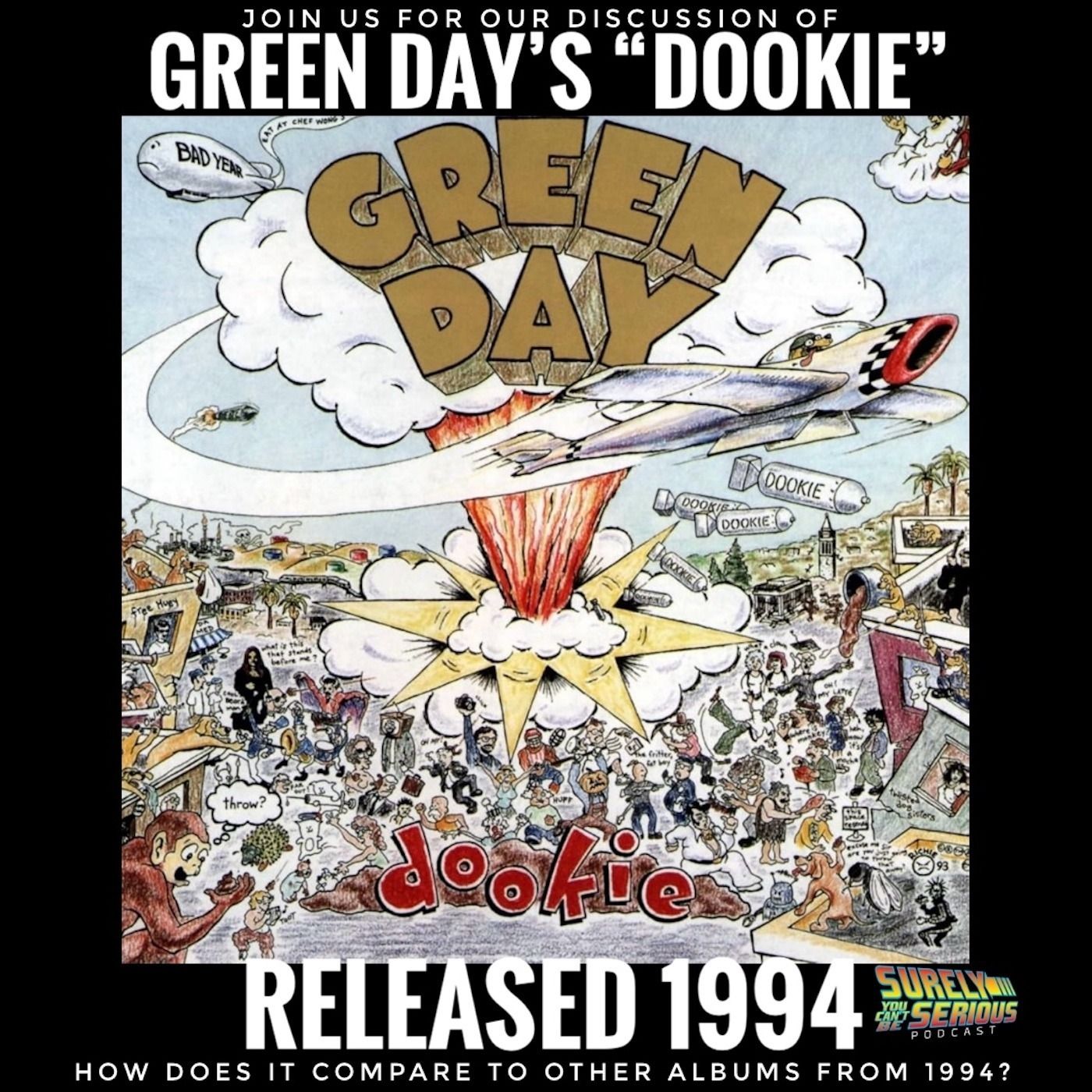
Green Day's "Dookie" (1994): Track by Track!
Do you have the time to listen to me whine? Welcome to the "Surely You Can't Be Serious" podcast! Hosts Jason and Dee are kicking off an epic five-part series celebrating the music that defined 1994. In this second episode, they're diving deep into Green Day's groundbreaking album "Dookie."Join Jason and Dee as they:
- Explore the Formation of Green Day: Discover how a trio of punk rockers from California rose from the underground scene to take the world by storm. Learn about their early influences, their journey to signing with a major label, and how "Dookie" became their breakout success.
- Uncover the Stories Behind the Songs: Track by track, they’ll delve into the stories, inspirations, and rebellious spirit that fueled the creation of hits like "Basket Case," "When I Come Around," and "Longview." Find out how personal experiences and the band's raw energy were captured in these iconic tracks.
- Discuss the Cultural Impact: Reflect on how "Dookie" didn't just launch Green Day into superstardom but also reshaped the landscape of rock music in the '90s. Jason and Dee will examine the album's influence on the punk revival, its enduring legacy, and its place in the hearts of fans across generations.
2024-09-03
61 min
Transcript
Available Results
Generated results are saved to the knowledge database for reuse and search.
No generated results are available for this episode yet.
Extract Knowledge
Pick what you want extracted first. Model, scope, and chapter options appear after a template is selected.
Generated results for public episodes are saved to the knowledge database so they can be reused and searched later.
Transcript
<v Speaker 1>Do you have that time to listen to me wine
<v Speaker 1>about nothing or everything?
<v Speaker 2>All I want?
<v Speaker 3>Hey, this is Scott Foster, Jason's college room mate.
<v Speaker 4>And you are listening to Shirley you Can't Be Serious Podcasts.
<v Speaker 3>Hello everybody, and welcome back to the Shirley you Can't
<v Speaker 3>Be Serious podcast where we are covering live throwing cut.
<v Speaker 3>Oh sorry, just being anted something here? Hold on, wait
<v Speaker 3>a minute, okay, sorry, not we are not covering live.
<v Speaker 3>That was We have to do a retraction from last
<v Speaker 3>week's episode. Apparently we are covering Green day to day,
<v Speaker 3>but we have Jeff Johnson with us. Wait uh no, no, wait, sorry,
<v Speaker 3>that's also incorrect information. Wait a minute, what happened here? Okay?
<v Speaker 4>All right, all right, right, So here's the deal. When
<v Speaker 4>you have guests on, you got to work around their schedule,
<v Speaker 4>and sometimes when you're a not a great planner like myself,
<v Speaker 4>those schedules can get mixed up. And so talk to
<v Speaker 4>Brad Moore. He wasn't able to do it this week,
<v Speaker 4>so I called an audible talked to Jeff Johnson, our
<v Speaker 4>good buddy who's been on many times, and asked him, hey,
<v Speaker 4>do you want to do doochie with us? Green Day.
<v Speaker 4>He's like, hey, yeah, man, let's do it. He's been
<v Speaker 4>listening to the album and I'm like great, And we
<v Speaker 4>talked about the days and here we are and I'm like, hey, Jeff,
<v Speaker 4>you ready to go. He's like, dude, I can't.
<v Speaker 3>Do it today. We're talking about next week.
<v Speaker 4>So that's my fault. That is totally my fault. I
<v Speaker 4>blew it.
<v Speaker 3>But but we're on a deadline at this point. We
<v Speaker 3>heard we are, so we will have to proceed without Jeff.
<v Speaker 3>So this episode will be about two thirds as long
<v Speaker 3>as it would have been.
<v Speaker 4>I guess well, and Jeff's podcaster at the film by
<v Speaker 4>a podcast. He understands how these things are and he
<v Speaker 4>has graciously let me off the hook. Jeff once again,
<v Speaker 4>I'm sorry. We'll see you again down the road. I'm
<v Speaker 4>sure very soon. But d you and I are back
<v Speaker 4>in nineteen ninety four. This is our second album. As
<v Speaker 4>we go through five weeks of albums of nineteen ninety four,
<v Speaker 4>I guess this is our second one. We're covering Green Day, Duke.
<v Speaker 3>Dukie also pop. Yes, that's her diarrhea.
<v Speaker 4>Yes, I had a kid in my neighborhood growing up.
<v Speaker 4>My dog's name was duke, and he used to like
<v Speaker 4>to tease me by calling him Dicky. I didn't like
<v Speaker 4>that at all.
<v Speaker 3>Yeah. Yeah, So speaking of that name, it relates directly
<v Speaker 3>to the album cover. Have you looked at this album cover.
<v Speaker 4>Not in detail?
<v Speaker 3>Okay? So the album cover is a art if you
<v Speaker 3>want to call it. That is an artistic piece by
<v Speaker 3>a guy named Richie Butcher U H. E. R. Okay,
<v Speaker 3>who had done things like this for other bands that
<v Speaker 3>Green Day was familiar with and was kind of a
<v Speaker 3>friend of the band, even played in some bands himself.
<v Speaker 3>But when they told him what the title of the was,
<v Speaker 3>he just went with that. And he always associated dookie
<v Speaker 3>or poop with monkeys and dogs, and so this album
<v Speaker 3>cover is filled with monkeys and dogs dropping dookie bombs
<v Speaker 3>or considering throwing the poop at somebody. And then in
<v Speaker 3>addition to that, it is populated with these various things
<v Speaker 3>like the Lady from the Black Sabbath album, the original
<v Speaker 3>Black Sabbath album, Angus Young of ACDC is on there.
<v Speaker 3>Really the murder of the co founder of the Black
<v Speaker 3>Panther Party, Huey P.
<v Speaker 4>Newton mess up your Black Panther.
<v Speaker 3>If you look at his picture on Wikipedia it's that
<v Speaker 3>guy from Forrest Gump. Really totally that guy. Yes, wow,
<v Speaker 3>the say through tower and then like a bunch of
<v Speaker 3>friends that they had, you know, just a little little drawing.
<v Speaker 3>It's so tiny you can't tell what's going on. Patty
<v Speaker 3>Smith is on there with her unshaved armpits. It's it
<v Speaker 3>is really a creative piece. And the you know, the
<v Speaker 3>record execs were like, hey, these are three pretty good
<v Speaker 3>looking guys. We want their picture to be on it.
<v Speaker 3>And they said, no, that is not us, because we're punk.
<v Speaker 4>Right, they're punk.
<v Speaker 3>These are the guys that brought back punk to the
<v Speaker 3>main stream. We did Billy Idol last year. He was
<v Speaker 3>the guy that kind of brought punk to the mainstream
<v Speaker 3>in the eighties, and these are the guys that brought
<v Speaker 3>it back in the nineties. Last year we talked about
<v Speaker 3>the Nerds coming into the mainstream, and now we have
<v Speaker 3>the Misfits coming back into the main stream.
<v Speaker 4>You know, this is like power punk pop.
<v Speaker 3>That's a lot of peace.
<v Speaker 4>You know, you've got the punk attitude with the Beatles
<v Speaker 4>like Melody. Yeah, it's no wonder why these guys were
<v Speaker 4>so successful. I told you that they've got a case
<v Speaker 4>for being one of the biggest bands of the nineties.
<v Speaker 3>Yeah, this and this album is typically on any one
<v Speaker 3>hundred list of best albums of the nineties for sure.
<v Speaker 3>Interesting fact, Good Riddance was actually recorded for this album.
<v Speaker 4>I was gonna drop that bomb on you?
<v Speaker 3>Yeah, I was recorded for this album. They just decided to.
<v Speaker 4>Say, would this album have been with that song on him?
<v Speaker 3>I don't know that you can have more than what
<v Speaker 3>this album was. This album was as the cover presents
<v Speaker 3>a nuclear bomb.
<v Speaker 4>It was really it really was. Okay, so this is
<v Speaker 4>released February first, nineteen ninety four. I want to just
<v Speaker 4>drop you in ninety four. What happened on February first? Okay,
<v Speaker 4>so this is just you know, a couple of months
<v Speaker 4>after Jack Nicholson attacks a car with the golf club.
<v Speaker 3>You remember that, I do kind of remember.
<v Speaker 4>Remember that he went went crazy On February first, nineteen
<v Speaker 4>ninety four, Jeff Bluley pleads guilty.
<v Speaker 3>Oh yeah, we had that why why from last Yeah? Yeah.
<v Speaker 3>Tanya Harding's boyfriend pleads guilty to smashing Nancy Kerrigan's kneecap.
<v Speaker 4>In exchange for turning dirt on Tanya Harding.
<v Speaker 3>Yeah.
<v Speaker 4>Also on February first, nineteen ninety four, Harry Styles of
<v Speaker 4>One Direction is born.
<v Speaker 3>It's weird, weird, Yeah, it's old. Yeah.
<v Speaker 4>Okay, So Green Day's Duke. He comes out February first,
<v Speaker 4>nineteen ninety four. Yeah, we're gonna dive into this album.
<v Speaker 3>Now, let's go, man, I'm ready to jump in. Okay.
<v Speaker 3>First song on the album it's called Burnout. Second okay,
<v Speaker 3>this song comes in with a hard punk beat right
<v Speaker 3>out of the gate. That bang.
<v Speaker 4>No, I've got crackling drum, speedy beat, very pop punk.
<v Speaker 3>Yeah, this is angsty, it's speedy. This is all things
<v Speaker 3>punk that you want. And then of course it's about
<v Speaker 3>the character's idea that life just sucks. You know, this
<v Speaker 3>is just kind of boring. Life sucks. The kind of
<v Speaker 3>lyrics which punk punk and more punk.
<v Speaker 4>Right nine apathy, rejecting responsibility, laying around being bored.
<v Speaker 3>Yeah. So this is what their life was like before
<v Speaker 3>they hit it big, right. They lived in a tiny,
<v Speaker 3>little blue collar you know what. I don't think it
<v Speaker 3>was even fully organized as a town rodeo in Berkeley.
<v Speaker 4>Yeah, this is like three towns. They're all small, not
<v Speaker 4>a lot going on, Like part of it was unincorporated.
<v Speaker 3>Yeah, that's it. Yes, an unincorporated town, and Billy and
<v Speaker 3>Mike eventually would meet there. Billy grew up in this town.
<v Speaker 3>I think he moved out there when he was about
<v Speaker 3>three or four years old. He was the youngest of
<v Speaker 3>six kids and was babied by his sisters. His oldest
<v Speaker 3>brother was twenty one years older than him, which means
<v Speaker 3>his mother was closer to his brother's age than he
<v Speaker 3>was to his brother's age. She'd had him at like
<v Speaker 3>eighteen or nineteen years old. Now. She came from Oklahoma,
<v Speaker 3>by the way, moved out during the war to help
<v Speaker 3>with armaments and stuff like that.
<v Speaker 4>I did hear that they had some o Klahoma roots.
<v Speaker 3>Yeah, she's an Oklahoma girl. Moved out to California. And
<v Speaker 3>his dad was a Golden Gloves boxer, like was a
<v Speaker 3>powerhouse of a guy.
<v Speaker 4>Yeah.
<v Speaker 3>And also throw back to the last week's episode with Weezer,
<v Speaker 3>his dad was a drummer, did jazz drumming, and so
<v Speaker 3>cute little baby Billy Joe got all of the attention,
<v Speaker 3>but he also got a lot. Both of the parents
<v Speaker 3>were musical and he got a lot of their abilities
<v Speaker 3>to started singing when he was very young. Actually ended
<v Speaker 3>up pressing an album when he was just a little kid.
<v Speaker 4>It's I told you he's like a prodigy. Like his
<v Speaker 4>voices spot on sounds great, and they're like, how do
<v Speaker 4>you like making a record? I love it?
<v Speaker 3>Five year old Billy Joe Armstrong look for Love is
<v Speaker 3>the name of the song. Yeah, you know, he's like
<v Speaker 3>six years old and singing. And then a few years
<v Speaker 3>later he gets a guitar, starts playing guitar. At eight
<v Speaker 3>years old, he is touring around with his dad, playing
<v Speaker 3>drums like they're tight. And then tragically, just a couple
<v Speaker 3>of years later, when he's ten, his dad realizes he
<v Speaker 3>has cancer, and this mountain of a man withers away
<v Speaker 3>over the next four months and passes away. Had to
<v Speaker 3>be a very tough childhood.
<v Speaker 1>I walk a.
<v Speaker 2>Only road, the only one that I have haven't known.
<v Speaker 4>A sophageal cancer, Yeah, he said. Three months between the
<v Speaker 4>time he was diagnosed to him the time.
<v Speaker 3>He was dead. Yeah. Well, very fortuitously, very interestingly, the
<v Speaker 3>month that his dad passed away, he met a guy
<v Speaker 3>named Mike.
<v Speaker 4>Yes, Mike Pritchard was in his fifth grade class at school.
<v Speaker 3>Yeah, Now, Mike had Mike had been adopted as a
<v Speaker 3>baby he had. His mother was a foster mother got
<v Speaker 3>in a call that they need to place a baby
<v Speaker 3>somewhere just six weeks old, and she ultimately she and
<v Speaker 3>her husband ended up adopting him. She and her husband
<v Speaker 3>split up and an older sister and he went to
<v Speaker 3>live with his dad for a while, but ultimately the
<v Speaker 3>mother and the dad had enough bad interactions that the
<v Speaker 3>mother was able to get full custody and that's when
<v Speaker 3>they went out to California and where Mike met Billy Joe. Yep.
<v Speaker 4>I heard him described as skinny, loud, and obnoxious, and
<v Speaker 4>you might know him more as Mike Durnt, yeah, which
<v Speaker 4>I thought this was hilarious story. The dirt comes from
<v Speaker 4>him screwing around on his bass going like, okay, what
<v Speaker 4>if we did this.
<v Speaker 3>Durnt yep, Durnt Durnt. That's how he got the name Dart.
<v Speaker 4>Yeah, and so they become buddies in fifth grade. Billy
<v Speaker 4>Joe had to wait for him to kind of get
<v Speaker 4>his chops to get up to speed.
<v Speaker 3>By about seventh grade. Yeah, well, they were both playing guitar, right.
<v Speaker 3>They had two guitarists and a drummer, and then they
<v Speaker 3>got a guy to come in and play bass. And
<v Speaker 3>the guy had come and play bass his named Sean,
<v Speaker 3>and then Sean, you know like kids do, had to
<v Speaker 3>go to the dentist or something during practice, and so
<v Speaker 3>they're like, he leaves and they're sitting around and Billy
<v Speaker 3>Joe says to Mike, hey, why don't you try to
<v Speaker 3>play the bass, and he picks it up. They start playing,
<v Speaker 3>and he said, I looked at him, and he looked
<v Speaker 3>at me, and instantly we knew he was the new
<v Speaker 3>bass player.
<v Speaker 4>That's good.
<v Speaker 3>And he was kind of bummed out about it because
<v Speaker 3>he's like, I don't get to play guitar anymore. But
<v Speaker 3>then Billy Joe's brother was like, hey, man, you're not
<v Speaker 3>a rhythm guitarist, you're a lead bass player, and that
<v Speaker 3>was enough to change him.
<v Speaker 4>Well, and the bass features prominently in a particular hit
<v Speaker 4>we're going to talk about here in a few minutes.
<v Speaker 3>Yeah, I mean the bass on these songs. I mean
<v Speaker 3>number one, This is a three man band. Every single
<v Speaker 3>member is critical, and we know that Billy writes a
<v Speaker 3>lot of the songs, but there is no question that
<v Speaker 3>the bass is a huge part of this. And I
<v Speaker 3>would say Mike is one of the best bass players
<v Speaker 3>that I've heard play from the guys in the nineties.
<v Speaker 3>Really yeah, I mean, I'm putting him up there with Flee.
<v Speaker 3>He's flea guy from Primus, Wow, Mike Dirt.
<v Speaker 4>Okay and You and I talked about this their early
<v Speaker 4>influences Molly Crue, Van Halen, Kiss, Deef Leppard.
<v Speaker 3>Billy Joe said, when he was thirteen years old, his
<v Speaker 3>sister took him to a few concerts. Took him, like
<v Speaker 3>they said that he was born in seventy two, so
<v Speaker 3>this would have been about eighty five. Took him to
<v Speaker 3>see ari Em ten thousand, Maniacs, Okay and the Replacements,
<v Speaker 3>and he was He became a huge Replacements fan, became
<v Speaker 3>a fan of Husker Doo as well. But he said
<v Speaker 3>when he heard these songs, this was an entirely different reaction.
<v Speaker 3>I mean, he obviously loved the metal songs, but these
<v Speaker 3>songs that these bands were playing hit him on an
<v Speaker 3>emotional level and that heavily influenced how he would write
<v Speaker 3>his own songs later on.
<v Speaker 4>Okay were ready for the next song on the album.
<v Speaker 3>Yeah, Let's do It. Song number two is called having
<v Speaker 3>a Blast.
<v Speaker 2>Day.
<v Speaker 3>Well you Zay.
<v Speaker 2>Say nine say.
<v Speaker 3>Okay, So this was a little rough, okay in this
<v Speaker 3>day and age. Now this says talking all you down
<v Speaker 3>with me, explosive duct tape to my spine. Nothing's gonna
<v Speaker 3>change my mind. I won't listen to anyone's last words.
<v Speaker 3>There's nothing left for you to say. Soon you'll be
<v Speaker 3>dead anyway, So plea shot and you shot South five and.
<v Speaker 2>Bad.
<v Speaker 3>No one is getting out of here alive. This played
<v Speaker 3>okay in nineteen ninety four. It wasn't a big deal
<v Speaker 3>because it would be another five years before Columbine happened.
<v Speaker 3>That's right. And now it's the most uncomfortable so on the.
<v Speaker 4>No doubt about it. The song was written in Cleveland
<v Speaker 4>in June of ninety two, and it was way before
<v Speaker 4>that homicidal epidemic that we went through in the nineties.
<v Speaker 3>Yeah.
<v Speaker 4>We even had a guy though, you came to a
<v Speaker 4>football game and blew himself up.
<v Speaker 3>I was there for that game. Yeah. Yeah, we thought
<v Speaker 3>the cannons had gone off at the wrong time, that's right. Yeah.
<v Speaker 4>So once Billy, Joel and Mike discovered punk, that really
<v Speaker 4>lit the fuse.
<v Speaker 3>Yeah, they had they had really gelled as a band.
<v Speaker 3>I've seen him in you know, the old high school
<v Speaker 3>talent shows, and they were still playing very much rock
<v Speaker 3>and roll kind of music, but punk was a new
<v Speaker 3>way to think about things. And this was interesting because
<v Speaker 3>we talked about how rock and roll and heavy metal
<v Speaker 3>was the thing of LA. Right Sunset Strip. You got
<v Speaker 3>guns n' Roses, You've got Motley Crue, you got all
<v Speaker 3>of those.
<v Speaker 4>Guys, stock and all those guys.
<v Speaker 3>All those guys down in LA. But they're up near
<v Speaker 3>the Bay Area, and San Francisco was where you had
<v Speaker 3>the punk scene. And by the nineties, the punk scene
<v Speaker 3>had build over into those kind of blue collar suburbs
<v Speaker 3>of the Bay Area what they call the East Bay,
<v Speaker 3>and there was this contingent of kids who would go
<v Speaker 3>to these clubs and listen to and play punk music.
<v Speaker 3>And he said when he fell in with them, it
<v Speaker 3>was like he met his people, right, like these were
<v Speaker 3>the people that he just gelled with, and so that
<v Speaker 3>really became their form of music. But that club, which
<v Speaker 3>was nine to twenty four Gilman Street, they called it
<v Speaker 3>Gilman Club. They wouldn't let them play when they first
<v Speaker 3>started because their music was too melodic, like it was
<v Speaker 3>to pop even at the beginning. Wow, But eventually they
<v Speaker 3>changed their drummer.
<v Speaker 4>So I heard Billy Joe Armstrong talking about initially when
<v Speaker 4>they first started out, he thought his brother was going
<v Speaker 4>to be the drummer for the band, right, And they thought, Hey,
<v Speaker 4>we're going to be like this Van Halen thing. Right,
<v Speaker 4>I'm gonna play guitar, you're gonna play drums, and we're
<v Speaker 4>gonna go be Van Halen. Yeah, but that didn't work out,
<v Speaker 4>and so.
<v Speaker 3>Yeah, they ultimately they picked a guy up who had
<v Speaker 3>been playing with another band. His name was John Kiffmeyer.
<v Speaker 3>But that guy had played plenty of times over at
<v Speaker 3>the Gilman, and so with him drumming for their band,
<v Speaker 3>number one, they were better because he was a more
<v Speaker 3>experienced drummer. But number two, he gave them the street
<v Speaker 3>cred to get in. Now here's the problem. They go
<v Speaker 3>on with him, they record a couple of EPs and
<v Speaker 3>then he's like, guys, I think I'm gonna go study.
<v Speaker 3>I think I'm gonna go to school.
<v Speaker 4>It's college time for me.
<v Speaker 3>Yeah. They're like, but you're our drummer. We were a
<v Speaker 3>three man band. We don't have an extra drummer.
<v Speaker 4>Yeah, we are not sticks, right, So at this point
<v Speaker 4>they're sweet children. That's the name of the band, yeah,
<v Speaker 4>which it was in the name of one of their songs.
<v Speaker 4>But yeah, at that time the band was called Sweet Children.
<v Speaker 4>You talked about the EPs that they released, right, They
<v Speaker 4>released an EP in nineteen eighty eight. YEP, they released
<v Speaker 4>one in nineteen ninety. These guys are born in nineteen
<v Speaker 4>seventy two. They're sixteen, seventeen, eighteen years old at this time.
<v Speaker 3>Yeah, and in fact.
<v Speaker 4>Before they could go on tour, they waited for Mike
<v Speaker 4>to graduate from high school. Billy Joe dropped out. He's
<v Speaker 4>I know what I'm doing, right, and so they're class
<v Speaker 4>of ninety guys. But as soon like the day after
<v Speaker 4>Mike Durt graduated from high school, they.
<v Speaker 3>Were on tour, off and touring. Yeah, so they've lost
<v Speaker 3>their drummer. Now. Interesting, these two EPs that they've done,
<v Speaker 3>they've done with an independent record label. That record label
<v Speaker 3>is called Lookout Records. Right. The guy who started Lookout
<v Speaker 3>Records was a guy who's also playing punk and his
<v Speaker 3>band was called Lookout that's right. Now, he's an older guy.
<v Speaker 3>He was born in like forty nine or something like that,
<v Speaker 3>so he was like my dad's age. You know, these
<v Speaker 3>guys are close to my age. This guy was close
<v Speaker 3>to my dad's age. Yeah, but he's got this record
<v Speaker 3>label and he's got this band. He had gotten started
<v Speaker 3>in music and wanted to do a record label and
<v Speaker 3>wanted to have a band. But he loved punk. This
<v Speaker 3>baby boomer loved punk. And so the community that he
<v Speaker 3>was in in near Berkeley, California, was a bunch of
<v Speaker 3>old hippies who are all into their own you know,
<v Speaker 3>Jefferson Airplane and Jimmy Hendrick's kind of music. And so
<v Speaker 3>he hits up this kind of wild kid son of
<v Speaker 3>his neighbors who just going nuts, and he's like, man,
<v Speaker 3>maybe this kid will you know, he's not got his
<v Speaker 3>influences of music yet maybe I can hit him up. Kid,
<v Speaker 3>try these drums out.
<v Speaker 4>That's right. His name is Frank Right, otherwise known as.
<v Speaker 3>Trey Cool Tray Cool, which I mean we've learned from
<v Speaker 3>the sex Pistols that you get a cool name when
<v Speaker 3>you become a punk rocker. You are allowed to change
<v Speaker 3>your name and it can be something very cool, and
<v Speaker 3>it can be Trey Cool if you will.
<v Speaker 4>Yeah, that's right. I did see that. He's Frank Right,
<v Speaker 4>the third, so he was actually they called him Trey yeah,
<v Speaker 4>I did think it was funny. So they just recruited
<v Speaker 4>him to be a drummer. He didn't even didn't know
<v Speaker 4>how to play drums. Twelve years old, Hey, come play drums.
<v Speaker 3>For us, twelve that's crazy. So Trey Cool had been
<v Speaker 3>playing with Lookout, this band for some time. Now Green
<v Speaker 3>Day has lost their drummer. Look Out obviously is having
<v Speaker 3>some success with these albums. And so Larry Liverpool, the
<v Speaker 3>guy who is the old guy, he rides the band
<v Speaker 3>and the record Larry Liverpool, Larry Liverpool, He's his name's
<v Speaker 3>Larry Hayes. Larry Liverpool was his punk name based upon
<v Speaker 3>a nuclear power plant I believe in the California area.
<v Speaker 3>And he says, well, maybe Trey can play for you guys,
<v Speaker 3>And man, when that magic happened, the Trinity was formed.
<v Speaker 3>That's it.
<v Speaker 4>You know you mentioned the name Green Day. They actually
<v Speaker 4>changed their name from Sweet Children to Green Day like
<v Speaker 4>a couple of days before their EP was released.
<v Speaker 3>Oh yeah, Larry had seen them playing live and he
<v Speaker 3>was like, oh my gosh, you guys are fantastic. Do
<v Speaker 3>you want to make an album? And they were like yeah, sure,
<v Speaker 3>oko I guess and they walk in and They're like, hey,
<v Speaker 3>we're changing our name, and he's like, what, No, everybody
<v Speaker 3>knows you as sweet Child. Why would you change your name. Well,
<v Speaker 3>they there was another band in the area called Sweet Baby,
<v Speaker 3>and they didn't want to get confused with that band,
<v Speaker 3>and so they decided, Hey, you know, we spend many
<v Speaker 3>of our days in the green if you will.
<v Speaker 4>Yeah, you and I were talking about that. I was like, what, Look,
<v Speaker 4>what the heck does that mean?
<v Speaker 1>You had to.
<v Speaker 4>Explain it to me.
<v Speaker 3>Yeah, Jason, the Baptist member of the podcast, did not
<v Speaker 3>know what a green day was, and so yeah, that
<v Speaker 3>green day comes from the idea of a day where
<v Speaker 3>you just sit around and doing nothing but smoking marijuana.
<v Speaker 3>So they become green Day. They have Trey Cool. I
<v Speaker 3>think we are now ready to hear song number three chump.
<v Speaker 4>Okay, before we go any further DP, there are fifteen
<v Speaker 4>songs on this album. It adds up to thirty eight minutes.
<v Speaker 3>Yeah, this is You're You're lucky if you get a
<v Speaker 3>song over three minutes on the top.
<v Speaker 4>Oh my gosh, they're so quick.
<v Speaker 3>Yeah they are. But that's a punk signature move it is.
<v Speaker 3>And yeah, this one, I mean short to the point.
<v Speaker 3>This one is Nope, not quite three minutes, Nope, you
<v Speaker 3>and something that's right. But this one, I love how
<v Speaker 3>it starts off. I don't know you, but I think
<v Speaker 3>I hate you. This is a great This is a
<v Speaker 3>great little place that we probably of all have been
<v Speaker 3>where you see somebody and you're like, I just I
<v Speaker 3>don't know what that is about that guy's face, but
<v Speaker 3>I just want to punch it. And then of course
<v Speaker 3>he this guy kind of realizes the error of his
<v Speaker 3>ways by the end of the song and he's like,
<v Speaker 3>maybe it's me. Maybe I'm just jealous.
<v Speaker 4>Maybe I'm the chump.
<v Speaker 3>Maybe I'm the chump. Yeah, this is the first song
<v Speaker 3>that he mentions Amanda, and I know.
<v Speaker 4>Amanda is the former girlfriend who ran off, broke up
<v Speaker 4>with him, joined the Peace Corps, moved away right before
<v Speaker 4>Dookie took off.
<v Speaker 3>How to go on the Peace Corps? Amanda, how's that case?
<v Speaker 4>I'm Hilaria clearly enjoy Ecuador.
<v Speaker 3>You know.
<v Speaker 4>Billy Joe Armstrong recorded like sixteen or seventeen songs. The
<v Speaker 4>vocals took two days. Most of the songs he took
<v Speaker 4>one take. Yeah, he just jumped in, fired it out there.
<v Speaker 4>You know, we talk many times about the ten thousand Hours.
<v Speaker 4>This is a guy who's been singing since he was
<v Speaker 4>four years old. So yeah, he was a very young man,
<v Speaker 4>like twenty one when they recorded this album, but that
<v Speaker 4>means he'd been singing for seventeen years. That's pretty you
<v Speaker 4>got you got you ten thousand hours in a couple
<v Speaker 4>times over on that's right, and he was obsessed with it,
<v Speaker 4>so yeah, he's a guy could do it. You know.
<v Speaker 4>This song was one they had to re record because
<v Speaker 4>they had this tape hisss that they could not get
<v Speaker 4>rid of.
<v Speaker 3>Yeah, and this is kind of an interesting thing about
<v Speaker 3>the Gilman Club. This was you know, there was a
<v Speaker 3>very strict criteria obviously because they couldn't get in initially
<v Speaker 3>because they were too melodic and their music right. But
<v Speaker 3>it also went the other way that if you became
<v Speaker 3>too successful, then you weren't punk enough anymore, and ultimately
<v Speaker 3>that you would get banned from the club for being sellout,
<v Speaker 3>which is absolutely what came with this album. But part
<v Speaker 3>of that was this idea that do we want to
<v Speaker 3>have a tape hisss on our record? No, we want
<v Speaker 3>our record to sound good. We wanted to sound full.
<v Speaker 3>They had recorded these other two EPs in a day
<v Speaker 3>or two. This one they got to sit in and
<v Speaker 3>kind of soak in it and spend some time experimenting
<v Speaker 3>with tones and sounds. And I mean, I gotta say,
<v Speaker 3>most of the guitar in each of these songs sounds
<v Speaker 3>pretty much the same, like it's that same tone. Sure,
<v Speaker 3>but they found that magic tone that they wanted by
<v Speaker 3>having an opportunity to spend time in a professional recording studio.
<v Speaker 4>All right, So before we go any further, in nineteen
<v Speaker 4>ninety two, they released an album called KerPlunk.
<v Speaker 3>The theme here.
<v Speaker 4>Yeah, but that's when they really started to take off.
<v Speaker 4>They got some traction. They sold out the first ten
<v Speaker 4>thousand copies of that album. And you we talked about
<v Speaker 4>how you're too successful in the punk scene. You're rejected
<v Speaker 4>because you're a sellout. But once that album had come
<v Speaker 4>out and been a success, the big record company started
<v Speaker 4>come calling, and so they ended up signing with Reprise Records.
<v Speaker 3>Which was an arm of Warner bro Brothers.
<v Speaker 4>Yeah, did you read that story about the executive who
<v Speaker 4>wanted them to come to his office and meet with them.
<v Speaker 4>So this record exec name Weiss, wanted them to come
<v Speaker 4>to Warner Brothers and let's talk about the marketing for
<v Speaker 4>this album. And he knew they were a punk band
<v Speaker 4>and he expected them to be like, you know, Johnny
<v Speaker 4>Rotten and said vicious. These a hole you know, right,
<v Speaker 4>you guys right right, punch you in the face type
<v Speaker 4>of guys. And when he got there, he was like,
<v Speaker 4>these guys are just kids. They're intimidated. They really don't
<v Speaker 4>even want to be here, like they're scared of this
<v Speaker 4>meeting with me. But he found them to be kind
<v Speaker 4>of sweet guys, you know, and sat down he talked
<v Speaker 4>about He's like, Okay, for Dookie, I think our goal
<v Speaker 4>should be two hundred thousand records sold. Well they far
<v Speaker 4>outshot that, Yeah, ten million copies sold.
<v Speaker 3>Yeah. And when they had been with Lookout, they had
<v Speaker 3>had they were Lookout's biggest success because they sold ten thousand, right,
<v Speaker 3>they sold ten thousand. Like the first day was pressed.
<v Speaker 3>I mean it was like the Lookout was having trouble
<v Speaker 3>keeping up with the demand for the record and they're
<v Speaker 3>literally I mean, this is a tiny little record company
<v Speaker 3>and these guys are just touring around. But it's it's
<v Speaker 3>incredible the word of mouth, Billy Joe comes home. At
<v Speaker 3>one point he was like I couldn't believe it. We
<v Speaker 3>were in Ohio and people were singing the words that
<v Speaker 3>I wrote. That's incredible.
<v Speaker 4>Well, let's get to the first single on the album. First,
<v Speaker 4>really big Sama here.
<v Speaker 3>I mean I not having had this album, I just
<v Speaker 3>got to say. These first three songs were the scrolling
<v Speaker 3>prologue to the album. Right and now is when we
<v Speaker 3>get the Star Destroyer looming over as it comes down
<v Speaker 3>crashing in. This is song number four, longview around.
<v Speaker 4>And watch the tube but nothing.
<v Speaker 5>James jan now zoo.
<v Speaker 3>For a bit.
<v Speaker 5>The same moment ins.
<v Speaker 3>And well this one comes in at whopping three minutes
<v Speaker 3>and fifty two seconds. No wonder they call that long view.
<v Speaker 4>Okay, so this was not a single. Okay, this is
<v Speaker 4>the same thing we talked about last week with Weezer,
<v Speaker 4>and we're going to talk about it again with Live.
<v Speaker 4>They didn't actually release physical singles because they wanted to
<v Speaker 4>drive album sales.
<v Speaker 3>Yeah, well they had the benefit of MTV, and with MTV,
<v Speaker 3>if you had a video, it was better than a single.
<v Speaker 3>That's right to get people interested in your band. And
<v Speaker 3>I'll read this lyric to you see you tell me
<v Speaker 3>what you think is going on here? Bite my lip?
<v Speaker 3>And close my eyes, take me away to paradise. I'm
<v Speaker 3>so damn board, I'm going blind. Do you think he's
<v Speaker 3>doing Does the term spanking the monkey mean anything to you? Well,
<v Speaker 3>could be.
<v Speaker 4>Yeah, I think it is.
<v Speaker 3>Yeah.
<v Speaker 4>All of these songs are about laying around doing nothing
<v Speaker 4>but spanking the monkey and drugs.
<v Speaker 3>Yeah right, yep. Which what is great is that when
<v Speaker 3>they made this video, they did it in the house
<v Speaker 3>that they used to hang out and play together. And
<v Speaker 3>it's like, literally, this is what I used to do
<v Speaker 3>in this chair in this video that I'm about to destroy.
<v Speaker 4>This is the same thing the Weezer did. We talked
<v Speaker 4>about that last week. Yeah, And at the end of
<v Speaker 4>this video he takes a knife and he's like gutting
<v Speaker 4>that couch and there's feathers flying everywhere and the music's crashing.
<v Speaker 4>First of all, this is a killer hit, right, This
<v Speaker 4>speech number one in the Modern rock charts. It's just
<v Speaker 4>such a great pop punk song.
<v Speaker 1>I'm not.
<v Speaker 3>I love how on this song that you have this
<v Speaker 3>blended transition from the last song as the drums come in, right,
<v Speaker 3>because the drums on this one are so to start
<v Speaker 3>off with, are not punk. You've got the Tom's coming
<v Speaker 3>in groove. It is a very groovy mix. And I've
<v Speaker 3>I've listened to Trey Cool talk. You know, I've seen
<v Speaker 3>drummers like, who is your most influential guy? Trey Cool said,
<v Speaker 3>ringo star, which you just don't hear that too often.
<v Speaker 3>But then the next question is obviously, well why, and
<v Speaker 3>he said, well, because he didn't try to stand out
<v Speaker 3>and be some sort of rock star drummer. He played
<v Speaker 3>the drums that fit the song. And that's what I've
<v Speaker 3>tried to do with all of our songs, is I
<v Speaker 3>try to make the drums accentuate what the song is not. Hey,
<v Speaker 3>look at me, I'm playing some incredibly drums, right and
<v Speaker 3>he I mean, he nails it on this one. This
<v Speaker 3>is great. I love this the drum beat on this one. Yeah.
<v Speaker 4>Bassist Mike Dirnt said that he wrote the signature baseline
<v Speaker 4>while high on LSD.
<v Speaker 3>So they've got this song, they've got it written right,
<v Speaker 3>and there's there's more than just these guys in the house, right,
<v Speaker 3>They've got friends over or whatever. Right, But Billy Joe
<v Speaker 3>is like, we can't you know, I can't. Mike is saying,
<v Speaker 3>I can't figure out the baseline. Billy's like, I don't
<v Speaker 3>know what it is. They're not they're not figuring it out.
<v Speaker 3>So Billy goes and watches a movie, goes to the movies,
<v Speaker 3>goes and watch the movie, and he comes back and
<v Speaker 3>everyone in the house is tripping balls on LSD and
<v Speaker 3>he's and he says, Mike is just sitting in the floor,
<v Speaker 3>you know, kind of out of it, zen like, and
<v Speaker 3>he's like, oh, I got the base line. You got
<v Speaker 3>the baseline. He's like, oh man, okay, let's hear it.
<v Speaker 3>He says, he plays it, and he's like, oh, that's it.
<v Speaker 3>And then he spends the rest of the night worried
<v Speaker 3>that he's gonna forget it because of the drugs. But
<v Speaker 3>God bless him. Next day he got up and he
<v Speaker 3>remembered it completely. So that's how we get this awesome,
<v Speaker 3>awesome baseline. Probably made millions of dollars from that LSD hit.
<v Speaker 3>Right there, well, him and the Beatles. I mean, I
<v Speaker 3>don't know what to say.
<v Speaker 4>That's it.
<v Speaker 3>Yeah, this song is don't do drugs kits.
<v Speaker 4>That's right. This song named after Longview, Washington. Okay, I
<v Speaker 4>don't know what happened there, but there you go. This
<v Speaker 4>video was nominated for three MTV Music Awards Best Group Video,
<v Speaker 4>Best Alternative Video, and Best New Artist. These guys literally
<v Speaker 4>became a success pretty I mean a mainstream success overnight. Okay,
<v Speaker 4>so this was the first big hit from this album. Yeah,
<v Speaker 4>this broke them right definitely. So they leave two weeks
<v Speaker 4>after the release of Doochie. They go on tour, using
<v Speaker 4>Trey Coole's dad's bookmobile as their tour bus.
<v Speaker 3>Right.
<v Speaker 4>They started so low on the totem pole and they're
<v Speaker 4>touring round. Okay, we'll play this keger, you know, for
<v Speaker 4>a couple of beers and twenty bucks whatever.
<v Speaker 3>They just wanted to play.
<v Speaker 4>They're playing anywhere and everywhere. Meanwhile, MTV starts to play
<v Speaker 4>the crap out.
<v Speaker 3>Of their video, right right.
<v Speaker 4>I was interesting, Trey Coole's dad said. I watched these
<v Speaker 4>guys write the song. They practiced it in my living room.
<v Speaker 4>I thought, hey, that's pretty cool. I mean, they're having fun,
<v Speaker 4>they're doing stuff because it's one thing for people to
<v Speaker 4>really like their songs, which I was kind of blown
<v Speaker 4>away about, and then for them to buy it. He goes,
<v Speaker 4>I just couldn't believe that the songs that they were
<v Speaker 4>playing in my living room became this worldwide phenomenon. He's like,
<v Speaker 4>I still don't know how all this happened. It's pretty
<v Speaker 4>incredible story.
<v Speaker 3>Yeah, Okay, time to move on to another fantastic song.
<v Speaker 3>This one is a remake of a song that appeared
<v Speaker 3>on their Cerplunk album. This song is called Welcome to Paradise. Okay,
<v Speaker 3>So have you ever heard the song Hello Mata, Hello Fada? Yeah? Yeah,
<v Speaker 3>this is the nineties version of that song. Okay. So
<v Speaker 3>when they moved out of their parents homes, right, it
<v Speaker 3>wasn't just a cheap house that they lived in. It
<v Speaker 3>was an abandoned house. Like they weren't paying rent. They
<v Speaker 3>were squatting. So when I say there were other people
<v Speaker 3>at the house, there were probably some drug addle bums
<v Speaker 3>and other stuff. You couldn't go out at night. You
<v Speaker 3>could go play some street basketball during the day, but
<v Speaker 3>you don't. It was a dangerous part of town that
<v Speaker 3>these guys were living.
<v Speaker 4>It was an abandoned house.
<v Speaker 3>Yeah. So the first part of the song, he's writing
<v Speaker 3>to his mother telling her, you know how awful it
<v Speaker 3>is there, and then six months later he's writing to
<v Speaker 3>her at the end of the song saying, what a
<v Speaker 3>great place this is? I know, right, paradise tongue in
<v Speaker 3>cheek becomes actual paradise.
<v Speaker 2>Welcome Tampa.
<v Speaker 4>This was the third song released to radio. We talked
<v Speaker 4>about how there weren't physical singles in the US.
<v Speaker 3>Right, UK had some physical singles, but right, not in
<v Speaker 3>the US. Right.
<v Speaker 4>They released this to radio October seventeenth and ninety four.
<v Speaker 4>This was originally recorded on KerPlunk, which you just mentioned.
<v Speaker 4>KerPlunk was Green Day's second album. They re recorded it
<v Speaker 4>and re released it in ninety four. This is a
<v Speaker 4>fun song.
<v Speaker 3>I love it, oh yeah. And they, you know, talk
<v Speaker 3>about a melodic chorus on this one. You know the
<v Speaker 3>verse on this one, you know it pushes through and
<v Speaker 3>it's rhythmic. But when you get to the chorus on
<v Speaker 3>this song, it is an absolute hook. I love it.
<v Speaker 3>You know.
<v Speaker 4>We talked about how it's it's speed drums, it's it's
<v Speaker 4>power chords, it's fast paced, but the melodies are what
<v Speaker 4>makes the songs absolutely.
<v Speaker 3>This video has Matt Bernalini Olpen in it and he
<v Speaker 3>gets kicked in the face in this video. Okay, if
<v Speaker 3>you don't know who this is, he is a founding
<v Speaker 3>member of the punk band Link eighty and and he
<v Speaker 3>is a co creator of some film making productions, including Chad,
<v Speaker 3>Matt and Rob and Radio Silence, but he is best
<v Speaker 3>known for working in horror films, including VHS Southbound, Ready
<v Speaker 3>or Not, Scream, Scream six, and abag Nail. So he's
<v Speaker 3>been around and he gets to get kicked in the
<v Speaker 3>face in a Green Day video.
<v Speaker 4>Oh well, good for him.
<v Speaker 3>He said that the papers like in the in the video,
<v Speaker 3>it's a live performance and there's like fires on stage.
<v Speaker 3>He said, all of those papers were like newspaper articles
<v Speaker 3>that were talking about Green Day, and so they decided
<v Speaker 3>to just spread them.
<v Speaker 4>Okay, all right, We're ready for the next one.
<v Speaker 3>Yeah.
<v Speaker 4>The next song on the album is called plain Teeth.
<v Speaker 3>So this is a what was the name of the
<v Speaker 3>movie where Tom Hanks directed, where it was like the
<v Speaker 3>band that thing you do, That thing you Do. Yeah,
<v Speaker 3>this has that kind of poppy little beat, happy little
<v Speaker 3>melody and just happens to be about a guy getting
<v Speaker 3>the crap beat out of him by his girlfriend.
<v Speaker 5>Right.
<v Speaker 4>I totally agree with you. It feels very like like
<v Speaker 4>Scooby Doo.
<v Speaker 3>Yeah, the Archie's archiees.
<v Speaker 4>Yeah, you know, just strumming the guitar. It's not speedy
<v Speaker 4>punk rock or anything like that. They were very influenced
<v Speaker 4>by the Beatles.
<v Speaker 3>Yeah.
<v Speaker 4>In fact, Trey Coole said that Please Please Me was
<v Speaker 4>the album that this is kind of modeled after. Right,
<v Speaker 4>All the songs are short, they get right to the point,
<v Speaker 4>just like the Beatles Please Please Me. There you go
<v Speaker 4>check out our buddies Deaf Dave and Jackson Wright at
<v Speaker 4>the Apples and Oranges podcast.
<v Speaker 3>Yeah, you know you said.
<v Speaker 4>It's about a guy getting the crap beat out of
<v Speaker 4>him by his girlfriend. This was inspired by a pillow
<v Speaker 4>fight that Mike Dirt had with his girlfriend.
<v Speaker 3>Oh, that's right, like broke his arm or something like that.
<v Speaker 4>That's it.
<v Speaker 3>Well, hey, it happens not a laughing matter for the victim.
<v Speaker 4>Here, I'm gonna give a quick shout out to my
<v Speaker 4>college buddy and current Patreon member of Cameron Neckert. In college,
<v Speaker 4>he got his nose destroyed in a pillow fight and
<v Speaker 4>he got a fist right across the nose. So it
<v Speaker 4>can't happen.
<v Speaker 3>Yeah, fell those are dangerous things. Boys and girls. Be careful.
<v Speaker 4>Hey, I want to talk about something real quick. One
<v Speaker 4>of the places that they played while Doukie is on
<v Speaker 4>its ascension, they played Woodstock ninety four. Yeah, and when
<v Speaker 4>they got on stage, it had been raining and wet
<v Speaker 4>and muddy, and they were not really welcomed by the crowd,
<v Speaker 4>and so they started mud slinging at them.
<v Speaker 3>Yeah, and these are punk guys.
<v Speaker 4>They're ready for that, so they're throwing it back at him.
<v Speaker 4>And then the people encouraged them more, and so there's
<v Speaker 4>just like this mud fight between Green Day and the fans.
<v Speaker 3>At some point, Billy Joe picks up one of the
<v Speaker 3>pieces and puts the mud in his mouth, puts it
<v Speaker 3>in his mouth. After that, all hell breaks loose.
<v Speaker 4>People start climbing on stage. A security card full on
<v Speaker 4>football tackles Mike Dirnt because thinking he had climbed on
<v Speaker 4>the stage. You can see it like on the video.
<v Speaker 4>He decks him like a linebacker.
<v Speaker 3>He knocked out his front teeth. On the monitor, he
<v Speaker 3>knocked out his front teeth. Now, they described this this
<v Speaker 3>whole experience, and it's like a it's like a scene
<v Speaker 3>out of Platoon, Like they come in in a helicopter
<v Speaker 3>they see this. I mean, if you haven't heard about
<v Speaker 3>the the Woodstock Reunion concert, it's infamous, right, there's a
<v Speaker 3>great documentary on it out there. But anyway, they they
<v Speaker 3>come in in this helicopter and it's just this nasty kept,
<v Speaker 3>poorly run mess of all of these stupid gen X
<v Speaker 3>guys like me doing wrong things. They lay in, they
<v Speaker 3>start putting on a show and war breaks out and
<v Speaker 3>they literally have to run off of the stage, jump
<v Speaker 3>in the helicopter and get away before they're killed.
<v Speaker 4>What's dog ninety four back in the day? All right, Okay,
<v Speaker 4>let's go to another one of the biggest and heaviest
<v Speaker 4>hitters on the album. Next song on the album is
<v Speaker 4>called Basketcase.
<v Speaker 5>Do you have that time to listen to me whine
<v Speaker 5>about nothing and everything?
<v Speaker 2>Alowe?
<v Speaker 5>Once, I am one of those mala dramatic bulls, rode
<v Speaker 5>into the bone out down about it.
<v Speaker 3>So I love how this one starts off differently. You
<v Speaker 3>can tell this the same guitar, but he's got it muted.
<v Speaker 3>He's got his palm on the strings and he's this
<v Speaker 3>is just him and the guitar with these muted strings.
<v Speaker 3>And then you can hear these little plinks and pops
<v Speaker 3>of Trey just putting the little little accent marks of
<v Speaker 3>foreshadowing on what's to come. For the first thirty seconds
<v Speaker 3>of the song, right, and then in full punk passion,
<v Speaker 3>they come crashing it.
<v Speaker 4>It explodes, right, Yeah, explodes with energy. This was the
<v Speaker 4>second single, released August first, nineteen ninety four. It was
<v Speaker 4>number one on the US Hot Alternative for five straight weeks,
<v Speaker 4>got a Grammy nomination for the Best Rock Vocal Performance.
<v Speaker 4>Over one billion streams on Spotify. This is a gangbuster song.
<v Speaker 2>Myself, since I six on.
<v Speaker 3>To me, this is the defining song of Green Day,
<v Speaker 3>Like I love good Riddance. I love it a lot.
<v Speaker 3>That was the first green Day album that I bought
<v Speaker 3>was Nimrod. But Good Riddance is a departure from what
<v Speaker 3>Green Day is. This song to me, he defines the
<v Speaker 3>band and their staying power.
<v Speaker 4>I can't really argue with that, except for when I
<v Speaker 4>Come Around is massive and Good Renance is off the
<v Speaker 4>chart humongous.
<v Speaker 3>Yeah.
<v Speaker 4>By the way, this song was written by Billy Joe
<v Speaker 4>Armstrong in Glasgow, Scotland while he was on Crystal meth.
<v Speaker 3>Don't do Drugs Kids, written.
<v Speaker 4>About his struggle with anxiety and panic disorder.
<v Speaker 3>Okay, so this video, Yes, they wheel tray up to
<v Speaker 3>his drums, right yeah, kind of based on one flew
<v Speaker 3>over Kouka's nest very much that vibe.
<v Speaker 4>Yeah, we talked about Jack Nicholson as a matter of
<v Speaker 4>fact earlier in the episode, losing his cool just a
<v Speaker 4>little bit there.
<v Speaker 3>It was not Trey cool.
<v Speaker 4>That's it, all right, and we've done. I mean, I
<v Speaker 4>hate to be done with this banger.
<v Speaker 3>It's an incredible song, but we gotta keep yelling.
<v Speaker 4>Hit stop on your tape player, kick it out, flip
<v Speaker 4>it over for side two. First song on side two
<v Speaker 4>is a song called She.
<v Speaker 3>This is another incredible song.
<v Speaker 4>It's a banger.
<v Speaker 3>It starts off so simply like the beat, the chord progression,
<v Speaker 3>the bass line just very straightforward. And then just before
<v Speaker 3>they really come in, you hear Mike really twisted up
<v Speaker 3>a little bit on his bassline. He really is the
<v Speaker 3>lead bass player in this band. It's great what they
<v Speaker 3>transitioned to from the simple into the complicated. And then
<v Speaker 3>with the chorus, you just have this awesome hook of
<v Speaker 3>a melody.
<v Speaker 4>I love it melody on top of drums and power chords. Yeah,
<v Speaker 4>this song is another song written about Amanda, the girl
<v Speaker 4>who dumped him and moved away in the Peace Corps,
<v Speaker 4>moved to Ecuador.
<v Speaker 3>Yeah, She She She She was the name of a poem,
<v Speaker 3>a feminist poem that Amanda had given him, and so
<v Speaker 3>after he got it, he wrote another poem called she
<v Speaker 3>for Her or Amanda, And then Amanda moved away and
<v Speaker 3>he was like, maybe I'll use this poem as a song.
<v Speaker 4>Yep, he gave her his heart and she gave him
<v Speaker 4>a pen.
<v Speaker 3>He did not just quote George Michael Christmas song did
<v Speaker 3>You No?
<v Speaker 4>I does quoting say anything?
<v Speaker 3>But you haven't seen that, okay.
<v Speaker 4>I love the song.
<v Speaker 3>So it's very Beatles Esque in its melody, but unlike
<v Speaker 3>basket Case, where you start off with just Billy Joe
<v Speaker 3>and the guitar, this one you don't even get the
<v Speaker 3>guitar until it's thirty seconds in. They are taking a
<v Speaker 3>very punk approach with same sounding guitar, same sounding bassed
<v Speaker 3>definite punk drums, but they're they're mixing and twisting and
<v Speaker 3>doing fancy stuff to make each of these songs unique.
<v Speaker 3>They all have the same feel, they all have the
<v Speaker 3>same vibe and tone about them, but they're all unique songs.
<v Speaker 3>Really well done. Love it. So we should mention that
<v Speaker 3>the producer on this one is Rob Cavallo. He's the
<v Speaker 3>guy from Warner Brothers who said I want to sign
<v Speaker 3>these guys. Okay, And obviously you mentioned that they had
<v Speaker 3>been courted by several other people. He's an A and
<v Speaker 3>R guy with Reprise, and they said, unlike everybody else
<v Speaker 3>who talked to us, he talked to us and he's like,
<v Speaker 3>we'll play some songs for me. And they did, you know,
<v Speaker 3>some Beatles covers or whatever, and he's like, oh, well, here,
<v Speaker 3>let me play something. He started playing with them, and
<v Speaker 3>they're like, oh, this guy is like one of us.
<v Speaker 3>And that's why they signed with him. And that not
<v Speaker 3>only does he sign them as their A and R guy,
<v Speaker 3>he produces their first album and several other albums after that.
<v Speaker 4>You know, that's incredible, what a great story of that is.
<v Speaker 4>But you know, we talked about how their goal initially
<v Speaker 4>was two hundred thousand albums sold for this one. At
<v Speaker 4>one point this album was selling four hundred thousand copies
<v Speaker 4>a week.
<v Speaker 3>Crazy, it's crazy.
<v Speaker 4>Massive success. Okay, let's move on to the next song
<v Speaker 4>on the album. It's called sassafrass Roots.
<v Speaker 3>Okay.
<v Speaker 4>I don't know if you know about this girl named
<v Speaker 4>Amanda Broke Billie Joe Armstrong's heart.
<v Speaker 3>Yeah, she's come up a few times.
<v Speaker 4>Now, this is the third song we've talked about how
<v Speaker 4>she is mentioned, and right before Doukie took off, she
<v Speaker 4>dumped him, movedway to Ecuador and joined the Peace Corps.
<v Speaker 3>Yeah, this one sounds a little bit more like their
<v Speaker 3>first couple of albums. This is not as polished, I
<v Speaker 3>guess as the other ones are. Okay, but it's okay.
<v Speaker 3>It's not my favorite on the album, honestly, but it's
<v Speaker 3>it's fine. It's fine. It's not a skipper, but it
<v Speaker 3>is kind of a filler.
<v Speaker 4>Well, let's move on to another big, big, big hitter.
<v Speaker 3>Youre goal Ladies and Gentlemen, tenth track on the album. Yes,
<v Speaker 3>we have five more after ten, but here it is
<v Speaker 3>when I come around. So Jason, did poor Billy Joe
<v Speaker 3>ever get over the heartbreak of Amanda. He did.
<v Speaker 4>He actually met a girl named Adrian Nesser who became
<v Speaker 4>his girlfriend and is now his wife. They've been married
<v Speaker 4>for over thirty years.
<v Speaker 3>Yeah. So he meets her back when they're on their
<v Speaker 3>current plunk tour, right, Yeah, and she has a boyfriend
<v Speaker 3>at the time, but fireworks weren't allowed in their unincorporated town,
<v Speaker 3>so when they would go outside of California, they would
<v Speaker 3>be able to be like, oh hey, we can buy fireworks,
<v Speaker 3>and so their concerts sometimes would turn into a fireworks show,
<v Speaker 3>which really means they were shooting bottle rockets to people.
<v Speaker 3>And so he saw her and shot a bottle rocket
<v Speaker 3>at her and her boyfriend. But it was all just fun.
<v Speaker 3>I don't know if you had any you know, Roman
<v Speaker 3>candle bottle rocket fights when you were in high school. Yes, yes,
<v Speaker 3>we were very smart kids, yes, very wise. But afterwards
<v Speaker 3>she comes up and she's like, hey, I've got you know,
<v Speaker 3>I've got friends in England who want to buy this album,
<v Speaker 3>or I got friends in these other places want to
<v Speaker 3>buy this album. Do you have any And he was
<v Speaker 3>like no, we sold out of them. But she's like, well,
<v Speaker 3>are they going to make anymore? And she he's like, yeah, yeah,
<v Speaker 3>we're going to make more. She says, well, how do
<v Speaker 3>I get it? And he goes, here's my name and address.
<v Speaker 3>You write me and I will get it to you
<v Speaker 3>as soon as that it's out. Well, that turned into
<v Speaker 3>a little pit and power relationship and that went on
<v Speaker 3>for four years and the band somewhere in the all
<v Speaker 3>of that touring that did they did over that time
<v Speaker 3>kept noticing, Hey, we're booking ourselves in these kind of weird,
<v Speaker 3>obscure places. Does this have anything to do with the
<v Speaker 3>fact that Adrian Nesser lives by because he would she
<v Speaker 3>would always find a way to come see him. And
<v Speaker 3>of course, eventually she broke up with her boyfriend and
<v Speaker 3>he's like, please come see me. She had just graduated
<v Speaker 3>from college, and so she gives her parents some excuse
<v Speaker 3>like I'm gonna go see what work is out there,
<v Speaker 3>but immediately moves in with him and he's like, let's
<v Speaker 3>get married now, and she says okay, and three weeks
<v Speaker 3>later they are married well round, and the day after
<v Speaker 3>the honeymoon she's like, I don't feel so good and
<v Speaker 3>he's like, well, we haven't really been being careful over
<v Speaker 3>the last three weeks, and she's like, well, let's go
<v Speaker 3>buy a test and sure enough, pregnant with child number one.
<v Speaker 4>And we just hit the thirtieth anniversary of this album.
<v Speaker 4>So that means that Billy bil Armstrong, who looks like
<v Speaker 4>he's about seventeen, has a thirty year old child.
<v Speaker 3>It's weird, weird, weird.
<v Speaker 4>Yeah, when you said basket Case was the definitive Green
<v Speaker 4>Day song, I think there's a case to be made
<v Speaker 4>that this is the definitive Green Day song. This got
<v Speaker 4>airplay and music video play to this day. I hear
<v Speaker 4>it all the time.
<v Speaker 3>It's so simple. It's basically two chords for the verse,
<v Speaker 3>four chords for the chorus. But Dart is doing some
<v Speaker 3>cool hammer on and pull offs with this one, and
<v Speaker 3>it's just it is. They've captured lightning in a bottle
<v Speaker 3>with this song. They really have.
<v Speaker 4>I don't even know if this is punk pop. This
<v Speaker 4>is just good old fashioned rock and.
<v Speaker 3>Roll, you know, Yeah, it really really is.
<v Speaker 4>This was the fourth single. It reached number six on
<v Speaker 4>US Billboard Hot one hundred airplay. That means, despite not
<v Speaker 4>having a physical single to sell, it was played on
<v Speaker 4>radio stations everywhere.
<v Speaker 3>Yeah, they have a cool little thing that they do
<v Speaker 3>with these lyrics frequently through out of it, Like with Chump,
<v Speaker 3>where he's talking about another dude at the beginning of
<v Speaker 3>the song and by the end of the song he
<v Speaker 3>realizes he's the chump. Same thing happens with this one.
<v Speaker 3>When I Come Around it's like this, you know, when
<v Speaker 3>I turned the corner and I'm okay, and then it
<v Speaker 3>turns into when I come around people don't want to
<v Speaker 3>be there.
<v Speaker 4>Yeah, yeah, there you go.
<v Speaker 3>Yeah, all right, let's move on to the next one.
<v Speaker 3>All right. Next song on the album is called coming
<v Speaker 3>clean Cut.
<v Speaker 4>Okay for me, this is the first one that I
<v Speaker 4>can get to and I'm like, this is a straight filler.
<v Speaker 4>We need to get past this.
<v Speaker 3>I didn't really, I wasn't super familiar with this album
<v Speaker 3>and the lyrics are not blatant in what the meaning is.
<v Speaker 3>It's only once I read what Billie Joe's explanation of
<v Speaker 3>it was that I was like, oh, well, no, I
<v Speaker 3>didn't didn't see that. But this was his struggle with
<v Speaker 3>bisexuality whenever he was young man apparently around seventeen, said
<v Speaker 3>he never actually had a male partner, but those those
<v Speaker 3>thoughts were going around. But that Gilman Club was again
<v Speaker 3>very noteworthy for being very open to all kinds of lifestyles,
<v Speaker 3>which was unique back in the early nineties, right. And
<v Speaker 3>the band that they would, you know, when they started
<v Speaker 3>to hit it big, the band that they would have
<v Speaker 3>open for them was a band called Pansy Division, which
<v Speaker 3>sang very detailed lyrics about homosexual sex, which when they
<v Speaker 3>started touring, there were, you know, some places that would
<v Speaker 3>be like, hey, we're not letting that band play, and
<v Speaker 3>Green Day would be like, Okay, that's fine, we're not
<v Speaker 3>playing either. So stood by their guys. But it's interesting.
<v Speaker 3>I had no idea that this was a this was
<v Speaker 3>an issue that he had dealt with, and I had
<v Speaker 3>no idea that that's what this song was about. But
<v Speaker 3>there you go talking about, you know, trying to explain
<v Speaker 3>to mom and dad, these weird feelings that he's having. Interesting, Okay,
<v Speaker 3>but it right. Didn't know that doesn't do much for
<v Speaker 3>me musically, and so I'm ready to pop on down
<v Speaker 3>to the next song.
<v Speaker 4>Here we go, Imanias sleep Us my friend.
<v Speaker 3>All right.
<v Speaker 4>This is written by Mike Diurnt about two old friends
<v Speaker 4>who meet by chance and then they realize that they
<v Speaker 4>have grown and become different people.
<v Speaker 3>Yeah. Another one that I'm just like.
<v Speaker 4>Okay, Yeah, there's some stragglers here at the end, I.
<v Speaker 3>Think, yeah, this is Yeah. Hey, Mike, you got any songs? Yeah?
<v Speaker 3>I got one. Yeah, Okay, this is the best one
<v Speaker 3>you got. Let's go with that.
<v Speaker 4>Is it two minutes or less?
<v Speaker 3>Yeah?
<v Speaker 4>Okay, throw it in there. Yeah, all right, well, let's
<v Speaker 4>let's go on to the next song.
<v Speaker 3>Then Okay, here we go. Next song on the album
<v Speaker 3>is in the End.
<v Speaker 4>All right, folks, sneeze and you'll miss it.
<v Speaker 3>The song's a wop in one minute and forty five
<v Speaker 3>seconds long.
<v Speaker 4>Hey, this is straight punk. This is there's no pop here.
<v Speaker 4>This is straight punk.
<v Speaker 3>This is great. I love this one. So I heard
<v Speaker 3>the song was about how he didn't really like his
<v Speaker 3>mom choosing his stepdad.
<v Speaker 4>Yeah, and I heard an interview with him. He's like, well,
<v Speaker 4>my sisters didn't like him, but me and my brothers
<v Speaker 4>we did. We thought it was kind of cool.
<v Speaker 3>Oh, okay, I.
<v Speaker 4>Guess there's just some family feelings there.
<v Speaker 3>So well, there's not enough lyrics here for me to
<v Speaker 3>figure it out on my own, right.
<v Speaker 4>I do have a cool story for you reguarding this album.
<v Speaker 3>Yep.
<v Speaker 4>So we're you know, we just hit the thirtieth anniversary
<v Speaker 4>of Dukie, right, it came out ninety four. Yeah, And
<v Speaker 4>we just hit the twentieth anniversary of American Idiot. Yeah,
<v Speaker 4>And they're on tour right now. They're gonna play Dukie
<v Speaker 4>in its entirety that includes this song plus the hidden
<v Speaker 4>track of the End, Yeah, and then American Idiot in
<v Speaker 4>its entirety.
<v Speaker 3>Wow.
<v Speaker 4>If you can see these guys on tour right now.
<v Speaker 4>You definitely should go ground. I know they're coming to
<v Speaker 4>Nashville in September.
<v Speaker 3>That's fantastic. So yeah, wow, great, love it all right.
<v Speaker 3>Next song on the album, So One. I'm waiting for
<v Speaker 3>Jason to talk about. This one is fod Something's.
<v Speaker 5>On my mind.
<v Speaker 3>It's been funck. What's up time?
<v Speaker 5>It's dime my mom to yo. So where's the other face?
<v Speaker 3>So Jason, what did it mean to you if somebody said,
<v Speaker 3>why don't you fo d well?
<v Speaker 4>I pulled out my nineteen eighty six eighty seven yearbook
<v Speaker 4>and I showed it to you, and we're right here.
<v Speaker 4>Had a buddy of mine, right.
<v Speaker 3>Foad foad, which means f off and die.
<v Speaker 4>Yeah, thank buddy, Thank you to my friend in nineteen
<v Speaker 4>eighty six. I wrote that on the front cover of
<v Speaker 4>my ear bag.
<v Speaker 3>So yeah, at least he didn't spell it out like
<v Speaker 3>Green Days. Right, all right? Yeah, this one is a hot,
<v Speaker 3>hot mess, is what it is? This is you got
<v Speaker 3>Billy Joe and a not very sonic kind of acoustic
<v Speaker 3>guitar for over half of the song Like this is,
<v Speaker 3>I'm like, when's the when's the loud gonna come in. Yeah,
<v Speaker 3>it's a minute and thirty five seconds into a minute
<v Speaker 3>and fifty second long song. Excuse me, a two minute
<v Speaker 3>and fifty second long song before the hard guitar and
<v Speaker 3>the drums come in and then it blows up in
<v Speaker 3>your face. Yeah. I don't think he liked whoever he
<v Speaker 3>was talking to when he wrote this song.
<v Speaker 4>Yeah, this is not my favorite. It starts out kind
<v Speaker 4>of harmless and then blows up into enough tirade.
<v Speaker 3>Yeah, there's a lot of it. But hey, they warned Jack,
<v Speaker 3>Yeah they did. Here's the title of the song. You
<v Speaker 3>can't be surprised, all right.
<v Speaker 4>And then we have finally, we have a hidden track
<v Speaker 4>on the album.
<v Speaker 3>Yeah, this one, this one is this one that's coming up?
<v Speaker 3>Is not Billy Joe singing?
<v Speaker 4>Interesting? I move alone. I was all by myself. No,
<v Speaker 4>I was wucking.
<v Speaker 2>So.
<v Speaker 3>Another interesting thing that happened in nineteen ninety four, well
<v Speaker 3>December twenty first of nineteen ninety three, to be supercise,
<v Speaker 3>was the release of a New Kid series called VeggieTales,
<v Speaker 3>where you had Bob the Tomato and Larry the Cucumber. Yes,
<v Speaker 3>and when I heard this song, I was like, is
<v Speaker 3>this Larry the Cucumber singing right here.
<v Speaker 4>It sounds like Larry the Cucumber singing about touching himself
<v Speaker 4>and thinking about other people.
<v Speaker 3>Yeah, it's a little weird. I like it's it's it's
<v Speaker 3>got this little kid voice to it. So I'm like,
<v Speaker 3>is this got in new window here or is this
<v Speaker 3>just some little kid who's sad to be by himself? Yeah? No,
<v Speaker 3>the report is the innu window is fully there.
<v Speaker 4>Yeah, for sure, for sure.
<v Speaker 3>So that. Yeah, the name of this one is called
<v Speaker 3>All by Myself in case you could tell from the
<v Speaker 3>fact that it's repeated multiple times throughout the song and
<v Speaker 3>Trey Cool is not only singing, he's playing guitar on it.
<v Speaker 3>It's not a bad melody. It's actually, you know, it's
<v Speaker 3>kind of cute if you didn't know what he was
<v Speaker 3>talking about. But that brings us to the end of
<v Speaker 3>the album. What a phenomenal nuclear bomb. I mean, they've
<v Speaker 3>got the perfect cover because that's what This was a
<v Speaker 3>nuclear bomb of an album.
<v Speaker 4>Yeah, I mean, this was a nuclear bomb of an album.
<v Speaker 4>Released in ninety four. They even come back stronger just
<v Speaker 4>a few years later with Good Riddance. I mean that
<v Speaker 4>was played at every single prom and graduation in the
<v Speaker 4>Country and still is you know.
<v Speaker 1>Another turning by the Fox Duck in the world.
<v Speaker 4>But they win a Grammy. They create this rock op b B.
<v Speaker 4>These guys are rock and roll Hall of Fame type
<v Speaker 4>of guys.
<v Speaker 3>Yeah. Their next album after this was Insomniac, which they
<v Speaker 3>came on pretty They were harder with the punk on
<v Speaker 3>this one, Yeah, and they were changing the style of
<v Speaker 3>their lyrics a little bit, but it didn't do quite
<v Speaker 3>as well. And then after a little ep that they did,
<v Speaker 3>they came out with Nimrod and again blew our doors off. Yeah,
<v Speaker 3>love it, Love it well, guys, thank you so much
<v Speaker 3>for joining us for this exploration of green Day. We
<v Speaker 3>either have Live Throwing Copper coming up next, or we
<v Speaker 3>have Collective Soul the Blue album coming up next, or
<v Speaker 3>we have Bush sixteen Stone coming up next. You will
<v Speaker 3>just have to tune in and see I hope you
<v Speaker 3>enjoy this journey through the albums of nineteen ninety four.
<v Speaker 3>We will see you guys next week.
<v Speaker 4>Thanks guys. All right, everybody back by Popular Band new
<v Speaker 4>version of the Shirley theme song in a powerpunk style.
<v Speaker 4>You think of this one.
<v Speaker 3>When I was a little boy.
<v Speaker 2>The movie's probably so much Shoy and the music cake
<v Speaker 2>buttling nothing today, then the Boblins saying thecauseter. Shirley came
<v Speaker 2>and made me join that same little way. Surely is
<v Speaker 2>a talking machine, Suley. We were across the strains. Surely
<v Speaker 2>is can't be the best days Sully a ucky queen.
<v Speaker 2>I'm a bactic. It's the record Gieve Schurey, you can't,
<v Speaker 2>you can't be serious, y Jason, Michael Scarrier, dogs and jats,
<v Speaker 2>mass hysteria. Feels like the dog said off the wall
<v Speaker 2>the ball. Schully kept her motor Queen. Yes she's a
<v Speaker 2>killer queen.
<v Speaker 3>But we'll spike the football.
<v Speaker 2>Sulli is a time scene, Sully. We went across the strings.
<v Speaker 2>Surely this can't be the best Is Sulli a rocket queen?
<v Speaker 3>Come back?
<v Speaker 2>It's the record machine. Surely you can't, you can't be serious.
<v Speaker 2>Sonny and Gina they both knew. Dylan said they knew
<v Speaker 2>it too. Sully's Roy's delirious, Samuel cranky, Johnny's face, We're
<v Speaker 2>rock digging in the wrong place. Surely you can't be serious.
<v Speaker 2>Not shot first, he became a trucker. Ham's Bloomy was
<v Speaker 2>the worst. Kaye I am serious, and don't call me short.
<v Speaker 2>Surely you can't, you can't be.
<v Speaker 3>Surely you can't.
<v Speaker 2>You can't be Surely you can't. You can't be serious, Sully.
<v Speaker 2>You can't. You can't be sully. You can't. You can't
<v Speaker 2>be silly.
<v Speaker 3>You can't.
<v Speaker 2>You can't be serious silly.
<v Speaker 4>You can't.
<v Speaker 2>You can't be silly.
<v Speaker 1>You can't.
<v Speaker 2>You can't be silly.
<v Speaker 1>You can't. You can't be serious.
Chapters
No chapters available.