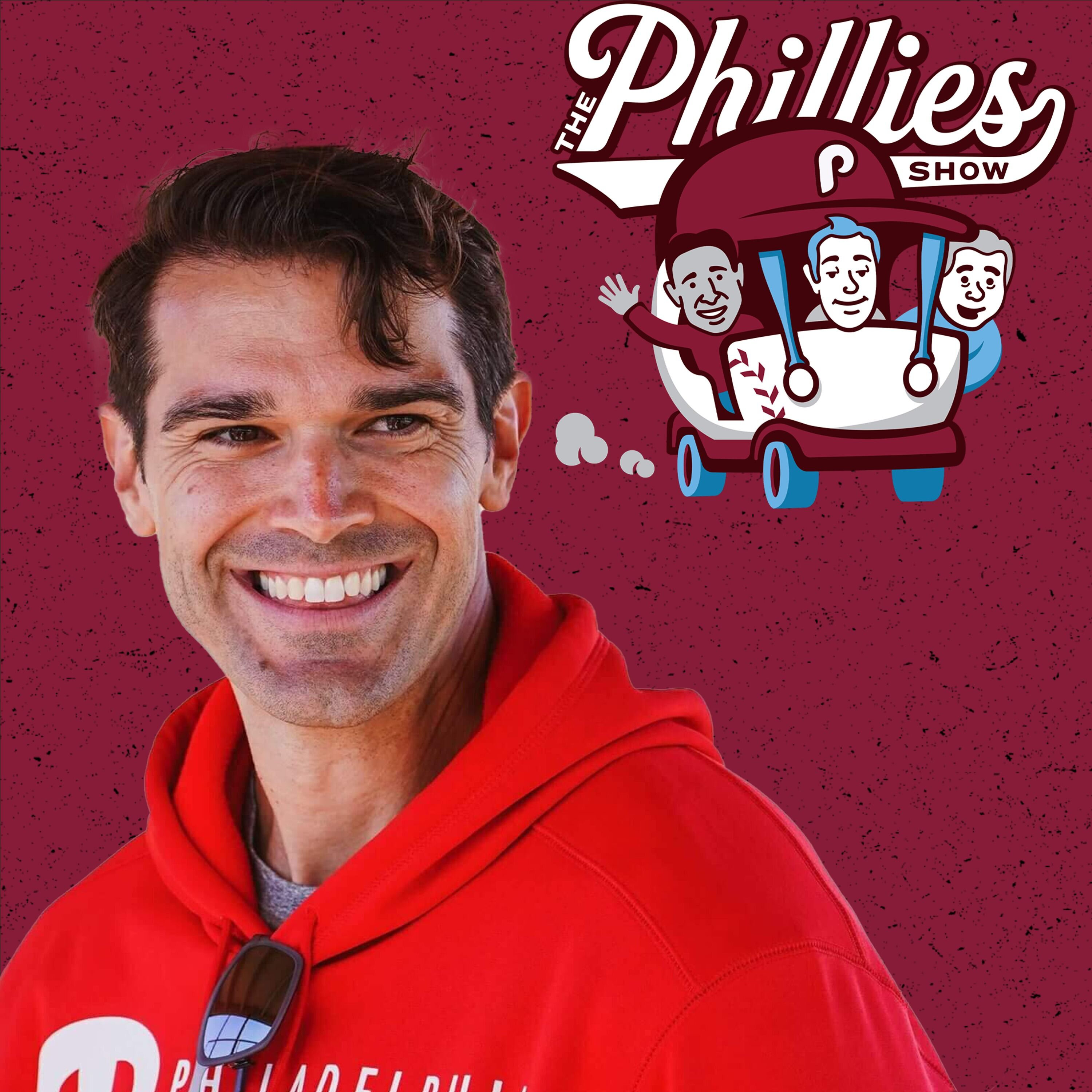
Preston Mattingly talks about the Phillies’ farm system
The Phillies want to keep their World Series-championship window open as long as possible. For that to happen, they will need contributions from prospects in their farm system. Nobody is better equipped to talk about those prospects than Phillies assistant general manager of player development Preston Mattingly.
Mattingly joined The Phillies Show and discussed the state of the Phillies’ system, the organization’s philosophies on hitting and starting pitching and – of course – top prospects like Andrew Painter, Aidan Miller, Justin Crawford, Mick Abel, Griff McGarry, Eduardo Tait, Staryln Caba and more.
Love The Phillies Show? You can purchase your very own Phillies Show t-shirt by 47 Brand here!
@Shibe Vintage Sports Get unique throwback Phillies tees, hats and sweatshirts from local artists at their shops in Center City, Wayne and West Chester and online.
@The Phillies Show Subscribe to the show on YouTube and follow us on social media!
@Foul Territory We’re part of the Foul Territory Network. Follow FT and find more shows, including Fair Territory!
If you like The Phillies Show, subscribe and give us a five-star review!
See omnystudio.com/listener for privacy information.
Available Results
Generated results are saved to the knowledge database for reuse and search.
Extract Knowledge
Pick what you want extracted first. Model, scope, and chapter options appear after a template is selected.
Transcript
00:00:04
Speaker 1: Hi, this is Chase that Lee.

00:00:05
Speaker 2: This is the Phillies Show.

00:00:08
Speaker 3: Hi everybody, Ruben Tomorrow, Junior, Jim Salisbury, Todd's the Lucky Here. We are brought to you by the foul Territory Network. It's Tuesday, October twenty ninth, twenty twenty four. Hard to believe, but it's been almost three weeks since the Phillies played their last game, that Game four loss to the Mets in New York in the NL Division Series. Since then, there's been a lot of talk, of course, about the future of the Phillies. The next several weeks and months will shape the future of the Phillies, and a big part of that future, of course, is the Phillies farm system. They're gonna need some of their prospects to step up and play significant roles next season and beyond to keep this window open as long as humanly possible. And so who better to talk about the farm system than Phillies' assistant general manager of player Development, Preston Manningly. Ruben, Jim and I caught up with him earlier and chatted about all those top Phillies prospects, from Andrew Painter to Aiden Miller to Justin Crawford and Moore. Hope you guys are going to enjoy this. This episode is brought to you by Shy Vintage Sports. Get your unique throwback Phillies teas hats and sweatshirts from local artists at their shops in Center City, Wayne and Westchester and at shibesports dot com. Here's our interview with Preston. Preston, thank you for joining us today. We appreciate the time. Kind of an interesting part of the year. World Series is going on right now, and you know, Jim Rubin and I are watching the World Series and we were thinking that this World Series. You might feel differently about this World Series anybody, because you've got like connections to both teams. You know, like you grew up your dad playing for the Yankees. You know, you played in the Dodgers system, you worked for the Dodgers. So do you like watch this World series any differently? Are you kind of like so far from from those things that you just watch it as a fan?

00:02:03
Speaker 2: Watching as a fan, I've definitely pretty far removed, but I definitely wish it was the Phillies playing. So I think you still watch it with a little bit of just like man, I wish this was us, but I definitely think it's good for baseball. Two great teams. It's been an entertaining series so far.

00:02:17
Speaker 3: So Preston, Jim and I were talking yesterday about having you on, and we were talking about all the different guys we wanted to talk about, and we were saying, how, like, you know, five, six, seven years ago, there was probably only you know, maybe a handful of guys that we were really kind of truly excited about. But I feel like now it's you know, you could talk about twenty five thirty guys that have some sort of level of intrigue. And I'm wondering how you feel about the state of the system since you've gotten here and kind of where it is now.

00:02:47
Speaker 2: Yeah, I think anytime you run the minor leagues, you always want to be better. You're always searching for better and make things more efficient and you know, more volume of players like you mentioned, interesting guys, different tiers what we I call him internally, But I think the credit for the turnaround the system would go to Brian Barber. A lot of our acquisition team, whether it's Brian Barber on the domestic side, Salagustinelli Georgie Valandia, Derek Chung on the international side, and then our acquisition team in the office of you know, krein Landry, Trey Barr, Annie Colombia, his group as well. Just it's always a team effort of getting players in and we've been really aggressive in a lot of different avenues, whether it's minor league Rule five searching for players. We're constantly looking to upgrade our system, and I think we've slowly but surely done that, and I think we're not where we want to be yet, right, that's not a secret, and I think we're going to continue to try and build this thing internally and hopefully, you know you mentioned twenty twenty five, hopefully a couple of years from now it's thirty thirty five, and then we get forty and fifty and just keep growing from there.

00:03:47
Speaker 4: So Preston, as Todd said, there are a number of really interesting names, and it's no secret that Andrew Painter is kind of near the top of that list, maybe even at the top of that list. He's in the Arizona Fall League. Now, what are your days like peeking in on him? You're watching video, you're keeping how you keep it in touch with him, and how do you think he's doing.

00:04:08
Speaker 2: Yeah, I've gotten to scene obviously living down here in Florida and Andy being here for a year plus rehabbing. I've got the scene his his rehab firsthand, whether that's him throwing his first bullpen, playing catch for the first time, the live VP's building up the SEM games and now kind of I feel like we kind of passed him along over to Arizona and you get to watch him on video. We've sent a bunch of people out there to watch him, and yeah, kind of tracking him through you know techtical communicate through text, their phone calls, and then just watching him in our internal system on the video we have. He's obviously so far it felt like asking somebody that it's a pretty high level to jump to if they're not being competitive baseball for for two almost two years. I think he's held his He's held his own. The stuff's continue to trend really well. The command is has trended upwards as he's gotten more you know, we're innings under his belt, more pitches, and honestly, I think he's just scratching the surface of who he's gonna be. I think he's a special talent, a special kid from a work ethics standpoint, and he has the pitch mix and the weapons to get guys out. Now, it's just to me refining that and being consistent on a day to day basis.

00:05:15
Speaker 4: I'm sure you're gonna be asked this like one hundred times over the next few months. But and you're probably not even there yet in terms of finalizing the plan for him for next year. But is there anything you can offer on where you guys stand on that and what you are thinking in terms of, you know, the twenty twenty five season and whether you turn them loose or whether you go easy with him? How does that all shape up here? As you know we reached the end of October.

00:05:45
Speaker 2: Yeah, I think we haven't finalized anything as a group. I know we're gonna sit down with a lot of different departments, whether that's medical, our strength, conditioning side, our performance group. Obviously Dave Dombrowski, our front office will be a big decision maker, a big hog in that. So I think we haven't finalized anything yet. But honestly, a kid coming off Tommy John, there's gonna be somewhat of limitations. I think we have to sit down as a group and find out the best way to utilize his innings. And I think we'll do that here in the in the short term.

00:06:13
Speaker 4: If he's healthy and feeling good and pitching well, do you expect to see him in the big leagues sometime next year?

00:06:21
Speaker 2: You know, I think he has the talent to do that right so, and he has like the stuff's good enough right now. So I think it's a matter of to me with him, is just getting consistent. I do think there is some piece of it of the when you missed two years of competition, jumping back into that is it's gonna be an adjustment for him, and especially at a upper level, whether that's double, a triple or even the major leagues, Like, there's gonna be some adjustment period to him getting back into high level competition, just little things of like daily routine and just getting back into it. It's gonna be it's gonna take a toll on him. And I think we're goan to be cognizant of his workload, you know, throughout that yst.

00:06:57
Speaker 1: And I've seen him a couple of years ago. I saw all the and i I'm big on makeup and and like the sort of the intangible things. The thing that that impressed me the most about him was his PFP's and how he sort of held himself. And I'm big on face. I love his face. I love the way he guys kind of goes about his business. Can you tell it? Can you tell us you know there's somebody you can compare him to. Can you talk a little bit about his makeup and why I think this is gonna be why I feel that that's gonna be a little bit of a difference maker for him.

00:07:32
Speaker 2: Yeah, I think you touched on it. I think first thing, I'll speak on the makeup, just from the time we got him, like he's been driven to get better every single day, like a lot of our players, but Andy stood out just from a sense of you know, he's six foot eight, he's throwing the ball mid up or nineties, and he repeats his delivererty the delivery almost like he's six foot one, six foot two. And I think when you see him in his what I call like his space, which is the mound and his kind of circle, he's really athletic, and he feels his position well. He controls the running game really well, and I think he doesn't scare at all. He's gonna keep coming after hitters. Whether he gives up a solo home run, the next one's gonna be right after. Guys. That's what I've always been impressed with with Andy is like he's not going to back down no matter who's in the box. He's on the attack twenty four to seven. And I think that speaks to like how he's made and like, you know, how he's his competitive makeup is. And I think in terms of who to compare him to, I don't have a like a definite comparison. Obviously I got drafted with with Kershawl and got to see him work. I think those two are just completely different. They're wired completely different. I think both both are uber competitive. I think they both come off differently, and I think Andy is a little bit he's still very young, but he's a little bit goofy at times, where where Clayton was very serious, especially on his pitch days, and it was like, you know, almost like he's ready to kill you, and like obviously Andy's the same way, but they just go about a different in different mindsets.

00:09:00
Speaker 3: Preston, I remember that, were you there the day two springs ago? Where there was a live VP on one of the backfields and and Schwarber took him deep. Were you were you were you watching that?

00:09:11
Speaker 2: Okay?

00:09:11
Speaker 3: So so Schwarber hits his bomb to right field, and Schwarber just kind of like gallops down the first baseline and Andy had the best reaction. He handled it so well. He kind of like tilted his head back and just laughed like, oh man, I can't believe you got me. And I think that kind of to me that that showed something that he wasn't rattled by it, that he took it and stride. I mean, I imagine that's kind of what you're talking about a little bit.

00:09:32
Speaker 2: Yeah, one hundred percent. And I think he, you know, even stall in double A and as he was kind of working his way up the ladder where if there was an outing where he may have struggled a little bit, whether it's a command standpoint or even getting hit around, like the next outing, the next hitter, it's always right after him. And there was never any of like, well I need to make these change. It was more just naughties need to attack more and if they can hit my stuff, good for them. I'm gonna keep coming after him. That's kind of his mindset. And it's been fun to watch Preston.

00:09:58
Speaker 4: When a kid like that, who has so much talent and such a bright future, misses a couple of years and now he's feeling good. How much of a challenge is it on you and other team officials, instructors and whatnot to just calm him down, calm down his enthusiasm and maybe pull the reins in a little bit and convince him that, yeah, you're doing great, but we need to exercise a little caution here. Is that a big challenge?

00:10:23
Speaker 2: Yeah? I think it's always It's funny you mentioned that after his last outing in the Arizona Fall Ley, I got a text from a guy that works closely with me and PD and said, Hey, you're gonna have to You're gonna have to slow people down on this guy because he looks like he's in midyear form here in his third inning here in the Fall League. So I definitely think it's something when you get a guy that's that talented and he's that close to the major leagues, it's definitely it's just human nature to want to, you know, talk about him being in the big league rotation and things of that sort. But I think you have to to me, like, as an organization, we have to do a good job of tempering expectations, making sure people realize and he is still a kid, He's still works looking through his delivery, his stuff, and like let him develop. To me, you can't rush development and let him develop at his pace. And then to me, when he gets there is like hopefully he's there to stay.

00:11:12
Speaker 1: So I wanted to know, Preston. I know there's a you know obviously some players Aidan Miller and Crawford and tight and Kyla. If you were going to say there's a strength in your organization, is it is it on the on the mound? Is it position? Player wise? Is it a little combination of both. Where where are your strengths and weaknesses you think you have in your organization?

00:11:35
Speaker 2: Yeah? I think right now I'd say our strength is in the infield. You mentioned a few guys. I think there's even some guys like the second tier, like some medium tier players that people don't know as much about that I think they should and they will hear coming soon. You mentioned you know Aiden Miller, you mentioned Starlin Kaba. Brian Rincone is a guy that you know, we're very high on and he's out in the Fall League now. Plus defender at shortstop, you know, puts together really quality at bat. Has not sown like the surface performance yet, but a lot of the underlying stuff's very good. You mentioned Starlinkba, another guy a run Escobar kind of came on the scenes this year before he had a lower leg injury that kind of set him back. A team that a guy that we're very high on. Other you know, Externallygue teams are very high on. So I would say infield, I think is the strength. But I also think, you know, we've done a pretty good job of outing outfielders. So as I say that, I'm sitting here and thinking about the our outfield guys and you mentioned Justin Crawford and Dante Norriy we took in the first round, Griffin Burkholter in the second round. I mean like you kind of have a good mix of both. And I think the one area I would say where not a weakness, but I feel like we just haven't spent a ton of draft capital is the catching spot. Obviously, Tay it's a big prospect and I think he's got a bright future ahead but he still is. He just turned eighteen years old, so he's an easy guy that's a few years away. And I think Sal and his group on the internationals side have done a really nice job of identifying some of these catchers, whether that's Guiermo Rosario, on Helmada, Leo Ferrabous, like some young kids, and like, do I know who's going to be the best you know out of that group, To be honest with no, because they're all, like I think, very talented. But I think it's always good to have some strength in numbers do at the lower levels and see who pops through.

00:13:19
Speaker 4: Can you tell us a little bit more about Tight? I'm sorry, Todd, I have so many good things about him.

00:13:25
Speaker 2: Yeah, Eduardo is a guy that I may still remember going to the dr and kind of watching our new signees and all of our guys are working on the field, hitting the cage, and I remember, because you know about like the different profiles of guys. Hey, this Cob is a very high profile player. You know, he signed for X and he's ranked this and you always know internally what these guys are. And I remember seeing Tight hitting the cage. I remember turning to Georgie Blandi and being like, Georgie, have you seen this guy? And we kind of both looked at each other and like we had both seen him, but I think he had taken such a big step even in like the couple months before after he agreed. When he arrived at the complex, we were kind of both like, wow, Like this bat looks like it's real. It was extremely loud in the cage. He has a really sound swing, and I think we kind of looked at each other and we're like, well, if he can catch, he's going to be a really interesting prospect. And it's turned out that this kid is extremely intelligent. He knows we needs to work on and get better at. He's hungry to learn and do those things. And I think we've seen, like even being the seventeen year old kid that he is, like he's taking big steps for him on the receiving side this year, and we think he's going to stay behind the plate, and if he can stay behind the plate, it's a hit power combo, a guy that's going to be a force in the middle of the lineup.

00:14:39
Speaker 3: Yeah, he showed really well right with the Threshers this season. When you promoted him, didn't I mean, you must be pretty encouraged by what you saw concerning He is like eighteen and most of these guys are a couple years older at least.

00:14:51
Speaker 2: Yeah, he's you know, we willing to challenge a lot of our younger guys. And you know, Tight started that breakout series game over in Lakeland as a seventeen year old. He essentially played the full season, I think the last maybe you know, a few weeks of the year he just turned eighteen, but we thought he could handle it. And just the back quality and like strength is not an issue. Usually with young kids, strength can be a little bit of an issue. With him, it's not. And yeah, he's he's got a chance to be special. And I think the one thing with him is just almost reining him in to understand that you can't hit everything, and you've got to understand what what pitchers are trying to do to you as you get older and move the ladder and you know, strike zone discipline and understanding where you can do damage. And I think once he gets that final piece, he's going to be a guy that I know everybody kind of knows about him now, but it'll be nationally known amongst everybody pressing.

00:15:43
Speaker 1: You talked about challenging, and I'm just kind of curious what your own personal thought process is, what your philosophy is on, you know, pushing guys or holding them back. Is it something that's individual? Is it something that that you as an.

00:16:01
Speaker 2: Organization want to do?

00:16:02
Speaker 1: How how do you guys? And I think a lot of fans would like to know, like how aggressive are the afhilies or how how controlled is your system and how you go about, you know, moving guys and how they matriculate through the system.

00:16:15
Speaker 2: I think it's an individual basis, Ruben. I mean, I think I think one thing we I and we talk about a lot, is like you have the answer key to your players. You know, like you know their makeup, you know their work ethic, you know the things they are excel at and the things they need to work on. So I think I think we we like to push our guys, but we like to do it in a strategic way. So let's just give a couple of examples. So like an Aiden Miller, a guy that started in low A this year finished the year in double A. And it some people would say it's aggressive, you know, pushing the kid his first full year out to out the double A. But I think we do that because we we felt as an organization that getting him to double A will help not necessarily expose, but like highlight a few things that we felt like he needs to work on, and then when he sees those things with his makeup, he's going to want to tack the full force in the offseasons. It almost builds his development plan for him by challenging him and putt him against upper level pitching and like, you know, putting him on the field at shortstop against you know, maybe it's a little bit faster runners and understanding the speed of the game at a higher level. All those things to me go into like you know, when you move guys when you don't. I think it's just a case by case basis. And obviously you saw, you know, the year the year prior Aron Kirkering. Maybe he started and I'll take the blame for that. He started a level where he shouldn't have been at in low A. But you know, I think we showed as an organization that we're not scared to move guys and if we failt he could help our major league team, We'll keep moving them until they get to that level, and that's what O'Ryan did. So I think it's it's definitely a case by case and uh, knowing the players makeup and and things that go into that help help answer those questions for you. But I think we want to be aggressive and uh, you know, I think we'll continue to show that going forward.

00:17:51
Speaker 1: Are there certain markers that you have to that you feel like certain players have to have, whether they're a pitcher or a position player or there there's certain things that Okay, once we feel like they can do X, we can then move them to why or is it again, you know, sort of a fluid situation for you.

00:18:09
Speaker 2: I think it's fluid, but I think you have like, you know, metrics that you track, like you just stay on the hitting side. Let's say a guy's you know, zone contact or just chase rate. It's been very public, right and like just X level lot how hard they hit it.

00:18:21
Speaker 3: Right.

00:18:21
Speaker 2: So, if you take those three things and you know they're they're performing at the top of the league or where you feel like, hey, this isn't a really good spot. We need to we need to challenge with the next level to like to see if this is sustainable. The way he's doing it. I think, you know, we use a lot of different markers in that regard just to see of like, hey, where his metrics are at and where he's trending, and then like and like on the flip side of that, if a guy's really struggling, may their surface performance is very good and their underlyings, you know, maybe it's poor and lacking. We may we could also do a flip side and move them to another level to get the player to buy into what we're trying to get them to work on and see it firsthand, to where if you get to a higher level, you may get exposed a little bit of what you need to work on. And then to me, it's easier for us to build a plan for that player for an improvement plan.

00:19:09
Speaker 4: How Preston you mentioned chase rate has been public Dave talked about it in his breakup press conference. Rob Thompson talked about it, talked about maybe staying on the ball longer, using the whole field as a potential solution or the area for improvement on the chase. How do you approach chase rate and improving it at the monitor league level? What do you stress? Are there any strategies for improving a guy's chase rate so when he gets to the big leagues he's a more selective hitter.

00:19:45
Speaker 2: So I think I take a step back and say, like, I think you acquire it and in the draft. Internationally, I think there's a lot of different things you can track to see how a guy sees the ball, a lot of different you know, training you guys can you can put guys through to track how they see the ball. There's so much data in colleges when you draft players of what guys do, So I think you can definitely acquire that. I think once you get them in the system, you know, I think it's it's very hard to flip an extreme to the to the opposite side of the extreme, Like if a guys let's just use a forty percent chase rate in college. To me, it's if I going in, it's going to be very tough to get him to be a twenty percent chase rate guy in the minor leagues. But you know, competition is going to get better. So I think it's it's hard to ask that of a player. But I think what we can do is take skill sets that we value. Players who see the ball make a certain amount of contact, and then to me, it's easier to when you get them in the minor leagues to coach them and develop them on that and train them on like we obviously have a lot of resources at our disposal, whether that's the trajec machine, which is about as realistic as you can get from from a pitching machine standpoint, and just put them through game at bats simulations, constantly communicating with them with whether it's coaching stuff about approach, about what you're trying to do with pitchers. And then also like the game planning aspect has gotten so big, and I think it's getting players to understand like what you're looking for when you're looking for it. It's a fine line of like not giving them too much, but educating them on what pitchers are trying to do to them so they can help make the best decisions possible when they get in the box.

00:21:22
Speaker 3: Another thing that Dave talked about a couple of weeks ago was the importance of starting pitching depth, and he cited, you know that the struggles in that number five spot down the stretch in ability to kind of put up consistent numbers, and I'm wondering where you feel like the starting pitching depth is in the higher levels in terms of their chances to step up and maybe you know, perform better than expected or better than they did last year. You know I'm talking about I guess Tyler Phillips. I don't know if you'd call him a prospect because he's been up, but I guess you could still you still could. But mick Abel Moys's chasse, Seth Johnson, where do you kind of see those guys right now in terms of their development and ability to help you know, if not next year than the year after that.

00:22:05
Speaker 2: Well, I think, first off, you can never have enough pitching depth, as everybody knows, like just with the injuries as high as they are in today's game. I think, you know, we've been very fortunate as an organization over the last couple of years of our starting pitching health guys for the most part of state healthy taking the ball. So I think, like just mentioned, the guys are talking about the guys you mentioned, you know, I think we're we're very high on Seth Johnson. I know he came up and struggled in a very short sample there in Miami, but we think he's a guy that can help us going forward. And then Mickey, well, I know he's been very public of you know, some of the struggles Mick went through this year. Honestly, I think it's going to be good for him in the long run, some of the things he had to go through, and I think we do tend to forget he is a twenty two year old in Triple A. It's a and honestly, the way the game's trended the major leagues in Triple A, it's a pretty wide gap now just the talent level, and I think getting micked to that upper level using major league baseballs with abs, it's a big adjustment for him. And I think a lot of struggles that were public throughout the year, we know he's made for that, and I think there was some adjustments that came later to where he continued to trend up throughout the you know, throughout the season with his stuff. We think he's gonna be a piece of what we're doing going forward. And then the second piece of that Gregory Soto trade, Moys's Chasse is a guy to me that has the stuff now to compete the big leagues. It's just refining and like the stunt, the fastball is special, it's it's a he's got a sweeper, a cutter, and a change up. It's a lot of finer points with him. We're trying to do holding runners just you know, the overall strike throwing is not quite where it needs to be. But I think, like to me, he's a guy where if he takes that next step from a command standpoint, it's not gonna matter as much the hitters. It's gonna matter of like him getting the ball of the plate consistently, cause if he does that, he's gonna have real success.

00:23:52
Speaker 3: Yeah, he was a guy where running into some scouts in the press box late in this season, they seem to like be wow, you know this guy. Chas say the Phillies are really lucky they got him, and you sound like he had that similar excitement about his his potential.

00:24:06
Speaker 2: Yeah. So I got to see his some of a couple of his starts down the stretch, and I was fortunate to see the one in Somerset where he went six innings and I think eighty four pitches and struck out fourteen. It honestly looked like minimumst boys, and he had a line up he was facing John Birdie and Anthony Rizzouz in the lineup, and the Yankees do a good job with hitters in the minor leagues. They have always have good group, and he went right through him, and like it just showed that was probably his high. But if that's the high, like we'll take it, and I definitely think it'll be good enough when he gets to the major leagues. Two and then nothing about him too, is he's twenty one years old and he's somewhat new to pitching with the amount of mileage he has on his arm, but he's not scared either, and he's going to keep coming after you. And he has the stuff, Like we said, if we can harness that and get him in the zone that he could hit a chance to pitch for a long time. And I think one thing we did with Moyses was when we got and he had pitched in a little bit of the Piggybacks system with Baltimore, we wanted to get him a consistent role and let him build on his routines. So we moved him just to the starting where he was a consistent starter weekend week out, just to try and dial in his his routines. His his you know, is in between start lifts things like that to where he could get a consistent foundation built going forward. On the on the starting.

00:25:18
Speaker 1: Side, President, I wanted to talk about that starting stuff and and uh and developing starting pitchers. Has been obviously a lot of talk about, you know, whether it's you know, having enough starting pitching depth and being able to get starters who can go longer and longer into the game. They're thinking about making changes even uh at at a much higher level than all of us about you know, having the starters pitch more. What is your philosophy. I know it's I know it's a very delicate thing because you know, certain guys are not necessarily coming out of college or have a ton of innings, and some guys are you know, you're really careful with the guys are coming off injuries, et cetera, et cetera. But what's your philosophy and are you trying to get those guys stretched out longer? You've ben trying to prepare some of those starters for those types of roles later on in their major league career.

00:26:07
Speaker 2: Yeah, I think first off, like I know, there's been a lot of changes that we talked about that have been very public. I hope they don't make those changes. I think that would be killing them. I honestly think it would kill the starting pitcher. I think if you want starters, you got to develop them as starters. And to be honest with you, as an industry, we're guilty as well of you know, we chase stuff. We chase guys getting into higher end velocities, and usually what that means is you throw them in shorter stints. I think as an organization and as an industry, we have to be willing to let guys pitch deep into game knowing that, hey, there's stuff may not grade out quite as well, they may not be throwing quite as hard, and that's okay because if we do that consistently and we get them through five and six and seven innings and we get workload under their belt. I'm not smart enough to know if it will help injuries, but I have a feeling that if we get guys to where they're consistently and consistent routines going deeper into games in the minor leagues, that when they get to the big leagues and they have one hundred innings, one hundred and twenty innings, one hundred and thirty innings under their belt. It will it will help decrease some of the injuries we have the big league level. Once guys get there and they've only only thrown thirty forty innings, and then we're asking them to go face world class hitters and oh, by the way, double and triple your workload. It's just to me, it's not sustainable, and as an industry, we have to be willing to develop these guys as starters and let them pitch deep into games responsibly, but pitch deep into games and do it consistently. That was my ram. The pitching side, that's awesome, not that man.

00:27:38
Speaker 1: That fires me up because I think that there's I think it's I think there's been a trend to go the other way, and I really do think it's I mean, at the end of the day, I think you're putting a workload on the bullpens and others. On the domino effect associated with not going deeper into games and having starters go consistently six or so of an innings, I think it's made it made it even more difficult for sustainability.

00:28:06
Speaker 2: Yeah, I think you've seen our organization. It's something we really believe in as our starting pitchers going deep into games. Whether it's the big league level, you can go and track all through the minor leagues. A lot of our kids, whether they're nineteen twenty, they're throwing one hundred plus innings in the minor leagues, and we think that's really valuable for them, whether that's just getting out there on the mound working on their craft like that helps with the running game, that helps with you know, understanding how to slow the game down at times when you've been out there in the fifth, sixth, seventh inning to know what to expect. Then when you do get to the major leagues and you're out there in the sixth inning, it's like, Oh, I've been here before, now I know what I need to do. Versus it's foreign to these guys when they get out there in the fourth inning. It's like, you know, what do you expect is going to happen? If they've never done the big at the minor leagues? Like, what do you think is going to happen at the major league level.

00:28:48
Speaker 4: Are there kids that you encounter, maybe new kids in the system, that feel like I pitched four innings.

00:28:54
Speaker 2: I pitched five innings.

00:28:55
Speaker 4: I did my job, and you have to convince them that, you know, there's another plot tell you need to go to to be considered a legit starting pitcher in the major leagues.

00:29:04
Speaker 2: No, I think guys want to pitch. I think guys want to stay out there as long as possible. You may get a one off, but I think for the most part, Look, I can only speak for our players, but I know, you know, you got to rip the ball out of our guys hands at times, and they want to be out there, and and I love that about him, So I think, you know, I can only speak for our organization, but I know our guys want to pitch deep into games.

00:29:23
Speaker 3: Presston Griff McGarry's in the Fall League and it's the folly. But I notice he's made two starts. As you know, he's he moved into a reliever situation role. What's what's kind of going on with him? Is there any reason behind him starting or is it just as a fall league and we want to get him a routine? Is it as simple as ads or something more there?

00:29:42
Speaker 2: Yeah, Griff's the guy. Obviously, it's been a starter kind of his whole tenure here with us in the Phillies, and we had built a pretty good workload on him and this year we or last year we kind of transition him to more of a reliever, and we had worked on some different things from an arm pass standpoint to try and shorten him up a little bit, and we did that with his arm and we threw him in sh order stints. Honestly, it's more of a workload thing now. I think now that the arm, the arm strokes where we want to be. We felt it's time to kind of make you more versatile and LinkedIn his role out and we know he can start. It's just to me with Griff it's very similar to Moises is just the command aspect of it of getting in the strike zone. And then we've seen, honestly, as a starter at times it's been better than as a reliever. So it's always going to be that guy that's gonna, you know, more of a stuff starter. It's going to use a lot of his pitches in four or five innings, but that's still valuable as well, and you know, I think keeping him his options open out in the Fall League. He's obviously pitched very well and his two or three at outings, so hopefully we continue that, you know, throughout the rest of the fall and then bring him into spring training. To me, I think we have not sat down as an organization to finalize everything, but to me, like we can go either way now that point. If we want to move to linked him out and mak him a full time starter, we could do that. If we wanted to keep him short and that when I say short, that multi inning reliever, we can do that as well.

00:30:58
Speaker 4: So Preston, will hear so much about Aiden Miller, you reference his name earlier, can just tell us what makes him special? You know in your eyes having now witnessed him for a full season and a half.

00:31:12
Speaker 2: Yeah, I think what makes him special is is like his work ethic first off, and who he is. I think from the second he got into an organization, it's been like on a mission to get better and prove either prove people wrong of where he got picked, prove people wrong in the fact that he can play shortstop, and just ultimately like he knows where he wants to go and he's like consistently asking questions and challenge just to like, hey, get me there quicker and honestly, sometimes like we have to pull the reins back on him a little bit because you can get a little bit moving pretty fast, and you know, three days after the season, he's wanting to be full go taken in field out, you know, in a carpenter complex. But I think it's a good problem to have. He's extremely driven, He's an extremely hard working kid. He's very intelligent, and he has all the tools necessary to be a very good, big leader for a long time. That's kind of what makes him special. I mean, he's very like intelligent on the field, he's a great person. Just like to me, Aiden's the total package. And I don't I always sometimes hesitate to, you know, kind of pump up our guys in the media, But with Aiden, it doesn't bother me at all because I know, you know what he's looking to do, and none of this stuff, whether he's performing well or he struggled a little bit, he never changed his pretty even keel of and he knows what he wants to do.

00:32:23
Speaker 3: You mentioned when you you promoted him into reading, you wanted to really push him because you felt he was ready and that you felt that anything that maybe cropped up in reading would kind of help him figure out his off season plan, what might have popped up that he might be working on this offseason, that he might have learned about himself and running that he hopes maybe he can take to the next level next year.

00:32:44
Speaker 2: Yeah, so he got hurt and didn't get to play as much as we would have liked. But I'll just take a step back even too. Jersey, Like, you know, he had struggled a little bit for the first time probably in his career ever, for the first month there in Jersey, And honestly, it was more just surface numbers and everything underlying was better in Jersey than it was in clear Water, which was kind of interesting to us, Like we didn't really know why he was struggling. I think there was a few things Aiden from, like a mentality standpoint, and like a few small swing things that Luke Marton, our director of hitting, went in and talked to him about. And honestly, since that time he kind of clicked, and we felt it was more just about Aiden getting it getting at bats verst higher level pitching, versus fixing swings or or making adjustments. We felt like we had made the necessary adjustments and it was now time for him to just go play and just learn pitching and work on his you know what he's trying to do with pitchers and along that line versus like actually making true like swing adjustments. And we know there'll be more things along the way, but we felt this swing. You know, from a mental standpoint, he was in a very good spot and it was like it was time for him to face some high level pitching in there and reading.

00:33:46
Speaker 1: As far as his position. As far as his position is concerned, I mean, what if you were to just look at him as a scout and as an evaluator, what position on the field do you think is his best position? And what position or positions do you feel like he can play?

00:34:03
Speaker 2: Yeah, I think like when you like, I think like the I was like you guys have done some scouting too. When you look at Aiden, you he screams third base right, just like the size, the low the lower half's very strong and this looks like that prototypical just strong bodied third baseman. But I think when you see move around and you see kind of the side to side he can throw from different ARMStrokes. He turns the double play really well. You start to seem and you're like hmm, I think you can play shortstop, so I think you mentioned this position. I think to me, also like when the mentioned turn the double play, like second base is an option, but i'd say third base, shortstop, and second base to me, or the three options as you know a lot of times in the games, like when you get called up, it's circumstance and that's where we need somebody, and whether that's shortstop, third base, second base, I think Aiden will be equipped to do all three. I think just the the profiles differently. Right. If you get Aiden at second base, he's a power hitting on base machine who I was going to put together grade at bats it's shortstop. He's kind of that, you know, it's kind of always that like what I just described, but like you kind of look for different things in different positions, whether that's defense versus offense. And he profiles at all three. So I think to answer, you're quite kind of danced around a little bit, Ruben. But to answer, I think he could play any of those three. And I think, you know, we're gonna keep Mitt shortstopp for as long as possible, but also let's start to layer in some other positions now that he's at the upper levels knowing that, hey, if something happens and we need a spot or we need to be able to play third base, we don't want the first time him doing that to be in the major leagues.

00:35:33
Speaker 3: One guy we touched on real briefly earlier was it was was Justin Crawford and Dave Dombrowski a couple of weeks ago said, I think the quote was something like, you know he's coming fast. We think he's coming fast. Why why do you think he's you know, he's coming fast towards the big leagues. You know, besides his talent obviously, but what's really jumped out at you over this past year that makes you feel like he might be getting close?

00:35:55
Speaker 2: Yeah, The first thing that comes to mind with Justin is how prepared this kid is. And honestly, like the where he grew up with his dad, he got to probably watch it firsthand. But Justin is as buttoned up on his routines, his hamstring program his maintenance programs as any player we have. And that's at nineteen and twenty years old. So I think when you get a kid who's that talented and he's as buttoned up as he is on his routines and what he needs to work on. I think, like, and you just start to throw out like, hey, he's a seventy eighty runner with elite bat to ball skills, and he can play center field and he's going to be an impact force on the bases. Like it's obviously very intriguing. Then you know, there's been some well known stuff, you know, thrown around about Justin about his ground ball rate. I personally think like, as he gets older and gets more mature, that's going to continue to trend down. But I would also say, like he's a guy that his profile is always going to be more conducive to we want more balls on the ground. But I think, you know, people don't people look at Justin as a kind of a singles type hitter. I don't see that at all. I think this kid's going to have real power. And you know, he's already shown some upper index of velocities and able to drive the ball to the opposite field and and a lot of his his stuff with his quality of contact is just a it's just a byproduct of like him catching the ball so deep, and as he learns to catch the ball out in front a little bit more. I think we'll get he'll get the ball in the air and on the line more naturally. So you know, we're very high on Justin and another tremendous kid who Brian Barber and his staff did a great job of identifying makeup tools and talent. And yeah, he's going to be a fun one for Philadelphia fans to watch.

00:37:32
Speaker 3: The man if he hits the ball on the line, a lot of balls in the gap. I'm seeing a lot of doubles and triples. I'm sure sure.

00:37:40
Speaker 2: It's a triple as soon as he hits that gap. So he's got that kind of impact potential.

00:37:45
Speaker 4: And when I when I look at the Phillies center field position, over many many years, there's been a lot of transition. It's almost been a turnstile out there. And he looks like the type of kid who could when he gets here it down for a good long time. And that's something they haven't had in a long time in center field, middle of the diamond position.

00:38:06
Speaker 2: That's so important.

00:38:07
Speaker 4: You see this kid as having a long career once he gets there.

00:38:10
Speaker 2: Yeah, I think that's the hope. Right, He's a guy that we feel very confident his ability to play center field to hit at the top of the order, and obviously he needs to keep progressing like we think he can. But you know, with the tools and the skill set that he has, I don't see any reason why this kid's not playing in the major leagues for a long time.

00:38:26
Speaker 1: Prester, I wanted to ask you a couple of questions about just overall, like the Phillies philosophy. I know there's organizations that have like the Dodgers Way and the Cardinals Way and stuff like that. Is there still a Phillies Way? Is it something that I know you have, probably have a developed player development manual, what have you. Can you talk a little bit about, you know, that fundamental part of what you're doing.

00:38:49
Speaker 2: Yeah, So we talk a lot about what we call protect the Standard, and what goes into that, honestly, is just four things that require no talent, And what we try and preach with all of our players is like talentless things, right like how we respect each other, the game, teammates, staff, how we prepare, how we play, and how we compete. So it's those four things, none of them take any talent. We preach it day in day out. Our players know it, our staff know it. And we try and push those things, knowing that Brian Barber and his scouting staff they're gonna they're gonna sign players with big tools and big talent, and so is sal and the international side with Georgie and Derek Chung, we're going to continue to bring those players in. So we've chosen the route of really preaching things that you can control, knowing that the talent's going to come in and it's just to me maintain they are, you know, growing that talent as it gets there. So I wouldn't say we have like, hey, this is the Philly way of how we're going to do this, but what we have is our standard of how we do things and we don't deviate from it.

00:39:45
Speaker 3: That's awesome. Preston, thanks a lot for the time, man, Yeah, it was awesome.

00:39:49
Speaker 1: Fun.

00:39:49
Speaker 2: Yeah, this is great.

00:39:51
Speaker 3: Yeah, we could talk and you know, ask you about ten, like I said, ten to fifteen other guys. You know, we didn't even get touch on Devin Salty Bond and and you know know, you know with some of these other guys that are that are coming up through the system that has everybody saying is rincone is you know, there's a whole bunch of guys.

00:40:08
Speaker 2: Well, they asked this one last question.

00:40:09
Speaker 1: I'll let you go.

00:40:10
Speaker 3: Who would be your under the radar guys? Or is there an under the radar guy? I don't know if that's putting you on the spot or not, but is there an under the radar guy that comes to mind that you're like, Man, I cannot believe people are not talking about this.

00:40:24
Speaker 1: Dude.

00:40:24
Speaker 2: I'll give you a couple you just mentioned. I'll give you a one outfielder, one infielder, and uh, one of them is like how you mentioned Rinconis. I think he's an under the radar guy from the simple standpoint of he's going to have top of the scale power. He's a better defender than people think. He's maybe one of our best base runners, and he controls his own really well, so maybe that kind of true. I think he's a better hitter than this. But the true out the three true outcome guy who gets on base has real power and to me, has the ability to play at least average, maybe a tick above average major league corner outfield. He's going to be a quality base runner for you. He'll get you twenty to twenty five bags just off instincts Loan and I personally still think there's a good enough hitter in there where. He's not one of those, you know, low average type guys. So I think he's got a chance to impact the major leagues here and here coming soon if he continues continues to progress. And then the one infielder I would give you was a rune Escobar. You know, Starlin Covin and Wardotey get a lot of a lot of the hype, which is well deserved. A ruined Escobar kind of flew under the radar on our FCL team, and part of it was because he went down with an injury, a lower level or lower leg injury. But he's a guy that has real power. He controls the zone, he's a plus defender, maybe it's second and third base, and he's strong man. This kid is strong and he loves the play, and so I think he's a guy to me as it a We plan on starting him in the full season next year, and I think people will start to see him as a as an eighteen year old, nineteen year old kid that can play a couple of spots in the infield, controls the zone, is really good at back quality and we think there's gonna be real power potential in there, so he'd be a little bit of sleeper for me as well.

00:41:59
Speaker 3: Okay, nice, awesome, thank thanks Pressing.

00:42:01
Speaker 1: Thanks show much for your time. Man, we know it's not an easy time. I know you guys got a lot of stuff going on, so we appreciate it.

00:42:07
Speaker 2: Hey, you guys having me on anytime. This is fun. Love talking about our players.

00:42:11
Speaker 3: Thanks Chres, Thanks again to Preston for the time. I hope you guys enjoyed that. Ruben, Jim and I will be back later this week. The Philly Show is brought to you by the Foul Territory Network. Subscribe to The Philly Show on YouTube and wherever you get your podcasts. If you like us, give us a review, Follow us on Instagram, TikTok x, Facebook, and threads. Find Ruben's analysis before, during, and after Phillies games on NBC Sports Philadelphia, on the Sports Radio ninety four, WIP Morning Show, and MLB Network. Find Jim at all phly dot com. Find me at MLB dot com, the Phillies Beat newsletter, and MLB Network