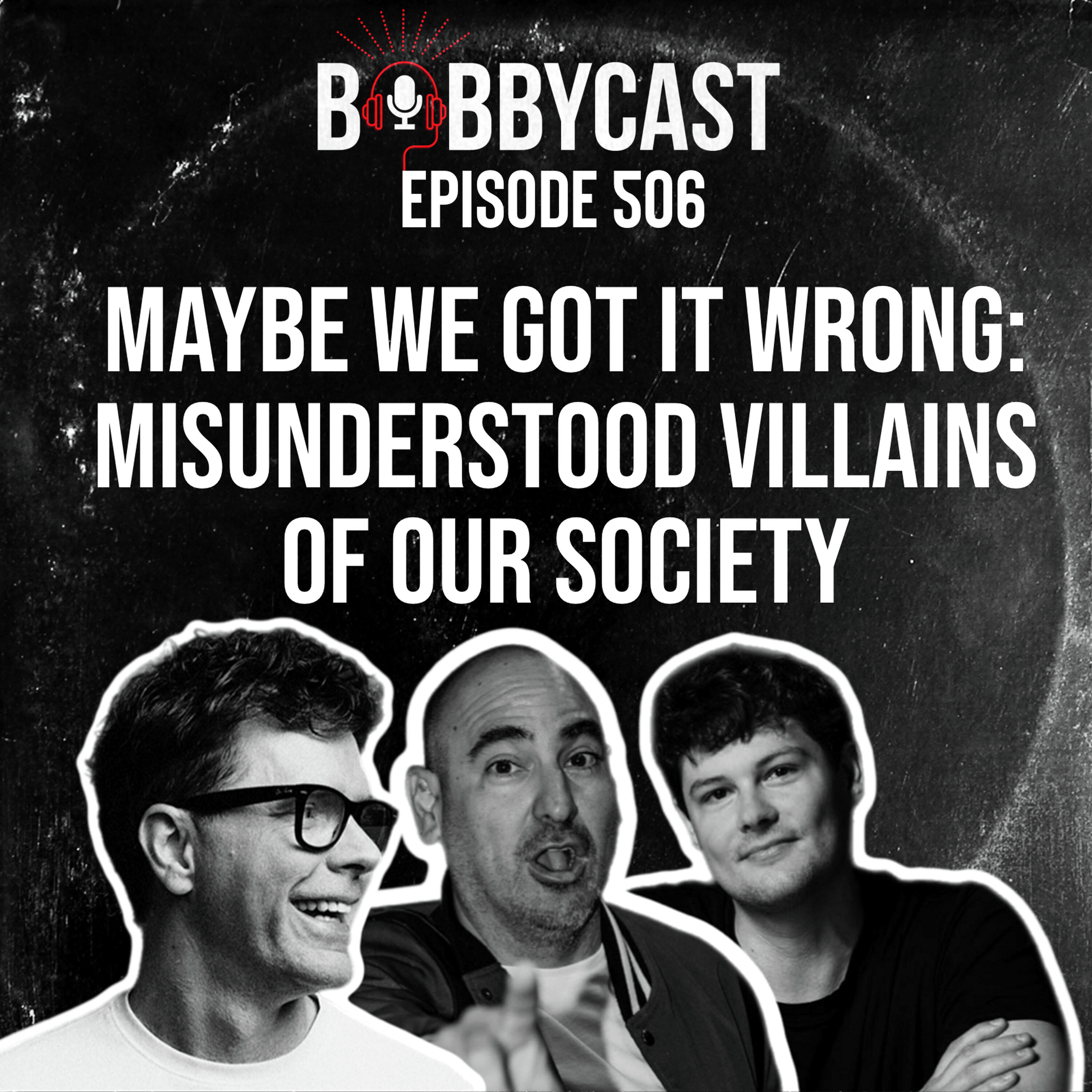
#506 - Maybe We Got it Wrong with Bobby, Reid & Eddie: Misunderstood Villains of Our Society
On this episode of the BobbyCast, Bobby, Reid and Eddie discuss some villains throughout time society may have gotten wrong. This all stemmed from Bobby's love for Thanos and feeling like he is misunderstood. The guys also discussed Yoko Ono, Tom from Tom and Jerry, and more!
Follow on Instagram: @TheBobbyCast
Follow on TikTok: @TheBobbyCast
Watch this Episode on Youtube
See omnystudio.com/listener for privacy information.
2025-04-11
37 min
Transcript
Available Results
Generated results are saved to the knowledge database for reuse and search.
No generated results are available for this episode yet.
Extract Knowledge
Pick what you want extracted first. Model, scope, and chapter options appear after a template is selected.
Generated results for public episodes are saved to the knowledge database so they can be reused and searched later.
Transcript
00:00:07
Speaker 1: Episode five oh six. This one's maybe we got it wrong. On this episode we talked about possibly misunderstood villains, maybe we were wrong about them. Now this is real life and fake life, which would also be fiction. We did this in la Eddie Reid and myself other episodes you might have missed Real quick Mark Hoppus from Blink one Eddy two, Amanda Knox from speaking of villains that we thought were bad that turns out not so much. She was on trial and convicted for killing her lover in Italy. Turns out she didn't do it. We have that Bobby cast Dylan Scott, My wife and I did a whole episode on our trip to Europe. So check out those older Bobby casts and subscribe wherever you're listening now, we'd really appreciate that, and you can watch on YouTube. So the links to all of these are in the episode notes. But now here we go, Maybe we got it wrong, Maybe we got it wrong, misunderstood villains. Oh and do you know this is rooted in my well.

00:01:08
Speaker 2: Here we go Theus. Yeah, maybe we got it wrong.

00:01:13
Speaker 1: I have stood up for Thanos forever, not because I think everything he did was right, and I think by the way, he's not even real. Okay, it sounds like I'm I'm like defending a real human for But he was having to save this planet because of what he saw happened to him, and the only way to save it was to kill half the people.

00:01:30
Speaker 2: Is that one accurate?

00:01:32
Speaker 1: Dude? It's fictional.

00:01:33
Speaker 2: No, no, no to the story that we know.

00:01:34
Speaker 1: Oh yeah, okay, like he was, he had to kill half the people otherwise the planet was going to kill itself. Okay, and so but he had to kill like half the Avenger. He was a bad guy.

00:01:44
Speaker 3: Yeah, this is bad for me, dude, because part of me always feels bad for the villains because I'm always.

00:01:50
Speaker 1: Well, when they give you an origin story too, for a villain, you always are like, oh, now, I get it.

00:01:54
Speaker 2: Starts he's an innocent kid, or he was.

00:01:57
Speaker 1: Like abducted or bullied or his parents were killed or so that's part that's part of real life though. That's absolute kind of turn absolutely, But you're exactly right. That's where I came up with this idea, was me always having to find Danos. That's great, and the Avengers and so some people get stuck with the villain label, like Danos and their full story never gets told. I'll give you another fiction example, though, we get watch Pingue on HBO.

00:02:24
Speaker 2: Yeah, yeah, that's a good one.

00:02:26
Speaker 3: I oh my gosh, I felt so bad for him.

00:02:28
Speaker 1: Yeah, and again we know their fiction. But I'm saying, like you do, you're just trying to make his mom proud. You've hated him forever because he's a bad guy. He's only the bad guy. He's the guy that's trying to get Batman through whatever version of Michael Keaton version or the old TV show Penguin whenever who played him back in.

00:02:47
Speaker 2: The day, Penguin, Danny did Vito di Vito.

00:02:50
Speaker 1: Yeah, he's always been a bad guy. But then when you watch the show and it's so good on HBO, you go, yeah, I be messed up too.

00:02:56
Speaker 2: But why did they do that to us though? Because they could have left him as just the bad guy and not told us his whole origin story, because that's what it was until last year. But are there even.

00:03:07
Speaker 1: Bad guys?

00:03:09
Speaker 2: Oh like born bad?

00:03:11
Speaker 1: Yeah? I would say there probably are. If their brain is like a psychopath, right, they don't have the ability to empathize that. But that's also like a chemical sure imbalance or a messed up part of their brain real life. And so a psychopath who doesn't have any sort of remorse, doesn't have any sort of guilt. Then you're going, that's a bad person because nothing happened to make them bad. But then you're going, they were born deficient, and that sucks for them too because they they had no choice in it. So it is a very complicated subject and topic rooted it. They knows with me, like, because for years I've fought this fot and so I have a list here from Biblical betrayals, the nineties pop stars, from Wow, from Hall of Fame ballplayers, and so I think these are people who were hated or mocked or blamed. And I'm not saying that it was wrong. I'm just saying I think possibly we give it a second look.

00:04:12
Speaker 2: I like it.

00:04:14
Speaker 1: Which category would you like to do first? Would you like to do political? Pop culture? Let's do you pop culture?

00:04:23
Speaker 2: Okay?

00:04:24
Speaker 1: Pop culture villains, Yoko ono.

00:04:27
Speaker 2: Ooh, big time villains. She broke up the Beatles, that's what pop culture. That's what our society says. We don't know the real story.

00:04:35
Speaker 1: Did she break up the Beatles or did she fall in love with the dude who became so enamored with her he broke up the Beatles. Possibly not possibly because she can't break up the Beatles herself. Well, when you watch unless John Lennon is so a part of it.

00:04:54
Speaker 2: When you watch old videos, nobody would bring their wives anywhere, and Yoka was there in the middle of it.

00:04:59
Speaker 1: But isn't that John Lennon his fault? Sure he could have told her, Yeah, he could have never dated her.

00:05:04
Speaker 3: You know, she gets jealous of all the women after John Lennon.

00:05:09
Speaker 2: And that's why she was there. But there were no women in the recording studio.

00:05:13
Speaker 1: I think her presence could have been anybody that John Lennon attached to that ended up with a fascination of him and her who wedged in between the band. I think she gets a lot of crap were breaking up the Beatles when she really didn't break up the Beatles. John Lennon did by allowing her in.

00:05:31
Speaker 2: Yeah, that's probably right, that's probably right, But you start you do. Hear stories too of she would influence the way he would write.

00:05:40
Speaker 1: But so he's letting her do that. He has her around, he gets to decide if she's there or not.

00:05:45
Speaker 2: Love makes you do crazy things man.

00:05:46
Speaker 1: Amen. So all I'm saying with with Yoko Ono, she didn't break up the Beatles. He allowed her to break up the Beatles. John Lennon broke up the Beatles. Maybe it deserves sakeing Look maybe next.

00:05:58
Speaker 2: Year here you are defending all of the.

00:06:01
Speaker 1: Captain Hook.

00:06:02
Speaker 2: Oh ooh interesting.

00:06:04
Speaker 1: Now I'd like to tell you why. First of all, Captain Hook's a bad dude, right, pirate on the ship trying to get Peter Pan. Pirates are mean and mean and green and evil. But Pan cut off his hand and fed it to a crocodile.

00:06:16
Speaker 2: Oh Peter Pan did that?

00:06:18
Speaker 3: Oh that's how that happened.

00:06:19
Speaker 1: Yeah, I'd be pretty pissed me too.

00:06:23
Speaker 2: And now your hand's a hook.

00:06:25
Speaker 3: Yeah.

00:06:26
Speaker 1: So. And also back in that period, like what period is that fictional? Sixteen hundreds, anytime there were real pirates that there weren't really a lot of laws. And so you also you got this kid flying around annoying us crap and yeah, trying to stop you from pirrating.

00:06:45
Speaker 2: Yeah. And then you have this little fairy, this little fairy flying around everywhere.

00:06:49
Speaker 3: You know, he's cocky too.

00:06:50
Speaker 1: Oh yeah, I would be if it's a little green blowing suit like that Darth Vader.

00:06:55
Speaker 2: Oh this is good.

00:06:57
Speaker 3: Oh old, that's a ultimate one.

00:06:58
Speaker 2: Right, this is a really good because man, when you again we meet Anakin Skywalker, who's little Darth Vader seems like an innocent kid to.

00:07:06
Speaker 1: Me, spoiler dude, And I'm not even a Star Wars guy. And I know the arc right.

00:07:14
Speaker 2: Where have you watched any of these movies?

00:07:17
Speaker 1: I know all of it about I've never seen any of the movie.

00:07:19
Speaker 2: That's amazing to me that you.

00:07:21
Speaker 1: That never pop culture so strong? I know it. Yeah, like I know you, I am your father. And then you're like, that's the big evil guy. But then once they do all the priests and then you learn all that he went through, Like once you know someone's story, you start to have a bit of empathy for maybe not for everything they do because of it. But Darth Vader, I don't know, does he deserve a second look?

00:07:47
Speaker 2: Yeah? I think he did. I know. I think he is a total villain by his.

00:07:52
Speaker 3: About say, I don't think he's going back, and I don't.

00:07:54
Speaker 2: I think it was by choice. He was in a circumstance.

00:07:59
Speaker 4: Man.

00:07:59
Speaker 2: I don't want to say too much much in case people want to watch it.

00:08:01
Speaker 1: Okay, it's it's okay.

00:08:02
Speaker 2: Kill the kids man. Huh he killed the kids who.

00:08:05
Speaker 1: Darth Vader did? Yeah, I know, But I'm talking about how he became evil. All it's it's like breaking bad Man, Walter White. Have them a listed, It's like Walter White. It's a slow process, but you decided it. But there were factors that they did not have any control of that heavily influenced their decisions, which is why I think just assigning villain to them would is not fair. Walter White is one. I mean, they a school teacher, he has cancer, needs money.

00:08:36
Speaker 2: He needs money to yeah, to help him out.

00:08:38
Speaker 1: And so that's what started that. The next thing, you know, he's a chemistry running a meth like multimillion dollar meth ring god killing people. But he but never wanted to be like his idea was not I'm going to go and kill people while selling meth.

00:08:54
Speaker 2: But then how do you become that?

00:08:56
Speaker 1: But had he never got cancer and had to fight to make money by being none of it would have happened.

00:09:02
Speaker 2: The evil forces man, the evil forces that just keep taking.

00:09:06
Speaker 3: He's not an evil person.

00:09:08
Speaker 2: He didn't start as an evil person.

00:09:09
Speaker 1: I didn't I don't feel like he was an evil person either, but he was forced to be by decisions he made based on circumstances that were handed to him. I don't know that I would have made the same decisions that he did some bad things.

00:09:21
Speaker 2: I think there was another way to make money for his first cancer. You think, so, yeah, go fund me, man, But that's fun me. Hey, big sale, let's start there.

00:09:31
Speaker 1: Walter White had a skill, though, like a literal skill that could make him money. Otherwise you're just begging, You're on the internet begging.

00:09:38
Speaker 2: Yeah, but his skill ruined people's lives. Yeah, and ruined the city and ruined.

00:09:44
Speaker 1: But that was going to be run regardless. It's not like had he not made the drugs, the drug wouldn't be there. And I'm also not saying what he did was right. I'm not defending what he did. I'm just saying, whenever we look at Darth Vader, whenever we look at I can do. Marie Antoinette, I don't know much.

00:10:01
Speaker 2: I don't know her story.

00:10:02
Speaker 1: So she's the let the meat cake familiar she got I've heard of that, So she was She's basically known as the Queen of the French Revolution. In excess, and she was shipped off to marry the king and to unite the two and she can't. But first of all, she never said let the meat cake. Secondly, she was young when she was shipped off to marry the king, King of the France. I believe, readyman, fight checked me on this, and like you're a kid, you get shipped off and her and the king never I'm just gonna go for memory. Then they were married, but they were never like close. So she like had an affair and lived in a back house like with her horse keeper. And I think she was made. I think she was the target, the escapego all these excess you know, they chopped her head off.

00:11:02
Speaker 2: They chopped her head off. Yeah, oh dang, yeah, man, I need to read it about Maria Antoinette.

00:11:08
Speaker 1: Read what do you see over there?

00:11:10
Speaker 3: So let's see, he was the king of France.

00:11:12
Speaker 1: Correct, yep, correct, go ahead, let's see.

00:11:15
Speaker 3: Uh that's all I got.

00:11:17
Speaker 1: Right now, hold on, I feel pretty solid about my brief explanation.

00:11:23
Speaker 2: But and they hated they didn't like her because she had an affair or so.

00:11:28
Speaker 1: No, no, it wasn't. So Marie Antoinette was the Queen of France. During the French Revolution, who was the one that was like, just let the let them meat cake all the people. So when she told what she was told the French people didn't have bread because again there were a lot of poor people there, she was like, just let them eat cake, which painted her as being kind of clueless and privileged.

00:11:48
Speaker 2: Got it, yes, heart, I wouldn't go very well.

00:11:51
Speaker 1: Like not understanding. And so that saying, which again now I don't really think she said it kind of became the symbol of the monarch at that time. She was guillotined.

00:12:04
Speaker 2: Is that a that's the one we you put your hands, but that.

00:12:06
Speaker 1: Would that be the verb guillotine? Yeah, guilatin. Her head was chopped off and they accused of everything treason's rebellion, but she was sent off at age fourteen. She was an Austrian princess, sent to France and in a political arrangement to bring them closer together, so he married the two countries, French and Austria. All of a sudden, you're closer. She was isolated and controlled, she was escapedgo from a broken system. She was she was a mom, was completely fearful. She's painted as a villain, very much so, And we didn't have TikTok, so we couldn't record her saying let the meet cake.

00:12:45
Speaker 2: Yeah.

00:12:46
Speaker 1: And I think a lot of times we assign things that we heard to movements, and she was a symbol of that excess movement. I feel like she was not the villain. I feel like she was a teenage kid who was shipped off to bring two countries together, and she kind of got crushed under all of her circumstances. What are you seeing over there?

00:13:11
Speaker 3: I was just saying this thing, says a compassionate queen and devoted mother. She did little to deserve her tragic destiny. So even this website doesn't think that she didn't know.

00:13:21
Speaker 1: I know, website is that I'm with you, But she is kind of the standard for excess. And she said let them eat cake when they didn't have bread.

00:13:31
Speaker 2: I'll be honest with you. I thought let them eat cake was a good thing, as in, like, come on, let's celebrate.

00:13:39
Speaker 1: Sports, villains, Berry bonds.

00:13:41
Speaker 2: Oh yeah. Steroids.

00:13:42
Speaker 1: First of all, is the face of steroids never failed to test?

00:13:46
Speaker 2: What do you mean you never failed to test?

00:13:48
Speaker 1: No, Now, when court's a different thing. When stuff comes out in court. But we never felt a test. Well it was all the Balco stuff. But yeah, so.

00:13:57
Speaker 4: Interest, Let's take a quick pause for a message from our sponsor, and we're back on the Bobby Cast.

00:14:13
Speaker 1: How about this Tanya Harding.

00:14:15
Speaker 2: Oh, Tanya Harding, man, I don't like how is she not a villain?

00:14:18
Speaker 1: So she didn't hit Nancy Carrigan in the leg, Jeff Giluli.

00:14:21
Speaker 2: Did, right, But she was d she was boyfriend girlfriend.

00:14:23
Speaker 3: Right now, I don't even know this story.

00:14:26
Speaker 2: Well, this is great, tell read about this.

00:14:28
Speaker 1: I'm just going for a memory here. But back in the Olympics, I'm gonna guess if I'm putting anyear on at ninety two, don't know. Ice skating America had two ice skaters that were vying for gold, Nancy Carrigan and Tanya Harding, And so this could have even been before the Nash before the Olympics. The trial.

00:14:45
Speaker 2: Yeah, I think it was maybe another another competition.

00:14:48
Speaker 1: Because Kragan ended up being in the Olympics. I think getting like a bronze or something. But Tanya Harding's like, dude and bodyguard popped Nancy Carigan in the leg broker leg. No, he didn't break it. I don't think like I think her like just hurt it. I don't know. I guess break the legs.

00:15:06
Speaker 2: I feel like it was bad enough to where she couldn't glory.

00:15:10
Speaker 1: I agree, I agree, I think a broken leg differently, You're right, I'm sure there was some bone, but yeah, hit her with a stick or club or something, and then she was out for a long time.

00:15:20
Speaker 3: That's crazy.

00:15:20
Speaker 2: Yeah, but according to Bobby, there's no connection between Galilee and there's connection.

00:15:28
Speaker 1: But I'm saying maybe Harding didn't possibly didn't know. He could have been doing it. He could have been doing it just like impress her.

00:15:35
Speaker 2: I don't know, man.

00:15:39
Speaker 3: It says he initially tried to cover up the attack after the first.

00:15:44
Speaker 2: Of course, he wasn't going to admit to that.

00:15:46
Speaker 1: No, it's crazy the fact that I remember Jeff galu Lee. Yeah, good job, dude, that's just a funny name. You ever watched Ey Tanya?

00:15:56
Speaker 2: Yes, great movie, and that's Margot Robbie. I think as Tanya.

00:16:02
Speaker 1: Yeah, it's good stuff. She does a good job. You never heard of that one, huh. So let me give you one. Judas Judas is known read as.

00:16:13
Speaker 3: I mean, he was a disciple man.

00:16:14
Speaker 1: He was a man who betrayed Jesus. He was one of jesus twelve disciples. Yep, he sold Jesus out to the authorities for how many pieces of silver? Ten thirty?

00:16:24
Speaker 2: So did you know that?

00:16:25
Speaker 3: I didn't know the exact amount.

00:16:27
Speaker 1: Now that betrayal led to the arrest, trial, crucifixion, and death of Jesus. In the Gospels, he's condemned as greedy, deceitful, and spiritual loss. His name has become synonymous with betrayal. Even today, if you call somebody a Judas, that's an insult.

00:16:40
Speaker 2: Yeah, someone who's gonna turn on you.

00:16:42
Speaker 1: So let me present a semi controversial.

00:16:49
Speaker 2: Option. I might have something here too.

00:16:52
Speaker 1: God, this is just an option, not even saying that it is the truth. Because he did betray Jesus. Absolutely, he showed the Roman where he was number one. Jesus chose him knowing that it would happen. Knowing that it was going to happen.

00:17:08
Speaker 2: Jesus knew that he was going to do this.

00:17:09
Speaker 1: If Jesus was all knowing follow me here, then he knew Judas would betray him and chose him anyway, which suggested Judas's purpose in the Divine Plan was that of the person who had betrayed Jesus and set forth the other steps. So if you were to believe, and I think most do, that Jesus is all knowing, then he would have known what was going to happen by choosing Judas and possibly needed that to happen for the other elements to fall into place.

00:17:47
Speaker 2: I'm not going to disagree with you on that because in the Bible it says that at dinner at the Last Supper, Jesus said that one of you will betray me today. I was about to say so, like one of you will be trying to and g like you said, Jesus knew it was going to be him, right? Did Judas know it's going to be him? I don't know. And even even at the dinner, Judas was like, is it me? And then she's like, you tell me?

00:18:16
Speaker 1: So I'm glad you said that because the all knowing did know, yeah, and led with words that showed he knowed.

00:18:24
Speaker 2: This is this is good. This is good because yeah, did did Judas know that he was going to do it? Did he do it on purpose? We don't know that, Like maybe it was just part of his fate that Jesus knew was it was gonna.

00:18:37
Speaker 1: Have to happen, or if he picked him as one of the disciples that eventually when the time came, I'm going to add another.

00:18:44
Speaker 2: I mean, he even told two or three other disciples that you will deny me after I'm dead too, three times and they did.

00:18:50
Speaker 1: And other showings of all knowing. Yeah, showings of all knowing. I like, that's okay. Think about this when it comes to Judas. I think the cruse fiction is the central event to Christianity. Yes, which can we agree on that?

00:19:05
Speaker 2: Yes?

00:19:06
Speaker 1: So if that's the case, it had to happen to fulfill the prophecy Judas's betrayal. Without Judas, there is no betrayal. Without the betrayal, there is no cross. So the all knowing New therefore executed the plan.

00:19:25
Speaker 2: I don't hate it. I don't hate it. I mean I never hated Judas anyway, like you know, like villain, but because he betrayed Jesus. But yeah, if you think of it that way, like it's all part of the plant.

00:19:39
Speaker 1: Man, And I'll give you one more element here in Matthew, Judas returns the silver and says, I have sinned by betraying innocent blood and then he goes out and he dies by suicide. Yeah, OK, yes, that's not the act of a bad dude. No, it's the act of somebody with guilt, somebody who's broken. When I think of ultimate villains, I mean it all starts with Thanos. But but with Judas? Was he evil? Was he weak? Was he needed? Was he you all this can be there? Did he fulfill like he fulfilled the prophecy? Did he betray? Yep? But did he half? Did Jesus put him in a place to where he knew he didn't have the ability to withstand?

00:20:35
Speaker 2: Yeah, So I think that's it's all good stuff. Man. I'm not disagreeing with you on any of this stuff.

00:20:40
Speaker 1: So here's my final part on this, because when you talk about religion, it can be controversy a little bit, which is why normally I don't although it was Bible trivia, chance like three years probably three years in a row. But maybe again, possibly Judas wasn't evil, Maybe he was chosen to carry the weight because he actually could carry the weight, And maybe the tragedy isn't in what he did, but that history doesn't really represent why he did it or why he was needed to do it.

00:21:11
Speaker 2: People were doing weird things then not knowing why they were doing it.

00:21:15
Speaker 1: That's my judas, that's Jesus.

00:21:17
Speaker 3: And then again, do you think everybody feels guilt unless they're like clinically insane.

00:21:22
Speaker 1: Well, insane is different, So sociopaths, psychopath that's when you get into those the differences there, gotcha, Psychopaths don't feel guilt. So what was your question? Now?

00:21:33
Speaker 3: I was just gonna say, are those the real villains? Then?

00:21:36
Speaker 1: But again, are they a villain if you're they can't if you're built in a in a way that doesn't allow you to have what we deem as normal, Like if you never have a chance and you're born a psychopath without the ability to feel, but we expect you to feel anyway, that's a bit unfair by society, right.

00:21:54
Speaker 2: Yeah, but there are also steps to like going down the villain road code that.

00:22:01
Speaker 1: Saying like psychopathic, real life serial killer. Yeah, like any some people have impulse control, sure, right, Like I guess I'm always just thinking of Walter White. To me, he's just the best example because he did start as just a very innocent school teacher. But you start seeing things differently once you get closer, like.

00:22:20
Speaker 2: And I've never done anything bad like that, but like I'm assuming that once you kill someone, it's weird the first time and you feel all these kinds of things, but then after a while it just starts feeling normal, and then you start maybe thinking I'm doing this for a good reason or who knows where the mind takes you after it just gets worse and worse and worse.

00:22:41
Speaker 1: But I would say the first time is the one that matters the most. And if you're broken period, our society says you are bad if you do something bad, even though you didn't have any control on if you did it, or you have no impost control. Again, there's a right answer here, man. This is a good So I have notes on two other people. If you are you guys?

00:23:05
Speaker 2: Interesting?

00:23:05
Speaker 1: Is this fun? Oh my gosh, I love this very interesting? Okay, Benedict Arnold, much like Judas, people will call you a Bennedict Donald if you're a trader. So do you want Benedict Arnold pre story before?

00:23:20
Speaker 2: Please?

00:23:22
Speaker 1: An insulting way? Okay, no idea. If I would have said if Benedict Arnold, would you have known that's an insult?

00:23:30
Speaker 2: No?

00:23:30
Speaker 1: So same thing synonymous with betrayal. So he was a general in the Continental Army during the American Revolution.

00:23:37
Speaker 2: American guy, American, Oh yeah, for sure. I was already thinking he was some like guy from England.

00:23:42
Speaker 1: In seventeen eighty, he secretly plotted to surrender West Point, a key American fort, to the British. The plot was uncovered, he fled to the British side. He fought against America, right, like he sold it to this though, he's a villain, right. So I'm gonna actually lay out some thoughts that I have regarding Benedict Arnald. But to this day, if you say someone like Benedict Donald, that means they're trader. Yeah, okay, yeah, So I want to give you the misunderstood angle of Bendeticie Donald because and I listened to this professor who does a podcast about history, which put me on this because he talked about how Bennedict Donald was a war hero for America, Like he was literally a revolutionary war hero. He played a role in victories like Saratoga, which was a turning point in the American Revolution. He was wounded multiple times fighting for America. Like he wasn't a spy. Yeah, He never set out to flip and go and fight for the British. He put his life on the line many times for America, noted during the right. I'm just trying to make sure you know that, like you was shot, he was stagged.

00:24:57
Speaker 2: Got it.

00:24:58
Speaker 1: For America. There there are riotings or soldiers under him would write about how they admired him so much as a leader from his bravery when he led them into battles. George Washington respected him deeply. And I don't think that he was doing all of this to be a spy. Okay, okay, So he fell overlooked. And I'm not saying what did was right, by the way, I'm just giving you a backstory.

00:25:22
Speaker 2: Got it.

00:25:24
Speaker 1: He was passed over constantly and consistently for promotions in favor of far less qualified men who just basically knew people right, got his feelings.

00:25:35
Speaker 3: It's one I know someone that sounds like this, like another person.

00:25:39
Speaker 1: Not in real life, who was passed over you.

00:25:43
Speaker 3: No, no, no, he was just like man Lee Harvey Oswald.

00:25:48
Speaker 1: Congress refused to reimburse him for a bunch of personal money he spent on the war effort, so he basically poured him p r poor, poured himself and then they gave him. His body was on the line and hurt. He's out of money and they wouldn't reimburse him for all the money that he spent.

00:26:07
Speaker 2: So that him upset too.

00:26:08
Speaker 1: Yes, so because he didn't have money. There was some corruption charges against him because he's trying to make money back, but a lot of those charges were political and not even criminal. So with the undervalue, they disrespected the money that he thought he owed. He was like, I have no other options. I'm not moving up. I'm broke, i spent all my money on this war. I'm hurt. And somebody comes along and it's like, hey, we'll help you, We'll show you some love.

00:26:35
Speaker 2: All you have to do is tell us.

00:26:37
Speaker 1: So the British promised him money and so again he physically wasn't good. He couldn't pay his medical and so you have the other side going. Do you have the other side going? They treated you so poorly. You have fought for them, you have represented them. You're shot and stabbed. They owe you money, they're not giving you the money back. They don't respect you.

00:27:00
Speaker 2: You're hurt if you take this money though, how many people does this effects it saves you. But how many people does this affects?

00:27:10
Speaker 1: He didn't, I would say he really didn't flip for the British. He kind of flipped against the Americans who wronged him. So it wasn't so much that he found a loyalty to Yeah, he was reading a bunch of British propaganda. Was like, no flipping over. But he had been screwed over so many times by a small part of that revolution that he's like, screw man, I'm out. Like this sucks. And they don't even pay him my money back. Yeah, like they owe me. But again it's that's okay. You're mad at the government, but the government is an entity. It's not a person. It's not like, you know, somebody probably did did him wrong. Some he didn't have money to eat or fix his body. What are you gonna do when you don't have money to eat or heal.

00:27:55
Speaker 2: You're gonna steal, You're gonna make bad decisions. You're gonna do anything you can to make to make money, which wi may.

00:28:00
Speaker 1: Not even be a bad decision. You're gonna do whatever you can to survive.

00:28:03
Speaker 2: But you have to gauge who this is going to affect.

00:28:07
Speaker 1: No no, who it's going to affect is you, because you're hungry and hurt. And if you're hungry and hurt, that's everything, right, So he did flip. He absolutely was a patriot, He absolutely led battles, He absolutely was injured in war. He absolutely had the respect of George Washington and many many men under him. But it wasn't until he A didn't get the proper promotion, but b didn't get paid back for the money of his own So.

00:28:35
Speaker 2: You think it was more of you think it was more of his his desperate measures or more of him being hurt. I am being upset.

00:28:44
Speaker 1: I think I'm gonna go fifty five percent desperate measures forty five percent I'm gonna stick it to the people who stuck it to me like I gave them everything.

00:28:56
Speaker 2: Because if it's just stick it, it's not good.

00:28:58
Speaker 1: I think fifty I would go more so than not desperate measures. But I do think a significant of it was they really screwed me over, And why would I not screw over somebody who screwed me over after I've led them, given on my life. My whole purpose was to lead. And again I'm not even I'm not even fighting for it. I'm just kind of presenting the other side of it, but I think it's a really interesting argument that doesn't get shared when talked. When Bennette Arnolds talked about.

00:29:22
Speaker 3: So the British Army after that, does he just go all right, I'm gonna go hang with you guys.

00:29:26
Speaker 2: Now?

00:29:27
Speaker 1: He did, yes, but he never lived lavish like the money they gave him didn't make him rich, No, just made him live just yeah, and he felt like there were people who respected him.

00:29:38
Speaker 2: Dude, It's crazy that every one of these stories has a backstory that makes you think twice if they're a villain or not.

00:29:44
Speaker 1: They're all the penguin, you know, Yeah, they're all the penguin. Do you know who I hate? And I wouldn't say villain, but that people are so mean to as Bill Buckner in Boston, who had an excellent career, excellent season, excellent game, World Series of Ball goes between his legs.

00:30:03
Speaker 2: They lose the World Series. Yeah, that's about it.

00:30:06
Speaker 1: He was until they won again. He was that guy.

00:30:09
Speaker 2: Mainly because you think he wanted to not to miss that. Like and then this goes with everything in sports too, like pep villains in sports. Bartman yeah, Bartman for the Cubs. You're a Cubs guy, you know, you know about Bartman, like you think he wanted to screw that.

00:30:25
Speaker 1: He wanted to reach out over moist Zalo and knocked and hit that ball in the Cubs. But but here's what people forget too, is that that was game six. First of all matter. First of all, they had the whole rest of that game. All they do is get the next guy out and then okay, they end losing that game. They d not losing the next game after, but didn't matter because Bartman was was kind of the scape, the scapeboad for years. Yeah, for years.

00:30:51
Speaker 2: Do you know where did he have to move?

00:30:52
Speaker 1: Like?

00:30:52
Speaker 2: Where is Bartman?

00:30:53
Speaker 1: He wanted a hiding basically because I would read stories about him. Don't know where he is now. I don't know what he's doing. I want to give you one final one.

00:30:59
Speaker 5: The Bobby Cast. We'll be right back. This is the Bobby Cast.

00:31:14
Speaker 1: Tom from Tom and Jerry. Oh, I know we did, jud.

00:31:20
Speaker 2: I mean Judas and Tom. I mean might be the same story here.

00:31:23
Speaker 1: Yeah, so so Eddie and I are the same age where you're younger than us. So I don't know if you ever watched like Tom and Jerry as a kid that would come on randomly and watch those cartoons.

00:31:33
Speaker 3: It would come on randomly. I never like got into it all.

00:31:36
Speaker 1: Well, you really couldn't get into it.

00:31:37
Speaker 3: I guess you just kind of watch them chase each other the whole time.

00:31:40
Speaker 2: Did you understand the rivalry or whatever they.

00:31:43
Speaker 3: Have cat mouse thing?

00:31:44
Speaker 2: Yeah?

00:31:45
Speaker 3: No, I never understood why, like why is he getting chased?

00:31:48
Speaker 1: Okay, great question, But my question first is did you watch enough of it to know Tom and Jerry? Are I understand?

00:31:53
Speaker 2: Okay?

00:31:53
Speaker 1: Yeah, So Tom was the cat, Jerry was the mouse, and Tom was just always under catch Jerry and kill Jerry, and he was just doing his job instinct that, yeah, what do you have cats?

00:32:09
Speaker 2: Do they eat mice?

00:32:10
Speaker 1: They eat mice. He's a house catch trying to stop a rodent infestation. Correct, Jerry is the one who brought the chaos.

00:32:19
Speaker 2: Jerry shouldn't even be in the house. Yeah.

00:32:20
Speaker 3: First of all, he's running through He's a rat.

00:32:22
Speaker 1: Let's be honest. Yeah, he's a Look, he's a rat.

00:32:25
Speaker 2: But dude, they do make they do make Tom the villain, Like Tom is the bad dude and Jerry's the cute little mouse. Say Oh my gosh, Tom's gonna eat me.

00:32:33
Speaker 1: If they just shot it from a different perspective and shot it from Tom's perspective more so than Jerry's, the mouse would be the bad guy. Yeah, the Avengers would be the bad guys. You could do this, You could do this all around. It's all about the perspective shot from. Because life is nuanced. Circumstances create people, people make decisions. We all make good and bad ones.

00:32:55
Speaker 2: This is deep.

00:32:56
Speaker 3: Yeah, if Jerry wasn't the villain, he would just use the front door, you know, while you have to go through the little bitty holes and be secretive about it, you know what I'm saying.

00:33:04
Speaker 1: No, I wonder if you watched a new version too, because they made a new.

00:33:07
Speaker 2: Oh they made it more PC.

00:33:08
Speaker 1: Well, they just made it like softer, like in the two thousands. Really, yeah, because we watched like the fifties version.

00:33:14
Speaker 2: There's no softness in the fifties versions. Yeah, even Looney Tunes.

00:33:17
Speaker 1: Yeah yeah, yeah, but Jerry's the bad guy.

00:33:21
Speaker 3: Yeah, I agree, But.

00:33:24
Speaker 1: I will say, why the coyotes a bad guy and there's really no way to talk to me out him being the bad guy. That might be nature too, though, he might be doing robots just chilling bro.

00:33:35
Speaker 2: Yeah. But but the coyote, Dude, the coyote is a predator like his in his nature. He needs to he needs.

00:33:41
Speaker 1: Us to actme like handvill like go get a slower one, yeah, go get it. Yeah.

00:33:47
Speaker 2: No. It always turned on him though, Man, every instrument he used.

00:33:50
Speaker 1: No elmer Fudd, you know, I hunted a lot.

00:33:55
Speaker 2: He wanted his rabbit.

00:33:56
Speaker 1: He wanted to kill his rabbit.

00:33:57
Speaker 2: His vill rabbit.

00:33:59
Speaker 1: Okay, so this, this has been our discussion on.

00:34:01
Speaker 2: What is the inconclusion?

00:34:04
Speaker 1: And well I did that minute ago. In conclusion. We are all filled with nuance. And I've had this conversation with my wife too. I think everybody is somebody's villain in real life. I think there's somebody out there and listen, Read is a kind and gentle soul, but there's somebody out there who know them doesn't like Read for some reason that he has inserted Read as the villain in his life because something either hasn't worked out for the other person, or Read is like taking his girl, or whatever the reason is.

00:34:38
Speaker 2: Is that it Read.

00:34:38
Speaker 3: That's definitely not it.

00:34:40
Speaker 1: But Read is the villain. You're the villain in someone's life. Oh yeah, Like we all have people who see us as the villain. Sure, and we see people as the villain that probably aren't. But based on our environment, our circumstances, the way that we see ourselves and others, we quickly find ways to villainize other people. So when I wrote most of this out, it was thanos a because I've just talked about it so long. And then I started researching other villains finger quotes, and I started to realize, Man, if they did like prequels on even real people that I think you would go still don't like him, but I have a little more understanding, And I think understanding is the key to all of this, and that even Caitlin's dad, the nicest man in the world, probably has someone who thinks he's a villain. And when I told that to Caitlin, she was like, no, wa, he's the nicest guy in the world. I was like, I agree, but you don't think there's another eye doctor in a small town that's like he's taken my clients. This guy he's taken like everybody goes to him.

00:35:41
Speaker 2: Yeah, and so he's made him a villain and he's misunderstood.

00:35:44
Speaker 1: So that's that's the end. I like it.

00:35:48
Speaker 2: This is so deep.

00:35:49
Speaker 1: I've never really had the Judas talk out loud.

00:35:52
Speaker 2: I enjoyed it.

00:35:53
Speaker 1: Yeah, so you guys, you don't have to agree with me. I know religion is a touchy thing. I don't think this sensitive thing. I respect it that people.

00:36:02
Speaker 2: Will disagree with you on that, but I don't think they will.

00:36:03
Speaker 1: I don't even care if they disagree. I just want everybody to know that that has done from a completely respectful place with Okay, I'm good as long as I say that, I'm good.

00:36:15
Speaker 2: Dude, Yeah, you're good.

00:36:16
Speaker 1: But I've never had the conversation. I've written it all out. I've never actually seven on a microphone before.

00:36:20
Speaker 2: Yeah, but you start with the Penguin and then.

00:36:23
Speaker 1: You're Judas Benedicto benedict Arnold's talk one too though. You're talking about America. Yeah, early early America, Revolutionary War. Okay, thank you very much for listening to the podcast. If you listen to all this, you're in the fifty minute club. I'm not exactly sure I really are on this, but if you don't mind sending me a message saying, hey, I'm in the fifteen minute club. I would love to see it. That means you got all the way to the end of something that we felt like might be so ridiculous. We may not even record into a microphone, So if you're in the fifty minute club, thank you very much and appreciate you.

00:36:53
Speaker 4: Guys, thanks for listening to a Bobby Cast production.
Chapters
No chapters available.