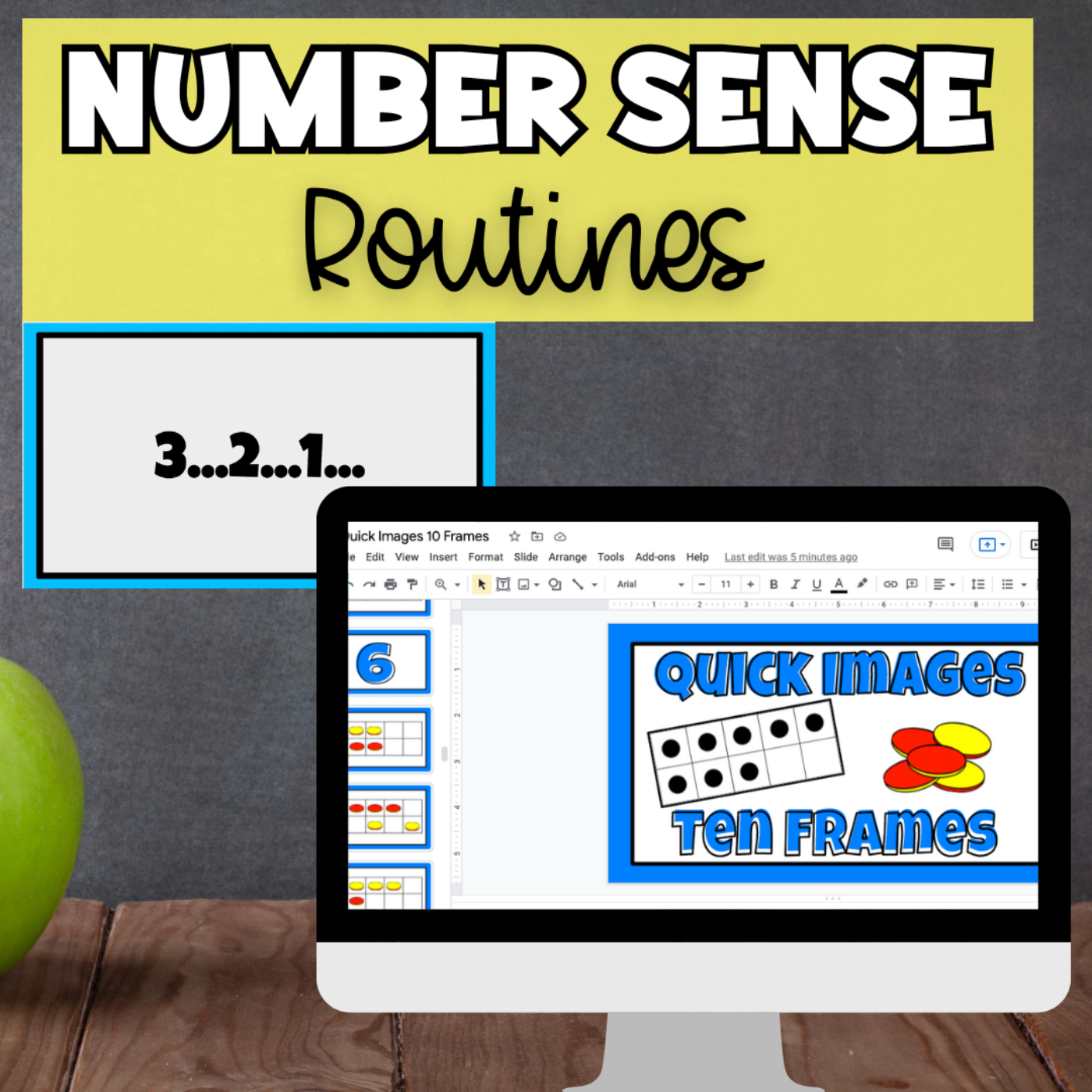
Ep 54: 3 Number Sense Routines for Elementary Math
Making Number Sense Make Sense: A Math Podcast for Early Elementary Teachers
Let’s discuss three easy warm-ups to develop number sense in early elementary math!
Have a topic you want me to discuss? Fill out the Google Form!
Helpful Links
Which One Doesn’t Belong Blog Post
Let's Connect!
2025-08-11
5 min
Transcript
Available Results
Generated results are saved to the knowledge database for reuse and search.
No generated results are available for this episode yet.
Extract Knowledge
Pick what you want extracted first. Model, scope, and chapter options appear after a template is selected.
Generated results for public episodes are saved to the knowledge database so they can be reused and searched later.
Transcript
Let's talk about three number sense routines
that you can use as a warm -up in your math block.
Hello, and welcome to Making Number Sense Make
Sense, a podcast for elementary teachers, specifically
early elementary teachers, looking to really
make an impact in the number sense of their students.
Using a number sense routine at the beginning
of your math block is a great way to get your
students thinking about math and talking about
math and getting comfortable sharing their opinions
with other students and having them practice
those conversational skills of how to agree or
disagree respectfully. So the three I'm going
to talk about today is which one doesn't belong,
quick images, and choral counting, starting with
which one doesn't belong. This one is my favorite
for the beginning of the year because there are
no wrong answers and everybody can participate
since it's really just an opinion. The way that
quick images could work is you could show four
different images and then have your students
decide of these four which one doesn't belong.
and why. And this is a great one to start, like
I said, because there's no wrong answers. And
I have found that even the most shy students
are willing to share their opinions on this because
most of the time they have someone else who agrees
with them. So it doesn't feel so isolating when
you're the odd one out that has a different opinion.
Everybody can share their opinion and show if
they agree or disagree. The next number sense
routine I really enjoy using is called quick
images. So that is exactly what it sounds like.
You show students something very quickly, usually
two to three seconds, and then hide it. And then
they have to tell you what they saw. As an example,
let's say I show a 10 frame with five red counters
on top and two yellow counters at the bottom.
I might say something like, I'm going to show
you something, but you really need to be looking
because I'm only going to show you for two seconds.
So you show them. the 10 frame for two to three
seconds and put it down and ask them to tell
you what it is that they saw. So some students
might say, oh, I saw that the top is full or
I saw five on top or five on top or two at the
bottom. Some of them might say, oh, I saw seven
altogether. So when they're sharing what they
saw, you would ask them how they know, like,
what did it look like? Do you think it could
be something else? Some students might say something
like, well, I saw that three were empty. So I
know that. 10 minus 3 is 7. So there's lots of
opportunities to get students talking about what
they saw and what they didn't see. Using quick
images is a great way to support subitizing when
they're starting to build their number sense.
So starting to see that different parts can make
up the same whole. So if you weren't using a
10 frame and counters, maybe you just used your
fingers and showed them eight with five on one
hand and three on the other hand. And they would
say something like, I saw five on that hand and
three on that hand. They might even make the
same number pattern with their own hands and
count them out to tell you how many they saw
in total. The last number sense routine I'm going
to talk about today. is called choral counting
and it is just what it sounds like. You're counting
all together and this really helps students learn
the number sequence by counting in a group even
if they're not quite confident with the number
sequence yet. Counting a lot or practicing counting
a lot and hearing it can help reinforce the counting
sequence. To do a choral count, you tell your
students the number range that you'll be counting,
and you're going to write down the numbers as
you count. So for example, if I was going to
count from 1 to 20, I would tell the students,
okay, we're going to count from 1 to 20, but
make sure that you're counting with me because
I need to be able to write down the numbers that
we're counting. So in this case, I would write
the numbers 1 to 10 in the first row and 11 to
20 in the second row. And after you've counted
together, you're going to ask the students what
they notice about the numbers that you just counted
and wrote down. Now, you can start with just
numbers 1 to 10, but I particularly like... choral
counting for tricky number sequences or if you're
wanting them to notice patterns in the number
system. That can help students notice that there's
always a 1 in the second row or that the numbers
start to be the same. So they might see a 7 in
the first row, a 7 in the second row. So they're
starting to see the pattern that they're noticing
at the beginning of the counting sequence goes
on to the bigger numbers in the counting sequence.
And that can help with number writing as well
to know that the 1 comes first and the 7 comes
second and 17. but in 27, the two comes first
and the seven comes second. So it's a really
good foundation for place value in that kind
of situation. Now you can do the same thing if
you're counting by tens, for example. So you
might show students just the counting sequence
of the tens, the decades, because that... can
help with these tricky number sequences too,
especially when they're counting to 100. Those
decades are what can really trip up students.
So seeing them, seeing them written out and just
focusing on them can help reinforce that knowledge
and that understanding. It definitely does not
have to be when you're counting by ones. Like
I said, you can count by tens, you can count
by twos, you can count by fives, maybe even starting
counting from a number other than one. or skip
counting from a number that's not the normal
number that they start skip counting by, so they
can kind of get into the routine and get into
the flow of what these number sequences look
like no matter where you start. I will link below
to a blog post about these number sense routines,
and within that are more in -depth instructions
on how to do all of these number sense routines
if it's something that you'd like to hear more
about. If you've been enjoying the podcast, make
sure to scroll down and leave a review, either
just a star review or a written review. I really
appreciate it.
Chapters
No chapters available.