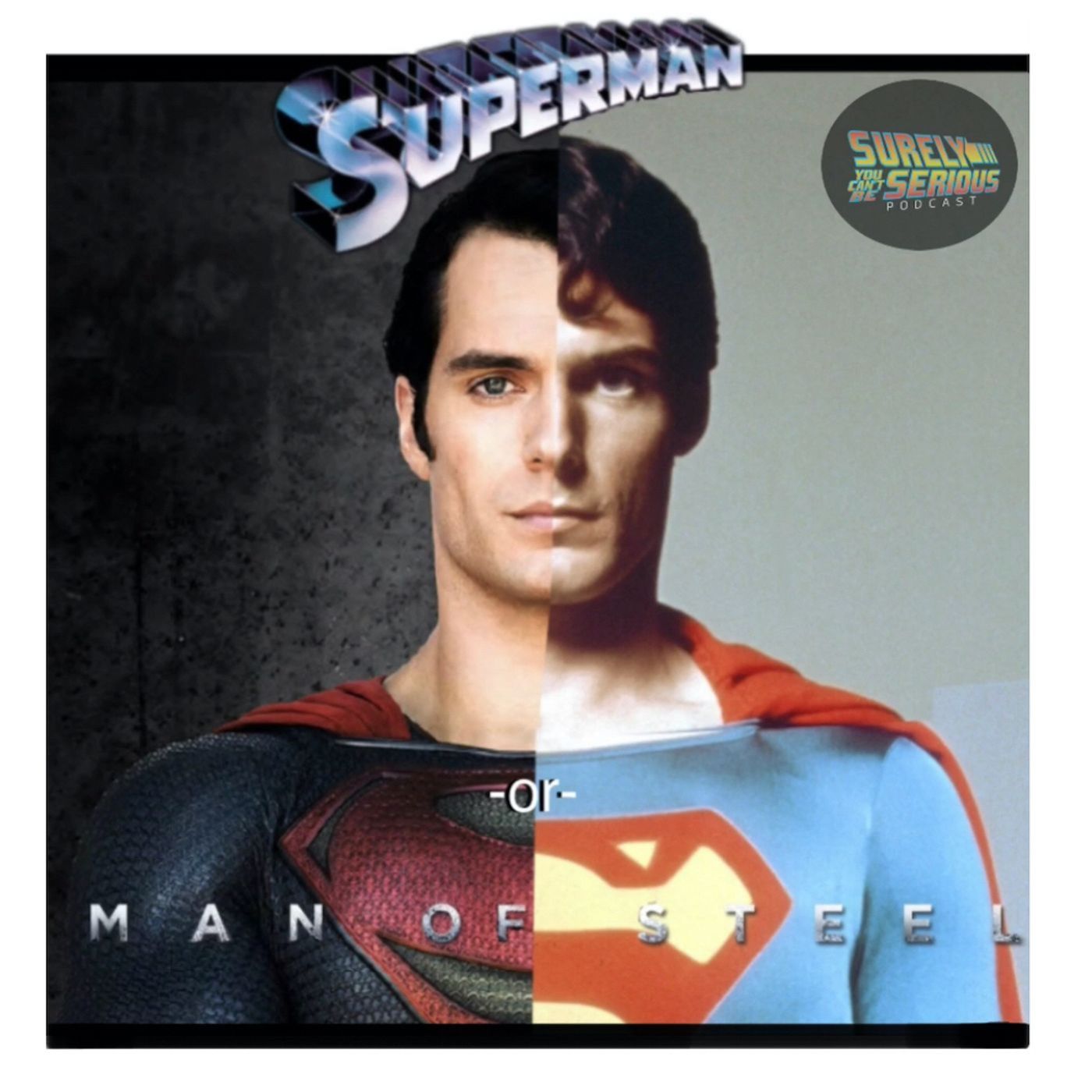
Superman I & II (1978 & 1981) vs. Man of Steel (2013): Part 1
The Last Son of Krypton or the Latest Son of Krypton? We are SUPER-excited to be joined by the host of the 30Something Movie Podcast, Mr. John Reid! In this episode we will stumble, we will fall, but in time we will accomplish wonders! (Or at least a pretty good podcast.) So, join us in the sun!
2020-06-02
63 min
Transcript
Available Results
Generated results are saved to the knowledge database for reuse and search.
No generated results are available for this episode yet.
Extract Knowledge
Pick what you want extracted first. Model, scope, and chapter options appear after a template is selected.
Generated results for public episodes are saved to the knowledge database so they can be reused and searched later.
Transcript
<v Speaker 1>Look up in the sky. It's a bird, it's a plane. No,
<v Speaker 1>it's the Surely You Can't Be Serious Podcast.
<v Speaker 2>Okay, everybody, welcome to our Superman versus Man of Steel episode.
<v Speaker 2>We are so glad to have John Read of the
<v Speaker 2>thirty something Movie Podcast on our episode this week. It
<v Speaker 2>actually coincides with their three hundredth episode, which they're going
<v Speaker 2>to release this week. So as soon as you get
<v Speaker 2>done listening to this podcast, go over to the thirty
<v Speaker 2>something Movie podcast page click subscribe and check out their stuff.
<v Speaker 2>They've got some great, great episodes and they're a lot
<v Speaker 2>of fun.
<v Speaker 1>Thank you, guys so much for tuning in again, or
<v Speaker 1>if this is your first time to listen to us,
<v Speaker 1>we're super glad to have you. Without further ado, Hello everybody,
<v Speaker 1>and welcome to the Surely You Can't Be Serious Podcast,
<v Speaker 1>discussing and debating the iconic and the forgotten of eighties
<v Speaker 1>and nineties pop culture with your co hosts James D.
<v Speaker 3>Gray and Jason Couliban.
<v Speaker 1>All right, everybody, welcome back.
<v Speaker 2>This is the Superman one and two versus Mansteals.
<v Speaker 1>We've got our guest John Reid with us from thirty
<v Speaker 1>s the podcast. John, how you doing Man. Good?
<v Speaker 3>Have you? Oh, I'm doing great. I'm just I'm excited
<v Speaker 3>to be here with you guys, and just I'm agonizing.
<v Speaker 3>I'm agonizing over the decisions that we have to make here.
<v Speaker 3>It's going to change the course of Mighty rivers. It
<v Speaker 3>may reverse the rotation of the Earth. It may cause
<v Speaker 3>people to forget that they ever spent the night with Superman.
<v Speaker 3>I mean whatever, it's I'm just I'm ready. Let's go.
<v Speaker 3>Let's make some decisions.
<v Speaker 1>Okay, that's it. We've got to have John as a
<v Speaker 1>guest on every single episode from now. That's right.
<v Speaker 3>It's been a day at work, So the fact that
<v Speaker 3>I knew that we were going to be able to
<v Speaker 3>get on and talk some Superman and all day while
<v Speaker 3>I'm supposed to be doing work stuff, I'm just walking
<v Speaker 3>around now. But I'm so glad to be with you guys.
<v Speaker 3>I'm having so much fun listening to your show, Like
<v Speaker 3>I cannot wait. Every single time your podcast comes up
<v Speaker 3>in my feet, I'm like, oh, no, skip all the
<v Speaker 3>other ones. You got to find out is it van
<v Speaker 3>Halen or van Hagar? We got to find out.
<v Speaker 2>Well, thanks for being with us, Man, Why don't tell
<v Speaker 2>us a little bit about thirty something.
<v Speaker 3>Yeah. Yeah, So we started about close to five years ago.
<v Speaker 3>Now we are a bunch of teachers. So we're sitting
<v Speaker 3>around talking about movies. I think it was twenty fourteen
<v Speaker 3>we were talking about We're talking about nineteen eighty four,
<v Speaker 3>and we're like, Wow, there's so many movies that just
<v Speaker 3>you know, thirty years ago, so many great movies from
<v Speaker 3>this year, and we just started rattling them off. We're
<v Speaker 3>just like, oh, and we're like, just think about from
<v Speaker 3>eighty four. You had Ghostbusters, you had The Nightmare on
<v Speaker 3>Elm Street, you had all these gremlins, all these different movies,
<v Speaker 3>and then we started jumping into eighty five and we're like, oh, man,
<v Speaker 3>then you got back to the future, you guys. So
<v Speaker 3>as we were doing all this, I had kind of
<v Speaker 3>wanting to do a podcast for a long time, back
<v Speaker 3>before like even a lot of people knew what podcasts were.
<v Speaker 3>I had listened to some different podcasts and I thought,
<v Speaker 3>you know what, it sounds like those guys have a
<v Speaker 3>lot of fun, and I would love to find a
<v Speaker 3>way to do this someday and do it completely for
<v Speaker 3>free and somehow eventually get paid for it. So, you know,
<v Speaker 3>one out of three ain't bad. So you know, we
<v Speaker 3>decided at that point, we kind of said, hey, you
<v Speaker 3>know what, let's get together and let's talk about movies.
<v Speaker 3>That'll be our theme is we're going to talk about
<v Speaker 3>movies that are thirty years old. And then that way
<v Speaker 3>we don't have an ending point where like, we can
<v Speaker 3>keep this going as long as we want to, we'll
<v Speaker 3>be able to keep going, you know, forever and ever
<v Speaker 3>and ever. And so we started it up. We made
<v Speaker 3>some mistakes with our first episode. I know there was
<v Speaker 3>another podcast at the time where the guys used to
<v Speaker 3>get together and sit in a restaurant or a diner
<v Speaker 3>and they would record while they were having their dinner.
<v Speaker 3>And I thought, it's a cool concept. Let's do that.
<v Speaker 3>So I hold all of my equipment to our local
<v Speaker 3>Mexican restaurant completely not thinking about the fact that, well,
<v Speaker 3>wait a minute, they're going to have mariachi music going
<v Speaker 3>the entire time. We're all going to be munching on chips.
<v Speaker 3>So that's our infamous lost episode, the one we're willing
<v Speaker 3>to start with this episode number two. Premise, Like I said,
<v Speaker 3>the premise of our show is whatever year we're in,
<v Speaker 3>we're going back thirty years. One of the benefits, and
<v Speaker 3>I think you guys see this too, one of benefits
<v Speaker 3>is I mean, we're we're friends in real life. You know,
<v Speaker 3>we're not just we're not just podcasting with each other.
<v Speaker 3>Because somehow we went we met online somewhere and here
<v Speaker 3>you go.
<v Speaker 1>Jason was the one that turned me onto you guys.
<v Speaker 1>He's probably been listening to you for two or three
<v Speaker 1>years now. Yeah, that's right, and I've been listening for
<v Speaker 1>the last year. So the first episode that I listened
<v Speaker 1>to though, was your two hundredth episode where you just
<v Speaker 1>you guys were It sounded like you're all in somebody's
<v Speaker 1>kitchen together and just having a great time, and I
<v Speaker 1>was like, this sounds I mean, it sounds awesome. It
<v Speaker 1>totally looked me in just all the movies that you
<v Speaker 1>guys were going through now thirty something Movie Podcast.
<v Speaker 3>Yeah, we're on Twitter or Facebook, Instagram, all those different places.
<v Speaker 3>If you just look for three zero podcast you're probably
<v Speaker 3>gonna find us on most of those different spots. But yeah,
<v Speaker 3>that's the easiest way to find us. And thirty Podcasts
<v Speaker 3>dot Com is our website. You can get to all
<v Speaker 3>the episodes from there.
<v Speaker 1>And I just want to say something about your co
<v Speaker 1>host real quick. It's almost always Pat and Bow that
<v Speaker 1>I hear. I know you have other guys who come
<v Speaker 1>in from time to time. But and I can't remember
<v Speaker 1>what the the movie was that you guys were talking about,
<v Speaker 1>But at some point in the podcast Pat and Bo
<v Speaker 1>started talking about Deli sandwiches. Maybe it was when the
<v Speaker 1>Harry met Sally, is what I'm guessing.
<v Speaker 3>I think it was.
<v Speaker 1>Yeah, and I was, I was salivating. I was just like, oh, pot,
<v Speaker 1>Pat and Bo need to just do their own let's
<v Speaker 1>talk about food podcasts, and I will. I'll guest host
<v Speaker 1>every time. All right, well you're here to join us.
<v Speaker 1>We're doing today.
<v Speaker 2>We're going to compare Superman the movie and Superman two
<v Speaker 2>kind of as one big conglomerate versus Men of Steel.
<v Speaker 1>Yeah, and John did an episode it was just you
<v Speaker 1>on actually two episodes, and if you want to go
<v Speaker 1>to Thirty Somethings podcast, it's episode one, one and two
<v Speaker 1>where he talks it was the it was the eightieth
<v Speaker 1>anniversary of the first Superman. He talks about in detail
<v Speaker 1>the whole origin story of Superman. And so when we
<v Speaker 1>first started talking about doing this podcast together. I was like,
<v Speaker 1>oh crap, I so much research that I've got to
<v Speaker 1>do because Superman is just this, I mean, it's volumes
<v Speaker 1>of history. And then I listened to those two podcasts
<v Speaker 1>and I was like, well, okay, I don't have to
<v Speaker 1>research anymore. I'm just gonna tell people to go done,
<v Speaker 1>go back to John's one eighty one and one eighty
<v Speaker 1>two of the thirty something podcast and you can get
<v Speaker 1>all of the backstory on Superman. And today we're just
<v Speaker 1>gonna we're going to focus on these three movies.
<v Speaker 3>You guys have caused me such turmoil since since you
<v Speaker 3>sent me a message and you were like, hey, would
<v Speaker 3>you like to be on an episode of the podcast
<v Speaker 3>in which we pit these movies against each other? You know,
<v Speaker 3>Superman one and two versus Man of Steel? And my
<v Speaker 3>initial reaction, I mean, well, I mean it would have
<v Speaker 3>been my reaction right now too, But my reaction was
<v Speaker 3>are you kidding? Yes? I would love to. And then
<v Speaker 3>when that wore off, I actually started thinking about it.
<v Speaker 3>I was like, okay, all right, let's do this Superman
<v Speaker 3>one and two versus Man of Steel. I totally know.
<v Speaker 3>Oh but wait, there's this Okay, but now there's that
<v Speaker 3>this one better that. Oh, you guys. So there have
<v Speaker 3>been several times where, over the course of the last
<v Speaker 3>couple of weeks, since we've been messaging back and forth,
<v Speaker 3>my wife will see me like furiously scribbling something on
<v Speaker 3>a piece of paper or my iPad or whatever, and
<v Speaker 3>she'll be like, all right, so, which one is it today?
<v Speaker 3>And I said, Nope, I'm not sharing. I'm gonna have
<v Speaker 3>to listen to the episode. I'm not sharing.
<v Speaker 1>Yeah, all of our listeners, you're going to have to
<v Speaker 1>hold out till the end for final judgment on these
<v Speaker 1>once we've done our comparison. Well to John's wife though, Yes,
<v Speaker 1>thank you Ford, thank you for letting him hang out
<v Speaker 1>with us today. It's double duty for the podcasting today.
<v Speaker 1>Superman the movie came out in nineteen seventy eight and
<v Speaker 1>December fifteenth, nineteen seventy eight. Yeah, there's a big origin
<v Speaker 1>story behind it. Let's get in that because that really
<v Speaker 1>is interesting.
<v Speaker 3>I think.
<v Speaker 1>Okay, the Salcans were the producers on this movie, and
<v Speaker 1>they bought the rights for this movie back in nineteen
<v Speaker 1>seventy four. Ilia Salkan the son went to Alexander Salkan,
<v Speaker 1>the father and said Hey, I think this is going
<v Speaker 1>to be a big hit. Now. Warner Brothers owned the
<v Speaker 1>rights to the movie at the time, and they said,
<v Speaker 1>I guess you can have it, but we're not going
<v Speaker 1>to give you any money for it. Right, So it
<v Speaker 1>was a negative, negative, negative pickup deal. Yeah, So they
<v Speaker 1>had to fund the movie themselves and then get reimbursed
<v Speaker 1>once it was finished.
<v Speaker 2>That's right, This is the part where we defend the
<v Speaker 2>Salkans for just a second, for a brief moment, we're
<v Speaker 2>going to defend the Salcans. They had to front all
<v Speaker 2>the money for two epically expensive movies being filmed at
<v Speaker 2>the same time.
<v Speaker 1>Right, Yeah. Of course it was their decision to film
<v Speaker 1>two movies at the same time, because, as it turned out,
<v Speaker 1>they had had some success with that in the past,
<v Speaker 1>except for the fact that they got sued over Back
<v Speaker 1>in the mid seventies, they had produced The Three Musketeers,
<v Speaker 1>which then, unbeknownst to anybody involved in the movie except them,
<v Speaker 1>became the Three Musketeers and the Four Musketeers. So all
<v Speaker 1>of the cast and crew got paid for one movie,
<v Speaker 1>even though they ultimately ended up doing two movies, and
<v Speaker 1>so the Salcons got sued by all of those guys.
<v Speaker 1>And now there is a standard provision in all acting
<v Speaker 1>contracts called the Salcan clause that says, you got to
<v Speaker 1>tell us how many movies we're making right now?
<v Speaker 3>Do you know?
<v Speaker 2>I don't know, John, If you know who the actors
<v Speaker 2>that were considered to be Superman originally, this is a
<v Speaker 2>who's whose list in the seventies.
<v Speaker 3>I know that one of the weirder ones that every
<v Speaker 3>time I hear that, I was like, how really, Dustin Hoffman,
<v Speaker 3>wasn't he.
<v Speaker 1>One of them?
<v Speaker 3>Yeah?
<v Speaker 1>Yeah, Dustin Hoffman. Yeah, that's that's always one of the
<v Speaker 1>stranger is Muhammad Ali was There was an actual consideration. Yeah,
<v Speaker 1>I mean he I mean, obviously he's physically fit enough
<v Speaker 1>to be the guy. But has he been in anything
<v Speaker 1>at Oh no, No.
<v Speaker 2>But he could look like a butterfly and sting like
<v Speaker 2>a bee, and he was he was.
<v Speaker 1>He was in a Superman comic book. He was Yeah, yeah,
<v Speaker 1>that's right. Have you seen that, John?
<v Speaker 3>I have you know what I've read? I have a
<v Speaker 3>I don't have the actual comic book. I read a
<v Speaker 3>reprint of it one time, and it was kind of
<v Speaker 3>it was meant to be, this a gimmicky thing throughout
<v Speaker 3>the seventies and some of the comics they had, like
<v Speaker 3>you know, Superman would get matched up with like JFK
<v Speaker 3>or Bob Hope or you know, all these I don't
<v Speaker 3>know what Superman and Bob Hope were doing, but you
<v Speaker 3>know they they had all these different issues where they'd
<v Speaker 3>have like these special guest stars. Yeah. Yeah, and I
<v Speaker 3>can't remember, at the top of my head a whole
<v Speaker 3>bunch of the story. But you know, on the front
<v Speaker 3>cover it's kind of an iconic cover with the comic books.
<v Speaker 3>Is you know, Superman and Muhammad Ali in a boxing
<v Speaker 3>ring together, you know, getting ready to throw down. And
<v Speaker 3>I remember seeing that as a kid and thinking, I
<v Speaker 3>don't know who that guy is, but he's about to die.
<v Speaker 1>You don't get a boxer in the world. He's about
<v Speaker 1>to die.
<v Speaker 2>All right, Well, here's the list. Okay, I thought this
<v Speaker 2>was interesting. Now when when you say these people were considered,
<v Speaker 2>there was an approved list for Superman. The director can
<v Speaker 2>take this list and hire according to this list. Right,
<v Speaker 2>So you have Al Pacino, You've got Dustin Huff, You've
<v Speaker 2>got Bruce Jenner, You've got Steve McQueen and Paul Newman.
<v Speaker 1>You've got Clint.
<v Speaker 2>Eastwood, Muhammad Ali, James Kahan, Warren Bady, Neil Diamond, Neil Diamond,
<v Speaker 2>and then finally he wasn't approved. But so that's just
<v Speaker 2>alone really wanted this part.
<v Speaker 3>I remember hearing about that.
<v Speaker 1>No, statistically speaking, it's still the safest form of trouble Yo. Lois.
<v Speaker 3>Yeah, you know, I Lois. There was like these two missiles,
<v Speaker 3>you know, there was the one and I had to
<v Speaker 3>go get the I did it.
<v Speaker 2>Yeah, he fought hard. You know who kept him from
<v Speaker 2>doing it Marlon Brando at the time. So that's just
<v Speaker 2>the Loan was considered to be the next Marlon Brando,
<v Speaker 2>and Marlon Brando said, we went to the producers like, now,
<v Speaker 2>this guy's not right. Stallan is actually out there and
<v Speaker 2>you can find this on YouTube and he is trashing
<v Speaker 2>Marlon Brando, like I have no respect him for him as.
<v Speaker 1>An actor, as a man, really put him down. Well,
<v Speaker 1>let's talk a little bit about that, since we're talking
<v Speaker 1>about getting the movie together. That was the way that
<v Speaker 1>they ultimately got them to buy in. So we we
<v Speaker 1>got Marlon Brando on board, They got Marlon Brando and
<v Speaker 1>then they got Gene Hackman.
<v Speaker 2>Well, once they got Marlon Brando, on board and Gene Hackman.
<v Speaker 2>Then Donner had some freedom to Okay, let me we
<v Speaker 2>got the stars in plays, let me get somebody who
<v Speaker 2>looks the part.
<v Speaker 1>And I'll back us up. For just a second, before
<v Speaker 1>Donner was on board, they were, I mean, this is
<v Speaker 1>this is kind of definitive sulkans. They were trying to
<v Speaker 1>find the cheapest place to make a movie, right, and
<v Speaker 1>so they said, okay, let's go to Italy. Italy is cheap.
<v Speaker 1>But then Marlon Brando had a warrant out for obscenity
<v Speaker 1>charges from the Last Tango in Paris, the rape scene,
<v Speaker 1>so they couldn't go there.
<v Speaker 2>Guy Hamilton was the director at that moment, right, who
<v Speaker 2>had done all a bunch of James Bond movies.
<v Speaker 1>Right. But then their next option was, well, let's go
<v Speaker 1>to England. But Guy Hamilton would be arrested after thirty
<v Speaker 1>days of being in England because he was.
<v Speaker 2>Taxing he was, so they chose Marlon Brando over Guy Hamilton, right,
<v Speaker 2>So then they had to find a director.
<v Speaker 1>The way Donner tells it is he was sitting in
<v Speaker 1>his bathroom. I'm sitting in the bathroom. You can imagine
<v Speaker 1>what's going on there, and he says, and I was
<v Speaker 1>really hungover and I had just woken up, and I
<v Speaker 1>get this call and it's some guy with a foreign
<v Speaker 1>accent saying, this is Alexander Salken.
<v Speaker 3>You know who I am.
<v Speaker 1>And he's like, no, what the heck do you want?
<v Speaker 1>While I'm a producer and interested in making Superman, would
<v Speaker 1>you like to direct? He's like, yeah, you know maybe,
<v Speaker 1>and he goes, we will pay you a million dollars.
<v Speaker 1>He's like, all right, You've got my attention. Where can
<v Speaker 1>I meet you? Donner at that point had only done
<v Speaker 1>The Omen and some other smaller movie that I can't recall.
<v Speaker 2>It, Gillingan's Island. He was a director on some of
<v Speaker 2>the Gilligan's Island some.
<v Speaker 1>TV stuff, and then Owen was his big one, and
<v Speaker 1>they had Jerry Goldsmith was the composer and Omen. He
<v Speaker 1>was at Donner's behest was supposed to be the composer
<v Speaker 1>for Superman, but then he wasn't available, so they got
<v Speaker 1>John Williams in. Then John Williams wasn'tvailable and Goldsmith was
<v Speaker 1>back in, and then Goldsmith was back out and John
<v Speaker 1>Williams was back in.
<v Speaker 2>The settled for John Williams. Yeah, poor guys okay, and
<v Speaker 2>Margot Kidder got the part. So Donner was in charge
<v Speaker 2>of the auditions at this point. Yeah, he's, you know,
<v Speaker 2>looking for Loewsling and she got the I don't really
<v Speaker 2>have a list of people that would consider. But when
<v Speaker 2>she came into the room to audition, she tripped, she stumbled,
<v Speaker 2>and they thought it was charming.
<v Speaker 1>He instantly said he fell in love with her. Right then.
<v Speaker 1>I gotta say, in rewatching it, she's not as unattractive
<v Speaker 1>as I remember her being when I was a kid,
<v Speaker 1>I just thought Superman could do so much better than
<v Speaker 1>this lady. But upon the rewatch, especially in Superman one,
<v Speaker 1>she's not a bad looking lady. No, no, she's not. Now.
<v Speaker 2>By the time nineteen eighty one rolled around, she had
<v Speaker 2>had some breakdowns.
<v Speaker 1>Yeah, lost her teeth and yeah, it's really rough road hard.
<v Speaker 3>I think about when and I'd heard that before, about
<v Speaker 3>how she tripped, and they're like, oh, that's so charming.
<v Speaker 3>I have never been offered a movie part, and I
<v Speaker 3>feel like I have done that so many times in
<v Speaker 3>my life. I feel like, by now I should have
<v Speaker 3>an Oscar.
<v Speaker 1>I do think it's interesting when Chris Reeve was brought
<v Speaker 1>in to read for the part.
<v Speaker 2>He was six foot five, one hundred and seventy pounds,
<v Speaker 2>and he went to the guys and the like, ah,
<v Speaker 2>he's kind of skinny, you know, I don't know if
<v Speaker 2>he really could.
<v Speaker 1>Pull off Superman. And he sweat refusely. Like at the
<v Speaker 1>end of Superman two, you know, he lifts up Zod
<v Speaker 1>and in that moment you see a little pit stain
<v Speaker 1>on the Superman really yeah, okay, And so when I
<v Speaker 1>heard you know, he's okay, So he has a pit stain.
<v Speaker 1>You know, that's that's something that happens to guys. You
<v Speaker 1>can't help that. But then I saw his actual audition
<v Speaker 1>tape before they had given him the padding and the
<v Speaker 1>industrial strength deodorant, and I mean it's literally down to
<v Speaker 1>his elbows on both both arms and down down to
<v Speaker 1>his waist. Yeah.
<v Speaker 2>But when he he they brought him in, he was skinny,
<v Speaker 2>tall and skinny, and he went to him and he said, listen,
<v Speaker 2>I was a jock in high school. I can put
<v Speaker 2>on the muscle, trust me, I can do it. And
<v Speaker 2>when Donner said, okay, listen, kid, you got the park
<v Speaker 2>and you got to make make sure you can do this,
<v Speaker 2>you know, so he trained with David Prowse, Darth Vader himself.
<v Speaker 1>We know you're a big Star Wars fan.
<v Speaker 3>Oh yeah, yeah, I and and that the first time
<v Speaker 3>as a kid when I had heard that somewhere, I
<v Speaker 3>don't know if I was reading, I was reading the
<v Speaker 3>book or a magazine article or something as a kid,
<v Speaker 3>and I found that out. I'm like, whoa Superman was
<v Speaker 3>Darth Vader's apprentice? Outstanding? Outstanding.
<v Speaker 1>So then as they're putting things together, they had anally.
<v Speaker 1>The Sulcans had gotten Mario Puzo to write the script
<v Speaker 1>in this thing.
<v Speaker 2>Incredible.
<v Speaker 1>And Mario Puzo, if the listeners don't know, was the
<v Speaker 1>one who had written Godfather one and two, which, of
<v Speaker 1>course just I mean, were the record setting in their
<v Speaker 1>box office success. I'm not really sure how you decide
<v Speaker 1>to put him in charge of a Superman movie script,
<v Speaker 1>but that's what they did. He wrote a five hundred
<v Speaker 1>and fifty page script that has never seen the light
<v Speaker 1>of day. Once Donner got his hands on it, he
<v Speaker 1>was like, this destroys the biblical canon of Superman. So
<v Speaker 1>he got Tom Makowitz to come in and do the
<v Speaker 1>serious rewrites on the script.
<v Speaker 2>And once again I'm going to defend the Salkans for
<v Speaker 2>a second. So they fronted the money to get this done.
<v Speaker 2>They had the insight to realize, number one, that comic
<v Speaker 2>book movies were going to be successful in the box office.
<v Speaker 1>Yeah, I think it's important to realize that in nineteen
<v Speaker 1>seventy eight, the idea of a comic book movie being
<v Speaker 1>successful was redicult to me.
<v Speaker 3>That's what's amazing about this Superman movie. Yes it was.
<v Speaker 3>It was a hit when it came out. You know,
<v Speaker 3>people loved it, but even still, there were a lot
<v Speaker 3>of comic book fans that did not love this movie
<v Speaker 3>at all. It didn't fit with the Superman at the time.
<v Speaker 3>In the comics, in terms of general audiences, you had
<v Speaker 3>the Batman sixty six, you had Wonder Woman, she had
<v Speaker 3>the Incredible Hulk TV show. That's pretty much what you
<v Speaker 3>had in terms of superheroes on TV. Other than cartoons,
<v Speaker 3>and other than those you know three, there's probably other
<v Speaker 3>TV series that were out there at the time. Anything
<v Speaker 3>that was superhero, anything that was comic book related, was
<v Speaker 3>automatically also campy. Like for some reason, they always felt like, oh, well,
<v Speaker 3>comic books are for kids, so we got to make
<v Speaker 3>this show kind of for kids. We got to make
<v Speaker 3>it campy, we got to make it silly. And then
<v Speaker 3>the fact that you bring out a Superman movie and
<v Speaker 3>you're like, you know what, we're actually going to try
<v Speaker 3>to do a semi serious take on what if Superman
<v Speaker 3>was real? And some of the things I think in
<v Speaker 3>the early drafts of the script that I had read
<v Speaker 3>was they had all these crazy cameos for like the
<v Speaker 3>other actors and and you know comedians of the time,
<v Speaker 3>that we're going to just like walk in for a
<v Speaker 3>scene and say something silly and then walk off. Yep,
<v Speaker 3>And that would have totally made it, you know, just
<v Speaker 3>like the sixties Batman movie. It would have just made
<v Speaker 3>it silly. It would have made it cartoonish. And that's
<v Speaker 3>why I love that. The tagline I think on the
<v Speaker 3>poster for this movie and maybe in the trailer too,
<v Speaker 3>was you know, you'll believe a man can fly?
<v Speaker 1>And from what I understand the the Salcans co producer
<v Speaker 1>producer Sper Spindler, that's it. Yeah. He spent he spent
<v Speaker 1>two solid weeks with the DC executives developing an integrity
<v Speaker 1>of the character clause for the contract before they were
<v Speaker 1>willing to let swap them this often have it. They
<v Speaker 1>they didn't want it. They didn't want the Batman thing
<v Speaker 1>to happen to to Superman because it's too valuable a character.
<v Speaker 1>I mean, it's it's one of the American fables.
<v Speaker 3>Now.
<v Speaker 2>Can you imagine the pressure that the Salcans were actually
<v Speaker 2>under not only fronting this financially, but as soon as
<v Speaker 2>you get the permission to shoot this thing and let's
<v Speaker 2>go do this, you got to figure out how how
<v Speaker 2>can I make a guy fly?
<v Speaker 1>That was a huge part of things. We can talk
<v Speaker 1>about that the flight thing later on, but that was
<v Speaker 1>that was definitely like the most critical issue of the
<v Speaker 1>filming was we cannot make this look can't We can't
<v Speaker 1>make it look fake. It's got to look real.
<v Speaker 2>They toyed with lighters and cartoons until they finally got
<v Speaker 2>that complex cable thing, and I still am amazed.
<v Speaker 1>So that's that's that's our origin story for Superman one
<v Speaker 1>and then for well, yeah, I mean sort of, there's
<v Speaker 1>obviously a story there with Superman two. So as the
<v Speaker 1>filming went on, the Salcans would constantly tell Donner that
<v Speaker 1>he was over budget and over time, and he mainstains
<v Speaker 1>to this day that he was never told what the
<v Speaker 1>budget was and never told how much time he had
<v Speaker 1>to shoot. But it got to the point that he
<v Speaker 1>couldn't handle be in the same room with Eric Spinkler
<v Speaker 1>or whatever his name is, and so they had Richard
<v Speaker 1>Lester come in as kind of a go between. Now,
<v Speaker 1>Richard Lester was among those guys from the Three Musketeers
<v Speaker 1>and the Four Musketeers that was in the process of
<v Speaker 1>suing the Salkans at the time, so that you kind
<v Speaker 1>of get this idea that there was a wink wink,
<v Speaker 1>nudge nudge of you'll get your money, but we're going
<v Speaker 1>to get it to you through Superman instead of through
<v Speaker 1>this lawsuit.
<v Speaker 2>I think there's no doubt. I mean, Richard Lester may
<v Speaker 2>a deal with the devil you guys have been screwing
<v Speaker 2>over for all these years.
<v Speaker 1>I'll tell you what.
<v Speaker 2>We'll get you your money, but you've got to help
<v Speaker 2>us out with Donner.
<v Speaker 1>Yeah. And so even though you know that we talked
<v Speaker 1>about them filming both Superman one and Superman two at
<v Speaker 1>the same time, at some point they said, hey, this
<v Speaker 1>is getting so much publicity, we've got a chance to
<v Speaker 1>release it on the fortieth anniversary of Superman, stop working
<v Speaker 1>on part two and finish up part one. And well,
<v Speaker 1>if that's not obvious, what's about to happen to Richard Donner?
<v Speaker 1>I don't know what is. So they they take the
<v Speaker 1>ending from Superman two and put it at the end
<v Speaker 1>of Superman one. The whole spending the Earth backwards to
<v Speaker 1>reverse time was originally supposed to be the end of
<v Speaker 1>Superman two. The ending of Superman one was supposed to
<v Speaker 1>be as he pushes the one of the two missiles
<v Speaker 1>that lets Lutheris and off out into space, and that
<v Speaker 1>missile is what destroys the Phantom Zone and releases the
<v Speaker 1>three criminals.
<v Speaker 2>Yeah, the Phantom Zone that looks like Queen two, the
<v Speaker 2>album they're all trapped in the Queen album.
<v Speaker 1>Yeah. Yeah. Well, and in the Mario Pousa script there
<v Speaker 1>was actually four guys. They would have really had the
<v Speaker 1>album cover they had, so yeah. So then they fire
<v Speaker 1>after after Superman one is a huge success, they fire
<v Speaker 1>Richard Donner and they make Richard Lester the director of
<v Speaker 1>Superman two. And they have to let enough time go
<v Speaker 1>by that Marlon Brando's contract expires so that they don't
<v Speaker 1>have to pay him anymore. Sinus any York comes in
<v Speaker 1>and that spot and kind of gives the you know,
<v Speaker 1>I'm going to start teaching you, which if you've seen
<v Speaker 1>the Richard have you seen the Richard Donner cut, John.
<v Speaker 3>I have, yeah, only once a few years ago. I
<v Speaker 3>have the DVD, but I've only watched it once. I
<v Speaker 3>enjoyed it. I liked it.
<v Speaker 1>But yeah, I enjoyed it as well. I mean it's
<v Speaker 1>a little rough because they're using scenes from the test
<v Speaker 1>footage that they did and auditions that they did. But
<v Speaker 1>the thing that is compelling about it is the Marlon
<v Speaker 1>Brando part. Richard Donner set out to make this analogous
<v Speaker 1>to the Christ story, and there's really when he has
<v Speaker 1>that moment where he's gone back after giving up his powers,
<v Speaker 1>and he's gone back to try to get his powers
<v Speaker 1>back even though he's been told it's not possible. It's
<v Speaker 1>ultimately Joerell's sacrifice giving him his power that causes Superman
<v Speaker 1>to become super again. That whole scene is pretty heavy
<v Speaker 1>handed in you cannot ever love you, never ever ever
<v Speaker 1>see you. Better think hard about this.
<v Speaker 2>Okay, yet you left the Crystal no problem?
<v Speaker 3>Then, Okay, I've conditioned my entire family to understand that
<v Speaker 3>if we're watching a comic book movie, nobody ever dies.
<v Speaker 3>Nobody ever, nothing's permanent. It's not going to happen. But
<v Speaker 3>no one of the things, Like I said, I don't
<v Speaker 3>remember much, you know, in terms of some of the differences.
<v Speaker 3>It details the differences between the Richard Lester versus the
<v Speaker 3>Richard Donner cut. But one of the things that really
<v Speaker 3>stuck out to me, and I think it was one
<v Speaker 3>of the scenes with Jarell. There's a part where he's
<v Speaker 3>kind of explaining some of this stuff to Superman to
<v Speaker 3>kal El and but it's almost like he shoots a
<v Speaker 3>look over at Lois and it's almost like, you know,
<v Speaker 3>this is all your fault. Like there's a moment where
<v Speaker 3>he like looks at her and be like, you know what,
<v Speaker 3>if you weren't here, I wouldn't have to be having
<v Speaker 3>this talk with my kid. And I vividly remember that.
<v Speaker 3>Maybe I'm thinking of the wrong scene, but I vividly
<v Speaker 3>remember something like that and thinking, while this movie's a
<v Speaker 3>lot darker than it used to be.
<v Speaker 2>You know, in Defensive Low, she never asked him to
<v Speaker 2>give up her powers, his power, and I mean, come on,
<v Speaker 2>she fell in love with Superman.
<v Speaker 1>She treated Clark like crust. Why would you decide to
<v Speaker 1>be the guy that she doesn't like.
<v Speaker 3>Man, if you're ever going to make a large, life
<v Speaker 3>changing decision, please speak with the woman that you love
<v Speaker 3>before you do that. Don't buy her a car. It's
<v Speaker 3>talking about my dad's situation. One time he got a
<v Speaker 3>really good deal on a car. But it was a
<v Speaker 3>Grandma car and he got a great deal on it,
<v Speaker 3>and we were all visiting family in Missouri and he
<v Speaker 3>was coming from Chicago and he drove up in that car,
<v Speaker 3>got out and looked at my mom and said, check
<v Speaker 3>out your new car. You know, I'm not going to
<v Speaker 3>say that. I remember my parents fighting a whole lot,
<v Speaker 3>but I felt like swords were going to be drawn
<v Speaker 3>at that moment. So you know, those type of things.
<v Speaker 3>If you're going to buy a Buick Park Avenue that's
<v Speaker 3>awfully ugly for your wife, or if you're going to
<v Speaker 3>give up your Kryptonian heritage and superpowers, please at least
<v Speaker 3>have some kind of conversation with the woman before you
<v Speaker 3>do any of them.
<v Speaker 2>Hopefully your dad found his lost green crystal and regained
<v Speaker 2>his powers after that.
<v Speaker 3>Man, Yeah, like he was driving a new viewer. Hey,
<v Speaker 3>you know what, Actually, the next time around, when it
<v Speaker 3>was somebody else's turn to get a new car, that
<v Speaker 3>got passed down to the kids, and she got a
<v Speaker 3>very nice new car after that. He did make up
<v Speaker 3>for it later on.
<v Speaker 1>So then there was some you know, they've got other
<v Speaker 1>people that they're talking about bringing in whenever. Richard Lester
<v Speaker 1>is now directing Superman two, even though they've filmed seventy
<v Speaker 1>five percent of it with Donner right, and one of
<v Speaker 1>those guys is John Williams.
<v Speaker 2>So the Ilia saw Kind, John Williams and Richard Lester
<v Speaker 2>are in a room and they're watching kind of the
<v Speaker 2>early cut of Superman two to discuss the score. Ilia
<v Speaker 2>saw Kind has to leave the room to go to
<v Speaker 2>the bathroom, and when he comes back, John Williams and
<v Speaker 2>Richard Lester had gotten in such a fight that John
<v Speaker 2>Williams said, I cannot get along with this man.
<v Speaker 1>I'm out of here.
<v Speaker 2>I'm done.
<v Speaker 1>You lose the greatest composer.
<v Speaker 3>How do you do that?
<v Speaker 1>It's crazy. Gene Hackman refused to come back, Valley peren
<v Speaker 1>ned Baty. None of those guys came back. So everything
<v Speaker 1>that you see in Superman two, that's got them and
<v Speaker 1>it was filmed by Richard Donner. They brought Richard Donner
<v Speaker 1>in too to see if you know, hey, you know,
<v Speaker 1>you can have a co directing credit on this or whatever,
<v Speaker 1>and apparently they got just at the beginning of the
<v Speaker 1>Eiffel Tower scene before he got up and said, please
<v Speaker 1>do not put my name on this movie.
<v Speaker 2>Richard Donner is not the Richard Donner we know of today.
<v Speaker 2>At that time, when he was shooting Superman, he was
<v Speaker 2>just the guy who directed The Omen and Gilligan's Island.
<v Speaker 2>Now he's the guy who directed Goonies and the leth
<v Speaker 2>of Weapon movies. And Richard Lester had done Harday's Night.
<v Speaker 1>And Three Musketeers and Four Musketeers.
<v Speaker 3>But right it seems like there was just a lot
<v Speaker 3>of I mean, there's even some other stuff about how
<v Speaker 3>even like Margot Kidder and several of the other people
<v Speaker 3>just did not get along with him at all. So
<v Speaker 3>it just kind of sounds like he is not the
<v Speaker 3>guy to work with, which is probably why most of
<v Speaker 3>them didn't seem to come back for Superman three either.
<v Speaker 1>In order for him to be.
<v Speaker 2>Called the director, he had to shoot over fifty percent
<v Speaker 2>of the movie well with seventy five percent of it
<v Speaker 2>in the can. He had to reshoot scenes to get
<v Speaker 2>the credit.
<v Speaker 3>So and his and his style it was very different
<v Speaker 3>than Richard Donner's were there were a couple of things
<v Speaker 3>that I've read and just in watching the two movies,
<v Speaker 3>Richard Donn they treated it very cinematically, for lack of
<v Speaker 3>a better word, I mean, it was very much you
<v Speaker 3>have all of these kind of very long shots, I
<v Speaker 3>mean of some of it looks like it could be
<v Speaker 3>a painting. Then you've got Richard Lester, and he was
<v Speaker 3>very much like, I wanted to look like a comic book.
<v Speaker 3>I'm going to cram a bunch of characters in this frame.
<v Speaker 3>We're gonna move quickly, We're going to have this kind
<v Speaker 3>of shot. We're going to do it this way. The
<v Speaker 3>camera is going to pan this direction and this fast.
<v Speaker 3>And so it sounds like he kind of wanted to
<v Speaker 3>make his own mark on it. But also he didn't
<v Speaker 3>agree with the very artistic way that Richard Donner had
<v Speaker 3>wanted to shoot this. That it was much more of
<v Speaker 3>a all right, well this is an action movie and
<v Speaker 3>it's a comic book, so let's make it look like
<v Speaker 3>a comic book.
<v Speaker 1>Well, and I'm gonna blaspheme here because I mean, let
<v Speaker 1>me just say, I grew up obsessed with Superman two.
<v Speaker 1>I literally memorized every line, watched it over and over again.
<v Speaker 1>Then as you grow older, you realize, Okay, there's a
<v Speaker 1>difference between these two movies. Stram one was a movie
<v Speaker 1>made for adults and Superman two was a movie made
<v Speaker 1>for kids. I mean, really, that's kind of the distinction.
<v Speaker 1>And because as a slightly older person, not completely mature,
<v Speaker 1>I watched Superman one again, I was like, this is
<v Speaker 1>kind of long, this is kind of dull insponse, and
<v Speaker 1>that's that kind of epic stuff that you're talking about.
<v Speaker 1>So here's the blasphemy. Richard Donner was still campy. His
<v Speaker 1>epic nous and his beautiful scenery was all in Smallville.
<v Speaker 1>I mean, it was the great planes, and then you
<v Speaker 1>had a little bit up in the Arctic. But when
<v Speaker 1>when Superman comes to Metropolis, the comedy starts, and it's
<v Speaker 1>it's that same style of goofy dialogue, puns and stuff
<v Speaker 1>that continues throughout the Superman movie.
<v Speaker 3>This, friends of mine, when we've had discussions about the
<v Speaker 3>Star Trek movies, are you got Star Trek fans at all.
<v Speaker 1>I really like the new iterations Chris Pine a whole
<v Speaker 1>lot better than I do the old ones. I like
<v Speaker 1>the old ones to watch the movies, and I watched
<v Speaker 1>the series a little bit, but I'm far from what
<v Speaker 1>you were like Van Hagler over Ben Helen. Oh my gosh,
<v Speaker 1>I brought her audience. Go ahead, John, Sorry, but yeah no.
<v Speaker 3>And that's that's kind of a comparison that that I've
<v Speaker 3>made in the past two is. You know, as a
<v Speaker 3>kid growing up, I used to really like the Star
<v Speaker 3>Trek movies, and I I think some of, you know,
<v Speaker 3>some of the stuff with these movies, is that the
<v Speaker 3>age that I was when I watched these movies, I
<v Speaker 3>was always watching them with my dad, and so I
<v Speaker 3>always have just these memories of watching him with him
<v Speaker 3>ingrained in my head. And I think a lot of
<v Speaker 3>my reaction came from his reaction, and I always think
<v Speaker 3>of you know, and I love both of these movies too,
<v Speaker 3>but I will fully admit that one is very long
<v Speaker 3>and very boring. Is the first the first two Star
<v Speaker 3>Trek movies. Is I always feel like the Superman movies
<v Speaker 3>are kind of similar to the Star Trek movies. In
<v Speaker 3>that Star Trek one even I mean, if you're if
<v Speaker 3>you're a Trek fan listening to this, if you've got
<v Speaker 3>to admit that's a long movie, and it's not always
<v Speaker 3>very exciting. Star Trek two that was you know, my
<v Speaker 3>dad would watch that with us, and and and just
<v Speaker 3>to me, and some people think that one's kind of
<v Speaker 3>boring too, It's like it's like watching a submarine battle
<v Speaker 3>in space. But you know, it's to me, that movie
<v Speaker 3>is exciting. And to me that's kind of like this
<v Speaker 3>NonStop action movie. That's that's a Star Trek movie. And
<v Speaker 3>that's kind of how I think about some of these
<v Speaker 3>two Superman movies too. Is the first one, it's very
<v Speaker 3>heavy on the story. It's the origin story, so you've
<v Speaker 3>got to get that stuff in there. You gotta pack
<v Speaker 3>as much history and mythology and information into this one.
<v Speaker 3>A little light on some of the action. You know,
<v Speaker 3>when they get to it, it's awesome, but a little
<v Speaker 3>light on the action. Superman two, it's boom, We're we're
<v Speaker 3>action right away. You know, we're drop kicking people on
<v Speaker 3>the moon, we're walking on water, we're you know, all
<v Speaker 3>that stuff.
<v Speaker 1>And don't forget the montage of everything that was important
<v Speaker 1>that happened in Superman one. I think I think I'm
<v Speaker 1>rewatching Superman one. I thought to myself at one point,
<v Speaker 1>I was like, did I actually watch this movie? Or
<v Speaker 1>is everything I know about this movie from the beginning
<v Speaker 1>of Superman two. I would say, since we're talking now
<v Speaker 1>about Superman two, let's talk about nineteen eighty one and
<v Speaker 1>what was going on, because you told me what was
<v Speaker 1>what was being released in the theater at this time,
<v Speaker 1>and I was just like, holy smokes, I would have
<v Speaker 1>lived there.
<v Speaker 2>Okay, So Superman two was released in the United States
<v Speaker 2>Une nineteenth, nineteen eighty one. In my estimation, this might
<v Speaker 2>be the greatest two weeks of eighties movies released during
<v Speaker 2>a week two week period anytime in the eighties. All Right,
<v Speaker 2>So June twelfth, the weekend before Superman two was released,
<v Speaker 2>you had History of the World by mel Brooks, Clash
<v Speaker 2>of the Titans Awesome, and Raiders of the Lost Arc
<v Speaker 2>all in the same weekend. Yeah, Okay, next week, June nineteenth,
<v Speaker 2>Superman two. As we've said, yeah, canniball run hilarious. Right
<v Speaker 2>the week afterwards, June twenty sixth, Okay, we're bookending this
<v Speaker 2>Dragon Slayer, forty Your Eyes Only, Great Muppet Caper and Stripes.
<v Speaker 3>So basically, if you're a kid in nineteen eighty one,
<v Speaker 3>you're broke, you're constantly asking mom and dad, Mommy, can
<v Speaker 3>I have a couple of bucks to go see a movie? Yes,
<v Speaker 3>I would have had no money at all.
<v Speaker 1>Let's talk about the beginning of Man. Let's talk about
<v Speaker 1>the origin story there. So this is an entirely different
<v Speaker 1>time in history. Of course, this is two thousand and eight.
<v Speaker 1>Warner Brothers starts to consider doing a Superman movie again.
<v Speaker 1>Two thousand and six had seen Superman Returns, which wasn't
<v Speaker 1>a big success. But in two thousand and eight, you've
<v Speaker 1>got the Dark Knight has come out, iron Man has
<v Speaker 1>come out, and so they're like, I think we can
<v Speaker 1>do Superman again. And Iron Man and Dark Knight proved
<v Speaker 1>that superhero movies can be mind blowing successes. So why
<v Speaker 1>not go back to the original Superhero At Warner Brothers,
<v Speaker 1>with the success of Dark Knight and it being a
<v Speaker 1>DC comic book movie, they were just waiting for Christopher Nolan,
<v Speaker 1>And of course David Goyer is the one who'd written
<v Speaker 1>the trilogy. The whole Dark Knight trilogy, and he comes
<v Speaker 1>to Christopher Nolan at some point and says, I have
<v Speaker 1>this idea for a Superman movie, and Christopher Nolan reads
<v Speaker 1>his script and says, I want to make this movie.
<v Speaker 3>You know, in terms of comic book movies, there's two
<v Speaker 3>kind of famous threads of the movies that never got made,
<v Speaker 3>and it's either Superman or spider Man. They always talk
<v Speaker 3>about how spider Man. They were trying to make a
<v Speaker 3>Spider Man movie all through the eighties, and you would
<v Speaker 3>hear that like every year for a decade. Never happened.
<v Speaker 3>Same thing with Superman. It was always you know, after
<v Speaker 3>Superman four, but they had plans to make a Superman five.
<v Speaker 3>The rights went back to the Sulcans because they had
<v Speaker 3>lost the rights and Cannon Films they were the ones
<v Speaker 3>that did Superman four, and so after Superman four they
<v Speaker 3>went bankrupt and they always kind of blame, you know,
<v Speaker 3>dumping a bunch of money into that movie as the
<v Speaker 3>reason for part of their bankruptcy. But then the rights
<v Speaker 3>reverted back to the Sulcans, and the Sulcans were, you know,
<v Speaker 3>we should we should do a story, you know in
<v Speaker 3>the comic books they had like this Bottle City of
<v Speaker 3>Candor that had, you know, somehow escaped Krypton's destruction and
<v Speaker 3>it was full of Kryptonians. What if we make a
<v Speaker 3>movie that brings that bottle city back and it involves
<v Speaker 3>bringing a whole bunch of Kryptonians. And so that was
<v Speaker 3>kind of the the idea behind Superman five, and then
<v Speaker 3>it just never got made. Then after that they had
<v Speaker 3>the idea behind you know, there's the Superman Reborn and
<v Speaker 3>that was around about the time that they did the
<v Speaker 3>Death of Superman comic in ninety three, I think it was.
<v Speaker 3>And that was a huge hit at the time, and
<v Speaker 3>I mean you had people that had never read a
<v Speaker 3>comic book were like, well, well, Superman's dead. I got
<v Speaker 3>to go find out what this is. And so that
<v Speaker 3>I think those guys, yeah, and I think that really
<v Speaker 3>kind of started a comic book boom. I mean, it
<v Speaker 3>was already starting to pick up in the nineties, but
<v Speaker 3>I think that's what started a lot of the heavy
<v Speaker 3>collecting of comics and where it where things as a collector,
<v Speaker 3>things got ridiculous. But when that was huge, then they
<v Speaker 3>had these other ideas. They're like, well, you know what,
<v Speaker 3>let's do a death of Superman movie, like, let's do this.
<v Speaker 3>Let's let's kill him in the movie and let's bring
<v Speaker 3>him back, and let's let's have this, you know, amazing
<v Speaker 3>movie where he's got the you know, this giant robotics
<v Speaker 3>suit he can fight in because he doesn't have his
<v Speaker 3>powers anymore. That was kind of at the time. They
<v Speaker 3>kind of were going back and forth on the script,
<v Speaker 3>and I think Kevin Smith actually ended up coming in
<v Speaker 3>at some point looking at the script and being like,
<v Speaker 3>you guys are out of your minds, Like this is
<v Speaker 3>the stupidest thing I've ever read. This does not fit
<v Speaker 3>with the character of Superman at all, And so they
<v Speaker 3>brought him in and then he started.
<v Speaker 2>To develop the Death of Superman Live, the Death.
<v Speaker 3>Of Superman Lives, and this just sounds like the most
<v Speaker 3>insane And what's funny to me is, you know that
<v Speaker 3>was the one where like Nicholas Cage was going to
<v Speaker 3>be Superman, yeah, and Tim Burton was going to direct,
<v Speaker 3>and I want to say, they were going to have
<v Speaker 3>just crazy stories. And what's funny to me is that
<v Speaker 3>John Peters was one of the producers even back then,
<v Speaker 3>and like he had this whole idea of, well, we
<v Speaker 3>got to have like these crazy creatures, and we want
<v Speaker 3>Superman fighting, yes, giant spiders. We want Superman fighting like
<v Speaker 3>giant mechanical spiders. And and Brainiac and Christopher Walken is
<v Speaker 3>going to be Brainiac and all this just crazy stuff. Well,
<v Speaker 3>you know, and and a lot of that got shot down,
<v Speaker 3>it never got made. But if you went to go
<v Speaker 3>see Wild Wild West just a few years later, you
<v Speaker 3>had giant spiders. So he clearly got his you know,
<v Speaker 3>his spider fetish, you know, got worked out through Wild
<v Speaker 3>Wild West. But so it's funny to me to look
<v Speaker 3>at Man of Steel's success. I know, yeah, you know,
<v Speaker 3>if you can go from Superman to Wild Wild West.
<v Speaker 3>But it's funny to me to see Man of Steel
<v Speaker 3>and see that list of all right, who are the
<v Speaker 3>producers for Man of Steel? John Peters, Okay, so.
<v Speaker 1>I've got a kind of origin story on Man of Steel. Now, John,
<v Speaker 1>you're from Illinois. You're in the Illinois area, I mean
<v Speaker 1>you're in the Chicago area, right, Yeah, yeah, So did
<v Speaker 1>you know that they were shooting Man of Steel in
<v Speaker 1>the various towns around that they were doing that?
<v Speaker 3>I did, and actually was I was trying at one
<v Speaker 3>point to make a trip down there because I knew
<v Speaker 3>the town that they were filming it in, and it's
<v Speaker 3>far enough way, it's a few hours away from where
<v Speaker 3>I am, and there were times where I was like,
<v Speaker 3>I just I want to get down there and I
<v Speaker 3>want to see it. Because I actually had a chance
<v Speaker 3>another teacher friend of mine and we were extras in
<v Speaker 3>the dark night, and so we got to be in
<v Speaker 3>downtown Chicago. We spent most of our day in kind
<v Speaker 3>of like one of the upper floors of some building
<v Speaker 3>that was down I think by LaSalle Street in Chicago,
<v Speaker 3>where they were filming one of the scenes, and we
<v Speaker 3>actually were extras. I think all of our scenes where
<v Speaker 3>you could actually see us got cut, but we were extras.
<v Speaker 3>You know, story of my life. They won't hire me
<v Speaker 3>after I trip over stuff. They won't leave me in
<v Speaker 3>the movie. But yeah, we got to be extras in
<v Speaker 3>the kind of funeral procession scene where the Joker is
<v Speaker 3>disguised as one of the police officers that's going to
<v Speaker 3>you know, fire the salute shots, and so we were
<v Speaker 3>there for that scene. We were extras on the sides.
<v Speaker 3>We were supposed to be people that were panicking on
<v Speaker 3>the sides as the Joker was running away and as
<v Speaker 3>he turned and ran away, he ran right in front
<v Speaker 3>of us. So that was a lot of fun. And
<v Speaker 3>being able to see, as somebody who loves movies, being
<v Speaker 3>able to be on the set and see how the
<v Speaker 3>whole thing works. I was just as enthralled with that
<v Speaker 3>in between time where they weren't shooting anything, like how
<v Speaker 3>stuff was getting set up, how they were working with
<v Speaker 3>the natural light of a cloud came by, you know,
<v Speaker 3>Christopher Nolan started swearing because he knew that his timetable
<v Speaker 3>was off, but you know, just being able to see
<v Speaker 3>that in person. So when I found out that they
<v Speaker 3>were going to be filming I think it was in Illinois.
<v Speaker 3>When I found out, I was like, you know what,
<v Speaker 3>I want to see this and I don't remember why.
<v Speaker 3>I remember having some plans to do that and it
<v Speaker 3>just never it never materialized.
<v Speaker 1>The story and by the time this episode comes out,
<v Speaker 1>we will have done the Gladiator Versus Brave Heart episodes.
<v Speaker 1>And so after Gladiator, Russell Crowe filmed a movie called
<v Speaker 1>Proof of Life and it was also filmed over in
<v Speaker 1>the UK. And he's got a son in the movie,
<v Speaker 1>and part of the movie involves a rugby game. They
<v Speaker 1>go to Stowe Boarding School to film this rugby scene
<v Speaker 1>and they're really playing rugby and there's one player out
<v Speaker 1>there that he sees that it's just lighting up the
<v Speaker 1>field and he's really impressed with him. And then once
<v Speaker 1>they're done with their filming and the game's over, Russell
<v Speaker 1>Crowe is standing by himself and this young rugby player
<v Speaker 1>comes over to him and starts talking to him and
<v Speaker 1>doesn't say anything about rugby, but just says, hey, you know,
<v Speaker 1>I'm considering being an actor and I just want to
<v Speaker 1>to ask you about that. And so once they finish
<v Speaker 1>filming Proof of Life, Russell Crowe is making this kind
<v Speaker 1>of care package for the kid who played his son
<v Speaker 1>in the movie and includes an autographed gladiator poster. And
<v Speaker 1>as he's doing it and he thinks, you know what,
<v Speaker 1>I'm going to do one for that rugby player that
<v Speaker 1>came over and talked to me and was a nice guy.
<v Speaker 1>So he sends him something that says a journey of
<v Speaker 1>a thousand miles begins with one step. And so this
<v Speaker 1>rugby player gets this thing and for the next several
<v Speaker 1>years will work in London, bartending in London and Jersey
<v Speaker 1>and then go to La for a few months to
<v Speaker 1>try to get into movies and not be successful and
<v Speaker 1>come back and bartend some more until he earns enough
<v Speaker 1>money to go back to la again. And that's his
<v Speaker 1>life until twelve years later, and Russell Crowe is working
<v Speaker 1>out next to this guy in Naperville, Illinois, and he
<v Speaker 1>Russell keeps looking at him and says, do I know you?
<v Speaker 1>And Henry Cavill says, do you remember going to the
<v Speaker 1>stowboarding school in the UK? And Russell says, yeah, I do,
<v Speaker 1>And he goes, do you remember a kid coming to
<v Speaker 1>ask you about acting?
<v Speaker 3>He goes, I do.
<v Speaker 1>He says, what did I tell you? Henry says, well,
<v Speaker 1>you said it pays really well, but they treat you
<v Speaker 1>like poop. And Russell Crow goes, how are you, Henry?
<v Speaker 1>It's a good to see.
<v Speaker 3>Well. I remember, like one of my one of my
<v Speaker 3>favorite movies is The Counter Bandy Cristo, but Henry Cavill
<v Speaker 3>is the Sun in that movie, and I vividly remember
<v Speaker 3>at the time two thousand and two looking at that
<v Speaker 3>and going, you know, that kid could play Superboy. That
<v Speaker 3>would be a really good you know, if they could
<v Speaker 3>just get he's got the face like it's a very
<v Speaker 3>similar to a Christopher Reeve kind of face. So they
<v Speaker 3>should make a Superboy TV show movie whatever with that kid.
<v Speaker 1>Henry Cavill was in good shape, but wasn't in Superman shape,
<v Speaker 1>and so he trained with the same guys from the
<v Speaker 1>Jim Jones facility that had trained the guys from three hundred,
<v Speaker 1>Zack Snyder's other movie. You know, all of the guys
<v Speaker 1>in three hundred looked like bodybuild and show.
<v Speaker 3>He didn't want any kind of digital touch ups. He
<v Speaker 3>didn't want anything like he he was like, you know
<v Speaker 3>what part of Yeah, He's like, you know what if
<v Speaker 3>this movie is about me as a character, testing my
<v Speaker 3>limits and figuring out, well, how powerful can I become?
<v Speaker 3>Like what do I need to work at this? I
<v Speaker 3>thought that was amazing that he just said, you know what,
<v Speaker 3>I'm not going to do any of these other tricks
<v Speaker 3>that some people might do to bulk up for these kinds.
<v Speaker 3>This is going to be oh naturale I.
<v Speaker 1>Heard about mate.
<v Speaker 2>He got ripped up for this movie, obviously really really cut,
<v Speaker 2>and they shot all of the shirtless stuff first so that,
<v Speaker 2>you know, out of consideration, and then as soon as
<v Speaker 2>that was done, Zack Snyder bought him a pizza and.
<v Speaker 1>A gallon of ice cream. Okay, so this is a
<v Speaker 1>good segue. I think into the actors, and I think
<v Speaker 1>first actors that we got to talk about are Henry
<v Speaker 1>Cavill and Christopher Reeve. So Henry Cavill, I think did
<v Speaker 1>a good job at being Superman. Christopher Reeve was Superman.
<v Speaker 1>Yes he was and always will be in my heart Superman.
<v Speaker 1>I don't have anything bad to say about Henry Cavill's performance.
<v Speaker 1>And I think this may largely have to do with
<v Speaker 1>the nostalgia idea that we bring up from time to time,
<v Speaker 1>but I think that it probably even goes beyond that,
<v Speaker 1>because as they had looked at Christopher Reeve passed him
<v Speaker 1>up and started looking at bigger actors and bigger stars,
<v Speaker 1>and kept coming back to him because there's just something
<v Speaker 1>about Christopher Reeve that makes you love him like I
<v Speaker 1>don't know what it is and I can't. It's not
<v Speaker 1>a definable thing, he just Okay. So the actor himself
<v Speaker 1>put it this way. He says, when Superman says I
<v Speaker 1>fight for truth, justice and the American way, a normal
<v Speaker 1>person would snicker, but he means it right. And Christopher
<v Speaker 1>Reeve played that perfectly. You were like, yeah, yeah, the
<v Speaker 1>American Way. Yeah, that's right, which I mean you got
<v Speaker 1>to think nineteen seventy eight that, I mean, there was
<v Speaker 1>a there was a lot of upheaval in the in
<v Speaker 1>the years preceding that that the idea of saying, you know,
<v Speaker 1>Superman fights for the American Way would have gone south bad.
<v Speaker 1>But he pulled it off. He I mean, he puts
<v Speaker 1>the flag back on the White House in nineteen eighty one.
<v Speaker 1>He made people proud to be American again. I think
<v Speaker 1>that Chris Reeve is kind of like the Lagosi in Dracula.
<v Speaker 2>It's the first time you get to taste the Superman character,
<v Speaker 2>or at least it was for me, right, and so
<v Speaker 2>that just kind of semented what my Superman is. Yeah,
<v Speaker 2>you know, I don't know, John, where you with Chris
<v Speaker 2>Reeve and Henry Cavick.
<v Speaker 3>Yeah, it's I mean, there's a reason why I think
<v Speaker 3>I think the Superman, the Christopher Reeves Superman has been,
<v Speaker 3>has shown up in other places and has influenced so
<v Speaker 3>many other things. Is it's just it's the iconic portrayal
<v Speaker 3>of Superman. He kind of embodies the qualities that you
<v Speaker 3>would expect from a Superman. In all the performances I've
<v Speaker 3>ever seen him in, he's always genuine, he's always charming.
<v Speaker 3>He is I mean, he's a tall guy. So you've
<v Speaker 3>got someone who is an imposing physical figure, even if
<v Speaker 3>he's not even if he's not bulked up, he's an
<v Speaker 3>imposing physical figure. And he's kind of I don't want
<v Speaker 3>to call him a gentle giant, but at the same time,
<v Speaker 3>he's kind of. He's he's got all those qualities about him.
<v Speaker 3>And I think when you look at what makes a Superman,
<v Speaker 3>if if you're going to be Superman, and if you're
<v Speaker 3>going to be you know this this character that is
<v Speaker 3>supposed to be kind of infallible when it comes to
<v Speaker 3>your optimism and your you know, your your generosity and
<v Speaker 3>kindness towards other people. I think you get somebody that
<v Speaker 3>embodies all of those things. And I think that's what
<v Speaker 3>Christopher Reef did. I think that's why you have a
<v Speaker 3>show like Smallville. When Smallville did everything that they were
<v Speaker 3>doing for the Superman mythology, that's why they brought him in.
<v Speaker 3>I think that's why they tied so much of their
<v Speaker 3>mythology to those movies and to you know, to that
<v Speaker 3>Krypton and you know, you brought in Terrence Stamp as
<v Speaker 3>the voice of Darrell, you brought you actually brought in
<v Speaker 3>Christopher Reeve, you brought in Margot Kidder, you know, all
<v Speaker 3>those things. Because for an entire generation, that was your Superman.
<v Speaker 3>I can look at Henry Cavill and could be like, well, Okay,
<v Speaker 3>that was the guy that was in Count of Money, Cristo,
<v Speaker 3>and he was in Superman, and he was Man of
<v Speaker 3>Steel and he did this, and he was in the
<v Speaker 3>Tutor's TV Show and you know, I know a bunch
<v Speaker 3>of things he's been in. But the moment I look
<v Speaker 3>at Christopher Reeve, that Superman, you know, in terms of
<v Speaker 3>Henry Cavill, his Superman is good. I really like his
<v Speaker 3>Clark Kent. In fact, I like his Clark Kent better
<v Speaker 3>I think than I liked the Christopher Reeve Clark Kent.
<v Speaker 3>Now that's that's right, and that's yeah. And that's me
<v Speaker 3>looking at it from an adult perspective, because as a kid,
<v Speaker 3>I was like, oh, Clark Kent's funny. It's hilarious. But
<v Speaker 3>over the years, as I've read more comic books, as
<v Speaker 3>I've read more stories and I've seen the TV shows
<v Speaker 3>like Smallville and some of the other iterations. Is you've
<v Speaker 3>got a Clark Kent that he doesn't have to put
<v Speaker 3>on quite as much of a show. He doesn't have
<v Speaker 3>to be nerdy, he doesn't have to be a bumbling OAF.
<v Speaker 1>He's the same guy like Clark Kent as Superman with
<v Speaker 1>Henry Cavill. They're the same. It's it is the Clark
<v Speaker 1>Kent story and Clark Kent's discovery of who he is
<v Speaker 1>without any kind of idea that I need to have
<v Speaker 1>an alterna identity. His whole life has had to keep
<v Speaker 1>his power as a secret, and it just plays into
<v Speaker 1>that whole idea.
<v Speaker 3>What's interesting is in the last couple of months in
<v Speaker 3>the Superman comics, Superman came out, had a press release
<v Speaker 3>and said, Hey, I just want to let the entire
<v Speaker 3>world know I'm Clark Kent and I'm married to Lois Lane,
<v Speaker 3>and so in the comics he has revealed that to
<v Speaker 3>the world because he spent the last couple of months
<v Speaker 3>in the comics being like, you know what, I always
<v Speaker 3>tell people, I'm fighting for truth and justice in the
<v Speaker 3>American way, but I'm lying to people all the time
<v Speaker 3>when I have this, you know, these glasses on, and
<v Speaker 3>I'm pretending to be somebody else that's not very truthful.
<v Speaker 3>So he made the decision. He's like, you know what
<v Speaker 3>I'm gonna, I'm gonna, I'm gonna do this. We'll see
<v Speaker 3>how it goes, but I want to embody that truth.
<v Speaker 3>And so he did that. So that'll be kind of
<v Speaker 3>interesting to see how that all plays out in the comics.
<v Speaker 3>But it kind of goes along. You've seen the progression
<v Speaker 3>for years where there's much less of a difference between
<v Speaker 3>that Clark and that Superman persona. So yeah, I mean,
<v Speaker 3>I really like Henry Cavill's Clark Kent. I do still
<v Speaker 3>like Christopher reeve Clark Kent as well, but I think
<v Speaker 3>just comparing the two, Christopher Reeve is much more of
<v Speaker 3>the Superman that I think of when I think of Superman,
<v Speaker 3>and Henry Cavill maybe did a little bit of a
<v Speaker 3>better job at the Clark Kent that I want to see.
<v Speaker 1>All right, let's talk about Lewis. Okay, So in Superman movies,
<v Speaker 1>we had Margot Kidder and in Man of Steel we
<v Speaker 1>had Amy Adams. I'm gonna go to that for Margot Kidder,
<v Speaker 1>real quick.
<v Speaker 2>Okay, before okay, here's the thing with her people kind
<v Speaker 2>of I know how I feel about her sex appeal.
<v Speaker 2>It's not great.
<v Speaker 1>I feel weird you're just saying those two words in
<v Speaker 1>the same sentence. But you know what, if you go
<v Speaker 1>back to Superman one, she's kind of cute. She's she's
<v Speaker 1>a pretty lady.
<v Speaker 2>She's she's attractive. Yeah, I mean she had done Playboy.
<v Speaker 2>I mean you know, I mean, they don't put ugly
<v Speaker 2>people in Playboy.
<v Speaker 1>Really, yeah, google search.
<v Speaker 2>But she did such a good job with the character,
<v Speaker 2>particularly for me, the scene at the end of Superman
<v Speaker 2>two where she's sobbing, Yeah, and she's selling. Not only
<v Speaker 2>is she crying, but she's been crying all night.
<v Speaker 1>You know.
<v Speaker 2>It's it's the great sadness realization of I can't express
<v Speaker 2>my feelings. I can't be in this relationship. It's not
<v Speaker 2>going to work. That whole scene was wonderful.
<v Speaker 1>I thought, Right, it's a little weird that it happens
<v Speaker 1>on like the morning after the first night, but yes, otherwise, yes, I.
<v Speaker 2>Can't wait to dive into the superkiss here in a
<v Speaker 2>few But for me, Margot Kitner did did a great
<v Speaker 2>job with what she had some personal circumstances caused her
<v Speaker 2>to look less appealing as the series went on, Right,
<v Speaker 2>but you know that I liked her.
<v Speaker 1>Yeah, she she was. She was great because right off
<v Speaker 1>the bat, she's got this kind of Catherine Hetburn asque
<v Speaker 1>tough girl reporter. You know, her interactions with Perry White.
<v Speaker 1>She she knows she's number one in the show. She
<v Speaker 1>knows she's the bomb, and so, yeah, I really dug
<v Speaker 1>that about her. And then you juxtapose that with how
<v Speaker 1>she turns into this kind of awkward high school girl
<v Speaker 1>whenever she meets Superman on the balcony for the first time.
<v Speaker 2>I don't know I like her, I don't. Okay, I'm
<v Speaker 2>just gonna say this. There are not many women in
<v Speaker 2>this world that I would give up the ability to
<v Speaker 2>fly to be with. Okay, Margot Kidder is definitely not
<v Speaker 2>on that list. No, Lois Lane is not on that list.
<v Speaker 1>No, I don't. Yeah, that's that's tough.
<v Speaker 2>Yeah, every man I know would love to the ability
<v Speaker 2>to fly.
<v Speaker 1>I say, I don't even still the day, I still
<v Speaker 1>don't know why he gave it up. We still don't know.
<v Speaker 1>He didn't have to and she didn't ask him to. Yeah, Okay,
<v Speaker 1>so Amy Adams. Amy Adams kind of has the same
<v Speaker 1>type of thing as Christopher Reeve does, where she to
<v Speaker 1>me is automatically likeable, like you just it. She she
<v Speaker 1>comes in and she's tough, tough in a different kind
<v Speaker 1>of way. But I mean, we're keeping this radio clean,
<v Speaker 1>so I can't say my favorite first line. But if
<v Speaker 1>we're done measuring these, then then we can move on.
<v Speaker 1>And I loved her tough attitude and I loved how
<v Speaker 1>they played off of that of she's got some gumption,
<v Speaker 1>she's got some toughness about her, and she has that
<v Speaker 1>same attitude with Barry White of hey, I'm the number
<v Speaker 1>one around here and don't mess with me.
<v Speaker 3>I like it.
<v Speaker 1>But again, she can be vulnerable, and she's just a
<v Speaker 1>very nice looking waiting Yeah.
<v Speaker 3>I think for me between the to Lois Lane's it
<v Speaker 3>kind of comes to you. Guys have already kind of
<v Speaker 3>mentioned a little bit. Is you know as a kid,
<v Speaker 3>I wasn't thinking about a whole lot of stuff. I
<v Speaker 3>just you know, this Margot Killer. She was the lowest
<v Speaker 3>lane that was in the movie. I'm like, Okay, that's
<v Speaker 3>lowest line. But you know, having seen several iterations of
<v Speaker 3>Lois now in TV shows, comic books, cartoons, whatnot. You know.
<v Speaker 3>I think it comes down to again, when I see
<v Speaker 3>Margot Kitterer for a generation, she was Lowest Lane Amy Adams.
<v Speaker 3>Though when I look at it in terms of a character,
<v Speaker 3>Margot Kidder had that kind of that toughness, you know,
<v Speaker 3>she had some of that tenacity that you would expect
<v Speaker 3>from a female reporter. But when it really comes down
<v Speaker 3>to it in terms of a character, like you know,
<v Speaker 3>what if if somebody likes Superman, somebody who's supposed to
<v Speaker 3>have an unflappable sense of character and kindness and all
<v Speaker 3>these different things, I cannot realistically see him falling for
<v Speaker 3>the personality of the Margot Kidder Lois Lane. I could
<v Speaker 3>see him falling for the personality of the Amy Adams
<v Speaker 3>Lowest Lane. Right. Absolutely no, She's not only is she
<v Speaker 3>fiery and tenacious and all of those things that you
<v Speaker 3>would have to be, but she's also kind. She's also
<v Speaker 3>she seems smart and generous. She's smart, yeah, and I
<v Speaker 3>just don't and she doesn't treat him like crap.
<v Speaker 1>The Margot kid or Lowis Lane falls in love with
<v Speaker 1>Superman and almost in lust with Superman and treats Clark
<v Speaker 1>Kent like crap and disregards him throughout the movie like
<v Speaker 1>there's no inkling whatsoever that she has any feelings beyond
<v Speaker 1>friendship for Clark Kent and Man of Steel. Lois Lane
<v Speaker 1>falls in love with Clark Kent. She doesn't fall in
<v Speaker 1>love with Superman. I mean, she's met him and has
<v Speaker 1>seen his powers briefly. But it is his story as
<v Speaker 1>Clark Kent about why he has to remain quiet about
<v Speaker 1>his powers that moves her, and it is and it's
<v Speaker 1>his sacrifice later on, and that one is Superman that
<v Speaker 1>I think causes her to fall in love with him.
<v Speaker 1>Is this understanding of where he is. And to me,
<v Speaker 1>that's a much better romantic story then Oh, I'm enamored
<v Speaker 1>by a superhero and kind of losing control myself.
<v Speaker 3>Well, and I almost don't want to take it to
<v Speaker 3>this kind of extreme. And I'm going to say this,
<v Speaker 3>but I'm not really calling her this. It's almost like
<v Speaker 3>Margot Kidder Lewis Lane is a gold digger. You know,
<v Speaker 3>she sees somebody with power and she's like, oh my god.
<v Speaker 3>And then even when he says things like yeah, you know,
<v Speaker 3>I never lie, and she's like are you kidding? Really,
<v Speaker 3>that's ridiculous. Everybody lies. And whereas Amy Adams one of
<v Speaker 3>my favorite, I think the indication of just how she
<v Speaker 3>feels about this man is when she's sitting down across
<v Speaker 3>the table from him and he's got the handcuffs on,
<v Speaker 3>and she's like, why did you let them handcuff you?
<v Speaker 3>And he's like, well, you know, if it helps him
<v Speaker 3>feel better, And just the little smile that she gives
<v Speaker 3>him at that point, it's like she loves his humility,
<v Speaker 3>Like she knows what he's capable of, she knows the
<v Speaker 3>power that he's that he's got, but he's sitting there
<v Speaker 3>in handcuffs and she I mean like that, you can
<v Speaker 3>see the look on her face, and just that little
<v Speaker 3>hint of a smile that she gives. It's like you
<v Speaker 3>can tell she's falling in love with this guy because
<v Speaker 3>he's humble.
<v Speaker 2>All right, well, let's talk about for me, one of
<v Speaker 2>the most interesting characters is Zod. So Terrence Stamp is
<v Speaker 2>General Zod in Superman one and two. You know, and
<v Speaker 2>you compare him to Michael Shannon, who is Zodd and
<v Speaker 2>Man of Steel.
<v Speaker 1>What do you guys think on that one? So Terrence
<v Speaker 1>Stamp took some recruiting, just like many of the actors
<v Speaker 1>whenever that first movie was coming out, because the idea
<v Speaker 1>of being a superhero having a superhero movie was not
<v Speaker 1>exciting to anybody. But as it turned out, Richard Donner
<v Speaker 1>found out that Stamp had been studying transcendental meditation. Stamp
<v Speaker 1>just so that if anybody doesn't know the history, he's
<v Speaker 1>obviously an incredible actor. But he had he had gotten nominated,
<v Speaker 1>maybe won the Oscar for Billy Budd way back in
<v Speaker 1>the sixties, and then what is kind of a I
<v Speaker 1>don't know that they had People magazine back then, but
<v Speaker 1>he was kind of the guy who was always out
<v Speaker 1>on the town and doing disco and living the actor life.
<v Speaker 3>He yeah, he liked a boogey, so he must have.
<v Speaker 3>They must not have needed their wardrobe department to bring
<v Speaker 3>his zod costume. Maybe he already had that.
<v Speaker 1>For he supplied all three of the criminals with their
<v Speaker 1>nightlife costume. And so anyway they got him on. He
<v Speaker 1>said that he did not want to give layers to
<v Speaker 1>this character, like he just wanted him to be a
<v Speaker 1>straightforward evil. You know, no complexity, nothing. This is just
<v Speaker 1>a bad guy. I thought, I loved zod in one
<v Speaker 1>and two. He has some funny lines, like.
<v Speaker 2>When the police siren pulls up or the police car
<v Speaker 2>pulls up, and he's like, the red light reminds me
<v Speaker 2>of the red crypton sun. I love it, except for
<v Speaker 2>the irritating noise, you know.
<v Speaker 1>Oh yeah, I like him. I do think that Michael
<v Speaker 1>Shannon does a good job.
<v Speaker 2>In fact, there's one line in Man of Steel when
<v Speaker 2>they're carrying a way and they're on Krypton and he's
<v Speaker 2>looking at Superman's mom and he's like, I will find him.
<v Speaker 2>I will find him, and he starts speaking with more
<v Speaker 2>and more conviction, and that last that last thing where
<v Speaker 2>he says I will find him, and I'm like, man,
<v Speaker 2>that one.
<v Speaker 1>Kind of shook me.
<v Speaker 2>That that dude looked intense. So I think they did
<v Speaker 2>both both did a good job. I'm more partial to
<v Speaker 2>Terrence Stamp just just because, but I thought Michael Shannon
<v Speaker 2>was great.
<v Speaker 1>Where are you at?
<v Speaker 3>Well, actually the you mentioned that line that I will
<v Speaker 3>find him. There was a podcast that I used to
<v Speaker 3>listen to a lot and it was kind of actually
<v Speaker 3>what what got me started and wanting to do a podcast.
<v Speaker 3>It was called geek Out loud and the host his
<v Speaker 3>name Steve and he lives in Georgia and he used
<v Speaker 3>to have a radio show. He was actually on like
<v Speaker 3>on the air radio, and uh, he would kind of
<v Speaker 3>have some of the people that would listen to him
<v Speaker 3>would send in fake commercials sometimes kind of like what
<v Speaker 3>you'd see on Saturday Night Live, where they come up
<v Speaker 3>with a fake ad for something and so round of
<v Speaker 3>the time that Man of It might run. About the
<v Speaker 3>time that Man of Steel came out, I put together
<v Speaker 3>a fake commercial for his radio show, and it was,
<v Speaker 3>oh god. It was called like General Zod's Love Codex,
<v Speaker 3>and it was supposed to be like this, it's supposed
<v Speaker 3>to be like this dating service, and you know, I
<v Speaker 3>had you know, I had my sister like pretend like
<v Speaker 3>she was one of the people calling into the dating
<v Speaker 3>service and and all this other stuff. But the final
<v Speaker 3>line of the dating service like if there's someone out
<v Speaker 3>there for you, And then we had Zods screaming, I
<v Speaker 3>will find him. That's great man now, I and some
<v Speaker 3>of this too. I I can't, you know, say what
<v Speaker 3>I said before about having watched these movies with my dad,
<v Speaker 3>you know, Superman too. This was this was something that
<v Speaker 3>just I cannot separate the experience of watching this with
<v Speaker 3>my dad and how much my dad loved Superman too.
<v Speaker 3>And I think this was this became the vocabulary of
<v Speaker 3>our house. You know, if I did something and it
<v Speaker 3>was it was something stupid or something my dad had
<v Speaker 3>told me to do, his phrase was wrong again, Zudd,
<v Speaker 3>you know it was that was constant in our house,
<v Speaker 3>or you know, he would you know, he'd be playing
<v Speaker 3>around with us. He'd be like, no, he's like, you
<v Speaker 3>got to listen to me, Neil.
<v Speaker 2>At last, he didn't say, why do you say this
<v Speaker 2>to me when.
<v Speaker 3>You know I will kill you for it? You know
<v Speaker 3>what I think he might have the first time I
<v Speaker 3>asked to borrow the car, you know, So, I mean
<v Speaker 3>it's again, It's like it's like Christopher Reeves Superman. This
<v Speaker 3>zod Is is larger than life. Like he's he's very
<v Speaker 3>two dimensional. So yes, it's not he's your he doesn't
<v Speaker 3>you know, it's your mustache twirling villain. It's your you know,
<v Speaker 3>it's you mentioned Dracula before. It's like your old school
<v Speaker 3>nineteen thirties Dracula. Like there's no complexity to this character.
<v Speaker 3>It's just a bad guy. It's a classic bad guy
<v Speaker 3>for the sake of being a bad guy, and I
<v Speaker 3>think in a movie of this kind, that's what makes
<v Speaker 3>him great. Now having said that, Michael Shannon, that brings,
<v Speaker 3>he brings the complexity Like I when I saw that
<v Speaker 3>and I saw his take on Zod, I'm like, you
<v Speaker 3>know what a oh they're doing. Zod is the villain
<v Speaker 3>why they already did it right the first time, But
<v Speaker 3>now watching watching this one, actually I might have to
<v Speaker 3>take that back a little bit. He is a phenomenal Sod.
<v Speaker 3>There's no way around this. The fact that he brought
<v Speaker 3>to this movie a motivation that had you almost I
<v Speaker 3>mean you were you were conflicted, and I think that
<v Speaker 3>was what was great about it was they wanted kal
<v Speaker 3>El to be conflicted, like, oh, well, I've never known
<v Speaker 3>any of my people. Well now my people are here
<v Speaker 3>and they don't seem to be such great people, but
<v Speaker 3>you know, Kryptonian. We got to keep the Kryptonian thing going.
<v Speaker 3>So maybe I should be maybe I should be aligning
<v Speaker 3>with these people, maybe I shouldn't. And there's that there's
<v Speaker 3>that kind of push and pull in the movie, and
<v Speaker 3>I think that just that backstory of Zod being like, look,
<v Speaker 3>I was raised to defend my people and on Krypton,
<v Speaker 3>whatever you're raised to be, that's what you are, and
<v Speaker 3>you don't deviate. You know, that's built into the fabric
<v Speaker 3>of our culture and our society. You don't deviate from that.
<v Speaker 3>You don't change from that. And I think his Zod
<v Speaker 3>bringing that to such a desperation when it gets to
<v Speaker 3>the point at the end of the movie where you
<v Speaker 3>know a lot of his people are now gone, and
<v Speaker 3>he even says that he's like, I am here to
<v Speaker 3>defend my people, and now because of you, I have
<v Speaker 3>no people. And then I remember taking my soul right,
<v Speaker 3>You've taken my reason for being. And I remember watching
<v Speaker 3>that and just thinking, as I'm watching this in the theater, going, oh,
<v Speaker 3>dear Lord, you have left this man desperate and without
<v Speaker 3>anything else to lose. Now he's going to be like
<v Speaker 3>even worse than he ever was before because you have
<v Speaker 3>pushed him to the edge up until that point. You
<v Speaker 3>could almost watch it. He's one of those villains where
<v Speaker 3>you're like, all right, so he's a bad guy, but like,
<v Speaker 3>I get why he's doing it. I wouldn't do it,
<v Speaker 3>but I get why he's doing it. And I think
<v Speaker 3>that was just that was an amazing take on the
<v Speaker 3>character of Zod, and so I think part of that
<v Speaker 3>it's a little bit tough because it is it's a
<v Speaker 3>little bit of an apples and oranges kind of thing.
<v Speaker 3>Is there's always a good place in time for a
<v Speaker 3>good two dimensional, mustache twirling, cackling villain, but there's also
<v Speaker 3>a good time and a place for wow like this
<v Speaker 3>is a villain like this is the kind of villain
<v Speaker 3>you can sink your teeth into.
<v Speaker 1>So the you know, you look at the motivations in
<v Speaker 1>both of the stories, the Superman one and two story,
<v Speaker 1>Zod's motivation is tyranny. I mean, he wants to rain
<v Speaker 1>on high from the beginning. That's what gets him in
<v Speaker 1>trouble in the first place, is that he's he's trying
<v Speaker 1>to take over control of Krypton. And then ultimately when
<v Speaker 1>he gets to Earth and Scream two, that's his whole
<v Speaker 1>goal is to take it over. And then when he finds,
<v Speaker 1>you know, when he finds out that the son of
<v Speaker 1>Dreaul lives, then he's he's bent on having his revenge.
<v Speaker 1>But these are all very vice motives. I mean, there's
<v Speaker 1>nothing redeeming about any of the motives that he has.
<v Speaker 1>But with the way they wrote Zod and Man of Steel,
<v Speaker 1>Krypton has got this kind of brave new world type
<v Speaker 1>of system where people are no longer birthed naturally but
<v Speaker 1>created in a big chamber, and each person is created
<v Speaker 1>with a specific job in mind. And Zod's specific job
<v Speaker 1>is to protect Krypton in the Kryptonian people, and he's
<v Speaker 1>he follows the leadership until such time as he realizes, Hey,
<v Speaker 1>they're now bureaucrats and they're causing the death of the
<v Speaker 1>people that it is my duty to defend. And to
<v Speaker 1>see that kind of passion behind it, I had to go, well,
<v Speaker 1>you know, what if I was in this situation, what
<v Speaker 1>if I had no familiarity with this other race of people.
<v Speaker 1>My one job was to protect my people. I mean,
<v Speaker 1>you got to think of it like your family.
<v Speaker 2>You know.
<v Speaker 1>If I could bring back my family from annihilation and
<v Speaker 1>what it took was getting rid of a family that
<v Speaker 1>I didn't know, could I see myself doing that?
<v Speaker 3>Yeah? Maybe go.
<v Speaker 2>I read a whole article about how General Zod is
<v Speaker 2>actually the good guy in Man of Steel.
<v Speaker 1>All right, everybody that does it for part one of
<v Speaker 1>the podcast, please join us next week we will have
<v Speaker 1>John back and we will be discussing the remainder of
<v Speaker 1>Superman one and Superman two versus Man of Steel. Don't
<v Speaker 1>forget to go check out the Thirty Somethings podcast, and
<v Speaker 1>as always, thank you for joining us. All music, images
<v Speaker 1>and movie clips are used for the purposes of commentary
<v Speaker 1>and education in conjunction with the fair Use agreement under
<v Speaker 1>the US copyright law.
Chapters
No chapters available.